Alternative Media Giants Sue The Censorship Industrial Complex
By Dan Frieth | Reclaim The Net | May 29, 2024
In a new lawsuit, Webseed and Brighteon Media have accused multiple US government agencies and prominent tech companies of orchestrating a vast censorship operation aimed at suppressing dissenting viewpoints, particularly concerning COVID-19. The plaintiffs, Webseed and Brighteon Media, manage websites like NaturalNews.com and Brighteon.com, which have been at the center of controversy for their alternative health information and criticism of government policies.
We obtained a copy of the lawsuit for you here.
The defendants include the Department of State, the Global Engagement Center (GEC), the Department of Defense (DOD), the Department of Homeland Security (DHS), and tech giants such as Meta Platforms (formerly Facebook), Google, and X. Additionally, organizations like NewsGuard Technologies, the Institute for Strategic Dialogue (ISD), and the Global Disinformation Index (GDI) are implicated for their roles in creating and using tools to label and suppress what they consider misinformation.
Allegations of Censorship and Anti-Competitive Practices:
The lawsuit claims that these government entities and tech companies conspired to develop and promote censorship tools to suppress the speech of Webseed and Brighteon Media, among others. “The Government was the primary source of misinformation during the pandemic, and the Government censored dissidents and critics to hide that fact,” states Stanford University Professor J. Bhattacharya in support of the plaintiffs’ claims.
The plaintiffs argue that the government’s efforts were part of a broader strategy to silence voices that did not align with official narratives on COVID-19 and other issues. They assert that these actions were driven by an “anti-competitive animus” aimed at eliminating alternative viewpoints from the digital public square.
According to the complaint, the plaintiffs have suffered substantial economic harm, estimating losses between $25 million and $50 million due to reduced visibility and ad revenue from their platforms. They also claim significant reputational damage as a result of being labeled as purveyors of misinformation.
The complaint details how the GEC and other agencies allegedly funded and promoted tools developed by NewsGuard, ISD, and GDI to blacklist and demonetize websites like NaturalNews.com. These tools, which include blacklists and so-called “nutrition labels,” were then utilized by tech companies to censor content on their platforms. The plaintiffs argue that this collaboration between government agencies and private tech companies constitutes an unconstitutional suppression of free speech.
A Broader Pattern of Censorship:
The lawsuit references other high-profile cases, such as Missouri v. Biden, to illustrate a pattern of government overreach into the digital information space. It highlights how these efforts have extended beyond foreign disinformation to target domestic voices that challenge prevailing government narratives.
Webseed and Brighteon Media are seeking both monetary damages and injunctive relief to prevent further censorship. They contend that the government’s actions violate the First Amendment and call for an end to the use of these censorship tools.
As the case progresses, it promises to shine a light on the complex interplay between government agencies, tech companies, and the tools used to control the flow of information in the digital age. The outcome could have significant implications for the future of free speech and the regulation of online content.
Case of 14-Year-Old Vaccinated for COVID Against His Will Headed to North Carolina Supreme Court
By John-Michael Dumais | The Defender | May 28, 2024
The North Carolina Supreme Court on May 23 agreed to hear the case of a Guilford County teenager who was given a COVID-19 vaccine against his will and without parental consent in August 2021, according to Carolina Journal.
The court’s decision to take up the case comes after a North Carolina appeals court ruled against the teen and his mother in March, upholding a lower court’s dismissal of their lawsuit.
Tanner Smith, then 14 years old, was instructed to get tested for COVID-19 at a Guilford County Schools vaccination site in order to continue playing football.
Despite Smith’s objections and the lack of parental consent, clinic workers administered a dose of the Pfizer COVID-19 vaccine, which at the time was available only under emergency use authorization (EUA).
In its unanimous ruling against Smith and his mother, Emily Happel, the appeals court found that the federal Public Readiness and Emergency Preparedness (PREP) Act shielded the defendants — Guilford County Board of Education and Old North State Medical Society — from liability in the lawsuit.
Commenting on the case, attorney Ray Flores, senior outside counsel for Children’s Health Defense, emphasized its significance for parental rights and the scope of the PREP Act’s liability shield.
“The North Carolina Supreme Court is the highest court so far to review parental rights vis-à-vis the PREP Act,” he told The Defender.
Flores argued that while the PREP Act is a “turbo-charged product liability immunity statute,” it should not shield “willful misconduct, fraud, breach of contract, undisclosed ingredients, false advertising — and certainly must not continue to abolish parental rights.”
Court recognized ‘egregious’ conduct but was ‘constrained’ by PREP Act
On August 19, 2021, Guilford County Schools sent a letter to Smith’s mother and stepfather about a “recent COVID-19 cluster” involving his football teammates. The letter recommended Smith report for a COVID-19 test to continue participating on the team.
The letter stated that testing would occur at Northwest Guilford High School on August 20, 2021, and that Old North State Medical Society would conduct the testing.
When Smith arrived at the testing site, workers gave him a form to fill out, which he believed to be related to the COVID-19 test.
Unbeknownst to Smith and his family, the site also operated as a COVID-19 vaccination clinic. Clinic workers attempted to contact Smith’s mother to obtain consent for administering the vaccine but were unsuccessful.
Despite the lack of parental consent and Tanner’s own objections, one of the clinic workers instructed another to “give it to him anyway,” and Tanner was injected with a dose of the Pfizer COVID-19 vaccine.
In August 2022, Emily Happel and Tanner Smith sued the Guilford County Board of Education and Old North State Medical Society, alleging battery and violations of their constitutional rights.
The plaintiffs argued that administering the COVID-19 vaccine without consent violated Tanner’s bodily autonomy rights and Emily’s parental rights under the North Carolina Constitution.
However, in February 2023, a lower court dismissed the case, citing the immunity provided by the federal PREP Act. The defendants argued that the PREP Act shielded them from liability for claims related to the administration of covered countermeasures, such as the COVID-19 vaccine, during a declared public health emergency.
The North Carolina Court of Appeals’ March decision affirmed the trial court’s dismissal of the lawsuit.
In its opinion, the court acknowledged the “egregious” nature of the conduct alleged in the case but found itself “constrained” by the broad immunity provided by the PREP Act.
The court held that both the Guilford County Board of Education and Old North State Medical Society were covered persons under the PREP Act and that the immunity applied to claims related to the administration of the COVID-19 vaccine.
The court noted that the PREP Act preempted state laws, including North Carolina’s statute requiring parental consent for EUA vaccines to minors.
‘We will win in the end’
Following the Court of Appeals decision, Emily Happel and Tanner Smith petitioned the North Carolina Supreme Court to hear their case.
The plaintiffs contended that the lower courts’ decisions have rendered North Carolina’s parental consent statute “totally useless” and “a law of aspiration, with no consequence for its blatant violation.”
David “Steven” Walker, attorney for the plaintiffs, wrote that the case:
“… involves legal principles of major significance to the jurisprudence of the State — the interplay between duty of the courts of North Carolina to remedy constitutional and other legal violations and a federal law that defendants purport forecloses that opportunity. …
“The trial court and the Court of Appeals interpreted the PREP Act so broadly as to shield nearly every act, no matter how egregious, from any legal consequence.”
On May 23, 2024, the North Carolina Supreme Court agreed to take up the case, focusing solely on the specific issue from Happel and Smith’s appeal concerning “Whether the trial court and the Court of Appeals erred when they determined that the PREP Act provided immunity to the defendants for constitutional violations and pre-empted all state law claims.”
The court’s decision to hear the case sets the stage for a potential landmark ruling on the scope of the PREP Act and its impact on state laws protecting parental rights.
Eight Republican members of the North Carolina House of Representatives filed an amicus brief in support of the plaintiffs, urging the Supreme Court to hear the case.
The legislators, represented by attorney B. Tyler Brooks of the Thomas More Society, argued that they have a “special interest in protecting the fundamental rights of the parents they represent and for whom the General Assembly has recently enacted legislation on the very subject embraced by this appeal.”
The law in question, N.C. Gen. Stat. § 90-21.5(a1), specifically prohibits the conduct of the clinic workers in this case. It states:
“Notwithstanding any other provision of law to the contrary, a health care provider shall obtain written consent from a parent or legal guardian prior to administering any vaccine that has been granted emergency use authorization and is not yet fully approved by the United States Food and Drug Administration to an individual under 18 years of age.”
Flores said the legislators’ “expertly drafted” brief “dismantles the lower courts’ finding that PREP extinguishes applicable state law” and that its “mere filing … reaffirms my conviction that we will win in the end.”
Flores is no stranger to challenging the PREP Act’s liability shield. In May 2023, he sued the U.S. Department of Defense (DOD) on behalf of George Watts, Jr., a 24-year-old who died from myocarditis complications after receiving the Pfizer-BioNTech COVID-19 vaccine.
Flores argued the DOD engaged in willful misconduct by continuing to distribute the EUA version of the vaccine after the FDA granted full approval to Pfizer’s Comirnaty vaccine.
EUA vaccines have a lower bar for safety and effectiveness. Watts delayed taking the vaccine until after FDA approval of Comirnaty, but the DOD did not make the approved vaccine available.
This article was originally published by The Defender — Children’s Health Defense’s News & Views Website under Creative Commons license CC BY-NC-ND 4.0. Please consider subscribing to The Defender or donating to Children’s Health Defense.
America’s Ugly History with the International Criminal Court
By Ted Snider | The Libertarian Institute | May 30, 2024
On May 20, the chief prosecutor of the International Criminal Court announced that he was seeking arrest warrants for Israeli Prime Minister Benjamin Netanyahu and Defense Minister Yoav Gallant as well as for Hamas leaders Yahya Sinwar, Ismail Haniyeh, and Mohammed Diab Ibrahim Al-Masri.
Officials in Washington lashed out against the court and began preparations to pressure the ICC to back off on pursuing the arrests. Netanyahu and Gallant, the United States insisted, should be left alone or left to Israel’s courts.
The Hamas officials should be held accountable, according to the State Department, but not by the ICC. “The Israeli government should hold them accountable on the battlefield. And if not a battlefield, then a court of law,” State Department spokesperson Matthew Miller said. “We absolutely believe that Hamas should be held accountable. That could either be through the prosecution of the war effort by Israel. It could be by being killed. It could be by being brought to justice in an Israeli court.”
Congress is looking to take the lead in punishing the ICC. House Speaker Mike Johnson said, “Congress is reviewing all options, including sanctions, to punish the ICC and ensure its leadership faces consequences if they proceed.”
During a Senate Foreign Relations Committee, Secretary of State Antony Blinken was asked if the White House would cooperate on legislation that “includes the question of the ICC sticking its nose in the business of countries that have an independent, legitimate, democratic judicial system.” Blinken responded that he is “committed to doing that.” He added, “We want to work with you on a bipartisan basis to find an appropriate response” and that “there’s no question we have to look at the appropriate steps to take to deal with, again, what is a profoundly wrong-headed decision.”
Blinken also told the Senate Appropriations subcommittee he would “welcome” working on “bipartisan” sanctions against the ICC. However, the White House may be considering other steps to deal with the ICC that do not include sanctions.
On May 28, White House spokesperson John Kirby said that sanctions were “not the right answer” to deal with the ICC arrest warrants. It is not that the White House would not punish the ICC, but that “Sanctions on the ICC are not an effective or appropriate tool to address U.S. concerns,” White House press secretary Karine Jean-Pierre said, adding that the White House “will work with Congress on other options to address the ICC overreach.”
Still, the White House remains firmly committed to thwarting the ICC deliberation into issuing an arrest warrant for Netanyahu. “Let me be clear,” Biden said, “We reject the ICC’s application for arrest warrants against Israeli leaders.”
Washington has centered its argument on the grounds that a democratic nation’s legal system should be given priority to act first. Marjorie Cohn, emerita professor of law at Thomas Jefferson School of Law and dean of the People’s Academy of International Law, told me that “the ICC operates under the principle of ‘complementarity.’ That means the Court will assume jurisdiction over a case only if the home country of the accused is unable or unwilling to hold him legally accountable.”
The White House also argued that Israel is not a member of the ICC, so the court lacks jurisdiction over Tel Aviv. Additionally, the Biden administration said that because the United States is not a member, it should not have to support or follow the court.
But, the U.S. fully supported the recent ICC arrest warrant for Russian President Vladimir Putin over actions taken in Ukraine. Russia and Ukraine are also not members of the ICC.
Biden endorsed the arrest warrant for Putin. “Well, I think it’s justified,” he said. “But the question is—[the ICC is] not recognized internationally by us either. But I think it makes a very strong point.” Blinken urged all member nations of the ICC to comply with Putin’s arrest warrant. Asked if European allies should “turn over” Putin, Blinken answered, “I think anyone who’s a party to the court and has obligations should fulfill their obligations.”
A reporter asked if the administration’s policy for Israel would impact the Defence Department’s work “with the ICC to provide evidence about Ukraine.” Defense Secretary Lloyd Austin answered, “Regarding the question of whether or not we’ll continue to provide support to the ICC with respect to crimes that are committed in Ukraine, yes, we continue that work.”
The separate standard for friends and enemies has consequences beyond the ICC. It nourishes the perception of the global majority and the newly emerging multipolar world that the U.S. has abandoned the universal application of international law for the self-serving application of the rules-based order. In doing so, it further damages the United States’ standing in the world and its pursuit of hegemony.
The ICC had jurisdiction to issue an arrest warrant for Putin because Ukraine accepted ad hoc jurisdiction of the court in 2014, meaning that crimes against humanity or genocide, but not crimes of aggression, committed on Ukrainian territory can be tried by the ICC.
But Palestine is an observer state in the UN General Assembly and also granted the ICC jurisdiction over its territory, including Gaza. On February 5, 2021, the ICC ruled that it does have jurisdiction over Palestine. What’s more, unlike Ukraine, Palestine is a signatory to the ICC’s Rome Statute.
The United States does not recognize the ICC. In 1998, 160 countries attended a conference to formulate the Rome Statute. Many of those countries advocated for universal jurisdiction that would give the new court jurisdiction over crimes committed anywhere in the world. The U.S. blocked that universal jurisdiction and insisted that the ICC have jurisdiction only over crimes committed in countries that voluntarily signed the Rome Statute. This was a loophole the U.S. planted for future exploitation.
In 2000, President Bill Clinton signed the Rome Statute but did not send it to the Senate to be ratified. Two years later, President George W. Bush withdrew the signature. That ensured that the ICC could not prosecute Americans for war crimes.
That has always been an important concern for the United States. Current and former officials told The New York Times in 2023 that “American military leaders oppose helping the court investigate Russians because they fear setting a precedent that might help pave the way for it to prosecute Americans.” Following the decision to seek an arrest warrant for Netanyahu, Mike Johnson said, “If the ICC is allowed to threaten Israeli leaders, ours could be next.”
To ensure that never happens, in 2002, the Bush administration enacted the American Servicemembers’ Protection Act, or the “Hague Invasion Act,” as it came to be known. The act authorizes the U.S. to use “all means necessary… to bring about the release of covered U.S. persons and covered allied persons held captive by, on behalf, or at the request of the Court.”
To be doubly sure, the Act banned “the provision of U.S. military assistance… to the government of a country that is a party to the court.” That prohibition was extended in 2004 by the Nethercutt Amendment to include several other types of economic assistance. NATO countries and major non-NATO allies were exempt. For all other countries—unless the president deemed it important to the national security of the United States– there was only one route to exemption. That was by entering a Rome Statute Article 98 agreement with the United States, ensuring that they agree not to surrender Americans to the ICC, “preventing the International Criminal Court from proceeding against United States personnel present in such country.”
WikiLeaks revealed hundreds of cables that show how the U.S. used the threat of sanctions to force countries into Article 98 agreements. A confidential December 2002 U.S. cable from Honduras states, “The U.S. will help those countries that sign Article 98 agreements and cut aid to those that do not.”
The United States sought agreements from 77 countries who joined the ICC “to make extraditions of Americans to the Hague impossible.” They exerted significant pressure. Romania’s foreign minister said he “can’t remember anything they put so much weight or interest into.”
The European Union told member states that entering into an Article 98 agreement with the U.S. “would be inconsistent” with their ICC obligations. Human Rights Watch said the American goal was “to exempt U.S. military and civilian personnel from the jurisdiction of the ICC” and that signing the “impunity agreements… would breach their legal obligations under the Rome Statute.” In the end, at least one hundred countries signed Article 98 agreements with the United States.
The long list of sanctioned countries eventually boomeranged against the United States, leading countries to look to Russia and China for help and impeding the U.S. wars on terror and drugs. They were gradually dropped.
In 2020, when the ICC tried to investigate the American use of torture against terrorism detainees, the U.S. imposed sanctions on court officials. The Biden administration revoked the sanctions order in 2021. When the ICC resumed its investigation into Afghanistan, it decided to focus on the Taliban and the Islamic State in Khorasan Province and allow alleged U.S crimes to “take a back seat.”
Whatever the U.S. intent is—whether it is to protect its friend or itself—the hypocritically selective application of its policy undermines the universality of international law. It also reinforces the perception of the global majority and the newly emerging multipolar world that the U.S. is no longer a sponsor of international law but of a rules-based order that is invoked when it suits them or their friends and is not invoked when it doesn’t.
What Has Israel Done for Americans in the Past Week?
They’ve taken our money & weapons and made us complicit as war criminals
BY PHILIP GIRALDI • UNZ REVIEW • MAY 30, 2024
The Jewish Virtual Library asserts that “The US-Israel relationship is based on the twin pillars of shared values and shared interests. Given this commonality of interests and beliefs, it should not be surprising that support for Israel is one of the most pronounced and consistent foreign policy values of the American people.” That is, of course, the big lie among the many that constitute the tie that binds the two countries together. The back-up lies, regularly spouted in Congress, are that Israel is a democracy and an ally. It is, of course neither, as it is a Jews-only apartheid regime that has no fixed borders and no reciprocal security arrangements with the US. Israel and its promoters never tell the truth, particularly when they are conning the United States government into providing more money and more weapons, as has been occurring both openly and secretly over the past eight months during the horrific ethnic cleansing of the Palestinians.
So how does it happen, particularly as Israel is manifestly evil in terms of its treatment of the Palestinians as well reckless in its aggression directed against neighbors like Lebanon and Syria? That it is not also bombing Egypt and Jordan is largely attributable to the billions of dollars in aid that the US gives to those countries conditional on their maintaining a wobbly modus vivendi with the aggressive and nuclear armed Zionists.
Given the wonderful comfort zone that Israel has established largely due to US protection in international bodies like the United Nations and the UN Security Council as well as vis-à-vis the several international courts and humanitarian aid agencies, Israel has been regularly attacking and otherwise killing its neighbors without ever being held accountable for anything. It is a pattern that is particularly visible now as the slaughter of Palestinians in Gaza approaches the 50,000 mark, consisting mostly of women and children. The recent outrageous assault on the Tal al Sultan neighborhood refugee camp near Rafah, which killed at least 45 and included graphic photography of a burning child’s body without a head as well as other still flaming and smoking corpses, was directed against homeless Gazans living in tents who had previously been driven from their destroyed homes in the northern part of the country. And to the eternal shame of Biden and company, the slaughter used US-made and supplied weapons.
Add to the carnage the famine that is now threatening to kill tens of thousands more Palestinians due to the Israeli government and its extremist settlers blocking the entry of food supplies and the scale of Israel’s chosen genocidal actions can be appreciated. Netanyahu’s claim that the army only used small munitions in Rafah and was targeting two Hamas officials hiding among the civilians was as usual a lie and the camp otherwise had no significance as a military target. Israel has followed up on the attack with another bombing run on nearby al-Mawasi the following night which killed more than twenty and the Jewish state’s tanks are now penetrating deep into the city no doubt preceding an infantry assault that could kill tens of thousands more. They have also cut off access to the entry point from Egypt to the south of Rafah. One senior Israeli government official is now predicting that the war will continue until the end of the year, another seven months, success apparently being measured by arriving at a point when Hamas and all other hostile Palestinians will be either killed or deported.
Following the Rafah slaughter, there no doubt occurred the mandatory phone call exchange between a sneering Prime Minister Benjamin Netanyahu and the grinning mental giant President Joe Biden, no doubt including Bibi’s expressing thanks for the American weaponry reportedly used in the killing. It’s really great when you don’t even have to pay for the weapons used to murder someone. To show his appreciation of the Israeli gratitude Biden no doubt muttered a phrase engraved on his prefrontal lobes, i.e. “Israel has a right to defend itself!” The transnational interaction presumably also produced the typical flatulence that emerges from the White House propaganda machine. Biden, in a bid to make it look like he was actually pressuring Israel to reduce civilian casualties, had previously warned that a full-scale invasion of Rafah would be hard to support and would be considered a “red line” issue, but it was a political stunt that he never intended to carry out apart from one delayed arrival of a shipment of the super heavy 2000 pound bombs. Many Americans, indeed a majority, are rightly deeply upset about the support of the US military and government for Israel’s latest war and an addled Biden is now counting votes while pretending to have humanitarian concerns.
Even so, the White House did not go so far as to blame the Israelis for their overreach. At a press conference, Biden’s National Security communications officer John Kirby, who reportedly was an Admiral once upon a time, possibly on the Good Ship Lollypop, articulated how “You’ve all seen the images, they’re heartbreaking, they’re horrific. There should be no innocent life lost here as a result of this conflict. Israel, of course, has a right to go after Hamas… As a result of this strike on Sunday, I have no policy changes to speak to. It just happened. The Israelis are going to investigate it. We’re going to be taking great interest in what they find in that investigation.” Sure you are John, and it will be a great and thorough investigation by Israel just like it was in the cases of the dead Americans on board the USS Liberty, peace activist Rachel Corrie, journalist Shireen Abu Akleh and, most recently, the 80 year old American citizen Omar Abdalmajeed As’ad who was beaten to death by elements in Israel’s “most moral army in the world” after being detained for the crime of having been walking in his West Bank village.
Why are Joe and company such dedicated dissimulators of the truth when it comes to Israel and all its malignant works? It is because of an entity known euphemistically as the Israel Lobby but which I much prefer to describe more accurately as the Jewish Money In Politics Entity (AIPAC, ADL and others) supported by the Scofield Bible Zio-Christian Crowd headed by clowns like House Speaker Mike Johnson. I know it’s a mouthful but that is what it is. Israel does not obtain US uncritical and overwhelming support because its behavior deserves it or because it serves American interests but rather because of all that money judiciously applied to corrupt the government at all levels and to buy and control the message of the media and entertainment industries. Professor John Mearsheimer, co-author of 2007’s The Israel Lobby, has long claimed that “Israel’s backers will go to silence anyone who challenges their narrative.” But according to Mearsheimer, something changed because of October 7th: “The big difference is that the lobby’s activities are completely out in the open today. I think few people knew much about the lobby back then. And very few people knew much about the lobby’s influence on American foreign policy, especially as it applies to the Middle East. And I think that we helped to expose that and now more people understand what’s going on. The lobby is now forced to operate much more out in the open.”
Pari passu, all that corruption judiciously applied is serving to strip Americans of their fundamental rights, particularly freedom of speech, as it will soon be illegal to criticize either Jews or Israel. And don’t expect any relief coming from the national election in November if there is a GOP victory in the form of Donald Trump and possibly Nikki Haley or some creature like that as a Ziocon replacement part. Trump sold out on every conceivable issue for Israel back in 2016-20 and would do it again. The Republicans have been striving to become the new party of “Israel First” as they want to steal away all that cash and media support from the Democrats. Senator Lindsey Graham of South Carolina has been calling for nuking Gaza while Nikki has been in Israel signing bombs to be dropped on the Pals with a purple marker: “Finish Them! America [Loves] Israel.” Her urging of a foreign military funded and armed by the US government to kill refugees living in tents after the destruction of their homes might be considered the cruelest way to endorse mass murder, but hey, Israel always comes first in the thinking of most Congressmen and those who are unfortunately sitting in the White House.
There is also legislation in the pipeline being pushed by the Republicans opposing any attempts by the White House to try to condition behavior by suspending weapons shipments to good friend and ally Israel, not that Biden would really go that route. The Congress has also been putting intense pressure on universities to clamp down on Pro-Palestinian groups on campus by claiming they are antisemites while not doing the same vis-a-vis the sometimes violent supporters of Israel, and the universities are obliging, canceling the graduation of protesters or even expelling them. Donald Trump has recently told a largely Jewish audience that he will deport any anti-Israel protesters if he becomes president, an interesting proposal as most of those demonstrating are native born American citizens and many of them are Jewish. He has also called on Israel to “finish” what it is doing to the Palestinians, clearly meaning that they should be exterminated or forced to emigrate, and has also told Jewish donors that today’s atmosphere in the US is very much like “before the holocaust.” No longer the loudmouth who called for an end to foolish wars, Trump has now in addition said that if he had been president when the Russian intervention into Ukraine had taken place, he would have bombed them. Likewise for China if it were to attack Taiwan. Either move would almost certainly start World War 3 even though neither Ukraine nor Taiwan is a vital security interest of the US but Trump is too stupid to know that. Secretary of State Antony Blinken is, for his part, urging that the US release for deployment in Ukraine advanced missile systems that would be able to strike deep into Russia. As dumb ideas go that it about as dumb as it gets, as the Russians have already indicated that they would respond with everything they have, meaning US military targets worldwide would be considered fair game for retaliation possibly using nuclear weapons.
We have truly been entering into something that might be entitled the Psycho Zone if it were to be made into a movie. War is being treated by the sociopaths in Washington, Israel and parts of Europe as though it were something to be casually entered into in one’s spare time. There is even talk in both the US and UK as well as in some other European capitals about initiating active conscription at a close to war level so we freedom lovers can sock it to those Russkies and Chinks good and proper. And as for the Palestinian trash, the Biden pontoon bridge that cost $320 million appears to be broken but it can still be used to carry out Netanyahu’s plan to push a bunch of screaming Ay-rabs into the Mediterranean Sea to get rid of them for once and for all. Hopefully they can’t swim and the Chosen ones will again be able to take possession of what was given to them by Yahweh. Or something like that.
Philip M. Giraldi, Ph.D., is Executive Director of the Council for the National Interest, a 501(c)3 tax deductible educational foundation (Federal ID Number #52-1739023) that seeks a more interests-based U.S. foreign policy in the Middle East. Website is councilforthenationalinterest.org, address is P.O. Box 2157, Purcellville VA 20134 and its email is inform@cnionline.org.
Terror in Syria: a US distraction from Gaza
The Resistance Axis has effectively thwarted US distraction tactics in Syria meant to support Israeli interests as the war on Gaza rages on
By Khalil Nasrallah | The Cradle | May 30, 2024
Western-backed terrorist strongholds in Syria have not remained untouched by the Israeli military assault on Gaza. With the broad activation of the Axis of Resistance in support of Gaza, particularly in Lebanon, it didn’t take too long before Washington began to mobilize its extremist foot soldiers in Syria’s north.
Soon after the 7 October Al-Aqsa Flood Palestinian resistance operation – and even before the war’s trajectory became clear and Hezbollah’s intentions were understood – terrorists in Syria began to escalate their operations. Terror attacks were recorded in northern Latakia and the western Aleppo region, where Hezbollah, Iranian advisors, and the Syrian army are concentrated, as well as along the demarcation line between areas controlled by the state and those controlled by the militants.
This escalation was almost certainly not a coincidence, given the history of similar mobilizations triggered during crucial political and military events in Syria. It is well established that Washington supports terrorist armed groups in northwest Syria to keep the Syrian army and its allies in a state of attrition, serving US and Israeli interests – most notably in the eastern part of the country where the US maintains an illegal military presence.
Moreover, there are clear indications that the uptick in terrorist attacks after 7 October was linked to the war on Gaza. This strategy seems designed to distract resistance forces, particularly Hezbollah, and sends a message that escalation by resistance factions would activate other fronts to alleviate pressure on Tel Aviv.
Idlib, the main northern sanctuary for the terror militias, presents a complex front, not only militarily but also due to its political entanglements and involvement in various regional dynamics. The conditions for launching a major operation there were unfavorable before 7 October and remain unfavorable in the ongoing war.
US support for subversive activities in Syria before 7 October
Before the Hamas-led resistance operation, US efforts were focused on supporting subversive activities in Syria, explicitly backing Al-Qaeda offshoot Hayat Tahrir al-Sham (HTS) led by Abu Mohammad al-Julani.
With British intelligence assistance, Washington sought to strengthen ties with Julani following a series of operations by the Syrian government and its allies in 2020. These military offensives culminated in the recapture of the Aleppo–Damascus M5 motorway and significant territory south of Idlib.
The hostilities concluded with the 5 March ceasefire agreement between Russian President Vladimir Putin and Turkish President Recep Tayyip Erdogan during the latter’s visit to Moscow, marking a new phase in the regional conflict.
On several occasions, the US attempted to rekindle hostilities to influence Turkish–Syrian negotiations, which were sponsored by Moscow and Tehran, aiming to restore relations and reduce tensions between Ankara and Damascus.
However, these talks faced several obstacles, including Erdogan’s domestic political considerations and the challenges posed by US policies regarding the Syrian crisis.
Between 2020 and 2023, the Syrian army and its allies imposed military conditions that restricted the militants’ capabilities, preventing them from launching large-scale operations. Reports indicate that during this period, the militants focused on enhancing their drone warfare capabilities, allegedly with support from French, British, and US intelligence.
These drones were used in several attacks, most notably the 5 October 2023 assault on a graduation ceremony at a military academy in Homs, central Syria, which resulted in over 150 military personnel and civilian casualties.
Post-7 October: Shifting focus and new frontline dynamics
The impact of the terrorist attack in Homs quickly faded as the world turned its attention two days later to the Qassam Brigades storming military sites and settlements around the Gaza Strip, capturing dozens of soldiers and settlers, prompting Israel to declare a state of war. As regional powers shifted their focus to the Gaza Strip, the situation in Idlib subsequently took a different turn.
In late December, terrorists launched a large-scale attack in the western Aleppo area, reaching the 76th Regiment near Urm al-Kubra. Hezbollah and the Syrian army managed to repel the assault, inflicting heavy casualties on the terrorists, many of whom were Uyghurs from China’s Xinjiang region.
Following, several other attacks tried to exploit the broader regional conflict, particularly the tensions in southern Lebanon. These attacks were influenced by external forces and extended beyond Julani’s leadership.
The attacks continued sporadically until the beginning of February, when the Syrian army, supported by Russian forces, introduced FPV (first-person view) suicide drones into the battle. These drones, which had demonstrated high effectiveness in Ukraine, significantly hindered the terrorists’ movements along the front lines to logistical points behind them.
The ability to curb the front lines suggested that disruptive tactics Washington might employ at any stage, especially in Idlib, could be neutralized. This came after the US had agreed to a truce in eastern Syria, accepted the status quo, and made concessions to prevent its bases from being targeted. These developments indicated the Resistance Axis’ capability to manage and prepare for new challenges, maintaining regional stability despite external pressures.
The steadfastness of resistance forces in Syria
Several indicators show that despite US attempts to create distraction fronts for resistance factions, Hezbollah remains steadfast in its fight against terrorism in Syria.
Hezbollah, along with other resistance forces such as Iraqi factions and Iranian advisors, has maintained a presence that supports the ongoing confrontation. Ultimately, the Syrian army and its allies have been successful in countering US distraction tactics through significant terrorist organizations, especially in Idlib.
This success offers several insights for the future. The Resistance Axis forces had anticipated such tactics and responded effectively, adapting to the circumstances of each stage. The American–Israeli reliance on terrorism to alter realities on support fronts has proven to be an unrealistic and losing strategy.
The outcomes of the current conflict may create political conditions favorable for a wide-scale military operation in Idlib in the future. Additionally, resistance forces are not isolated in their efforts to counter terrorist fronts, with Russian involvement playing a significant role that cannot be overlooked.
For a Fistful of Shekels: Israeli Defense Contractors’ Profits Boom as Economy Takes a Beating

By Ilya Tsukanov – Sputnik – 30.05.2024
With the world watching in horror as the raging Palestinian-Israeli conflict approaches its eight month anniversary, arms makers continue to quietly make a tidy profit from the war. Israel’s domestic defense sector is no exception.
US business media has warned of the “haunting parallels” between Israel’s ballooning military expenditures amid the Gaza War and the country’s 1970s ‘lost decade’ of surging inflation, out of control budget deficits, stagnant growth and faltering investor confidence.
Israel’s Central Bank expects the war in Gaza to cost a whopping 250 billion shekels ($67.4 billion US) through 2025, as defense spending as a share of GDP jumps from 5.3% to 9%. That’s amid increasingly dour circumstances in the civilian economy, with Q4 of 2023 seeing Israel’s GDP drop by over 20%, while consumption dropped 27% and investment by 70%.
Most worrying of all for Tel Aviv is the potential loss of investment flows – particularly in the tech sector. “We can’t even begin to measure how many people have decided not to invest in Israel in the short term, let alone on a permanent basis,” Shoresh Institute economist Dan Ben-David told Bloomberg in a report published Thursday.
But as the civilian economy suffers, Israel’s arms makers have no complaints, boasting record profits, buoyed by Washington’s nod to an unprecedented $17 billion in new military aid (more than five times the $3 billion+ Tel Aviv has been getting from the US annually since the early 1980s). A portion of the funds can be spent on Israeli-made weapons – a privilege not granted to other US allies, with roughly half a billion dollars also typically slated for Israeli-US joint research in missile defense.
Israel’s top three defense giants – Israel Aerospace Industries (IAI), Rafael Advanced Defense Systems and Elbit Systems have enjoyed surging stock prices and orders growing at a pace beyond their ability to keep up.
- IAI reported a 7% growth in sales to $5.3 billion in 2023, a 49% jump in net profit, with production ranging from drones, missiles, bombs, radars and electronic warfare articles to space-based defenses. Its order backlog has soared to $18 billion.
- Rafael – makers of Tamir missiles for the Iron Dome and an array of other air defense and anti-tank missiles and drones, saw a record 21% increase in sales and a whopping 85% increase in order volume, with net profits hitting $158 million – a 17% jump from 2022, and the backlog of orders reaching over $14 billion.
- Elbit, makers of much of the “guts” of Israeli weapons, plus drones, communications equipment, small arms, cluster munitions and armored vehicles, saw profits jump 8% in 2023, with revenues reaching nearly $6 billion, and Q1 2024 results this week showing $1.6 billion in revenues, and a $20.4 billion order backlog.
The US is the World Leader with No Pier

By Bill Buppert | The Libertarian Institute | May 30, 2024
Yet another existential chaos avalanche in American foreign policy.
The pier took two months and $350m to build, lasted 12 days, and delivered less than 60 trucks’ worth of food (most of which was stolen after it reached Gaza) before it broke and had to be towed away for repairs. Think through the process: ships provide a mass delivery mechanism for cargo and the draft of a ship prevents it from getting close to shore hence the need for pier structures for off-loading and the US spends a third of of billion dollars for a temporary structure to facilitate the off-loading. Weather conditions and sea states are not a mystery and for those keen enough to observe, the facilitators of this disaster had access to all the historical data to know what to do and whether to proceed ahead with the project.
And, remember, this is the same US foreign policy that provides military aid, even now, that necessitated the need for the temporary pier in the first place.
This debacle is a demonstration project of the American experience in the Middle East.
They Think We Are Stupid, Volume 9
By Aaron Kheriaty, MD | Human Flourishing | May 29, 2024
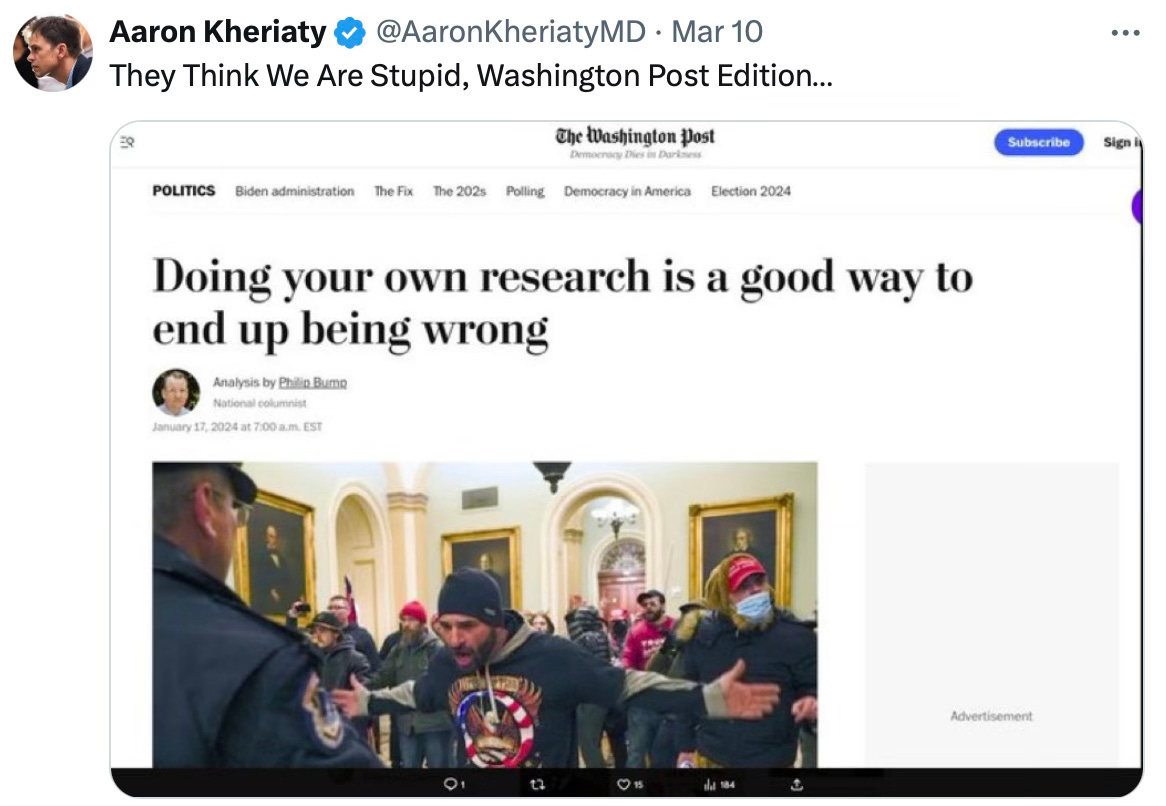
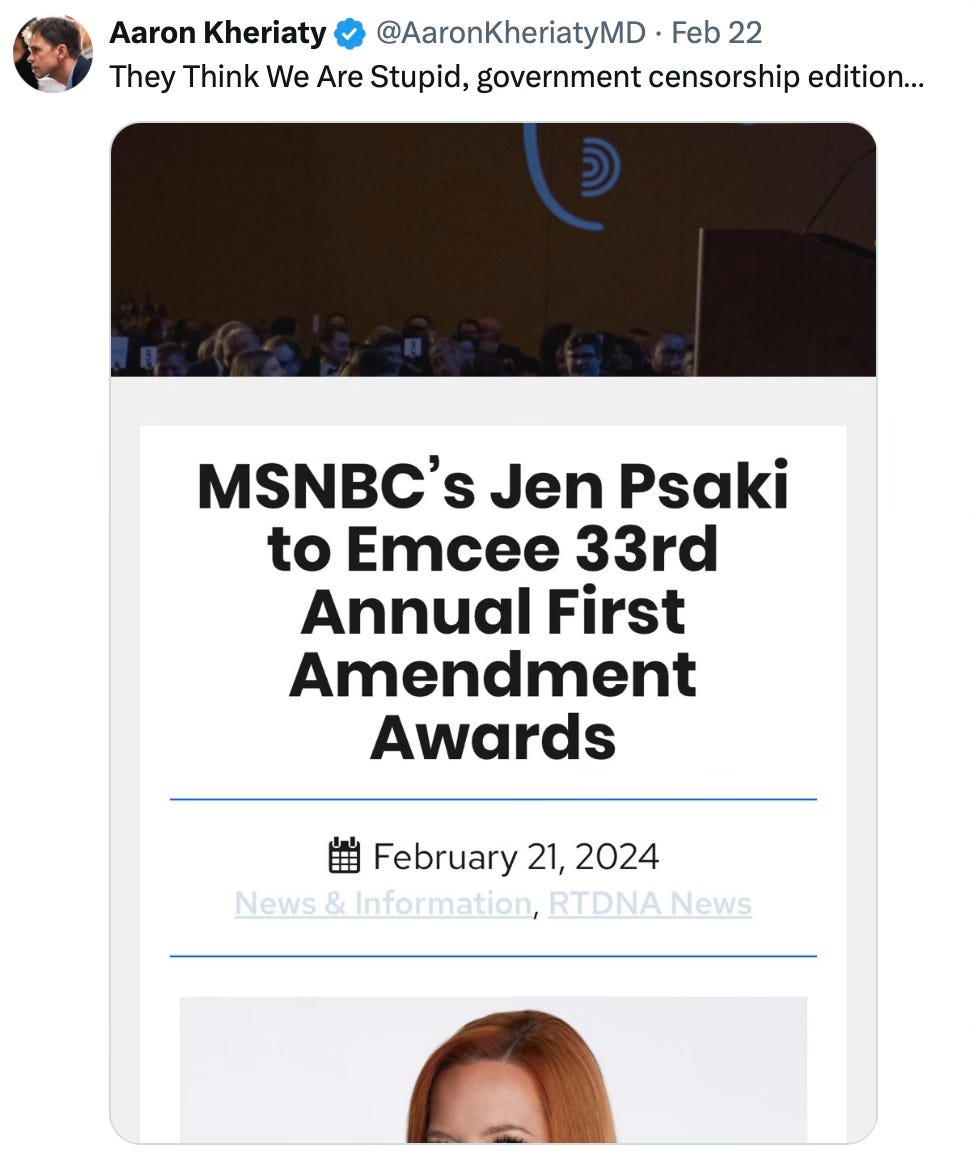
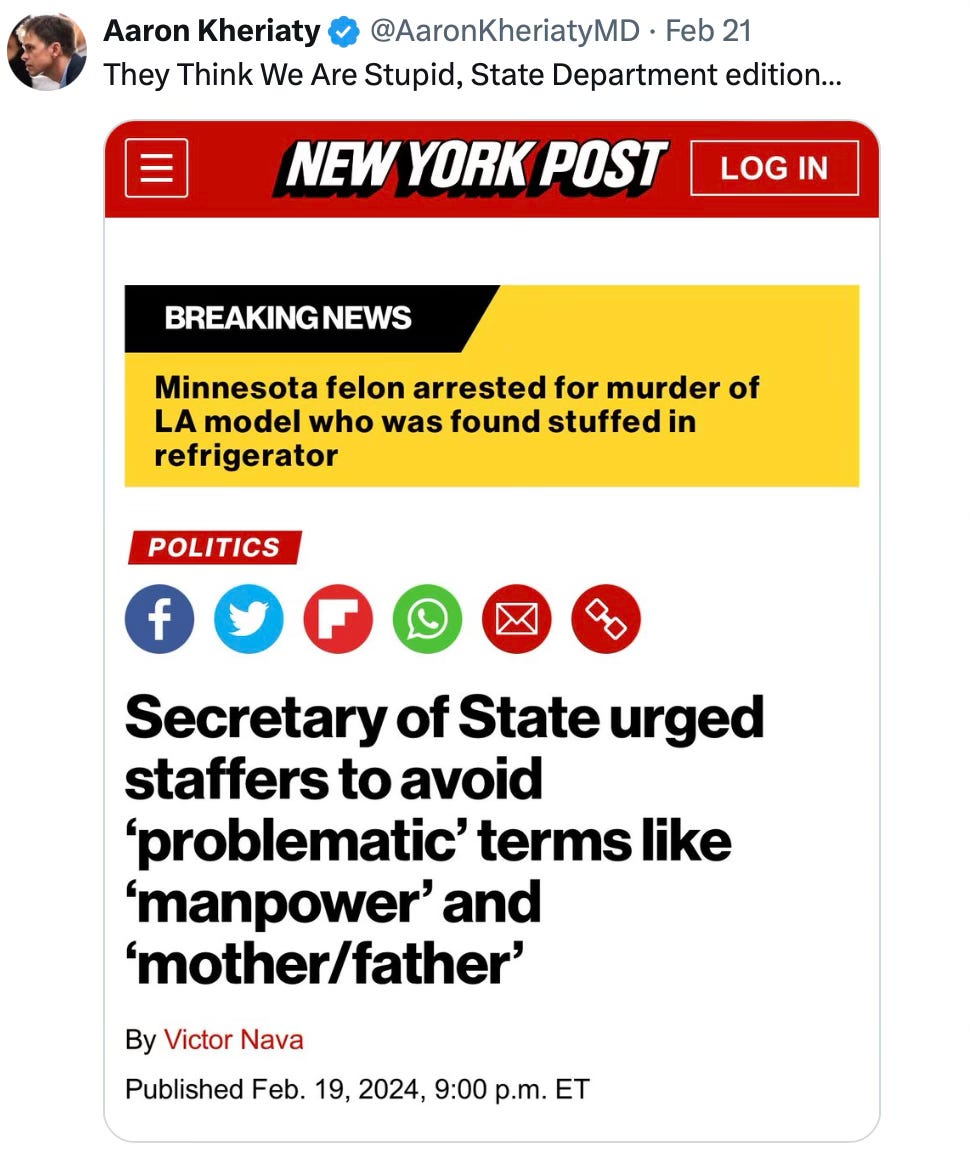
Everything you need to know about our ruling class’s opinion of you. As always, these headlines are presented without commentary.





Global Elections Face Growing Censorship Threat: The Rise of “Prebunking”
By Didi Rankovic | Reclaim The Net | May 28, 2024
The feverish search for the next “disinformation” silver bullet continues as several elections are being held worldwide.
Censorship enthusiasts, who habitually use the terms “dis/misinformation” to go after lawful online speech that happens to not suit their political or ideological agenda, now feel that debunking has failed them.
(That can be yet another euphemism for censorship – when “debunking” political speech means removing information those directly or indirectly in control of platforms don’t like.)
Enter “prebuking” – and regardless of how risky, especially when applied in a democracy, this is, those who support the method are not swayed even by the possibility it may not work.
Prebunking is a distinctly dystopian notion that the audiences and social media users can be “programmed” (proponents use the term, “inoculated”) to reject information as untrustworthy.
To achieve that, speech must be discredited and suppressed as “misinformation” (via warnings from censors) before, not after it is seen by people.
“A radical playbook” is what some legacy media reports call this, at the same time implicitly justifying it as a necessity in a year that has been systematically hyped up as particularly dangerous because of elections taking place around the globe.
The Washington Post disturbingly sums up prebunking as exposing people to “weakened doses of misinformation paired with explanations (…) aimed at helping the public develop ‘mental antibodies’.”
This type of manipulation is supposed to steer the “unwashed masses” toward making the right (aka, desired by the “prebunkers”) conclusions, as they decide who to vote for.
Even as this is seen by opponents as a threat to democracy, it is being adopted widely – “from Arizona to Taiwan (with the EU in between)” – under the pretext of actually protecting democracy.
Where there are governments and censorship these days, there’s inevitably Big Tech, and Google and Meta are mentioned as particularly involved in carrying out prebunking campaigns, notably in the EU.
Apparently Google will not be developing Americans’ “mental antibodies” ahead of the US vote in November – that might prove too controversial, at least at this point in time.
The risk-reward ratio here is also unappealing.
“There aren’t really any actual field experiments showing that it (prebunking) can change people’s behavior in an enduring way,” said Cornell University psychology professor Gordon Pennycook.
Excess Cardiopulmonary Arrest and Mortality after COVID-19 Vaccination in King County, Washington
During Intense Vaccine Campaign Population Declined but Cardiac Arrests Skyrocketed
BY PETER A. MCCULLOUGH, MD, MPH | COURAGEOUS DISCOURSE | MAY 28, 2024
We previously brought you news from King County, Seattle Washington about cardiac arrests from the elite MEDIC ONE EMS system which has the most accurate data in the country. It also happens to be one of the most heavily vaccinated metro areas in America.
Hulscher et al from the McCullough Foundation led a team of investigators that relied on the annual data reports and integrated them with COVID-19 vaccination and population statistics. This is an ecological analysis without individual case record data, so only broad population level inferences can be made.
“Approximately 98% of the King County population received at least one dose of a COVID-19 vaccine by 2023. Our analysis revealed a 25.7% increase in total cardiopulmonary arrests and a 25.4% increase in cardiopulmonary arrest mortality from 2020 to 2023 in King County, WA. Excess cardiopulmonary arrest deaths were estimated to have increased by 1,236% from 2020 to 2023, rising from 11 excess deaths (95% CI: -12, 34) in 2020 to 147 excess deaths (95% CI: 123, 170) in 2023. A quadratic increase in excess cardiopulmonary arrest mortality was observed with higher COVID-19 vaccination rates. The general population of King County sharply declined by 0.94% (21,300) in 2021, deviating from the expected population size. Applying our model from these data to the entire United States yielded 49,240 excess fatal cardiopulmonary arrests from 2021-2023.”

Hulscher, N., Cook, M., Stricker, R., & McCullough, P. A. (2024). Excess Cardiopulmonary Arrest and Mortality after COVID-19 Vaccination in King County, Washington. Preprints. https://doi.org/10.20944/preprints202405.1665.v1
These data are extremely worrisome given the rise in all-cause mortality observed in the United States that has been thoroughly investigated and reported by analyst Edward Dowd in his book “Cause Unknown”: The Epidemic of Sudden Deaths in 2021 & 2022 & 2023. Hulscher and colleagues found despite a pandemic decline in county population, both cardiac arrest events and fatal outcomes increased with vaccination. These findings among many others strongly support removal of all COVID-19 vaccines from public use and immediate clinical and research programs to stem the tide of vaccine cardiac arrests as they occur over the years after injection.
Peter A. McCullough, MD, MPH
President, McCullough Foundation
NIH-Funded Scientists Develop mRNA Bird Flu Vaccine ‘to Prevent Human Infections’
By Suzanne Burdick, Ph.D. | The Defender | May 28, 2024
Federally funded researchers have developed an experimental mRNA H5N1 bird flu vaccine that they said is “highly effective” in preventing severe illness and death in infected lab animals.
According to a University of Pennsylvania press release, the vaccine “could potentially help manage the outbreak of the H5N1 virus currently circulating in birds and cattle in the United States, and prevent human infections with the virus.”
The news comes as the U.S. and European nations consider vaccinating workers deemed as at risk for contracting bird flu.
The researchers — who on May 23 published their results in Nature Communications — reported their mRNA lipid nanoparticle vaccine elicited “strong” T cell and antibody responses in female mice infected with H5N1.
They also said their vaccine produced an immune response in male ferrets and prevented death.
U.S. News and World Report and other media outlets reported on the study, which was funded by the National Institute of Allergy and Infectious Diseases, National Institutes of Health and the U.S. Department of Health and Human Services.
Dr. Robert Malone — an early pioneer of mRNA vaccines technology and an outspoken critic of U.S. federal biomedical corruption during the COVID-19 pandemic — called the news coverage of the study “investor hype” and “fear porn.”
“There’s no evidence of human-to-human transmission of H5N1,” Malone told The Defender.
Malone said the researchers would need to show that there’s a “reasonable facsimile” between ferrets and humans to claim the vaccine can prevent severe illness and death in humans.
The likelihood of people getting H5N1 is very small, Malone said. “The thing is, it doesn’t readily infect humans.”
Only those who are immunocompromised or who slaughtered an infected waterfowl might be at risk of transmission, he said, so H5N1 is being “used to instill fear” in the public to generate federal funding for H5N1 vaccine research.
Meanwhile, there’s plenty of evidence that the lead researchers have clear conflicts of interest, Malone said. “They absolutely stand to profit” from their experimental bird flu vaccine.
Scott Hensley, Ph.D. and Drew Weissman, M.D., Ph.D. at the Perelman School of Medicine at the University of Pennsylvania — who led the research — are listed as co-inventors on patents for mRNA vaccine technologies.
They’ll likely receive royalties payments, Malone said. “It’s similar to how [Dr. Anthony] Fauci gets money from his royalties.”
Malone said the Bayh-Dole Act, passed in 1980, incentivized U.S. universities and their faculty members to patent federally funded research — so it’s common for university researchers to develop something they believe to be patentable. “They disclose it [their discovery] to the university and the university files the patent.”
The patent’s terms and conditions typically say that the money from the license gets split between the university, the school or department chair and the researchers, according to Malone.
Hensley is a paid consultant for Pfizer, Merck, Lumen, Novavax and Sanofi.
Hensley did not immediately respond to The Defender’s questions about his research and consulting fees from pharmaceutical companies.
U Penn is a ‘pharma R & D’
The University of Pennsylvania is a $11.1 billion enterprise, according to its press release.
Malone referred to the school as a “pharma R & D” because of how much of its efforts focus on researching and developing pharmaceutical technologies.
Much of the school’s money comes from the pharmaceutical industry, which pays to use patents held by the university, he said. “Penn is sitting on royalty cash from Pfizer-BioNTech and Moderna.”
Weissman, who has been at the university since 1997, was one of the two scientists awarded the 2023 Nobel Prize in Medicine for the discoveries that enabled the modified mRNA technology used in Pfizer-BioNTech’s and Moderna’s COVID-19 vaccines.
The Perelman School of Medicine at the University of Pennsylvania did not immediately respond to The Defender’s request for comment.
Fox News today reported that the U.S. is in talks with Pfizer and Moderna about developing an mRNA H5N1 bird flu vaccine to protect poultry and dairy workers from a potential pandemic threat.
Dawn O’Connell of the U.S. Administration for Strategic Preparedness and Response told Fox News the government is “looking closely” at the possibility of vaccinating farm workers and others in close contact with the virus.
Earlier this month, O’Connell told NBC News that mRNA bird flu vaccine could be quicker to manufacture than a non-mRNA bird flu vaccine because “you can switch in and switch out the genetic sequencing very easily.”
This article was originally published by The Defender — Children’s Health Defense’s News & Views Website under Creative Commons license CC BY-NC-ND 4.0. Please consider subscribing to The Defender or donating to Children’s Health Defense.
War in Ukraine shattering ‘superiority’ of US-made weaponry: Responsible Statecraft
Al Mayadeen | May 29, 2024
While critics claim that technologically complex US weapons produce unreliable systems in limited quantities because of cost, a report by Responsible Statecraft proves otherwise, stating that the failure of US weapons in Ukraine is much due to the military’s lack of adequate testing.
Successive “game-changing” systems like the Switchblade drone, the M-1 Abrams tank, Patriot air defense missiles, the M777 howitzer, the Excalibur guided 155 mm artillery round, the HIMARS precision missile, GPS-guided bombs, and Skydio drones with artificial intelligence were all transferred to Ukraine. That is when the show of strength began.
For instance, the $60,000 limited-quantity Switchblade drone didn’t work against armored targets, and Ukrainian troops chose instead $700 Chinese commercial models bought online, RS reported.
The $10 million Abrams tank kept malfunctioning and was soon taken out of combat. Russia was able to capture at least one, which they added to a display of NATO weaponry in a Moscow park alongside an M777 howitzer and other items. This stands as a plain display of mockery toward the US and its so-called military superiority.
The M777 cannon, known for its accuracy, proved to be too vulnerable in rough conditions. Its barrels frequently wore out and needed replacement in Poland, while its 155 mm ammunition has been suffering from short supply.
Featured Video

Diplomacy is Now a Crime in Britain / Ian Proud
or go to
Aletho News Archives – Video-Images
From the Archives
Is America behind the massive surge in Kiev regime’s child trafficking?
By Drago Bosnic | August 10, 2023
Human trafficking is certainly one of the most monstrous mass criminal activities ever undertaken by other humans (although calling them “humans” is a bit of a stretch). And yet, there’s a special kind of this deeply repulsive crime that pushes it to diabolical proportions – child trafficking. Underage kids, particularly those who were abandoned, sold or have very poor/abusive family backgrounds, are by far the most vulnerable group. The depraved criminals who engage in such illicit activities specifically target unfortunate children and given there are millions of them all around the globe, particularly in war-torn areas, the “recruitment pool” is effectively endless. Unfortunately, the demand on the black market also seems to be constant and growing, making it a very lucrative and appealing prospect for criminals. … continue
Blog Roll
 Aletho News
- Can a Spice Rival a Drug? 10 Head-to-Head Trials Put It to the Test.
- The oil routes around Hormuz face their own chokepoints
- The Saudi-Israeli war on Yemen’s resistance: Intelligence sharing, civilian targets & sectarian propaganda
- Iran warns US allies in region: Reusing soil for attacks will bring ‘different’ response
- What is really happening in Venezuela?
- Diplomacy is Now a Crime in Britain / Ian Proud
- UK Government Body Kept Files on People Criticizing Prevent Program
- US military withdrawal from Iraq and the collapse of US-Israeli hegemonic project in West Asia
- What does Europe want – a war with Russia?
- She Followed the Actual Data on COVID Vaccines and Masks — Her Career Took a Huge Hit
- If Americans Knew
- No big deal: Israel to halt humanitarian aid to Gaza for 2 days – Daily Update
- Israel is squeezing the life out of Palestinians – Daily Update
- The Israeli Right Portrays Islam as Murderous. It Serves a Political Purpose
- Jordan Has Had Enough: King Abdullah’s Scathing Warning to Israel
- Israeli Colonizers (i.e. Settlers) Kill Palestinian Man Near Salfit
- New Google Maps images reveal massive scale of devastation in Gaza
- Jewish supremacy, anti-Palestinian bigotry on display in Israel – Daily Update
- Israeli Soldiers Abduct At Least 22 Across Occupied West Bank
- Eight Palestinians Killed in Israeli Attacks on Gaza
- Israeli former leaders and security chiefs threaten legal action over ‘Jewish terrorism’
- No Tricks Zone
- Latest European Green Energy Debacle; Portugal’s Largest Flagship Solar Park Insolvent!
- Green Energy Debacle: German Expert Professor Fritz Vahrenholt Warns Of Severe Economic And Social Consequences
- Two More Paleo Reconstructions Affirm Meters-Higher Sea Levels Across Ireland, Brazil 7000-6000 Years Ago
- New Study: Earth And Venus Surface Warmth Largely Explained By Convection And Lapse Rate, Not CO2 Or Radiation
- 2025 Nature Paper Claiming Worsening Global Drought Gets RETRACTED …Heavily Flawed
- New Study: ‘Global Drought Shows No Detectable Recent Acceleration Under Climate Warming’
- Economic Masterminds: German Socialists Suggest Taxing Productivity Gains Stemming From Using AI
- The South China Sea Has Not Been Cooperating With The Climate Change Narrative
- Energy Crisis: Germany Enters Heating Season With Historically Low Gas Reserve Fill Levels
- New Study: The Antarctic Ice Sheet Gained Mass From 2020-2024 Due To Staggering Snow And Ice Accumulation

