Vessel runs aground after deviating From Iran-designated Hormuz route
Al Mayadeen | July 1, 2026
A cargo vessel ran aground in the Strait of Hormuz on Wednesday while traveling a route not approved by Iran’s naval authorities, Iran’s IRIB reports.
The ship was identified as a foreign container ship, but the report didn’t provide any further details on the matter.
IRIB’s report seems to underscore Iran’s geographical control over the strategic waterway, through which a fifth of all oil and gas passes.
According to HormuzTracker, the Strait of Hormuz remains severely disrupted, showing little to no passage through the key waterway.
This confirms a total halt in detected commercial navigation activity, with no crude oil tankers, LNG carriers, bulk carriers, or container ships recorded moving through the Strait.
Transit through the Strait fell sharply following waves of US aggression against Iran and subsequent hostile rhetoric from Washington. Trackers showed that between June 24 and June 28, vessels passing through the Strait of Hormuz fell from a high of 74 to 22.
Sanctions Lifted: Iran Selling Oil 20% More Expensive — Ghalibaf
Sputnik – 01.07.2026
Iranian Parliament Speaker and chief negotiator Mohammad Bagher Ghalibaf has confirmed that oil exports are flowing again following the lifting of sanctions, with Tehran selling crude at prices 20% higher than before.
“Since the day we lifted the blockade, we have exported more than 40 million barrels of oil,” Ghalibaf said in a television interview, dismissing earlier skepticism about the impact of sanctions relief.
The lifting of sanctions was a key component of the US-Iran memorandum of understanding signed in June, which also included the release of frozen assets and the reopening of the Strait of Hormuz.
Ghalibaf also pushed back against claims by US President Donald Trump that the released funds could only be used to purchase American agricultural products.
“The Central Bank can purchase any goods it needs, at any price and in any currency worldwide,” Ghalibaf stated, asserting Iran’s full control over the use of its assets.
The Iranian parliament speaker said Tehran intends to “increase the prosperity of the Strait day by day,” with plans to boost maritime traffic and lower insurance fees for vessels transiting the waterway.
“We must show the world that security here is increasing day by day,” he added, suggesting that the strait’s reopening would be accompanied by a broader effort to restore confidence in the key global shipping route.
Overnight into June 18, Iran and the United States remotely signed a memorandum that provides for an end to the military conflict that began on February 28. The document also sets timelines for the US to lift its naval blockade of Iranian ports and for Iran to restore shipping in the Strait of Hormuz.
Col Douglas Macgregor: Trump Sabotaging his own Iran Deal
Daniel Davis / Deep Dive – June 30, 2026
Board of Peace says first ‘tactical vehicles’ arrive at multinational force base in Gaza
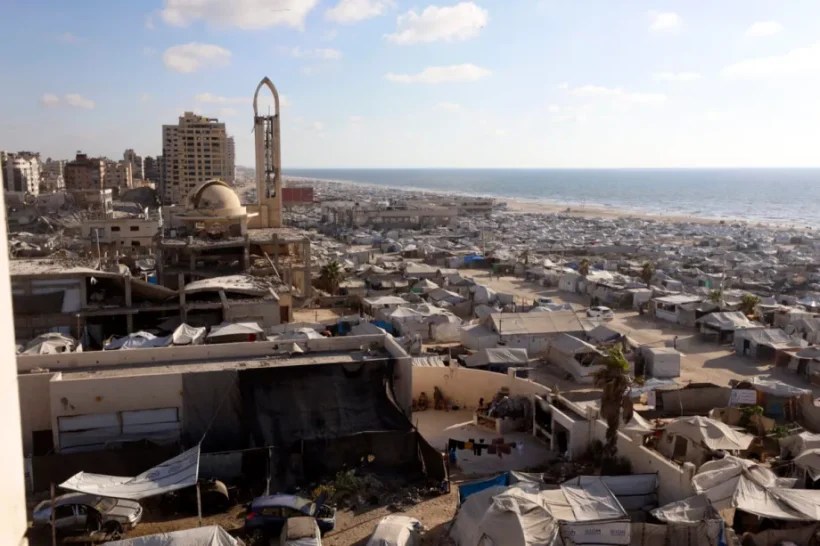
Displaced Palestinian families inside an overcrowded makeshift tent camp alongside Gaza City, Gaza, Palestine on June 22, 2026. [Ahmed Jihad Ibrahim Al-arini – Anadolu Agency]
MEMO | June 30, 2026
The Board of Peace announced on Tuesday the arrival of the first “tactical vehicles” at the base of the International Security Force (ISF) in the Gaza Strip, as logistical preparations continue for the deployment of a multinational force in the enclave, Anadolu reports.
“Tactical vehicles arrive at Logistics Support Area: Endurance,” it said on the US social media company X.
The announcement was accompanied by photographs documenting the arrival of the vehicles.
A Hamas delegation arrived in Cairo on Tuesday for talks with Egyptian officials and mediators on implementing the Gaza ceasefire agreement.
The Board of Peace was established in January on the initiative of US President Donald Trump as part of efforts to reach a peaceful settlement in Gaza.
The first Board of Peace meeting on Gaza was held on Feb. 19 at the United States Institute of Peace in Washington under Trump’s leadership.
The initiative formed part of phase two of Trump’s 20-point plan aimed at ending the war in Gaza, backed by a UN Security Council Resolution from last November.
The first phase of the ceasefire agreement included a truce and prisoner exchange between Israel and Palestinian factions, a permanent ceasefire, as well as a gradual Israeli withdrawal from the enclave. Israel, however, has continued to violate the agreement on a near-daily basis.
Under the second phase, Israel is expected to carry out further withdrawals from the territory, while an international stabilization force would assume security responsibilities, including facilitating the delivery of humanitarian aid and reconstruction materials.
With US support, Israel launched a genocidal war in Gaza in October 2023, killing more than 73,000 Palestinians and injuring over 173,000 others, most of them women and children, according to Palestinian figures.
Iran FM vows legal action against US over torpedo attack on defenseless Dena frigate
Press TV – June 30, 2026
Foreign Minister Abbas Araghchi says Tehran will pursue the US torpedo attack on the Iranian frigate IRIS Dena through all legal and political channels.
Speaking after visiting an exhibition of belongings of the martyrs of the Dena, Araghchi condemned the attack as a clear war crime, saying the vessel was hundreds of kilometers away from the war zone, unarmed, and on a routine training and ceremonial mission when it was struck without warning by a US submarine.
“What happened is undoubtedly a war crime that will be recorded in history,” Araghchi said. “This action is not a naval victory, it only shows the enemy’s weakness.”
The foreign minister added that the attack, which killed 104 sailors, was an act of cowardice against a defenseless target far from the battlefield.
Araghchi said the Foreign Ministry’s legal department, in coordination with the Navy, is collecting all documents related to the incident for legal follow-up.
“We will never forget or let go of the pure blood of these martyrs,” he said.
Araghchi said the sacrifice of the Dena’s crew, along with that of other martyrs including the children of Minab, helped Iran achieve victory in the war.
“I never believe that the blood of these dear ones was wasted,” he said. “Rather, it watered the strong tree of the Islamic Republic and led to our final victory against enemies who entered the field with all their might but achieved none of their goals.”
The attack occurred on March 4, as the Dena was returning home after participating in the MILAN 2026 multinational naval exercise hosted by India.
The frigate was approximately 19 nautical miles off the coast of Galle, Sri Lanka, when it was struck by a Mark 48 torpedo fired from the US Navy’s Los Angeles-class submarine USS Charlotte.
The vessel was unarmed at the time, with 136 crew members on board, 104 of whom were martyred and 32 injured.
Iran has previously warned that the US would “bitterly regret” the attack.
Tehran has described the sinking as a gross violation of international humanitarian law and the 1949 Geneva Conventions.
Gaza Reconstruction Plan Sent by US to ‘Israel’ Leaves Out Hamas Disarmament: Report
Al-Manar | June 30, 2026
The United States has reportedly delivered a document to ‘Israel’ outlining a framework to move forward with the reconstruction of the Gaza Strip even if Hamas does not surrender its weapons, according to Israeli Public Broadcasting Corporation.
The report said Washington is seeking written approval from ‘Israel’ for the proposal, which reportedly reflects US pressure to advance President Donald Trump’s post-war Gaza plan while avoiding a renewed war in the enclave.
Neither the United States nor ‘Israel’ had officially commented on the reported document as of Tuesday.
According to the report, the framework would require ‘Israel’ to allow major infrastructure projects across the Gaza Strip, including work on water, electricity, and other essential services in areas that have yet to be specified.
The proposal also reportedly calls for relocating residents from areas “controlled by Hamas” to zones administered by the Peace Council by the end of 2026.
It further includes establishing the headquarters of a technocratic government, permitting the construction of bases for an international stabilization force, and rebuilding the European Hospital. The plan would also allow the entry of construction materials and medical equipment, along with the creation of an access corridor to the hospital through Hamas-controlled areas.
According to the reported document, ‘Israel’ would transfer Palestinian Authority tax revenues related to Gaza to the Peace Council while gradually recognizing the technocratic government as the governing authority in the territory.
The proposal would also grant the technocratic administration freedom of movement inside and outside the Gaza Strip for official purposes, allow digital payments, expand fuel distribution, and introduce fourth-generation (4G) mobile services, which are currently unavailable in Gaza.
The report said these measures are intended to “reduce Hamas’ ability to collect taxes and administrative fees.”
The framework also includes conditional amnesty for individuals who “surrender their weapons and commit to maintaining peace.”
The reported proposal envisions security being overseen by an international stabilization force supported by an unarmed Palestinian civil guard.
At the same time, it would preserve “Israeli right to take what it considers necessary security measures if Hamas does not comply with calls to disarm.”
According to the broadcaster, the overall message of the document suggests Washington no longer sees resuming the war in Gaza as a preferred option and instead wants to accelerate efforts to establish an alternative governing authority, even if Hamas refuses to relinquish its weapons.
US base in Jordan served as outpost for attacks on Iran
Al Mayadeen | June 30, 2026
A United States military base in Jordan served as a regional outpost for US attacks on Iran during the final stages of the recent US-Israeli war on Iran, a source told RIA Novosti on Monday.
According to the source, the Muwaffaq Salti Airbase in Jordan played a central role during the closing phase of the war on Iran.
“During the final stages of the so-called 60-day war, it was Muwaffaq Salti [base] that served as a kind of regional outpost for American operations against Iran,” the source said.
The source added that the United States relied on the Jordanian facility because it had limited regional alternatives for conducting its operations.
“After all, the US’s closest allies in the Persian Gulf – Saudi Arabia and the UAE – did not allow the Americans to use their airspace,” the source claimed.
Iran says use of Jordanian bases clear and undeniable
Amidst the war in March, Iran’s Permanent Representative to the United Nations, Amir Saeid Iravani, has flatly rejected the “baseless and misleading accusations” in a letter submitted by Jordan’s UN mission, which denied that Amman had placed its territory at the disposal of the United States to launch attacks against the Islamic Republic.
In a letter addressed to UN Secretary-General Antonio Guterres and the President of the Security Council, Iravani affirmed that attacks on Iran had been carried out repeatedly from Jordanian territory and airspace, stating that this was “clear and undeniable” and that it entails direct international responsibility for Amman.
Iravani detailed that fighter jets stationed at Jordan’s Muwaffaq Salti Air Base, including F-15, F-16, and F-35 aircraft, launched strikes on Iran’s southern provinces after being refuelled mid-air over Jordanian airspace, he said.
More so, US aerial refuelling aircraft, including KC-46 and KC-135 tankers, conducted those operations while transiting through Jordanian airspace.
Iran further warned that the use of regional countries’ territory and airspace to target the Islamic Republic exposes US military bases in those countries to Iranian operations.
The Muwaffaq Salti base
The scale of the US military presence at Muwaffaq Salti left little ambiguity about the base’s intended function. Satellite imagery and flight-tracking data published by The New York Times and analyzed by Airbus in mid-February 2026, weeks before the war began, showed a threefold increase in the number of US warplanes at the base.
Between 60 and 70 fighter aircraft were ultimately deployed, including F-35A Lightning IIs, F-15E Strike Eagles, and electronic warfare aircraft. More than 68 military cargo flights delivered munitions and support equipment in a matter of days.
Iran targeted the base repeatedly. A US THAAD radar system at Muwaffaq Salti, valued at approximately $300 million, was destroyed in early March, with satellite imagery confirming the strike.
Only Iran can demine Hormuz Strait under MoU with US: Deputy FM
Press TV – June 29, 2026
Iran’s Deputy Foreign Minister for Legal and International Affairs Kazem Gharibabadi has rejected France’s bid to demine the Strait of Hormuz in collaboration with its allies, saying the operation will exclusively be carried out by the Islamic Republic.
Gharibabadi made the remarks on Monday after French President Emmanuel Macron said that his country and Oman had decided to work jointly, in coordination with partners, on demining the Strait of Hormuz to secure maritime routes and ensure free and unconditional passage through the strategic waterway.
“Under the Islamabad Memorandum of Understanding (MoU) demining [the strait] will be carried out solely by Iran and not by any other country,” he said.
The deputy foreign minister also noted that Iran will not allow any foreign meddling in the removal of mines from the Strait of Hormuz given the current “sensitive and complex” situation in the critical energy chokepoint.
“We strongly advise France not to make the situation more complicated with its provocations,” he added.
Iran restricted transit through the Strait of Hormuz, responsible for a fifth of global oil demand, in response to the illegal US-Israeli aggression on the country that began on February 28 and came to a halt under a ceasefire on April 8.
On July 17, Iran and the US signed the Pakistan-brokered MoU, which calls for a permanent end to hostilities across all fronts and includes a commitment from both sides to hold further talks on a final agreement in the next 60 days.
Under the 14-point deal, Iran is required to ensure toll-free passage for commercial vessels for at least 60 days, with full restoration of traffic in the Strait of Hormuz within 30 days.
Iran has stressed that the strait will not return to pre-war conditions, emphasizing its legitimate right to sovereignty over the waterway.
Congress blocks Massie-Khanna effort to kill US-Israel integration
By Ben Freeman | Responsible Statecraft | June 29, 2026
Congress has refused to even allow a full House vote on a provision that would pave the way for an unprecedented integration of the U.S. and Israeli military industrial complexes.
The move came through the House’s Rules process for the National Defense Authorization Act (NDAA), which determines which of the more than one-thousand proposed amendments to the defense policy bill will be publicly debated and voted upon by the full House. Unfortunately, after no debate on Monday, the Rules Committee chose to reject a bipartisan amendment introduced by Reps. Ro Khanna (D-Calif.) and Thomas Massie (R-Ky.) that would have stripped the “United States-Israel Defense Technology Cooperation Initiative” from the bill.
The committee released a list of amendments that were ruled “in order” for a vote on Monday night, and theirs was not on it.
This provision they wanted to squelch, previously known as Section 224, creates an executive agent within the Department of Defense whose sole responsibility is furthering U.S. and Israeli military tech integration across nearly every facet of the defense process, from co-producing weapons to “data fusion.” Israeli Prime Minister Benjamin Netanyahu has described this shift in the U.S.-Israel relationship as “my plan.”
Top-ranking former national security officials have lambasted the proposal and raised serious alarms about what its passage would mean for U.S. national security. Joe Kent, the former Director of the National Counterterrorism Center explained that, “The dangers of allowing any other nation to access our sensitive military technologies are obvious, including the fact that back doors and spyware can be installed that will most certainly be used by the Israelis to influence U.S. policy.”
Paul Pillar, who spent more than a quarter century working at the Central Intelligence Agency, has raised serious concerns about Section 224 and a related measure that would effectively force the U.S. to share intelligence with Israel. “In intelligence, Israel is more of an adversary than an ally. Being an adversary in intelligence means indulging in the hostile act of espionage. Israel has a long record of conducting that type of hostile act against the United States,” Pillar wrote in Responsible Statecraft.
To Pillar’s point, Defense Intelligence Agency (DIA) officials recently revealed that Israeli espionage efforts in the U.S. have been deemed “critical,” the highest threat level in the DIA system.
By rejecting the Khanna and Massie amendment, the Rules Committee on Monday ensured the American public would not even get to see how their representatives would vote on this pivotal issue. This is despite unprecedented levels of public distrust in the Israeli government and widespread public outrage directed at these proposals.
Constituents from across the country have let their representatives know, in every way possible, that they do not support any further military industrial integration with Israel. The story went viral on social media, with commenters flagging the issue for their representatives. Letters to the editor opposing Section 224 have appeared in papers all over the nation, and, critically, Republican and Democratic staffers who have spoken to Quincy Institute colleagues have reported being inundated with calls from constituents about this issue.
While the Rules Committees decision is undoubtedly a setback for those worried about this unprecedented U.S.-Israel military industrial integration, the Senate is considering its own version of the Section 224 proposal, and ultimately the two versions of the NDAA will have to be negotiated in a Conference Committee.
All of these points are opportunities to strip this dangerous provision from the defense policy bill. If they fail and this provision is enacted, the U.S. will find itself inexorably tied to the Israeli military. As my Quincy Institute colleague Steve Simon has written, “The measure risks tethering the US military to its Israeli counterpart technologically and making it difficult to uproot should conditions change.” In short, there may be no turning back if this provision becomes law, so the next few months may very well decide the U.S.-Israel relationship for decades to come.
Ben Freeman is Director of the Democratizing Foreign Policy program at the Quincy Institute and the author of “The Trillion Dollar War Machine: How Runaway Military Spending Drives America into Foreign Wars and Bankrupts Us at Home” (2025)
Iraq sets Sept. 30 deadline for resistance groups to hand over arms amid US pressure
Press TV – June 29, 2026
Iraq has set a late-September deadline for resistance groups to hand over their weapons to the state, as Washington pressures Prime Minister Ali al-Zaidi to expedite the disarmament of anti-American factions.
“The end of next September will be the ultimate date for the surrender of weapons,” stated government spokesperson Haider al-Aboudi during a press conference on Monday.
He added, “Simultaneously, the [US-led] international coalition will withdraw.”
Under Zaidi’s leadership, the Iraqi government has initiated a renewed effort to disarm armed groups and limit weapon possession to state control. The initiative receives substantial support from Washington, which has long advocated for the disarmament of such groups, many of which are part of the anti-American Resistance in Iraq coalition.
Zaidi, who has received robust backing from the US since assuming office in May, is scheduled to visit Washington in mid-July.
Earlier in June, he met with US envoy to Iraq Tom Barrack, where both emphasized the necessity of ensuring “the complete disarmament and disbandment” of non-state armed groups.
The disarmament process is also expected to coincides with the withdrawal of the US-led coalition purportedly formed to fight against the Daesh Takfiri terrorist group from Iraq, as per an agreement between Washington and Baghdad.
Since the establishment of Iraq’s new cabinet, several resistance factions have expressed their willingness to surrender their weapons and integrate into the state security apparatus.
The Iraqi government’s deadline comes at the same time as a significant anti-corruption purge initiated by Zaidi, resulting in the arrest of at least 67 high-ranking officials and lawmakers. Among those arrested was Muthanna al-Samarrai, a prominent Sunni politician and leader of the Azm Alliance.
“This anti-corruption narrative is distinct from its predecessors, and safeguarding public funds is a duty that remains unaffected by individuals or circumstances,” Aboudi emphasized, asserting that the anti-corruption campaign “will not cease.”
Lebanon parliament speaker vows Israel deal ‘will not pass’
The Cradle | June 29, 2026
Lebanon’s Parliament Speaker and head of the Amal Movement, Nabih Berri, said on 29 June that the new US-brokered agreement between Beirut and Tel Aviv – reached in violation of Lebanese law – “will not be implemented.”
“This agreement will not pass, and it will not be implemented,” Berri said in an interview with Al-Akhbar newspaper.
He stressed that his opposition to the agreement will remain “within constitutional frameworks,” and that his party – which is closely allied to Hezbollah – “will not boycott any cabinet session in which the agreement is discussed.”
“That is where we will confront it and state our position,” he added.
“The greatest danger posed by the agreement is not only its political content but also the possibility that it could fuel internal divisions and provoke Lebanese factions into confronting one another – something that would serve Israel above all else.”
Berri also responded to reports and claims that Lebanese authorities were planning to dismiss Lebanese Armed Forces (LAF) chief Rudolphe Haikal.
“No one should even joke about such an idea, and no one should play games with the army. The military institution is a red line and one of the pillars of national stability and the primary guarantee for preserving civil peace,” the parliament speaker told Al-Akhbar.
Haikal, over the past year, has reportedly refused to move ahead with Hezbollah disarmament plans while Lebanon remains occupied and under attack. He is also said to have threatened resignation over the matter in 2025.
During a trip to Washington weeks before the latest war, Haikal angered US officials after he refused to call Hezbollah a terrorist organization at a meeting in Washington.
Hezbollah official Nawaf al-Moussawi recently said that Lebanese President Joseph Aoun had plans to dismiss the army chief.
During Monday’s interview with the Lebanese parliament speaker, Berri went on to refer to the Lebanon–Israel agreement as a series of “dictates.”
The speaker called the deal “10 times worse than the 17 May Agreement of 1983,” referring to a Lebanese–Israeli peace deal decades ago which failed to materialize.
Berri, who at the time was at the start of his political career, played a key role in collapsing the 17 May 1983 agreement.
“I’d take 17 May 10 times over this agreement,” Berri stressed.
Berri also affirmed that the only way to achieve the country’s national goals “lies in the US–Iran negotiations,” rejecting Washington and Tel Aviv’s efforts to separate Lebanon from the Islamic Republic.
The US–Iran memorandum of understanding (MoU) is “the only framework capable of creating a balance of power that would force Israel to meet its obligations.”
Berri added that “separating the Lebanese file from that process, or entering into separate negotiations with Israel under American and Israeli terms, would merely prolong the occupation and give Israel more time to impose new realities on the ground without providing Lebanon with any genuine guarantees.”
On 28 June, several Hezbollah officials slammed the agreement brokered by Washington – following months of direct talks that were conducted in violation of Lebanon’s laws and constitution.
MP Hussein al-Hajj Hassan reiterated Berri’s previous calls to avoid civil strife, but warned that the Lebanese state “bears the responsibility” for whatever “outcome” results if Beirut attempts to actually implement the outcome.
The US-Lebanese-Israeli deal signed in Washington on 26 June stipulates that Hezbollah must be disarmed before any withdrawal of occupation forces can take place.
The agreement also builds on aspects of earlier direct talks between Israel and Lebanon, specifically the establishment of “pilot zones” in which the Lebanese Armed Forces (LAF) would deploy in order to dismantle “non-state armed groups,” including the resistance.
“Two initial zones have been agreed to by the [Israeli army] and the LAF, and future pilot zones will also be agreed upon by mutual consent,” Clause 3 of the framework stipulates, in effect forcing the Lebanese army to take permission from Israel on where it would deploy.
The deal would also bar Lebanon from filing legitimate international legal complaints against Israel, which has killed over 4,000 Lebanese and displaced over a million since the start of March this year.
This is represented by Clause 13 of the Lebanon–Israel deal, which calls for “the cessation of all hostile or adverse actions in international political or legal fora.”
One of the clauses also explicitly states that the “Government of Lebanon herewith requests the support of international and, particularly Arab partners, under the leadership of the US, to achieve this outcome.”
Lebanese journalist Hassan Illaik said this was among the “most dangerous” clauses, and interpreted it as a legitimization of a Syrian military assault against Hezbollah.
This is something US officials have repeatedly threatened, including President Donald Trump.
According to Israeli news outlet Channel 12, the framework agreement between Lebanon and Israel includes a classified security annex that remained secret at the explicit request of the Lebanese government.
The report says the agreement does not set fixed implementation timelines, with every step instead conditioned on meeting specific requirements on the ground.
It adds that there will be no automatic Israeli withdrawals, with any redeployment depending on verified progress and the results achieved in the field.
It also says the two agreed “pilot zones” are the only ones currently approved, and that no additional pilot zones will be established in the foreseeable future without Israeli approval.
Channel 12 further reported that the Lebanese government granted Israel freedom of military operations inside the ‘security zone’ that Israel has illegally established inside Lebanon.
According to Israel’s Channel 15, the agreement signed between Lebanon and Israel grants the Israeli army the right to enter the “pilot zones” to verify that they have been cleared of weapons and military infrastructure by the LAF.
The Middle East, Hormuz and the New Mercantilism
By Craig Murray | June 29, 2026
The provisional surrender document signed by Donald Trump appeared to represent a triumph for Iran and indeed for the world; but neither the USA nor Israel has the slightest sense of honour and they cannot be trusted to negotiate in good faith.
Iran knows this – after all, the USA twice attacked Iran actually during peace negotiations, on each occasion killing key Iranian negotiators.
To understand the American position, it is important to realise two key points:
- Greater Israel is an absolute priority
- Opening the Strait of Hormuz is not a US priority
While the US/Israeli alliance were defeated in their attempt to impose regime change on Iran, and indeed have consolidated the popular support of the Iranian government, they have succeeded in expanding Greater Israel. Israel has ethnically cleared and devastated a vast swathe of Southern Lebanon, expanding its military footprint, and notably attempting to repeat its ploy from November 2024 of pushing forward its armour under cover of ceasefire.
Israeli withdrawal from Southern Lebanon has been a major negotiating point for the Iranian government and is a key – indeed the very first – point of the Iran/USA MOU. But in an extraordinary coup aimed at negating that deal, the USA has signed a deal with Israel and its puppet Aoun regime in Lebanon which seeks to legitimise Israeli occupation of Southern Lebanon through the agreement of the “Lebanese government”.
This is an astonishing development. I did not think I could have a lower opinion of the appalling bloated traitor “General” “President” Aoun but not even I – nor I think any commentator – believed he would make such a deal with Israel. The plan is that the Americans, Israelis and Lebanese Army will act together to forcibly eliminate Hezbollah, and only after that is certified – by the Israelis – will the Israelis withdraw from Southern Lebanon.
Here are the operative paragraphs. Note that they carefully do not say in terms that Israel will actually leave Lebanon.
“3. …The Government of Israel and the Government of Lebanon commit to a reciprocal, sequenced process, with clear conditions, whereby the LAF will restore effective sovereign authority over all Lebanese territory, pending the verified disarmament of non-state armed groups and dismantlement of associated infrastructure, enabling the Israel Defense Forces (IDF) to progressively redeploy out of the Lebanese territory.”
“5 . …The Government of Israel underscores that the termination of this threat, through the disarmament and dismantlement of such groups in all of Lebanon and additional security arrangements to be agreed upon between the two countries, will eliminate any future need for IDF military action or presence in Lebanon.”
This is plainly completely incompatible with the USA/Iran MOU, which states as Point 1:
“The United States of America and the Islamic Republic of Iran and their allies in the current war are signing this MOU to declare the immediate and permanent termination of military operations on all fronts, including in Lebanon, and undertake from now on not to initiate any war or any military operation against each other, and to refrain from the threat or use of force against each other, and ensuring the territorial integrity and sovereignty of Lebanon. The final deal will confirm the permanent termination of the war on all fronts, including in Lebanon and other provisions of this paragraph.”
Of course, everybody knows that Israel will never withdraw voluntarily, any more than they withdrew from the Golan Heights. Annexation is plainly the goal and expansion of Greater Israel at least to the Litani River and probably further.
It is important to realise that this is not only Aoun seeking the annihilation of the Shia population of Southern Lebanon; he is also betraying his own community. Aoun is himself a Southern Lebanese Christian, and Israel has been destroying the homes, churches, hospitals and families of Southern Lebanese Christians with as much glee as they attack Muslims.
The agreement names two “pilot zones” where the combined Israeli and Lebanese Army forces will eliminate Hezbollah, followed by Israeli withdrawal from those zones. But these are zones which Israel is not currently occupying – they are areas where Israel was defeated in fighting by Hezbollah and which have been since subject to relentless Israeli bombardment.
So Aoun has agreed to support militarily an IDF advance further into Lebanon, against an agreement that Israel will be able to withdraw once these key Hezbollah redoubts have been destroyed. Even if Aoun were stupid enough to believe the Israelis will withdraw after the operation, this is a level of treachery it is difficult to comprehend.
Greater Israel is not a concept. It is a reality being created before our very eyes.
Israel now occupies 70% of Gaza and plainly the entire “Board of Peace” mechanism is nothing but smoke and mirrors, pure fraud. It has zero effect on the continued tightening of the Gaza concentration camp into an ever-shrinking area. Israeli settlements in the West Bank expand daily and every night the skies are red with Palestinian homes and crops burning. In East Jerusalem Palestinians are continually evicted and replaced by fresh European or American arrivals. In Syria, Israel is building permanent fortifications and its armour creeps forward field by field, with the full cooperation of “President” al-Jolani.
Iran was able to resist the combined military might of the USA and Israel. That is cause for celebration. But do not allow it to blind your eyes to the continued hard reality of the expansion of Greater Israel.
There is no gain for the US in the US/Iran Memorandum of Understanding which the US did not already possess before starting the war. It is therefore very possible, and in many senses valid, to read it as the formalisation of US defeat: a surrender document. Which is why you should be sceptical about US commitment to the terms.
The Strait of Hormuz was fully open before the US started the war. Allowing the flow of oil to resume has become a short-term US priority due to high domestic retail prices and pending elections, but the MOU envisages more Iranian control – and potentially fees – in the Strait than existed before the war.
There is no indication of restrictions on the Iranian nuclear programme that were not already available in the peaceful negotiations. Crucially there are no limitations on Iran’s vital ballistic missile production. The proposed relaxation of sanctions and release of frozen assets is a triumph for Iran and long overdue, and the $300 billion in dollars in reparations, from unspecified sources, is stunning.
So stunning of course that anyone with their head screwed on will realise there is no long term American intention to keep faith with the deal.
Trump is not stupid. There are many ways of characterising his kind of cunning, but it is not stupidity. He was not, as the prevailing narrative seeks to state, the only person in the World who did not realise the Strait of Hormuz would be closed by the war. The USA is quite happy to see the Strait of Hormuz closed, or permanently made more difficult and expensive to transit.
The key to understanding Trump’s position is his famous love of tariffs. Trump is a mercantilist. For many years the world worked on the general basis of accepting the economics of Adam Smith – that freedom of trade promoted universal, reciprocal wealth creation. That was the founding basis of the World Trade organisation, and is the internal philosophy of big trading blocs like the EU.
Trump rejects this and returns to the philosophy that other nations are all competitors, not potential partners, and that success lies not only in increasing your own production, but in damaging your rivals’ production – which ultimately will increase domestic production further. Trump rejects the basic premise of free trade.
The long prevailing belief in the beneficial effects of free trade historically was, as logic demands, accompanied by the demand for freedom of navigation.
Sweeping away tariffs goes hand in hand with sweeping away the controls on shipping which carry the goods. Before the rise of liberal economics, almost all states had practised mercantilism, with controls on shipping being a major source of state revenue. The magnificence of Kronborg Castle in Helsingør, in which Hamlet is set, was constructed entirely from revenues from tolls on ships exiting the Baltic by passing the strait it overlooks, for example.

Freedom of navigation was initially enforced ultimately by the British, and later the American, Navy. States attempting to enforce customary passage fees, for example in the Malaccan Strait, were classified as “pirates” and freedom of navigation became a routine justification for imperialist aggression and/or colonial occupation. Freedom of navigation eventually became customary international law, ultimately codified in the UN Convention of the Law of the Sea.
The simple truth is this: in openly abandoning the principle of free trade, the Trump regime has also abandoned the logically linked principle of freedom of navigation. This is evident not just in their indifference to the closure of the Strait of Hormuz. It is evident in the naval blockades of Cuba and Venezuela and above all in the worldwide blockade of Russian hydrocarbon deliveries, including the effective end of free passage through the Strait of Dover, and a de facto naval blockade of the Arctic passages.
Following the shale boom, the United States is a net hydrocarbon exporter. The USA balance of trade benefits from high hydrocarbon prices. Trump is doing everything he can to increase US hydrocarbon production by slashing environmental and other controls. This is a core Trump policy.
The USA does not import hydrocarbons through the Strait of Hormuz. That fact is key to Trump’s thinking.
In this mercantilist view, closure of the Strait has two benefits for the USA.
- It disadvantages rival hydrocarbon suppliers
- It disadvantages rival industrial competitors in Europe and Asia who do get hydrocarbons through Hormuz.
This is exactly the same logic behind the destruction of Nord Stream 2. The same mercantilist system also explains the effective seizure through naval blockade and control of Venezuela’s oil production, and the blockade of Russian hydrocarbons through sanctions and the “shadow fleet” propaganda disguising another naval blockade.
The UK’s recent actions in the Dover strait indicate that the West, not just the United States has surrendered the principle of freedom of navigation in straits.
Trump believes, as he has repeatedly stated in public, that domestic fuel prices in the USA are a blip and will equalise as the USA increases its domestic fuel production and Venezuelan fuel production. However this was not happening in time for the mid-term elections which is why reopening the Strait of Hormuz became a temporary priority that occasioned the ceasefire and MOU with Iran.
None of this implies good faith negotiation or a real prospect for a lasting peace.
Featured Video

“Historic Russia”: The Land Putin Will Not Give Back
or go to
Aletho News Archives – Video-Images
From the Archive
How Ukraine Tortured and Slaughtered Donbass
By Kit Klarenberg | Al Mayadeen | July 11, 2024
Almost immediately after the proxy war erupted, ISIS-tier footage of the torture and murder of Russians in Ukrainian custody emerged.
On July 6th, the New York Times published an astonishing investigation: In Ukraine, Killings of Surrendering Russians Divide an American-Led Unit. The article documents in grim detail how Chosen Company, an international volunteer battalion for Kiev, routinely executes Russian prisoners of war. It is the very first mainstream admission that this practice – a brazen breach of the Geneva Conventions, and a grave war crime – is widespread among Ukraine’s fighters, both foreign and homegrown. … continue
Blog Roll
 Aletho News
- Burnham tackles Britain’s poverty with aggression in Yemen
- Peace in Ukraine: the easy way – or the hard way
- Trump & the Rrrrussians
- US taxpayer money laundered back through Ukraine – Musk
- Before COVID, an NIH lab chief proposed making a SARS-like bat virus more infectious
- Gates, Bourla on Trial in Netherlands Accused of ‘Great Reset’ Scheme at Vaccine Injury Hearing
- BRITAIN’S WARNING: PREPARE FOR WAR
- “Historic Russia”: The Land Putin Will Not Give Back
- How the Cambridge Analytica scandal still haunts Mark Zuckerberg
- The Ongoing Cancellation Campaign Against a Dissenting Academic in Norway
- If Americans Knew
- DAILY UPDATE: Latest essential news on Palestine, Israel, & region
- Damning report shows the media must confront its failures on Gaza
- BBC senior broadcaster speaks out on Gaza coverage
- Netanyahu vows vast West Bank invasion in response to 20-minute skirmish that left 2 Israeli soldiers and 2 Palestinian fighters dead
- Tied up and tortured: Israel using US-made electroshock weapons on Palestinian detainees
- The outsourced risk: how newsrooms rely on Gaza’s freelancers without protecting them
- Gaza bakeries forced to shut as Israel blocks flour shipments
- Gaza’s breast cancer patients face a deadly wait for treatment amid Israel’s genocide
- DAILY UPDATE: Latest essential news on Palestine, Israel, & region
- The Israel Lobby’s Changing Fortunes
- No Tricks Zone
- Two New Studies Find Thwaites Glacier Melt Cannot Be Driven By Human Activity Or A Warming Ocean
- E-Cars Reduce CO2 Emissions By Only 41% Compared To Internal Combustion Engine Vehicles
- Predictions Made By Renowned Climate Professor Over Past Decades Have Been Proven To Be Poor
- New Study Suggests Large Regions Of The Pacific Ocean Have Been Cooling For The Last 80 Years
- Germany’s Green Energy Debacle: High Energy Costs Force Kahla Porzellan to Close After 182 Years!
- New Study: 50 Years Of The Most Aggressive ‘Net Zero’ Policies Can Only Affect The Global Climate By 0.03°C
- US September “Heat” Was No Record…Many Records Set Decades Ago
- Latest European Green Energy Debacle; Portugal’s Largest Flagship Solar Park Insolvent!
- Green Energy Debacle: German Expert Professor Fritz Vahrenholt Warns Of Severe Economic And Social Consequences
- Two More Paleo Reconstructions Affirm Meters-Higher Sea Levels Across Ireland, Brazil 7000-6000 Years Ago

