NATO member blames Israel for Iranian attack
RT | April 16, 2024
Iran’s first direct attack on Israel is the fault of Israeli Prime Minister Benjamin Netanyahu first and foremost, Turkish President Recep Tayyip Erdogan has said.
In a televised address after a cabinet meeting in Ankara, Erdogan said it was unfair to look at last Saturday’s events in a vacuum.
“The one chiefly responsible for the tension that gripped our hearts on the evening of April 13 is Netanyahu and his bloody administration,” he said.
“Since October 7, the Israeli government has opted for provocative moves in order to spread the fire to the entire region. The Israeli government targeted the Iranian consulate in Damascus, violating international law and the Vienna Convention, and that was the last straw,” added Erdogan.
Tehran’s diplomatic mission was struck on April 1, killing seven high-ranking officers of the Islamic Revolutionary Guard Corps (IRGC) Quds Force, including two generals. Israel never officially claimed responsibility for the strike, but has repeatedly bombed Syria, claiming preemptive self-defense from the Iranian presence there.
“We have seen the double-standard approach of Western countries,” Erdogan said, pointing out that only a handful of countries condemned Israel’s move, but rushed to denounce Iran’s response.
Tehran eventually launched scores of drones and missiles against targets inside Israel. The US, UK, France and Jordan helped the Israelis with air defense but some of the projectiles got through, causing unspecified damage.
Erdogan also blamed Israel for the current conflict in general, saying its forces have “indiscriminately” killed tens of thousands of Palestinian civilians in Gaza, including people standing in line for humanitarian aid.
“For more than 132 days, Israel has been implementing genocidal policies,” the Turkish leader claimed.
Netanyahu declared war on Gaza-based Hamas after the Palestinian militant group raided nearby Israeli villages and military bases last October. Much of Gaza has since been reduced to rubble and its civilian population pushed to the edge of starvation. A recent report by UN Human Rights Council special rapporteur Francesca Albanese has accused Israel of intending to commit genocide in the enclave.
Russia, China nearing alliance conditions
By M K Bhadrakumar | Indian Punchline | August 10, 2018
The Chinese Communist Party Politburo member Yang Jiechi is visiting Moscow on August 14-17 at the invitation of the secretary of the Russian national security council, Nikolai Patrushev to participate in the 14th round of Russian-Chinese consultations on strategic stability. The forthcoming event in Moscow will be closely watched since the two countries are fast nearing a situation of confronting a common ‘enemy’. This is a new experience for both since the halcyon days of the Sino-Soviet alliance in the 1950s.
The mainstream opinion has been that the Sino-Russian comprehensive partnership and cooperation is more the stuff of geopolitical signaling than a strategic alliance. The Western opinion has also been notably skeptical whether such partnership between Russia and China will be sustainable over time due to the growing asymmetry in the two countries’ comprehensive national power. Both premises may be getting outdated by the sheer force of developments.
Curiously, another body of opinion is steadily forming lately whether Russia and China could be actually on the verge of reaching alliance conditions in the rapidly changing global situation characterized by growing tensions in their respective relations with the United States. An essay in the Financial Times this week titled ‘China and Russia’s dangerous liaison’ authored by the daily’s Asia editor (who used to be the Beijing bureau chief previously), Jamil Anderlini, forcefully makes this point.
The writer argues that it is an intelligence blunder of historic proportions that the West is making by “dismissing the anti-western, anti-US alliance that is now forming between Moscow and Beijing.” Anderlini writes:
- This idea that Russia and China can never really be friends is just as wrong and dangerous as the cold war dogma that portrayed global communism as an unshakeable monolith… Their tightening embrace is as much about antipathy towards the US and the US-dominated global order as their rapidly growing common interests… Thanks to its continued rise and obvious ambition to supplant the US, China is a far bigger long-term challenge for America than Russia. No less a figure than Henry Kissinger – the architect of that reconciliation with China in 1972 – has reportedly counselled Donald Trump to pursue a “reverse Nixon-China strategy” by seeking to befriend Moscow and isolate Beijing.
However, the chances of a “reverse Nixon-China strategy” by the US are virtually zero. Even if President Trump is inclined in that direction, the ‘Deep State’ simply won’t allow him a free hand. It is after much effort that NATO has cast Russia in an ‘enemy’ image and anchored a whole new purposive agenda on that platform. Unshackling it can lead to the unraveling of the western alliance system itself. The New York Times today reported that the Washington establishment connived with the US’ NATO allies to present a fait accompli at the recent summit meeting of the alliance in Brussels.
In fact, the Trump administration has just announced plans to create a new Space Force as the sixth branch of its military to prepare for “the next battlefield” to counter Russia and China, which are “aggressively” working to develop anti-satellite capabilities. Announcing this at the Pentagon on August 9, US Vice-President Mike Pence said,
- China and Russia have been conducting highly sophisticated on-orbit activities that could enable them to maneuver their satellites into close proximity of ours, posing unprecedented new dangers to our space systems… We must have American dominance in space, and so we will.
President Trump promptly tweeted, “Space Force all the way!” And this comes soon after the announcement by Washington that it would impose extensive new sanctions against Moscow by August 22, including bans on a wide range of exports, by the end of the month as punishment for the alleged nerve agent attack on former Russian agent Sergei Skripal and his daughter Yulia in Britain in March. The State Department has further threatened another wave of sanctions in 3 months’ time, including a lowering of the diplomatic relations with Russia. Without doubt, within a month of the Helsinki summit, US-Russia relations are in free fall once again.
Moscow has strongly reacted. PM Dmitry Medvedev warned on Friday that tightening up of economic sanctions against Russia may be treated as a declaration of economic war, to which Russia will respond with all economic, political and other means possible.
Similarly, China and the US are embroiled in an escalating trade war. On Wednesday, Beijing unveiled a list of US$16 billion worth of American goods it plans to hit with tariffs. This is response to Washington’s announcement the previous day that it would impose 25 per cent tariffs on an equivalent value of Chinese exports. An editorial in the government-owned China Daily on Thursday flagged that “the possibility that the two countries are heading for a prolonged trade conflict has to be faced.”
Clearly, a closer coordination between Russia and China in a concerted strategy to push back at the US will be a key topic at the consultations in Moscow next week. The point is, the quasi-alliance between Russia and China cannot be belittled as ‘geopolitical signaling’ anymore. Just short of a formal military alliance, the two countries are intensifying their cooperation and coordination. In an unusual gesture, Moscow announced well in advance that President Vladimir Putin will be receiving Yang, signaling the high importance that the Kremlin attaches to the strategic consultations with China.
The bottom line is, despite the attempts by American analysts to create dissension in the Sino-Russian relations – by propagating that China poses demographic threat to the Russian Far East; that China is conspiring to militarily seize the Siberian Lebensraum; that China is overshadowing Russia in the Central Asian region, etc. –the attraction of China is only increasing in Moscow’s strategic calculus, thanks to China’s formidable economic firepower (with its nominal GDP set to overtake the Eurozone’s by the end of this year) and China’s rapidly developing technological sophistication.
Of course, Moscow realizes that no significant improvement in the Russian-American relations can be expected either so long as Trump remains in power. To be sure, new directions of Russia-China cooperation will be identified at the talks in Moscow. Read a commentary, here, by a leading Chinese pundit who envisions the Northern Sea Route (which is a key template of Moscow’s Arctic strategies) as an “important component” of China’s Belt and Road initiative, and could be considered as “part of an ambitious strategy to change China’s land and sea connections to Europe and the world.”
Yemen: The Anguish, Bloodshed and Forgotten Heroes in a Forgotten War
By Vanessa Beeley | 21st Century Wire | October 13, 2016
It should be personal to all of us. Yemen, regularly portrayed as the poorest nation in the Arab world, is proving itself to be the richest in courage, resourcefulness and resilience.
Ever since March 2015, some of you may have noticed how oil-rich Saudi Arabia, with the United States at its side, have been waging genocidal war against the Yemeni people.
Yemen are a people under attack by an undeclared super-power coalition comprised of the Kingdom of Saudi Arabia, US, UK, EU, UAE and Israel. As in Iraq, while the Yemeni people are under attack from super-powers, they are simultaneously being collectively punished by the illegal sanctions imposed by a corrupt United Nations body.
Sanctions imposed by resolution 2216, against 5 named individuals, on the pretext of legitimizing an illegitimate fugitive ex-president, Saudi Arabia and Washington’s hand-picked puppet leader, Mansour Hadi, who demanded that neighbouring Saudi Arabia bomb his own people – even after Hadi had resigned twice from an already over-extended presidential term, before fleeing to his alma mater in Riyadh.
UN sanctions imposed upon 5 named individuals yet being exploited by the US/UK/EU backed Saudi coalition to collectively starve and punish 27 million Yemeni people.
This fact has been consistently omitted and waxed over by western political appeasers and ethically challenged mainstream media apologists – and their ignorant and conceded omission is one of the primary reasons why this conflict has been allowed to go from bad to worse.

To compare Saudi Arabia’s belligerent actions in Yemen to Nazi Germany’s undeclared wars of aggression prior to WWII is no exaggeration. In fact, one could make the argument that this Saudi-US joint venture is much worse, and a far more dangerous precedent. Likewise, the failure of a corrupt UN (who effectively sold Saudi Arabia its seat on at the head of the UN Human Rights Council ), led by an impotent Secretary General in Ban-ki Moon, to censure Saudi Arabia for its flagrant violation of international law, the Nuremberg Principles and the entire Geneva Convention content and implied framework – leaves the UN in the exact same position as the League of Nations in 1938.
This is most certainly the case on paper, and with each passing moment we are nudging ever closer to geopolitical déjà vu.
The Anguish
This is one of the most egregious war crimes we’ve seen so far in Yemen, and considering what Saudi Arabia has already done to date, this is off the scale. On the 9th October 2016, the Saudi ‘coalition’ targeted one of the biggest public halls in Yemen’s capital Sanaa.
Officials said two air strikes hit the grand hall of ceremonies, where a post funeral gathering was held to receive condolences for the late Ali bin Ali al-Ruwaishan, the father of Interior Minister, Jalal al-Ruwaishan.
A total of 4 missiles were launched into crowds of civilians. The first strike, two missiles tore into the hall and surrounding areas leaving dozens dead and dying. Then, as funeral-goers clambered over the smouldering rubble to rescue the injured, Saudi coalition planes returned for the double tap air-strike, targeting the civilian rescuers.
Yesterday, the under secretary of the Public Health Ministry in Yemen told journalist and Middle East commentator, Marwa Osman, the death toll had risen to 458 and hundreds more injured. In an interview with RT, Osman went on to describe, 213 bodies were reported as charred, burned beyond recognition, 67 bodies were completely dismembered and 187 bodies torn apart by shrapnel. The brutality of this attack is evident from the horrific photos that appeared on social media very quickly after the event, as Yemenis were reeling from the scale of the massacre.
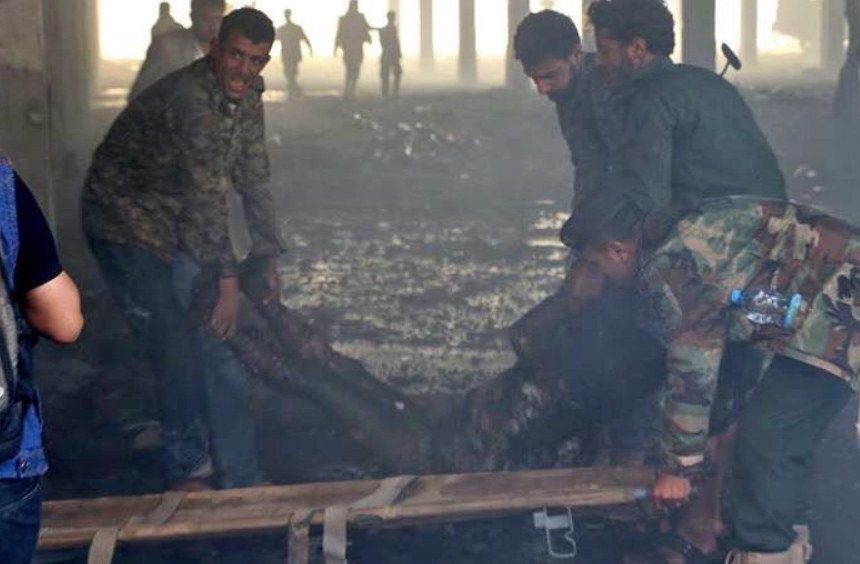
Yemen civil defence and army recovering bodies from the Saudi coalition bombed ceremony hall in Sanaa (Photo: Yemen the Forgotten War)
The hundreds more injured have been described as “bleeding to death in the streets“. The following report came in from Sanaa hours after the attack:
“Saudi-American airstrikes targeted the biggest hall in Sanaa. The hall was hit by 4 missiles, 2 air-strikes. When rescuers went to the aid of the dying and injured Saudi jets attacked for the second time in their double tap operation. It’s impossible to count the deaths. Officially they are saying less than 500 but many more are dying because they can’t be treated due to the absence of medical supplies and hospital facilities. This is entirely due to the UN sanctions and effective land, air and sea blockades. The hall is 2km from our home and 150m from my university but luckily, today I was not there.
Yesterday we killed several mercenary leaders in Mareb and Saudi commanders so today they are taking their revenge on the innocent people” ~ information supplied to Vanessa Beeley of 21st Century Wire.
[…]
According to Hassan Al Haifi, writer, academic and political commentator, living in Sanaa, the Saudi attack was deliberate:
“The mourners were paying tribute to General Jalal Al-Rouishan, Min of Int, who hails from a leading family of Khowlan Al-Tayyal Tribe, a leading and powerful Yemeni tribe.”
Al Haifi commented that this was a cynical and brutal attack by the Saudi coalition, intending to kill as many Ansarullah and Ali Abdullah Saleh officials and supporters as possible. A number of Saleh’s closest friends and allies were killed by the strikes along with a smaller number of Ansarullah members. Al Haifi, himself should have been at the ceremony but had been delayed and fortunately was not there when the Saudi jets launched their missiles into the throngs of mourners.
The Bloodshed
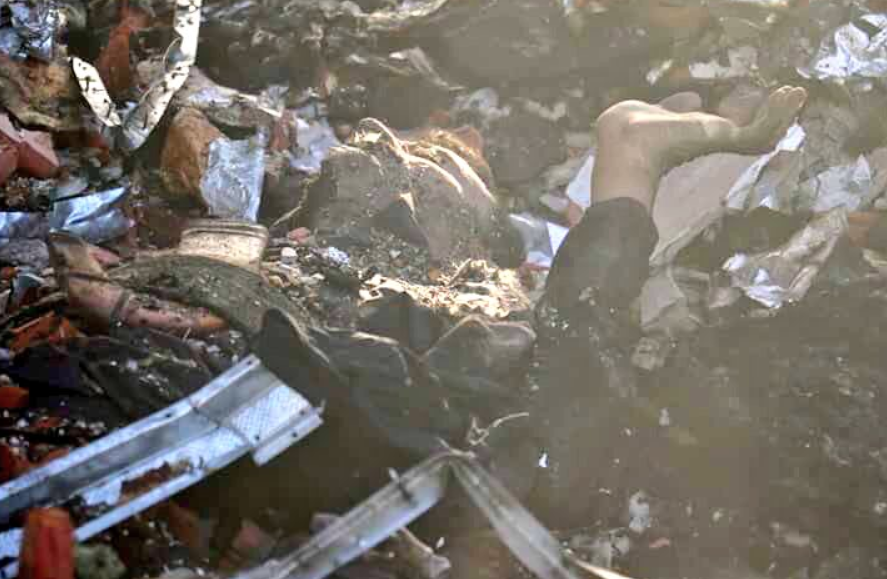
Saudi air-strike on Sanaa (Photo supplied to 21st Century Wire from Yemen)
The US State Department immediately swung into damage limitation mode and cranked up their hypocrisy to protect their Saudi coalition military industrial complex clients. John Kirby even deployed the “self-defence” terminology usually reserved for their other regional, arms guzzling ally with close links to Al Qaeda, Israel.
The bloodshed and suffering of the Yemeni people was reduced to an obscene game of semantics by a cold and calculating US State Department, as their multi billion dollar arms industry registered obscene trading levels with the Saudi coalition in 2015. In the first 21 months of Saudi-US illegal war on Yemen, US arms sales worth $33 Billion were closed Saudi and Gulf Cooperation Council (GCC) entities according to Defense News. In total, America’s Nobel Peace Chief Barack Hussein Obama has offered to sell $115 billion in weapons to Saudi Arabia since taking office in 2009 – more than any previous US administration, according to a recent report.
Not to be left out of the party, Britain has also sold more than £3.7 billion in arms to Saudi Arabia since Saudi’s illegal war of aggression began.
In truth, many of these estimates are conservative and do not include many more hundreds of millions in ancillary costs, staffing, support contracting and engineering.
Forgotten Heroes
Even though they’ve been completely redacted by the western media, and also by the myriad of Gulf monarchy media outlets, the real heroes of this conflict are the Yemeni people.
In their reductionist way of thinking and categorizing the world outside of their shores, Americans refer to Middle East populations in sectarian terms – because this is they way they would like to see the world, but it couldn’t be any further from reality. To Americans, the Yemeni war is all because of “Iranian-backed Shia Houthi Rebels.” The first US Congressman ever to say that in public probably read it directly off an AIPAC policy briefing sheet. That’s the sad reality still in Washington – information-poor (and lobby cash-rich) elected representatives are only able to see the world through the Israeli lens.
The reality is much more complex than just “the Houthis.” A genuine Arab Spring has taken place in Yemen and the US and Saudi response was simply to try and crush the people. But the people have resisted fiercely, and together. Unlike other neo-colonial ventures like Iraq and Afghanistan – the people of Yemen have united to a large degree and are determined to realize their own vision of self government. This is something that has been written off by everyone in the US establishment – from the President all the way down the political food chain.
Damning Indictment
The UK/US built, House of Saud, is waging a genocidal war of aggression that has already destroyed entire swathes of Yemeni cultural heritage and decimated entire communities, particularly in the northern, traditionally Ansarullah (Houthi) held areas such as Saada and Hajjah. This was by design. By now, we can see clearly how this was yet another ethnic cleansing programme being endorsed, fuelled and defended by the United States and her allies in the UK, EU, Israel, and of course the neighbouring Gulf States, the majority of whom participated in this dirty war. Oman, a lone, moderate, and independent thinking gulf state, has remained neutral, providing a degree of support to the Yemeni people. […]
The height of US hypocrisy was on full display during a US State Department press briefing where the already discredited US spokesman John Kirby shameless danced around a mass-murder by Saudi Arabia – whose airstrikes are supported logistically by the United States. This is the definition of criminality unchecked. Watch:
Author Vanessa Beeley is a special contributor to 21WIRE, and since 2011, she has spent most of her time in the Middle East reporting on events there – as a independent researcher, writer, photographer and peace activist. She is also a volunteer with the Global Campaign to Return to Palestine. See more of her work at her blog The Wall Will Fall.
For further background on Saudi ‘s war of aggression please read 21WIRE article: UN Whitewashing Saudi Coalition War Crimes and International Human Rights Violations
US-Saudi Led Blitzkrieg against Yemen is “An Ego Boost”
By Ahmad Barqawi | Global Research | May 3, 2015
“Slaughter Yemenis civilians, and win a free Bentley.” That pretty much sums up Saudi Arabia’s frivolous four-week military jamboree in Yemen otherwise known as Op “Decisive Storm”, if not its entire foreign (and now military) policy in the region; it may have been a “slip of the tweet” on the part of Saudi Prince Al Waleed Bin Talal, a Forbes top 100 billionaire who offered via his Twitter account to award Saudi fighter-jet pilots a fleet of 100 Bentley luxury cars, a bonus if you will, for their (bombing) services rendered; nonetheless it paints a vivid, albeit repulsive, picture of how politics are conducted in the oil-rich sheikhdoms of the Gulf: at the deviant whims of their Kings and Princes.
No wonder the Arab World is a complete mess of constant wars and conflicts; everything is subject to the often violent impulses of the ruling monarchies in the GCC club who now seem more than intent on leading the entire region, Kamikaze style, into a sectarian abyss with no foreseeable point of return; and Op Decisive storm, a codename that was shamelessly borrowed from America’s wars on the Arab World, was just that; a violent outburst that started, ended and now has even morphed into Op “Restoring Hope” at the mere sectarian fancies of Saudi Arabia with the helpless lot of Arab governments tagging along for the now routine trip of bombing yet another Arab country back to the stone age, and when you have a seemingly bottomless well of petrodollars, wield all the clout of mainstream media and a far-reaching religious authority; then forming a military coalition, especially one that is purely based on vicious sectarian grounds, is almost as easy as picking players for a football squad.
This is, in a nutshell, how the Saudi Government managed to crowbar eight countries into a military coalition comprising a mishmash of Gulf Cooperation Council members (sans Oman), Gulf Cooperation Council rejects (Jordan and Morocco) and Gulf Cooperation Council scroungers (Egypt and Sudan) to intervene in Yemen against a local political movement that just so happens to adhere to a religious sect that is often faintly (and inaccurately) traced back to Shia Islam. You could almost instantly smell the vile stench of oil and sectarianism all over Saudi Arabia’s latest, ongoing still, disastrous endeavor in Yemen.
The Saudis’ delusional sales pitch this time was that Iran (who else?) was about to take over Yemen via local militant “Shia” proxies attempting a coup against the “legitimate” government of outgoing/incoming/fleeing president Abed Rabbo Mansour Hadi (still holed up in Riyadh till now); therefore a military intervention with all (Sunni) guns blazing was in urgent order to safeguard “legitimacy” and maintain “stability” in an already impoverished and war-torn Yemen, and we know just how much the GCC club adores peace and stability in the region, its horrific portfolio of destabilization handiwork in Libya, Syria and Iraq is a bloody testament to that.
Of course legitimacy in this (Saudi) context refers to a flip-flopping, weakling of an interim president who, only with the help of Saudi money and support, managed to win a presidential election where he was actually the only candidate on the ballot, a president who outstayed both his tenuous welcome and his presidential term, resigned, fled to the port city of Aden, rescinded his resignation and declared himself president again only to flee once more, chased after by his people, into the waiting arms of the Saudis (perhaps better known to everyone else as his sole meal tickets) but of course not before demanding that his oil-rich patrons bomb his own country into smithereens because evidently that’s what “legitimate” presidents do, at least in the GCC’s book (of horrors).
Show me one of Saudi Arabia’s (many) lackeys in the region who didn’t ask for foreign military intervention into his own country, and I’ll show you Flying Pigs! The standard refrain of extending open invitations for foreign powers to wage devastating wars is strictly (and curiously) espoused by those whom the Saudi Kingdom considers (or designates) “legitimate representatives” of their people. From the Bahraini monarchy to the current Libyan government to the 14th of March alliance in Lebanon and the entirety of the Syrian opposition mismatched posses; not one of these handpicked Saudi puppets has missed an opportunity to ask, in fact beg, for the bombardment of his own country by a foreign government, as if it’s a mandatory rite of passage for those who wish to be on the Saudi payroll/leash and get the GCC’s stamp of approval. And this Abed Rabbo Mansour Hadi (none) character, whose return to power in Yemen was the only stated goal behind Saudi Arabia’s genocide in Yemen, is no different.
We’re told that the current blitzkrieg in Yemen is all about “restoring legitimacy”, but it’s near-impossible to take that claim seriously without bursting into an uncontrollable wave of laughter; none of the Saudi-led coalition members are exactly known for their democratic credentials, on the contrary; If you played a word-association game, the words “dictatorship”, “tyranny” and “authoritarianism” (or any random combination thereof) would elicit every single time the exact member list of the coalition currently bombing Yemen today into their warped versions of democratic rule and legitimacy.
In fact the war on Yemen is essentially nothing but an ego-boost for the Saudis in response to what’s perceived by the Kingdom as Iran’s growing influence in the region especially after an interim nuclear deal was signed with the west; a shot of (military) adrenaline for the oil-rich Kingdom to assert its political relevance and nothing beyond that at a time when its foreign policy is beginning to resemble a non-stop tragic-comedy of errors and blunders.
This ego-trip masquerading as a military operation has left, so far, more than a 1,000 Yemenis killed, countless others wounded and the wanton destruction of the country’s infrastructure; and although we’re thankfully spared the sight of Saudi-led coalition forces’ spokesman waffling around, trying in vain to finagle a military feat out of indiscriminately bombing civilian areas in Yemen in his daily briefings (or awkward rendezvous with his pro-war, GCC-funded media entourage); the war still goes on, given a new lease of life under a new codename; “Restoring Hope”, despite its “rosy” moniker which has tasteless PR written all over it, promises to be just as vicious and devastating as Decisive Storm if not more; now that free Bentleys are at stake here for outstanding achievements in criminality, I’m sure these hefty royal “incentives” will show in the destructive zeal the next time coalition pilots fly their sorties and drop their load of explosives on unsuspecting Yemenis.
We were told that Decisive Storm had “fulfilled its objectives”, according to a statement by Saudi Defense Ministry. What objectives? We don’t know; deposed Yemenis president is still in Riyadh and the Houthis along with the Yemenis army control much of the ground in Yemen, now unless the real objective was the step-by-step reenactment of Israel’s wars on the Gaza strip, in which case: mission accomplished indeed with flying colors (or overflowing blood of Yemenis!), the Saudis cannot claim any success whatsoever beyond reducing the country to debris and waste; a feat that was bizarrely celebrated in GCC-funded media as a “decisive blow” to Iranian influence in the region.
At the start of Operation Decisive Storm; then Saudi Ambassador to the U.S., current foreign minister, Adel Al-Jubeir said that the military operation was “…designed to protect the people of Yemen and its legitimate government from a takeover by a violent extremist militia”; protecting the people of Yemen… by bombing them into blind submission and a state of near-servitude, to keep the country an impoverished Saudi implantation and nothing more, I mean how dare the Yemenis even entertain the outrageous notion of self-determination when (Saudi) fate has ordained they be reduced to nothing more than an Oil-rich Kingdom’s backyard for gutter politics and inglorious exploits (or Achilles heel for that matter).
And no, in his statement; Ambassador Al Jubair was not referring to Al Qaida or the Islamic State militias which have been laying all manner of terror and destructive waste to Libya, Iraq and Syria with complete financial, logistical, political and ideological cover from the legitimacy-loving GCC folk, by “violent extremist militia”; Al Jubair was referring to the Ansarullah group; an indigenous Yemeni faction accused of being a mere tail for Iran, you know unlike the very independent Abed Rabbo Mansour Hadi, when in fact it does enjoy considerable political sway and popularity in Yemen.
Al Jubair also said that “all of Saudi Arabia’s allies were consulted before launching military operations in Yemen”. I’m guessing the consultations went something like this: the Saudis telling their allies to jump and everyone replying in unison, with a-cheese-eating-grin on their faces: “how high? … and please write those checks out to cash”.
And that’s the long version too.
“Coalition of the Willing…. to Get Paid from the GCC”
Only Pakistan, which the Saudis were hoping would join in the fun of leveling another impoverished Arab country into rubble; solely based on its “Sunni credentials” of course… and nuclear power, managed to bow out of this “coalition of the unwitting” escapade; thanks, ironically, to the only problem the Saudis can’t just fix or deal with no matter how much money they throw at it: Democracy… or a semblance thereof; when the Pakistani Parliament unanimously voted to remain neutral in the war on Yemen (i.e.: not to be a member of the GCC’s Suicide Squad parade).
There you can find a group of people with enough sense about them not to blindly follow the Saudis’ caprices into the Yemenis quagmire for a handful of cash and oil barrels, and heed instead the national interests of their own country first. Sadly this was not the case with the rest of coalition members whom are mostly made up of Arab governments posing as hired yes-men for Saudi Arabia (or yes-men posing as governments for that matter).
First we have Egypt; fresh out of an economic bash in Sharm Al Sheikh, which will sure keep Egypt locked in a tight GCC financial death grip for years to come, with billions of (petro) dollars dropping off his pockets; General Abdel Fattah al Sisi (“legitimate” President of Egypt, lest we forget, because this war is all about defending legitimacy against coup’d’etats) was the first in line to fully commit to Operation Decisive Storm, ground-troop-warts and all.
The man who sold himself to Egyptians as the Second Coming of President Jamal Abdel Nasser trampled all over Nasser’s legacy by fighting the Saudis’ dirty war in Yemen in an unholy alliance with the reactionaries of the Gulf (to paraphrase Nasser himself who’s probably rolling in his grave right about now).
Suddenly and at the flick of a (Saudi) switch; Egypt’s priorities were reshuffled beyond recognition or even the slightest bit of logic to best suit the GCC’s depraved interests in the region; the Houthis taking control of the Yemeni capital somehow became an existential threat to Cairo’s national security, trumping even threats coming from a terrorism-infested Sinai peninsula or over 1,000 km of open borders with the abyss of lawlessness and violence that is Libya today. And Bab Al Mandeb Strait in Yemen became the top priority for Sisi’s Egypt at a time when the land of the Nile faces potential drought and is threatened with the vanishing face of its landmark river, thanks to Ethiopia’s Renaissance Dam, along with another coalition member: Sudan.
Desperately wanting to prove that he too can wade in sectarian blood with the best of them; Sudanese President Omar al Bashir, probably lured by the promise of future-petrodollar-riches and the perfect opportunity to break his ICC-imposed isolation, stumbled over himself to heed Saudi Arabia’s call to (Sunni) arms and bomb some “infidel” Yemenis into god-forsaken oblivion (according to Sudanese state owned media). Never mind the embarrassing fact that the Sudanese “Air Force”, which is now dropping its load of bombs with a wanton exuberance on Yemeni civilians, stood completely idle and useless when Israel, on more than one occasion, practically used the entire country of Sudan as an open-field target practice for its fighter jets and F-16s under the pretext of targeting weapons’ depots and convoys destined for Palestinian Resistance factions in Gaza. Talk about priorities gone south.
It was only two years ago when the Saudis practically humiliated Sudanese President Omar Al Bashir when they blocked their own airspace to his plane as he was heading to… yes you guessed it, Iran to attend the inauguration of then newly elected president Rouhani, and now here is Al Bashir jumping into (criminal) action alongside the Saudis to bomb another Arab country into the throes of sectarian discord and potential partition.
Give that a moment’s thought and you might get a headache: Sudan, a country which itself is still reeling from a Western-sponsored partition scheme, is actively (and foolishly) participating in carving up yet another Arab country into two warring entities. There’s an almost Alice-in-Wonderland feel to it.
GCC hopefuls Jordan and Morocco of course happily tagged-along with the Saudis into yet another sectarian misadventure in what’s starting to look like a long drawn out series of auditions to join the GCC club which entail the two tiny monarchies to get down and dirty in the destruction of other Arab countries for the benefit (and amusement) of the Saudis; starting with Libya and Syria, and God knows where it’s going to go after Yemen; but you can be sure it’ll be under the spurious pretext of the “Shiite threat”,
And then you have the Arab League whose complete transformation from a schlocky, ineffectual entity into the proverbial make a wish foundation for the imperial West was epitomized in full shameless splendor in the unfortunate case of Yemen.
Gone are the days when the Arab League would grovel at the feet of NATO governments to intervene militarily somewhere in the Arab world or co-conspire with the West for yet another foreign invasion of one of its member states, now the Arab League, essentially nothing more than a mere echo chamber for the mercurial whims of the GCC nowadays, is finally taking matters into its own unreliable hands and summoning its American-made military might.
No time for niceties of the UNSC resolutions under the seventh chapter sort à la Libya or good-ol’ fashioned UN sanctions; Nah, the Arab League will no longer stoop to such pedestrian and banal methods, in the latest Arab League summit in Sharm Al Shaikh, the one which hastily rubber-stamped the Saudi war on Yemen, Arab leaders decided to resurrect a 65-year old near-dead defense pact and form a joint military force, which was about as thoughtful and welcome a notion as a fourth Netanyahu term, to counter… the Shiite threat in Yemen; kind of makes you yearn for the not-so-distant days when Arab Summits were all about vacuous, fig-leaf statements and “strong-worded” condemnations at best and public bickering and laughable finger-pointing at worst.
To put things into proper, albeit depressing perspective; neither Israel’s illegal occupation of Palestine nor America’s criminal invasion of Iraq has ever prompted Arab governments to even get near that defense pact; the GCC’s unhealthy obsession with Iran, bordering on hysteria, did.
Sectarianism is the New Black
“The Israel occupation of Palestine does not exist; it is a figment of our collective imagination. Iran is the enemy and Netanyahu and co. are allies.” that’s the only way we can reconcile ourselves with the bleak reality of the Arab world today which can be summed up in one word: Iranophopia… on Wahhabi steroids.
It’s quite telling when Netanyahu’s latest address to the Congress and the entirety of the last Arab league summit seem blurred into one big anti-Iran screed; Netanyahu could’ve made the same exact firebrand speech in Sharm Al Shaikh, steeped in anti-Iran buffoonery and short on intelligence, and it wouldn’t have seemed out of place or different… except for the number of standing ovations which I suspect would have been significantly higher than what he received from the jump-and-applaud-every-other-line U.S. Congress back in March.
So Iran… or Shiism (two interchangeable terms in GCC political discourse) is the enemy, evidently the alleged threat posed by Iran (and represented through the mere “presence” of Shiite indigenous communities in some Arab countries) supersedes the real existential threat posed by the Israeli expansionist project in Palestine (does anybody remember Palestine these days?) and beyond, notions like “Arab unity” and “Arab joint military pact”, which were constantly mocked by the monarchies of the Gulf as “wooden language” whenever they’re used in the context of the Palestine/Israel conflict, are now being used (and abused with a xenophobic fervor) by the GCC-camp only in relation to Iran.
So the GCC is perfectly fine with droves of illegal European settlers migrating all the way to Palestine, expelling Palestinians from their lands and squatting comfortably in their midst, but when it comes to indigenous Yemenis for instance, god forbid they “march towards the city of Aden”.
Pan-Arabism is for suckers; sectarianism is the new black in the Arab world… in the literal and most depressing sense of the word. The map of the Arab world has been reconfigured into areas of contending Saudi and (alleged) Iranian influence, and feuding mini-statelets laden with sectarian discord and internal bloodletting thanks only to Saudi Arabia’s growing and self-inflected paranoia against the “Shiite threat”.
Nothing makes sense in the Arab world unless put in a sectarian bracket; this is what more than ten years’ worth of a constant barrage of fear-mongering against Shiites has yielded so far; a trail of failed Arab states and conflict-ridden regions.
The Saudis (controlling the majority of media outlets in the Arab World along with the rest of the GCC) have managed to turn a minority religious sect, approximately one-fifth of the world’s Muslims if not less, into the new big bad boogeyman for the remaining majority of Muslims, and what started as laughable, clumsy attempts courtesy of the GCC at provoking friction among Muslims in the wake of Bush’s invasion of Iraq; is now a no-holds-barred sectarian confrontation engulfing the Arab world where everything from suicide bombings all the way up to F-16s goes, with Israel comfortably cheering from the sidelines, unencumbered in its occupation of Palestine, as both sides of the Sunni-Shiite divide tear each other to shreds.
Dangerous Parallels
Speaking of Israel; “the coalition of willing… to get paid from the GCC” is taking entire pages right out of the Israeli military’s own scorched-earth playbook by carpet-bombing civilian areas, vital infrastructure, schools, hospitals, factories, dairy plants, airports, one football stadium and, on at least two occasions, refugee camps, all the while imposing a no-fly-zone (we all know how the GCC is fond of those) coupled with a draconian siege reminiscent of that forgotten Israeli blockade on Gaza, which by the way, went totally unreferenced in the final statement of the latest gung-ho Arab Summit. Collective punishment is the name of the military campaign here, a strict “disciplinary” treatment delivered via extensive aerial bombardment to keep the Yemeni population in check and obediently toeing the Saudi line. I wonder where we have seen all of this before.
The parallels between Operation Decisive Storm/Restoring Hope and Israel’s own criminal wars on Gaza are ominously striking and equally horrid; the guilty-by-nonexistent-association doctrine, pioneered and espoused by Israel to justify its deliberate targeting of civilians by deeming all Palestinians in Gaza, including newborns and children, to be members of Hamas, was adopted with a demented zeal by the GCC in their own military misadventure in Yemen.
Thus all these ashen-faced victims of the coalition’s bombing campaign are militant “Shia Houthis”, and every charred skeleton, burned beyond recognition and crumbling in the arms of a shrieking loved one, is that of an Iranian agent’s, or so it’s reported in the callous sectarian coverage of Gulf-funded media which seem to fetishize the murder of Yemenis and the destruction of the country’s infrastructure with frenzied abandon, even the “courtesy” of at least shoving some of the nameless casualties of the air strikes under the euphemism of “Collateral Damage” is not extended to the Yemenis; just like it wasn’t extended to the Libyans when the city of Sirte was virtually flattened to the ground during Operation “Odyssey Dawn for Benghazi/Living Hell for the rest of the country”, these weren’t residential areas and universities that NATO was bombing back then we were told, but Gaddafi’s military command and control centers. In Yemen it’s Houthis’ training camps or “concentration centers”, whatever that means.
The deliberate de-Yemenization and even dehumanization of the victims of Operation Decisive Storm/Restoring Hope is practiced on a daily basis on Al Jazeera and Al Arabiya channels. Constantly referring to the victims of the bombing campaigns strictly as “Houthis”, prompting the viewer to think they’re an invasive alien breed and not indigenous people comprising almost 40% of the Yemeni population, while true Yeminis, according to the GCC, are those Hadi-supporters pathetically paraded all over Gulf-funded networks rallying in support of the Saudi airstrikes on their country.
Aljazeera Arabic TV talk-show host Faisal Al Qasem (known for his vulgar and trashy persona which makes Jerry Springer look like the paragon of classy journalism) summed up the entire sordid coverage of GCC funded media of the war on Yemen when he screamed at one of his guests; “look at the Houthis, just look at their faces… they don’t even look like us Arabs”.
Remember those leaflets with badly translated, “pseudo-apologetic” Arabic messages that the Israeli Army used to dump on Gazans before bombing the living daylights out of them with all manner of cluster ammunition and dime bombs? Well the same leaflets with the same exact clumsy messages are being dropped on Yemenis courtesy of the GCC’s coalition of the unwitting in another disgusting display of kinship verging on pathological idol-worship towards the IOF’s criminal tactics. Thus claims by Houthi rebels that the coalition is using White Phosphorous (Israel’s favorite weapon of choice) may not be that farfetched; the harrowing images trickling out of Yemen and shown on (few) Media outlets are proof positive that Yemen is being used as a test ground for GCC’s multi-billion dollar, American-made arsenal of death and destruction, including the use of internationally banned weapons.
The complete lack of subtlety in borrowing from the Israeli military’s book (of terrorism) and openly recycling its brand of criminality up to the smallest details against the Yemenis leaves no doubt that the alliance between the GCC and the Zionist entity has taken another gigantic leap forward into an all-hands-on-deck political, military and diplomatic integration.
The war on Yemen, like all wars waged on defenseless populations including Israel’s mass murdering sprees against Palestinians, is nothing but an ego boost, Decisive Storm/Restoring Hope was probably prompted by the Interim nuclear agreement Iran managed to strike with the West last month; I don’t even want to imagine how the Saudis will react if and when a full comprehensive deal is reached come June 30.
All-Out War in Ukraine: NATO’s ‘Final Offensive’
By James Petras :: 11.20.2014
Introduction
There are clear signs that a major war is about to break out in Ukraine: A war actively promoted by the NATO regimes and supported by their allies and clients in Asia (Japan) and the Middle East (Saudi Arabia).
The war over Ukraine will essentially run along the lines of a full-scale military offensive against the southeast Donbas region, targeting the breakaway ethnic Ukraine- Russian Peoples Republic of Donetsk and Lugansk, with the intention of deposing the democratically elected government, disarming the popular militias, killing the guerrilla resistance partisans and their mass base, dismantling the popular representative organizations and engaging in ethnic cleansing of millions of bilingual Ukraino-Russian citizens. NATO’s forthcoming military seizure of the Donbas region is a continuation and extension of its original violent putsch in Kiev, which overthrew an elected Ukrainian government in February 2014.
The Kiev junta and its newly ‘elected’ client rulers, and its NATO sponsors are intent on a major purge to consolidate the puppet Poroshenko’s dictatorial rule. The recent NATO-sponsored elections excluded several major political parties that had traditionally supported the country’s large ethnic minority populations, and was boycotted in the Donbas region. This sham election in Kiev set the tone for NATO’s next move toward converting Ukraine into one gigantic US multi-purpose military base aimed at the Russian heartland and into a neo-colony for German capital, supplying Berlin with grain and raw materials while serving as a captive market for German manufactured goods.
An intensifying war fever is sweeping the West; the consequences of this madness appear graver by the hour.
War Signs: The Propaganda and Sanctions Campaign, the G20 Summit and the Military Build Up
The official drum- beat for a widening conflict in Ukraine, spearheaded by the Kiev junta and its fascist militias, echoes in every Western mass media outlet, every day. Major mass media propaganda mills and government ‘spokesmen and women’ publish or announce new trumped-up accounts of growing Russian military threats to its neighbors and cross-border invasions into Ukraine. New Russian incursions are ‘reported’ from the Nordic borders and Baltic states to the Caucusus. The Swedish regime creates a new level of hysteria over a mysterious “Russian” submarine off the coast of Stockholm, which it never identifies or locates – let alone confirms the ‘sighting’ of. Estonia and Latvia claim Russian warplanes violated their air space without confirmation. Poland expels Russian “spies” without proof or witnesses. Provocative full-scale joint NATO-client state military exercises are taking place along Russia’s frontiers in the Baltic States, Poland, Romania and Ukraine.
NATO is sending vast arms shipments to the Kiev junta, along with “Special Forces” advisers and counter-insurgency experts in anticipation of a full-scale attack against the rebels in the Donbas.
The Kiev regime has never abided by the Minsk cease fire. According to the UN Human Rights office 13 people on average –mostly civilians –have been killed each day since the September cease fire. In eight weeks, the UN reports that 957 people have been killed –overwhelmingly by Kiev’s armed forces.
The Kiev regime, in turn, has cut all basic social and public services to the Peoples’ Republics’, including electricity, fuel, civil service salaries, pensions, medical supplies, salaries for teachers and medical workers, municipal workers wages; banking and transport have been blockaded.
The strategy is to further strangle the economy, destroy the infrastructure, force an even greater mass exodus of destitute refugees from the densely populated cities across the border into Russia and then to launch massive air, missile, artillery and ground assaults on urban centers as well as rebel bases.
The Kiev junta has launched an all-out military mobilization in the Western regions, accompanied by rabid anti-Russian, anti-Eastern Orthodox indoctrination campaigns designed to attract the most violent far right chauvinist thugs and to incorporate the Nazi-style military brigades into the frontline shock troops. The cynical use of irregular fascist militias will ‘free’ NATO and Germany from any responsibility for the inevitable terror and atrocities in their campaign. This system of ‘plausible deniability’ mirrors the tactics of the German Nazis whose hordes of fascist Ukrainians and Ustashi Croats were notorious in their epoch of ethnic cleansing.
G20-plus-NATO: Support of the Kiev Blitz
To isolate and weaken resistance in the Donbas and guarantee the victory of the impending Kiev blitz, the EU and the US are intensifying their economic, military and diplomatic pressure on Russia to abandon the nascent peoples’ democracy in the south-east region of Ukraine, their principle ally.
Each and every escalation of economic sanctions against Russia is designed to weaken the capacity of the Donbas resistance fighters to defend their homes, towns and cities. Each and every Russian shipment of essential medical supplies and food to the besieged population evokes a new and more hysterical outburst – because it counters the Kiev-NATO strategy of starving the partisans and their mass base into submission or provoking their flight to safety across the Russian border.
After suffering a series of defeats, the Kiev regime and its NATO strategists decided to sign a ‘peace protocol’, the so-called Minsk agreement, to halt the advance of the Donbas resistance into the southern regions and to protect Kiev’s soldiers and militias holed-up in isolated pockets in the East. The Minsk agreement was designed to allow the Kiev junta to build up its military, re-organize its command and incorporate the disparate Nazi militias into its overall military forces in preparation for a ‘final offensive’. Kiev’s military build-up on the inside and NATO’s escalation of sanctions against Russia on the outside would be two sides of the same strategy: the success of a frontal attack on the democratic resistance of the Donbas basin depends on minimizing Russian military support through international sanctions.
NATO’s virulent hostility to Russian President Putin was on full display at the G20 meeting in Australia: NATO-linked presidents and prime ministers, especially Merkel, Obama, Cameron, Abbott, and Harper’s political threats and overt personal insults paralleled Kiev’s growing starvation blockade of the besieged rebels and population centers in the south-east. Both the G20’s economic threats against Russia and the diplomatic isolation of Putin and Kiev’s economic blockade are preludes to NATO’s Final Solution – the physical annihilation of all vestiges of Donbas resistance, popular democracy and cultural-economic ties with Russia.
Kiev depends on its NATO mentors to impose a new round of severe sanctions against Russia, especially if its planned invasion encounters a well armed and robust mass resistance bolstered by Russian support. NATO is counting on Kiev’s restored and newly supplied military capacity to effectively destroy the southeast centers of resistance.
NATO has decided on an ‘all-or-nothing campaign’: to seize all of Ukraine or, failing that, destroy the restive southeast, obliterate its population and productive capacity and engage in an all-out economic (and possibly shooting) war with Russia. Chancellor Angela Merkel is on board with this plan despite the complaints of German industrialists over their huge loss of export sales to Russia. President Hollande of France has signed on dismissing the complaints of trade unionists over the loss of thousands French jobs in the shipyards. Prime Minister David Cameron is eager for an economic war against Moscow, suggesting the bankers of the City of London find new channels to launder the illicit earnings of Russian oligarchs.
The Russian Response
Russian diplomats are desperate to find a compromise, which allows Ukraine’s ethnic Ukraine- Russian population in the southeast to retain some autonomy under a federation plan and regain influence within the ‘new’ post-putsch Ukraine. Russian military strategists have provided logistical and military aid to the resistance in order to avoid a repeat of the Odessa massacre of ethnic Russians by Ukrainian fascists on a massive scale. Above all, Russia cannot afford to have NATO-Nazi-Kiev military bases along its southern ‘underbelly’, imposing a blockade of the Crimea and forcing a mass exodus of ethnic Russians from the Donbas. Under Putin, the Russian government has tried to propose compromises allowing Western economic supremacy over Ukraine but without NATO military expansion and absorption by Kiev.
That policy of conciliation has repeatedly failed.
The democratically elected ‘compromise regime’ in Kiev was overthrown in February 2014 in a violent putsch, which installed a pro-NATO junta.
Kiev violated the Minsk agreement with impunity and encouragement from the NATO powers and Germany.
The recent G20 meeting in Australia featured a rabble-rousing chorus against President Putin. The crucial four-hour private meeting between Putin and Merkel turned into a fiasco when Germany parroted the NATO chorus.
Putin finally responded by expanding Russia’s air and ground troop preparedness along its borders while accelerating Moscow’s economic pivot to Asia.
Most important, President Putin has announced that Russia cannot stand by and allow the massacre of a whole people in the Donbas region.
Is Poroshenko’s forthcoming blitz against the people of southeast Ukraine designed to provoke a Russian response – to the humanitarian crisis? Will Russia confront the NATO-directed Kiev offensive and risk a total break with the West?
James Petras latest book is THE POLITICS OF IMPERIALISM:THE US,ISRAEL AND THE MIDDLE EAST (CLARITY PRESS:ATLANTA)
Who is hit hardest by Russia’s trade ban?
RT | August 8, 2014
Germany and Poland will lose the most trade with Russia, and neighboring Finland and Baltic states Lithuania and Latvia will lose a bigger proportion of their GDP. Norway will see fish sales to Russia disappear, and US damages would be very limited.
Russia has banned imports of fruit, vegetables, meat, fish and dairy products from the 28 countries of the EU, the US, Canada, Norway, and Australia for one year.
EU trade is heavily dependent on Russian food imports. Last year Russia bought $16 billion worth of food from the bloc, or about 10 percent of total exports, according to Eurostat.
In terms of losses, Germany, Poland and the Netherlands- the top three EU food suppliers to Russia in 2013 – will be hit hardest. Food for Russia makes up around 3.3 percent of total German exports.
French Agriculture Minister Stephane Le Foll said his government is already working together with Germany and Poland to reach a coordinated policy on the new Russian sanction regime.
Last year, Ireland exported €4.5 million worth of cheese to Russia, and not being able to do so this year is a big worry, Simon Coveney, the country’s agriculture minister, said.
Farmers across Europe could face big losses if they aren’t able to find alternative markets for their goods, especially fruit and vegetables.
Some are already demanding their governments provide compensation for lost revenue.
“If there isn’t a sufficient market, prices will go down, and we don’t know if we can cover the costs of production, because it is so expensive,” Jose Emilio Bofi, an orange farmer in Spain, told RT.
NATO Aims To Repeat Its Libya ‘Success’ In Ukraine
By Daniel McAdams | Ron Paul Institute | May 17, 2014
As NATO and its US masters edge the US and EU closer to war with Russia over Ukraine, it might be appropriate to have a look at NATO’s last “success” story.
Yesterday in Libya, where NATO bombs fell just over three years ago to “liberate” the people from Gaddafi, Islamist militias in Benghazi were under helicopter and warplane attack by a paramilitary force headed by former general Khalifa Haftar. The former general first emerged in Libya back in 2011, having left his long-time home base in the US state of Virginia where his ties to the CIA were an open secret.
Yesterday’s attack by Haftar’s paramilitary group was said to have been joined by some of the Libyan armed forces. At the same time, Libya’s acting prime minister, Abdullah al-Thinni, condemned the attacks as “a coup against the revolution.” The acting prime minister continued, “Air force units that bombed targets in Benghazi today did so illegally, without any orders from us.”
Ironically, the Islamist militias under attack in Benghazi — presumably at the behest of the Obama administration — were not long ago instrumental to the US and NATO when they started the uprising against Gaddafi.
So who runs the government in Libya when some armed forces units attack “the revolution” in Benghazi at the command of a CIA-affiliated former general?
As the Interventions Watch blog points out, claims that Gaddafi was bombing Benghazi from the air provided the main trigger for the NATO attack on Libya. So what will western cheerleaders for that attack say when now a CIA-affiliated militia and parts of the country’s armed forces are actually bombing Benghazi from the air?
If the 2011 NATO attack on Libya was such a success, why is chaos the only thing that reigns in Libya? And why are US military assets being moved from Spain to Sicily over fears of increasing unrest in Libya?
With this great “success” under its belt, we can hardly wait for NATO’s next act: a war with Russia over Ukraine.
EU, US impose sanctions against Russian officials over Crimea referendum
RT | March 17, 2014
US President Barack Obama has ordered that sanctions be applied against 11 Russian and Ukrainian officials, the White House said. Earlier, the EU imposed sanctions against 21 officials after Crimea declared its independence.
The US has imposed sanctions against Russian and Ukrainian officials on Monday, with the White House stating that “the actions and policies” of the Russian government with respect to Ukraine “undermine democratic processes and institutions in Ukraine; threaten its peace, security, stability, sovereignty, and territorial integrity; and contribute to the misappropriation of its assets.”
Obama’s executive order applies to seven top Russian officials, including presidential aide Vladislav Surkov, presidential adviser Sergey Glazyev, State Duma deputy Leonid Slutsky, member of the upper chamber of the Russian parliament (the Federation Council) Andrey Klishas, head of the upper chamber of the Russian parliament Valentina Matvienko, Deputy Prime Minister Dmitry Rogozin and State Duma deputy Yelena Mizulina.
In addition, the US Treasury has imposed sanctions on four Ukrainian individuals “for their actions or policies that threaten the peace, security, stability, sovereignty, or territorial integrity of Ukraine and in undermining the Government of Ukraine” including the ousted President of Ukraine Viktor Yanukovich, Crimean top officials Sergey Aksyonov and Vladimir Konstantinov, and former Ukrainian presidential chief of staff Viktor Medvedchuk.

“It’s US Turn to Show Political Resolve”
Interview with Iran’s Foreign Minister Mohammad Javad Zarif | August 17, 2013
 The new Iranian Foreign Minister Mohammad Javad Zarif is taking over the Ministry of Foreign Affairs of the Islamic Republic of Iran from his predecessor, Ali Akbar Salehi, at a time that the entire Middle East and North Africa from Syria to Egypt, from Tunisia to Libya, and also from Bahrain to Iraq and Lebanon, are grappling with various political and security crises. Iran’s nuclear case has been also relatively stagnant. In the meantime, the radical politicians in the United States as well as pro-Israeli lobbies in the US Congress and Senate are keeping up their loud cries for the intensification of sanctions against the Islamic Republic. On the verge of his official inauguration as the new Iranian foreign minister, in the following interview we have discussed with Mohammad Javad Zarif such important issues as the true meaning of moderation in Iran’s foreign policy, the new administration’s plans for the continuation of the nuclear negotiations, the possibility of transferring management of the nuclear case from the Supreme National Security Council to the Ministry of Foreign Affairs, Iran’s possible positions on radical moves taken by the United States and the pro-Israeli lobby, and the possibility of future direct talks between Tehran and Washington in the light of the existing political equations in the region.
Q: The issue of “moderation” was one of the main mottos of the “Administration of Foresight and Hope.” How do you define moderation in the area of foreign policy?
A: I personally believe that moderation means realism and creation of balance among various needs of a country for the advancement of the foreign policy and pursuit of the foreign policy goals through plausible and rational methods and a suitable discourse. Moderation does not mean to forget about the values or discard the principles. Moderation neither means to fall short of materializing the country’s rights. In other words, as I said in my address to the Majlis (Iranian parliament), moderation has its roots in self-confidence. The people who confide in their own ability, power, possibilities and capacities will tread the path of moderation. But those who are afraid and feel weak mostly go for radicalism. Radicals in the world are cowardly people and although their slogans may be different from one another, there are close and good relations among them. The world of today needs moderation more than anything else and the Islamic Republic of Iran, as a powerful country, can push ahead with a suitable foreign policy approach through moderation.
Q: In his first press conference after the inauguration ceremony, President [Hassan Rouhani] said resumption of the nuclear negotiations with the P5+1 group will be one of his priorities. Do you have any new plan or proposal for the resumption of these talks?
A: There have been discussions inside the administration with Mr. President about how to follow up on the country’s nuclear rights and reduce unjust sanctions which have been imposed against the Islamic Republic of Iran. The basis for our work is to insist on the rights of Iran and do away with logical concerns of the international community. As the Supreme Leader and the President have emphasized, it would be easy to achieve this goal provided that the main goal of all involved parties is to find a solution to the nuclear issue. We believe that finding a solution to the nuclear issue needs political will. On the side of the Islamic Republic of Iran, the election of Dr. Rouhani – in view of his past track records with regard to this case – proves that the Iranian people are willing for the nuclear issue to reach a final solution with power and strength and within a reasonable time frame. We wish the opposite side will also have the necessary political resolve for the resolution of the nuclear issue. In that case, we would have no concern with respect to assuring the world about the peaceful nature of our nuclear energy program because according to the fatwa [religious decree] issued by the Supreme Leader and based on the strategic needs of Iran, nuclear weapons have no place in our national security doctrine and are even detrimental to our national security.
Q: There have been rumors about the possibility of transferring the management of the nuclear case from the Supreme National Security Council to the Ministry of Foreign Affairs. Do you confirm such speculations or deny them and, basically, are there any specific plans for the transfer of this case?
A: I have not heard such a thing. This is a decision for the President to make. At any rate, in view of the experience I have in this regard, I will do my utmost to be of service for the advancement of the nuclear case in any position I am and to any degree possible. However, it is for the highest ranks of the Islamic Establishment to make the final decision about how to pursue the nuclear case, the form and framework of negotiations, and the best methods to be used in this regard.
The main issue is whether the necessary political resolve [among member states of the P5+1 group] will be present and whether the US government is ready to stand in the face of the interest groups and prevent the whole case to be steered by radical groups?
Q: We have witnessed the emergence of anti-Iran currents at both the US Congress and Senate concurrent with the election and inauguration of President Hassan Rouhani’s administration. On the other hand, Israelis claim in their propaganda campaigns that the administration in Iran has changed, but policies are the same as before. What is your plan to offset such radical moves?
A: The warmongering elements are apparently concerned about reduction of problems and are clearly doing their utmost to resort to any pretext in order to intensify the crisis with Iran. The important point is that decision-makers in Europe and the United States should come to grips with the real nature and goals of warmongers. On this basis, they should not allow a warmongering and tension-seeking agenda – which aims to put unjust pressures which have no place in international law on the Iranian nation – to prevent them from taking advantage of opportunities which can be used to find solutions to existing problems. The political agenda of radicalism clearly proves that radicals are cowards and are afraid of negotiations and dialogue. Therefore, such groups make recourse to hasty and ineffective methods in order to bar the progress of moderation. Such cowardly people usually fail to achieve their political goals as well.
Q: Will you agree to engage in bilateral direct talks with the United States if such a thing is proposed to you on the sidelines of such international meetings as the United Nations General Assembly sessions or negotiations with the P5+1 group?
A: The Supreme Leader has made his opinion about [direct] talks [with the United States] public time and time again. Negotiations, per se, is not an issue here, but the main issue is what topics are going to be discussed in such negotiations and how much political determination exists in the opposite side for the settlement of the existing problems. The main issue is will such a political resolve take shape and whether the US administration is actually ready to stand up to radical groups and prevent such radical groups from setting the course of the whole issue? This will be in fact a litmus test for the government of the United States to show its readiness to play a more serious role and pave the way for the achievement of a final solution.
Q: Don’t you think that bilateral talks between Tehran and Washington constitute the secret precondition for the improvement of relations between Iran and Europe?
A: In my opinion, political will is the precondition for the improvement of relations. The methods [to do this] can be discussed, but what is necessary is the emergence of such a political will and its manifestation in practice. In that case, various methods can be used to achieve goals. At a time that it is not still clear whether such a political will exists or not, the efficiency of using new methods cannot be clearly decided. In Iran, the election of Mr. Rouhani shows that people have made up their mind to engage in constructive interaction with the world. Mr. Rouhani, on the other hand, has shown through his words and deeds that he has the necessary political will to do this. Now, the important requisite is for such a political will to take shape on the other side of the equation.
Q: You are taking charge of the Ministry of Foreign Affairs at a time that the Middle East is going through a hectic period of its history. We are witnessing different crises from Syria to Egypt, and from Bahrain to Lebanon and Iraq. What are your priorities among these regional cases?
A: Conditions in the region have become hectic and inflammatory as a result of shortsightedness of certain political players – most of them coming from outside the region – during the past few years, and we need a collective effort to curb in the crisis. On the one hand, we are faced with fundamentalism while, on the other hand, we see how people’s votes are forgotten and downtrodden. And of course, we can see the clear hands of foreign interventionist powers that foment unrest in the region the result of which is the loss of thousands of innocent lives. Unfortunately, we have been witnessing a severe escalation of domestic conflicts in Egypt during the past few days in which hundreds of innocent people have lost their lives. As a result, it is not only incumbent on us to find a way to put an end to the ongoing crisis in Egypt, but a more serious need of the region and the world is to prevent further spread of radicalism by taking advantage of the indigenous models of democracy. I believe that the Islamic Republic of Iran will be able to play a crucial role in this regard, especially after the political epic that took place during the current [Iranian calendar] year [through the presidential election in the country].
Source: Iranian Diplomacy (IRD)
http://www.irdiplomacy.ir/
Translated By: Iran Review.Org
Related articles
Featured Video
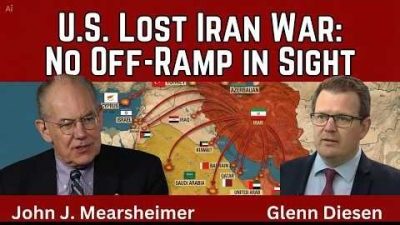
John Mearsheimer: US Already lost Iran war – No off-ramp in sight
or go to
Aletho News Archives – Video-Images
Frlom the Archives
70 Neocons Petition Congress To Effectively Allow Israel To Say When The US Should Attack Iran
By Damian Lataan | January 10, 2014
Seventy senior Israeli-centric neoconservatives have written an open letter to Congress imploring them to do more to ensure Iran complies with the conditions of any agreement finally reached with the P5+1 over Iran’s nuclear program.
While the neocons are ostensibly asking Congress to ensure compliance, it is clear that their real aim is to convince members of Congress to support the bill currently passing through the Senate which calls for tighter sanctions against Iran in the event of any waywardness on Iran’s part.
The neocons are eager to see the bill currently passing through the Senate with enough support to make it veto-proof, not so much because they are concerned about Iran’s so-called nuclear weapons program – there’s still not a skerrick of hard evidence that Iran has a nuclear weapons program – but, rather, because embedded within the bill is this clause:
… if the Government of Israel is compelled to take military action in legitimate self-defense against Iran’s nuclear weapon program, the United States Government should stand with Israel and provide, in accordance with the law of the United States and the constitutional responsibility of Congress to authorize the use of military force, diplomatic, military, and economic support to the Government of Israel in its defense of its territory, people, and existence…
Essentially, the clause is an automatic trigger for the US to attack Iran at any time the Israelis choose to launch a first strike – regardless of whether President Obama is in favour or not.
Partial list… continue
Blog Roll
 Aletho News
- ‘Heinous crime’: Iran denounces Israeli assassination of 4 Iranian diplomats in Lebanon
- John Mearsheimer: U.S. Already Lost Iran War – No Off-Ramp in Sight
- UK Parliament Plans ISP Blocking and Age Verification Powers
- World cannot remain silent as US and Israel attack ‘heritage of humankind’: Iran
- Emirati billionaire rebukes US senator over call for Gulf states to join war with Iran
- Op. True Promise 4: Iran’s missile blitzkrieg dismantles US war machine in West Asia
- Aramco CEO warns ‘catastrophe’ imminent if Strait of Hormuz remains shut
- What If Iran Says No?
- Trump Threatens to ‘Hit’ Iran ‘Twenty Times Harder’ Over Strait of Hormuz Oil Flows
- Spare the hypocrisy: Baghaei slams Ursula’s support for US
- If Americans Knew
- Israel Decided the War, But Trump’s America Fights and Pays the Bill
- Conscientious Objector Group: Phone ‘Ringing Off Hook’ As Huge Mobilization Underway
- U.S. support for Israel continues to plummet, despite media’s best efforts
- Threats and missiles fly, death tolls soar in Iran, Lebanon, Gaza – Not a ceasefire Day 151
- Lebanon: Israel’s White Phosphorous Use Risks Civilian Harm
- Corporate Media Go All Out To Support The US-Israeli War On Iran
- US-Israel war on Iran is creating a steady growing number of amputees
- Israel planned this war on Iran for 40 years. Everything else is a smoke screen
- The wrong question about the war in Iran
- ‘Your Tax Dollars Being Used to Raise Your Gas Prices’: US-Israel Bomb Major Iranian Oil Depots
- No Tricks Zone
- New Study Documents A 20-Year Pause In Arctic Sea Ice Decline – Driven By Internal Variability
- Wake-up Call: Survey Shows Majority Of Germans Now Favor Postponing Climate Targets!
- Televised! Leading German Political Candidate Tells Schoolchildren CO2 Makes Sun Hotter!
- New Study: A Century Warming Of 1.1°C Is ‘Commonplace’ And ‘Not Unusual’ During This Interglacial
- New Study: ‘Internal Noise’ And Volcanic Forcing Can Trigger 10-15°C Warming Within Decades
- Glaciers Worldwide Are Suddendly Surging, Experts Blame Warming!
- Surprising Discovery: Sahara Is Greening…Billions Of Trees Where Once Thought To Be Barren
- New Research Reaffirms Clouds, Aerosols, And Surface Solar Radiation Are ‘Driving The Climate System’
- Germany: Electric Car Catches Fire At Charging Station, Sets Off Local “Inferno”, Widespread Damage
- New Study: Canada’s New Brunswick Was 1°C Warmer Than Today During The Medieval Warm Period
 Aletho News