Aletho News

ΑΛΗΘΩΣ

Bolivia’s TIPNIS Dispute

Example of How Liberal-Left Alternative Media Becomes a Conveyor Belt for US Regime Change Propaganda

By Stansfield Smith | Dissident Voice | April 4, 2018

As has become a standard operating procedure, an array of Western environmental NGOs, advocates of indigenous rights and liberal-left alternative media cover up the US role in attempts to overturn the anti-imperialist and anti-neoliberal governments of Rafael Correa in Ecuador and Evo Morales in Bolivia.

This NACLA article is a recent excellent example of many. Bolivia’s TIPNIS (Territorio Indígena y Parque Nacional Isiboro Secure) dispute arose over the Evo Morales government’s project to complete a road through the park, opposed by some indigenous and environmental groups.

As is NACLA modus operandi, the article says not one word about US and right-wing funding and coordination with the indigenous and environmental groups behind the TIPNIS anti-highway protests. (This does not delegitimize the protests, but it does deliberately mislead people about the issues involved).

In doing so, these kinds of articles cover up US interventionist regime change plans, be that their intention or not.

NACLA is not alone in what is in fact apologetics for US interventionism. Include the Guardian, UpsideDownWorld, Amazon Watch, so-called “Marxist” Jeffery Webber (and here), Jacobin, ROAR, Intercontinentalcry, Avaaz, In These Times, in a short list of examples. We can add to this simply by picking up any articles about the protests in Bolivia’s TIPNIS (or oil drilling in Ecuador’s Yasuni during Rafael Correa’s presidency) and see what they say about US funding of protests, if they even mention it.

This is not simply an oversight, it is a cover-up.

What this Liberal Left Media Covers Up

On the issue of the TIPNIS highway, we find on numerous liberal-left alternative media and environmental websites claiming to defend the indigenous concealing that:

(a) The leading indigenous group of the TIPNIS 2011-2012 protests was being funded by USAID. The Confederation of Indigenous Peoples of the Bolivian East (CIDOB) had no qualms about working with USAID — it boasted on its website that it received training programs from USAID. CIDOB president Adolfo Chavez, thanked the “information and training acquired via different programs financed by external collaborators, in this case USAID”.

(b) The 2011 TIPNIS march was coordinated with the US Embassy, specifically Eliseo Abelo. His phone conversations with the march leaders – some even made right before the march set out — were intercepted by the Bolivian counter-espionage agency and made public.

(c) “The TIPNIS marchers were openly supported by right wing Santa Cruz agrobusiness interests and their main political representatives, the Santa Cruz governorship and Santa Cruz Civic Committee.In June 2011 indigenous deputies and right wing parties in the Santa Cruz departmental council formed an alliance against the MAS (Movement for Socialism, Evo Morales’s party). CIDOB then received a $3.5 million grant by the governorship for development projects in its communities.

Over a year after the TIPNIS protests, one of the protest leaders announced he was joining a right-wing, anti-Evo Morales political party.

(d) The protest leaders of the TIPNIS march supported REDD (Reduce Emissions from Deforestation and Degradation). The Avaaz petition (below) criticizing Evo Morales for his claimed anti-environmental actions also covered this up. As far back as 2009 “CIDOB leaders were participating there in a USAID-promoted workshop to talk up the imperialist-sponsored REDD project they were pursuing together with USAID-funded NGOs.”

REDD was a Western “environmental” program seeking to privatize forests by converting them into “carbon offsets” that allow Western corporations to continue polluting. That REDD would give Western NGOs and these indigenous groups funds for monitoring forests in their areas.

(e)These liberal-left alternative media and environmental NGOs falsely presented the TIPNIS conflict as one between indigenous/environmentalist groups against the Evo Morales government (e.g. the TIPNIS highway was “a project universally[!] condemned by local indigenous tribes and urban populations alike”). Fred Fuentes pointed out that more than 350 Bolivian organizations, including indigenous organizations and communities, even within TIPNIS, supported the proposed highway.

CONISUR (Consejo de Indígenas del Sur), consisting of a number of indigenous and peasant communities within TIPNIS, backed by Bolivia’s three largest national indigenous campesino organizations, organized a march to support of the road. They argued that the highway is essential to integrating Bolivia’s Amazonia with the rest of the country, as well as providing local communities with access to basic services and markets.

The overwhelming majority of people in the West who know about the TIPNIS protests, or the Yasuni protests in Ecuador, where a similar division between indigenous groups took place, never learned either from the liberal-left media or the corporate media, that indigenous groups marched in support of the highway or in support of oil drilling.

Therefore, this liberal-left media is not actually defending “the indigenous.” They are choosing sides within indigenous ranks, choosing the side that is funded and influenced by the US government.

(f) The TIPNIS conflict is falsely presented as Evo Morales wanting to build a highway through the TIPNIS wilderness (“cutting it in half” as they dramatically claim). There are in fact two roads that exist there now, which will be paved and connected to each other. Nor was it wilderness: 20,000 settlers lived there by 2010.

(g) Anti-highway march leaders actually defended industrial-scale logging within TIPNIS. Two logging companies operated 70,000 hectares within the national park and have signed 20-year contracts with local communities.

(h) They often fail to note that the TIPNIS marchers, when they reached La Paz, sought to instigate violence, demanding Evo Morales removal. Their plot was blocked by mobilization of local indigenous supporters of Evo’s government.

If we do not read Fred Fuentes in Green Left Weekly, we don’t find most of this information. Now, it is true that some of the media articles did mention that there were also TIPNIS protests and marches demanding the highway be built. Some do mention USAID, but phrase it as “Evo Morales claimed that those protesting his highway received USAID funding.”

Avaaz Petition Attacking Evo Morales over TIPNIS

The TIPNIS campaign, which became a tool in the US regime change strategy, was taken up in a petition by Avaaz. It included 61 signing groups. Only two from Bolivia! US signers included Amazon Watch, Biofuelwatch, Democracy Center, Food and Water Watch, Global Exchange, NACLA, Rainforest Action Network.  Whether they knew it, whether they wanted to know it, they signed on to a false account of the TIPNIS conflict, placed the blame on the Bolivian government, target of US regime change, and hid the role of the US.

US collaborators in Bolivia and Ecuador are painted as defenders of free expression, defenders of nature, defenders of the indigenous. The US government’s “talking points” against the progressive ALBA bloc countries have worked their way into liberal-left alternative media, which echo the attacks on these governments by organizations there receiving US funds. That does not mean Amazon Watch, Upside Down World or NACLA are themselves funded by the US government – if it somehow exculpates them that they do this work for free. Even worse, much of this propaganda against Evo and Correa appears only in the liberal-left alternative press, what we consider our press.

The USAID budget for Latin America is said to be $750 million, but estimates show that the funding may total twice that. Maria Augusta Calle of Ecuador’s National Assembly, said in 2015 the US Congress allocated $2 billion to destabilize targeted Latin American countries.

This information, how much money it is, what organizations in the different countries receive it, how it is spent, ought to be a central focus of any liberal-left alternative media purporting to stand up for the oppressed peoples of the Americas.

Yet, as Fuentes points out:  “Overwhelmingly, solidarity activists uncritically supported the anti-highway march. Many argued that only social movements — not governments — can guarantee the success of [Bolivia’s] process of change…. with most articles written by solidarity activists, they] downplay the role of United States imperialism…. Others went further, denying any connection between the protesters and US imperialism.”

Why do they let themselves become conveyer belts for US regime change propaganda?

Why did this liberal-left media and NGOs let themselves become conveyor belts for US propaganda for regime change, legitimizing this US campaign to smear the Evo Morales government?

Some of it lies in the liberalish refusal to admit that all international issues can only be understood in the context of the role and the actions of the US Empire. As if conflicts related to countries the US deems hostile to its interests can be understood without taking the US role into account. Some liberal-left writers and groups do understand this, just as they do understand they may risk their positions and funding by looking too closely into it.

It seems easier to not see the role the Empire plays and simply present a liberal-left “critique” of the pluses and minuses of some progressive government targeted by the US. That is how these alternative media sources end up actually advocating for indigenous groups and environmental NGOs which are US and corporate funded. They even criticize countries for defending national sovereignty by shutting down these non-governmental organizations, what Bolivian Vice-President Linera exposes as “foreign government financed organizations” operating in their countries.

Some of it lies in the widely held anti-authoritarian feeling in the US that social movements “from below” are inherently good and that the government/the state is inherently bad. The reporting can be informative on social movements in Honduras, Guatemala, Mexico, Colombia where the people struggle against state repression. But when these social movements in Ecuador or Bolivia were able to win elections and gain hold of some real state power, reporting soon becomes hostile and misleading. “Support social movements when they struggle against governmental power; oppose them once they win government power,” they seem to say. Their reporting slides into disinformation, undermining our solidarity with other struggles, and covering up US regime change efforts. Upside Down World is an excellent example of this.

Some of it lies in what many who call themselves “left” still have not come to terms with: their own arrogant white attitude they share with Western colonizers and present day ruling elites: we know better than you what is good for you, we are the best interpreters and defenders of your socialism, your democracy, your human rights. They repeatedly critique real or imagined failures of progressive Third World governments – targets of the US.

Genuine solidarity with the peoples of the Third World means basing yourself in opposition to the Empire’s interference and exposing how it attempts to undermine movements seeking to break free from Western domination.

Some of it lies in deep-rooted white racist paternalism in their romanticizing the indigenous as some “noble savage” living at one with nature in some Garden of Eden. Providing these people with schools, health clinics, modern conveniences as we have, is somehow felt not to be in their best interests.

A serious analysis of a Third World country must begin with the role the West has played. To not point out imperialism’s historic and continuing exploitive role is simply dishonest, it is apologetics, it shows a basic lack of human feeling for the peoples of the Third World.

A function of corporate media is to conceal Western pillaging of Third World countries, to cheerlead efforts to restore neocolonial-neoliberal governments to power. However, for liberal-left media and organizations to do likewise, even if halfway, is nothing other than supporting imperialist interference.

Stansfield Smith, Chicago ALBA Solidarity, is a long time Latin America solidarity activist, and presently puts out the AFGJ Venezuela Weekly. He is also the Senior Research Fellow at the Council on Hemispheric Affairs.

April 5, 2018 Posted by | Deception, Environmentalism, Mainstream Media, Warmongering, Progressive Hypocrite, Timeless or most popular | , , , , , , , | Leave a comment

US govt spent $9mn on Soros-backed political campaign in Albania – documents

RT | April 5, 2018

Documents the State Department was forced to publish show that it spent almost $9 million on political reform in Albania coordinated with billionaire George Soros. The US government denies the expenditure was inappropriate.

The US Agency for International Development (USAID) channeled funds into a ‘Justice for All’ campaign to reform the judicial system in Albania in 2016. The campaign was run by Soros’s East West Management Institute, according to the conservative watchdog Judicial Watch. The group obtained 32 pages of State Department documents in a legal battle, which concluded with the US government submitting to a Judicial Watch Information Act (FOIA) request in exchange for a dropped lawsuit.

“The Obama administration quietly spent at least $9 million in US taxpayers’ dollars in direct collusion with left-wing billionaire George Soros’s backing of a socialist government in Albania,” Judicial Watch President Tom Fitton said in a statement.

Soros is a billionaire and “shouldn’t be receiving taxpayer support to advance his radical left agenda to undermine freedom here at home and abroad,” Fitton added.

Following the report’s publication, a USAID official told Fox News that the agency did not provide grants to Soros’s Open Society Foundation (OSF) in Albania, which is technically true according to the Judicial Watch publication. Instead, the US embassy in Tirana and the OSF “each provided funding to a local organization to conduct a public opinion poll on attitudes towards the Judicial Reform effort,” a document from February 2017 said. The poll’s result sounded favorable for the judicial reform championed by the OSF and the Obama administration.

“For decades, there has been broad bipartisan agreement in Washington, DC, on the need to promote democracy and human rights abroad,” a spokesperson for OSF told Fox News in a statement, adding: “Of late there has been an unfortunate and misguided effort to politicize this process.”

Fitton and Judicial Watch were especially critical of US Ambassador to Albania Donald Lu, whom the group called in the statement “a holdover from the Obama administration” and an official with inappropriately close ties to Soros. The embassy in Tirana, they point out, frequently asks representatives of the OSF to “participate in technical reviews” of applications for funding USAID receives, according to a February 2017 memo.

Judicial Watch accuses Lu of interfering in Albanian politics by backing the country’s ruling Socialist Party at the expense of the opposition. The group said that in May 2017 Lu declared that the US would recognize the results of the Albanian general election even if the opposition refused to participate.

In March 2017, five Republican senators wrote to then-Secretary of State Rex Tillerson, asking about claims that US taxpayer funds were spent on interfering in the internal politics of countries such as Albania, as well as neighboring Macedonia.

“This includes reports of diplomats playing political favorites, USAID funds supporting extreme and sometimes violent political activists, and the US government working to marginalize the moderates and conservatives in leadership roles,” Senator Mike Lee (R-Utah) said at the time, adding that “this behavior is unacceptable and must be halted immediately.”

Judicial Watch has also made FOIA requests about the activities of Soros groups in Macedonia, Romania and Colombia.

Judicial reform in Albania remains a matter of controversy. In December last year, opposition parties in the national parliament tried to stop the appointment of an interim prosecutor general – with is part of Albania’s transition to the new system – by igniting smoke bombs in the chamber. The radical move was meant to express protest against what they called an unconstitutional move by the ruling party.

Last month, the political establishment in Washington was up in arms over the Trump administration’s proposal to cut the budget for “democracy promotion” activities abroad, specifically funding for the National Endowment for Democracy (NED) and its partisan adjuncts, the National Democratic Institute (NDI) and the International Republican Institute (IRI).

Read more:

Establishment alarmed as Trump threatens to gut US ‘democracy promotion’ racket

April 5, 2018 Posted by | Corruption, Deception | , , , , , , | Leave a comment

Cambodia PM accuses US of lying about aid suspension

Press TV – March 3, 2018

Cambodia’s prime minister has slammed the US administration for being dishonest about the “suspension” of aid to the Southeast Asian nation, saying Washington’s aid cut had actually taken place in 2016.

The White House announced Tuesday that it was suspending or curtailing several Treasury, USAID and military aid programs aimed at supporting Cambodia’s military, taxation department and local authorities, claiming that they were all responsible for the country’s recent political instability.

Reacting to the announcement, Prime Minister Hun Sen said Washington’s ambassador to Phnom Penh, William Heidt, was lying and insisted that US aid to Cambodia’s tax department was slashed back in 2016, Reuters reported.

“We, the 16 million people, didn’t receive American aid in the tax sector. This aid was already finished in 2016,” said the prime minister during a speech to thousands of garment workers in the country’s southern province of Preah Sihanouk.

He then added, “Please, US Ambassador, answer this one question: why did you announce cutting aid while there is no aid? Do you intend to distort the reputation of Cambodia?”

The US Embassy in Phnom Penh, however, refused to comment about the prime minister’s remarks.

According to the report, Washington’s decision to partially suspend its aid to Cambodia came amid an ongoing government crackdown on the nation’s political opposition, Hun Sen’s critics, as well as opposition lawmakers and non-governmental organizations months prior to a July general election.

Hun Sen, who the report describes as “a close ally of China,” has often criticized Washington publicly, specifically for dropping bombs on Cambodia during the Vietnam War, which concluded in 1975.

He has also accused the leader of the main opposition Cambodia National Rescue Party (CNRP), who was detained and jailed last year, of conspiring with Washington to topple him.

Meanwhile, the White House has said the US had spent over $1 billion worth of aid for Cambodia and that its assistance to the country for health, agriculture and mine-clearing will continue.

March 3, 2018 Posted by | Aletho News | , , | Leave a comment

America’s Democracy Hypocrisy

By Thomas Knapp | The Garrison Center | February 27, 2018

In late February, Venezuela’s government began accepting presidential candidate registrations and announced a snap legislative election for April. The country’s opposition denounces the process as a sham and Maduro as a dictator, both of which may be true.

Oddly,  a third voice — the US government — also weighed in. Per US state media outlet Voice of America, “the United States, which under President Donald Trump has been deeply critical of Maduro’s leadership in crisis-torn and economically suffering Venezuela, on Saturday rejected the call for an early legislative vote.”

Given the perpetual public pearl-clutching over alleged Russian meddling in the 2016 US presidential election, that’s some major league chutzpah.

The US State Department wants “‘a free and fair election’ involving full participation of all political leaders, the immediate release of all political prisoners, credible international observation and an independent electoral authority.

Let’s take that one at a time.

Participation of all political leaders? In some US states, it’s harder for a third party to get on a ballot than in, say, Iran.

The immediate release of all political prisoners? Last I heard, US president Donald Trump hadn’t pardoned (among others) Leonard Peltier.

Credible international observation? The US proper committed to admitting international election observers in the Organization for Security and Co-Operation in Europe’s 1990 Copenhagen Document, but many US states forbid international observers or, for that matter, local observers who aren’t affiliated with one of the two ruling parties.

Electoral authorities? The two ruling parties control them all and routinely use them to suppress threatened competition, as do pseudo-private entities like the Commission on Presidential Debates, which makes giant illegal (but government approved) in-kind contributions to the Republican and Democratic candidates in the form of televised candidate beauty pageants which exclude the opposition parties.

Writing in The Atlantic, veteran election meddler Thomas O. Mela — formerly of the US State Department, the  US Agency for International Development, the National Democratic Institute and Freedom House — argues that election meddling is different when the US does it, because … well, “democracy.”

Mela asserts a “difference between programs to strengthen democratic processes in another country (without regard to specific electoral outcomes), versus efforts to manipulate another country’s election in order to sow chaos, undermine public confidence in the political system, and diminish a country’s social stability.”

The US government spends a lot of time and money (USAID’s budget alone is about one-tenth the budget of the entire Russian government) on foreign election meddling, and somehow “democracy” always gets interpreted as “whatever outcome the US government prefers at the moment.”

Perhaps we should get our own democratic house in order instead of, or at least before, presuming to tell the rest of the world how democracy does or should work.

Thomas L. Knapp (Twitter: @thomaslknapp) is director and senior news analyst at the William Lloyd Garrison Center for Libertarian Advocacy Journalism (thegarrisoncenter.org).

February 28, 2018 Posted by | Civil Liberties, Mainstream Media, Warmongering, Timeless or most popular | , , , , , , | 6 Comments

Your guide to top anti-Russia think tanks in US & who funds them

By Bryan MacDonald | RT | February 6, 2018

Countering Russia has become a lucrative industry in Washington. In recent years, the think tank business has exploded. But who funds these organizations, who works for them and what are the real agendas at play?

From the start, let’s be clear, the term ‘think tank’ essentially amounts to a more polite way of saying ‘lobby group.’ Bar a few exceptions, they exist to serve – and promote – the agendas of their funders.

However, particularly in the United States, the field has become increasingly shady and disingenuous, with lobbyists being given faux academic titles like ‘Senior Non-Resident Fellow’ and ‘Junior Adjunct Fellow’ and the like. And this smokescreen usually serves to cloud the real goals of these operations.

Think tanks actually originate from the Europe of the Dark Ages. That’s 9th-century France, to be precise. But the modern American movement is modeled on British organizations from around a millennium later, many of which, such as ‘RUSI (1831)’, still exist today. The concept was possibly brought to America by the Scottish-born Andrew Carnegie. And his ‘Carnegie Endowment for International Peace’ (1910) is still going strong.

Yet, the real boom in the ‘think tank’ industry came with the era of globalization. With a 200-percent rise in numbers since 1970. And in recent years, they’ve become more transnational, with foreign states and individuals sponsoring them in order to gain curry favor in Washington.

One country that largely hasn’t bothered playing this game is Russia. Instead, mostly in the foreign policy and defense sectors, Moscow frequently serves as Enemy Number One for many advocacy groups. Here are some prominent outfits in the think tank racket, which focus on hyping up threats from Russia.

  • The Atlantic Council

Founded: 1961

What is it? Essentially the academic wing of NATO. The Atlantic Council serves to link people useful to the organization’s agenda across Europe and North America. However, in recent years, its recruitment has increasingly focused on employees who directly attack Russia, especially on social media. Presumably, this is to give them a guaranteed income so they can continue their activities, without needing to worry about paying the bills.
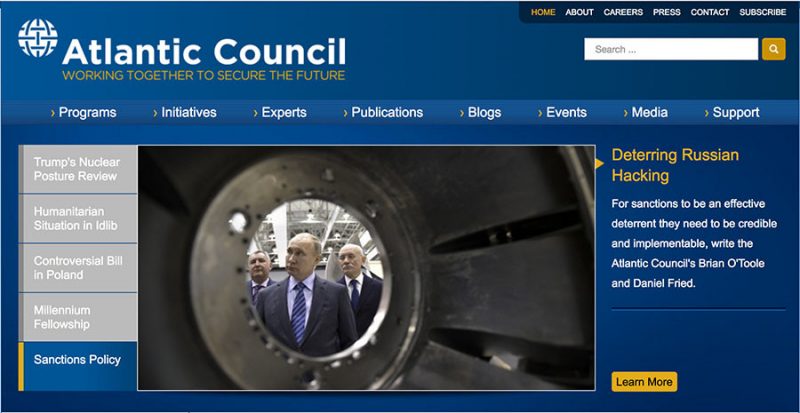
What does it do? Promotes the idea of Russia being an existential threat to Europe and the US, in order to justify NATO’s reason for being.

Who are its people? The Atlantic Council’s list of lobbyists (sorry, ‘Fellows’!) reads like a telephone directory of the Russia bashing world. For instance, Dmitri Alperovitch (of Crowdstrike, which conveniently alleges how Russia hacked the Democratic National Congress) is joined by the perennially- wrong Anders Aslund, who has predicted Russia’s impending collapse on a number of occasions and has, obviously, been off the mark. Then there’s Joe Biden’s “Russia hand,” Michael Carpenter and their recent co-authored Foreign Affairs piece suggests he actually knows very little about the country). Meanwhile, Evelyn Farkas, a fanatical Russophobe who served in Barack Obama’s administration has also found a home here. Another interesting Atlantic Council lobbyist is Eliot Higgins, a “geolocation expert” who has made a career out of spinning tales from the Ukraine and Syrian wars but is, naturally, mostly disinterested in covering Iraq and Yemen, where the US and its allies are involved, but Russia has no particular stake. Lastly, we can’t forget CNN’s Michael Weiss, the self-declared “Russia analyst” who, by all accounts, has never been to Russia and can’t speak Russian.

Who pays for it? The Atlantic Council has quite an eclectic bunch of patrons to serve. NATO itself is a big backer, along with military contractors Saab, Lockheed Martin and the Raytheon Company, all of which naturally benefit from increased tensions with Moscow. The UK Foreign Office also splashes the cash and is joined by the Ukrainian World Congress and the US Department of State. Other sugar daddies include the US military (via separate contributions from the Air Force, Navy, Army and Marine Corps), Northrop Grumman and Boeing.

  • The Center for European Policy Analysis (CEPA)

Founded: 2005

What is it? Despite the name, CEPA is based in Washington, not the ‘old continent’, but it does have an outpost in Warsaw. This club specifically focusses on Central and Eastern Europe and promoting the US Army and foreign policy establishment’s agenda there. Or, in its own words, creating a “Central and Eastern Europe with close and enduring ties to the United States.”
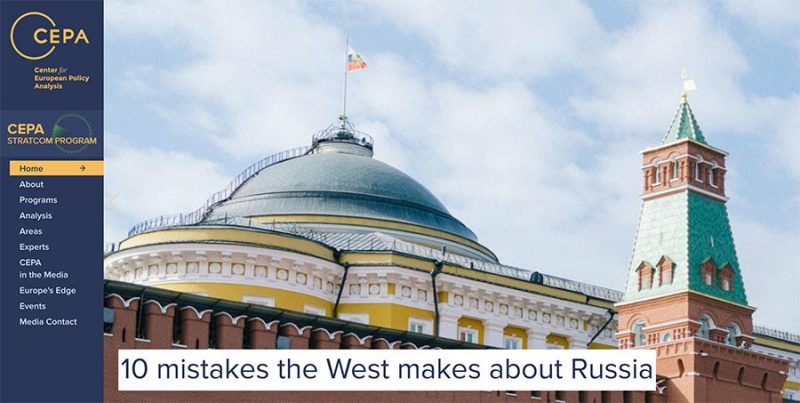
 

What does it do? CEPA amounts to a home for media figures who devote their careers to opposing Russia. It whips up tensions, even when they don’t really exist, presumably in order to drum up business for its sponsors, who are heavily drawn from the military industry. For example, it spent last year hyping up the ‘threat’ from Russia’s and Belarus’ joint ‘Zapad’ exercises, even running a sinister-looking countdown clock before the long-planned training commenced.

CEPA grossly overestimated the size of the event, saying it “could be the largest military exercise since the end of the Cold War” and dismissing basically all Moscow’s statements on its actual nature as “disinformation.”

Who are its people? Times of London columnist Edward Lucas has been part of CEPA for years.

The dedicated ‘Cold Warrior’ doesn’t appear to have spent much time in Russia for a long while and still seems to view the country through a prism which is very much rooted in the past. Thus, he’s more-or-less an out-of-touch dinosaur when it comes to Russia expertise. He will soon be joined by Brian Whitmore, who comes on board from RFE/RL and appears to be even more ill-informed than Lucas. His broadcasts for the US state broadcaster led to him being described as the “Lord Haw Haw of Prague,” where has been based for some years. CEPA is a pretty fluid organization and, until recently, Anne Applebaum and Peter Pomerantsev were also on its list of lobbyists. The former is a Polish-American Washington Post columnist who obsessively denigrates Russia and the latter has previously worked with the Atlantic Council’s Michael Weiss, which shows you how small and incestuous the Russia-bashing world is.

Who pays for it? While other think tanks at least try to make their funding look semi-organic, CEPA looks to have zero hang-ups about its role as a mouthpiece for defence contractors. Which is, at least, honest. FireEye, Lockheed Martin, Raytheon, Bell Helicopters and BAE systems pump funds in and they are joined by the US State Department and the Department of Defence. Another notable paymaster is the National Endowment for Democracy – ‘regime change’ experts who are surely interested in CEPA’s remit to also cover Belarus. The US Mission to NATO and NATO’s own Public Diplomacy Division also provide cash.

  • German Marshall Fund of the United States

Founded: 1972

What is it? Don’t be fooled by the name, the German Marshall Fund (GMF) is a very American body these days with little input from Berlin. It was founded by a donation from Willy Brandt’s Bonn-government to celebrate the 25th anniversary of the Marshall Plan. Ironically, Brandt is today best remembered as the father of ‘Ostpolitik’, which sought a rapprochement between Germany and Russia.

What does it do? After the fall of the Soviet Union, the GMF transformed into a vehicle promoting US influence in Eastern Europe, with outreaches in Warsaw, Belgrade and Bucharest. However, in the past 12 months, it’s taken a very strange turn. Following the election of US President Donald Trump (ironically a German-American), the lobby group launched the Alliance for Securing Democracy (ASD) project. Its centerpiece is the ‘Hamilton 68 Dashboard’, which seems to classify social media users which reject the US liberal elite’s consensus as “Russian trolls.” The reaction has been highly critical, with even the secretly-funded Russian opposition website Meduza asking “how do you identify ‘pro-Russian amplifiers’ if… themes dovetail with alternative American political views?”

Who are its people? The GMF, especially through its new ASD plaything, has a high-profile bunch of lobbyists. They include Toomas Ilves, an American-raised son of Estonian emigrants who once headed the Estonian desk at erstwhile CIA cut-out Radio Free Europe and eventually became president of Estonia. Also on board is Bill Kristol, known as the ‘architect of the Iraq War’ and former CIA Director Michael Morrell. Former US Ambassador to Russia Michael McFaul, who recently announced he was partially abandoning his Russian scholarship and has “lost interest in maintaining my (sic) ability to speak/write Russian” is another team member.

After serving on Obama’s team, McFaul has re-invented himself as a network TV personality since 2016 with 280,000 Twitter followers, 106,000 of which are fake, according to Twitter audit.

Who pays for it? USAID are big backers, throwing in a seven-figure annual sum. This, of course, raises some questions about US taxpayers essentially funding the Hamilton 68 dashboard, which may be smearing Americans who don’t agree with their government’s policies as Russian agents. The State Department also ponies up capital, as does NATO and Latvia’s Defense Ministry. Other interesting paymasters are George Soros, Airbus and Google. While Boeing and the ubiquitous Raytheon are also involved.

  • Institute for the Study of War

Founded: 2007

What is it? This lobby group could as easily be titled ‘The Institute for the Promotion of War’. Unlike the others, it doesn’t consider Russia its primary target, instead preferring to push for more conflict in the Middle East. However, Moscow’s increased influence in that region has brought the Kremlin into its crosshairs.

What does it do? The IFTSOW agitates for more and more American aggression. It supported the Iraq ‘surge’ and has encouraged more involvement in Afghanistan. IFTSOW also focuses on Syria, Libya and Iran. Just last week, one of its lobbyists, Jennifer Cafarella,  called for the US military to take Damascus, which would bring Washington into direct conflict with Russia and Iran.

Who are its people? Kimberly Kagan is the brains behind this operation. She’s married to Frederick Kagan, who was involved in the neocon ‘Project for the New American Century’ group along with his brother, Robert Kagan. Which makes Kimberly the sister-in-law of Victoria “f**k the EU” Nuland.

Another lobbyist is Ukrainian Natalia Bugayova, who was involved in Kiev’s 2014 EuroMaidan coup. She previously worked for the Kiev Post, a resolutely anti-Russian newspaper which promotes US interests in Ukraine. However, IFTSOW’s most notorious lobbyist was Elizabeth O’Bagy, who emerged as a ‘Syria expert’ in 2013 and called for American political leaders to send heavy weaponry to Syrian insurgent groups. She claimed to have a PhD from Georgetown University in Washington, DC, but this was fictional and once the media twigged to it, she was dismissed by the IFTSOW. Two weeks later, she was rewarded for her deception by falling up to a job with fanatical Russophobe Senator John McCain. O’Bagy has also collaborated with the Atlantic Council’s Michael Weiss, which is further evidence of how tight-knit the world of US neoconservative advocacy really is.

Who pays for it? Predictably, Raytheon has opened its wallet. Meanwhile, other US military contractors like General Dynamics and DynCorp are also involved. L3, which provides services to the US Department of Defense, Department of Homeland Security, and government intelligence agencies is another backer along with Vencore, CACI and Mantech.

February 6, 2018 Posted by | Mainstream Media, Warmongering, Militarism, Russophobia, Timeless or most popular | , , , , , , , , , | 1 Comment

US Senators Urge to Prevent Alleged ‘Russian Meddling’ in Mexico’s Election

Sputnik – February 1, 2018

WASHINGTON – The Trump administration should take steps to deter alleged Russian interference in the upcoming presidential election in Mexico and other parts of the Western Hemisphere, US Senators Tim Kaine, Marco Rubio and Robert Menendez said in a letter to Secretary of State Rex Tillerson and USAID Administrator Mark Green.

“We are deeply troubled by recent news articles that Russia is reportedly using sophisticated technology to meddle in Mexico’s upcoming election,” the letter said on Wednesday. “As such, we believe it is critical that USAID continue to play an active role in providing technical assistance, education and training to support countries’ efforts to strengthen electoral systems.”

The lawmakers fear Russia’s alleged actions in the region will cause instability, especially as six contentious presidential elections will take place this year in the Western Hemisphere, including in Brazil and Colombia, the letter said.

Tillerson is set to visit Mexico City on Friday to meet with Mexican Foreign Minister Luis Videgaray and Canadian Foreign Affairs Minister Chyrstia Freeland for talks on regional issues.

Russian ambassador to Mexico Eduard Malayan earlier this month dismissed rumors about Russia’s “interference” in Mexico’s forthcoming election as “nonsense.”

Russia has faced numerous accusations of meddling in elections since the 2016 US presidential vote in which then-Republican candidate Donald Trump claimed victory against the odds. The US intelligence community alleged that Trump’s campaign team colluded with the Kremlin to bring him victory in the election.

Similar accusations followed France’s presidential election, Spain’s Catalan referendum and the United Kingdom’s Brexit vote.

Russian officials have repeatedly refuted such accusations. Kremlin spokesman Dmitry Peskov has called the claims groundless. Russian Foreign Minister Sergey Lavrov has stressed that the accusations of Russia meddling in the elections of foreign states were unsubstantiated.

READ ALSO:

CIA Prediction of Russian Meddling in US Midterm Elections ‘Nonsense’

February 1, 2018 Posted by | Russophobia | , , , , , | 1 Comment

The condensed case against the White Helmet imposters in Syria

Vanessa Beeley | January 26, 2018

A reading of the evidence presented by Vanessa Beeley regarding the UK FCO & USAID multi-million-financed White Helmet organisation embedded with terrorist factions inside Syria, also funded by the same hostile governments.

White Helmet archives: http://21stcenturywire.com/tag/White-…

January 27, 2018 Posted by | Deception, Fake News, Mainstream Media, Warmongering, Timeless or most popular, Video, War Crimes | , , , | Leave a comment

Bolivia’s TIPNIS Dispute: How Liberal-Left Alternative Media Becomes a Conveyor Belt for US Regime Change Propaganda

Chicago ALBA Solidarity / November 30, 2017

As has become a standard operating procedure, an array of Western environmental NGOs, advocates of indigenous rights and liberal-left alternative media cover up the US role in attempts to overturn the anti-imperialist and anti-neoliberal governments of Rafael Correa in Ecuador[1] and Evo Morales in Bolivia.

This NACLA article[2] provides an excellent example. Bolivia’s TIPNIS (Territorio Indígena y Parque Nacional Isiboro Secure) dispute arose over the Evo Morales government’s project to complete a road through the park, opposed by some indigenous and environmental groups.

As is NACLA modus operandi, the article says not one word about US and rightwing funding and coordination with the indigenous and environmental groups behind the TIPNIS anti-highway protests. (This does not delegitimize the protests, but it does deliberately mislead people about the issues involved).

In doing so, these kinds of articles cover up US interventionist regime change plans, be that their intention or not.

NACLA is not alone in what is in fact apologetics for US interventionism. Include the Guardian, UpsideDownWorld, [3] Amazon Watch, so-called “Marxist” Jeffery Weber,[4] Jacobin, ROAR, [5] Intercontinentalcry, Avaaz, In These Times, in a short list of examples. We can add to this simply by picking up any articles about oil drilling in Ecuador’s Yasuni during Rafael Correa’s presidency, or the protests in Bolivia’s TIPNIS and see what they say about US funding of protests, if they even mention it.

This is not simply an oversight, it is a cover-up.

What this Liberal Left Media Covers Up

On the issue of the TIPNIS highway, we find on numerous liberal-left alternative media and environmental websites claiming to defend the indigenous concealing that:

  1. The leading indigenous group of the TIPNIS 2011-2012 protests was being funded by USAID. The Confederation of Indigenous Peoples of the Bolivian East (CIDOB) had no qualms about working with USAID — it boasted on its website that it received training programs from USAID. CIDOB president Adolfo Chavez, thanked the “information and training acquired via different programs financed by external collaborators, in this case USAID”. [6]
  1. The 2011 TIPNIS march was coordinated with the US Embassy, specifically Eliseo Abelo. His phone conversations with the march leaders – some even made right before the march set out — were intercepted by the Bolivian counter-espionage agency and made public.[7]
  1. “The TIPNIS marchers were openly supported by right wing Santa Cruz agrobusiness interests and their main political representatives, the Santa Cruz governorship and Santa Cruz Civic Committee.” [8] In June 2011 indigenous deputies and right wing parties in the Santa Cruz departmental council formed an alliance against the MAS (Movement for Socialism, Evo Morales’s party). CIDOB then received a $3.5 million grant by the governorship for development projects in its communities.
  1. Over a year after the TIPNIS protests, one of the protest leaders announced he was joining a rightwing anti-Evo Morales political party.[9]
  1. The protest leaders of the TIPNIS march supported REDD (Reduce Emissions from Deforestation and Degradation). The Avaaz petition (below) criticizing Evo Morales for his claimed anti-environmental actions also covered this up. As far back as 2009 “CIDOB leaders were participating there in a USAID-promoted workshop to talk up the imperialist-sponsored REDD project they were pursuing together with USAID-funded NGOs.” [10]

REDD was a Western “environmental” program seeking to privatize forests by converting them into “carbon offsets” that allow Western corporations to continue polluting. That REDD would give Western NGOs and these indigenous groups funds for monitoring forests in their areas.

  1. These liberal-left alternative media and environmental NGOs falsely presented the TIPNIS conflict as one between indigenous/environmentalist groups against the Evo Morales government. (e.g. the TIPNIS highway was “a project universally[!] condemned by local indigenous tribes and urban populations alike”)[11] Fred Fuentes pointed out that more than 350 Bolivian organizations, including indigenous organizations and communities, even within TIPNIS, supported the proposed highway.

CONISUR (Consejo de Indígenas del Sur), consisting of a number of indigenous and peasant communities within TIPNIS, backed by Bolivia’s three largest national indigenous campesino organizations, organized a march to support of the road. They argued that the highway is essential to integrating Bolivia’s Amazonia with the rest of the country, as well as providing local communities with access to basic services and markets. [12]

The overwhelming majority of people in the West who know about the TIPNIS protests, or the Yasuni protests in Ecuador, where a similar division between indigenous groups took place, never learned either from the liberal-left media or the corporate media, that indigenous groups marched in support of the highway or in support of oil drilling.

  1. The TIPNIS conflict is falsely presented as Evo Morales wanting to build a highway through the TIPNIS wilderness (“cutting it in half” as they dramatically claim). There are in fact two roads that exist there now, which will be paved and connected to each other. Nor was it wilderness: 20,000 settlers lived there by 2010.[13]
  1. Anti- highway march leaders actually defended industrial-scale logging within TIPNIS. Two logging companies operated 70,000 hectares within the national park and have signed 20-year contracts with local communities.[14]
  1. They often fail to note that the TIPNIS marchers, when they reached La Paz, sought to instigate violence, demanding Evo Morales removal. Their plot was blocked by mobilization of local indigenous supporters of Evo’s government.

If we do not read Fred Fuentes in Green Left Weekly, we don’t find most of this information. Now, it is true that some of the media articles did mention that there were also TIPNIS protests and marches demanding the highway be built. Some do mention USAID, but phrase it as “Evo Morales claimed that those protesting his highway received USAID funding.”

Avaaz Petition Attacking Evo Morales over TIPNIS

The TIPNIS campaign, which became a tool in the US regime change strategy, was taken up in a petition by Avaaz. It included 61 signing groups. Only two from Bolivia! US signers included Amazon Watch, Biofuelwatch, Democracy Center, Food and Water Watch, Global Exchange, NACLA, Rainforest Action Network.[15]  Whether they knew it, whether they wanted to know it, they signed on to a false account of the TIPNIS conflict, placed the blame on the Bolivian government, target of US regime change, and hid the role of the US.US collaborators in Bolivia and Ecuador are painted as defenders of free expression, defenders of nature, defenders of the indigenous. The US government’s “talking points” against the progressive ALBA bloc countries have worked their way into liberal-left alternative media, which echo the attacks on these governments by organizations there receiving US funds.  That does not mean Amazon Watch, Upside Down World or NACLA are themselves funded by the US government – if it somehow exculpates them that they do this work for free. Even worse, much of this propaganda against Evo and Correa appears only in the liberal-left alternative press, what we consider our press.

The USAID budget for Latin America is said to be $750 million, but estimates show that the funding may total twice that. [16] Maria Augusta Calle of Ecuador’s National Assembly, said in 2015 the US Congress allocated $2 billion to destabilize targeted Latin American countries.[17]

This information, how much money it is, what organizations in the different countries receive it, how it is spent, ought to be a central focus of any liberal-left alternative media purporting to stand up for the oppressed peoples of the Americas.

Yet, as Fuentes points out:  “Overwhelmingly, solidarity activists uncritically supported the anti-highway march. Many argued that only social movements — not governments — can guarantee the success of [Bolivia’s] process of change…. with most articles written by solidarity activists, [they] downplay the role of United States imperialism…. Others went further, denying any connection between the protesters and US imperialism.”[18]

Why do they let themselves become conveyer belts for US regime change propaganda?

Why did this liberal-left media and NGOs let themselves become conveyer belts for US propaganda for regime change, legitimizing this US campaign to smear the Evo Morales government?

Some of it lies in the liberalish refusal to admit that all international issues can only be understood in the context of the role and the actions of the US Empire. As if conflicts related to countries the US deems hostile to its interests can be understood without taking the US role into account. Some liberal-left writers and groups do understand this, just as they do understand they may risk their positions and funding by looking to closely into it.

It seems easier to not see the role the Empire plays and simply present a liberal-left “critique” of the pluses and minuses of some progressive government targeted by the US. That is how these alternative media sources end up actually advocating for indigenous groups and environmental NGOs which are US and corporate funded. They even criticize countries for defending national sovereignty by shutting down these non-governmental organizations, what Bolivian Vice-President Linera exposes as “foreign government financed organizations” operating in their countries.

Some of it lies in the widely held anti-authoritarian feeling in the US that social movements “from below” are inherently good and that the government/the state is inherently bad. The reporting can be informative on social movements in Honduras, Guatemala, Mexico, Colombia where the people struggle against state repression. But when these social movements in Ecuador or Bolivia were able to win elections and gain hold of some real state power, reporting soon becomes hostile and misleading. “Support social movements when they struggle against governmental power; oppose them once they win government power,” they seem to say. Their reporting slides into disinformation, undermining our solidarity with other struggles, and covering up US regime change efforts. UpsideDownWorld is an excellent example of this.

Some of it lies in what many who call themselves “left” still have not come to terms with: their own arrogant white attitude they share with Western colonizers and present day ruling elites: we know better than you what is good for you, we are the best interpreters and defenders of your socialism, your democracy, your human rights. They repeatedly critique real or imagined failures of progressive Third World governments – targets of the US.

Genuine solidarity with the peoples of the Third World means basing yourself in opposition to the Empire’s interference and exposing how it attempts to undermine movements seeking to break free from the Western domination.

Some of it lies in deep-rooted white racist paternalism in their romanticizing the indigenous as some “noble savage” living at one with nature, in some Garden of Eden. Providing these people with schools, health clinics, modern conveniences we have, is somehow felt not to be in their best interests.

A serious analysis of a Third World country must begin with the role the West has played. To not point out imperialism’s historic and continuing exploitive role is simply dishonest, it is apologetics, it shows a basic lack of human feeling for the peoples of the Third World.

A function of corporate media is to conceal Western pillaging of Third World countries, to cheerlead efforts to restore neocolonial-neoliberal governments to power. However, for liberal-left media and organizations to do likewise, even if halfway, is nothing other than supporting imperialist interference.

[1] https://www.counterpunch.org/2016/02/16/propaganda-as-news-ecuador-sells-out-indigenous-tribes-and-the-environment-to-china/

[2] https://nacla.org/blog/2017/08/22/why-evo-morales-reviving-bolivia%E2%80%99s-controversial-tipnis-road

[3] http://upsidedownworld.org/main/bolivia-archives-31/4864-bolivias-conamaq-indigenous-movement-we-will-not-sell-ourselves-to-any-government-or-political-party

[4] https://mronline.org/2011/08/20/separating-fact-from-fantasy-in-bolivia-a-review-of-jeffery-r-webbers-from-rebellion-to-reform-in-bolivia/

http://www.wrongkindofgreen.org/2012/03/28/the-morales-government-neoliberalism-in-disguise/

[5] https://roarmag.org/essays/bolivia-authoritarianism-mas-elections/

[6] Fred Fuentes, Bolivia: Solidarity activists need to support revolutionary process; Rumble over jungle far from over http://links.org.au/node/2611

[7]   http://www.strategic-culture.org/news/2012/09/26/end-to-usaid-spying-looms-in-latin-america.html

[8] http://www.wrongkindofgreen.org/2012/03/28/the-morales-government-neoliberalism-in-disguise/

[9] http://www.la-razon.com/nacional/Pedro-Nuni-lideres-regionales-proyecto_0_1946805357.html

[10] http://www.wrongkindofgreen.org/2012/03/28/the-morales-government-neoliberalism-in-disguise/

[11] http://www.coha.org/corrupted-idealism-bolivias-compromise-between-development-and-the-environment/

[12] http://www.wrongkindofgreen.org/2012/03/28/the-morales-government-neoliberalism-in-disguise/

[13] Linda C.  Farthing, Benjamin H. Kohl Evo’s Bolivia: Continuity and Change (2014: 52)

[14] http://links.org.au/node/2611

[15] http://amazonwatch.org/news/2011/0921-appeal-to-bolivian-president-evo-morales-protect-the-rights-of-the-indigenous-peoples-of-tipnis

[16] http://www.globalresearch.ca/usaid-spying-in-latin-america/5306679

[17] http://www.hispantv.com/noticias/ecuador/37659/eeuu-destino-$2000-millones-para-desestabilizar-america-latina

[18] http://links.org.au/node/2611

November 30, 2017 Posted by | Deception, Economics, Environmentalism | , , , , , , , , | Leave a comment

Learning to Love McCarthyism

By Robert Parry | Consortium News | November 6, 2017

The New York Times has finally detected some modern-day McCarthyism, but not in the anti-Russia hysteria that the newspaper has fueled for several years amid the smearing of American skeptics as “useful idiots” and the like. No, the Times editors are accusing a Long Island Republican of McCarthyism for linking his Democratic rival to “New York City special interest groups.” As the Times laments, “It’s the old guilt by association.”

Yet, the Times sees no McCarthyism in the frenzy of Russia-bashing and guilt by association for any American who can be linked even indirectly to any Russian who might have some ill-defined links to Russian President Vladimir Putin.

On Monday, in the same edition that expressed editorial outrage over that Long Island political ad’s McCarthyism, the Times ran two front-page articles under the headline: “A Complex Paper Trail: Blurring Kremlin’s Ties to Key U.S. Businesses.”

The two subheads read: “Shipping Firm Links Commerce Chief to Putin ‘Cronies’” and “Millions in Facebook Shares Rooted in Russian Cash.” The latter story, which meshes nicely with the current U.S. political pressure on Facebook and Twitter to get in line behind the New Cold War against Russia, cites investments by Russian Yuri Milner that date back to the start of the decade.

Buried in the story’s “jump” is the acknowledgement that Milner’s “companies sold those holdings several years ago.” But such is the anti-Russia madness gripping the Establishment of Washington and New York that any contact with any Russian constitutes a scandal worthy of front-page coverage. On Monday, The Washington Post published a page-one article entitled, “9 in Trump’s orbit had contacts with Russians.”

The anti-Russian madness has reached such extremes that even when you say something that’s obviously true – but that RT, the Russian television network, also reported – you are attacked for spreading “Russian propaganda.”

We saw that when former Democratic National Committee chairwoman Donna Brazile disclosed in her new book that she considered the possibility of replacing Hillary Clinton on the Democratic ticket after Clinton’s public fainting spell and worries about her health.

Though there was a video of Clinton’s collapse on Sept. 11, 2016, followed by her departure from the campaign trail to fight pneumonia – not to mention her earlier scare with blood clots – the response from a group of 100 Clinton supporters was to question Brazile’s patriotism: “It is particularly troubling and puzzling that she would seemingly buy into false Russian-fueled propaganda, spread by both the Russians and our opponents about our candidate’s health.”

In other words, the go-to excuse for everything these days is to blame the Russians and smear anyone who says anything – no matter how true – if it also was reported on RT.

Pressing the Tech Companies

Just as Sen. Joe McCarthy liked to haul suspected “communists” and “fellow-travelers” before his committee in the 1950s, the New McCarthyism has its own witch-hunt hearings, such as last week’s Senate grilling of executives from Facebook, Twitter and Google for supposedly allowing Russians to have input into the Internet’s social networks.

Trying to appease Congress and fend off threats of government regulation, the rich tech companies displayed their eagerness to eradicate any Russian taint.

Twitter’s general counsel Sean J. Edgett told the Senate Judiciary subcommittee on crime and terrorism that Twitter adopted an “expansive approach to defining what qualifies as a Russian-linked account.”

Edgett said the criteria included “whether the account was created in Russia, whether the user registered the account with a Russian phone carrier or a Russian email address, whether the user’s display name contains Cyrillic characters, whether the user frequently Tweets in Russian, and whether the user has logged in from any Russian IP address, even a single time. We considered an account to be Russian-linked if it had even one of the relevant criteria.”

The trouble with Twitter’s methodology was that none of those criteria would connect an account to the Russian government, let alone Russian intelligence or some Kremlin-controlled “troll farm.” But the criteria could capture individual Russians with no link to the Kremlin as well as people who weren’t Russian at all, including, say, American or European visitors to Russia who logged onto Twitter through a Moscow hotel.

Also left unsaid is that Russians are not the only national group that uses the Cyrillic alphabet. It is considered a standard script for writing in Belarus, Bulgaria, Macedonia, Serbo-Croatia and Ukraine. So, for instance, a Ukrainian using the Cyrillic alphabet could end up falling into the category of “Russian-linked” even if he or she hated Putin.

Twitter’s attorney also said the company conducted a separate analysis from information provided by unidentified “third party sources” who pointed toward accounts supposedly controlled by the St. Petersburg-based Internet Research Agency (IRA), totaling 2,752 accounts. The IRA is typically described in the U.S. press as a “troll farm” which employs tech-savvy employees who combat news and opinions that are hostile to Russia and the Russian government. But exactly how those specific accounts were traced back to this organization was not made clear.

And, to put that number in some perspective, Twitter claims 330 million active monthly users, which makes the 2,752 accounts less than 0.001 percent of the total.

The Trouble with ‘Trolling’

While the Russia-gate investigation has sought to portray the IRA effort as exotic and somehow unique to Russia, the strategy is followed by any number of governments, political movements and corporations – sometimes using enthusiastic volunteers but often employing professionals skilled at challenging critical information or at least muddying the waters.

Those of us who operate on the Internet are familiar with harassment from “trolls” who may use access to “comment” sections to inject propaganda and disinformation to sow confusion, to cause disruption, or to discredit the site by promoting ugly opinions and nutty conspiracy theories.

As annoying as this “trolling” is, it’s just a modern version of more traditional strategies used by powerful entities for generations – hiring public-relations specialists, lobbyists, lawyers and supposedly impartial “activists” to burnish images, fend off negative news and intimidate nosy investigators. In this competition, modern Russia is both a late-comer and a piker.

The U.S. government fields legions of publicists, propagandists, paid journalists, psy-ops specialists, contractors and non-governmental organizations to promote Washington’s positions and undermine rivals through information warfare.

The CIA has an entire bureaucracy dedicated to propaganda and disinformation, with some of those efforts farmed out to newer entities such as the National Endowment for Democracy (NED) or paid for by the U.S. Agency for International Development (USAID). NATO has a special command in Latvia that undertakes “strategic communications.”

Israel is another skilled player in this field, tapping into its supporters around the world to harass people who criticize the Zionist project. Indeed, since the 1980s, Israel has pioneered many of the tactics of computer spying and sabotage that were adopted and expanded by America’s National Security Agency, explaining why the Obama administration teamed up with Israel in a scheme to plant malicious code into Iranian centrifuges to sabotage Iran’s nuclear program.

It’s also ironic that the U.S. government touted social media as a great benefit in advancing so-called “color revolutions” aimed at “regime change” in troublesome countries. For instance, when the “green revolution” was underway in Iran in 2009 after the reelection of President Mahmoud Ahmadinejad, the Obama administration asked Twitter to postpone scheduled maintenance so the street protesters could continue using the platform to organize against Ahmadinejad and to distribute their side of the story to the outside world.

During the so-called Arab Spring in 2011, Facebook, Twitter and Skype won praise as a means of organizing mass demonstrations to destabilize governments in Tunisia, Egypt and Syria. Back then, the U.S. government denounced any attempts to throttle these social media platforms and the free flow of information that they permitted as proof of dictatorship.

Social media also was a favorite of the U.S. government in Ukraine in 2013-14 when the Maidan protests exploited these platforms to help destabilize and ultimately overthrow the elected government of Ukraine, the key event that launched the New Cold War with Russia.

Swinging the Social Media Club

The truth is that, in those instances, the U.S. governments and its agencies were eagerly exploiting the platforms to advance Washington’s geopolitical agenda by disseminating American propaganda and deploying U.S.-funded non-governmental organizations, which taught activists how to use social media to advance “regime change” scenarios.

While these uprisings were sold to Western audiences as genuine outpourings of public anger – and there surely was some of that – the protests also benefited from U.S. funding and expertise. In particular, NED and USAID provided money, equipment and training for anti-government operatives challenging regimes in U.S. disfavor.

One of the most successful of these propaganda operations occurred in Syria where anti-government rebels operating in areas controlled by Al Qaeda and its fellow Islamic militants used social media to get their messaging to Western mainstream journalists who couldn’t enter those sectors without fear of beheading.

Since the rebels’ goal of overthrowing President Bashar al-Assad meshed with the objectives of the U.S. government and its allies in Israel, Turkey, Saudi Arabia and the Gulf states, Western journalists uncritically accepted the words and images provided by Al Qaeda’s collaborators.

The success of this propaganda was so extraordinary that the White Helmets, a “civil defense” group that worked in Al Qaeda territory, became the go-to source for dramatic video and even was awarded the short-documentary Oscar for an info-mercial produced for Netflix – despite evidence that the White Helmets were staging some of the scenes for propaganda purposes.

Indeed, one argument for believing that Putin and the Kremlin might have “meddled” in last year’s U.S. election is that they could have felt it was time to give the United States a taste of its own medicine.

After all, the United States intervened in the 1996 Russian election to ensure the continued rule of the corrupt and pliable Boris Yeltsin. And there were the U.S.-backed street protests in Moscow against the 2011 and 2012 elections in which Putin strengthened his political mandate. Those protests earned the “color” designation the “snow revolution.”

However, whatever Russia may or may not have done before last year’s U.S. election, the Russia-gate investigations have always sought to exaggerate the impact of that alleged “meddling” and molded the narrative to whatever weak evidence was available.

The original storyline was that Putin authorized the “hacking” of Democratic emails as part of a “disinformation” operation to undermine Hillary Clinton’s candidacy and to help elect Donald Trump – although no hard evidence has been presented to establish that Putin gave such an order or that Russia “hacked” the emails. WikiLeaks has repeatedly denied getting the emails from Russia, which also denies any meddling.

Further, the emails were not “disinformation”; they were both real and, in many cases, newsworthy. The DNC emails provided evidence that the DNC unethically tilted the playing field in favor of Clinton and against Sen. Bernie Sanders, a point that Brazile also discovered in reviewing staffing and financing relationships that Clinton had with the DNC under the prior chairwoman, Debbie Wasserman Schultz.

The purloined emails of Clinton campaign chairman John Podesta revealed the contents of Clinton’s paid speeches to Wall Street (information that she was trying to hide from voters) and pay-to-play features of the Clinton Foundation.

A Manchurian Candidate?

Still, the original narrative was that Putin wanted his Manchurian Candidate (Trump) in the White House and took the extraordinary risk of infuriating the odds-on favorite (Clinton) by releasing the emails even though they appeared unlikely to prevent Clinton’s victory. So, there was always that logical gap in the Russia-gate theory.

Since then, however, the U.S. mainstream narrative has shifted, in part, because the evidence of Russian election “meddling” was so shaky. Under intense congressional pressure to find something, Facebook reported $100,000 in allegedly “Russian-linked” ads purchased in 2015-17, but noted that only 44 percent were bought before the election. So, not only was the “Russian-linked” pebble tiny – compared to Facebook’s annual revenue of $27 billion – but more than half of the pebble was tossed into this very large lake after Clinton had already lost.

So, the storyline was transformed into some vague Russian scheme to exacerbate social tensions in the United States by taking different sides of hot-button issues, such as police brutality against blacks. The New York Times reported that one of these “Russian-linked” pages featured photos of cute puppies, which the Times speculated must have had some evil purpose although it was hard to fathom. (Oh, those devious Russians!).

The estimate of how many Americans may have seen one of these “Russian-linked” ads also keeps growing, now up to as many as 126 million or about one-third of the U.S. population. Of course, the way the Internet works – with any item possibly going viral – you might as well say the ads could have reached billions of people.

Whenever I write an article or send out a Tweet, I too could be reaching 126 million or even billions of people, but the reality is that I’d be lucky if the number were in the thousands. But amid the Russia-gate frenzy, no exaggeration is too outlandish or too extreme.

Another odd element of Russia-gate is that the intensity of this investigation is disproportionate to the lack of interest shown toward far better documented cases of actual foreign-government interference in American elections and policymaking.

For instance, the major U.S. media long ignored the extremely well-documented case of Richard Nixon colluding with South Vietnamese officials to sabotage President Lyndon Johnson’s Vietnam War peace talks to gain an advantage for Nixon in the 1968 election. That important chapter of history only gained The New York Times’ seal of approval earlier this year after the Times had dismissed the earlier volumes of evidence as “rumors.”

In the 1980 election, Ronald Reagan’s team – especially his campaign director William Casey in collaboration with Israel and Iran – appeared to have gone behind President Jimmy Carter’s back to undercut Carter’s negotiations to free 52 American hostages then held in Iran and essentially doom Carter’s reelection hopes.

There were a couple of dozen witnesses to that scheme who spoke with me and other investigative journalists – as well as documentary evidence showing that President Reagan did authorize secret arms shipments to Iran via Israel shortly after the hostages were freed during Reagan’s inauguration on Jan. 20, 1981.

However, since Vice President (later President) George H.W. Bush, who was implicated in the scheme, was well-liked on both sides of the aisle and because Reagan had become a Republican icon, the October Surprise case of 1980 was pooh-poohed by the major media and dismissed by a congressional investigation in the early 1990s. Despite the extraordinary number of witnesses and supporting documents, Wikipedia listed the scandal as a “conspiracy theory.”

Israeli Influence

And, if you’re really concerned about foreign interference in U.S. elections and policies, there’s the remarkable influence of Israel and its perceived ability to effect the defeat of almost any politician who deviates from what the Israeli government wants, going back at least to the 1980s when Sen. Chuck Percy and Rep. Paul Findley were among the political casualties after pursuing contacts with the Palestinians.

If anyone doubts how Israeli Prime Minister Benjamin Netanyahu has continued to pull the strings of U.S. politicians, just watch one of his record-tying three addresses to joint sessions of Congress and count how often Republicans and Democrats jump to their feet in enthusiastic applause. (The only other foreign leader to get the joint-session honor three times was Great Britain’s Prime Minister Winston Churchill.)

So, what makes Russia-gate different from the other cases? Did Putin conspire with Trump to extend a bloody war as Nixon did with the South Vietnamese leaders? Did Putin lengthen the captivity of U.S. hostages to give Trump a political edge? Did Putin manipulate U.S. policy in the Middle East to entice President George W. Bush to invade Iraq and set the region ablaze, as Israel’s Netanyahu did? Is Putin even now pushing for wider Mideast wars, as Netanyahu is?

Indeed, one point that’s never addressed in any serious way is why is the U.S. so angry with Russia while these other cases, in which U.S. interests were clearly damaged and American democracy compromised, were treated largely as non-stories.

Why is Russia-gate a big deal while the other cases weren’t? Why are opposite rules in play now – with Democrats, many Republicans and the major news media flogging fragile “links,” needling what little evidence there is, and assuming the worst rather than insisting that only perfect evidence and perfect witnesses be accepted as in the earlier cases?

The answer seems to be the widespread hatred for President Trump combined with vested interests in favor of whipping up the New Cold War. That is a goal valued by both the Military-Industrial Complex, which sees trillions of dollars in strategic weapons systems in the future, and the neoconservatives, who view Russia as a threat to their “regime change” agendas for Syria and Iran.

After all, if Russia and its independent-minded President Putin can be beaten back and beaten down, then a big obstacle to the neocon/Israeli goal of expanding the Mideast wars will be removed.

Right now, the neocons are openly lusting for a “regime change” in Moscow despite the obvious risks that such turmoil in a nuclear-armed country might create, including the possibility that Putin would be succeeded not by some compliant Western client like the late Boris Yeltsin but by an extreme nationalist who might consider launching a nuclear strike to protect the honor of Mother Russia.

The Democrats, the liberals and even many progressives justify their collusion with the neocons by the need to remove Trump by any means necessary and “stop fascism.” But their contempt for Trump and their exaggeration of the “Hitler” threat that this incompetent buffoon supposedly poses have blinded them to the extraordinary risks attendant to their course of action and how they are playing into the hands of the war-hungry neocons.

A Smokescreen for Repression

There also seems to be little or no concern that the Establishment is using Russia-gate as a smokescreen for clamping down on independent media sites on the Internet. Traditional supporters of civil liberties have looked the other way as the rights of people associated with the Trump campaign have been trampled and journalists who simply question the State Department’s narratives on, say, Syria and Ukraine are denounced as “Moscow stooges” and “useful idiots.”

The likely outcome from the anti-Russian show trials on Capitol Hill is that technology giants will bow to the bipartisan demand for new algorithms and other methods for stigmatizing, marginalizing and eliminating information that challenges the mainstream storylines in the cause of fighting “Russian propaganda.”

The warning from powerful senators was crystal clear. “I don’t think you get it,” Sen. Dianne Feinstein, D-California, warned social media executives last week. “You bear this responsibility. You created these platforms, and now they are being misused. And you have to be the ones who do something about it. Or we will.”

As this authoritarian if not totalitarian future looms and as the dangers of nuclear annihilation from an intentional or unintentional nuclear war with Russia grow, many people who should know better are caught up in the Russia-gate frenzy.

I used to think that liberals and progressives opposed McCarthyism because they regarded it as a grave threat to freedom of thought and to genuine democracy, but now it appears that they have learned to love McCarthyism except, of course, when it rears its ugly head in some Long Island political ad criticizing New York City.

Investigative reporter Robert Parry broke many of the Iran-Contra stories for The Associated Press and Newsweek in the 1980s.

November 6, 2017 Posted by | Civil Liberties, Full Spectrum Dominance, Mainstream Media, Warmongering, Progressive Hypocrite, Russophobia, Timeless or most popular | , , , , , | Leave a comment

The Legacy of Reagan’s Civilian ‘Psyops’

By Robert Parry | Consortium News | October 13, 2017

Declassified records from the Reagan presidential library show how the U.S. government enlisted civilian agencies in psychological operations designed to exploit information as a way to manipulate the behavior of targeted foreign audiences and, at least indirectly, American citizens.

A just-declassified sign-in sheet for a meeting of an inter-agency “psyops” committee on Oct. 24, 1986, shows representatives from the Agency for International Development (USAID), the State Department, and the U.S. Information Agency (USIA) joining officials from the Central Intelligence Agency and the Defense Department.

Some of the names of officials from the CIA and Pentagon remain classified more than three decades later. But the significance of the document is that it reveals how agencies that were traditionally assigned to global development (USAID) or international information (USIA) were incorporated into the U.S. government’s strategies for peacetime psyops, a military technique for breaking the will of a wartime enemy by spreading lies, confusion and terror.

Essentially, psyops play on the cultural weaknesses of a target population so they could be more easily controlled or defeated, but the Reagan administration was taking the concept outside the traditional bounds of warfare and applying psyops to any time when the U.S. government could claim some threat to America.

This disclosure – bolstered by other documents released earlier this year by archivists at the Reagan library in Simi Valley, California – is relevant to today’s frenzy over alleged “fake news” and accusations of “Russian disinformation” by reminding everyone that the U.S. government was active in those same areas.

The U.S. government’s use of disinformation and propaganda is, of course, nothing new. For instance, during the 1950s and 1960s, the USIA regularly published articles in friendly newspapers and magazines that appeared under fake names such as Guy Sims Fitch.

However, in the 1970s, the bloody Vietnam War and the Pentagon Papers’ revelations about U.S. government deceptions to justify that war created a crisis for American propagandists, their loss of credibility with the American people. Some of the traditional sources of U.S. disinformation, such as the CIA, also fell into profound disrepute.

This so-called “Vietnam Syndrome” – a skeptical citizenry dubious toward U.S. government claims about foreign conflicts – undermined President Reagan’s efforts to sell his plans for intervention in the civil wars then underway in Central America, Africa and elsewhere.

Reagan depicted Central America as a “Soviet beachhead,” but many Americans saw haughty Central American oligarchs and their brutal security forces slaughtering priests, nuns, labor activists, students, peasants and indigenous populations.

Reagan and his advisers realized that they had to turn those perceptions around if they hoped to get sustained funding for the militaries of El Salvador, Guatemala and Honduras as well as for the Nicaraguan Contra rebels, the CIA-organized paramilitary force marauding around leftist-ruled Nicaragua.

Perception Management

So, it became a high priority to reshape public perceptions inside those targeted countries but even more importantly among the American people. That challenge led the Reagan administration to revitalize and reorganize methods for distributing propaganda and funding friendly foreign operatives, such as creation of the National Endowment for Democracy under neoconservative president Carl Gershman in 1983.

Another entity in this process was the Psychological Operations Committee formed in 1986 under Reagan’s National Security Council. In the years since, the U.S. administrations, both Republican and Democratic, have applied many of these same psyops principles, cherry-picking or manufacturing evidence to undermine adversaries and to solidify U.S. public support for Washington’s policies.

This reality – about the U.S. government creating its own faux reality to manipulate the American people and international audiences – should compel journalists in the West to treat all claims from Washington with a large grain of salt.

However, instead, we have seen a pattern of leading news outlets simply amplifying whatever U.S. agencies assert about foreign adversaries while denouncing skeptics as purveyors of “fake news” or enemy “propaganda.” In effect, the success of the U.S. psyops strategy can be measured by how Western mainstream media has stepped forward as the enforcement mechanism to assure conformity to the U.S. government’s various information themes and narratives.

For instance, any questioning of the U.S. government’s narratives on, say, the current Syrian conflict, or the Ukraine coup of 2014, or Russian “hacking” of the 2016 U.S. election, or Iran’s status as “the leading sponsor of terrorism” is treated by the major Western news outlets as evidence that you are a “useful fool” at best, if not a willful enemy “propagandist” with loyalty to a foreign power, i.e., a traitor.

Leading mainstream media outlets and establishment-approved Web sites are now teaming up with Google, Facebook and other technology companies to develop algorithms to bury or remove content from the Internet that doesn’t march in lockstep with what is deemed to be true, which often simply follows what U.S. government agencies say is true.

Yet, the documentary evidence is now clear that the U.S. government undertook a well-defined strategy of waging psyops around the world with regular blowback of this propaganda and disinformation onto the American people via Western news agencies covering events in the affected countries.

During more recent administrations, euphemisms have been used to cloak the more pejorative phrase, “psychological operations” – such as “public diplomacy,” “strategic communications,” “perception management,” and “smart power.” But the serious push to expand this propaganda capability of the U.S. government can be traced back to the Reagan presidency.

The Puppet Master

Over the years, I’ve obtained scores of documents related to the psyops and related programs via “mandatory declassification reviews” of files belonging to Walter Raymond Jr., a senior CIA covert operations specialist who was transferred to Reagan’s National Security Council staff in 1982 to rebuild capacities for psyops, propaganda and disinformation.

Raymond, who has been compared to a character from a John LeCarré novel slipping easily into the woodwork, spent his years inside Reagan’s White House as a shadowy puppet master who tried his best to avoid public attention or – it seems – even having his picture taken.

From the tens of thousands of photographs from meetings at Reagan’s White House, I found only a couple showing Raymond – and he is seated in groups, partially concealed by other officials.

But Raymond appears to have grasped his true importance. In his NSC files, I found a doodle of an organizational chart that had Raymond at the top holding what looks like the crossed handles used by puppeteers to control the puppets below them. The drawing fits the reality of Raymond as the behind-the-curtains operative who was controlling the various inter-agency task forces that were responsible for implementing psyops and other propaganda strategies.

In Raymond’s files, I found an influential November 1983 paper, written by Col. Alfred R. Paddock Jr. and entitled “Military Psychological Operations and US Strategy,” which stated: “the planned use of communications to influence attitudes or behavior should, if properly used, precede, accompany, and follow all applications of force. Put another way, psychological operations is the one weapons system which has an important role to play in peacetime, throughout the spectrum of conflict, and during the aftermath of conflict.”

Paddock continued, “Military psychological operations are an important part of the ‘PSYOP Totality,’ both in peace and war. … We need a program of psychological operations as an integral part of our national security policies and programs. … The continuity of a standing interagency board or committee to provide the necessary coordinating mechanism for development of a coherent, worldwide psychological operations strategy is badly needed.”

One declassified “top secret” document in Raymond’s file – dated Feb. 4, 1985, from Secretary of Defense Caspar Weinberger – urged the fuller implementation of President Reagan’s National Security Decision Directive 130, which was signed on March 6, 1984, and which authorized peacetime psyops by expanding psyops beyond its traditional boundaries of active military operations into peacetime situations in which the U.S. government could claim some threat to national interests.

“This approval can provide the impetus to the rebuilding of a necessary strategic capability, focus attention on psychological operations as a national – not solely military – instrument, and ensure that psychological operations are fully coordinated with public diplomacy and other international information activities,” Weinberger’s document said.

An Inter-Agency Committee

This broader commitment to psyops led to the creation of a Psychological Operations Committee (POC) that was to be chaired by a representative of Reagan’s National Security Council with a vice chairman from the Pentagon and with representatives from CIA, the State Department and USIA.

“This group will be responsible for planning, coordinating and implementing psychological operations activities in support of United States policies and interests relative to national security,” according to a “secret” addendum to a memo, dated March 25, 1986, from Col. Paddock, the psyops advocate who had become the U.S. Army’s Director for Psychological Operations.

“The committee will provide the focal point for interagency coordination of detailed contingency planning for the management of national information assets during war, and for the transition from peace to war,” the addendum added. “The POC shall seek to ensure that in wartime or during crises (which may be defined as periods of acute tension involving a threat to the lives of American citizens or the imminence of war between the U.S. and other nations), U.S. international information elements are ready to initiate special procedures to ensure policy consistency, timely response and rapid feedback from the intended audience.”

In other words, the U.S. government could engage in psyops virtually anytime because there are always “periods of acute tension involving a threat to the lives of American citizens.”

The Psychological Operations Committee took formal shape with a “secret” memo from Reagan’s National Security Advisor John Poindexter on July 31, 1986. Its first meeting was called on Sept. 2, 1986, with an agenda that focused on Central America and “How can other POC agencies support and complement DOD programs in El Salvador, Guatemala, Honduras, Costa Rica and Panama.” The POC was also tasked with “Developing National PSYOPS Guidelines” for “formulating and implementing a national PSYOPS program.” (Underlining in original)

Raymond was named a co-chair of the POC along with CIA officer Vincent Cannistraro, who was then Deputy Director for Intelligence Programs on the NSC staff, according to a “secret” memo from Deputy Under Secretary of Defense Craig Alderman Jr.

The memo also noted that future POC meetings would be briefed on psyops projects for the Philippines and Nicaragua, with the latter project codenamed “Niagara Falls.” The memo also references a “Project Touchstone,” but it is unclear where that psyops program was targeted.

Another “secret” memo dated Oct. 1, 1986, co-authored by Raymond, reported on the POC’s first meeting on Sept. 10, 1986, and noted that “The POC will, at each meeting, focus on an area of operations (e.g., Central America, Afghanistan, Philippines).”

The POC’s second meeting on Oct. 24, 1986 – for which the sign-in sheet was just released – concentrated on the Philippines, according to a Nov. 4, 1986 memo also co-authored by Raymond.

But the Reagan administration’s primary attention continued to go back to Central America, including “Project Niagara Falls,” the psyops program aimed at Nicaragua. A “secret” Pentagon memo from Deputy Under Secretary Alderman on Nov. 20, 1986, outlined the work of the 4th Psychological Operations Group on this psyops plan “to help bring about democratization of Nicaragua,” by which the Reagan administration meant a “regime change.” The precise details of “Project Niagara Falls” were not disclosed in the declassified documents but the choice of codename suggested a cascade of psyops.

Key Operatives

Other documents from Raymond’s NSC file shed light on who other key operatives in the psyops and propaganda programs were. For instance, in undated notes on efforts to influence the Socialist International, including securing support for U.S. foreign policies from Socialist and Social Democratic parties in Europe, Raymond cited the efforts of “Ledeen, Gershman,” a reference to neoconservative operative Michael Ledeen and Carl Gershman, another neocon who has served as president of the U.S.-government-funded National Endowment for Democracy (NED), from 1983 to the present. (Underlining in original.)

Although NED is technically independent of the U.S. government, it receives the bulk of its funding (now about $100 million a year) from Congress. Documents from the Reagan archives also make clear that NED was organized as a way to replace some of the CIA’s political and propaganda covert operations, which had fallen into disrepute in the 1970s. Earlier released documents from Raymond’s file show CIA Director William Casey pushing for NED’s creation and Raymond, Casey’s handpicked man on the NSC, giving frequent advice and direction to Gershman. [See Consortiumnews.com’sCIA’s Hidden Hand in ‘Democracy’ Groups”]

While the initials USAID conjure up images of well-meaning Americans helping to drill wells, teach school and set up health clinics in impoverished nations, USAID also has kept its hand in financing friendly journalists around the globe.

Last year, USAID issued a fact sheet summarizing its work financing “journalism education, media business development, capacity building for supportive institutions, and strengthening legal-regulatory environments for free media.” USAID estimated its budget for “media strengthening programs in over 30 countries” at $40 million annually, including aiding “independent media organizations and bloggers in over a dozen countries,”

In Ukraine before the 2014 coup, USAID offered training in “mobile phone and website security,” which sounds a bit like an operation to thwart the local government’s intelligence gathering, an ironic position for the U.S. with its surveillance obsession, including prosecuting whistleblowers based on evidence that they talked to journalists.

USAID, working with billionaire George Soros’s Open Society, also funded the Organized Crime and Corruption Reporting Project (OCCRP), which engages in “investigative journalism” that usually goes after governments that have fallen into disfavor with the United States and then are singled out for accusations of corruption.

The USAID-funded OCCRP also collaborates with Bellingcat, an online investigative website founded by blogger Eliot Higgins, who is now a senior non-resident fellow of the Atlantic Council, a pro-NATO think tank that receives funding from the U.S. and allied governments.

Higgins has spread misinformation on the Internet, including discredited claims implicating the Syrian government in the sarin attack in 2013 and directing an Australian TV news crew to what looked to be the wrong location for a video of a BUK anti-aircraft battery as it supposedly made its getaway to Russia after the shoot-down of Malaysia Airlines Flight 17 in July 2014.

Despite his dubious record of accuracy, Higgins has gained mainstream acclaim, in part, because his “findings” always match up with the propaganda theme that the U.S. government and its Western allies are peddling. Though most genuinely independent bloggers are ignored by the mainstream media, Higgins has found his work touted by both The New York Times and The Washington Post, and Google has included Bellingcat on its First Draft coalition, which will determine which news will be deemed real and which fake.

In other words, the U.S. government has a robust strategy for deploying direct and indirect agents of influence who are now influencing how the titans of the Internet will structure their algorithms to play up favored information and disappear disfavored information.

A Heritage of Lies

During the first Cold War, the CIA and the U.S. Information Agency refined the art of “information warfare,” including pioneering some of its current features like having ostensibly “independent” entities and cut-outs present U.S. propaganda to a cynical public that would reject much of what it hears from government but may trust “citizen journalists” and “bloggers.”

USIA, which was founded in 1953 and gained new life in the 1980s under its Reagan-appointed director Charles Wick, was abolished in 1999, but its propaganda functions were largely folded into the new office of Under Secretary of State for Public Diplomacy and Public Affairs, which became a new fount of disinformation.

For instance, in 2014, President Obama’s Under Secretary for Public Diplomacy Richard Stengel engaged in a series of falsehoods and misrepresentations regarding Russia’s RT network. In one instance, he claimed that the RT had made the “ludicrous assertion” that the U.S. had invested $5 billion in the regime change project in Ukraine. But that was an obvious reference to a public speech by U.S. Assistant Secretary of State for European Affairs Victoria Nuland on Dec. 13, 2013, in which she said “we have invested more than $5 billion” to help Ukraine to achieve its “European aspirations.”

Nuland also was a leading proponent of the Ukraine coup, personally cheering on the anti-government rioters. In an intercepted phone call with U.S. Ambassador to Ukraine Geoffrey Pyatt, Nuland discussed how “to glue” or “midwife this thing” and who the new leaders would be. She picked Arseniy Yatsenyuk – “Yats is the guy” – who ended up as Prime Minister after elected President Viktor Yanukovych was overthrown.

Despite all the evidence of a U.S.-backed coup, The New York Times simply ignored the evidence, including the Nuland-Pyatt phone call, to announce that there never was a coup. The Times’ obeisance to the State Department’s false narrative is a good example of how the legacy of Walter Raymond, who died in 2003, extends to the present.

Over several decades, even as the White House changed hands from Republicans to Democrats, the momentum created by Raymond continued to push the peacetime psyops strategy forward.

In more recent years, the wording of the program may have changed to more pleasing euphemisms. But the idea is the same: how you can use psyops, propaganda and disinformation to sell U.S. government policies abroad and at home.

Investigative reporter Robert Parry broke many of the Iran-Contra stories for The Associated Press and Newsweek in the 1980s.

October 14, 2017 Posted by | Deception, Full Spectrum Dominance, Timeless or most popular | , , , , , , , , | 1 Comment

Reagan Documents Shed Light on U.S. ‘Meddling’

By Robert Parry | Consortium News | September 13, 2107

“Secret” documents, recently declassified by the Reagan presidential library, reveal senior White House officials reengaging a former CIA “proprietary,” The Asia Foundation, in “political action,” an intelligence term of art for influencing the actions of foreign governments.

The documents from 1982 came at a turning-point moment when the Reagan administration was revamping how the U.S. government endeavored to manipulate the internal affairs of governments around the world in the wake of scandals in the 1960s and 1970s involving the Central Intelligence Agency’s global covert operations.

Instead of continuing to rely heavily on the CIA, President Reagan and his national security team began offloading many of those “political action” responsibilities to “non-governmental organizations” (NGOs) that operated in a more overt fashion and received funding from other U.S. government agencies.

But secrecy was still required for the involvement of these NGOs in the U.S. government’s strategies to bend the political will of targeted countries. If the “political action” of these NGOs were known, many countries would object to their presence; thus, the “secret” classification of the 1982 White House memos that I recently obtained via a “mandatory declassification review” from the archivists at the Reagan presidential library in Simi Valley, California.

In intelligence circles, “political action” refers to a wide range of activities to influence the policies and behaviors of foreign nations, from slanting their media coverage, to organizing and training opposition activists, even to setting the stage for “regime change.”

The newly declassified memos from the latter half of 1982 marked an ad hoc period of transition between the CIA scandals, which peaked in the 1970s, and the creation of more permanent institutions to carry out these semi-secretive functions, particularly the National Endowment for Democracy (NED), which was created in 1983.

Much of this effort was overseen by a senior CIA official, Walter Raymond Jr., who was moved to Reagan’s National Security Council’s staff where he managed a number of interagency task forces focused on “public diplomacy,” “psychological operations,” and “political action.”

Raymond, who had held top jobs in the CIA’s covert operations shop specializing in propaganda and disinformation, worked from the shadows inside Reagan’s White House, too. Raymond was rarely photographed although his portfolio of responsibilities was expansive. He brought into his orbit emerging “stars,” including Lt. Col. Oliver North (a central figure in the Iran-Contra scandal), State Department propagandist (and now a leading neocon) Robert Kagan, and NED President Carl Gershman (who still heads NED with its $100 million budget).

Despite his camera avoidance, Raymond appears to have grasped his true importance. In his NSC files, I found a doodle of an organizational chart that had Raymond at the top holding what looks like the crossed handles used by puppeteers to control the puppets below them. The drawing fit the reality of Raymond as the behind-the-curtains operative who controlled various high-powered inter-agency task forces.

Earlier declassified documents revealed that Raymond also was the conduit between CIA Director William J. Casey and these so-called “pro-democracy” programs that used sophisticated propaganda strategies to influence not only the thinking of foreign populations but the American people, too.

This history is relevant again now amid the hysteria over alleged Russian “meddling” in last year’s U.S. presidential elections. If those allegations are true – and the U.S. government has still not presented any real proof  – the Russian motive would have been, in part, payback for Washington’s long history of playing games with the internal politics of Russia and other countries all across the planet.

A Fight for Money

The newly released memos describe bureaucratic discussions about funding levels for The Asia Foundation (TAF), with the only sensitive topic, to justify the “secret” stamp, being the reference to the U.S. government’s intent to exploit TAF’s programs for “political action” operations inside Asian countries.

Indeed, the opportunity for “political action” under TAF’s cover appeared to be the reason why Reagan’s budget cutters relented and agreed to restore funding to the foundation.

William Schneider Jr. of the Office of Management and Budget wrote in a Sept. 2, 1982 memo that the Budget Review Board (BRB) had axed TAF funding earlier in the year.

“When the BRB last considered this issue on March 29, 1982, it decided not to include funding in the budget for a U.S. Government grant to TAF. The Board’s decision was based on the judgement that given the limited resources available for international affairs programs, funding for the Foundation could not be justified. During that March 29 meeting, the State Department was given the opportunity to fund TAF within its existing budget, but would not agree to do so.”

However, as Schneider noted in the memo to Deputy National Security Advisor Robert McFarlane, “I now understand that a proposal to continue U.S. funding for the Asia Foundation is included in the ‘political action’ initiatives being developed by the State Department and several other agencies.

“We will, of course, work with you to reconsider the relative priority of support for the Foundation as part of these initiatives keeping in mind, however, the need for identifying budget offsets.”

A prime mover behind this change of heart appeared to be Walter Raymond, who surely knew TAF’s earlier status as a CIA “proprietary.” In 1966, Ramparts magazine exposed that relationship and led the Johnson administration to terminate the CIA’s money.

According to an April 12, 1967 memo from the State Department’s historical archives, CIA Director Richard Helms, responding to a White House recommendation, “ordered that covert funding of The Asia Foundation (TAF) shall be terminated at the earliest practicable opportunity.”

In coordination with the CIA’s “disassociation,” TAF’s board released what the memo described as “a carefully limited statement of admission of past CIA support. In so doing the Trustees sought to delimit the effects of an anticipated exposure of Agency support by the American press and, if their statement or some future expose does not seriously impair TAF’s acceptability in Asia, to continue operating in Asia with overt private and official support.”

The CIA memo envisioned future funding from “overt U.S. Government grants” and requested guidance from the White House’s covert action oversight panel, the 303 Committee, for designation of someone “to whom TAF management should look for future guidance and direction with respect to United States Government interests.”

In 1982, with TAF’s funding again in jeopardy, the CIA’s Walter Raymond rallied to its defense from his NSC post. In an undated memo to McFarlane, Raymond recalled that “the Department of State underscored that TAF had made significant contributions to U.S. foreign policies through fostering democratic institutions and, as a private organization, had accomplished things which a government organization cannot do.” [Emphasis in original]

Raymond’s bureaucratic intervention worked. By late 1982, the Reagan administration had arranged for TAF’s fiscal 1984 funding to go through the U.S. Information Agency (USIA) budget, which was being used to finance a range of President Reagan’s “democracy initiatives.” Raymond spelled out the arrangements in a Dec. 15, 1982 memo to National Security Advisor William Clark.

“The issue has been somewhat beclouded in the working levels at State since we have opted to fund all FY 84 democracy initiatives via the USIA budgetary submission,” Raymond wrote. “At the same time, it is essential State maintain its operational and management role with TAF.”

Over the ensuing three and half decades, TAF has continued to be  subsidized by U.S. and allied governments. According to its annual report for the year ending Sept. 30, 2016, TAF said it “is funded by an annual appropriation from the U.S. Congress, competitively bid awards from governmental and multilateral development agencies, including the U.S. Agency for International Development, Australian Department of Foreign Affairs and Trade, United Kingdom’s Department for International Development and by private foundations and corporations,” a sum totaling $94.5 million.

TAF, which operates in 18 Asian countries, describes its purpose as “improving lives across a dynamic and developing Asia.” TAF’s press office had no immediate comment regarding the newly released Reagan-era documents.

Far From Alone

But TAF was far from alone as a private organization that functioned with U.S. government money and collaborated with U.S. officials in achieving Washington’s foreign policy goals.

For instance, other documents from the Reagan library revealed that Freedom House, a prominent human rights organization, sought advice and direction from Casey and Raymond while advertising the group’s need for financial help.

In an Aug. 9, 1982 letter to Raymond, Freedom House executive director Leonard R. Sussman wrote that “Leo Cherne [another senior Freedom House official] has asked me to send these copies of Freedom Appeals. He has probably told you we have had to cut back this project to meet financial realities. We would, of course, want to expand the project once again when, as and if the funds become available.”

According to the documents, Freedom House remained near the top of Casey’s and Raymond’s thinking when it came to the most effective ways to deliver the CIA’s hardline foreign policy message to the American people and to the international community.

On Nov. 4, 1982, Raymond wrote to NSC Advisor Clark about the “Democracy Initiative and Information Programs,” stating that “Bill Casey asked me to pass on the following thought concerning your meeting with [right-wing billionaire] Dick Scaife, Dave Abshire [then a member of the President’s Foreign Intelligence Advisory Board], and Co.

“Casey had lunch with them today and discussed the need to get moving in the general area of supporting our friends around the world. By this definition he is including both ‘building democracy’ and helping invigorate international media programs. The DCI [Casey] is also concerned about strengthening public information organizations in the United States such as Freedom House.

“A critical piece of the puzzle is a serious effort to raise private funds to generate momentum. Casey’s talk with Scaife and Co. suggests they would be very willing to cooperate. Suggest that you note White House interest in private support for the Democracy initiative.”

In a Jan. 25, 1983 memo, Raymond wrote, “We will move out immediately in our parallel effort to generate private support” for “public diplomacy” operations. Then, on May 20, 1983, Raymond recounted in another memo that $400,000 had been raised from private donors brought to the White House Situation Room by USIA Director Charles Wick. According to that memo, the money was divided among several organizations, including Freedom House and Accuracy in Media, a right-wing media attack group.

In an Aug. 9, 1983 memo, Raymond outlined plans to arrange private backing for that effort. He said USIA Director Wick “via [Australian publishing magnate Rupert] Murdock [sic], may be able to draw down added funds” to support pro-Reagan initiatives. Raymond recommended “funding via Freedom House or some other structure that has credibility in the political center.”

[For more on the Murdoch connection, see Consortiumnews.com’sRupert Murdoch: Propaganda Recruit.”]

Questions of Legality

Raymond remained a CIA officer until April 1983 when he resigned so in his words “there would be no question whatsoever of any contamination of this” propaganda operation to woo the American people into supporting Reagan’s policies.

Raymond fretted, too, about the legality of Casey’s role in the effort to influence U.S. public opinion because of the legal prohibition against the CIA influencing U.S. policies and politics. Raymond confided in one memo that it was important “to get [Casey] out of the loop,” but Casey never backed off and Raymond continued to send progress reports to his old boss well into 1986.

It was “the kind of thing which [Casey] had a broad catholic interest in,” Raymond said during his Iran-Contra deposition in 1987. He then offered the excuse that Casey undertook this apparently illegal interference in domestic affairs “not so much in his CIA hat, but in his adviser to the president hat.”

In 1983, Casey and Raymond focused on creating a permanent funding mechanism to support private organizations that would engage in propaganda and political action that the CIA had historically organized and paid for covertly. The idea emerged for a Congressionally funded entity that would be a conduit for this money.

But Casey recognized the need to hide the strings being pulled by the CIA. In one undated letter to then-White House counselor Edwin Meese III, Casey urged creation of a “National Endowment,” but added: “Obviously we here [at CIA] should not get out front in the development of such an organization, nor should we appear to be a sponsor or advocate.”

document in Raymond’s files offered examples of what would be funded, including “Grenada — 50 K — To the only organized opposition to the Marxist government of Maurice Bishop (The Seaman and Waterfront Workers Union). A supplemental 50 K to support free TV activity outside Grenada” and “Nicaragua — $750 K to support an array of independent trade union activity, agricultural cooperatives.”

The National Endowment for Democracy took shape in late 1983 as Congress decided to also set aside pots of money — within NED — for the Republican and Democratic parties and for organized labor, creating enough bipartisan largesse that passage was assured.

But some in Congress thought it was important to wall the NED off from any association with the CIA, so a provision was included to bar the participation of any current or former CIA official, according to one congressional aide who helped write the legislation.

This aide told me that one night late in the 1983 session, as the bill was about to go to the House floor, the CIA’s congressional liaison came pounding at the door to the office of Rep. Dante Fascell, a senior Democrat on the House Foreign Affairs Committee and a chief sponsor of the bill.

The frantic CIA official conveyed a single message from CIA Director Casey: the language barring the participation of CIA personnel must be struck from the bill, the aide recalled, noting that Fascell consented to the demand, not fully recognizing its significance.

The aide said Fascell also consented to the Reagan administration’s choice of Carl Gershman to head the National Endowment for Democracy, again not recognizing how this decision would affect the future of the new entity and American foreign policy.

Gershman, who had followed the classic neoconservative path from youthful socialism to fierce anticommunism, became NED’s first (and, to this day, only) president. Though NED is technically independent of U.S. foreign policy, Gershman in the early years coordinated decisions on grants with Raymond at the NSC.

For instance, on Jan. 2, 1985, Raymond wrote to two NSC Asian experts that “Carl Gershman has called concerning a possible grant to the Chinese Alliance for Democracy (CAD). I am concerned about the political dimension to this request. We should not find ourselves in a position where we have to respond to pressure, but this request poses a real problem to Carl.”

Besides clearing aside political obstacles for Gershman, Raymond also urged NED to give money to Freedom House in a June 21, 1985 letter obtained by Professor John Nichols of Pennsylvania State University.

What the documents at the Reagan library make clear is that Raymond and Casey stayed active shaping the decisions of the new funding mechanism throughout its early years. (Casey died in 1987; Raymond died in 2003.)

Lots of Money

Since its founding, NED has ladled out hundreds of millions of dollars to NGOs all over the world, focusing on training activists, building media outlets, and supporting civic organizations. In some geopolitical hotspots, NED may have scores of projects running at once, such as in Ukraine before the 2014 coup that overthrew elected President Viktor Yanukovych and touched off the New Cold War with Russia. Via such methods, NED helped achieve the “political action” envisioned by Casey and Raymond.

From the start, NED also became a major benefactor for Freedom House, beginning with a $200,000 grant in 1984 to build “a network of democratic opinion-makers.” In NED’s first four years, from 1984 and 1988, it lavished $2.6 million on Freedom House, accounting for more than one-third of its total income, according to a study by the liberal Council on Hemispheric Affairs, which was entitled “Freedom House: Portrait of a Pass-Through.”

Over the ensuing decades, Freedom House has become almost an NED subsidiary, often joining NED in holding policy conferences and issuing position papers, both organizations pushing primarily a neoconservative agenda, challenging countries deemed insufficiently “free,” including Syria, Ukraine (before the 2014 coup) and Russia.

NED and Freedom House often work as a kind of tag-team with NED financing NGOs inside targeted countries and Freedom House berating those governments if they try to crack down on U.S.-funded NGOs.

For instance, on Nov. 16, 2012, NED and Freedom House joined together to denounce a law passed by the Russian parliament requiring Russian recipients of foreign political money to register with the government. Or, as NED and Freedom House framed the issue: the Russian Duma sought to “restrict human rights and the activities of civil society organizations and their ability to receive support from abroad. Changes to Russia’s NGO legislation will soon require civil society organizations receiving foreign funds to choose between registering as ‘foreign agents’ or facing significant financial penalties and potential criminal charges.”

Of course, the United States has a nearly identical Foreign Agent Registration Act that likewise requires entities that receive foreign funding and seek to influence U.S. government policy to register with the Justice Department or face possible fines or imprisonment.

But the Russian law would impede NED’s efforts to destabilize the Russian government through funding of political activists, journalists and civic organizations, so it was denounced as an infringement of human rights and helped justify Freedom House’s rating of Russia as “not free.”

The Russian government’s concerns were not entirely paranoid. On Sept. 26, 2013, Gershman, in effect, charted the course for the crisis in Ukraine and the greater neocon goal of regime change in Russia. In a Washington Post op-ed, Gershman called Ukraine “the biggest prize” and explained how pulling it into the Western camp could contribute to the ultimate defeat of Russian President Vladimir Putin.

“Ukraine’s choice to join Europe will accelerate the demise of the ideology of Russian imperialism that Putin represents,” Gershman wrote. “Russians, too, face a choice, and Putin may find himself on the losing end not just in the near abroad but within Russia itself.”

The long history of the U.S. government interfering covertly or semi-covertly in the politics of countries all over the world is the ironic backdrop to the current frenzy over Russia-gate and Russia’s alleged dissemination of emails that undermined Democratic presidential nominee Hillary Clinton’s campaign.

The allegations are denied by both Putin and WikiLeaks editor Julian Assange who published the Democratic emails – and the U.S. government has presented no solid evidence to support the accusations of “Russian meddling” – but if the charges are true, they could be seen as a case of turnabout as fair play.

Except in this case, U.S. officials, who have meddled ceaselessly with their “political action” operations in countries all over the world, don’t like even the chance that they could get a taste of their own medicine.

Investigative reporter Robert Parry broke many of the Iran-Contra stories for The Associated Press and Newsweek in the 1980s.

September 13, 2017 Posted by | Deception, Mainstream Media, Warmongering | , , , , , , , | Leave a comment

The Lies on Afghanistan

By Matthew Hoh | CounterPunch | August 21, 2017

There has never been progress by the U.S. military in Afghanistan, unless you are asking the U.S. military contractors or the Afghan drug barons, of whom an extremely large share are our allies in the Afghan government, militias and security forces, there has only been suffering and destruction. American politicians, pundits and generals will speak about “progress” made by the 70,000 American troops put into Afghanistan by President Obama beginning in 2009, along with an additional 30,000 European troops and 100,000 private contractors, however the hard and awful true reality is that the war in Afghanistan has only escalated since 2009, never stabilizing or deescalating; the Taliban has increased in strength by tens of thousands, despite tens of thousands of casualties and prisoners; and American and Afghan casualties have continued to grow every year of the conflict, with U.S. casualties declining only when U.S. forces began to withdraw in mass numbers from parts of Afghanistan in 2011, while Afghan security forces and civilians have experienced record casualties every year since those numbers began to be kept by the UN.

Similarly, any progress in reconstructing or developing Afghanistan has been found to be near [non] existent despite the more than $100 billion spent by the United States on such efforts by the Special Inspector General for Afghan Reconstruction (SIGAR). $100 billion, by the way, is more money than was spent on the Marshall Plan when that post-WWII reconstruction plan is put into inflation adjusted dollars. Oft repeated claims, such as millions of Afghan school girls going to school, millions of Afghans having access to improved health care and Afghan life expectancy dramatically increasing, and the construction of an Afghan job building economy have been exposed as nothing more than public relations lies. Often displayed as modern Potemkin Villages to visiting journalists and congressional delegations and utilized to justify continued budgets for the Pentagon and USAID, and, so, to allow for more killing, like America’s reconstruction program in Iraq, the reconstruction program in Afghanistan has proven to be a failure and its supposed achievements shown to be virtually non-existent, as documented by multiple investigations by SIGAR, as well as by investigators and researchers from organizations such as the UN, EU, IMF, World Bank, etc.

Tonight, the American people will hear again the great lie about the progress the American military once made in Afghanistan after “the Afghan Surge”, just as we often hear the lie about how the American military had “won” in Iraq. In Iraq it was a political compromise that brought about a cessation of hostilities for a few short years and it was the collapse of the political balance that had been struck that led to the return to the violence of the last several years. In Afghanistan there has never even been an attempt at such a political solution and all the Afghan people have seen in the last eight years, every year, has been a worsening of the violence.

Americans will also hear tonight how the U.S. military has done great things for the Afghan people. You would be hard pressed to find many Afghans outside of the incredibly corrupt and illegitimate government, a better definition of a kleptocracy you will not find, that the U.S. keeps in power with its soldiers and $35 billion a year, who would agree with the statements of the American politicians, the American generals and the pundits, the latter of which are mostly funded, directly or indirectly, by the military companies. It is important to remember that for three straight elections in Afghanistan the United States government has supported shockingly fraudulent elections, allowing American soldiers to kill and die while presidential and parliamentary elections were brazenly stolen. It is also important to remember that many members of the Afghan government are themselves warlords and drug barons, many of them guilty of some of the worst human rights abuses and war crimes, the same abuses of which the Taliban are guilty, while the current Ghani government, and the previous Karzai government, have allowed egregious crimes to continue against women, including laws that allow men to legally rape their wives.

Whatever President Trump announces tonight about Afghanistan, a decision he teased on Twitter, as if the announcement were a new retail product launch or television show episode, as opposed to the somber and painful reality of war, we can be assured the lies about American progress in Afghanistan will continue, the lies about America’s commitment to human rights and democratic values will continue, the profits of the military companies and drug barons will also continue, and of course the suffering of the Afghan people will surely continue.

Matthew Hoh is a member of the advisory boards of Expose Facts, Veterans For Peace and World Beyond War. In 2009 he resigned his position with the State Department in Afghanistan in protest of the escalation of the Afghan War by the Obama Administration. He previously had been in Iraq with a State Department team and with the U.S. Marines. He is a Senior Fellow with the Center for International Policy.

August 21, 2017 Posted by | Deception, Fake News, Mainstream Media, Warmongering | , , | Leave a comment