USAID was ‘key tool’ for Washington undermining the Venezuelan government, official review reveals
By Kit Klarenberg | RT | May 9, 2021
Allegations that the US government’s leading aid provider is in fact a ‘trojan horse’ for regime change have circulated for years but were always strenuously denied. Now though, Washington appears to have confirmed it in writing.
On April 16, the oversight division of the US Agency for International Development (USAID) quietly published a review of the organization’s activities in Venezuela from January-April 2019. Its seismic findings were almost universally ignored by the mainstream media, although the Grayzone certainly took notice.
During that chaotic period, Juan Guaido declared himself the country’s acting and rightful leader, challenging the legitimacy of elected President Nicolas Maduro, leading to fiery upheaval engulfing the streets of Caracas. In a widely publicized incident on February 23, trucks carrying USAID “humanitarian commodities” from Colombia into Venezuela were stopped at border crossings and set ablaze.
Western news outlets and politicians were quick to blame the arson on government forces, framing the action as a dastardly attempt to prevent vital supplies reaching citizens desperately in need.
However, journalist Max Blumenthal was actually on the ground in Venezuela at the time, and compiled compelling evidence the fires were started by anti-Maduro activists. Two weeks later, the New York Times published video evidence proving this was in fact the case, without acknowledging Blumenthal had already busted the ploy wide open.
The event is specifically referenced in the USAID review, and while the language is highly euphemistic, reading between the lines it appears the aid was never intended to reach Caracas, and the incendiary episode was, in effect, a Washington-directed “false flag” event.
In interviews with investigators, senior USAID staff admitted the agency’s programs are “subject to foreign policy guidance from the National Security Council and State Department,” guidance which may “impact USAID’s ability to adhere to humanitarian principles and mitigate operational risks.”
In other words, no matter what positive ends its distribution of aid may achieve in some areas, the agency is ultimately answerable to the US military and intelligence agencies, while also engaging in activities that are anything but philanthropic at their behest as a result.
The review notes that it was in response to such “directives” – which included “taking actions that deviated from humanitarian principles and heightened security and fiduciary risks” – USAID dispatched those trucks to the Venezuelan border.
The State Department and National Security Council is reported to have specifically approached USAID for the purpose after the US government in January and February 2019 “identified USAID’s humanitarian assistance for Venezuelans as also serving as a key tool to elevate support” for Guaido’s illegitimate “interim government” and “increase pressure on the Maduro regime.”
Though it’s striking to see USAID’s shadowy nature spelled out in an official report intended for public consumption, the agency’s wide-ranging, insidious role in US efforts to reverse Venezuela’s Bolivarian revolution has been clear since 2010. That year, WikiLeaks published a US embassy cable from 2006 that was transmitted from Caracas to US diplomatic missions the world over – including Vatican City.
It noted that in August 2004, the US ambassador outlined his team’s “five point strategy” in Venezuela, which included “penetrating [Hugo] Chavez’ political base,” “dividing Chavismo,” “protecting vital US business,” and “isolating Chavez internationally.” USAID’s Office of Transition Initiatives (OTI), which “provides fast, flexible, short-term assistance targeted at key political transition” – i.e. facilitates regime change – was said to be central to these efforts.
OTI’s activities in Venezuela included supporting over 300 NGOs across the country “with technical assistance, capacity building, connecting them with each other and international movements, and financial support upwards of $15 million.”
Many of the NGOs which included initiatives “dealing with the rights of the handicapped,” and countering “revolutionary ideology” via “civic education” were said to have been specifically launched off the back of OTI funding. Quite some trojan horse, although USAID’s destabilization efforts aren’t always conducted under the bogus banner of democracy and human rights.
For example, in 2014 it was revealed that OTI had established ZunZuneo, a ‘Cuban Twitter’, in order to stir unrest in Havana. It was constructed via a nexus of secret shell companies and financed by foreign banks.
Tens of thousands of Cubans registered accounts on the social network over the course of two years. The plan was to build a receptive audience, then push them toward unseating the government of Raul Castro. Users were entirely unaware it was created by USAID, and that their sensitive personal data was surreptitiously being gathered in service of a prospective future coup.
In response to the scandal, then-White House press secretary Jay Carney said, “USAID is a development agency not an intelligence agency.” Allegations to the contrary have swirled for decades, and quite understandably. From 1962-1974, a core division of the agency was the Office of Public Safety (OPS), which tutored thousands of police officers in 49 countries over the course of its existence, and provided them with weapons and pacification equipment worth millions.
Its director was Byron Engle, a veteran of the Central Intelligence Agency (CIA). The OPS provided cover for its operatives overseas, helped Langley plant staff in the local police forces of countries of interest to Washington, and also worked as a prospective agent talent spotter. In the late 1960s, it became the subject of negative congressional scrutiny due to allegations equipment it provided and personnel it had trained were linked to torture, murder and disappearances across Latin America.
A US Government Accountability Office report on the OPS, published two years after it shuttered, concluded the unit “encouraged or condoned police brutality, taught or encouraged use of terror and torture techniques, and promoted creation of police states” – charges which government officials, perhaps unsurprisingly, denied.
That report also exposed how extensive support was provided to police forces in countries notorious for their brutal treatment of political dissidents today, including Indonesia, the Philippines, Saudi Arabia, Thailand, and Vietnam. Mercifully, no one seems to have been tortured or killed as a result of USAID’s cloak-and-dagger machinations in Venezuela, although the oversight review was far from glowing in its appraisal of the agency’s National Security Council and State Department-directed activities there.
For instance, USAID’s implementers in Colombia “did not assess the risks of fraud or develop risk mitigation strategies with anti-fraud control activities,” meaning untold funds and “humanitarian commodities” may have been pilfered by Guaido and his interim government.
After all, in June 2019, it was revealed the would-be leader’s entourage, including hundreds of defectors from the Venezuelan armed forces, had spent vast sums of aid money on expensive dinners, nightclubs and shopping trips in Bogota, as they awaited the downfall of Maduro. Said to have an appetite for “prostitutes, alcohol and violence,” the hotels they and their families stayed in went unpaid for three months despite Guaido’s promises to bankroll them, prompting their eviction.
Given the effort to remove the legitimate government of Venezuela remains abortive as of May 2021, it’s likely the ramshackle administration-in-exile has racked up an even bigger bill. Who will ultimately pick up that hefty tab is anyone’s guess.
Kit Klarenberg is an investigative journalist exploring the role of intelligence services in shaping politics and perceptions.
‘Independent’ report claiming Uyghur genocide brought to you by sham university, neocon ideologues lobbying to ‘punish’ China
By AJIT SINGH · THE GRAYZONE · MARCH 17, 2021
Throughout March 2021, headlines in corporate media outlets from CNN to The Guardian blared about the release of the “first independent report” to authoritatively determine that the Chinese government has violated “each and every act” of the United Nations convention against genocide, and therefore “bears State responsibility for committing genocide against the Uyghurs.”
The report, published on March 8 by the Newlines Institute for Strategy and Policy, in collaboration with the Raoul Wallenberg Centre for Human Rights, follows a last-minute accusation made in January by the outgoing Trump administration, along with similar declarations by the Dutch and Canadian Parliaments. It was published shortly after the release of a remarkably similar report on February 8 that was commissioned by the US government-backed World Uyghur Congress, and which alleged that there is a “credible case” against the Chinese government for genocide.
CNN, The Guardian, AFP, and the CBC hailed the March 8 Newlines report as an “independent analysis” and a “landmark legal report” that involved “dozens of international experts.” Samantha Power, the Biden administration’s nominee to direct the US Agency for International Development (USAID), also promoted it: “This report shows how this [genocide] is precisely what China is doing with the Uighurs,” the notorious humanitarian interventionist stated.
The report’s authors have insisted that they are “impartial” and are “not advocating any course of action whatsoever.” But a closer look at the report and the institutions behind it reveals its authors’ claims of “independence” and “expertise” to be a blatant deception.
Indeed, the report’s principal author, Yonah Diamond, recently called on the Biden administration to unilaterally “confront,” and “punish” China for supposedly committing genocide, and expand sanctions against the country. Meanwhile, the think tanks behind the report have advocated fervently for the West to “combat” and sanction China, and have promoted US regime change policies targeting Syria, Venezuela, Iran, and Russia.
A majority of the report’s “expert” signatories are members of the Newlines Institute and the Wallenberg Centre. Others are members of the hawkish Inter-Parliamentary Alliance on China, former US State Department officials, and ardent supporters of US military interventionism. The report relies most substantially on the “expertise” of Adrian Zenz, the far-right evangelical ideologue, whose “scholarship” on China has been demonstrated to be deeply flawed, riddled with falsehoods and dishonest statistical manipulation.
The reliance on the voluminous but demonstrably fraudulent work of Zenz is not surprising, given that the report was financed by the Newlines Institute’s parent organization, the Fairfax University of America (FXUA). FXUA is a disgraced institution that state regulators moved to shut down in 2019 after finding that its “teachers weren’t qualified to teach their assigned courses”, academic quality was “patently deficient,” and plagiarism was “rampant” and ignored.
Just days before the Newlines Institute published its “expert” report accusing China of genocide, an advisory board to the US Department of Education recommended terminating recognition of FXUA’s accreditor, placing its license in jeopardy.
“New” report regurgitates old, discredited “evidence”
The Newlines report presents no new material on the condition of Uyghur Muslims in China. Instead, it claims to have reviewed all of “the available evidence” and applied “international law to the evidence of the facts on the ground.”
Rather than conducting a thorough and comprehensive review of “the available evidence,” the report restricted its survey to a narrow range of deeply flawed pseudo-scholarship along with reports by US government-backed lobbying fronts for the exiled Uyghur separatist movement. It was upon this faulty foundation that the report applies legal analysis related to the UN Genocide Convention.
Newlines’ report relies primarily on the dubious studies of Adrian Zenz, the US government propaganda outlet, Radio Free Asia, and claims made by the US-funded separatist network, the World Uyghur Congress. These three sources comprise more than one-third of the references used to construct the factual basis of the document, with Zenz as the most heavily relied upon source – cited on more than 50 occasions.
Many of the remaining references cite the work of members of Newlines Institute’s “Uyghur Scholars Working Group”, of which Zenz is a founding member and which is made up of a small group of academics who collaborate with him and support his conclusions.
As The Grayzone has reported, Zenz is a far-right Christian fundamentalist who has said he is “led by God” against China’s government, deplores homosexuality and gender equality, and has taught exclusively in evangelical theological institutions. A careful review of Zenz’s research shows that his assertion of genocide is concocted through fraudulent statistical manipulation, cherry-picking of source material, and propagandistic misrepresentations. His widely-cited reports were not published in peer-reviewed journals overseen by academic institutions, but rather, by a DC-based CIA cut-out called the Jamestown Foundation and “The Journal of Political Risk,” a publication headed by former NATO and US national security state operatives.
As his academic malpractice comes to light, Zenz has faced increasing scrutiny and embarrassment, as evidenced by his threat to take legal action against his scholarly critics.
In order to shore up the report’s credibility, and to deflect from its essential reliance on Zenz’s reports, its authors have emphasized their supposed “independence” and “impartiality.”
“This [is] not an advocacy document, we’re not advocating any course of action whatsoever”, stated Azeem Ibrahim, Director of Special Initiatives at Newlines Institute. “There were no campaigners involved in this report, it was purely done by legal experts, area experts and China ethnic experts.”
However, just weeks before the publication of the report, its principal author, Yonah Diamond, penned a bellicose call for the Biden administration to eschew the UN (which Diamond deems to be “beholden to the Chinese government”) and unilaterally confront China. Following the Trump administration’s declaration that China was committing genocide in Xinjiang, Diamond argued that the US is legally obliged to “punish” China and that “the Biden administration must now take concrete action to that end together with U.S. allies”.
The report attempts to construct an appearance of broad expert consensus supporting its conclusions, including a list of 33 “independent expert” signatories. Unsurprisingly, this list consists of individuals pushing for a New Cold War and confrontation with China, and who support separatist efforts to transform the mineral-rich, geopolitically important region of Xinjiang into a NATO-oriented ethno-state:
Irwin Cotler and Helena Kennedy — co-chairs, along with Marco Rubio, of the hawkish Inter-Parliamentary Alliance on China (IPAC). Composed almost exclusively of white Western lawmakers, IPAC formed in 2020 in order to mount a “common defence” against the “rise of the People’s Republic of China.” Members of the World Uyghur Congress executive, Erkin Ekrem and Rahima Mahmut, sit on IPAC’s advisory board and secretariat; Adrian Zenz also sits on the advisory board.
David Scheffer, Beth von Schaack, and Gregory H. Stanton — Scheffer and Schaack are both former US State Department Ambassadors-at-Large, while Stanton is a former US State Department official.
Lloyd Axworthy and Allan Rock — the former Canadian Minister of Foreign Affairs and former Canadian UN Ambassador, respectively.
Adrian Zenz –– founding member of Newlines Institute’s “Uyghur Scholars Working Group”
Rather than consult a wide range of authorities and academic experts, or subject its study to peer review, Newlines relied entirely on a narrowly focused community of like-minded ideologues. A majority of the signatories are members of the two think tanks behind the report, the Newlines Institute and the Wallenberg Centre. Far from “independent”, these organizations are deeply partisan, self-described “campaigners” that align closely with US and Western foreign policy goals, advocating for sanctions and intervention against China and other non-aligned nations across the Global South.
Newlines Institute: A collection of regime-change ideologues and “Shadow CIA” operatives
The supposedly independent report accusing China of genocide was published by the Newlines Institute for Strategy and Policy based in Washington, DC and known formerly as the Center for Global Policy. Founded in 2019, the think tank’s stated aim is “to enhance US foreign policy” with a “specialization in Muslim states and societies.”
With extensive ties to the US regime-change establishment, the Newlines Institute is a reliable repository of anti-China material. For example, it has featured the ramblings of Robert Spalding, the former Senior Director for Strategy to President Trump and one of the architects of the Trump administration’s 2018 national security doctrine, which formally reoriented US foreign policy from a focus on the so-called “global war on terror” towards great power competition with China and Russia.
The leadership of Newlines Institute includes former US State Department officials, US military advisors, intelligence professionals who previously worked for the “shadow CIA” private spying firm, Stratfor, and a collection of interventionist ideologues. Its contributors represent a who’s who of Syria regime changers who cheerlead for US military interventionism while intimidating and bullying any prominent figure that dared present a critical perspective on the proxy war.
Hassan Hassan, Director; Founder and Editor-in-Chief of Newlines Magazine — Ardent supporter of US imperialism, including wars on Iraq, Libya, Yemen and especially Syria. Along with Newlines contributor Michael Weiss, Hassan called for the US military to balkanize Syria, permanently occupy its oil-rich Jazira region and turn the country into “an American security protectorate.”
Azeem Ibrahim, Director — Adjunct Research Professor at the Strategic Studies Institute, US Army War College. Ibrahim is a co-author of the Newlines report.
Kamran Bokhari, Director — Previously served as the Central Asia Studies Course Coordinator at US Department of State’s Foreign Service Institute
Faysal Itani, Deputy Director — Former resident Senior Fellow at the US State Department-funded Atlantic Council, which functions as the semi-official think tank of NATO in Washington, DC.
Michael Weiss, Senior Editor – A veteran Israel lobbyist, neoconservative activist and anti-Muslim agitator-turned advocate of Islamist insurgents in Syria, Weiss has branded himself as an expert on Russia despite having never visited the country and speaking no Russian.

Michael Weiss with jihadist rebels in Aleppo, Syria in August 2012
Muhammad Idrees Ahmad, Senior Editor – In 2016, Ahmad phoned Grayzone editor Max Blumenthal unsolicited before Blumenthal published a two-part investigative exposé on the Syrian White Helmets, threatening him with severe consequences if he went ahead. (Listen to a recording of Ahmad’s threatening call here). A lecturer on digital journalism at Stirling University in the UK, Ahmad recently attacked Democracy Now! for hosting scholar Vijay Prashad for a discussion on the danger of a new Cold War with China.
Rasha Al Aqeedi, Senior Analyst — Iraq-born pundit who formerly worked as a research fellow at the neoconservative Foreign Policy Research Institute (FPRI), a neoconservative think tank originally founded by white supremacists and Cold War hardliners that has honored Iraq war advocates John Bolton and James Mattis. Like her colleague Ahmad, Aqeedi dedicates a significant portion of her time to smearing anti-war figures on social media.
Elizabeth Tsurkov, Non-Resident Fellow — Previously worked for a number of neoconservative and establishment think tanks, including the Atlantic Council, Foreign Policy Research Institute and Freedom House. Tsurkov served in the Israeli military, during Israel’s 2006 war on Lebanon. Throughout the Syrian proxy war, Tsurkov maintained friendly contacts with members of the Saudi-backed jihadist militia, Jaish al-Islam, and boasted about links both she and Israel’s military-intelligence apparatus maintained with Syria’s armed opposition.
Nicholas A. Heras, Senior Analyst — Previously a research associate at the US Department of Defense’s National Defense University, Heras is also a fellow at the arms industry-funded Center for New American Security. There, he proposed using “wheat [as] a weapon of great power… to apply pressure on the Assad regime.” In other words, Heras advocated for the mass starvation of Syrian civilians by occupying their wheat fields, a US policy that is currently underway in the country’s northeastern region.
Caroline Rose, Senior Analyst — Previously served as an analyst at Geopolitical Futures, headed by Stratfor founder, George Friedman. Stratfor is a private spying and intelligence firm commonly referred to as a “Shadow CIA.” It has contracted extensively with the US government, and has trained the radical wing of Venezuela’s opposition and advised them on destabilization tactics.
Robin Blackburn, Managing Editor — For 12 years, Blackburn served as a writer and editor with Stratfor.
Robert Inks, Editor — Previously served as Director of the Writers Group and Special Projects Editor at Stratfor.
Daryl Johnson, Non-Resident Fellow — Served in the US Army and previously worked as a senior analyst at the Department of Homeland Security. He is the founder of DT Analytics, a private consulting firm for police and law enforcement.
Eugene Chausovsky, Non-Resident Fellow — Lectures on the “geopolitics of Central Asia” at the US State Department’s Foreign Service Institute. Previously worked as Senior Eurasia Analyst at Stratfor for over a decade.
Imtiaz Ali, Non-Resident Fellow — Previously worked as a curriculum specialist at the US State Department’s Foreign Service Institute.
Ahmed Alwani is the founder and president of the Newlines Institute. Alwani previously served on the advisory board for the U.S. military’s Africa Command (AFRICOM) and is the Vice President of the International Institute of Islamic Thought (IIIT); his father, Taha Jabir Al-Alwani was one of IIIT’s founders.
Newlines Institute recently took steps to counter rumors of IIIT’s connections to the Muslim Brotherhood. In an internal email obtained by The Grayzone, dated November 17, 2020, Newlines Director Hassan Hassan addressed the “accusation” against the then-Center for Global Policy. Hassan wrote that while a different “older entity” was funded by IIIT, “[t]he current one has no relation to IIIT.” Hassan attempted to assuage concerns by downplaying Alwani’s connection to IIIT, claiming that Alwani “inherited the International Institute for Islamic Thought as Vice President as a sort of legacy”, following his father’s death in 2018.
Newlines Institute overseen by disgraced sham “university”
Newlines Institute is a branch of a disgraced educational institution that has repeatedly violated state educational standards, raising further questions about the quality of the think tank’s work.
Newlines Institute’s parent institution is Fairfax University of America (FXUA), a school also founded and led by Alwani, and formerly known as Virginia International University. FXUA is a private university in Fairfax, Virginia. Founded in 1998, FXUA’s short track record has been riddled with numerous academic scandals and efforts by state regulators to shut the institution down.
In 2019, the State Council of Higher Education for Virginia initiated proceedings to revoke FXUA’s (then known as Virginia International University) certificate to operate. The move came after state regulators found widespread noncompliance with state educational standards.
According to the Richmond Times-Dispatch, auditors determined that “teachers weren’t qualified to teach their assigned courses”, the academic quality and content of classes were “patently deficient”, and student work was characterized by “rampant plagiarism” that went unpunished.
“Unqualified students regularly submit plagiarized or inferior work; faculty turn a blind eye and lower grading standards (perhaps to avoid failing an entire class); and administrators do not effectively monitor the quality of online education being provided”, the audit said.
“That such substandard coursework could continue with no complaints from students, faculty or administrators raises concerns about the purpose of education at VIU [Virginia International University].”

A review of Fairfax University/VIU by an anonymous employee
Indeed, signs point to FXUA/VIU serving as a “visa mill” rather than a legitimate educational institution. As Inside Higher Ed explains, the term “visa mill” refers to a sham operation where an institution “offers little by way of educational value,” but instead lures international students through its ability to offer access to student and work visas, while exploiting them by charging exorbitant tuition costs. FXUA/VIU’s accreditor, the Accrediting Council for Independent Colleges and Schools (ACICS), has long faced accusations of certifying such institutions.
In 2019, Inside Higher Ed reported that FXUA/VIU’s “appears to exist primarily to enroll international students,” finding that over the previous five years, “the percentage of students from North America varied between 1 and 3 percent”. Auditors found that the the student body was largely comprised of international students with an “abysmally poor command” of the English language. The students were charged $2,178 per graduate class and $1,266 per undergraduate class to receive their “patently deficient” education.
Although Virginia International University reached an agreement with state regulators that allowed it to continue operating and has rebranded itself as Fairfax University of America, significant concerns remain about the university, along with its subsidiary Newlines Institute.
Just days before Newlines Institute’s report on China was released, its FXUA’s accreditation was once again in potential jeopardy. On March 5, an advisory board to the US Department of Education recommended terminating recognition for ACICS. The National Advisory Committee on Institutional Quality and Integrity voted 11-to-1 to recommend that ACICS lose the federal recognition it needs to operate.
The advisory committee made the same recommendation in 2016, leading to the ACICS’s recognition being revoked under the Obama administration, before recognition was restored to the troubled accreditor in 2018 by then-President Trump’s Secretary of Education, the infamous privatization activist and oligarch Betsy Devos.

Raoul Wallenberg Centre founder Irwin Cotler (L) with pro-Israel lawyer and Wallenberg fellow Alan Dershowitz
The Wallenberg Centre: A haven for anti-China hawks and regime-change lobbyists
Newlines Institute published its report in collaboration with The Raoul Wallenberg Centre for Human Rights. The report’s principal author, Yonah Diamond, is legal counsel for The Wallenberg Center, and many of the report’s signatories hold affiliations with the organization.
Based in Montreal, The Wallenberg Centre was founded by Irwin Cotler, former Minister of Justice and Attorney General of Canada. While often touted as a “human rights champion”, Cotler is, in fact, a champion of the “responsibility to protect” and “humanitarian intervention” doctrines, regularly invoked by Western states in order to justify imperial interventions in the global south.
Cotler routinely levels propagandistic accusations of human rights abuses, atrocities, and genocide in service Western imperialism, including interventions in Libya and Syria, Iran, and Venezuela, where Cotler served as legal counsel for far-right, US-backed Venezuelan coup leader Leopoldo López. Lopez’s wife, Lilian Tintori, holds an advisory position at The Wallenberg Centre.
Cotler is also active in Haiti, serving as the Minister of Justice in the Canadian administration that worked with the US and France to help overthrow former Haitian President Jean-Bertrand Aristide in 2004. In 2014, Cotler invited Maryam Rajavi, leader of the exiled Iranian MEK cult, to speak on Canada’s parliament hill. Four years later, he nominated US and UK-funded Syrian White Helmets for the Nobel Peace Prize.
Cotler is an ardent supporter of Israeli apartheid and longtime advisor to Moshe Ya’alon, former Israeli Defense Minister and Chief of Staff of the Israeli military. Cotler has played significant role in the Canadian government’s efforts to equate criticism of Israel with anti-Semitism and smear the nonviolent boycott, divestment and sanctions (BDS) movement for Palestinian rights.
Cotler has long harbored hostile sentiments towards China. For a number of years, Cotler served on the international legal team for Chinese anti-government dissident Liu Xiaobo, a right-wing ideologue who called for the privatization and “Westernisation” of China, ardently supported former President George W. Bush, and cheered on US wars on Vietnam, Afghanistan, and Iraq.
More recently, during the coronavirus pandemic, Cotler echoed calls of right-wing US lawmakers for international legal action and sanctions to punish China for supposedly causing the coronavirus pandemic.
In its mission statement, the Wallenberg Centre outlines its right-wing, Western imperial outlook in detail, explicitly identifying China, Venezuela, Iran, and Russia as countries that it is pushing to “combat” with sanctions.
The Wallenberg Centre has become a haven for anti-China hawks, including Senior Fellows David Kilgour, former Canadian Secretary of State, and David Matas, senior legal counsel for B’nai Brith Canada, a right-wing organization that describes itself as dedicated to “Israel advocacy”.
Kilgour and Matas have extensive ties to the far-right, anti-China religious cult Falun Gong. Both men are regularly contributors to the group’s propaganda arm, The Epoch Times, a media network that The New York Times has described as an “anti-China, pro-Trump media empire” and “leading purveyor of right-wing misinformation”. In 2019, an NBC News exposé found that The Epoch Times spent over $1.5 million on approximately 11,000 pro-Trump advertisements in just six months, “more than any organization outside of the Trump campaign itself, and more than most Democratic presidential candidates have spent on their own campaigns.”
In 2006, Kilgour and Matas were commissioned by Falun Gong to author a report which made sensational accusations that the Chinese government was secretly conducting a mass campaign of live organ harvesting Falun Gong disciples. In 2017, an investigation by The Washington Post determined that the claims made by Kilgour and Matas were unfounded, with experts commenting that their allegations were “not plausible” and “unthinkable.”
* * *
As Washington advances its new Cold War strategy, it has amplified accusations of genocide and other atrocities against the Chinese government, all focused on Beijing’s policy in Xinjiang. To broaden support for the dubious narrative, the US government has turned to a series of pseudo-academic institutions and faux experts to generate seemingly serious and independent studies.
Any critical probe of the reams of reports on Xinjiang and the hawkish institutions that publish them will quickly reveal a shabby propaganda campaign dressed up as academic inquiry. Western media’s refusal to look beneath the surface of Washington’s information war against China only highlights its central role in the operation.
Ajit Singh is a lawyer and journalist. He is a contributing author to Keywords in Radical Philosophy and Education: Common Concepts for Contemporary Movements (Brill: 2019).
Nicaragua’s ‘Foreign Agents’ Law Explained
NSCAG News | February 22, 2021
In October 2020, Nicaragua passed a ‘Foreign Agents’ law. The law requires all organisations, agencies or individuals, who work with, receive funds from or respond to organizations that are owned or controlled directly or indirectly by foreign governments or entities, to register as foreign agents with the Ministry of the Interior. The fundamental objective of the law is to establish a legal framework that will regulate natural or legal persons that respond to foreign interests and funding, and use this funding to carry out activities that lead to interference by foreign governments or organisations in the internal affairs of Nicaragua, putting at risk the sovereign security of the country.
Predictably, the law has caused an outcry from the United States, who accuse Nicaragua of sliding towards dictatorship (when in fact the new law mirrors a similar and even more stringent law in the United States) and organisations like Amnesty International who claim that President Ortega plans to ‘silence those who criticise government policies, inform the population and defend human rights.’
The truth of the matter is that the intention behind the law is very simple – to create a tool that allows Nicaragua to ensure or prevent foreign powers, countries, governments, agencies or organisations from developing acts of interference in Nicaragua’s domestic affairs or national domestic policy, something that not only Nicaragua seeks to do and condemn, but very much something that international organisations of all kinds also condemn. There are Resolutions of the United Nations; there are Resolutions of the Organization of American States; there are Rulings of the International Court of Justice in The Hague, where they condemn, in a clear and categorical way, all these acts of interference, by any foreign Government in the domestic matters of another country.
For years now, the US has poured millions of dollars into opposition NGOs and media in Nicaragua in an attempt to destabilise the country, undermine the democratically elected government and bring about ‘regime change’. Since 2017, a handful of Nicaraguan NGOs and media have received well over US$100 million from USAID alone. There are clear signs that the US intends to intensify these actions in the run up to Nicaragua’ national elections in November. In passing the Foreign Agents law, the Nicaraguan government has acted only to stem the tide of US funding which has been used until now to create chaos and instability and attack the country’s sovereignty.
There are around 5,000 NGOs in Nicaragua – the vast majority are engaged in perfectly legitimate activities around health and social issues for example and none of them will be affected by this law which is targeted solely at a minority of organisations who have been heavily funded by the US merely to act as proxies for US and right wing opposition ambitions in the country.
‘Nicaragua has the right to know about and protect itself from foreign funding of its domestic opposition – a country is not required to cooperate in its own overthrow by a foreign power.’ – Chuck Kaufman, Alliance for Global Justice
Sources:-
Council on Hemispheric Affairs, article by John Perry
The Grayzone article by Ben Norton
Interview with Deputy Walmaro Gutierrez, President of the Economic Commission of Nicaragua’s National Assembly, Tortilla con Sal
Briefs
By Nan McCurdy
UNICEF Says Not Closing Schools Was Best Decision
Jean Gough, UNICEF regional director for Latin America and the Caribbean, acknowledged the decision of the Nicaraguan government not to close schools in the face of the pandemic. The regional director of the United Nations Children’s Fund congratulated the efforts made by Nicaragua to give continuity to education, among them the “best decision was not to close the schools in time of pandemic.” During a meeting at the headquarters of the Nicaraguan Foreign Ministry with the Minister of Foreign Affairs, Denis Moncada, Gough expressed UNICEF’s decision to continue supporting the actions of the Nicaraguan government. The meeting allowed both parties to discuss the current Cooperation Program between UNICEF and Nicaragua for the period 2019-2023. Moncada thanked the representative of the United Nations agency for the support they provide to programs on education and protection of children and adolescents. (Radio La Primerisima, 7 March 2021)
The Unwelcome Return of the Real Purveyors of Violence
By Ron Paul | January 18, 2021
With the mainstream media still obsessing about the January 6th “violent coup attempt” at the US Capitol Building, the incoming Biden Administration looks to be chock full of actual purveyors of violent coups. Don’t look to the mainstream media to report on this, however. Some of the same politicians and bureaucrats denouncing the ridiculous farce at the Capitol as if it were the equivalent of 9/11 have been involved for decades in planning and executing real coups overseas. In their real coups, many thousands of civilians have died.
Take returning Assistant Secretary of State Victoria Nuland, for example. More than anyone else she is the face of the US-led violent coup against a democratically-elected government in Ukraine in 2014. Nuland not only passed out snacks to the coup leaders, she was caught on a phone call actually plotting the coup right down to who would take power once the smoke cleared.
Unlike the fake Capitol “coup,” this was a real overthrow. Unlike the buffalo horn-wearing joke who desecrated the “sacred” Senate chamber, the Ukraine coup had real armed insurrectionists with a real plan to overthrow the government. Eventually, with the help of incoming Assistant Secretary of State Nuland, they succeeded – after thousands of civilians were killed.
As we were unfortunately reminded during the last four years of the Trump Administration, the personnel is the policy. So while President Trump railed against the “stupid wars” and promised to bring the troops home, he hired people like John Bolton and Mike Pompeo to get the job done. They spent their time “clarifying” Trump’s call for ending wars to mean he wanted to actually continue the wars. It was a colossal failure.
So it’s hard to be optimistic about a Biden Administration with so many hyper-interventionist Obama retreads.
While the US Agency for International Development (USAID) likes to sell itself as the compassionate arm of the US foreign policy, in fact USAID is one of the main US “regime change” agencies. Biden has announced that a top “humanitarian interventionist” – Samantha Power – would head that Agency in his Administration.
Power, who served on President Obama’s National Security Council staff and as US Ambassador to the UN, argued passionately and successfully that a US attack on the Gaddafi government in Libya would result in a liberation of the people and the outbreak of democracy in the country. In reality, her justification was all based on lies and the US assault has left nothing but murder and mayhem. Gaddafi’s relatively peaceful, if authoritarian, government has been replaced by radical terrorists and even slave markets.
At the end of the day, the Bush Republicans – like Rep. Liz Cheney – will join hands with the Biden Democrats to reinstate “American leadership.” This of course means more US overt and covert wars overseas. The unholy alliance between Big Tech and the US government will happily assist the US State Department under Secretary of State Tony Blinken and Assistant Secretary of State Nuland with the technology to foment more “regime change” operations wherever the Biden Administration sees fit. Finish destroying Syria and the secular Assad? Sure! Go back into Iraq? Why not? Afghanistan? That’s the good war! And Russia and China must be punished as well.
These are grave moments for we non-interventionists. But also we have a unique opportunity, informed by history, to denounce the warmongers and push for a peaceful and non-interventionist foreign policy.
Copyright © 2021 by RonPaul Institute
US official: Indonesia could get billions in funding in return for normalisation
![Indonesian Muslims stage a protest outside the US ambassador's office in Indonesia against US President Donald Trump's announcement to recognise Jerusalem as the capital of Israel, in Jakarta on December, 8, 2017 [Dasril Roszandi / Anadolu Agency]](https://www.middleeastmonitor.com/wp-content/uploads/2017/12/20171208_2_27364188_28592899.jpg)
Indonesian Muslims protest outside the US ambassador’s office in Indonesia against US recognition of Jerusalem as the capital of Israel, in Jakarta on December, 8, 2017 [Dasril Roszandi / Anadolu Agency]
MEMO | December 23, 2020
Indonesia could see billions of dollars in additional funding from the US if it agreed to normalise ties with Israel, a US official has said.
Bloomberg quoted Chief Executive of the United States Agency for International Development (USAID), Adam Buehler, as saying that the agency could double its investments in Indonesia, which currently amount to about $1 billion, if Jakarta establishes diplomatic relations with Israel.
“We are talking to Indonesia about this … if they are ready for it, we will be happy to provide them with financial support that is greater than what we actually offer now.”
The US official said he would not be surprised if the aid provided by the agency to Indonesia, the most populous Muslim country, increases by one or two billion dollars if Jakarta establishes diplomatic relations with Israel.
US and Israeli leaders say that they expect more countries to join the wave of normalisation which began in August with the announcement that the UAE had agreed to sign a peace deal with the occupation state. This was quickly followed by Bahrain, Sudan and Morocco.
The United States hopes that Oman and Saudi Arabia will sign similar deals in the future, although Buehler said it is not likely that USAID will provide assistance to the two countries because the rules do not allow the agency to invest in high-income countries.
Late last month Indonesia reaffirmed its firm support for Palestinian independence.
A non-permanent member of the UN Security Council, Indonesia presents one of its main goals on the council as dealing with the Palestinian question. It has had no formal relations with the occupation state of Israel since it was formed on Palestinian land in 1948. In support of Palestine, Jakarta issued a tax exemption on Palestinian imports.
In turn, Israel has taken soft measures against Indonesia such as banning tourists from the country but has made overtures towards it in recent years in order to influence the process of normalisation.
The Covid-19 Celebrity Humanitarianism – Sean Penn and the Great Reset
By Vanessa Beeley |
Unlimited Hangout| November 27, 2020
Actor Sean Penn’s “charitable” NGO, with close ties to USAID and the Clintons, has pivoted its focus from “disaster relief” abroad to now playing a key role in US COVID-19 testing and the promotion of the transnational corporatocracy’s Covid-19 narratives.
On the 12th November 2020, an article appeared in the Daily Mail about three powerful men sharing a beach holiday: Twitter’s Jack Dorsey, Hollywood’s Sean Penn and the reclusive Israeli billionaire, Vivi Nevo. The story slipped under the radar, almost unnoticed by a public caught up in the Covid-19 controversy that continues to sweep the planet. However, the connections between these three elite influencers is well worth a closer look, particularly with regards to their combined role in promoting the transnational corporatocracy’s Covid-19 narratives.
Sean Penn and his altruistic aspirations – valiant, misguided or corrupt?
In Part 1 of this 2 part article, I will review the emergence of Sean Penn as a gladiator for the official Covid-19 narrative and the promotion of ulterior agendas in service to the ruling class who are turning their hybrid war strategy against their own populations with devastating effect.
Sean Penn established Community Organised Relief Effort (CORE) in January 2010 in response to the earthquake that devastated the island of Haiti that same year. Formerly called the J/P Haitian Relief Organisation, CORE claims that “our life-saving programs revolve around building healthier and safer neighbourhoods to mitigate the scale of devastation caused by disaster.”
The Clinton connection
What CORE fails to mention is that the destabilisation and eradication of Haitian culture, heritage, communities and self-sufficiency began long before the earthquake of 2010. It might have something to do with the funding that CORE receives from USAID, a CIA power expansion agency, and Penn’s close relationship with the Clintons whose foundation has been instrumental in the “rapacious role of US imperialism in that impoverished semi-colonial country.”

CORE partners taken from their website
Penn declines to mention that Clinton, Bush and Obama have the blood of Haitians on their hands or that Clinton and Bush were deeply involved in “perpetuating the poverty, backwardness and repression in Haiti” that exacerbated the crisis in January 2010 that Penn responded to.
According to journalist, Patrick Martin:
“Clinton took office in the immediate aftermath of the military coup which ousted Haiti’s first democratically elected president, the populist cleric Jean-Bertrand Aristide. That coup was backed by the administration of Bush’s father, who saw Aristide as an unwanted and potentially dangerous radical.”
The Clinton’s influence on the island of Haiti has been one of unmitigated predation and political piracy – a legacy entirely ignored by Penn, who endorsed Hilary Clinton in the 2016 elections and who visited the imperialism-stricken island with robber baron, Bill Clinton, in 2015. Penn appears to be blissfully ignorant of the scandal surrounding the Clinton response to the 2010 earthquake that left the already scavenged island in tatters.
The Clintons stepped up to lead the global response to the Haiti earthquake. At President Obama’s request, Clinton and George W. Bush created the “Clinton-Bush Haiti Fund,” and began “aggressively fundraising around the world to support Haiti”. The Interim Haiti Recovery Commission (IHRC) selected Bill Clinton as its co-chair. Hillary Clinton was still Secretary of State and was therefore responsible for funnelling USAID “relief” funding to Haiti. A whopping $ 13.3 billion was pledged by international donors to allegedly rebuild Haiti and to restore dignity to the lives of the forcibly impoverished Haitian people. Unsurprisingly, the IHRC response was mired in controversy and accusations of embezzlement levied against the Clintons who, effectively, held the purse strings of the incoming donations.
The IHRC collected and estimated $ 9.9 billion in three years but the deplorable misery and poverty that Haitians endure did not improve. It is widely believed that the Clintons cynically robbed and destroyed Haiti for their own gain. Haitian author, journalist, and historian, Dady Chery, expressed the general view thus:
“In 2016, by all estimates, the cost of the US presidential elections doubled or quadrupled to about $5-10 billion. This is the most expensive presidential bid in history, and Hillary Clinton has vastly outspent Donald Trump. Where did the money come from?”
Rather than express outrage at the Clinton potential involvement in defrauding the people of Haiti, Penn continued a campaign of genuflection to the Clintons. In 2015, at a Haiti benefit event, Penn introduced Bill Clinton as a “once-in-a-generation leader with laser focus, immense curiosity, courage and compassion that can be unequivocally measured by sustainable benefits and the improvement of so many lives around the world.”
During his twenty minute speech, Clinton praised Penn for his work in Haiti and encouraged the star-studded audience to contribute to what is now CORE by stating that “you will never contribute to an organisation that will give you a higher probability of having your good intentions turned into real positive changes in other people’s lives”. The hypocrisy oozed from every honeyed word.
Also present at the fundraising gala was sexual predator, Harvey Weinstein, the Hollywood producer who was sentenced to 23 years in prison for first-degree criminal sexual acts and third-degree rape earlier this year. This will connect to the other two men on the beach (i.e. Jack Dorsey and Vivo Nevo) in Part 2.
In 2012, Hillary Clinton’s aides lavished praise on Penn who had just received the 2012 “Peace Summit Award” from former Soviet Union President, Mikhail Gorbachev, for his work in Haiti. A number of media reports pointed out that the email address had been redacted but was listed as “CIA”.
Whether Penn participated knowingly in the imperialist rape of Haiti or was nothing more than a useful celebrity idiot who served the agenda of the Clinton/Bush vulture policy is a question for serious debate. Penn certainly didn’t slum it when travelling to Haiti. HRO or CORE paid out more than $ 126,000 in first class flights in 2013. This luxury travel was justified by Penn’s celebrity status and “consideration for his safety”.
Penn’s close relationship with the Clintons also apparently brought him into the nefarious orbit of child-sex provider and elite blackmailer, Jeffrey Epstein. It has been claimed that Penn was on the guest list of an intimate dinner between Epstein’s under-age girl procurer, Ghislaine Maxwell and Bill Clinton in 2014.
Covid-19 “response” and a potential ulterior motive for CORE Covid-19 tests
Fast forward to 2020, and we find Sean Penn and CORE intimately involved in Covid-19 drive-through testing centres. In September 2020, CORE had conducted more than one million Coronavirus tests, by November, this had increased to 2.5 million.
The PCR test, DNA harvesting and false positives
The validity of the PCR tests in diagnosing Covid-19 has been the subject of much scientific discussion with a growing number of medical experts and analysts dismissing the PCR test as unreliable and inconclusive due to the high percentage of false positives. It is also claimed that this widespread DNA collection under the pretext of Covid-19 could be a covert genetic information harvest on the pretext of extracting viral DNA from all the genetic material.
I spoke with a medical expert who will remain anonymous for security reasons and he informed me that the PCR test is “not designed to diagnose disease.” He told me:
“The test identifies a genetic sequence being present in a sample and then copies it, thereby increasing the amount of genetic material. Each test cycle copies and increases the genetic material. A specific amount of GM is required to meet a threshold of detection. The test will keep copying until it is possible to say the virus is “detected”. Therein lies the problem. After “Covid” infection, when the virus has been removed by the immune system, some viral genetic debris can remain for many months. A tiny fragment viral, genetic material debris will be found and multiplied by many, many cycles until the detection threshold is reached. This is a false positive.”
He informed me that most labs are running upwards of 40 cycles. “In at least 4 examples of RT PCR testing in the US, it was found that 90% of the positive tests were actually false.”
He also told me “the real reason they are pushing the testing is control. They want a rapid test to be used every day, multiple times per day to gain entry to school, work, restaurants, entertainment centres etc. It is conditioning.”
The sinister question is whether all this genetic DNA information is passed on to undisclosed entities for “research purposes” without the patient’s knowledge.
Prior to the Covid-19 “crisis”, patient privacy in the US was protected by federal laws like the Common Rule and the Health Insurance Portability and Accountability Act (HIPAA). The Emergency laws or orders introduced on the back of Covid-19 have enabled a widespread genome harvesting strategy with little or no accountability for how the DNA information collected is ultimately used.
The issue of DNA collection is not new. An article by Off-Guardian from 2017 asked why the US Air-force was collecting samples of Caucasian Russian DNA. Predictably, the story was ignored by US/UK state media. At the time, Russian President Putin, speculated that the US was preparing an anti-Russian bioweapon. That theory is no longer so “conspiratorial” with the looming threat of a potential bio terror false flag which will, inevitably, plunge the world into even greater engineered chaos.
As part of my research for this article, I sent an email to CORE asking them what they did with the DNA collected from their testing procedures. Until now, no response has been forthcoming.
CORE now receives funding from the Bill and Melinda Gates Foundation. Jack Dorsey, the Twitter CEO donated $ 10 million to Penn’s initiative. Further sponsors include the Clinton Foundation. The CORE testing site at Dodger Stadium, Los Angeles is the largest in the US – “three times the size of any other location in LA” and can test up to 6,000 people per day. Mouth swabs are used in place of the nasal swabs to avoid the need for medical staff to perform the test.
Penn’s funding from Covid-19 impresario, Bill Gates, is an indicator of the depth of Penn’s involvement in what is the Covid-19 portal to the World Economic Forum’s “Great Reset”. Penn is no stranger to the Gates world of “philanthropy”. When Melinda Gates spoke about gender inequality at a 2015 Hollywood Report “women in entertainment” breakfast, it was Penn who introduced her. Penn went on to extol the Gates global immunisation projects. That Penn is wholly supportive of the Covid-19 class war should come as no surprise.
To those who reject masks:
Please change your minds. People are suffering and dying, and the economy is totally collapsing entirely due to YOU.— Sean Penn (@SeanPenn) November 17, 2020
One cannot help but wonder what happened to Penn. In 2002, Penn placed a $56,000 advertisement in the Washington Post asking President George W. Bush to end a cycle of violence. In 2003, he wrote an impassioned anti-imperialist full-page statement for the New York Times opposing the Bush military interventionism in Iraq.
Penn wrote:
“We see Bechtel. We see Halliburton. We see Bush, Cheney, Rumsfeld, Wolfowitz, Powell, Rice, Perle, Ashcroft, Murdoch, many more. We see no WMDs. We see dead young Americans. We see no WMDs. We see dead Iraqi civilians. We see no WMDs. We see chaos in the Baghdad streets. But no WMDs.”
This could simply be a result of Penn’s fervent support for the Democrats or it could indicate that, once upon a time, Penn had genuine anti-war principles. I will cover Penn’s pro-Democrat-bias and possible connections later in this article.
Today, in 2020, Penn appears to be a fully fledged member of the billionaire and Big Pharma complex that is pushing a high-risk global vaccination roll-out. He has demanded that the “military must be tasked with a full offensive against this virus.” Penn has described the military intervention in Haiti as the US deployment of “the most effective logistical and humanitarian organization the world has ever seen: the US military.” Penn’s own terminology in relation CORE’s Covid-19 response has been littered with military analogy, describing it as a “mission to save lives”, an interesting allusion to “an active shooter scenario” and finally “you become a gun.” That might be a little closer to the truth than Penn intended.
CORE is backed by USAID, the Clintons, the Rockefeller Foundation, the Bill and Melinda Gates Foundation. This is not a grass roots volunteer organization, it is an instrument of power. Co-founder of CORE, or J/P HRO as it was in 2010, is a notorious character by the name of Sanela Diana Jenkins ( the J/P stood for Jenkins-Penn).
Jenkins who is of Bosnian (Bosnia and Herzegovina) origin, has consistently underpinned the narratives that led to the NATO bombing of former Yugoslavia in 1999 including the much disputed Srebenica “genocide.” (For a greater understanding of the complexities of this dark period in Yugoslav history, I highly recommend “Media Cleansing, Dirty Reporting,” by Peter Brock.) Jenkins raised $ 1 million for the Clinton Foundation in Haiti and together with actor, George Clooney, she raised $ 10 million for the “Not on Our Watch” organisation, which intervened in Darfur on behalf of US imperialist interests.
Jenkins actively supported regime change in Libya which resulted in the brutal murder of its President, Muammar Gaddafi, which was famously celebrated by Hillary Clinton, who said : “we came, we saw, he died”.
Penn – Maverick or CIA tool?
I mentioned Penn’s support for the Democrats earlier in the article. A deeper delve into Penn’s “journalism” reveals a possible political agenda that is in lock-step with the Democrat policies. On October 23, 2008, Penn met with President Raul Castro of Cuba, less than two weeks before Barack Obama was elected as the first black US President. During the seven-hour meeting, Castro expressed a desire to meet with Obama who had said that he would reverse some of the draconian policies imposed by the preceding Bush administration during his election campaign.
The Mexican drug cartels and the US banking cartel cover-up
According to Penn’s biography as it appears in his controversial Rolling Stone interview with Mexican drug lord, Joaquín Archivaldo Guzmán Loera, i.e. El Chapo, “Actor, writer and director Sean Penn has written from the front lines in Haiti, Iraq, Iran, Venezuela and Cuba.” El Chapo’s arrest almost immediately after meeting with Penn drew accusations of Penn’s involvement in his detection. However, there is evidence that El Chapo was actually not that hard to find and that the entire capture may have been nothing more than elaborate cover for the real billionaire criminals behind the global drug dealing industry, the US banking cartel.
As journalist, Richard Becker, wrote in 2019:
“Joaquin Guzman, also known as “El Chapo,” will likely spend the rest of his life in isolation inside a “supermax” prison in Colorado, after his sentencing on July 17 for drug trafficking, money laundering, and other crimes. No US bankers will be in the adjoining cells, although without vast assistance from the latter, the Mexico-based drug cartels could never have achieved the size and profitability they have.
Despite the banks reaping huge profits as financiers and accomplices of the cartels, the number of bank executives criminally prosecuted for laundering hundreds of billions of dollars in illegal drug money is exactly zero.”
One could be forgiven for speculating that the Penn scandal provided spectacular cover for the oligarchs behind the scenes of El Chapo’s Sinaloa cartel. In March 2010, Wachovia bank agreed “in a settlement to having laundered at least $378 billion in drug money from 2004-2007 for Mexican drug cartels.” The case never went to court.
There is also the additional issue of claims of the discovery of a 50-caliber sniper rifle associated with Obama’s “Operation Fast and Furious” at the hideout of El Chapo. Operation Fast and Furious involved the sale of firearms at retail stores which could then allegedly be tracked to prominent drug cartel figures in Mexico. The operation was an abject failure which resulted in the murder of various individuals with US-supplied weapons, not dissimilar to the Obama “train and equip” programme in Syria, which squandered $500 million on weapons and equipment for the non-existent “moderate opposition.” These weapons, they say, inexplicably fell into the hands of the global terror organisation, ISIS. The US National Rifle Association accused Obama and former Attorney General, Eric Holder of hatching the operation as cover to increase gun violence in Mexico and thus justify more restrictive gun-laws in the US.
At the very least, the timing of Penn’s intervention and the subsequent arrest of El Chapo is interesting.
Penn always in the “right” place at the right time?
Haiti
In 2012, Penn met with US-approved, former Haiti President, Jean Claude “Baby Doc” Duvalier whose father Francois “Papa Doc” Duvalier, had been instated as President-for-life in 1957 with US backing. US warships were reportedly stationed “just off the coast of Haiti to oversee a smooth transition of power to Duvalier’s son.” Under the Duvalier dynasty, more than 60,000 Haitians were murdered and tortured by death squads known as the Tonton Macoutes who regularly burned dissenters alive or publicly hung them. “Baby Doc” had been removed from power in 1986 by a popular uprising. After his meeting with “Baby Doc”, Penn recommended “reconciliation” with this neo-colonialist instrument of injustice, despite the fact that Haitian human rights group and civilians wished to see “Baby Doc” prosecuted for “crimes against humanity” and widespread corruption.
Penn does not specify the date of his 2012 “chance” meeting with “Baby Doc” but perhaps coincidentally, President Bill Clinton met “Baby Doc” in January 2012 in Titanyen, the site of mass graves for the bodies of men, women and children massacred by the Duvalier tyrants over the course of three decades of US-orchestrated and sponsored dictatorship. On the same stage with “Baby Doc” and Clinton was the latest in the line of US-approved puppet leaders, President Michel Martelly also highly promoted by Penn.

Sean Penn holds flag as he walks with Egyptian actor Khaled al-Nabawi in Tahrir Square during a protest against the ruling military council, in Cairo September 30, 2011. REUTERS/Stringer
Egypt
In 2011, Penn just happened to be in Tahrir Square as the Arab Spring gathered momentum in Egypt. Penn called on military leaders for a “faster transition to democracy”. Penn told the Egyptian daily, Al Ahram, that “the world is inspired by the call for freedom by the courageous revolution of Egypt [..] a transition of power from the military to the people.” Effectively, Penn came out in favour of yet another US/UK-orchestrated regime change – one that would ultimately lead to the reduction of Egypt to a poverty-stricken nation dependent upon foreign aid, conveniently for the US and Israel who alongside the UK, were instrumental in fomenting the uprising as explained by the Journeyman documentary – “The Revolution Business”.
Iran, Syria and Chavez
In 2009, two American “hitch-hikers”, Josh Fattel and Shane Bauer, were arrested by Iranian border guards after they were accused of entering Iranian territory on the border with Iraqi “Kurdistan” without permission and were jailed for espionage. Penn flew to Venezuela to ask President Hugo Chavez to negotiate their release with Iranian President Mahmoud Ahmadinejad. Penn had allegedly been alerted to the plight of Bauer and Fattel by friends in “US intellectual circles.” Penn’s support for Chavez was the subject of much controversy in American media, but that controversy likely provided him with the credibility he needed to be afforded an audience with Syria’s US-media-maligned President Bashar Al Assad in the midst of the US/UK-driven “regime change” war against Syria. The meeting is believed to have taken place during the summer of 2016.
Perhaps it is yet another coincidence, but one of thePenn-rescued “hitch hikers,” Shane Bauer, went on to become a “journalist” member of the western media “regime change” chorus invested in the criminalization of the Syrian government and its elected President Bashar Al Assad. A “journalist” who, without hesitation, regurgitated the now discredited 2018 Douma “chemical weapon” story despite serious doubts from acclaimed journalist, Robert Fisk, who was one of the first to visit the scene of the alleged attack. Evidence that the attack was, almost certainly, a staged event, produced by the UK FCO-midwived White Helmets and Douma’s dominant armed group, Jaish Al Islam, seemed to escape Bauer’s “in depth” journalism. One Syrian commentator on Twitter responded succinctly to Bauer’s tweet.
Bauer, himself, reported that he had been denied a visa by the Syrian authorities because his “journalism” was not considered objective enough. It is quite possible that the decision could also have been influenced by his history of illegal entry into Iran. True to form, Bauer entered Syria illegally with the help of US-proxies, the Kurdish contra forces, the so-called “Syrian Democratic Forces” occupying much of north-east Syria, including the oil fields in order to produce his undercover report which served as thinly veiled PR for the continuation of a ten-year US/UK-led war against Syria.
Celebrity humanitarianism: PR for neoliberal capitalism and US hegemony
Is Sean Penn a Hollywood “honey trap” for the five eyes intelligence alliance, as he was colourfully described by a Twitter commenter recently? Or is Penn nothing more than a member of the rising celebrity cult-humanitarian complex spearheaded by entertainment stars, billionaires and activist “NGOs” that include Bill Gates, George Soros, Angelina Jolie, Bono and Penn’s ex-wife, Madonna? The line between being an intelligence asset and an “innocent” promoter of US hegemony and neoliberal capitalism is an indistinct one in either case.

The three men on the beach, Sean Penn, Jack Dorsey and Vivi Nevo. Photo: the Daily Mail
In many instances, the timing of Penn’s “happenstance” meetings with figures key to US foreign policy and military adventurism raises obvious questions. I have not covered all of Penn’s political publicity stunts in this article, only those I consider to be the primary ones. Effectively, Penn’s political involvement has furthered the foreign policy objectives of the US predatory class, which inevitably result in global inequality, food insecurity and devastation for countries in the cross-hairs, the same global insecurity that Penn’s version of celebrity altruism claims to fight against.
As described in the book, “Celebrity Humanitarianism – the ideology of global charity” by Byllan Kapoor:
“[…] celebrity humanitarianism, far from being altruistic, is significantly contaminated and ideological: it is most often self-serving, helping to promote institutional aggrandizement and the celebrity ‘brand’; it advances consumerism and corporate capitalism, and rationalizes the very global inequality it seeks to redress; it is fundamentally depoliticizing, despite its pretensions to ‘activism’; and it contributes to a ‘post-democratic’ political landscape, which appears outwardly open and consensual, but is in fact managed by unaccountable elites.”
Penn is a Covid-19 fearmongering fanatic. Aside from demanding that the military be involved in the response, Penn has issued an array of stinging attacks on Twitter against President Trump’s Covid-19 measures, deeming them ineffective and disproportionate to the Penn-perceived magnitude of the threat. Perhaps unsurprisingly, Penn is supportive of the Biden power bid, which will bring in a Covid-19 task force comprised of individuals who have voiced support for eugenics and population control.
Who persuaded Penn to take to Twitter earlier this year? None other than Twitter CEO, Jack Dorsey, who will be the main subject of Part 2 of this article, which will cover Dorsey’s role in funding and promoting the Covid-19 Big Pharma programmes and draconian US government population suppression measures.

Sean Penn with Vivi Nevo and Leonardo Di Caprio at the Haiti Rising Gala, 2017. Photo: Getty images, Vogue.
The three men on the beach are instrumental in paving the way for the Great Reset and Dorsey should be held responsible for much of the Twitter censorship of dissenting voices during this unprecedented power grab by the powers that be. Celebrities like Penn and influencers like Dorsey enable their expansionism rather than call for their accountability for the damage being inflicted upon the world’s most vulnerable and increasingly disenfranchised human beings under the guise of “relief.”
NicaNotes: More Money for Coup Groups from US Agency for International Development
By Nan McCurdy | November 12, 2020
Organizations that led the coup attempt in 2018 against the constitutional government of President Daniel Ortega, continue to receive foreign funding from the United States and some European countries. The latest information on USAID funding of the US-directed opposition was made available by journalist William Grigsby on Radio La Primerísima’s Sin Fronteras Magazine.
USAID fiscal year 2021 (Oct. 1, 2020-Sept. 30, 2021) foreign assistance includes “funds to support the restoration of democracy and human rights in the region.” This document shows funding of US$13.4 million dollars bringing USAID funding of the Nicaraguan opposition since 2017 to US$102.27 million.
Just the wealthy Chamorro family – Juan Sebastian, Cristiana and Carlos Fernando – received US$3.87 million. The Violeta Barrios de Chamorro Foundation managed by Christiana Chamorro received the largest amount, US$1.6 million for the rest of 2020 and 2021. Through this foundation, the US finances some twenty-five media and TV and radio shows including La Prensa and Channel 10 known for their vociferous anti-Sandinismo. Juan Sebastian Chamorro, whose NGO is FUNIDES, receives US$1.37 million. Carlos Fernando Chamorro with his media empire Grupo Cinco, which includes Confidencial, receives US$901,471.
William Grigsby in his Nov. 10 article said that “the abuse, hypocrisy and lack of democracy of the Chamorro family was once again exposed with the release of a series of documents proving that they receive funding from the United States and other European governments to illegally enrich themselves and cause disorder in Nicaragua.”
The latest documents and screenshots here show the amount of money given to the Violeta Barrios de Chamorro Foundation from 2014 to 2020 – US$4.39 million. If you add in the latest donation of US$1.6, the total is US$5.99– or almost six million dollars just for the Violeta Barrios de Chamorro Foundation.
The Chamorro gang is the darling of the Yankees
The amount of money to finance coup activities through media has increased considerably in the last two years to the Chamorro Foundation which focuses on disinformation through online, print, radio and television. In 2020 and 2021 the amount given to them was US$2.59 million.
This funding is part of the US orchestrated plan called RAIN to destabilize and if possible overthrow the Nicaraguan government leaked from the US embassy in Managua in July and includes a USAID contract to hire a company to head up the destabilization plan. While the document, Responsive Assistance in Nicaragua, tries to portray its intentions as democratic, it is a disturbing example of US intervention in another nation’s internal affairs.
There is also a substantial amount of funding for organizations that work on the Caribbean Coast. US$1.7 million was given recently to three organizations: the Foundation for the Autonomy and Development of the Atlantic Coast of Nicaragua (FADCANIC) received US$457,759; the Nidia White Women’s Movement Association has a budget of half a million dollars from the US for the period 2020-2021 and the Association for the Development of the Atlantic Coast has a similar budget of US$785,341 for its political activities in 2020-2021. This is particularly interesting as The Oakland Institute received nearly a million dollars in 2018 for their work including the disinformation campaign to attempt to damage Nicaragua’s environmental reputation on the Caribbean Coast.
Organizations that continue to receive USAID financing for their electoral destabilization activities are: Grupo Ética y Transparencia, which has a grant of US$1 million for the election year of 2021 and Hagamos Democracia, which has a grant of US$1.1 million. Both organizations have worked in opposition to the Sandinista party, at least in the last four elections. Movimiento Por Nicaragua, the NGO of Violeta Granera, is receiving US$601,124.
The so-called Permanent Commission of Human Rights headed by the Marcos Carmona (accused of criminal activities) received US$825,671; the Nicaraguan Association for Human Rights (ANDPH) headed by Alvaro Leiva received US$701,032. The board of directors of ANDPH denounced Leiva for stealing nearly half a million dollars and accused him of inflating the number of deaths during the 2018 coup attempt as a tactic to get more US funding.
The United States government portrays this aid as supporting democracy but it is targeted against one side in the political arena of a foreign country and would never be allowed in the US. Why should it be allowed in any other country?
The US and its “Humanitarian” War for Central Asia
By Vladimir Odintsov – New Eastern Outlook – 06.09.2020
Despite the failure of the color revolution campaign organized by Washington, the United States and its allies show no signs of moving their attention away from Central Asia. The countries in the region continue to receive so-called “assistance” that permeates all spheres of life of the republics, implanting foreign values, undermining the authorities and interfering in internal affairs, actively trying to tear these states away from Russia and China.
Since the countries of Central Asia’s (CA) proclamation of independence, various international donors have expanded their participation in the region by providing official state and international assistance for development, which has reached more than 25 billion US dollars since 1991. The largest recipient of such aid in the region is Kyrgyzstan, which has received about $ 8.1 billion, followed by Tajikistan ($ 5.9 billion), then Uzbekistan ($ 5.8 billion), and Kazakhstan ($ 4.2 billion). The country that has received the least amount of aid since 1991 was Turkmenistan (803.45 million US dollars). But this is only direct state and international assistance.
In addition, the so-called “assistance” is afforded through various foundations, NGOs, including USAID, NDI, Soros Foundation, Freedom House, Foundation to Promote Open Society, Civil Society Development Association and others, as well as embassies of Western countries. Recently, the well-known abbreviation NED (National Endowment for Democracy), has been mentioned more and more often in the media.
Fearing the restoration of the “Soviet regime” in the states of Central Asia and the strengthening of Russia and China’s influence, the United States in its activities in the region increasingly began to focus on the “humanitarian” areas, including, first of all, the “educational presence”, strengthening of influence on society through various controlled NGOs, establishing control over the press and, through Washington-funded information platforms, influencing the creation of an ideological and propaganda background beneficial to the United States.
The “educational presence” is viewed in Washington as the most important stage in the preparation of the future political and business elite in the states of interest to the United States, and is mainly carried out through “flagship” universities, the activities of cultural sections of American embassies, exchange programs and educational grants.
In recent years, the United States has especially actively used the following as “flagship” universities: American University of Central Asia (AUCA, Bishkek). Kazakh American University (KAU, Alma-Ata) and the Kazakhstan Institute of World Economy and Entrepreneurship (KIMEP, Alma-Ata).
The focus of such “flagship” universities in educating future leaders of the region’s countries close to the United States is not even hidden in the official announcement of the American University of Central Asia, which states that it was founded in 1993 to “educate future leaders for democratic transformations in Central Asia.” It became the first university in Central Asia to issue US accredited liberal arts degrees through a partnership with Bard College in the United States of America. It is worth noting that AUCA is not accountable to the Ministry of Education and Science of Kyrgyzstan, it has an American Board of Trustees, and since May 2019 it has been headed by American political scientist, an expert on Russian politics, Andrew Kuchins.
Other flagship US universities are predominantly located in Kazakhstan. One of them is the private Kazakh-American University, which is a multi-level educational complex with a kindergarten, school, bachelor’s and master’s degrees. KAU was established in 1997 to “train professionals focused on leadership and aimed at the industrial and innovative development of the Republic of Kazakhstan,” as follows from the official presentation of this university. Another pivotal US university in Central Asia is KIMEP, the oldest and largest private university operating according to the North American model of education in Central Asia for the same purpose of educating the future leaders of the region by their own model. Another important institution of higher education providing the “educational presence” of the United States is Narxoz University (formerly the Alma-Ata Institute of National Economy) in Kazakhstan, which is headed by American Andrew Wachtel, current member of the US National Academy of Sciences, former president of AUCA.
In addition, the United States has a network of partner universities in the region. At the same time, in a number of higher educational institutions of Kazakhstan, Kyrgyzstan, Tajikistan, Turkmenistan, there are so-called “American sections”, which are essentially US Embassy’s external units, where appropriate work is carried out with the youth of Central Asia, aimed at achieving American foreign policy and foreign economic goals. The American Council for Cooperation in Education and Language Learning (ACCELS) operating in the region is subordinated to the same goals, which, by this Council’s own definition, is called upon to “educate specialists who are able to spread American ideas in the field of business, public administration, to plant the American educational system, to promote positive image of the USA.”
For a more productive outreach to student youth, American diplomats actively communicate with various higher educational institutions of the region, often speak there, participate in institute conferences, invite individual students to some protocol events at the US Embassy, thereby demonstrating an interest in the fate of the future leaders of the CA countries. In carrying out such activities, representatives of American embassies have the opportunity to spot the brightest students, mark them with individual grants and invite them to participate in exchange programs funded by the State Department, and with the support of American corporations or other “interested” US institutions, including US intelligence agencies.
Thus, the “educational presence” is effectively used in the “humanitarian struggle” of the United States for Central Asia, to increase the loyalty of Central Asian citizens to America, especially the most ambitious and brilliant representatives of regional youth. Thus, actively interfering in the domestic affairs of the Central Asian countries and influencing them.
The US contracts out its regime change operation in Nicaragua
By John Perry | COHA | August 4, 2020
Masaya, Nicaragua – An extraordinary leaked document gives a glimpse of the breadth and complexity of the US government’s plan to interfere in Nicaragua’s internal affairs up to and after its presidential election in 2021.
The plan,[1] a 14-page extract from a much longer document, dates from March-April this year and sets the terms for a contract to be awarded by USAID (a “Request for Task Order Proposal”). It was revealed by reporter William Grigsby from Nicaragua’s independent Radio La Primerisima[2] and describes the task of creating what the document calls “the environment for Nicaragua’s transition to democracy.” The aim is to achieve “an orderly transition” from the current government of Daniel Ortega to “a government committed to the rule of law, civil liberties, and a free civil society.” The contractor will work with the “democracy, human rights, and governance (DRG) sub-sectors” which in reality is an agglomeration of NGOs, think tanks, media organizations and so-called human rights bodies that depend on US funding and which – while claiming to be independent – are in practice an integral part of the opposition to the Ortega government.
To justify such blatant interference, a considerable rewriting of history is needed. For example, the document claims that the ruling Sandinista party manipulated “successive” past elections so as to win “without a majority of the votes.” Then after “manipulating the 2016 presidential elections” to similar effect, it was warned by the Organization of American States (OAS) that there had been various “impediments to free and fair elections” as a result of which the OAS requested “technical electoral reforms.” What the document omits, however, are the overall conclusions of the OAS on the last elections. Although it identified “weaknesses typical of all electoral processes,” the OAS explicitly said that these had “not affected substantially the popular will expressed through the vote.” In other words, the nature of Daniel Ortega’s victory (he gained 72% of the popular vote) made any minor irregularities irrelevant to the result: he won by an enormous margin. The leaked document makes clear that the US is worried that the same might happen again and aims to stop it.
Not surprisingly, the document also rewrites recent history, saying that the “uprising” in 2018 (which had strong US backing) was answered by “the government’s brutal repression” of demonstrations, while it ignores the wave of violence and destruction that the opposition itself unleashed. The economic disruption it caused is still damaging the country, even though (pre-pandemic) there were strong signs of recovery. USAID, however, has to paint a picture of a country in crisis “… broadening into an economic debacle with the potential to become a humanitarian emergency, depending on the impact of the COVID-19 contagion on Nicaragua’s weak healthcare system.” Someone casually reading the document, unaware of the real situation, might get the impression that, in Nicaragua’s “crisis environment,” regime change is not only desirable but urgently required. The reality – that Nicaragua is at peace, has so far coped with the COVID-19 pandemic reasonably well, and hasn’t suffered the severe economic problems experienced by its neighbors El Salvador and Honduras – is of course incompatible with the picture the US administration needs to present, in order to give some semblance of justification for its intervention.
A long history of US intervention
Given the long history of US interference in Nicaragua, going back at least as far as William Walker’s assault on its capital and usurption of the presidency in 1856, the existence of a plan of this kind is hardly surprising. What’s unusual is that someone has made it publicly available and we can now see the plan in detail. Of course, the US has long developed a tool box of regime change methods short of direct military intervention, such as when it sent in the marines in the 1920s and 1930s or illegally funded and provided logistical support for the “Contra” forces in the 1980s. It now has more sophisticated methods, using local proxies, which are deniable in the unlikely event that they will be exposed by the international media (which normally displays little interest, being much more interested in electoral interference by Russia than it is in Washington’s disruption of the democratic processes).
The latest escalation in intervention began under the Obama presidency and continued under Trump, although the motivation probably has more to do with the US administration’s ongoing concerns about the success of the Ortega government’s development model since it returned to power in 2007 and began a decade of renewed social investment. Oxfam summarized the problem in the memorable title it gave to a 1980s report about Nicaragua: The Threat of a Good Example. Between 2005 and 2016, poverty was reduced by almost half, from 48 percent to 25 percent according to World Bank data. Nicaragua had a low crime rate, limited drug-related violence, and community-based policing. Over the 11 years to 2017, Nicaragua’s per-capita GDP increased by 38 percent—more than for any of its neighbors. Its success contrasted sharply with the experience of the three “Northern Triangle” countries closely allied to the US. While Nicaragua became one of the safest countries in Latin America, neighboring Guatemala, El Salvador and particularly Honduras saw soaring crime levels, rampant corruption and rapid growth in the drug trade that prevented social progress and produced the “migrant caravans” that began to head north towards the US in 2017.
The US administration’s efforts in 2016 and 2017, building on long experience of manipulating Nicaraguan politics, appeared to produce results in April 2018. The first catalyst for action by US-funded groups was an out-of-control forest fire in a remote reserve, inaccessible by road.[3] The tactics were clear: take an incident with potential to get young people onto the streets, blame the government for inaction (even though the fire was almost impossible to control), whip up people’s anger via social media, organize protests, generate critical stories in the local press, enlist support from neighboring allies (in this case, Costa Rica) and secure hostile coverage in the international media. All of these tactics worked, but before the next stage could be reached (protesters being repressed by the Ortega “regime”) the forest fire was extinguished by a rainstorm.
A week later, the opposition forces were unexpectedly given a second opportunity. The government announced a package of modest social security reforms, and quickly faced new protests on the streets. The same tactics were deployed, this time with much greater success. Violence by protesters on April 19 (a police officer, a Sandinista supporter and a bystander were shot) brought inevitable attempts by the police to control the protests, leading to rapid escalation. Media messages proliferated about students being killed, many of them false. Only a few days later the government cancelled the social security reforms, but by now the protests had (as planned) moved on to demanding the government’s resignation. The full story of events in April-July 2018, and how the government eventually prevailed, is told in Live from Nicaragua: Uprising or Coup?
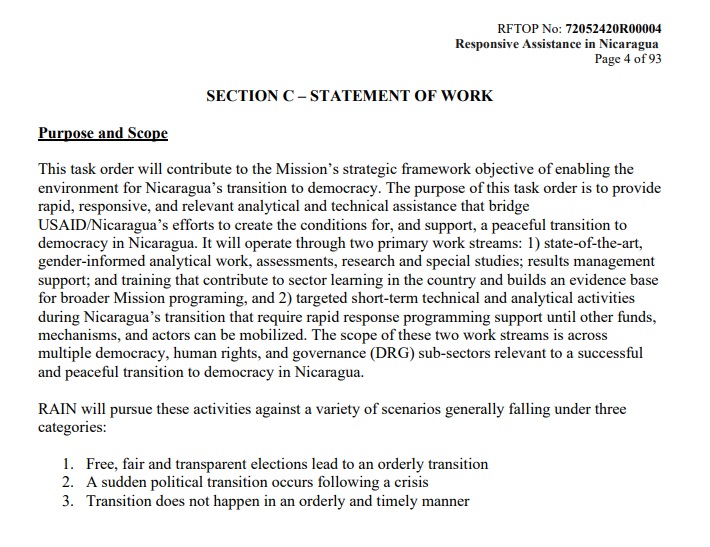
A section of the report
Laying the groundwork for insurrection
How were the conditions for a coup created? The aims of US government funding in Nicaragua and the tactics they paid for in this period were made surprisingly clear in the online magazine Global Americans in 2018, which is partly funded by the National Endowment for Democracy (NED).[4] Arguing (in May 2018, at the height of the violence) that “Nicaragua is on the brink of a civic insurrection,” the author Ben Waddell, who was in Nicaragua at the time, pointed out that “US support has helped play a role in nurturing the current uprisings.”
His article’s title, Laying the groundwork for insurrection,[5] was starkly accurate in describing the ambitions behind the NED’s funding program, which had financed 54 projects in Nicaragua over the period 2014-17 and has continued to do so since then. What did the projects do? Like the recently leaked document, NED promotes ostensibly innocuous or even apparently beneficial activities like strengthening civil society, promoting democratic values, finding “a new generation of democratic youth leaders” and identifying “advocacy opportunities.” To get behind the jargon and clarify the NED’s role, Waddell quotes the New York Times (referring to the uprisings in Egypt, where NED had also been active):[6]
“… the United States’ democracy-building campaigns played a bigger role in fomenting protests than was previously known, with key leaders of the movements having been trained by the Americans in campaigning, organizing through new media tools and monitoring elections.”
In the case of Nicaragua, the NED’s funding of groups opposed to the Sandinista government began in 1984, giving the lie to their aim being to “promote democracy” since that was the year in which Nicaragua’s revolutionary government held the country’s first-ever democratic elections. Waddell makes it clear that the NED’s efforts continued, years later:
“… it is now quite evident that the U.S. government actively helped build the political space and capacity in Nicaraguan society for the social uprising that is currently unfolding.”
The NED is not the only non-covert source of US funding. Another is USAID, which describes its role in the 2018 uprising in similar terms to the NED. Not long before he exposed the new document, William Grigsby was able to publish lists of groups and projects in Nicaragua funded by USAID and by the National Democratic Institute (NDI).[7] He showed that upwards of $30 million was being distributed to a wide range of groups opposed to the government and involved in the violence of 2018, and that in the case of the NDI at least this funding continued into 2020.
Last year, Yorlis Gabriela Luna recounted for COHA her own experiences of how US-funded groups trained young people, in particular, and influenced their political beliefs in the build-up to 2018.[8] She explained how social networks and media outlets were “capable of fooling a significant portion of Nicaragua’s youth and general population.” She explained how the groups used scholarships to learn English, diploma programs, graduate studies, and courses with enticing names like “democratic values, social media activism, human rights and accountability” at private universities, “to attract and lure young people.” She went on to explain how exciting events were organised in expensive hotels or even involving trips abroad, so that young people who had never before been privileged in these ways developed a sense of “pride,” belonging, and “group identity,” and as a result “wound up aligning themselves with the foreign interests” of those who funded the courses and activities.
The new task during and after the pandemic
Two years after the failed coup attempt, what are the organizations that receive US funding now supposed to do? The new document is full of jargon, requiring the contractor (for example) to engage in “targeted short-term technical and analytical activities during Nicaragua’s transition that require rapid response programming support until other funds, mechanisms, and actors can be mobilized.” The work also requires “longer-term programs, which will be determined as the crisis evolves.” Preparation is required for the possibility that “transition [to a new government] does not happen in an orderly and timely manner.” The contractor will have to prepare “a roster of subject matter experts in Nicaragua” to provide short term technical assistance, “regardless of the result of the 2021 election, even in the event of the Sandinistas ‘winning fairly’.” The document is full of requirements like being able to offer “a rapid response” and “seize new opportunities,” emphasizing the urgency of the task. In other words, a fresh attempt is underway to destabilize Daniel Ortega’s government and, in the event that this doesn’t work, and even should the Sandinistas win the next election fairly, as the document admits is a possibility, US attempts at regime change are stepping up a gear.
Who will carry this out? The document places much emphasis on “maintaining” and “strengthening” civil society and improving its leadership, which appears to refer to the numerous NGOs, think tanks and “human rights” bodies which receive US funding. At one point the document asks “what should donor coordination, the opposition, civil society, and media focus on?” – clearly implying that the contractor has a role in influencing not just these civil society groups but also the media and political parties.
Not surprisingly, the document has been interpreted as a new plan to destabilize the country. Writing in La Primerísima, Wiston López argues that the plan’s purpose is “to create the conditions for a coup d’état in Nicaragua.”[9] Brian Wilson, the VietNam veteran severely injured in the 1980s when attempting to stop a freight train carrying supplies to the “Contra,” and who lives in Nicaragua, concludes that the US now realizes that Ortega will win the coming election.[10] In response, the “US has launched a brazen, criminal and arrogant plan to overthrow Nicaragua’s government.”
Supposing that there is a clear Sandinista victory in 2021, will the US nevertheless refuse to accept the result? Having implied that the OAS had serious criticisms of the last election when this was not the case, the document implies that it will be pressured to take a different attitude next time, saying that “whether the OAS decides to pick up the pressure on electoral reform again will be an important international pressure point.” No doubt the US will try to insist that the OAS must be election observers, and if this is refused it will allow the legitimacy of the election to be called into question, if the result is unfavorable to US interests. Many question whether the OAS is even qualified to have an observer role any longer, however, after the serious harm it did to Bolivian democracy in 2019 by casting doubts on what experts considered a fair election and, in effect, instigating a coup.[11] This document creates legitimate concern that the US government would like to use the OAS to prevent another government that is not to its liking from winning an election, as it did so recently in Bolivia.
Not only must conditions be created to replace the current government, but once this is achieved the changes must extend to “rebuilding” the institutions of government, including the judicial system, police and armed forces. After the widespread persecution of government officials, state and municipal workers and Sandinista supporters that occurred in 2018, it is not surprising that this is interpreted as requiring a purge of all the institutions and personnel with Sandinista sympathies. As Wilson says, “the new government must immediately submit to the policies and guidelines established by the United States, including persecution of Sandinistas, dissolving the National Police and the Army, among other institutions.”
USAID makes it clear that it is internal pressure in Nicaragua that might eventually provoke a coup d’état, so it calls on its agents to deepen the political, economic and also the health crisis, taking into account the context of COVID-19. The US State Department recently awarded an extra $750,000 to Nicaraguan non-government bodies as part of its global response to COVID-19, and this includes “support for targeted communication and community engagement activities.”[12] As López points out in Popular Resistance, “Since March the US-directed opposition has focused 95% of their actions on attempting to discredit Nicaragua’s prevention, contention, and Covid treatment. However, this only had some success in the international media and is now backfiring since Nicaragua is the country with one of the lowest mortality rates in the continent.”[13] The Johns Hopkins University’s world map of coronavirus cases currently shows Nicaragua with 3,672 cases compared with 17,448 in El Salvador, 42,685 in Honduras and 51,306 in Guatemala.[14] Even though higher figures produced by Nicaragua’s so-called Citizens’ Observatory[15] are regularly cited in the international media, they currently show just 9,044 “suspected” cases, still far below the numbers in the “Northern triangle” countries.
What will the opposition do next?
COHA has already documented the disinformation campaign taking place against Nicaragua during the pandemic and how this has been repeated in the international media. So far, however, warnings of the health system’s collapse have proved to be unfounded.[16] If, as happened with the Indio Maíz fire and the social security protests in 2018, the opposition fails in its attempt to use the pandemic to destabilize the Ortega government, what will it do next? A recent incident shows that attempts to seize on events to spur a crisis will continue. On July 31, a fire occurred in Managua’s cathedral. The fire department responded quickly and put out the blaze within ten minutes, but a crucifix and the chapel where it stood were badly damaged. Within minutes opposition newspaper La Prensa reported that “an attack” had occurred involving a “Molotov cocktail” and that the government or its supporters were implicated.[17] This was echoed by other local and international media, opposition parties, the Archbishop of Managua, and by one of the NGOs which received USAID funding.[18] Despite the lack of any evidence to back up the media stories, the United Nations High Commission for Human Rights (UNHCR) also condemned the incident, obviously implying that it was an attack on human rights.[19]
Yet a police investigation quickly established that there was no evidence at all of any foul play, or that petrol or explosive materials were involved.[20] Their investigations pointed instead to a tragic accident involving lighted candles and the alcohol spray being used as a disinfectant as part of the cathedral’s anti-COVID-19 precautions. The Catholic Church has already announced that the damaged chapel will be restored to its former state. However, the damage that has been done to the government’s national and international reputation, and to its highly politicized relationship with the Catholic Church, will be more difficult to repair.
John Perry is a writer based in Nicaragua.
End notes
[1] Downloadable in English (pdf) at https://s3.amazonaws.com/rlp680/files/uploads/2020/07/31/aid-mayo-2020-ingles.pdf
[2] “EEUU lanza descarado plan intervencionista para tumbar al FSLN”, https://www.radiolaprimerisima.com/noticias/general/287264/eeuu-lanza-descarado-plan-intervencionista-A histotrypara-tumbar-al-fsln/
[3] “International Forces ‘Distorting’ Nicaragua’s Indio Maíz Fire,” https://www.telesurenglish.net/analysis/International-Forces-Distorting-Nicaraguas-Indio-Maiz-Fire-20180414-0019.html
[4] See details at https://www.ned.org/wp-content/themes/ned/search/grant-search.php (NED is nominally independent of the US administration, but is funded by Congress.)
[5] “Laying the groundwork for insurrection: A closer look at the U.S. role in Nicaragua’s social unrest,” https://theglobalamericans.org/2018/05/laying-groundwork-insurrection-closer-look-u-s-role-nicaraguas-social-unrest/
[6] “U.S. Groups Helped Nurture Arab Uprisings,” https://www.nytimes.com/2011/04/15/world/15aid.html
[7] “Asi financia EEUU a los terroristas,” http://www.radiolaprimerisima.com/noticias/general/286068/asi-financia-eeuu-a-los-terroristas/
[8] “The Other Nicaragua, Empire and Resistance,” https://www.coha.org/the-other-nicaragua-empire-and-resistance/
[9] “EEUU lanza descarado plan intervencionista para tumbar al FSLN,” http://www.radiolaprimerisima.com/noticias/general/287264/eeuu-lanza-descarado-plan-intervencionista-para-tumbar-al-fsln/
[10] “NIcaragua targeted for US overthrow in 2020-21,” https://popularresistance.org/nicaragua-targeted-for-us-overthrow-in-2020-21/
[11] “Bolivia’s Struggle to Restore Democracy after OAS Instigated Coup,” https://www.coha.org/bolivias-struggle-to-restore-democracy-after-oas-instigated-coup/
[12] See https://www.state.gov/update-the-united-states-continues-to-lead-the-global-response-to-covid-19/
[13] “US Launches Brazen Interventionist Plan to Overthrow the FSLN,” https://popularresistance.org/us-launches-brazen-interventionist-plan-to-overthrow-the-fsln/
[14] See https://coronavirus.jhu.edu/map.html
[15] See https://observatorioni.org/
[16] “Experts Warn about Possible Health System Collapse in Nicaragua,” https://www.voanews.com/episode/experts-warn-about-possible-health-system-collapse-nicaragua-4320606
[17] See https://www.laprensa.com.ni/2020/07/31/nacionales/2702954-lanzan-bomba-molotov-adentro-de-la-capilla-de-la-catedral
[18] See for example https://confidencial.com.ni/atentado-con-bomba-molotov-en-la-catedral-de-managua/ and https://elpais.com/internacional/2020-07-31/un-atentado-con-bomba-molotov-incendia-la-capilla-de-la-catedral-metropolitana-de-managua.html
[19] See https://twitter.com/OACNUDH/status/1289574031159488514?ref_src=twsrc%5Etfw%7Ctwcamp%5Etweetembed%7Ctwterm%5E1289574031159488514%7Ctwgr%5E&ref_url=https%3A%2F%2Fwww.laprensa.com.ni%2F2020%2F08%2F01%2Fnacionales%2F2703388-organismos-de-derechos-humanos-condenan-ataque-a-la-catedral-de-managua
[20] “Esclarecimiento de incendio en Capilla de la Sangre de Cristo, Catedral de Managua”, https://www.el19digital.com/articulos/ver/titulo:105922-esclarecimiento-de-incendio-en-capilla-de-la-sangre-de-cristo-catedral-de-managua-presentacion
‘Coup-Plotters for Hire’: Unearthed USAID Nicaragua Regime Change Doc Puts 2018 Protests in Context
Sputnik – 05.08.2020
An uncovered US Agency for International Development (USAID) document lays out a blueprint for regime change in Nicaragua. An expert told Sputnik the playbook shines a new light on the 2018 protests in Nicaragua as well as similar operations in other countries targeted by the US, such as Venezuela.
A new report by the Council on Hemispheric Affairs (COHA) has revealed a guide to regime change in Nicaragua by USAID. The document, which dates to March-April of this year, describes in frank terms how the agency, which maintains close ties with the US Central Intelligence Agency (CIA), could create or exploit a variety of scenarios to remove democratically-elected Nicaraguan President Daniel Ortega and his FSLN party from power in or around the upcoming 2021 elections.
Jill Clark-Gollub, assistant editor and translator at COHA, told Radio Sputnik’s Loud and Clear Wednesday that many of the tactics outlined in the USAID document can be observed in the demonstrations that rocked Nicaragua in the summer of 2018.
‘Code-Speak for a Coup’
“It’s a contract hiring coup plotters – a ‘coup-plotters for hire’-type contract. And it’s really astounding how the whole document is based on the premise that we can impose a better version of democracy for the Nicaraguan people. It talks about a crisis and a transition, and all of this is code-speak for basically bringing about a coup.”
“It talks about three scenarios in which the transition can take place, and it says a transition could take place if our candidate wins the election, but other parts of the document make it clear that they don’t expect their pro-US candidate to win the election. They don’t even have a candidate. Then they talk about creating a crisis for a sudden transition – another code-speak for a coup – and then it talks about a delayed transition in which the FSLN party, the Sandinista Front for National Liberation, wins. And it’s even a free and fair election, and it’s recognized internationally, so it takes a longer time to get them out of there.”
“If you really hadn’t been paying attention at all, you would think there’s this country in crisis and that the US would be doing them a favor to get rid of that government and put in somebody else.”
US Officials Admit to Venezuela ‘Coup’
The news comes amid statements before a Senate committee on Tuesday in which US Sen. Chris Murphy (D-CT) frankly admitted to having attempted to engineer a coup d’etat against Venezuelan President Nicolas Maduro beginning in January 2019.
“Our Venezuela policy over the last year and a half has been an unmitigated disaster,” Murphy told the Senate Foreign Relations Committee. “We have to admit that our big play, recognizing [Juan] Guaidó right out of the gate, and then moving quickly to implement sanctions just didn’t work … First, we thought that getting Guaidó to declare himself president would be enough to topple the regime. Then we thought putting aid on the border would be enough. Then we tried to sort of construct a kind of coup in April of last year, and it blew up in our face when all the generals that were supposed to break with Maduro decided to stick with him in the end.”
Josh Hodges, the senior deputy assistant administrator in USAID’s Bureau for Latin America and the Caribbean (LAC), told the panel USAID support has been instrumental in helping Guaidó’s movement to function.
“We are using development assistance to support the interim government and the National Assembly with technical training, staffing support, equipment and communication efforts,” Hodges said. “USAID’s support bolsters the interim government’s ability to effectively operate and interact with constituents, despite the increased repression from the illegitimate regime. Our assistance has enabled increased participation with legitimate officials.”
Manufacturing Crises via ‘Psychological Warfare’
Clark-Gollub told Sputnik that USAID being directly involved in plotting a coup was “interesting,” because “this in the past, I believe, would have been done by the CIA. Now it’s being done by USAID, and as I said, it’s advertised on LinkedIn. It’s like they have no shame anymore.”
“USAID has been funding Nicaraguan opposition and media groups for years,” she said, noting the 2018 civil disturbances were a case study in what the document describes. “You just need to go back two years and look at this document and all of this doublespeak and understand what I mean.”
“It’s almost embarrassing for the people who are allowing themselves to be used for this. The document talks about how they’re going to use NGOs and opposition parties and the media kind of to corral them to do what they need to do for this plot. So it reveals a lot of stuff that we’ve known, and it brings it out in the open. We have known the media is paid by the US; this is recognition that they’re directed by the US. And the shameful thing for people outside of Nicaragua is that our mass media just parrots what the self-serving Nicaraguan opposition media publishes in Nicaragua.”
She further noted the US was “trying to use the [COVID-19] pandemic for this crisis” mentioned in the document as a possible regime change scenario. “They even created their own citizens’ observatory with mysterious ‘scientific experts’ who they would never say who they were, who were publishing their own statistics on the number of infected and dying people in Nicaragua from the pandemic.”
Instead, Nicaragua’s health system, which the FSLN government has spent 13 years rebuilding and expanding, did not collapse on itself under the weight of the pandemic, as the US embassy in Managua predicted it would, but instead has weathered the storm well, with the lowest COVID-19 case fatality rate in Central America and a very low per capita fatality rate.
Clark-Gollub said use of these tactics “amounts to psychological warfare. They are just going to keep trying to build up, dig up things to make things into a crisis, and it’s terrible,” noting Nicaraguans are being “bombarded” with “fake news” about mass deaths and burials that are actually occurring in other countries.
Especially in 2018, the opposition was “on top of social media,” which the document also urges as a tactic. “We know that in 2018, there had been 2,000 young Nicaraguans recruited, mostly through the Catholic Church, to be social media influencers. And these were the ones putting out ‘color revolution’ type posts,” such as urging painting national colors over FSLN symbols. She also noted they would announce police violence at an event before it had happened, which created confusion and drove demonstrations about events that never occurred.
She recalled that former US national security adviser John Bolton called Nicaragua and Venezuela, along with Cuba, a “troika of tyranny,” writing in his recently released memoir that if one of the three falls, so will the others.
“These three countries are working toward a multipolar world, and the US does not want to see that succeed,” she noted.
“The Nicaraguan people got a big education in 2018; they understand that they’re under attack. It’s not as easy for them to be duped again about fake news that comes out, especially on social media. But that said, this does not mean this is not wearing on people, this psychological warfare … I think that the Nicaraguan people are standing firm and are going to continue to build their country.”
Featured Video

Trita Parsi: Israel Set a Trap for Total War in the Region
or go to
Aletho News Archives – Video-Images
Book Review
Why the War on Conspiracy Theories Is Bad Public Policy
By Kevin Barrett • Unz Review • February 1, 2019
 A Review of Conspiracy Theories and Other Dangerous Ideas by Cass Sunstein (based on an earlier paper co-authored with Adrian Vermeule); In Defense of Troublemakers: The Power of Dissent in Life and Business by Charlan Nemeth; and Conspiracy Theories and the People Who Believe Them, edited by Joseph E. Uscinski
On January 25 2018 YouTube unleashed the latest salvo in the war on conspiracy theories, saying “we’ll begin reducing recommendations of borderline content and content that could misinform users in harmful ways—such as videos promoting a phony miracle cure for a serious illness, claiming the earth is flat, or making blatantly false claims about historic events like 9/11.”
At first glance that sounds reasonable. Nobody wants YouTube or anyone else to recommend bad information. And almost everyone agrees that phony miracle cures, flat earthism, and blatantly false claims about 9/11 and other historical events are undesirable.
But if we stop and seriously consider those words, we notice a couple of problems. First, the word “recommend” is not just misleading but mendacious. YouTube obviously doesn’t really recommend anything. When it says it does, it is lying. … continue
Blog Roll
 Aletho News
- Trita Parsi: Israel Set a Trap for Total War in the Region
- Trump’s Iran war is on an Israeli leash
- Saudi oil boss issues global supply warning
- Riyadh Says Its Oil System Is Intact. The Numbers Say Otherwise.
- Trump and Netanyahu Want to “Finish the Job” on Iran
- US ‘one-sided dictation’ not Iran’s beliefs makes rational talks impossible: Baghaei
- Iran’s Next Strike May Not Explode. It Could Shut You Down /Col Doug Macgregor
- Iran: US political targets legitimate if assassinations return
- Iraq shuts key border crossing with Iran under US pressure: Report
- Undersea Internet cables could be targeted in retaliation for attacks on Iran: IRGC deputy chief
- If Americans Knew
- The Israel Lobby’s Changing Fortunes
- AIPAC has become such a political liability that it’s shifting to a more “nimble” approach to buying politicians
- At least 160 Israeli settler attacks in 2 weeks
- Will Gaza’s Ancient Christian Community Disappear Forever?
- Israel’s vision of regional security rests on keeping Arab states weak
- Heidi Levine recounts how Palestinian youths helped save her in settler attack
- DAILY UPDATE: Latest essential news on Palestine, Israel, & region
- Trump’s Intensifying Sabotage of the ICC, for Israel’s Sake
- Israeli military detain US and UK volunteers in West Bank including Democratic NY politician Brad Lander
- Americans at National Conservatism Conference held in Israel this year criticize Israel
- No Tricks Zone
- E-Cars Reduce CO2 Emissions By Only 41% Compared To Internal Combustion Engine Vehicles
- Predictions Made By Renowned Climate Professor Over Past Decades Have Been Proven To Be Poor
- New Study Suggests Large Regions Of The Pacific Ocean Have Been Cooling For The Last 80 Years
- Germany’s Green Energy Debacle: High Energy Costs Force Kahla Porzellan to Close After 182 Years!
- New Study: 50 Years Of The Most Aggressive ‘Net Zero’ Policies Can Only Affect The Global Climate By 0.03°C
- US September “Heat” Was No Record…Many Records Set Decades Ago
- Latest European Green Energy Debacle; Portugal’s Largest Flagship Solar Park Insolvent!
- Green Energy Debacle: German Expert Professor Fritz Vahrenholt Warns Of Severe Economic And Social Consequences
- Two More Paleo Reconstructions Affirm Meters-Higher Sea Levels Across Ireland, Brazil 7000-6000 Years Ago
- New Study: Earth And Venus Surface Warmth Largely Explained By Convection And Lapse Rate, Not CO2 Or Radiation

