Trump slams Guaidó while expressing openness in speaking with Maduro
By Paul Antonopoulos | June 22, 2020
In what potentially could be a radical change in Washington’s policy towards Venezuela, U.S. president Donald Trump confessed that he has had doubts about his decision to recognize opposition leader Juan Guaidó as president of the South American country. Trump revealed in an interview with Axios in the Oval Office what he thinks about the self-proclaimed wannabe president of Venezuela, Guaidó, and even confessed that he “would maybe think” of meeting personally with Venezuelan President Nicolás Maduro, who has already publicly expressed his willingness to talk with the American president.
“Maduro would like to meet. And I’m never opposed to meetings — you know, rarely opposed to meetings. I always say, you lose very little with meetings. But at this moment, I’ve turned them down,” Trump said.
In a preview of the interview published by Axios, Trump revealed how little confidence he has in Guaidó because the politician failed to take control of the Venezuelan government despite the strong support provided by the U.S. and another 60 countries that recognize him as the legitimate president.
Asked by Axios whether he regretted his decision on backing Guaidó on the advice of John Bolton, his former National Security Advisor, Trump initially said “not particularly,” but then went on to say, “I could have lived with it or without it, but I was very firmly against what’s going on in Venezuela.”
In another part of the interview, Trump speaks directly of the moment when he decided to recognize the opposition leader as president: “Guaidó was elected. I think that I wasn’t necessarily in favor, but I said — some people that liked it, some people didn’t. I was OK with it. I don’t think it was — you know, I don’t think it was very meaningful one way or the other.”
Also, in the preview, Axios quoted a fragment of Bolton’s upcoming book The Room Where It Happened, where he reveals some behind the scenes diplomacy of the Trump Administration and the private feelings the president has about Guaidó. Bolton says that Trump “thought Guaidó was ‘weak,’ as opposed to Maduro, who was ‘strong’” and that “Trump was calling Guaidó the ‘Beto O’Rourke of Venezuela,’ hardly the sort of compliment an ally of the United States should expect.” O’Rourke, who was a Democratic Presidential Candidate and is one of Trump’s biggest critics, was called a “poor bastard” who “quit like a dog” by the American president, a demonstration of just how low Trump thinks of Guaidó.
Trump in the interview described Bolton as a “nutjob” who may be the “dumbest human being on Earth.” Trump could perhaps seek to slowly normalize relations with Maduro and move away from Guaidó, while placing the blame entirely on Bolton for the escalation of hostilities between Washington and Caracas.
In 2019, shocking events were triggered when Guaidó proclaimed himself president. An attempt to forcibly enter a shipment of “solidarity aid” into Venezuela from Colombia that likely had weapons was made; Venezuela suddenly was without electricity after a cyberattack; there was another coup attempt; and, many attacks on military barracks. Yet, Maduro survived the intense pressures from the U.S. and sixty of its allies.
The American President is known to admire authoritarianism and/or strong leaders. Despite sanctions, coup attempts and threats of military invasion, Maduro has not only survived the U.S.-led destabilization, but cemented his positions as leader of Venezuela. Although they may be adversaries, it would not be a wild claim to say that Trump admires Maduro’s strength and determination, especially as Guaidó utterly failed when he had every advantage afforded to him.
If someone had said in 2019 that just a year later Venezuela would not only be more stable than the U.S. when we consider the Black Lives Matter uprising in the aftermath of the George Floyd murder, but would also achieve a seat in the UN Human Rights commission, no one would have believed it.
The U.S. could not allow 2019 to confirm the decline of its dominance over Latin America. With the defeat it suffered in Venezuela, the return of Cristina Kirchner in Argentina and the breakdown of neoliberal governments in the region, Washington had to resort to coups to protect its interests, as seen in Bolivia.
Venezuela now has a fragmented opposition to Maduro that is immersed in an internal war. At this point, Guaidó is not guaranteed to be re-elected as president of the National Assembly. For the U.S. however, it does not matter who occupies that position so long as they are serving Washington’s agenda. The so-called Deep State in the U.S. remains pitifully unchanged in their policy to destroy the existence of sovereign governments in the region. However, is Trump attempting to break free of such war hawks by expressing an openness to speak with Maduro? Although Trump may have individual opinions on not wanting to challenge Venezuela, despite public rhetoric, he will be restricted by the main power structures that exist in the U.S. and push for complete dominance no matter the administration in power and what they want to achieve.
Paul Antonopoulos is an independent geopolitical analyst.
Bank of England Set to Decide Who Venezuela’s President is. How Did It Come to This?
Sputnik – 21.06.2020
What was a typical withdrawal request from a customer to a depository bank has turned into a political controversy, given that the government that owns the bank does not recognise the customer.
London’s High Court is scheduled to hear an unprecedented case on Monday regarding Venezuela’s attempts to extract its gold bullion from the Bank of England.
Venezuela’s central bank (BCV), controlled by the government of Nicolas Maduro, has around $1.8 billion worth of gold at the Bank of England. BCV has recently demanded that €930 million ($1.04bn) in gold be released to help Caracas fight the coronavirus outbreak.
The heavily-sanctioned Latin American country is among the 135 nations with beleaguered public health systems which are attempting to secure vital medical supplies under a major initiative led by the United Nations Development Programme.
BCV had wanted to transfer the proceeds from selling the gold directly to the UNDP to acquire medical equipment, medicines and foodstuffs, but the Bank of England “refused to confirm” that it would hand over the bullion, according to court documents filed last month. BCV in response launched legal action.
The UK government, which wholly controls the bank, does not recognise President Nicolas Maduro and backs the self-declared interim president, Juan Guaido. The UK-held assets of two dozen Venezuelan officials linked with Maduro, but not those of BCV, have been frozen.
The Bank of England denied a similar request for the withdrawal of gold in November 2018; at the time, a cabinet minister said that dealing with a customer’s request is up to the bank and not to the government.
Guaido, who appointed a parallel board of BCV directors, last month warned that the bank would effectively be “financing torture” in Venezuela if it honoured its obligations. His lawyers argue that a decision to release gold should be taken by Venezuela’s legislature rather than by the central bank. They also question whether the BCV board has a buyer lined up for the gold.
Lawyers representing BCV maintain that the request in question is meant to deal with a public health emergency and that the Bank of England’s lack of action is “putting lives at risk”.
“Venezuela has been denied access to its resources during an international crisis,” said London-based lawyer Sarosh Zaiwalla. “In effect, the nation’s gold reserves in the BoE are being held hostage to political factors dictated by the foreign policy of the United States and certain of its allies.” The high court ruling is expected before the end of July.
US Rejects Venezuela Legislative Elections as TSJ Intervenes in Two Opposition Parties
By Ricardo Vaz and Lucas Koerner – Venezuelanalysis – June 17, 2020
Mérida – The US State Department has voiced opposition to upcoming parliamentary elections in Venezuela.
In a press statement published on Monday, Secretary of State Mike Pompeo criticized the recent Supreme Court (TSJ) appointment of a new electoral council (CNE).
“The regime has selected a CNE that will rubber-stamp its decisions and ignore the conditions required for free elections,” the statement said, adding that “elections that represent the will of the people are impossible.”
The Trump administration has repeatedly refused to recognize any elections while President Nicolas Maduro remains in office. In March, the State Department released a “transition” plan with a five-person “Council of State” assuming power and convening presidential and legislative elections. Washington has vowed to ramp up sanctions until Caracas accepts the deal.
The Venezuelan Supreme Court swore in a new CNE on Friday, with former TSJ justice Indira Alfonzo assuming the presidency. While Venezuelan law mandates that the CNE be chosen by a two-thirds majority of the National Assembly (AN), the judicial body stepped in following a request from minority opposition parties in order to guarantee elections this year. The TSJ had also appointed the CNE in 2003, 2005, and 2014 when the AN failed to secure the necessary majority.
AD ruling
Pompeo’s statement came amid another pair of controversial rulings by the high court.
On Monday, the TSJ suspended the current leadership of Venezuela’s largest opposition party, Democratic Action (AD), and named a new ad hoc one headed by former Amazonas State Governor Bernabe Gutierrez.
The brother of newly-appointed CNE Rector Jose Gutierrez, Bernabe Gutierrez previously served as the party’s national secretary before he was expelled by AD Secretary General Henry Ramos Allup on Monday for “conspiring” with President Nicolas Maduro to participate in the upcoming elections. The TSJ order provisionally anulls all party expulsions and exclusions.
Ramos Allup lashed out at the move as a “robbery,” challenging Gutierrez to “come here and take [the headquarters of] Democratic Action.”
For his part, Gutierrez released a statement accusing the ex-secretary general of operating a “regime of terror” and announcing a new era of “internal democracy, of the right to opine, to dissent… without fear of being expelled.” The party leader additionally confirmed that AD would participate in parliamentary elections later this year, which Ramos Allup had previously announced in March.
Ramos Allup has long been infamous for authoritarian leadership style and hostility to elections, with US State Department cables describing the party under his tenure as not only “extremely vertically organized” but “dictatorial.”
Hard-right opposition figures have, however, denounced the standoff within Democratic Action as staged, accusing Ramos Allup of ordering Gutierrez to negotiate with the Maduro government in his stead out of fear of US sanctions.
In 2017, the AD boss announced that four governors from the party had “expelled themselves” after they swore in before the National Constituent Assembly. The elected officials remain members of AD to this day.
PJ ruling
The TSJ ruling was followed by a similar one on Tuesday suspending the leadership of the right-wing Justice First (PJ) party. National Assembly Deputy Jose Brito, who broke with opposition leader Juan Guaido over a series of mutual corruption allegations late last year, was named national coordinator of the party. Following his expulsion from PJ in December, the lawmaker filed a TSJ motion for his reinstatement, claiming that his exclusion was “illegal” and demanding internal party elections.
Brito has likewise confirmed that PJ will participate in AN elections, stating that the majority of the party rank-and-file “want to go to elections.”
PJ’s national coordinator Julio Borges blasted the attempt to “steal” the party, adding that the party is “united and in high spirits, with the goal of restoring freedom to Venezuela.” Borges, who serves as opposition representative before the Lima Group, is sought by Venezuelan prosecutors for his alleged involvement in the 2018 assassination attempt against President Nicolas Maduro.
EU weighs in
The European Union also released a statement criticizing the CNE appointment and TSJ rulings.
“These decisions reduce the democratic space in the country to a minimum and create additional obstacles to the resolution of the profound political crisis in Venezuela,” the statement read, before urging the Venezuelan government and opposition to “engage in meaningful and inclusive negotiations” concerning the CNE and electoral participation.
In response, President Maduro blasted the EU’s “colonialist vision” and urged the body to “leave Venezuela alone.”
“Venezuela will have its elections. We do not care about the European Union,” he said in a televised address on Monday.
On Tuesday, Maduro held a conference call with members of the ruling Socialist Party (PSUV), urging the party to nominate fresh candidates for AN elections, to open the door to grassroots candidates and strengthen alliances with other parties.
Opposition leader Juan Guaido, who declared himself “interim president” last year with the support of Washington, has vowed to boycott the elections, proposing to extend the opposition-controlled AN’s mandate through 2021.
Under Venezuela’s constitution, legislative elections must be held before the end of the year.
Venezuela’s US-backed opposition probed over links to terrorism
By Jesús Silva | Press TV | June 19, 2020
Caracas – Over the past few days, the US-backed Venezuelan opposition parties have been hit by decisions of the country’s Supreme Court of Justice.
The court has ordered an investigation into one party’s possible links to terrorism while appointing new heads for three other parties.
Voluntad Popular, the main opposition party, which is related to politicians Leopoldo López and Juan Guaido, is now being investigated over possible involvement in acts of terror and may be declared a terrorist group by the Judiciary in the upcoming days.
By the same token, Primero Justicia, Acción Democrática and UNT, three of the largest political organizations who oppose President Nicolas Maduro, were sued by many of their own members over impeding internal elections. The nation’s top Court responded by appointing new provisional authorities for the parties and ordering internal elections to be held as soon as possible.
The opposition says the judges are politically biased and some have described the move as an attempt by the government to bring the National Assembly under its control.
However, the court says the decisions were part of a necessary restructuring process. Some say the rulings are all based on the facts and the rule of law.
Persident Maduro has once again accused opposition parties of robbing Venezuela of its wealth and plotting a foreign invasion to end his socialist government.
This year’s parliamentary elections are being organized by Caracas despite Washington’s meddling and boycott threats from the US-backed opposition. Experts say that the socialist ruling party has a good chance of winning the vote since the opposition is divided.
Iran surges in Venezuela in defiance of US sanctions
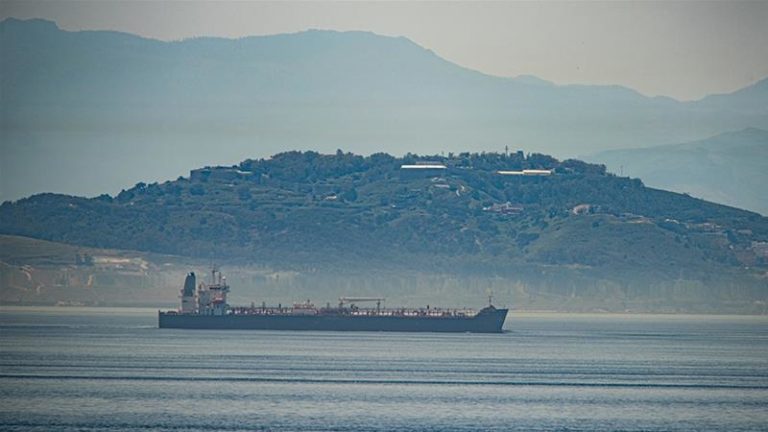
Iranian oil tanker Clavel crossing the Gibraltar stretch heading for Venezuela, May 20, 2020
By M. K. BHADRAKUMAR | Indian Punchline | May 25, 2020
Escorted by the Venezuelan navy and air force, an Iranian oil tanker named Fortune has entered that country’s waters on Sunday, amidst intense speculation whether the US would interfere with the delivery. The US has imposed oil sanctions against Venezuela and Iran and had said it is monitoring the Iranian tanker.
In fact, five Iranian tankers carrying about 1.5m barrels of fuel passed through the Suez Canal earlier this month, according to shipping data on Refinitiv Eikon, and were heading for Venezuela. The other four Iranian tankers — Forest, Petunia, Faxon and Clavel — are approaching the Caribbean en route to Venezuela.
A flotilla of US Navy and Coast Guard vessels is patrolling the Caribbean Sea on a mission to counter illicit drug trafficking. But the Pentagon has stated that there are no plans to stop the Iranian tankers.
At the same time, a Pentagon spokesman, Jonathan Hoffman, while saying on Thursday he was not aware of any operations related to the Iranian cargoes, also added, “We have continued to say that Iran and Venezuela – both two outliers in the international order – [are] clearly violating international sanctions on both nations with this transaction.”
The US sanctions on Venezuela are aimed at increasing pressure on President Maduro to step down. Thus, arguably, Iran is frontally challenging the Trump administration’s stated policy of ‘regime change’ in Venezuela. The Iranian move comes just three weeks after the abortive coup attempt masterminded by the White House on May 1 with the participation of two former US Green Berets aimed at capturing Maduro and transport him to the US in American helicopters to be put on trial on fake drug trafficking charges.
The coup attempt showed the extent of desperation in Washington to overthrow the Maduro government before the US presidential election in November, which President Trump hopes would help him garner Hispanic votes. Iran has now offered a lifeline to Venezuela.
In an historical context, this becomes a frontal assault by Iran on the Monroe Doctrine dating back to the 19th century, which in US foreign policy calculus regarded the Western Hemisphere as its sphere of influence. According to a Reuters report, the Trump administration said earlier this month it was “considering measures” it could take in response to the Iranian shipments, without providing specifics.
No doubt, this is a deliberate sanctions-busting enterprise by Iran. Venezuela desperately needs fuel for up to 1,800 gasoline stations that have been partially closed for weeks due to insufficient supply from state-run refineries.
Venezuela’s gasoline output is now limited to a single facility, the Amuay refinery, but most fuel produced is low octane as most of the country’s alkylation units are out of service. Imported alkylate could improve the quality of domestic gasoline. Venezuela’s refineries are in poor condition. Shipments of equipment in flights by Iran’s Mahan Air have arrived in Venezuela in recent weeks to start repair work.
It will be interesting to see whether the US Navy would interdict any of the other four Iranian tankers before they enter Venezuelan waters. Tehran has sternly warned the US that it would retaliate if any such attempt is made. On Saturday, Tehran raised the ante with President Hassan Rouhani explicitly warning, “If our oil tankers in the Caribbean Sea or anywhere else in the world get into trouble caused by the Americans, they (US) will run into trouble reciprocally.”
Washington is well aware of Iran’s capability to create big problems for the US Navy deployed in the Persian Gulf, especially the Strait of Hormuz. Last week, in a precautionary step, US Navy, via the Maritime Safety Office run by the National Geospatial-Intelligence Agency, alerted all international maritime traffic to maintain a safe distance of at least 100 meters from US naval vessels in international waters and straits. Pentagon officials separately confirmed that the stay-away warning to marine traffic in the Persian Gulf, the Arabian Sea and the Gulf of Oman was actually intended for Iran.
In geopolitical terms, Iran’s strategic defiance of the US in the Western Hemisphere makes an interesting case study not only of the decline in American influence in its backyard to the south but the entire efficacy of the “sphere of influence” concept in contemporary world politics. This is one thing.
More importantly, in the backdrop of the Iranian tanker reaching Venezuela, Caracas has described Iran as a “revolutionary partner” in the struggle against US imperialism. From the Iranian viewpoint, Venezuela becomes a part of the “axis of resistance” against the US. To be sure, the audacity of the two countries will irritate Washington to no end.
How far the Iran-Venezuela axis will deepen and expand will bear watch. Importantly, the UN Security Council embargo against Iran exporting arms to other countries is expiring in October. The US move to extend the timeline of the embargo is unlikely to succeed, given the strong negative reaction by Russia and China. It is entirely conceivable that a matrix of military cooperation may commence in a near future involving Iran and Venezuela.
Iran’s indigenously developed missile capability acts as a deterrent against US aggression. Iran has transferred missile technology to Hezbollah, which is estimated to have the capability today to inflict significant damage to Israel in the event of any aggression by the latter on Lebanon. Significantly, the deterrence is working and Israel no longer stages attacks on Lebanon.
A similar shift in the strategic balance with Iran’s help can create more space for Venezuela to push back at the US. All in all, Iran appears to be working on a strategy to help Venezuela to maintain its strategic autonomy. There is enormous potential for cooperation and coordination between Iran and Venezuela. If Venezuela has the largest known oil reserves in the world, Iran too has massive reserves of oil and gas.
The despatch of oil to lubricate the beleaguered Venezuelan economy may prove to be the harbinger of an assertive Iranian power projection elsewhere in Latin America too. Surely, in the near term, it is a rebuff to the Trump administration’s maximum pressure strategy against Iran. In a longer-term perspective, a concerted regional strategy in Latin America by Russia, China and Iran can seriously erode the US influence in the continent.
Venezuela sues Bank of England for refusal to return country’s gold amid coronavirus crisis
RT | May 20, 2020
Venezuela’s Central Bank has launched legal action to force the Bank of England to release more than $1 billion in gold held in its coffers to battle the Covid-19 outbreak, according to Reuters.
The claim, submitted in a London court on May 14, says that Caracas needs the gold back to buy healthcare equipment, medicine, and food to address the “COVID-19 emergency” in the country, the document seen by Reuters said. Once it is sold by the Bank of England (BoE), the funds are transferred to the United Nations Development Programme.
The gold reserves of many developing nations are held in BoE vaults, with Venezuelan assets on its deposit reportedly worth around $1.7 billion. However, Venezuela has been unable to retrieve its assets from London due to political pressure from the US, which has been seeking to oust President Nicolas Maduro.
“The foot-dragging by the Bank of England is critically hampering Venezuela and the UN’s efforts to combat COVID-19 in the country,” Sarosh Zaiwalla, a London-based lawyer representing the central bank, said as cited by Reuters.
In January, the BoE rejected Venezuela’s request to withdraw $1.2 billion in gold. Bloomberg reported at the time that the refusal came after the request of high-profile US officials to help cut off the Maduro government from its overseas assets.
Venezuela had 749 coronavirus cases with 10 people dead as of Wednesday, according to Johns Hopkins University data.
The South American nation plunged deeper into political crisis after opposition leader Juan Guaido declared himself ‘interim president’ following calls for regime change from Washington. While offering support to Guaido, Washington has been targeting Venezuela with multiple rounds of sanctions, crippling the nation’s finances. The restrictions include the country’s vital oil sector which accounts for most of its revenues.
Will Trump Really Start Two Wars Instead of “Just” One?
The Saker | Unz Review | May 20, 2020
Amidst the worldwide pandemic induced scare most of us have probably lost track of all the other potential dangers which still threaten international peace and stability. Allow me to list just a few headlines which, I strongly believe, deserve much more attention than what they got so far. Here we go:
- Military Times : “5 Iran tankers sailing to Venezuela amid US pressure tactics“
- Time : “5 Iranian Tankers Head to Venezuela Amid Heightened Tensions Between U.S. and Tehran“
- FoxNews: “Iran tankers sailing to Venezuela in effort to undermine US sanctions“
Notice that Military Times speaks of “US pressure tactics”, Time of “tensions” and FoxNews of “efforts to undermine US sanctions”?
I don’t think that this is a coincidence. Folks in the US military are much more in touch with reality than the flag-waving prostitutes which some people call “reporters” or “journalists”.
Furthermore, the US has embarked on a new policy to justify its acts of piracy on the high seas with something called Visit, Board, Search and Seizure (VBSS) all under the pretext of the war on drugs. To get a better understanding of the context of these developments I asked a specialist of Maritime issues of our community, NatSouth, who replied the following: (stress added)
If a ship does not comply with the request to be boarded, it is usual that the pursuing authorities must gain the permission of the ‘flag’ state prior to boarding, on the high seas and the pursuit has to have started in the coastal state’s jurisdictional waters. The caveat here is that in the Caribbean – Caribbean Regional Maritime Agreement (CRA) – (long name: Agreement Concerning Co-operation in Suppressing Illicit Maritime and Air Trafficking in Narcotic Drugs and Psychotropic Substances in the Caribbean Area). So, there is an agreement with participating coastal states on boardings and pursuits in EEZs and the like. You can find more on the legal aspects of boardings at sea here: and more info on so-called “consensual boardings” here.
The anti-drug/ counterterrorism angle allows the U.S. Navy and the USCG to carry out interdictions on the high seas. Important point to note whether this approach will be taken to interdict the tankers, given that Venezuela is a declared narco-State. The absurdity is that Venezuela isn’t the primary transit point in the region, Colombia holds that honour.
If I could add at this point, the origins are that Venezuela didn’t wish to play ball with Washington anymore, specifically with the DEA back in 2005, squaring the circle of sorts, (or should that be a vicious circle cunningly used by Washington, because who is going to argue with that narrative, aka the war on terror). March: SOUTHCOM’s Adm. Faller: “There will be an increase in US military presence in the hemisphere later this year. This will include an enhanced presence of ships, aircraft, & security forces to reassure our partners… & counter a range of threats to include illicit narco-terrorism.” At the same time, the State dept released this tweet, so the US could effectively carry out boardings under the guise of counterterrorism as well.
While the Iranian tankers were in the Mediterranean, Washington released a (delayed) “Global Maritime Sanctions Advisory”, to the maritime industry, setting out guidelines to shipowners and insurers to enable them to avoid the risks of sanctions penalties related to North Korea, Syria and Iran. This also concerns oil exports from Iran, (but doesn’t apply to Iranian flagged ships). This came after the State Dept gave warning notice to oil companies to stop operations, including Rosneft (Russia), Reliance (India) and Repsol (Spain).
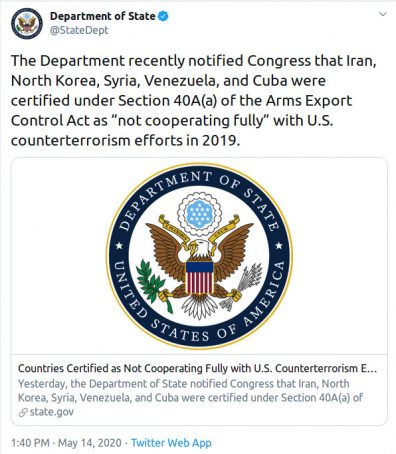
Then NatSouth concluded the following:
Under international law, every merchant ship must be registered with a flag state, which has jurisdiction over the vessel. Hence, this time, the use of Iranian-flagged tankers, as a direct response from Washington’s latest version of restating “maximum pressure” campaign on enforcement of Iran and Venezuela sanctions, (back in Feb, literally the same language as in Aug 2019). There was talk back then of a naval embargo, which would a serious notch up in tensions. There was mention of the 4 U.S. warships in the Caribbean, the U.S. Navy tweeted about, but one the Preble went through the Panama Canal into the Pacific).
Pretty clear, isn’t it?
What the US is doing is substituting itself for the United Nations and it is now openly claiming the right to board any vessel under whatever kind of pious pretext like, say, narco-trafficing, nuclear proliferation, sanctions against so-called “rogue states”, etc. Clearly, the AngloZionists expect everybody to roll over and take it.
How likely is that?
Let’s look at a few Iranian headlines, all from PressTV:
- PressTV, May 16th: “Iran’s fuel shipment to Venezuela guaranteed by its missile power“
- PressTV, May 17th: “US aware Iran will respond ‘very strongly’ if Venezuela-bound ships attacked: Analyst“
- PressTV, May 18th: “Iran: US bears responsibility for any foolish act against tankers heading to Venezuela“
Three days in a row. I think that it is fair to assume that the Iranians are trying very hard to convince Uncle Shmuel not to mess with these tankers. Does anybody seriously believe that the Iranians are bluffing?
Before we look at some of the aspects of this potential crisis, let’s just mention a few things here.
First, the US is acting in total and official illegality. Just like the bombing of Syria, the threats to Iran, or the US murderous sanctions Uncle Shmuel imposes left and right – the blockade of Venezuela is a) totally illegal and b) an act of war under international law.
Second, if USN commanders think they can operate with impunity only because the Caribbean is far away from Iran, they are kidding themselves. Yes, Iranian forces cannot defend these tankers so far away from home, nor can they take any action against the USN in the Atlantic-Caribbean theater of naval operations. But what they can and will do is retaliate against any AngloZionist target in the Middle-East, including any oil/gas tanker.
Third, while Venezuela’s military is tiny and weak compared to the immensely expensive and bloated US military, being immensely expensive and bloated is no guarantee of success. In fact, and depending on how the Venezuelan leadership perceives its options, there could be some very real risk for the USA in any attempt to interfere with the free passage of these ships.
What do I mean by that?
Did you know that Venezuela had four squadrons of Su-30MKV for a total of 22 aircraft? Did you know that Venezuela also had an unknown number of Kh-31A supersonic anti-shipping missiles? And did you know that Venezuela had a number of S-300VM and 9K317M2 Buk-M2E long range and medium range SAMs?
True, that is nowhere near the amount of weapons systems Venezuela would need to withstand a determined US attack, but it is more than enough to create some real headaches for US planners. Do you remember what the Argentinian Air Force did to the British Navy during the Malvinas war? Not only did the Argentinians sink two Type 42 guided missile destroyers (the HMS Sheffield and the HMS Coventry) which were providing long-range radar and medium-high altitude missile picket for the British carriers, they also destroyed 2 frigates, 1 landing ship, 1 landing craft, 1 container ship. Frankly, considering how poorly defended the British carriers were, it is only luck which saved them from destruction (that, and the lack of sufficient number of Super Étendard strike aircraft and Exocet missiles). I would add here that the British military, having been defeated on many occasions, has learned the painful lessons of their past defeats and does not suffer from the cocky-sure attitude of the US military. As a result, they were very careful during the war against Argentina and that caution was one of the factors which gave a Britain well-deserved the victory (I mean that in military terms only; in moral terms this was just another imperialist war with all the evil that entails). Had the Argentinians had a modern air force and enough anti-shipping missiles, the war could have taken a very different turn.
Returning to the topic of Venezuela, war is a much more complex phenomenon than just a struggle of military forces. In fact, I strongly believe that political factors will remain the single most important determinant factor of most wars, even in the 21st century. And chances are that the Venezuelans, being the militarily weaker side, will look to political factors to prevail. Here is one possible scenario among many other possible ones:
Caracas decides that the US seizing/attacking the Iranian tankers constitutes an existential threat to Venezuela because if that action goes unchallenged, then the US will totally “strangle” Venezuela. Of course, the Venezuelan military cannot take on the immense US military, but what they could do is force a US intervention, say by attacking one/several USN vessel(s). Such an attack, if even only partially successful, would force the US to retaliate, bringing US forces closer not only to Venezuelan air defenses, but also closer to the Venezuelan people which will see any US retaliation as an illegitimate counter-counter-attack following the fully legitimate Venezuelan counter-attack.
Then there is the problem of defining victory. In the US political “culture” winning is usually defined as pressing a few buttons to fire off some standoff weapons, kill lots of civilians, and then declare that the “indispensable nation” has “kicked the other guy’s ass”. The problem with that is the following one: if they other guy is very visibly weaker and has no chance for a military victory of his own, then the best option for him is to declare that “surviving is winning” – meaning that if Maduro stays in power, then Venezuela as won. How would the USA cope with that kind of narrative? Keep in mind that Caracas is a city of over two million people which even in peacetime is rather dangerous (courtesy of both regular crime and potential guerilla activities). Yet, for Maduro to “win” all he has to show is that he controls Caracas. Keep in mind that even if the US forces succeed in creating some kind of “zone of real democracy” somewhere near the Colombian border, that will mean nothing to Maduro, especially considering the terrain between the border and the capital city (please check out this very high resolution map of Venezuela or this medium resolution one). As for the notion of a USN landing on the shores of Venezuela, all we need to do is to remember how the immense Hodgepodge of units which were tasked with invading Grenada (including 2 Ranger Battalions, Navy Seals, most of an Airborne Division, etc. for a total of over 7,000 soldiers(!) against a tiny nation which never expected to be invaded (for details, and a good laugh, see here for a full list of participating US forces!) was defeated by the waves of the Caribbean and the few Cuban military engineers who resisted with small-arms fire (eventually, most of the 82AB was calling in to fix this mess).
In other words, if Maduro remains in power in Caracas then, in political terms, Venezuela wins even though it would loose in purely military terms.
This phenomenon is hardly something new, as shown by the following famous quote by Ho Chi Minh: “You can kill ten of my men for every one I kill of yours. But even at those odds, you will lose and I will win.”
By the way, this is exactly the same problem the Empire faces with Iran: as long as the Islamic Republic remains an Islamic Republic it “wins” in any exchange of strikes with the USA and/or Israel.
Still, it is pretty obvious that the US can turn much of Venezuela into a smoking heap of ruins. That is true (just like what the USA did to Korea, Vietnam, Iraq or Serbia and Israel what did to Lebanon in 2006). But that would hardly constitute a “victory” in any imaginable sense of the word. Again, in theory, the US might be able to secure a number of landing locations and then send in an intervention force which could try to take key locations in Caracas. But what would happen after that? Not only would the hardcore Chavistas trigger a guerilla insurrection which would be impossible to crush (when is the last time the USA prevailed in a counter-insurgency war?), but many Venezuelans would expect the US to pay for reconstruction (and they would be right, according to the rules of international law, “once you take it, you own it” meaning that the USA would become responsible for the socio-economic situation of the country). Finally, there is always the option of an anti-leadership “decapitating” strike of some kind. I believe that in purely military terms, the US has the know-how and resources to accomplish this. I do not believe that this option would secure anything for the USA, instead – it would further destabilize the situation and would trigger some kind of reaction by the Venezuelan military both outside and inside Venezuela. If anything, the repeated failures of the various coup attempts against Chavez and Maduro prove that the the bulk of the military remains firmly behind the Chavistas (and the failed coup only served to unmask the traitors and replace them anyway!).
The bottom line is this: if Uncle Shmuel decides to seize/attack the Iranian tankers, there is not only a quasi certitude of a war between the US and Iran (or, at the very least, an exchange of strikes), but there is also a non-trivial possibility that Maduro and his government might actually decide to provoke the USA into a war they really can’t win.
Is Trump capable of starting a process which will result in not one, but two wars?
You betcha he is! A guy who thinks in categories like “my button is bigger than yours” or “super-dooper weapons” obviously understands exactly *nothing* about warfare, while the climate of messianic narcissism prevailing among the US ruling classes gives them a sense of total impunity.
Let’s hope that cooler heads, possibly in the military, will prevail. The last thing the world needs today is another needless war of choice, never mind two more.
Iran’s fuel shipment to Venezuela guaranteed by its missile power
Press TV – May 16, 2020
Iran is shipping tons of gasoline to Venezuela in defiance of US sanctions on both countries in a symbolic move guaranteed by Tehran’s missile prowess.
Unconfirmed reports and tanker monitoring groups suggest that at least five Iranian-flagged tankers are transporting fuel to Venezuela through the Atlantic Ocean despite the US sanctions on both Tehran and Caracas.
Iran has intentionally hoisted its own flag over the huge tankers which are navigating through the Atlantic before the eyes of the US Navy.
Iran is shipping large consignments of gasoline to Venezuela even though the US would try to intercept the shipments and seize the tankers.
There are unconfirmed reports that the US Navy has deployed its USS Detroit (LCS-7), USS Lassen (DDG-82), USS Preble (DDG-88), and USS Farragut (DDG-99) to the Caribbean along with its patrol aircraft Boeing P8-Poseidon for possible encounter with the Iranian vessels.
However, analysts say it is very unlikely that the US makes such a mistake, as it would have serious repercussions for the Trump administration ahead of the November elections.
The US would not dare to seize the Iranian vessels especially after Iran’s reaction to a similar move by the United Kingdom, a close ally of Washington.
Iran also has the upper hand thanks to its missile power, which was shown to the US in the IRGC’s retaliatory missile attacks on the Ain al-Assad Airbase in Iraq, which accommodated American troops.
The US was also reminded of the Islamic Republic’s missile prowess following the recent successful launch of Nour-1 military satellite, which reached its orbit using the Qased satellite carrier. Some Western analysts claim the satellite achievements are a prelude to Iran’s program to develop intercontinental ballistic missiles (ICBMs).
Confident about its missile capabilities, Iran is going on with the gasoline shipment to its ally in Latin America, mocking the US sanctions on the oil sectors of both countries.
The US seems to be between the rock and hard place. While it is unlikely for Washington to dare to intercept the tankers, if they reach their destination safe and sound, it may tarnish the “superpower” forever.
The fuel shipment also shows Iran’s success in turning into an exporter of gasoline after years of importing the fuel.
A senior official in US President Donald Trump’s administration told Reuters on Thursday that the United States was considering measures against Iran in response to the fuel shipment.
The official said Washington has a “high degree of certainty” that the Venezuelan government is paying Iran in gold for the fuel.
If these claims are confirmed, the “fuel for gold” exchange is also a great achievement for the Islamic Republic amid the US’ maximum pressure policy, which deprives the country’s economy of billions of dollars’ worth of oil revenues.
There are reports that Iran is receiving nine tons of gold in exchange for the fuel its ships transport to Venezuela. Under the cruel sanctions imposed by the US after its withdrawal from the 2015 nuclear deal in 2018, nine tons of gold can be a very precious asset for the Iranian economy.
However, we must still wait and see whether the US administration would let the Iranian tankers go and strip Washington of its “superpower” title, or it would dare to intercept the vessels and endanger Donald Trump’s campaign ahead of the November elections.
Earlier in the day, Iranian government spokesman Ali Rabiei said Venezuela and Iran are both independent states that have had and will continue to have trade relations with each other.
“We sell goods and buy goods in return. This trade has nothing to do with anyone else. We have to sell our oil and we have ways to do it,” Rabiei said in reaction to reports of the fuel shipment to the Latin American country.
See also:
US interception of Iran vessel to Venezuela would be ‘completely illegal
Ottawa’s ties with far right Colombian president undermines human rights rhetoric regarding Venezuela

By Yves Engler · May 13, 2020
A week ago a former Canadian soldier instigated a harebrained bid to kidnap or kill Venezuelan President Nicolás Maduro. Launched from Colombia, the plot failed spectacularly with most of the men captured or killed.
Still, the leader of the invasion Jordan Goudreau, a veteran of the Canadian military and US special forces, has been remarkably forthright about the involvement of opposition figure Juan Guaidó. A leaked contract between Guaidó’s representative in Florida and Goudreau’s Silvercorp USA describes plans for a multi month occupation force, which after ousting Maduro would “convert to a National Asset Unit that will act under the direction of the [Guaidó] Administration to counter threats to government stability, terror threats and work closely” with other armed forces. Apparently, Goudreau was hoping for a big payday from Venezuela’s opposition. He also had his eyes on the $15 million bounty Washington put up in March for Maduro’s capture as well as tens of millions dollars for other members of the government.
As the plot has unraveled, Ottawa has refused to directly criticize the invasion launched from Colombia. The military has also refused to release information regarding Goudreau’s time in the Canadian forces. What’s more, since the plot began Canada’s foreign affairs minister has reached out to regional opponents of Maduro and reasserted Ottawa’s backing for Guaidó. The PM also discussed Venezuela with his Colombian counterpart.
The Trudeau government’s reaction to recent events suggest the global pandemic has not deterred them from brazenly seeking to overthrow Venezuela’s government. In a bid to elicit “regime change”, over the past couple years Ottawa has worked to isolate Caracas, imposed illegal sanctions, took that government to the International Criminal Court, financed an often-unsavoury opposition and decided a marginal opposition politician was the legitimate president.
The day after the first phase of the invasion was foiled foreign minister François-Philippe Champagne spoke to his Colombian, Peruvian and Brazilian counterparts concerning the “Venezuela crisis and the humanitarian needs of Venezuelans.” Four days later Champagne tweeted, “great call with Venezuela Interim President Juan Guaidó. Canada will always stand with the people of Venezuela in their desire to restore democracy and human rights in their country.”
On Monday Prime Minister Justin Trudeau spoke with Colombian President Iván Duque Márque. According to the official release, they “discussed the crisis in Venezuela and its humanitarian impact in the region which is heightened by the pandemic. They underscored the need for continued close collaboration and a concerted international effort to address this challenging situation.” Over the past 18 months Trudeau has repeatedly discussed Venezuela with a Colombian president who has offered up his country to armed opponents of Maduro.
The Trudeau government has been chummy with Duque more generally. After he won a close election marred by fraud allegations then Foreign Minister Chrystia Freeland “congratulated” Duque and said, “Canada and Colombia share a commitment to democracy and human rights.” In August 2018 Trudeau tweeted, “today, Colombia’s new President, Ivan Duque, took office and joins Swedish PM, Norway PM, Emmanuel Macron, Pedro Sánchez, and others with a gender-equal cabinet. Iván, I look forward to working with you and your entire team.” A month later he added, “thanks to President Ivan Duque for a great first meeting at UNGA this afternoon, focused on growing our economies, addressing the crisis in Venezuela, and strengthening the friendship between Canada & Colombia.”
But, Duque is from the extreme right — “le champion du retour de la droite dure en Colombie”, according to a Le Soleil headline. The Colombian president has undercut the peace accord the previous (right, but not far right) government signed with the Revolutionary Armed Forces of Colombia (FARC) to end Colombia’s 50-year civil war, which left some 220,000 dead. Duque’s policies have increased violence towards the ex-rebels and social activists. Seventy-seven former FARC members were killed in 2019. Even more human rights defenders were murdered. The United Nations High Commissioner for Human Rights found that at least 107 Colombian, mostly Indigenous, rights defenders were killed in 2019.
Through the first part of this year the pace at which social leaders and demobilized FARC members have been killed has increased. According to the UN observer mission in Colombia, 24 demobilized guerrillas have already been assassinated and a recent Patriotic March report on the “The other pandemic lived in Colombia” details 95 social leaders, human rights defenders and former guerrillas killed in the first four months of 2020.
Trudeau’s dalliance with Duque is difficult to align with his stated concern for human rights in Venezuela.
The same can be said for Ottawa’s failure to condemn the recent invasion attempt. The Trudeau government should be questioned on whether it was involved or had foreknowledge of the recent plot to invade Venezuela.
New Information: Guaidó Was the “Commander in Chief” of the Failed Mercenary Operation Against Venezuela

This document shows the chain of comand. (Council on Hemispheric Affairs)
By Patricio Zamorano | Council of Hemispheric Affairs | May 13, 2020
New information divulged this week reveals that Juan Guaidó was designated as “commander and chief” of the mercenary operation that completely unraveled on the shores of Venezuela. The 41 page contract that formed the basis of the already known eight page General Services Agreement was published by the Washington Post [1] this week.
This more complete document confirms what the mercenary and head of SilverCorp, Inc., Jordan Goudreau, had already revealed to the media: the agreement was aimed at “planning and executing an operation to capture/detain/remove Nicolas Maduro (heretoafter “Primary Objective”) remove the current Regime and install the recognized Venezuelan President Juan Guaido.”

The document provides complete information about the money that would be invested (212 million dollars), and the payments and commissions that SilverCorp would receive from Guaidó’s team, which includes Juan José Rendón, Sergio Vergara and attorney Manuel Retureta.
The document also explains the promised retainer of 1.5 million dollars that Goudreau has been complaining about publicly since the failed operation last Sunday, May 3.
What has not been said: information about the operation was published two days before the attack
There is an important detail that the world press has not analysed. One AP article[2] which details the preparations for the attack was published Friday May 1, two days before the attempt to invade Venezuela was launched from Colombia. The article provides particulars on the presence of three paramilitary groups (deserters from the Venezuelan armed forces and police) in Colombia and explains how this operation had been foiled and aborted. It clearly names Jordan Goudreau, including a profile on the mercenary and many other details about the planned attack. No Colombian nor US authority mobilized to neutralize the illegal paramilitary camps.
This document also appears to confirm that Goudreau, despite the exposure of the planned incursion by the press, still proceeded with the attack, irresponsibly putting at risk the lives of those involved. It also shows that neither US intelligence agencies, nor the Colombian police, nor even Guaidó’s team took action to stop the attack.
One can extrapolate two possible reasons for this. Allowing the operation to move forward, without directly committing to SilverCorp, would show the actual consequences of the operation (whether a success or failure). The operation could also expose the government of Maduro to world criticism if it produced fatalities on one side or the other. What is certain is that all of these scenarios, “whether above or under the table” in the words of Rendón on CNN, were discussed extensively with Guaidó and his advisors with the aim of illegally overthrowing Maduro. Rendón told CNN in Spanish that “they analysed all of the scenarios; alliances with other countries, their own actions, uprisings of people from within, of the soldiers that are there, the eventual use of actors that are outside, retired soldiers. All these scenarios were produced, as the president said well, we are analysing things above and below the table.”[3]
Guaidó was leader of the operations
The most important theme of this story, which the Washington Post does not even mention in its article, is what is described on page 39 of the contract.
Under the title “ATTACHMENT N: CHAIN OF COMMAND,” the document includes the following:
- Commander in Chief – President Juan Guaidó
- Overall Project Supervisor – Sergio Vergara
- Chief Strategist: Juan Jose Rendon
- On Site Commander – To be determined
The page is signed by Guaidó’s advisors and there is a large black box that surely hides compromising information about SilverCorp.

Denial is followed by selective recognition
The evidence is very clear that Guaidó’s team has decided to change its strategy. The first reaction of Guaidó was to deny that he was involved in the disastrous operation[4] in the face of the cost of lives of eight mercenaries, former Venezuelan soldiers, and the capture of numerous paramilitaries, including two US former soldiers. Guaidó’s team however, publicly acknowledged this week their involvement, but they tried to discredit SilverCorp as if it had acted on its own. Nevertheless Rendón recognized that he had paid 50 thousand dollars to the mercenary company[5] of Florida and that his signature on the document is legitimate.
The big question is what will be the response of the legal authorities in the US and Colombia. So far there has been no arrest, despite the fact that all of the details of the operation and the violations of law committed are clear and irrefutable.
In the coming days it will become evident whether the governments of Trump and Duque in Colombia opt for the strategy of impunity. This scandal without doubt weakens in an important way the illegal policy of sanctions and the dirty campaign supported by the hard-line Venezuelan opposition that has broken with the strategy of dialogue that other more moderate anti-Chavista sectors continue to advance in Caracas.
Translation made from the original Spanish by Fred Mills, academic and Co-Director of COHA
End notes
[1] “From a Miami condo to the Veenzuelan coast, how a plan to ‘capture’ Maduro went rogue”, https://www.washingtonpost.com/world/the_americas/from-a-miami-condo-to-the-venezuelan-coast-how-a-plan-to-capture-maduro-went-rogue/2020/05/06/046222bc-8e4a-11ea-9322-a29e75effc93_story.html
[2] “Ex-Green Beret led failed attempt to oust Venezuela’s Maduro”, https://apnews.com/79346b4e428676424c0e5669c80fc310
[3] “J.J. Rendón habla sobre la Operación Gedeón en Conclusiones de CNN en Español”, https://cnnespanol.cnn.com/2020/05/07/j-j-rendon-habla-sobre-la-operacion-gedeon-en-conclusiones-de-cnn-en-espanol/
[4] “Guaidó niega vínculos con intento de invasión en Venezuela”, https://www.chicagotribune.com/espanol/sns-es-coronavirus-guaido-niega-vinculo-intento-invasion-venezuela-20200505-uiditc4i6nbdda3nyx24n26zee-story.html
[5] “J.J. Rendón habla sobre la Operación Gedeón en Conclusiones de CNN en Español”, https://cnnespanol.cnn.com/2020/05/07/j-j-rendon-habla-sobre-la-operacion-gedeon-en-conclusiones-de-cnn-en-espanol/
Venezuela’s Guaido says US mercenary contract is fake, even after own allies give full doc to US media
RT | May 9, 2020
Opposition leader Juan Guaido continues to deny any link to a failed armed incursion into Venezuela, despite his own allies handing over a lengthy contract to American media naming him as the commander of the operation.
The opposition figurehead and self-declared “interim president” of Venezuela denied again on Friday that he had anything to do with the ill-fated mission, which by most accounts was set up by a Florida-based security company, Silvercorp USA, and its American CEO, Jordan Goudreau.
“We reiterate once again that the interim government has no link, commitment or responsibility to Silvercorp or its actions, as well as deny that President Guaido has signed an assumption contract with [the company],” Guaido’s office said in a statement.
Earlier this week, however, the Washington Post published a 41-page document it alleged to be the full multi-million-dollar contract between Silvercorp and Guaido, even noting the document was “provided by Venezuelan opposition officials on the condition that one of the attachments be redacted.” Among its many revelations, the leaked contract clearly lists Guaido as the operation’s “commander in chief,” directly at odds with his repeated claims to the contrary.
While the complete contract does not contain Guaido’s signature, top adviser Juan Rendon has admitted to Reuters that he negotiated the deal, and his name does appear on the contract alongside other senior opposition members. Guaido did apparently sign a shorter “general services agreement,” though that document does not specify what the deal was for.
The failed mission, launched on May 3, saw several dozen armed mercenaries attempt to storm the Venezuelan coast from Colombia in speedboats. The operation fell apart before it could get off the ground, with security forces intercepting the boats and killing eight of the fighters before arresting some 13 more – two of them US citizens and employees of Silvercorp. One of those Americans, Luke Denman, has since stated the mission sought to capture Venezuelan President Nicolas Maduro and bring him back to the US, where he is wanted on “narco-terrorism” charges.
Guaido has offered a very different version of events, however, insisting Maduro fabricated the entire story while calling the leaked contract a fake, meant to generate a “false positive” justification to “kidnap and arrest” members of the opposition. The alternative account, if true, would mean the Washington Post is either working hand-in-glove with Maduro, or was fooled by his operatives posing as opposition figures. Goudreau and Rendon – Guaido’s own adviser – would also have to be in on the conspiracy, as both have corroborated that there was, in fact, a deal with Silvercorp.
US President Donald Trump has rejected claims of American involvement in the incursion plot, stating he would have sent in the military had he wanted to carry out such a mission, though Maduro has repeatedly accused Washington of ordering the operation. Other critics have also voiced suspicions about the timing of the attempted mercenary raid, which came only weeks after the US indicted Maduro on drug trafficking and launched a militarized anti-narcotics mission in the Caribbean Sea – on Venezuela’s doorstep.
Featured Video

Col Doug Macgregor: America’s Back to ENDLESS WARS
or go to
Aletho News Archives – Video-Images
Book Excerpt
Leslie Wexner’s Inner Demon
BY WHITNEY WEBB |
UNLIMITED HANGOUT| JUNE 10, 2022
This short excerpt from Whitney Webb’s upcoming book “One Nation Under Blackmail” examines an obscure media profile of Leslie Wexner, Jeffrey Epstein’s mentor, from the 1980s that contains disconcerting revelations about Wexner’s personality and his inner world. … continue
Blog Roll
Recent Comments
papasha408 on Germany demands UN Rapporteur… papasha408 on Israel Demanding that Iran Lim… Coronistan on Why can’t western leaders acce… John Edward Kendrick on German government ‘embezzling’… loongtip on Von der Leyen to have new secu… papasha408 on First Gaza, then the world: Th… papasha408 on Is Nixing Aid to Israel a Pois… papasha408 on Japan to Sign Up For NATO’s Uk… Redracam on Iran Willing to Dilute Enriche… loongtip on When Threats Replace Evid… loongtip on Zelensky tried to kill the cha… eddieb on I might get killed for posting…


 Aletho News
- 40 State Attorneys General Want To Tie Online Access to ID
- Col Doug Macgregor: America’s Back to ENDLESS WARS
- Villains of Judea: Haim Saban
- Germany demands UN Rapporteur Albanese resign, joining France
- Hamas official says Netanyahu joining ‘peace council’ is a farce
- Israel Demanding that Iran Limit the Range of Missiles to 300 Kilometers
- Why can’t western leaders accept that they have failed in Ukraine?
- German government ‘embezzling’ taxpayer money to fund Ukraine – veteran politician
- Russian Soldiers Tortured in Secret Ukrainian Prisons
- Tensions between Hungary and Ukraine could lead to a new regional conflict
- If Americans Knew
- AZAPAC, the new PAC opposing Israeli domination of U.S policies
- Haim Saban: Billionaire for Israel
- Rafah e-wallet plan highlights Israel’s deepening financial occupation
- Viral post claims Netanyahu sought legal approval, igniting speculation about Israel’s organ harvesting
- AIPAC Has a New Opponent: PAL PAC
- Right-Wing Catholic Off Trump Religion Panel After Israel-Gaza Remarks at Antisemitism Event
- Jewish terrorism, apartheid rule the West Bank – Not a ceasefire Day 125
- Why Israel persecutes children like my son Shadi
- In Gaza, One Man Is Searching for the Remains of His Family With a Flour Sifter
- Horrific situation in Gaza, West Bank – Not a ceasefire Day 124
- No Tricks Zone
- German Gas Crisis…Chancellor Merz Allegedly Bans Gas Debate Ahead of Elections!
- Pollen Reconstructions Show The Last Glacial’s Warming Events Were Global, 10x Greater Than Modern
- Germany’s Natural Gas Storage Level Dwindles To Just 28%… Increasingly Critical
- New Study Rebuts The Assumption That Anthropogenic CO2 Molecules Have ‘Special’ Properties
- Climate Scientist Who Predicted End Of “Heavy Frost And Snow” Now Refuses Media Inquiries
- Polar Bear Numbers Rising And Health Improving In Areas With The Most Rapid Sea Ice Decline
- One Reason Only For Germany’s Heating Gas Crisis: Its Hardcore-Dumbass Energy Policy
- 130 Years Later: The CO2 Greenhouse Effect Is Still Only An Imaginary-World Thought Experiment
- New Study Affirms Rising CO2’s Greening Impact Across India – A Region With No Net Warming In 75 Years
- Germany’s Natural Gas Crisis Escalates … One Storage Site Near Empty …Government Silent
 Aletho News