Maduro Calls on US to Respect Venezuela
AVN | January 2, 2015
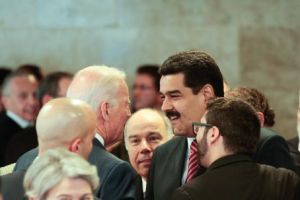 Caracas – Venezuela’s president Nicolas Maduro reaffirmed to the US government on Friday the need for respectful relations with Venezuela.
President Maduro made this clear to US Vice President Joseph Biden, in a brief meeting on Thursday during the inauguration of Brazil’s president, Dilma Rousseff, in the Planalto presidential palace in Brasilia, in the presence of Uruguayan President Jose Mujica, while greetings of foreign authorities were made to the Brazilian president.
“We ask the United States, what I told Vice President Biden and have said a thousand times, in public and in private, we want relationships of respect,” President Maduro told reporters transmitted by Telesur, after holding a bilateral meeting with Rousseff on Friday.
Maduro also mentioned sanctions the US government decided to apply, for alleged violations of Human Rights, against Venezuelan government officials who contributed to curb vandalism and terrorism promoted by political parties and sectors of the extreme right, which left 43 people killed.
Maduro described the sanctions as “a wrong step” and said Venezuela will seek, during future summits of the Community of Latin American and Caribbean States (CELAC) and the Americas, a scenario to try to make the United States have second thoughts on these measures against Venezuelans.
The Venezuelan government “is based on respect for international law. It is a government appreciated and supported throughout the continent, by Latin America and the Caribbean,” said the Venezuelan President noting that Biden had to realize, during the ceremony of Rousseff’s inauguration, the “cordiality and brotherhood” in relations between the South American countries.
“It is the great virtue of South America: the different political positions and different projects that we live today and work jointly, center-right, center-left and revolutionary governments cooperate permanently between each other,” he said.
“In South America we all fit in, and I think that’s what North America should understand,” he added.
Rapprochement Between the United States and Cuba and Sanctions Against Venezuela
By WILLIAM CAMACARO and FREDERICK B. MILLS | CounterPunch | January 2, 2015
In a historic address on December 17, 2014 on “Cuba policy changes” President Barack Obama declared, “our shift in policy towards Cuba comes at a moment of renewed leadership in the Americas.” This “renewed leadership,” in our view, seeks to gradually undermine socialism in Cuba, check waning U.S. influence in the region, and inhibit a growing continental Bolivarian movement towards Latin American liberation, integration, and sovereignty. To be sure, normalization of relations with Cuba and the release of Gerardo Hernández, Ramón Labañino and Antonio Guerrero were long overdue, and the reunification of Alan Gross with his family was an important and welcome gesture. The rapprochement between the United States and Cuba and the simultaneous imposition of a new round of sanctions by the U.S. against Venezuela, however, do not signal a change in overall U.S. strategy but only a change in tactics. As President of Venezuela Nicolas Maduro remarked in a letter to President Raul Castro “there is still a long road to travel in order to arrive at the point that Washington recognizes we are no longer its back yard…” (December 20, 2014).
From Embargo to Deployment of U.S. Soft Power in Cuba
The Obama gambit arguably seeks to move Cuba as far as possible towards market oriented economic reforms, help build the political community of dissidents on the island, and improve U.S. standing in the region, and indeed in the world. In a Miami Herald op-ed piece (December 22, 2014), John Kerry (Secretary of State), Penny Pritzker (Secretary of Commerce) and Jacob J. Lew (Treasury Secretary) wrote that normalization of relations between the U.S. and Cuba will “increase the ability of Americans to provide business training and other support for Cuba’s nascent private sector” and that this will “put American businesses on a more equal footing.” Presumably the op-ed is referring to “equal footing” with other nations that have been doing business for years with Cuba despite the embargo. The essay also indicates that the U.S. will continue its “strong support for improved human-rights conditions and democratic reforms in Cuba” by “empowering civil society and supporting the freedom of individuals to exercise their freedoms of speech and assembly.” Such a version of “empowering civil society” is probably consistent with decades of U.S. clandestine attempts to subvert the Cuban government, documented by Jon Elliston in Psy War on Cuba: The declassified history of U.S. anti-Castro propaganda (Ocean Press: 1999). It is also in line with more recent efforts, through USAID funded social media (phony Cuban Twitter) and a four year project to promote “Cuban rap music” both of which ended in 2012, designed to build dissident movements inside Cuba. In December 2014, Matt Herrick, spokesman for USAID, defended the latter unsuccessful covert program saying, “It seemed like a good idea to support civil society” and that “it’s not something we are embarrassed about in any way.” Moreover, a fact sheet on normalization published by the U.S. Department of State mentions that funding for “democracy programming” will continue and that “our efforts are aimed at promoting the independence of the Cuban people so they do not need to rely on the Cuban state” (December 17, 2014). The Cuban government, though, has a different take on the meaning of “independence of the Cuban people.” They emphasize “sovereign equality,” “national independence,” and “self determination.” In an address on normalization, Raul Castro insisted on maintaining Cuban sovereignty and stated “we have embarked on the task of updating our economic model in order to build a prosperous and sustainable Socialism” (December 17, 2014). Obviously the ideological differences between Washington and Havana will shape the course of economic and political engagement between these two nations in the months and years ahead.
Rapprochement Between the U.S. and U.S. Isolation in Latin America
Through normalization of relations with Cuba, the U.S. also seeks to end its increasing isolation in the region. Secretary of State John Kerry, in his Announcement of Cuba Policy Changes, remarked that “not only has this policy [embargo] failed to advance America’s goals, it has actually isolated the United States instead of isolating Cuba” (December 17, 2014). In October 2014, the United Nations General Assembly voted against the U.S. Cuba embargo for the 23rd year in a row, with only the U.S. and Israel voting in favor. The inclusion of Cuba in the political and, to a certain degree, economic life of Latin America, has also been part of a larger expression of Latin American solidarity that clearly repudiates regional subordination to Washington. Since the sixth Summit of the Americas in Cartagena (April 2012), the U.S. has been on very clear notice by the Community of Latin American and Caribbean States (CELAC) that there will be no seventh Summit of the Americas in Panama in April without Cuba, a condition to which Washington has ceded.
The flip side of Washington’s growing “isolation” has been the critically important regional diversification of diplomatic and commercial relations between Latin America and the BRICS nations (Brazil, Russia, India, China, and South Africa) and the construction of alternative development banks and currency reserves to gradually replace the historically onerous terms of the World Bank and the International Monetary Fund. The financial powerhouse of the BRICS nations is China. Over the past year, China has sent high level delegations to visit CELAC nations and in some cases these meetings have resulted in significant commercial agreements. As a follow up, there will be a CELAC–China forum in Beijing in January 2015 whose main objective, reports Prensa Latina, “is exchange and dialogue in politics, trade, economy and culture.” These ties with BRICS and other nations are consistent with the Chavista goal that the Patria Grande ought to contribute to building a multi-polar world and resist subordination to any power block on the planet. By bringing a halt to its growing isolation, Washington would be in a better position to increase its participation in regional commerce. The terms of economic engagement with most of Latin America, however, will no longer be determined by a Washington consensus, but by a North—South consensus. The Obama gambit, though, appears to be trading one source of alienation (embargo against Cuba) for another (sanctions against Venezuela).
Obama’s Gambit: Pushing Back the Bolivarian Cause at its Front Line–Venezuela
The Obama administration’s move to normalize relations with Cuba, while a welcome change of course, can be seen as a modification in tactics to advance the neoliberal agenda as far as possible in Havana while ending a policy that only serves to further erode U.S. influence in the region. Such diplomacy is in line with what appears to be a major U.S. policy objective of ultimately rolling back the ‘pink tide’, that is, the establishment, by democratic procedures, of left and center left regimes in two thirds of Latin American nations. It is this tide that has achieved some measure of progress in liberating much of Latin America from the structural inequality, social antagonism, and subordination to transnational corporate interests intrinsic to neoliberal politics and economics. And it is the continental Bolivarian emphasis on independence, integration, and sovereignty that has fortified the social movements behind this tide.
The Obama gambit, from a hemispheric point of view, constitutes a tactical shift away from the failed U.S. attempt to isolate and bring the Cuban revolution to its knees through coercion, to an intensification of its fifteen year effort to isolate and promote regime change in Venezuela. The reason for this tactical shift is that Venezuela, as the front line in the struggle for the Bolivarian cause of an increasingly integrated and sovereign Latin America, has become the biggest obstacle to the restoration of U.S. hegemony and the rehabilitation of the neoliberal regime in the Americas.
If this interpretation of U.S. hemispheric policy is near the mark, Obama’s grand executive gesture towards Cuba is immediately related to the context of Washington’s unrelenting antagonism towards Chavismo and, in particular, to the latest imposition of sanctions against Caracas. The reason for this is quite transparent. It has been Venezuela, more than Cuba, during the past fifteen years, that has played the leading role in the change of the balance of forces in the region on the side of sovereignty for the peoples of the Americas, especially through its leadership role in ALBA, CELAC, UNASUR and MERCOSUR, associations that do not include the U.S. and Canada. Argentine sociologist Atilio Boron, in an interview with Katu Arkonada of Rebelión (June 24, 2014), points out, “It is no accident… that Venezuela in particular is in the cross hairs of the empire, and for this reason we must be clear that the battle of Venezuela is our Stalingrad. If Venezuela succumbs before the brutal counter offensive of the United States…the rest of the processes of change underway on the continent, whether very radical or very moderate, will end with the same fate.” The latest U.S. sanctions against Venezuela can be viewed as one component of this counter offensive. It is to a closer look at the sanctions bill, signed into law by the president on December 18, 2014, that we now turn.
The “Venezuela Defense of Human Rights and Civil Society Act of 2014” (S 2142) not only targets Venezuelan officials whom U.S. authorities accuse of being linked to human rights abuses by freezing their assets and revoking their travel visas (Sec. 5 (b) (1) (A) (B)), it also promises to step up U.S. political intervention in Venezuela by continuing “to support the development of democratic political processes and independent civil society in Venezuela” (section 4 (4)) and by reviewing the effectiveness of “broadcasting, information distribution, and circumvention technology distribution in Venezuela” (section 6). One of the instruments of this support for “democratic political processes” has been the National Endowment for Democracy (NED). Sociologist Kim Scipes argues that, “the NED and its institutes are not active in Venezuela to help promote democracy, as they claim, but in fact, to act against popular democracy in an effort to restore the rule of the elite, top-down democracy” (February 28 – March 2, 2014). Independent journalist Garry Leech, in his article entitled “Agents of Destabilization: Washington Seeks Regime Change in Venezuela,” (March 4, 2014) examines Wikileaks cables that indicate similar efforts have been carried out in Venezuela by USAID’s Office of Transition Initiatives (OTI) during the past decade. Hannah Dreier (July 18, 2014), reported that “the State Department and the National Endowment for Democracy, a government-funded nonprofit organization, together budgeted about $7.6 million to support Venezuelan groups last year alone, according to public documents reviewed by AP.” The sanctions bill (S 2142), then, in light of these precedents, contains provisions that suggest an imminent escalation in the use of soft power to support the political opposition to Chavismo in Venezuela, though such funding has been banned by Caracas.
The current U.S. sanctions against Caracas are consistent with fifteen years of U.S. antagonism against the Bolivarian revolution. The measures send a clear signal of increased support for a Venezuelan political opposition that has suffered division and discord in the aftermath of their failed “salida ya” (exit now) strategy of the first quarter of 2014. The sanctions also undermine any near term movement towards normalization of relations between the U.S. and Venezuela. It is no surprise that provisions of the law that targets Venezuelan officials accused of human rights violations have gotten some limited traction inside this South American nation, with the executive secretary of the Venezuelan opposition Democratic Unity Roundtable (MUD), Jesús Torrealba, openly supporting this measure. This is probably not going to get the MUD a lot of votes. According to a Hinterlaces poll taken in May, a majority of Venezuelans are opposed to U.S. sanctions. There has also been a swift repudiation of sanctions by the Maduro administration and the popular sectors. On December 15, 2014, in one of the largest and most enthusiastic gatherings of Chavistas in the streets of Caracas since the death of Hugo Chavez, marchers celebrated the fifteenth year anniversary of the passage by referendum of a new constitution (December 15, 1999) and vigorously protested against U.S. intervention in their country. Even dissident Chavistas appear to be toning down their rhetoric and circling the wagons in the face of Washington’s bid to assert “renewed leadership” in the region.
There is no doubt that the Maduro administration is under tremendous pressure, from left Chavistas as well as from the right wing opposition, to reform and improve public security and deal effectively with an economic crisis that is being exacerbated by falling petroleum prices. What the government of Venezuela calls an “economic war” against the country has domestic and well as international dimensions. Although there is no smoking gun at this time that exposes a conspiracy, some analysts interpret the recent fall in oil prices as part of a campaign to put severe economic pressure on Iran, Russia and Venezuela, countries whose fiscal soundness relies a great deal on petroleum revenues. For example, Venezuelan independent journalist, Jesus Silva R., in his essay entitled “The Government of Saudi Arabia is the Worst Commercial Enemy of Venezuela,” argues that the Saudis and Washington are complicit in the “economic strangulation, planned from the outside, against Venezuela” (December 22, 2014). Whatever the cause of falling petroleum prices and despite the domestic challenges facing Caracas, it will most probably be the Venezuelan electorate that decides, through upcoming legislative elections, whether to give Chavismo a vote of confidence, not outside intervention or a fresh round of guarimbas and terrorist attacks perpetrated by the ultra right. For the large majority of Venezuelans reject violence and favor constitutional means of resolving political contests.
U.S. Sanctions Against Venezuela Evoke Latin American Solidarity with Caracas
The good will generated by rapprochement between the U.S. and Cuba has already been tempered by the almost simultaneous new round of sanctions imposed by Washington against Venezuela. It is important to recall, perhaps with some irony, that it was precisely the late Venezuelan President Hugo Chavez’s establishment of fraternal ties with a formerly isolated Cuba that drew, in particular, the ire of Washington and the virulent antagonism of the right wing Venezuelan opposition. Now it is Latin American and to a significant extent, international solidarity with Venezuela that may prove to be a thorn in Washington’s side. On December 12, 2014, ALBA issued a strong statement against the Senate passage of the sanctions bill, expressing its “most energetic rejection of these interventionist actions [sanctions] against the people and government of the Bolivarian Government of Venezuela.” The statement also warned “that the legislation constitutes an incitement towards the destabilization of…Venezuela and opens the doors to anticonstitutional actions against the legal government and legitimately elected President Nicolas Maduro Moros.” The communiqué also expressed solidarity with Venezuela adding that the countries of ALBA “desire to emphasize that they will not permit the use of old practices already applied to countries in the region, directed at bringing about political regime change, as has occurred in other regions of the world.” MERCOSUR issued a statement on December 17, 2014 that “the application of unilateral sanctions… violate the principle of non-intervention in the internal affairs of States and does not contribute to the stability, social peace and democracy in Venezuela.” On December 22, the G77 plus China countries expressed solidarity and support for the government of Venezuela in the face of “violations of international law that in no way contributes to the spirit of political and economic dialogue between the two countries.” On December 23, the Movement of Non-Aligned Nations stated that it “categorically rejects the decision of the United States Government to impose unilateral coercive measures against the Republic of Venezuela…with the purpose of weakening its sovereignty, political independence and its right to the self determination, in clear violation of International Law.” It is also important to recall that on October 16, 2014 the UN General Assembly elected Venezuela (by a vote of 181 out of 193 members) to a non-permanent seat on the UN Security Council with unanimous regional support, even crossing ideological lines. This UN vote came as a grave disappointment to opponents of the Bolivarian revolution and reinforced Venezuelan standing in CELAC. In yet another diplomatic victory, as of September 2015, Venezuela will assume the presidency of the Movement of Non-Aligned Nations for a three year term. Clearly, it is Washington, not Venezuela that has already become an outlier as the Obama administration launches its “renewed leadership in the Americas.” If these immediate expressions of solidarity with the first post-Chavez Bolivarian government in Venezuela are an indicator of a persistent and growing trend, then by the time of the upcoming seventh Summit of the Americas, April 10 – 11, 2015 in Panama, President Obama can expect approbation for Washington’s opening to Havana, but he will also face a united front against U.S. intervention in Venezuela and anywhere else in the region.
Note: Translations by the authors from Spanish to English of government documents are unofficial. Where citations are not present in the text, hyperlinks provide the source.
William Camacaro MFA. is a Senior Analyst at the Council on Hemispheric Affairs and a member of the Bolivarian Circle of New York “Alberto Lovera.”
Frederick B. Mills, Ph.D. is Professor of Philosophy at Bowie State University and Senior Research Fellow at the Council on Hemispheric Affairs.
MTV Glorifies Venezuela’s Barricade Protests in New Reality TV Show
By Z.C. Dutka | Venezuelanalysis | December 18, 2014
Santa Elena de Uairen – US entertainment channel MTV has signed a contract with a Venezuelan media group to purchase extensive footage of the violent anti-government protests that wracked the South American nation earlier this year, to be featured in the new reality series Rebel Music.
The footage, captured by citizen reporters with GoPro cameras, show masked and shirtless men throwing handmade grenades and wreaking general havoc in a coordinated effort to force president Nicolas Maduro’s resignation that lasted from February to May this year.
43 people were killed during that time, the majority while trying to clear rubbish from or cross the barricades set up by demonstrators. Numerous public institutions including hospitals, universities, and transportation agencies were also burnt down in protest.
Reporte Confidencial became known for editing the GroPro material nightly, adding in a pumping dubstep track befitting a London club scene, and posting the finished videos to YouTube, where they received thousands of views from around the world.
It is this material MTV now seeks to own.
The reality show Rebel Music claims to be inspired by young people who “are raising their voices to demand change for a better future…. often putting their lives on the line,” according to the show’s website.
With this premise, many Venezuelans fear the show’s narrative will grant hero status to those hardcore protestors – whose tactics were so violent they effectively drove away a majority of opposition supporters, according to polls.
Furthermore, as the White House approves sanctions against Venezuelan government officials, others accuse the MTV program of dovetailing too neatly with US foreign policy. […]
The series, which first aired last month, will also feature voices of dissent in Myanmar, Iran, Senegal, Turkey and US Native American communities.
The US media has made no effort to hide its contempt of Venezuela’s socialist government since the Hugo Chavez’s election in 1999, while Chavez, in turn, repeatedly accused Washington of funding subversive movements to remove him from office.
Shepard Fairey and USAID
Venezuelan political analyst Luigino Bracci pointed out the paradoxical use of red stars and other archetypal communist symbols in an op-ed for Caracas newspaper Alba Ciudad last week, which he attributes to the show’s executive producer, Shepard Fairey.
Fairey is the pop art empresario behind the OBEY campaign and the red and blue stencil portrait of Barack Obama, which featured the word HOPE and was used universally throughout the US president’s initial campaign.
Though he calls himself apolitical, Fairey has been criticized for reproducing communist Cuban and Korean poster art with slight twists and selling them as his own. In a 2008 interview with the magazine Mother Jones, reporter Liam O’Donoghue also called the artist out on appropriating images from social movements, usually created by artists of color, and stripping them of their political messages.
In a promotional video, Rebel Music features Venezuelan reggae artist OneChot whose 2010 video for the English-language single “Rotten Town” generated controversy for its depiction of Caracas as an Inferno of crime and murder, replete with images of dead and dying children.
Though the reggae singer also claims to abstain from politics, his music is more popular with Venezuela’s privileged class, the same sector that widely supports the opposition.
“You are not free of violence anywhere. That is why I fight for change in Venezuela,” OneChot says to the MTV cameras.
While many Caracas artists would be eager for such international exposure, some mistrust the pre-determined script many reality shows are known to possess, believing it may spell out further US defamation of Venezuela’s socialist leaders.
After being approached by MTV correspondents to represent the pro-Chavez version of events, underground hip hop artist Arena La Rosa announced her refusal on her Facebook page.
“My dignity and my ideas are worth more than a million [page] views, so I have wisely decided not to participate,” the chavista rapper said.
On the same day La Rosa posted her response, the Associated Press released documents detailing the US government’s failed attempt at infiltrating the Cuban hip hop scene, by way of the developmental organization USAID.
According to the AP, Washington had sought to build a network of young people seeking “social change” to spark a resistance movement against the government of Cuban president Raul Castro.
Incidentally, Maduro has accused numerous opposition leaders of attempting the same kind of subterfuge during February’s unrest. A committee of victims and their families has even assembled to seek justice from those public figures who they believe encouraged such extreme tactics.
Meanwhile, Venezuela will have to wait for the MTV segment to be released to understand how their high-stakes reality will be adapted to meet the lofty demands of broadcast entertainment.
Cuba Better Be Careful What It Wishes For
By Andrew Korybko | Sputnik | December 17, 2014
The US and Cuba have reached a historic deal to swap notable prisoners and establish diplomatic relations after decades of mutual hostility. The announcement caught many by surprise, and begs the question: Are there more sinister geopolitical calculations at work behind the U.S.’ olive branch?
The tradeoff largely boils down to this: the US has released the three remaining members of the Cuban Five in exchange for jailed contractor Alan Gross, 53 US-selected “political prisoners,” and an unnamed intelligence source who was imprisoned over 20 years ago. As a result, both countries will now establish diplomatic relations and the decades-long US embargo will be largely eased.
Many people are rightfully cheering what seems to be an imminent end to U.S. hostility towards Cuba, but all of this may just be a deception. The U.S. needs Cuba more than the other way around, since it wants to use the island as a pivot to reverse the Caribbean Basin’s move to multipolarity and prolong Washington’s full control over its historic “lake.”
Regime Change Done Differently
Cuba no longer needs the U.S. as much as it did at the end of the Cold War, when its economy was in despair and the market hardly functioned. It’s come a long way since then, and although it still has its fair share of problems, it’s proved that it can survive on its own while being officially isolated from its massive northern neighbor. While the U.S. had plenty of opportunity to exploit Cuba when it was at its weakest in the 1990s, it missed the chance to do so, driven by the precondition that regime change must happen first.
Now, however, the tables have turned, and the U.S. is pursuing a policy of engagement first in order to facilitate the same regime change goal it’s been trying to pull off for over the past half century.
“I do not expect the changes I’m announcing today to bring about a change in Cuban society overnight,” Obama said, implying that he still wants the U.S. vision of change to occur. The removal of the embargo would only be a victory for the Cuban people if they are able to retain their independence, sovereignty, and preferred form of government afterwards.
Indirect Inroads
Overt hostility hasn’t worked in the past against Cuba, and it likely won’t work in the future. Plus, there’s been a general trend in recent years for the US to pursue its objectives through covert and indirect means. This is where Cuba is most vulnerable in the recent ‘thaw’ in relations. The American economy doesn’t need Cuba at all, really, and Washington’s opening to Havana is a convenient cover to catch Cuba in its social and economic snare to more directly control the inevitable leadership transition process that will occur with Fidel’s passing. It already tried and failed to use USAID to create a ‘revolutionary Twitter’ on the island, as well as its embarrassing follies with anti-government Cuban rappers, to name but the few most recent regime change scandals there. And it must be kept in mind that Mr. Gross was working for the Agency when he was arrested in 2011 for trying to, as Cuban authorities described it, to “promote destabilizing activities and subvert constitutional order” to foster a “Cuban Spring.”
Cuba is also vulnerable to reverse migration, in that dissident and possibly extremist Cuban-Americans may return to the island in order to build a future Color Revolution’s social infrastructure to deploy when the time is right (likely in the aftermath of Fidel’s death). American businesses can fill a valuable development and investment gap on the island, in exchange for making Cuba ever more dependent on the U.S. This would give the U.S. another lever of influence over the island’s affairs, which could be activated in unison with a Color Revolution to create maximum disorder.
Bucking The Trend
The timing of Washington’s “outreach” to Havana isn’t coincidental, as it coincides with major processes going on in the region that the U.S. hopes to reverse. Most recently, the pro-U.S. Prime Minister of Haiti, Laurent Lamothe, was forced to resign last week amid protests and popular outrage over his corruption and ineffectiveness. Backtracking America’s hold on the region even further, the Chinese are slated to begin construction on the Nicaraguan Canal, which when completed, would create a major breach in America’s control of the Caribbean Sea. Finally, Venezuela has been a center of resistance to American hegemony over the hemisphere ever since the leadership of the late President Hugo Chavez.
Cuba is the symbolic leader of the Latin American resistance movement, and its “Cuban Spring” surrender would be disheartening for the other allied states that defy the U.S. via the ALBA grouping. Congress recently passed sanctions against Venezuela (largely overshadowed by the anti-Russian ones), which is the financial engine of the hemispheric resistance, to facilitate a Color Revolution there as well, as President Maduro himself has previously alleged Washington wants to do.
Venezuela’s economy is also hurting because of the recent oil price slump, which may inhibit its ability to subsidize the allied Nicaraguan, Ecuadorian, and Bolivian ones in the future. With Cuba out of the game, and perhaps even Venezuela, there’d be little ideological or economic support keeping Nicaragua, the future key to the Caribbean, from being next (to say nothing of Ecuador and Bolivia) and the Chinese-sponsored canal from becoming a failed infrastructure project. If this happens, then the U.S. would have reasserted its complete control over the Caribbean and begun to penetrate the Andes, thus tightening the containment noose around Brazil and strangling the future of multipolarity in the region.
Venezuela and Russia to Cooperate to Stabilize Price of Oil
teleSUR | November 17, 2014
Venezuelan Foreign Minister Rafael Ramirez met with the Russian Energy Minister Alexander Novak in order to discuss potential strategies the two countries could implement in order to stabilize world oil prices. The visit by Ramirez is part of his tour of oil-producing countries in anticipation of the meeting of Organization of the Petroleum Exporting Countries in Vienna on November 27.
In an interview with teleSUR, Ramirez stated that the two ministers agreed on the need for oil producing countries to have closer coordination in order to preserve the price of oil. “During our comprehensive meeting we exchanged points of view on things we could do in the immediate future in order for us to maintain the price of oil and preserve for our people the income from natural resources.”
The price of oil has dropped 30 percent since June, negatively affecting the amount of income going into government coffers. Ramirez stated that this drop in the price of oil can be attributed to several factors such speculators and the sanctions placed on Russia and Iran. He stated that there is an over-production as a result of oil extracted via the environment-damaging hydraulic fracturing, or fracking, method out of the United States, which has flooded the market with an extra million barrels of oils this year.
Ramirez earlier met with the Iranian Oil Minister, Biyan Namdar Zangane, the two agreed to present a proposal at the upcoming OPEC meeting that would stabilize the price of oil at $USD100 a barrel.
Venezuela and Russia are important oil-producing countries, together with Iran, their oil policies have important effects on the world oil market.
Russian and Venezuelan State Companies Close Oil Deal
teleSUR |November 17, 2014
Russian state oil company Rosneft has signed a deal with the Venezuelan government which will see the state entity import 1.6 million tonnes of oil and 9 million tonnes of oil derivatives from Venezuela’s state owned oil company, PDVSA.
The agreement was finalised in a meeting between Rosneft CEO, Igor Sechin, and Venezuela’s Foreign Minister, Rafael Ramirez, earlier on Monday. Ramirez is currently on an international tour, meeting with other oil exporting countries and particularly member-states of OPEC (Organization of Petroleum Exporting Countries) in order to stabilize the falling price of oil. Russia will be his last stop after visiting Algeria, Qatar and Iran.
“I would like to note the growing volume of cooperation in the oil sphere between Russia and Venezuela. Thanks to Venezuelan … minister of foreign affairs Rafael Ramirez, as well as PDVSA’s new CEO Eulogio del Pino for supporting the new projects,” commented Sechin.
Following the announcement, Venezuelan president Nicolas Maduro, also revealed that the two countries had agreed to coordinate a “special meeting” of OPEC and non OPEC countries as a result of Ramirez’s visit.
This is the second oil exportation agreement to be signed between Rosneft and PDVSA, with the first having been negotiated in the May 2014 St. Petersberg International Economic Forum (SPIEF). Russia and Venezuela already have a number of joint oil projects operating in Venezuela, as well as a series of other bilateral agreements.
Ballots or Bullets: Democracy and World Power
By James Petras | October 31, 2014
The principal reason why Washington engages in military wars, sanctions and clandestine operations to secure power abroad is because its chosen clients cannot, and do not, win free and open elections.
A brief survey of recent election outcomes testify to the electoral unattractiveness of Washington-backed clients. The majority of democratic electorates rejects candidates and parties which back the US global agenda: neo-liberal economic policies; a highly militarized foreign policy; Israeli colonization and annexation of Palestine; the concentration of wealth in the financial sector; the military escalation against China and Russia. While the US policy attempts to re-impose the pillage and dominance of the 1990s via recycled client regimes the democratic electorates want to move on toward less bellicose, more inclusive governments, which restore labor and welfare rights.
The US seeks to impose the unipolar world, of the Bush Sr. and Clinton era, failing to recognize the vast changes in the world economy, including the rise of China and Russia as world powers, the emergence of the BRIC and other regional organizations and above all the growth of popular democratic consciousness.
Failing to convince electorates by reason or manipulation, Washington has opted to intervene by force, and to finance organizations to subvert the democratic electoral process. The frequent resort to bullets and economic coercion when ballots fail to produce the “appropriate outcome” testifies to the profoundly reactionary nature of US foreign policy. Reactionary in the double sense of ends and means.
Pragmatically, the imperial centered socio-economic policies deepen inequalities and depress living standards. The means to achieve power, the instruments of policy, include wars, intervention, covert operations, are more akin to extremists, quasi-fascist, far right regimes.
Free Elections and the Rejection of US Clients
US-backed electoral parties and candidates have suffered defeats throughout most of the world, despite generous financial backing and international mass media propaganda campaigns. What is striking about the negative voting outcomes is the fact that the vast majority of adversaries are neither anti-capitalist nor ‘socialist’. What is equally striking is that all of the US clients are rightist or far-rightist parties and leaders. In other words, the polarization is usually between center-left and rightist parties; the choice is between reform or reaction, between an independent or satellite foreign policy.
Washington and Latin America: Masters of Defeats
Over the past decade, Washington has backed losing neo-liberal candidates throughout Latin America and then sought to subvert the democratic outcome.
Bolivia
Since 2005, Evo Morales, the center left leader favoring social reforms and an independent foreign policy, has won three Presidential elections against Washington backed rightist parties, each time by a greater margin. In 2008, he ousted the US ambassador for intervening, expelled the Drug Enforcement Agency (DEA) in 2008, USAID in 2013 and the Military Mission after foiling an aborted coup in Santa Cruz.
Venezuela
The United Socialist Party of Venezuela (PSUV) and its predecessor have won every Presidential and Congressional election (over a dozen) except one over the past 15 years despite US multi-million dollar funding of neo-liberal opposition parties. Unable to defeat the Chavez-led radical-reform government, Washington backed a violent coup (2002), a boss’s lockout (2002/3), and decades long paramilitary attacks of pro-democracy leaders and activists.
Ecuador
The US has opposed the center-left government of President Correa for ousting it from the military base in Manta, renegotiating and repudiating some of its foreign debt and backing regional pacts which exclude the US. As a result Washington backed an abortive police led coup in 2010 that was quickly defeated.
Honduras
During democratically elected President Manual Zelaya’s tenure in office, a center-left President, Honduras sought to pursue closer relations with Venezuela in order to receive greater economic aid and to shed its reputation as a US dominated “banana republic”. Washington, unable to defeat him at the ballot box, responded by supporting a military coup (2009) which ousted Zelaya and returned Honduras to the US fold. Since the coup Honduras has experienced more killings of popular leaders-200- than any country in Latin America.
Brazil
The center-left Workers Party has won four straight elections against US backed neo-liberal candidates beginning in 2002 and continuing through the 2014 elections. The US propaganda machine, including NSA’s spying on President Rousseff and the strategic state petrol company, Petrobras, and the international financial press went all out to discredit the reformist center-left government. To no avail! The voters preferred an ‘inclusive’ social liberal regime pursuing an independent foreign policy to an opposition embedded in the discredited socially regressive neo-liberal politics of the Cardoso regime (1994-2002). In the run-up to the 2014 elections Brazilian and US financial speculators attempted to strike fear in the electorate by betting against the currency (real) and driving the stock market into a precipitous fall.
To no avail. Rousseff won with 52% of the vote.
Argentina
In Argentina a massive popular revolt overthrew the US backed neo-liberal regime of De la Rua in 2001. Subsequently, the electorate elected the center-left Kirchner government over the rightist, US backed Menem candidacy in 2003. Kirchner pursued a reformist agenda imposing a moratorium on the debt and combining high economic growth with large scale social expenditures and an independent foreign policy. US opposition escalated with the election of his wife Cristina Fernandez. Financial elites, Wall Street, the US judiciary and Treasury intervened to destabilize the government, after failing to defeat Fernandez’s re-election. Extra-parliamentary financial pressures were matched by political and economic support for rightist politicians in preparation for the 2015 elections.
Earlier, in 1976, the US backed the military coup and political terror that led to the murder of 30,000 activists and militants. In 2014 the US backed a “financial coup” as a federal judge sided with vulture funds, sowing financial terror in international markets against a democratically elected government.
Paraguay
President Fernando Lugo was a moderate former Bishop who pursued a watered-down center-left agenda. Nevertheless, he raised issues that conflicted with Washington’s extremist agenda, including Paraguay’s membership in regional organizations that excluded the US (MERCOSUR). He appealed to the landless rural workers and he retained ties to other Latin American center-left regimes. He was deposed by Congress in 2012 in a highly dubious ‘institutional coup’, quickly supported by the White House and replaced by a straight-line neo-liberal, Federico Franco with tight links to Washington and hostile to Venezuela.
Globalizing US Threats to Democracy
US subversion of democracy when center-left political formations compete for power is not confined to Latin America – it has gone ‘global’.
Ukraine
The most egregious example is the Ukraine, where the US spent over $6 billion in over a decade and a half. Washington financed, organized, and promoted pro NATO shock troops to seize power against an elected regime (Viktor Yanukovych) which tried to balance ties between the West and Russia. In February 2014, an armed uprising and mob action led to the overthrow of the elected government and the imposition of a puppet regime totally beholden to the US. The violent putschists met resistance from a large swathe of pro-democracy activists in the Eastern region. The Kiev junta led by oligarch Petro Poroshenko dispatched air and ground troops to repress the popular resistance with the unanimous backing of the US and EU. When the rightist regime in Kiev moved to impose its rule over the Crimea and to break its military base treaty with Russia, the Crimean citizens voted, by a large margin (85%), to separate and merge with Russia.
In both the Ukraine and Crimea, US policy was directed toward imposing by force, the subordination of democracy to NATO’s drive to encircle Russia and undermine its democratically elected government.
Russia
Following the election of Vladimir Putin to the Presidency, the US organized and financed a large number of opposition “think tanks”, and NGO’s, to destabilize the government. Large scale demonstrations by well-funded NGO’s were given wide play by all the Western mass media.
Failing to secure an electoral majority and after suffering electoral defeats in the executive and legislative elections, Washington and the EU, using the pretext of Russian “intervention” in the Ukraine, launched a full scale economic war on Russia. Economic sanctions were enforced in the hopes of provoking economic collapse and a popular upheaval. Nothing of the sort occurred. Putin has gained greater popularity and stature in Russia and consolidated its ties with China and the other BRIC countries.
In sum, in the Ukraine, Crimea and Russia, facing independent elected governments, Washington resorted to a mob uprising, military encirclement and an escalation of economic sanctions.
Iran
Iran has periodic elections in which pro and anti-western parties compete. Iran has drawn the wrath of Washington because of its support for Palestinian liberation from the Israeli yoke; its opposition to the Gulf absolutist states; and its ties to Syria, Lebanon (Hezbollah) and post- Saddam Hussain Iraq. As a result, the US has imposed economic sanctions to cripple its economy and finances and has funded pro-Western neo-liberal opposition NGO’s and political factions. Unable to defeat the Islamist power elite electorally, it chooses to destabilize via sanctions in order to disrupt its economy and assassinations of scientists and cyber warfare.
Egypt
Washington backed the Hosni Mubarak dictatorship for over three decades. Following the popular uprising in 2011, which overthrew the regime, Washington retained and strengthened its ties to the Mubarak police, military and intelligence apparatus. While promoting an alliance between the military and the newly elected President Mohammed Morsi, Washington funded NGO’s, who acted to subvert the government through mass demonstrations. The military, under the leadership of US client General Abdel Fattah el-Sisi, seized power, outlawed the Moslem Brotherhood and abolished democratic freedoms.
Washington quickly renewed military and economic aid to the Sisi dictatorship and strengthened its ties with the authoritarian regime. In line with US and Israeli policy, General Sisi tightened the blockade of Gaza, allied with Saudi Arabia and the Gulf despots, strengthened its ties with the IMF and implemented a regressive neo-liberal program by eliminating fuel and food subsidies and lowering taxes on big business.
The US backed coup and restoration of dictatorship was the only way Washington could secure a loyal client relationship in North Africa.
Libya
The US and NATO and Gulf allies launched a war (2011) against the independent, nationalist Libyan government, as the only way to oust the popular, welfare government of Colonel Gaddafi. Unable to defeat him via internal subversion, unable to destabilize the economy, Washington and its NATO partners launched hundreds of bombing missions accompanied by arms transfers to local Islamic satraps, tribal, clans and other violent authoritarian groups. The subsequent ‘electoral process’ lacking the most basic political guarantees, fraught by corruption, violence and chaos, led to several competing power centers. Washington’s decision to undermine democratic procedures led to a violent Hobbesian world, replacing a popular welfare regime with chaos and terrorism.
Palestine
Washington has pursued a policy of backing Israeli seizures and colonization of Palestinian territory, savage bombings and the mass destruction of Gaza. Israel, determined to destroy the democratically elected Hamas government, has received unconditional US backing. The Israeli colonial regime has imposed racist, armed colonies throughout the West Bank, financed by the US government, private investors and US Zionist donors. Faced with the choice between a democratically elected nationalist regime, Hamas, and a brutal militarist regime, Israel, US policymakers have never failed to back Israel in its quest to destroy the Palestinian mini-state.
Lebanon
The US, along with Saudi Arabia and Israel, has opposed the freely elected Hezbollah led coalition government formed in 2011. The US backed the Israeli invasion in 2006, which was defeated by the Hezbollah militias. Washington backed the right wing Hariri-led coalition (2008 – 2011) which was marginalized in 2011. It sought to destabilize the society by backing Sunni extremists especially in Northern Lebanon. Lacking popular electoral support to convert Lebanon into a US client state, Washington relies on Israeli military incursions and Syrian based terrorists to destabilize Lebanon’s democratically elected government.
Syria
Syria’s Bashar Assad regime has been the target of US, EU, Saudi and Israeli enmity because of its support for Palestine, its ties with Iraq, Iran, Russia and Hezbollah. Its opposition to the Gulf despotism and its refusal to become a US client state (like Jordan and Egypt) has been another source of NATO hostility. Under pressure from its internal democratic opposition and its external allies, Russia and Iran , the Bashar Assad regime convoked a conference of non-violent opposition parties, leaders and groups to find an electoral solution to the ongoing conflict. Washington and its NATO allies rejected a democratic electoral road to reconciliation. They and their Turkish and Gulf allies financed and armed thousands of Islamic extremists who invaded the country. Over a million refugees and 200,000 dead Syrians were a direct result of Washington’s decision to pursue “regime change” via armed conflict.
China
China has become the world’s largest economy. It has become a leading investment and trading country in the world. It has replaced the US and the EU in Asian, African and Latin American markets. Faced with peaceful economic competition and offers of mutually beneficial free trade agreements, Washington has chosen to pursue a policy of military encirclement, internal destabilization and Pan Pacific integration agreements that exclude China. The US has expanded military deployments and bases in Japan, Australia and the Philippines. It has heightened naval and air force surveillance just beyond China’s limits. It has fanned rival maritime claims of China’s neighbors, encroaching on vital Chinese waterways.
The US has supported violent Uighur separatists, Tibetan terrorists and protests in Hong Kong in order to fragment and discredit China’s rule over its sovereign territory. Fomenting separation via violent means results in harsh repression, which in turn can alienate a domestic constituency and provide grist for the Western media mills. The key to the US countering China’s economic ascent is political: fomenting domestic divisions and weakening central authority. The democratization which Chinese citizens favor has little resonance with US financed ‘democracy’ charades in Hong Kong or separatist violence in the provinces.
Washington’s effort to exclude China from major trade and investment agreements in Asia and elsewhere has been a laughable failure. The principle US “partners”, Japan and Australia are heavily dependent on the Chinese market. Washington’s (free trade) allies in Latin America, namely Colombia, Peru, Chile and Mexico are eager to increase trade with China. India and Russia are signing off on multi-billion dollar trade and investment deals with China! Washington’s policy of economic exclusion miscarried in the first month!
In sum, Washington’s decision to pursue confrontation over conciliation and partnership; military encirclement over co-operation; exclusion over inclusion, goes counter to a democratic foreign policy designed to promote democracy in China and elsewhere. An authoritarian choice in pursuit of unachievable Asian supremacy is not a virtue; it is a sign of weakness and decay.
Conclusion
In our global survey of US policy toward democracy, center-left governments and free elections we find overwhelming evidence of systematic US hostility and opposition. The political essence of the “war on terrorism” is Washington’s world-wide long-term pernicious assault on independent governments, especially center-left democratic regimes engaged in serious efforts to reduce poverty and inequality.
Washington’s methods of choice range from financing rightist political parties via USAID and NGO’s, to supporting violent military coups; from backing street mobs engaged in destabilization campaigns to air and ground invasions. Washington’s animus to democratic processes is not confined to any region, religious, ethnic or racial group. The US has bombed black Africans in Libya; organized coups in Latin America against Indians and Christians in Bolivia; supported wars against Muslims in Iraq, Palestine and Syria; financed neo-fascist “battalions”and armed assaults against Orthodox Christians in the Eastern Ukraine; denounced atheists in China and Russia.
Washington subsidizes and backs elections only when neo-liberal client regimes win. It consistently destabilizes center-left governments which oppose US imperial policies.
None of the targets of US aggression are strictly speaking anti-capitalist. Bolivia, Ecuador, Brazil, Argentina are capitalist regimes which attempt to regulate tax and reduce disparities of wealth via moderate welfare reforms.
Throughout the world, Washington always supports extremist political groups engaged in violent and unconstitutional activity that have victimized democratic leaders and supporters. The coup regime in Honduras has murdered hundreds of rank and file democratic activists, farm workers,and poor peasants.
The US armed Islamic jihadist and ex-pat allies in Libya have fallen out with their NATO mentors and are at war among themselves, engaging in mutual bloodletting.
Throughout the Middle East, South Asia, North Africa, Central America and the Caucuses wherever US intervention has taken place, extreme right-wing groups have served, at least for a time, as Washington and Brussels’ principal allies.
Pro EU-NATO allies in the Ukraine include a strong contingent of neo-Nazis, paramilitary thugs and “mainstream” military forces given to bombing civilian neighborhoods with cluster bombs.
In Venezuela, Washington bankrolls terrorist paramilitary forces and political extremists who murdered a socialist congressional leader and dozens of leftists.
In Mexico the US has advised, financed and backed rightist regimes whose military, paramilitary and nacro-terrorist forces recently murdered and burned alive 43 teachers’ college students, and are deeply implicated in the killing of 100,000 “other” Mexicans, in less than a decade.
Over the past eleven years the US has pumped over $6 billion dollars in military aid to Colombia, funding its seven military bases and several thousand special operations forces and doubling the size of the Colombian military. As a result thousands of civil society and human rights activists, journalists, trade union leaders and peasants, have been murdered. Over 3 million small land-holders have been dispossessed.
The mass media cover up the US option for right wing extremism by describing ruling mass murderers as “center-right regimes” or as“moderates”: linguistic perversions and grotesque euphemisms are as bizarre as the barbarous activities, perpetrated by the White House.
In the drive for world power, no crime is left undone; no democracy that opposes it is tolerated. Countries as small and marginal as Honduras or Somalia or as great and powerful as Russia and China cannot escape the wrath and covert destabilization efforts of the White House.
The quest for world domination is driven by the subjective belief in the “triumph of the will”. Global supremacy depends entirely on force and violence: ravaging country after country, from carpet bombing of Yugoslavia, Iraq, Afghanistan and Libya to proxy wars in Somalia, Yemen, Ukraine to mass killings in Colombia, Mexico and Syria.
Yet there are limits to the spread of the “killing fields”. Democratic processes are defended by robust citizens’ movements in Venezuela, Ecuador and Bolivia. The spread of imperial backed terrorist seizures of power are stymied by emergence of global powers, China in in the Far East and Russia in Crimea and eastern Ukraine have taken bold steps to limit US imperial expansion.
In the United Nations, the President of the United States and his delegate Samantha Powers rant and rave, in a fit of pure insanity, against Russia as “the greatest world terrorist state” for resisting military encirclement and the violent annexation of the Ukraine.
Extremism, authoritarianism and political insanity know no frontiers. The massive growth of the secret political police, the National Security Agency, the shredding of constitutional guarantees, the conversion of electoral processes into elite controlled multi-billion dollar charades, the growing impunity of police involved in civilian murders, speaks to an emerging totalitarian police – state inside the US as a counterpart to the violent pursuit of world power.
Citizens’ movements, consequential center-left parties and governments, organized workers, in Latin America, Asia and Europe have demonstrated that authoritarian extremist proxies of Washington can be defeated. That disastrous neo-liberal policies can be reverted. That welfare states, reductions in poverty, unemployment and inequalities can be legislated despite imperial efforts to the contrary.
The vast majority of the Americans, here and now, are strongly opposed to Wall Street, big business and the financial sector. The Presidency and the Congress are despised by three quarters of the American public. Overseas wars are rejected. The US public, for its own reasons and interests, shares with the pro-democracy movement’s world-wide, a common enmity toward Washington’s quest for world power. Here and now in the United States of America we must learn and build our own powerful democratic political instruments.
We must, through the force of reason, contain and defeat “the reason of force”: the political insanity that informs Washington’s ‘will to power’. We must degrade the empire to rebuild the republic. We must turn from intervening against democracy abroad to building a democratic welfare republic at home.
Open Letter to Samantha Power
teleSUR | October 25, 2014
Dear Ambassador Power:
I recently read your statement decrying the UN General Assembly’s election of Venezuela to the UN Security Council. This statement, so obviously laden with hypocrisy, necessitated this response.
You premise your opposition to Venezuela’s ascendancy to the Security Council on your claim that “From ISIL and Ebola to Mali and the Central African Republic, the Security Council must meet its responsibilities by uniting to meet common threats.” If these are the prerequisites for sitting on the Security Council, Venezuela has a much greater claim for this seat than the U.S., and this is so obvious that it hardly warrants pointing out. Let’s take the Ebola issue first. As even The New York Times agrees, it is little Cuba (another country you decry) which is leading the fight against Ebola in Africa. Indeed, The New York Times describes Cuba as the “boldest contributor” to this effort and criticizes the U.S. for its diplomatic estrangement from Cuba.
Venezuela is decidedly not estranged from Cuba, and indeed is providing it with critical support to aid Cuba in its medical internationalism, including in the fight against Ebola in Africa and cholera in Haiti. And, accordingly, the UN has commended both Cuba and Venezuela for their role in the fight against Ebola. Indeed, the UN Secretary-General’s Special Envoy on Ebola recently stated:
I urge countries in the region and around the world to follow the lead of Cuba and Venezuela, who have set a commendable example with their rapid response in support of efforts to contain Ebola.
By this measure, then, Venezuela should be quite welcome on the Security Council.
In terms of ISIL, or ISIS as some call it, Venezuela has no blame for that problem. Of course, that cannot be said of the U.S. which has been aiding Islamic extremists in the region for decades, from the Mujahideen in Afghanistan (which gave rise to Bin Laden and Al Qaida) to the very radical elements in Syria who have morphed into ISIL. And, of course, the U.S.’s multiple military forays into Iraq — none of which you ever opposed, Ms. Power — have also helped bring ISIS to prominence there. So again, on that score, Venezuela has a much greater claim to a Security Council seat than the U.S.
And what about Mali? Again, it is the U.S. which has helped destabilize Mali through the aerial bombardment of Libya, which brought chaos to both countries in the process. Of course, you personally supported the U.S.-led destruction of Libya so you should be painfully aware of the U.S.’s role in unleashing the anarchy which now haunts Libya and Mali. Venezuela, on the other hand, opposed the U.S.’s lawless assault on Libya, thereby showing again its right to be on the Security Council.
Indeed, while you state quite correctly that “[t]he UN Charter makes clear that candidates for membership on the Security Council should be contributors to the maintenance of international peace and security and support the other purposes of the UN, including promoting universal respect for human rights,” the U.S. is unique in its undermining of all of these goals. It is the U.S. — through its ceaseless wars in countries such as Iraq, Afghanistan, Libya, Yugoslovia, El Salvador, Guatemala, Nicaragua and Vietnam, to name but a few — which has been the greatest force of unleashing chaos and undermining peace, security and human rights across the globe for the past six decades or so. As Noam Chomsky has recently opined — citing an international poll in which the U.S. was ranked by far “the biggest threat to world peace today” — the U.S. is indeed “a leading terrorist state.”
Meanwhile, Venezuela has played a key role in brokering peace in Colombia, and has been a leader in uniting the countries of Latin America and the Caribbean into new and innovative economic and political formations (such as ALBA) which allow these countries to settle their disputes peacefully, and to confront mutual challenges, such as Ebola. It is indeed because of such productive leadership that, as you note in your statement, Venezuela ran unopposed by any of its Latin American neighbors for the Security Council seat.
What’s more, as Chomsky again points out, Venezuela’s Hugo Chavez led “the historic liberation of Latin America” from centuries-long subjugation by Spain and then the U.S. I would submit that it is Venezuela’s leadership in that regard which in fact motivates your opposition to Venezuela’s seat on the Security Council, and not any feigned concern about world peace or human rights.
Top Venezuelan Legislator Calls for Investigation of NGOs funded by USAID

Diosdado Cabello speaks at a press conference in this archive photo. (Photo: AVN )
teleSUR | October 17, 2014
The president of the Venezuelan National Assembly Diosdado Cabello called Friday on intelligence agencies to investigate Non-Governmental Organizations (NGOs) in the country that are funded by the United States Agency for International Development (USAID).
Cabello’s call comes on the heels of the arrival of a representative of the U.S. government in Venezuela to meet with representatives of NGOs at the U.S. Embassy in Caracas.
According to their website, USAID’s mission is “furthering America’s interests, while improving lives in the developing world.”
In practice, much of the work of USAID has been to support the activities of groups that are opposed to democratically elected governments. Cabello pointed to an NGO that has links to “Operation Liberty”, the group lead by Lorent Saleh, who is currently in custody on accusations of intent to commit terrorist acts in Venezuela.
Cabello has previously warned of the attempts by the U.S. and its allies to interfere in the internal affairs of Venezuela, saying, “This is one way for imperialism to finance conspiracy [against the government].”
Bolivia expelled USAID and its representatives from that country in 2013 due to their support of opposition groups opposed to the government of Evo Morales.
Maduro Hands Over Land Titles to Indigenous Communities, Creates Institute to Protect Native Languages
By Z.C. Dutka | Venezuelanalysis | October 15, 2014
On Monday, in celebration of the nationally acclaimed Day of Indigenous Resistance, Venezuelan president Nicolas Maduro established a presidential council for indigenous peoples, handed over collective land titles to 14 original communities, lowered the threshold age for indigenous pensioners, and announced the creation of an institute to protect the country’s 44 native languages.
The South American leader also pledged 5000 new homes for indigenous communities for 2015 through the national housing mission Mision Vivienda, and announced the investment of 575 million bolivars (about $7 million) to address extreme poverty in 396 of those communities.
Aloha Nuñez, the Indigenous Peoples’ Minister, noted that the presidential council was formed as a result of elections held in 2,194 indigenous communities after the idea was discussed in 1,589 countrywide assemblies.
Delia Gonzalez, a spokesperson for the Wayúu community of Zulia state, said that the debates leading up to the creation of the council were conducted with respect, tolerance and spirituality, in the interest of enabling diverse indigenous peoples to make significant contributions to the transition towards socialism.
Nuñez also explained how the language institute is the product of many years’ collective efforts. Of the 44 different original peoples that exist in Venezuela, Nuñez said, 34 speak their language and 10 have lost theirs through lack of use.
“We should immediately found and motivate a team systematically [that can] permanently, scientifically, register, rescue and revive all indigenous languages that exist in Venezuelan territory,” said Maduro from Miraflores presidential palace where Monday’s ceremony was held.
Shortly after, the Venezuelan president announced the incorporation of all indigenous above the age of 50 into the Amor Mayor mission for special elderly pensions. Nationwide, the mission applies to women over 55 and men over 60 who live in family homes maintained by minimum wage workers.
Land titles that encompass six ethnic groups and 14 communities of Anzoategui state were presented to community representatives; 1,891 hectares to the Guatacarito people, 438 to the Cumanagoto, 983 to the Capachal, 3,294 to the Pedregal, 657 to the Guayabal and 1,119 hectares to the Kariñas of Mapiricurito.
From 2011 to 2013 the Committee for the Demarcation of Land and Habitat, of the indigenous ministry, has signed 40 property titles for collective lands, including over 1.8 million hectares of land.
In a similar ceremony in July, Nuñez declared, “Today, the Bolivarian government recognizes the lands that ancestrally belonged to us and have been our home for many years.”
Venezuela Declares Victory over Transnational in Response to Exxon-Mobil Settlement Ruling
By Cory Fischer-Hoffman | Venezuelanalysis | October 10, 2014
Caracas – On Thursday, The International Center for Settlement of Investment Disputes (ICSID) stated that Venezuela’s compensation payment to Exxon Mobil Corp for the 2007 nationalization of the oil company’s holdings in the country should only be 13% of the amount that the transnational company claimed that it was owed. Venezuelan officials have described the ruling as a victory and a testament to the country’s sovereignty.
In 2007, PDVSA, Venezuela’s state oil company, renegotiated their contract with Exxon Mobil so that less of the profits from oil extraction would leave the country. Following ten years of very profitable oil exploitation by the foreign corporation in Venezuela’s Orinoco region, Exxon Mobil resisted the partial nationalization measures. When two of its refineries were then expropriated, the company brought the case to arbitration, demanding a compensation of USD $20 billion, which they later reduced to $12 billion.
The ICSID ruling on Thursday stated that Venezuela’s payment to Exxon Mobil would be $1.6 billion, an amount far lower than what the company had claimed. Venezuela’s foreign minister, Rafael Ramirez said that this ruling “confirmed that the level of compensation sought had been exorbitant and completely unjustified.”
An Exxon spokesperson said the nationalization was “clearly not a desirable outcome” and he went on to claim that Venezuela “failed to provide fair compensation for expropriated assets.” According to the Wall Street Journal, Exxon Mobil’s sales last year of USD $438 billion are roughly equivalent to Venezuela’s gross domestic product.
While Exxon Mobil has admitted defeat, the Venezuelan government, still owing the oil giant $1.6 billion, has claimed a victory. Ramirez noted in his official statement, “Once again the Bolivarian Republic of Venezuela, its government, institutions and workers have confronted and [have] been able to defeat the aggressions of powerful transnational interests.”
Venezuela still faces pending rulings for other expropriated industries and the much anticipated ruling in the ConocoPhillips expropriation case is expected within the next few months. Ramirez insisted that the government sees these arbitrations as an affront to the country’s sovereignty and that they will continue to fight compensation claims from multinationals.
“We reiterate that Venezuela must be respected, we are committed to defending our independence and sovereignty in all scenarios” Ramirez concluded as he read the government statement following Thursday’s ruling.
Terrorism and Assassinations in Venezuela
By Maria Paez Victor | CounterPunch | October 8, 2014
Last Friday, the centre of Caracas was filled with thousands of mourning citizens as they accompanied two flag draped coffins loaded with flowers they had cast upon it in homage.
If a Member of Parliament representing the Venezuelan opposition had been brutally tortured and stabbed to death in his own home, the Western press –including Canada’s- would have splashed the news in headlines around the world.
Yet this has just happened to a Member of Parliament from the governing party of Venezuela, but the international press is mostly silent. International politicians have not wrung their hands with indignation or regret, as they have about the lawful incarceration of opposition leader Leopoldo López who publicly and repeatedly incited mobs to violence and caused has at least 47 deaths.
On Wednesday, October 1, 2014, Robert Serra, 27 years old, a lawyer and legislator from the governing party PSUV, the youngest Member of Parliament of Venezuela, and his partner Maria Herrera, were assassinated in their own home in a central area of Caracas. It was an outrageous and deliberate act of terror. Robert Serra and María Herrera were tortured, stabbed and then bled to death. He specialized in criminology, and was engaged in the task of helping to curb crime in the country. María Herrera assisted him in this vital work. Robert Serra came from a poor family; his mother worked as a street hawker to help him go to law school. He was famous for his insightful interventions in parliament and was much beloved, some referred to him as “ a future Chávez”.
Their deaths were carried out systematically. Ernesto Samper, ex-president of Colombia and current president of UNASUR, said: “This crime is evidence of the infiltration of Colombian paramilitary in Venezuela.”
Just a few weeks ago, President Santos of Colombia deported to Venezuela a young man, Lorent Saleh, who had been meeting with paramilitaries in Colombia to conspire against the Venezuelan government. He appears in a video with Alvaro Uribe, ex-president of Colombia, who owes his political career to his connections to Escobar, the head of Colombian narco-traffic, and is accused by the Colombian Senate of being behind the proliferation of the paramilitary there. Saleh stated he was buying arms of war and contracting snipers and explosive experts because “they” were going to carry out selective assassination of 20 leaders of the Venezuelan government in order to bring it down. Then he said who “they” were: leaders of Venezuela’s opposition parties.
In Parliament, days before his assassination, Robert Serra had denounced -in no uncertain terms- the terrorist plans of Alvaro Uribe and Lorent Saleh.
The Venezuelan government of President Nicolás Maduro has been under relentless and continuous attack since it was elected. It has been submitted to economic sabotage with contraband and withholding of food and goods, a deliberate campaign of false rumors, and three months of street violence to create the appearance of chaos and lack of governability. These subversive actions were deftly overcome by a government that stuck to the letter of the law, refused to take the bait of meeting violence with violence, and its call for peace included setting up negotiations with the opposition facilitated by ministers of neighboring countries. The Venezuelan people overwhelmingly repudiated the violent opposition tactics, and gave Mr. Maduro’s popularity an even larger boost.
In an attempt to produce “regime change”, violence has been intensified now to include assassinations. This was agreed upon in a meeting at Guadarrama, Spain at the end of June hosted by the Spanish spy agency CNI and the FAES – a think tank of the party Partido Popular of ex-president of Spain, Jose Maria Aznar. The USA’s CIA carries out the financing and training of the CNI, as Edward Snowdon has revealed.[i]
Two Venezuelan opposition leaders, Julio Borges and Ramon Muchacho, who were also behind the street violence, were present, and a video message from Maria Corina Machado was viewed. She could not be present as she is being investigated for her part in the street violence, which she enthusiastically led. Machado, as a standing member of Venezuela’s parliament, ignominiously accepted simultaneously the position of ambassador of Panama in order to address the OAS in 2014. According to the Constitution, she in effect, forfeited her condition of parliamentarian by representing a foreign government – and one, which at that time- was against Venezuela.
Machado, along with Lopez, instigated the street violence that cost so many deaths and millions in damages. Yet, holding such disdain for the rule of law, she was invited by the Canadian Council for the Americas to speak at the prestigious Canadian law firm of Cassel Brock and Blackwell last May. This was a clear example either of Canadian willful ignorance or connivance.
The imperial forces believe Venezuela’s oil is just too rich a prize to leave in the hands of its people. The sterling leadership that the country has shown in promoting the integration of Latin America for the purposes of solving its common social problems and to protect its natural resources is just unacceptable to the greed of multinationals, the United States, and their subservient allies who seem to think the petroleum is theirs to take.
The assassinations of Robert Serra and María Herrera, of Eliézer Otáiz head of Caracas Municipality 5 months ago, the killings during the street riots of last March that were led by paramilitary (not students as the world press stated) and the bombing death of district attorney Danilo Anderson ten years ago, as well as the hundreds of rural leaders that have been assassinated by paramilitary mercenaries hired by the large landowners, have only fed the determination of the Venezuelan people. They know that their Bolivarian government, no matter how besieged and no matter how big the problems, is a government on their side, not on the side of the powerful elites and their foreign owners that have never in Venezuelan history sided with the poor or the nation’s best interest.
As the crowds wound their slow way towards the cemetery where Robert Serra and María Herrera were to be buried, the ubiquitous cry that was heard at every step was: “Justice! Justice! We want justice!” The Venezuelan authorities dare not ignore this clamor.
María Páez Victor, Ph.D. is a Venezuelan born sociologist living in Canada.
Notes.
[i] Carlos Fazio, “Violencia y terrorismo son ejes de la nueva fase de desetabilizacion subversive”, Resumen Latinoamericano, 2 octubre 2014, http://www.resumenlatinoamericano.org/
Featured Video
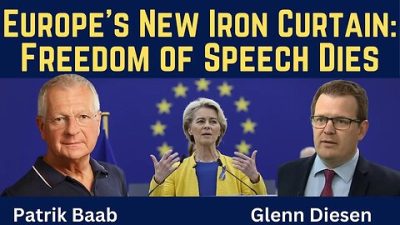
Patrik Baab: Europe’s New Iron Curtain – Freedom of Speech Dies
or go to
Aletho News Archives – Video-Images
Book Review
Jeffrey Epstein: A Jewish Individual?
The Occidental Observer | February 5, 2023
One Nation Under Blackmail: The Sordid Union between Intelligence and Organized Crime that Gave Rise to Jeffrey Epstein (Volume 1 & 2) by Whitney Webb
“Far from being an anomaly, Epstein was one of several men who, over the past century, have engaged in sexual blackmail activities designed to obtain damaging information (i.e., “intelligence”) on powerful individuals with the goal of controlling their activities and securing their compliance.”[1]
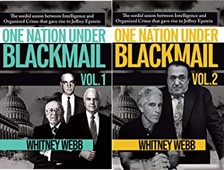
Jeffrey Epstein is dead and Ghislaine Maxwell is locked away in prison, and the thought-makers of our world seem keen to let the more explosive parts of the scandal dissipate from the public consciousness. As far as the mainstream media is concerned, Epstein and Maxwell were little more than well-connected socialites who ran a sex-trafficking ring for the rich and the powerful, and the focus has shifted instead to the criminal and civil cases seeking to achieve redress for the victims of sexual abuse.
On occasion some newspaper articles will mention the hidden cameras littered across Epstein’s properties, others the reams of CDs and hard drives found within them during the FBI raids. Altogether missing from the Netflix documentaries (Jeffrey Epstein: Filthy Rich [2020] and Ghislaine Maxwell: Filthy Rich [2022]) or the articles that spend their time narrowly focusing on the links between Epstein and Bill Gates, is the acknowledgement of the true nature of Epstein himself and the ultimate purpose of this sex-trafficking of minors — a sexual blackmail operation.
Not everyone is cowardly enough to let these controversial aspects lie untouched, as the newly released two-volume book One Nation Under Blackmail by independent reporter Whitney Webb seeks to blow wide open this media-enforced blackout. Utilizing primarily open-source information (that is, publicly accessible information such as books, newspapers articles and government reports),[2] Webb’s book delves into the life and times of Jeffrey Epstein and his deep ties to Jewish billionaires and Israeli intelligence. … continue
Blog Roll
Recent Comments


 Aletho News
- Patrik Baab: Europe’s New Iron Curtain – Freedom of Speech Dies
- Trump’s ‘Board of Peace’ exports Israeli ‘ceasefire’ diplomacy to the world
- Israeli army closes dozens of cases involving killing of Palestinians inside torture camps
- Europe creates a ‘Russian government-in-exile’, consisting of a bunch of losers
- Munich, 2007: The Day the West Was Told No
- At The Munich Security Conference, AOC Gets It Wrong On Foreign Policy
- Europe Decided to Go to War With Russia by 2030, Already Preparing – Orban
- Russia and China Are Expanding Their Cooperation to Counter US Efforts to Bully Iran and Cuba
- NATO plotting maritime blockade of Russia – Moscow
- Jeffrey Epstein’s sinister shadow over West Asia
- If Americans Knew
- Israel battles Palestinian right of return, one Palestinian at a time – Not a ceasefire Day 127
- Noor’s short life of unimaginable suffering
- Israel Destroyed Gaza’s Hospitals. Now It’s Banning Doctors Without Borders.
- Is Spite of What Zionists Say, It’s a Good Thing to Criticize Governments
- Palestinian mother, daughter recount strip searches, harsh conditions in Israeli detention
- Israel used weapons in Gaza that made thousands of Palestinians evaporate
- ADL’s Stats Twist Israel’s Critics Into Antisemites
- Why Is the World Silent When the Gaza Genocide Is Not Over?
- In Gaza: 8,000 bodies under rubble, 3,000 missing – Not a ceasefire Day 126
- AZAPAC, the new PAC opposing Israeli domination of U.S policies
- No Tricks Zone
- Unfudging The Data: Dutch Meteorological Institute Reinstates Early 20th Centruy Heat Waves It Had Erased Earlier
- German Gas Crisis…Chancellor Merz Allegedly Bans Gas Debate Ahead of Elections!
- Pollen Reconstructions Show The Last Glacial’s Warming Events Were Global, 10x Greater Than Modern
- Germany’s Natural Gas Storage Level Dwindles To Just 28%… Increasingly Critical
- New Study Rebuts The Assumption That Anthropogenic CO2 Molecules Have ‘Special’ Properties
- Climate Scientist Who Predicted End Of “Heavy Frost And Snow” Now Refuses Media Inquiries
- Polar Bear Numbers Rising And Health Improving In Areas With The Most Rapid Sea Ice Decline
- One Reason Only For Germany’s Heating Gas Crisis: Its Hardcore-Dumbass Energy Policy
- 130 Years Later: The CO2 Greenhouse Effect Is Still Only An Imaginary-World Thought Experiment
- New Study Affirms Rising CO2’s Greening Impact Across India – A Region With No Net Warming In 75 Years
 Aletho News