General William Westmoreland’s strategy during the Vietnam war was to kill enemy soldiers faster than they could be replaced. American Generals attempted to win with massive aerial bombings, starving the rural population, and shooting anyone who seemed hostile. Large areas of South Vietnam were designated as “free fire zones” where everyone was presumed the enemy. American soldiers often laughed at this immorality and stated: “kill them all and let God sort them out.” As a result, roughly two million Vietnamese civilians were killed and several times more wounded by American weaponry. General William DePuy defined this strategy as: “more bombs, more shells, more napalm… We are going to stomp them to death.”
Related Tale: “The Illusion of South Vietnam” explains why Vietnamese viewed the Americans as colonial occupiers: https://www.youtube.com/watch?v=0B9BM…
By the time US military ground troops arrived in Vietnam, “They all hated us!” as this Marine Corps veteran explains: https://www.youtube.com/watch?v=tixOy…
“Peers Inquiry; Report of the Department of the Army Review of the Preliminary Investigations into the My Lai Incident”; Library of Congress; https://www.loc.gov/rr/frd/Military_L…
The 1964 Gulf of Tonkin congressional resolution authorized President Lyndon Johnson to conduct military attacks in Vietnam. This was considered a blank check for American military intervention that was based on lies. The American destroyers USS Maddox and USS Turner Joy were not attacked by North Vietnamese torpedo boats on August 4th 1964, which was used to justify this resolution. This is now widely known, but since the Maddox had been fired upon two days earlier, some feel it was justified. However, few know that the US Navy had been supporting armed attacks along the coast and the Vietnamese were defending themselves.
“Skunks, Bogies, Silent Hounds, and the Flying Fish: The Gulf of Tonkin Mystery, 2-4 August 1964,” originally published in the National Security Agency’s classified journal “Cryptologic Quarterly” in early 2001, provides a comprehensive SIGINT-based account of what happened in the Gulf of Tonkin: https://nsarchive2.gwu.edu//NSAEBB/NS…
The core of this film is to investigate the hearts and minds of the Vietnamese who fought in that war. How did they sustain their morale in the face of such. Project for U.S. History class. I do not own any of the songs or images used in this video. Special thanks to Mr. Nguyen for the interview and Mr. Hoffman.
Supporters of the American empire think the U.S. military is invincible. They insist that the U.S. military never lost a battle during the entire Vietnam war. The U.S. military had every advantage, yet mistakes were made and some battles lost.
and has links to sources. Many lost battles are hidden in historical accounts by blending them with larger operations. One can read the sanitized details in official histories made after the war to confirm these battles as losses. For example, The Marine Corps’ official history of “Operation Utah.” https://www.marines.mil/Portals/59/Pu…
Related Tale: “The Illusion of South Vietnam” explains why all Vietnamese viewed the Americans as colonial occupiers: https://www.youtube.com/watch?v=0B9BM…
Supporters of the American empire proclaim the U.S. military invincible unless stabbed in the back by politicians. They say the US military won the war in Vietnam, but claim victory was lost after politicians cut off aid to South Vietnam. This is fake history. The Vietnam war was lost by 1963 after the CIA failed to establish a new nation that became known as South Vietnam. The arrival of American troops prevented a defeat, but only caused more death and destruction until they left.
Soon after the Americans departed, the fragile, corrupt puppet regime of South Vietnam collapsed. After this retreat, supporters of the American empire began to spread lies that South Vietnam collapsed in 1975 only because Democrats in Congress cut military aid. This deception begins with the half-truth that the 1968 Tet Offensive was a major defeat for the Vietnamese. This was true on the tactical level but it was a strategic disaster for the US military.
“MACV The Joint Command in the Years of Withdrawal 1968-1973; Graham A. Cosmas; US Army Center for Military History: https://history.army.mil/html/books/0…
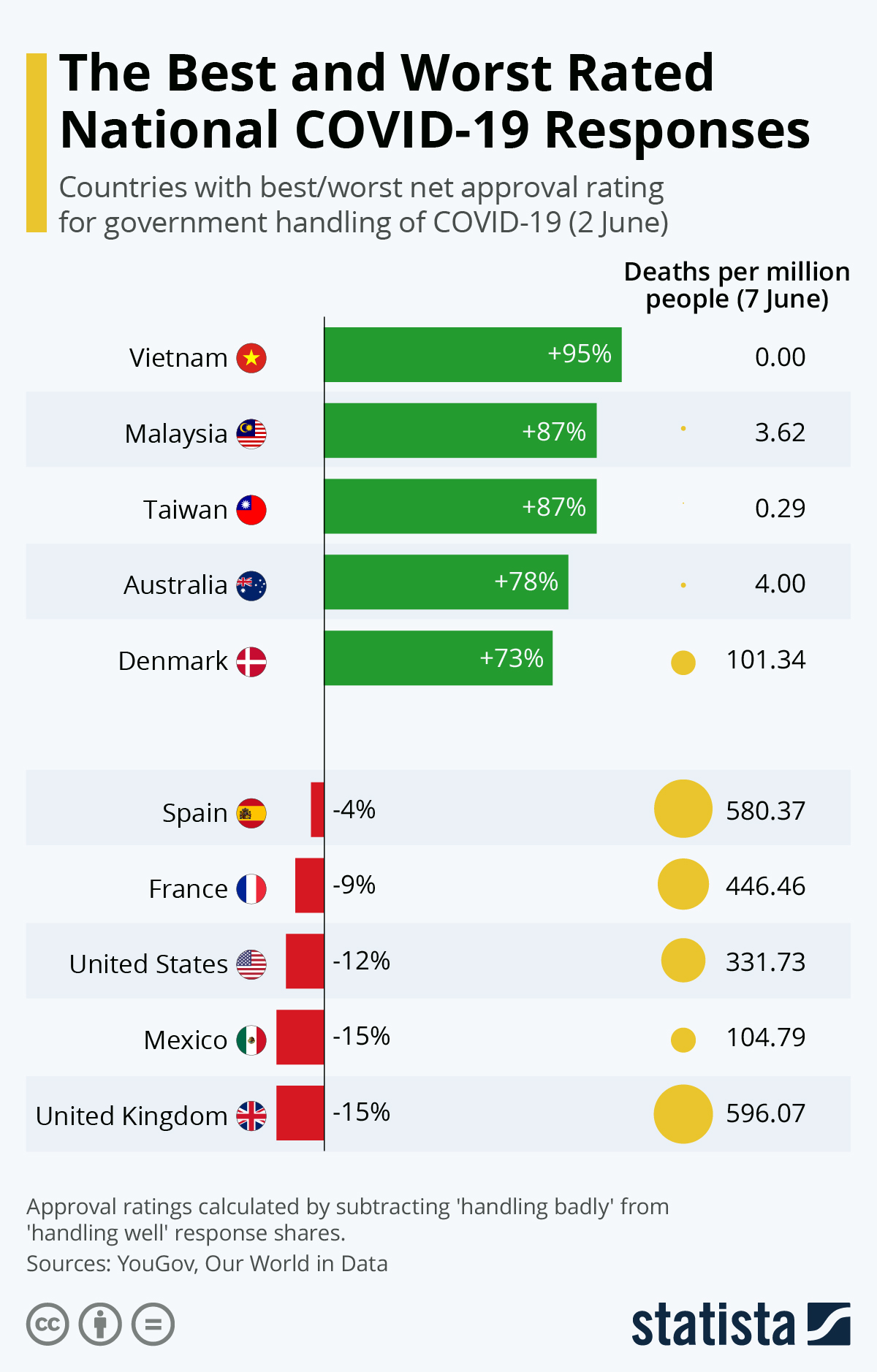
The extent to which the COVID-19 pandemic has affected countries varies vastly, connected in part to the respective government’s handling of the situation. As Statista’s Martin Armstrong shows below, these national responses can be worlds apart – both in terms of efficacy and as survey data from YouGov shows, the subsequent level of public approval, too.
In the UK, where the government’s response has been heavily criticised, the net approval rating (calculated by subtracting ‘handling badly’ from ‘handling well’ responses) is the joint-lowest of all countries surveyed.
Also with a rating of -15 is Mexico, where President López Obrador originally downplayed the severity of the pandemic and is now struggling to find the right balance between prioritizing public health and protecting the economy.
At the other end of the scale, Vietnam has so far recorded just over 300 cases and zero deaths.
To compare to the countries at the bottom of the ranking, Our World in Data figures have the number of deaths per million people for the UK and Mexico at 596.07 and 104.79, respectively.
Countries included in the survey were: Australia, Canada, Denmark, Finland, France, Germany, India, Indonesia, Italy, Japan, Malaysia, Mexico, Norway, Philippines, Poland, Singapore, Spain, Sweden, Taiwan, UK, USA, Vietnam.
Discussions about why the United States lost the Vietnam war focus on actions taken after American ground troops arrived in 1965. They could never succeed because the war had already been lost. Ho Chi Mihn was the most popular man in all of Vietnam and his soldiers were respected fighters for independence. They had defeated the French and later the Army of South Vietnam created by the American CIA. American soldiers fought for a nation that didn’t exist.
“CIA and the Wars in Southeast Asia 1947-1975”; Signals Intelligence; has interesting information recently declassified. https://www.cia.gov/library/center-fo…
By the time US military ground troops arrived in Vietnam, “They all hated us!” as this Marine Corps veteran explains: https://www.youtube.com/watch?v=tixOy…
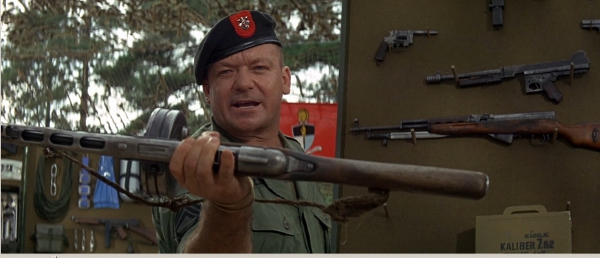
John Wayne’s Vietnam-era pro-war classic, The Green Berets opens with a scene of a press conference. It starts off with a group of Green Berets introducing themselves to the press, which is followed by a Q&A session with two Green Berets sergeants who have been assigned to answer questions. The scene reaches a crescendo when a reporter asks one of the sergeants if the war in Vietnam does not seem like a war between the Vietnamese and if the Americans should therefore stay out of it. Hearing this, the visibly irritated sergeant proceeds to pick up captured Vietnamese firearms from a display board nearby, and drops them in front of the reporter one by one, all the while explaining in a voice laden with hostile emotion that the weapons are Chinese-made, Soviet-made and Czechoslovakian-made respectively.
The implication is clear. The war in Vietnam is not merely an internal Vietnamese affair, because quite aside from the American factor in the war there is also the Soviet, the Chinese, even the Czechoslovakian factor. It is therefore on the account of this involvement of foreign Communist powers in Vietnam that the United States has to involve itself on the other side.
Now it is easy to see the inadequacy of that argument. Providing war material, even on a vast scale, is in no way comparable to a direct military intervention carried out with an occupation force of half a million soldiers, which is how many the United States had in Vietnam at the time The Green Berets aired in 1968.* Clearly the American involvement in Vietnam went far beyond what was necessary to balance out the involvement of the Soviets, the Chinese, or the Czechoslovaks, on the side of Hanoi.
But is it even true the American involvement was a reaction, perhaps an exaggerated reaction, to the Soviet, etc involvement? What were the actual cause and effect, in life rather than on film? Were the Americans in Vietnam because Soviet shipments of weaponry were going there, or were the Soviets shipping weaponry to Vietnam because the Americans had come there? How does this and other claims of war propagandists of the time stack up against what we know from the works of historians today?
In fact, where the Soviets are concerned their relationship with the Vietnamese before the American intervention in Vietnam was at its nadir precisely because the Soviet Union would not support DRV (North Vietnam) in reunifying Vietnam by military means. Soviet aid to DRV in this period, that is when the North was facilitating the struggle of the NLF (“Viet Cong”) in the South and before direct American involvement on a great scale, was relatively small and almost exclusively economic, not military.
When the unifying elections called for by the Geneva Accords of 1954 that had ended the French War in Vietnam did not come about, Hanoi gradually resolved to wage a military campaign to oust the American-backed government in the South. In this, however, it did not have the support of Moscow.
The Soviets feared American intervention which would have to result in an American-Soviet confrontation that would interfere with their policy line of “peaceful coexistence” with the Capitalist bloc. They made it clear to Hanoi they supported its struggle to reunify Vietnam only in as much as it was pursued by diplomatic means and encouraged Hanoi to pursue a peaceful strategy.
Vietnamese Communists shared many of the concerns being voiced by Moscow, but ultimately pressed on regardless. Both the Vietnamese and the Soviets were acutely aware that waging a violent struggle for reunification could result in an American invasion in Vietnam. They were both uneasy about this prospect and regarded it as highly undesirable, even disastrous. The difference was that the Vietnamese were ultimately willing to accept a confrontation with the Americans if they stood in the way of the reunification of their country, but the Soviets were not.
It was not until the time of the Gulf of Tonkin Resolution which marked the official entry of the United States into the war in Vietnam that the USSR begun to provide DRV with military assistance. The Soviets had held back on providing Vietnamese Communists with war material because this would encourage them to wage war in the South, which could in turn result in an American intervention. Now that Americans had intervened regardless, the Soviets no longer had a reason to continue to hold back. Whatever they did, the Americans were already in Vietnam. Now they would provide the Vietnamese with aid, because that was the only way these could hope to prevail against the Americans.
An additional reason for the Soviet reversal on the question of military assistance was to regain the influence they had lost with North Vietnam to China. In 1954 Moscow and Beijing had pressured the Vietnamese Communists into signing the Geneva Accords, which ended the French War in Indochina, but also split Vietnam in half.** Since then both China and the Soviet Union acted as a moderating force on Hanoi. They encouraged the Vietnamese to pursue the goal of reunification by peaceful means only, even after these had clearly shown themselves to be ineffectual when unifying elections called for by the Accords failed to materialize.
Following the Sino-Soviet split, however, Beijing gradually moved away from this position and came to see a military struggle could complement diplomatic and propaganda efforts. In time, the Chinese position would become further radicalized and they would reject the notion that negotiations could be of any use at all. It is important to understand, however, that Beijing came to approve of the armed struggle of the Vietnamese only in 1961, fully two years after the Vietnamese had gone ahead with it.
The change in the position of the PRC and the resultant increase in assistance to Vietnam enabled the Chinese-Vietnamese relationship to thrive. In the context of the Sino-Soviet confrontation within the Communist camp North Vietnam was now aligning ever more closely to China. That is, until the American intervention in the war caused the Soviets to launch a giant, Lend Lease-like program of military assistance to the DRV and regain their lost influence with Hanoi.
The key thing to take from here is that it was not the case that the Vietnamese fell under China’s influence which directed them to pursue the goal of unification of their country with military means. The Vietnamese were orienting themselves to that of the two Communist powers which would support them in their own policy line on South Vietnam. Chinese-Vietnamese relations could thrive precisely because China had come to adopt Hanoi’s view of peaceful means to reunify Vietnam as inadequate. The Soviet Union in turn could regain its influence over DRV and pull it back from the Chinese camp only when it had dropped its opposition to the military struggle of the Vietnamese.
The presence of Soviet and Chinese-made firearms in Vietnamese hands did not in fact point to the latter being simply the agents of monolithic Communism with designs over the entire globe as John Wayne wanted Americans to believe in 1968. In actuality, by going to war the Vietnamese Communists had defied the Kremlin and had frustrated its plans. It was precisely by opting for a military struggle that the DRV leadership had demonstrated its freedom of action. It was also the case that the USSR did everything it could to spare the US its calamitous war in Vietnam.
The Soviets attempted to dissuade the Vietnamese leadership from waging a military struggle even at the cost of losing nearly all its influence in Hanoi and seeing North Vietnam slide into the Chinese camp. If the mistake the Soviets committed was failing to appreciate just how important it was to the Vietnamese to reunify their country, it was a mistake the Americans tragically made as well. In part, due to propagandists like John Wayne who put out the idiotic drivel of the Vietnamese struggle for reunification as a matter of “world Communist domination”.
*Albeit by the time The Green Berets aired this was no longer the case, the Chinese also stationed troops in Vietnam, specifically in the Communist-run Democratic Republic of Vietnam (North Vietnam), but on a far smaller scale. In all 320,000 Chinese anti-aircraft and engineer troops served in Vietnam in comparison to 2.7 million Americans. The Chinese deployed in North Vietnam in mid 1965, in response to the Americans landing in the South. They evacuated in early 1968, having suffered about 1100 dead, mainly in the American bombing of the North.
**The two powers went as far as to signal the Viet Minh that rejecting the Accords may result in their ending their material assistance to the movement’s struggle.
Emile De Antonio’s documentary and strong narrative about Vietnam war with archival footage, interviews and a soundtrack by John Cage. An early film (1968) to bitterly comment on the war in Vietnam.
“Trump has nothing to do with the anti-Russia campaign and the public remains indifferent, while an improbable coalition of the Congress and the jeering media is orchestrating the chorus.”
An instance of such monumental patience is extremely rare, if not unprecedented, in Russian diplomacy: Moscow took 179 days to retaliate against former US President Barack Obama’s expulsion of 35 Russian diplomats on December 30, 2016, ostensibly to show rancour at alleged Russian efforts to interfere with the US presidential election.
The 35 Russian diplomats were “intelligence operatives”, Obama said. He gave them 72 hours to leave American soil, and he impounded two Russian diplomatic compounds as well.
In Moscow, though, President Vladimir Putin responded that Russia wouldn’t retaliate but would decide on further steps only after considering the actions of the incoming new president, Donald Trump.
Putin went on invite the children of American diplomats posted in Russia to a Christmas party in the Kremlin. But he had a master plan.
Putin preferred to start Russia’s discourse with the Trump administration on a creative note. Trump had raised high expectations in Moscow that a brave new world of partnership between Russia and the US might be approaching.
In the months that followed, however, such hopes began dimming even as Russia became a toxic subject in the Washington Beltway.
Nonetheless, residual hope lingered, as Trump deputed state secretary Rex Tillerson to travel to Moscow for talks in April and within the month also received the visiting Russian Foreign Minister Sergey Lavrov in the Oval Office.
The Russian spirits certainly soared when Trump and Putin held an extraordinary 126-minute meeting on the sidelines of the G20 summit in Hamburg where they discussed a range of issues complicating the relationship and yet managed to stay in their positions.
However, the pendulum has now swung to the other extreme with the US Congress passing legislation on further sanctions against Russia. What stunned Moscow is the near-unanimity with which the US lawmakers voted for the bill.
Moscow has drawn two conclusions. First, an intensification of US pressure against Russia is on the cards even as Russophobia has morphed into an anti-Russian mindset. A hardening of the US stance on Ukraine is likely. In Syria, too, Russia is far from a commanding position since several players are, pursuing their own agenda.
The sanctions encompass areas where Russia has the capacity to offer cooperation – energy, defense, mining, railway transport, etc. Curiously, the bill seeks to arm-twist third countries that may be inclined toward developing cooperation with Russia – countries such as India, Vietnam, Turkey, Saudi Arabia or Egypt. Again, real pressure will come if the US begins to tamper with the strategic balance with Russia.
Second, the legislation virtually takes the Russia policies out of Trump’s hands. Moscow trusted Trump’s instincts to improve relations with Russia and hoped that he’d call the shots ultimately.
But that may be about to change. Congress is reducing Trump to a subaltern role. Russia has no means to leverage influence in the US Congress. Trump may find a way to strike back at the Congress but it is small comfort if political tensions consequently rise in Washington.
All in all, therefore, Moscow sees that a normalization of Russia-US relations can be ruled out for a foreseeable future. The Congress can be expected to determine the US policy towards Russia through the Trump presidency – and this will be a policy of strangling Russia.
This grim prospect leaves Russia with no alternative but to recognise the US as a strategic and key challenge to its security.
Thus, Moscow’s decision on July 28 to curb the US diplomatic presence in Russia may seem a timid response. After all, Moscow is only responding to Obama’s harsh decision and is merely seeking reciprocity with a ceiling of 455 diplomats for both countries (which is where Russian tally currently stands.)
But on close examination, Washington has been made to look foolish. While Obama expelled 35 Russian diplomats, Putin’s order to slash the number of US diplomatic staff to 455 will affect a few hundred US personnel currently assigned to Russia.
Moscow is signalling that bilateral cooperation has become pointless. Indeed, Trump has nothing to do with the anti-Russia campaign and the American public remains indifferent, while an improbable coalition of the Congress and the jeering media is orchestrating the chorus. But the realities cannot be ignored.
The triumphalism on the Hill will be short-lived, because the potential strategic consequences for US’ core interests and vital interests are yet to sink in. The West’s policy on Russia now onward becomes a point of discord between Washington and the EU.
China, no doubt, gets a huge strategic windfall, since Moscow will seek closer rapprochement with Beijing, especially on security. A Russian observer noted wryly, “we can easily imagine them (Russia and China) holding military drills in the Straits of Florida near Cuba.”
Knowing Putin, Russia’s response will be calibrated. He implied in remarks while visiting Helsinki on Tuesday that Russia will play the long game.
After all, it is not only in the US’ relations with Russia, but also with allies in Europe and Asia – Germany and Japan, in particular – that fault lines have appeared. Russian diplomacy can be trusted to exploit what Germans call the “zeitgeist” – the spirit of our times – as the US’ global influence inexorably declines.
Russia’s cooperation can be crucial to US interests, and Moscow now has an option to cherry pick. Make no mistake, Moscow will exercise its option highly selectively.
After, or rather in spite of, a century of French, Japanese, and American military presence, Vietnam’s independence in 1975 was always inevitable for a number of important reasons. This is not to cast an aspersion on the U.S. military. It is simply an historical fact.
Although the Vietnamese had been rebelling against the French since their arrival in S.E. Asia, World War I was the initial catalyst for Vietnam’s independence. Vietnamese and other Indochinese troops, notably Cambodians, in the French colonial forces went to Europe and the Middle East in World War I to serve in both combat and support roles. French estimates vary as to the numbers killed and wounded. However, the surviving veterans were exposed to western literature and political views that they took home. Simply put, the “independence genie” was out of the bottle not to be recorked.
Having already promised the Philippines independence, President Franklin Delano Roosevelt (FDR) did not want the French, British, or Dutch back in their previous S.E. Asia colonies after World War II. FDR’s postwar plan for Indochina was a three-power high commission somewhat like the Allied partition of Berlin with a 25-year duration to work out independence. The Chinese would get the northern sector, the British the central, and the Americans the south approximating the three regional divisions of Tonkin, Annam, and Cochin China.
But with FDR dead, the 1945 Potsdam Conference divided Vietnam along the 16th parallel just south of Danang with the Chinese Nationalists to the north and the British to the south. The Chinese Nationalists promptly proceeded to loot the north fueling centuries of traditional Chinese-Vietnamese animosities while the British used surrendered Japanese troops to chase Viet Minh in the south before returning French forces arrived in late 1945 and early 1946.
U.S. military aid began flowing to the French shortly after VJ Day thus turning the French colonial restoration effort into an anti-communist war that in Western thinking trumped anti-colonialism. In the 1950s the U.S. assumed an ever-expanding role in the Vietnam conflict to help keep France in the newly-formed NATO alliance. Predictably the Vietnamese simply took the U.S. as French replacements to be battled likewise.
In reality World War II marked the fast-approaching end of European colonialism worldwide. Ho Chi Minh, Haile Selassie of Ethiopia, and other anti-colonialists were at the Versailles Treaty negotiations in 1919 seeking at least token recognition for colonial subjects. Spurned, they never gave up but after the independence stimuli of two World Wars future Vietnam independence was effectively unstoppable regardless of what France or the U.S. might do to contain it.
The only U.S. option that might have worked, at least temporarily, would have been a full-fledged military invasion of the north or perhaps a North Vietnamese rebellion. The U.S. and South Vietnamese commando raids and psychological and propaganda warfare against the north were hampered from all-out efforts to prepare an invasion or stimulate a rebellion for two reasons.
First, after encouraging Hungary to rebellion in 1956 against their Soviet-backed government and failing to back them up, it would not be U.S. policy to do so again, although there has been a notable exception or two. The Hungarian rationale is explained inThe Secret War Against Hanoi by professor Richard H. Shultz, Jr. of the Fletcher School of Law and Diplomacy. And second, an invasion of North Vietnam was an automatic war with China that would have violated Gen. Maxwell Taylor’s well-known dictum of no more land wars in Asia.
The only “secrets” the Pentagon Papers revealed in 1971 were that U.S. policy makers made continuing small incremental escalations of the war desperately hoping each one would mysteriously negate the need for another. This was simply wishful thinking that Vietnam resistance would weaken and the nightmare would disappear. Finally, there was no defined “end state” describing what specific conditions would constitute a U.S. victory in Vietnam.
The logical question is what other policy might have produced a different outcome. Obviously FDR’s three-power plan could have been tried. Could Ho Chi Minh have been the Tito of Indochina? Could Charles DeGaulle have taken a different tack? Could the U.S. have found a way to work with a Ho Chi Minh government? The U.S. has worked with all manner of undesirable governments around the world never demanding perfection so we will never know what a theoretical different outcome for Vietnam might have been.
In April 1964 I was an Air Force lieutenant on Taiwan when I volunteered to go directly to Vietnam to command a unit at Bien Hoa Air Base. (Lieutenants as commanders were a rarity in the Air Force.) It didn’t take me long to realize that Vietnam was a lost cause when I heard how some Americans were speaking about or, worse yet, to some Vietnamese. I realized “this turkey ain’t gonna fly” if this is what we think of our alleged allies. I was in Vietnam a combined seven years in the Air Force, as an Air America manager, and later a church group staffer, but nothing changed my mind as to the eventual outcome.
Many bemoaned the fact that the U.S. Congress did not fulfill its Paris Peace Accord obligations to support the South Vietnamese, specifically ignoring President Ford’s pleas to do so in April 1975. The Case-Church Amendment of June 1973 prohibited any further U.S. military activity in Vietnam. Rarely mentioned is that in 1973 President Nixon wrote a secret letter in carefully couched language offering the North Vietnamese $3.25 billion in reconstruction aid.
In the atmosphere of 1975 Congress was not about to send money to North or South Vietnam. Whatever anyone may think of how it happened, Vietnam was finally and fully independent as Ho Chi Minh declared it on September 2, 1945, the same day the Japanese surrendered on board the U.S.S. Missouri. Unfortunately for 58,000 American families who later lost loved ones in Vietnam, only the latter event was newsworthy at the time.
Fred Donner holds two degrees in East Asian studies. In addition to his seven years in Vietnam, he was five years a Foreign Service officer in Manila and Wash, DC and ten years a S.E. Asia intelligence analyst at the Defense Intelligence Agency.
Hearts and Minds is a 1974 American documentary film about the Vietnam War directed by Peter Davis.
The film’s title is based on a quote from President Lyndon B. Johnson: “the ultimate victory will depend on the hearts and minds of the people who actually live out there”.
The movie was chosen as Academy Award for Best Documentary Feature at the 47th Academy Awards presented in 1975.
As the West prepares to march off to yet another war in the Middle East, we should perhaps remind ourselves of who is giving the West their marching orders.
In February 2003, just weeks before the US and their allies launched their attack on Iraq and her peoples, a delegation of US congressmen, together with the US Ambassador to the United Nations, John Bolton, a well known pro-Zionist and neoconservative war-hawk, were in Israel at the invitation of the Israeli government then led by Israeli Prime Minister Ariel Sharon.
Addressing the congressmen, Sharon told them ‘that Iran, Libya and Syria should be stripped of weapons of mass destruction after Iraq’. Later, Sharon told John Bolton ‘that Israel was concerned about the security threat posed by Iran, and stressed that it was important to deal with Iran even while American attention was focused on Iraq’. … continue
This site is provided as a research and reference tool. Although we make every reasonable effort to ensure that the information and data provided at this site are useful, accurate, and current, we cannot guarantee that the information and data provided here will be error-free. By using this site, you assume all responsibility for and risk arising from your use of and reliance upon the contents of this site.
This site and the information available through it do not, and are not intended to constitute legal advice. Should you require legal advice, you should consult your own attorney.
Nothing within this site or linked to by this site constitutes investment advice or medical advice.
Materials accessible from or added to this site by third parties, such as comments posted, are strictly the responsibility of the third party who added such materials or made them accessible and we neither endorse nor undertake to control, monitor, edit or assume responsibility for any such third-party material.
The posting of stories, commentaries, reports, documents and links (embedded or otherwise) on this site does not in any way, shape or form, implied or otherwise, necessarily express or suggest endorsement or support of any of such posted material or parts therein.
The word “alleged” is deemed to occur before the word “fraud.” Since the rule of law still applies. To peasants, at least.
Fair Use
This site contains copyrighted material the use of which has not always been specifically authorized by the copyright owner. We are making such material available in our efforts to advance understanding of environmental, political, human rights, economic, democracy, scientific, and social justice issues, etc. We believe this constitutes a ‘fair use’ of any such copyrighted material as provided for in section 107 of the US Copyright Law. In accordance with Title 17 U.S.C. Section 107, the material on this site is distributed without profit to those who have expressed a prior interest in receiving the included information for research and educational purposes. For more info go to: http://www.law.cornell.edu/uscode/17/107.shtml. If you wish to use copyrighted material from this site for purposes of your own that go beyond ‘fair use’, you must obtain permission from the copyright owner.
DMCA Contact
This is information for anyone that wishes to challenge our “fair use” of copyrighted material.
If you are a legal copyright holder or a designated agent for such and you believe that content residing on or accessible through our website infringes a copyright and falls outside the boundaries of “Fair Use”, please send a notice of infringement by contacting atheonews@gmail.com.
We will respond and take necessary action immediately.
If notice is given of an alleged copyright violation we will act expeditiously to remove or disable access to the material(s) in question.
All 3rd party material posted on this website is copyright the respective owners / authors. Aletho News makes no claim of copyright on such material.
 Aletho News
 Aletho News