HEBRON – Israeli settlers set fire to an 1,000-year-old olive tree in central Hebron overnight Friday, witnesses said.
Local activist Issa Amro said the group then hurled stones at a community center in the Tel Rumeida neighborhood on Saturday morning.
Settlers tried to remove the Palestinian flag from the ‘steadfastness and challenge’ center, while Israeli soldiers looked on, he said.
Several days ago a group of Israeli settlers stole the building’s flag, which activists had since replaced with a new one, Amro added.
Tel Rumeida lies in the Israeli-military controlled H2 zone of the southern West Bank city, after a 1997 agreement split Hebron into areas of Palestinian and Israeli control. The zone includes the ancient Old City, home of the revered Ibrahimi Mosque — also split into a synagogue referred to as the Tomb of the Patriarchs.
Around 800 Jewish settlers live in Hebron’s Old City, among 30,000 Palestinians in the parts of the city that are under Israeli control.
June 2, 2012
Posted by aletho |
Ethnic Cleansing, Racism, Zionism, Illegal Occupation | Hebron, Israeli settlement, Tel Rumeida, West Bank |
Leave a comment
On Wednesday, May 23, a group of Israeli settlers forcefully occupied the home of a Palestinian family near the illegal Tel Rumeida colony in the Palestinian city of Hebron. In an incident that lasted 3 hours, settlers forced their way into the house and began physically and verbally abusing the family. The family was evacuated by Israeli soldiers. The settlers then blocked the entrance, preventing the family from entering the premises.
At 6p.m., Muhammed Toma Aburmeli was working in his shop in Tel Rumeida when he received a call from his distressed wife requesting that he come home immediately. As he returned home he saw his wife and young children standing near checkpoint Gilbert, with his home surrounded by Israeli soldiers. Looking closer at the entrance of his home, Muhammed saw a large group of young Israeli settlers standing outside his doorstep and preventing the family from entering.
At approximately 5:30 p.m., Muhammed’s wife, Merfat Muhammed Aburmeli, and 4 children, the eldest only 8 years old, were inside their new home located on the same road as the illegal Tel Rumeida settlement. The family was preparing to move furniture into the house. As the preparations were underway a group of 15 to 20 settlers no older than the age of 16 stormed into the house.
The settlers immediately confronted the frightened family, insulting them and demanding that they leave the home. The young settlers repeatedly claimed that the land is theirs and that the Palestinian family has no right to live here. As well as the verbal barrage, the settlers began to violently push Muhammed’s wife and her children.
The harassment lasted 10 minutes before Israeli soldiers intervened. Checkpoint Gilbert is only 3 metres from the house so this can be considered a slow response on behalf of the soldiers.
Israeli military arrived and the settlers continued to abuse the family. The first thing the soldiers did was evacuate the Aburmeli family, rather than force the settlers to leave. The family was then ordered by the military not to return to their house until the settlers were gone.
The Israeli soldiers requested that the settlers leave. The young Israeli settlers ignored the request and ran through the house causing damage. Ten minutes passed before soldiers resorted to physical means to force them out of the home. The settlers showed resistance, shoving soldiers as they dragged them out.
After evacuating the premises, soldiers locked the house’s door. The young settlers then blocked the entrance to the home from the outside. The Israeli military made no effort to disperse the group and instead soldiers surrounded the house.
When Muhammed arrived at the scene he asked the soldiers what was happening. The soldiers shrugged off his question and instead demanded that he show identification. After handing back his ID card, he too was told to go stand with his family and wait for the soldiers to diffuse the situation.
Soldiers made no efforts to remove the settlers, and Muhammed and his family were left standing outside and waiting for almost 3 hours before the settlers began to leave by themselves at 8:30 p.m.
Muhammed, Merfat, and their young children returned to their home. They say that what is upsetting is not only the behaviour of the illegal Israeli settlers, but the incompetent reaction of the Israeli army. This harassment, however, is not a new ordeal for the Aburmeli family. Only one day before, settlers damaged a window of their home by hitting it with sticks. In their last home, located nearby, settlers similarly blocked the entrance on more than one occasion.
Families living near the illegal Tel Rumeida settlement, which occupied a section of houses and roads in downtown Hebron, have long been the subject of abuse and discrimination coming from both the settlers and Israeli policies. Currently, only 2 Palestinian families remain living in what is now the Israeli settlement.
These 2 families are not permitted visitors, even family members, because all other Palestinians are prevented by Israeli soldiers from entering. These families in particular face abuse by the Israeli settlers on a regular basis. It can be difficult for the families even just to walk without being pelted by stones or being subject to insults.
Muhammed fears that incidents such as these will continue to occur, but says that no matter what happens he will never leave his home because he, as well as other Palestinians, has a right to live in freedom, peace, and dignity in his own land, and illegal settlers can not force them to leave. He finishes by saying, “if they wish to do worse, then let them, because we will not leave. As the olive tree will continue to live here, we Palestinians will continue to live here.”
May 30, 2012
Posted by aletho |
Ethnic Cleansing, Racism, Zionism | Hebron, International Solidarity Movement, Israel, Israeli settlement, Tel Rumeida, West Bank |
Leave a comment
Bassem Tamimi, a leading member of the grass roots movement against the Israeli Annexation Wall and settlement construction in the village of an-Nabi Saleh, has on Tuesday been sentenced at the Israeli Ofer Military Court in the West Bank.
Mr. Tamimi was sentenced to 13 months imprisonment and a further 17 months suspended sentence. Tamimi was released following the judgement, due to having already served 13 months imprisonment waiting for his case to come to trial.
The ruling means that if Tamimi participates in any of the village’s weekly non-violent protest activities he will be forced to serve out the remainder of the suspended sentence in prison.
Bassem Tamimi has been described as a human rights defender by Catherine Ashton, the High Representative for Foreign Affairs and Security Policy of the European Union. Ashton has been critical of the trial against Tamimi, as she was of the trial against Abdullah Abu Rahme, a similar figure in the non-violent protest movement in the village of Bil’in.
The trial of Bassem Tamimi came under fire following allegations of coerced testimony from children of Nabi Saleh who, contravening international law, were interrogated by the Israeli military with neither legal representation or a parent or guardian present.
May 29, 2012
Posted by aletho |
Civil Liberties, Deception, Ethnic Cleansing, Racism, Zionism | Bassem Tamimi, Catherine Ashton, European Union, Human rights, International Middle East Media Center, Israeli settlement, NabiSaleh, Palestine, Palestinian prisoners in Israel, West Bank |
Leave a comment
On Friday, May 25, illegal Israeli settlers drove into the village Lubban ash-Sharqiya where they attempted to forcefully enter a family’s home. When Israeli soldiers and policemen arrived at the scene they joined the settlers, supporting’ them whilst they tried to enter the house.
Men of the Palestinian family, together with International Solidarity Movement (ISM) volunteers and other internationals, stood at the gate of the house to prevent the settlers from entering. The father of the household, Khaled Daraghmeh, and his son were then beaten and arrested.
Lubban ash-Sharqiya is a village located some 30 kilometres south of Nablus, adjacent to Route-60, the primary north-south road that runs through the occupied West Bank. The village is surrounded from all directions by 3 illegal settlements: Eli, Shilo, and Ma’le Levona. The illegality of these Israeli colonies has been confirmed by the International Court of Justice and the United Nations Security Council.
On the outskirts of Lubban ash-Sharqiya, near the colony Ma’le Levona, Khaled Daraghmeh lives with his family. Khaled, like many other Palestinian villagers, works as a farmer and is dependent on what the harvest provides him. Living next to Israeli settlements is not an easy fate for Palestinians and Khaled has suffered a lot.
“It began to get really bad about five years ago. That was when the Israeli Occupying Forces (IOF) demolished my first house.” says Khaled.
After his first house was demolished, Khaled moved to his father’s old house just across the road. The peace he sought there did not last long. Only a couple months later, settlers attacked and burned down the entire building. Khaled was then forced to move to a third house, an ancient Ottoman building that also belongs to his father. Here the family lived in one part of the house, using the remaining space as a poultry farm.
The settlers have made it clear, however, that they are determined to get rid of Palestinians in the area. Last Saturday, some 50 settlers forcefully entered the house, removed all the furniture, and burned it. They also poisoned the drinking water of the poultry farm, leading to the death of most of the animals inside.
Now Khaled is frightened of life in his own home. He welded the door to the living area and moved into a small, dark room, where he used to keep animals.
“In the past, I was able to repair or rebuild what the settlers destroyed, but now I have used up all my savings,” says Khaled.
The harassment continues til today. As Khaled worked his land, a settler car stopped at the road and began making phone calls. He feared a new attack and called the ISM, seeking their immediate presence. Upon their arrival, the settlers had already left and everything appeared calm. Later, while the group of Palestinians and internationals sat together having lunch, approximately 20 settlers of all ages arrived and started walking towards the Ottoman house.
Palestinians from the area, accompanied by the ISM, approached the settlers and asked them what they were doing here. They replied that the land was ‘community property’ and that they had the right to be there. Khaled, who owns the land and has all the needed documents to prove it, replied by saying that this is his land, and that he wanted them to leave.
While the discussion continued, an Israeli military jeep with 6 soldiers arrived and began to split up the crowd. A policeman told the settlers that they could not enter the house as it belongs to Khaled and his family. The settlers grew upset with the policeman and screamed that he was a coward and afraid of the internationals and their cameras.
A discussion in Hebrew took place between them and meanwhile another police car arrived and 2 other policemen joined the crowd. After a couple of minutes of heated dialogue, the 3 policemen, the 6 soldiers, and the illegal settlers walked towards the house while the settlers screamed, “you see, you see, now we can enter!”

Jamal Daraghmeh is peppersprayed and loses his shoe in the violent arrest | Katarina Reigo
The Palestinians together with the internationals formed a line at the gate of the house to prevent the approaching group from illegally entering the house. Khaled was wrestled to the ground and beaten by soldiers and police men, even after being handcuffed. When Jamal, Khaled’s 21 year old son, saw his father beaten and attacked, he ran over to try to help. When he reached, the soldiers and policemen attacked Jamal in the same way they did his father.
Khaled’s 17 year old son, Jalad, then tried to help them and was instead attacked by the settlers and pushed away by the soldiers.
As the policemen walked away with the handcuffed men, they struck Jamal in the head a couple of times. The youngest son, Mu’min, 14, was filming the attacks on his brother and father when the policemen tried to kick him in the head. The boot missed him only by a few centimetres. Then policeman pulled the camera out of the teenager’s hands and stole it.
Only moments later, Jamal was pepper sprayed in the face before they forced him into the police vehicle. Khaled was then pushed into the jeep with bleeding hands from the brutal handcuffing.
“This has become normal to us. My father has been arrested 4 times recently and my brothers is beaten up all the time. Mu’min can not even walk to school without the settlers attacking him,” says Jalad.
To survive as a Palestinian living adjacent to these illegal settlements, can, with the assistance of the Israeli Occupation Forces, feel like a losing game. Only last year, 250 to 270 of Khaled’s olive trees were uprooted by settlers. Last week, an entire field of cucumbers was destroyed along with the irrigation system of the family’s land.
These attacks have pushed the Daraghmeh family into the desperate situation they are now in. After being forced to start over again and again, they have no money left. They can not repair the things that are destroyed, leading to a bad harvest, and less income.
Simultaneously, the Israeli state has offered Khaled 5 million shekels (1 million Euros) for his land. But as many other Palestinians, he is rejecting the money, and the resulting ethnic cleansing, and will continue to live and work on his land even if it means sleeping in a small, dark room with no electricity or running water.
May 28, 2012
Posted by aletho |
Ethnic Cleansing, Racism, Zionism, Subjugation - Torture | International Solidarity Movement, Israel, Israeli settlement, Nablus, West Bank |
Leave a comment
Late on Sunday night Israeli soldiers invaded the village of Bil’in, near the central West Bank city of Ramallah, and attempted to kidnap a local peace activist, one of the organizers of nonviolent peaceful protests against the illegal Israeli Annexation Wall and settlements in the area.
The Friends of Freedom and Justice Committee in Bil’in (FFJ) reported that resident Hosam Hamad, 33 years old, was not at home when soldiers invaded it. Instead, the soldiers handed his mother a warrant for his arrest.
The FFJ added that the army pushed journalists and cameramen away when they attempted to ask the soldiers why they were trying to take Hamad. They informed them that they were not allowed to document the invasion and did not provide any explanation for their actions.
Bil’in is known for its leading role in creative non-violent resistance against the Annexation Wall and settlements in the area. Peace activists from different parts of the world as well as Israeli activists participate in the weekly non-violent protests.
Israeli soldiers use excessive force against the protesters, and repeatedly kidnap local activists of the non-violent resistance. The army is responsible for hundreds of injuries and several deaths because of its use of force against the protesters.
In 2008, Ashraf Abu Rahma was detained during a nonviolent protest; he was cuffed and blindfolded before one soldier held him while another soldier shot him in the leg.
The shooting was caught on tape by a young Palestinian woman from Bil’in, and was handed to a number of human rights groups to expose the Israeli crime. The soldiers subsequently detained her father as an act of punishment.
Abu Rahma’s brother, Basem, and his sister, Jawaher, were killed by Israeli fire in different non-violent protests against the Wall and settlements.
A statement issued by the spokesperson of the EU’s High Representative, Catherine Ashton, said last Tuesday that the European Union defends the right of Palestinians to hold peaceful protests against illegal Israeli settlement construction on their land.
May 28, 2012
Posted by aletho |
Civil Liberties, Ethnic Cleansing, Racism, Zionism, Illegal Occupation, Solidarity and Activism, Subjugation - Torture | Bil'in, Catherine Ashton, European Union, International Middle East Media Center, Israel, Israeli settlement, West Bank |
Leave a comment
18 year old Saleh al-Zoghayer, who was recently stabbed by Israeli soldiers in Bethlehem, has been at the centre of the media recently. Several contradicting and false reports surfaced along with a shocking photograph of Saleh following the stabbing.
On Sunday, May 20, Saleh took a day off. Leaving his construction job in the town of Tobas, he travelled to Bethlehem to visit doctors there due to an illness. Upon arriving in Bethlehem, it is uncertain as to why, he was instructed by Israeli soldiers to exit the vehicle in which he was a passenger. Saleh found himself in the midst of a bike tour held by illegal Israeli settlers. The tour in question was held for Jerusalem day and was heavily guarded by Israeli Occupation Forces (IOF).
According to Israeli media sources such as Ynet and Hareetz, Saleh attempted to stab an IOF soldier and instead harmed himself. At first, both Palestinian and Israeli news sources suggested that Saleh had died from his injuries but this was not the case.
Saleh’s father, Nidal Mohamad al-Zoghayer, was interviewed by International Solidarity Movement (ISM) volunteers on May 23 and an entirely different story emerged. Nidal says his son is not the “Palestinian terrorist” that Itamar Fleishman of Ynet baselessly suggests. Saleh was on the receiving end of criminal violence, said Nidal, and not from IOF soldiers but from the illegal settlers.
Having been denied permission from Israeli authorities to go visit his son, Nidal relays to ISM what his lawyer said after seeing Saleh with his own eyes.
According to Nidal’s lawyer, Saleh is recovering and in stable condition. He suffered multiple stab wounds, with two perpendicular wounds across his abdomen and one near to his heart. Barely able to sit up in his hospital bed, his legs are tied together at the ankles with cuffs. Three IOF soldiers are positioned at his door at all times.
Nidal tells us the IOF are detaining his son and upon his recovery, Saleh will be charged with ‘assaulting a soldier.’ He finds the IOF’s version of events highly unlikely. If Saleh had indeed attacked a soldier in an area with a large military presence, says Nidal, he would have immediately been shot.
Saleh is not a political activist, said Nidal. “My son has no political affiliation, and has never been detained before this incident. He works 6 days a week, Saturday to Thursday, only to come to Hebron on Friday evening to spend time with his family and friends.”
Illegal settlers are known for their violent behaviour against Palestinian men and women of all ages. Just one day prior to Saleh’s stabbing, settlers attacked the town of Asira Al-Qibliya, shooting live ammunition and injuring several including one man who was shot in the head. Israeli soldiers were present but did not interfere with the settlers’ attack as has become routine in the occupied West Bank.
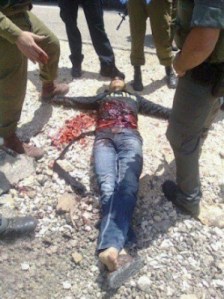 Nidal showed photographs of wounds to Saleh’s neck that indicate a struggle as well as further photographs of his son covered in blood, with IOF soldiers standing on his hands.
Nidal says that if the IOF is able to stand by as illegal settlers fire live ammunition at unarmed villagers, then it should not be controversial for him to suggest they stood by and allowed an attack on his son. “There are many cameras in that area and soldiers are on hand 24 hours a day. I want to see the Closed Circuit Television (CCTV) footage of what really happened to my son.”
This would be the only hope for Saleh to prove his innocence as the Israeli military courts are notoriously unjust: 99.74% of cases heard by the military courts against Palestinians in the West Bank end in a conviction. In Israeli military courts, the word of a soldier is enough evidence to convict even a minor.
Saleh was in the midst of saving money for his wedding and the purchase of a home. He is one of 8 children, the eldest of which is currently held in an Israeli prison. Originally having been detained by the Palestinian Authority for his political views, Saleh’s eldest brother was re-incarcerated by the IOF upon his release, without a chance to see his family in between.
Saleh’s uncle, Ahmed al-Zoghayer, also sat down with the ISM. He reenforced Nidal’s belief that if his nephew had attempted to attack a soldier he would have been shot.
Ahmed clarified one of the reasons for Saleh’s presumed death. The ambulance carrying Saleh was late to arrive at the scene. When it arrived, his heart had stopped and he was believed to be dead. Defibrillators were used and his heart began beating again. Saleh was then successfully operated on.
An 18 year old has been accused of attacking an IOF soldier. His family contests this and their demand for CCTV footage has not yet been responded to. ISM supports the call for its obtainment.
May 27, 2012
Posted by aletho |
Ethnic Cleansing, Racism, Zionism, Subjugation - Torture | Asira al-Qibliya, International Solidarity Movement, Nidal, West Bank |
Leave a comment
Forcible transfer and deportation are terms that commonly evoke images of people being loaded onto trucks or trains or violently driven away.1 Forcible transfer, however, may also take the form of involuntary or induced movement of people resulting from the creation of insecurity, disorder, or other adverse conditions, for the purpose of, or resulting in such migration. Article 49 of the Fourth Geneva Convention prohibits all forcible transfers. Only the security of the population of the occupied territory or imperative military reasons can exceptionally justify total or partial evacuation of an area under occupation. Those evacuated shall be transferred back to their homes as soon as hostilities in the area in question have ceased.
A key criterion to assess the forcible nature of the displacement is whether or not the transfer is the result of the individual’s own genuine choice to leave.2 As developed in the case law of the International Tribunal for the Former Yugoslavia (ICTY), forcible transfer is understood as the forced displacement of persons from where they reside to a place that is not of their own choosing and “includes threat of force or coercion, such as that caused by fear of violence, duress, detention, psychological oppression or abuse of power against such person or persons or another person, or by taking advantage of a coercive environment.”3 The ongoing forcible transfer of the Palestinian people from or within the Jordan Valley in the Occupied Palestinian Territory (OPT) is a clear example of this kind of transfer (sometimes misleadingly called “indirect transfer”).
The facts speak for themselves. Although there is uncertainty as to population levels in the past, it is estimated that between 250,000 and 300,000 Palestinians lived in the Jordan Valley on the eve of the 1967 Israeli military occupation.4 After more than 40 years of occupation, the Palestinian population in the area has been dramatically reduced to 56,000.5 However, the displacement of Palestinian people from their homeland is not a phenomenon relegated to the past, but an ongoing process, particularly in this resource rich and geopolitically strategic area.
During 2011, more than one third of all Palestinians forcibly transferred in the West Bank were residents of the Jordan Valley, nearly 60 percent of whom were children.6 If we consider that the area contains vast land reserves and abundant water resources, making it the most fertile region of the OPT, the estimates appear striking. How did this dramatic decrease in population occur?
The 1967 “voluntary” exodus
The circumstances surrounding the plight of the Palestinian people in the Jordan Valley during and after the 1967 War refute the widespread misperception that the 1967 exodus was largely “voluntary,” as compared to the forcible nature of the 1948 exodus.
Israel’s military strategy during, and just after, the 1967 War aimed to drive out tens of thousands of Palestinians from their villages, towns and refugee camps in the West Bank and the Gaza Strip.7 This was particularly the case for the Jordan Valley where Israeli forces expelled 88 percent of the area’s population eastwards, across the river to Jordan. The village of Jiftlik, for example, was razed to the ground, rural communities were depopulated, and virtually all residents of three 1948 large refugee camps surrounding Jericho fled or were expelled to Jordan.8 Despite not being the site of any major military battles during the 1967 war, the Jordan Valley suffered the highest population loss in the entire West Bank in the war and its aftermath.9
Israel’s purpose of removing the Palestinians from the area is confirmed by the measures it took to prevent the return of those who had fled during the war and the period that followed. These measures included the routine shooting of civilians trying to return, or “infiltrate,” to their lands across the Jordan River10 as well as the inclusion of Jordan Valley landowners on a secret “black list” in order to deny their entry into the West Bank.11 At the same time, from 1967 to 1994, Israel undertook a mass withdrawal of residency rights from hundreds of thousands of Palestinians who travelled abroad during that period, effectively preventing them from returning to their homeland.12 Then, after the eruption of the intifada of 2000, Israel barred almost all Palestinians from returning to, or visiting, the areas.13
The Palestinians remaining in the Jordan Valley would be, from 1967 onwards, subject to Israel’s policies aimed at minimising the number of Palestinians in the area,14 while maximising Israeli control over the land, water resources and transport routes.
Deprivation of land and water resources
The policy to take control over the land included legal and administrative changes, financial incentives to settlers and institutional coordination.15 Israel began by declaring in 1967 nearly 60 percent of the Jordan Valley as closed military areas, effectively banning Palestinian access to, and development of, the land.16 Through subsequent military orders, Israel seized control of the water resources of the OPT.17
Huge trenches have been dug in the Jordan Valley as part of the Apartheid Wall system to prevent Palestinian access to agricultural lands, these areas are also ‘live-fire zones’ for the Israeli army. Israeli decision-makers saw Jewish civilian presence as a necessary element to guarantee and maintain control over the occupied land, and so the Occupying Power immediately began to transfer its own civilian population into the area; an action expressly prohibited by Article 49(6) of the Fourth Geneva Convention, regardless of its motive.18 By the end of 1968, the Israeli military had established three military outposts in the Valley.19 The eventual shift from military outpost to predominantly agricultural colonies from the early 1970s in the Jordan Valley adequately illustrates the colonizing nature of the settlement enterprise while refuting Israel’s alleged security needs to justify the occupation of the Jordan Valley.
The built up area and the land cultivated by the existing 38 settlements take up a further 10 percent of the Valley. Although the actual settler population in the area is quite small, most of the approximately 9,400 settlers20 are farmers who cultivate large tracts of land and use most of the water resources. This has rendered the Jordan Valley the area of the OPT most relentlessly exploited by settlement agricultural production.
The deliberately discriminatory nature of Israel’s policies results in a striking inequality of access to water between Israelis and Palestinians in the Jordan Valley. Indeed the water available to the Palestinians of the Valley falls far short of that recommended by the World Health Organisation.21 The situation is even worse for the Palestinians living in the rural communities of the Jordan Valley who are not even connected to the water network system.
Furthermore, the water extraction ratio in the Israeli settlements is the highest in the West Bank.22 The deep wells serving the Israeli colonies have dried up the Palestinian wells and springs in the area.23 The Israeli pumping stations, including those on or near the lands of Palestinian communities, are closed and fenced off. With no access to running water, in some cases the rural Palestinian inhabitants survive on water supplies that the World Health Organization classifies as an indicator of an emergency response situation.24 Palestinians have no choice but to buy their own water—water that they are entitled to extract for themselves under international law–from the Israeli water company Mekorot. They often have to buy water from mobile tanks that deliver water of dubious quality at much higher prices.25
Meanwhile, in the same area, Israeli settlers enjoy intensive-irrigation farms, lush gardens and swimming pools.26 It should thus come as no surprise that the 9,400 Israeli settlers living in the Jordan Valley consume more than six times the quantity of water consumed by the more than 56,000 Palestinians in the area.27
And the Oslo Accords came to life
Under the Oslo Accords, more than 90 percent of the Jordan Valley was classified as “Area C,” 28 meaning full Israeli civil and military control extending to land registration, planning, building and designation of land use. The 1995 Interim Agreement called for the gradual transfer of power and responsibility in the sphere of planning and zoning in Area C from the Israeli military’s “Civil Administration” to the Palestinian Authority.29 Yet, this transfer was never implemented and Israel’s continued control over planning and zoning in Area C has, according to the World Bank, “become an increasingly severe constraint to [Palestinian] economic activity.” 30
Israel’s implementation of the Oslo Accords has consolidated its control over the Jordan Valley. It has used this control to effectively appropriate more Palestinian land and restrict Palestinian mobility and economic activity with disastrous effects upon the Palestinian civilian population.
Approximately 40 percent of the Jordan Valley’s population is comprised of semi nomadic Bedouin and herder communities that have traditionally grazed their herds throughout the area. Today, the local population is restricted to enclaves, surrounded by Israeli settler infrastructure on the one hand, and no-go areas on the other.31
Moreover, although Palestinians can, in theory, cultivate what remains of their land, as part of its policy of minimising Palestinian presence and growth in Area C the Occupying Power has imposed harsh restrictions on building and freedom of movement on the area; restrictions that apply only to Palestinians. Israel prevents Palestinians from constructing any infrastructure or implementing development projects such as water wells, reclaiming of agricultural land, opening agricultural roads or extending irrigation networks. Thus, despite its vast agricultural potential, the Israeli restrictions on access to the land and its water resources have turned the Jordan Valley into the least-cultivated Palestinian area.32
The final push
Palestinians cannot build or renovate homes or any other infrastructure in Area C without first obtaining permits from the Israeli military’s Civil Administration. These permits, however, are rarely issued.33 The restrictions imposed on Palestinians force many of them to build without the required permits to meet their needs, despite the ever-present risk, and practice, of demolition.34
The Palestinians’ inability to obtain permission for legal construction and Israel’s policy of demolishing their homes due to lack of building permits lead to the displacement of hundreds of Palestinians in Area C.35 Systematic destruction of Palestinian infrastructure is particularly rampant in the Jordan Valley. Consider that in June 2009, the Jordan Valley registered a dramatic increase of demolitions in closed military zones 36 and, in July 2010, the Israeli government instructed its military to increase demolitions of “illegal” Palestinian buildings in the Jordan Valley.37 As a result, approximately 40 percent of the structures demolished during 2011 in the West Bank, including East Jerusalem, were located in the Jordan Valley.38 These demolitions affected at least 2,000 Palestinians in the Valley, and more than 4,100 in the entire occupied West Bank.39
The inability to carry out legal construction inevitably impacts the provision of basic services to, as well as livelihoods of, Palestinians in the Jordan Valley. The PA is unable to undertake any infrastructure projects in Area C without the approval of the Israeli military’s Civil Administration. Therefore, while the Interim Agreement saw the transfer of responsibility for the provision of education and health services in Area C to the PA, the virtual impossibility of obtaining building permits from the Civil Administration for the construction or expansion of public buildings, such as schools and clinics, makes the provision of these services practically impossible.40
As a result of the Occupying Power’s illegal practices, the communities living in the Jordan Valley—considered a “high risk” area 41—represent some of the most vulnerable in the West Bank, and are regarded as priority groups for humanitarian assistance due to their lack of access to basic services (such as education and health) and infrastructure (including water, sanitation and electricity).42
In addition to severely limiting the amount of water available to Palestinians and denying them permits to restore old wells and build new ones, Israel has continuously destroyed water cisterns and the other basic rainwater collection systems that serve rural and herder communities.43 Moreover, during the summer months, the Israeli army has stepped up pressure on Palestinian herder communities to force them out of the Jordan Valley. The army not only confiscates the villagers’ water tanks, it also deprives the villagers and their flocks of water by restricting their movement in the area.44
Palestinians in the Jordan Valley face additional daily challenges, such as restricted access to land for grazing and agriculture, violence from Israeli settlers living nearby and regular harassment from Israeli soldiers.45 Tightened restrictions on access in and out the Valley, which is surrounded by checkpoints and roadblocks, have separated the area from the rest of the occupied West Bank.46 These restrictions have also exacerbated the hardship of the communities living there, contributing to the erosion of standards of living, increasing poverty and growing aid dependency.47
Conclusion
Not only did the Occupying Power expel the majority of the Jordan Valley’s population en masse during the 1967 war, it has also implemented measures effectively preventing displaced Palestinians from returning. Israel’s policies of extensive land appropriation, water deprivation and the establishment of colonies have crippled the agricultural and herding economy of the Palestinian residents of the area, virtually depriving them of their means of livelihood.
Combined with movement restrictions and severe curtailment of the ability to build—thereby preventing Palestinian residents from having access to housing, health and education—the Occupying Power’s policies in the Jordan Valley perversely force the transfer of the protected population from or within the area. Given the unbearable living conditions created by Israel’s policies, it is evident that Palestinian residents of the Jordan Valley do not exercise anything resembling a genuine choice when leaving their place of residence.
Article 49(1) of the Fourth Geneva Convention only exceptionally allows evacuation of an area if the security of the civilian population under occupation, or imperative military necessity, so demand. Imperative military necessity involves a very stringent test and Israel’s alleged general security concerns do not justify its discriminatory policies in the area. There is no evidence that the declaration of the closed military zones, their large areas, or their outlines respond to military necessity.48 Home demolitions and eviction of persons on the grounds that they live in “closed military areas” are unjustifiable. Indeed, there does not seem to be any security grounds justifying the occupying authority’s de facto deportation or transfer of Palestinians from the Jordan Valley.
Israel’s practices constitute internationally wrongful acts giving rise to state responsibility and individual criminal liability. The violation of the prohibition of forcible transfer amounts to a grave breach of the Fourth Geneva Convention and, as such, it is encompassed by the war crimes provision of the Rome Statute of the International Criminal Court (ICC).49
The forcible displacement of the protected Palestinian population is closely linked to the Occupying Power’s unlawful transfer of its own civilian population into the Occupied Territory. Undoubtedly, the transfer of Israel’s own civilian population into the Jordan Valley entails severe consequences for the Palestinian protected population living there, threatening its separate existence.50 Furthermore, such transfer makes the return of people displaced from the area and the restitution of their property more difficult.51
Israel’s aim of changing the demographic composition of the area in order to create or consolidate territorial claims is particularly evident in the Jordan Valley and plainly contravenes the purpose of Article 49(6) of the Fourth Geneva Convention.52 Ultimately, the absolute prohibition of the transfer of the Israel’s nationals to the OPT strengthens the prohibition of using land belonging to the occupied territory or its inhabitants for the furtherance of Israel’s own interests.53 The transfer of Israeli nationals to the Jordan Valley serves economic, social or strategic needs, primarily the colonisation and subsequent annexation of the area. Regardless of the motive, the transfer of Israel’s own civilian population into the OPT amounts to a war crime under the Rome Statute of the International Criminal Court.54
The State of Israel is responsible for the commission of unlawful acts in violation of its obligations under international law.55 It must, therefore, bring these violations immediately to a halt. Israel is also legally obliged to restore the situation to the way it was before the unlawful acts were committed, which entails restoring the properties to their legitimate owners, facilitating the return of displaced individuals back to their homes, and making full reparation for the loss or injury caused.56
Furthermore, international law on state responsibility sets out the rules on the obligations of third parties. Individual states have an obligation not to recognise illegal situations created or actions taken by the violating state, an obligation not to render aid or assistance and to cooperate to bring to an end the serious breaches of international law, such as Israel’s extensive unlawful appropriation of Palestinian land, the forcible transfer of the Palestinian population and the transfer of its own population to the OPT. In this respect, the UN Security Council has expressly called upon all High Contracting parties to Fourth Geneva Convention to ensure respect by Israel of its obligations under the Convention.57
Endnotes
1. Deportation denotes displacements that involve the crossing of an international border while forcible transfer relate only to displacements within a State. Stakić, IT-97-24-A, Judgment of 22 March 2006.
2. Naletilić and Martinović, (ICTY) IT-98-34-T, Judgment , 31 March 2003, para. 519.
3. Stakić, (ICTY) IT-97-24-A, Judgment , 22 March 2006, para. 281. Krstic (ICTY) IT-98-33-T, Judgment, 2 August 2001, para. 529-530.
4. Ma’an Development Center and Jordan Valley Popular Committees, ‘Eye on the Jordan Valley’ (2010) 27. <http://www.maan-ctr.org/pdfs/Eyeon%20theJVReportFinal.pdf> accessed 28 March 2012.
5. Data obtained from the Palestinian Bureau of Statistics.
6. At least 367 people were displaced in the Jordan Valley and 1,094 in the West Bank, including East Jerusalem. According to these statistics, a person is considered to be displaced if she/he has been forced to leave a home or primary residence because of a demolition or forced eviction. Displacement Working Group oPt, Demolition Summary Table (29 December 2011) and Damaged Assessment Form (June 2011). The Displacement Working Group (DWG), established in 2007 and led by the High Commissioner for Human Rights (OHCHR), has a broad membership, including UN agencies, international and local (Israeli and Palestinian) NGOs and donors.
7. Nur Masalha, ‘The 1967 Palestinian Exodus’ in The Palestinian Exodus 1948-1967 (Karmi et al. eds, Ithaca Press-Garnet Publishing UK, 1999) 80-81, 89-90, 94-95.
8. Ibid.
9. William Harris, Taking Root. Israeli Settlement in the West Bank, the Golan and Gaza-Sinai 1967-1980 (New York-Toronto, Research Studies Press,1980) 16 and 21.
10. Masalha (n 9) 99; Tom Segev, 1967 Israel, the War, and the Year that Transformed the Middle East, 540-542.
11. The blacklist began with 100 people, but swelled to over 2,000 by late 2004, when it was allegedly cancelled. Eldar, ‘Ministry admits “blacklist” of Palestinians who left the West Bank during Six-Day war’, Haaretz (5 July 2006) <http://www.haaretz.com/print-edition/news/ministry-admits-blacklist-of-palestinians-who-left-west-bank-during-six-day-war-1.192233> accessed 27 March 2012.
12. Eldar, ‘Israel admits it covertly cancelled residency status of 140,000 Palestinians’, Haaretz (11 May 2011) <http://www.haaretz.com/print-edition/news/israel-admits-it-covertly-canceled-residency-status-of-140-000-palestinians-1.360935> accessed 27 March 2012.
13. Eldar (n 13)
14. Peace Now, Settlements in Focus (Vol. 4, Issue 4): “A New Jordan Valley Settlement – Facts, Background, and Analysis” < http://peacenow.org/entries/archive5214 accessed 28 March 2012. 15. Harris (n 11) 42 16. Military Order No. 34 (1967) Regarding Closed Zones. In addition, Military Order No. 378 (1970) Concerning Security Instructions-Announcement of Closed Area prohibits Palestinian entry into the settlements unless they posses a special permit and authorises eviction of persons living therein without any judicial or administrative procedure. 17. Military Order 92 (1967) granted complete authority over all water related issues in the OPT to the Israeli army. Military Order 158 (1967) stipulated that Palestinians could not construct any new water installation without first obtaining a permit from the Israeli army and that any water installation or resource built without a permit would be confiscated. 18. Michael Cottier, ‘Article 8, War Crimes’ in Otto Triffterer (ed)., Commentary on the Rome Statute of the International Criminal Court, Observers’ Notes, Article by Article, second edition, (Beck and Hart Publishers, Oxford 2008), marginal 92. 19. Peace Now (n 16) 20 According to the Israeli Central Bureau of Statistics approximately 9,400 Israeli settlers reside in 27 settlements and 9 outposts in the Jordan Valley, in addition to the population of three of these settlements and the outposts, the population of which is not provided. Ibid. 21. Amnesty International, ‘Troubled Waters, Palestinians denied fair access to water’, Index: MDE 15/027/2009 (October 2009) 4-5. http://www.amnesty.org/en/library/asset/MDE15/027/2009/en/e9892ce4-7fba-469b-96b9-c1e1084c620c/mde150272009en.pdf> accessed 28 March 2012.
4-5.
22. Ibid 5, 17 and 41
23. World Bank, ‘West Bank and Gaza. Assessment of Restrictions on Palestinian Water Sector Development’, Sector Note (April 2009), vii, 12. <http://siteresources.worldbank.org/INTWESTBANKGAZA/Resources/WaterRestrictionsReport18Apr2009.pdf> accessed 2 April 2012.
24. Ibid, 17.
25. Tanked water costs 12 NIS per cubic meter or more( NIS: New Israeli Shekel (1 USD= 3.74 NIS), which is four to five times the price of piped water purchased from Mekorot (2.6 NIS per cubic meter).Ibid 18.
26. Amnesty (n 23) 5.
27. Ma’an Development Center , ‘Draining Away, The Water and Sanitation Crisis in the Jordan Valley’, (2010) 2.<http://www.maan-ctr.org/pdfs/WateReport.pdf> accessed 2 April 2012.
28. Approximately 61 per cent of the West Bank falls within Area C. The Declaration of Principles on Interim Self Government Arrangements (Oslo 1) was signed in 1993 between Israel and the Palestine Liberation Organization and was intended to be a first step in a phased process to transfer power from the Israeli military and its civil administration to the Palestinian Authority. The two parties agreed to the division of the West Bank (with the exception of East Jerusalem) into three areas: A, B and C. In 1995 the second Oslo Accord, also known as the Interim Agreement was signed.
29. Article 27.2 of Interim Agreement, related to Planning and Zoning.
30. World Bank, ‘The Economic Effects of Restricted Access to Land in the West Bank’ (October 2008) iv. <http://siteresources.worldbank.org/INTWESTBANKGAZA/Resources/EconomicEffectsofRestrictedAccesstoLandintheWestBankOct.21.08.pdf> accessed 28 March 2012.
31. At least five Palestinian communities (Al Farisiya, Al Malih, Khirbet al-Ras al Ahmar, Khirbet Humsa and Al Hadidiya) are located within Israeli-declared closed military areas. Palestinian shepherds and farmers, including their herds, caught crossing through nature reserves under Israeli control are subject to fines for trespassing. OCHA, ‘The Humanitarian Impact of Israeli Infrastructure in the West Bank’ 42-44 and 105. < http://www.ochaopt.org/documents/TheHumanitarianImpactOfIsraeliInfrastructureTheWestBank_Intro.pdf> accessed 27 March 2012.
32. World Bank, ‘The Underpinnings of the Future Palestinian State: Sustainable Growth and Institutions’ (21 September 2010) 15 .
<http://siteresources.worldbank.org/INTWESTBANKGAZA/Resources/WorldBankSep2010AHLCReport.pdf> accessed 2 April 2012.
33. According to UN OCHA, based on data provided by the Israeli Ministry of Defense, between January 2000 and September 2007, over 94 per cent of applications for building permits in Area C submitted by Palestinians to Israeli authorities were denied. OCHA, ‘Lack of Permit. Demolitions and Resultant Displacement in Area C’ (May 2008) 1. <http://www.ochaopt.org/documents/Demolitions_in_Area_C_May_2008_English.pdf> accessed 28 March 2012.
34. Between January 2000 and September 2007, 5,000 demolition orders were issued, and over 1,600 Palestinian buildings were demolished within Area C. Ibid, 1.
35. OCHA, ‘Displacement and Insecurity in Area C of the West Bank’ (July 2011) 10-11.
<http://www.ochaopt.org/documents/ocha_opt_area_c_report_august_2011_english.pdf> accessed 28 March 2012.
36. Seventy nine per cent of Palestinians displaced by demolitions recorded during June 2009 in Area C were residing in the Jordan Valley in populated areas declared closed military zones by the Israeli authorities. OCHA, Humanitarian Monitor (June 2009).
<http://www.ochaopt.org/documents/ocha_opt_humaniatarian_monitor_june_english.pdf>
37. Levinson, ‘Civil Administration told to crack down on illegal Arab structures’, Haaretz (19 July 2010) < http://www.haaretz.com/print-edition/news/civil-administration-told-to-crack-down-on-illegal-arab-structures-1.302692> accessed 2 April 2012..
38. Displacement Working Group oPt, Demolition Summary Table (29 December 2011).
39. Displacement Working Group oPt, Demolition Summary Table (29 December 2011). A person is considered to be affected if she/he is not displaced, but the demolition has an impact on an uninhabited home, a part of the home, the work place, source of livelihood or income. DWG Damage Assessment Form (June 2011).
40. OCHA, ‘Restricting Space: The Planning Regime Applied by Israel in Area C of the West Bank’ (15 December 2009)
<http://www.ochaopt.org/documents/special_focus_area_c_demolitions_december_2009.pdf> accessed 28 March 2012.
41. Save the Children UK and Ma’an Development Center, ‘Life on the Edge: The struggle to survive and the impact of forced displacement in high risk areas of the occupied Palestinian territory’ (October 2009) <http://www.maan-ctr.org/pdfs/LIVE.pdf> accessed 27 March 2012.
42. OCHA, ‘West Bank Movement and Access Update. Special Focus’ (August 2011) 22-26
<http://www.ochaopt.org/documents/ocha_opt_movement_and_access_report_august_2011_english.pdf> accessed 2 April 2012.
43. Statement by the UN Resident and Humanitarian Coordinator for the OPT, Maxwell Gaylard, on Continuing Demolition of Water Cisterns in the West Bank, Office of the UN Special Coordinator for the Middle East Peace Process, 1 February 2011.
<http://www.ochaopt.org/documents/ocha_opt_mg_statment_on_water_cir_2011_02_2_english.pdf> accessed 28 March 2012.
44. Amnesty (n 23) 45.
45. UN OCHA , The Humanitarian Monitor (May 2009) 5.
46. The Jordan Valley area is separated from the rest of the West Bank by dozens of physical obstacles,
including almost 30 kilometers of trenches and earth walls. As a result, all traffic to and from the area has been limited to five routes, four of which are controlled by checkpoints. See OCHA, ‘West Bank Movement and Access Update’ 21 (n 44) for a detailed account of access restrictions to the Jordan Valley.
47. A UN OCHA survey completed in February 2010 among herder communities located in Area C found that food insecurity stood at 79 per cent, compared to 25 per cent among the wider Palestinian population in the West Bank. A year later, following a massive food assistance intervention by UNRWA and WFP, the food insecurity rate had been reduced to 55 per cent. Information collected by OCHA among Bedouin communities in al-Bqai’a area suggests a strong causal link between access restrictions and the high levels of food insecurity recorded. Ibid 26.
48. Human Rights Watch, ‘Separate and Unequal. Israel’s Discriminatory Treatment of Palestinians in the Occupied Palestinian Territories’ (19 December 2010) 67. <http://www.hrw.org/reports/2010/12/19/separate-and-unequal-0> accessed 2 April 2012.
49. Article 147 of the Fourth Geneva Convention and article 8 (2)(a)(vii) of the Rome Statute.
50. The Commentary of the Fourth Geneva Convention expressly establishes that the transfer of their own civilian population to occupied territory by certain Powers during World War II worsened the economic situation of the native population and endangered their separate existence as a race. Pictet, Commentary (n 7) 283.
51. Cottier (n 20) ‘Article 8, War Crimes’, marginal 87.
52. According to the interpretation of the provision provided for by the Commentary of the Fourth Geneva Convention . Pictet, Commentary (n 7) 283.
53. Antonio Cassese, ‘Powers and Duties of an Occupant in relation to Land and natural Resources’ in E Playfair (ed), International Law and the Administration of Occupied Territories (Clarendon Press, Oxford 1992), 431-432.
54. Article 8(2)(b)(viii).
55. The state responsibility for forced displacement of civilians has been recently highlighted by the Eritrea
Ethiopia Claims Commission. See, for instance, Partial Award, Civilians Claims, Eritrea’s Claims 15, 16,
23 and 27-32, 17 December 2004, paras 79-106, 44 ILM 601; and Partial Award, Civilians Claims,
Ethiopia’ Claim 5, 17 December 2004, paras 128-131, 44 ILM 630.
56. Article 31 of the International Law Commission Draft Articles on State Responsibility.
57. SC Resolution 681 (1990), 20 December 1990.
Published in Forced Population Transfer in Palestine; Thinking Practically about Return (Spring-Summer 2012)
May 27, 2012
Posted by aletho |
Ethnic Cleansing, Racism, Zionism, Illegal Occupation, Timeless or most popular | Fourth Geneva Convention, Israel, Israeli settlement, Jordan Valley, West Bank |
Leave a comment
Israel is a parliamentary democracy represented by a very large number of parties, with universal suffrage for all citizens, regardless of race, religion or sex …
— CIA World Fact Book, 2011
This week a sobering and highly informative closed door seminar was held on the plight of Palestinian Prisoners in the elegant surroundings of London’s Westminster Central Hall, a stone’s throw away from the Houses of Parliament and the 11th century Westminster Abbey, the all affirmation of stability and continuity — in starkest contrast to testimony at the proceedings of the meeting.
The seminar, hosted by Middle East Monitor, had been planned and organized at the height of the Palestinian prisoners’ hunger strike. Although most prisoners are reported to have ended their desperation-driven fasts following a deal with the Israeli authorities, the issues surrounding their shocking treatment and imprisonment are unchanged.
Sabah al Mukhtar, President of the Arab Lawyers Association, who chaired the gathering, opened by reminding that, “A basic right of a people under occupation is to resist.”
Further, that the Fourth Geneva Convention is specific as to the treatment of prisoners, with absolute outlawing of abuse and stipulation of legal conditions which must include humane treatment, being regarded as innocent until proven guilty and speedy access to legal representation — a far cry from the conditions for Palestinian prisoners in Israeli jails.
Lord Alf Dubs, who serves on the Parliamentary Committee on Human Rights, talked of a visit to the West Bank last year. Unable to visit a prison, he did attend an Israeli Military Court and was shocked at what he witnessed.
Remarking on security so tight that not even business cards were allowed in, he was struck by the age of the prisoners. Many were children, including one of fourteen. A fifteen year old was in tears in the dock, a sight Lord Dubs found profoundly disturbing.
The majority of children, he learned, were picked up in the early hours of the morning and incarcerated with no access by parents, no lawyer until they were in the dock, thus no explanation of procedures, discussion of case and, above all, semblance of reassurance. Handcuffs were taken off as they came through the door of the Court, but all were in shackles in the dock. Most defendants were: “just throwing stones.” The Court had no cctv; thus, no record of any miscarriage of justice.
Parents are often denied access to detained children for at least two months. Article 77 of the Geneva Convention states that: “Children shall be the object of special respect (and provided) with the care and aid they require.” The reality, concluded His Lordship, was “a stain” on the Israeli establishment.
Chairman of the UK-based charity, Lawyers for Palestinian Human Rights, Tareq Shrourou, stated that at every stage childrens’ rights are abused “from detention to incarceration, to release.” Sixteen and seventeen year olds are still treated as adults in detention. In the West Bank it is not the police, but the army who conduct arrests, whether of children or adults.
Children, as are adults, are blindfolded, in addition to being handcuffed and shackled. Blindfolding is also in defiance of the Geneva Convention.
“That the military might of Israel is threatened by children throwing stones is laughable”, commented al Mukhtar, adding that the whole concept of Military Children’s Courts were legally “outlandish.”
“In the past eleven years alone, around seven thousand five hundred children, some as young as twelve years, are estimated to have been detained, interrogated, and imprisoned …”1
It should be noted that a Palestinian detainee can be interrogated for a period of one hundred and eighty days, during which he or she can be denied a lawyer for ninety days. During interrogation a detainee can be subject to varying levels of torture, physical and/or psychological.
This was graphically described by an urbane, quietly spoken man (name withheld by request) who described the reality of being detained for the first time at fifteen years old.
“I was imprisoned in 1987, 1988, 1990 and 1992 then deported to South Lebanon.”
In 1987, as a student, he had been one of a number who were taken from their school by the authorities, to a detention centre. He was, he said, punched, interrogated, beaten for two months, then released for lack of evidence of any wrongdoing.
In 1988, he stated, in the night, his home “was stormed.” Soldiers rushed to his bedroom pointing guns at him as he awoke and struggled up. He was taken, blindfolded, his hands tied with plastic cuffs.
In prison he was “put in a yard. There were eight rooms on one side and cells on the other. In each room there was a different torture. I visited all eight.”
His head, he said, was banged hard against the wall, on the table as he sat; he was near choked by extreme pressure on his throat; a ruler was banged hard on his nose “in a way that makes you lose control of your head.” Eventually he lost consciousness.
Made to raise his head, stunning blows under the chin resulted.
He described a “breaking chair fall” after which “you are punched whichever way you move.” And, he recounted, “female soldiers practice sex in front of you. Even as a child I knew how to keep a blind eye.” Shades of Abu Ghraib.
Failure to confess resulted in threats of death, “But I had nothing to tell.” He was finally released after sixty-four days due to no evidence.
He was arrested and released without charge again in 1990. In 1992 he was deported to Lebanon.
He was just twenty years old, with a life’s horrors already lived and childhood’s chrysalis years of discovery and approaching adulthood lost to Israeli jail’s nightmares.
The UN Convention on the Rights of the Child, to which Israel is a signatory, is specific:
In all actions concerning children, whether undertaken by public or private social welfare institutions, courts of law, administrative authorities or legislative bodies, the best interests of the child shall be a primary consideration.
Article 37(b) of the Convention adds:
The arrest, detention or imprisonment of a child… shall be used only as a measure of last resort and for the shortest appropriate period of time.2
The anomaly of the uniqueness of the military court system in Israel was addressed in detail as “an exception under all laws. A military court must deal with military people, not civilians, not minors.” A further anomaly is that there is no legal appeal system. An appeal is “an administrative decision, made usually not by a judge, or even a lawyer.”
Khaled Almudallal, representing Ufree, the European network to support the rights of Palestinian Prisoners, reminded that, incredibly, there are twenty-seven Palestinian parliamentarians of the Palestinian Legislative Council and two Ministers being held in detention.
A near forgotten tragedy has an equally forgotten background:
As candidates prepared for elections to the Palestinian Legislative Council (PLC) in 2006, the Israeli authorities began a campaign of detention and imprisonment … The 2006 Palestinian elections were overseen by international observers who declared them to be free and fair (thus) Hamas (became) the democratically elected Palestinian government.
Wrong kind of democracy, thus the democratically elected remain illegally detained by representatives of a people who, ironically, were given by James Arthur Balfour, a “national home” within “Palestine.” The famed letter has no mention of a “State”. This “home”, it specifies, is conditional on:
… it being clearly understood that nothing shall be done which may prejudice the civil and religious rights of existing non-Jewish communities in Palestine …
The injustices of historic enormity, legal and territorial, in violation of human rights under a swathe of international legislation, continue unabated – to be met by “the silence of the world”, commented al Mukhtar, adding, regarding the prisoners: “As far as I know, Middle East Peace Envoy Tony Blair, has been equally silent.”
However, the international community is not silent. The Boycott movement gains massive strength. Coincidentally, on the day of the Seminar, the Israeli Ambassador to South Africa had been due to address the University of KwaZulu-Natal. The event was cancelled by the University’s Deputy Vice Chancellor, Joseph Ayee, at twenty-four hour’s notice, due to the “likely reputational damage” it would bring the university.3
Politics Professor, Lubna Nadvi, said the university’s decision represented the general sentiment among students and staff. “Israel is fast becoming a pariah state, like Apartheid South Africa did, that no one really wants to be associated with, including academics and students,” the Professor is quoted as saying.
Yet destruction of Palestinian lives and history, sacred to all nations, is ongoing and six thousand prisoners remain in jail, and in beyond anything that would be recognized as a justice system in a functioning democracy.
In spite of the hunger strike agreement, there is so little progress from Israel, that there are fears that the only negotiating tool those held have – their lives – may be again put on the line.
Organizations represented at the Seminar are working closely with those involved in the Northern Ireland hunger strike to devise a way forward for both sides.
One suggestion, from British MP Jeremy Corbyn, is forming an international friendship network with prisoners, especially corresponding.
At a “Special Session on Children” at the United Nations on May 9. 2002, the Israeli Minister of Justice stated, in a lengthy address, Israel’s commitment to:
Extending the hope and promise of childhood to the millions of children that continue to suffer, even in an era of unprecedented global prosperity, means reducing poverty, protecting children from the scourge of war and violence … providing all children with adequate healthcare, clean water, basic education, and a nurturing and protective environment in which they can grow and thrive.
The yawning chasm between fine aspirational statements and reality on the ground could hardly be starker. For every child taken into custody, childhood dies at that moment.
For every parent arbitrarily held, they know not when they will see their children and family again. Some have shared none of their children’s formative years at all.
“Our revenge will be the laughter of our children”, wrote Ireland’s Bobby Sands, who died on the 66th day of his protest hunger strike, on May 5. 1981, four days short of his birthday. When there is nothing left to lose to achieve justice, those deprived will eventually sacrifice the last tragic bargaining tool in humanity’s creative box to achieve it.
Since the guests became occupiers, Palestine’s children and their parents have now waited sixty-four years to laugh freely.
May 26, 2012
Posted by aletho |
Civil Liberties, Subjugation - Torture, Timeless or most popular | Fourth Geneva Convention, Geneva Convention, Israel, Palestine, Palestinian prisoners in Israel, West Bank |
Leave a comment
 WEST BANK — Haaretz newspaper said the Israeli civil administration issued 13,000 demolition warnings against Palestinians accused of unlicensed construction in Area C of the West Bank.
The newspaper stated in a report that Israel intensified its construction restrictions on the Palestinian citizens in the villages and towns of the West Bank and seeks to prevent them from building through creating criminal files against them.
It said the civil administration increased the issuance of severe penalties against the Palestinians in all villages and towns located within Area C under Israel’s control.
Its report underlined that the civil administration was active recently in the demolition of many Palestinian homes and structures including schools in Al-Khalil city at the pretext of unlicensed construction.
The report pointed to the UN office for the coordination of humanitarian affairs’ recent report which condemned Israel’s restrictions on construction permits for Palestinians and its demolition of their homes while encouraging settlement construction.
May 26, 2012
Posted by aletho |
Ethnic Cleansing, Racism, Zionism, Subjugation - Torture | Demolition, Haaretz, Israel, Israeli Civil Administration, West Bank |
Leave a comment
An Israeli “peacenik” comes out of the cold
On May 17, 2012, the Washington based Woodrow Wilson Center featured Amihai Ayalon in a book presentation: Peace Without Partners: Can Israeli Unilateralism Lead to a Two-State Solution?. The controversial topic provoked questions − did the book contain a genuine proposal for achieving peace or, was it only another distraction for those who desire a just solution to the Israeli/Palestinian crisis? Because hope is eternal, are Ami Ayalon’s words designed to keep it that way?
Ami Ayalon arrived with credentials; a former Labor Party member in the Israeli Knesset, he gains attention by having previously been commander-in-chief of the navy and head of the Shin Bet, Israel’s secret service. The former intelligence agent also arrived with publicity. His Blue White Future organization “that seeks to help achieve a two-state solution, and has developed a radical new unilateral approach to achieve this goal,” so as to maintain a Jewish majority in Israel and keep its blue/white Star of David flag, received space in a New York Times article: Peace Without Partners, By Ami Ayalon, Orni Petruschka and Gilead Sher, April 23, 2012
Add suspicion to the agenda. Note that other Labor party figures, identified with the “peace process,” fired up many and disillusioned all. Recall President Shimon Peres, “father” of the settlements, General and Prime Minister Yitzhak Rabin, originator of “:break the bones of Palestinians” during the 1990 Intifada, and former Knesset member Yosef Beilin’s Geneva Initiative, “a permanent status agreement based on previous official negotiations, international resolutions, the Quartet Roadmap, the Clinton Parameters, and the Arab Peace Initiative,” whose program had no accomplishments. All were members of a Labor Party that, despite its calls for “peace initiatives,” promoted the settlements, the major obstacle to negotiations.
Ayalon’s Peace Without Partners approach maintains that the “greatest threat to the nation is disappearance of the Zionist entity. Israel needs to be a Jewish democracy with a majority of Jews. The children who have been raised with a narrative of 5000 years of Jewish history cannot be betrayed.” From these propositions, Blue White Future concludes that “peace requires two states.” Continuing the thoughts, he suggests that Palestinian leader “Abu Mazen cannot deliver what he promises because he lacks support from Arab heads of state. Nor can Israel promise what former Prime Minister Olmert proposed. Negotiations no longer exist. Only coordinated unilateralism, based on former United States President Clinton’s peace proposals, can resolve the crisis.”
The details of a six point plan
(1) Israel must take constructive steps to advance the two states based on the 1967 borders, with land swaps − regardless of whether Palestinian leaders agree to accept it.
(2) Israel should declare willingness to return to negotiations anytime and state that it has no claims to sovereignty on areas east of the existing security barrier. It should end all settlement construction east of the security barrier and in Arab neighborhoods of Jerusalem.
(3) Israel should also enact a voluntary evacuation, compensation and absorption law for settlers east of the fence, so that those who wish can begin relocating before there is an agreement with the Palestinians.
(4) Israel should develop a strategic plan to help 100,000 settlers who live east of the barrier to relocate within Israel’s recognized border.
(5) The IDF will remain in the West Bank until the conflict is officially resolved by a final-status agreement
(6) A Law of National referendum will decide the Israeli population acceptance of the plan.
Coordinated Palestinian acceptance will complete the process – two nations for two peoples and all disputes mutually resolved.
Another benefit − from this approach “the international community will see Israel as an honest player.”
A disingenuous plan, with built in obstacles
The “show stoppers” are so definitive that success with the plan is dubious.
Will any Israeli leader want to have his/her name recorded in history as acquiescing to the halt of the Israeli initiative to control all of Biblical Israel and having relinquished land to the Palestinians?
Ami Ayalon calmly states that “right of return” of any Palestinian refugee to Israel will not be permitted; refugees will return to the new Palestine nation. Will any Palestinian leader agree to that proposal? To them, the Palestinians outside of borderless Israel are not refugees; they are displaced persons who have been forced to live outside of their lands. The present West Bank cannot absorb new populations ─ insufficient agriculture, water, and employment prevent immigration of a large number of new people, and the authority will fear that the in-gathered Palestinians will be those who are most poor, most angry, most restless and most rebellious. In addition, the Palestinians in West Bank, Gaza, Lebanese and Syrian camps want to return to ancestral homes in Haifa, Jaffa, Tiberias, and hundreds of other ethnically cleansed villages in Israel. No more than someone removed from Philadelphia would consider returning to Akron, Ohio, will displaced Palestinians consider returning to a territory that is alien to them.
Will Israel cede claims of sovereignty on areas east of the existing security barrier? Prime Minister Netanyahu has declared, “Israel will never cede the Jordan Valley.” On March 2, 2010, the PM told a Knesset committee that the Jordan Valley’s “strategic location makes pullout impossible, even in a peace deal.”
An immediate question; why is Amihai Ayalon telling us this? His proposal has an air of uncertainty and a dreamlike quality. The proposal rests on convincing the Israeli government to proceed with the recommendations − a difficult, if not impossible task. What can Americans do about that, except hope and postpone other endeavors until the Israelis, if ever, proceed? Why is the Labor leader, who must have many associates in Israeli politics, not devoting all of his time and effort to convince his associates and government to start moving the proposition − at least halting new settlements and settler expansions − some small initiative to convince others that this concept has legs. Would not Israel, if it had any interest in the plan, want to show some good faith?
The thrust is singular − a Zionist perspective on only what is good for Israel and not what is good for reconciliation. It essentially legalizes the illegal land seizures and legitimizes the illegitimate actions. No consideration to “right” the “wrongs,” or to allow Palestinians to reclaim water rights, land rights, and human rights.
Most disturbing is the appearance that the Israeli children have been raised with a narrative of 5000 (?) years of Jewish history, rather than the actual sixty years of Israeli history. Archaeology and historical research have disproved the biblical myths of a united Jewish nation that commanded vast territory for centuries in the Levant. Academics lack historical evidence that supports the existence of the Torah’s Hebrew prophets or a common and connected history of Jews through millennia. Other than religious beliefs and some common customs, Falasha, Yemenites, Mizrahi, Ashkenazi, German-American and other Jews have tenuous relations between each other. Relating modern day Israel to ancient tribes, as if the small tribe of a 5000 year-old Abraham walked the land only a few years ago, denies reality.
Careful examination of the proposal, as in most mighty dramas, reveals sub-text. The former Shin Bet leader has knowingly or carelessly framed a document of surrender. This plan serves as a floater, to gauge opinion of a treaty of surrender for the Palestinians, in which Israel unilaterally dictates the surrender terms. The terms may not be exactly as Ami Ayalon has specified, but then the Palestinians, who have sacrificed everything, must make some sacrifices. Expect the terms to be exactly as Israel wants them, with Jerusalem entirely Israeli, all major settlements incorporated into Israel, some unusable Israeli land given to the Palestinians for any loss in West Bank land, all Israeli roads and water provisions remaining as is for Israelis in the West Bank, and the Jordan Valley incorporated into Israel. There will be a new nation with defined borders, the nation of Israel; the Palestinians in the West Bank and Gaza can declare themselves one or two nations, as they want. Checkpoints will disappear and be replaced by border guards. A visa will be required to enter Israel, even if it is only for passing through new Israeli territory to re-enter Palestinian territory. This will include traversing the Jordan valley to reach Jordan. West Bank Palestinians will be more landlocked and less able to move than brethren in Gaza.
The drama of Peace Without Partners is not much different than that of Partners Without Peace. The characters and their actors are the same. The backdrop and scenery are the same. The plot is identical. The script has been modified, but still controlled by the same director. Without a change in action, the ending will be the same − and there is no discernible change in action.
May 24, 2012
Posted by aletho |
Ethnic Cleansing, Racism, Zionism, Illegal Occupation, Timeless or most popular | Ami Ayalon, Clinton Parameters, Israel, West Bank |
Leave a comment
Monday May 21 is the third day in a row of Israeli military exercises in and around the small Palestinian village of Khirbet Atwayel outside Nablus. These exercises prevent the farmers from working on their lands and force the villagers to sleep under the sound of heavy shelling with the constant presence of soldiers.
Khirbet Atweyel is a village located on the slopes West of the Jordan valley. The 18 families that reside there are almost exclusively farmers and have been victims to the actions of the Israeli Occupation Forces (IOF) for a long time.
Every month, Israeli soldiers arrive, erect tents, and stay for a few days while they receive various kinds of military training. These include the shooting of live rounds, rocket missiles, and other heavy artillery. During these days, the farmers are denied entry to their own lands and can only stand aside and watch while soldiers drive their jeeps and other vehicles over the fields.
Volunteers with the International Solidarity Movement (ISM), together with members of the municipality of the nearby town of Aqraba, approached the village on Monday, May 21.
“As usual, the soldiers stop their activities when they see internationals in the village. Only ten minutes ago they were shooting rockets on the hills a couple of hundred meters from the town’s houses,” Basem, the mayor of Khirbet Atwayel says.
Later, whilst two ISM activists attempted to approach the field in order to better photograph the military tents, Israeli soldiers opened fire nearby. The activists were forced to turn around and flee the way they came. A rocket was fired on an adjacent hill, creating an ear piercing bang.
“These rockets are the kind of weapons they usually shoot at night. If you come here between 10-11 p.m. you will find they shoot dozens, making it impossible to sleep,” Basem says.
The military training, however, is only one of many aspects of oppression that the people of Khirbet Atwayel suffer on a daily basis. Like many other villages in the Jordan valley, Khirbet Atwayel is in Area C. It is under full Israeli civil and military control. One result is that the villagers are not allowed to have wells or water cisterns. Instead, they are forced to buy water from Aqraba and transport it in tanks to their houses. This makes the basic necessity of water enormously expensive. Irrigation of crops has become impossible and farmers are left to hope that the winter will bring enough rain.
When asked for his thoughts about the future of his village, Basem replied, “the occupiers are obviously trying to get rid of us, but we were born in this village and this land has been within our families for generations. We will never leave and give up what is rightfully ours.”
May 23, 2012
Posted by aletho |
Ethnic Cleansing, Racism, Zionism, Subjugation - Torture | Aqraba, International Solidarity Movement, Israel, Jordan Valley, West Bank |
Leave a comment
The problem facing the Palestinian leadership, as they strive to bring the millions living in the occupied territories some small relief from their collective suffering, amounts to a matter of a few words. A bit like a naughty child who has only to say “Sorry” to be released from his room, the Hamas government need only say “We recognise Israel” and supposedly aid and international goodwill will wash over the West Bank and Gaza.
That, at least, was the gist of Israeli Prime Minister Ehud Olmert’s recent speech during a visit to the Negev, when he suggested that his country’s hand was outstretched across the sands towards the starving masses of Gaza — if only Hamas would repent. “Recognise us and we are ready to talk about peace” was the implication.
Certainly the Palestinian people have been viciously punished for making their democratic choice early this year to elect a Hamas government that Israel and the Western powers disapprove of. An economic blockade has been imposed, starving the Palestinian Authority (PA) of income to pay for services and remunerate its large workforce. Millions of dollars in tax monies owed to the Palestinians have been illegally withheld by Israel, exacerbating the humanitarian crisis. A physical blockade of Gaza enforced by Israel has prevented the Palestinians from exporting their produce, mostly perishable crops, and from importing essentials like food and medicine. Israeli military strikes have damaged Gaza’s vital infrastructure, including the supply of electricity and water, as well as randomly killing its inhabitants. And thousands of families are being torn apart as Israel uses the pretext of its row with Hamas to freeze the visas of Palestinian foreign passport holders.
The magic words “We recognise you” could end all this suffering, so why not utter them? Is Hamas so filled with hatred and loathing for Israel as a Jewish state that it cannot make such a simple statement of good intent? Is the Palestinians’ recalcitrance not proof that they still want to drive the Jews into the sea?
It is easy to forget that, though conditions have dramatically deteriorated of late, the Palestinians’ problems did not start with the election of Hamas. Israel’s occupation is four decades old, and no Palestinian leader has ever been able to extract from Israel a promise of real statehood in all of the occupied territories: not the mukhtars, the largely compliant local leaders, who for decades were the only representatives allowed to speak on behalf of the Palestinians after the national leadership was expelled; not the PA under the secular leadership of Yasser Arafat, who returned to the occupied territories in the mid-1990s after the Palestine Liberation Organisation had recognised Israel; not the leadership of his successor, Mahmoud Abbas, the “moderate” who first called for an end to the armed Intifada; and now not the leaders of Hamas, even though they have repeatedly called for a long-term truce ( hudna ) as the first step in building confidence.
Similarly, few Palestinians doubt that Israel will continue to entrench the occupation — just as it did during the supposed peacemaking years of Oslo, when the number of Jewish settlers doubled in the occupied territories — even if Hamas is ousted and a government of national unity, of technocrats or even of Fatah, takes its place.
There is far more at stake for Israel in winning this little concession from Hamas than most observers appreciate. A statement saying that Hamas recognised Israel would do much more than meet Israel’s precondition for talks; it would mean that Hamas had walked into the same trap that was set earlier for Arafat and Fatah. That trap is designed to ensure that any peaceful solution to the conflict is impossible.
It achieves this end in two ways.
First, as has already been understood, at least by those paying attention, Hamas’s recognition of Israel’s “right to exist” would effectively signify that the Palestinian government was publicly abandoning its own goal of struggling to create a viable Palestinian state.
That is because Israel refuses to demarcate its own future borders, leaving it an open question what it considers to be the extent of its “existence” it is demanding Hamas recognise. We do know that no one in the Israeli leadership is talking about a return to Israel’s borders that existed before the 1967 war, or probably anything close to it.
Without a return to those pre-1967 borders (plus a substantial injection of goodwill from Israel in ensuring unhindered passage between Gaza and the West Bank) no possibility exists of a viable Palestinian state ever emerging.
And no goodwill, of course, will be forthcoming. Every Israeli leader has refused to recognise the Palestinians, first as a people and now as a nation. And in the West’s typically hypocritical fashion when dealing with the Palestinians, no one has ever suggested that Israel commit to such recognition.
In fact, Israeli governments have glorified in their refusal to extend the same recognition to the Palestinians that they demand from them. Famously Golda Meir, a Labour prime minister, said that the Palestinians did not exist, adding in 1971 that Israel’s “borders are determined by where Jews live, not where there is a line on a map.” At the same time she ordered that the Green Line, Israel’s border until the 1967 war, be erased from all official maps.
That legacy hit the headlines last week when the dovish education minister, Yuli Tamir, caused a storm by issuing a directive that the Green Line should be reintroduced in Israeli schoolbooks. There were widespread protests against her “extreme leftist ideology” from politicians and rabbis, and many schools said they would refuse to comply.
According to Israeli educators, the chances of textbooks showing the Green Line again — or dropping references to “Judea and Samaria”, the Biblical names for the West Bank, or including Arab towns on maps of Israel — are close to nil. The private publishers who print the textbooks would refuse to incur the extra costs of reprinting the maps, said Professor Yoram Bar-Gal, head of geography at Haifa University.
Sensitive to the damage that the row might do to Israel’s international image, and aware that Tamir’s directive is never likely to be implemented, Olmert agreed in principle to the change. “There is nothing wrong with marking the Green Line,” he said. But in a statement that made his agreement entirely hollow, he added: “But there is an obligation to emphasise that the government’s position and public consensus rule out returning to the 1967 lines.”
The second element to the trap is far less well understood. It explains the strange formulation of words Israel uses in making its demand of Hamas. Israel does not ask it simply to “recognise Israel”, but to “recognise Israel’s right to exist”. The difference is not a just matter of semantics.
The concept of a state having any rights is not only strange but also alien to international law. People have rights, not states. And that is precisely the point: when Israel demands that its “right to exist” be recognised, the subtext is that we are not speaking of recognition of Israel as a normal nation state but as the state of a specific people, the Jews.
In demanding recognition of its right to exist, Israel is ensuring that the Palestinians agree to Israel’s character being set in stone as an exclusivist Jewish state, one that privileges the rights of Jews over all other ethnic, religious and national groups inside the same territory. The question of what such a state entails is largely glossed over both by Israel and the West.
For most observers, it means simply that Israel must refuse to allow the return of the millions of Palestinians languishing in refugee camps throughout the region, whose former homes in Israel have now been appropriated for the benefit of Jews. Were they allowed to come back, Israel’s Jewish majority would be eroded overnight and it could no longer claim to be a Jewish state, except in the same sense that apartheid South Africa was a white state.
This conclusion is apparently accepted by Romano Prodi, Italy’s prime minister, after a round of lobbying in European capitals by Israel’s telegenic foreign minister, Tzipi Livni. According to The Jerusalem Post last week, Prodi is saying in private that Israel should receive guarantees from the Palestinians that its Jewish character will never be in doubt.
Israeli officials are cheering what they believe is the first crack in Europe’s support for international law and the rights of Palestinian refugees. “It’s important to get everyone on the same page on this one,” an official told the Post.
But in truth the consequences of the Palestinian leadership recognising Israel as a Jewish state run far deeper than the question of the future of Palestinian refugees. In my book Blood and Religion, I set out these harsh consequences both for the Palestinians in the occupied territories and for the million or so Palestinians who live inside Israel as citizens, supposedly with the same rights as Jewish citizens.
My argument is that this need to maintain Israel’s Jewish character at all costs is actually the cause of its conflict with the Palestinians. No solution is possible as long as Israel insists on privileging citizenship for Jews above other groups, and on distorting the region’s territorial and demographic realities to ensure that the numbers continue to weigh in the Jews’ favour.
Although ultimately the return of Palestinian refugees poses the biggest threat to Israel’s “existence”, Israel has a far more pressing demographic concern: the refusal by the Palestinians living in the West Bank to leave the parts of that territory Israel covets (and which it knows by the Biblical names of Judea and Samaria).
Within a decade, the Palestinians in the occupied territories and the million Palestinian citizens living inside Israel will outnumber Jews, both those living in Israel and the settlers in the West Bank.
That was one of the chief reasons for the “disengagement” from Gaza: Israel could claim that, even though it is still occupying the small piece of land militarily, it was no longer responsible for the population there. By withdrawing a few thousand settlers from the Strip, 1.4 million Gazans were instantly wiped from the demographic score sheet.
But though the loss of Gaza has postponed for a few years the threat of a Palestinian majority in the expanded state Israel desires, it has not magically guaranteed Israel’s continuing existence as a Jewish state. That is because Israel’s Palestinian citizens, though a minority comprising no more than a fifth of Israel’s population, can potentially bring the whole house of cards tumbling down.
For the past decade they have been demanding that Israel be reformed from a Jewish state, which systematically discriminates against them and denies their Palestinian identity, into a “state of all its citizens”, a liberal democracy that would give all citizens, Jews and Palestinians, equal rights.
Israel has characterised the demand for a state of all its citizens as subversion and treason, realising that, were the Jewish state to become a liberal democracy, Palestinian citizens could justifiably demand: the right to marry Palestinians from the occupied territories and from the Diaspora, winning them Israeli citizenship — “a right of return through the backdoor” as officials call it; the right to bring Palestinian relatives in exile back to their former homes in Israel under a Right of Return programme that would be a pale shadow of the existing Law of Return that guarantees any Jew anywhere in the world the automatic right to Israeli citizenship.
To prevent the first threat, Israel passed a flagrantly racist law in 2003 that makes it all but impossible for Palestinians with Israeli citizenship to bring a Palestinian spouse to Israel. For the time being, such couples have little choice but to seek asylum abroad, if other countries will give them refuge.
But like the Gaza disengagement, this piece of legislation is a delaying tactic rather than a solution to the problem of Israel’s “existence”. So behind the scenes Israel has been formulating ideas that taken together would remove large segments of Israel’s Palestinian population from its borders and strip any remaining “citizens” of their political rights unless they swear loyalty to a “Jewish and democratic state” and thereby renounce their demand that Israel reform itself into a liberal democracy.
This is the bottom line for a Jewish state, just as it was for a white apartheid South Africa: if we are to survive, then we must be able to do whatever it takes to keep ourselves in power, even if it means systematically violating the human rights of all those we rule over and who do not belong to our group.
Ultimately, the consequences of Israel being allowed to remain a Jewish state will be felt by all of us, wherever we live, and not only because of the fallout from continuing and growing anger in the Arab and Muslim worlds at the double standards applied by the West to the conflict between Israel and the Palestinians. Given Israel’s view that its most pressing interest is not peace or regional accommodation with its neighbours but the need to ensure a Jewish majority at all costs to protect its “existence”, Israel is likely to act in ways that endanger regional and global stability.
A small taste of that was offered in Israel’s cheerleading of the invasion of Iraq, during the build-up in 2002 and 2003, and its assault on Lebanon this summer. But it is most evident in its drumbeat of war against Iran.
Israel has been leading attempts to characterise the Iranian regime as profoundly anti-Semitic, and its presumed nuclear ambitions as directed by the sole goal of wanting to “wipe Israel off the map” — a calculatedly mischievous mistranslation of Iranian President Mahmoud Ahmadinejad’s speech.
Most observers have assumed that Israel is genuinely concerned for its safety from nuclear attack, however implausible the idea that even the most fanatical Muslim regime would, unprovoked, launch nuclear missiles against a small area of land that contains some of Islam’s holiest sites, in Jerusalem.
But in truth there is another reason why Israel is concerned about a nuclear-armed Iran that has nothing to do with conventional ideas about safety.
Last month, Ephraim Sneh, one of Israel’s most distinguished generals, a senior member of the Labour party and now Olmert’s deputy defence minister, revealed that the government’s primary concern was not the threat posed by Ahmadinejad firing nuclear missiles at Israel but the effect of Iran’s possession of such weapons on Jews who expect Israel to have a monopoly on the nuclear threat.
If Iran got such weapons, “Most Israelis would prefer not to live here; most Jews would prefer not to come here with families, and Israelis who can live abroad will … I am afraid Ahmadinejad will be able to kill the Zionist dream without pushing a button. That’s why we must prevent this regime from obtaining nuclear capability at all costs.”
In other words, the Israeli government is considering either its own pre-emptive strike on Iran or encouraging the United States to undertake such an attack — despite the terrible consequences for global security — simply because a nuclear- armed Iran might make Israel a less attractive place for Jews to live, lead to increased emigration and tip the demographic balance in the Palestinians’ favour.
Regional and possibly global war may be triggered simply to ensure that Israel’s “existence” as a state that offers exclusive privileges to Jews continues.
For all our sakes, we must hope that the Palestinians and their Hamas government continue refusing to “recognise Israel’s right to exist”.
* Jonathon Cook is a journalist based in Nazareth. His book Blood and Religion: The Unmasking of the Jewish and Democratic State is published by Pluto Press.
May 20, 2012
Posted by aletho |
Deception, Ethnic Cleansing, Racism, Zionism, Illegal Occupation, Timeless or most popular, Wars for Israel | Gaza, Green Line, Hamas, Israel, Right To Exist, West Bank |
Leave a comment
 Nidal showed photographs of wounds to Saleh’s neck that indicate a struggle as well as further photographs of his son covered in blood, with IOF soldiers standing on his hands.
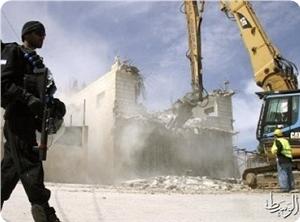 WEST BANK — Haaretz newspaper said the Israeli civil administration issued 13,000 demolition warnings against Palestinians accused of unlicensed construction in Area C of the West Bank.
 Aletho News
 Aletho News