OCHA Report: “370 Injured During Nakba Commemoration”
By Saed Bannoura | IMEMC News | May 19, 2012
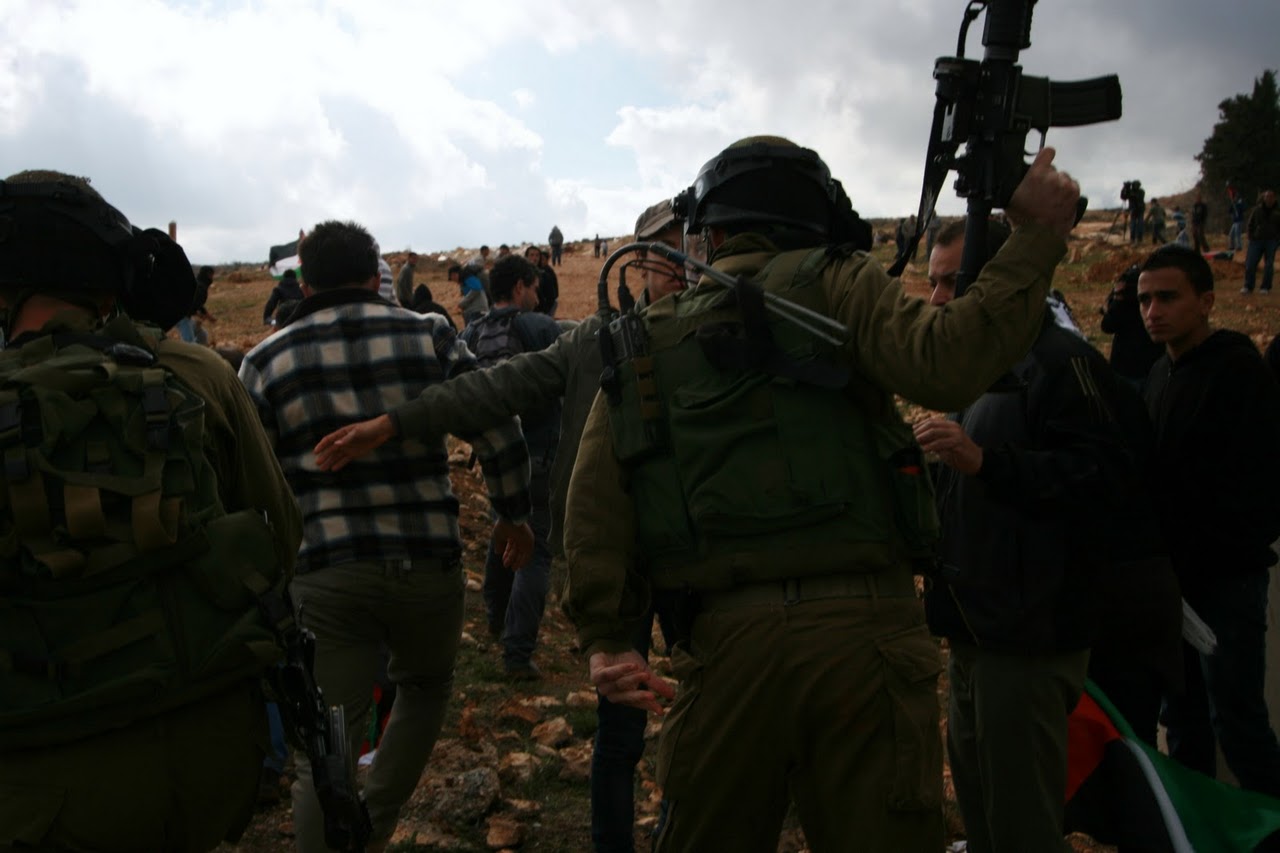
The United Nations Office for the Coordination of Humanitarian Affairs (OCHA) recently issued its weekly report on Israeli violations in the occupied territory for the period between 9- 15 of May, revealing that Israeli soldiers shot at least 370 Palestinians during the Nakba commemoration, and continued their violations in the West bank and the Gaza Strip.
The report indicated that the number of Palestinians injured by Israeli fire since the beginning of this year has reached 1,339, adding that the rate of injuries is 69 a week, comparing to 28 a week last year.
Most of the injuries took place when the soldiers attacked Nakba protests on May 15, especially the protests that were held near the Qalandia terminal, north of Jerusalem, and the Ofer prison terminal near Ramallah.
OCHA further stated that Israel demolished seven Palestinian buildings under the claim that they were built without construction permits.
It said that 27 Palestinians were also injured during a weekly protest against Israeli restrictions preventing Palestinian farmers from reaching their lands near the Qadumim settlement, built on lands that belong to residents of Qalqilia, in the northern part of the West Bank.
OCHA also said that Israeli settlers carried out several attacks against the residents and their lands, leading to several injuries while Israeli settlers cut more than 430 trees, including at least 280 olive trees near Nablus, Salfit and Bethlehem.
The Office said that Israeli settlers cut at least 3,070 trees since the beginning of 2012 (most of them are olive trees), and injured 50 residents.
As for the destruction of property, OCHA stated that, during the reported period, Israel demolished seven Palestinian-owned livelihood structures affecting 40 Palestinians. The buildings are in Burqa in the Nablus district, Al-Jalama near Jenin, and Husan near Bethlehem, in addition to the destruction of a water cistern and the foundations of a house under construction in Beit Hanina neighborhood in East Jerusalem; Israel also issued demolition orders against Palestinian houses in Silwan, in occupied East Jerusalem.
According to OCHA, Israel demolished 285 Palestinian buildings displacing 477 Palestinians, which is a %25 increase comparing structures demolished in 2011.
Israeli soldiers also shot and wounded more than eight Palestinians near the border with Israel, in the Gaza Strip during the reported week. The residents were treated for the effects to teargas inhalation when the soldiers targeted them for “approaching the security fence”; the residents were working in their own lands.
OCHA said that 29 Palestinians were killed in the Gaza Strip and 155 were injured since the beginning of this year.
The Israeli Navy also continued its restrictions and attacks against Palestinian fishermen, as Israel continued to limit the fishing area allotted to Gaza fishermen for only three nautical miles. During the period of this weekly report, the Navy detained fishermen and confiscated their boats; the fishermen were released but the fishing boats remained with Israel.
Fuel shortages and power outages in Gaza continued to hinder the lives of 1.6 million Palestinians in Gaza, while the Gaza Power Plant is only producing 25 megawatts of the needed 80 megawatts.
Fuel smuggling into Gaza via siege-busting tunnels this week was less that %15 of the 800,000 – one million liters of diesel and benzene that used to enter Gaza regularly each day prior the onset of fuel crisis in 2011.
The Palestinian Fishermen Syndicate said that the number of fishing trips conducted in recent months witnessed a sharp decrease (less than four trips a month for each fishing boat) compared to 15 trips a month.
It is worth mentioning that more than 65,000 Palestinians depend on fishing as their only source of livelihood in the Gaza Strip but are suffering due to increased Israeli restrictions. In April, Gaza fishermen fished 99.6 Tons.
Please follow the link for the comprehensive report issued by OCHA in the Occupied Palestinian Territory.
Related articles
- Jewish settlers stealing Palestinian water springs: UN (alethonews.wordpress.com)
- 7 casualties in Israeli artillery shelling east of Gaza (alethonews.wordpress.com)
Hundreds of thousands of Israelis likely to visit West Bank site after court decision
Al Akhbar | May 17, 2012
Hundreds of thousands of Israelis are likely to visit a West Bank tomb in the coming year, after a Jerusalem court awarded two rabbis legal and administrative control over it in contravention of international law.
Joseph’s Tomb in Nablus is in the part of the West Bank that the Oslo Accords assigned to full Palestinian control.
Consequently, the Israel Defense Forces officially have no jurisdiction in the area and any Israeli involvement there is illegal.
However Israeli court judge Rabbi Haim Rosenthal ruled that rabbis Shlomo Ben-Shimon and Mordechai Gross, who head the settler organization Shechem Ehad (One Nablus), are the “representatives entitled to appear, legally and publicly, before any court or institution on matters connected to” the tomb, according to a report in the Israeli newspaper Haaretz.
The court granted the two rabbis sole control over the area for the next 18 months, after which it will review the decision.
Currently over 20,000 Jews visit the tomb a year, as it is open from midnight to 4am once a month, but the decision could see that number increase to hundreds of thousands.
In their application, the two rabbis argued that the 20,000 limit “doesn’t at all satisfy the enormous demand.”
The court had previously refused the request, and the decision will be seen as yet another abuse of Palestinian autonomy.
The decision is likely to enrage Palestinians who already suffer an ongoing occupation of the West Bank.
Netanel Shnir, another key figure in Shechem Ehad, was quoted in November 2010 as saying that the ultimate goal of the group was to get Jews to return to Nablus “to settle there and inherit the land.”
Israel continues to encourage the development of illegal Jewish-only settlements in the West Bank, despite condemnation from the United Nations, the European Union, and rights groups.
The Jewish state refuses to accept Palestinian sovereignty in the West Bank, maintaining an illegal occupation in the area while upholding a siege on Gaza.
Related articles
- Jewish settlers attack village, block Nablus road (alethonews.wordpress.com)
Nakba Day 2012: Revolution On Hold
By Linah Alsaafin | Al Akhbar | May 16, 2012
The week leading up to the 64th commemoration of Nakba Day, the city of Ramallah witnessed a blitz of protests which were echoed in other Palestinian cities such as Gaza, Nablus, and Jerusalem. The deal to end the hunger strike on the eve of Nakba led to a more subdued commemoration then was expected.
The mass hunger strike that began on April 17, with an estimated 2,500 Palestinian prisoners participating, was the largest of its kind and had entered its fourth week. Eight of the hunger strikers had entered their third consecutive month without food.
Small protests at the Israeli prison of Ofer in west Ramallah took place daily, with the Israeli army typically responding with tear gas and rubber bullets.
Every day, the city center witnessed multiple marches, with marchers calling on shopkeepers to close their stores and join them as they headed back to the point they started from: the prisoners’ solidarity tent at Clock Square.
On some occasions, huge traffic jams were caused by the protesters who blocked the main streets as they sat on the ground, chanting and holding up posters and pictures of prisoners.
Other creative ways of demonstrating to raise awareness about the prisoners’ struggle included offering water and salt to people, as a reminder that these two elements were all that the prisoners were surviving on during their hunger strike.
Frustration was vented at the Palestinian Authority (PA) leadership as well. Protesters almost managed to enter the PA compound of al-Muqata, calling out against the leadership’s compliant silence.
During a Europe Day celebration, a small of group of protesters and mothers of prisoners expressed their wishes to have their sons back home and their disappointment in the PA’s lack of action to Prime Minister Salam Fayyad, who responded in the well-rehearsed manner of any politician paying lip service to a cause.
During PA president Mahmoud Abbas’ brief visit to the prisoners’ solidarity tent in al-Bireh last Thursday, protesters who had unfurled posters exposing Abbas’ silence on the hunger strikes were attacked by undercover policemen both physically and verbally. Despite an array of media cameras in the tent, only one outlet covered the incident.Last Wednesday, the UN building in Ramallah was effectively shut down by protesters for the whole day. Protesters, who were barred from entering the building, called on secretary general Ban Ki Moon to take a more assertive stance regarding the Palestinian prisoners, in accordance with the third and fourth Geneva Conventions that Israel regularly violates.
The International Committee of the Red Cross (ICRC) buildings in Gaza and Ramallah were both shut down, and a protest took place in front of the office of the Quartet on the Middle East in Jerusalem.
For the first time in a long time, Palestinians were united on the street, regardless of their political factions, and perhaps disregarding them. The prisoners proved they had the potential to unite the people and overstep the PA regime’s political normalization with Israel. Chants of “Why the security coordination while your people are getting shot at by the Israeli army” and “Oslo is long gone! We have returned to the struggle!” referring to the signing of the disastrous Oslo Accords in 1993, reverberated through the streets.
Nakba Eve
On the eve of Nakba Day, the mood was electric in anticipation of the commemoration events. It seemed like it wasn’t clear who most feared the potential explosive zenith the hunger strikers had managed to bring out – the PA (with Abbas begging Israel to allow the PA to have more weapons to maintain ‘security’) or Israel, who had taken extreme measures in preparation for suppressing the Nakba protests.
In the early morning hours of May 15, confirmation of a deal between the hunger strikers and the Israeli Prison Authorities (IPA) was heard. The mass hunger strikers, who had gone 28 days without food, succeeded in achieving almost all of their demands, which included three main calls: an end to administrative detention, an end to solitary confinement (19 prisoners have spent years living in a tiny cell by themselves), and the right to family visits.
All administrative detainees, held without charge or trial, are to be released once their detention expires without having their detention renewed. Family visits will be reinstated within a month, a great relief for families from Gaza, who haven’t seen their sons, brothers, and fathers since 2007.
The longest hunger strikers in the history of Palestine, Bilal Thiab and Thaer Halahleh (77 days), as well as Hasan Safadi (71 days) and Omar Abu Shalal (69 days) all agreed to end their strike on the basis of the same agreement the administrative detainees agreed to.
Diffusing Hunger
The hunger strikers had triumphed. Yet the role of the PA and its frantic collusion with Israel to reach a deal ahead of Nakba Day is certainly questionable. The charged atmosphere was effectively diffused.
As a result, Nakba Day in the West Bank lost its unique potential to spark an uprising and instead panned out like any other commemoration. In Nablus, a branch of the International Solidarity Movement for Palestinians (ISM) went to the Huwarra checkpoint to demonstrate, catching the Israeli soldiers there off-guard. The demonstration wasn’t announced because when they did that last year, the PA was quick to suppress them.One protester, identified only as Beesan, told Al-Akhbar that “the group of around 30 protesters was forced to retreat by the army. Huwarra checkpoint was sealed shut, meaning no one could go in or out of Nablus. As the protesters made their way back to Nablus, PA security forces followed them in their cars, and kept calling the director of the ISM branch Wael al-Faqih to disband the protest.”
One of the villages in the Ramallah governate, Ni’lin, tasted a small victory before being suppressed by the Israeli army. Protesters went to the village early in the morning and managed to cross through the checkpoint to the other side where the town of Ramleh, ethnically cleansed in 1948, lies. Ramleh, which used to be home to thousands of Palestinians, now has a Jewish majority and is part of Israel. Israeli occupation forces dispersed the protesters with tear gas and arrested Naji Tamimi from Nabi Saleh, who has only just been released after a year in Israeli jail on March 1st.
In Ramallah, thousands of people marched from Yasser Arafat’s grave in Muqata to Clock Square, where singers sang nationalistic songs and politicians congratulated the hunger strikers on their victory.
Another Day of Protests
Hundreds made their way to Ofer prison, in the largest demonstration there yet. The Israeli army surrounded the protesters from three sides and fired large amounts of tear gas canisters, which forced the majority of protesters to remain at a distance from the jail.
Persistent protesters managed to get close to the soldiers and were chanting against the occupation, but had to scatter on more than one occasion when the soldiers brought out the skunk truck and began firing plastic covered steel bullets.
At Qalandiya checkpoint, a smaller protest was quickly quelled by the Israeli army, and one man was taken immediately to hospital after being shot at with live ammunition.
In essence, it was just another protest at Ofer or Qalandiya, disconnected from the heavy inference that May 15 holds for Palestinians. The right of return assertions and chants were eclipsed by the general chants against the occupation, and occasionally for the prisoners whose cause is still not over yet.
The prospective spark for an uprising on Nakba Day did not happen, but the struggle remains. 4,600 prisoners still languish in Israeli jails, the right of return has not yet been achieved, and that the stage is still set for an uprising against the occupation.
Related articles
- Palestinians Mark 64th Nakba Day (eurasiareview.com)
- Tel Aviv University imposes restrictions on Nakba Day events (alethonews.wordpress.com)
Voices from the Occupation: Hammam and Odai S. – Settler violence
Defense for Children International | May 9, 2012

Names: Hammam and Odai S.
Date of incident: 21 April 2012
Age: 3 and 12
Location: Hebron, West Bank
Nature of incident: Settler violence
On 21 April 2012, a 12-year-old boy and his three-year-old brother go with their father to their land south of Hebron, in the occupied West Bank, where they are attacked by a group of settlers.
“On 21 April 2012, at around 9:00 am, I went with my father and my three-year-old brother, Hammam, to our land in Khirbet Shuweika, about seven kilometres from where we live,” explains 12-year-old Odai. “My father started clearing the land; I helped him for a while and then I went to play with Hammam,” he continues.
“At around 1:00 pm, I saw six men approaching us. They were carrying sticks and their faces were covered. I stayed where I was and didn’t feel scared because I didn’t know they were settlers. When they were about 20 metres away, they started throwing stones at us. Four of them attacked my father, and the other two attacked me and my brother. I felt terrified. Hammam started screaming and shivering. He was also terrified.”
Odai’s father tried to defend his children and was hit by stones several times. “A stone also hit me in the left leg and it hurt a lot,” says Odai. “Luckily, Hammam was not hit.” While they were being attacked, Odai’s father called his brothers to come and help them. “When the settlers noticed that two cars had arrived, they fled.”
Odai and his father were taken to the nearest medical centre for treatment. “I was told the settlers were from the settlement of Shim’a, located about one and a half kilometres from Khirbet Shuweika,” explains Odai. “What happened terrified me and my brother. This is the first time I have had such a terrifying experience,” he adds.
Related articles
- Voices from the Occupation: Settler/soldier violence/detention of 16-year-old (alethonews.wordpress.com)
- Settler Violence: Broken Glass on Shuhada Street (alethonews.wordpress.com)
- Hebron teen ‘shot by Israeli settler’ (alethonews.wordpress.com)
- Jewish settlers attack village, block Nablus road (alethonews.wordpress.com)
- Israeli Soldiers Invade Homes In Hebron, Jewish Settlers Attack Young Man (alethonews.wordpress.com)
- Israeli settlers injure three Palestinians, uproot dozens of olive trees in two separate incidents (alethonews.wordpress.com)
- Impunity Under the Law: Settler attack in Jabari neighborhood (alethonews.wordpress.com)
- Fadi Abu Zeitoun, killed as settlers attacked farmers (alethonews.wordpress.com)
- Settlers Raise Israel’s Flag On Top Of Ibrahimi Mosque (alethonews.wordpress.com)
- Open letter to Dutch government (altahrir.wordpress.com)
Popular Committee Offices Raided by Israeli Military Forces, Ramallah
PNN | May 8, 2012
At 1.30 a.m. on Tuesday morning, 8th May, ten armored jeeps of the Israeli Occupation Forces surrounded and raided the offices of Stop the Wall in Ramallah. Israeli military stole 2 laptops, 3 hard drives and 10 memory cards containing files and photos as well as archive material relating to the work that the organisation does in opposition to Israel’s apartheid wall and the attack on Palestinian human rights that the wall and the settlements represent. This is yet another attack upon Palestinian civil society and their struggle against the physical and psychological oppression, land confiscation and ethnic cleansing policies of Israel.
Stop the Wall is one of the most vibrant organizations of human rights defenders in Palestine, and has been promoting, for almost ten years, civil resistance and advocacy campaigns against the Wall and in defense of Palestinian rights to self determination. Human Rights Defenders are internationally recognized as an essential element in political processes and their repression further underlines Israeli unwillingness to achieve a just peace.
Jamal Juma’, coordinator of the Stop the Wall Campaign, comments:
“It is not surprising that the Israeli authorities have chosen this moment to escalate their repression against the Stop the Wall grassroots network of civil resistance against the Wall and the settlements, choosing to act on the same day that the Israeli High Court rejected the appeals of Palestinian hunger strikers Bilal Diab and Tha”ir Halahleh, imprisoned without charge and without trial, effectively condemning them to death.
The courageous steadfastness of the more than 2000 hunger strikers in Israeli jails is underlining once more the power of civil resistance as part of the Palestinian struggle. Almost daily people are out in the streets to protest in solidarity with the Palestinian political prisoners, and the discontent with the fruitless and completely stalled diplomatic processes is growing stronger. At the same time, the Israeli authorities announced in 2011 to UN agencies that throughout 2012 year they will systematically displace the Palestinian population in area C. While the displacement drive is underway in the Jordan Valley, home demolitions are rising and the settlement construction is accelerated, the people across the West Bank are always more constraint behind the cantons of the wall.
This raid on the Stop the Wall offices is a clear message that the Israeli authorities are fearing widespread nonviolent action will challenge their policies effectively. Israel is preparing for confrontation and more repression, clearly showing that it is not ready to relinquish any of the international sanctioned rights the Palestinian people are struggling for.”
This is not the first time Stop the Wall has been the target of Israeli repression. In September 2009 Stop the Wall youth coordinator was arrested and the Stop the Wall coordinator, Jamal Juma’, was arrested a few months later, in December 2009. The Israeli authorities were not able to formulate any accusations against either of them and after a sustained international campaign, that saw the active involvement of the diplomatic missions in Palestine and European foreign ministries as well as countless human rights organizations around the world, both had to be freed in January 2010. This attack was followed only a few months later by an extensive office raid by the Israeli military on February 8 2010 and mass arrests of grassroots human rights defenders in the villages most actively protesting against the Wall.
For photos see: http://www.flickr.com/photos/stopthewall/sets/72157629631856082/
Background:
Stop the Wall is one of the most vibrant organizations of human rights defenders in Palestine, and has been promoting, for almost ten years, civil resistance and advocacy campaigns against the Wall and in defense of Palestinian rights to self determination. Human Rights Defenders are internationally recognized as an essential element in political processes and their repression further underlines Israeli unwillingness to achieve a just peace.
This raid on the Stop the Wall offices is a clear message that the Israeli authorities are fearing widespread nonviolent action will challenge their policies effectively.
The courageous steadfastness of the more than 2000 hunger strikers in Israeli jails is underlining once more the power of civil resistance as part of the Palestinian struggle. Almost daily people are out in the streets to protest in solidarity with the Palestinian political prisoners, and the discontent with the fruitless and completely stalled diplomatic processes is growing stronger. At the same time, the Israeli authorities announced in 2011 to UN agencies that throughout 2012 year they will systematically displace the Palestinian population in area C. While the displacement drive is underway in the Jordan Valley, home demolitions are rising and the settlement construction is accelerated, the people across the West Bank are always more constraint behind the cantons of the wall. Israel is preparing for confrontation and more repression, clearly showing that it is not ready to relinquish any of the international sanctioned rights the Palestinian people are struggling for.
This is not the first time Stop the Wall has been the target of Israeli repression. In September 2009 Stop the Wall youth coordinator was arrested and the Stop the Wall coordinator, Jamal Juma’, was arrested a few months later, in December 2009. The Israeli authorities were not able to formulate any accusations against either of them and after a sustained international campaign, that saw the active involvement of the diplomatic missions in Palestine and European foreign ministries as well as countless human rights organizations around the world, both had to be freed in January 2010. This attack was followed only a few months later by an extensive office raid by the Israeli military on February 8 2010 and mass arrests of grassroots human rights defenders in the villages most actively protesting against the Wall.
Related articles
- Israeli military court sentences Palestinian journalist (alethonews.wordpress.com)
- Israeli forces raid anti-wall campaign office in Ramallah (maannews.net)
Israeli Hawkademia in Australian Universities
By Vacy Vlazna | Palestine Chronicle | May 2, 2012
The Israeli ‘defense’ industry is embedded in Israeli universities and in universities around the world including Australia. It plunders overseas intellectual property for Israel’s military research-and-development (R&D) programs while strategic bi-lateral research and exchange missions deliberately whitewash or ‘normalize’ the Zionist military occupation of Palestine and her people.
In Israel, Zionism and the military are undifferentiated. The IOF (Israeli Occupation Forces), the world’s fourth most powerful (nuclear) army, since the inception of the state of Israel, is duty bound to secure the fanatical Zionist goal of Eretz Yisrael or Greater Israel, which incorporates the whole of historic Palestine and beyond (from the Nile to the Euphrates).
The 1948 Nakba, the Catastrophe, which accounted for the destruction of 500 Palestinian villages and the forceful expulsion of over 700,000 Palestinians by Israeli terrorist militia (Irgun, Lehi, and Haganah) that metamorphosed into the Israeli army, has never ended with Israel’s relentless policies of ethnic cleansing through the expansion of its illegal colonies and the illegal Annexation Wall on stolen Palestinian land perforated moreover by hundreds of checkpoints and roadblocks manned by belligerent IOF.
Under international law, Israel’s military occupation of Palestine is illegal and yet it has impunity to defy UN Resolutions and to daily commit war crimes because of US, EU, Canadian and Australian support as well as the $3.1 billion in Israeli military assistance granted annually from the US State Department budget.
“Israeli defense sales in 2010 totaled 7.2 billion U.S. dollars, making the small nation the world’s fourth largest exporter…Most of the sales are from four leading companies: Elbit Systems, Israeli Aerospace Industries (IAI), Rafael, and Israel Military Industries ..Strong points of Israel’s arms industry include unmanned aerial vehicles, armoured vehicles, smart munitions, military and civilian aircraft avionics, weapons platforms and structural upgrades for foreign governments and private clients.”
It is Palestinian men, women, teenagers and children who are the guinea pigs of Israel’s ‘battle-tested’ weaponry.
Israeli defense companies as well as their joint venture US/UK defense partners have subsidiaries in Australia- Elbit Australia, Oracle Australia, Thales Australia, Raytheon Australia and have footholds in and associations with Australian universities.
In November 2011, Elbit Systems joined the Australian Defense Department’s Rapid Prototyping, Development and Evaluation Program. The University of Western Australia and Edith Cowan University also joined. “Elbit Systems and its subsidiaries contribute directly to two of the most insidious facets of the Israeli occupation of Palestinian territory: the indiscriminate assaults on civilian populations, through the provision of unmanned aerial vehicles (UAV’s or ‘drones’) and other military equipment to Occupation forces; and the ever-tightening ghettoization of the West Bank, through the provision of surveillance and electronics systems along the Apartheid Wall and settlements. During Israel’s 23-day assault in Gaza in 2008-09, missiles fired from drones were directly attributed to the killing of 78 Palestinians, including 29 children. Like all Israeli firms operating the military technology sector, endless war and occupation create valuable marketing opportunities. Elbit UAVs, for example, can be sold on the global market as ‘battle tested’ devices, significantly increasing their appeal and leading to their adoption by a number of militaries.”
The ZEN Entrepreneurs’ Challenge is a student business planning competition run by the Entrepreneurship, Commercialization and Innovation Centre at the University of Adelaide. ‘Participants work with dedicated mentors to cultivate their entrepreneurial plans including marketing thanks to Dr. Ben-Ari who joined Elbit Systems in 1978 and is, since 2001, Managing Director of Elbit Systems Singapore.
The Edith Cowan University’s Security Management program is offering academic credit to delegates on completion of the 2013 “Security Fundamentals Tour of Israel designed to provide a select group of security specialists and professionals with an insight into Israel’s critical infrastructure security and what continues to drive Israel to be one of the leading security technology providers.” The tour includes the euphemistically named ‘Separation’ Wall which is in fact an Apartheid/Annexation Wall deemed illegal by the International Court of Justice in 2004 and also includes the security, passenger screening and deterrence applications of Ben Gurion Airport which last month detained and deported volunteers invited to Palestine to help build a school for blind children. Last year, Australians Vivienne Porzsolt and Sylvia Hale were also arrested and detained at Ben Gurion for having the temerity of wanting to visit Marrickville’s sister city, Bethlehem.
In February, a guest speaker at Deakin University’s 7th Annual International Electromaterials Science Symposium was A/Prof. Yair Ein – Eli, He had been Director of Research and Battery Technology at Electric Fuel Ltd before joining the Department of Materials Engineering at the Technion. Electric Fuel Ltd is a subsidiary of the Arotech Corporation which has facilities in Israel and “operates through three major business divisions: High-level armoring for military and nonmilitary air and ground vehicles; interactive simulation for military, law enforcement and commercial markets, and batteries and charging systems for the military’.
Each Israeli university has societies worldwide that encourage and facilitate academic and scientific exchanges and collaboration. ‘Recent exchanges organized by The Technion Society of Australia have included Technion staff at Sydney University, University of NSW, University of Newcastle, Victoria University, University of Adelaide and Australian National University.’ On staff at the University of Western Sydney is a professor with Technion associations and experience in military and civilian R&D. Both Elbit and Rafael Advanced Systems (run by the Israeli Ministry for Defence)have long-standing partnerships with the hawkish Technion.
In May 2008 was the launch of the AICC s inaugural WA Innovation and Business Development Mission to Israel, supported by the WA State Governments Department of Industry and Resources and coordinated by the Australia Israel Chamber of Commerce (WA) Inc. (AICC). Among delegates were representatives from the University of Western Australia and Murdoch University. Mr R McCulloch representing Murdoch University’s interest in water research and renewable energy institutes praised Israel’s “immediate interest and openness to finding partners” though, of course this excludes Palestinians whose critical water resources are stolen, controlled and/or demolished by Israel.
The University of Johannesburg which had a joint water project with Ben Gurion University severed links in 2011 because it found “detailed, factual evidence and information regarding Ben Gurion’s direct and indirect role in further entrenching the violations of human rights and international law by the Israeli state”.
Innocuous academic interchange can promote normalization whereby Israeli oppression, racism and apartheid is accepted as the ‘normal’ status quo.
The Yachad Accelerated Learning Project designed to improve outcomes and address inequalities in Indigenous and Remote education was set up with the support of Melbourne and Monash Universities and The Hebrew University (Michael Federmann, the Chairman of Elbit Systems is a member of the Executive Committee of the Board of Governors of Hebrew University). In 2007 an Australian Yachad delegation enthusiastically visited the Bedouin village of Kseyfeh aware or unaware that the per capita spending per Bedouin student is less than half Israel’s average and that 40% of indigenous Bedouins are threatened by forced transfer policies and live in Unrecognized Villages systematically deprived of water, electricity, health care, education yet not deprived of incessant home demolitions.
The information presented here about the relationship between Australian universities and the Israeli occupation of Palestine is merely the tip of a very grubby iceberg. Australian universities by their degrading prostration to funding donors associated with Zionist Israel have lost their moral equilibrium and the purpose and ideals of academia. Dissenting academics are rare. Few emulate Professor Jake Lynch’s protest of the 2011 Israel Research Forum at the University of Sydney with guest experts from the The Weizmann Institute of Science, Technion – Israel Institute of Technology, and Tel Aviv University, all of which collaborate with the Israeli military industry.
Academics and students, concerned for the human rights of the people of Palestine, must investigate their university finances and demand divestment from and boycott of companies and Israeli universities that are implicated in the war crimes and crimes against humanity that Palestinians suffer daily.
– Dr. Vacy Vlazna is Coordinator of Justice for Palestine Matters. She was Human Rights Advisor to the GAM team in the second round of the Acheh peace talks, Helsinki, February 2005.
Related articles
- Lethal Hawkademia and BDS (alethonews.wordpress.com)
- Lebanese Society in California Normalizes with Israelis (alethonews.wordpress.com)
Illegal Settlements Bonanza: Israel Plots an Endgame
By Ramzy Baroud | Palestine Chronicle | May 2, 2012
Israel’s colonization policies are entering an alarming new phase, comparable in historic magnitude to the original plans to colonize Gaza, the West Bank and East Jerusalem following the war of 1967.
On April 24, an Israeli ministerial committee approved three settlement outposts – Bruchin and Rechelim in the northern part of the West Bank, and Sansana in the south. Although all settlement activities in the occupied West Bank and East Jerusalem are considered illegal by international law, Israeli law differentiates between sanctioned settlements and ‘illegal’ ones. This distinction has actually proved to be no more than a disingenuous attempt at conflating international law, which is applicable to occupied lands, and Israeli law, which is in no way relevant.
Since 1967, Israel placed occupied Palestinian land, privately owned or otherwise, into various categories. One of these categories is ‘state-owned’, as in obtained by virtue of military occupation. For many years, the ‘state-owned’ occupied land was allotted to various purposes. Since 1990, however, the Israeli government refrained from establishing settlements, at least formally. Now, according to the Israeli anti-settlement group, Peace Now, “instead of going to peace the government is announcing the establishment of three new settlements… this announcement is against the Israeli interest of achieving peace and a two states solution”
Although the group argues that the four-man committee did not have the authority to make such a decision, it actually matters little. Every physical space in the occupied territories – whether privately owned or ‘state owned’, ‘legally’ obtained or ‘illegally’ obtained – is free game. The extremist Jewish settlers, whose tentacles are reaching far and wide, chasing out Palestinians at every corner, haven’t received such empowering news since the heyday of Israeli Prime Minister Ariel Sharon.
The move regarding settlements is not an isolated one. The Israeli government is now challenging the very decisions made by the Israeli Supreme Court, which has been used as a legitimization platform for many illegal settlements that drove Palestinians from their land.
On April 27, the Israeli government reportedly asked the high court to delay the demolition of an ‘unauthorized’ West Bank outpost in the Beit El settlement which was scheduled to take place on May 1st. The land, even by Israeli legal standards, is considered private Palestinian land, and the Israeli government had committed to the court to take down the illegal outposts – again, per Israeli definition – on the specified date.
Now the rightwing Netanyahu government is having another change of heart. In its request to the court, the government argued: “The evacuation of the buildings could carry social, political and operational ramifications for construction in Beit El and other settlements.” Such an argument, if applied in the larger context of the occupied territories, could easily justify why no outposts should be taken down. It could eradicate, once and for all, such politically inconvenient terms such as ‘legal’ and ‘illegal’.
“Previous Israeli governments have pledged to demolish the unauthorized settler outposts in the West Bank, but only a handful have been removed,” according to CNN online. In fact, that ‘handful’ are likely to be rebuilt, amongst many more new outposts, now that the new legal precedence is underway.
Michael Sfard, an attorney with Yesh Din, which reportedly advocates Palestinian rights, described the request as “an announcement of war by the Israeli government against the rule of law.” More specifically, “they said clearly that they have reached a decision not to evacuate illegal construction on private Palestinian property.”
Some analysts suggested that Netanyahu was bowing down to the more rightwing elements in his cabinet – as if the man had, till now, been a peacemaker. The bottom line is that Israel has decided embark on a new and dangerous phase, one that violates not only international law, but Israel’s own self-tailored laws that were designed to colonize the occupied territories. It appears that even those precarious ‘laws’ are no longer capable of meeting the colonial appetite of Israeli settlers and the ruling class.
Israeli settlements have been contextualized through Israeli legal and political references, as opposed to references commonly accepted in international law. The emphasis on differences between Israeli governments, political parties and religious/ultra-nationalist settlement movements is distracting and misleading; colonizing the rest of historic Palestine has been and remains a national Israeli project.
An article in the rightwing Israeli Jerusalem Post agrees. “Support for settlement is not simply a program of right-of-center Likud. Its history has firm roots in Labor party activity during the periods of its governments, and activities by predecessors of the Labor party going back before the creation of the Israeli state” (April 27).
The only variable that might be worth examining is the purpose of the settlement, not the settlement itself. Following the war of 1967, the Allon plan sought to annex more than 30 percent of the West Bank and all of Gaza for security purposes. It stipulated the establishment of a “security corridor” along the Jordan River, as well outside the “Green Line”, a one-sided Israeli demarcation of its borders with the West Bank. Then, there was no Likud party to demonize, for that was the Labor party’s vision for the newly occupied territories.
While the Israeli settlement drive since then has swallowed much of the West Bank and East Jerusalem, populating them with over half a million Israelis, the international community’s response was as moot in 1967 as it is now in 2012. Responding to the latest sanctioning of illegal outposts, UN Secretary General Ban Ki-Moon declared that he was “deeply troubled” by the news. Meanwhile, Russia was ‘deeply concerned’ and so was the EU’s Catherine Ashton. As for the US, State Department spokeswoman Victoria Nuland insisted that the Israeli measure is not “helpful to the process.” What process?
While Israel has now showed all of its cards, and the international community declared its complacency or impotence, the Palestinian leadership in Ramallah continues to plan some kind of UN censure of the settlements. Even if a watered-down version of some UN draft managed to survive the US veto, what are the chances of Israel heeding the call of international community?
There is no doubt that Israel is plotting its version of the endgame in Palestine, which sees Palestinians continuing to subsist in physical fragmentation and permanent occupation. Unless a popular Palestinian uprising takes hold, no one is likely to challenge what is actually an Israeli declaration of war against the Palestinian people.
– Ramzy Baroud (www.ramzybaroud.net) is an internationally-syndicated columnist and the editor of PalestineChronicle.com. His latest book is My Father Was a Freedom Fighter: Gaza’s Untold Story (Pluto Press, London).
Related articles
- Knesset to discuss bill authorising settlers’ seizure of Palestinian land (alethonews.wordpress.com)
- Israeli government confirms plan for segregated settler train system (alethonews.wordpress.com)
- Study: Israeli ‘state land’ illegally taken from West Bank (alethonews.wordpress.com)
Israeli occupation authorities demolish well near Hebron
Ma’an – 02/05/2012
HEBRON – Israeli authorities demolished a water well in a village east of Hebron on Wednesday, locals said.
Officials accompanied by soldiers tore down the well belonging to Saeed Jaber in Baqaa village, residents said.
Palestinian Water Authority chief Shaddad Attili warned earlier this year that Israel was systemically destroying well and rainwater harvesting cisterns to forcibly displace Palestinian communities who depend on them for their basic water needs.
At least 25 Palestinian wells and 32 Palestinian cisterns were demolished in 2011, he said.
Last week local director of the UN’s humanitarian agency Ramesh Rajasingham said that more than 1,500 Palestinians have lost their homes as a result of demolitions and evictions since the beginning of 2011.
Palestinians can only build on one percent of the Israeli-controlled zone Area C in the West Bank, most of which is already built up, while settlements continue to expand in the same zone, the UN says.
Related articles
- The right to water: Water cistern demolitions in Hebron area (alethonews.wordpress.com)
- Israeli demolition ‘displaces 120′ in Hebron village (alethonews.wordpress.com)
- Settlers Raise Israel’s Flag On Top Of Ibrahimi Mosque (alethonews.wordpress.com)
- Israeli Soldiers Invade Homes In Hebron, Jewish Settlers Attack Young Man (alethonews.wordpress.com)
- Hebron teen ‘shot by Israeli settler’ (alethonews.wordpress.com)
- Israeli Brutality: Violent arrests of Palestinians in Hebron and disappearance of Dutch volunteer (alethonews.wordpress.com)
- Israeli occupation authority demolished 20 Palestinian homes in West Bank last week (alethonews.wordpress.com)
Report: “Five Killed, 285 Kidnapped In April”
By Saed Bannoura | IMEMC & Agencies | May 01, 2012
 File Photo

The International Solidarity Foundation for Human Rights (Tadamon) reported that Israeli soldiers shot and killed five Palestinians, including a 4 year old child, and kidnapped more than 285 Palestinians in April.
The child, Aseel Ara’ra, 4, from Anata, near the central west Bank city of Ramallah, was shot in the neck on October 25, 2011, and was left in a quadriplegic state before dying of her injuries last month.
Also in April, the army shot and killed Hashem Misbah Sa’ad, 17, after claiming that he approached the border fence. Sa’ad is from ash-Shujaeyya neighbourhood, east of Gaza city.
Soldiers also shot and killed Bilal Yousef As-Sa’ayda, 20, also after claiming the he approached the border fence.
Two more Palestinians were killed in the West Bank. One of the deceased, identified as Rashad Shoukha, 28, was seriously wounded after the under-cover forces of the Israeli army broke into his home in Rammoun town, near Ramallah, and died of his wounds a week after he was injured.
Resident Fadi Zeitoun, from Beta village, near Nablus, was killed after a group of extremist settlers of the Yitzhar illegal settlement, south of Nablus, chased him with their guns while he was driving his tractor.
Israeli soldiers conducted dozens of invasions into the occupied territories in April, and kidnapped more than 285 residents, including dozens of women and children, and a number of former political prisoners who previously spent years in Israeli prisons and detention centers.
In the West Bank, soldiers kidnapped 45 children, and three female university students from the southern West Bank city of Hebron.
Tadamon attorney, researcher Ahmad Tubassy, slammed the ongoing and escalating Israeli violations against the Palestinian people, especially the ongoing violations against the political prisoners currently holding an open-ended hunger-strike demanding their legitimate rights guaranteed under international Law.
He stated that targeting civilians, especially women and children, violates all international regulations, and the Fourth Geneva Conventions to which Israel is a signatory.
Related articles
- 18 year old shepherd shot by Israeli soldiers in Jordan Valley (alethonews.wordpress.com)
- Yitzhar settlers attack school children in Urif (alethonews.wordpress.com)
- Palestinian Injured After Being Attacked By Boars Released By Settlers (alethonews.wordpress.com)
- Four (Incl child) Injured After Being Attacked By Soldiers Invading Their Home (occupiedpalestine.wordpress.com)
- Israeli Soldiers Invade Homes In Hebron, Jewish Settlers Attack Young Man (alethonews.wordpress.com)
- Open letter to Dutch government (altahrir.wordpress.com)
- Israeli settlers injure three Palestinians, uproot dozens of olive trees in two separate incidents (alethonews.wordpress.com)
Featured Video

The Truth About the Trump Shootings with Ken Silva
or go to
Aletho News Archives – Video-Images
From the Archives
The Geopolitics behind the War in Yemen (I)
By Mahdi Darius NAZEMROAYA | Strategic Culture Foundation | 30.03.2015
The United States and the Kingdom of Saudi Arabia became very uneasy when the Yemenese or Yemenite movement of the Houthi or Ansarallah (meaning the supporters of God in Arabic) gained control of Yemen’s capital, Sanaa/Sana, in September 2014. The US-supported Yemenite President Abd-Rabbuh Manṣour Al-Hadi was humiliatingly forced to share power with the Houthis and the coalition of northern Yemenese tribes that had helped them enter Sana. Al-Hadi declared that negotiations for a Yemeni national unity government would take place and his allies the US and Saudi Arabia tried to use a new national dialogue and mediated talks to co-opt and pacify the Houthis.
The truth has been turned on its head about the war in Yemen. The war and ousting of President Abd-Rabbuh Manṣour Al-Hadi in Yemen are not the results of «Houthi coup» in Yemen. It is the opposite. Al-Hadi was ousted, because with Saudi and US support he tried to backtrack on the power sharing agreements he had made and return Yemen to authoritarian rule. The ousting of President Al-Hadi by the Houthis and their political allies was an unexpected reaction to the takeover Al-Hadi was planning with Washington and the House of Saudi. … continue
Blog Roll
 Aletho News
- IRGC air defenses destroy another US MQ-1 drone over Strait of Hormuz
- Imran Khan’s entire immediate family detained in Pakistan ahead of mass protest demanding his release
- EU nation detains former presidential frontrunner
- Leaked: Britain’s Sham Conviction Of Hashim Thaci
- Seyed M. Marandi: U.S. Strike Imminent – Toward Total War in the Middle East
- Russia Voted Under Fire. Washington Is Loading the Tankers.
- 12 Things Your Oncologist Was Trained Not to Tell You
- Anthrax Attacks Paved Way for COVID-Era ‘Junk Drugs and Vaccines’
- How Real Is the Impact of Western Sanctions on Israel?
- France, You Are Guilty: How Paris Turned Western Sahara into the Maghreb’s Powder Keg
- If Americans Knew
- Inside Israel’s ‘soft’ ethnic cleansing plan for Gaza through the eyes of its victims
- New online database tracks pro-‘Israel’ political donations in the United States
- Israeli president pardons soldier convicted for killing wounded Palestinian
- Singer Ed Sheeran says his ‘heart broken’ by Gaza devastation, addresses Macklemore controversy
- Israel Has Imprisoned Female Journalist Bushra Al-Tawil Without Trial Or Charge In Solitary Confinement For Past Month
- Israel poised to teach West Bank a lesson after one Israeli killed – Daily Update
- Salah Sarsour’s Legal Team Says DHS Has Not Met Its Burden to Prove He Is Deportable
- An analysis of tax forms by The Intercept show Kraft’s charity and LLC have donated to Friends of the IDF and AIPAC’s super PAC.
- Israeli attacks kill four Palestinians in Gaza – Daily Update
- Inside Gaza’s death trap of collapsing, bombed-out buildings
- No Tricks Zone
- 2025 Nature Paper Claiming Worsening Global Drought Gets RETRACTED …Heavily Flawed
- New Study: ‘Global Drought Shows No Detectable Recent Acceleration Under Climate Warming’
- Economic Masterminds: German Socialists Suggest Taxing Productivity Gains Stemming From Using AI
- The South China Sea Has Not Been Cooperating With The Climate Change Narrative
- Energy Crisis: Germany Enters Heating Season With Historically Low Gas Reserve Fill Levels
- New Study: The Antarctic Ice Sheet Gained Mass From 2020-2024 Due To Staggering Snow And Ice Accumulation
- Study: Ocean Heating Rates From Thousands Of Years Ago ‘Dwarf’ Modern Ocean Heating Rates
- Climate Extremists Target, Attack Large-Scale Power Grid Infrastructure In Germany!
- New Study: Antarctic Ice Melt Has Contributed Less Than 1 Centimeter To Sea Level Rise In The Last 30 Years
- Fear Of Debate: Alarmist German Climate Scientist Calls On Mainstream Media To Discredit Skeptic Voices
 Aletho News