Closed military zone in Shuhada Street and Tel Rumeida extended yet another month
International Solidarity Movement | February 6, 2016
Hebron, Occupied Palestine – Since the 1st of November 2015 the Tel Rumeida area and Shuhada Street in occupied Al-Khalil (Hebron) has been declared a ‘closed military zone’. The first declaration of the closure was for one month, but since then the order has been extended several times.
The newest order from the 1st of February declares the area as closed till the 1st of March with the chance of extension.

Shuhada Checkpoint (Checkpoint 56)
The closure effects the residents of the area every single day. Every family living in the area has been given a number and was forced to register with the Israeli forces. When entering the area, through checkpoints, the residents have to show ID, give their number and often also answer questions and get bag and body searched. Friends and family of the residents are unable to visit them inside the area; even doctors or craftsmen are completely barred from entering the area.
Furthermore, the closed military zone has led to the eviction of two human rights organisations based in Tel Rumeida. These are now banned from living in their houses and working from their offices and since they are banned from the whole area are not able to observe and document the rampant Israeli human rights violations. The ‘closed military zone’ clearly intends to evict Palestinian residents in order to allow for an expansion of the illegal Israeli settlements, and by evicting human rights defenders to silence the truth on the Israeli forces harassment, attacks and human rights violations.
Israeli movement calls for separating 28 Palestinian villages from Jerusalem
MEMO | February 6, 2016
 New Israeli movement Save Jewish Jerusalem has called for the building of a wall encircling 28 Palestinian villages in East Jerusalem in order to preserve the city’s Jewish identity, Israeli newspaper Maariv reported on Friday.
According to Quds Press, which reported on the news published in Maariv, Save Jewish Jerusalem was set up by the former Cabinet minister Haim Ramon, alongside a number of former political, security and military officials.
Maariv noted that the movement does not belong to a certain political faction.
The manifesto’s authors explain that by removing some 200,000 Palestinians from the municipal boundaries of Jerusalem, the city’s Jews will constitute more than 80% of its residents, and the percentage of Palestinians will drop to less than 20%, from the nearly 40% today.
After the villages’ separation from Jerusalem, the Israel Defence Forces (IDF) and other security agencies would operate in them the way they currently do in the rest of the West Bank, according to the manifesto.
Intimidation through nightly ‘settler-tour’

Israeli forces blocking the entrance to the Palestinian market
International Solidarity Movement | January 31, 2016
Hebron, Occupied Palestine – On Saturday, 30th January 2016, large groups of settlers, accompanied by heavily-armed soldiers, entered the Palestinian market at night and took it over for about an hour during night-time in occupied al-Khalil (Hebron).
Around 9:30 pm, Israeli settlers from the illegal settlements throughout al-Khalil gathered at Bab al-Baladiyya, from where they walked into the Palestinian souq, the market, surrounded by heavily-armed Israeli forces. The group of more than 50 settlers started a ‘tour’ of the Palestinian market, with Israeli forces ‘guarding’ them throughout the Palestinian market. Palestinian residents were not allowed to pass and forced to wait at a distance, with soldiers repeatedly pointing the lasers from their guns at them to indicate they have to stop. A walk home at night though, for some Palestinians took almost an hour, instead of the usual 10 minutes.
This kind of ‘settler tour’ through the Palestinian market used to take place regularly on Saturday afternoons. During the ‘tour’ Palestinians are often denied to pass, stopped, ID-checked and detained. In the recent months, no ‘settler tours’ took place, but last week they started again with a nightly-tour at 11pm. For the Palestinian residents of the souq, these tours have become a regular form of intimidation and harassment in the past.
Israeli forces seize Palestinian vehicles, equipment in Jordan Valley

Ma’an – January 30, 2016
TUBAS – Israeli forces late Friday confiscated trucks and equipment being used to build a new agricultural road in the Palestinian village of Khirbet al-Dir in the northern Jordan Valley.
The head of a local council in the occupied West Bank village, al-Maleh Arif Daraghmah, told Ma’an that military forces had seized the equipment, without citing a reason for its removal.
Daraghmah added that days before, Israeli forces had ruined dozens of acres of agricultural land and roads while carrying out military drills in the area.
A spokesperson for Israel’s Coordinator of Government Activities in the Territories (COGAT) told Ma’an: “Yesterday evening, two trucks, JCB and an excavator, were confiscated as they were used for illegal road building adjacent to Mehoula in Area C.”
The Jordan Valley — occupied with the rest of the West Bank in 1967 — is in Area C, under full Israeli military and administrative control, and residents of the area face a constant threat of destruction of structures and property.
Threats of displacement for the thousands of Bedouins living in the area have reportedly increased dramatically since 2012, notably the use of Israeli military training exercises as a means of forcible displacement.
Rights groups argue that Israel aims to fully annex the strategic area of land and is unlikely to return the occupied area to Palestinians.
Israeli media reported earlier this week that the Israeli government announced that it may revoke the closed military zone status of a number of land plots in the Jordan Valley, supposedly returning the land to their original Palestinian owners after decades of confiscation.
The news came several days after COGAT announced that plans to declare 1,500 dunams (370 acres) of land in the Jordan Valley as “state land” were in their “final stages.” The move will be the largest declaration of “state land” by Israel since August 2014.
Israeli Soldiers Shoot International Activist In Nabi Saleh Protest
IMEMC News | January 28, 2016
Israeli soldiers attacked, Friday, the weekly nonviolent protest in Nabi Saleh village, near Ramallah, and shot an international activist with a live round, while many protesters suffered the effects of tear gas inhalation.
Morad Eshteiwy, coordinator of the Popular Committee in Nabi Saleh village, northwest of Ramallah, said the activist was shot in the leg, and was moved to a local hospital for treatment. He added that many protesters suffered severe effects of tear gas inhalation, after the soldiers used excessive force.
The army surrounded the village, fired many gas bombs, live rounds and rubber-coated steel bullets.
Eshteiwy added that, for the second time in one week, the soldiers sealed the main entrance of the village, forcing hundreds of Palestinians from nearby villages and towns, to take longer, unpaved roads.
Also on Friday, dozens of protesters suffered the effects of tear gas inhalation, after Israeli soldiers attacked the weekly nonviolent protest in Bil’in village, near Ramallah.
‘Hares boys’ sentenced to 15 years after families pay fines
Ma’an – January 29, 2016
RAMALLAH – After a nearly three-year long battle in Israeli military courts, five Palestinian teens from the occupied West Bank village of Hares accused of manslaughter after reportedly throwing stones were on Thursday issued sentences of 15 years, a prisoners’ rights group said.
The case has been disputed in the past by relatives and rights groups, who say that insufficient evidence was provided to prove that the five had any involvement in the death of an Israeli toddler who passed away two years after the teens were accused of throwing stones at her mother’s vehicle, causing it to crash.
A lawyer from the Palestinian Prisoners’ Society, Iyad Mahamid, told Ma’an that the military court issued the sentences to Muhammad Suleiman, Tamer Souf, Ammar Souf, Ali Shamlawi, and Muhammad Kleib.
Relatives of the detainees told Ma’an following a court hearing in December 2015 that the teens would be sentenced to prison terms of 15 years on the grounds that their families pay fines of 30,000 shekels ($7,700) by Jan. 28.
“Hares Boys,” an activist blog dedicated to raising awareness of the teens’ case, posted on their Facebook page “Free the Hares Boys” on Thursday that the families were able to pay the fines in full with the assistance of outside donations.
Failure to pay the fines could have resulted in prolonged sentencing to at least 25 years in prison, according to the Hares Boys blog.
Thursday sentencing marks a poor end to a drawn-out court battle that began after the five were detained by Israeli forces on March 15, 2013. All were 16 and 17 years old at the time of their detention.
Their arrest followed the hospitalization of a three-year-old Israeli girl, Adele Biton, who suffered severe head injuries when her mother’s car collided with a truck near the Israeli mega-settlement of Ariel. The toddler died two years later after suffering complications from pneumonia.
The family believes that while the child died of pneumonia, the severity of her complications was due to injuries sustained after the vehicle accident, according to Israeli media.
The Israeli vehicle had reportedly lost control after being hit by a stone, and the five teens were later accused of throwing stones that day at vehicles driving on Route 5, a highway leading to several nearby Israeli settlements.
Twenty Israeli drivers afterwards filed insurance claims stating that stones hit their cars, but the incidents lacked eyewitness testimony and the police received no calls at the time the teens were throwing stones.
All five denied the allegations, but later signed confessions “after being repeatedly abused in prison and during interrogations,” according to the Hares Boys blog.
The mother of the toddler told Israeli media following Thursday’s sentencing: “It is not much consolation, we would have preferred [the] death [penalty] or life-sentencing. The state did not properly tend to the matter and it didn’t fully enforce the punishment to the fullest.”
The British Parliament on Thursday in response to an online public forum inquiry said an official from the British Embassy in Tel Aviv had met with Chief Military Prosecutor Maurice Hirsch in November to express its concern over the case of the Hares boys, adding that the government would continue to raise the case to Israeli authorities.
The teens’ families as well as rights groups have repeatedly argued over the past three years that the youth were being held without evidence and unjustly prosecuted in a military court system that convicts over 99 percent of Palestinians.
The Hares Boys blog wrote in their defense in 2013: “If the boys are convicted, this case would set a legal precedent which would allow the Israeli military to convict any Palestinian child or youngster for attempted murder in cases of stone-throwing.”
Israeli Prime Minister Benjamin Netanyahu in September declared a “war on stone throwing,” establishing a minimum prison sentence for adults who throw stones as well as allowing Israeli forces to use sniper fire against stone throwers in circumstances that pose mortal danger.
The PM said at the time that there would be “significant fines” for minors who commit such offences, as well as for their parents.
The Knesset had already passed a law in July making penalties for stone-throwing more severe. The new law allowed for stone-throwers to receive a 20-year prison sentence where intent to harm could be proven, and 10 years where it could not.
At the time the bill was passed, Palestinian MK Jamal Zahalka said: “Who will the judge send to prison? He who demolished the home, seized the land, killed the brother, or the boy who threw a stone?”
Israeli forces storm al-Quds University, seize documents
Ma’an – January 29, 2016
JERUSALEM – Hundreds of Israeli soldiers stormed Abu Dis’ al-Quds Open University early Friday and confiscated equipment and documents belonging to its student union, staff members told Ma’an.
Hassan Dweik, the university’s deputy head, said that up to 300 soldiers stormed the campus, holding six security guards in a room and preventing them from leaving for two and a half hours.
He said the soldiers raided the university’s Islamic studies department, as well as its student union offices after smashing their way through their doors.
 Dweik said the soldiers confiscated at least one computer as well as boxes filled with students’ documents.
He said the soldiers fired stun grenades during the raid, and took pictures and measurements of a number of buildings inside the university campus.
He condemned the raid as a dangerous violation against education, and called on international human rights and education rights groups to decry the army’s actions.
An Israeli army spokesperson said she was looking into the reports.
Since a wave of unrest swept the occupied Palestinian territory in October last year, Abu Dis’ Al-Quds University has found itself a focal point of violent clashes between Palestinian students and Israeli soldiers.
A number of Palestinians who allegedly carried out stabbing attacks on Israelis were students there.
These include 19-year-old law student Muhannad Shafiq Halabi, who was shot dead at the beginning of the month after he stabbed to death two Israelis in Jerusalem’s Old City — an act that served to trigger much of the subsequent popular unrest.
Several days before the attack, Israeli media reported that Halabi posted a photograph on Facebook of Diya Talahmeh, another Palestinian studying at al-Quds University who died in unclear circumstances during an encounter with Israeli forces in the West Bank village of Khursa in September.
Israeli forces have regularly stormed university campuses across the occupied Palestinian territory in recent months.
Earlier this month, Birzeit University in Ramallah condemned an Israeli army raid into its campus, during which Israeli forces confiscated and damaged university equipment.
“Birzeit University condemns this attack and the direct violation of the sanctity of the university campus,” the university said. “This is a belligerent military attack on the university and our right to education and all the principles involved in the freedom of education.”
Nonviolent Resistance in the South Hebron Hills
By Cassandra Dixon | Dissident Voice | January 28, 2016
The worst worries of a child’s school day should be homework. Maybe a lost book, or an argument with a friend. No child’s walk to school should routinely involve armed soldiers and fear of sometimes being chased and assaulted by angry adults. But for the Palestinian children who live with their families in the small rural villages that make up the South Hebron Hills, this is how the school day begins. Illegal settlements and outposts isolate and separate their villages and soldiers are a constant in their lives.
Once, the trip from the tiny hamlet of Tuba to the school in the village of Tuwani was a calm and beautiful walk along a quiet road connecting the two villages. During the 1980s Israeli settlers built a settlement on privately owned Palestinian land, which had been used to graze sheep and goats. Following construction of the settlement, the settlers established an illegal outpost. Now, industrial chicken barns sit astride the road that once served children walking to school, farmers taking livestock to town, and families traveling to Tuwani, or the larger town of Yatta for health care, shopping, and higher education.
Between the settlement and the outpost, what remains of the road is closed to Palestinians. With one exception – children walk behind an Israeli military jeep to reach their school. Their parents are not allowed to walk with them.
 Photo by Cassandra Dixon (See *note below)

The twenty or so children who make this trip start their school day in an unprotected field, anxiously waiting for the Israeli soldiers who will oversee their walk to school. Villagers had built shelters in which the children could await the soldiers, but Israeli authorities have dismantled every shelter. If it is raining, the children get soaked. Some days the soldiers are the same soldiers who chased or arrested shepherds the day before – shepherds who may be the brothers or fathers of these children. Some days the soldiers are late, leaving the group of children waiting, vulnerable to attack and within easy reach of the outpost. Some days the military escort does not arrive at all, and the children make the trip to school with international volunteers along a longer path, which also lies alongside the settlement.
About 1,000 people live in the neighboring villages, an estimated half of whom are children. Nevertheless, because the villages lie inside of Israeli Firing Zone 918, the military uses the land for military training.
Amazingly, despite all of this, it is almost unheard of for children to miss a day of school. Parents are determined that their children will be educated. When I began volunteering in Tuwani, the school reached only to third grade. Now thanks to the community’s determination to provide their children with education, students can complete high school in the village, and although facing a continued threat of demolition by Israeli military bulldozers, villagers have built and staffed primary schools for children who live in 8 nearby villages.
This is what nonviolent resistance to military occupation looks like.
I’m grateful that I can spend a portion of this year in Palestine. For many years children in these villages have taught me about nonviolence. Sometimes, the presence of international human rights workers holding cameras has some small positive effect on their days.
U.S. people bear some responsibility for the interruption of their childhoods. The U. S. subsidizes about 25% of Israel’s military budget, at a cost to U.S. taxpayers conservatively estimated at $3.1 billion a year.
I’m working with the Italian organization Operation Dove.
They support Palestinians who resist the Israeli occupation, standing with families in their commitment to remain on their land. This includes accompanying school children and farm families as they walk to school, graze their animals and tend their crops. Operation Dove helps document the harassment, intimidation, arrests, detentions, home demolitions, checkpoints, road closures, military training exercises, and settler attacks. Villagers also report to Operation Dove when they endure theft and when their crops and property are destroyed.
Protective presence provided by activists is not a large-scale solution to the violence that intrudes into childrens’ lives in Palestine. But many years of visits with these families persuades me that it’s important and necessary to support and participate in the villagers’ nonviolent efforts. Families that confront militarism and occupation help us move beyond our addiction to militarism and violence.
The children I met early on are grown now. Some have gone on to college, and some have families of their own. These young people have every reason to be angry. Their childhoods included fear, intimidation, demolitions, arrests and isolation. But they have also grown up witnessing their community’s steadfast commitment to nonviolently resist injustice. Their families have supported them well, including them in the community’s struggle for dignity. Against all odds they are growing up with humor and tenacity instead of anger and bitterness. They are living proof to the rest of us that love wins.
*Author’s Note: This little girl was injured by two masked settlers who attacked her with stones as she gathered herbs with a friend on the path between Tuba and Tuwani. She and her siblings make the same trip on foot each school day. She is an amazingly smart and tough young girl — insistent that the many odd volunteers that pass through her life should learn her name and visit her family’s home. She needed four stitches in a head wound after the attack.
9-year old girl got shot with live ammunition during Friday demonstrations in Kafr Qaddum
International Solidarity Movement | January 24, 2016
Kafr Qaddum, Occupied Palestine – On the 22nd of January, when villagers of Kafr Qaddum carried out their weekly demonstration against the surrounding settlement of Kedumim, Israeli forces attacked them with the use of tear gas and live ammunition. Two men got shot in their legs and 9-year old Ayat Zahi Ali was shot in her arm, all of them with live bullets. Earlier that morning in the same village a farmer was ambushed and beaten when he was going out to work his land.
Since 2011 the people of Kafr Qaddum have protested the theft of their land and the Israeli closure of the village main road with weekly demonstrations. The villagers stated that they had a strange feeling on Thursday night, suspecting that Israeli forces may have entered the village in the cover of the dark to prepare for an ambush during the Friday demonstration. Their worries were verified in the morning when a farmer who was walking onto his land got ambushed and beaten by soldiers that were hiding in the bushes.
In fear of more soldiers hiding in the village the route for the demonstration was changed and people were extra cautious. One hour after the protest started Israeli soldiers showed up and immediately started shooting live ammunition towards the crowd. Two men, Hamza Abu Khaled, 21 and Abd Allah Anwar, 40, were shot in their legs. According to villagers one of the bullets shattered the bone.
Ayat Zahi Ali, 9 years old, was shot in her left upper arm with live ammunition while she was inside her father’s house. Her uncle and family members carried her to a red crescent ambulance. Israeli forces entered the village with a military bulldozer armed with snipers and continued to fire tear gas and live ammunition at the protesters and nearby the houses.

Ayat Zahi Ali is being carried after being shot by Israeli forces. Photo credit: ISM

Military bulldozer entering the village, with a sniper in the right window. Photo credit: ISM
Ayat is not the first young girl that has been injured by Israeli live bullets in Kafr Qaddum in recent times. In September 2015, Israeli soldiers shot the 3 year old Maram Abed al-Latif al-Qaddumiwaa in her head while she was standing on her balcony. When er father rushed to help her he also got shot in the head.
The main road that leads to Kafr Qaddum is cut off by a permanent roadblock, making the journey to the main road three times longer than necessary. This again is illegal according to an Israeli court decision from 2010, but the road is still kept closed.
Israeli forces detain Palestinian lawmaker, former minister in Hebron
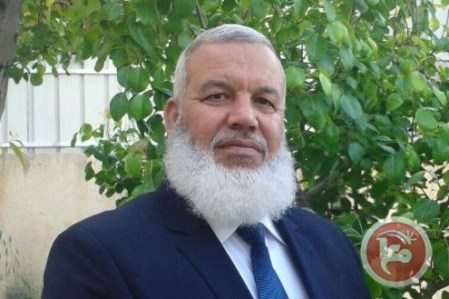
Palestinian security sources said Israeli forces detained Hatim Qafisha, a Hamas-affiliated member of the PLO’s Palestinian Legislative Council, from his home. (MaanImages)
Ma’an – January 24, 2016
HEBRON – Israeli forces detained at least six Palestinians, including a Palestinian lawmaker and a former Palestinian Authority minister, from their homes in the southern occupied West Bank district of Hebron overnight Sunday, Palestinian and Israeli sources told Ma’an.
Palestinian security sources said Israeli forces detained Hatim Qafisha, a Hamas-affiliated member of the PLO’s Palestinian Legislative Council, from his home in the Wadi al-Hariyya neighborhood of Hebron city.
Security sources added that unidentified assailants set fire to Qafisha’s private vehicle after he had been detained and Israeli forces had left the area.
Israeli forces also raided the Nimra neighborhood around dawn and detained Issa al-Jaabari, who served as the PA’s Minister of Local Governance in 2006.
Sources said Israeli forces blew the front doors off of al-Jaabari’s home before raiding the dwelling and detaining the former minister.
Furthermore, Israeli forces carried out a predawn raids in the al-Sheikh neighborhood of Hebron city and detained a former prisoner identified as Ibrahim Jamil Hassan after ransacking his home, along with several others in the neighborhood.
An Israeli army spokesperson did not confirm specific detentions, but said Israeli forces detained four Palestinians in Hebron city, all of which were reportedly detained for being “Hamas operatives.” The spokesperson added that two more Palestinians were detained in areas north and west of the city.
Israeli sniper shoots Canadian citizen in West Bank
American Herald Tribune | January 21, 2016
In describing what she calls a lack of symmetry in recent escalations in Israel and the West Bank, Canadian-Palestinian artist and PhD student Rehab Nazzal told The Real News, “You have the Israeli occupation forces armed with all forms of weapons, and you have the youth, mainly the youth in their 20s, mostly they were born during what’s called, between quotations, the peace process.”
Nazzal is describing Palestinians born during the Oslo Accord negotiations of the 1990s, who have been protesting across Israel, the occupied West Bank and Gaza since the summer–and suffering for it.
Since 1 October 2015, 155 Palestinians have been killed by Israeli forces. 24 Israelis have been also been killed, many in stabbing or car ramming attacks.
Nazzal was photographing an Israeli skunk truck in the West Bank–an armored crowd control vehicle that shoots putrid water–when an Israeli sniper shot and wounded her on 11 December, 2015. Medics were prevented from attending to her because rounds of teargas were shot consecutively at them by Israeli forces.
She is recovering still in the West Bank, and plans to continue her Canadian federal government research council-funded research into “non-lethal” and crowd-control weapons.
Nazal contextualizes her shooting among the countless other shootings across the West Bank. “I am one of over 16,000 Palestinians who were injured during the past three months. Among these, over 6,000 with live bullets. Just yesterday, here in my neighborhood where I am now, there were tens of Palestinians who were injured, one seriously with live bullets, and one was killed. He was shot in the chest and was killed yesterday. Today was his funeral. And the city is just buried with tear gas and all forms of aggression,” she said.
She continues to speak about the inequity of aggression between Palestinian youths throwing stones and Israeli forces quelling the demonstrations with live bullets and the inability of nations–even her own nation–to act. “It’s very difficult. And the worst part of it, that the world is silent.”
According to Nazzal’s lawyer Dimitri Lascaris, there is little legal recourse to take because of “something called a State Unity Pact, which effectively bars a lawsuit against the government of Israel or any other government for human rights violations,” Lascaris said, clarifying that he is referring to the Canadian courts. He adds that what is “appalling about this law is that it does not provide immunity for states when they engage in commercial activities. But they could commit crimes against humanity, war crimes, you know, some of the most heinous offenses under international human rights law, and they’re completely immune from suit in the domestic courts of our country.”
Nazzal and Lascaris do intend to painstakingly document the event of Nazzal’s shooting, and in particular the impediment of medics by Israeli forces. And using political power, Lascaris said, “we’re going to call upon the government of Justin Trudeau to fulfill its promise of a more principled foreign policy than the predecessor Harper government, which was absolutely and unequivocally committed to supporting the government of Israel, no matter what atrocities it committed.”
As yet, the new Canadian prime minister Justin Trudeau has not provided a statement of support for the Palestinian struggle and continues to remain a close ally of Israel.
Trudeau is also principally opposed to the Boycott, Divestment and Sanctions movement, a Palestinian civil society-led grassroots movement to call on companies to end their complicity with the Israeli occupation.
Nazzal describes her disappointment with the Canadian government’s lack of response–she is a Canadian citizen–as well as the lack of response from the Canadian ambassador to Israel.
“Not even a condemnation to what happened… If we suppose that the Israeli soldiers don’t know I am a researcher doing work, but I am an unarmed civilian and standing away, far from protesters, even this, we haven’t heard any word… from the Canadian ambassador in Israel or the foreign minister.
Which brings that hypocrisy to our human rights violations in other countries. Why, why Israel is not being questioned. I am, again, a Canadian citizen. I have my career, my children there. I have my life there. Yeah, I am just in disbelief, as well.”
Israeli forces demolish homes in Jerusalem-area Bedouin neighborhood

Ma’an | January 20, 2016
JERUSALEM – Israeli bulldozers demolished three housing structures belonging to Palestinian Bedouins in Jerusalem district on Thursday, displacing 17 Palestinians, half of them children.
Israeli bulldozers escorted by Israeli forces raided and surrounded the Jabal al-Baba neighborhood of the village of al-Eizariya, forcibly evacuated residents, and demolished the houses.
Jabal al-Baba representative Atallah Mazaraa told Ma’an that the demolition was sudden and without prior notice, adding that an Israeli court had frozen all demolition orders in the area around a year ago.
Mazaraa said that he and the residents were held at gunpoint for hours while the demolition took place, causing fear and panic among the children present.
Mazaraa said the three demolished homes belonged to Hamda Muhammad Odeh Abu Kutaiba, her son, Ali Abu Kutaiba, and Ghassan Jahalin. The families’ furniture and possessions were still inside when the housing structures were destroyed.
Ali Abu Kutaiba and Jahalin had been living with their families in mobile homes donated by the European Union.
Mazaraa said the EU-donated structures could have easily been taken apart instead of demolished.
Israeli forces also leveled the lands on which the houses were standing in order to prevent any attempts at reconstruction, he added.
COGAT, the Israeli defense ministry unit in charge of civil administration in the Palestinian territories, only confirmed the demolition of two structures, saying in a statement that “enforcement steps were taken against two illegal constructions which were built without a permit.”
The statement added that the demolitions were carried out “after completing the supervision process and issuing the relevant factors.”
Mazaraa said the whole Jabal al-Baba area, which counts some 300 people, was being threatened with demolition.
Jabal al-Baba is one of several Bedouin villages facing repeated demolitions due to plans by Israeli authorities to build thousands of homes for Jewish-only settlements in the E1 corridor.
Although Israeli Prime Minister Benjamin Netanyahu was forced to suspend work on the housing units in 2013, settlement watchdog Peace Now reported last week that the Ministry of Housing has “quietly” continued planning 8,372 homes in the corridor.
Settlement construction in E1 would effectively divide the West Bank and make the creation of a contiguous Palestinian state — as envisaged by the internationally backed two-state solution to the Palestinian-Israeli conflict — almost impossible.
Palestinian Prime Minister Rami Hamdallah slammed the displacement of Palestinian Bedouin communities near Jerusalem in a press release on Wednesday, saying that “Israel’s systematic violation of international laws is no longer acceptable by the international community.”


Featured Video

ARE PATIENTS BEING PROPERLY INFORMED ABOUT OZEMPIC?
or go to
Aletho News Archives – Video-Images
New Book
Breast Cancer: Before You Consent
A new Unbekoming paperback
Lies are Unbekoming | September 18, 2026
Peter Gøtzsche reviewed every randomised mammography screening trial ever conducted for the Cochrane Collaboration. Cochrane’s headline is that, assuming a 15% mortality reduction, one woman in 2000 avoids dying of breast cancer over ten years. Ten are overdiagnosed and treated. Two hundred experience false alarms.
But that headline assumes the reduction. When Gøtzsche looked only at the trials with adequate randomisation — the higher-quality ones — the reduction disappeared. No effect on breast cancer mortality. No effect on all-cause mortality.
This is the Cochrane finding, published in the establishment’s own database of systematic reviews.
No woman being asked to consent to a mammogram this week knows it.
That is why the new Unbekoming paperback exists. … continue
Blog Roll
 Aletho News
- US lawmaker blocks $2.8 billion weapons sale to Israel: Report
- Yemeni army claims responsibility for strikes on sensitive sites in Saudi capital, Aramco facilities in Yanbu
- Iran Judiciary issues indictments against 159 US, Israeli officials for assassination of Leader, commanders
- Turkiye revokes Iranian bank license under US sanctions campaign
- US-Denmark Agreement on Greenland Is ‘PR Stunt’ Ahead of Midterms
- Araghchi: Military intervention cannot create security; coercion cannot bring peace
- Fraud Squared
- Breast Cancer: Before You Consent
- Iran’s Plan to Shut Down AI in the Persian Gulf
- Israel seeks ‘compensation’ from Washington over Saudi F-35 sale
- If Americans Knew
- Inside Gaza’s death trap of collapsing, bombed-out buildings
- The everyday items Israel bans from Gaza every day
- Inside the siege, the ruined buildings of Gaza – Daily Update
- Debunking The Claim That Macklemore Has A “History Of Antisemitism”
- CPJ demands release of arrested Palestinian-US journalist near Bethlehem
- Robert Kraft: The Billionaire Friend of Netanyahu Pulling The Strings Behind the Macklemore/Ed Sheeran Blow Up
- Columbia Administered Fund Gives Big Money to Pro-Israel Groups
- Deportation Case of Palestinian Activist Salah Sarsour Tests First Amendment
- ‘We Will Not Forget’: Palestinians Mark 44 Years since Sabra and Shatila
- Why do we let Zionists decide what we can and can’t say?
- No Tricks Zone
- New Study: ‘Global Drought Shows No Detectable Recent Acceleration Under Climate Warming’
- Economic Masterminds: German Socialists Suggest Taxing Productivity Gains Stemming From Using AI
- The South China Sea Has Not Been Cooperating With The Climate Change Narrative
- Energy Crisis: Germany Enters Heating Season With Historically Low Gas Reserve Fill Levels
- New Study: The Antarctic Ice Sheet Gained Mass From 2020-2024 Due To Staggering Snow And Ice Accumulation
- Study: Ocean Heating Rates From Thousands Of Years Ago ‘Dwarf’ Modern Ocean Heating Rates
- Climate Extremists Target, Attack Large-Scale Power Grid Infrastructure In Germany!
- New Study: Antarctic Ice Melt Has Contributed Less Than 1 Centimeter To Sea Level Rise In The Last 30 Years
- Fear Of Debate: Alarmist German Climate Scientist Calls On Mainstream Media To Discredit Skeptic Voices
- End-Of-August Arctic Sea Ice Extent Hasn’t Fallen In 20 Years, Official Data Show!
 Aletho News