22 years after the Ibrahimi mosque massacre, Palestinians still suffer consequences

International Solidarity Movement | February 25, 2016
Hebron, Occupied Palestine – On the 25th of February 1994, a US citizen residing in the illegal Kiryat Arba settlement entered the Ibrahimi mosque in the early morning during the month of Ramadan. Baruch Goldstein, dressed in his army uniform, opened fire on the Palestinians that were crammed inside for the prayer. He killed 29 men and boys and injured dozens before people overpowered him and beat him to death.
That day, many more Palestinians were killed in Hebron during riots protesting the massacre that had occurred, in front of the mosque and the hospital where the injured were treated, as well as in the cemetery were the dead were being buried. In the next few days, protests and marches happened all over the West Bank and across historic Palestine. It is believed that in total, in these few days, 50 to 70 Palestinians were killed, and over 250 were injured.
Immediately after the attack, the Israeli government released a statement condemning this act and affirming that Goldstein was acting on his own behalf. The Prime Minister Yitzak Rabin called Goldstein a “degenerate murderer, a shame on Zionism and an embarrassment to Judaism.” Rabin always affirmed that Goldstein acted on his own behalf and that the Israeli military had no knowledge of his plans. Though his act was condemned, it resulted in many measures that mostly impacted on Palestinians. Instead of evacuating the settlements of Hebron, only a few of the most extreme settlers were temporarily disarmed.
A round-the-clock curfew was imposed. Shops in Shuhada Street were forced shut by the Israeli army, on the pretext of keeping settlers safe on this commercial artery. Many other shops also had to close due to lack of supplies and customers. New checkpoints were installed. Palestinians were first banned from driving and then simply from accessing most of Shuhada Street. Many of these measures resulted in the displacement of many Palestinian families.
In 1997, a protocol was signed between Israel and the PLO, dividing Hebron into two areas: “H1”, controlled by Israeli forces, and “H2”, under Palestinian control. It called for the withdrawal of Israeli soldiers from the H1, which represented 80% of the city. To this day, even though H1 is officially controlled by the Palestinian Authority, it remains under overall Israeli control, while H2 is now the home to many violent and extremist settlers. Some of them still go every year to the tomb of Baruch Goldstein to celebrate his treacherous act of murder.
22 years later, all measures that were declared in Hebron on the 25th of February, 1994 are still enforced, except for the curfew. And settlers are more than ever taking over the city, with the compliance of the Israeli government.
The last tiny bit of Shuhada Street, that was not (yet) declared a ‘sterile zone’ and thus been completely barred for Palestinians, has been under repeated ‘closed military zone’ orders since 1st November 2015. Whereas the majority of Shuhada Street has been completely unaccessible for Palestinians, the tiny strip leading from the recently ‘renovated’ Shuhada checkpoint up to the illegal Beit Hadassah settlement, is slowly resembling a ‘ghost street’ more and more, as only Palestinians registered with the Israeli army are allowed to go there.
The closed military zone order is an illegal collective punishment on the whole Palestinian population of this area, that was forced to register in order to be allowed to live in their own houses whereas settlers in the adjacent illegall settlements can walk the roads freely and completely undisturbed. This clearly is just another step in the Israeli policy of making life for Palestinians as hard and humiliating as possible in an attempt to make them leave the area and eventually drive all of them out and connect the settlements.
Every year, Palestinians in occupied al-Khalil commemorate the Ibrahimi mosque massacre and protest against the closure of Shuhada Street and the illegal Israeli occupation. The week, leading up to the 22nd anniversary of the massacre, has seen and will continue to see creative activities and demonstrations. This past week there were also many commemorations of Palestinians, most of whom have been gunned down by Israeli forces and left to bleed to death without any medical help.
Israeli forces demolish sole school in Bedouin community
Ma’an – February 21, 2016
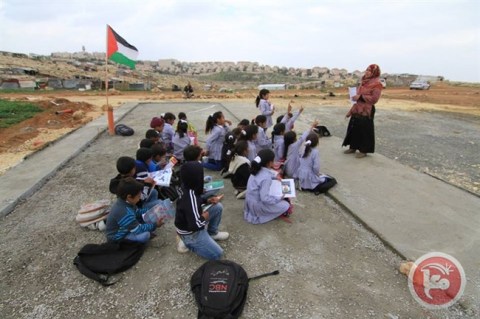
JERUSALEM – Israeli forces on Sunday demolished a Bedouin school for children in the Abu al-Nuwaar community near the town of al Eizariya in the occupied West Bank, a spokesperson for the Al-Jahalin Bedouin community said.
Atallah al-Jahalin told Ma’an that Israeli forces, accompanied by 30 vehicles and a delegation from Israeli’s Civil Administration, raided the area and destroyed the sole school in the community.
Residents said Israeli forces told them the school was demolished because concrete structures were forbidden in the area.
Israeli forces also reportedly seized the contents of the school.
Al-Jahalin added that Israeli forces briefly detained two youths who were protesting the demolition, both of whom were released after the demolition.
After the demolition, primary students held a “sit-in” where the school once stood while wearing their uniforms and holding school books in protest.
On Wednesday, the Coordinator for Humanitarian and UN Development Activities for the occupied Palestinian territory Robert Piper said the number of Palestinians displaced in 2016 is already equivalent to over half of the total number displaced in all of 2015.
Piper called on Israel to immediately halt all demolitions in the occupied West Bank, which he said were in violation of international law.
“Most of the demolitions in the West Bank take place on the spurious legal grounds that Palestinians do not possess building permits,” Piper said.
“But, in Area C, official Israeli figures indicate only 1.5 percent of Palestinian permit applications are approved in any case. So what legal options are left for a law-abiding Palestinian?”
The UN documented 283 homes and other structures destroyed, dismantled, or confiscated between Jan. 1 and Feb. 15.
The measures displaced 404 Palestinians, including 219 children. Another 1,150 Palestinians were also affected after losing structures related to their source of income, according to the UN.
The destruction was focused in 41 locations, many in Palestinian Bedouin or herder communities in Area C, the over 60 percent of the West Bank under full Israeli military control.
Piper highlighted previous statements by UN Secretary-General Ban Ki-Moon that Israeli zoning and planning policies are “restrictive and highly discriminatory.”
“International law is clear — Palestinians in the West Bank have the right to adequate housing and the right to receive humanitarian assistance,” said Piper.
“As the occupying power, Israel is obliged to respect these rights,” the UN official said.
Repeated calls by international bodies for Israel to cease the displacement of Palestinians living in the occupied Palestinian territory have done little in the past to stop ongoing demolitions or settlement expansion onto Palestinian land.
The EU earlier this week condemned Israeli policy regarding demolition and settlement expansion that the body said made the possibility for an independent Palestinian state impossible.
Israeli forces use excessive violence on peaceful demonstration in Hebron
International Solidarity Movement | February 20, 2016
Hebron, Occupied Palestine – On 20th February 2016, the Hebron Defence Committee organised a demonstration under the motto ‘Dismantle the Ghetto, take the settlers out of Hebron’ in occupied al-Khalil (Hebron). Israeli forces attacked the peaceful demonstration with stun grenades and arrested several activists.

Demonstrators marching under the banner of ‘take the settlers out of Hebron’
The demonstration started after the noon-prayer at Ali Bakr mosque and peacefully marched towards the entrance to Shuhada Street in the Palestinian market, chanting against occupation and for their freedom. Once the peaceful march reached Bab al-Baladiyya in the Old City of al-Khalil, Israeli forces quickly started gathering behind the gates that lead directly onto Shuhada Street – that has been closed off for Palestinians since the Ibrahimi Mosque massacre in 1994.
As the Palestinian, Israeli and international activists joined hands in trying to take down the military gate that locks off the access to Shuhada Street for Palestinians, allowing exclusive use for settlers from the illegal settlements only, the Israeli forces suddenly attacked the protestors throwing more than a dozen stun grenades at the crowd of people. While the demonstrators were running for cover, trying to avoid being hit by the stun grenades, the Israeli forces unlocked the military gate and came running into the Palestinian market.

Protestors at the gate leading into Shuhada Street
Israeli forces arrested a total of 12 activists from Hithabrut – Tarabut group and moved them to the Police station for interrogation. While 8 where released, 4 were charged with attacking officers.

Israeli forces using excessive force arresting an activist
As can be seen on this video, Israeli forces attacked several protestors, beating them and threw stun grenades directly at the press – that was visible wearing flag-jackets and helmets reading ‘press’.
The demonstration was held in commemoration of the 1994 Ibrahimi Mosque massacre, in which extremist settler Baruch Goldstein murdered 29 Palestinians and injured more than 120 when he opened fire on whorshippers inside the Ibrahimi mosque.
Over 400 Palestinians Displaced in 6 Weeks
IMEMC News & Agencies – February 19, 2016
 Over 400 Palestinians in the occupied West Bank have been displaced due to Israeli demolitions during the first six weeks of, this year, a senior UN official said, Wednesday.
Coordinator for Humanitarian and UN Development Activities for the occupied Palestinian territory, Robert Piper, in a statement, called the number of demolitions “alarming.”
The number of Palestinians displaced in 2016 is already equivalent to over half of the total number displaced in all of 2015, the official said.
According to Ma’an, Piper called on Israel to immediately halt all demolitions in the occupied West Bank, which he said were in violation of international law.
“Most of the demolitions in the West Bank take place on the spurious legal grounds that Palestinians do not possess building permits,” Piper said.
“But, in Area C, official Israeli figures indicate only 1.5 percent of Palestinian permit applications are approved in any case. So what legal options are left for a law-abiding Palestinian?”
The UN documented 283 homes and other structures destroyed, dismantled, or confiscated between Jan. 1 and Feb. 15, many of which were located in the Jordan Valley.
The measures displaced 404 Palestinians, including 219 children. Another 1,150 Palestinians were also affected after losing structures related to their source of income, according to the UN.
The destruction was focused in 41 locations, many in Palestinian Bedouin or herder communities in Area C, the over 60 percent of the West Bank under full Israeli military control.
A number of demolitions carried out took place in Palestinian communities whose lands have been designated by Israel as “closed military zones,” where military exercises have historically been carried out in effort to drive Palestinians from their land.
Piper highlighted previous statements by UN Secretary-General Ban Ki-Moon that Israeli zoning and planning policies are “restrictive and highly discriminatory.”
“International law is clear — Palestinians in the West Bank have the right to adequate housing and the right to receive humanitarian assistance,” said Piper.
“As the occupying power, Israel is obliged to respect these rights,” the UN official said.
Repeated calls by international bodies for Israel to cease the displacement of Palestinians living in the occupied Palestinian territory have done little in the past to stop ongoing demolitions or settlement expansion onto Palestinian land.
The EU, earlier this week, condemned Israeli policy regarding demolition and settlement expansion that the body said made the possibility for an independent Palestinian state impossible.
The UN and the Invisible Palestinian Knives of Allege-gate
By Vacy Vlazna | Dissident Voice | February 17, 2016
In Palestine, you would be forgiven for thinking that there was no United Nations Special Rapporteur on extrajudicial, summary or arbitrary executions.
The SR, Christof Heyns, in the past 6 years, has never made a country on-site visit to Palestine to get first hand information on the hundreds of cases of Zionist perpetration of extrajudicial, summary or arbitrary executions of the people of Palestine.
Not even the dozens of extrajudicial street executions of Palestinian children and youth carrying the invisible knives of Allege-gate since October 1, 2015 has impelled Heyns to rush to Palestine to ensure the zionist war criminals uphold Palestinian right to life.
In Palestine ‘alleged’ is a synonym for ‘extrajudicial, summary, or arbitrary execution’.
Yes, there is a Palestinian youth intifada, and, yes, there have been acts of resistance to the illegal occupation involving knives, rocks, and cars that have taken some occupier-settler lives.
But the Zionist Occupation Forces (ZOF); i.e., military and police death squads are running amok in Occupied Palestine shooting, seemingly for grisly amusement, innocent Palestinian school children, workers, housewives and youth.
In a wimpy statement on 16 November 2015, SR Heyns welcomed the assurance of the Zionist “Attorney General Yehuda Weinstein to the effect that Israeli security forces are prohibited from firing at a suspected assailant unless an immediate danger to human life cannot otherwise be prevented and that the use of fire must be proportional to the threat.”
You can be certain that the devastated parents of Wisam Qasrawi, 21 who buried their beloved child – transformed from family breadwinner into a martyr by lawless zionist bullets – know Wisam was killed in an indisputable and illegal extrajudicial execution.
 Wisam was born in a village, Misilya. It was described for the Palestine Exploration Fund (patron was Queen Victoria) by Royal Engineers’ surveyor Lieutenant Condor in 1881 as a village with ancient wells beneath it and a rounded hilltop above with extensive views north east across the great plain to Nazareth, west to Carmel, and to Jenin behind a neighbouring hill, ‘north west across a broad corn vale’.
Today, Misilya continues its ancient agricultural lineage of growing olives and cereal. Its 3000 residents are close-knit and mainly poor because of the crippling zionist occupation.
Wisam was outgoing, energetic, well liked and had lots of friends with whom he enjoyed playing playstation and billiards at the local cafe. Wisam also had an admirable sense of responsibility; he left school in year 11 to become the family breadwinner because his father had a severe back injury and his mother had small twins plus his other younger siblings to care for. Even while at school he worked as a part-time farm or building labourer to help out.
The early morning of Sunday, January 17th, gave no hint of impending tragedy. Wisam got dressed for his work at a brick/stone factory in Nablus, gave his mother the remaining money in his wallet and armed only with his mobile joined his mate who was giving him a lift as far as the Huwwara checkpoint. He was dropped off about 500 yards from the checkpoint.
Eyewitnesses reported that the heavily armed soldiers were calling out to Wisam, “Come on, come to us”. Wisam walked, relaxed and hands in the air, and at 50 metres military shots burst hitting his chest and head. Typically, he was left to bleed out and die.
Within 10 minutes, even before Wisam’s mate returned to Misilya, the Zionist news reported an alleged attempted stabbing at the Huwwara checkpoint with no soldiers injured (understandable).
By the afternoon the ZOF had made incursions into Wisam’s village, set up checkpoints and closed off the village which was in collective shock, helplessness, anger and mourning.
Wisam’s body was returned at night and respectfully given a martyr’s burial; the body is not washed as usual with scented water and wrapped in a shroud, but the martyr is buried in the clothes in which he/she died and the blood is left unwashed. According to a Hadith – on Resurrection Day, the Shahid’s blood -“Its color saffron, and its odor musk”.
With 68 years of the violent unrestricted bloodletting of martyrs, the scent of this holy musk is tragically Palestine’s oxygen.
Wisam is no more, just as Ehab, Khalil, Ahmad, Ruqayya, Dania, Nihad, Fuad, Naim, and all the other young innocent invisible-knife wielders, are no more.
The UN was set up to maintain international peace, security and human rights for all. In 68 years, the now 192 member states of the UN have not furthered one moment of peace and justice for the people of Palestine.
The Zionist state has over and over, day to day, blatantly violated every UN declaration and convention it has ratified and it has never been suspended or expelled from the UN:
A Member of the United Nations which has persistently violated the Principles contained in the present Charter may be expelled from the Organization by the General Assembly upon the recommendation of the Security Council.
The UN is as fake as the fake knives of Allege-gate. Both are smokescreens for impunity for Zionist brutality and crimes against humanity.
Dr. Vacy Vlazna is Coordinator of Justice for Palestine Matters. She was Human Rights Advisor to the GAM team in the second round of the Aceh peace talks, Helsinki, February 2005 and then withdrew on principle. Vacy was coordinator of the East Timor Justice Lobby as well as serving in East Timor with UNAMET and UNTAET from 1999-2001.
Israel levels lands, demolishes structures in East Jerusalem
Ma’an – February 17, 2016
JERUSALEM – The Israeli authorities on Wednesday demolished agricultural structures and leveled land in the outskirts of al-Issawiya village in occupied East Jerusalem, locals said.
Muhammad Abu al-Hummas, a spokesperson for a local popular committee, told Ma’an that bulldozers had started leveling around five acres of land, adding that they “deliberately” ruined the dirt roads used by farmers to access their fields as well as their fences.
He said they were accompanied by Israeli police forces as well as officials from Jerusalem’s municipality and the Israeli Nature and Parks Authority.
The land is located in an area Israeli authorities have earmarked for a national park, in a controversial plan known as “11092”, which aims to turn around 740 dunams (175 acres) of Palestinian land in the East Jerusalem neighborhoods of al-Issawiya and al-Tur into Israeli parkland.
The Israeli planning council suspended the plan in September 2014 until the needs of the neighborhoods could be assessed.
However, the council, which previously approved the annexation of the 740 dunams, said approval of the plan could potentially be justified and was not fundamentally illegal.
Abu al-Hummus said the Israeli authorities were “leveling and ruining private Palestinian lands despite an Israeli court decision to freeze the settlement plans.”
One of the owners of the land leveled on Wednesday, Adnan Darwish, told Ma’an that Israeli bulldozers had ruined eight dunams (two acres) of his property, uprooting a number of olive and cypress trees.
He said they had also demolished a structure used as a sheep barn belonging to Salih Abu Turk. Other landowners affected were identified as Ali Abu al-Hummus, Atif Ubeid, and Shaaban Ubeid.
The Palestinian Center for Human Rights has previously described Israel’s plan in al-Issawiya as “part of the Israeli government’s plans to create a Jewish demographic majority in the occupied city.”
East Jerusalem was seized by Israel along with the West Bank in 1967 during the Six-Day War, and since then, the Israeli government has undertaken a policy of “Judaization” across the city.
PA seizes Israeli truck loaded with chemical waste
MEMO – February 16, 2016
The Environmental Quality Authority yesterday seized an Israeli truck full of chemical remains heading to illegally unload in occupied Palestinian territories, Quds Press reported.
The truck, which left the Israeli settlement of Karnei Shomron, was seized between the Palestinian villages of Kafr Thulth and Azzun near the West Bank city of Qalqilya.
The truck was to be offloaded near a residential compound in Qalqilya, a statement by the Environmental Quality Authority revealed.
The load included remains of several chemical industries, including paint.
The authority said it handed the truck and driver over to the District Coordination Offices.
A senior official in the authority said a complaint regarding this Israeli violation would be filed to the Secretariat of the Basel Convention, which is in charge of the transport of dangerous goods.
He also said that the Palestinian contractors, who were involved in this issue, would be prosecuted.
Environment expert George Karzam told Quds Press: “The Israeli occupation recently closed a number of its dumps and facilities related to treating solid and chemical waste in the lands occupied in 1948 [Israel] moving them to new sites in the West Bank, mainly in the Jordan Valley.”
This was because of the poisonous substances which were being discarded as well as the odors coming from the dumps, Karzam explained.
Israel has also been putting pressure on the Palestinian Authority to open new waste sites for illegal settlements in the West Bank, he added.
Israeli forces uproot 100 olive trees in Wadi Qana
Ma’an – February 16, 2016
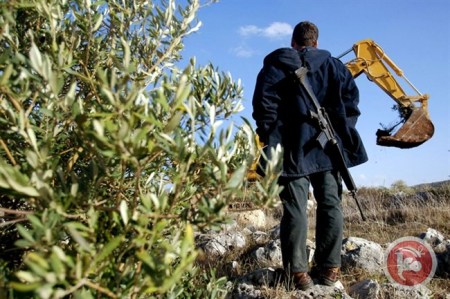
SALFIT – Israeli forces uprooted 100 olive trees in the Wadi Qana area west of the village of Deir Istiya in Salfit district on Tuesday amid ongoing efforts to push Palestinians out of the area, locals said.
Farmers from Deir Istiya told Ma’an the forces arrived in Wadi Qana and uprooted the trees without prior notice.
Soldiers then forced locals from the area in order to allow Israeli settlers to arrive there, the farmers said.
Ibrahim al-Hamad, director of the Palestinian Ministry of Agriculture’s Salfit branch, told Ma’an that soldiers removed the seven-year-old trees on the grounds that the area is a nature reserve, with planting prohibited in the area.
Al-Hamad added that Israeli soldiers also removed a water tank belonging to Palestinian locals.
A spokesperson for Israel’s Coordination of Government Activities in the Territories (COGAT) was not immediately available for comment.
Wadi Qana, a valley that has historically served agricultural and recreational purposes for local Palestinians who own land in the area, was declared a nature reserve by Israel’s Civil Administration in 1983.
Israel has used this designation for years to justify uprooting Palestinian crops and forcing Palestinians from the area, according to Israeli rights group B’Tselem.
Several Jewish-only Israeli settlements and outposts have been illegally established along the ridges of the valley since the 1970s.
Waste water dumped from the settlements has gradually polluted the river, forcing out Palestinians who have lived in and visited the valley for generations.
Palestinian owners of land in Wadi Qana and the village of Dir Istiya have meanwhile been prevented from building or planting in the area, the majority of which is in Area C, under the full civil and military control of Israel.
The NY Times Maps Jerusalem: Distilling the Worst of Israeli Propaganda
By Barbara Erickson – TimesWarp – February 15, 2016
In a new multimedia production The New York Times is now offering us “The Roots of the Recent Violence Between Israelis and Palestinians,” a series of 13 images accompanied by brief notes. The title promises much, and the teaser adds that this new offering presents us with “the geography of the issues surrounding the ongoing violence.”
Here, it seems, the newspaper has an opportunity to provide the context so often missing from Times stories about Palestine and Israel. With such an introduction readers might hope to learn about the historical beginnings of the conflict and to perceive the effects of occupation on the face of the land.
It was not to be. In fact, this slick presentation distills the worst of the Times reporting on the issue. The text never once mentions the occupation; it provides no historical context of any kind, and it blindly follows the preferred narrative of Israeli propagandists.
The visuals never leave Jerusalem, and the text sticks to events there. The presentation opens with an image of the Dome of the Rock and the Al Aqsa Mosque, accompanied by the comment that the violence “was set off in part over a dispute over Al Aqsa Mosque compound.” Nothing more is said about this complex issue.
The images then move on to highlight Jewish “neighborhoods” in Palestinian East Jerusalem and Jewish homes dotting the Palestinian neighborhoods, and we learn that the “neighborhoods” are “considered illegal settlements by most of the world.” This is the Times’ usual formulation, which distorts the fact that the entire international community—outside of Israel—deems the settlements illegal.
There is no mention of the impact these settlements have on Palestinians’ lives. We get nothing but maps and terse comments about who lives where, but the Times does finally provide a motive for the recent attacks: It comes from “frustration” over the lack of basic city services.
We are set up for this trivial claim in the fourth visual, which shows us Shuafat Refugee Camp in East Jerusalem surrounded by a yellow line. “Israel built a barrier in response to Palestinian attacks from the West Bank in the early 2000s,” the text notes. “While effective at stopping suicide bombers, it cut off several East Jerusalem neighborhoods from the rest of the city, leaving them without basic services.”
In the following image the narrative continues, “Palestinians say these frustrations are at the root of the recent attacks. Israelis officials accuse Palestinian leaders of inciting violence.”
There we have it. Not a word about loss of land, the confiscation of resources, military incursions and all the many miseries associated with military occupation. So much for the “roots” of the conflict.
Although the Times attempts a show of balance, by referring to both sides, the text is heavily weighted toward the Israeli point of view. It twice mentions Israeli actions as “responses” to violence and never suggests that Palestinians are responding to oppression.
It repeats the Israeli claim that Palestinians who died in the recent uprising were all involved in attacks or “clashes” with troops, omitting the reports of human rights groups and others who charge Israel with “street executions” of Palestinians who pose no possible threat to security forces or civilians.
In addition, the Times gives a distorted account of the Separation Barrier. It fails to say that the 2004 International Court of Justice decision held that the wall is illegal and that its route (85 percent of it inside the West Bank) threatens “de facto annexation.” The newspaper also repeats the Israeli claim that the wall “effectively stopped suicide bombers.”
As an Israeli journalist recently observed in 972 Magazine, the recent assaults have demolished this facile claim. The latest attackers could have come with bombs instead of knives; the wall did not keep them out. The bombings ended when militants abandoned the tactic.
If the Times truly intended to illustrate the “geography of the issues surrounding the ongoing violence,” it could have shown some dramatic effects of the occupation on the landscape, such as:
- The route of the Separation Barrier, snaking well inside the boundary between the West Bank and Israel
- The rows of dead parsley and spinach fields in Gaza, where Israel has deliberately sprayed herbicides on hundreds of acres
- The contrast between lush West Bank settlements, with their lawns and swimming pools, and parched Palestinian villages nearby
- The shrinking cantons of the West Bank, where Israel is illegally confiscating more and more Palestinian territory
- The dead strip of land inside Gaza, where Israel has imposed a firing zone and has frequently entered to bulldoze crops and soil
Images such as these might provide a real sense of the “roots” of the recent violence. Instead, the Times has chosen to encapsulate Israeli propaganda in this latest presentation, perpetuating its ingrained bias in a package of misleading notes and slick visual effects.
Follow @TimesWarp on Twitter
Israeli Soldiers Push Man from Wheelchair following Shooting
IMEMC News & Agencies – February 15, 2016
A video released by a Palestinian, immediately after Israeli forces shot and critically injured a 14-year-old girl, shows Israeli forces assaulting bystanders.
In the video, an Israeli soldier pushes a disabled man in a wheelchair backwards, flipping the man and his wheelchair over. Two more Palestinians rush to the disabled man’s aide, while Israeli forces charge forward at other bystanders, setting off a stun grenade.
The video shows Israeli forces attacking and threatening Palestinians who were attempting to get near Yasmin al-Zarou, who was shot near an Israeli checkpoint in Hebron city, according to Ma’an.
The Occupation Goes Missing from The NY Times
By Barbara Erickson | TimesWarp | February 8, 2016
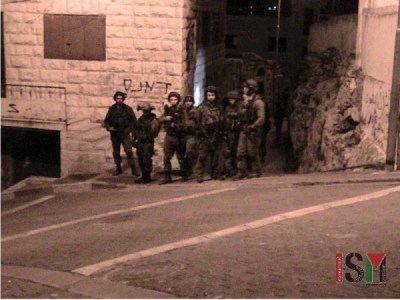 The occupation went missing from The New York Times this past week. Palestinians were there, as victims and attackers, but the brutal military regime that controls their lives made no appearance.
The newspaper had plenty to say about Israeli Jewish life, however: two lengthy stories about prayer space at the Western Wall and one discussing Zionism. Each of these stories ran over a thousand words.
Two shorter news articles reported that the murderers of a Palestinian teen had been sentenced to prison and that a knife attack left one Israeli police officer dead, but nothing in either of these provided the context crucial to understanding events in the occupied territories.
Meanwhile, as the Times obsesses over Israeli identity and attitudes, the occupation grinds on, producing news that appears elsewhere. At the top of the list were two major stories: A Palestinian prisoner was near death after passing his 75th day on hunger strike, and Israeli forces carried out a massive demolition of over 20 homes, rendering more than 100 Palestinians homeless in the dead of winter.
The ordeal of Mohammed al-Qeeq, a journalist held without trial since Nov. 21 of last year, drew the attention of Israeli and international media outlets, which recounted his legal appeals, protests on his behalf and an Israeli Supreme Court decision which “froze” his detention but confined him to a hospital. (Al-Qeeq refused the offer and continued his fast.)
Al-Qeeq’s hunger strike was deemed unfit to print in the Times, perhaps because it would touch on Israel’s use of administrative detention, which holds prisoners without trial. Readers are not to know that as of last December 660 Palestinians were held in this limbo, nor were they to be informed that a number of human rights groups have protested Israel’s unsavory use of the practice.
And then there is the matter of two impoverished villages in the South Hebron Hills of the West Bank, Khirbet Jenbah and Khirbet Al-Halawah, which were made even more destitute after Israeli army crews arrived last Tuesday and demolished 22 structures, displacing 110 people, including dozens of minors. The army also confiscated solar panels, which, like many of the homes, had been donated by aid organizations.
The military claimed that it destroyed Jenbah and Al-Halawah because they were located in a declared firing zone. The Israeli publication 972 Magazine, however, noted that “Jewish settlements within [the zone] have not been served with eviction orders.”
This was the largest mass demolition in a decade, and the plan to destroy villages within the firing zone has drawn international attention and a petition from world-renowned authors to spare the communities. None of this, however, was enough to draw the interest of the Times.
Instead, the Times considered it more urgent to examine the effects of a new prayer space at the Western Wall—not once, but twice—and to take a look at Zionism today. Villagers thrown out in the cold of winter and a prisoner on the brink of death took a back seat to these concerns.
The Times claims that it gives readers “the complete, unvarnished truth as best as we can learn it,” and it insists that the newspaper’s overriding goal is to “cover the news as impartially as possible.” Readers who never stray to other sources of information may actually believe this.
Three new homes will be demolished in Jerusalem
International Solidarity Movement | February 7, 2016
South Jerusalem, Occupied Palestine – Yesterday, on Saturday February 6th, we visited the house of 49 year old, Salah Abukaf, who lives in the neighborhood of Sur Baher in occupied South Jerusalem, and two days ago received a house demolition order.

Salah Abukaf’s home
Last year, on September 13th, a 68 year old illegal Israeli settler died in a car accident near Abukaf’s home. The Israeli police first said that this was a regular car accident, but then decided to accuse his 18 year old son, Mohammed Abukaf, together with 4 other friends, all between 17 and 19 years of age, Walid al Atrash, Abed Dweyad, Jihad Tawil, and Ali Sabra, of throwing stones to the car and creating the accident.
At approximately 3 in the morning on September 24 and again on September 25, the Israeli police violently raided the homes of these five young men and arrested them. The police also confiscated their Jerusalem ID’s, which poses a serious problem because when Palestinian’s lose their Jerusalem ID they lose their right to live there and all other residents’ rights. These arrests were carried out despite the fact that the Israeli police have not yet presented evidence of them throwing stones at the car.
According to Salah Abukaf, the five young men were sitting in a place 500 meters away from the car at the moment of the accident, and denies the claims that his son threw stones. “They are accusing my son of things he didn’t do.”

Salah Abukaf talks in an interview for Ma’an news.

Salah’s wife is suffering with this situation and couldn’t help crying in her interview.
On Friday, February 5th, the Israeli police gave home demolition orders to three of the young men’s homes, for Mohammed Abukaf, Walid al Atrash and Abed Dweyad. According to these orders, the families have up to the 10th of February to make an appeal to the court. Nonetheless, the families say that according to the way Israeli authorities normally behave, they are afraid that when waiting for the court’s answer to their appeals, the Israeli forces will come to demolish their houses anyway, making their efforts futile.

Israeli forces came into Abukaf’s house and drilled holes into the walls. The family suspects they were measuring how thick the walls are in order to dynamite the house.

Another hole in the main room’s wall.
In the meantime, the family of Salah Abukaf is paying 50.000 shekels, Walid al Atrash 60.000 shekels and Abed Dweyad 75.000 shekels to cover their lawyers’ expenses to fight their cases in the court. These families already suffer from bad financial situations and paying these amounts of money is a big burden for them.
Abukaf explains; “If I knew my son had done something wrong, then I would be willing to accept this, but what the Israeli authorities are doing is simply collective punishment. It is illegal under International Law that they destroy my family’s home where my children live. Where are we going to go now?”

8 year old Hala, on the right side, and 9 year old Hadeel on the left, are the two youngest living in this home.

Mohammed’s sister, 17 year old Ala’.
In Walid al Atrash’s house, a total of 8 people, including his two parents and five siblings, will be left homeless if their home is demolished.
Abed Dweyad’s home includes a total of seven people, with his two parents and four siblings, will be left homeless as well if their house is demolished.
It is important to note that this event is happening following Israel’s master plan to ethnically cleanse Palestinians from Jerusalem. The objective of this plan is to reduce today’s 37% Palestinian population to 20% by the year 2020, and allow for 80% of its total population to be Israeli Jewish.
Featured Video

Macgregor: We Haven’t Seen the Worst of the Iran War Yet
or go to
Aletho News Archives – Video-Images
New Book
Breast Cancer: Before You Consent
A new Unbekoming paperback
Lies are Unbekoming | September 18, 2026
Peter Gøtzsche reviewed every randomised mammography screening trial ever conducted for the Cochrane Collaboration. Cochrane’s headline is that, assuming a 15% mortality reduction, one woman in 2000 avoids dying of breast cancer over ten years. Ten are overdiagnosed and treated. Two hundred experience false alarms.
But that headline assumes the reduction. When Gøtzsche looked only at the trials with adequate randomisation — the higher-quality ones — the reduction disappeared. No effect on breast cancer mortality. No effect on all-cause mortality.
This is the Cochrane finding, published in the establishment’s own database of systematic reviews.
No woman being asked to consent to a mammogram this week knows it.
That is why the new Unbekoming paperback exists. … continue
Blog Roll
 Aletho News
- US lawmaker blocks $2.8 billion weapons sale to Israel: Report
- Yemeni army claims responsibility for strikes on sensitive sites in Saudi capital, Aramco facilities in Yanbu
- Iran Judiciary issues indictments against 159 US, Israeli officials for assassination of Leader, commanders
- Turkiye revokes Iranian bank license under US sanctions campaign
- US-Denmark Agreement on Greenland Is ‘PR Stunt’ Ahead of Midterms
- Araghchi: Military intervention cannot create security; coercion cannot bring peace
- Fraud Squared
- Breast Cancer: Before You Consent
- Iran’s Plan to Shut Down AI in the Persian Gulf
- Israel seeks ‘compensation’ from Washington over Saudi F-35 sale
- If Americans Knew
- Inside Gaza’s death trap of collapsing, bombed-out buildings
- The everyday items Israel bans from Gaza every day
- Inside the siege, the ruined buildings of Gaza – Daily Update
- Debunking The Claim That Macklemore Has A “History Of Antisemitism”
- CPJ demands release of arrested Palestinian-US journalist near Bethlehem
- Robert Kraft: The Billionaire Friend of Netanyahu Pulling The Strings Behind the Macklemore/Ed Sheeran Blow Up
- Columbia Administered Fund Gives Big Money to Pro-Israel Groups
- Deportation Case of Palestinian Activist Salah Sarsour Tests First Amendment
- ‘We Will Not Forget’: Palestinians Mark 44 Years since Sabra and Shatila
- Why do we let Zionists decide what we can and can’t say?
- No Tricks Zone
- New Study: ‘Global Drought Shows No Detectable Recent Acceleration Under Climate Warming’
- Economic Masterminds: German Socialists Suggest Taxing Productivity Gains Stemming From Using AI
- The South China Sea Has Not Been Cooperating With The Climate Change Narrative
- Energy Crisis: Germany Enters Heating Season With Historically Low Gas Reserve Fill Levels
- New Study: The Antarctic Ice Sheet Gained Mass From 2020-2024 Due To Staggering Snow And Ice Accumulation
- Study: Ocean Heating Rates From Thousands Of Years Ago ‘Dwarf’ Modern Ocean Heating Rates
- Climate Extremists Target, Attack Large-Scale Power Grid Infrastructure In Germany!
- New Study: Antarctic Ice Melt Has Contributed Less Than 1 Centimeter To Sea Level Rise In The Last 30 Years
- Fear Of Debate: Alarmist German Climate Scientist Calls On Mainstream Media To Discredit Skeptic Voices
- End-Of-August Arctic Sea Ice Extent Hasn’t Fallen In 20 Years, Official Data Show!
 Aletho News