Yemen to keep up counterstrikes until the end of invasion: Ansarullah official
Press TV – January 23, 2022
A senior Yemeni official vows that the country will keep up its counteroffensives until its complete liberation from the scourge of a United States-backed and Saudi-led invasion and siege.
Mohammed al-Bukhaiti, a member of the Yemeni popular resistance Houthi Ansarullah movement’s Political Bureau, made the remarks on Sunday in an exclusive interview with Iran’s al-Alam Arabic-language television network.
Saudi Arabia and several of its allies have been attacking Yemen, the Arab world’s poorest nation, since March 2015 in an unsuccessful bid to change its ruling structure in favor of its former Riyadh-aligned regime.
The war, and an ensuing siege that the aggressors have been employing, has killed hundreds of thousands of Yemenis and turned the entire Yemen into the scene of the world’s worst humanitarian crisis.
The Yemeni forces that feature the Yemeni army and its allied fighters from the Popular Committees have, however, vowed not to lay down their arms until the expulsion of all foreign forces.
“Yemen’s operations against the countries of the [invading] coalition will continue at the domestic and overseas levels until the coalition stops its attacks and ends the blockade,” al-Bukhaiti said.
Invaders’ systematic denial
The invading countries are trying to deflect the international public opinion from their atrocities through a number of methods, he noted.
“They first deny any responsibility for their crimes, but later admit their involvement only to say they are going to investigate the atrocities,” said the official.
Al-Bukhaiti, meanwhile, rebuffed the invaders’ claims that they are attacking the impoverished country to retaliate for the Yemeni forces’ operations.
He said the aggressors took Yemen under heavy bombardment throughout the first three years of the war, during which the country did not have the deterrent power that it is using now to return the Saudi-led offensives.
“The invaders used to commit such crimes from the very first day of the invasion for three [consecutive] years,” long before Yemen became able to retaliate the aggression with ballistic missiles and drones, the Ansarullah official said.
He also hailed that the counterattacks had managed to force the invaders to reduce the number of their military assaults.
‘US, Zionists support aggressors’
“Those who support the invading countries, including Saudi Arabia and the UAE [in their crimes against the Yemeni people], are the United States and the Israeli regime, which are bereft of all human values,” al-Bukhaiti said.
The atrocities are being perpetrated to force Yemen to surrender and devolve into a vassal state, he added.
“But we tell them that these atrocities will have the opposite result” because they would prompt more Yemeni soldiers to join the battlefront against the aggressors, the official concluded.
Boris’s garden party – a more pressing issue than Yemeni genocide
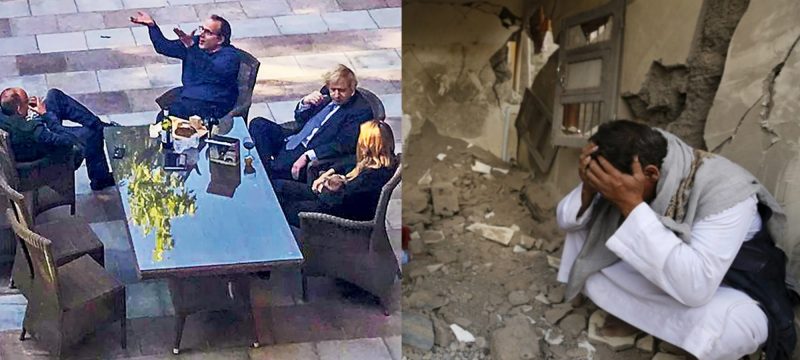
By Gavin O’Reilly | OffGuardian | January 15, 2022
Over the past several days, the news story that has dominated British news headlines, and consequently, the news headlines of the rest of the Western world, is controversy over a leaked email confirming Boris Johnson’s attendance at a Downing Street garden party in May 2020 – a time when the Summer weather is usually at its peak in Britain, and incidentally, the same time when the entire country was under stringent lockdown measures.
In spite of offering an almost immediate apology in the House of Commons on Wednesday, Johnson has faced intense calls to resign from his position.
Not only from the opposition of Keir Starmer’s Labour, Ed Davey’s Liberal Democrats and Nicola Sturgeon’s SNP, but also from prominent members of his own Conservative Party such as Scottish Tory leader Douglas Ross. With the main point of contention being that members of the British public were prohibited from seeing gravely ill loved ones at the same time as Johnson’s attendance of said garden party due to the restrictions put in place.
The ongoing controversy over ‘partygate’ however is in stark contrast to the minuscule Western media coverage of Boris Johnson’s key role in what is currently the world’s worst humanitarian crisis, the now seven-year long Saudi Arabia-led war on Yemen.
A conflict that has resulted in the worst Cholera outbreak of all time, the deaths of 10,000 children directly through the ensuing violence, and the further deaths of more than 85,000 children through the mass-starvation the conflict has triggered.
In July 2016, following his appointment as Foreign Secretary under the then-government of Theresa May, Johnson approved the sale of more than £1.2bn worth of British made-weaponry to Downing Street-ally Saudi Arabia – the Gulf Kingdom immediately putting it to use on Yemen’s agricultural, health and sanitation infrastructure.
This lead directly to the aforementioned Cholera outbreak and famine in what is already the most impoverished nation on the Arabian Peninsula, a situation exacerbated even further by a Saudi blockade preventing food and medical supplies from entering the country.
British support for the Saudi-led conflict goes far beyond lucrative arms sales to Riyadh however, with British military advisors on hand alongside their US counterparts in the Saudi command room to assist in the selection of targets for the Royal Saudi Air Force – more than 100 Saudi pilots have also been trained at RAF airbases in Britain over the past decade alone.
With both policies remaining in place since Johnson became Prime Minister in July 2019, alongside the aforementioned arms sales which have resulted in significant profit for British defence contractors such as BAE Systems.
Perhaps the most crucial role in Britain’s decision to support the Yemen war however, is a geopolitical ambition that Downing Street shares with the United States and Israel – the containment of Iran within the region.
The Islamic Republic, a long-time Western foe since the 1979 Islamic Revolution saw the US-UK aligned Shah deposed and replaced with the anti-Western and anti-Zionist Ayatollah Khomeini, is widely accused of backing the Ansar Allah rebel movement, more commonly known as the Houthis. Whose seizure of the Yemeni capital Sana’a and overthrow of the then pro-Saudi President Abdrabbuh Mansur Hadi in early 2015 would result in Riyadh launching its US-UK backed air campaign in March of that year in a bid to restore the government of its favoured candidate.
It is also the reason why, in addition to multi-billion pound arms deals between London and Riyadh, that what has now amounted to a seven-year long US and UK backed genocide of the Yemeni people, has received scarce media coverage in the West – in stark contrast to a Summer garden party held by a British Prime Minister who has himself played a key role in the slaughter.
Gavin O’Reilly is an Irish Republican activist from Dublin, Ireland, with a strong interest in the effects of British and US Imperialism; he was a writer for the American Herald Tribune from January 2018 up until their seizure by the FBI in 2021, with his work also appearing on The Duran, Al-Masdar, MintPress News, Global Research and SouthFront. He can be reached through Twitter and Facebook.
With Democrat Back in White House, MSNBC Returns to Ignoring U.S.-Backed War in Yemen
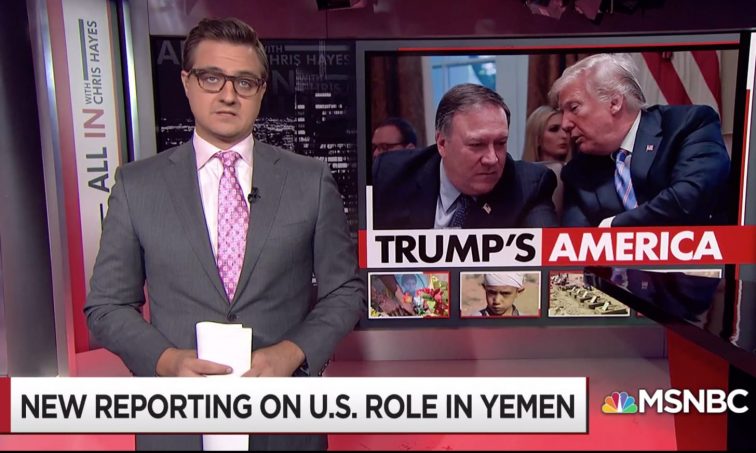
By Adam Johnson | The Column | November 24, 2021
A review of MSNBC’s coverage from Nov. 3, 2020 to Nov. 22, 2021 shows MSNBC hasn’t run a single segment on the U.S.-backed war still raging in Yemen.
To the extent MSNBC did cover Yemen’s “civil war” during this time frame it was exclusively to pass along, without skepticism, claims last spring from Democrats that President Biden had “ended U.S. support for the war”—which turned out to not be true in any meaningful sense, a fact evident at the time but not met with any questioning from MSNBC reporters or pundits.
Since then, it’s become increasingly clear little has changed in the status quo. While the U.S. has halted some forms of assistance, like mid-air refueling of aircraft, other forms of vital participation remain, including: green-lighting of weapons transfers, maintaining spare parts for Saudi war planes, sharing some forms of intelligence, and training the Royal Saudi Navy, which is enforcing a catastrophic blockade on Yemen.
And then there is the political cover that the Biden administration is giving the Saudi-led coalition, a vital form of support that noted in September by Annelle R. Sheline and Bruce Riedel at The Brookings Institute—hardly a far-left bastion of anti-imperial polemic:
Biden’s broken promise on Yemen
… Unfortunately, Biden’s approach is fatally flawed. The president stated that he would “end U.S. support for offensive operations in Yemen.” Yet the Saudi-led war on Yemen by definition, is an offensive operation. Saudi Arabia is bombing and blockading another country: Between March 2015 and July 2021, the Saudis conducted a minimum of 23,251 air raids, which killed or injured 18,616 civilians. The Houthis, known formally as Ansarallah, launch missiles in retaliation but if Saudi airstrikes ceased, the Houthis would have little reason to provoke their powerful neighbor. As long as the U.S. materially and rhetorically backs the Saudis’ war of choice, Biden’s assertion that the U.S. would end support for offensive operations is a lie.
The second crucial flaw in Biden’s approach is that he did not call for an immediate end to the Saudi blockade of Yemen. The blockade primarily blocks fuel from entering the Houthi-controlled Hodeida port; the Saudis also prevent the use of Sanaa International Airport. Blockades cannot be defensive: they are offensive operations, and therefore U.S. involvement should have ended following Biden’s declaration in February. The U.S. tacitly cooperated with the blockade by not challenging it, and the U.S. Navy occasionally announces it has intercepted smuggled weapons from Iran, suggesting a more active role than the administration admits. Congress should investigate.
Just this week, the Biden White House and State Department announced the US will be selling another $650 million in weapons to Saudi Arabia, hiding behind the nonsensical talking point that the weapons are “purely defensive.”
There was a time when MSNBC media personalities did act like they cared about what the UN calls the “world’s worst humanitarian disaster,” which has killed almost a quarter of a million people.
MSNBC ignored the war almost completely during the Obama years and early Trump years. But after the Saudi coalition bombed a school bus in August 2018, and Saudi dictator Mohammad bin Salman ordered the killing of Washington Post columnist Jamal Khashoggi in October 2018, they—like much of the U.S. media—finally began reporting on the regime’s human rights abuses. For a while.
MSNBC ran multiple segments on the war in the second half of 2018 when it was considered very much Trump’s war.
- Aug 9 2018 – All in with Chris Hayes: Dozens of children killed in school bus bombing in Yemen
- Aug 10 2018 – Velshi & Ruhle: An airstrike in Yemen struck a school bus, killing children
- Oct 21 2018 – All in with Chris Hayes: 14 Million People On Brink Of Starvation In Yemen
- Nov 15 2018 All in with Chris Hayes: Trump boosts authoritarians, as war rages in Yemen
- Sept 2018 – All in with Chris Hayes: WSJ: Pompeo backed continuing US role in war in Yemen
- Nov 28 2018 – All in with Chris Hayes: Senate advances bill to end support for war in Yemen
- Dec 12 2018: All in with Chris Hayes: Rep. Chris Murphy on what’s at stake with vote on Yemen
- Dec 12 2018 – All in with Chris Hayes: Paul Ryan’s Cowardly Act On Yemen
- Dec 13 2018 – Andrea Mitchell Reports: Bernie Sanders: Congress must determine U.S. involvement in Yemen crisis
- Dec 13 2018 – Ali Velshi: Senate votes to end U.S. support for Saudi-led war in Yemen
After this spasm of concern in late 2018, the coverage largely died out. As I noted in FAIR at the time, when activist pressure to pass a resolution compelling an end to U.S. support for the war was at its most urgent in March 2019, MSNBC ignored the effort altogether. There was a brief aside about Trump’s veto of said Yemen war powers act by Rachel Maddow on April 16, 2019, but it amounted to little more than a passing mention.
The next—and it turns out last—time an actual segment aired on the Yemen war was on Morning Joe in July 2020. This report, by NBC News’ Keir Simmons, did mention the war and the U.S.’s role in it, with a focus on how Covid was killing Yemenis. But since the July 2020 Morning Joe report, there have been no segments aired on MSNBC about the U.S.-backed Saudi bombing of Yemen.
In over 18 months, our nominally progressive cable network has not dedicated a single news report, roundtable debate, or segment to the world’s worst humanitarian disaster, which continues to be aided and armed by the U.S. government. When it was Trump’s war—and the Saudi regime fell out of favor with U.S. elites—their hearts bled. Now that we’re back to business as usual and the war is being armed and supported by a Democratic White House, it’s simply a non-issue.
In February 2021, President Joe Biden announced the U.S. was ending its support for “offensive” operations in Yemen, a deliberately vague and ultimately meaningless distinction that appears to have been designed to confuse progressives into declaring victory and moving on. Much to the White House’s liking, one can assume, the gambit seems to have worked, with MSNBC shelving the issue altogether and treating the U.S.-funded and backed war crime like it was wrapped up and out of our hands.
But it’s far from it. At any time, the Biden administration could cancel a U.S. program that provides maintenance for Saudi warplanes, the same warplanes that are still dropping bombs on civilians, including the recent bombing of a plastics factory in Sana’a. The Biden administration could reject the sale of U.S. air-to-air missiles, which can be used to shoot down airplanes and are one more tool the Saudi-led coalition can use to menace humanitarian workers who want to deliver supplies, or people trying to get their ill loved ones out of the country for treatment. And, it is an extremely low bar, but, at any point, Biden could clarify what is meant by support for “defensive” operations, and disclose the full extent of U.S. participation in the blockade, something he has repeatedly declined to do, even after 16 senators requested more transparency and robust action. These are all things the Biden administration is declining to do, thereby providing material and political support that is contributing to Saudi Arabia’s ability to continue the war.
After his six-month period in 2018 of breathlessly and repeatedly pronouncing the urgency of the issue, Chris Hayes’ show ‘All In’ has not run a segment on Yemen at all since December 2018.
Hayes hasn’t even mentioned the topic on Twitter since Biden took office Jan 20, 2021.
Mehdi Hasan, a consistent, long-time critic of Saudi Arabia and the war prior to joining MSNBC Feb 28 2021, did a segment on his online-only Peacock show after the election on Dec. 3 featuring prominent Yemen war critics Prof. Shireen Al-Adeimi and journalist Spencer Ackerman. In this segment, Hasan suggests in his opening that a Biden presidency would turn a page on the U.S.-Saudi relationship and end the war, neither of which happened (though both of his guests expressed profound skepticism). Also on his Peacock online-only show, he asked questions about continued U.S. support for Saudi Arabia, some quite skeptical, to guests Sen. Chris Murphy (D-Conn.) in April 2021 and Rep. Mark Pocan (D-Wisc.) in May 2021. But none of this was on his main cable show on MSNBC.
Hasan has not done a single segment on the Yemen war for his MSNBC show since his show first aired Feb 28 2021. On March 14 2021, he did ask White House Chief of Staff Ron Klain about the White House going soft on Saudi Arabia in general and in a one “minute rant” from May 2021, Hasan did take about 6 seconds to mention the U.S. selling arms to Saudi Arabia that are used in Yemen.
But this is the full extent of Hasan’s—and thus MSNBC’s—Yemen coverage. It goes without saying that multimillionaire MSNBC personalities Lawrence O’Donnell and Rachel Maddow haven’t done any segments on the war since Biden took office because, in the more than six years since it’s been raging, they haven’t mentioned it at all. To their credit, at least their indifference to the world’s largest humanitarian crisis isn’t motivated by partisan gotchas—they just don’t care in general.
In November 2020, Hasan insisted “we” needed to hold Biden to his promises that he would end US support for the war in Yemen.
Now that it’s been over a year since Biden’s election, and the U.S. is openly backing the Saudi blockade starving Yemenis, selling $650 million weapons to Saudi Arabia just this week, and continues to back SaudiArabia at the UN, perhaps media personalities with large platforms at nominally progressive cable networks should do just that.
Yemen on the Brink of Disaster, Poverty, and Extinction
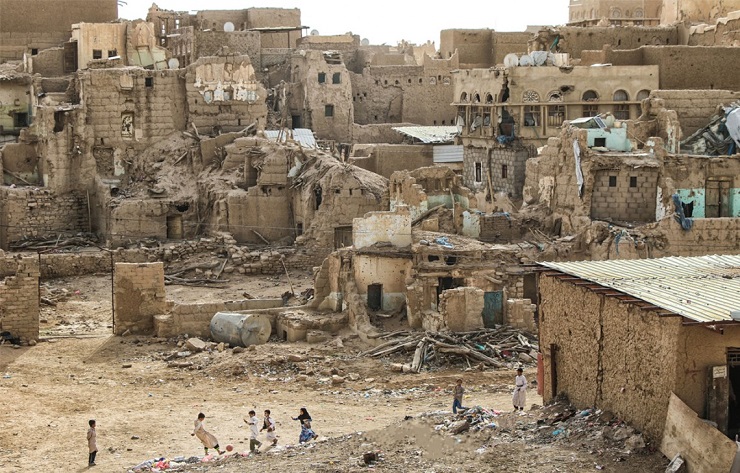
By Viktor Mikhin – New Eastern Outlook – 03.11.2021
UNICEF Spokesperson James Elder has just returned from Yemen with some tragic news about children living in what the United Nations calls the worst humanitarian crisis in the world.
Speaking at a press briefing in Geneva, he said: “The Yemen conflict has just hit another shameful milestone: 10,000 children have been killed or maimed since Saudi Arabia’s bombing campaign started in March 2015. That’s the equivalent of four children every day.” Elder told reporters that the estimates provided by the international UN agency were likely an understatement of the actual number of children killed and injured, which is rarely recorded by anyone. “These are of course the cases the UN was able to verify. Many more child deaths and injuries go unrecorded, to all but those children’s families.”
International experts have identified four significant dangers that have brought the country to the brink of humanitarian collapse. First of all, it is a brutal and protracted military conflict, and the blame for unleashing it lies entirely with the US and Saudi Arabia. Secondly, the colossal economic devastation that struck all regions of the country resulted from the military conflict. Also, there is a lack of infrastructure and social services, i.e., health, nutrition, water and sanitation, social protection, and education. Finally, the UN is critically underfunded.
It may be recalled that the war with Yemen began in March 2015, when Saudi Arabia brazenly and cynically launched a bombing campaign to restore the former regime, which obeyed orders from Riyadh, essentially maintaining Yemen’s status as a parallel and subordinate state to the Saudis. This had been the case before the popular revolution in the country, which triggered powerful Saudi airstrikes. The United States sold hundreds of billions of dollars worth of arms to the Kingdom during this war, in addition to intelligence and logistical support for Saudi military aircraft. Evidence shows that the UK is the second-largest supplier of arms to Riyadh, which is being actively used in an undeclared war, mostly against civilians. Other Western countries, including “democratic” France and Canada, have also profited enormously from this war, supplying the Saudis with mountains of offensive weapons.
These are the words and deeds of the so-called democratic West. Calling for democracy and freedom in their words, Western countries in reality supply arms and military equipment at every opportunity, thus fomenting military conflicts in which hundreds of thousands of people die in Yemen, Iraq, Syria, Afghanistan, and Libya. It makes one wonder where are the so-called international organizations which allegedly aim to prevent conflict and prosecute those who incite and encourage these bloody wars?
The United States, the skilled cheaters of double standards in politics and human rights, has once again manifested itself concerning Yemen. US Secretary of State Anthony Blinken has loudly reiterated that resolving the conflict in Yemen remains an alleged top priority of US foreign policy. These comments were made during a telephone conversation with the newly appointed United Nations Special Envoy for Yemen Hans Grundberg. And this was said at a time when the Pentagon was sending a new shipment of aerial bombs to Saudi Arabia, which the Saudis are actively using in their war against, as Riyadh says, “the fraternal Yemeni people.”
So far, only human rights groups have accused these countries of complicity in Saudi Arabia’s war crimes in Yemen. One investigation found that the bomb dropped from a Saudi warplane in August 2018, which hit a school bus and killed more than 40 children, came from the United States. But it was just one bomb, while Yemeni officials say most Saudi airstrikes have targeted residential areas, and all Saudi bombs and missiles are purchased abroad from “democratic” countries.
The head of the UN Children’s Agency also presented journalists with these grim figures on the suffering of Yemeni children, from malnutrition to education and sanitation. For example, he said: “Let me share a few more numbers: Four out of every five children need humanitarian assistance; that’s more than 11 million children, and 400,000 children suffer from severe acute malnutrition More than two million children are out of school. Another four million are at risk of dropping out. Two-thirds of teachers, more than 170,000, have not received a regular salary for more than four years. 1.7 million children are currently internally displaced because of violence. As the violence has intensified, especially in the Marib area, more and more families have fled their homes. A staggering 15 million people (more than half of them, about 8.5 million, are children) do not have access to safe water, sanitation or hygiene. With the current level of funding and without an end to the fighting, UNICEF will not be able to help all these children.” And he went on to predict a grim prognosis: “There is no other way to help them without a lot of international support, which will result in a large number of Yemeni children dying.”
But does it matter to the gentlemen in western capitals who make huge profits from the blood of Yemeni children and the supply of arms, which allows them to eat sweet and sleep well? It’s none of their business. As they usually say in the United States, it’s just business, nothing personal.
Despite the efforts of UNICEF and other international organizations, the severity of the humanitarian situation in Yemen cannot be overemphasized. The economy is in a critical state. GDP has fallen 40% since 2015 when neighboring Arab Saudi Arabia decided to punish Yemenis for their “disobedience.” Vast numbers of people lost their jobs, causing family incomes to plummet. About a quarter of people, including many health workers, teachers, engineers, and sanitation workers, rely on civil servants’ salaries that are paid irregularly, if at all. And while the displacement and destruction of schools have resulted in classrooms that can hold up to 200 children, teachers are showing up. Yes, unpaid teachers come in and teach on their enthusiasm to educate the next generation.
In addition to the Saudi-imposed war, with the US behind it, many Yemenis are starving not because there is no food but because there is not enough money to buy it. “But such people have no choice, which means they are forced to sell everything from jewelry to pots just to feed their own children,” writes Egypt’s Al-Ahram. “But their children continue to starve, as families end up selling off all their possessions and cannot buy simple food for themselves or their children.”
Economists believe that UNICEF alone urgently needs more than $235 million to continue its life-saving work in Yemen until mid-2022. Failure to do so will force the agency to reduce or terminate life-saving assistance to vulnerable children. “Funding is critical,” notes Al-Ahram. “We can draw a clear line between donor support and lives saved,” it adds. And perhaps the newspaper’s most emotional comment was the following: “Yemen is the most brutal place in the world to be a child. And, incredibly, it’s getting worse.”
Last month, the United Nations warned that 16 million Yemenis, more than half the population, are facing starvation. Unless the international community steps up support, food aid could soon dry up. Doctors warn that a staggering 99% of Yemenis have not been vaccinated against Covid-19. The country is now battling a third deadly wave of infections in which large numbers of people, especially children and the elderly, will die due to a lack of vaccines. How the West treats the suffering of Yemenis, who are direct co-conspirators in Saudi Arabia’s shameful war, was directly commented on by Yemen’s Al-Sahwa : “We need the promised vaccines, but it is also shameful that by buying up all the vaccines for themselves, rich countries like the UK and Germany are blocking all decisions to get the medicine we need into our country.”
Many countries worldwide are well aware of the plight of the Yemeni people, especially the children and elderly, and deplore the fact that Saudi Arabia still seeks a military solution to the Yemeni crisis, stating that this approach will lead to nothing but death and destruction. They have repeatedly called on Riyadh to abandon a military solution and instead seek political ways to end the devastating war in Yemen. Speaking at a briefing for journalists, Iranian Foreign Ministry spokesman Saeed Khatibzadeh said: “Unfortunately, the Saudi government is still looking for a military solution for Yemen, even though it knows and has understood after a long time that war has no other result than killing innocents and civilians, damaging the peoples of the region and security.” The sooner the Government of Saudi Arabia shows its commitment to political solutions and ends this destructive war, the better for the country and the region, as well as for the peace and security in the entire region.
Biden Approves $650 Million Missile Sale To Saudis After Earlier Vowing To End War In Yemen
By Tyler Durden | Zero Hedge | November 4, 2021
Despite the prior stated intent by the Biden White House to see an immediate end to the war in Yemen, the administration on Thursday announced that it’s approving a new $650 million sale of air-to-air missiles (AMRAAM) and related equipment to Saudi Arabia.
“The State Department has made a determination approving a possible Foreign Military Sale to the Kingdom of Saudi Arabia of AIM-120C Advanced Medium Range Air-to-Air Missiles (AMRAAM) and related equipment for an estimated cost of $650 million,” a Pentagon statement announced. Specifically it includes up to 280 air-to-air missiles.
What’s been described as the “forgotten war” in Yemen has raged since 2015, with for much of that period the Pentagon providing direct assistance to Saudi-UAE coalition airstrikes against Yemeni Houthi rebels backed by Iran. Prior US involvement in the Saudi-waged war grew increasingly controversial, given the high civilian death toll – amid a total estimated death toll of over 130,000 Yemenis killed.
Further the United Nations within the past two years has designated the conflict “the world’s worst humanitarian crisis.” Recall that back in February Biden earned bipartisan praise for the following foreign policy “promises”:
In his first major foreign policy address, President Joe Biden on Feb. 4 declared his commitment to “end the war in Yemen,” which he called a “humanitarian and strategic catastrophe.” The president announced that the US would stop assisting all “offensive operations” in that impoverished country and halt all “relevant arms sales” to the Saudi Arabia/UAE-led coalition that is waging war there.
In describing the rationale for the new massive weapons sale to the kingdom, the Thursday Biden administration statement characterized the ‘defensive’ nature of the systems:
We’ve seen an increase in cross-border attacks against Saudi Arabia over the past year. Saudi AIM-120C missiles, deployed from Saudi aircraft, have been instrumental in intercepting these attacks that also US forces at risk and over 70,000 US citizens in the Kingdom at risk.
There have been multiple missile and drone attacks launched out of Yemen over the past year, with the Iran-backed Houthis showing increased sophistication and reach.
Astoundingly, Pentagon also claimed that the Saudi kingdom is a “force for progress” in the Middle East: “This proposed sale will support US foreign policy and national security of the United States by helping to improve the security of a friendly country that continues to be an important force for political and economic progress in the Middle East,” it said.
Notably the weapons transfer will include medium-range missiles for Saudi fighter jets, which will likely directly aid in the continued Saudi bombing of Yemen as it continues to lay siege the country – further contributing to the humanitarian crisis of famine, disease, and lack of basic medicines.
Prior analysis we featured days ago described described that there’s currently a diplomatic push to get a ceasefire in place, and ultimately end the war. While this would get the Saudis out of the negative coverage of the war, the kingdom seems to be focused on what they can get out of the US for heading down this path.
So it appears the US administration is now seeking to justify its freshly approving the new missile deal by attempting it to link it to conditions that would end the war in Yemen. Though there doesn’t seem to be anything Riyadh has firmly or definitively agreed to just yet.
UK’s arms sales to Riyadh three times higher than previously thought

Press TV – July 15, 2021
A new investigation has revealed that Britain has exported around three times as much weaponry and military equipment to Saudi Arabia, which is leading a devastating military aggression against Yemen, than previously believed.
According to a report published by British online newspaper The Independent, the British government’s official figures state that British ministers have signed off 6.7 billion pounds (9.28 US dollars) worth of arms, such as bombs, missiles, and aircraft, to the oil-rich kingdom ever since it started its bombardment campaign of neighboring Yemen back in March 2015.
However, researchers say the actual figure is likely to be close to £20 billion (over $27 billion) because the official numbers do not entail sales carried out under an obscure “open license” system.
The investigation further casts doubts on allegations of the British government about having “one of the most robust and transparent export control regimes in the world.”
The probe emphasized that Britain’s operation of the parallel and less transparent “open license” system gives a more open-ended green light to arms manufacturers to sell specific armaments to a specific country without a monetary limit.
It further noted that the United Kingdom operated an open license for bombs and air-to-surface missiles to Saudi Arabia between 2014 and August 2019.
Moreover, an open license has covered Britain’s sales of equipment and components for use in the twin-engine and multi-role Eurofighter Typhoon jets to Saudi Arabia. The warplanes have been used in Saudi airstrikes across Yemen.
The researchers also examined the accounts of companies known to be selling arms to Saudi Arabia, and discovered that the revenues of British multinational arms producer BAE Systems, for instance, totaled nearly 17 billion pounds (23.5 US dollars).
As a result, they estimate that the real value of exports is close to £20 billion ($27 billion).
“The use of open licenses also offers the government a convenient sleight of hand when it comes under pressure over arms sales to a particular country due to events such as wars, military coups, or well-publicized human rights abuses,” the report warns.
Katie Fallon of Campaign Against Arms Trade, which conducted the research, stated, “The use of Open Licenses covers up the real extent of the UK arms trade and makes it impossible to know what quantities of weapons are being sold around the world.”
“UK-made fighter jets, bombs and missiles have had a devastating impact in the ongoing bombardment of Yemen. The fact that the real total of these sales could be so much higher than previously reported emphasizes the central role that the UK government and UK-based companies have played in the war. There must be full transparency about what arms have gone over and in what quantity,” Fallon added.
“So much of the arms industry takes place in secret, and that’s how the arms dealers like it. As long as the widespread use of Open Licenses continues, the true nature and volume of the UK arms trade will remain hidden from scrutiny, and therefore from meaningful control,” Fallon pointed out.
Saudi Arabia, backed by the US and its regional allies, launched the devastating war on Yemen in March 2015, with the goal of bringing the government of former Yemeni president Abd Rabbuh Mansur Hadi back to power and crushing the popular Ansarullah resistance movement.
Yemeni armed forces and allied Popular Committees have, however, gone from strength to strength against the Saudi-led invaders, and left Riyadh and its allies bogged down in the country.
The Saudi war has left hundreds of thousands of Yemenis dead, and displaced millions more. The war has also destroyed Yemen’s infrastructure and spread famine and infectious diseases across the Arab country.
Documents reveal US pressure on ex-Yemeni regime to agree on normalizing ties with Israel
Press TV – July 12, 2021
The interior ministry of Yemen’s National Salvation Government has released a series of confidential documents detailing the United States pressure on the administration of former Yemeni dictator, Ali Abdullah Saleh, to normalize relations with Israel and lift the blockade on products made in the Israeli occupied territories.
According to the documents, the US embassy in Sana’a had asked then-Yemeni authorities to end the economic embargo on Israeli goods, and not to participate in any activities deemed harmful to the Tel Aviv regime, the official Yemeni news agency Saba reported.
The papers expose the level of Washington’s and Tel Aviv’s discontent and frustration with the blockade, and how US officials left no stone unturned to force former Yemeni officials into opening the Arab country’s market to Israeli businesses and their products.
The former US ambassador to Yemen, Thomas C. Krajeski, called on Saleh’s regime to lift sanctions on companies with first-, second- or third-degree ties to Israel, which was not turned down by the Yemeni side.
Then-Yemeni foreign minister, Abu Bakr al-Qirbi, later told the US ambassador that the so-called embargo on US and Israeli goods was not actually being enforced.
The documents go on to reveal that the US embassy urged the Yemeni foreign ministry not to dispatch representatives to an anti-Israel event at the University of Damascus in Syria.
Moreover, the American diplomat described Yemen’s removal of boycott of Israeli products as the fundamental prerequisite for the Arab state’s membership in the World Trade Organization, and its access to free trade and international investment.
Last month, Spokesman for Yemen’s Armed Forces Brigadier General Yahya Saree announced that Yemeni security forces had arrested a man involved in espionage activities on behalf of Israel’s Mossad intelligence agency.
Saree said in a tweet at the time that more details on the matter will be provided in a documentary entitled “The Spy of Mossad in Yemen.”
The documentary will shed light on part of Israel’s intervention in the country and “the plan to target Yemen militarily, and other secrets revealed for the first time,” the senior Yemeni military figure pointed out.
The developments come as earlier reports said that Israel and the United Arab Emirates have been working to establish a spy base on Yemen’s strategically-located island of Socotra.
The UAE has also been accused of constructing an air base on the Mayyun Island, situated off the Yemeni coast in the Bab el-Mandeb.
Both activities have drawn strong condemnation from the Yemeni government, which has described them as violation of Yemen’s sovereignty and international law, especially following the illegally-run tours to Socotra from Abu Dhabi, some of which included Israeli tourists.
“The transfer of tourists to the Socotra Island reveals the plans and programs of the occupying UAE, which are in line with the Zionist schemes to dominate Yemeni islands as well as the steps towards normalization with the regime,” a statement read back then.
Yemen’s popular Ansaullah resistance movement has previously threatened to attack Israel if it was “involved in any action against Yemeni people.”
The Israeli regime took the threats seriously, and deployed its Iron Dome and Patriot missile systems around the southern city of Eilat early this year.
Yemenis slam US seizure of resistance website domains
By Abdullatif Al-washali | Press TV | June 24, 2021
Sana’a – The US Justice Department committed a new flagrant violation of the freedom of the press and blocked several regional outlets’ websites including the Yemeni channel al-Masirah and Iran’s Press TV claiming they are linked to what it calls Iranian disinformation efforts.
Yemenis condemned this move saying it proves that the US calls for freedom of speech are lies. Yemen’s Ministry of Information said the US government seizure of a few websites confirmed the strength of the media of the resistance and proved that these websites revealed the true face of the US including its participation in the brutal Saudi war on Yemen.
Ali al-Share’e the manager of al-Masirah website said this move revealed the weakness of the US even though it owns thousands of media outlets.
Experts believe that this step is part of a media war of the US government against the media outlets of the resistance. They said these attacks will persist and the resistance axis should be ready for further violations.
Yemenis say the freedom of speech is a fundamental right for all free people of the world and the United States has no right to deny individuals or communities this right. They believe that such attacks will promote the free media outlets to continue exposing the US policies.
Biden lied about Yemen
By Caitlin Johnstone | April 29, 2021
The Biden administration has finally admitted that the US is indeed providing offensive material support to Saudi Arabia’s genocidal assault on Yemen, directly contradicting Biden’s February claim that it would no longer be providing offensive support in that war. We are being lied to about yet another US war by yet another US president.
“The United States continues to provide maintenance support to Saudi Arabia’s Air Force given the critical role it plays in Saudi air defense and our longstanding security partnership,” Pentagon spokesperson Jessica McNulty has informed Vox reporter Alex Ward.
“Multiple US defense officials and experts acknowledged that, through a US government process, the Saudi government pays commercial contractors to maintain and service their aircraft, and those contractors keep Saudi warplanes in the air. What the Saudis do with those fighter jets, however, is up to them,” Ward reported, adding, “The US could cancel those contracts at any time, thus effectively grounding the Saudi Air Force, but doing so would risk losing Riyadh as a key regional partner.”
“The recent admission by the Department of Defense that US companies are still authorized to maintain Saudi warplanes … means that our government is still enabling the Saudi operations, including bombings and enforcing a blockade on Yemen’s ports,” Hassan El-Tayyab, the legislative manager for Middle East policy at the Friends Committee on National Legislation lobbying group, told Ward.
El-Tayyab is on record speaking out after Biden’s deceitful February announcement, saying this administration needs to make it abundantly clear what it actually means by ending offensive support for the war on Yemen and actually stick to it.
“I’m not a full pessimist here. I welcome the news,” he told Al Jazeera at the time, adding, “But I’m just trying to stay vigilant and not take the foot off the gas on advocacy pressure. Because we don’t know what’s going to happen.”
Well, now we do know. The US is maintaining and servicing the warplanes that are bombing Yemen and enforcing a blockade, which has killed hundreds of thousands and the United Nations warns could kill 400,000 more this year alone if conditions don’t change, proving Joe Biden a liar and vindicating the experts and activists who cautioned against accepting his announcement on blind faith.
Getting to this point where questions are finally answered about the reality of the Biden administration’s Yemen policy has been like pulling teeth, with officials giving questioners the runaround for months on this issue. Watch this clip of US Yemen Envoy Tim Lenderking dodging questions like George Bush dodges shoes as congressman Ted Lieu tries to get a straight answer as to whether the US has stopped supporting the war on Yemen:
Antiwar’s Dave DeCamp writes the following:
“The admission comes over two months since President Biden said he was ending support for Riyadh’s ‘offensive’ operations in Yemen. Vox reporter Alex Ward asked Pentagon spokesman John Kirby on Monday if the planes that the US is servicing could be used for offensive operations in Yemen. Kirby admitted that the ‘maintenance support for systems could be used for both’ offensive and defensive operations. … Besides continuing to maintain the Saudi Air Force, the Biden administration has given Riyadh the political cover to continue enforcing the blockade on Yemen. Biden officials have claimed that Yemen is not under a blockade, even though Saudi warships are preventing fuel shipments from docking in the port of Hudaydah, which makes it impossible to deliver food to Yemen’s starving civilian population.”
The United Nations conservatively estimates that some 233,000 Yemenis have been killed in the [Saudi-led] war … mostly from what it calls “indirect causes.” Those indirect causes would be disease and starvation resulting from what UN Secretary-General Antonio Guterres calls “the worst famine the world has seen for decades.”
When people hear the word “famine” they usually think of mass hunger caused by droughts or other naturally occurring phenomena, but in reality the starvation deaths we are seeing in Yemen (a huge percentage of which are children under the age of five) are caused by something that is no more natural than the starvation deaths you’d see in a medieval siege. They are the result of the Saudi coalition’s use of blockades and its deliberate targeting of farms, fishing boats, marketplaces, food storage sites, and cholera treatment centers with airstrikes aimed at making those parts [of the country, which are] controlled by Yemen’s Ansarullah movement so weak and miserable that they break.
The United States lies about all its wars with the help of the mass media, but up until this year its lies about Yemen have largely consisted of lies by omission: simply not talking about Yemen (like when MSNBC went an entire year without mentioning it a single time during the height of Russiagate hysteria), reporting on the famine as though it’s the result of a tragic natural disaster, or omitting America’s role in the slaughter. This time, it was just a straightforward lie: Biden said the US was ending offensive support, and it wasn’t.
As we’ve discussed previously, when the people demand something of their government it’s a lot easier to simply tell them you’re on their side and redirect them than to tell them no. Democrats are especially good at this.
As awareness grows that Yemen is the single most horrifying atrocity taking place in our world today, pressure is mounting for the US government to use its tremendous amount of leverage over Saudi Arabia to cease the human butchery. Rather than increasing that pressure by saying no, the Biden administration defused it by falsely pretending to give in to the demands. Because the risk of “losing Riyadh as a key regional partner” was deemed too great.
And meanwhile the slaughter continues, unbroken from Obama to Trump and from Trump to Biden. The names change, the narratives change, but the murderous imperial war machine rolls on uninterrupted.
Crashing Saudi Oil Economy Explains Urgent Yemeni Peace Offer
By Finian Cunningham | Strategic Culture Foundation | March 26, 2021
After six years of blowing up Yemen and blockading its southern neighbor, the Saudi rulers are now saying they are committed to finding peace. The move is less about genuine peace than economic survival for the oil kingdom.
The Saudi monarchy say they want “all guns to fall completely silent”. Washington, which has been a crucial enabler of the Saudi war on Yemen, has backed the latest “peace offer”. Secretary of State Antony Blinken this week endorsed the initiative from the Saudi rulers, saying he had spoken with them “on our work together to end the conflict in Yemen, facilitate humanitarian access and aid for the Yemeni people”.
The Saudi foreign ministry stated: “The initiative aims to end the human suffering of the brotherly Yemeni people, and affirms the kingdom’s support for efforts to reach a comprehensive political resolution.”
Can you believe this sickening duplicity from the Saudis and the Americans?
So, after six years of relentless aerial bombing in Yemen causing the world’s worst humanitarian crisis, according to the United Nations, the Saudis and their American military supplier, seem to have developed a conscience for peace and ending suffering.
The real reason for trying to end the conflict is the perilous state of the Saudi oil-dependent economy. Saudi Aramco, the state-owned oil, gas and petroleum industry, recently announced that its profits have slumped by nearly half in 2020 compared with the year before. Down from $88 billion to $49 billion.
Given that its oil economy provides nearly 90 per cent of state budget that is a stupendous hit on the Saudi finances. The Saudi rulers rely on hefty state subsidies to keep its 34 million population content. With income from the oil industry nosediving that means state deficits will explode to maintain public spending, or else risk social unrest from dire cutbacks.
Saudi Arabia remains the biggest oil exporter, but due to the Covid-19 pandemic and world economies going into recession crude oil prices have plummeted. At one point oil prices fell to around $20 a barrel. The Saudi economy needs an oil price of around $70 a barrel to reel in a profit.
The upshot is the Saudi war in Yemen has become a critical drain on state finances and potentially jeopardizing the superficial stability of the absolute monarchy.
Of further alarm is the increasing missile and drone attacks by the Houthi rebels in Yemen on key Saudi locations, including the capital Riyadh.
The Yemeni rebels are escalating airstrikes on Aramco installations at its headquarters in Dhahran and Dammam in Eastern Province, as well as in the cities of Abha, Azir, Jazan, and Ras Tanura. The targets include oil refineries and export terminals. The Saudis claim they have intercepted a lot of the missiles with U.S.-made Patriot defense systems. Nevertheless, the mere fact that the Yemenis can hit key parts of the Saudi oil economy over a distance of 1,000 kilometers is a grave security concern undermining investor confidence.
The first major strike was in September 2019 when Houthi drones hit the huge refinery complex at Abqaiq. That caused Saudi oil production to temporarily shut down by half. It also delayed an Initial Public Offering of Aramco shares on the stock market as investors took fright over political risk.
At a time when the Saudi oil economy is contracting severely due to worldwide circumstances, an additional debilitating threat is the intensifying campaign of Houthi airstrikes. They are taking the war into Saudi heartland.
The Biden administration has condemned the Houthi missile attacks on Saudi Arabia as “unacceptable”. Such American concern is derisory given how Washington has been providing warplanes, missiles and logistics for the Saudis to indiscriminately bomb Yemen causing tens of thousands of deaths. The Americans also enable the Saudis to impose a blockade on Yemen’s sea and airports, which has prevented vital food and medicines from being supplied to the country. Nearly 80 per cent of Yemen’s 30 million population are dependent on foreign aid deliveries. The blockade is a war crime, a crime against humanity, and the Americans are fully complicit.
President Joe Biden has said he is ending U.S. military support for Saudi Arabia’s war in Yemen. It was an election promise. However, it is not clear what military support the U.S. has actually stopped, if at all. The Saudi bombing of food depots continues and the blockade on the country could not be maintained without essential American logistics.
More cynically, the Biden administration realizes that the Saudis started a war back in March 2015, when Obama was president and Biden was vice-president, that has turned into an un-winnable quagmire whose horrendous human suffering has become a vile stain on America’s international image.
That’s why Biden and his diplomats have been urging the Saudi rulers to sue for peace. Now it seems the Saudi monarchy realizes that the reckless war launched by “defense minister” Crown Prince Mohammed bin Salman has come with a price that they can’t afford to sustain if they want to preserve their rickety house of cards, known as the House of Saud.
On the latest peace proposal, the Yemeni rebels have rejected it out of hand. They say it contains “nothing new”. The Houthis say the only way to end the war is for the Saudis and their American sponsors to end the aggression on their country. There is no “deal”. It is a case of the Saudis and the Americans just getting out.
Meantime, the airstrikes on Saudi oil infrastructure are going to continue with ever-increasing damage to the royal coffers. Thus, the Saudi rulers have no choice but to unconditionally surrender in this criminal war. They are facing a humiliating defeat as the Yemenis take revenge and Uncle Sam washes his hands of blood.
Featured Video

Trita Parsi: Israel Set a Trap for Total War in the Region
or go to
Aletho News Archives – Video-Images
From the Archive
Zionism’s Violent Legacy
By Donald Neff | Washington Report On Middle East Affairs | January 1996
On January 4, 1948, Jewish terrorists drove a truck loaded with explosives into the center of the all Arab city of Jaffa and detonated it, killing 26 and wounding around 100 Palestinian men, women and children.[1] The attack was the work of the Irgun Zvai Leumi – the “National Military Organization,” also known by the Hebrew letters Etzel – the largest Jewish terrorist group in Palestine. The Irgun was headed by Revisionist Zionist Menachem Begin and had been killing and maiming Arabs, Britons and even Jews for the previous ten years in its efforts to establish a Jewish state.
This terror campaign meant that at the core of Revisionist Zionism there existed a philosophical embrace of violence. … continue
Blog Roll
 Aletho News
- Trita Parsi: Israel Set a Trap for Total War in the Region
- Trump’s Iran war is on an Israeli leash
- Saudi oil boss issues global supply warning
- Riyadh Says Its Oil System Is Intact. The Numbers Say Otherwise.
- Trump and Netanyahu Want to “Finish the Job” on Iran
- US ‘one-sided dictation’ not Iran’s beliefs makes rational talks impossible: Baghaei
- Iran’s Next Strike May Not Explode. It Could Shut You Down /Col Doug Macgregor
- Iran: US political targets legitimate if assassinations return
- Iraq shuts key border crossing with Iran under US pressure: Report
- Undersea Internet cables could be targeted in retaliation for attacks on Iran: IRGC deputy chief
- If Americans Knew
- The Israel Lobby’s Changing Fortunes
- AIPAC has become such a political liability that it’s shifting to a more “nimble” approach to buying politicians
- At least 160 Israeli settler attacks in 2 weeks
- Will Gaza’s Ancient Christian Community Disappear Forever?
- Israel’s vision of regional security rests on keeping Arab states weak
- Heidi Levine recounts how Palestinian youths helped save her in settler attack
- DAILY UPDATE: Latest essential news on Palestine, Israel, & region
- Trump’s Intensifying Sabotage of the ICC, for Israel’s Sake
- Israeli military detain US and UK volunteers in West Bank including Democratic NY politician Brad Lander
- Americans at National Conservatism Conference held in Israel this year criticize Israel
- No Tricks Zone
- E-Cars Reduce CO2 Emissions By Only 41% Compared To Internal Combustion Engine Vehicles
- Predictions Made By Renowned Climate Professor Over Past Decades Have Been Proven To Be Poor
- New Study Suggests Large Regions Of The Pacific Ocean Have Been Cooling For The Last 80 Years
- Germany’s Green Energy Debacle: High Energy Costs Force Kahla Porzellan to Close After 182 Years!
- New Study: 50 Years Of The Most Aggressive ‘Net Zero’ Policies Can Only Affect The Global Climate By 0.03°C
- US September “Heat” Was No Record…Many Records Set Decades Ago
- Latest European Green Energy Debacle; Portugal’s Largest Flagship Solar Park Insolvent!
- Green Energy Debacle: German Expert Professor Fritz Vahrenholt Warns Of Severe Economic And Social Consequences
- Two More Paleo Reconstructions Affirm Meters-Higher Sea Levels Across Ireland, Brazil 7000-6000 Years Ago
- New Study: Earth And Venus Surface Warmth Largely Explained By Convection And Lapse Rate, Not CO2 Or Radiation

