Obama Administration Fails to Make Progress on Reforming US Drone Program
Sputnik — February 23, 2016
US President Barack Obama’s administration has failed to implement reforms regarding the controversial drone policy to make it more transparent, accountable and consistent with national security interests, according to a report by the US think tank Stimson Center published Tuesday.
“Little progress has been made during the past year and a half to enact reforms that establish a more sensible US drone policy consistent with America’s long-term security and economic interests. The lack of a clear drone policy risks leaving a legacy on drone use that is based on secrecy and a lack of accountability that undermines efforts to support the international rule of law,” the report reads.
In 2014, the Stimson Task Force, comprising senior military and intelligence officials, recommended public disclosure of targeted drone strikes, thorough review of past and present drone strikes and their effectiveness and detailed reports explaining the legal basis of the US lethal drone program, among other recommendations.
The proposals were later backed by UN experts, including the adviser to Special Rapporteur on extrajudicial killings, Sarah Knuckey.
The US military has increasingly relied on drones to conduct operations in Afghanistan, Pakistan, Libya, Syria and Iraq. Critics have slammed the practice for resulting in a significant number of civilian deaths and the destruction of infrastructure unrelated to terrorists.
Data collected by the Bureau of Investigative Journalism shows that US drone strikes have killed up to 1,000 civilians in Afghanistan, Pakistan, Somalia and Yemen over the past 10 years.
The Business of War: Saudi Defense Sales Help BAE Systems to Big Profit
Sputnik – 18.02.2016
While thousands have been killed and millions more injured and displaced as a result of fighting in the Middle East, British defense company BAE systems has seemingly cashed in on the conflict, posting a sharp rise in revenue due to the sale of products to Saudi Arabia.
BAE’s sales rose by 7.6 percent in the past year to US$25.7 billon (£17.9bn), while the company’s share price eclipsed earlier forecasts.The company, which specializes in selling aerial and naval military products, as well as munitions and warfare systems, recently announced job cuts and a scaling down of production due to a lack of demand.
However, the increase in fighting in Syria and Yemen has seemingly boosted demand and subsequently the company’s sales.
BAE confirmed it had increased aircraft deliveries to Saudi Arabia and struck a deal to supply the Gulf kingdom with 22 more “Hawk Advanced Jet Trainer” aircraft, along with additional ground equipment training aids.
Concerns Over Saudi Sales
The announcement of increased profits comes at a time of high debate about arms sales to Saudi Arabia, with many campaigners concerned about reports of alleged Saudi war crimes and breaches and international law associated with Riyadh’s bombing campaign against Houthi rebels in Yemen.
A number of international organizations have called for the British government to immediately suspend the sale of arms to Saudi Arabia and cancel revoke any licenses until a proper investigation into such claims is carried out.
The UK-based Campaign Against Arms Trade (CAAT) has initiated legal action against the government over the matter, arguing that the country’s continued sale of arms to Riyadh is in breach of international guidelines.A recent UN report found that 21 million people are in need of some sort aid in Yemen, with the country experiencing a “humanitarian catastrophe” as a result of the conflict, which has killed approximately 6,000 people, including 3,000 civilians, since March 2015.
CAAT spokesperson Andrew Smith told Sputnik the UK needed to review its policy in regards to exporting arms to Saudi Arabia if the humanitarian condition was to improve.
“The bombs have to stop and the best thing the UK can do would be to end all arms sales to Saudi Arabia. Since David Cameron took to office [in 2010] the UK has licensed £6.7 billion (US$9.6bn) worth of arms to Saudi Arabia and has given it huge support on the world stage.”
UK Profiting From Conflict
The UK has been accused of cashing in on the conflict, with government statistics revealing British military sales to Saudi Arabia increased dramatically following Riyadh’s March 2015 announcement that it would be undertaking an aerial campaign against Houthi rebels.
After Riyadh announced it would be leading an international military coalition in the country, the value of Britain’s military sales to the Gulf kingdom surged from US$151 million (£107m) in the first quarter of 2015 (January-March) to US$2.4 billion (£1.7bn) in the second quarter (April-June).
This 16-fold increase was followed up by another US$1.6 billion (£1.1bn) worth of military sales to Saudi Arabia from July to the end of September as the coalition continued to attack targets in Yemen.
UN ‘conservative estimates’ show 700 children among 6,000 Yemen fatalities
RT | February 17, 2016
The UN will launch a humanitarian drive to raise some $1.8 billion required to save millions of people from humanitarian catastrophe in Yemen, where over 6,000 people have been killed since the Saudi-led coalition intervention in March 2015.
In a briefing to the 15-nation United Nations Security Council, Stephen O’Brien, the UN Under-Secretary-General for Humanitarian Affairs, announced that on Thursday the Yemen Humanitarian Response Plan will be launched in Geneva.
The plan aims to raise $1.8 billion to cover the “most critical and prioritized needs” that includes food for nearly nine million people. The money will also be used for water and sanitation for some 7.4 million people and medical treatment for 10.6 million people.
Highlighting the urgent need for the Security Council to take greater measures to protect civilians, O’Brien said that the UN should insure that people have a chance to survive.
“Some 2.7 million people have had to flee their homes. At least 7.6 million people are severely food insecure. Some two million acutely malnourished children and pregnant or lactating women need urgent treatment,” he told the UNSC.
He noted that since the escalation of the conflict in March 2015 which has involved Saudi-led bombings, over 6, 000 people have been killed.
“More than 35,000 casualties, including over 6,000 deaths, have been reported by health facilities across the country,” since last March, O’Brien said, adding that UN has confirmed that out of that number, 2,997 were civilians deaths, in addition to 5,659 that were injured as the result of the hostilities.
Of great concern to the UN is the fate of the children in the conflict. O’Brien said that “conservative estimates” suggest that over 700 children have been killed and over 1,000 more injured. He also noted that as many as 720 children have been documented as having been forcibly recruited as child soldiers by the warring parties. The diplomat also noted that some 1,170 schools have been closed leaving some 3.4 million minors out of education.
The destruction or closure of health facilities, which totals some 600 since March, has also left some 14 million Yeminis in desperate need of medical attention.
Noting that on Sunday Saudi-led coalition airstrike struck a building 200 meters away from UN and diplomatic personnel facility, he urged all parties in Yemen to protect civilians.
“The parties to the conflict have a duty of care in the conduct of military operations to protect all civilian persons and objects, including humanitarian and health care workers and facilities, against attack,” Mr. O’Brien said, reminding all parties of their obligations under international humanitarian law to “facilitate humanitarian access to all areas of Yemen,” he said.
At the same time, O’Brien noted that for the past two weeks Saudi Arabia has continued to impede the work of UN staff in the country, “causing delays to important missions.” The diplomat said that Riyadh is also blocking sea access to Yemen’s ports, and is preventing aid from traveling around the country,
“Access to northern Governorates where needs are among the most severe in the country also continue to be challenging due to relentless conflict, including airstrikes – in particular to communities along the border with Saudi Arabia where conflict is intense,” O’Brien noted.
Tensions in Yemen escalated after Shia President Saleh was deposed in 2012 and his Houthi supporters, reportedly aided by Iran, eventually seized the capital city Sana’a last year. Houthi forces then advanced from Sana’a towards the south, seizing large parts of Yemen, and sending the current Sunni President Abd-Rabbu Mansour Hadi into exile.
In late March, a Saudi Arabian-led coalition responded with airstrikes in order to stop Houthi advances and reinstate Hadi back in power. By late summer, the Saudi-led forces had started a ground operation, which so far is stuck in a stalemate.
UN initiative to protect schools in war zones vetoed by Britain
RT | February 9, 2016
Britain has refused to sign up to a UN agreement on protecting schools in wartime, which has been signed by 51 states, despite the fact it was drawn up by a former UK military officer.
The agreement was championed by the UN children’s fund UNICEF to protect schools from attack during conflicts. It aimed to set out a “safe schools declaration” and provide guidelines for military forces.
However, it was reported on Tuesday by the Telegraph newspaper that Foreign Secretary Phillip Hammond had effectively vetoed the move after having opposed it as head of two government departments.
Already signed by 51 nations, the initiative was developed in response to deadly attacks on schools in Syria and Yemen.
In a statement on Monday, Amnesty International senior crisis advisor Lama Fakih reported how schools were being targeted with deadly effect in Yemen, where a Sunni/Shia proxy war is currently being fought with Saudi and Iranian backing.
“The Saudi Arabia-led coalition launched a series of unlawful airstrikes on schools being used for educational – not for military – purposes, a flagrant violation of the laws of war,” she wrote.
“Schools are central to civilian life, they are meant to offer a safe space for children. Yemen’s young school pupils are being forced to pay the price for these attacks,” she added.
It was hoped Britain would be a leading voice in the campaign to protect schoolchildren and schools after the high-profile campaign against sexual violence in warzones led by Phillip Hammond’s predecessor William Hague and movie star Angelina Jolie.
But Britain, like the other permanent members of the UN Security Council, did not sign up.
It is rumored that the Ministry of Defence (MoD) and Foreign Office have been put off by fears of litigation given the volume of cases brought against the military for alleged crimes in the Iraq and Afghan occupations.
Initially it appears that of the three government departments whose support was needed only the MoD – then under Hammond – was resisting, while the Department for International Development (DFID) and Hague’s Foreign Office were supportive.
Hammond’s subsequent shift from defense to the Foreign Office is felt to have poisoned both the military and diplomatic ministries against the initiative, despite the fact the agreement was drawn up by a former British naval officer.
Steven Haines, who drew up the British military rulebook for the 2003 Iraq invasion, is now a professor of international law at the University of Greenwich.
He told the Telegraph of his disappointment at the government’s response to his proposals.
“The stumbling block was Philip Hammond at Defence,” he said.
“It’s very frustrating.
“There’s no way that I was going to draft something that would embarrass the British government.”
The declaration, which was launched in Norway in 2015, commits governments to six guidelines including one which prevents military forces for using from using active schools as military bases.
It was thought that if Britain signed up then its role as a trainer of foreign troops would help to engender respect for schools and schoolchildren among military forces globally.
A Foreign Office spokesman defended the move, telling the paper that while they “support the spirit of the initiative, we have concerns that the Guidelines do not mirror the exact language and content of International Humanitarian Law.
“Therefore the UK, along with several other countries, was not able to sign the Safe Schools Declaration in Oslo in May 2015,” the spokesman said.
Britain’s concern about future legal cases may spring from its controversial military support for regional ally Saudi Arabia in the Gulf theocracy’s war in Yemen.
That support has included both material backing, in the form of weapons and munitions traded by UK arms firms subject to government license, and the presence of British military personnel as advisors to the Saudi military.
The UK government maintains the military advisors are present in Saudi headquarters to ensure international law is followed.
CIA covert ops needs Saudi money: decades story recurring
American Herald Tribune | January 30, 2016
For decades, America’s Central Intelligence Agency (CIA) has been relying on its partner’s money in discrete and covert operations; the money of the Saudi oil-rich kingdom.
Citing several current and former US officials, the New York Times reported on Jan. 23 that from the very beginning of the US operations against the Assad government in Syria, Saudi money was largely the supporter.
The most recent example of this ‘close bond’ between the US and Saudi Arabia has came to light in the New York Times article, which reported that US President Barack Obama knew well the US could rely on Saudi money when, in 2013, he secretly gave the CIA the green light to arm militant groups in Syria that were fighting against President Bashar al-Assad’s government.
Code-named Timber Sycamore, the deal stipulates that the Saudis contribute both weapons and large sums of money and the CIA takes the lead in training the rebels on AK-47 assault rifles and tank-destroying missiles.
In 2012, the US repeatedly claimed that the Timber Sycamore program was designed to deliver what it claimed to be ‘non-lethal’ aid, yet months later, Obama gave his approval for the CIA to begin directly arming and training the rebels from a base in Jordan, amending the Timber Sycamore program to allow lethal assistance.
Also, the NY Times report noticeably underlines that such a long intelligence relationship helps explain why the United States has been reluctant to openly criticize Saudi Arabia for its human rights abuses, its treatment of women and its support for the extreme ideology Wahhabism, that has inspired many of the very terrorist groups.
In the latest violation which brought uproar across the Muslim world in particular, Saudi Arabia executed a prominent Shia cleric, Sheikh Nimr al-Nimr, for challenging the oppression of the royal family and demanding human rights, yet the Obama administration did not publically condemn the action. Also, another form of Saudi human rights abuses to which the US has had no clear condemnation is its war on Yemen that has so far claimed the lives of more than 8,270 people including women and children.
The CIA covert operations in Syria began in 2013, in which more than 10,000 Wahhabi terrorists were armed, funded and trained. The trainings were taking place inside Jordan’s territories, and estimates have put the total cost of the ops at several billion dollars.
“They understand that they have to have us, and we understand that we have to have them,” said Mike Rogers, the former Republican congressman who was chairman of the House Intelligence Committee when the CIA operation began.
The operation was described as part of the so-called “counterterrorism” program. On this note, a former State Department counterterrorism adviser and the author of a book on the Islamic State, William McCants points out “The more that the argument becomes, ‘We need them as a counterterrorism partner,’ the less persuasive it is. If this is purely a conversation about counterterrorism cooperation, and if the Saudis are a big part of the problem in creating terrorism in the first place, then how persuasive of an argument is it?”
Even though the biggest contributor was Saudi Arabia, yet its allies also had their share in the game. According to the NY Times, when Obama signed off on arming the rebels in the spring of 2013, the Qataris, Turkish and Saudis had been funneling weapons into Syria for more than a year. The Qataris had even smuggled in shipments of Chinese-made FN-6 shoulder-fired missiles over the border from Turkey.
MORE…
Britain’s ‘proxy war’ in Yemen condemned by critics
RT | January 28, 2016
Britain is at war in Yemen and is arming and facilitating a brutal Saudi dictatorship that is bombing innocent civilians, a growing chorus of critics has warned.
The allegation that Britain is engaged in covert warfare in Yemen was first made by Scottish National Party (SNP) Westminster leader Angus Robertson during a heated discussion in Parliament on Monday. However, it has since been echoed by political commentators and human rights campaigners, who are demanding the government come clean on the role of UK forces in the Saudi-led campaign.
The conflict in Yemen consists of a range of regional, local and international power struggles emanating from historical and recent events. As scrutiny of Britain’s involvement in the war intensifies, campaigners and commentators insist that the UK is intervening in the conflict. They argue that Britain’s arming of the Saudi-led coalition and provision of advice to Saudi military personnel amounts to proxy warfare.
‘Reckless conduct’
Britain’s arms sales to Saudi Arabia totaled £2.95 billion (US$4.23 billion) for the first nine months of 2015, and roughly £7 billion since Prime Minister David Cameron took office in 2010. Amid mounting concerns that UK-made weapons have been used to bomb schools, hospitals, markets and other civilian targets in Yemen, Cameron has been urged to suspend all arms sales to Saudi Arabia.
Labour Party leader Jeremy Corbyn and Shadow Foreign Secretary Hilary Benn sent a letter to the PM on Wednesday demanding transparency on Britain’s involvement, after a leaked version of a UN panel’s report concluded attacks on Yemeni civilians had been “widespread and systemic.”
The 51-page report, which was obtained by the Guardian, examined 199 missions conducted by the Saudi-led coalition that violated international law.
Many of the attacks involved repeated airstrikes on civilian objects, including refugee camps; civilian gatherings such as weddings; civilian vehicles such as buses; residential areas; medical facilities; schools; mosques; markets, factories and essential civilian infrastructure. Three cases of civilians being pursued and shot at by aircraft as they fled residential bombings were also recorded.
UK director of Human Rights Watch said the findings of the UN report “flatly contradict” UK ministers’ rhetoric about the Saudi-led coalition’s actions in Yemen.
“For almost a year, [Foreign Secretary] Philip Hammond has made the false and misleading claim that there is no evidence of law or war violations by the UK’s Saudi ally and other members of the coalition,” he told the Guardian.
Amnesty International UK’s head of policy and government affairs Allan Hogarth expressed disgust at the government’s attempt to downplay concerns over Saudi Arabia’s conduct in Yemen.
“Thousands of civilians have already died and it’s been utterly dismaying to see Downing Street brushing aside extremely serious concerns about the reckless conduct of Saudi Arabia in this devastating conflict,” he said.
Conflict in Yemen
Saudi Arabia revealed earlier this month that British and American forces are stationed in the control center from which military operations against Yemen are being directed. However, the Ministry of Defence (MoD) has refused to disclose how many British personnel are involved.
The department also insists Britain’s involvement is confined to advice and training geared at ensuring Saudi Arabia complies with international law.
Yemen’s civil war kicked off in 2014, after Zaidi Shiite-led Houthi rebels overran the capital, Sanaa. The rebels, who had been targeted in six separate wars by Yemen’s central government, were loyal to Yemen’s former President Ali Abdullah Saleh.
During the Arab spring in 2011, the Houthis had gained control of Yemen’s Saada province. However, it wasn’t until September 2014 that they conquered Sanaa. The Shiite-led rebels subsequently forced President Hadi to resign in January 2015, and seized control of swaths of southern Yemen.
The following March, a Saudi-led coalition of states launched airstrikes against the Houthis in a bid to retake Yemen. Sometime later, a Saudi-led ground operation also began. By August 2015, the Houthis had been pushed back by resistance fighters supported by the Saudi-led coalition.
As the conflict rolls onward and civilian fatalities continue to mount, criticism of Britain’s role in the Saudi-led military campaign is growing ever stronger.
Saudi war on Yemen violates humanitarian law: UN panel
Press TV – January 27, 2016
A UN panel of experts says Saudi Arabia’s months-long war on impoverished Yemen has violated the humanitarian law as many of the airstrikes have been carried out on civilian targets.
The UN experts have called on the UN Security Council to “investigate reports of violations of international humanitarian law and human rights law in Yemen by all parties and to identify the perpetrators of such violations,” AFP reported on Tuesday.
The report added that Saudi warplanes had carried out 120 sorties, involving documented airstrikes on refugee camps, weddings, buses, medical facilities, residential areas, mosques, markets, factories, food warehouses, schools and airports.
“Many attacks involved multiple air strikes on multiple civilian objects,” the report further said, adding that “civilians are disproportionately affected” by the unabated aerial aggression. It also denounced Riyadh’s crippling blockade on Yemen, which constitutes “the prohibited use of starvation as a method of warfare.”
Saudi Arabia began its military aggression against Yemen in late March last year. The strikes are supposedly meant to undermine the Ansarullah movement and restore power to the fugitive former president, Abd Rabbuh Mansur Hadi.
Some 8,300 people have been killed and over 16,000 others injured since the strikes began. The Saudi war has also taken a heavy toll on Yemen’s infrastructure.
Yemenis have been carrying out retaliatory attacks on the Saudi forces deployed in the country as well as targets inside Saudi Arabia.
Citing Terrorism Concerns, John Kerry Supports Saudi Bloodbath in Yemen
Sputnik – 25.01.2016
US Secretary of State John Kerry has expressed his support for Saudi Arabia’s military campaign in Yemen, a conflict that has killed over 2,400 civilians. As justification, the secretary reiterated false claims that Riyadh is battling al-Qaeda.
Over the weekend, the White House stated its concern over the rising civilian death toll in the Yemen conflict.
“We are deeply concerned about recent reports of escalating violence in Yemen and resulting deaths of civilians…” White House National Security Council spokesperson Ned Price said in statement on Saturday.
But while the Obama administration is ostensibly worried about the amount of violence, it also fully supports the Saudi campaign that is creating the chaos. One day after the release of Price’s statement, US Secretary of State John Kerry reiterated his full support for Riyadh’s actions.
“Let me assure everybody that the relationship between the United States and the GCC nations ([Persian] Gulf Cooperation Council) is one that is built on mutual interest, on mutual defense and I think there is no doubt whatsoever in the minds of the countries that make up the GCC that the United States will stand with them against any external threat,” Kerry told reporters.
Kerry claimed that the war was necessary since it is partially aimed at targeting “al-Qaeda operatives.” Those motivations are highly suspect, however, given that Riyadh failed to go after al-Qaeda in the Arabian Peninsula (AQAP) during the first nine months of fighting.
In April, the Saudi government also looked the other way as AQAP seized the port city of al Mukalla. By gaining control of the central bank, the terrorist group gained over $17 billion from the city’s capture.
In addition, Kerry cited the need to combat Iranian “interference.”
“The United States remains concerned about some of the activities that Iran is engaged in other countries,” he told reporters.
Riyadh has provided little evidence to suggest that Tehran is providing any assistance to Houthi rebels in Yemen.
Riyadh’s intervention began last March, and the Saudi naval blockade of Yemen has left approximately 1 million people internally displaced, and as many as 20 million people in need of food, water, and medical supplies.
The United Nations estimates that as many as 2,400 Yemeni civilians have been killed by coalition bombing. Most airstrikes have utilized cluster munitions sold by the United States. Worth an estimated $1.2 billion, this could partially explain Kerry’s support, but it also implicates Washington in Yemen’s civilian deaths.
“We should be culpable for the crime of killing civilians as well, as we produce and sell the weapons when we know the use they will be put to,” retired US Army Major Todd Pierce told Sputnik.
“Our indivisibility with our ‘allies’ inculpates us in their crimes…”
Featured Video
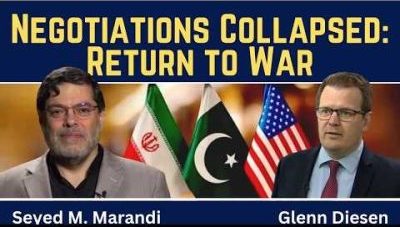
Seyed M. Marandi: Negotiations Collapsed – Return to War
or go to
Aletho News Archives – Video-Images
From the Archives
The US-Iran Scenario That Most Scares Israel
By Ali Haydar | Al-Akhbar | October 9, 2013
Israeli Prime Minister Benjamin Netanyahu issued a series of threats toward Iran and its interlocutors in the West, including the US, as serious negotiations on Iran’s nuclear program seem more plausible.
As a possible rapprochement looms between the US and Iran, Netanyahu has attempted to impose impossible Israeli conditions on the negotiators, such as the full dismantling of Iran’s nuclear program, not to mention threatening military force.
Whatever the deal that could materialize between Iran and the West, Israel is going to find itself before an open-ended path. One can foresee three possible scenarios… continue
Blog Roll
 Aletho News
- Most Israelis oppose Iran ceasefire, reject talks: Poll
- Iran to charge ships from ‘hostile’ nations to cross Hormuz – security chief
- UK, Spain reject Trump’s new scheme to blockade Hormuz Strait
- Russian frigate ‘resurfaces’, chases off NATO pirates days after Kiev ‘sank’ it
- Ukraine Targets Russian Merchant Fleet With NATO Intel Support – Presidential Aide
- Russia’s ‘shadow fleet’ makes mockery of UK naval power
- Ukraine plans to attack Russian ships with Norwegian support
- US’s ‘Very Foolish’ Double Blockade of Hormuz Strait Makes Absolutely No Sense: Here’s Why
- China issues rules on countermeasures against foreign states’ unlawful extraterritorial jurisdiction
- Seyed M. Marandi: Negotiations Collapsed – Return to War
- If Americans Knew
- Israeli prison authorities are blocking hundreds of solidarity postcards being sent to female Palestinian prisoners
- ‘I wished for death’: Sexual violence in Israel’s prisons is an ‘organized state policy’
- Israeli army shoots, kills 9-year-old girl in her Gaza classroom
- Israel is attacking Lebanon to sabotage the Iran ceasefire, but the media is hiding its true motivation
- Israel’s restriction of aid into Gaza leads to critical shortages in bread, baby formula, and water
- Critical shortages in Gaza, Lebanon in ruins, “piracy” in Iran – Daily Update
- US-Iran ceasefire negotiations make zero progress – Daily Update
- Pro-Israel ‘Thinktanks’ and Individuals who Influence U.S. Foreign Policy
- Mearsheimer reveals how Israel dictates US policies on Iran, Gaza – video
- After killing 350+, Israel still has a “score to settle” with Lebanon before ceasefire – Daily Update
- No Tricks Zone
- Cave Discovery Reveals Today’s Desert Climates Were Recently Far Warmer, Wetter, Teeming With Life
- German Expert: Heat Dome Led To Record Temps In Western USA…Warmer In 1934, 1936
- New Study: No Linear Warming Or Glacier Retreat Along Northern Antarctic Peninsula Since 1980s
- An Inconvenient Tree: Uncovered In Alps… Europe Much Warmer Than Today 6000 Years Ago
- New Study Reports A 60% Slowdown In Greenland’s Ice Loss Rate In The Last Decade
- Low Intensity Tornado Wrecks Major Solar Farm, Creating A Potential Toxic Dump
- New Study Finds Warming Saves Lives…Cold Temperatures 12 Times More Deadly Than Excess Heat
- German Science Blog Accuses PIK Climate Institute Of Hallucinating Climate Tipping Points
- Devastating Assessment Of Comirnaty Vaccine By Former Senior Pfizer Europe Toxicologist
- New Study: CO2 Is ‘Effectively Negligible’ As An Explanatory Climate Change Factor Since 2000
 Aletho News