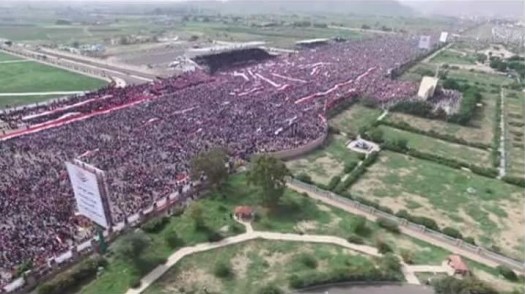
The UN-brokered peace talks between Yemen’s warring sides have ended in Switzerland without any agreement to end the Saudi aggression against the impoverished country, a member of the delegation representing Yemen’s fugitive former president says.
The negotiations will resume in Ethiopia on January 14, representatives of Abd Rabbuh Mansour Hadi said after the talks ended on Sunday.
This came only hours after the United Nations office in Geneva said in a statement that the talks between a delegation representing the Houthi Ansarullah movement and Hadi’s representatives ended. Hadi is supported by Saudi Arabia through a deadly air campaign against the Houthis and Yemeni people.
UN Special Envoy for Yemen Ismail Ould Cheikh Ahmed is expected to hold a press conference on the negotiations later on Sunday.
The UN-brokered negotiations began in the Swiss village of Magglingen on December 15 with the aim of reaching a permanent ceasefire in Yemen.
On Saturday, the two sides agreed to form a committee to oversee a fragile seven-day truce that came into effect on December 15 and has been violated several times.
Yemen has been under military attacks by Saudi Arabia since late March. More than 7,500 people have been killed and over 14,000 others injured since March. The strikes have also taken a heavy toll on the impoverished country’s facilities and infrastructure, destroying many hospitals, schools and factories.
The Saudi attacks were supposed to stop under a ceasefire which went into effect hours before the talks in Switzerland began; however, the raids have continued after the truce with reports of fatalities.
Saudi aggression
Also on Sunday, five Yemeni women were killed in a fresh Saudi airstrike in Sa’ada province.
Saudi warplanes bombed a residential area in al-Kitaf town, al-Masirah satellite television said.
This is the second Saudi bombing of the region in the past 48 hours. In an attack on Friday, 15 people had been killed.
Earlier on Sunday, Saudi jets also targeted a firm in a village in Bani Matar town in Sana’a province. Saudi jets also bombed a post office there.
A mosque and a bus station were also bombed in al-Hudaydah province.
The Sunday attacks were the latest violation of a seven-day ceasefire that came into force after UN-brokered talks opened in Switzerland between Yemen’s warring sides on December 15.
On December 17, head of Ansarullah Political Council Saleh Ali al-Sammad said in a statement that Riyadh had intensified its bombing of Yemen, taking advantage of the truce.
In return, Ansarullah fighters and allied army units killed about 150 Saudi-led troops in two ballistic missile attacks on Saturday.
The first attack hit a military base in Ma’rib province that also destroyed eight Apache helicopters, a drones’ command center, two Chinook airplanes as well as a number of tanks and military vehicles.
The second attack targeted a gathering of Saudi forces in al-Tawal border crossing, which links Yemen’s northwestern province of Hajjah to Saudi’s southwestern province of Jizan.
December 20, 2015
Posted by aletho |
Militarism, War Crimes | Saudi Arabia, Yemen |
Leave a comment
Human rights activists fear British military personnel could be embedded with Saudi Arabian allies who are bombing Yemen after receiving opaque responses from the Ministry of Defence (MoD).
Concerns have been raised by the charity Reprieve, which is best known for its work on post 9/11 torture and rendition, after the MoD published figures detailing the number of UK military personnel embedded around the world.
The war in Yemen, between Shia Houthi rebels and Saudi-backed forces, is not one the UK is officially involved in. However, the theocratic Saudi kingdom is a close regional ally of Britain.
Thousands have been killed, tens of thousands injured and up to 2.5 million displaced, according to some reports.
While most of those embedded personnel are in easily identifiable locations – such as in the US, Canada, NATO and the EU member states – nearly 100 personnel are assigned to cryptically titled ‘Coalition HQs’.
Responding to the revelations that 94 members of the UK armed forces are carrying out duties for unknown forces, Jennifer Gibson, a staff attorney at Reprieve, said in a statement: “This is a long way from real transparency. It is impossible to tell what operations or even what countries these personnel are active in, making this information almost worthless.”
Gibson said the terms used were “hopelessly vague” and asked “what, for example, are the ‘coalition HQs’ where nearly 100 UK personnel are based?”
“Is this the highly-controversial Saudi-led coalition in Yemen, the long-standing coalition in Afghanistan, the coalition in Iraq and Syria, or another we don’t know about?”
Gibson said the UK is entitled to use military force, but that “parliament and the public deserve to know at the very least which wars we are sending our troops into and under whose command.”
It emerged in July that UK aircrews embedded with foreign air forces – allegedly the US and Canadian militaries – had been carrying out combat missions over Syria.
This was despite there being no parliamentary authority for such actions. A vote on bombing targets within Syria has since passed early in December.
In a statement released with the figures on the MoD website, Defence Secretary Michael Fallon said: “Embeds [sic] play an important role in enhancing our national security interests around the world, strengthening our relationships with key allies and developing our own capabilities.
“For operational and personal security reasons the information that can be routinely released is limited,” he added.
December 18, 2015
Posted by aletho |
Aletho News | Saudi Arabia, Syria, UK, Yemen |
Leave a comment
More than a dozen civilians have lost their lives in a string of new Saudi airstrikes against various areas across Yemen.
Saudi warplanes on Friday struck a residential neighborhood in the al-Kitaf district of Sa’ada some 240 kilometers (150 miles) north of Sana’a, leaving 15 people dead, the al-Masirah satellite television reported.
Two people were injured when Saudi military aircraft dropped cluster bombs on the Maran district of the same arid and mountainous province.
Meanwhile, militiamen loyal to fugitive former Yemeni President Abd Rabbuh Mansur Hadi have reportedly wrested control over the Harad district of Yemen’s northwestern province of Hajjah.
The militiamen, who were trained and equipped in Saudi Arabia, crossed the border from the kingdom on Friday following fierce clashes with Yemeni army and allied forces and attacked the district.
Saudi warplanes also carried out four aerial assaults against the Baqim district in Sa’ada Province, but there were no immediate reports of casualties and the extent of damage. Additionally, Saudi jets fired a number of missiles into the Zahir district of the northwestern Yemeni province, with no reports of possible casualties.
Separately, Yemeni army soldiers backed by allied fighters from Popular Committees fired a Qaher-1 (Conqueror-1) ballistic missile at a military base in Saudi Arabia’s southwestern border region of Najran.
Yemeni forces also launched an OTR-21 Tochka ballistic missile at the Tadawil camp, housing Saudi-led military forces, in Yemen’s central province of Ma’rib.
Also on Friday, two Saudi soldiers were killed when Yemeni army soldiers and fighters from Popular Committees launched an operation in the Harad district. An M1 Abrams battle tank was also destroyed in the process.
Elsewhere in Yemen’s southwestern province of Ta’izz, Yemeni forces killed four members of the US Blackwater Worldwide security services company. The slain mercenaries were reportedly of Italian, South African, Rwandan and Pakistani nationalities.
Yemen has been under military attack by Saudi Arabia since late March. The Saudi military strikes were launched to supposedly undermine the Ansarullah movement and bring Hadi back to power.
More than 7,500 people have been killed and over 14,000 others injured since March. The strikes have also taken a heavy toll on the impoverished country’s facilities and infrastructure, destroying many hospitals, schools, and factories.
December 18, 2015
Posted by aletho |
Illegal Occupation, War Crimes | Saudi Arabia, Yemen |
Leave a comment
The establishment so wants everyone else to unfriend Trump supporters on Facebook. There’s even an app to block them. That’ll teach them!
Yes, Trump plays a bully boy and is appealing to populist (good), nativist, xenophobic, racist sentiments (bad). Those things need to be meaningfully addressed and engaged rather than dismissed by self-styled sophisticates, noses raised.
Focusing on the negative aspects of his campaign has blinded people to the good — and I don’t mean good like, oh, the Democrat can beat this guy. I mean good like it’s good that some of these issues are getting aired.
Trump is appealing to nativist sentiments, but those same sentiments are skeptical of the militarized role of the U.S. in the world — as was the case of Pat Buchanan’s 1992 campaign.
The New York Times recently purported to grade the veracity of presidential candidates. Of course by their accounting, Trump was off the scales lying. But he recently said the Obama administration and Hillary Clinton as Secretary of State “killed hundreds of thousands of people with her stupidity…. The Middle East is a total disaster under her.” Now, I think that’s pretty accurate, though U.S. policy in my view may be more Machiavellian than stupid, but the remark is a breath of fresh air on the national stage.
But I’ve not seen anyone fact check that, because that’s not an argument much of establishment media wants to have. Of course, a few sentences later Trump talks about the attack on the CIA station in Benghazi, causing Salon to dismiss him as embracing “conspiracies,” which is likely all many people hear.
Shouldn’t someone who at times articulates truly inconvenient truths be noted as breaking politically correct taboos? Trump says such truths — like at the Las Vegas debate about U.S. wars:
We’ve spent $4 trillion trying to topple various people that frankly, if they were there and if we could’ve spent that $4 trillion in the United States to fix our roads, our bridges, and all of the other problems; our airports and all of the other problems we’ve had, we would’ve been a lot better off. I can tell you that right now.
Which I think is a stronger critique of military spending than we’ve heard from Bernie Sanders of late.
But Trump — or Rand Paul’s — remarks about U.S. policies of regime change and bombings are often unexamined. It’s more convenient to focus on our kindness in letting a few thousand refugees in than to examine how millions of displaced people from Syria, Iraq, Afghanistan, Pakistan, Yemen, Somali might have gotten that way because of U.S. government policies.
People say Trump’s proposal to temporarily ban Muslim immigrants is unconstitutional. News flash: the sitting Democratic president has bombed seven countries without a declaration of war. We’ve effectively flushed our constitution down the toilet. Does that justify violating it more? No. But the pretend moral outrage on this score is hollow.
And there’s a logic to the nativist Muslim bashing. It’s obviously wrong, but it’s rational given the skewed information the public is given. Since virtually no one on the national stage is seriously and systematically criticizing U.S. policy — it’s invasions, alliances with Saudi Arabia and Israel — then it makes sense to say we’ve got to change something and that something is separating from Muslims.
Some sophisticates slam Trump for acting in the Las Vegas debate like he didn’t know what the nuclear triad is. Well, I have no idea if he knows what the nuclear triad is or if he was just acting that way. But I’m rather glad he didn’t adopt the administration position of saying it’s a good idea to spend a trillion dollars to “modernize” our nuclear weapons so we can efficiently threaten the planet for another generation. People may recall that for all the rhetoric from Obama on ending nuclear weapons, it was Reagan who apparently almost rose to the occasion when Gorbachev proposed getting rid of nuclear weapons. But Reagan is totally evil, so “progressives” have to hate him and so we’re not supposed to remember that.
So much of our political culture just lives off of hate. People hated Saddam Hussein and Osama Bin Laden, so they backed anything GW Bush wanted. People hated GW Bush, so they backed Kerry or Obama or whoever without condition, no matter where it lead. People hated Assad, so they helped the rise of ISIS. People now hate ISIS — some apparently want to nuke ’em — that will almost certainly lead to worse. John Kasich — the great reasonable Republican moderate — says “it’s time that we punched the Russians in the nose” — who cares if that brings us closer to nuclear war. Many demonize Trump — at last, someone from the U.S. who some in the mainstream label a Hitler. Hate, hate, hate, hate. Can we just view people for who they are with clear eyes, assessing the good and bad in them?
Trump calls for a cutoff of immigration of Muslims “until we can figure out what the hell is going on” — which, given our political culture’s seeming propensity to never figure out much of anything, might be forever. Then again, he’s raising a real question. Says Trump: “There’s tremendous hatred. Where it comes from, I don’t know.” Now, a reasonable stance would be to say let’s stop bombing until “we can figure out what the hell is going on.” But Trump — unlike virtually anyone else with a megaphone — is actually raising the issue about why there’s resentment against the U.S. in the Mideast.
Virtually the only other person on the national stage stating such things is Rand Paul, though his articulations have also been uneven and have been a pale copy of what his father has said.
Of course, what should be said is: If we don’t know “what the hell is going on!” — then maybe we should stop bombing. But that doesn’t get processed because the general public lives under the illusion that Obama is a pacifistic patsy. The reality is that Obama has been bombing more countries than any president since World War II — Afghanistan, Pakistan, Iraq, Syria, Yemen, Libya and Somalia.
At the Las Vegas debate, Trump said: “When you had the World Trade Center go, people were put into planes that were friends, family, girlfriends, and they were put into planes and they were sent back, for the most part, to Saudi Arabia.” Which is totally mangled, but raises the question of Saudi Arabia with relation to 9/11.
Half of what Trump says is boarderline deranged and false. But he also says true things — and critically, important things that no one else with any media or political access is saying.
Yes, Trump says he’ll bomb the hell out of Syria, as does virtually every other Republican candidate. But Obama’s already bombing the hell out of Syria and Iraq — but it’s quiet, so people think it’s not happening. So they reasonably think passivity is the problem.
What people are right in sensing is that Obama, Bush and the rest of the establishment is playing endless geopolitical games and they’re right to be sick of it. The stated goals — democracy in the Mideast, getting rid of WMDs, stability in the right and protecting the U.S. public are obviously not going to be achieved by the policies of the establishment. They in all likelihood are pretexts and the planers have other, unstated, objectives that they are pursuing.
Trump touts his alleged opposition to the Iraq war. Some of us launched major campaigns to try to stop the 2003 invasion. I don’t remember seeing Trump at any of the anti-war rallies in 2002, but he apparently made a few remarks in 2003 and 2004. Certainly nothing great or courageous. But it’s good that someone with the biggest megaphone is saying the Iraq war was bad. People who are getting behind him are thus reachable on the U.S. government’s proclivity toward endless war.
And perhaps think for a minute about what a Trump-Clinton race would be like, given that she voted for the invasion of Iraq.
Now, Trump may well be no different if he were to get into office. But he conveys the impression that he will act like a normal nationalist and not a conniving globalist. And much of the U.S. public seems to want that. And that’s a good thing. He’s indicating that there’s a solution to constant war and that he’s different from everyone else who has signed on to perpetual war. It’s good that that’s energizing people who had given up on politics.
Trump — apparently alone among Republican presidential candidates — is saying that he will talk to Russian President Putin. Having some sense that the job of a president is to attempt to have reasonable relations with the other major nuclear powered state is a serious plus in my book. He conveys the image of being a die-hard nationalist, but — unlike most of our recent leaders — not hell-bent on global domination. People who want a better world should use that.
No prominent Democrat has taken on the position that we should really seriously examine the root causes of anger at the U.S. government. The public is never presented with a world view that does that. The only one on the national stage in recent memory to have done so in recent history was Ron Paul — and he was demonized in ways similar to Trump by much of the liberal establishment in 2008.
Bernie Sanders has of course rightly touted his vote against the Iraq invasion in 2002 and has very correctly linked that invasion to the rise of ISIS. But Sanders had a historic opportunity to address these issues in a debate just after the Paris attack on Nov. 13, and actually didn’t seem to want to talk foreign policy. Now he’s complaining about a lack of media coverage. Yes, the media are unfair against progressive candidates, but you don’t do any good by refusing to engage in what is arguably the great, defining debate of our time.
Even more troubling has been that Sanders has adopted the refrain that we need to have the Saudis “get their hands dirty.” That’s exactly the wrong approach and one shared with most of the Republican field. Even at the liberal extreme, Barbara Lee has declined to take issue with the U.S. arming with Saudi Arabia as it kills away in Yemen.
In terms of economics, Trump is alone in the Republican field in defending in a progressive tax. Tom Ferguson has noted: “lower income voters seem to like him about twice as much as the upper income voters who like him in the Republican poll.” Trump has “even dumped on some issues that are virtually sacred to the Republicans, notably the carried interest tax deduction for the super rich.” Writes Lee Fang: “Donald Trump Says He Can Buy Politicians, None of His Rivals Disagree.”
Can progressives pause for a moment and note that it’s a good thing that someone who a lot of people who have checked out of the political process are backing someone saying these things?
It’s important to stress: I have no idea what Trump actually believes. Backing him as person is probably akin to picking a the box on The Price is Right. He could of course be even more authoritarian than what we’ve seen so far. The point I’m making is what he’s appealing to has serious elements that are a welcome break from the establishment as well as some that are reactionary.
I have no personal love lost for Trump. Truth is, I lived in one of his buildings when I was growing up in Queens. His flamboyance as my dad and I were scraping by in a one bedroom apartment rather sickened me. I remember seeing the recently completed Trump Tower in Manhattan for the first time as a teen with my father and my dad bemused himself with the notion that he’d own one square inch of the place for the monthly rent checks he wrote to Trump for years.
And Trump for all I know is a total tool of the establishment designed to implode, as some of critics of Bernie Sanders have accused him of Sheepdogging for Hillary Clinton, so too Trump might be doing for the Republican anti establishment base. Or he might pursue the same old establishment policies if he were ever to get into office — that’s largely what Obama has done, especially on foreign policy. Trump says “I was a member of the establishment seven months ago.”
The point is that the natives are restless. And they should be. It’s an important time to engage them so they stay restless and funnel that energy to constructive use, not demonize or tune them out.
Sam Husseini is communications director for the Institute for Public Accuracy and founder of votepact.org — which urges left-right cooperation. Follow him on twitter: @samhusseini.
December 16, 2015
Posted by aletho |
Militarism | Afghanistan, Barbara Lee, Bernie Sanders, Donald Trump, Iraq, John Kasich, Libya, Middle East, Obama, Pakistan, Somalia, Syria, United States, Yemen |
Leave a comment
Multi-million-dollar advertising money has long been suspected as an unspoken filter for Western news media coverage. If the news conflicts with advertising interests then it is simply dropped.
Western complicity in Yemen’s conflict is a case study. Add to that the celebrity sheen of Hollywood stars Jennifer Aniston and Nicole Kidman. What we then have is an illustration of how ugly realities of killing and war crimes are cosmetically air brushed from public awareness.
Let’s take three major Western media outlets — BBC, CNN, France 24. All are notable for their dearth of news coverage on the bloody conflict in Yemen. On any given day over the past nine months, these channels have rarely given any reports on the daily violence in the Arabian Peninsula country.
Yemen is heading into peace talks in Geneva this week, so there might follow some desultory reports on the said channels. But over the past nine months when the country was being pummeled in an appalling onslaught by foreign powers, the same channels gave negligible reportage.
It also turns out — not coincidentally — that major advertisers on these same news channels include Qatar Airways, Emirates Airlines and Etihad. The latter two advertisers feature screen celebrities Jennifer Aniston and Nicole Kidman, posing as satisfied customers of these Gulf state-owned companies.
Other prominent advertisers on BBC, CNN and France 24 are Turkish Airlines and Business Friendly Bahrain.
This advertising complex has, undoubtedly, a direct bearing on why the three mentioned Western news channels do not give any meaningful coverage of the disturbing events in Yemen.
Notwithstanding there is much that deserves telling about Yemen — if your purpose was journalism and public information.
The poorest country in the Arab region is being bombed by a coalition of states that include the US, Britain and Saudi Arabia, as well as a handful of other Persian Gulf oil-rich kingdoms. The latter include Qatar, the United Arab Emirates and Bahrain.
Thousands of Yemeni civilians — women and children — have been killed in air strikes by warplanes from this foreign military coalition, which claims to have intervened in Yemen to reinstall a regime headed up by a discredited president who was forced into exile in March this year by a popular uprising. The uprising was led by the Yemeni national army allied with guerrilla known as the Houthis.
Out of Yemen’s 24 million population, nearly half are in dire humanitarian conditions from lack of food, water and medicine, according to the United Nations. The suffering is aggravated by a sea and air blockade of Yemen by the Western-Arab military coalition.
Due to Western involvement in a humanitarian disaster unfolding in Yemen, one might think that Western media would be at least giving some coverage. Well, not if you watch BBC, CNN or France 24.
Moreover, there are reliable reports that ground forces fighting against the Houthi rebels and the Yemeni national army are comprised of Western mercenaries — in addition to troops from Saudi Arabia, Bahrain and the UAE.
According to Lebanon’s Al Manar news outlet, foreign mercenaries killed so far in Yemen include French, British and Australian, as well as Colombian and others from Latin America. They have been enlisted by the notorious US-based private security firm, Blackwater, also known as Academi.
The mercenaries are first sent to the United Arab Emirates for training before dispatch to Yemen, reported the New York Times.
What’s more — and this is explosive from a journalistic point of view — the mercenaries being sent to Yemen also comprise Islamist brigades aligned with the self-styled Islamic State (IS) terror network out of Syria. This has been confirmed by senior Yemeni army sources and several Arab region news outlets, such as Yemen’s Masirah TV and Lebanon’s Al Akhbar newspaper.
In Syria, the IS terror group and other jihadist brigades are suspected of being deployed covertly by a US-led coalition for the purpose of regime change against the government of President Bashar al-Assad. The US-led coalition includes Britain, France, Turkey, Saudi Arabia, Qatar and the UAE. Illicit oil smuggling is one stream of income to fund the terror brigades, as Russian intelligence has uncovered.
Washington and its allies claim to be bombing Syria to “degrade and defeat” IS, in the words of President Barack Obama. But, according to the Syrian and Russian militaries, the Western-led coalition is not serious in its stated aims. Indeed, on the contrary, evidence points to the US-led bombing of Syria as being inordinately ineffectual compared with the parallel Russian aerial campaign against the terror groups.
The conclusion is that the West’s “ineffectiveness” in defeating IS is a deliberate policy because IS is actually a covert regime-change asset in Syria.
That conclusion is consistent with how IS and other jihadist mercenaries are being relocated out of Syria to take up military assignment in Yemen in a configuration that sees Washington and London provide air power, along with warplanes from Saudi Arabia and other Arab states; and the same Arab states providing on-the-ground US-trained mercenaries in addition to their own regular armies.
The IS terror brigades are thus integrated with the Western-Arab coalition fighting in Yemen.
According to Brigadier General Ali Mayhoub, of the Syrian Arab Army, hundreds of jihadist mercenaries have been secretly flown out of Syria to Yemen on board civilian airliners belonging to Turkish Airlines, Emirates Airlines and Qatar Airways.
The IS-affiliated mercenaries were flown into Yemen’s southern port city of Aden at the end of October, about three weeks after Russian President Vladimir Putin ordered Russian fighter jets to begin their blistering anti-terror operations in Syria.
It seems more than a coincidence that major commercial companies belonging to Turkey, Qatar, the United Arab Emirates and Bahrain are lucrative sources of advertising revenue for the three Western news channels, BBC, CNN and France 24. Actresses Jennifer Aniston and Nicole Kidman leverage the advertising budget stakes by multiple millions of dollars.
The companies belong to countries — all or partially state-owned — that are involved in sponsoring military campaigns in Yemen and Syria. The more overt military intervention in Yemen has seen a catalogue of war crimes, including the bombing of civilian centres with cluster bombs, such as hospitals and schools.
Amnesty International last week documented “war crimes” carried out by the aerial bombing coalition attacking Yemen, comprising the US, Britain, Saudi Arabia and other Gulf Arab states.
Yet, scarcely any of these gross violations committed in Yemen by the Western-Arab coalition and their connections to terrorist groups in Syria are covered by the three major Western news channels, BBC, CNN and France 24.
Patently, the censorship is correlated with specific sources of commercial advertising income, which is over-riding the Western public interest in knowing what is really going on in Yemen and how their governments are involved in violations of international law, including state-sponsored terrorism.
Ironically, the same Western channels never stop blowing trumpets to their “consumers” of how courageous and ethical they are in “bringing you the stories”. Evidently, as far as Yemen is concerned, the “journalistic commitment” is determined not by truth and much more by advertising money flowing from states complicit in war crimes.
Western news media’s self-declarations of “independence” and “integrity” are like the celebrity adverts that sponsor them. Cosmetic and illusory.
December 14, 2015
Posted by aletho |
Deception, Mainstream Media, Warmongering | Bahrain, BBC, CNN, Da’esh, France 24, Qatar, Saudi Arabia, Turkey, United Arab Emirates, Yemen |
Leave a comment
At the Brookings Institution in Washington last Friday, Israeli Defence Minister Moshe Ya’alon gave an expose of his country’s perspectives on the conflict in Syria. Ya’alon is a former chief of staff of Israeli armed forces. His extensive remarks betrayed Israel’s acute dilemma on the policy front following the traumatic defeat its diplomacy suffered in attempting to forestall the Iran nuclear deal. Israel is finding it hard to turn a new leaf, while other protagonists in the region and indeed the Obama administration are moving on. Ya’alon made the following points:
- Russia is playing a “more significant role” than the US in the Syrian conflict at present. This is not to Israel’s liking, because Russia supports the ‘Shia axis’, which includes Iran, Syria (Assad regime), Hezbollah, Houthis in Yemen and other Shia elements in Bahrain and Saudi Arabia, etc.
- Israel disfavors the Syrian peace process devolving upon the UN-sponsored International Syria Support Group and the Vienna talks because it recognizes Iran’s key role in reaching any settlement, which can only lead to the consolidation of Iran’s ‘hegemony’ in Syria.
- The geopolitics of the Middle East in general and in Syria are centred around three groupings: a) The “very solid” Shia axis which at present enjoys the support of Russia, is anathema to Israel; b) The Muslim Brotherhood axis which comprises Turkey, Qatar, and Gaza (Hamas), which is “not on the same page” as with the US or Israel; and, c) The Sunni Arab camp, “the most significant camp” in the region, which lacks leadership, but brings together Israel with Saudi Arabia and other GCC states, Egypt, Jordan, and Morocco.
- The US should “orchestrate” and lead the Sunni Arab camp; in Syria, this means defeating Daesh with the foot soldiers provided by Sunni Arabs and Kurds, whom, therefore, Washington should ‘empower, support, finance and arm’. The US should have done this from the very beginning, but it is not yet “a lost cause. There is still a chance to do it”.
- One of the dangerous implications of the Iran deal is that Tehran is increasingly perceived as “a part of the solution” in Middle East’s hot spots, whereas, a resurgent Iran is a more confident Iran which is all set on the path to become a big military power. The S-300 missiles supplied by Russia recently “are going to be operational within a couple of weeks.”
- The Russian military operations in Syria have been a failure insofar as Moscow had estimated that a 3-month offensive would gain more territory for the Syrian regime, whereas, this hasn’t happened, and, therefore, pressure has built on Moscow to explore a political settlement.
- A settlement is hard to reach in Syria and the country will remain unstable for a very long time to come.
Interestingly, Ya’alon conceded that the “apocalyptic, messianic” regime in Iran is firmly ensconced in power in Tehran and “with more money now, without political isolation, without external pressure”, it has more room to maneuver. Thus, no change can be expected in the Iranian policies. As he put it, “I don’t see the chance to have McDonald branches in Tehran as the new future”.
The remarks by Ya’alon underscore the stark isolation of Israel in the politics of the Middle East. Evidently, Israel’s preferred option is that the US resumes its containment strategy against Iran, and, as part of the policy, should lead its regional allies to militarily push for regime change in Syria. On the other hand, the Obama administration has had enough of confrontation with Iran, has no stomach for getting involved in a prolonged war in Syria or anywhere in the Middle East. Besides, Israel is overlooking that the West’s attitude toward the Assad regime has mellowed significantly and there is overall acceptance that Assad has a role in the transition.
On the other hand, the S-300 missiles supplied by Russia recently are becoming operational within the coming week or so and they will considerably strengthen Iran’s air defence system. In sum, an Israeli military option against Iran is inconceivable from now onward. Both Iran and Israel are acutely conscious that the power balance in the region has shifted. Put differently, the spectre that is haunting Israel is the inexorable rise of Iran as a regional ‘superpower’. At one point Ya’alon put it as follows:
- We believe in the end Daesh (Islamic State) is going to be defeated. Iran is very different. It’s actually an original superpower… That is why we worry about this regime, and if they are perceived as a key for the solution because they are ready to fight Daesh, then they are going to gain more hegemony in the region… to be more dangerous, to be situated on our border, as part of the political settlement in Syria. This is very dangerous.
The implications of a Syrian settlement, reached on the basis of a consensus involving Iran, are very serious indeed for Israel. Iran put its cards on the table recently by stressing that the fate of President Assad is a ‘red line’ for Tehran – non-negotiable. And Iran openly regards Assad as an anchor sheet of ‘resistance’. Significantly, one of the most influential figures in the Iranian establishment, Ali Akbar Velayati, the advisor on foreign affairs to the Supreme Leader and a distinguished former foreign minister himself, made a stunning statement last week that Tehran expects Russia to join the resistance soon — and China too in a conceivable future. Velayati’s statement cannot be without any basis.
Israel has adopted a tactful line so far by engaging Russia and avoiding any skirmishes with the Russian forces operating in Syria. But it thoroughly dislikes the Russian-Iranian-Hezbollah axis in Syria, which is only going from strength to strength. Israel watches with unease that the Russian-Iranian military ties are poised for a phenomenal makeover. (Iranian and Hezbollah forces apparently helped in the rescue of the Russian pilot recently on the Syrian-Turkish border.) The Russian operations go hand in hand with the ground attacks by the Syrian government forces, who are assisted by the Hezbollah and are operating under the guidance of Iranian military advisors.
The crunch time comes if and when the military operations intensify in the southern regions of Syria bordering the Golan Heights. The instability in Syria is useful for Israel to disrupt the supply lines for Hezbollah. But the new reality could be a strong Iranian-Hezbollah presence in southern Syria in the approaches to the Golan Heights enjoying Russian air cover. If that happens, Israel’s illegal annexation of the Golan Heights could become a theatre for the forces of the ‘resistance’. Read Ya’alon’s extensive remarks here.
December 13, 2015
Posted by aletho |
Timeless or most popular, Wars for Israel | Da’esh, Egypt, GCC, Hamas, Hezbollah, Iran, Iraq, Israel, Jordan, Middle East, Morocco, Qatar, Russia, Saudi Arabia, Syria, Turkey, Yemen, Zionism |
Leave a comment

Muhammad Abdul Salam, Yemen’s Houthi Ansarullah movement spokesman
Yemen’s Houthi Ansarullah movement says a ceasefire is to take effect in the country on December 14, ahead of the UN-brokered peace talks.
“Based on what has been agreed upon, there will be a halt to the aggression on the 14th of this month,” Houthi spokesman Mohammed Abdul Salam said on Saturday, referring to the deadly Saudi campaign against Yemen.
The Ansarullah official, who was briefing journalists in the capital, Sana’a, said the Houthis and their allies are determined to attend the December 15 negotiations in Switzerland to press for the demands of the Yemeni nation in talks with representatives of the fugitive former president of Yemen, Abd Rabbuh Mansour Hadi, who is a staunch ally of the regime in Riyadh.
UN Special Envoy for Yemen Ismail Ould Cheikh Ahmed said on December 7 that both the Houthis and the supporters of Hadi have agreed to attend the talks in Switzerland in a bid to end the Saudi-imposed war.
Sources in Hadi’s office have confirmed that Riyadh would halt the deadly airstrikes against Yemen before the opening of the UN talks.
On March 26, the Saudi military launched its campaign in an attempt to undermine the Houthis and bring Hadi back to power. More than 7,500 people have been killed and over 14,000 others injured ever since.
December 12, 2015
Posted by aletho |
Aletho News | Saudi Arabia, Yemen |
Leave a comment
Doubling the number of pilots and support staff and expanding to more bases around the US are two parts of the Air Force’s plan to meet the Pentagon’s goal of expanding drone operations. The $3 billion wish list still needs congressional approval.
The plan was announced on Thursday, after months of soliciting feedback from the USAF’s drone pilots and support staff, who have complained about being overworked and under-appreciated. It envisions adding 75 MQ-9 Reaper drones to the current fleet of 175 Reapers and 150 MQ-1 Predators, increasing the number of squadrons from eight to 17, and adding up to 3,500 new pilots and support staff, reported the Los Angeles Times.
Currently, most of the USAF drone operations are flown out of Creech Air Force Base in Nevada. The base, about an hour’s drive from Las Vegas, has no housing facilities, so the 3,325 military personnel and civilian contractors working round-the-clock shifts must commute.
Another reason for the expansion is the rising need for surveillance flights, according to General Herbert “Hawk” Carlisle, head of USAF’s Air Combat Command (ACC), which oversees drone operations.
“Right now, 100% of the time, when a MQ-1 or MQ-9 crew goes in, all they do is combat,” said Carlisle. “So we really have to build the capacity.”
Another part of the plan would see the command structure in the largely improvised drone program brought in line with the more traditional chain of command within the USAF.
Of the planned 3,500 additional airmen, 600 to 700 will be officers and the rest will be enlisted, ACC spokeswoman Major Genieve David told Defense News. The expansion will include pilots, sensor operators, maintenance crews and intelligence analysts.
Rather than concentrating all drone operations at Creech AFB, the Air Force is considering splitting the program to multiple facilities around the US and maybe even overseas. Matching shifts to time zones would reduce the stress on the operators, USAF officials have told reporters.
The bases currently considered for the drone program expansion are Beale AFB near Sacramento, California; Davis-Monahan AFB near Tucson, Arizona; Langley AFB near Newport News, Virginia and the joint base Pearl Harbor-Hickam near Honolulu, Hawaii. The Pentagon is also considering placing a drone operations center at Lakenheath, a Royal Air Force base in Suffolk, England, the LA Times reported. However, that would require a basing agreement with the UK authorities.
In August, the Pentagon revealed plans to significantly expand its drone operations by 2019, going from 61 flights a day to around 90. The USAF would fly 60 flights a day by itself, with the Army flying up to 16 flights. The Special Operations Command would be responsible for four flights and contractors for as many as ten. These numbers do not include the drone flights operated by the CIA.
In October, a whistleblower from inside the drone program revealed the tactics and targeting methods used by the US military in Afghanistan, Somalia and Yemen, protesting the reliance on unreliable signal intelligence and the civilian death tolls. During one five-month period of operations in Afghanistan, for example, nearly 90 percent of people killed were not the intended targets – but the Pentagon would still classify them as “enemy killed in action (EKIA),” unless there was specific proof that the male casualties were not terrorists.
“Anyone caught in the vicinity is guilty by association,” the whistleblower said.
December 12, 2015
Posted by aletho |
Militarism, War Crimes | Afghanistan, Somalia, United States, USAF, Yemen |
Leave a comment
A new report says mercenaries and military advisers from the infamous US security firm, formerly known as Blackwater, are replacing UAE troops in the Saudi war in Yemen.
The Beirut-based al-Akhbar newspaper said on Thursday UAE forces are being gradually replaced by recruits from the US-based private military contractor, which now goes by the name, Acamedi.
The move came after the UAE evacuated some of its military sites in Yemen following its failures in several operations, the Lebanese daily added.
According to al-Akhbar, UAE’s move to involve the private military contractor in the Yemen conflict has raised objections among some members of the Saudi-led coalition.
On Wednesday, Yemen’s Arabic-language al-Masirah news website said the commander-in-chief of Blackwater mercenaries in the country was killed in the al-Omari district of Ta’izz Province.
Some Australian, British and French advisers and commanders, plus half a dozen Colombian soldiers, were reportedly among the dead. The mercenaries are part of the Emirati forces that help Saudi Arabia in its war against the impoverished nation.
Blackwater has had to change its name several times due to its ill fame around the world. The company which went by the alias Xe Services before its current name is one of the most notorious private security firms in the world for killing scores of civilians in Iraq, Afghanistan, and Yemen.
Yemen has been under military attack by Saudi Arabia since March 26. The Saudi strikes were launched to undermine Yemen’s Ansarullah movement and bring fugitive former president Abd Rabbuh Mansour Hadi, a staunch ally of Riyadh, back to power.
December 10, 2015
Posted by aletho |
Illegal Occupation, Militarism, War Crimes | Acamedi, Saudi Arabia, UAE, Xe Services, Yemen |
Leave a comment
Saudi Arabia’s aggression against Yemen is strengthening terrorist groups such as the Daesh Takfiri militants, says Yemeni Ansarullah Houthi movement.
According to a statement released by the movement on Saturday, Riyadh and its supporters are also responsible for the recent execution of 25 Ansarullah fighters, recently carried out by Takfiri terrorists of Daesh in southwestern Yemen.
Saudi Arabia and its allies in Yemen have taken measures to sabotage attempts to release the Houthi fighters before their grisly executions, the statement further read.
The terrorist group released a video on Friday, showing the brutal execution of the fighters in different ways.
Houthi fighters, along with allied army units, are fighting the Takfiris and resisting against the unabated Saudi aggression against Yemen, which began on March 26 in a bid to undermine the Houthi Ansarullah movement and restore power to fugitive former President Abd Rabbuh Mansour Hadi, a staunch ally of Riyadh.
Exploiting the chaos in Yemen, Daesh, which is mainly operating in Syria and Iraq, has been able to infiltrate the country.
Meanwhile, Yemeni forces carried out a retaliatory attack against a Saudi warship in waters close to the southwestern province of Ta’izz. The ship was tasked with carrying out multiple attacks against residential areas in the province.
The ships’ destruction makes it the sixth naval ship belonging to Riyadh and its allies that have been destroyed over the past months.
December 5, 2015
Posted by aletho |
Illegal Occupation, Militarism, War Crimes | Saudi Arabia, Yemen |
Leave a comment
The German government yesterday refused to issue the findings of its intelligence agencies regarding Saudi Arabia’s plans to rule the Arab world, reiterating that Saudi is an “essential partner” in the Middle East, Arabi21 reported.
Spokesman Steffen Seibert said that it is “important” that the country has a “united” stance towards Saudi Arabia’s role in the region. “Evaluations of the German intelligence do not reflect this united stance,” Seibert added.
He said that does not mean there must not be any “differences of opinion” in our political ruling systems, but Saudi Arabia “is a very very important factor in the region,” citing Saudi’s partnership in the Syrian talks in Vienna, Austria, and its plans to hold a meeting for the Syrian opposition groups.
Foreign Ministry spokesman Martin Schaefer said that it is good that our relations with the intelligence services are “good and credible” regarding the Middle East, noting that the information it issued is just for the government not for journalists.
The German intelligence agency said Deputy Crown Prince of Saudi Arabia Mohamed Bin Salman and his father King Salman, who acceded to power in January, are planning to be the “leaders of the Arab world” by advancing a foreign policy agenda.
It said that they are working to achieve their aims “with a strong military component as well as new regional alliances.” The report mentions Saudi’s involvement in the war on Houthi rebels in Yemen.
December 5, 2015
Posted by aletho |
Illegal Occupation, Militarism, War Crimes | Germany, Middle East, Saudi Arabia, Yemen |
Leave a comment
Over the past 15 years the US has been engaged in a series of wars, which has led many writers to refer to the ‘rise of militarism’ – the growth of an empire, built primarily by and for the projection of military power – and only secondarily to advance economic imperialism.
The rise of a military-based empire, however, does not preclude the emergence of competing, conflicting, and convergent power configurations within the imperial state. These factions of the Washington elite define the objectives and targets of imperialist warfare, often on their own terms.
Having stated the obvious general fact of the power of militarism within the imperialist state, it is necessary to recognize that the key policy-makers, who direct the wars and military policy, will vary according to the country targeted, type of warfare engaged in and their conception of the war. In other words, while US policy is imperialist and highly militaristic, the key policymakers, their approach and the outcomes of their policies will differ. There is no fixed strategy devised by a cohesive Washington policy elite guided by a unified strategic vision of the US Empire.
In order to understand the current, seemingly endless wars, we have to examine the shifting coalitions of elites, who make decisions in Washington but not always primarily for Washington. Some factions of the policy elite have clear conceptions of the American empire, but others improvise and rely on superior ‘political’ or ‘lobbying’ power to successfully push their agenda in the face of repeated failures and suffer no consequences or costs.
We will start by listing US imperialist wars during the last decade and a half. We will then identify the main policy-making faction which has been the driving force in each war. We will discuss their successes and failures as imperial policy makers and conclude with an evaluation of “the state of the empire” and its future.
Imperial Wars: From 2001-2015
The current war cycle started in late 2001 with the US invasion and occupation of Afghanistan. This was followed by the invasion and occupation of Iraq in March 2003, the US arms support for Israel’s invasion of Lebanon in 2006, the proxy invasion of Somalia in 2006/7; the massive re-escalation of war in Iraq and Afghanistan in 2007-2009; the bombing, invasion ‘regime change’ in Libya in 2011; the ongoing proxy-mercenary war against Syria (since 2012), and the ongoing 2015 Saudi-US invasion and destruction of Yemen. In Europe, the US was behind the 2014 proxy putsch and violent ‘regime change’ in Ukraine which has led to an ongoing war against ethnic Russian speakers in south-east Ukraine, especially the populous industrial heartland of the Donbas region.
Over the past 15 years, there have been overt and covert military interventions, accompanied by an intense, provocative military build-up along Russia’s borders in the Baltic States, Eastern Europe (especially Poland), the Balkans (Bulgaria and Romania) and the mammoth US base in Kosovo; in Central Europe with nuclear missiles in Germany and, of course, the annexation of Ukraine and Georgia as US-NATO clients.
Parallel to the military provocations encircling Russia, Washington has launched a major military, political, economic and diplomatic offensive aimed at isolating China and affirming US supremacy in the Pacific.
In South America, US military intervention found expression via Washington-orchestrated business-military coup attempts in Venezuela in 2002 and Bolivia in 2008, and a successful ‘regime change’ in Honduras in 2009, overthrowing its elected president and installing a US puppet.
In summary, the US has been engaged in two, three or more wars since 2001, defining an almost exclusively militarist empire, run by an imperial state directed by civilian and military officials seeking unchallenged global dominance through violence.
Washington: Military Workshop of the World
War and violent regime change are the exclusive means through which the US now advances its foreign policy. However, the various Washington war-makers among the power elite do not form a unified bloc with common priorities. Washington provides the weapons, soldiers and financing for whichever power configuration or faction among the elite is in a position, by design or default, to seize the initiative and push their own war agenda.
The invasion of Afghanistan was significant in so far as it was seen by all sectors of the militarist elite, as the first in a series of wars. Afghanistan was to set the stage for the launching of higher priority wars elsewhere.
Afghanistan was followed by the infamous ‘Axis of Evil’ speech, dictated by Tel Aviv, penned by presidential speech-writer, David Frum and mouthed by the brainless President Bush, II. The ‘Global War on Terror’ was the thinly veiled slogan for serial wars around the world. Washington measured the loyalty of its vassals among the nations of Europe, Asia, Africa and Latin America by their support for the invasion and occupation of Afghanistan. The Afghan invasion provided the template for future wars. It led to an unprecedented increase in the military budget and ushered in Caesar-like dictatorial presidential powers to order and execute wars, silencing domestic critics and sending scores of thousands of US and NATO troops to the Hindu Kush.
In itself, Afghanistan was never any threat and certainly no economic prize for plunder and profit. The Taliban had not attacked the US. Osama Bin Laden could have been turned over to a judicial tribunal – as the governing Taliban had insisted.
The US military (with its Coalition of the Willing or COW) successfully invaded and occupied Afghanistan and set up a vassal regime in Kabul. It built scores of military bases and attempted to form an obedient colonial army. In the meantime, the Washington militarist elite had moved on to bigger and, for the Israel-centric Zionist elite, higher priority wars, namely Iraq.
The decision to invade Afghanistan was not opposed by any of Washington’s militarist elite factions. They all shared the idea of using a successful military blitz or ‘cake-walk’ against the abysmally impoverished Afghanistan as a way to rabble rouse the American masses into accepting a long period of intense and costly global warfare throughout the world.
Washington’s militarist elites fabricated the link between the attacks on 9/11/2001 and Afghanistan’s governing Taliban and the presence of the Saudi warlord Osama Bin Laden. Despite the ‘fact’ that most of the ‘hijackers’ were from the kingdom of Saudi Arabia and none were Afghans, invading and destroying Afghanistan was to be the initial test to gauge the highly manipulated and frightened American public’s willingness to shoulder the burden of a huge new cycle of imperial wars. This has been the only aspect of the invasion of Afghanistan that could be viewed as a policy success – it made the costs of endless wars ‘acceptable’ to a relentlessly propagandized public.
Flush with their military victories in the Hindu Kush, the Washington militarists turned to Iraq and fabricated a series of increasingly preposterous pretexts for war: Linking the 9/11 ‘jihadi’ hijackers with the secular regime of Saddam Hussein, whose intolerance for violent Islamists (especially the Saudi variety) was well documented, and concocting a whole fabric of lies about Iraqi ‘weapons of mass destruction’ which provided the propaganda basis for invading an already disarmed, blockaded and starved Iraq in March 2003.
Leading the Washington militarists in designing the war to destroy Iraq were the Zionists, including Paul Wolfowitz, Elliot Abrams, Richard Perle, and a few Israel-centric Gentile militarists, such as Vice President Cheney, Secretary of State Colin Powell and Defense Secretary Rumsfeld. The Zionists had a powerful entourage in key positions in the State Department, Treasury and the Pentagon.
There were ‘outsiders’ – non-Zionists and militarists within these institutions, especially the Pentagon, who voiced reservations – but they were brushed aside, not consulted and ‘encouraged’ to retire.
None of the ‘old hands’ in the State Department or Pentagon bought into the hysteria about Saddam Hussein’s weapons of mass destruction, but to voice reservations was to risk one’s career. The manufacture and dissemination of the pretext for invading Iraq was orchestrated by a small team of operatives linking Tel Aviv and Deputy Secretary of Defense Paul Wolfowitz’s Office of Special Plans, a tight group of Zionists and some Israelis headed by Abram Shulsky (Sept. 2002-June 2003).
The US war on Iraq was an important part of Israel’s agenda to ‘re-make the Middle East’ to establish its unchallenged regional hegemony and execute a ‘final solution’ for its own vexing ‘Arab (native Palestinian) problem’: It was made operational by the powerful Zionist faction within the Executive (White House), which had assumed almost dictatorial powers after the attack on 9/11/2001. Zionists planned the war, designed the ‘occupation policy’ and ‘succeeded wildly’ with the eventual dismemberment of a once modern secular nationalist Arab state.
In order to smash the Iraqi state – the US occupation policy was to eliminate (through mass firings, jailing and assassination) all high level, experienced Iraqi civil, military and scientific personnel – down to high school principals. They dismantled any vital infrastructure (which had not been already destroyed by the decades of US sanctions and bombing under President Clinton) and reduced an agriculturally advanced Iraq to a barren wasteland which would take centuries to recover and could never challenge Israel’s colonization of Palestine, let alone its military supremacy in the Middle East. Naturally, the large Palestinian Diaspora refugee population in Iraq was targeted for ‘special treatment’.
But Zionist policymakers had a much larger agenda than erasing Iraq as a viable country: They had a longer list of targets: Syria, Iran, Lebanon and Libya, whose destruction was to be carried out with US and NATO blood and treasure (and not a single Israeli soldier).
Despite the fact that Iraq did not even possess a functioning air force or navy in March 2003 and Afghanistan in late 2001 was rather primitive, the invasions of both countries turned out to be very costly to the US. The US completely failed to benefit from its ‘victory and occupation’, despite Paul Wolfowitz’ boasts that the pillage of Iraq’s oil fields would pay for the entire project in a ‘few months’. This was because the real Zionist plan was to destroy these nations – beyond any possibility for a quick or cheap imperialist economic gain. Scorching the earth and salting the fields is not a very profitable policy for empire builders.
Israel has been the biggest winner with no cost for the ‘Jewish State’. The American Zionist policy elite literally handed them the services of the largest and richest armed forces in history: the US. Israel-Firsters played a decisive role among Washington policy-makers and Tel Aviv celebrated in the streets! They came, they dominated policy and they accomplished their mission: Iraq (and millions of its people)was destroyed.
The US gained an unreliable, broken colony, with a devastated economy and systematically destroyed infrastructure and without the functioning civil service needed for a modern state. To pay for the mess, the American people faced a spiraling budget deficit, tens of thousands of American war casualties and massive cuts in their own social programs. Crowning the Washington war-makers’ victory was the disarticulation of American civil and constitutional rights and liberties and the construction of a enormous domestic police state.
After the Iraq disaster, the same influential Zionist faction in Washington lost no time in demanding a new war against Israel’s bigger enemy – namely Iran. In the ensuing years, they failed to push the US to attack Tehran but they succeeded in imposing crippling sanctions on Iran. The Zionist faction secured massive US military support for Israel’s abortive invasion of Lebanon and its devastating series of blitzkriegs against the impoverished and trapped people of Gaza.
The Zionist faction successfully shaped US military interventions to meet Israel’s regional ambitions against three Arab countries: Yemen, Syria, and Libya. The Zionists were not able to manipulate the US into attacking Iran because the traditional militarist faction in Washington balked: With instability in Afghanistan and Iraq, the US was not well positioned to face a major conflagration throughout the Middle East, South Asia and beyond – which a ground and air war with Iran would involve. However, the Zionist factions did secure brutal economic sanctions and the appointment of key Israel-Centric officials within the US Treasury. Secretary Stuart Levey, at the start of the Obama regime, and David Cohen afterwards, were positioned to enforce the sanctions.
Even before the ascendancy of Israeli Prime Minister Binyamin Netanyahu, Tel Aviv’s military objectives after Iraq, including Iran, Syria, Lebanon, Libya, and Yemen had to be spaced over time, because the non-Zionist factions among Washington’s elite had been unable to integrate occupied Afghanistan and Iraq into the empire.
Resistance, armed conflict and military advances in both Afghanistan and Iraq never ceased and are continuing into their 2nd decade. As soon as the US would withdraw from a region, declaring it ‘pacified’, the armed resistance would move back in and the local sepoys would defect to the rebels or take off for London or Washington with millions in pillaged loot.
‘Unfinished wars’, mounting casualties and spiraling costs, with no end in sight, undermined the agreement between the militarist and the Zionist factions in the Executive branch. However, the massively powerful Zionist presence in the US Congress provided a platform to bray for new and even bigger wars.
Israel’s vicious invasion of Lebanon in 2006 was defeated despite receiving massive US arms supplies, a US funded ‘Iron Dome’ missile defense system and intelligence assistance. Tel Aviv could not defeat the highly disciplined and motivated Hezbollah fighters in South Lebanon despite resorting to carpet bombing of civilian neighborhoods with millions of banned cluster munitions and picking off ambulances and churches sheltering refugees. Israelis have been much more triumphal murdering lightly armed Palestinian resistance fighters and stone-throwing children.
Libya: A Multi-faction War for the Militarists (without Big Oil)
The war against Libya was a result of multiple factions among the Washington militarist elite, including the Zionists, coming together with French, English and German militarists to smash the most modern, secular, independent state in Africa under President Muammar Gaddafi.
The aerial campaign against the Gaddafi regime had virtually no organized support within Libya with which to reconstruct a viable neo-colonial state ripe for pillage. This was another ‘planned dismemberment’ of a complex, modern republic which had been independent of the US Empire.
The war succeeded wildly in shredding Libya’s economy, state, and society. It unleashed scores of armed terrorist groups, (who appropriated the modern weapons of Gaddafi’s army and police) and uprooted two million black contract workers and Libyan citizens of South Saharan origin forcing them to flee the rampaging racist militias to the refugee camps of Europe. Untold thousands died in rickety boats in the Mediterranean Sea.
The entire war was carried out to the publicly giddy delight of Secretary of State Hillary Clinton and her ‘humanitarian interventionist’ lieutenants (Susan Rice and Samantha Power), who were utterly ignorant as to who and what the Libyan “opposition” represented. Eventually, even Hillary’s own Ambassador to Libya would be slaughtered by … the same victorious US-backed ‘rebels’ (sic) in the newly liberated Bengazi!
The Zionist faction destroyed Gaddafi (whose capture, grotesque torture and murder was filmed and widely disseminated), eliminating another real adversary of Israel and supporter of Palestinian rights. The US militarist faction, which led the war, got nothing positive – not even a secure naval, air, or training base – only a dead Ambassador, millions of desperate refugees flooding Europe, and thousands of trained and armed jihadists for the next target: Syria.
For a while Libya became the main supply-line for Islamist mercenaries and arms to invade Syria and fight the secular nationalist government in Damascus.
Once again the least influential faction in Washington turned out to be the oil and gas industry, which lost lucrative contracts it had already signed with the Gaddafi regime. Thousands of highly trained foreign oil workers were withdrawn. After Iraq, it should have been obvious that these wars were not ‘for oil’!
Ukraine: Coups, Wars, and Russia’s ‘Underbelly’
With the US-orchestrated coup and intervention in Ukraine, the militarist factions once again seized the initiative, establishing a puppet regime in Kiev and targeting Russia’s strategic ‘soft underbelly’. The plan had been to take over Russia’s strategic military bases in Crimea and cut Russia from the vital military-industrial complexes in the Donbas region with its vast iron and coal reserves.
The mechanics of the power grab were relatively well planned, the political clients were put in power, but the US militarists had made no contingencies for propping up the Ukrainian economy, cut loose from its main trading partner and oil and gas supplier, Russia.
The coup led to a ‘proxy war’ in the ethnic-Russian majority regions in the south east (the Donbas) with four ‘unanticipated consequences’. 1) a country divided east and west along ethno-linguistic lines, (2) a bankrupt economy made even worse by the imposition of an IMF austerity program, (3) a corrupt crony capitalist elite, which was ‘pro-West by bank account’, (4) and, after two years, mass disaffection among voters toward the US puppet regime.
The militarists in Washington and Brussels succeeded in engineering the coup in Ukraine but lacked the domestic allies, plans and preparations to run the country and successfully annex it to the EU and NATO as a viable country.
Apparently the militarist factions in the State Department and Pentagon are much more proficient in stage managing coups and invasions than in establishing a stable regime as part of a New World Order. They succeed in the former and fail repeatedly in the latter.
The Pivot to Asia and the Pirouette to Syria
During most of the previous decade, traditional global strategists in Washington increasingly objected to the Zionist faction’s domination and direction of US war policies focused on the Middle East for the benefit of Israel, instead of meeting the growing challenge of the new world economic superpower in Asia, China.
US economic supremacy in Asia had been deeply eroded as China’s economy grew at double digits. Beijing was displacing the US as the major trade partner in the Latin American and African markets. Meanwhile, the top 500 US MNCs were heavily invested in China. Three years into President Obama’s first term the ‘China militarist faction’ announced a shift from the Middle East and the Israel-centric agenda to a ‘pivot to Asia’, the source of 40% of the world’s industrial output.
But it was not profits and markets that motivated Washington’s Asia faction among the militarist elites – it was military power. Even trade agreements, like the TransPacific Partnership (TPP), were viewed as tools to encircle and weaken China militarily and undermine its regional influence.
Led by the hysterical Pentagon boss Ashton Carter, Washington prepared a series of major military confrontations with Beijing off the coast of China.
The US signed expanded military base agreements with the Philippines, Japan, and Australia; it participated in military exercises with Vietnam, South Korea, and Malaysia; it dispatched battleships and aircraft carriers into Chinese territorial waters.
The US confrontational trade policy was formulated by the Zionist trio: Secretary of Commerce, Penny Pritzker, Trade Negotiator Michael Froman (who works for both the Asia militarist and Zionist factions), and Treasury Secretary Jake Lew. The result was the Trans-Pacific Partnership (TPP), involving 12 Pacific countries while deliberating excluding China. Washington’s Asian militarist faction planned to militarize the entire Pacific Basin, in order to dominate the maritime trade routes and, at a moment’s notice, choke off all of China’s overseas markets and suppliers – shades of the series of US provocations against Japan leading up to the US entering WW2.
The ‘Asia-militarist faction’ successfully demanded a bigger military budget to accommodate its vastly more aggressive posture toward China.
Predictably, China has insisted on defending its maritime routes and has increased its naval and air base building and sea and air patrols. Also, predictably, China has countered the US-dominated TPP by setting-up a one hundred billion dollar Asia Infrastructure Investment Bank (AIIB), while contributing to the multi-billion dollar BRICS Bank. Meanwhile, China even signed a separate $30 billion dollar trade agreement with Washington’s strategic ‘partner’, Britain. In fact, Britain followed the rest of the EU and joined the Asia Infrastructure Investment Bank – despite objections from Washington’s “Asia faction”.
While the US depends heavily on its military pacts with South Korea and Japan, the latter nations have been meeting with China – their most significant trading partner – to work on expanding and deepening economic ties.
Up until 2014, the “business-with-China faction” of the Washington elite played a key role in the making of US-Asia policy. However, they have been eclipsed by the Asia militarist-faction, which is taking US policy in a totally different direction: Pushing China out as Asia’s economic superpower and escalating military confrontation with Beijing now heads Washington’s agenda.
Ashton Carter, the US Defense Secretary, has China, the second most important economy in the world in the Pentagon’s ‘cross-hairs’. When the TPP failed to curtail China’s expansion, the militarist faction shifted Washington toward a high risk military course, which could destabilize the region and risk a nuclear confrontation.
The Pirouette: China and Syria
Meanwhile in the Levant, Washington’s Zionist faction has been busy running a proxy war in Syria. The pivot to Asia has had to compete with the pirouette to Syria and Yemen.
The US joined Saudi Arabia, Turkey, the Gulf Emirates, and the EU in sponsoring a replay of the Libyan ‘regime change’ — sponsoring proxy terrorists from around the globe into invading and devastating Syria. Damascus has been attacked from all sides for the ‘crime’ of being secular and multi-ethnic; for being pro-Palestinian; for being allied with Iran and Lebanon; for having an independent foreign policy; and for maintaining a limited representative (but not necessarily democratic) government. For these crimes, the West, Israel and the Saudis would have Syria fractured into an ethnically cleansed ‘tribal state’ – something they had accomplished in Iraq and Libya.
The US militarist faction (personified by Secretary of Defense Carter and Senators McCain and Graham) have funded, trained and equipped the terrorists, whom they call ‘moderates’ and had clearly expected their progeny to follow Washington’s directions. The emergence of ISIS showed just how close these ‘moderates’ stuck to Washington’s script.
Initially, the traditional militarist wing of Washington’s elite resisted the Zionist faction’s demand for direct US military intervention (American ‘boots on the ground’). That is changing with recent (very convenient) events in Paris.
Warfare: From Piecemeal Interventions to Nuclear Confrontation
The Washington militarists have again committed more US soldiers to Iraq and Afghanistan; American fighter planes and Special Forces are in Syria and Yemen. Meanwhile, US naval armadas aggressively patrol the coasts of China and Iran. The militarist-Zionist ‘compromise’ over Syria was comprised of an initial contingent of 50 US Special Forces to join in ‘limited’ combat roles with (“loyal” sic) Islamist mercenaries – the so-called moderates. There are commitments for greater and heavier weaponry to come, including ground to air missiles capable of shooting down Russian and Syrian military jets.
Elite Factional Politics: An Overview
How does the record of these competing factions, formulating US imperial war policies in the Middle East over the past 15 years stack up? Clearly there has been no coherent imperial economic strategy.
The policy toward Afghanistan is remarkable for its failure to end the longest war in US history – over 14 years of occupation! The recent attempts by US-led client NATO forces to withdraw have been immediately followed by military advances by the nationalist-Islamist resistance militia – the Taliban, which controls much of the countryside. The possibility of a collapse of the current puppet in Kabul has forced the militarists in Washington to retain US bases – surrounded by completely hostile rural populations.
The Afghan war’s initial appearance of success triggered new wars – inter alia Iraq. But taking the long view, the Afghan war, has been a miserable failure in terms of the stated strategic goal of establishing a stable client government. The Afghan economy collapsed: opium production (which had been significantly suppressed by the Taliban’s poppy eradication campaign in 2000-2001) is the now predominant crop – with cheap heroin flooding Europe and beyond. Under the weight of massive and all pervasive corruption by ‘loyal’ client officials – the Afghan treasury is empty. The puppet rulers are totally disconnected from the most important regional, ethnic, religious and family clans and associations.
Washington could not ‘find’ any viable economic classes in Afghanistan with which to anchor a development strategy. They did not come to terms with the deep ethno-religious consciousness rooted in rural communities and fought the most popular political force among the majority Pashtu, the Taliban, which had no role in the attack on ‘9/11’.
They artificially slapped together a massive army of surly illiterates under Western imperial command and watched it fall apart at the seams, defect to the Taliban or turn their own guns on the foreign occupation troops. These “mistakes”, which accounted for the failure of the militarist faction in the Afghanistan war were due, in no small part, to the pressure and influence of the Zionist faction who wanted to quickly move on to their highest priority, a US war against Israel’s first priority enemy – Iraq – without consolidating the US control in Afghanistan. For the Zionists, Afghanistan (envisioned as a ‘cake-walk’ or quick victory) was just a tool to set the stage for a much larger sequence of US wars against Israel’s regional Arab and Persian adversaries.
Before the militarists could establish any viable order and an enduring governmental structure in Afghanistan, attention shifted to a Zionist-centered war against Iraq.
The build-up for the US war against Iraq has to be understood as a project wholly engineered by and for the state of Israel, mostly through its agents within the US government and Washington policy elite. The goal was to establish Israel as the unchallenged political-military power in the region using American troops and money and preparing the ground for Tel Aviv’s “final solution” for the Palestinian ‘problem’; total expulsion…
The US military and occupation campaign included the wholesale and systematic destruction of Iraq: Its law and order, culture, economy and society – so there would be no possibility of recovery. Such a vicious campaign did not resonate with any productive sector of the US economy (or for that matter with any Israeli economic interest).
Washington’s Zionist faction set about in a parody of Pol Pot’s Khmer Rouge to identify and destroy any competent, experienced Iraqi professional, civil servant, scientist, intellectual, or military official capable of re-organizing and re-building the county and war-battered society. They were assassinated, arrested, tortured, or driven into exile. The occupation deliberately encouraged religious parties and traditional tribes to engage in inter-communal massacres and ethnic cleansing. In other words, the Zionist faction did not pursue the traditionally understood policy of empire building which would incorporate the second tier functionaries of a conquered state to form a competent client regime and use Iraq’s great oil and gas wealth to build its economy. Instead they chose to impose a scorched earth policy; setting loose organized sectarian armies, imposing the rule of grotesquely corrupt ex-pats and placing the most venal, sectarian clients in positions of power. The effect has been to transform the most advanced, secular Arab country into an ‘Afghanistan’ and in less than 15 years destroying centuries of culture and community.
The goal of the ‘Zionist strategy’ was to destroy Iraq as Israel’s regional rival. The cost of over a million Iraqi dead and many millions of refugees did not prick any conscience in Washington or Tel Aviv.
After all, Washington’s traditional ‘militarist faction’ picked up the bill (costing hundreds of billions) which they passed on to the American taxpayers (well over one trillion dollars) and used the deaths and suffering of tens of thousands of American troops to provide a pretext for spreading more chaos. The result of their mayhem includes the specter of the Islamic State in Iraq and Syria (ISIS), which they may consider to be a success – since hysteria over ISIS pushes the West ‘closer to Israel’.
The sheer scale of death and destruction inflicted on the Iraqi population by the Zionist faction led to thousands of highly competent Ba’athist officers, who had survived ‘Shock and Awe’ and the sectarian massacres, to join armed Islamist Sunnis and eventually form the ISIS. This group of experienced Iraqi military officers formed the strategic technical core of ISIS which launched a devastating offensive in Iraq in 2014 – taking major cities in the north and completely routing the US-trained puppet armies of the ‘government’ in Baghdad. From there they moved into Syria and beyond. It is fundamental to understanding the roots of ISIS: The Zionist faction among US militarist policymakers imposed a deliberate ‘scorched earth’ occupation policy, which united highly trained nationalist Ba’athist military officers with young Sunni fighters ,both locals and increasingly foreign jihadist mercenaries. These deracinated members of the traditional Iraqi nationalist military elite had lost their families to the sectarian massacres; they were persecuted, tortured, driven underground, and highly motivated. They literally had nothing left to lose!
This core of ISIS leadership stands in stark contrast to the colonial, corrupt, and demoralized army slapped together by the US military with more cash than morale. ISIS quickly swept through half of Iraq and came within 40 miles of Baghdad.
The US militarist faction faced military defeat after eight years of war. They mobilized, financed, and armed their client Kurdish mercenaries in northern Iraq and recruited the Shia Ayatollah Ali al-Sistani to appeal to the Shia militia.
ISIS exploited the Western-backed Islamist uprising in Syria and extended their sweep well across the border. Syria had accepted a million Iraqi refugees from the US invasion, including many of Iraq’s surviving experienced nationalist administrative elite. The US militarists are in a dilemma – another full-scale war would not be politically feasible, and its military outcome uncertain… Moreover the US was aligned with dubious allies – especially the Saudis – who had their own regional ambitions. Turkey and Saudi Arabia, Israel and the Kurds were each eager to expand their power territorially and politically.
In the midst of this, the traditional Washington militarists are left with no overall viable imperialist strategy. Instead they improvise with faux ‘rebels’, who claim to be moderates and democrats, while taking US guns and dollars and ultimately joining the most powerful Islamist groups – like ISIS.
Throwing a wrench into the machinery of Israeli-Saudi hegemonic ambitions, Russia, Iran and Hezbollah have sided with the secular Syrian government. Russia finally moved to bomb ISIS strongholds – after identifying a significant ISIS contingent of militant Chechens whose ultimate aims are to bring war and terror back to Russia.
The US-EU war against Libya unleashed all the retrograde mercenary forces from three continents (Africa, Asia and Europe) and Washington finds itself with no means to control them. Washington could not even protect its own consulate in their ‘liberated’ regional capital of Benghazi – the US ambassador and two intelligence aides were killed by Washington’s own ‘rebels’. The competing and cooperating factions of the Washington militarist elite placed Libya on a steaming platter: Serving up invasion, regicide and hundreds of thousands of refugees, which they did not bother to even ‘season’ with any plan or strategy – just unadulterated scorched earth against another opponent of Zionism. And a potentially lucrative strategic neo-colony in North Africa has been lost with no accountability for the Washington architects of such barbarism.
Latin America: The Last Outpost of the Multi-Nationals
As we have seen, the major theaters of imperial policy (the Middle East and Asia) have been dominated by militarists, not professional diplomats-linked to the multi-national corporations. Latin America stands as something of an exception. In Latin America, US policymakers have been guided by big business interests. Their main focus has been on pushing the neo-liberal agenda. Eventually this has meant promoting the US-centered ‘free trade’ agreements, joint military exercises, shared military bases, and political backing for the US global military agenda.
The ‘militarist faction’ in Washington worked with the traditional business faction in support of the unsuccessful military coups in Venezuela (2002 and 2014), the attempted coup in Bolivia 2008, and a successful regime change in Honduras (2010).
To harass the independent Argentine government which was developing closer diplomatic and trade ties with Iran, a sector of the US Zionist financial elite (the ‘vulture fund’ magnate Paul Singer) joined forces with the Zionist militarist faction to raise hysterical accusations against President Cristina Kirchner over the ‘mysterious’ suicide of a Israel-linked Argentine prosecutor. The prosecutor, Alberto Nisman, had devoted his career to ‘cooking up a case’ against Iran with the aid of the Mossad and CIA for the unsolved, bombing the Buenos Aires Jewish community center in 1994. Various investigations had exonerated Iran and the Nisman Affair was an intense effort to keep Argentina from trading with Iran.
The Washington business faction operated in a mildly hostile Latin America for most of the past decade. However, it was able to recover influence, via a series of bilateral free trade agreements and took advantage of the end of the commodity cycle. The latter weakened the center-left regimes and moved them closer to Washington.
The ‘excesses’ committed by the US backed military dictatorships during the nineteen sixties through eighties, and the crisis of the neo-liberal nineties, set the stage for the rise of a relatively moderate business-diplomatic faction to come to the fore in Washington. It is also the case that the various militarist and Zionist factions in Washington were focused elsewhere (Europe, Middle East and Asia). In any case the US political elite operates in Latin America mostly via political and business proxies, for the time being.
Conclusion
From our brief survey, it is clear that wars play a key role in US foreign policy in most regions of the world. However, war policies in different regions respond to different factions in the governing elite.
The traditional militarist faction predominates creating confrontations in Ukraine, Asia and along the Russian border. Within that framework the US Army, Air Force, and Special Forces play a leading, and fairly conventional, role. In the Far East, the Navy and Air Force predominate.
In the Middle East and South Asia, the military (Army and Air Force) factions share power with the Zionist faction. Fundamentally the Zionists dictate policy on Iraq, Lebanon, and Palestine and the militarists follow.
Both factions overlapped in creating the debacle in Libya.
The factions form shifting coalitions, supporting wars of interest to their respective power centers. The militarists and Zionists worked together in launching the Afghan war; but once launched, the Zionists abandoned Kabul and concentrated on preparing for the invasion and occupation of Iraq, which was of far greater interest to Israel.
It should be noted that at no point did the oil and business elite play any significant role in war policy. The Zionist faction pushed hard to secure direct US ground intervention in Libya and Syria, but was not able to force the US to send large contingents of ground troops due to opposition from the Russians as well as a growing sector of the US electorate. Likewise, the Zionists played a leading role in successfully imposing sanctions against Iran and a major role in prosecuting banks around the world accused of violating the sanctions. However, they were not able to block the military faction from securing a diplomatic agreement with Iran over its uranium enrichment program – without going to war.
Clearly, the business faction plays a major role in promoting US trade agreements and tries to lift or avoid sanctions against important real and potential trade partners like China, Iran and Cuba.
The Zionist faction among Washington elite policymakers takes positions which consistently push for wars and aggressive policies against any regime targeted by Israel. The differences between the traditional militarist and Zionist factions are blurred by most writers who scrupulously avoid identifying Zionist decision-makers, but there is no question of who benefits and who loses.
The kind of war which the Zionists promote and implement – the utter destruction of enemy countries – undermines any plans by the traditional militarist faction and the military to consolidate power in an occupied country and incorporate it into a stable empire.
It is a serious error to lump these factions together: the business, Zionist, and various militarist factions of the Washington policy making elite are not one homogeneous group. They may overlap at times, but they also differ as to interests, liabilities, ideology, and loyalties. They also differ in their institutional allegiances.
The overarching militarist ideology which permeates US imperialist foreign policy obscures a deep and recurrent weakness – US policymakers master the mechanics of war but have no strategy for ruling after intervening. This has been glaringly evident in all recent wars: Iraq, Syria, Libya, Ukraine, etc. Improvisation has repeatedly led to monumental failures: from financing phantom armies to bleeding billions to prop-up incompetent, kleptocratic puppet regimes. Despite the hundreds of billions of public money wasted in these serial disasters, no policymaker has been held to account.
Long wars and short memories are the norm for Washington’s militarist rulers who do not lose sleep over their blunders. The Zionists, for their part, do not even need a strategy for rule. They push the US into wars for Israel, and once having destroyed ‘the enemy country’ they leave a vacuum to be filled by chaos. The American public provides the gold and blood for these misadventures and reaps nothing but domestic deterioration and greater international strife.
November 20, 2015
Posted by aletho |
Corruption, Deception, Ethnic Cleansing, Racism, Zionism, Militarism, Timeless or most popular, Wars for Israel | 9/11, Afghanistan, Benjamin Netanyahu, David Frum, Elliot Abrams, Hezbollah, Hillary Clinton, Iran, Iraq, Israel, Latin America, Lebanon, Libya, Middle East, NATO, Palestine, Paul Wolfowitz, Richard Perle, Stuart Levey, Syria, United States, Yemen, Zionism |
Leave a comment