Greedy Pro-war US Lobbyists are Eager to Allow the Middle-Eastern Carnage to be Carried On
By Jean Perier | New Eastern Outlook | September 26, 2016
Allegations regarding the “peace-loving nature of Saudi Arabia and its aspirations amid the so-called fight against terrorism have been recently discussed by political circles across Western countries.
Western officials have unleashed particularly harsh criticism toward Riyadh in connection with its ongoing military operations in Yemen that have claimed civilian lives by the hundreds. For instance, the UN coordinator for the delivery of humanitarian aid to Yemen, Jamie McGoldrick, announced on August 30 that the Saudi armed intervention resulted in a civilian death toll of 10,000 people in just 18 months of fighting.
British political and business circles are now questioning the approval of the sale of 3 billion pounds worth of weapons to Saudi Arabia that London approved, similarly such concerns are being voiced in France, with Paris having sold up to 13 billion euros worth of weapons to Riyadh.
This year, Saudi Arabia has been particularly busy purchasing weapons from among the largest arms exporters in the world, including the United States, Germany and Canada. The total worth of all contracts exceeds a staggering sum of 16 billion dollars. A brief analysis of the weapons purchased by the Saudis indicates modernization attempts made in a bid to prepare for a large scale ground conflict.
Last June, Saudi Arabia purchased 419 Canadian LAV-6 lightly-armored infantry fighting vehicles also known as Kodiaks. In August, the United States approved the sale of 153 M1 Abrams main battle tanks to Saudi Arabia, a contract that will earn Washington 1.15 billion dollars. Additionally, Saudi Arabia is expected to purchase 153 .50 caliber heavy machine gun, 266 M240 medium machine guns, smoke grenade launchers and an extensive amount of equipment for field repairs for their new American-made tanks.
Along with the modernization of its ground forces, Riyadh continues to strengthen its naval fleet. In the first quarter of this year Riyadh has purchased 48 patrol ships (TNC-35s and FPB-38s) built in Germany.
The drastic increase in Saudi weapons imports is closely connected with Riyadh’s intervention in Yemen, and its possible confrontation with Iran, the conflict in Syria, and Saudi aspirations to take an active part in the resolution of various geopolitical crises across the Middle East in accordance with its own interests.
According to the The Boston Globe, certain representatives of US political circles opposed vigorously continuous arms shipments to Saudi Arabia. It’s been reported that a total of sixty-four members of the House of Representatives have signed a letter warning that the deal would have ” a deeply troubling effect on civilians“ in Yemen, where Saudi Arabia is conducting a fierce military campaign.
The United Nations has estimated that the Saudi-led coalition’s bombing Yemen is responsible for “twice as many civilian casualties as all other forces put together.” Yet the Obama administration wants to sell the Saudis 153 battle tanks made by General Dynamics, some of which are to be used in Yemen.
Since taking office in 2009, President Obama has made 42 arms deals with Saudi Arabia, worth a staggering 115 billion dollars. For some members of the US Congress, the latest deal represents a breaking point, since they are reluctant to send weapons that will be used first in Yemen and then in other conflicts likely to be equally as barbaric, serving Saudi, not American interests. “There is an American imprint on every civilian life lost. in Yemen, “said Senator Chris Murphy, a Connecticut Democrat who is a co-sponsor of the resolution to block the deal. Another co-sponsor, Republican Senator Rand Paul of Kentucky, called the deal ”a recipe for disaster and an escalation of an ongoing arms race in the region.”
However, despite the attempts made by a number of American politicians to put an end to Saudi war crimes, the Senate voted 71 to 27 to kill legislation that would have stopped the 115 billion deals. The overwhelming vote stopped an effort led by Republican Senator Rand Paul and Democratic Senator Chris Murphy to block the deal over concerns including Saudi Arabia’s role in the 18-month-long war in Yemen and worries that it might fuel an ongoing regional arms race.
It is clear that Riyadh is not going to end its current campaign of regional aggression, leaving few other options other than banning United States arms sales to the Kingdom.
However, the voice of reason has been drowned out by the sheer greed by the pro-war lobby in Congress, providing Riyadh with carte blanche to carry on with its military interventions across the region, unhindered and unopposed. The US political establishment has once again shown its true face, as a willing accomplice, and approving any sort of massacre as long as it can obtain profits from it.
Yemen’s Sammad Proposes Border Truce with Saudi
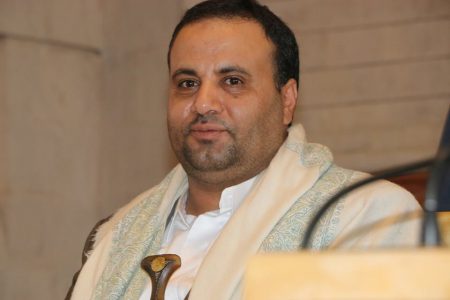
Head of Ansarullah politburo Saleh al-Sammad
Al-Manar | September 26, 2016
Head of the new Yemeni council, Salah al-Sammad, proposed on Sunday a truce on the country’s border with Saudi Arabia in an exchange for a halt in Saudi-led strikes on his country.
The proposal coincided with a surge in fighting after peace talks were suspended last month.
Sammad called on Saudi Arabia to “stop naval, air and land aggression, cease air raids and lift the blockade of our country, in exchange for an end to combat operations on the border and to missile launches into Saudi territory,” he said, in a speech published on the sabanews website.
Sammad also urged the UN and “peace-loving states” to exert pressure on the attacking Saudi regime to accept the offer.
He also suggested an amnesty for “combatants who have sided with the aggression,” a reference to fighters who back the Saudi-US assault on Yemen.
The Huthis are allied with soldiers loyal to former president Ali Abdullah Saleh.
Saudi Arabia in March 2015 formed an Arab coalition to begin air strikes on Yemen. More than 6,600 people have been killed since the coalition launched its intervention, most of them civilians, and at least three million people have been displaced, according to the United Nations.
Source: AFP
‘Saudi Arabian forces never once targeted ISIS militants in Yemen’
RT | August 29, 2016
The latest car bombing is most likely a personal vendetta, probably more of a gang problem inside Aden over who is going to take control, the rebels or Islamic State (IS, formerly ISIS/ISIL), political commentator Marwa Osman told RT.
Up to 60 people have been killed in a car bomb attack in the Yemeni city of Aden with dozens more injured. Most of the dead were pro-government troops.
ISIS has claimed responsibility for the attack.
RT: What is ISIS trying to achieve in this attack?
Marwa Osman: First, let’s tell people where ISIS targeted. They targeted a school compound which consists of the Popular Committee Forces who are allied with Abd Rabbuh Mansur Hadi, who was the president who resigned twice before the war in Yemen. So, they targeted these people who are already in war with “Ansar Allah” also known as the Houthis in the mainstream media. So, they are now targeting supposedly their own allies. And that is because there is a personal vendetta, probably more of a gang problem inside Aden over who is going to take control now. Is it the rebels who are actually backed by Saudi Arabia, who is still bombing and killing people in Saada and Sana’a? Or is it going to be ISIS which is also backed by Saudi Arabia which has been funneling money and arms by Saudi Arabia for the past seven or eight years in Yemen. Who is going to take control? That is the fight that is going on there. It is not a fight of fighting ISIS or fighting people who are there to try and liberate Yemen. No, because the actual thing is that both groups, these popular movements which are Hadi’s supporters and ISIS – they are both fighting “Ansar Allah” which is also getting beaten by the Saudi-led coalition. So, this is more of who is going to control the area.
RT: With this Saudi Arabian involvement you mentioned, is it possible that Saudi Arabia is using ISIS as some sort of proxy army to achieve its desires in that part of the world?
MO: It is not only possible, it is the only fact on the ground because up until now, since March 25, 2015 when the US coalition led by the Saudis ran… all over Yemen, they have never – not even once – targeted all of the Al-Qaeda-ISIS wilayat. They have eight wilayat inside of Yemen and not once have they targeted them. Why? Because they are actually there to run the on-ground incursion for the Saudis. And up until now they have not been able to do that; they were not able to go to Sana’a or to Saada for that matter. They only have been targeting Aden as we just saw today. It is obviously very devastating: 60 people dead because of the explosion. But these two proxy warriors for the war of Al-Saud, both rebels that supposedly represent Abd Rabbuh Mansur Hadi, the former president and also Al-Qaeda. It is the way it is going on in Syria, Iraq, Yemen and also Libya. So, when you talk about Saudi Arabia funding ISIS, it is the only way that it is going to gain any ground incursions on the Yemeni field. And yet this is not happening…
RT: Are you saying that ISIS is de facto a proxy army of mercenaries being used to achieve regime change?
MO: Yes, of course. And that what we have been saying since the beginning of 2010 and all 2011 when Al-Qaeda was changing into ISIS based on the ideology of Wahhabism, which is diffused and brought upon us by the monarchy of Al-Saud. Where they have got their weapons from, where they were funded from? It was obvious; we had all the reports and also the statements from both Qatar and Saudi Arabia. But then Qatar last year started to back off, but Saudi Arabia is still enraged by the incapability of their forces to take any control of Yemen. By God, Yemen is taking land inside of Saudi Arabia; it is that devastating for Al-Saud now. And when we talk about Iraq, Syria as well, it is also the same thing. They are still funding the same group that has the ideology of Al-Saud which is Wahhabism because they have no other choice. They are losing in Yemen; they obviously lost a lot in Syria and Iraq. There is no other place. The Iraqis are asking the Saudis to change their ambassador because he is the main person who is in contact with Al-Qaeda and ISIS inside of Iraq. So, when we talk about this, and talk about the role of Saudi Arabia, I don’t want to just demonize them. There are facts that demonize them. There are facts that Riyadh is still issuing a bloody campaign against Yemen. And there are US and UK so-called consultants inside of Riyadh in the control room of the war on Yemen. And we are still asking if they are funding ISIS or not. How did ISIS come to be if it were not for Al-Saud?
Read more:
At least 60 dead in Yemeni suicide bombing, ISIS takes responsibility
How the occupied mentality syndrome works
Saudi Arabia on the American chessboard – Part 3
By B. J. Sabri | American Herald Tribune | June 27, 2016
Read part 2: “The occupied mentality Syndrome“
Previously I argued whether Saudi Arabia’s repeated involvements in U.S. interventions and wars stem from free national will or in response to a specific condition. For starters, in Saudi Arabia there is no national will. In Saudi Arabia, the national will is the will of the Al Saud clan. Still, when a major Arab state allies itself with a superpower that committed unspeakable crimes against humanity in almost every Arab country, then something is wrong. This fact alone should compel us to examine the U.S.-Saudi relation for one exceptional reason. As a result of the U.S.-Saudi wars, hundreds of thousands of people in Afghanistan, Iraq, Iran, Libya, Syria, Yemen, and Somalia have lost their lives. Millions became displaced in their own homelands. And millions more rendered refugees.
Attributing the Saudi policies to the bonds of “partnership” with the U.S. is frivolous. There are no bonds between these two thugs except those of business, military deals, secret plots, and wars. Proving this point, bonds such as these have no space for the American and Saudi peoples to share significant cultural or societal exchanges. If partnership is not the reason for the Saudi contribution to the U.S. strategy of empire and imperialism, then another reason must exist.
This leads to three possibilities. (1) The Saudis are exercising their supreme national rights to do whatever they want. Or, (2), they are responding to inducement. Or, (3), they are complying with applied pressure. While the first possibility cannot be taken seriously, the remaining two possibilities are plausible. This means the Saudi participation in the U.S. wars—by proxy and directly—must have origins in factors other than the fluid concepts of alliance and partnership.
By the way, yielding to pressure is not new in international relations. In the age of today’s imperialism, the U.S. use of the UNSC to impose its policies is an example. If impositions fail, then the U.S. acts unilaterally. Examples: the imposition of the no-fly zone in Iraq 1991-2003 and the invasion in 2003. In the era of classical colonialism during 19th century, Britain’s gun boat diplomacy to force the opening of China to foreign trade is another example. Again, when a nation succumbs to another nation, that succumbence is never ordinary.
I also argued that succumbence to power is the result of protracted material, mental, and emotional processes performing as one element. From this premise I went on to coin the term: Occupied Mentality Syndrome (OMS) to describe such an element. Unlike other forms of mentalities (national, group, personal, and so on), the mentality I am debating is atypical. Driven by subjective factors but influenced by politically construed constraints—real or imagined—, this mentality has special traits. It competes with ideology, it conforms to pressure, it lays the blame on others, and it discards accountability.
Although such traits may not appear all at once, the presence of any one of them in a given situation is a reason to suspect that an OMS is lurking behind. Most interesting, those afflicted by this syndrome accept what comes next as a normal outcome of free deliberation. This is an anomaly. It is so because those who endorse it only calculate value versus detriment.
But calculations gutted from analysis, congruency of purpose, or the study of variables lead to contentious decisions. It is no mystery that decisions with far-reaching negative consequences impacting others could lead to tension or even open hostility. How does the Saudi regime get away from the impact of their decisions?
The usual act has been to reject any responsibility without discussion—as it happened with Iraq’s war against Iran. In doing so, the Saudi regime takes cues directly from Niccolò Machiavelli. Explanation: after converting the deliberation process into a justificatory procedure, the Saudi regime moves to the next phase: conferring legitimacy to already made decisions. Here is how they do it: make the decisions appear as if they were the result of (1) the collective national will—through the regime’s talking heads, preachers, and media,—and (2) purported adherence to the “Islamic Sharia”. The bogus legitimacy ruse that ensues is ludicrous. A tyrannical and obscurantist regime has now the authority to move forward with its decisions by calling on its citizens to observe a Quranic verse—taken out of context—calling on Muslims to obey their rulers.
To test the validity of the OMS concept, let me reprise my argument about how the Iranian Revolution and the Soviet invasion of Afghanistan shaped the mindset of the Saudi regime. Although the outcome of the 18-month long anti-Shah demonstrations was predictable, it, nevertheless, caught the U.S. and Saudi Arabia unprepared for his downfall. With the Shah gone, a psycho-political “drama” unfolded. The United States lost one of Nixon’s two pillars (the other is Saudi Arabia) in the Middle East; Israel lost its only ally in the Muslim world; Al Saud lost their inner confidence. The mere idea of a Khomeini-style revolution sweeping Saudi Arabia was enough to induce convulsive spasms in all those concerned with power, money, and oil.
Afghanistan was a different story. While the United States was mostly concerned with the Soviet power and on how to respond to the invasion, Saudi Arabia was literally terrified about the potential spread of “godless” Communism. . . . Thus was born the “special relationship” between U.S. ruling circles and a reactionary, absolutist clan.
What do we understand from the U.S.-Saudi relation?
Marked differences between the U.S. and Saudi polities make it intuitive that such a relation is no more than an opportunistic convergence between two regimes. Said differently, what we have here is a forum for massive business encounters and ideological boastings that both regimes struggle to call “alliance”. Generally, in the pre-9/11 period that relation had two sets of motives. While the American set is trite—empire-building, hegemony, oil, wars, and Israel—, the Saudi’s is issue-focused. (1) The clan must have the absolute primacy over Saudi life and society. (2) The clan defines its quest for security and survival in U.S. imperialistic context. That is, whatever the U.S. needs, the Saudi regime can supply in exchange for the clan’s needs.
It would be interesting to imagine the following scenario. The subject is Afghanistan. Was it ever possible for the Saudi regime to pursue a course independent from the objectives of the United States policy because they run against the legitimate interests of the Saudi people? To debate this point: was the spending of over $3.2 billion (indexed for that period) on the anti-Soviet Afghan war of any benefit to the Saudi society?
Let us make another supposition. Because Al Saud think of their clan as being the most powerful on earth, then a pressing question comes to mind. If they were that powerful, why did they not take alternative measures to counter U.S. pressure in the decades before 9/11? For instance, they could have purchased technology, weapons, and advanced commodities—and even “protection” from any industrial country other than the United States. [1] Or, with all the money they had, they could have started an autonomous national industrialization process like that of India, Iran, Turkey, China, South Korea, and others.
Ironically, even if the Saudi regime had the means to undertake that process, it would not have moved to implement it. Explanation: advanced statecraft mechanisms leading to independent decision making in any sector of the national life are unavailable because of the despotic nature of the regime. Not only that, but achieving sovereignty means also sovereignty for the people. This would surely curtail the power of the clan due to increased popular participation in the setting of national priorities.
Let us consider another point: the Saudis have always bragged that their “alliance” with the U.S. is unbreakable. This has an implication: the preventive imprisonment of their critical judgment and free will. Explanation: while the Saudis are unwilling to break with the U.S., the U.S. can discard them at will and play them at any given time—as happened recently with the story of the 28 pages never published from the 9/11 report. Tentative conclusion: from the clan’s perspective, it appears that whatever the U.S. wants can be addressed and accepted. Still, my earlier supposition that Saudi Arabia had the means and will to be independent from the United States has merit, It means, any U.S. pressure on the Saudis for burden sharing would be useless if the Saudis resist and go somewhere else for their needs.
If a counter-argument suggests that the Saudi spending in Afghanistan was worth it to deter a potential Russian aggression, then a reasoned rebuttal could be as follows. Fact 1: we know that the U.S.-Saudi relation revolves around deterring hypothetical “threats” against the kingdom. Fact 2: but we also know that neither the USSR, nor any other regional or international power has ever threatened to attack or invade Saudi Arabia. Amusingly, the only rumored threat of invasion came from Saudi Arabia’s “ally”, the United States (and from Britain) consequent to the Arab oil embargo in 1973. Conclusion: Al Saud had no impelling reasons to finance the U.S. imperialist enterprise in Afghanistan—even if they loathed the Soviets.
My argument: the Saudi regime has been concealing the primary motive feeding their “alliance” with the United States. Yet, it is not that difficult to guess what the clan thinks. Being a superpower with massive Zionist and Israeli influence, the United States offered the best guarantee for the survival of the regime on two fronts.
On the domestic front, the U.S. may help the regime survive if domestic unrest becomes unstoppable. The American-authorized French intervention to quell the Mecca uprising in 1979 is an example. As for The Zionist and Israeli component in American politics viewed from a Saudi angle, this is intuitive too. Like all Arab regimes, deluding themselves that the U.S. has a sovereign Arab policy, the Saudis thought of their U.S. relation as a buffer against America’s ally and protégée: Israel.
Furthermore, whereas Saudi motives are clan-based, those of the United States are system-based. This means, they are global, rationalized, and originate from how the ruling circles view the role of the United States in the world. Still, motives need forces to have effect. Consequently, the motives of a political state are the same motives of the ideological and material forces that drive it. For instance, in post-WWII United States, such forces worked as one construct to drive the purpose of U.S. hegemony. The economics, politics, and ideology of militarized capitalism, imperialism, colonialism, and Zionism are a few examples of such forces.
I mentioned colonialism as a force in the making of the United States. Does this apply to the United States of today? Here is how I see it. With military bases in over 160 countries, with bases count ranging from 761 to 900 plus, with military personnel in excess of 156,000, with a land mass of over 2,202,735 hectares (approx. 5,443,076 acres) occupied by the U.S. military, and with $150 billion annual budget, the United States is nothing but a global colonialist power whose bases are nothing less than outposts for a colonialist enterprise in progress. See deployment map in the article: These are all the countries where the US has a military presence. [2], [3], [4], [5], [6] [Note: I included several links to the issue of bases because some data differ from one source to another. Besides, the cited articles could offer an integrated view of the subject.]
Three motives define the course of U.S. power. These are (1) the determination to expand the spheres of U.S. influence, (2) the relentless intent to dominate geostrategic regions, and (3) wars as economic enterprises. How does the United States implement its domination project? The U.S. has an impressive array of tools and gadgets. Limited sampling: planned hostility, military interventions against countries resisting U.S. demands, wars against independent-minded countries that U.S. rulers love to call “rogue states”, seizure of foreign assets in the U.S., economic sanctions against “disobedient” states, applying U.S. laws on foreign states, dubbing adversaries as terrorists, harassment of big rival powers . . .
If examined in the context of classical colonialism, the U.S. domination of Saudi Arabia has all the signs of a colonialist dependency model. In this model, the periphery depends on the center in a way designed to consecrate the primacy of the center. But Saudi Arabia has never been a U.S. colony. This is true but irrelevant. The changing nature of modern dependency uses revamped practices. In one such practice, Washington makes the decisions and Riyadh implements them as if they were its own. The examples of Libya, Syria, and Yemen are instructive.
Keeping this in mind, I contend that many facts of the U.S.-Saudi relation point into the direction of multiple forms of dependency. The U.S. as a “protector” of the clan, massive Saudi purchase of U.S. arms, financial deals, and U.S. military presence in the kingdom are just the most prominent forms. One crucial aspect of the relation deserves stringent analysis. The U.S.-Saudi “alliance” goes beyond dependency, beyond petrodollar deposits, beyond investments in the U.S. economy, beyond the purchase of weapons, and beyond buying of treasury bonds. I am referring to a subject often overlooked: Saudi Arabia as a destructive interventionist tool in the hands of U.S. imperialists and Zionists.
To recap, stating that the U.S.-Saudi coupling is an alliance makes no sense. The alliance notion has different requirements, defining clauses, and formal obligations. Not even the claim of partnership is valid. Partnership takes its name from concepts such as equal sharing of burden, profits, and losses. This is not the case between the United States and Saudi Arabia. What we have here is an opportunistic platform between two different regimes pursuing separate agendas.
Again, prior to the collapse of the Soviet Union, U.S. aims included the opposition to Communism, containing Arab hostility to the U.S. and Israel, securing cheap oil, and providing basing rights for the U.S. military. On the Saudi side, preventing potential Iranian-style Islamic and progressive national revolutions in the region was the top concern. After the collapse of the Soviet Union, things changed. Generally, while the Saudis are obsessed with keeping the status quo in their regional milieu, the Americans are maneuvering their regional marionettes and intervening directly to alter the socio-structures and political assets of the entire region known as the Middle East.
Countless facts during the past 35 years attest that Saudi Arabia’s foreign policy coincided with or was in response to the U.S. world agenda. As a result, we can draw a preliminary conclusion. From 9/11 forward, the disoriented Saudi regime has been devotedly executing what the United States wants it to do in exchange for not complicating its life. With that, Saudi Arabia has become the material accessory and financing tool of the United States and Israel to remake (destroy) the Arab homeland according to the U.S. and Israeli plans. Iraq, Syria, and Libya are examples. [7], [8]
It is natural that an event such as 9/11 would have traumatized the clan and drove them to panic and despair. This is not only due to the nationality of some of the alleged attackers but also because Wahhabism, the creed of the Saudi state, has taken a post among the accused. For one, 9/11 worsened the socio-political instability of the clan and amplified their notorious arrogance. But 9/11 alone cannot explain the real reasons behind the intensified proclivity of the regime for violence toward the few remaining Arab states that still reject U.S. hegemony and Israeli settler colonialism.
However, in Saudi contest, the principal effect of 9/11 was “surgical”. It exposed the ugly face of Saudi barbarity by externalizing its warring enmity toward Iran and any Arab nation that opposes U.S. hegemony and the criminal practices of the Wahhabi state. That proclivity for violence and that foaming anti-Arab and anti-Iranian enmity were the means with which Al Saud thought they could placate post-9/11 United States and appease Israel in the process. Involving the Saudi ruling family in 9/11 was a master stroke of a strategy. With it, the United States has skillfully exploited the primal fear of the Saudi regime from losing power. And just like that, with one unsubstantiated accusation, the United States seized the grand moment—the prey was ready to be devoured.
It is beside the point to state that analyses meant to explain post-9/11 Saudi actions and policies must consider the determination of the Saudi regime to take whatever is needed to appease the United States. After 9/11 the Saudis thought they could silence the hyper-imperialist bully by withdrawing their recognition of Afghanistan under the Taliban rule. It did not work out. Then they moved, as requested by the United States, to cut off funding to religious organizations and Wahhabi-inspired schools in many countries. It did not work out either. Afterwards, they offered King Abdulla’s initiative to recognize Israel. Still, it did not work out. . . .
Here is what the crude mentality of Al Saud failed to comprehend. The appeasement the hyper-empire was thinking of was much wider, much deeper, and has no end—it is the unconditional Saudi willingness to play along with the U.S. plans and strategies.
I maintain, therefore, that explaining the Saudi post-9/11 wars and interventions against selected Arab states is ineffective without proper investigative tools. What we need are approaches that would enable us to see below, above, and around the appearances of events.
Another significant outcome of 9/11 was tangible: the transformation of Saudi Arabia from an American “ally” into a near hostage pliable for blackmail. For instance, the Saudi regime voiced concern and even some opposition to the planned U.S. invasion of Iraq in 2003. Still, they were unable to stop the U.S. from using their territory, airports, ports, and military facilities for that purpose. But when the invasion took its course, they mightily supported it. This is duplicity, of course; but I do not have to debate that such behavior says more than it could hide. Simply, it indicates fear from opposing U.S. moves.
I hold, therefore, that the radical change in Saudi Arabia’s post-9/11 regional conduct (the war against Libya, Syria, Yemen, Iraq; the harassment of Lebanon; the anti-Iran bellicosity; the tryst with Israel) was not in response to pressing Saudi needs, or to sudden wakening of the regime’s dormant “democratic values”. By extracting meanings out of statements, and by reading deeply into the cumulative consequences of the Saudi actions and their purpose, the answer should dispense with theoretical uncertainties. That is, those radical changes were in response to U.S. pressure or other forms of hard persuasion including implicit blackmail.
In which way did Iraq’s war against Iran confirm the U.S. scheme for the Middle East? What role did Al Saud play in that war? How does all this relate to and corroborate the occupied mentality syndrome?
Next: Part 4
Notes
- I should mention that Saudi Arabia has purchased missiles from China, as well as advanced weapons from Germany, Italy, Britain, Japan and other countries. Still, none of these deals would have been completed without the United States approving them first. The U.S. approval is motivated. First, U.S. military industry licenses the making of its weapons abroad and has deals to manufactures other weapons in partnership with many countries. Second, by submitting the weapons sale to its preventive approval, the United States establishes equal control on buyers and sellers. And this is how hegemony works. (Read: Why Did Saudi Arabia Buy Chinese Missiles? This is an imperialist view by the Foreign Policy Magazine. Pay attention to how Jeffrey Lewis explains the conditions that made the purchase possible. He writes, “Apparently with the approval of the George W. Bush administration.” [Italics mine]. Needless to say, the word “apparently” should have been omitted. . . .
- Gilbert Achcar, Greater Middle East: the US plan, Le Monde Diplomatique
- Mahdi Darius Nazemroaya, Plans for Redrawing the Middle East, Uruknet, 18 November 2006.
- David Vine, The United States has Probably More Foreign Military Bases than Any Other People, Nation, or Empire in History, The nation, 14 September, 2015
- David Vine, Where in the World Is the U.S. Military? Politico Magazine, July/August, 2015
- Julia Zorthian and Heather Jones, This Graphic Shows Where U.S. Troops Are Stationed Around the World, Time, 16 October 2015
- Tom Engelhardt, The US Has 761 Military Bases Across the Planet, and We Simply Never Talk About It, AlterNet, 7 September 2008
- Louis Jacobson, Ron Paul says U.S. has military personnel in 130 nations and 900 overseas bases, POLITIFACT, 14 September, 2011
Yemen’s Houthis reject Kerry’s initiative for peace
Press TV – August 27, 2016
Yemen’s Houthi Ansarullah movement has rejected an initiative put forth by US Secretary of State John Kerry to resolve the crisis in the war-torn country.
Mohammed Abdulsalam, the Ansarullah spokesman, said Saturday that the offer aims at depriving the Houthis of their arms in their fight of resistance against the Saudi invasion.
“Whoever has a greedy eye on our weapons, we will have a greedy eye on his life,” Abdulsalam wrote in a message posted on Facebook.
Kerry earlier called on Houthis to hand over their weapons including ballistic missiles and to pull back from the capital Sana’a. In return, the US secretary of state said Houthis and allies can have a share in Yemen’s future unity government.
The proposal comes amid reports that Houthis have stepped up missile attacks on border regions in Saudi Arabia over the past weeks. The attacks are carried out in reaction to deadly Saudi airstrikes that the regime in Riyadh says are meant to undermine Houthis and allies and to restore power to Abd Rabbuh Mansour Hadi, Yemen’s president who has resigned and fled the capital.
About 10,000 people have been killed across Yemen since the Saudi campaign started in March 2015.
The conflict in Yemen re-escalated after peace talks mediated by the United Nations and held in Kuwait collapsed earlier this month. The talks hit a snag after Houthis rejected a similar initiative proposed by the UN, saying it lacked any clear mechanism for transition of power.
Houthis had declared since the start of the talks in April that they were ready for disarmament and withdrawal from key areas they control in case a broad political agreement is reached in which Hadi would have no role.
Saudi Arabia Cries Foul Play in Yemen
By Catherine Shakdam | New Eastern Outlook | August 27, 2015
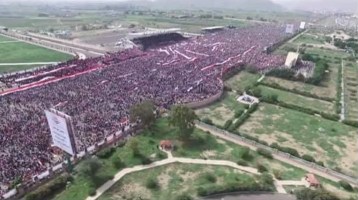
As the Yemen International Conference in the Support of Yemen was in full swing in the British capital, London, Yemenis came in their hundreds of thousands to pledge their support to the Resistance movement this August 20, 2016 – yet another popular show of force, yet another grand display of sovereign political will in the face of foreign diktat.
To the sounds of explosions, and flying Saudi war planes it is Yemen which came to defy its invaders; a proud nation under unprecedented duress, a land united under the banner of its resistance.
“We won’t bow down to the House of Saud” chanted the crowd. “We will never bow down to the criminal House of Saud,” millions repeated in unison.
If Yemen remains in the throes of a brutal war of attrition for its dared ambition to live free under its skies, its people are quite determined to weather whatever storm Saudi Arabia will throw, so that their right to self-govern and resist oppression could be affirmed – never to be questioned again.
However one chooses to look at Yemen’s war, it would be foolish to deny still that those brave souls corporate media still label as “rebels” are in fact the carrier of a nation’s will; the very expression of a people’s inherent right to carve its own political future, regardless of what anyone else might think.
Let me be brutally honest here – Yemen neither needs foreign approval, nor does it require foreign vetting. Yemenis want what they want because they can! It is really that simple.
Yemen needs no liberating from the Houthis, for the Houthis are Yemen. Yemen is not being overrun by Shiites, Yemen is Zaidi country. There is no Iranian agenda at play either, only a desire to disappear the suffocating influence of the House of Saud.
Standing in opposition of the most violent, radical and reactionary theocracy ever to grace the pages of our history does not make Yemen an “Iranian agent”, it makes Yemen an expectant independent nation.
Media coverage of Yemen so far has been criminal at best, misleading always.
The public has been conned into a narrative which is devoid of all humanity, and democratic courtesy. The simple fact that media feel entitled to slap derogatory adjectives before the Houthis as to direct their readers’ self-righteous sense of political morality is despicable.
I read the terms Iran-backed Shia Houthis rebels too many times not take offense. How dare you define a people whom you know nothing about? How dare you speak over and at an entire nation because their will does align with yours?
Let’s play the adjective game shall we?
When have you ever read the following statement: Wahhabi-backed-Western-sold-out- twice-resigned-once-runaway-child-killer-Sunni President Abdo Rabbo Mansour Hadi? Likely never … Why? Because Saudi Arabia and its allies are still hiding behind this pale figure of a man to legitimize their odious genocidal military intervention against Yemen.
Let me tell you of this so-called legitimate political figure the West has canonised as Yemen’s forever president.
Hadi is a fraud and a traitor. Not only did he allow for the killing of his countrymen, he actually actively pursued their annihilation in the name of a chair he never truly was appointed to. Hadi was elected in a one-man election in 2012 for the duration of a 2-year’s mandate – not exactly what you call democratic.
Hadi was never the choice of the people, he was Riyadh’s choice through the GCC-brokered transition of power agreement (2011).
How can anyone speak of democracy and refuse Yemenis their own?
How can anyone still read corporate media and not deplore the stench of their abominable hypocrisy and bias?
Do not tell Yemen what it wants, but hear what it is telling you.
Hear what an entire nation is screaming from the top of its glorious lungs, and witness the rise of a Resistance which breadth will maybe crumble al-Saud tyranny.
“We won’t bow down to the House of Saud … We will never bow down to the criminal House of Saud!”
Can you hear them now? Can you not respect that a nation simply cannot bring itself to live the abomination which is Wahhabism? Can you not recognise that Yemen is the last line of defense for all free folks in Arabia?
Who will speak for democracy and political self-determination when radicalism will have nations at the mercy of their guns? Can you not see that what you refuse Yemen – free will, is exactly what you demand for yourself?
Do not tell me of the will of a people when under bombs millions have rallied before their appointed leaders.
Yemen is free today by the strength of its Resistance movement.
Yemen is dignified today for one man rose from the oppression of religious repression to reclaim pluralism his own coat of arms. Sheikh Abdel-Malek al-Houthi, one of the sons of Hamdan, Yemen’s very own legacy offered Yemen its Freedom to keep none for himself.
Sheikh al-Houthi liberated Yemen from al-Saud never to demand a seat at power’s table.
Do not speak of what you don’t know Mr corporate media. Do not define with your adjectives the nature of a land for which you have no respect for.
Yemen might be poor and battered but it is a grand and noble land.
Of course Saudi Arabia would want you to believe that Yemen’s political ambitions are illegitimate, unlawful and nefarious.
Have you ever bothered asking why? Have you even given the infamous “Houthis” the time of day before dismissing them under misapprehension?
I think not. What the public did is assume. What the public did is read those adjectives media associated ad nauseam to Yemen resistance movement, and automatically accept those labels as truths. Adjectives those days have become dangerous weapons of mass-destruction.
Adjectives have cost Yemen its freedom!
Yemenis this August 20, 2016 came to publicly offer their support to the new highest political council – and still Riyadh has cried foul play.
Millions took to the streets knowing full well that Saudi Arabia warplanes were up above to offer their voice and their arms to the Resistance, and still Western capitals have called for Hadi’s “restoration.”
What will it take for you to wake up?
Yemen has bled, burnt, exploded, pleaded, negotiated, mourned, cried and starved while you turned your nose up in disgust arguing what future a people should have instead of the one they want for themselves.
If you like the idea of a life spent in the shadow of Wahhabism why not book a ticket to Saudi Arabia and experience first-hand the type of democracy al-Saud have in mind for Yemen, you might find new respect then for the Houthis of Yemen.
One more thing before I go: no one said you had to love the Houthis, only that you respect that Yemenis do.
Catherine Shakdam is the Director of Programs of the Shafaqna Institute for Middle Eastern Studies and a political analyst specializing in radical movements.
US Okay With Surgical Strikes on Yemen Hospitals
By William Boardman | Reader Supported News | August 24, 2016
Nuremberg: “a war of aggression … is the supreme international crime”
Waging genocidal war on a defenseless country was never so baldly and honestly put on any agenda for talks among US secretary of state John Kerry, representatives of Saudi Arabia’s dictatorship, and their mutual allies, even though they are all engaged in an endless genocidal war on Yemen. This war is a war of aggression, started by Saudi Arabia in March 2015, with crucial US blessing, participation, personnel, and ordnance. The US has been a willing, guilty partner and enabler in 18 months of military atrocities in a one-sided war that everyone involved knew – or should have known – was a pure war crime based on a paranoid delusion.
American participation in this war of aggression was a war declared by press release from the National Security Council on March 25, 2015, another example of the imperial presidency’s ability to act by fiat without fear of serious objection from the public, the media, or even Congress:
President Obama has authorized the provision of logistical and intelligence support to GCC [Gulf Cooperation Council]-led military operations. [emphasis added]
The fundamental crime in Yemen is waging a war of aggression, which encompasses all the subsequent war crimes including bombing civilians, using cluster bombs, bombing hospitals, bombing food supplies, and trying to starve a population to submission or death. Yemen, with a population of 26 million people, was the poorest country in the region even before it was attacked. What the US supports and sanctions against Yemen makes any US complaint about Russian actions in Crimea sound like howling hypocrisy.
For all that the Saudis frame their war on Yemen as a defense against a threat from Iran, there has never been any credible evidence of any credible threat to Saudi Arabia from any element of the miniscule Iranian presence in Yemen. Yemen is fighting a civil war, a new version of the same old civil war Yemenis have been fighting for decades, both before and after Yemen was two separate countries. The Iran “threat” is the paranoid delusion supposedly justifying a merciless war on a civil population already beset by a four-sided civil war. There is no way that those who decided to wage this war of aggression could not have known the reality in Yemen if they had wanted to know it. Presumably they knew it all full well and chose a war of aggression anyway, recklessly, perhaps even thoughtlessly, but criminally all the same.
The Saudi goal was always to get rid of a longstanding threat on its southwestern border, where the tribal land of the Houthis lay both in Yemen and Saudi Arabia. When the long-oppressed Houthis, a Shia minority in a Sunni world, drove out the Sunni government of Yemen in 2015, the Saudis, without saying in so many words, decided on a course of action that could lead to a final solution. And everyone knew, at the time, and no one objected, according to this account by the highly reliable Andrew Cockburn on Democracy NOW! (whose piece in Harper’s Magazine for September 2016, ironically titled “Acceptable Losses,” provides an excellent exegesis of the war on Yemen, but with a more elegiac tone):
I was told, very early on in the war, Deputy Secretary of State Tony Blinken went to Riyadh to ask the—this is two weeks—yeah, it was two weeks into the war [mid-April 2015], when they had already been bombing away, using the U.S. bombs, U.S.-supplied bombs, using U.S. weapons, killing already dozens, if not certainly, you know, hundreds of civilians, destroying factories. And finally, Blinken turns up in Riyadh and asks, “By the way, what are you trying to accomplish here?” And the Saudis effectively said, or at least the Americans understood them to say, “Well, we basically want to wipe out the Houthis.” Well, they termed it as “end all Iranian influence in Yemen.” So, the Americans—Blinken was a bit shocked by that, so I’m told, and said, “Well, you know, that’s going a bit far. But it’s—you should certainly stop the Houthis taking over the country.” And that, effectively, gave the Saudis carte blanche to continue this kind of mindless carpet bombing….
By 2015, American hands were already bloody with the US drone assassination program that had killed not only innocent civilians, but American citizens, without a trace of due process of law. In effect, already enmeshed in its own nexus of war crimes in Yemen, the US green-lighted the Saudi-led war of aggression that would make American crimes pale by comparison. As American policy over the years would have it, American weapons have been dispersed all over Yemen since 2006.
Kerry to consult on terrorism, but not US or Saudi terrorism
Terror bombing, an example of which is Saudi pilots flying American planes dropping American bombs on defenseless Yemeni civilian targets, is probably not the terrorism Secretary Kerry wants to discuss – ever – with the Saudis and their allies, never mind other weapons suppliers like France and the United Kingdom. As the official State Department notice put it in deadly opaque prose:
Secretary Kerry will travel to Jeddah, Saudi Arabia, for a series of meetings with senior Saudi leaders, his counterparts from the Gulf Cooperation Council, the United Kingdom, and the United Nations Special Envoy for Yemen. His discussion will focus on the ongoing conflict in Yemen and efforts to restore peace and stability….
Those “efforts to restore peace and stability” notably include the destruction of two schools, another hospital, and a potato chip factory, along with the associated men, women, and children, especially at the schools. Perhaps the latest great military “victory” achieved by the war criminals known as the Saudi-led coalition is to drive the world’s leading medical crisis-zone organization out of Yemen by targeting its hospitals over and over and over and over since March 2015. Of course, America the Exceptional does not stand for this betrayal of human decency, and our presidential candidates of all parties have railed ceaselessly against this indiscriminate murder of patients, their families, their doctors and other medical personnel, forcing the White House to take action to bring to an end 17 months of aggressive war and other war crimes and crimes against humanity – no, wait, that’s not happening, is it?
Actually, if any presidential candidate of any political party has expressed the slightest objection to the Saudi-coalition’s genocidal war on Yemen, such evidence is so hard to come by that it may as well not exist. (In August 2015, Jill Stein of the Green Party mentioned in passing that the Saudis “are committing war crimes right now in Yemen,” and more recently she called for an end to US funding for Saudi Arabia and Israel because of their violations of human rights laws. She does not tend to make a point of the US support for a war of aggression in Yemen, but she’s better than any other candidate on Yemen.) At this point, a year and a half into our shared war of aggression, every candidate is complicit in this horrendous, unjustified war promoted and pursued with smug disdain for anything like peace by our peace prize winning President Obama. The blood drips from all their hands, their feet, their tongues and eyelashes, but most of all from every pore of our Nobel Laureate in the White House. (As the book Double Down reported in 2012: “Turns out I’m really good at killing people,” Obama said quietly, “Didn’t know that was gonna be a strong suit of mine.”)
With the US at war, Congress has nothing to say about any of it
The US is at war with Yemen, in support of the Saudi-led coalition that launched its undeclared war of aggression on March 26, 2015. US war-making includes, but is not limited to: US intelligence services providing intelligence to the aggressor nations; US military personnel participating in daily target planning and attack assessment; US tanker aircraft re-fueling aggressor nation aircraft bombing Yemen (46,500 acknowledged sorties in the first 11 months of war); US drones targeting and attacking under US control; US military contractors servicing the Saudi F-15s that bomb Yemen; US personnel training Saudi military; US military personnel operating in Yemen; and the US Navy reinforcing the Saudi blockade intent on starving Yemen into submission.
The US Congress has never debated, never authorized US participation in a war of aggression against Yemen. The US president has never asked Congress for such authorization of a war of aggression against Yemen. Neither house of Congress has acted on any bill that directly addresses the war of aggression against Yemen. More than a year after the war started, two Democratic members of Congress (joined by two Republicans) introduced identical bills intended to respond to the war. California congressman Ted Lieu (joined by Florida congressman Ted Yoho) and Connecticut senator Christopher Murphy (joined by Kentucky senator Rand Paul) asked their colleagues to address the horrors of the war (briefly enumerated in the bill), not by ending the war, but only by temporarily limiting US arms sales to Saudi Arabia. That’s it. They did not mention US participation in the war. Both their bills were referred to committee. At the time there was a spotty ceasefire in Yemen while peace talks proceeded in Kuwait (the talks were suspended in early August, leading to the Saudi escalation currently killing more civilians).
Incredibly, this non-response response to war crimes in Yemen has gotten Rep. Lieu some recent positive press coverage, in The Intercept of August 22 and elsewhere, even though his bill is designed to have no immediate impact on the carnage. Rep. Lieu is a colonel in the US Air Force Reserve. When he was on active duty he taught the law of war to other Air Force officers. His interview rhetoric, like most of his public action, is soft-edged even though he knows perfectly well his country is committing war crimes. He almost said as much in an August 15 statement objecting to the Saudi attack on a school in Haydan, Yemen, that killed 10 children:
The indiscriminate civilian killings by Saudi Arabia look like war crimes to me. In this case, children as young as 8 were killed by Saudi Arabian air strikes. By assisting Saudi Arabia, the United States is aiding and abetting what appears to be war crimes in Yemen. The Administration must stop enabling this madness now. [emphasis in original]
Rep. Lieu and others have also objected to the State Department’s certification of another arms sale to Saudi Arabia: this one is $1.15 billion for 153 tanks, hundreds of machine guns, and other war materiel. This is in addition to the record $100 billion in arms sales to the Saudis already made by the Obama administration. The latest arms deal suggested to Rep. Lieu “that the administration is, at best, callously indifferent to the mass amount of civilians dying as a result of the Saudi-led coalition’s bombing.” He did not openly consider whether 153 Abrams Main Battle Tanks and other weaponry might open the way for the air war of aggression to be matched by an escalation of the ground war of aggression as well. Twenty of those new US tanks are specifically designated as replacements for tanks lost in combat, some of them in Yemen. On the other hand, the official State Department notice of the Abrams Tank sale assures Congress: “The proposed sale of this equipment and support will not alter the basic military balance in the region.” That’s hardly reassuring in a region where wars of attrition and military quagmires are killing not only thousands of Yemenis, but Palestinians, Israelis, Lebanese, Syrians, Saudis, Turks, Kurds, Iraqis, Afghans, and god knows who else, more often than not with Made-in-USA weapons and munitions.
The proposed US tank sale has drawn the attention of several NGOs (non-governmental organizations) looking to wash American hands of the war on Yemen by blocking the sale, or at least having a debate about it in Congress. Human Rights Watch (HRW) wrote a letter to Secretary Kerry August 19, with temperate language of concern about several countries, including Yemen. HRW asked Secretary Kerry “to emphasize the potential consequences if Saudi Arabia fails to improve its conduct.” But it did not suggest what those consequences might be in light of the reality that the US has coordinated and condones all Saudi conduct to date. CODEPINK is supporting a petition to support the Congressional letter that urges President Obama to postpone the US tank sale to the Saudis.
Even The New York Times is expressing something shy of anguish over “American complicity” and “carnage” and targets that are not “legitimate” under international law as it supports efforts to block the tank sale in Congress. The Times doesn’t mention that this is the same Congress that in June – supporting a White House request – refused to block the sale of cluster bombs to Saudi Arabia for fear of “stigmatizing” cluster bombs. That’s a reflection of the American version of reality, since cluster bombs are already stigmatized by most countries of the world and using them on civilians, as US-Saudi forces do in Yemen, is widely understood to be a war crime. The solution, according to the Times :
Congress should put the arms sales on hold and President Obama should quietly inform Riyadh that the United States will withdraw crucial assistance if the Saudis do not stop targeting civilians and agree to negotiate peace.
That can’t happen in the real world, where the president and the Saudis all know they are war criminals and are, like Macbeth, so steeped in blood “that should I wade no more,/Returning were as tedious as go o’er.”
There is no reason to expect any good to come to Yemen until a whole lot more Americans face the reality of their country’s support for a genocidal war of aggression. When enough Americans recognize that, then they will have to do a lot more about it than stop selling tanks to the aggressors. Until then the US-sponsored atrocity of ethnic cleansing in a poverty-stricken country that threatens no one will continue unabated.
Zarif rejects US claim of Iran arms shipment to Yemen
Press TV – August 26, 2016
Iran’s foreign minister has categorically denied the US claims that Tehran ships arms to Yemen, saying Washington itself knows better which international parties spread terrorism throughout the world.
Mohammad Javad Zarif was reacting to comments by US Secretary of State John Kerry who accused Tehran on Thursday of transferring “missiles and other sophisticated weapons” to “rebels” in Yemen.
“By such statements, the US administration has implicated itself in the Saudi regime’s war crimes and inhumane and infanticidal atrocities against the innocent and oppressed Yemeni people. It should undoubtedly accept responsibility and be answerable for all the inhuman crimes,” Zarif said.
Kerry made the accusations during a visit to Saudi Arabia, which has been waging a brutal military campaign against Yemen for more than year.
The top US diplomat was in Jeddah where UN special envoy for Yemen Ismail Ould Cheikh Ahmed as well as representatives from Britain and Saudi Arabia’s Persian Gulf allies in the war had gathered to discuss the conflict.
“Mr. Kerry knows well better than anyone that the Saudi government has, over the past year and a half, been invariably and sternly frustrating all the efforts taken to bring about ceasefire in Yemen,” Zarif said.
In his remarks, Kerry said “the threat potentially posed by the shipment of missiles and other sophisticated weapons into Yemen from Iran extends well beyond Yemen and is not a threat just to Saudi Arabia and… the region.”
“It is a threat to the United States and it cannot continue,” he added.
Zarif also dismissed Kerry’s claims of Iranian threat to the region and the US, saying the Islamic Republic’s “military might poses no threat to any country and simply serves defensive purposes.”
“What threatens the region and the world today is the ideological, financial and political bases of Takfiri terrorism in the world, whose source and causes Mr. Kerry should know well.”
The Saudi military has been pounding Yemen since March 2015 to undermine Yemen’s Houthi Ansarullah movement and to restore power to the former president, Abd Rabbuh Mansur Hadi, a staunch ally of Riyadh.
Nearly 10,000 people, most of them civilians, have been killed in Riyadh’s military aggression which lacks any international mandate.
The US maintains strong military ties with Riyadh, which had Washington approve a USD-1.29-billion rearming program for the kingdom last November.
“Without a doubt, the US administration would further discredit its policies in the region through its support and ignorance and inattention to the facts on the ground,” said Zarif.
“It is high time the US administration learned from its glaring past mistakes in Syria and Iraq and open its eyes to realities,” he added.
On Thursday, the UN human rights office said the Saudi military is using cluster bombs against residential areas in Yemen in violation of international law, blaming the Riyadh regime for most of the civilian casualties in its impoverished southern neighbor.
Human Rights Watch (HRW) criticized the United States in May for selling cluster munitions to Saudi Arabia, saying the kingdom had used various types of US-made cluster munitions in its war against Yemen despite evidence of mounting civilian casualties.
UK dismisses concerns about arms sale to Saudi Arabia
Press TV – August 23, 2016
The British government has dismissed concerns about selling arms to Saudi Arabia amid accusations that it misled the parliament over the case.
On Tuesday, a British government spokeswoman defended the recent weapon sales to Riyadh, saying the Saudis have stuck to conditions set by the United Kingdom.
She also noted that London is ensuring Riyadh is not breaking humanitarian laws by bombing civilian targets.
“The UK Government takes its arms export responsibilities very seriously and operates one of the most robust arms export control regimes in the world,” the spokeswoman said.
“The Government is satisfied that extant licenses for Saudi Arabia are compliant with the UK’s export licensing criteria,” she added.
The dismissal came in response to a statement by charity group Oxfam, which accused the UK government of being in a state of “denial and disarray” over its continued sales of weapons to the kingdom.
Penny Lawrence, deputy chief executive of Oxfam GB, said Britain was “flagrantly” ignoring its own arms control rules as well as international treaties.
“UK arms and military support are fueling a brutal war in Yemen, harming the very people the Arms Trade Treaty is designed to protect,” she said.
“Schools, hospitals and homes have been bombed in contravention of the rules of war. The UK Government is in denial and disarray over its arms sales to the Saudi-led coalition bombing campaign in Yemen,” Lawrence added.
“It has misled its own parliament about its oversight of arms sales and its international credibility is in jeopardy as it commits to action on paper but does the opposite in reality.”
Oxfam has launched a public appeal calling on the government to stop the war on Yemen.
The UK, the second-largest exporter of weapons in the world, approved licenses for the sale of $11.2 billion in armaments last year, but its licensing export regime is under acute scrutiny amid fears British weaponry, including cluster bombs, is being routinely used in Yemen.
According to sources, London supplied export licenses for close to £3 billion worth of arms to Saudi Arabia last year. The British government has also been accused of being involved in guiding the Saudi military aggression in Yemen.
Since the beginning of the Saudi war against Yemen in March of last year, nearly 10,000 people, including over 2,000 children, have been killed.
Meanwhile, the regimes that have made major arms purchases from the UK since last year include Saudi Arabia, Bahrain, Egypt and Burundi.
In 2014, Britain only licensed $248 million worth of arm sales. The massive surge in the arms sales in 2015 is largely attributable to sales of weapons to the Saudi kingdom.
The largest export license granted was worth $2.48 billion of fighter jets agreed in May 2015. Additionally, the UK approved the export of $1.45 billion of air-to-air missiles to the Saudi regime in July 2015.
In September, it further approved the sale of $90.5 million worth of bombs to Riyadh. All three sales took place after the Saudi’s brutal bombing campaign of Yemen began in March 2015, prompting concerns that civilian buildings have been targeted in widespread human rights violations.
In 2015, the British government also approved licenses of $123 million in sales of military equipment to Egypt, despite concerns over the country’s repressive policies since the July 2013 coup that ousted the country’s first democratically-elected president, Mohamed Morsi.
“This is a clear case of the government saying one thing and doing another, and exposes the blatant doublespeak and hypocrisy that lies at the heart of UK foreign policy,” said Andrew Smith of the Campaign Against Arms Trade (CAAT), which compiled the export sales figures.
Featured Video

“Historic Russia”: The Land Putin Will Not Give Back
or go to
Aletho News Archives – Video-Images
From the Archive
How Ukraine Tortured and Slaughtered Donbass
By Kit Klarenberg | Al Mayadeen | July 11, 2024
Almost immediately after the proxy war erupted, ISIS-tier footage of the torture and murder of Russians in Ukrainian custody emerged.
On July 6th, the New York Times published an astonishing investigation: In Ukraine, Killings of Surrendering Russians Divide an American-Led Unit. The article documents in grim detail how Chosen Company, an international volunteer battalion for Kiev, routinely executes Russian prisoners of war. It is the very first mainstream admission that this practice – a brazen breach of the Geneva Conventions, and a grave war crime – is widespread among Ukraine’s fighters, both foreign and homegrown. … continue
Blog Roll
 Aletho News
- US taxpayer money laundered back through Ukraine – Musk
- Before COVID, an NIH lab chief proposed making a SARS-like bat virus more infectious
- Gates, Bourla on Trial in Netherlands Accused of ‘Great Reset’ Scheme at Vaccine Injury Hearing
- BRITAIN’S WARNING: PREPARE FOR WAR
- “Historic Russia”: The Land Putin Will Not Give Back
- How the Cambridge Analytica scandal still haunts Mark Zuckerberg
- The Ongoing Cancellation Campaign Against a Dissenting Academic in Norway
- Yemen and ‘the Houthis’: Challenging Sami Hamdi’s Narrative
- No, Christians did not invent Zionism
- AIPAC-led lobbying network opens branches in Cypriot, Greek parliaments
- If Americans Knew
- Damning report shows the media must confront its failures on Gaza
- BBC senior broadcaster speaks out on Gaza coverage
- Netanyahu vows vast West Bank invasion in response to 20-minute skirmish that left 2 Israeli soldiers and 2 Palestinian fighters dead
- Tied up and tortured: Israel using US-made electroshock weapons on Palestinian detainees
- The outsourced risk: how newsrooms rely on Gaza’s freelancers without protecting them
- Gaza bakeries forced to shut as Israel blocks flour shipments
- Gaza’s breast cancer patients face a deadly wait for treatment amid Israel’s genocide
- DAILY UPDATE: Latest essential news on Palestine, Israel, & region
- The Israel Lobby’s Changing Fortunes
- AIPAC has become such a political liability that it’s shifting to a more “nimble” approach to buying politicians
- No Tricks Zone
- Two New Studies Find Thwaites Glacier Melt Cannot Be Driven By Human Activity Or A Warming Ocean
- E-Cars Reduce CO2 Emissions By Only 41% Compared To Internal Combustion Engine Vehicles
- Predictions Made By Renowned Climate Professor Over Past Decades Have Been Proven To Be Poor
- New Study Suggests Large Regions Of The Pacific Ocean Have Been Cooling For The Last 80 Years
- Germany’s Green Energy Debacle: High Energy Costs Force Kahla Porzellan to Close After 182 Years!
- New Study: 50 Years Of The Most Aggressive ‘Net Zero’ Policies Can Only Affect The Global Climate By 0.03°C
- US September “Heat” Was No Record…Many Records Set Decades Ago
- Latest European Green Energy Debacle; Portugal’s Largest Flagship Solar Park Insolvent!
- Green Energy Debacle: German Expert Professor Fritz Vahrenholt Warns Of Severe Economic And Social Consequences
- Two More Paleo Reconstructions Affirm Meters-Higher Sea Levels Across Ireland, Brazil 7000-6000 Years Ago

