Despite Human Toll, US to Supply More Weapons to Saudis
Sputnik – 05.09.2015
Turbulence in the Middle East presents an obvious challenge for the Obama Administration, seeking to satisfy all major players in a series of convoluted games. Washington continues to supply weapons to “crucial ally” Saudi Arabia, where coalition airstrikes on Yemen kill innocent people and humanitarian aid is blocked from entry.
President Obama and Saudi King Salman met Friday in the Oval Office. The details of their chat remain undisclosed, though various sources earlier hinted arms supplies would be on the table for discussion.
Among possible candidates are Boeing’s GPS-guided Joint Direct Attack Munitions, according to Bloomberg. Approved for use in the Royal Saudi Air Force’s F-15s back in 2008, it’s likely they have been used for the bombardment of Yemen this year, which has reportedly claimed the lives of dozens of civilians. There are also numerous reports of the use of internationally banned cluster munition in the airstrikes, which began in March.
Reuters reported Wednesday a deal had nearly been reached for two frigates worth over $1 billion to the Saudis by Lockheed Martin Corp. The US recently approved a possible $5.4 billion sale of advanced Patriot missiles to Riyadh, the US Defense Security Cooperation Agency (DSCA) said in a statement in July, the same month US defense contractor Raytheon was awarded a $180 million contract to provide Saudi Arabia with guided air-to-ground missiles.
Defense buildup in Saudi Arabia, which became the world’s top arms importer this year, has considerably benefited several American weapons manufacturers. And the US relies on defense contractors to fill the void created by Pentagon budget constraints, as former US Assistant Secretary of Defense Lawrence Korb told Sputnik, adding that the Saudis have increased orders for US missile defense systems out of fear that Iran will grow stronger militarily after nuclear sanctions are lifted.
Ahead of today’s meeting with King Salman, Barack Obama announced they planned to discuss Iran, Syria, the self-proclaimed Islamic State terror group, the global economy and energy issues, among others.
“I look forward to continuing to deepen our cooperation on issues like education and clean energy and science and climate change because His Majesty is interested, obviously, ultimately in making sure that his people, particularly young people, have prosperity and opportunity into the future,” Obama said. “And we share those hopes and those dreams for those young people, and I look forward to hearing his ideas on how we can be helpful.”
No mention of any arms sales.
As western countries profit from the sales of advanced weapons systems to Riyadh — including American and British warships to maintain a blockade on humanitarian aid to Yemen — they turn a blind eye to what many call Saudi war crimes and the obvious violation of human rights under Saudi leadership at home.
“The entire affair is a blatant breach of international law, and an assault on authentic democracy and self-determination,” Canadian writer and activist Stephen Gowans noted earlier this month.
On Monday, Amnesty International accused the Saudi-led, US-backed coalition of using internationally banned weapons in Yemen in a report that also lambasted the US for supplying the coalition with intelligence and material support, and the disastrous consequences for local populations the war perpetrates.
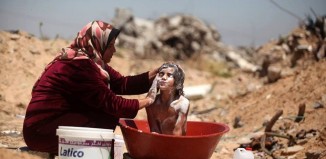
Wars leave 13 million children without school in Mideast: UN
Press TV – September 3, 2015
The United Nations has voiced alarm over the “destructive impact” of the deadly wars on children’s education in the Middle East and North Africa (MENA), saying violence has forced at least 13 million kids out of schools there.
In a report released on Thursday on threats to the education system in six violence-torn countries and territories across the region, the United Nation’s children fund UNICEF warned that “the hopes of a generation” would be dashed should kids fail to return to classrooms in conflict zones of both regions.
Syria, Iraq, Yemen and the Palestinian territories in the Middle East as well as Sudan and Libya in North Africa were the main countries the report focused on.
Over 8,850 schools are no longer usable due to the ongoing political instability and violence, said the report.
Peter Salama, the regional director for UNICEF in the MENA region, told AFP that “the destructive impact of conflict is being felt by children right across the region.”
“It’s not just the physical damage being done to schools, but the despair felt by a generation of schoolchildren who see their hopes and futures shattered,” he added.
According to the UN, one in four schools was closed this school year due to violence.
“Even those Syrian teachers who have ended up as refugees in other countries have faced obstacles which prevent them from working,” said the report, adding more than 52,000 teachers have left their posts.
UNICEF said that violence in Iraq has taken a heavy toll on the schooling of at least 950,000 children.
Iraq and Syria have been grappling with a spike in violence fueled by Takfiri terror groups, particularly Daesh, which controls swathes of land in both Arab states.
Elsewhere in the Middle East, the Saudi military has been pounding neighboring Yemen with fatal air raids over the past five months. Civilians as well as the country’s infrastructure have been the main target of Riyadh’s strikes.
The Saudi military campaign has led to the closure of hundreds of schools and colleges in Yemen since late March, according to the report.
UNICEF also said over 280 schools had been damaged and eight “completely destroyed” in the Tel Aviv regime’s 2014 war on the Israeli-blockaded Gaza Strip that left over 2,200 people dead.
In Libya, which is suffering from rising violence after the 2011 overthrow of former dictator Moamar Qaddafi, more than half of those displaced say their children cannot attend classes, while the conflict in Sudan’s Darfur and South Kordofan has also had a severe impact on the country’s creaking school infrastructure, the report said.
Missing From Reports of Yemeni Carnage: Washington’s Responsibility
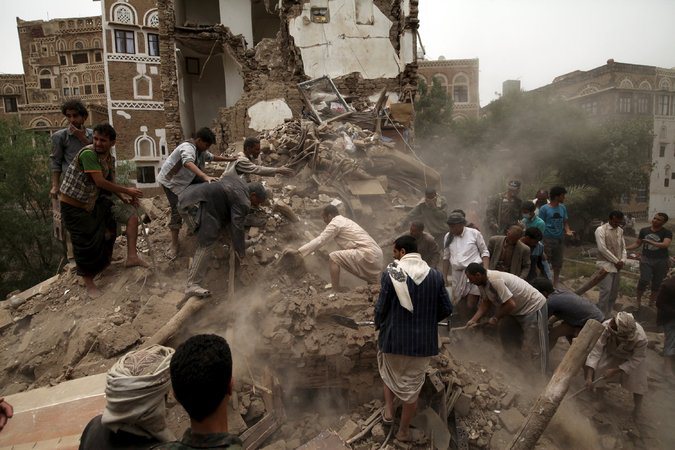
This photo of the aftermath of an airstrike in Sana, Yemen, accompanied a New York Times story (6/24/15) that provided a detailed account of the human toll of the air war—but made no mention of the US’s responsibility. (photo: Mohamed Al-Sayaghi/Reuters)
By Jim Naureckas | FAIR | August 31, 2015
The New York Times (8/30/15) reported on the deaths of civilians in a military assault in Yemen. Wrote reporter Saeed Al-Batati:
Airstrikes by a Saudi-led military coalition killed at least 13 civilians working early Sunday at a water plant in northern Yemen, the plant’s owner said.
The bombings appeared to be the latest in a series of airstrikes by Saudi Arabia or its Arab coalition partners that have hit civilian facilities with no apparent military target nearby.
The Washington Post (8/30/15) briefly covered the story too, using a Reuters wire report that gave a higher death toll:
An airstrike by warplanes from a Saudi-led coalition, which said it targeted a bomb-making factory, killed 36 civilians working Sunday at a bottling plant in the northern Yemeni province of Hajjah, residents said.
Noting that another airstrike had killed four people in Sanaa, Yemen’s capital, the piece continued:
The attacks were the latest in an air campaign launched in March by a Saudi-led alliance in support of Yemen’s exiled government, which is fighting Houthi forces allied with Iran.
Both of these reports left out the information that made this news particularly relevant to the papers’ mostly American readership: The US government is actively backing the air war in Yemen that killed those civilians, as the Times and Post have both reported. The Times (3/26/15) wrote at the start of the Saudi assault:
A spokeswoman for the National Security Council said Wednesday night that the United States was providing intelligence and logistical support for the campaign in Yemen, and that President Obama had authorized a ”joint planning cell” with Saudi Arabia to coordinate American support for the military offensive.

The Washington Post provided a photo of the kind of jets the US had sold to Saudi Arabia—but when such jets were used to kill civilians, they were out of the picture. (photo: Fayez Nureldine/AFP)
And the Post, in a piece headlined “How US Weapons Will Play a Huge Role in Saudi Arabia’s War in Yemen” (3/26/15), noted that the weaponry involved largely comes from the US:
US officials said they will offer intelligence and logistical support to the Saudis, but that’s really only a piece of it: The Saudi military is equipped with billions of dollars in advanced American-made weapons.
But that “huge role” often disappears when the the leading papers are discussing the carnage that results from the air attacks that the US is supporting and supplying. Thus when the Times‘ Rick Gladstone (8/22/15) reported that “Saudi-led airstrikes on a residential district in Yemen’s southwestern city of Taiz had killed more than 65 civilians, including 17 people from one family,” according to Doctors Without Borders, and that the death toll in the war included “hundreds of civilians killed in airstrikes,” Washington’s role in facilitating those deaths went unmentioned.
Yemeni drone victim appeals to court to end German role in US strikes
Reprieve – September 1, 2015
A Yemeni family whose relatives were killed in a US drone strike have appealed to a German court to ensure that a US base in the country is not used for further attacks, which might endanger their lives.
In May 2014, a court in Cologne heard evidence from Faisal bin Ali Jaber, an environmental engineer from Sana’a, following revelations that Ramstein air base is used by the US to facilitate American drone strikes in Yemen. Mr Jaber is bringing the case against Germany – represented by international human rights organization Reprieve and its local partner the European Center for Human Rights (ECCHR) – for failing to stop the bases on its territory from being used for the attacks that have killed civilians.
Although the court ruled against Mr bin Ali Jaber in the May hearing, it gave him immediate permission to appeal the decision, while the judges agreed with his assertion that it is ‘plausible’ Ramstein air base is crucial in facilitating drone strikes in Yemen. Today’s appeal, filed at the Higher Administrative Court in Münster, asks the German government to end the country’s complicity in the extrajudicial killings.
Mr Jaber lost his brother-in-law Salim, a preacher, and his nephew Waleed, a local police officer, when a US strike hit the village of Khashamir on 29 August 2012. Salim often spoke out against extremism, and had used a sermon just days before he was killed to urge those present to reject Al Qaeda.
Kat Craig, Legal Director at Reprieve said: “It is now clear that US bases on German territory, such as Ramstein, provide a crucial hub for the launching of drone strikes in countries like Yemen – leading to scores of civilians being killed. Faisal bin Ali Jaber and the countless other victims like him are right to call for an end to European countries’ complicity in these terrible attacks. The German courts have already signalled their serious concerns – now the government must be held accountable for allowing the use of German soil to carry out these killings.”
Andreas Schüller of the ECCHR said: “Drone strikes carried out outside of conflict zones are nothing but extrajudicial targeted killings – the implementation of death sentences without any trial. German authorities are under an obligation to protect individuals – including people living in Yemen – from suffering harm caused by breaches of international law involving Germany, but the exchange of diplomatic notes between the German and US government has to date proven to be wholly unsuitable. There needs to be a public debate on whether Germany is really doing enough to prevent violations of international law and the murder of innocent people.”
Bernie Sanders: I would continue assassination drone program

A US MQ-9 Reaper assassination drone
Press TV – August 30, 2015
Independent Senator Bernie Sanders, who is seeking Democratic nomination for the 2016 US presidential election, says he will continue the Pentagon’s assassination drone program.
In an interview with ABC News on Sunday, Sanders said that he would limit the use of US terror drones, but said that he would not end the targeted killing campaign.
“I think we have to use drones very, very selectively and effectively. That has not always been the case,” Sanders said.
“What you can argue is that there are times and places where drone attacks have been effective,” he added.
“There are times and places where they have been absolutely counter-effective and have caused more problems than they have solved. When you kill innocent people, what the end result is that people in the region become anti-American who otherwise would not have been,” said the junior senator from Vermont.
Since 2001, the United States has been carrying out drone attacks in several countries, including Yemen, Pakistan, Afghanistan and Somalia.
The aerial attacks were initiated by former US President George W. Bush but have been escalated under President Barack Obama.
Former US drone operator Brandon Bryant, who was involved in the killing of more than 1,600 people, revealed earlier this year that aerial strikes are conducted with complete uncertainty.
Bryant, who worked for almost five years in America’s secret drone program bombing targets in Afghanistan and other countries, such as Pakistan and Iraq, said operators lacked visibility and were not sure about the identity of the people they were shooting at.
“We see silhouette, shadows of people, and we kill those shadows,” he said.
Western complicity in Yemen genocide met with media silence
By Finian Cunningham | RT | August 24, 2015
In the latest atrocity in Yemen, Saudi warplanes bombed a residential area, killing at least 65 people. Most of the victims are reported to be civilians from the Salah district of Taiz, Yemen’s third largest city.
The apparent war crime committed has tragically become an almost daily occurrence during five months of relentless aerial bombardment of Yemen by a Western-backed coalition of foreign powers.
In recent days, there were similar air strikes on civilian centers in the Red Sea port city of Hodeida and the northern province of Saada. In the Hodeida strike, which killed several dock workers, the British charity Save the Children said it believed the attack was a deliberate bid by the Saudis to sabotage aid supplies to the civilian population.
Surely, this should be front page news, with CNN, the BBC and France 24, among other big Western media outlets, splashing it as their top story. The onus is on them because their governments are implicated in grave crimes. However, there has been no news coverage of the tragic events. Aside from some brief, vague reports of a generalized humanitarian crisis, there has been a wall of silence as to how the Western-backed Saudi-led coalition is pulverizing Yemeni civilians and creating the crisis. That suggests a deliberate blackout by Western media.
To date, the death toll in the country has reached near 4,500, according to the World Health Organization. This week, the United Nations put the total number of children who have been killed at 400. Yemeni sources say the civilian casualties are much higher, but can’t verify because of the widespread mayhem.
Meanwhile, the International Committee of the Red Cross (ICRC) and the World Food Program say the country is on the brink of cataclysmic famine, with over 50 percent of the 24 million population at immediate risk.
Yemen was already the Arab region’s poorest country even before the US-backed and Saudi-led military coalition began bombing on March 26. In just five months, the country is crumbling into a “Syria-level crisis,” according to the ICRC.
What’s happening in Yemen cannot be described as anything less than “foreign aggression” on a sovereign country, where civilians are being slaughtered by American-supplied “precision bombs” and F-16 fighter jets. The systematic starvation of people by denying them food, water and medical aid as a result of an air and sea blockade on the country adds to the barbarity. This is genocide by any legal definition of the word.
Despite the horror and complicity of Western governments in that horror, the Western news media avoid providing informative reports on the carnage in Yemen. When the media do give occasional brief reports, they routinely distort the nature of the violence as if it is being perpetrated by two warring sides: on the one hand, “Saudi coalition forces”; and on the other, “Iranian-backed Houthi rebels”.
Let’s quickly dispense with that self-serving distortion. The Houthi rebels are not Iranian-backed. How could they be when Yemen is blockaded by Saudi and American forces? The Houthis are in alliance with the Yemeni national army and other rebel groups, called Popular Committees. Earlier this year, the revolutionary front kicked out the US and Saudi-backed puppet-president Abded Rabbo Mansour Hadi, taking over much of the country’s territory, including the capital Sana’a.
That is why the Saudis and their Persian Gulf Arab dictator cronies, plus the Egyptian dictatorship of Abdel Fattah el-Sisi, joined forces to bomb Yemen. They claim to be defending the “legitimate government of Yemen” represented by Hadi and his corrupt clique who are exiled in the Saudi capital Riyadh. No doubt the region’s dictatorships fear the spread of revolutionary contagion, as do the Western patrons of these despotic regimes.
Washington, along with Britain and France, is supporting the Saudi-led bombing coalition, not just politically and diplomatically, but with the supply of warplanes, missiles and logistics. The US has set up a fusion center in Saudi Arabia for the purpose of coordinating the Arab-piloted F-16s.
Germany is also implicated as, according to Der Spiegel, it is the fourth biggest arms supplier to Saudi Arabia, after France, Britain and Italy.
On the ground in Yemen, there are remnant supporters of the deposed Hadi regime. Clashes between these loyalists and the revolutionary forces have indeed contributed to the civilian death toll. But, again, Western media attempts at portraying the conflict as some kind of civil war are grossly misleading.
Among the pro-Hadi forces are troops from Saudi Arabia and the United Arab Emirates. Several Saudi and Emirati soldiers have been confirmed killed in recent battles in the southern areas around the port city of Aden, as well as in fire fights across Yemen’s northern border with Saudi Arabia. The Saudi-led coalition has expanded its involvement in the ground war over the past month with the arrival of artillery and armored vehicles and up to 3,000 Saudi and UAE troops, according to the Financial Times.
Also among the pro-Hadi forces are Jihadist mercenaries from across the region that have been trafficked into Yemen by the Saudis, according to Yemeni civilian and military sources. This is the same strategy that the Saudis and the Persian Gulf Arab regimes have been using in Syria over the past four years to overthrow the Assad government, along with covert support from Turkey, Jordan, Israel and Western governments.
Western media have, of course, given copious coverage of the Syrian war, with false narratives about “moderate rebels” fighting against a “despotic regime”. Syria gets covered because Washington, London and Paris want to implement regime change there for strategic reasons to do with undermining Assad’s allies in Russia and Iran. Whereas in Yemen “regime re-installation” of a corrupt exiled clique doesn’t quite have the same story appeal. Therefore, the Western media just ignore Yemen.
The jihadists fighting in Yemen are linked to the Sunni extremists of Al-Qaeda and the Islamic State network, specializing in suicide bomb attacks on mosques frequented by the Shia Houthis.
Washington and its Western allies are thus heavily involved in an illegal war of aggression against Yemen, prosecuted by Saudi Arabia and other Arab dictatorships working in collusion with Islamist terror networks. Adding “efficacy” to this state-sponsored terrorism is the humanitarian siege imposed on the population.
What is happening in Yemen is truly a heinous crime against humanity committed by Western governments. It is an unspeakable crime. And that is why the Western media will not dare talk about it. The Western media are obliged to ignore, obfuscate and distort the shocking truth of what their governments are committing in Yemen.
This makes the Western media just as complicit in the appalling criminality.
The Age of Imperial Wars
From Regional War, “Regime Change” to Global Warfare
By Prof. James Petras | Global Research | August 22, 2015
2015 has become a year of living dangerously.
Wars are spreading across the globe.
Wars are escalating as new countries are bombed and the old are ravaged with ever greater intensity.
Countries, where relatively peaceful changes had taken place through recent elections, are now on the verge of civil wars.
These are wars without victors, but plenty of losers; wars that don’t end; wars where imperial occupations are faced with prolonged resistance.
There are never-ending torrents of war refugees flooding across borders. Desperate people are detained, degraded and criminalized for being the survivors and victims of imperial invasions.
Now major nuclear powers face off in Europe and Asia: NATO versus Russia, US-Japan versus China. Will these streams of blood and wars converge into one radiated wilderness drained of its precious life blood?
Living Dangerously: The Rising Tide of Violent Conflicts
There is no question that wars and military threats have replaced diplomacy, negotiations and democratic elections as the principal means of resolving political conflicts. Throughout the present year (2015) wars have spread across borders and escalated in intensity.
The NATO allies, US, Turkey and the EU have openly attacked Syria with air strikes and ground troops. There are plans to occupy the northern sector of that ravaged country, creating what the Erdogan regime dubs a ‘buffer zone’ cleansed of its people and villages.
Under the pretext of ‘fighting ISIS’, the Turkish government is bombing Kurds (civilians and resistance fighters) and their Syrian allies. On Syria’s southern border, US Special Forces have accelerated and expanded operations from their bases in Jordan on behalf of the mercenary terrorists – funded by the monarchist Gulf States.
Over 4 million Syrians have fled their homes as refugees and over 200,000 have been killed since the US-EU-Turkey-Saudi-sponsored war against the secular Syrian government was launched four years ago.
Dozens of terrorist, mercenary and sectarian groups have carved up Syria into rival fiefdoms, pillaged its economic and cultural resources and reduced the economy by over ninety percent.
The US-EU-Turkish military intervention extends the war into Iraq, Lebanon and…. Turkey – attacking secular governments, ethnic minority groups and secular civil society.
The feudal, monarchist Saudi Arabia and the United Arab Emirates have invaded Yemen with tanks, launching air strikes against a country without any air defenses. Major cities and towns are devastated. Saudi ground troops and armored carriers are killing and wounding thousands – mostly civilians. The brutal Saudi air and sea blockade of Yemen’s ports have led to a humanitarian crisis, as ten million Yemenis face starvation deliberately imposed by a grotesque and obscenely rich monarchy.
The Yemeni resistance fighters, driven out of the major cities, are preparing for prolonged guerrilla warfare against the Saudi monsters and their puppets. Their resistance has already spread across the frontiers of the absolutist Saudi dictatorship.
The brutal Israeli occupation troops, in collaboration with armed ‘settler’ colonists, have accelerated their violent seizure of Palestinian lands. They have stepped up the ethnic cleansing of Palestinians, Bedouins, Druze and Christian inhabitants replacing their communities with racist ‘Jews-only’ colonial settlements.
Daily assaults against the huge ‘concentration camps’ of Gaza accompany an armed blockade of land, air and water, preventing the reconstruction of the tens of thousands of homes, schools, hospital, factories and infrastructure, destroyed by last year’s Israeli blitzkrieg.
Israel’s continued annexation and ethnic cleansing of Palestinian territory precludes any diplomatic process; colonial wars have been and continue to be Israel’s policy of choice in dealing with its Arab neighbors and captive populations.
Africa’s wars, resulting from earlier US-EU interventions, continue to ravage-the Continent. Somalia, Sudan, Kenya, Libya are riven by bloody conflicts between US-EU backed regimes and armed Islamic and nationalist resistance movements.
Throughout North and Sub-Sahara Africa, US-EU backed regimes have provoked armed upheavals in Libya, Nigeria (Boko Harem), Egypt (ISIS, Moslem Brotherhood et al), Chad, Niger, South Sudan, Somalia and elsewhere.
Imperial client Egyptian and Ethiopian dictators rule with iron fists – financed and armed by their EU and US sponsors.
Imperial wars rage throughout the Middle East and South Asia. Hundreds of experienced Baathist Iraqi military officers, who had been expelled or jailed and tortured by the US Occupation army, have now made common cause with Islamist fighters to form ISIS and effectively occupy a third of Iraq and a strategic swath of Syria.
There are daily bombings in Baghdad undermining its US client. Strategic advances by ISIS are forcing the US to resume and escalate its direct combat role
The US-Baghdad retreat and the defeat of the US-trained Iraqi military in the face of the Baathist-Islamist offensive is the opening salvo of a long-term, large-scale war in Iraq and Syria. The Turkish air-war against the Kurds in Iraq will escalate the war in Northern Iraq and extend it into southeast Turkey.
Closer to ‘home’, the EU-US-backed coup (‘regime change’) in Kiev and the attempt to impose dictatorial-pro-West oligarchic rule in Ukraine have detonated a prolonged civil-national war devastating the country and pitting NATO’s proxies against Russian-backed allies in the Donbas.
US, England, Poland and other NATO powers are deeply committed to pushing war right up to Russia’s borders.
There is a new Cold War, with the imposition of wide-ranging US-EU economic sanctions against Russia and the organizing of major NATO military exercises on Russia’s doorsteps. It is no surprise that these provocations are met with a major counter-response – the Russian military build-up. The NATO power grab in Ukraine, which first led to a local ethnic war, now escalates to a global confrontation and may move toward a nuclear confrontation as Russia absorbs hundreds of thousands of refugees from the slaughter in Ukraine.
The US puppet regime in Afghanistan has faced a major advance of the Taliban in all regions, including the capital, Kabul.
The Afghan war is intensifying and the US-backed Kabul regime is in retreat. US troops can scarcely advance beyond their bunkers.
As the Taliban military advances, its leaders demand total surrender of the Kabul puppets and the withdrawal of US troops. The US response will be a prolonged escalation of war.
Pakistan, bristling with US arms, faces a major conflict along its borders with India and permanent war in its semi-autonomous Northwest frontier states with Islamist and ethnic Pashtu guerrilla movements backed by mass regional political parties. These parties exercise de facto control over the Northwest region providing sanctuary and arms for Taliban militants operating in Afghanistan and Pakistan.
Armed ethno-religious conflicts persist in western China, Myanmar and northern India. There are large-scale popular resistance movements in the militant northeast Thailand opposed to the current military-monarchist dictatorship in Bangkok.
In the 21st century, in South and Southeast Asia, as in the rest of the world, war and armed conflicts have become central in resolving ethnic, social, tribal and regional differences with central states: diplomacy and democratic elections have been rendered obsolete and inefficient.
Latin America – On the Verge
Burgeoning violent extra-parliamentary right-wing movements, intent on overthrowing or ‘impeaching’ elected center-left Latin American governments face major confrontations with the state and its mass supporters.
 In Ecuador, Venezuela and Brazil, US-backed opposition groups are engaged in violent demonstrations, directed toward ousting the elected regimes. In the case of Ecuador, ‘popular sectors’, including some indigenous leaders and sectors of the trade union movement, have called for an ‘uprising’ to oust President Correa. They seem oblivious of the fact that the hard-right oligarchs who now control key offices in the three principal cities (Guayaquil, Quito and Cuenca) will be the real beneficiaries of their ‘uprisings’.
The resurgent Right envisions violent ‘regime change’ as the first step toward ‘wiping the slate clean’ of a decade of social reforms, independent regional organizations and independent foreign policies.
‘Civil war’ may be too strong a word for the situation in Latin America at this time – but this is the direction which the US-backed opposition is heading. Faced with the mess and difficulty of dislodging incumbent regimes via elections, the US and its local proxies have opted for the choreography of street violence, sabotage, martial law and coups – to be followed by sanitized elections – with US-vetted candidates.
War and violence run rampant through Mexico and most of Central America. A US-backed military coup ousted the popularly elected, independent President Zelaya in Honduras. The ensuing US-proxy regime has murdered and jailed hundreds of pro-democracy dissidents and driven thousands to flee the violence.
The 1990’s US-brokered ‘Peace Accords’ in El Salvador and Guatemala effectively blocked any agrarian reform and income redistribution that might have led to the rebuilding of their civil societies. This has led to over two decades of mass disaffection, the rise of armed ‘gangs’ numbering over 100,000 members and an average of six to ten thousand homicides a year with El Salvador becoming the ‘murder capital of the hemisphere’ on a per capita basis. The annual murder toll under the US-brokered ‘Peace Accords’ now exceeds those killed each year during the civil war.
The real ‘carnage capital’ of the hemisphere is Mexico. Over 100,000 people have been murdered during the decade-long, US-backed ‘war on drugs’ – a war which has become a state-sponsored war on the Mexican people.
The internal war has allowed the Mexican government to privatize and sell the crown jewels of the national economy – the petroleum industry. While thousands of Mexicans are terrorized and slaughtered, the US and EU oil companies are curiously shielded from the drug lords. The same Mexican government, its police, officials and military, who collaborate with the drug lords in dividing up the billions of drug dollars, protect foreign oil companies and their executives. After all, narco-dollars are laundered by banks in New York, Miami, Los Angeles and London to help fuel the speculation!
From Regional to Nuclear Wars
Regional and local wars spread under the shadow of a looming world war. The US moves its arms, planes, bases and operations to the Russian and Chinese borders.
Never have so many US troops and war planes been placed in so many strategic locations, often less than an hour drive from major Russian cities.
Not even during the height of the Cold War, did the US impose so many economic sanctions against Russian enterprises.
In Asia, Washington is organizing major trade, military and diplomatic treaties designed to exclude and undermine China’s growth as a trade competitor. It is engaged in provocative activities comparable to the boycott and blockade of Japan which led to the Second World War in Asia.
Open ‘warfare by proxy’ in Ukraine is perhaps the first salvo of the Third World War in Europe. The US-EU-sponsored coup in Kiev has led to the annexation of Western Ukraine. In response to the threat of violence toward the ethnic Russian majority in Crimea and the loss of its strategic naval base on the Black Sea, Russia annexed Crimea.
In the lead-up to the Second World War, Germany annexed Austria. In a similar manner the US-EU installed a puppet regime in Kiev by violent putsch as its own initial steps toward major power grabs in Central Asia. The military build-up includes the placement of major, forward offensive military bases in Poland.
Warsaw’s newly elected hard-right regime of President Andrzej Duda has demanded that Poland become NATO’s central military base of operation and the front line in a war against Russia.
Wars and More Wars and the Never-ending Torrents of Refugees
The US and EU imperial wars have devastated the lives and livelihoods of scores of millions of people in South Asia, North and Sub-Sahara Africa, Central America, Mexico, the Balkans and now Ukraine.
Four million Syrian refugees have joined millions of Afghan, Pakistani, Iraqi, Yemeni, Somali, Libyan, Palestinian and Sudanese refugees fleeing US-EU bombs, drones and proxy mercenaries ravaging their countries.
Millions of war refugees escape toward safety in Western Europe, joining the millions of economic refugees who have fled free market destitution in Lithuania, Latvia, Estonia, Bulgaria, Romania, Poland, the Balkans and other EU satellites.
Panic among the civilian population of Western Europe sets in as hundreds of thousands cross the Mediterranean, the Aegean and the Balkans.
Droves of refugees perish each day. Tens of thousands crowd detention centers. Local labor markets are saturated. Social services are overwhelmed.
The US builds walls and detention camps for the millions trying to escape the harsh consequences of imperial-centered free markets in Mexico, narco-terror and the fraudulent ‘peace accord’-induced violence in Central America.
As Western wars advance, the desperate refugees multiply. The poor and destitute clamber at the gates of the imperial heartland crying: ‘Your bombs and your destruction of our homelands have driven us here, now you must deal with us in your homeland’.
Fomenting class war between the refugees and ‘natives’ of the imperial West – may not be on the agenda . . . for now, but the future for ‘civil’ society in Europe and the US is bleak.
Meanwhile, more and even bigger wars are on the horizon and additional millions of civilians will be uprooted and face the choice of starving, fleeing with their families or fighting the empire. The ranks of seasoned and infuriated resistance fighters are swelling in Afghanistan, Iraq, Libya, Yemen, Ukraine and elsewhere.
The US and EU are becoming armed fortresses. US police deal with the marginalized citizenry as an occupying army, assaulting African-Americans, immigrants and dissidents – while looting poor communities . . . and protecting the rich…
Conclusion
War is everywhere and expanding: No continent or region, big or small, is free from the contagion of war.
Imperial wars have spawn local wars . . . igniting mass flights in a never-ending cycle. There are no real diplomatic success stories! There are no enduring, viable peace accords!
Some pundits may protest this analysis: They point to the recent US – Cuba rapprochement as a ‘success’. They conveniently forget that the US is still subverting Cuba’s biggest trading partner, Venezuela; that Washington’s major regional proxies are demanding regime change among Cuba’s allies in Ecuador, Brazil and Bolivia and that Washington is increasingly threatening Cuba’s alternative markets in Russia and China. The vision of the US flag flapping in the breeze outside its embassy in Havana does little to cover Washington’s iron fist threatening Cuba’s allies.
Others cite the US – Iran peace accord as a major ‘success’. They ignore that the US is backing the bloody Saudi invasion of neighboring Yemen and the massacre of Shiite communities; that the US has provided Israel with a road map detailing Iran’s entire defense system and that the US [Israel] and EU are bombing Iran’s Syrian ally without mercy.
As for the US – Cuba and Iranian agreements– are they enduring and strategic or just tactical imperial moves preparing for even greater assaults?
The war epidemic is not receding.
War refugees are still fleeing; they have no homes or communities left.
Disorder and destruction are increasing, not decreasing; there is no rebuilding the shattered societies, not in Gaza, not in Fallujah, not in the Donbas, not in Guerrero, not in Aleppo.
Europe feels the tremors of a major conflagration.
Americans still believe that the two oceans will protect them. They are told that placing NATO missiles on Russia’s borders and stationing warships off China’s shores and building electrified walls and laying barbed wire along the Rio Grande will protect them. Such is their faith in their political leaders and propagandists.
What a packet of lies! Inter-continental missiles can ‘rain down’ on New York, Washington and Los Angeles.
It is time to wake up!
It is time to stop the US – EU headlong race to World War III!
Where to start? Libya has been irrevocably destroyed; it is too late there! Syria, Iraq and Afghanistan are aflame. We are being plunged deeper into war while being told we are withdrawing! Ukraine sucks in more guns and more troops!
Can we really have peace with Iran if we cannot control our own government as it dances to the Israelis tune? And Israel insists on war – our waging war for them! As the Israeli war criminal General and Prime Minister Ariel Sharon once told some worried American Zionists: “Trouble with the US? We lead them by the nose…!”
Just look at the terrified families fleeing carnage in the Middle East or Mexico.
What is to be done?
When will we cut our losses and shake off the bonds of these war makers – foreign and domestic?
UN Says Continues to Wait for Saudi Arabia’s Aid to Yemen Pledged in April
Sputnik – 20.08.2015
While four out of five Yemenis require humanitarian assistance amid the airstrikes and ground fighting in the country, UN agencies have still not received the funding from Saudi Arabia of $274 million pledged in April, UN Emergency Relief Coordinator Stephen O’Brien told the Security Council Wednesday.
O’Brien noted the humanitarian assistance alone cannot meet all the needs of an entire country with a population of 26 million people, and that the response plan will only be funded at 33 percent even once the funds from Saudi Arabia are received.
“The civilian population is bearing the brunt of the conflict. A shocking four of out five Yemenis require humanitarian assistance and nearly 1.5 million people are internally displaced… To date only 18 percent, some 282 million US dollars, of the $1.6 billion requested through the Yemen Humanitarian Response Plan has been received. UN agencies have still not received the funding from Saudi Arabia of $274 million pledged in April,” O’Brien said in an open briefing.
Yemen has been engulfed in the military conflict between Houthis, the country’s main opposition faction, and government forces loyal to its president in exile.
A coalition of Arab states, led by Saudi Arabia, has been launching airstrikes on Yemeni areas under control of the Houthi militants since March under the request of the country’s president-in-exile.
The ongoing hostilities in Yemen have claimed the lives of at least 1,900 civilians and more than 4,000 have suffered injuries, according to the United Nations.
Some 21 million are in urgent need of humanitarian aid.
Nearly 400 kids killed in Yemen since late March: UNICEF
Press TV – August 19, 2015
The United Nations Children’s Fund (UNICEF) says around 400 children have been killed in Yemen since late March, when Saudi Arabia launched a military campaign against its impoverished neighbor.
In a report titled “Yemen: Childhood Under Threat”, the UNICEF said that as many as 398 children have been killed and nearly 600 others sustained injuries since March 26.
“Since the conflict escalated on 26 March 2015,” the report said, “Nearly three children are being killed every day and another five injured.”
The report also described Yemen as one of “the most terrifying places in the world to be a child,” stressing that almost 10 million children are in the dire need of humanitarian assistance.
“Overall, around 1.8 million children are likely to suffer from some form of malnutrition in Yemen in this year alone,” the reports said.
It said that 95 schools have been completely destroyed due to shelling or airstrikes by Saudi Arabia, and 305 other schools have been damaged since the end of March.
It said that almost 3,600 schools have been closed in the country, which has affected over 1.8 million children.
Julien Harneis, the representative for UNICEF in Yemen said, “This conflict is a particular tragedy for Yemeni children.”
“We urgently need funds so we can reach children in desperate need,” said Harneis, adding, “We cannot stand by and let children suffer the consequences of a humanitarian catastrophe.”
Saudi Arabia launched its aggression against Yemen on March 26 – without a UN mandate – in an effort to undermine Yemen’s Houthi Ansarullah movement and to restore power to the country’s fugitive former President Abd Rabbuh Mansour Hadi, a staunch ally of Riyadh.
The UN says the conflict in Yemen has killed more than 4,000 people, nearly half of them civilians, since late March. Local Yemeni sources, however, say the fatality figure is much higher.
US expands support role in Saudi war on Yemen: Report

Press TV – August 19, 2015
The United States has more than doubled the number of its military staff “providing intelligence, munitions and midair refueling” for Saudi Arabia’s airstrikes on Yemen.
The number of so-called American advisors working at joint military operations centers in Saudi Arabia and Bahrain has risen from 20 to 45, The Los Angeles Times reports.
In addition, US warships have also helped enforce a naval blockade in the Gulf of Aden and southern Arabian Sea.
US officials stress the sea cordon is intended to prevent weapons shipments to Ansarullah fighters.
However, human rights groups say the blockade has hindered imports of basic commodities, including food and fuel, to the impoverished nation.
Saudi Arabia launched its military aggression against Yemen on March 26 – without a UN mandate – in an effort to undermine Yemen’s popular Houthi Ansarullah movement, whose fighters had forced the US-backed president, Abd Rabbuh Mansour Hadi, into exile.
A US special operations team was deployed at al-Anad, the country’s largest airbase, to collect intelligence and launch drone strikes in southern Yemen, until it was driven out in March as Ansarullah fighters advanced.
American officials said last week that they will not deploy the team back to Yemen until Hadi, the fugitive former president, is restored to power.
The humanitarian situation has become critical in Yemen, with many international aid organizations seeking a safe passage into the country to supply medical and humanitarian supplies to the most affected people.
Human rights group Amnesty International said in a report that the Saudi airstrikes have mostly pounded populated areas with no identifiable military targets nearby, leaving a “bloody trail of civilian death.”
The onslaught has claimed more than 4,300 lives and forced more than 1.3 million others from their homes since March, according to United Nations agencies.
Saudi Arabia Builds Naval Base on Occupied Yemeni Island
Al-Manar | August 17, 2015
Saudi Arabia has invaded and occupied Yemen’s strategic Island of Socotra in the Indian Ocean and is now building its biggest naval base there, Fars news agency reported.
“Hundreds of workers from Asian countries have been deployed by the Saudi navy to construct the kingdom’s naval base on the island,” Arabic-language Al-Ittihad news website quoted informed sources as saying on Sunday.
Socotra is a small archipelago of four islands in the Indian Ocean; the largest island, also called Socotra, is about 95 percent of the landmass of the archipelago. Socotra is located between the continents of Asia and Africa.
Saudi Arabia is launching a wide-scale military campaign against Yemen and it has been striking the impoverished nation for the last 144 days to restore power to fugitive president Abed-Rabbu Mansour Hadi, a close ally of Riyadh.
The Saudi-led aggression has so far killed at least 5,419 Yemenis, including hundreds of women and children.
Mercenary Drone Operators Kill Outside US Chain of Command
Sputnik – 01.08.2015
WASHINGTON — The US armed forces are using a growing number of mercenaries or contractors to operate lethal drone attacks as regular troops are increasingly unwilling to do so, experts told Sputnik.
“‘Private contractors’, mercenaries, have been involved in US drone surveillance and attack for some time, certainly with the CIA, and most probably not only in intelligence analysis, but also in the roles of pilots and sensor operators,” KnowDrones.com Coordinator Nick Mottern told Sputnik on Friday.
The sensor operators are the people who pull the trigger to launch Hellfire missiles and bombs, he said.
Mottern noted the need to hire mercenaries indicates that the US military is not able, for whatever reason, to find enough people within its ranks to do such work.
“This is… because it is involving an increasing amount of killing, and, I suspect, an increasing amount of PTSD [Post-Traumatic Stress Disorder].”
The situation, Mottern continued, presents a major legal problem for the contracting companies and the military alike, because of the question who should be held accountable for the killing going on conducted by drones.
“[T]he critical decisions of identifying ‘the enemy’ are being made by civilians who are under no official chain of command,” he added.
All drone killing remains clearly in violation of international law and US domestic law against assassination, Mottern pointed out.
Yet, “here we have the US paying civilians to do illegal killing without even the legal accountability applied to the US military,” he said. “[T]he mercenaries are accountable only to their employers who most assuredly are encouraging high kill totals to ensure continued contracts. “
This lack of accountability and of any clear chain of command “obviously means dramatically increased jeopardy for the people under surveillance and drone attack; that is a dramatic increase in the number of people being killed and terrorized,” Mottern explained.
The unwillingness of the US military to comment on this situation is evidence of its illegality, the activist argued.
The Bureau of Investigative Journalism (BIJ), Mottern said, has documented up to nearly 6,000 people killed by US drone attacks in Afghanistan, Pakistan, Yemen and Somalia, not including those killed in Afghanistan before 2015, or those killed by drone attacks in Iraq, Libya or possibly Syria.
“The extent of drone surveillance, killing and terrorism going on is very likely far beyond what is documented by [the BIJ figures],” Mottern warned.
Upstate Drone Acton activist Ed Kinane told Sputnik on Friday that the scale of drone operations and the amount of carnage they will inflict looks likely to increase in coming months.
“The problem isn’t ‘lack of personnel’; the problem is an overabundance of opportunities for surveillance and killing — thanks to the US military’s drive for assassination, intervention and invasion,” Kinane said.
The continued and increasing cycles of war generate further profit for major defense contractors in the United States and its close allies, Kinane claimed.
“More war equals more profit, [therefore] perpetual war equals perpetual profit [and] more regional instability equals more opportunities to secure control over resources of fractured nations,” Kinane argued.
The intelligence analysts now employed by the Pentagon will likely eventually be involved in domestic police and intelligence work as well, Kinane predicted.
Featured Video
BRITAIN’S WARNING: PREPARE FOR WAR
or go to
Aletho News Archives – Video-Images
From the Archive
How Ukraine Tortured and Slaughtered Donbass
By Kit Klarenberg | Al Mayadeen | July 11, 2024
Almost immediately after the proxy war erupted, ISIS-tier footage of the torture and murder of Russians in Ukrainian custody emerged.
On July 6th, the New York Times published an astonishing investigation: In Ukraine, Killings of Surrendering Russians Divide an American-Led Unit. The article documents in grim detail how Chosen Company, an international volunteer battalion for Kiev, routinely executes Russian prisoners of war. It is the very first mainstream admission that this practice – a brazen breach of the Geneva Conventions, and a grave war crime – is widespread among Ukraine’s fighters, both foreign and homegrown. … continue
Blog Roll
 Aletho News
- Israel Demolishes Home Of Lebanese Journalist Whose Viral Film Exposed Pager Attack
- Record Oil, Empty Tanks: The UAE’s Miracle Recovery
- Burnham tackles Britain’s poverty with aggression in Yemen
- Peace in Ukraine: the easy way – or the hard way
- Trump & the Rrrrussians
- US taxpayer money laundered back through Ukraine – Musk
- Before COVID, an NIH lab chief proposed making a SARS-like bat virus more infectious
- Gates, Bourla on Trial in Netherlands Accused of ‘Great Reset’ Scheme at Vaccine Injury Hearing
- BRITAIN’S WARNING: PREPARE FOR WAR
- “Historic Russia”: The Land Putin Will Not Give Back
- If Americans Knew
- An error has occurred; the feed is probably down. Try again later.
- No Tricks Zone
- Two New Studies Find Thwaites Glacier Melt Cannot Be Driven By Human Activity Or A Warming Ocean
- E-Cars Reduce CO2 Emissions By Only 41% Compared To Internal Combustion Engine Vehicles
- Predictions Made By Renowned Climate Professor Over Past Decades Have Been Proven To Be Poor
- New Study Suggests Large Regions Of The Pacific Ocean Have Been Cooling For The Last 80 Years
- Germany’s Green Energy Debacle: High Energy Costs Force Kahla Porzellan to Close After 182 Years!
- New Study: 50 Years Of The Most Aggressive ‘Net Zero’ Policies Can Only Affect The Global Climate By 0.03°C
- US September “Heat” Was No Record…Many Records Set Decades Ago
- Latest European Green Energy Debacle; Portugal’s Largest Flagship Solar Park Insolvent!
- Green Energy Debacle: German Expert Professor Fritz Vahrenholt Warns Of Severe Economic And Social Consequences
- Two More Paleo Reconstructions Affirm Meters-Higher Sea Levels Across Ireland, Brazil 7000-6000 Years Ago

