Saudi warplanes target main TV station in Yemen
Press TV – April 30, 2015
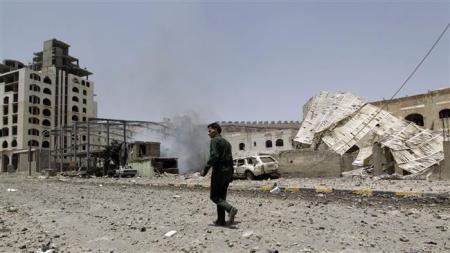
Saudi Warplanes have reportedly targeted the bureau of a major TV station in Yemen as Riyadh’s illegal aggression continues to take its toll on civilians.
According to reports on Thursday, Saudi fighter jets targeted the office of the al-Masirah TV, a major broadcasting service run by the Ansarullah Houthi movement.
The TV channel is regarded as the main source of information on Saudi Arabia’s aggression against Yemen, providing up-to-date coverage of the attacks and concomitant fatalities across the impoverished Arab country.
Meanwhile, Saudi warplanes continued to target several cities and areas in Yemen with the latest airstrikes targeting Salif air defense camp in Hudaydah, west of Yemen.
Elsewhere, in eastern Ma’rib province, Saudi warplanes launched air raids on an anti aircraft battalion. The presidential palace in Ta’izz was also pounded.
Earlier in the day, Saudi fighter jets bombarded different regions north of the capital Sana’a, while areas in the northern province of Sa’ada also came under attack.
Riyadh launched its airstrikes against Yemen on March 26 without a United Nations mandate. Saudi Arabia aims to undermine the Houthis and restore power to fugitive former president, Abd Rabbuh Mansour Hadi, who is a staunch ally of Riyadh.
The regime’s warplanes have repeatedly targeted residential areas across the country.
On April 21, Riyadh announced the end of the first phase of its unlawful military operations, which claimed the lives of nearly 1,000 people; but airstrikes have continued with Saudi bombers targeting different areas across the country in a new phase.
Official Yemeni reports say nearly 250 women and children have been killed so far.
Saudi Arabia training tribal ground force in Yemen – report
RT | April 30, 2015
In order to break the stalemate in the ongoing conflict in Yemen, Saudi Arabia has reportedly started training hundreds of Yemeni tribesmen to fight the Houthis on the ground, while Riyadh continues its bombardment campaign.
“You cannot win a war against the Houthis from the air – you need to send ground forces in, but now there’s a program to train tribal fighters on the border,” a Doha-based military source familiar with the matter told Reuters.
According to another Yemeni official source, some 300 fighters have already managed to return to Yemen after getting Saudi training. They were allegedly sent to the Sirwah district in the central Marib province to battle Houthis in the area. According to the source the newly trained unit managed to push the Houthis back.
Saudi Arabia’s coalition spokesman failed to either confirm or deny the reports.
“We always confirm that we are helping the resistance and the popular groups, the loyal army … but we cannot go into details on where, how, how much,”Brigadier Ahmed Asseri said.
The training received by the Yemeni tribesmen in Saudi Arabia allegedly includes light weapons and tactical advice knowledge. According to another Reuters source, the Kingdom plans to boost deployment of such units to fight the Houthis resistance.
Rhiayad is reportedly gathering all tribal leaders loyal to the ousted president Abd-Rabbu Mansour Hadi, who fled to Saudi Arabia, to unite their tribal forces against those of the Houthis.
“Saudi Arabia wants to unite tribal leaders in this meeting but the feeling is that there’s not much hope for that,” a Yemeni source in Riyadh told Reuters. Apparently the tribal delegations seem more concerned battling the jihadi elements in Yemen in addition to the Houthi opposition.
“The Saudis have decided that they are going to intensify the unstable situation by providing arms to an oppositional group, a group that has been traditionally oppositional to the Houthis,” Ajamu Baraka, Middle East expert told RT.
On the ground in Yemen, the Shiite Houthi fighting force and army units loyal to former president Ali Abdullah Saleh are in control of central and southern areas.
The fighting is ongoing on a number of major fronts. In Aden, the Houthis are engaging tribesmen who are supported by Saudi-led air forces. In Yemen’s third largest city, Taiz, Houthis are fighting the Sunni Islamist fighters. The Houthis and their allies have been also fighting both Islamists and local tribesman in Marib and in Shabwa provinces.
The forces in Yemen which Saudi Arabia is arming can turn jihadi, Baraka says, as they have some “traditional, Whabis, Islamic leanings,” which is the “main ideological, Islamic foundation for Al Qaeda.”
“The only force that is gaining as a consequence of this conflict is in fact Al-Qaeda,” he went on to stress.
Meanwhile, the airstrikes continued throughout the country on Wednesday, targeting Houthi forces in Aden, Saada, Hajja, Taiz, Ibb and Bayda.
Yemen suffers vital food and aid shortages as shelling continues
RT | April 28, 2015
Amid constant shelling by the Saudi-led coalition, Yemen is struggling to import even essentials such as food and water, with a UN-imposed arms blockade on Houthi fighters interrupting any deliveries to the country.
Speaking at UN Security Council closed-door consultations on the crisis in Yemen, the United Nations envoy to Yemen warned that UN arms embargo targeting the Houthis is having a collateral impact on aid deliveries.
“Implementation of the new targeted arms embargo … could inadvertently restrict the flow of much-needed commercial goods and humanitarian assistance to Yemen, including food, fuel and medical supplies,” Jamal Benomar told reporters after the briefing.
Around 10 vessels containing food supplies for Yemen are still waiting to enter the country’s ports, as many Yemeni sea outlets are now being cut off by Saudis who refuse to allow any international vessels to dock in Houthi-controlled areas.
According to the UN, the number includes three ships awaiting clearance at Hodeida, with one carrying 13,500 tonnes of rice. Another six ships carrying fuel, corn and construction products are awaiting clearance from the coalition to dock at the nearby Salifa port.
Yemen which imports more than 90 percent of its food, mainly by sea, has been struggling to feed the population for weeks. Earlier this month, Reuters reported that at least five merchant ships were not allowed to pass. Only two or three of those vessels have been able to offload their cargo, ship tracking data and shipping sources told Reuters.
“Ships with wheat need to wait up to five days for permission to enter. Several seem to be delayed,” a German commodities trade source told the news agency.
Aid deliveries have also been hindered by the Saudis who have now been engaging the Houthi forces from the air for over a month now.
Two Iranian cargo planes headed for Yemen were forced to turn back by Saudi Arabia last week. On Friday Iran’s Foreign Ministry summoned Saudi Arabia’s chargé d’affaires in Tehran to express its protest over the move.
“We consider all options for helping the Yemeni people and immediate dispatch of humanitarian aid and transfer of the injured,” Iran’s Deputy Foreign Minister for Arab and African Affairs Hossein Amir-Abdollahian said on Sunday.
The food that does eventually enter the war-torn country is being moved slowly around Yemen as shortages of fuel continues, United Nations’ World Food Programme said.
With a price tag of $10 per liter of petrol, hospitals are suffering the worst, with the UN humanitarian agency OCHA warning that fuel supplies to generate powers will dwindle for one more week before running out in two weeks time.
Prices for wheat products have also skyrocketed in the country and have risen by more than 40 percent since February. Medicine prices have risen by more than 300 percent, the UN said.
The humanitarian situation in Yemen has become catastrophic, humanitarian agencies said on Monday, as over 12 million people need help, according to UN figures.
“It was difficult enough before, but now there are just no words for how bad it’s gotten,” said International Committee of the Red Cross (ICRC) spokeswoman Marie Claire Feghali. “It’s a catastrophe, a humanitarian catastrophe.”
The lack of safe drinking water supply is also becoming a widespread problem in Yemen, a country of vast sand dunes and dessert.
“There’s a consensus on water sharing across the Middle East – since water is generally pretty scarce there. President Hadi cut the water budget by 70 percent and that was one of the many decisions that created the sentiment against him,” Danny Makki of the Syrian Youth Movement, told RT.
Meanwhile Yemen’s exiled government of President Ali Abdullah Saleh declared three areas in Yemen as “disaster” zone. Yemeni Human Rights Minister Izzedine al-Asbahi proclaimed that fighting in the country has “turned Yemen back 100 years,” due to the destruction of infrastructure. Provinces of Aden, Dhalea and Taiz, have suffered the most, al-Asbahi told a news conference in the Saudi capital Riyadh.
Since the Saudi-led bombings started on March 26, more than 1,000 people, including an estimated 551 civilians have been killed, the United Nations said last week. UNICEF said at least 115 children were among the dead.
“The impact on civilians is the major concern – a bombing campaign has been happening for over a month, and a hundred of killed civilians are children,” Joe Stork from Human Rights Watch told RT.
Commenting on Monday’s UN Security Council meeting, Russia’s UN envoy, Vitaly Churkin said that the warring parties have agreed on some measures in resolving the conflict.
“They [the warring parties in Yemen] agreed on a whole series of arrangements for settling the political crisis. The only remaining issue was the way the collective leadership would be structured,” Churkin told reporters.
Last Tuesday, Saudi Arabia said the first phase of the campaign, codenamed operation Decisive Storm, had achieved all of its goals and was concluded. The new phase, operation Restoring Hope, was announced with a focus on diplomacy, but didn’t rule out new airstrikes. Less than 24 hours later, airstrikes resumed with fighting continuing until this day.
Yemen factions close to deal before Saudi raid: Resigned UN envoy
Press TV – April 27, 2015
The recently resigned UN envoy to Yemen says Yemeni political factions were on the verge of a power-sharing deal when Saudi Arabia launched its military aggression against Sana’a.
Jamal Benomar told The Wall Street Journal on Sunday that Riyadh’s military campaign derailed the negotiations between Yemeni warring parties aimed at forming a unity government, which would have included Houthi Ansarullah fighters.
“When this campaign started, one thing that was significant but went unnoticed is that the Yemenis were close to a deal that would institute power-sharing with all sides, including the Houthis,” said Benomar, who spearheaded the negotiations until he resigned last week.
Benomar resigned on April 15 due to sharp criticism from Saudi Arabia and its allies for what they called his little success in influencing the political scene in Yemen in their favor.
Saudi Arabia launched its air campaign against Yemen on March 26 – without a United Nations mandate – in a bid to undermine the Houthi Ansarullah movement and to restore power to former fugitive President Abd Rabbuh Mansur Hadi, a staunch ally of Riyadh.
Hadi stepped down in January and refused to reconsider the decision despite calls by the Houthi Ansarullah movement.
However, the Ansarullah movement later said Hadi had lost his legitimacy as president of Yemen after he escaped the capital, Sana’a, to Aden in February.
On March 25, the ex-president fled the southern city of Aden, where he had sought to set up a rival power base, to the Saudi capital, Riyadh, after popular committees, backed by Ansarullah revolutionaries, advanced on Aden.
The Ansarullah fighters took control of the Yemeni capital in September 2014. The revolutionaries said Hadi’s government was incapable of properly running the affairs of the country and containing the growing wave of corruption and terror.
Benomar said that Houthi fighters had agreed to withdraw from the cities they were controlling under the deal that had been taking shape, and that the UN had worked out details of a new government force to replace them.
In exchange, Western-backed fugitive former President Abd Rabbuh Mansur Hadi would have been part of an executive body that would run the country temporarily, Benomar said.
The Houthis had agreed to that reduced role for Hadi until Riyadh launched its military aggression against Yemen, he said, adding this led to the Houthis’ opposition to any role for Hadi in government.
“A very detailed agreement was being worked out, but there was one important issue on which there was no agreement, and that was what to do with the presidency,” Benomar said, adding “We were under no illusion that implementation of this would be easy.”
Benomar is scheduled to address the UN Security Council behind closed doors on Monday and to report on the suspended political talks in Yemen.
On Friday, former Yemeni dictator Ali Abdullah Saleh urged all sides involved in the conflict in the impoverished country, including the Ansarullah fighters and forces loyal to Hadi, to “return to dialogue,” adding that he was ready to reconcile with all Yemeni political factions.
The 73-year-old former Yemeni leader, who stepped down in February 2012, further called on the army and security forces to come under the control of local authorities in each province.
Meanwhile, Saudi Arabia pushes ahead with its deadly air raids against neighboring Yemen.
According to latest figures released by the World Health Organization, the death toll from the violence in Yemen since late March has exceeded 1,000.
Embracing the Saudi War on Yemen
By Robert Parry | Consortium News | April 25, 2015
As the humanitarian crisis in Yemen worsens, the Obama administration seems less concerned about the plight of the desperate Yemeni people than the feelings of the Saudi royals who have spent the last month indiscriminately bombing a nearly defenseless Yemen, using high-tech U.S. jets and bombs to reportedly kill hundreds of civilians and damage its ancient cities.
On Friday, the Obama administration took credit for blocking nine Iranian ships from reaching Yemen with relief supplies, claiming that the ships may have carried weapons that the Yemenis could use in their civil war or to defend against Saudi attacks. President Barack Obama had dispatched a U.S. aircraft carrier fleet to the Yemeni coast to enforce an embargo that has helped the Saudis seal off the country from outside help.
A person closely involved with the Yemen crisis told me that the Iranian ships carried food and medicine, not weapons, but turned back to avoid the risk and humiliation of being boarded by the U.S. Navy. Meanwhile, Yemen, already one of the poorest countries in the Arab world, is facing shortages of basic supplies since the Saudis have cut off normal trade routes into Yemen.
Yet, despite the suffering of Yemen, the U.S. government appears more worried about the sensitivities of Saudi Arabia, one of the richest countries in the region. A Defense Department official, speaking anonymously, told the New York Times that it was “important that the Saudis know that we have an arm around their shoulders.”
Defense Department officials also acknowledged that they didn’t know what type of cargo was being transported aboard the Iranian ships, the Times reported. Though the Obama administration had touted the possibility that the Iranian ships carried weapons, the decision by Iran to avoid a confrontation may have reflected Tehran’s desire not to worsen relations with the United States and thus disrupt fragile negotiations over international guarantees to ensure that its nuclear program remains peaceful.
But the losers in this military/diplomatic maneuvering appear to be the Yemenis who, in effect, face a Saudi strategy of starving the country into submission with the help of the United States. While U.S. Ambassador to the United Nations Samantha Power built her public image as a “humanitarian interventionist” asserting a “responsibility to protect” vulnerable populations, she has said little about the Saudi role in Yemen’s humanitarian crisis.
In a statement on April 14, at the height of the Saudi bombing campaign, Power made no mention of the Saudi attacks or the hundreds of civilian dead from Saudi bombs supplied by the United States. She instead focused her denunciations on the Houthi rebels and former Yemeni President Ali Abdullah Saleh who have joined forces in a civil war that ousted sitting President Abd Rabbuh Mansur Hadi, who then fled to Saudi Arabia.
Power primarily blamed the Houthis, who “have intensified their military campaign, bombed Aden, and extended their offensive to Yemen’s south. These actions have caused widespread violence and instability that threaten the security and welfare of the Yemeni people, as well as the region’s security.”
Though the Saudi air force has bombed a number of cities including the ancient port city of Aden, Power ignored those attacks in her statement. But Power was not alone in her solicitousness toward the Saudis. On Friday, Secretary of State John Kerry even endorsed the Saudi bombing of Houthi targets in Yemen.
Who Are the Houthis?
The Houthis adhere to the Zaydi sect, an offshoot of Shiite Islam but one that is considered relatively close to Sunni Islam and that peacefully co-existed with Sunni Islam for centuries. But the Houthis have been resisting what they regard as government persecution in recent decades.
As revealed in leaked U.S. government cables and documented by Human Rights Watch, Yemen’s government used U.S. military aid to support an all-out assault against the Houthis in 2009. HRW said Yemeni government forces indiscriminately shelled and bombed civilian areas, causing significant civilian casualties and violating the laws of war. This repression of the Houthis led to an escalation last fall which ended with the Houthi rebels, who allied themselves with army forces loyal to ex-President Saleh, capturing Sanaa and other major cities.
After these victories, in private contacts with American officials, the Houthis indicated their readiness to take the fight to Al-Qaeda’s Yemeni affiliate. However, since the Saudi airstrikes began a month ago, “Al-Qaeda in the Arabian Peninsula” has taken advantage of the limitations on Houthi rebel movements by grabbing more territory in the east and overrunning a prison that held a number of Al-Qaeda militants.
The Saudi royals have a complicated relationship with Al-Qaeda including some princes who are viewed as important financiers of the terror group. The Saudis also promote the same extremist interpretation of Sunni Islam, known as Wahhabism. Now, instead of concentrating on the terror threat from Al-Qaeda, the Saudis have sought to portray the Yemeni civil war as a proxy assault in Saudi Arabia’s backyard by Shiite-ruled Iran.
In that propaganda effort, the Saudis have been helped by Israeli Prime Minister Benjamin Netanyahu who has relied on the powerful Israel Lobby and his own rhetoric to divert the U.S. Congress from a focus on Al-Qaeda and its hyper-brutal spinoff, the Islamic State, to Iran, which both Saudi Arabia and Israel have designated their primary regional enemy.
In his March 3 speech to a joint session of Congress, Netanyahu cited Yemen as one of the Mideast countries that Iran has been “gobbling up.” Many regional experts, however, considered Netanyahu’s assertion ludicrous given the Houthis’ reputation for stubborn independence.
For instance, former CIA official Graham E. Fuller called the notion “that the Houthis represent the cutting edge of Iranian imperialism in Arabia – as trumpeted by the Saudis” a “myth.” He added:
“The Zaydi Shia, including the Houthis, over history have never had a lot to do with Iran. But as internal struggles within Yemen have gone on, some of the Houthis have more recently been happy to take Iranian coin and perhaps some weapons — just as so many others, both Sunni and Shia, are on the Saudi payroll. The Houthis furthermore hate al-Qaeda and hate the Islamic State.”
But the Obama administration remains sensitive to Israeli-Saudi criticism of its efforts to negotiate a peaceful settlement of the Iranian nuclear dispute. So, to demonstrate that the Americans are comforting the Saudi royals with “an arm around their shoulders,” the U.S. government is embracing the Saudi bombardment of a largely defenseless country and is turning back ships carrying relief supplies.
~
Investigative reporter Robert Parry broke many of the Iran-Contra stories for The Associated Press and Newsweek in the 1980s. You can buy his latest book, America’s Stolen Narrative, either in print here or as an e-book (from Amazon and barnesandnoble.com).
Billionaire prince offers give one Bentley to each Saudi bomber for striking Yemen

The Bentley Continental GT (bentleymotors.com)
Press TV – April 23, 2015
Billionaire Saudi Prince al-Waleed bin Talal has vowed to give a free Bentley to every Saudi pilot that has taken part in bombardment of Yemen.
According to a Wednesday report by the Daily Mail, late Saudi King Abdullah’s nephew pledged to reward each of the 100 pilots a free Bentley, a British luxury automobile.
The Saudi business tycoon, one of the richest men in the world, reportedly made the pledge in a Twitter post that was later removed.
“To recognize the one hundred participating Saudi pilots I am pleased to present them with 100 Bentley cars,” read the post.
“I congratulate our wise leaders on the victory of ‘Operation Decisive Storm’ and the beginning of ‘Operation Restoring Hope’,” Waleed said.
Meanwhile the airstrikes, which have killed nearly 1,000 people continued against the impoverished country despite the fact that Riyadh declared an end to them on Tuesday.
Airstrikes continue
Saudi warplanes continued their air campaign in the seaport city of Aden in the early hours of Thursday.
They also conducted at least six airstrikes on the Manbeh region in Sa’ada province in northwestern Yemen.
On Wednesday, several other strikes hit the Arab world’s poorest country.
Saudi Arabia’s military campaign was launched without a UN mandate in a bid to undermine the Ansarullah movement and to restore power to the country’s fugitive former president, Abd Rabbuh Mansur Hadi, a staunch ally of Riyadh.
Saudi Arabia’s Disastrous War in Yemen
By Michael Horton | CounterPunch | April 22, 2015
In what has been three decades of ill-advised wars in the Middle East, Saudi Arabia’s war in Yemen may be the most ill-advised of them all. “Operation Decisive Storm,” the ironic name for Saudi Arabia’s aerial campaign in Yemen, has led to nothing decisive in Yemen beyond ensuring that the country remains a failed state and fertile ground for organizations like al-Qaeda in the Arabian Peninsula (AQAP). Long before the commencement of “Operation Decisive Storm,” Yemen, the poorest country in the Middle East, was grappling with a host of problems ranging from severe water shortages, food insecurity, and a moribund economy, to a long running multi-front insurgency. Saudi Arabia’s war in Yemen has exacerbated all of these problems and could well be the coup de grace for a unified and relatively stable Yemen.
On Tuesday April 21st, the government of Saudi Arabia abruptly announced that it was ending “Operation Decisive Storm” and that it would be scaling back its aerial campaign in Yemen. “Operation Decisive Storm” will be replaced with “Operation Restore Hope,” an unfortunate name for a military operation given that it was also the name for the US’ ill-fated 1992-3 intervention in Somalia. It is unclear what “Operation Restore Hope” aims to achieve; however, the first phase of Saudi Arabia’s war in Yemen has been disastrous.
According to the World Health Organization, more than 900 people have died in Yemen since the Saudi led aerial campaign against Yemen began on March 25th. In addition, one hundred and fifty thousand Yemenis have been displaced and the number of food insecure people has increased to more than twelve million. Due to the ongoing blockade of its ports—Yemen imports more than 90% of its food—prices for basic food items have soared and there are widespread shortages. In Aden, where temperatures routinely climb into the triple digits, most of the city of more than five hundred thousand has no access to water. Across the country, supplies of gasoline and gas have been exhausted. Hospitals, which were already struggling to cope with a lack of medicine and supplies, now have little or no fuel left to run their generators. Those patients in Yemen’s Intensive Care Units will likely die as their life saving machines are idled due to a lack of electricity.
AQAP has, so far, been the only beneficiary of Saudi Arabia’s war in Yemen. In south east Yemen, in the governorate of the Hadramawt, al-Qaeda in the Arabian Peninsula (AQAP) has taken over Yemen’s fifth largest city, Mukalla, and has also taken control of the city’s airport and port. “Operation Decisive Storm” targeted the Houthis, a Zaidi militia that is the sworn enemy of al-Qaeda. Saudi Arabia’s aerial bombardment also focused on those elements of the Yemeni Armed Forces that are allied with the Houthis and former Yemeni president Ali Abdullah Saleh. These same military units, including the Yemeni Air Force which has been largely destroyed, were also critical to fighting AQAP and its allies. “Operation Decisive Storm” has effectively neutralized the two forces that were responsible for impeding AQAP’s advance across large sections of southern and eastern Yemen.
So what did the Saudis hope to achieve with “Operation Decisive Storm?” The government of Saudi Arabia claimed that it launched military operations against Yemen to restore the now exiled government of Yemeni President Abd Rabbuh Mansur al-Hadi who fled Yemen for Saudi Arabia on March 25th.
However, the reinstallation of Hadi’s government, which had little support before he and his ministers openly called on the Saudis and their partners to bomb their own country, remains unlikely. Hadi, who was Saleh’s long serving vice-president, was chosen to be vice-president by Saleh for a reason: Hadi has no power base in the Yemen. Hadi is a southerner who has no ties to Yemen’s perennially powerful northern based tribes and as a southerner who sided with Saleh and the north in the 1994 civil war, he is regarded as a traitor by many in the south.
It is also important to note that the so called Hadi supporters who are fighting Houthi militias and their allies in south Yemen are fighting under the flag of the Peoples’ Democratic Republic of Yemen (PDRY). Most of those fighting in Aden and in other southern cities are not fighting for Hadi but for independence from the north due to a long list of unaddressed grievances. Up until a few months before his departure for Saudi Arabia, the security services under Hadi’s control were pursuing and arresting members of al-Hirak, the Southern Separatist Movement.
The second—and linked—goal of the Saudi led aerial campaign was to force the Houthis to disarm. This was as unlikely as the restoration of Hadi’s government. The Houthis have fought six wars against the Yemeni Armed Forces since 2004 and successfully fought off Saudi forces in 2009-10. While Saudi Arabia’s air war undoubtedly degraded some of the Houthis’ military capabilities and may have resulted in the loss of what is already arguably limited support for the Houthis and their allies, it in no way defeated the Houthis who have withstood far worse with far fewer resources than they now have.
After bombing Yemen for nearly a month and igniting what could be a prolonged civil war, the government of Saudi Arabia may have finally come to the conclusion that the only way forward for Yemen is through dialogue and negotiation. No one party or faction in Yemen is capable of asserting control over the country, even with the support of a regional power, be it Saudi Arabia or Iran. Former Yemeni president Ali Abdullah Saleh, a master of Machiavellian politics with an encyclopedic knowledge of Yemen’s tribes and clans, was never able to exert full control over Yemen. For much of his 33 years in power, Saleh was derisively referred to as the “mayor of Sana’a” because his writ did not extend much beyond the Yemeni capital. In many respects, Yemen can be described as an “asylum of liberty.” Power has historically been dispersed among various factions. This dispersal of power militates against strong centralized authority.
In an April 19th interview with Russia Today, Jamal Benomar, who resigned as the United Nations Special Adviser on Yemen on April 16th, claimed that negotiations between all parties in Yemen were ongoing and nearing a successful interim conclusion before the bombardment of Yemen began. In his rambling April 19th speech, Houthi leader, Abdul Malek al-Houthi, vowed not to surrender but also indicated that the Houthis remained open to negotiations. Yemen’s former ruling party, the General People’s Congress, and its former leader, Ali Abdullah Saleh, have both called for renewed negotiations.
Yemen has a rich corpus of traditions that, when allowed to function, can limit conflict and favor negotiated settlements. These traditions were in evidence during Yemen’s own popular uprising in 2011 which, while violent, did not, at that time, lead to the kind of brutally violent civil wars that have engulfed Libya and Syria. Saudi Arabia’s war in Yemen, if it continues, could upend many of these traditions and ensure that Yemen is the next Syria or Libya. At a minimum, the war has already led to the deaths of hundreds of civilians, destroyed critical infrastructure, impoverished thousands more Yemenis, and allowed AQAP to dramatically expand the areas under its control.
Yemen: The Little Army That Could
By Dr. Cesar Chelala | CounterPunch | April 21, 2015
In his book Century of the Wind, the late Uruguayan writer Eduardo Galeano tells how in 1927 the U.S. Marines landed in Nicaragua to quell a revolutionary revolt by Augusto César Sandino, who led a ragtag army of Nicaraguan peasants to fight the invasion. The Marines had gone to Nicaragua to protect the lives and properties of United States citizens.
Armed primarily with machetes and 19th century rifles, Sandino’s army fought the Marines, undergoing heavy losses in an enormously unequal fight. In November 1927, the Marines succeeded in locating El Chipote, Sandino’s mountain headquarters. However, when the Marines reached it, they found the place abandoned and guarded by straw dummies.
Despite massive efforts, American forces were never able to capture Sandino, and eventually, due in large part to the 1929 Great Depression, U.S. soldiers were withdrawn from Nicaragua following the 1932 Nicaraguan elections. As Alfonso Alexander, a Colombian journalist fighting in Sandino’s army said at the time, “The invaders were like the elephant and we the snake. They were immobility, we were mobility.” Chilean poet Gabriela Mistral called Sandino’s warriors, admiringly, Crazy little army.
There is an eerie resemblance between these facts and what is now happening in Yemen, the poorest country in the Middle East, where a small army of Houthi soldiers is fighting the combined forces of Saudi Arabia and its allies (the five Gulf Arab States and Jordan, Egypt, Morocco and Sudan), with the support of the U.S. The disproportion of forces between both sides would be laughable, if it weren’t tragic.
The Houthi rebels belong to a branch of Shia Islam known as Zaidism, and make up almost a third of the country. They have ruled the north of the country for almost a thousand years, until the 1960s. The rise of al-Qaeda in the Arabian Peninsula –whom they oppose- and their long-held feelings that the central government wasn’t sharing fairly the country’s resources led to their taking up arms and overtaking the government.
Considered a threat to the regime stability the Yemeni government waged brutal war against the Houthis in their stronghold in Sa’ada province, in the north of Yemen. Although their leader, Hussein al Houthi, was killed in the first war, he was replaced by his brother and current leader, Abdul Malik.
The Houthis rose to power because most Yemenis want a strong leader, with a clear vision about where the country should go. Both brothers were able to provide that vision that essentially encompasses the desire for government accountability, an end to corruption, fair fuel prices, job opportunities for ordinary citizens and a more fair distribution of resources.
The Houthis have been shown to be well organized and reliable. Since taking control of Sa’ada, their birthplace, they have made it one of the most peaceful and well-run areas in Yemen. The sound of gunfire has almost ceased now in Sa’dah, the Sa’ada Governorate capital city. Residents have electricity for most of the day and reliable water supply.
Since declaring control of Yemen on February 6, the Houthis have been advancing steadily south, in spite of heavy losses and constant bombardment by Saudi Arabia and its allies that have provoked a serious humanitarian crisis in the country.
Unrelenting air strikes have killed and injured thousands of people, many of them civilians, and thousands more have been forced to leave their homes and are desperately trying to find food and potable water. In April 18, 2015, Oxfam’s warehouse in Sa’ada containing humanitarian supplies has been hit and destroyed by an airstrike, leaving thousands of civilians without help.
A group of Yemeni scholars, residents and nationals of the UK and the U.S. have issued a statement regarding the situation in Yemen in which they state, “The military attack by Saudi Arabia, backed by the GCC states (but not Oman), Egypt, Jordan, Sudan, the UK and above all the USA, is into its third week of bombing and blockading Yemen… The targets of the campaign include schools, homes, refuge camps, water systems, grain stores, and food industries. This has the potential for appalling harm to ordinary Yemenis as almost no food or medicine can enter…Rather than contributing to the destruction of the country, the USA and UK should support a UN Security Council resolution demanding and immediate, unconditional ceasefire and use of their diplomatic influence to strengthen the sovereignty and self-government of Yemen. As specialists we are more than aware of the internal divisions within Yemeni society, buy we consider that it is for the Yemenis themselves to be allowed to negotiate a political settlement.”
Like the valiant Nicaraguan soldiers, Sandino’s “crazy little army”, there is no reason to believe so far that the Yemeni soldiers have other than their country’s peaceful survival in mind.
Dr. Cesar Chelala is a winner of an Overseas Press Club of America award and a national award on journalism from Argentina.
Hezbollah slams Saudi’s bid to buy silence on Yemen

Deputy head of Hezbollah’s Executive Council Sheikh Nabil Qaouq
Press TV – April 19, 2015
An official of Lebanon’s Hezbollah resistance movement has blasted Saudi Arabia’s bid to silence the group’s vocal opposition to its Yemeni aggression, saying Saudi money could not buy Hezbollah’s silence.
“Those who are waging an aggression against Yemen today have also mistaken their calculations and approach towards Hezbollah,” said the movement’s deputy head of executive council, Sheikh Nabil Qaouq, as quoted in a Sunday report by Lebanese Naharnet news website.
He further suggested that the Saudi regime was attempting to silence the group’s vocal opposition to its aggression against its neighbor adding, “They were betting on our silence and on neutralizing us, but they failed to realize that we do not fear threats and that we cannot be sold or bought.”
According to the report, Qaouq went on to emphasize that “Saudi money” can purchase “countries, the UN Security Council, presidents, princes and ministers” but “cannot buy Hezbollah’s silence.”
The development comes as Hezbollah’s Secretary General Sayyed Hassan Nasrallah and other leaders of the movement are locked in a rhetorical battle with the US-backed Saudi kingdom over Riyadh’s military attacks against Yemen.
“Saudi Arabia can threaten figures, dignitaries, scholars and Arab countries, but it cannot threaten the resistance,” Qaouq said, adding, “Their problem with us is that we cannot be bought or sold and we do not fear intimidation. It also lies in the growing role, status and influence of Hezbollah in the regional equations.”
Saudi Arabia’s air campaign against the Ansarullah fighters of the Houthi movement started on March 26 – without a United Nations mandate – in a bid to restore power to the country’s fugitive former president, Abd Rabbuh Mansur Hadi, a staunch ally of Riyadh.
According to reports, some 2,600 people, including women and children, have so far lost their lives in the attacks.
German court to hear evidence from Yemeni drone victim for first time
Reprieve | April 19, 2015
A court in Germany is set to take evidence from a Yemeni victim of the USA’s secret drone programme – in the wake of revelations that military bases on German soil play a key role in the strikes.
Faisal bin Ali Jaber, an environmental engineer from Sana’a who lost two relatives to a 2012 drone strike, has won the right to give evidence next month, as part of a constitutional claim filed in Germany.
The claim, filed in October last year by international human rights organisation Reprieve and its German partner, the European Center for Constitutional and Human Rights (ECCHR), seeks measures by the German administration to stop the use of German territory for illegal actions by the U.S. in Yemen. They argue that the German government is acting in breach of the German constitution by allowing the U.S. to use its air base at Ramstein for illegal drone attacks abroad.
Mr Jaber lost his brother-in-law Salim – a preacher – and nephew Waleed – a local police officer – to a US drone strike on the village of Khashamir on 29 August 2012. Salim often spoke out against extremism, and had used a sermon just days before he was killed to urge his congregation to reject Al Qaeda.
The case represents the first time that a court in a country which provides support to the US drone programme will hear from one of its civilian victims. The U.S.’ campaign of drone strikes – carried out in secret by the CIA and U.S. Special Forces – has come in for widespread criticism due to a lack of transparency and accountability. Many legal experts have argued that it violates both domestic and international law, while humanitarians have warned of the large number of civilians killed in the strikes.
Kat Craig, Legal Director at Reprieve and Mr bin Ali Jaber’s lawyer: “This is a crucial step in efforts to gain accountability for the civilian victims of secret US drone strikes. It also highlights that the US is not alone in this campaign – support is quietly provided by allies including Germany and the UK. Faisal’s story demonstrates how the misguided drone programme is not simply unacceptable, but deeply counterproductive. Not only is it killing civilians; it has even killed the very people who should be our allies in fighting extremism. Let’s hope this marks the start of some long overdue scrutiny of a programme characterised by secrecy.”
Andreas Schüller, Mr bin Ali Jaber’s attorney at ECCHR, said: “Germany must now take effective measures to stop the US from using Ramsteinn airbase for combat drone missions.”
Saudi claim of Iran arms flow to Yemen ridiculous: Official
Press TV – April 18, 2015
A senior Iranian military official has denounced as “ridiculous” Saudi Arabia’s allegation that Tehran is sending weapons to Yemen.
“This claim is ridiculous because everyone knows that it is Saudi Arabia which has procured different weapons through the US and is using them against the oppressed Yemeni nation today,” Chief of Staff of the Iranian Armed Forces Major General Hassan Firouzabadi told reporters on Saturday.
He added that Iran supports the Yemeni people because they have stood up for their civil rights, national sovereignty and independence.
He said Tehran supports an independent Yemen and a democratic Yemeni nation, saying the Yemenis are fighting against the enemies in a united way.
Firouzabadi emphasized that if the US and Saudi Arabia make an allegation against Iran, it is a “blame game.”
Iran has in numerous occasions denied as baseless reports that Tehran is sending weaponry for the the revolutionaries in Yemen.
Saudi Arabia started its military aggression against Yemen on March 26, without a UN mandate, in a bid to restore power to the former fugitive president, Abd Rabbuh Mansur Hadi, a close ally of Riyadh.
More than 2,600 people have been killed during the Saudi aggression so far.
In a letter to UN Secretary General Ban Ki-moon on Friday, Iran’s Foreign Minister Mohammad Javad Zarif submitted a four-point peace plan on Yemen in an attempt to end the bloodshed in the impoverished Arab country.
The plan calls on the international community to get more effectively involved in ending the senseless aerial attacks on the Yemeni people and establishing a ceasefire in the country.
Featured Video

Elijah Magnier: Yemen’s strikes are shattering Saudi Arabia’s long-term strategy
or go to
Aletho News Archives – Video-Images
From the Archives
British weapons and personnel doing much of the killing in Yemen
Press TV – June 18, 2019
A detailed report published by the Guardian newspaper has shown how Britain is massively contributing to Saudi Arabia’s devastating war on Yemen as it suggests that London is not only supplying the bombs that fall on Yemenis, but it provides the personnel and expertise that keep the war going.
The comprehensive report by Arron Merat published on Tuesday showed that Britain was doing much of the killing in Yemen as the country continues to provide Saudi Arabia with everything it needs to turn its southern impoverished neighbor into a graveyard.
“Every day Yemen is hit by British bombs – dropped by British planes that are flown by British-trained pilots and maintained and prepared inside Saudi Arabia by thousands of British contractors,” said Merat in the report. … continue
Blog Roll
 Aletho News
- Racist Seinfeld Dances for Joy as Bibi Unveils His New Map
- A West Bank War for Netanyahu’s Election Campaign, Could It Backfire?
- Yemen denounces European Parliament’s ‘hypocritical’ push to blacklist Ansarullah
- Qalibaf: UAE’s UN bid aims to ‘clear the runway’ for ‘Greater Israel’, whitewash genocide
- Pakistan reopens Iran border after boosting security: Report
- Why are so many Brazilians voting for Flávio Bolsonaro?
- Democrats Put Anti-Russia Agenda Ahead of American Workers
- Elijah Magnier: Yemen’s Strikes Are Shattering Saudi Arabia’s Long-Term Strategy
- Pentagon designates Chinese cultural centers national security threat
- Israel Demolishes Home Of Lebanese Journalist Whose Viral Film Exposed Pager Attack
- If Americans Knew
- An error has occurred; the feed is probably down. Try again later.
- No Tricks Zone
- Sudden Stratospheric Warming, Powerful El Niño Combination May Lead To Extreme Europe Cold, Energy Crisis!
- Two New Studies Find Thwaites Glacier Melt Cannot Be Driven By Human Activity Or A Warming Ocean
- E-Cars Reduce CO2 Emissions By Only 41% Compared To Internal Combustion Engine Vehicles
- Predictions Made By Renowned Climate Professor Over Past Decades Have Been Proven To Be Poor
- New Study Suggests Large Regions Of The Pacific Ocean Have Been Cooling For The Last 80 Years
- Germany’s Green Energy Debacle: High Energy Costs Force Kahla Porzellan to Close After 182 Years!
- New Study: 50 Years Of The Most Aggressive ‘Net Zero’ Policies Can Only Affect The Global Climate By 0.03°C
- US September “Heat” Was No Record…Many Records Set Decades Ago
- Latest European Green Energy Debacle; Portugal’s Largest Flagship Solar Park Insolvent!
- Green Energy Debacle: German Expert Professor Fritz Vahrenholt Warns Of Severe Economic And Social Consequences

