A new leader for the next phase of Palestinian resistance

Yahya Sinwar, head of the Palestinian Islamic movement Hamas ,in Gaza City on 14 April 2023 [Yousef Masoud/SOPA Images/LightRocket via Getty Images]
By Sayid Marcos Tenório | MEMO | August 20, 2024
The Palestinian Islamic Resistance Movement, Hamas, announced on 6 August the election of Yahya Sinwar as the new head of the movement’s Political Bureau, succeeding Ismail Haniyeh, who was assassinated in an Israeli terrorist attack in Tehran. Haniyeh was in the Iranian capital to attend the inauguration of President Masoud Pezeshkian.
Sinwar is one of the most prominent figures in the Hamas political sphere, known for his heavy hand and for making big changes. His unanimous election is a strong message that Hamas has become stronger and more resilient despite the severe blow it received from the political murder of Haniyeh. The movement expressed its confidence in Sinwar, known as Abu Ibrahim, to lead this new delicate phase in a complex local, regional and international context.
Known for his steadfast leadership style and his resistance-focused approach to the occupation state, Sinwar has played a crucial role in shaping the resistance movement’s strategies and managing Gaza’s complex political and social relations.
Hamas wanted a replacement for Haniyeh who would send strong messages to the enemies of the Palestinian people.
Sinwar was elected head of the Hamas Political Bureau in Gaza in February 2017, also succeeding Ismail Haniyeh. He was re-elected for a second term in 2021. He led the Great March of Return in 2018, a peaceful attempt to break the siege of Gaza, as well as the Sword of Al-Quds campaign in 2021. He has also played a prominent role in strengthening relations with the axis of resistance.
The new political bureau head was the mastermind and commander of the epic Al-Aqsa Flood, which has lasted more than 300 days. In a speech at the commemoration in Gaza on 14 December 2022 of the 35th anniversary of the creation of Hamas, he foreshadowed the events of 7 October when he declared: “We will come to you [Israel], God willing, in a thunderous flood. We will go against you with endless rockets, we will go against you in an endless onslaught of combatants, we will go against you with millions of our own, like an endless tide.”
The other Palestinian factions and leaders of the axis of resistance expressed their support for Sinwar’s election, demonstrating confidence in his ability to overcome the loss of Haniyeh and to continue his legacy and that of all the martyred leaders, especially those who fell during Al-Aqsa Storm.
Yahya Sinwar was born in 1962 in the Khan Younis refugee camp in the Gaza Strip after his family was ethnically cleansed from the city of Majdal Asqualan (“Ashkelon”) by the Zionists in the 1948 Nakba. He completed his secondary education at Khan Younis Boys Secondary School. He then earned a bachelor’s degree in Arabic from the Islamic University of Gaza, where he was one of the leaders of the Student Council for five years, serving as Secretary of the Artistic Committee, then of the Sports Committee, Vice-President, President of the Council, and then Vice-President again from 1982 to 1987.
He began his political activity in his youth, leading numerous popular clashes against the Zionist occupation state between 1982 and 1988. His participation was instrumental in the founding of Majd, the Hamas internal security apparatus tasked with exposing Israeli spies. Along with Salah Shehada, he was one of the founders of the Hamas military wing, the Izz Ad-Din al-Qassam Brigades, in 1991.
Arrested by Israel in 1982, Sinwar spent six months in Fara’a Prison for his resistance activities. In 1988, he was arrested again and given four life sentences, serving 23 consecutive years in the enemy’s prisons.
He spent four years being held in solitary confinement.
In prison, he repeatedly assumed leadership of the Hamas prisoners’ High Command, leading a series of hunger strikes, with significant examples in 1992, 1996, 2000 and 2004. He learnt and still speaks fluent Hebrew and has numerous writings and translations related to political and security issues.
He translated the books Shabak Among the Remains and Israeli Parties in 1992, for example, and authored Hamas: Experience and Mistakes and Al-Mayd, which documents the work of the occupation state’s Shin Bet internal security agency. He is also the author of a novel, Thorns and Carnations, which covers the experience of the Palestinian struggle from the 1967 Naksa to the First Intifada (1987-1993).
After his release in 2011 under the prisoner exchange deal which saw 1,027 Palestinian prisoners freed in exchange for Israeli soldier Gilad Shalit, he was elected to the Hamas political office in Gaza and assumed responsibility for the security cabinet in 2012. He was later elected to the general political office and assumed responsibility for the military cabinet in 2013.
Now, the legitimate resistance for the liberation of the historic land of Palestine from occupation, with Jerusalem as its capital, continues under the leadership of Yahya Sinwar, a selfless anti-colonial, anti-occupation fighter.
Iran Hawks’ Hacking Claims Designed to Distract Americans, Set Stage for New Regional War
By Ilya Tsukanov – Sputnik – 20.08.2024
After nearly a year of efforts to taunt, provoke and intimidate Iran into a full-on regional war in the Middle East amid the Gaza crisis, Iran hawks in Washington have turned to a new strategy, accusing Tehran of interfering in the upcoming US presidential election. A respected Middle Eastern affairs scholar explains what’s behind the new approach.
The FBI, the US Cybersecurity and Infrastructure Security Agency and the Office of the Director of National Intelligence formally accused Iran of attempting to hack the Trump and Biden-Harris presidential campaigns on Monday.
The new allegations, which came weeks after a series of reports in US media citing “anonymous intelligence sources” claiming that Iran was plotting to assassinate Donald Trump, or to hack his presidential campaign, were not accompanied with any evidence.
“As the lead for threat response, the FBI has been tracking this activity, has been in contact with the victims, and will continue to investigate and gather information in order to pursue and disrupt the threat actors responsible. We will not tolerate foreign efforts to influence or interfere with our elections, including the targeting of American political campaigns,” the US intel agencies said in a joint statement.
Iran calmly rejected the US’s “unsubstantiated” and evidence-free claims.
“Such allegations are unsubstantiated and devoid of any standing. As we have previously announced, the Islamic Republic of Iran harbors neither the intention nor the motive to interference with the US presidential election,” the country’s permanent mission to the United Nations said in a statement.
“Should the US government genuinely believe in the validity of its claims, it should furnish us with the pertinent evidence – if any, to which we will respond accordingly,” the mission added.
Dangerous Distraction Action
“There is little doubt that the rhetoric itself has more impact than the substantiation of these accusations,” Dr. Mehmet Rakipoglu, a political scientist and international affairs observer and assistant professor at Turkiye’s Mardin Artuklu University, told Sputnik.
“Creating artificial agendas such as [the Iran hacking claims] intensifies hostilities between the parties involved. This accusation seems to be aimed at diverting attention from Israel’s actions in Gaza and refocusing it on the US election process,” Rakipoglu added, pointing out that Tel Aviv has been bogged down by accusations of engaging in genocide against Gaza’s civilian population, while proving unable to defeat Hamas militarily.
“It is already clear that the American public is deeply divided, regardless of whether there is an alleged Iranian attack. It is not Iran or any other external actor that is responsible for these divisions, but rather the US administrations themselves,” the academic said.
Rakipoglu stressed that, conveniently for the accusers, there’s virtually no way to verify the US intelligence agencies’ allegations, or conversely, prove that or Iran, or any other country, has interfered in the US election.
In some sense, the claims against Iran this election cycle are reminiscent of similar allegations made against Russia ahead of, during and following the 2016 vote, Rakipoglu said.
“While the US propagated a narrative of Russian interference during the 2016 elections, it continued to lose influence over time. It seems that the current accusation against Iran serves the same purpose as the allegations against Russian interference in 2016,” the observer said.
If that’s the case, it could signal a dangerous turn for Iran, and the Middle East in general. The 2016 Russian meddling allegations sparked a deep downturn in Russia-US relations, with the Russiagate conspiracy hounding Donald Trump throughout his term in office, blocking his ability to restore any semblance of normal ties with Moscow, and ultimately manufacturing consent among a substantial portion of the US electorate for the NATO-Russia proxy conflict in Ukraine which began in 2022.
Democratic Party platform lacks call for US arms embargo on Israel
Press TV – August 20, 2024
The US Democratic Party has unveiled its party platform ahead of the 2024 presidential race, laying out 92 pages of policy priorities with no mention of halting weapons sales to Israel amid the regime’s genocidal war in the besieged Gaza Strip.
The platform which was approved by delegates at the Democratic National Convention (DNC) in Chicago a day earlier lacks a call for curbing arms sales to Israel despite a demand by pro-Palestinian demonstrators for an arms embargo on the occupying regime in the US city.
The platform, rather, announces that the 2016 Memorandum of Understanding (MOU) reached with Israel under former President Barack Obama “is ironclad”. The memorandum which runs until 2028 gives Israel $3.8bn in US military aid each year.
The platform also lists examples of US President Joe Biden’s unwavering support for Israel’s war on Gaza, including the sending of arms shipments and providing a diplomatic shield for Israel at the United Nations during votes for a ceasefire.
The latest development comes a week after Biden’s administration approved more than $20 billion in weapons sales to Israel.
The new US military aid comes despite claims by Washington that it is supporting a ceasefire in Gaza where Israel has been waging a genocidal war since early October last year.
Israel launched the war on Gaza on October 7 after the Palestinian resistance movement Hamas waged the surprise Operation Al-Aqsa Storm against the occupying entity in retaliation for its intensified atrocities against the Palestinian people.
Since then, the United States has supplied the Tel Aviv regime with more than 10,000 tons of military equipment and used its veto power against all United Nations Security Council resolutions that called for an immediate ceasefire in Gaza.
The occupying regime has killed more than 40,000 Palestinians, mostly women and children, since the start of the barbaric campaign of death, destruction and genocide. And more than 1.7 million people have been internally displaced.
Independent Journalist Arrested Under Terrorism Act in UK

By Ian DeMartino – Sputnik – 20.08.2024
Independent Journalist Richard Medhurst was arrested in the UK on Thursday under the UK’s Terrorism Act 2000, according to a video he posted Monday on X recounting the experience.
“On Thursday, as I landed in London’s Heathrow airport, I was immediately escorted off the plane by six police officers who were waiting for me at the entrance of the aircraft. They arrested me – not detained – they arrested me under Section 12 of the Terrorism Act of 2000 and accused me of allegedly ‘expressing an opinion or belief that is supportive of a proscribed organization’ but wouldn’t explain what this meant,” Medhurst says in the video.
Section 12 of the Terrorism Act 2000 has a clause that was added in 2019 that made it illegal to “expresses an opinion or belief that is supportive of a proscribed organization” if “in doing so is reckless as to whether a person to whom the expression is directed will be encouraged to support a proscribed organization.”
Medhurst’s reporting has focused heavily on the Israeli-Gaza war and has spoken out against funding Ukraine. He also posted about the very act that he was arrested for.
“The fascist ‘terrorism act’ being used to hold activists without charge or trial because they tried to stop actual terrorism and genocide by the IDF,” Medhurst posted the same day he was arrested. Medhurst was referring to Palestinian activists who have been detained recently under the Terrorism Act.
Medhurst says he was then handcuffed and transferred to a police station where he was searched and his electronic devices seized.
“I was placed in solitary confinement, in a cold cell that smelled like urine. There was barely any light and the bed, if you can even call it a bed, was simply a small concrete ledge with a paper-thin mattress. The cell had no windows, no heating, no toilet paper. I was recorded 24/7 with audio and video, even when going to the toilet. I had to eat food with a piece of cardboard you’re supposed to fold in two in order to scoop up the meal,” Medhurst said, describing the conditions he was held in.
He was then held for nearly 24 hours without being allowed to contact his family and his attempts to speak to a solicitor (UK legal advisor) were hindered and possibly monitored.
“The police said that I have the right to inform someone that I’m locked up. So I said okay, I want to call my family, then they go ‘Well, your calls are withheld due to the nature of the alleged offense’ I tried to ask well, what’s the point of a right if you can just randomly withdraw it? Why tell me that I have this right at all? And one of them said something along the lines of ‘Well, it’s not an absolute right, it can be waived,’” Medhurst described.
“For many hours, no one in the world knew what had happened to me or where I was. Only the police could call a solicitor for me. I had to ask four or five different guards for several hours before I finally received a call. Some of my solicitor’s calls did not get through or were not answered. One of the calls -my solicitor was told- would be monitored, and so they simply refused to take it. I asked to speak to the solicitor afterwards when that happened but I was not allowed to.”
“In total, I spent almost 24 hours in detention. At no point whatsoever was I allowed to speak to a family member or friend. After waiting 15 hours, I was finally interviewed by two detectives,” Medhurst says the interview lasted 60 to 90 minutes.
Medhurst emphasized that he denies all accusations by the police, noting that his parents held Nobel Peace Prizes for their work as UN peacekeepers and he “categorically and unequivocally” condemns terrorism.
“Those like myself, who are speaking up and reporting on the situation in Palestine are being targeted. I had booked my ticket to London on the same day and yet an entire team of police were mobilized to arrest and question me. This is why I felt this was a preplanned, coordinated arrest. Many people have been detained in Great Britain because of their journalism, sometimes under the Terrorism Act, sometimes not. I think of Julian Assange, Craig Murray, Kit Klarenberg, David Miranda, Vanessa Beeley. As far as I am aware, I am the only journalist, however, to have been arrested and held for up to 24 hours under section 12 of the Terrorism Act.”
Medhurst said that he now feels he has a “muzzle” put on him, and does not know if he will be charged with the crime he was arrested for or if he will be put in jail in a few months, something that makes his work more difficult. “I simply do not know if or how I can work at all during the next month.
Former UN weapons inspector and geopolitical analyst Scott Ritter, whose house was raided by the United States FBI earlier this month for alleged violations of the Foreign Agents Registry Act, called the arrest “political persecution” designed to “hamper [Medhurst’s] important work as a journalist.”
“Freedom of the press, freedom of speech really are under attack. The state is cracking down and escalating to try and stop people from speaking out against our government’s complicity in genocide, please do not just stand with me, but with the others who are still inside,” Medhurst concluded.
UK authorities have not commented on Medhurst’s arrest. His website currently displays an error page but it is not clear if Medhurst removed it voluntarily, at the direction of UK authorities, or if the site was taken down by service providers. Sputnik has reached out to Medhurst for clarification and will update this space if he replies.
Majority of Jewish Israelis oppose prosecution of soldiers for raping Palestinian detainees: Poll
The Cradle | August 19, 2024
A new poll conducted by the Institute for National Security Studies (INSS) at Tel Aviv University has revealed Israeli Jews’ opinions regarding whether Israeli soldiers should be prosecuted for raping Palestinian detainees and whether Israel should launch a wide-scale war against Hezbollah and Iran.
The poll asked a question regarding the five soldiers recently accused of torturing and sexually assaulting a Palestinian detainee at the notorious Sde Teiman camp.
The poll stated, “If it is found that there is a basis for suspicion against the five suspects, how should they be treated?”
A large majority of Israeli Jews, 65 percent, responded, “They should be disciplined at the command level only.”
In contrast, only 21 percent said they should be prosecuted. The remaining 14 percent said, “I don’t know.”
The poll also asked, “Do you think Israel should or should not obey international law and maintain moral values in war?”
In response, 47 percent of Israeli Jews said the army “Doesn’t have to obey.” Only 42.5 percent said it “Must obey.” The remaining 10.5 percent said, “I don’t know.”
The poll also asked, “What do you think Israel’s response to Hezbollah’s attacks should be?”
In response, 52 percent of Israeli Jews said, “Israel must initiate broad military activity even at the cost of regional war.”
This included the 27 percent who said the regional war should also include “the occupation and certain control of the territories of southern Lebanon.”
In contrast, 17 percent of Israel Jews responded that “Israel should respond locally to all attacks and avoid an escalation and deterioration into a wide-scale war as much as possible.”
A further 26 percent of Israeli Jews said, “Israel should initiate military activity limited to harming Hezbollah.”
The poll further asked, “Under the current circumstances, is it advisable for Israel to take direct military action against Iran?”
In response, 52 percent of Jewish Israelis answered positively with “yes” or “I think so.”
In contrast, 37.5 percent said “no” or “I don’t think so.” The remaining 17.5 percent said they didn’t know.
In another question, the poll asked, “What worries you more, security threats to Israel from outside, or socio-religious tensions within Israel?”
In response, 39 percent said security threats to Israel from outside worry them more. Some 51 percent said socio-religious tensions within Israel are more worrying.
Colombia bans coal exports to Israel
MEMO | August 19, 2024
Colombia’s President Gustavo Petro signed a decree banning coal exports to Israel, Bloomberg reported, adding that this is an effort “to pressure the government of Prime Minister Benjamin Netanyahu to end the conflict in Gaza.”
The Columbian president said that Israel uses Colombian coal to make bombs to kill Palestinian children.
Since the beginning of the war on Gaza, the Colombian president has repeatedly stressed that Israel is committing genocide, calling on the world to put an end to Netanyahu’s violations.
At the end of February, Petro announced the suspension of arms purchase deals from the occupation, following the flour massacre in Gaza when 118 Palestinians were martyred while waiting for an aid convoy near the Nabulsi roundabout in the northern Gaza Strip.
Petro also announced in May that his country has severed its diplomatic relations with Israel and that the countries of the world should not be passive towards what is happening in Gaza.
Colombia is Israel’s biggest coal supplier, having sold it about $450 million of the fuel in 2023, according to Bloomberg News.
It had suspended coal exports in June.
Hamas reveals details of latest US proposal for Gaza ceasefire: Report
The Cradle | August 18, 2024
Sources in the Hamas movement revealed details of the newest US proposal for a Gaza ceasefire between the Palestinian resistance movement and Israel, Al-Sharq newspaper reported on 18 August.
An official source in the movement told Al-Sharq that the US proposal included reducing the presence of the Israeli army on the strategic Gaza-Egypt border area known as the Philadelphia Corridor but not a full withdrawal of the Israeli army. The proposal also included the returning management of the Rafah crossing to the Palestinian Authority (PA) under Israeli supervision.
The source added that the US proposal also includes allowing Israel to monitor displaced Palestinians at the Netzarim Corridor as they return to the north of Gaza.
Washington’s proposal also includes deporting outside of Palestine a large number of Palestinian prisoners who will be released by Israel in the exchange deal, according to a source in the Hamas movement.
The source also pointed out that the proposal gives Tel Aviv the right to refuse the release of at least 100 Palestinian prisoners now held in Israeli prisons in any exchange for the remaining Israeli captives held by Hamas.
The US proposal additionally states that “a permanent ceasefire will be discussed in the second phase within a specific limit, and if Hamas does not agree to the Israeli demands, the army will return to the war and carry out its military operations,” according to the source.
He explained that according to the proposal, an agreement on the reconstruction of Gaza and lifting of the 17-year blockade on the enclave would be discussed only after the implementation of the first phase of the deal.
The US proposal comes as Israel continues to carry out regular massacres of women and children in Gaza and amid reports that Israeli Prime Minister Benjamin Netanyahu is seeking to sabotage a possible ceasefire deal.
Documents cited by the New York Times (NYT) on 13 August confirmed that Netanyahu has continued to add new conditions to Israel’s demands each time a deal for a ceasefire is close to being reached.
The unpublished documents show that Israel “relayed a list of new stipulations in late July to American, Egyptian, and Qatari mediators that added less flexible conditions to a set of principles it had made in late May,” NYT reported.
It added that the documents “make clear that the behind-the-scenes maneuvering by the Netanyahu government has been extensive.”
Hamas has stated that Netanyahu continues to delay a ceasefire agreement to give the Israeli army more time to kill Palestinians and destroy homes and infrastructure in Gaza. The resistance movement called in a statement on 12 August for mediators to push Israel into accepting the proposal it had agreed to in early July, which was an updated version of Biden’s May proposal.
“We demand that the mediators submit a plan to implement what they presented to the movement and that we agreed to on 2 July 2024, based on Biden’s vision and the Security Council resolution, and oblige the occupation to do so, instead of going to more rounds of negotiations or new proposals that provide cover for the occupation’s aggression and give it more time to perpetuate the war of genocide against our people,” Hamas said on 11 August.
This week, the number of Palestinians killed by Israel in Gaza exceeded 40,000, according to the health ministry. The number may be much higher due to indirect deaths from the destruction of Gaza’s health and sanitation infrastructure and due to those people who remain missing, buried under the rubble of buildings and homes destroyed by Israeli bombs.
Hamas responds to Doha proposal, says Netanyahu ‘obstructing’ ceasefire deal
Press TV – August 18, 2024
Hamas has squarely blamed Israeli Prime Minister Benjamin Netanyahu for the failure to reach a ceasefire agreement in Gaza, following two days of talks in Doha that concluded on Friday, in which the Palestinian resistance movement did not participate
Hamas gave its official response in a statement on Sunday after reviewing the outcomes of the negotiations, mediated by Qatar and Egypt as well as the United States.
Hamas called on the mediators to present a concrete plan to implement the proposals agreed upon on July 2, emphasizing the need to avoid a continuous cycle of stalled negotiations due to Netanyahu’s delaying tactics and new conditions.
The resistance movement accused Netanyahu of employing a strategy to buy time and prolong the aggression in Gaza.
“We became certain that Netanyahu is still putting obstacles in the way of reaching an agreement,” Hamas said in its statement.
The group emphasized that the latest proposal presented during the talks aligns with Netanyahu’s conditions, which notably include his rejection of a permanent ceasefire and any withdrawal from Gaza.
The resistance movement highlighted that the proposal also reflects Netanyahu’s insistence on maintaining control over strategic areas of Gaza, including the Netzarim Junction, the Rafah Crossing, and the Philadelphi Corridor.
Furthermore, Hamas criticized the new conditions that Netanyahu imposed on the prisoner exchange negotiations.
“We hold Netanyahu fully responsible for thwarting the mediators’ efforts and obstructing the path to an agreement,” it reiterated.
Hamas asserted that they have approached the mediation efforts in Qatar and Egypt responsibly, and have considered all proposals intended at stopping the aggression against Palestinians and concluding a prisoner exchange deal.
This approach, Hamas noted, is driven by a desire to spare the blood of their people and end the ongoing violence and genocide against Palestinian civilians in the Gaza Strip.
The movement also reaffirmed its commitment to what it agreed upon on July 2, which was outlined by US President Joe Biden at the end of May and approved by the UN Security Council.
“We call on the mediators to fulfill their responsibilities and oblige the occupation to implement what has been agreed upon,” it added.
The latest round of ceasefire talks on Gaza concluded in Doha without a breakthrough on Friday, but a new date has been set for further discussions next week.
A statement from the White House, issued by co-mediators Qatar and Egypt, described a fresh proposal that they said builds “on areas of agreement” and seeks to bridge remaining gaps, allowing for “a swift implementation of the deal.”
In a separate statement late Friday, President Biden expressed optimism about a deal, saying that the “bridging proposal” provides a foundation for a final agreement on a ceasefire and a prisoner exchange deal.
Despite the optimistic tone, dozens of rounds of indirect talks between Hamas and Israel have failed to produce an agreement since a short-lived truce collapsed in December.
The mediation efforts have suffered several setbacks, chief among them the assassination of Hamas’ political leader and chief negotiator, Ismail Haniyeh, in an Israeli strike in Tehran late in July.
The Cradle’s Instagram page ‘permanently banned’ over pro-Palestine content
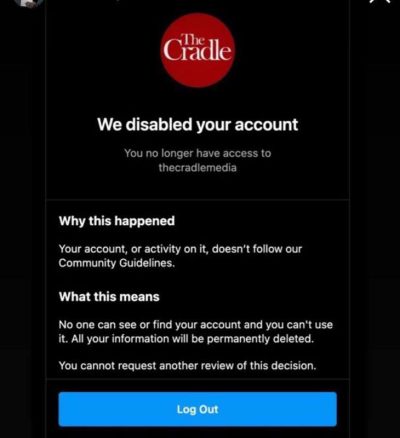
The message that The Cradle team received from Instagram
Press TV – August 18, 2024
In yet another instance of censorship targeting alternative media outlets, Instagram has blocked the page of The Cradle, a journalist-driven news website covering West Asia.
Owned by Meta Platforms Inc., formerly Facebook Inc., Instagram claimed the page was “disabled” for not “following our community guidelines,” without specifying which guidelines were violated.
The Cradle’s social media team was informed that they “cannot request another review of the decision,” effectively making the suspension indefinite.
“No one can see or find your account and you can’t use it. All your information will be permanently deleted,” the message added.
A senior member of The Cradle team took to social media to condemn the censorship.
“This, my friends, is what happens when you amplify the voice of the resistance,” wrote the journalist, referring to the “permanent Meta ban.”
“We are proud of our work and its overwhelming reach, and none of it was in vain. Returning to Meta seems impossible at the moment, but please stay with us on X, Telegram, and YouTube.”
The Cradle has extensively covered Israel’s genocidal war against Palestinians in the Gaza Strip since October 7, 2023, highlighting both the regime’s war crimes and the complicity of Western states.
Its social media presence and following have also grown over the past year amid the war on Gaza.
According to rights groups, social media giants, particularly Meta-owned platforms, have engaged in systemic, global censorship of pro-Palestinian content since the genocidal war began last year.
At least three of Meta’s most senior leaders are believed to have close ties to Israel, including Chief Information Security Officer (CISO) Guy Rosen, who also served in the Israeli military’s Unit 8200.
Mark Zuckerberg, Meta founder and CEO, and Sheryl Sandberg, a Meta board member, have also been involved in pushing Israeli propaganda, including the discredited “Hamas October 7 mass rape” hoax, Paul Biggar, a New York-based software engineer and founder of Tech for Palestine, told the Press TV website in a May interview.
In October last year, days after the genocidal war on Gaza was launched, Meta removed the largest Palestinian news page, Quds News Network, on Facebook.
In February, Meta removed the English-language accounts belonging to the Leader of the Islamic Revolution Ayatollah Seyyed Ali Khamenei on Instagram.
It came on the day when the Leader said the genocide in Gaza was a tragedy for the entire humanity.
Press TV has also faced multiple bans on various social media platforms, including Instagram, Facebook, and X, for its pro-resistance coverage, both before and after Operation Al-Aqsa Storm.
US universities impose ‘police state’ rules to prevent campus protests over Gaza war
Press TV – August 18, 2024
US universities have imposed “police state” rules to avoid a repeat of campus protests against Israel’s genocidal war on Gaza, with students and faculties warning of the chilling effect they would have on free speech.
Reports indicate that as summer break ends, university administrations across the United States are imposing tougher measures to avoid a new wave of campus protests, which led to nationwide police crackdowns on campuses last semester.
Large protest encampments set up last semester eventually ended after a nationwide police crackdown on campuses in different US universities led to more than 3,100 arrests.
Scores of students faced criminal charges and disciplinary measures, and several schools scaled back graduation ceremonies for protesting against the Israeli war which has killed more than 40,000 Palestinians so far.
Columbia University students, who were at the vanguard of the movement, may encounter the most changes.
The university president, Minouche Shafik, resigned this week in the wake of criticism for her handling of the protests, but not before overseeing the installation of fencing around the lawns of the school’s quad – the heart of campus life and the site of large protest encampments.
According to the Wall Street Journal, university administrators are also considering bringing in “peace officers” with the authority to arrest students – something Columbia’s current 290 security personnel cannot do.
In an email sent to students last month, the administration also announced a “color-coded campus status” system, with varying levels of access restrictions “based upon the potential disruption to our academic mission and/or campus operations.”
To further confront protesting students, some universities have banned the use of “event tents, tables, walls, outdoor displays, inflatables, freestanding signs, huts, sculptures, booths, facilities, flashing or rotating lights, illuminated signs, or similar objects and structures.”
Students say despite new draconian rules the pro-Palestine rallies will continue as long as Israeli atrocities go on in occupied Palestinian lands.
“The war is still there … nothing has changed in Palestine,” said Jonathan Ben-Menachem, a sociology PhD student who participated in the Columbia University students’ campus protests.
He said universities’ efforts to quash the protests when students return from summer vacation will fail.
“It’s going to be more of a police state than it was, but I don’t think that means no one’s going to do anything,” the graduate student pointed out.
Human rights advocates and student activists as well as university faculty members have sounded the alarm about the new policies, warning that the restrictions in addition to endangering free speech, run counter to educational institutions’ mission to foster debate, risk deepening tensions on campuses, and – in the case of public universities – may run foul of schools’ constitutional obligations.
Last week, the American Association of University Professors issued a statement condemning the harsh anti-protesting rules at universities.
The tougher new rules “impose severe limits on speech and assembly that discourage or shut down freedom of expression”, wrote the group, which represents more than 44,000 faculty members nationwide.
“Those who care about higher education and democracy should be alarmed.”
Israel’s creation and exploitation of Palestinian human shields
By Ramona Wadi | MEMO | August 17, 2024
How many times have Israeli officials justified massacring Palestinian civilians because Hamas uses them as human shields? Israeli media has now reported the opposite – the Israeli Defense Forces (IDF) using Palestinian civilians as human shields in areas slated for incursion. “It is better that they explode and not the soldiers,” an Israeli soldier was told by an IDF commander. According to testimonies given to Haaretz by soldiers, senior IDF staff are aware of the practice.
In Israeli narratives of Palestinian human shields, the context is completely stripped away. There is no mention of the fact that Gaza is blockaded, that people have no way out and that a densely populated strip of land is home to both civilians and the resistance movement, including their weapons. Israel using the term “human shields” to describe Hamas’s limitations in terms of resistance in Gaza is not only misleading, but also completely wrong. It is Israeli colonial violence that has created Palestinian human shields.
After creating Palestinian human shields, Israel found a way to use them. First, to build its narrative justifying each aggression against Gaza. In the genocide, Israel used Palestinian human shields to save the lives of soldiers tasked with killing Palestinians in Gaza.
While Israel’s colonial narrative deems Hamas a terror group, it is interesting to note how the Israeli media specified that the human shields used by the IDF “are not terror suspects”. The phrase itself speaks volumes about Israel’s genocidal intent and action in Gaza – every Palestinian is a target, not just Hamas. Palestinian civilians, Israeli media reported: “Are detained specifically to be sent into buildings and tunnels that troops believe may be booby-trapped.” Briefly, the IDF will explore any avenue to kill Palestinians in one way or another, and human shields make for convenient collateral damage for Israel, which doesn’t even need to justify its atrocities, not even in genocide, thanks to the impunity the international community bestowed upon the settler-colonial entity.
“These are just reports at this point,” US State Department spokesperson Vedant Patel stated in reply to reporters’ questions about Israel using Palestinian civilians as human shields. Yet the Haaretz report quotes Israeli soldiers confirming the IDF’s knowledge, which points to a practice legitimised by Israeli military officials.
Patel, however, found it pertinent to mention the Israeli propaganda, which states Hamas uses civilian infrastructure to operate from, as well as using civilians as human shields. “That is not hyperbole,” he added. There has never been greater hyperbole than Israel’s colonial narratives unless we are speaking about the US that disseminates hyperbole as truth.
Just a day prior to Haaretz’s report, Ynet News ran an article justifying Israel’s killing of civilians taking shelter in schools by blaming Hamas for using the premises and, therefore, civilians as human shields, quoting IDF spokesperson Daniel Hagari. “Israel views civilian casualties as a tragedy, while Hamas sees them as a strategy,” Hagari stated.
Israel’s use of Palestinian human shields as part of its military strategy clearly contradicts Hagari’s words and Netanyahu’s narrative. The only tragedy for Israel is the exposure of its crimes. Although with allies such as the US, which constructs its own definitions of what constitutes truth and hyperbole, tragedy is quickly exploited for PR opportunities, while Palestinian civilians – human shields created by Israel – decay in the genocide the world has learnt to accept.
Gaza Ceasefire Talks in Doha Concluded: New Proposal Said to Be on Table
Al-Manar | August 16, 2024
Two days of negotiations in Doha failed to end Gaza woe caused by a Zionist genocidal war ongoing for the 315th consecutive day despite the various political statements and media reports which claim a remarkable progress in this regard.
Political and security officials representing Qatar, Egypt, US and ‘Israel’ met amid the absence of Hamas representatives in order to mull a US truce proposal.
The U.S. presented a new bridging proposal to Israel and Hamas on Friday in an effort to close the remaining gaps in the Gaza hostage and ceasefire deal, the U.S., Qatar and Egypt claimed in a joint statement.
US President Joe Biden told reporters in the Oval Office on Friday that “we are closer to a deal than we have ever been,” adding he doesn’t want “to jinx” it but “we might have something there.” Biden said, “we are not there yet but we are closer than we were three days ago.”
Biden also spoke on the phone with the Emir of Qatar and the President of Egypt on Friday about the deal.
The U.S., Qatar and Egypt said in the statement that the talks over the last two days in Doha “were serious and constructive and were conducted in a positive atmosphere.”
“The U.S. with support from Egypt and Qatar, presented to both parties a bridging proposal that is consistent with the principles laid out by President Biden on May 31, 2024 and Security Council Resolution No. 2735,” they said.
“This proposal builds on areas of agreement over the past week, and bridges remaining gaps in the manner that allows for a swift implementation of the deal.”
A source with knowledge of the talks told Axios : “We got more progress over the last two days than the last six weeks combined.”
Working teams from the U.S., Qatar, Egypt and Israel will continue technical work over the coming days on the details of implementation of the deal, the statement said.
According to the statement, the issues that still need to be concluded are the arrangements for extensive humanitarian provisions to Gaza and the specifics relating to the hostages and Palestinian prisoners who will be released as part of the deal.
Another summit between the senior mediators and negotiators — CIA director Bill Burns, the Qatari prime minister, director of the Israeli Mossad and the Egyptian head of intelligence — will take place in Cairo before the end of next week “with the aim to conclude the deal under the terms put forward today,” the statement said.
Secretary of State Antony Blinken is expected to travel to the region on the weekend to continue pushing for a deal, sources briefed on the trip said.
On Sunday, Blinken is expected to land in Israel and meet Prime Minister Netanyahu on Monday, the Israeli Prime Minister’s office said.
Featured Video

The American Retreat from Vietnam
or go to
Aletho News Archives – Video-Images
From the Archives
Secret document reveals plans for civil war in Lebanon, Israeli false flags, and invasion
By Randi Nord | Geopolitics Alert | April 5, 2019
Beirut – During his visit with US Secretary of State, Mike Pompeo, Lebanese President Michael Aoun reportedly received a US-Israeli document detailing plans for creating a civil war in Lebanon with covert false flag operations and possible Israeli invasion.
Although the source of the document is Israeli and created in partnership with Washington, no one knows who presented it to Aoun. The Lebanese TV station, Al-Jadeed, initially reported the document on Lebanese TV and a video on its website. Geopolitics Alert translated the report for this article. … continue
Blog Roll
 Aletho News
- ‘Distance yourselves from Israel’: IRGC urges US population to question govt policies
- America’s Greenland deal has a radioactive backstory
- The RAF Fairford ‘terror plot’: Unpacking escalation in the UK echo-chamber
- EU Council Advances Chat Control 2.0 Scanning Proposal
- Ex-Greek MEP files complaint against Israeli spyware firm over alleged Pegasus surveillance
- Troubling ideas throughout the Torah, Talmud, Mishneh Torah and Tanya
- ‘Grave, alarming’: Iran mission on Trump’s UNGA ‘annihilation’ threats
- Najaf airport to reopen to Iranian flights within 24 hours: Ambassador
- From ‘How Will This End For Iran’ to ‘When America Walks Away’: A tale of two Economist covers
- Tehran blasts ‘baseless’ speculation linking Iran to alleged bomb plot at UK air base
- If Americans Knew
- Ex-Biden officials are desperate for a Gaza scapegoat
- Israeli “settlers” Invade Al-Aqsa; Pour Boiling Water on 75-Year-Old
- Israel Has Kidnapped Another American Teenager
- US arms sales to Israel worth $21.6 billion in 20 months
- Three Palestinians Killed in Israeli Attacks on Gaza
- Revealed: German “Anti-Semitism Expert” Driving Crackdown on Palestine Solidarity is Former Israeli Spy
- Egypt’s Warning to Israel Before Oct 7
- Israel’s siege signals another cruel winter for 1.8 million Gazans – Daily Update
- Netanyahu Asked UAE Leader to Deny Report on Oct. 7 Warning in Secret Visit, Sources Say
- CNN Chief Int’l Correspondent Clarissa Ward on Journalists in Gaza
- No Tricks Zone
- New Study: Earth And Venus Surface Warmth Largely Explained By Convection And Lapse Rate, Not CO2 Or Radiation
- 2025 Nature Paper Claiming Worsening Global Drought Gets RETRACTED …Heavily Flawed
- New Study: ‘Global Drought Shows No Detectable Recent Acceleration Under Climate Warming’
- Economic Masterminds: German Socialists Suggest Taxing Productivity Gains Stemming From Using AI
- The South China Sea Has Not Been Cooperating With The Climate Change Narrative
- Energy Crisis: Germany Enters Heating Season With Historically Low Gas Reserve Fill Levels
- New Study: The Antarctic Ice Sheet Gained Mass From 2020-2024 Due To Staggering Snow And Ice Accumulation
- Study: Ocean Heating Rates From Thousands Of Years Ago ‘Dwarf’ Modern Ocean Heating Rates
- Climate Extremists Target, Attack Large-Scale Power Grid Infrastructure In Germany!
- New Study: Antarctic Ice Melt Has Contributed Less Than 1 Centimeter To Sea Level Rise In The Last 30 Years

