Seyed M. Marandi: U.S. Military DIVIDED? Iran’s Secret Defense EXPOSED
Dialogue Works | April 6, 2026
An intense discussion on escalating U.S.–Iran tensions highlights internal divisions within the U.S. military and claims of miscalculation in confronting Iran’s long-prepared defense systems. The interview argues Iran’s capabilities remain largely intact, with underground bases and strategic planning shaping its response. It emphasizes regional involvement, warning that Gulf states hosting U.S. forces are deeply entangled. The conversation frames the conflict as potentially catastrophic globally, with risks to energy routes, economies, and civilian infrastructure, while stressing that continued escalation could trigger widespread retaliation and long-term geopolitical consequences.
The End of NATO
By Salman Rafi Sheikh – New Eastern Outlook – April 6, 2026
The war between the United States and Iran has become not only a military crisis in the Middle East but also a turning point for the transatlantic alliance, exposing deep divisions between Washington and its European allies.
When Donald Trump publicly derided NATO as a “paper tiger” and threatened to withdraw the United States from the alliance over Europe’s refusal to back the Iran war, it signaled more than frustration; it exposed a strategic rupture. As this conflict unfolds, Washington is discovering that military strength without allied support is not dominance, but isolation. The Iran war may yet end on the battlefield, although it is unlikely to be a US victory. But politically, it is already reshaping—and dramatically weakening—the foundations of American global power.
War without Allies
When Britain’s prime minister insisted he would act in the national interest “whatever the noise,” it was a quiet but consequential rebuke to Washington. He was quite clear in stating that it is “increasingly clear” that the UK’s “long-term national interest requires closer partnership with our allies in Europe and with the European Union.” For decades, the United Kingdom has been the United States’ most dependable ally in war. Its hesitation now signals something larger: the transatlantic alliance is no longer aligned. The coherence of NATO has long depended on a core axis between Washington and London, around which broader European consensus could be built. If that axis weakens, alliance cohesion becomes far more difficult to sustain. It is already happening.
Several key NATO members have moved beyond rhetorical caution to operational resistance, directly constraining US military options. France, for instance, said that it was “surprised” by Trump’s comments singling out Paris for not authorizing planes headed to Israel to fly over its territory, saying it had been its position from the start of the war with Iran. “We are surprised by this tweet. France has not changed its position since day one (of the conflict), and we confirm this decision,” President Emmanuel Macron’s office said. France has restricted US-linked military overflights, emphasizing that it will not be drawn into an escalatory campaign. Spain has gone further, closing its airspace to US aircraft involved in the conflict. Italy has limited access to key bases. Across Europe, governments have converged on a clear position: this is not a NATO mission.
These decisions carry operational consequences. Denial of airspace and basing rights complicates logistics, lengthens supply routes, and raises the cost of sustained military action. More importantly, they signal a breakdown in political alignment. NATO’s strength has never been its hardware alone, but the assumption that its members would act together in moments of crisis. That assumption no longer holds.
Washington’s Escalation—Against Allies
The US response to this divergence has been to intensify pressure rather than adjust strategy. Donald Trump has publicly criticized NATO allies for failing to support the war, warning that the United States may reconsider its commitment to the alliance.
This rhetoric has been reinforced by policy signals. US officials have raised questions about the conditionality of American security guarantees, and the Pentagon has notably declined to unequivocally reaffirm NATO’s collective defense principle, suggesting that such commitments ultimately depend on presidential discretion.
This introduces a fundamental shift. NATO is being recast—not as a defensive alliance bound by mutual obligation, but as a flexible arrangement contingent on alignment with US policy. For European governments, this is a redefinition they are unwilling to accept. The result is an emerging confrontation within the alliance itself. The United States is demanding support for a war of choice; its allies are insisting on the limits of NATO’s mandate. Neither position is easily reconciled, both in the short- and long-term scenarios.
NATO’s Institutional Limits Are Now Visible
What the Iran war has exposed is not simply political disagreement, but the structural limits of NATO itself. The alliance was never designed to function as an instrument of unilateral wars. Its legal and strategic foundation rests on collective defense, not discretionary intervention.
This distinction is embedded in the North Atlantic Treaty itself. Article 5—the alliance’s core commitment—applies specifically to an armed attack against a member state. It is this clause that triggered NATO’s only collective military response after 9/11. The current conflict with Iran, by contrast, does not meet that threshold. It is not a case of collective defense, but of strategic choice.
Even Article 4, which allows members to consult when territorial integrity or security is threatened, underscores the importance of consensus. Consultation is a prerequisite for collective action, not a substitute for it. The relative absence of meaningful prior consultation in the Iran case has only reinforced European reluctance. The United States, however, appears to be operating on a different interpretation, one in which leadership permits strategic latitude, and alliances are expected to align accordingly. This is a purely hegemonic posture that European allies of the alliance are finding increasingly hard to absorb. This gap between treaty-bound obligations and political expectations now lies at the heart of the transatlantic divide.
What Does the Future Look Like?
Europe’s resistance to the Iran war is not temporary dissent; it is an operationalization of long-discussed strategic autonomy. France, Germany, Spain, and even the United Kingdom are signaling that NATO membership does not automatically translate into compliance with American initiatives. They are asserting the right to define their own limits of engagement.
This shift has immediate and long-term consequences. NATO may remain institutionally intact, i.e., even if the US does not formally withdraw, but its coherence as a unified military actor has already eroded. Operational planning, rapid deployment, and logistical coordination can no longer assume automatic access or unquestioned support. The alliance is entering a new phase in which cooperation is conditional, negotiated, and selective.
For the United States, the implications are profound. Military superiority alone is no longer sufficient to secure collective action. Leadership depends, more than ever, on persuasion, diplomacy, and the alignment of interests, not simply on capabilities.
The Iran war has thus done more than challenge US military objectives. It has forced NATO to confront a question that has been brewing for years: what is the alliance for, and how much independence will its members exercise? In Trump’s mind, members have no real independence. They are expected to pay more for defence, i.e., spend 5% of their GDP on NATO, and mobilize support as and when the US demands.
Salman Rafi Sheikh is a research analyst of international relations and Pakistan’s foreign and domestic affairs.
Follow new articles on our Telegram channel
37 days of war on Iran cost US staggering $42bln, tracker shows
Al Mayadeen | April 6, 2026
The US aggression against Iran has cost American taxpayers over $42.1 billion in nearly 37 days of war, according to the Iran War Cost Tracker portal.
The portal’s real-time tracking is based on a Department of War briefing for the US Congress on March 10, which stated that Washington spent $11.3 billion in the first six days of its aggression on Iran and plans to spend an additional $1 billion each subsequent day of the war.
Trump requests $1.5 trillion defense budget as war costs spiral
On Friday, US President Donald Trump asked Congress to enact a $2.2 trillion budget for discretionary programs, seeking a massive increase in defense spending, while also renewing his push for steep cuts to domestic agencies.
The budget proposal released on Friday requests $1.5 trillion for defense, a significant increase over the $1 trillion sought for fiscal year 2026. The new figure includes $1.1 trillion in base discretionary spending for the Department of War and another $350 billion in mandatory spending as the US carries out its war on Iran.
The sharp increase in military spending comes as the United States remains engaged in a war that has driven up costs and placed a growing strain on financial and military resources. The war cost Washington more than $11 billion in its first six days alone, with estimates placing daily expenditures at between $1 billion and $2 billion. Munitions stockpiles have been drawn down significantly, raising concerns about sustainability and replenishment.
War costs could reach hundreds of billions
Short-term projections from weeks ago cited by The Intercept suggest that the war could push costs to $250 billion in its eighth week, if it drags on this long.
A government official, speaking on condition of anonymity, acknowledged the uncertainty of these figures, telling The Intercept that “it’s a back-of-the-napkin estimate,” while another official told the outlet, “They really have no idea of the real cost.”
The proposed budget also aligns with a broader military buildup that includes investments in missile systems, naval assets, and advanced fighter jets, signaling preparations that extend beyond immediate battlefield needs. Against this backdrop, the proposed budget reflects a broader reallocation of resources toward sustaining prolonged military operations, while partially offsetting rising expenditures through cuts to domestic spending.
The budget blueprint comes ahead of the November 2026 midterm elections, with Republicans aiming to preserve their narrow control of both chambers of Congress. The proposal is also likely to face scrutiny from lawmakers who have already raised concerns over the scale of war-related spending and its long-term fiscal impact.
For American taxpayers, the message is clear: as the war on Iran grinds on with no end in sight, the costs continue to mount. And the administration’s solution is not to end the war, but to pour even more money into it, all while cutting domestic programs that ordinary Americans rely on.
Whether Congress will approve Trump’s request remains to be seen. But one thing is certain: the price of this war has only begun to be counted.
Baghdad tells Asian refiners, traders to begin loading Iraqi crude amid Iranian exemption
The Cradle | April 6, 2026
Baghdad has told Asian traders and refiners they can begin loading Iraqi oil into tankers for transit through the Strait of Hormuz following an Iranian exemption to transit the strategic waterway.
After the US and Israel began their unprovoked attack on Iran over one month ago, Iran closed the Strait of Hormuz, threatening to target vessels linked to the US and Israel with missile and drone strikes.
The move forced Iraq to cut its oil production by some 70 percent, as Baghdad had no major alternate route for exporting oil, which funds 90 percent of the state budget, and as its oil storage facilities quickly reached capacity.
Iraqi oil exports subsequently plunged by roughly 97 percent, to an average of 99,000 barrels per day (bpd).
However, in a notice sent on Sunday, Iraq’s State Organization for Marketing of Oil (SOMO) announced that Iraqi oil shipments were now “exempt from any potential restrictions.”
It asked Asian buyers to begin loading crude into vessels, saying export terminals, including in the city of Basra on the Persian Gulf, were “fully operational.”
According to Bloomberg, it was not immediately clear if the Iranian exemption would apply to all Iraqi oil or just the tankers owned by SOMO.
“Buyers expressed caution about the move,” the financial news outlet added.
The Ocean Thunder, a tanker carrying a million barrels of Iraqi crude, crossed the narrow strait on Sunday.
Iraq often sells oil on a free-on-board basis, meaning refiners arrange their own shipping. Asian buyers speaking to Bloomberg said they were seeking additional information, including whether Iraq would allow the use of its own tankers for extra security.
Transit of vessels through Hormuz has not only been hampered by Iranian threats, but by massive increases in maritime insurance premiums, as well as outright cancellations of insurance policies by western insurers.
Bloomberg notes that the number of vessels transiting through Hormuz has increased over the past week but remains at a “trickle” compared to before the war.
On 18 March, Baghdad reached a deal with leaders of the Iraqi Kurdistan region to resume oil exports via pipeline to Turkiye, though the volume the pipeline can hold is too small to make up for the disruptions of exports from Basra through Hormuz.
Roughly 300,000 bpd are now exported via the pipeline in the Kurdistan Region through Turkiye’s Ceyhan port.
This may aid Israel’s oil security, as Tel Aviv receives much of its oil from Azerbaijan, which ships to Ceyhan via the Baku-Tbilisi-Ceyhan pipeline. From there, Israel can import crude via oil tankers transiting to Haifa on the Mediterranean Sea.
Under fire, Moscow and Tehran close ranks
US–Israeli escalation is accelerating, rather than weakening, the Russia–Iran axis, reshaping the Caspian into a contested strategic corridor.

By Hazal Yalin | The Cradle | April 6, 2026
Hours after the US and Israel – increasingly referred to in some circles as the “Epstein coalition” – attacked Iran on 28 February, Russia’s Foreign Ministry issued a sharply worded response, describing the assault as “a deliberate, premeditated, and unprovoked act of armed aggression against a sovereign and independent UN member state, in direct violation of the fundamental principles and norms of international law.”
When interpreting diplomatic texts in general – and Russia’s statements in particular, given its near-obsessive adherence to traditional diplomacy – the importance of terminology is often overlooked. The concept of “aggression” is not an ordinary one; it signifies a violation of the very spirit of the UN Charter, especially Article 2(4).
A firm response to aggression
Just as significant as its use is its absence elsewhere. Aside from Russia, North Korea, and Cuba, no other state initially used the term “aggression” in condemning the attack—not even China, which only adopted the wording after 2 March.
This framing has been consistent across Russian statements and in President Vladimir Putin’s diplomatic readouts. At the same time, Moscow has walked a careful line in its engagement with Persian Gulf monarchies.
While avoiding endorsement of Iranian strikes on US and Israeli-linked targets in the Gulf, Russian officials have repeatedly stressed that the central issue remains US–Israeli aggression—and that criticism of Iran cannot be allowed to obscure this.
Foreign Minister Sergey Lavrov captured this balance on 5 March during the Ambassadorial Roundtable on the Ukraine crisis. While opposing Iranian strikes on Gulf states and questioning their military utility, he warned that “Simply saying that Iran has no right to do anything effectively means openly encouraging the United States and Israel to continue what they are doing.”
In line with this approach, Russia (and China) did not veto the UN Security Council resolution on 11 March condemning Iran. However, Russia’s permanent representative to the UN, Vasiliy Nebenzya, stated that the resolution was one-sided and “confused cause and effect.”
This stance is largely linked to the UAE’s critical role in facilitating capital movement for Russia under western sanctions.
Israeli irritation and escalation
Such an uncompromising definition of aggression – and the Kremlin’s apparent decision to avoid even routine contact with the Israeli government – was never likely to pass unnoticed in Tel Aviv.
The first notable rupture came via an interview with Israeli army spokesperson Anna Ukolova on Radio RBK. Referencing reports that Israel had hacked Tehran’s traffic cameras to track Iranian officials, she was asked whether similar access existed in Moscow. Her response was striking:
“The elimination of key figures – the leadership of all these proxy groups, including Iran’s Supreme Leader, Ali Khamenei – already demonstrates that we possess quite formidable capabilities, and that no one who seeks to do us harm will go unscathed.”
“Then again, the question is: Who would want to do us harm? I hope that, at this moment, Moscow does not wish Israel ill. I want to believe that.”
Israeli Prime Minister Benjamin Netanyahu’s extremist government has traditionally adopted a cautious and diplomatic stance in relations with Russia. Even if it had decided to shift toward open hostility, one would expect it to do so through diplomatic, economic, or even, at most, fifth-column activities within Russia. Ukolova’s direct threat – drawing a parallel of “elimination” against the Russian leadership – was unprecedented.
Attack on Bandar Anzali
The remark itself might have been dismissed as bluster were it not followed by something far more consequential: Israel’s reported strike on Iran’s Bandar Anzali Port on the Caspian coast.
The attack was first reported on 18 March by Israel’s Channel 12 as an “unusual attack” carried out 1,300 kilometers from Israeli territory.
Curiously, western media remained silent on the matter for some time. In Russia, Press Secretary Dmitry Peskov initially stated on 20 March that he had no information about it. When asked how Moscow would view a situation where the conflict escalated to engulf the Caspian Sea region, he said: “Russia would view it extremely negatively.”
Later that same day, Russia’s Foreign Ministry spokesperson Maria Zakharova confirmed the strike, warning that the Caspian Sea basin has always been regarded “as a safe zone of peace and cooperation. The aggressors’ reckless and irresponsible actions pose a threat of dragging Caspian states into an armed conflict.”
She also stressed that Bandar Anzali is “an important trade and logistics hub that is actively used in Russian–Iranian trade, including for food deliveries. The strike has affected the economic interests of Russia and the other Caspian states that maintain transport communications with Iran via that port.” Two days later, Peskov noted that the conflict was “showing a tendency to expand its boundaries.”
Because there is a general tendency to follow events through the lens of London or Washington, The story only gained wider traction on 24 March, when the Wall Street Journal (WSJ) ran it as a headline: “Israel Hits Russian–Iranian Weapons Smuggling Route in the Caspian Sea.”
Casting a sovereign logistics corridor as “smuggling” recodes the strike as pre-emptive policing rather than escalation. The same report noted that the attack threatened Iran’s food supply and signaled Israel’s capacity to inflict broader civilian hardship – language that treats civilian suffering as a strategic message.
Russia’s public response was strong – and predictably so – for two reasons.
The Caspian legal order
First, the legal status of the Caspian Sea. Unlike other bodies of water, the Caspian falls outside the UN Convention on the Law of the Sea. Its governance is defined instead by the 2018 Convention on the Legal Status of the Caspian Sea, agreed upon by its five littoral states.
Under this framework, all decisions concerning the Caspian must be made jointly by the five littoral states – Russia, Iran, Azerbaijan, Kazakhstan, and Turkmenistan. Non-littoral states are prohibited from maintaining a military presence (Article 3/6), and littoral states cannot allow their territory to be used for aggression against one another (3/7). Navigation security is a shared responsibility (3/9).
An attack carried out by a non-littoral actor via the Caspian undermines not only these provisions but the broader stability they are meant to guarantee.
While no explicit breach of Articles 3/6 or 3/7 has been formally identified, the presence of Israeli, US, and British military and intelligence networks – particularly in Azerbaijan – is widely acknowledged. This latent infrastructure adds a further layer of tension.
The strike on Bandar Anzali directly engages Article 3/9. It represents a breach of navigational security by an external actor, placing responsibility on all littoral states. Yet, aside from Russia and Iran, none have responded – an omission that speaks as loudly as any formal position.
Trade routes and strategic depth
The second factor is more straightforward: geography. The Caspian is the primary trade corridor between Russia and Iran, and Bandar Anzali is one of its key nodes.
This trade is not limited to civilian goods. Since the signing of the “comprehensive strategic partnership agreement” on 17 January 2025, it is widely understood that military logistics also transit this route.
The agreement was signed in Moscow on 17 January 2025 by Russian President Vladimir Putin and Iranian President Masoud Pezeshkian. It was approved by the Russian State Duma on 8 April 2025, signed by Putin on 21 April 2025, approved by the Iranian parliament on 21 May 2025, endorsed by the Guardian Council on 11 June 2025, and entered into force on 2 October 2025.
As previously noted by The Cradle, the agreement is not a binding mutual defense pact but a statement of strategic intent. Russia’s threshold for military support hinges on legal framing – specifically, whether an action qualifies as “aggression” in terms Moscow recognizes. Iran, for its part, has resisted any arrangement that would allow foreign military use of its territory.
Still, the agreement is far from symbolic. It outlines extensive cooperation in defense, security, and intelligence, and explicitly commits both sides to countering third-party interference across the Caspian, Central Asia, the Caucasus, and West Asia.
Articles 4, 5, and 6 set out broad military and security cooperation frameworks, while Articles 4/1 and 4/2 specifically formalize intelligence exchange, experience-sharing, and operational coordination between the two countries’ security and intelligence services.
Iran, US receive Pakistan-mediated plan for ceasefire then final deal
Al Mayadeen | April 6, 2026
Iran and the United States have received a plan to end hostilities that could come into effect on Monday and reopen the Strait of Hormuz, Reuters reported, citing a source aware of the proposals.
A framework to end the US-Israeli war on Iran has been put together by Pakistan and exchanged with Tehran and Washington overnight, the source told Reuters, outlining a two-tier approach with an immediate ceasefire followed by a comprehensive agreement.
“All elements need to be agreed today,” the source said, adding the initial understanding would be structured as a memorandum of understanding finalized electronically through Pakistan, the sole communication channel in the talks.
Pakistan as mediator
Axios first reported on Sunday that the United States, Iran, and regional mediators were discussing a potential 45-day ceasefire as part of a two-phase deal that could lead to a permanent end to the war, citing US, Israeli, and regional sources.
The source told Reuters that Pakistan’s army chief, Field Marshal Asim Munir, has been in contact “all night long” with US Vice President JD Vance, special envoy Steve Witkoff, and Iranian Foreign Minister Abbas Araghchi.
Under the proposal, a ceasefire would take effect immediately, reopening the Strait of Hormuz, with 15 to 20 days to finalize a broader settlement. The deal, tentatively dubbed the “Islamabad Accord”, would include a regional framework for the Strait, with final in-person talks to be held in Islamabad.
Iran rejects opening Hormuz in exchange for ‘temporary ceasefire’
Meanwhile, a senior Iranian official told Reuters on Monday that Iran will not reopen the Strait of Hormuz in exchange for a “temporary ceasefire”, adding that Tehran views Washington as lacking the readiness for a permanent ceasefire.
The official confirmed Iran had received Pakistan’s proposal for an immediate ceasefire and was reviewing it, adding that Tehran does not accept being pressured to accept deadlines and make a decision.
Two Pakistani sources said Iran has yet to commit despite intensified civilian and military outreach.
“Iran has not responded yet,” one source said, adding that proposals backed by Pakistan, China, and the United States for a temporary ceasefire have drawn no commitment so far.
The final agreement is expected to include Iranian commitments not to pursue nuclear weapons in exchange for sanctions relief and the release of frozen assets, the source said.
Iran’s approach
For Tehran, the calculus is clear: any agreement must include guarantees that the United States and “Israel” will not use the ceasefire to regroup and launch any attacks in the future. Having been burned by previous negotiations, most notably when Iran engaged in good-faith talks with the US only to see them bomb Iranian territory, Iranian officials are understandably cautious.
As the Monday deadline approaches, the world waits to see whether Tehran will sign onto a deal that, on paper, offers sanctions relief and an end to hostilities, but in practice, offers few assurances that the aggressors will not strike again.
Pakistan mediation not new
Pakistan first publicly signaled its mediation role in the escalating US-Israeli war in late March 2026, when Islamabad offered to help facilitate indirect talks and relay messages between Washington and Tehran. This came as the war involving Iran entered its second month, heightening fears of wider regional instability.
On March 24, 2026, Prime Minister Shehbaz Sharif said Pakistan was ready to host talks and promote a diplomatic path toward peace, emphasizing that Islamabad stood “ready and honoured” to support meaningful negotiations.
By March 26, 2026, Deputy Prime Minister and Foreign Minister Ishaq Dar confirmed that Pakistan was relaying a 15‑point US proposal to Iranian officials as part of indirect peace efforts. He acknowledged that media speculation had grown but said Islamabad was working discreetly to keep communication lines open.
Pakistan’s role gained broader visibility as it worked with other regional capitals, including Turkiye and Egypt, to prepare the ground for diplomatic engagement and explore avenues to reduce hostilities.
Iran submits demands for end to war as mediators scramble ahead of Trump deadline
The Cradle | April 6, 2026
Iran announced on 6 April that it has conveyed its demands on a potential ceasefire with the US and Israel through intermediaries, as US President Donald Trump’s threat to bomb Iranian energy and water infrastructure looms.
Iranian Foreign Ministry spokesperson Esmail Baghaei told a news briefing that Tehran has communicated its demands “based on national interests” through regional mediators.
“We have formulated our own set of demands based on our interests and considerations. We are not ashamed to voice our legitimate and logical demands,” he said when asked about the prospect of an end to the war.
Iranian officials have previously stated that Tehran has four main conditions for an agreement: an end to the war and guarantees against future military attacks, compensation for losses during the conflict, recognition of formal control of the Strait of Hormuz, and no limits on its ballistic missile program.
Baghaei stressed that Iranian leaders are committed to continuing the war to defend the country from US-Israeli attacks if necessary.
“Expressing our positions quickly and courageously should not be interpreted as backing down,” he said.
The ministry at the same time expressed doubts about US intentions, stating that “America destroyed the path of diplomacy in months in the worst way, and the world sees that its claims do not match its actions.”
“America gives no value to the security of the region’s countries, and its only obsession is maintaining the existence of the Zionist entity,” the statement added.
The US and Israel launched an unprovoked war on Iran starting on 28 February, including assassinating the Islamic Republic’s supreme leader, Ali Khamenei, despite negotiations taking place at the time described by Omani mediators as “positive.”
US and Israeli attacks have so far killed over 1,340 people in Iran, according to Iranian authorities.
The Iranian Foreign Ministry announcement comes amid a report from Axios claiming that the US, Iran, and a group of regional mediators are discussing a potential 45-day ceasefire meant to lead to a permanent end to the war.
The negotiations are crucial, as US President Donald Trump gave a 48-hour deadline for Iranian leaders to reach a deal with him, including opening the Strait of Hormuz, while threatening to bomb Iran’s electricity and water infrastructure if they refuse.
However, Axios described the chances for reaching a deal before Trump’s deadline of Tuesday at 8:00 pm Eastern Time (ET) as “slim.”
“But this last-ditch effort is the only chance to prevent a dramatic escalation in the war that will include massive strikes on Iranian civilian infrastructure and a retaliation against energy and water facilities in the Gulf states,” the news outlet wrote.
On Sunday, Trump extended the deadline to Tuesday, telling Axios that he was “deep in negotiations” with Iranian officials.
“There is a good chance, but if they don’t make a deal, I am blowing up everything over there,” he claimed.
Last week, during a televised address to the nation, Trump threatened to bomb Iran “back to the Stone Age.”
If Trump orders deliberate attacks on Iran’s civilian infrastructure, such attacks would constitute war crimes.
They would be reminiscent of the US bombing campaign against Iraq during the 1991 Gulf War, which heavily damaged the country’s electricity and water purification facilities. Coupled with economic sanctions over the next decade, the US bombing campaign led to hundreds of thousands of Iraqi deaths.
If Trump makes good on the threat, Iran has, in turn, threatened to retaliate with attacks against power and water infrastructure in Israel and the Gulf states.
Iran’s shuttering of the Strait of Hormuz to the US and its allies has already struck a blow to Gulf oil production, while the targeting of Gulf desalination facilities could eliminate drinking water supplies for a combined 62 million people.
Two sources speaking with Axios said the plan for a major US-Israeli bombing campaign targeting Iran’s energy facilities is “ready to go,” if no deal is reached by the deadline.
The last-minute diplomatic effort reportedly involves Pakistani, Egyptian, and Turkish mediators, according to the four sources. Messages are reportedly being passed between Trump’s envoy Steve Witkoff and Iranian Foreign Minister Abbas Araghchi.
The sources said the mediators are discussing the terms of a two-phase deal: the first phase would involve a potential 45-day ceasefire, during which a permanent end to the war would be negotiated in the second phase.
According to the sources, a deal to open the Strait of Hormuz and a “solution” for Iran’s highly enriched Uranium, such as removing it from the country or diluting it, would only be reached in the second phase.
The Iranian officials have reportedly insisted to the mediators that they will not agree to a ceasefire similar to that reached in Gaza or Lebanon, where Israel had the ability to carry out additional attacks at any time despite the agreement.
Iran Threatens Retaliatory Strike on Stargate AI Project in UAE
OpenAI, Oracle, NVIDIA, Cisco, and SoftBank stand to lose $30 billion.
By Kurt Nimmo | Another Day in the Empire | April 6, 2026
Iran has threatened to follow through on its threat to strike tech operations in Israel and the Persian Gulf emirates. Brigadier General Ebrahim Zolfaghari, IRGC Khatam al-Anbiya Headquarters spokesperson, in a video released on April 5, singled out the AI Stargate data center in the UAE. He threatened “complete and utter annihilation” of the $30 billion facility in Abu Dhabi and extended the threat to other US and Israeli tech targets.
In early March, the IRGC attacked Amazon’s AWS data centers in Bahrain and Dubai, triggering outages. It was the first time a “hyperscale cloud provider” suffered a military attack, notes Tom’s Hardware. Earlier this month, the IRGC claimed to have hit Oracle’s data center in Dubai, although this was denied by Oracle.
“Should the USA proceed with its threats concerning Iran’s power plant facilities the following retaliatory measures shall be promptly enacted,” warned Zolfaghari. “All power plants, energy infrastructure, and information and communications technology of the Zionist regime, and all similar companies within the region that have American shareholders shall face complete and utter annihilation.”
The IRGC video provided a censored Google Maps satellite image of the Stargate facility. “Nothing stays hidden to our sight, though hidden by Google,” the caption reads. A second photo of the site, taken apparently with night vision or a similar technology, reveals the hidden structures redacted by Google.
G42, OpenAI, Oracle, NVIDIA, Cisco, and SoftBank collaborated to establish the UAE Stargate AI project. Group 42 Holding Ltd, commonly known as G42, is an Emirati AI development holding company headquartered in Abu Dhabi. Oracle, NVIDIA, and Cisco were specifically mentioned in a previous IRGC threat.
The initiative is led by Sam Altman of OpenAI, Larry Ellison of Oracle, and Masayoshi Son of SoftBank, and all three are billionaires. OpenAI and Microsoft provide artificial intelligence for the IDF. CEO and founder Sam Altman, during a meeting with Israeli President Isaac Herzog, said “Israel will play a huge role in AI development.” Ellison, the second richest man in the world, has donated millions to the Friends of the IDF and maintains close ties with the Israeli leadership, including Benjamin Netanyahu. Masayoshi Son’s SoftBank Group invests in Israeli technology, particularly in AI and cybersecurity. Son also invests in Israeli tech startups, including Lemonade, Compass, and WeWork.
The Stargate Project, a five data center, $400 billion investment, is supported by President Trump. The original site is located in Abilene, Texas, with subsequent sites in Lordstown, Ohio, and Milam County, Texas. Trump pushed the project through an AI action plan released in July. The initiative aims to federalize state-level AI regulations and accelerate the development of AI.
The massive 1-gigawatt Stargate UAE data center is the world’s largest AI computing cluster outside of the United States. G42 has a plan to expand the facility to encompass a 10-square-mile site with up to 5 gigawatts of power. Stargate represents the first international deployment of OpenAI infrastructure in West Asia. It is designed to enhance “sovereign” AI capabilities in the Gulf. Due to Stargate’s large scale and enormous energy requirements, it has been compared to the Manhattan Project.
“Safeguarding our models is a continuous commitment and a core pillar of our security posture,” explains Altman’s OpenAI. “Every OpenAI model deployment is governed by a rigorous, continuously evolving security framework that spans information security, governance, and physical infrastructure… We will continue to invest significantly in defense-in-depth measures that address physical security, insider threats, supply chain, and advanced cyber risks.”
Iran has demonstrated “physical security” of enemy infrastructure is no longer realistic. For more than a decade, it has worked to improve the precision and lethality of its ballistic missiles. It is estimated Iran has up to 80,000 Shahed loitering munitions and can produce hundreds daily. If the United States was unable to secure its $1.1 billion ballistic missile tracking system in Qatar, there is little chance it will be able to protect corporate assets in West Asia. If the crown jewel of Stargate AI is taken out in the UAE, it is likely the project will fail, with the loss of $30 billion or more.
The IRGC notice threatens the entire AI buildout in West Asia. “The Gulf states, particularly the UAE and Saudi Arabia, have aggressively positioned themselves as neutral computing corridors, offering cheap energy, abundant capital, and favorable regulatory environments,” reports Startup Fortune.
Companies like Microsoft, Google, and Amazon have committed tens of billions to the region, betting that its strategic location between Europe, Asia, and Africa makes it an ideal hub for data processing. The IRGC threat challenges that assumption directly, as the Times of India reported, signaling what could be a deliberate shift toward targeting high-value Western technology assets in the Gulf.
Iran remains steadfast in its demands: reparations for damages caused by military action, the withdrawal of US forces from the Persian Gulf, safeguards against future attacks, including attacks against resistance groups, and Iranian sovereignty over the Strait of Hormuz. Short of achieving its objectives, Iran will continue to ascend the escalation ladder and target critical infrastructure in Israel and Persian Gulf nations complicit in a disastrous war initiated by Israel and the United States.
US sent ‘a lot’ of arms to Iranian protesters – Trump
RT | April 6, 2026
The US sent “a lot” of weapons to Iranian protesters during unrest in January, President Donald Trump has told Fox News.
The demonstrations, initially driven by economic grievances and marred by violence, were openly incited at the time by Trump, who threatened the Iranian authorities with retaliation for suppressing the unrest. Tehran described the demonstrations as foreign-instigated and accused the US and Israel of fueling the movement, blaming armed provocateurs for deadly clashes.
In a phone interview on Sunday, Trump told reporter Trey Yingst that Washington had carried out a covert effort to arm demonstrators. He claimed the plan had little effect because Kurdish intermediaries allegedly kept the weapons instead of delivering them.
During the early stages of the Iranian protests, former CIA chief Mike Pompeo – who led the ‘maximum pressure’ campaign against Iran in Trump’s first administration – praised the rioting, sending his regards to protesters and “every Mossad agent walking beside them.”
In mid-March, the New York Times reported that Israel’s Mossad intelligence agency sought to “galvanize the Iranian opposition” during the early phase of the US-Israeli bombing campaign launched on February 28.
Mossad chief David Barnea reportedly presented a destabilization plan to the Trump administration in January. Israeli Prime Minister Benjamin Netanyahu cited the agency’s optimism in making the case to Trump for military action.
However, instead of being overthrown by a mass uprising alongside targeted assassination of Iranian leaders, Tehran consolidated its control. A Kurdish offensive in Iran, which Trump had also encouraged, did not materialize either.
The US has a long history of supplying arms to groups aligned with its strategic goals. In the 1980s, the CIA supported jihadist insurgents in Afghanistan fighting Soviet forces. More recently, the Obama administration authorized the Timber Sycamore program in Syria, intended to help ‘moderate rebels’ topple the government in Damascus, which ended up strengthening radical Islamist factions.
Barak Ravid Launders Deception To Allow Trump To Back Off Of His Power Plant Threat – Again
The Dissident | April 6, 2026
The Trump administration is seemingly creating another deception, claiming that Iran wants to give concessions to the United States to yet again back off on its threat to target Iranian power plants and bridges if they do not agree to open the Strait of Hormuz.
For context, Trump took to Truth Social and in an unhinged message wrote , “Tuesday will be Power Plant Day, and Bridge Day, all wrapped up in one, in Iran. There will be nothing like it!!! Open the Fuckin’ Strait, you crazy bastards, or you’ll be living in Hell – JUST WATCH!” later adding that this planned war crime will take place, “Tuesday, 8:00 P.M. Eastern Time!”.
Iran, remained defiant and did not give in to Trump’s threats, with the Iranian IRCG saying , “We have consistently declared that any aggression against civilian targets will be met with extensive responses against enemy interests anywhere in the region” adding that “any repeated attacks on civilian facilities will trigger a second stage of the operation, which will be far more forceful, doubling the losses for the aggressors” stating, “We reiterate: if you commit further acts of aggression against civilian facilities, our responses will be even more crushing”.
Just in time for Trump to back off from his threat against Iran, Axios journalist Barak Ravid-who was previously with Israel’s Unit 8200 and repeatedly launders U.S. and Israeli national security state propaganda and controlled leaks as news report- put out an article claiming that “The U.S., Iran and a group of regional mediators are discussing the terms for a potential 45-day ceasefire that could lead to a permanent end to the war, according to four U.S., Israeli and regional sources with knowledge of the talks.”
According to Ravid’s “report” “this last-ditch effort is the only chance to prevent a dramatic escalation in the war that will include massive strikes on Iranian civilian infrastructure and a retaliation against energy and water facilities in the Gulf states” and that “the mediators are discussing with the parties the terms for [a] two-phased deal; the first phase would [be] a potential 45-day ceasefire during which a permanent end to the war would be negotiated.”
But this “report” seems to be yet another deception laundered to allow Trump to back off on his threats – knowing that they did not work in scaring Iran into opening the Strait of Hormuz, and fearing Iran’s retaliatory strikes if Trump follows through.
As even Barak Ravid’s report acknowledges, “the mediators are highly concerned that the Iranian retaliation for a U.S.-Israeli strike on the country’s energy infrastructure would be destructive for Gulf countries’ oil and water facilities.”
Not The First Time
The most conclusive evidence that Ravid’s report was a deception through a controlled leak is that he previously laundered a fake news report to allow Trump to get out of his initial threat against Iranian Nuclear power plants.
On March 21st, Trump first wrote on Truth Social, “If Iran doesn’t FULLY OPEN, WITHOUT THREAT, the Strait of Hormuz, within 48 HOURS from this exact point in time, the United States of America will hit and obliterate their various POWER PLANTS, STARTING WITH THE BIGGEST ONE FIRST!”.
Iran did not give in to Trump’s threats, with Iranian military spokesman Ebrahim Zolfaqari saying , “If Iran’s fuel and energy infrastructure is attacked by the enemy, all energy infrastructure, as well as information technology (IT) and water desalination facilities, belonging to the US and the regimes in the region will be targeted pursuant to previous warnings”.
“In case of the slightest attack on the electricity infrastructure of the Islamic Republic of Iran, the entire region will go dark”, Mehr news, an outlet affiliated with Iran’s IRGC, warned, giving a list of targets which included:
Saudi Arabia
– The Village (near Al-Khobar): gas power plant (4,000+ MW)
– Ras Tanura (Sharqiya Province): major oil and gas facility / power infrastructureUnited Arab Emirates
– Barakah (Al Dhafra, Abu Dhabi): nuclear power plant (~5,600 MW)
– Jebel Ali (South Dubai): gas power and desalination complex (multi-GW capacity)
-Mohammed bin Rashid Solar Park (Dubai): large-scale solar power projectQatar
– Ras Laffan (north Qatar): gas power plant (one of the largest in Qatar)
– Umm Al Houl (south of Doha): gas power + desalination plant (multi-GW capacity)Kuwait
– Al-Zour South: oil and gas power plant
-Al-Zour North: combined-cycle power plant (multi-GW capacity)
– Shaqaya Energy Park (west Kuwait): solar and wind renewable energy complex
Realizing that Iran was not going to back down in the face of Trump’s threats and fearing Iran’s retaliatory strikes on Israel and the Gulf States – and it’s effect on the global economy – Trump came up with an excuse to postpone the strikes, taking again to Truth Social to say :
I AM PLEASED TO REPORT THAT THE UNITED STATES OF AMERICA, AND THE COUNTRY OF IRAN, HAVE HAD, OVER THE LAST TWO DAYS, VERY GOOD AND PRODUCTIVE CONVERSATIONS REGARDING A COMPLETE AND TOTAL RESOLUTION OF OUR HOSTILITIES IN THE MIDDLE EAST. BASED ON THE TENOR AND TONE OF THESE IN DEPTH, DETAILED, AND CONSTRUCTIVE CONVERSATIONS, WHICH WILL CONTINUE THROUGHOUT THE WEEK, I HAVE INSTRUCTED THE DEPARTMENT OF WAR TO POSTPONE ANY AND ALL MILITARY STRIKES AGAINST IRANIAN POWER PLANTS AND ENERGY INFRASTRUCTURE FOR A FIVE DAY PERIOD, SUBJECT TO THE SUCCESS OF THE ONGOING MEETINGS AND DISCUSSIONS. THANK YOU FOR YOUR ATTENTION TO THIS MATTER!
Iran, however denied that the talks were taking place at all, with Iran’s Press TV reporting that, “Iran has received messages through some friendly countries over the past few days regarding the US request for negotiations to end the ongoing war” but that “Iran has responded appropriately and based on the Islamic Republic’s principled positions” which includes demands for “a guarantee that war would never take place again, US military bases are closed in the region, and compensations are paid for damages inflicted on Iranian military and civilian structures.”
This was confirmed by journalists Jeremy Scahill and Murtaza Hussain, who reported that an Iranian official, off the record, confirmed that “there aren’t any negotiations taking place. The Iranian side has simply communicated its conditions to them, and even that has been done indirectly”.
Trump doubled down on this deception, claiming that he was negotiating with a “a top person” in Iran – who he would not name.
Aiding Trump in laundering this deception was none other than Barak Ravid.
In an article for Axios, Ravid claimed, “U.S. envoys Steve Witkoff and Jared Kushner had been in touch with the speaker of the Iranian parliament, Mohammad Bagher Ghalibaf” and that, “the mediating countries were trying to convene a meeting in Islamabad — with Ghalibaf and other officials representing Tehran, and Witkoff, Kushner and possibly Vice President Vance representing the U.S. — possibly later this week.”
But Mohammad Bagher Ghalibaf – Iran’s hardline speaker of parliament publicly rebuked the report, stating, “Iranian people demand complete and remorseful punishment of the aggressors. All Irainan officials stand firmly behind their supreme leader and people until this goal is achieved. No negotiations have been held with the US, and fakenews is used to manipulate the financial and oil markets and escape the quagmire in which the US and Israel are trapped.”
Iranian media noted that this deception was deployed because “Trump backed down from his threats after realizing that the country would target all power plants in West Asia, warning that any threat to Tehran would be met with a proportional and firm response.”
The most likely explanation behind the Axios report is that an increasingly desperate and mentally declining Trump believed sending an unhinged message on Truth Social would this time make Iran back down and open the Strait of Hormuz.
With Iran yet again remaining defiant against U.S. threats, Trump yet again feared Iran’s retaliatory response to American strikes on power plants and tapped Barak Ravid to deploy another deception that would allow him to postpone the threats yet again.
Hezbollah hits Israeli warship off Lebanon’s coast, sets it aflame
Press TV – April 5, 2026
Fighters from the Lebanese Hezbollah resistance movement have carried out an operation in retaliation for the Israeli acts of aggression against Lebanon, targeting a military vessel off the coast of the Arab nation before it could launch any hostile action.
According to a statement issued by the group on Sunday, Hezbollah members targeted an Israeli military ship 68 nautical miles off the Lebanese coast, stressing that the vessel was preparing to carry out its aggressions against Lebanese territory.
“The targeting operation was carried out with a naval cruise missile after monitoring the target for hours, and it was confirmed to have been directly hit,” the statement noted.
Hezbollah emphasized that the strike falls within the framework of Operation Devoured Straw, and in defense of Lebanon and its nation.
This came a day after the Lebanese resistance fighters conducted a total of 42 top-tier operations against Israeli positions, including military bases and illegal settlements.
Hezbollah said 20 operations out of those conducted struck enemy positions within the occupied territories, while 21 were carried out on Lebanese soil.
“The most distant operation reached a target located 15 kilometers beyond the Palestinian-Lebanese border,” the statement read.
Three more military operations were carried out during the early hours of Sunday, which included separate attacks on Israeli forces inside Lebanese territories or along the border settlements.
Israeli Channel 12 television channel has revealed that Northern Command chief Major General Ravil Milo admitted in a leaked closed-door meeting with settlers in Misgav Am that the regime’s military apparatus was “surprised” by Hezbollah’s ability to rebuild its strength.
According to the report, post-war assessments following the 2024 aggression on Lebanon that claimed Hezbollah had been neutralized were “overly optimistic.
Milo highlighted a widening gap between what the Tel Aviv regime believed after the war and the current situation on the ground, acknowledging that Hezbollah continues to maintain both presence and operational capabilities.
“They suddenly found that Hezbollah still exists,” he said, underscoring the persistence of the resistance despite previous Israeli assertions.
Iran slams US strikes on B1 bridge, Mahshahr petrochemical plants as ‘blatant acts of state terrorism’
Press TV – April 5, 2026
Iran’s Ambassador and Permanent Representative to the United Nations, Amir Saeid Iravani, has called on the UN to denounce the US-Israeli strikes on the B1 bridge and the Mahshahr petrochemical plants as blatant acts of “state terrorism” and”war crimes.”
“I wish to bring to the attention the grave breaches of international humanitarian law, acts of terrorism and war crimes perpetrated by the United States and the Israeli regime through the deliberate and indiscriminate targeting of civilian and critical infrastructure in Iran,” Iravani wrote in a letter addressed to Secretary-General of United Nations, António Guterres, and the President of the United Nations Security Council (UNSC), Jamal Fares Alrowaiei.
On Wednesday, the US airstrikes deliberately targeted the Karaj-Tehran Bl Bridge, a major civilian transportation artery connecting Tehran to its western suburbs.
This critical infrastructure was struck in multiple waves, resulting in its partial destruction and causing significant civilian casualties.
This heinous crime, openly acknowledged by US President Donald Trump in a public social media statement, was followed, on Saturday, by deliberate strikes on the Mahshahr Petrochemical Special Economic Zone in Khuzestan, a hub of Iran’s industrial and energy infrastructure employing a large civilian workforce, he continued.
These unlawful attacks were neither incidental nor spontaneous, according to Iravani.
They were preceded and accompanied by repeated, explicit and public threats made by Trump to deliberately target Iran’s civilian and critical infrastructure, he added.
On Wednesday, Trump brazenly threatened to “bring Iran back to the Slone Age” and to strike “each and every one of their electric generating plants very hard and probably simultaneously.”
These statements followed earlier threats on Monday to “blow up and completely obliterate” Iran’s critical infrastructure, including power plants, oil facilities, Kharg Island and desalination installations, as well as statements on March 21 threatening to “hit and obliterate” Iran’s power plants, he noted.
“The explicit, deliberate and systematic targeting of civilians and civilian objects, as well as the destruction of infrastructure essential to the survival of the civilian population, including electricity, water and energy systems, and other critical civilian facilities, constitutes a war crime and a blatant act of State terrorism, intended to terrorize and severely harm civilians,” Iravani emphasized.
Iran calls upon the Secretary-General of the United Nations, the Security Council, the United Nations High Commissioner for Human Rights, the International Committee of the Red Cross and all Member States of the United Nations to fulfil their legal and moral obligations by “Unreservedly and unequivocally condemn these deliberate and atrocious acts constituting war crimes and State terrorism, and take immediate, decisive and concrete measures to halt the ongoing criminal and unlawful acts of the US and the Israeli regime,” he stated.
Iravani demanded that the international community ensure that all those responsible are held fully accountable under international law, including Trump and the Prime Minister of the Israeli regime, Benjamin Netanyahu, for deliberately pursuing policies that result in war crimes and acts of state terrorism.
Featured Video
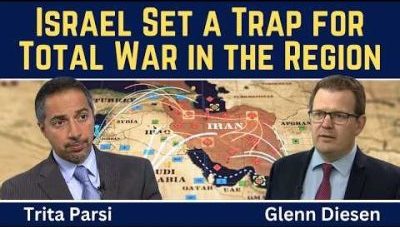
Trita Parsi: Israel Set a Trap for Total War in the Region
or go to
Aletho News Archives – Video-Images
From the Archive
Zionism’s Violent Legacy
By Donald Neff | Washington Report On Middle East Affairs | January 1996
On January 4, 1948, Jewish terrorists drove a truck loaded with explosives into the center of the all Arab city of Jaffa and detonated it, killing 26 and wounding around 100 Palestinian men, women and children.[1] The attack was the work of the Irgun Zvai Leumi – the “National Military Organization,” also known by the Hebrew letters Etzel – the largest Jewish terrorist group in Palestine. The Irgun was headed by Revisionist Zionist Menachem Begin and had been killing and maiming Arabs, Britons and even Jews for the previous ten years in its efforts to establish a Jewish state.
This terror campaign meant that at the core of Revisionist Zionism there existed a philosophical embrace of violence. … continue
Blog Roll
 Aletho News
- Trita Parsi: Israel Set a Trap for Total War in the Region
- Trump’s Iran war is on an Israeli leash
- Saudi oil boss issues global supply warning
- Riyadh Says Its Oil System Is Intact. The Numbers Say Otherwise.
- Trump and Netanyahu Want to “Finish the Job” on Iran
- US ‘one-sided dictation’ not Iran’s beliefs makes rational talks impossible: Baghaei
- Iran’s Next Strike May Not Explode. It Could Shut You Down /Col Doug Macgregor
- Iran: US political targets legitimate if assassinations return
- Iraq shuts key border crossing with Iran under US pressure: Report
- Undersea Internet cables could be targeted in retaliation for attacks on Iran: IRGC deputy chief
- If Americans Knew
- The Israel Lobby’s Changing Fortunes
- AIPAC has become such a political liability that it’s shifting to a more “nimble” approach to buying politicians
- At least 160 Israeli settler attacks in 2 weeks
- Will Gaza’s Ancient Christian Community Disappear Forever?
- Israel’s vision of regional security rests on keeping Arab states weak
- Heidi Levine recounts how Palestinian youths helped save her in settler attack
- DAILY UPDATE: Latest essential news on Palestine, Israel, & region
- Trump’s Intensifying Sabotage of the ICC, for Israel’s Sake
- Israeli military detain US and UK volunteers in West Bank including Democratic NY politician Brad Lander
- Americans at National Conservatism Conference held in Israel this year criticize Israel
- No Tricks Zone
- E-Cars Reduce CO2 Emissions By Only 41% Compared To Internal Combustion Engine Vehicles
- Predictions Made By Renowned Climate Professor Over Past Decades Have Been Proven To Be Poor
- New Study Suggests Large Regions Of The Pacific Ocean Have Been Cooling For The Last 80 Years
- Germany’s Green Energy Debacle: High Energy Costs Force Kahla Porzellan to Close After 182 Years!
- New Study: 50 Years Of The Most Aggressive ‘Net Zero’ Policies Can Only Affect The Global Climate By 0.03°C
- US September “Heat” Was No Record…Many Records Set Decades Ago
- Latest European Green Energy Debacle; Portugal’s Largest Flagship Solar Park Insolvent!
- Green Energy Debacle: German Expert Professor Fritz Vahrenholt Warns Of Severe Economic And Social Consequences
- Two More Paleo Reconstructions Affirm Meters-Higher Sea Levels Across Ireland, Brazil 7000-6000 Years Ago
- New Study: Earth And Venus Surface Warmth Largely Explained By Convection And Lapse Rate, Not CO2 Or Radiation

