Protesters block Israeli cargo ship at Port of Oakland
Press TV – September 28, 2014
Hundreds of American protesters, angered by Israel’s recent deadly assault on the Gaza Strip, gathered at the Port of Oakland to block an Israeli ship from unloading its cargo.
Workers with the International Longshore and Warehouse Union (ILWU) refused to unload the Zim Shanghai as about 200 activists picketed outside several of the port’s gates on Saturday morning.
The cargo ship is managed by Israel’s largest shipping firm, Zim Integrated Shipping Services.
About 50 police officers were also present at the port.
The protesters said they would continue with their “Block the Boat” campaign.
They said Israeli authorities must be held responsible for the deaths of more than 2,100 Palestinians during the recent 50-day war on Gaza.
“I think it was a big victory today for those who are opposed to the policies of Israel in Gaza,” said Steve Zeltzer, an organizer of the protest.
Similar actions were taken in August, when protesters blocked Israeli-owned ship Zim Piraeus for five days, forcing it to leave for Los Angeles with most of its cargo unloaded.
Longshore workers refused to cross picket lines to unload Zim Piraeus in August.
Protesters on Saturday said they hoped to achieve the same outcome.
“We ask the ILWU to carry on its long historical tradition of opposing injustice and honoring community picket lines. Let’s keep the pressure on and continue this tradition of labor blockades against oppression,” the “stop ZIM action committee” said in a statement.
Israel bars entry to Al-Aqsa mosque to Palestinians for third consecutive day
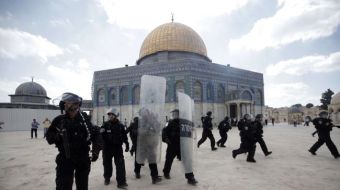
Al-Akhbar | September 26, 2014
Israel on Friday imposed restrictions on the entry of Palestinian worshipers into the Al-Aqsa Mosque in annexed East Jerusalem for the third consecutive day.
Israeli police stepped up security around the mosque, deploying 2,000 troops in Jerusalem and erected roadblocks at entrances to Jerusalem’s Old City.
“Police prevent men under 50 and West Bankers from entering Al-Aqsa compound or Friday prayers,” Sheikh Azzam al-Khatib, director-general of the Organization for Muslim Endowments and Al-Aqsa Affairs, told the Turkish Anadolu Agency.
Jews celebrated the start of Rosh Hashanah (Jewish New Year) on Wednesday evening, the first day of new Jewish year of 5775.
Israel typically imposes restrictions on Muslim worshipers’ access to Al-Aqsa during Jewish holidays
The Israeli authorities also closed the Ibrahimi Mosque to Muslims in the West Bank city of Hebron on Wednesday and Thursday for Rosh Hashanah.
Israel is also closing the Gaza Strip’s only functioning commercial crossing – the Kerem Shalom border terminal – for four days starting Thursday for the Jewish holiday.
Khatib said that while Israel restricts the entry of Palestinians into Al-Aqsa mosque compound, it facilitates the entry of Zionist settlers into the holy site.
He said that at least 300 Zionist settlers and 120 Israeli soldiers had forced their way into the compound in the past three days.
In recent months, groups of extremist settlers – often accompanied by Israeli security forces – have repeatedly forced their way into the flashpoint compound.
The frequent violations anger Palestinian Muslims and occasionally lead to violent confrontations.
For Muslims, Al-Aqsa represents the world’s third holiest site.
Jews, for their part, refer to the area as the “Temple Mount,” claiming it was the site of two prominent Jewish temples in ancient times.
Israel occupied East Jerusalem during the 1967 Middle East War. It later annexed the city in 1980, claiming it as the capital of the Zionist state – a move never recognized by the international community.
In September 2000, a visit to the site by controversial Israeli leader Ariel Sharon sparked what later became known as the “Second Intifada” – a popular uprising against the Israeli occupation in which thousands of Palestinians were killed.
(Anadolu, Al-Akhbar)
Israel continues to harass and restrict Gaza fishermen despite truce agreement
Al-Akhbar | September 25, 2014
Every time Gaza fisherman Rami goes to sea, the same thing happens: five nautical miles offshore, shots ring out and a voice over an Israeli loudspeaker demands he turn back.
Officially, Gaza’s fishing fleet has the right to trawl the waters up to six nautical miles off the shore under the terms of Israel’s illegal and brutal eight-year blockade.
Although that outer limit has frequently been reduced, or even cancelled outright over the years, it was formally reinstated by virtue of an August 26 truce agreement which ended a deadly 50-day war between Israel and Hamas militants.
But nearly a month after the ceasefire took effect, even those six nautical miles — which the fishermen say is not nearly enough — are unattainable.
One afternoon, Rami Bakr and his 10-man crew put to sea for a 10-hour fishing expedition. With them was an AFP team.
Very quickly, warning shots skimmed the boat as an Israeli navy vessel approached. On board were around a dozen soldiers armed with machine guns, shouting through a loudspeaker for them to stop.
“These are the worst conditions we’ve ever known,” said the 41-year-old fisherman, who has spent more than three decades of his life fishing the waters off Gaza.
“During the war, the Israelis bombed fishing huts on the beach and now they are preventing fishermen from earning their crust at sea,” he said.
The Gaza Strip has long been known for its plentiful seafood and fish although the stocks have been depleted by pollution, frequent wars and the blockade.
Today, the coastal enclave counts some 4,000 fishermen, more than half of whom live below the poverty line, said Nizar Ayash, head of the Gaza fishermen’s syndicate.
During the recent seven-week war launched by Israel which killed over 2,000 Palestinians, the majority of which are civilians, 80 of Gaza’s fleet of around 1,500 fishing boats and dozens of fishing huts were destroyed in the Israeli bombardment, which also reduced nets and fishing equipment to ashes, he said.
For Ayash, the problems experienced by Rami are widespread.
“Since the ceasefire, many Israeli attacks have been reported,” he said, referring to repeated shooting at fishing vessels.
Israeli forces say the warning shots are necessary because Palestinian boats flout the six-mile limit.
With their tackle destroyed and the price of oil soaring, Gaza’s fishermen are almost working at a loss.
Today, a single fishing expedition can cost up to about $500, said another fisherman called Mehdi Bakr, who lost his hand when an Israeli navy vessel fired at his boat in 1997.
For every night on the water, they need 270 liters (59 gallons) of diesel and 250 liters of petrol, he explained.
And all this for a very small catch.
“September and October is sardine season and they are only found between six to nine nautical miles from the shore, so with a six-mile limit, we’re bringing home hardly anything,” explained Taha Bakr, a 24-year-old member of Rami’s crew.
Because fishing is a trade passed on from father to son, and because he can no longer provide for his family and the job is so dangerous, the young man with green eyes and a neatly-trimmed beard has signed up to journalism school.
“It’s so that I don’t have to fish again, that job is just too risky,” he told AFP.
Maria Jose Torres, deputy head of office in the Palestinian branch of the UN humanitarian agency (OCHA), said that the 1993 Oslo Accords established a fishing zone of up to 20 nautical miles.
“It is essential to increase the fishing zone beyond six nautical miles to allow the fishermen to earn their living,” she said, indicating that the vast majority today are unable to support themselves.
“Some 84 percent of them are only able to survive thanks to help from the UN,” she said.
Rami said he keeps putting out to sea so that he can feed his children.
“It has been a long time since we last heard the singing and laughter of fishermen at sea who returned with their nets full,” he said.
But Mehdi fears for the future of this millennia-old profession in Gaza.
“We, the young generation, are not happy with this. If it carries on like this, there won’t be any more fishing in Gaza at all,” he said.
(AFP, Al-Akhbar)
Gaza farms adjacent to buffer zone suffer greatest losses
MEMO | September 24, 2014
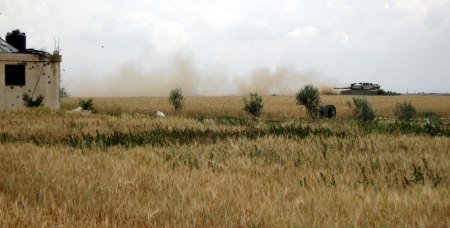
Palestinian residents in the buffer zone along the eastern borders of the Gaza Strip suffer the loss of their homes and source of income in every Israeli escalation.
Palestinian farmer Mohamed Qudih, 60, and his wife Sabiha, 59, lost their house, which was destroyed by the Israeli occupation during the ground invasion in the Khan Younis village of Khuza’a. They also lost their farm, which included around 50 olive and date trees and okra crops.
“I was surprised when I saw the rubble of my house,” Qudih told local Palestinian news agency Quds Net. “I was also surprised to see around 50 olives trees and date palms were uprooted and the okra crop was crushed.”
Qudih’s farm is 800-metres away from the Gaza-Israeli border. “We suffer so much as the Israeli occupation always razes the farms adjacent and near its borders,” he said.
He added: “We are always in danger while working or staying in our farms as the Israeli border troops in the military towers always fire live bullets and tanks and bulldozers move on the ground when they feel anything approaching the borders.”
Iyad Qudih, 40, whose farm is 500-metres from the border, had a similar story: “I came back to my farm to find no sign of my house and all the trees and crops were damaged.”
Mu’taz Al-Najjar, 19, tends to his family’s farm which is 450-metres from the border. He hopes the buffer zone is cancelled in order for his family to freely access their entire farm and benefit from it. He called for the representatives of the Palestinian fighters to the indirect talks with the Israelis in Cairo to stick to this demand.
“This will help hundreds of farmers access all areas of their farms and thus more farmers will have work and agriculture produce will increase,” he said.
Khuza’a is located to the east of Khan Younis, a Palestinian city in the south of the Gaza Strip. It is located on 4,000 Dunams (1,000 acres) of land and is home to 14,000 Palestinians, most refugees.
The Israeli occupation razed a large number of Palestinian houses in the neighbourhood during the latest war on Gaza and wrecked most of its farms and empty lands.
ISIS is not ‘Blowback’ from Western Foreign Policy; They ARE Western Foreign Policy
Empire Strikes Black | September 24, 2014
 Notice that ISIS are sworn enemies of Syria, Hizbu’llah, and Iran. This in itself gives a most obvious clue as to the identity of the group’s benefactors.
A prevalent liberal cliché is the “blowback” theory – the theory that ISIS terror attacks, and indeed the group’s very existence, are somehow in retaliation to US/Western/”Israeli” foreign policy actions.
This is a disingenuous theory that is disseminated in order to keep the empire’s citizens on side. Crucially, it distracts from a key truth.
Western and “Israeli” intelligence has historically effected deep infiltration of ‘jihadist’ terror cells throughout the Arab world and the West; these groups are used literally as footsoldiers (see Afghanistan throughout the 1980s) to achieve Western and “Israeli” military and strategic objectives. The “blowback” theory distracts from this key fact.
ISIS aren’t retaliating against Western foreign policy; they are Western foreign policy. These very people were mobilised against Muammar Gaddafi in Libya’s bogus ‘revolution’ of 2011, as with Syria in the same year.
In moving across the Syrian-Iraqi border, ISIS – Zionism’s footsoldiers – underwent a magical media transformation into the ‘bad guys’. The ‘war against ISIS’ is a con, a total scam. It is a pretext for a war against the resistance axis: chiefly Syria, Hizbu’llah, Iran, and the Palestinian resistance. It is a pretext to kick the ‘Yinon plan’ – the plan to balkanise the Arab world to ensure “Israeli” hegemony – into high gear
The WMD lies of 2003 never went away; they simply got re-packaged for the liberal crowd in the post-Bush era.
Obama’s Novel Lawyering to Bomb Syria
By Robert Parry | Consortium News | September 23, 2014
The Obama administration has devised an extraordinary legal justification for carrying out bombing attacks inside Syria – that the United States and its Persian Gulf allies have the right to defend Iraq against the Islamic State because the Syrian government is unable to stop the cross-border terror group.
“The Syrian regime has shown that it cannot and will not confront these safe havens effectively itself,” said the U.S. letter delivered by Ambassador Samantha Power to United Nations officials. “Accordingly, the United States has initiated necessary and proportionate military actions in Syria in order to eliminate the ongoing ISIL [Islamic State] threat to Iraq, including by protecting Iraqi citizens from further attacks and by enabling Iraqi forces to regain control of Iraq’s borders.”
Yet, beyond the danger to world order if such an expansive theory is embraced by the international community (does anyone remember how World War One got started?), there is the hypocrisy of the U.S. government and many of those same Gulf allies arming, training and funding Syrian rebels for the purpose of preventing the Syrian military from controlling its territory and then citing that lack of control as the rationale to ignore Syria’s sovereignty.
In other words, the United States, Saudi Arabia, Qatar, Jordan and other enemies of Syria covertly backed the rebels inside Syria and watched as many of them – including thousands of the U.S.-preferred “moderates” – took their newly acquired military skills to al-Qaeda affiliates and other terrorist organizations. Then, the U.S. and its allies have the audacity to point to the existence of those terror groups inside Syria as a rationale for flying bombing raids into Syria.
Another alarming part of the U.S. legal theory is that among this new “coalition of the willing” – the U.S., Saudi Arabia, the United Arab Emirates, Qatar, Bahrain and Jordan – only Jordan shares a border with Syria. So, this novel principle would mean that distant countries have the right to destabilize a country from afar and then claim the destabilization justifies mounting military attacks inside that country.
Such a theory – if accepted as a new standard of behavior – could wreak havoc on international order which is based on the principle of national sovereignty. The U.S. theory also stands in marked contrast to Washington’s pious embrace of strict readings of international law when denouncing Russia just this summer for trying to protect ethnic Russians in eastern Ukraine from brutal assaults by the U.S.-backed coup regime in Kiev.
In Ukraine, the Obama administration rejected any and all mitigating circumstances, such as the overthrow of an elected president and the coup regime’s use of artillery, airstrikes and even neo-Nazi militias to suppress eastern Ukraine’s ethnic Russian population. In the Ukraine case, the Obama administration insisted that national sovereignty was inviolable despite the fact that the Feb. 22 coup had violated Ukraine’s constitutional order and had produced a human rights disaster.
An entirely different set of rules were applied to Syria, where President Barack Obama decided that Syrian President Bashar al-Assad “must go” and where Obama authorized the CIA to provide arms, training and money for supposedly “moderate” rebels. Other U.S. “allies,” such as Saudi Arabia and Qatar, supported some of the more extreme anti-Assad groups.
Israel’s right-wing Likud government also was eager for “regime change” in Syria as were America’s influential neoconservatives who saw Assad’s overthrow as a continuation of their strategy of removing Middle East leaders regarded as hostile to Israel. Saddam Hussein’s Iraq was the first on the list with Syria and Iran to follow. In those cases, the application of international law was entirely optional.
Before President George W. Bush’s invasion of Iraq in 2003, the U.S. government came up with another convenient argument, claiming the war was an act of American self-defense because otherwise Hussein might give his “weapons of mass destruction” to al-Qaeda for use against U.S. targets. As it turned out, Hussein had no WMDs and was a bitter enemy of al-Qaeda, which didn’t exist in Iraq until after the U.S. invasion.
The overthrow and subsequent execution of Hussein turned Iraq into a cauldron of bloody chaos, pitting Shiites against Sunnis and creating a fertile environment for a group of brutal Sunni extremists who took the name “al-Qaeda in Iraq.”
Getting Assad
But Official Washington is slow to learn lessons. In 2011, the Obama administration’s “liberal interventionists” threw their weight behind a Sunni-led uprising to oust Assad, who runs a harsh but largely secular government with key support from Alawites, Shiites, Christians and other minorities who feared Sunni extremism.
As with Iraq, Syria’s sectarian violence drew in many Sunni extremists, including jihadists associated with al-Qaeda, particularly the Nusra Front but also “al-Qaeda in Iraq” which rebranded itself the Islamic State of Iraq and Syria or simply the Islamic State. Eventually, al-Qaeda leaders rejected the Islamic State because it had become a rival of the Nusra Front and because its brutality was too graphic even for al-Qaeda.
Despite the growing radicalism of Syrian rebels, Official Washington’s influential neocons and the “liberal interventionists” continued the drumbeat for ousting Assad, a position also shared by Israeli leaders who went so far as to indicate they would prefer Damascus to fall to al-Qaeda extremists rather than have Iranian ally Assad retain control. [See Consortiumnews.com’s “Israel Sides with Syrian Jihadists.”]
Whenever there was a chance to push Obama into ordering a U.S. military assault on Assad’s government, “the Assad-must-go crowd” pressed the argument. For instance, a still-mysterious Sarin gas attack outside Damascus on Aug. 21, 2013, was immediately blamed on Assad’s forces. The neocons and the ”liberal interventionists” demanded an air war to punish the Syrian government – and possibly open the way for a rebel victory.
This pressure on Obama mounted despite strong doubts within the U.S. intelligence community that Assad’s forces were responsible. Some evidence pointed to rebel extremists trying to create a provocation to bring the U.S. military into the war on their side.
Partly because of those doubts, President Obama backed away from a military strike at the last minute and accepted a compromise arranged by Russian President Vladimir Putin to get Assad to surrender his entire chemical weapons arsenal. Since then, additional evidence has emerged raising doubts about the government’s complicity and pointing more toward the rebels. [See Consortiumnews.com’s “The Collapsing Syria-Sarin Case.”]
Nevertheless, much of the mainstream U.S. news media, including the foreign-page editors of the New York Times who have increasingly fallen under the spell of neocon ideology, have taken to citing the Syrian government’s guilt for the Sarin gas attack as flat fact, rather than a point in serious dispute. It seems no journalism standards need apply when demonized figures, such as Assad or Putin, are facing accusations.
Israel’s Shift
Yet, with al-Qaeda-connected terrorists controlling part of the Israeli border along the Golan Heights, the Israeli government began to reverse its position on demanding Assad’s removal. As the Israeli investigative Web site, Debka Files, reported on Sept. 9, citing military and intelligence sources:
“The Israeli government has radically changed tack on Syria, reversing a policy and military strategy that were long geared to opposing Syrian President Bashar Assad … This reversal has come about in the light of the growing preponderance of radical Islamists in the Syrian rebel force fighting Assad’s army in the Quneitra area since June. Al Qaeda’s Syrian Nusra front … is estimated to account by now for 40-50 percent – or roughly, 4,000-5,000 Islamists – of the rebel force deployed just across Israel’s Golan border. …
“Nusra Front jihadis fighting alongside insurgents on the various Syrian battlefronts made a practice of surreptitiously infiltrating their non-Islamist brothers-at-arms, a process which the latter’s foreign allies, the US, Israel, Saudi Arabia, Qatar and Jordan, either ignored or were unaware of. These tactics began to pay off in the past month, when large numbers of moderate rebels suddenly knocked on the Nusra Front’s door and asked to join.”
I have confirmed this Israeli shift with my own sourcing. But it’s unclear whether Israel’s change of heart will cause any second thoughts among U.S. neocons who typically conform their policy recommendations to Israeli interests. However, on the Syrian case, the neocons and their “liberal interventionist” friends might be too dug in on ousting Assad to adjust.
Indeed, all of Official Washington seems incapable of admitting that its wishful thinking about Syrian “moderates” may have caused another major strategic error in the Mideast. The unrealistic “group think” about “moderates” contributed to a power vacuum in Syria that has pulled in some of the most vicious Islamic extremists on earth and turned parts of Syria into a new base of operation for international terrorism.
For his part, President Obama recognized the folly of training Syrian “moderates” – just last month he dismissed the notion as a “fantasy” that was “never in the cards” as a workable strategy – but he nevertheless resurrected it last week as a key part of his new Syrian initiative. He won solid congressional majorities in support of spending some $500 million on the training scheme.
The most charitable view of Obama’s strange flip-flop is that he feared being accused of aiding Assad if the U.S. bombing campaign against the Islamic State indirectly strengthened Assad’s hold on Damascus. So, Obama tacked on what he knew to be a useless appendage, a tough-sounding plan to “ramp up” the “moderate” rebel forces.
Similarly, Obama’s harsh rhetoric about refusing to coordinate the airstrikes with the Syrian government may be more a concession to the sensibilities of the neocons and the “liberal interventionists” than a reality.
I was told last week that U.S. intelligence had used Russian government go-betweens to clear the airstrikes with the Syrian government which gave quiet permission for the bombing campaign in parts of Syria. I was further told on Monday that U.S. military officials and their Syrian counterparts have met face-to-face to ensure that the U.S.-led airstrikes would encounter no Syrian air defenses.
That tacit approval from the Syrian government could be a sound legal basis for the airstrikes, much as other governments, such as Yemen and Pakistan, have tolerated or even encouraged U.S. air attacks on domestic enemies associated with al-Qaeda and other militant groups.
Yet, Obama may find it politically impossible to state the truth – that a “realist” approach to foreign affairs sometimes requires working with disreputable governments. So, instead of simply saying that Syria has no objection to these bombing raids, Obama has invented a dangerous new legal theory to justify the violation of a country’s sovereignty.
~
Investigative reporter Robert Parry broke many of the Iran-Contra stories for The Associated Press and Newsweek in the 1980s. You can buy his new book, America’s Stolen Narrative, either in print here or as an e-book (from Amazon and barnesandnoble.com).
Tampa Palestine solidarity protest delays unloading of Israeli ship

Block the boat protest. (FightBack!News/Staff)
By Gage Lacharite | Fight Back! NEWS | September 23, 2014
Tampa, FL – 70 Palestine solidarity activists filed into the intersection of Maritime and 20th Street here to protest the docking of the ZIM Alabama, a container ship carrying Israeli goods. The Tampa Port Authority was woken early in the morning of Sept. 21 by protesters opposing the importation of Israeli goods. Israeli companies super-exploit Palestinian labor, paying very low wages.
Protesters were hoping to catch the attention of dockworkers arriving for work. Some members of the International Longshoremen’s Association Local 1402 waved and honked in support.
“It was really great to see dockworkers showing interest and support for our cause. There was a real sense of solidarity from the workers themselves,” said Caroline England, a member of Tampa Students for a Democratic Society (SDS).
After gathering at the intersection, protesters marched to the port itself. Upon approaching the security checkpoint at the port, police surrounded the protesters, attempting to cut them off from both the port and incoming workers. Police threatened to arrest a Palestinian American woman. However fellow protesters were able to get the police to back off. The rally continued until 8:00 a.m., when it was announced that International Longshoremen’s Association workers would not be entering the port until 1:00 p.m. due to an unspecified delay. Protesters retreated in order to rest and organize reinforcements for later.
The protesters gathered again at noon with a larger crowd than the morning. They conducted another march on the port, slowing traffic that was attempting to enter. Police stood by as protesters entered the port and protested the docking of the ZIM Alabama from Israel.
The action is part of the Block the Boat movement to place economic pressure on Israel to stop killing and oppressing Palestinians. There is a growing movement of students participating in the Boycott, Divest And Sanction (BDS) campaign.
Sam Beutler of Students for Justice in Palestine at the University of South Florida said, “Every little action on our part counts. The BDS movement was integral to the destruction of the South African Apartheid regime and can play a similar role in dealing with Israeli apartheid today – whether it be not buying Sabra hummus, HP computers, or attempting to stop a boat containing Israeli goods from docking. Each action moves towards the ending of the Israeli occupation of Palestine.”
This is the second protest of the ZIM Alabama in Tamp; there was another Aug. 30. Another Block the Boat rally is being organized to oppose the return of the ZIM Alabama.
Israeli forces clash with Palestinians after Zionist settlers storm into Al-Aqsa Mosque
Al-Akhbar | September 24, 2014
Clashes erupted Wednesday between Palestinians and Israeli forces in Al-Aqsa Mosque compound in occupied East Jerusalem after dozens of Zionist settlers– led by two government ministers and backed by Israeli police – forced their way into the holy compound, a Palestinian guard of the complex said.
“Ninety-three settlers protected by 40 Israeli police and special forces forced their way into the holy compound through the Al-Magharbeh Gate,” the guard, who asked not to be named, told Anadolu Agency.
 He added that “at least 20 Palestinians were injured and five others arrested.”
The Zionist settlers were accompanied by Israeli Housing Minister Uri Ariel and Internal Security Minister Yitzhak Aharonovitch, in addition to several Jewish extremist leaders.
In response, some 300 Palestinian Muslim worshipers converged near the Al-Qibali and the Dome of the Rock mosques to protest the intrusion, the guard said.
In a bid to disperse angry Palestinians, Israeli forces fired rubber bullets and teargas, he added.
“At least 16 Palestinians were injured by rubber bullets, including one in the head and two in the abdomen. Around 45 others suffered teargas inhalation,” the guard said.
According to Sheikh Omar al-Qiswani, the Palestinian director of the Al-Aqsa complex, the two ministers took a tour of the compound’s courtyards, passing by the Dome of the Rock, Qibali and Marawani mosques before leaving through the Al-Rahmeh Gate.
Israeli security forces withdrew from the compound after the clashes, the guard said.
“Israeli police and army troops pulled out of the compound after attacking Palestinian worshipers,” he said.
Israeli police have stepped up security at the gates of the Al-Aqsa complex for the second day in a row, barring a number of Palestinians from entering the compound, al-Qiswani said.
“Except for the Al-Magharbeh Gate, where [Jewish] settlers regularly force their way into the complex, the Israeli police closed all other gates with chains,” al-Qiswani said.
Jews will celebrate “Rosh Hashanah” on Wednesday, which will mark the first day of the new Jewish year of 5775.
Groups of extremists called for marking the holiday by storming the Al-Aqsa compound and performing Talmudic rituals.
In recent months, groups of extremist Zionist settlers, often accompanied by Israeli security forces, have stepped up their intrusions into the Al-Aqsa Mosque complex, the world’s third holiest site for Muslims.
For Muslims, Al-Aqsa represents the world’s third holiest site. Jews, for their part, refer to the area as the “Temple Mount,” claiming it was the site of two prominent Jewish temples in ancient times.
Israel occupied East Jerusalem during the 1967 Middle East War. It later annexed the holy city in 1980, claiming Jerusalem as the unified capital of the self-proclaimed Jewish state – a move never recognized by the international community.
In September 2000, a visit to the site by controversial Israeli leader Ariel Sharon sparked what later became known as the “Second Intifada” – a popular uprising against the Israeli occupation in which thousands of Palestinians were killed and injured.
(Anadolu, Al-Akhbar)
‘Made in Palestine’: New sales pitch for marketing Israeli products
MEMO | September 23, 2014
Along one of the roads in the city of Ariha in the north of the occupied West Bank, merchants Khaldoun and Hassan regularly receive 30 tons of dates produced in the neighbouring Israeli agricultural settlements, in preparation for their transfer to one of the packaging factories built on the outskirts of the city, Anadolu news agency reported.
Inside the factory, about 13 minors are working on “screening” the dates and repackaging them in bags that read “dates of the Holy Land” in both Arabic and English and “Made in Palestine” in order to market them locally, in the Arab states and in Europe.
This is what one of the farms that is owned by Israeli settlers does in order to market its produce of dates to customers of European Union countries after the enforcement of a decision earlier this year to boycott any products of settlements in the West Bank.
Anadolu cited a statement issued by the Palestinian national economy minister saying that members of the ministry have found dozens of tons of produce coming from the settlements in this way, on its way to either the local market or to the packaging factories in the city of Ariha and the neighbouring villages.
Merchant Khaldoun, 45 years, told Anadolu’s reporter, “We do trade in dates of the settlements, which we buy at prices that are 40 per cent lower than the market price. And in order to be able to market the dates, we clean and re-package them and choose the best in preparation for selling them in the local market, as well as the Arab and European markets.”
He added that the annual volume of his seasonal sales of dates is nearly 350 tons, pointing out that other merchants who work in this field and in other varieties of vegetables and fruits, such as citrus fruits, nuts, and medical herbs have similar practices.
His fellow trader Hassan said that he has a licensed company that is registered officially. The export process takes place after the official bodies check the quality and specifications of the product, ensuring the product’s conformity with European specifications and international standards. It is then exported under the “Made in Palestine” label.
The minister of economy said in its statement that any truck carrying dates must also be carrying a transfer permit to move the dates from inside the farm of production to the factory that will process the packaging, noting that it has begun to take stricter steps over the trade of dates through listing the names of the farmers who grow dates, the number of trees they own and their annual average production.
Palestine enjoys customs exemptions and export-related facilities in trade with the countries of the European Union, so the Israeli companies cooperate with Palestinian merchants to export the dates produced in the settlements illegally established in the West Bank to the European Union, while benefiting from such exemptions.
In the beginning of 2014, the European Union announced its decision to boycott economic, scientific and academic relations with institutions, factories and farms that have any investments or presence in the Israeli settlements established in the occupied Palestinian territories.
Earlier, the ministry of economy confiscated more than 20 tons of corrupt and damaged dates coming from the Israeli settlements while on their way to one of the factories for repackaging to later sell them as a product of Palestine.
Featured Video

Racist Seinfeld Dances for Joy as Bibi Unveils His New Map
or go to
Aletho News Archives – Video-Images
TV Drama Review
Japanese drama projects Japan’s wartime atrocities onto Chinese characters

Global Times | October 25, 2026
By portraying Chinese characters as perpetrators of ruthless violence while casting Japanese Self-Defense Forces (SDF) intelligence operatives as defenders, the season 2 of the Japanese drama Vivant has recently drawn criticism from Chinese netizens, who argue that its depiction turns historical reality on its head while ignoring Japan’s wartime atrocities.
The TBS drama series – a spy suspense story in which an alleged unofficial intelligence unit of the SDF operates across the globe — has attracted a passionate fanbase. Its currently airing season 2 opened with a household rating of 18.8 percent, the highest for a TV drama this year, according toa commentary article by Japanese media Toyo Keizai.
What draws attention is the portrayal of the enemies in the series, the article noted. Scenes in which the Chinese organization subjects kidnapped members of the SDF unit to brutal torture are repeated with unrelenting intensity.
It is rare for Japanese TV dramas to explicitly portray a real-life country as the enemy, the article noted.
Japanese Prime Minister Sanae Takaichi also made a reference to the drama, saying that she has been recording Vivant and hopes to binge-watch it over the year-end and New Year holidays, according to Japanese media outlets.
China’s CCTV News report on Sunday revealed that the drama features scenes in which Chinese personnel cut off the fingers of and stab Japanese intelligence operatives in the abdomen. Such acts bear striking similarities to the torture inflicted on Chinese nationals by invading Japanese troops during the World War II.
The drama distorts the truth by attributing these atrocities to modern Chinese characters. Beneath the surface, it subtly glorifies Japan’s cross-border overseas operations, blurs the functional boundaries of the SDF and implicitly promotes an expansionist narrative, per CCTV News. … continue
Blog Roll
 Aletho News
- EU facing trillion-euro debt hole while seeking more cash for Kiev
- How US, Europe, Persian Gulf states exhausted missile stockpiles, splurged billions to defend Israel
- Up in arms… Koreans reject U.S. empire’s plan to make South Korea the next Ukraine
- Iran, Turkey, Pakistan, Saudi Arabia could advance region-led security framework in Tehran: FM spox
- Netizens condemn Japanese drama for projecting Japan’s wartime atrocities onto Chinese characters
- Racist Seinfeld Dances for Joy as Bibi Unveils His New Map
- A West Bank War for Netanyahu’s Election Campaign, Could It Backfire?
- Yemen denounces European Parliament’s ‘hypocritical’ push to blacklist Ansarullah
- Qalibaf: UAE’s UN bid aims to ‘clear the runway’ for ‘Greater Israel’, whitewash genocide
- Pakistan reopens Iran border after boosting security: Report
- If Americans Knew
- An error has occurred; the feed is probably down. Try again later.
- No Tricks Zone
- Sudden Stratospheric Warming, Powerful El Niño Combination May Lead To Extreme Europe Cold, Energy Crisis!
- Two New Studies Find Thwaites Glacier Melt Cannot Be Driven By Human Activity Or A Warming Ocean
- E-Cars Reduce CO2 Emissions By Only 41% Compared To Internal Combustion Engine Vehicles
- Predictions Made By Renowned Climate Professor Over Past Decades Have Been Proven To Be Poor
- New Study Suggests Large Regions Of The Pacific Ocean Have Been Cooling For The Last 80 Years
- Germany’s Green Energy Debacle: High Energy Costs Force Kahla Porzellan to Close After 182 Years!
- New Study: 50 Years Of The Most Aggressive ‘Net Zero’ Policies Can Only Affect The Global Climate By 0.03°C
- US September “Heat” Was No Record…Many Records Set Decades Ago
- Latest European Green Energy Debacle; Portugal’s Largest Flagship Solar Park Insolvent!
- Green Energy Debacle: German Expert Professor Fritz Vahrenholt Warns Of Severe Economic And Social Consequences

