The Gaza war: who won?
The ceasefire agreement between Palestinian resistance fighters and the Tel Aviv regime has been hailed as tantamount to the victory of Palestinians against Israel.
Under the truce deal, Tel Aviv must lift the blockade it has imposed on the Gaza Strip since 2007. Israel must also reopen the border crossings into the besieged Palestinian territory.
In this edition of The Sun Will Rise, we discuss the barbarous Israeli military aggression against Gaza and the victory of resistance against Israel.
Featuring:
– an exclusive from Gaza by Ashraf Shannon, in which he interviews Professor Mosheer Amer from the Islamic University of Gaza and victims of the Gaza war.
– a feature on Palestinian photographic video works – “Voices” – by Rich Wiles exhibited in the P21 Gallery in London.
In the studio, we were joined by:
Fouad Shaat
President, General Union of Palestinian Students (GUPS UK)
&
Khalid Tamimi
Palestinian Student Activist
Two Palestinians shot dead by Israeli forces lead to clashes with over 30 injured
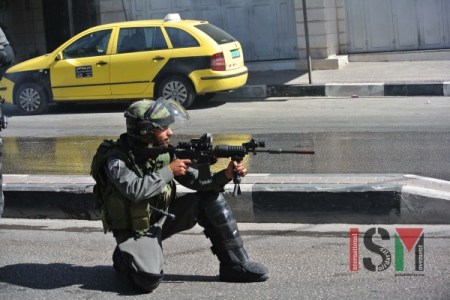
International Solidarity Movement | September 23, 2014
Hebron, Occupied Palestine – Violence broke out on the streets of Hebron’s university district (al-Khalil) this morning when Israeli soldiers opened fire on unarmed demonstrators who had been protesting the murders of two Palestinians earlier that day.
Protestors took to the streets after Marwan Kawasme, 29, and Amar Abu Aisha, 32, were killed and burned by Israeli soldiers in the very early hours of this morning. The Israeli military alleged that the two men were behind the deaths of the three settler teenagers in June of this year.
The soldiers used tear gas canisters and live ammunition bullets during the clashes, with numerous injuries including a 15-year-old boy who was shot in the head and is now in a critical condition in hospital. A representative of the Red Cross stated to ISM that there were over 30 injuries, though the exact number is still unknown.
The building where the murders took place was also set on fire and destroyed.
Tensions had been high all morning as word of the two dead Palestinians spread throughout the area. By 8 am around 200 Palestinian residents had gathered to show their frustration at the senseless taking of life. Although stones were thrown, the protesters were unarmed and did not pose a threat to the violent occupying military. The Israeli army, still present after the earlier incident, unleashed dozens of canisters of tear gas leaving many people unable to breath and in need of medical help. Hemmed in and with nowhere to escape to, the protestors hid behind what ever they could find.
The situation further deteriorated when the Israeli soldiers, without warning began to fire live bullets at the protestors, hitting one boy in the head and injuring a number of others.
After an hour of further violence by the Israeli soldiers, the protestors cleared and the injured were taken away.
Throughout the earlier afternoon however similar incidents of unrest were reported around Hebron (al-Khalil).
Israel imposes restrictions around al-Aqsa ahead of Jewish holidays
Ma’an – 23/09/2014
JERUSALEM – Israeli police on Tuesday morning deployed heavily at all gates of the al-Aqsa Mosque compound imposing restrictions on the entry of Muslim worshipers ahead of the Jewish New Year.
A Ma’an reporter in the holy city said Israeli police denied Palestinian men aged under 45 and all women entry to the mosque. Women and men under 45 had to perform dawn prayer in the streets outside the compound, she added.
In addition, police kept all gates closed except the Chain gate and the Council gate where police officers deployed heavily and scrutinized ID cards of worshipers.
Dozens of young men and women who were barred from al-Aqsa gathered outside the gates and chanted slogans denouncing Israeli police procedures and affirming it was their right to access the holy place.
Director of the Jerusalem office of the Palestinian ministry of endowment Sheikh Azzam al-Khatib told Ma’an that Tuesday’s closures of the compound were in preparation for Jewish holidays.
He said Knesset member Miri Regev from the Likud party who chairs the Knesset’s interior and security committee had asked the police to prepare the grounds for visits by Jews during holidays.
“We expect very difficult days in al-Aqsa during the upcoming Jewish holidays,” al-Khatib said.
Israeli forces regularly escort Jewish visitors to the site, leading to tension with Palestinian worshipers.
The compound, which sits just above the Western Wall plaza, houses both the Dome of the Rock and Al-Aqsa mosque and is the third holiest site in Islam.
It is also venerated as Judaism’s most holy place as it sits where Jews believe the First and Second Temples once stood. The Second Temple was destroyed by the Romans in 70 AD.
Al-Aqsa is located in East Jerusalem, a part of the internationally recognized Palestinian territories that have been occupied by the Israeli military since 1967.
Did Israel help US by downing Syrian jet?
By Jonathon Cook | The Blog from Nazareth | September 23, 2014
Today the US – backed by “moderate” Arab states like Saudi Arabia, UAE, Qatar and Jordan – started bombing territory in another sovereign state, Syria, without a UN Security Council resolution or a plausible argument that it is acting in self-defence. That makes it a crime of aggression, defined at Nuremberg as “the supreme international crime differing only from other war crimes in that it contains within itself the accumulated evil of the whole.”
In a sign that Obama’s war on ISIS in Syria could quickly be extended into a war against Syrian president Bashar Assad, Israel downed a Syrian jet inside Syria this morning with a US-funded Patriot missile. According to Israel, the Syrian plane had passed 800 metres into its territory before heading back into Syria, during what the Israeli media say was a sortie against “rebels” operating close to the Israeli border (that’s right – the people Obama is currently bombing but whose injuries are being mended in Israeli hospitals).
Of course, we only have Israel’s word for it that the plane briefly crossed into Israeli [claimed] territory, but watch to see how completely the western media will assume Israel’s story to be the only valid account.
Let’s assume for a second that Israel’s claim is true. Even the Israeli media, presumably echoing the Israeli military, believe the plane was not threatening to attack Israel in any way, and it must have been over Israeli [claimed] territory for seconds, or maybe fractions of a second. But the plane was shot down in Syria because Israeli military “policy stipulates that any plane that breaches its territorial authority must be downed to avoid security risk”. Decoded, that means Syria has to be taught a lesson about who is boss. Israel, remember, has flown over Syrian and Lebanese territory on a regular basis.
The other, strong possibility is that Israel has been told by the US to help keep Syrian skies free of Syrian planes while the US goes about its business breaking international law. See how much play that gets in western media reporting.
CORRECTION:
It has been pointed out to me that actually the Haaretz article implies that when the Syrian plane reportedly crossed into “Israeli territory” it was most likely passing briefly over the Golan – that is, Syrian territory occupied by Israel since 1967.
I appreciate the correction. It exposes an additional layer of misinformation in this whole story.
Syria slams Israel support for ISIL
Press TV – September 23, 2014
Syria has once again slammed the Israeli regime’s support for the Takfiri ISIL militants operating inside the Arab country.
A Syrian military official, whose name was not mentioned in the reports, made the comments on Tuesday after Tel Aviv said earlier in the day that it had shot down a Syrian warplane as it attempted to fly over the ceasefire line into the Israeli-occupied Golan Heights.
The official confirmed the shooting down and underlined that the move was based on Tel Aviv’s policy of supporting ISIL Takfiris.
The aircraft was apparently a MiG-21 fighter jet which was downed by a surface-to-air Patriot missile, the Army radio said, adding that the wreckage landed on the Syrian side of the plateau.
However, an unnamed Israeli military official identified the downed aircraft as a Sukhoi Su-24 Russian fighter plane.
The development comes amid heavy clashes on the Syrian side of the Golan Heights. The Syrian government has been hitting back at the foreign-backed militants there with frequent airstrikes.
Syria has been gripped by deadly violence since March 2011.
According to reports, the Western powers and their regional allies — especially Qatar, Saudi Arabia and Turkey — are supporting the Takfiris fighting against the Syrian government.
Golan Heights have been under the Israeli occupation since the 1960s. The Tel Aviv regime captured 1,200 square kilometers (460 square miles) of the Golan Heights during the Six-Day War of 1967 and annexed the region in 1981.
Israelis frightened of a newborn’s name
By Jonathon Cook | The Blog from Nazareth | September 22, 2014
Israel is a Jewish state, as everyone keeps reminding us. Lots of things Israel would prefer you never hear about flow from that strange characterisation, including a two-tier system of rights conferred by two different citizenship laws, one for Jews and one for non-Jews (that is, mostly Palestinians living inside Israel). Much of my journalism has sought to document the very ugly racism inherent in the Jewish state’s self-definition.
But here’s a revealing little story about how the idea of a Jewish state touches on the most intimate areas of Israelis’ lives, areas that should be inconsequential to a normal kind of state.
A few days ago, Israel’s interior ministry published a list of the most popular boys and girls’ names in time for the Jewish new year. It was publicised as the list of the most popular Israeli names. I was surprised that not one Arab name made it into the top 10, even though a fifth of Israel’s population are Palestinians. I should not have been. In fact, as Haaretz now reports, several Arab names were in the top 10 – including Mohammed, which was actually at number one. Israeli officials simply dropped it and any other Arab-sounding names from the list.
The deep chauvinism at work here is illustrated by the fact that the most popular name listed, Yosef, only came first because the Arabic version (Yusuf), which is spelt the same in Hebrew, was included. So the issue for the interior ministry was simply to prevent Israeli Jews and Jews overseas from seeing any Arab-looking names on the list.
The names of newborns are a contested issue in Israel only because of the deep-seated ethnic insecurities of the Jewish majority. That insecurity looks here to be simply petty. But that very same pettiness also lies behind Israel’s security and demographic obsessions, its profound militarisation, and the systematic oppression of Palestinians.
The Israeli offensive on Gaza caused full or partial damages to 75 kindergartens and day-care centers
Democracy and Workers’ Rights Center in Palestine | September 21, 2014
Gaza, Occupied Palestine – The Democracy and Workers’ Rights Center field teams have documented full or partial damages to 75 kindergartens and day-care centers caused during the 51 day Israeli offensive against the Gaza Strip this summer.
DWRC’s field workers conducted field visits to all the kindergartens that suffered damages and collected information through filling questionnaires and affidavits from kindergarten owners in the five Gaza governorates, with a particular focus on eastern areas, where these damages were concentrated.
Among the 75 kindergartens and day-care centers that suffered damages, 12 were fully destroyed and 63 partially damaged by shelling and bombing. They are distributed as follows: 10 are located in the North Gaza governorate, 17 in the Gaza governorate, 17 in the Middle Gaza governorate, 21 in Khan Younis governorate, and 10 in Rafah governorate. These kindergartens employ 629 female workers, including educators, administrators and cleaning agents, and they used to care for and provide pre-school education to 12,671 children.


The owners of some of the kindergartens have undertaken repairs at their own cost in order to reopen them and others have relocated to alternative premises near their original location, while a third group has been unable to open their kindergartens or day-care centers to this day.
The Democracy and Workers’ Rights Center strongly condemns Israeli attacks on educational institutions and calls upon the international community to hold the Israeli occupying power accountable for crimes committed during its latest military offensive against the Gaza Strip. The Center stresses the need ensure special care and protection for children under all circumstances as stipulated in international human rights law and humanitarian law, and declarations on the rights of the child. DWRC also emphasizes the urgent need to rehabilitate damaged kindergartens and day-care centers, and compensate their owners as soon as possible due to the society’s need for their essential services.
Early childhood education in the occupied Palestinian territory is provided by private sector or NGOs, and receives no subsidies from the government. 99% of the workers in the sector are women, most of them paid well below the monthly minimum wage of 1450 NIS. It is a sector that has already suffered greatly from high poverty and unemployment rates, particularly in the Gaza Strip, since it largely depends on the capacity of families to pay for its services.
For further information or to access detailed data about the damages incurred by kindergartens and day-care centers, please contact us at extr@dwrc.org
Israeli forces detain 11 Palestinians overnight, 152 last week
Ma’an – September 21, 2014
RAMALLAH – Israeli forces detained 11 Palestinians overnight and a total of 152 during the third week of September, a rights group said Sunday.
The Palestinian Prisoner’s Society said in a statement that Israeli soldiers raided Jenin overnight and detained Mahmoud Tawfiq Yahya.
In the Bethlehem district, forces detained Hamza Maali, Muhammad Maali, and Baha al-Teen.
Additionally, in Hebron, Wahid Sabarna, Faris al-Titi, Ahmad al-Qaqasmeh, and Muhammad al-Adra were arrested overnight, the statement said.
Soldiers also detained three Palestinians in the Nablus district — university lecturer Raed Abu Badawiyya, human rights activist Abd al-Rahman Rihan, and Fahd Sharaya.
Israeli forces have detained 152 Palestinians across the West Bank last week — 50 in Hebron, 40 in Jerusalem, 17 in Bethlehem, 16 in Ramallah, seven in Jenin, six in Tulkarem, six in Nablus, and ten in Salfit and Tubas, according to PPS.
Palestinian school set on fire
International Solidarity Movement | September 21, 2014
As-Sawia, Occupied Palestine – On the evening of the 10th September, unknown assailants broke into the As-Sawia Secondary School, forced open the door and set the school on fire. Bedouins living close to the school saw the fire and alerted the fire brigade. By the time it was put out, the principal’s office and teachers’ rooms were completely burned.


“We lost six computers, four printers, all the teachers’ books and materials, but most of all, the administrative documents and files of the students and about the school situation over the past years. The whole damage is around 140,000 shekels,” the principle Adnan Hussein told ISM. The school was closed for three days after the arson attack.


As in many schools in the occupied West Bank, the students and staff of As-Sawia Secondary School suffer from constant settler and military harassment. Three days before the arson, armed settlers who called themselves “security” from one of the nearby hilltop illegal settlements stood at the school gates. When the principal spoke to them, they claimed that children threw stones at the settler cars on their way to school.
The school is located by Road 90, which was paved in 1944 and runs across the West Bank. The road is used by Palestinians and by illegal settlers. The children have to walk alongside it to get to school in the mornings and to go home after school.
“Our school is suffering both for the settlers and the army,” explained Hussein. “We constantly have the army at our gates, checking ID’s and bothering children”
On the 3 September, armed settlers stopped in a car marked as the illegal settlement Eli’s “security” at the gate of the school. One of the settlers came out of the car, jumped over the fence and started following some of the children, who have finished their classes and were leaving for home. The principle approached the settler and told him that he is not allowed in the school with weapons, and the settler responded that he was looking for a child who threw stones and shouted at the settler car earlier.
After agreeing to move outside the school gate at the head teacher’s insistence, the settler with the machine gun was joined by another settler and they insisted that the boy in the red T-shirt was brought to them. They also wanted the head teacher’s mobile phone number so that they could call him in the future.
“I had a bad feeling that something horrible will happen and that they will start shooting,” related Hussien. “I left some teachers with the settlers and with other teachers went to escort children through another gate and send them home, when three soldiers appeared. I went to speak to them. I told them that they cannot be in school with their weapons and in their uniforms but they insisted that they wanted to speak to a boy in the red T-shirt for 10 minutes.”
The principal and staff stood between the soldiers and settlers and the pupils to protect them while they were leaving the school. By this time worried parents were at the gate and they took the children away.
Throughout 2013, the army entered the As-Sawiya 51 times and children and the staff had to put up with teargas, sound bombs and arrests of pupils.
Hussein explained, “It is a constant worry that the settlers and the army will come. It is hard enough to control 350 teenagers even in the countries where there is no occupation. It is not easy and we do what we can to try to do our best keep the education for our children going. We have no problem with Jewish people and I can say that many of them are nice and honest, but settlers are generally dangerous people. I know that people should be able to choose where they live, but that does not include taking someone else’s land without permission.”
Donors will fail Gaza again
By Nicola Nasser | Al-Ahram | September 19, 2014
On 12 October, Cairo is due to host a conference, sponsored and chaired by Egypt and Norway, of international and Arab donors for the reconstruction of Gaza. This is their ostensible aim. But the reasons that the donors cited for not fulfilling earlier pledges, made in Paris in 2007 and Sharm El-Sheikh in 2009, still exist.
This means that the donors who attend the upcoming Cairo conference will probably make the same pledges they made at the two previous conferences and then once again fail to fulfil them.
Meanwhile, the Palestinian people under blockade in Gaza will remain in suspense, waiting for the next aggression to be unleashed on them by the Israeli occupation, purportedly in order to eliminate the causes that the donors cite for recycling their pledges for the reconstruction of Gaza that is unlikely to happen in the foreseeable future.
Fulfilment of the donors’ old/new pledges is still contingent politically on the imposition of the status quo in the West Bank on Gaza. This entails security coordination with the occupying power, the pursuit and elimination of all forms of resistance to the occupation, rendering all reconstruction activities subject to the approval of the Israeli security regime, and much more.
Even should these conditions be met, the donors’ fulfilment of their pledges will remain contingent on the Palestine Liberation Organisation’s (PLO) continued commitment to negotiations as its sole strategy, and to the agreements that led to the creation of the Palestinian Authority (PA).
All the evidence indicates that the PLO and the PA have spearheaded the battle to impose the donors’ conditions on their behalf. Beneath the rubric of “legitimacy”, “the national project” and “the single central authority” that “alone holds the powers to make decisions on war and peace,” the PLO and PA have demonstrated that they are ready to abide by the donors’ political conditions.
The irony is that Israel has never met the conditions it compelled the donors to impose, not just in order to proceed with the reconstruction of Gaza, but also on the PA in general.
Israel has never renounced violence. It repeatedly wages war and unleashes its instruments of state terrorism against the Palestinians under occupation. It has flagrantly and repeatedly violated every agreement signed with the PLO. It has not even reciprocated the PLO’s recognition of Israel, nor has it officially acknowledged the Palestinians’ right to establish a Palestinian state.
Currently, the occupation authorities are threatening to dissolve the Palestinian national reconciliation government if it does not assert its full authority over Gaza. The message was driven home by PA Deputy Prime Minister Mohammed Mustafa, who said that there would be no reconstruction unless his government can fully assert its control over Gaza.
However, all the evidence also indicates that the resistance is there to stay in Gaza and that its powers to resist the imposition of the donors’ conditions — on it and on Gaza — are increasing.
The only possible way to read all of the foregoing, and other facts, is that the reconstruction of Gaza under such conditions and circumstances will be deferred until further notice and that deferring reconstruction and linking it to a process of cloning the West Bank model in Gaza is actually a strategy that paves the way for yet another invasion of Gaza.
It is also a fact that reconstruction needs in Gaza are accumulating as a result of this strategy. Destruction in Gaza did not begin with the response to action against this strategy in 2007. The reconstruction of Gaza’s airport and seaport, for example, has been pending since the occupation destroyed these facilities in 2002. Reconstruction dues from the destruction wrought by the Israeli assaults on Gaza in 2008-2009 and 2012 are also continuing to accumulate.
A recent report by the Palestinian Economic Council for Development and Reconstruction (PECDAR) estimates that it will cost around $8 billion to rebuild what was destroyed during the last Israeli attack on Gaza. The report says that this process would take five years if the occupation authority were to “fully” lift the embargo on Gaza, which is hardly likely to happen soon.
Clearly, the reconstruction of Gaza requires a new Palestinian strategy, one that draws a line between the grants donors offer and their political conditions, and that rejects once and for all any Palestinian commitment to those degrading conditions that, as the years since the so-called “peace process” began have proven, have brought more destruction than construction, and have served as the chief incubator of Palestinian divisions and not brought even a minimum degree of national benefit.
At the same time, any new government that emerges from a national partnership must embrace resistance against the occupation. The current national reconciliation government, with its six-month term and its principle tasks of preparing for presidential and legislative elections, is by definition an interim government and is not qualified to shoulder heavy and long-term burdens such as the reconstruction of Gaza and securing the end of the blockade.
Both of these tasks are humanitarian and national goals that are higher than any political or factional disputes. Yet the Palestinian presidency’s determination to toe the line with the donors’ conditions, which make no distinction between humanitarian needs and political ends, is a strategy that fails to discriminate between national needs and factional interests. It is a strategy that protracts the humanitarian disaster in Gaza.
Unfortunately, the need to separate politics — factional or otherwise — from the humanitarian issue does not appear to be on the agenda of either foreign and Arab donors, or of Palestinian President Mahmoud Abbas, in spite of the letter he sent to UN Secretary General Ban Ki-Moon on 30 July declaring Gaza a “disaster zone” in the grips of a “dangerous humanitarian crisis.”
This “dangerous humanitarian crisis” is the product of forms of collective punishment that were inflicted against the people of Gaza before the Palestinian rift and that grew worse afterwards. Any Palestinian assent to continuing to adhere to donors’ political conditions, which are responsible for perpetuating the collective punishment, is a form of Palestinian complicity in subjecting the people of Gaza to this punishment. The time has come for all Palestinian leaders to exonerate themselves from all charges of complicity in such punishment.
The collective punishments that have been and continue to be visited on Gaza are not acceptable, even on the pretext of punishing Hamas. Under the Geneva Conventions and before international criminal law they constitute a war crime inflicted on the civilian inhabitants of Gaza, who are protected by international humanitarian law, at least in theory.
To insist that Gaza’s reconstruction be linked to the reinstatement of the “full” authority of the Palestinian presidency and the PA over Gaza, and to the donors’ political conditions which, in fact, are the conditions of the occupying power, is merely another way to say that the reconstruction of Gaza should be linked to the imposition of Fatah’s factional agenda on Gaza.
It also means that civilians in Gaza are to be collectively punished for the factional disputes that Fatah has with Hamas, in which case it becomes very difficult to avoid pointing fingers of accusation at Palestinian complicity in the ongoing collective punishment of the people of Gaza, and more difficult yet to defend any possible Palestinian contribution to the perpetration of such a war crime.
As long as the current situation persists, reconstruction of Gaza will remain pending indefinitely, and the reconstruction burden will only grow. Eventually, the people of Gaza will have no alternative but to look for salvation through other means that they, alone, can control. The Palestinian presidency and its faction must decide to free themselves once and for all from their financial and political dependence on donors and the sterile “peace process” that has so far wrought only death, destruction and division.
It is not too late to opt for the national alternative, which is still available given good intentions, to save the people of Gaza, national unity, the resistance, and decision-making autonomy.
This alternative entails following through on implementation of the mechanisms for national reconciliation, activating the unified command framework for the PLO, agreeing on a new Palestinian strategy based on the principles of partnership and resistance, and creating a new national unity government committed to this strategy and qualified to shoulder such enormous tasks as the reconstruction of Gaza and lifting the blockade.
All of the foregoing requires no more than honest introspection, the prevalence of national conscience, and political free will.
Nicola Nasser is a veteran Arab journalist based in Birzeit, West Bank of the Israeli-occupied Palestinian territories.
Featured Video

Racist Seinfeld Dances for Joy as Bibi Unveils His New Map
or go to
Aletho News Archives – Video-Images
TV Drama Review
Japanese drama projects Japan’s wartime atrocities onto Chinese characters

Global Times | October 25, 2026
By portraying Chinese characters as perpetrators of ruthless violence while casting Japanese Self-Defense Forces (SDF) intelligence operatives as defenders, the season 2 of the Japanese drama Vivant has recently drawn criticism from Chinese netizens, who argue that its depiction turns historical reality on its head while ignoring Japan’s wartime atrocities.
The TBS drama series – a spy suspense story in which an alleged unofficial intelligence unit of the SDF operates across the globe — has attracted a passionate fanbase. Its currently airing season 2 opened with a household rating of 18.8 percent, the highest for a TV drama this year, according toa commentary article by Japanese media Toyo Keizai.
What draws attention is the portrayal of the enemies in the series, the article noted. Scenes in which the Chinese organization subjects kidnapped members of the SDF unit to brutal torture are repeated with unrelenting intensity.
It is rare for Japanese TV dramas to explicitly portray a real-life country as the enemy, the article noted.
Japanese Prime Minister Sanae Takaichi also made a reference to the drama, saying that she has been recording Vivant and hopes to binge-watch it over the year-end and New Year holidays, according to Japanese media outlets.
China’s CCTV News report on Sunday revealed that the drama features scenes in which Chinese personnel cut off the fingers of and stab Japanese intelligence operatives in the abdomen. Such acts bear striking similarities to the torture inflicted on Chinese nationals by invading Japanese troops during the World War II.
The drama distorts the truth by attributing these atrocities to modern Chinese characters. Beneath the surface, it subtly glorifies Japan’s cross-border overseas operations, blurs the functional boundaries of the SDF and implicitly promotes an expansionist narrative, per CCTV News. … continue
Blog Roll
 Aletho News
- EU facing trillion-euro debt hole while seeking more cash for Kiev
- How US, Europe, Persian Gulf states exhausted missile stockpiles, splurged billions to defend Israel
- Up in arms… Koreans reject U.S. empire’s plan to make South Korea the next Ukraine
- Iran, Turkey, Pakistan, Saudi Arabia could advance region-led security framework in Tehran: FM spox
- Netizens condemn Japanese drama for projecting Japan’s wartime atrocities onto Chinese characters
- Racist Seinfeld Dances for Joy as Bibi Unveils His New Map
- A West Bank War for Netanyahu’s Election Campaign, Could It Backfire?
- Yemen denounces European Parliament’s ‘hypocritical’ push to blacklist Ansarullah
- Qalibaf: UAE’s UN bid aims to ‘clear the runway’ for ‘Greater Israel’, whitewash genocide
- Pakistan reopens Iran border after boosting security: Report
- If Americans Knew
- An error has occurred; the feed is probably down. Try again later.
- No Tricks Zone
- Sudden Stratospheric Warming, Powerful El Niño Combination May Lead To Extreme Europe Cold, Energy Crisis!
- Two New Studies Find Thwaites Glacier Melt Cannot Be Driven By Human Activity Or A Warming Ocean
- E-Cars Reduce CO2 Emissions By Only 41% Compared To Internal Combustion Engine Vehicles
- Predictions Made By Renowned Climate Professor Over Past Decades Have Been Proven To Be Poor
- New Study Suggests Large Regions Of The Pacific Ocean Have Been Cooling For The Last 80 Years
- Germany’s Green Energy Debacle: High Energy Costs Force Kahla Porzellan to Close After 182 Years!
- New Study: 50 Years Of The Most Aggressive ‘Net Zero’ Policies Can Only Affect The Global Climate By 0.03°C
- US September “Heat” Was No Record…Many Records Set Decades Ago
- Latest European Green Energy Debacle; Portugal’s Largest Flagship Solar Park Insolvent!
- Green Energy Debacle: German Expert Professor Fritz Vahrenholt Warns Of Severe Economic And Social Consequences

