The Nobel War Prize
Obama didn’t apologize for being a wartime president receiving a peace prize in Oslo—he laid the groundwork for battle, and outdid Bush in arguing for American supremacy.
by Thaddeus Russell
December 11, 2009
Much was made about the irony of awarding the Nobel Peace Prize to a president overseeing one war while escalating another. But with breathtaking boldness, in his speech accepting the award, Barack Obama marched past the irony and into a declaration of war on much of the rest of the world.
Liberal pundits John Nichols of The Nation and Joe Klein of Time praised Obama’s speech for being “exceptionally well-reasoned and appropriately humble” and for its “intellectually rigorous and morally lucid” qualities. Writing for The Daily Beast, Peter Beinart offered a fuller commendation by arguing that it rejected what he calls the Bush administration’s “moral chauvinism” and “self-righteousness” in foreign relations. According to Beinart, while the previous foreign-policy makers believed that they were instructing “our moral inferiors on how to behave,” Obama in his speech declared “that we are not inherently better than anyone else.”
Yet Obama’s central argument was precisely that national, religious, and “tribal” cultures which do not uphold the values of Americans (and some Europeans) are not only inferior to ours but also must be transformed—by any means necessary. Obama audaciously rejected not only the pacifism of Gandhi and his own purported role model, Martin Luther King, Jr., but also the concept that war is justified only in self-defense. And though some commentators have praised Obama for what they see as his commitment to multilateralism, his speech was as strident a call for American primacy in international relations as anything delivered by his predecessor.
Obama scolded those who hold “a reflexive suspicion of America” and gave primary credit to the United States rather than “international institutions” for saving the world from communism, fascism, and economic crisis. In a line that could have been delivered by any member of the infamously unilateralist Bush foreign policy team, Obama admonished his European audience that “the United States of America has helped underwrite global security for more than six decades with the blood of our citizens and the strength of our arms.”
Significantly, Obama defended his escalation in Afghanistan on “the recognized principle of self-defense” but then pledged to go “beyond self-defense”—with armed intervention when necessary—anywhere “the inherent rights and dignity of every individual” are denied. Establishing that a just use of military action “extends beyond self-defense or the defense of one nation against an aggressor,” Obama asserted his belief that “force can be justified on humanitarian grounds.”
The president then named several violators of “inherent rights”—Iran, Burma, Sudan, Zimbabwe, and The Democratic Republic of Congo—and warned that “there must be consequences” if diplomacy fails to reform them. Those rights, which include the freedom of speech and assembly, the right of people to “worship as they please,” and the right to democracy are, according to Obama, not only natural and God-given but also “universal aspirations.” Speaking for the seven billion inhabitants of the earth, he proclaimed that “we’re all basically seeking the same things.”
Obama dismissed the claim made in “some countries” that such statements are tantamount to cultural imperialism by calling it a “false suggestion that these are somehow Western principles, foreign to local cultures or stages of a nation’s development.”
But where did those principles originate? Obama cited the Universal Declaration of Human Rights adopted by the United Nations General Assembly in 1948. Yet representatives from only 48 of the world’s nearly 200 nations voted for the declaration, and it was written not by God or Mother Nature but by a Canadian law professor named Peter Humphrey.
More importantly, the rights enumerated in the Universal Declaration and the idea that they are inherent were invented in a particular time, in particular places, and by very particular human beings—specifically, during the 17th and 18th centuries, in Europe and America, by wealthy, powerful, white, male philosophers and politicians like John Locke and Thomas Jefferson. The idea that there are natural or God-given rights to speech, assembly, worship, and the vote simply did not exist before then. Moreover, were one to account for all the public statements and popular movements for the president’s idea of inherent rights over the last four centuries and even in recent decades, they would constitute only a tiny percentage of the earth’s population.
Polls taken in the contemporary Middle East, for example, show that an overwhelming majority reject at least one of Obama’s “universal aspirations.”
At the end of the speech the president went even farther in claiming grounds for military intervention, adding that “a just peace includes not only civil and political rights—it must encompass economic security and opportunity” as well as “swift and forceful action” against climate change. He ominously asserted that economic development “rarely takes root without security” and that “military leaders in my own country” believe that “our common security hangs in the balance” so long as climate change is not swiftly and forcefully addressed.
In a crowning irony, Obama attacked the believers of absolute, universal truth for “the murder of innocents.” No “Holy War”, he said, “can ever be a just war.” For “if you truly believe that you are carrying out divine will, then there is no need for restraint—no need to spare the pregnant mother, or the medic, or the Red Cross worker, or even a person of one’s own faith.” Such total adherence to belief is “incompatible with the concept of peace.”
Given Obama’s orders as commander-in-chief, their deadly consequences for civilians and U.S. soldiers, and his justifications for them, one might say, indeed.
Thaddeus Russell has taught history, philosophy, and American Studies at Columbia University, Barnard College, Eugene Lang College, and the New School for Social Research.
Zionist hawk calls for “tough diplomacy” toward Iran
Press TV – December 15, 2009
Israeli Defense Minister Ehud Barak has called for “tough diplomacy” and “tough sanctions” to persuade Iran to halt its uranium enrichment activities.
“We still believe it’s time for diplomacy, probably tough diplomacy, there is a need for tough sanctions, preferably based on Chapter 7 of the (UN) Charter,” Barack told reporters at a press conference in Vienna on Monday.
Iran faces pressure to stop enriching uranium, with the major powers claiming its civilian nuclear program is cover for a nuclear weapons program.
Along with the major powers, Israel — the only player in the Middle East with a nuclear arsenal — accuses Iran of trying to produce a nuclear weapon and maintains that a “nuclear Iran” is the prime existential threat to its security. Under such a pretext, it has threatened Iran with a military option.
However, unlike Israel, Iran is a signatory to the nuclear Non-Proliferation Treaty, and International Atomic Energy Agency inspectors have never found evidence that Iran’s civilian nuclear program has been diverted.
In addition, Iran has called for the total eradication of all weapons of mass destruction.
No freeze on Palestinian suffering
Seth Freedman | guardian.co.uk
14 December 2009
Within minutes of our arrival in Tuwani, in the south Hebron hills of the West Bank, an army Jeep rolled into the village and shattered the mid-morning tranquillity. “We’re turning this place into a closed military zone,” announced the stern-faced commander to anyone within earshot. Brandishing his rifle in one hand and a military document in the other, he proceeded to explain that “I decide who can be here and who can’t, and anyone who isn’t a resident has to leave immediately”.
That meant us – me, my friend and our three guides from the Villages Group – as well as the other activists who maintain a permanent presence in Tuwani assisting the locals in their struggle to survive. The timing of the closure was no accident: earlier in the morning NGO workers and locals had taken part in a solidarity march to highlight the hardships suffered by the village children who run the gauntlet of the neighbouring settlement every time they walk to and from their school.
Anything the activists could do the soldiers could do better, it seemed. “The IDF [Israel Defence Forces] don’t like us coming to support the residents of Tuwani,” said one volunteer, “so they make it their mission to make everyone’s lives uncomfortable as a result.”
The shutdown of the village and the surrounding farmland was only the latest in a long line of attempts by the Israeli authorities to break the will of the Palestinians living in the area. As we drove out of Tuwani, we were shown the stump of an electricity pylon sawn down by the army after attempts by villagers to connect themselves to the national grid. Elsewhere, dirt mounds and locked gates stopped locals driving to the nearby city of Ya’ta, thus preventing them taking their produce to sell at market, and severely impairing their economic prospects.
Thanks to the army’s exclusion orders, we were forced to walk a treacherous and convoluted route through the rocky scrubland to visit communities living in even deeper seclusion beyond Tuwani. In Tu’ba, the cave-dwelling residents of the village are under no illusion about what the future holds for them, despite all the hype surrounding the much-vaunted settlement freeze.
“The freeze will have no effect round here,” the father of the household told us bitterly. Our guide expanded on the theme, telling us that the “real freeze is on Palestinian construction: 95% of Palestinian applications for building permits in Area C are denied by the civil administration, and for communities in this area they are not allowed to build above ground whatsoever”.
Those people living in caves are, it seems, tolerated by the authorities while they remain underground, but as soon as they put their heads above the surface and attempt to build rudimentary shacks and outhouses, demolition orders are served and the army are quick to enforce the letter of the law with gusto.
Meanwhile, in the neighbouring settlements of Carmel and Ma’on, building work was going on in earnest, and defiant banners on bus stops and fence posts declared the settlers’ intention to “smash the freeze”, and denounced the incumbent government as traitors to the Zionist cause. While government inspectors have been attacked during their attempts to bring settlement construction to a halt, the full force of the settlers’ wrath has – as ever – been meted out against the Palestinians.
The sickening desecration of a mosque on Friday in the village of Yasuf, near Nablus, appears to be the opening salvo in the settlers’ latest battle to force the government to back down over the building freeze, and those we met in the south Hebron hills were wary of similar reprisal attacks being carried out against their communities. “Our children are still attacked on a regular basis,” one local told us, “as well as our shepherds and farmers. Even if we call the police, we know justice will never be done, and the situation is only getting worse now that the settlers are furious about Netanyahu’s decision.”
Ehud Krinis, one of the Villages Group activists, believes that the freeze is “just an act” on the part of the government; having worked in the area for almost eight years and seen the settlers’ above-the-law behaviour first hand, he maintains “there is no effective force that can stop the settlers building more. In fact, as we can see in Susiya and elsewhere, the settlers simply see the freeze as a challenge to construct [at an even faster rate], which is what will happen over the next 10 months.”
As we sat with the head of the Bedouin clan living in Um al-Kheir – a collection of tumble-down tents and shacks literally touching the perimeter fence of the Carmel settlement – the mood of resignation engulfing the encampment’s residents was suffocating. We were shown aerial photos of Um al-Kheir’s gradual demise over the past 30 years, a situation attributable to the encroachment of the settlers and the military on to their ancestral land. It was clear that for those forced to endure the humiliation and hardship on a daily basis, the politicians’ upbeat talk was at best cheap, and at worst a flagrant denial of the facts.
For those Palestinians living under military rule, coupled with indiscriminate and incessant settler attacks against them, their children and their flocks, there is no end in sight to the suffering. While the world might have been convinced that the worm is about to turn in the Israeli political arena, a quick glance at the fevered construction still taking place in the settlements, the oppressive military activity against the Palestinian villagers and the overarching penury in which the Palestinians are forced to subsist should give onlookers food for thought about the true situation on the ground.
Freeze or no freeze, the future looks no brighter for the Palestinian locals today than it has during any of the bitter years and decades gone by.
ClimateGate: A closer look at some of the ‘tricks’ by the email authors
David Rose | Mail Online | December 13, 2009
The claim was both simple and terrifying: that temperatures on planet Earth are now ‘likely the highest in at least the past 1,300 years’. As its authors from the United Nations Intergovernmental Panel on Climate Change (IPCC) must have expected, it made headlines around the world.
Yet some of the scientists who helped to draft it, The Mail on Sunday can reveal, harboured uncomfortable doubts. In the words of one, David Rind from the US space agency Nasa, it ‘looks like there were years around 1000AD that could have been just as warm’.
Keith Briffa from the University of East Anglia’s Climatic Research Unit (CRU), which plays a key role in forming IPCC assessments, urged caution, warning that when it came to historical climate records, there was no new data, only the ‘same old evidence’ that had been around for years.
‘Let us not try to over-egg the pudding,’ he wrote in an email to an IPCC colleague in September 2006. ‘True, there have been many different techniques used to aggregate and scale data – but the efficacy of these is still far from established.’
But when the ‘warmest for 1,300 years’ claim was published in 2007 in the IPCC’s fourth report, the doubters kept silent.
It is only now that their concerns have started to emerge from the thousands of pages of ‘Warmergate’ emails leaked last month from the CRU’s computers, along with references to performing a ‘trick’ to ‘hide’ temperature decline and instructions to resist all efforts by the CRU’s critics to use the Freedom of Information Act to check the unit’s data and conclusions.
Last week, as an official inquiry by the former civil servant Sir Muir Russell began, I tried to assess Warmergate’s wider significance.
The CRU’s supporters insisted it was limited. ‘In the long term, it will make very little difference to the scientific consensus, and to the way politicians respond to it,’ Professor Trevor Davies, the university’s Pro-Vice Chancellor and a former CRU director, told me. ‘I am certain that the science is rock solid.’
He admitted that his CRU colleagues had sometimes used ‘injudicious phrases’, but that was because they kept on being ‘diverted’ from their work by those who wished to scrutinise it. ‘It’s understandable that sometimes people get frustrated,’ he said.
The only lesson the affair had for him was that ‘we have got to get better in terms of explanation. Some scientists still find it quite it difficult to communicate with the public.’
Others, however, were less optimistic. Roger Pielke, Professor of Environmental Studies at the University of Colorado, could in no sense be described as a climate change sceptic, let alone a ‘denier’.
‘Human-caused climate change is real, and I’m a strong advocate for action,’ he said. ‘But I’m also a strong advocate for integrity in science.’
Pielke’s verdict on the scandal is damning.
‘These emails open up the possibility that big scientific questions we’ve regarded as settled may need another look. They reveal that some of these scientists saw themselves not as neutral investigators but as warriors engaged in battle with the so-called sceptics.
‘They have lost a lot of credibility and as far as their being leading spokespeople on this issue of huge public importance, there is no going back.’
Climate science is complicated, and often the only way to make sense of raw data is through sophisticated statistical computer programs. The consequence is that most lay individuals – politicians and members of the public alike – have little choice but to take the assurances of scientists such as Davies on trust.
He and other ‘global warmists’ often insist that when it comes to the IPCC’s main conclusions – that the Earth is in a period of potentially catastrophic warming and that the main culprit is man-made greenhouse gas emission – no serious scientist dissents from the conventional view.
Hence, perhaps, Gordon Brown’s recent comment that those who disagree are ‘behind-the-times, antiscience, flat-Earth climate sceptics’.
In fact, there is a large body of highly-respected academic experts who fiercely contest this thesis: people such as Richard Lindzen, Professor of Meteorology at the Massachusetts Institute of Technology and a disillusioned former IPCC member, and Dr Tom Segalstad, head of geology at Oslo University, who has stated that ‘most leading geologists throughout the world know that the IPCC’s view of Earth processes are implausible if not impossible’.
These dissenters focus their criticisms on the IPCC’s analysis of the way the atmosphere works and the models it uses to predict the future.
However, Warmergate strikes at something more fundamental – the science that justifies the basic assumption that the present warming really is unprecedented, at least in the past few thousand years.
Take the now-notorious email that the CRU’s currently suspended director, Dr Phil Jones, sent to his IPCC colleagues on November 16, 1999, when he wrote he had ‘just completed Mike’s Nature trick’ and had so managed to ‘hide the decline’.
The CRU’s supporters have protested bitterly about the attention paid to this message. In the course of an extraordinary BBC interview in which he called an American critic an ‘****hole’ live on air, Jones’s colleague Professor Andrew Watson insisted that the fuss was completely unjustified, because all Jones had been talking about was ‘tweaking a diagram’.
Davies told me that the email had been ‘taken out of context’ adding: ‘One definition of the word “trick” is “the best way of doing something”. What Phil did was standard practice and the facts are out there in the peer-reviewed literature.’
However, the full context of that ‘trick’ email, as shown by a new and until now unreported analysis by the Canadian climate statistician Steve McIntyre, is extremely troubling. Derived from close examination of some of the thousands of other leaked emails, he says it suggests the ‘trick’ undermines not only the CRU but the IPCC.
There is a widespread misconception that the ‘decline’ Jones was referring to is the fall in global temperatures from their peak in 1998, which probably was the hottest year for a long time. In fact, its subject was more technical – and much more significant.
It is true that, in Watson’s phrase, in the autumn of 1999 Jones and his colleagues were trying to ‘tweak’ a diagram. But it wasn’t just any old diagram.
It was the chart displayed on the first page of the ‘Summary for Policymakers’ of the 2001 IPCC report – the famous ‘hockey stick’ graph that has been endlessly reproduced in everything from newspapers to primary-school textbooks ever since, showing centuries of level or declining temperatures until a dizzying, almost vertical rise in the late 20th Century.
There could be no simpler or more dramatic representation of global warming, and if the origin of worldwide concern over climate change could be traced to a single image, it would be the hockey stick. Drawing a diagram such as this is far from straightforward.
Gabriel Fahrenheit did not invent the mercury thermometer until 1724, so scientists who want to reconstruct earlier climate history have to use ‘proxy data’ – measurements derived from records such as ice cores, tree-rings and growing season dates.
However, different proxies give very different results.
For example, some suggest that the ‘medieval warm period’, the 350-year era that started around 1000, when red wine grapes flourished in southern England and the Vikings tilled now-frozen farms in Greenland, was considerably warmer than even 1998.
Of course, this is inconvenient to climate change believers because there were no cars or factories pumping out greenhouse gases in 1000AD – yet the Earth still warmed.
Some tree-ring data eliminates the medieval warmth altogether, while others reflect it. In September 1999, Jones’s IPCC colleague Michael Mann of Penn State University in America – who is now also the subject of an official investigation –was working with Jones on the hockey stick. As they debated which data to use, they discussed a long tree-ring analysis carried out by Keith Briffa.
Briffa knew exactly why they wanted it, writing in an email on September 22: ‘I know there is pressure to present a nice tidy story as regards “apparent unprecedented warming in a thousand years or more”.’ But his conscience was troubled. ‘In reality the situation is not quite so simple – I believe that the recent warmth was probably matched about 1,000 years ago.’
Another British scientist – Chris Folland of the Met Office’s Hadley Centre – wrote the same day that using Briffa’s data might be awkward, because it suggested the past was too warm. This, he lamented, ‘dilutes the message rather significantly’.
Over the next few days, Briffa, Jones, Folland and Mann emailed each other furiously. Mann was fearful that if Briffa’s trees made the IPCC diagram, ‘the sceptics [would] have a field day casting doubt on our ability to understand the factors that influence these estimates and, thus, can undermine faith [in them] – I don’t think that doubt is scientifically justified, and I’d hate to be the one to have to give it fodder!’
Finally, Briffa changed the way he computed his data and submitted a revised version. This brought his work into line for earlier centuries, and ‘cooled’ them significantly. But alas, it created another, potentially even more serious, problem.
According to his tree rings, the period since 1960 had not seen a steep rise in temperature, as actual temperature readings showed – but a large and steady decline, so calling into question the accuracy of the earlier data derived from tree rings.
This is the context in which, seven weeks later, Jones presented his ‘trick’ – as simple as it was deceptive.
All he had to do was cut off Briffa’s inconvenient data at the point where the decline started, in 1961, and replace it with actual temperature readings, which showed an increase. On the hockey stick graph, his line is abruptly terminated – but the end of the line is obscured by the other lines.


Any scientist ought to know that you just can’t mix and match proxy and actual data,’ said Philip Stott, emeritus professor of biogeography at London’s School of Oriental and African Studies. ‘They’re apples and oranges. Yet that’s exactly what he did.’
Since Warmergate-broke, some of the CRU’s supporters have claimed that Jones and his colleagues made a ‘full disclosure’ of what they did to Briffa’s data in order to produce the hockey stick.
But as McIntyre points out, ‘contrary to claims by various climate scientists, the IPCC Third Assessment Report did not disclose the deletion of the post-1960 values’. On the final diagram, the cut off was simply concealed by the other lines.
By 2007, when the IPCC produced its fourth report, McIntyre had become aware of the manipulation of the Briffa data and Briffa himself, as shown at the start of this article, continued to have serious qualms. McIntyre by now was an IPCC ‘reviewer’ and he urged the IPCC not to delete the post-1961 data in its 2007 graph. ‘They refused,’ he said, ‘stating this would be “inappropriate”.’
Yet even this, Pielke told me, may not ultimately be the biggest consequence of Warmergate.
Some of the most controversial leaked emails concern attempts by Jones and his colleagues to avoid disclosure of the CRU’s temperature database – its vast library of readings from more than 1,000 weather stations around the world, the ultimate resource that records how temperatures have changed.
In one email from 2005, Jones warned Mann not to leave such data lying around on searchable websites, because ‘you never know who is trawling them’.
Critics such as McIntyre had been ‘after the CRU station data for years. If they ever hear there is a Freedom of Information Act now in the UK, I think I’ll delete the file rather than send to anyone’.
Yesterday Davies said that, contrary to some reports, none of this data has in fact been deleted. But in the wake of the scandal, its reliability too is up for grabs.
The problem is that, just like tree rings or ice cores, readings from thermometers or electronic ‘thermistors’ are open to interpretation.
The sites of weather stations that were once open countryside become built up areas, so trapping heat, and the type of equipment used changes over time. The result is what climate scientists call ‘inhomogeneities’ – anomalies between readings that need to be ‘adjusted’.
But can we trust the way such ‘adjustments’ are made?
Last week, an article posted on a popular climate sceptic website analysed the data from the past 130 years in Darwin, Australia.
This suggested that average temperatures had risen there by about two degrees Celsius. However, the raw data had been ‘adjusted’ in a series of abrupt upward steps by exactly the same amount: without the adjustment, the Darwin temperature record would have stayed level.
In 2007, McIntyre examined records across America. He found that between 1999 and 2007, the US equivalent of the Met Office had changed the way it adjusted old data.
The result was to make the Thirties seem cooler, and the years since 1990 much warmer. Previously, the warmest year since records began in America had been 1934.
Now, in line with CRU and IPCC orthodoxy, it was 1998.
At the CRU, said Davies, some stations’ readings were adjusted by unit and in such cases, raw and adjusted data could be compared. But in about 90 per cent of cases, the adjustment was carried out in the countries that collected the data, and the CRU would not know exactly how this had been done.
Davies said: ‘All I can say is that the process is careful and considered. To get the details, the best way would be to go the various national meteorological services.’
The consequences of that, Stott said, may be explosive. ‘If you take Darwin, the gap between the two just looks too big. If that applies elsewhere, it’s going to get really interesting. It’s no longer going to be good enough for the Met Office and CRU to put the data out there.
‘To know we can trust it, we’ve got to know what adjustments have been made, and why.’
Last week, at the Copenhagen climate summit, the Met Office said that the Nineties have been the warmest decade in history. Depending on how the data has been adjusted, Stott said, that statement may not be true.
Pielke agreed. ‘After Climategate, the surface temperature record is being called into question.’ To experts such as McIntyre and Pielke, perhaps the most baffling thing has been the near-unanimity over global warming in the world’s mainstream media – a unanimity much greater than that found among scientists.
In part, this is the result of strongarm tactics.
For example, last year the BBC environment reporter Roger Harrabin made substantial changes to an article on the corporation website that asked why global warming seemed to have stalled since 1998 – caving in to direct pressure from a climate change activist, Jo Abbess.
‘Personally, I think it is highly irresponsible to play into the hands of the sceptics who continually promote the idea that “global warming finished in 1998” when that is so patently not true,’ she told him in an email.
After a brief exchange, he complied and sent a final note: ‘Have a look in ten minutes and tell me you are happier. We have changed headline and more.’
Afterwards, Abbess boasted on her website: ‘Climate Changers, Remember to challenge any piece of media that seems like it’s been subject to spin or scepticism. Here’s my go for today. The BBC actually changed an article I requested a correction for.’
Last week, Michael Schlesinger, Professor of Atmospheric Studies at the University of Illinois, sent a still cruder threat to Andrew Revkin of the New York Times, accusing him of ‘gutter reportage’, and warning: ‘The vibe that I am getting from here, there and everywhere is that your reportage is very worrisome to most climate scientists … I sense that you are about to experience the “Big Cutoff” from those of us who believe we can no longer trust you, me included.’
But in the wake of Warmergate, such threats – and the readiness to bow to them – may become rarer.
‘A year ago, if a reporter called me, all I got was questions about why I’m trying to deny climate change and am threatening the future of the planet,’ said Professor Ross McKitrick of Guelph University near Toronto, a long-time collaborator with McIntyre.
‘Now, I’m getting questions about how they did the hockey stick and the problems with the data. Maybe the emails have started to open people’s eyes.’
Russian secret service agents admitted yesterday that the hacked ‘Warmergate’ emails were uploaded on a Siberian internet server, but strenuously denied a clandestine state-sponsored operation to wreck the Copenhagen summit.
The FSB – formerly the KGB – confirmed that thousands of messages to and from scientists at the University of East Anglia’s Climatic Research Unit were distributed to the world from the city of Tomsk, as revealed by The Mail on Sunday last week.
Now, it has emerged that IT experts specialising in hacking techniques were brought in by the Russian authorities following this newspaper’s exposure of the Tomsk link. They have gathered evidence about how and where the operation was carried out, although they are not prepared to say at this stage who they think was responsible.
A Russian intelligence source claimed the FSB had new information which could cast light on who was behind the elaborate operation.
‘We are not prepared to release details, but we might if the false claims about the FSB’s involvement do not stop,’ he said. ‘The emails were uploaded to the Tomsk server but we are sure this was done from outside Russia.’
The Kremlin’s top climate change official, Alexander Bedritsky, denied the Russian government was involved in breaking into the CRU’s computer system.
‘You can post information on a computer from any other country. It is nonsense to blame Russia,’ he said.
‘US fighter jets attack Yemeni fighters’
|
|
|
US fighter jets have attacked Yemen’s Sa’ada Province, Houthi fighters say.
|

Yemen’s Houthi fighters say the US fighter jets have launched 28 attacks on the northwestern province of Sa’ada.
The US has used modern fighter jets and bombers in its offensive against the Yemen fighters, Houthis said in a statement.
According to the statement, the US fighter jets have launched overnight attacks on the Yemeni fighters, Arabic Almenpar website reported.
The development comes as The Daily Telegraph on Sunday reported that the US has sent its special forces to Yemen to train its army.
The reports of the US military intervention in Yemen come as Saudi Arabia is also lending full support to the Yemeni government’s crackdown on Yemen’s Houthi minority.
Saudi Arabia has launched cross-border ground attacks against Yemeni fighters and its fighter jets have reportedly dropped phosphorus bombs on Yemen’s northern areas.
International aid agencies and some UN bodies including United Nations Children’s Fund (UNICEF) and UN High Commissioner for Refugees (UNHCR) have voiced concern over the dire condition of the Yemeni civilians who have become the main victims of the conflict in the country.
The United Nations which according to its charter is set up “to take effective collective measures for the prevention and removal of threats to peace, and for the suppression of acts of aggression or other breaches of the peace” has failed to adopt any concrete measures to help end the bloody war.
War crime case against Tony Blair now rock-solid

Neil Clark: A trial would be warmly welcomed by millions – so what happens next?
By Neil Clark – December 14, 2009
Tony Blair’s extraordinary admission on Sunday to the BBC’s Fern Britton – that he would have gone to war to topple Saddam Hussein regardless of the issue of Iraq’s alleged WMDs – is sure to give fresh impetus to moves to prosecute our former prime minister for war crimes.
The case against Blair, strong enough before this latest comment, now appears rock solid. Going to war to change another country’s regime is prohibited by international law, while the Nuremburg judgment of 1946 laid down that “to initiate a war of aggression”, as Blair and Bush clearly did against Iraq, “is the supreme international crime, differing only from other war crimes in that it contains within itself the accumulated evil of the whole”.
Blair’s admission, that he “would still have thought it right to remove him [Saddam]” regardless of the WMD issue, is also an acknowledgement that he lied to the House of Commons on February 25, 2003, when he told MPs: “I detest his [Saddam’s] regime. But even now he [Saddam] can save it by complying with the UN’s demand. Even now, we are prepared to go the extra step to achieve disarmament peacefully. I do not want war… But disarmament peacefully can only happen with Saddam’s active co-operation.”
The view that Blair is a war criminal is now mainstream: when comedian Sandi Toksvig, host of Radio Four’s News Quiz, called him one on air, the BBC, according to the Mail on Sunday, did not receive a single complaint.
But while it is easy to label Blair a war criminal, what are the chances of him actually standing trial – and how could it be achieved? Various initiatives have already been launched.
The Blair War Crimes Foundation, set up by retired orthopaedic surgeon David Halpin, has organised an online petition, addressed to the President of the UN General Assembly and the UK Attorney General, which lists 14 specific complaints relating to the Iraq war, including “deceit and conspiracy for war, and providing false news to incite passions for war” and violations of the Geneva Conventions by the occupying powers.
The campaigning journalist George Monbiot, who attempted a citizen’s arrest of the former US Ambassador to the UN, John Bolton, for his role in the Iraq war, said at the Hay Literary festival in 2008 that he would put up the first £100 of a bounty payable to the first person to attempt a non-violent citizen’s arrest of Blair.
Monbiot has also called for the setting up of national arrest committees in countries which, unlike Britain, have incorporated the ‘Crime.
US ‘sends special forces to Yemen’ amid crisis
Press TV – December 14, 2009
US special forces have reportedly been sent to Yemen to train its army, as the Yemeni military backed by the Saudi Arabian army has been fighting local Houthi fighters in the north of the country.
The development comes amid fears that foreign military intervention in the country has put Yemeni civilians in dire condition.
American officials told The Daily Telegraph on Sunday that the US forces have been sent to Yemen to prevent the country from turning into a “reserve base” for al-Qaeda.
The move to strengthen Yemen’s army comes at a time that the country’s army is not fighting with al-Qaeda militants which are based in the southern parts of the country.
The conflict in northern Yemen began in 2004 between Sana’a and Houthi fighters. The conflict intensified in August 2009 when the Yemeni army launched Operation Scorched Earth in an attempt to crush the Shia fighters in the northern province of Sa’ada.
The government claims that the fighters, who are named after their leader Abdul Malik al-Houthi, seek to restore the Shia Zaidi imamate system, which was overthrown in a 1962 coup
The Houthis reject the claim and accuse the Yemeni government of violation of their civil rights, political, economic and religious marginalization as well as large-scale corruption.
The Saudi air force has further complicated the conflict by launching its own operations against Shia resistance fighters.
Saudi fighter jets are reportedly using phosphorous bombs against the Houthi fighters.
Houthi fighters on Sunday said that Saudi forces launched a major cross-border airstrike on Yemen, leaving at least 70 civilians dead and more than 100 others injured in the northern district of Razeh.
As Sana’a does not allow independent media into the conflict zone, there are no clear estimates available as to how many people have been killed in the Shia province of Sa’adah since the beginning of the conflict.
International aid agencies and some UN bodies including United Nations Children’s Fund (UNICEF) and UN High Commissioner for Refugees (UNHCR) have voiced concern over the dire condition of the Yemeni civilians who have become the main victims of the conflict in the country.
UNICEF has deplored the plight of children in northern Yemen. UNICEF Regional Director for the Middle East and North Africa, Sigrid Kaag, said “They (children) are living in difficult conditions, away from their homes and schools despite significant humanitarian relief efforts.”
UNHCR estimates that since 2004, up to 175,000 people have been forced to leave their homes in Sa’ada and take refuge at overcrowded camps in which, according to UN reports, bad conditions have resulted in children’s death.
The United Nations which according to its charter is set up “to take effective collective measures for the prevention and removal of threats to the peace, and for the suppression of acts of aggression or other breaches of the peace” has failed to adopt any concrete measures to help end the bloody war.
Chavez says Clinton threatens Venezuela over ties with Iran
 MOSCOW, December 14 (RIA Novosti) – Venezuelan President Hugo Chavez said a recent statement by the U.S. secretary of state on ties with Iran was “a clear threat” against his country and Bolivia, the EFE news agency said on Monday.
Hillary Clinton said on Monday that “if people want to flirt with Iran, they should take a look at what the consequences might well be for them.” She expressed hope that they would “think twice” before doing so.
“Clinton’s statements are, above all a threat to Bolivia and Venezuela, as well as the whole Bolivarian Alliance,” the agency quoted the Venezuelan leader as saying at a summit of the Bolivarian Alliance for the Peoples of our America (ALBA).
ALBA, or the Bolivarian Alliance for the Peoples of Our America, was founded by former Cuban leader Fidel Castro and Hugo Chavez in 2005 and now comprises nine members – Venezuela, Bolivia, Cuba, Ecuador, Nicaragua, Honduras, Dominica, Saint Vincent and the Grenadines and Antigua and Barbuda.
“They are a direct evidence of the Imperialistic threat, which seeks to halt the development of progressive forces… Facing this threat, we agreed… to strengthen Alba and to activate [cooperation] in all directions: economic, political and social,” the Venezuelan leader went on.
Iranian President Mahmoud Ahmadinejad, whose country is suspected of developing a nuclear program aimed at the production of an atomic weapon, has visited a number of Latin American states in late November, including Bolivia and Venezuela.
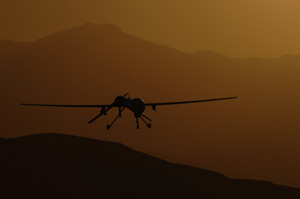
US Wants to Expand Drone Strikes Into Major Pakistani City
Officials: ‘Real Discussion’ of Attacking Quetta
by Jason Ditz, December 13, 2009
Top US officials say there is a “real discussion” going on right now about launching drone attacks against the Balochistan capital city of Quetta. The comments are the latest in a series of threats against the city, one of Pakistan’s largest.
Though the Pakistani government has looked the other way and even provided behind the scenes support for the various US drone attacks against Pakistan’s tribal areas, officials say a strike on Quetta would be a deal-breaker.
“We are not a banana republic,” one official declared, adding that a US attack on Quetta “might be the end of the road.” Pakistan’s military has likewise repeatedly warned against attacks on the city.
The US threats are ostensibly designed to counter the Quetta Shura, a group of Afghan exiles supposedly running much of the insurgency from the city. Pakistan has repeatedly denied that the Shura even exists, though on Friday Defense Minister Ahmad Mukhtar insisted that security forces had degraded them to the point they no longer pose a real threat.
HOW THE ‘JERUSALEM POST’ PROPAGANDISES ITS EXTREME VIEWS WITHOUT SEEMING TO BE EXTREME
By Damian Lataan
December 14, 2009
I suspect that many exiled Palestinians and their friends and supporters take the trouble to read the ‘Jerusalem Post’ on a regular basis if for no other reason than to get an Israeli perspective of how things are in the West Bank, the Gaza Strip and elsewhere and in order to assess the Israeli point of view on these matters.
The ‘Jerusalem Post’ is a politically right of centre newspaper and generally pro-Zionist and pro-Likud though it occasionally publishes works that clearly do not support the right-wing of Israeli politics – but only occasionally, and then only to present it self as a ‘fair and balanced’ journal in support of what they consider is their idea of ‘democracy’. The ‘Jerusalem Post’ tries hard to present its right-wing Zionist views without seeming to be extreme. One of the ways that it does this is to write articles that argue the right-wing cause but without going ‘over the top’ with extremist rhetoric. It then allows its right-wing readership to do the rest by inviting them to comment. The ‘Jerusalem Post’ then censors comments so that the extremists view dominates. The ‘Jerusalem Post’ will publish irrational or just plain stupid comments that dissent from their article in order to belittle and demean the more progressive or left-wing side of the ‘debate’. Sensible progressive or left-wing comments rarely get published.
A good example of how all this works appeared in the ‘Jerusalem Post’ last week when it published an article entitled ‘Security and Defence: Round Two’ by Yaakov Katz. The article was about how Israel is gearing up for, and why the Israel people should expect, another ‘round’ of war against Hamas and the Palestinian people in the Gaza.
Katz is a skilled propagandist and is well practised in the art of expressing an extremist view with such eloquence as to make it seem almost moderate. This is done by presenting his writings as objective analysis rather than obvious propaganda and political rhetoric. As well as the content of his article conveying the message to Israelis and the rest of the world, (the message, incidentally, is; “The IDF believes this future conflict will be far different than its predecessor, and likely more lethal”) Katz leaves it to his readers to express what he really thinks. There’s this one for example:
Round two? Round umpteen! Only one way to fight ethically NOW. Territorial and demographic (non-violent [sic] transfer) VICTORY AND BUFFER to achieve true.. balance in ME (minimally “Big” Israel, how the British Mandate should have been divided anyway) with a minimal amount of casualties. It is NOT ethical anymore to send soldiers into battle without any clear and honest territorial gain. Honesty will win the day. Backed by a diplomatic “offensive” to finally put across Israel’s historical rights and position forthrightly and to explain to the Arabs/Mulsims (sic) and West that a “Big” Israel is the best psychological defense against Totalitarian Jihad. Israeli politicians have to back the jewish (sic) soldier! Shalom is the only defense, not rounds of hagana (sic)
No more rounds.
Unlike Katz, this reader is not constrained when it comes to saying what he/she as a Zionist really believes.
Then there’s this which highlights the Zionists belief in a God-given right to lands that don’t belong to them. It’s not something you’ll ever find Katz saying in the ’Jerusalem Post’ but he’d likely endorse the sentiment expressed:
Simon the Maccabbee took Gaza 2150 years ago. That’s what we will be forced to do sooner or later.
It is part of our land and the more we try to run away from it the more it chases after us. Most of the Arab there want to leave and would do so in a minute if helped to do so. Which would solve the problem of Gaza once and for all in a humane fashion. The world and especially the 22 Arab states sitting on 1/6 of the Earth’s land can certainly find room for these people who want simply to leave. Then the Gush Katif Jews can return rebuild and make the whole of Gaza into a paradise as their own small area was before the destruction.
And there’s this from a reader who calls himself ‘Pedro’ in Australia:
The question is, knowing all this what is Israel going to do about it and why in the first place do you allow this monsters to arm them self to this point?? Why must you wait for them to attack first?
If you link to the article and read it and the comments that follow you’ll soon understand how the propagandists work.
But what’s really frightening is how these people, Katz supported by his readers, can actually endorse blatant violence in order to achieve nothing less than conquest of lands that are not theirs. This is the mindset of the Zionists. The propagandist plants the pestilent seed; the readers that support him supply the manure to fertilise it.
Obama snubs UK freedom request
Last Briton in Guantanamo Bay has been held eight years without charges
By Robert Verkaik, Law editor
The Independent
December 12, 2009
The government has clashed with the Obama administration over the return of the last UK resident to be held at Guantanamo Bay.
Foreign Office officials yesterday confirmed that Foreign Secretary David Miliband last month made an “exceptional” request to the US for the release of Shaker Aamer, but that his appeal has been rejected.
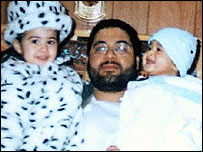 Mr Aamer, 42, who lived with his British wife and four children in London for five years after arriving in Britain in 1996, has been detained at the prison camp in Cuba since February 2002 after his capture in Afghanistan in December 2001. He was later handed over to American forces and held at Bagram prison, where he claims he was subjected to torture during interrogations.
Britain made its first request for the release of Mr Aamer to representatives of the Bush administration in August 2007. Mr Miliband was known to have discussed Mr Aamer’s release with Hillary Clinton after President Obama’s election victory, but it was not known until yesterday that a second request had been made.
A Foreign Office spokesperson said: “We have made an exceptional request for the release and return of Shaker Aamer, a Saudi national, to the UK.
“This is because of the exceptional nature of the Guantanamo facility and our sustained efforts to see it closed. Though we were successful with securing the return of four other non-UK nationals, we have not been able yet to do so with Shaker.”
Mr Aamer has never been charged with an offence.
This week the High Court in London ruled that there was evidence of wrong-doing in Mr Aamer’s case and ordered the UK Government to disclose secret documents that Mr Aamer alleges prove Britain was complicit in his torture.
The case is potentially more damaging to Britain than that of former Guantanamo detainee Binyam Mohamed because British agents are accused of being present during Mr Aamer’s alleged torture. In one allegation an MI5 agent is said to have been present when Mr Aamer’s US interrogators banged his head against a wall, although the agent did not intervene.
In his court victory on Tuesday two judges ruled that Mr Aamer was entitled to see UK Government documents relating to his detention. His lawyers say they contain evidence supporting his claims that confessions he made were obtained through torture.
Lord Justice Sullivan said: “Our present view is that this matter is clearly very urgent. If this information is to be of any use it has to be put in the claimant’s hands as soon as possible.”
Later Mr Aamer’s solicitor, Irene Nembhard, said: “It is the first ray of light for Shaker and his family. [They] will be overjoyed and they will be expecting that the British Government will give their lawyers the documents to assist them in persuading the Americans to release Shaker.” President Obama made the closure of the US naval base a key priority when he was elected last year. He set himself a deadline of one year but has since admitted that he will not be able to meet this target.
Clive Stafford Smith, the director of UK legal charity Reprieve, has represented Mr Aamer in the US. He said that the British and American governments seem to working in unison to keep information about Mr Aamer’s treatment from being made public. “It seems to be another big example of the British government working with the US to hide their mutual wrongdoing,” he said.
The US have told the UK that they believe Mr Aamer represents a security risk.