US claims of Assad’s chemical weapons are lies – Pushkov
RT | June 14, 2013
A senior Russian MP holds that the recent White House statement of chemical weapons use by the Syrian government is as false as the notorious reports about Iraqi WMDs.
“The data about Assad’s use of chemical weapons is fabricated by the same facility that made up the lies about Saddam Hussein’s weapons of mass destruction. Obama is walking George W. Bush’s path,” the head of the Duma’s Foreign Affairs Committee Aleksey Pushkov tweeted.
The Russian MP was referring to the 2003 invasion in Iraq prompted by the US and UK claims that Saddam Hussein possessed weapons of mass destruction that threatened neighboring nations. The UN probe into the matter was underway as the invasion started and no traces of WMD have been discovered on Iraqi territory since the war ended, prompting accusations that the US administration and special services fabricated the data to get an excuse to start the conflict.
In comments to Russian news agencies Pushkov noted that the supplies of arms from the US to the Syrian rebels would hardly lead to the overthrow of President Bashar Assad’s regime. He added that the government in Syria is supported by “a significant, if not the larger, part of the population” and the Syrian military “show a high degree of resistance.”
Pushkov also forecast that the United States would now attempt to further escalate the situation.
“Now they are arming the rebels but then they will come to some form of direct military involvement. We cannot exclude the possibility of cruise missile strikes and if this measure brings no result – of direct military intervention,” he said.
The statement was made shortly after US authorities publicly announced that they had proof that pro-government forces used chemical weapons, like the nerve agent sarin in the Syrian conflict, killing at least 150 people. At the same time, the US side claimed that there was no proof about similar actions from the rebels’ side.
US Deputy National Security Advisor Ben Rhodes has told the press that President Barack Obama has decided to boost the US support to the Syrian opposition forces and that this would now include military support. The detailed orders will be issued within the nearest weeks after Obama consults with the Congress, the official added.
Earlier last week UK and France said that their probes into the alleged use of chemical weapons in Syria showed that the pro-government forces did it at least once causing casualties among rebels and called the international community for immediate action. Many officials, including top Russian politicians, noted that the impartiality of British and French researchers is under question and urged an independent probe.
The UN is currently preparing its own independent investigation, but it might take a long time. Syrian government has said it was ready to accept the UN delegation and help with the investigation.
In late March one of the conflicting parties in Syria allegedly used a sarin-charged missile near the city of Aleppo. The government and rebels now accuse each other of the attack that killed at least 25 people.
While the UK, France and now the United states accuse pro-Assad forces, Turkish media said in early June that the country’s security forces had found sarin gas in the homes of members of the Al-Qaeda-linked Al-Nusra Front – one of the main groups opposing the Syrian government.
Russian officials have repeatedly condemned the use of chemical weapons and urged an all-sided and unbiased research into all incidents connected with the issue.
Settlers from Bracha attack and harass farmer on his land
International Solidarity Movement | June 13, 2013
Al Rujeib, Occupied Palestine – On Friday 7th June five settlers from the illegal settlement of Bracha attacked a farmer on his land, using sling shots to throw stones at him near Huwwara checkpoint. The same settlers continued to harass the farmer in the following days as he tried to graze his sheep and gather his crops, unprotected by the Israeli authorities.
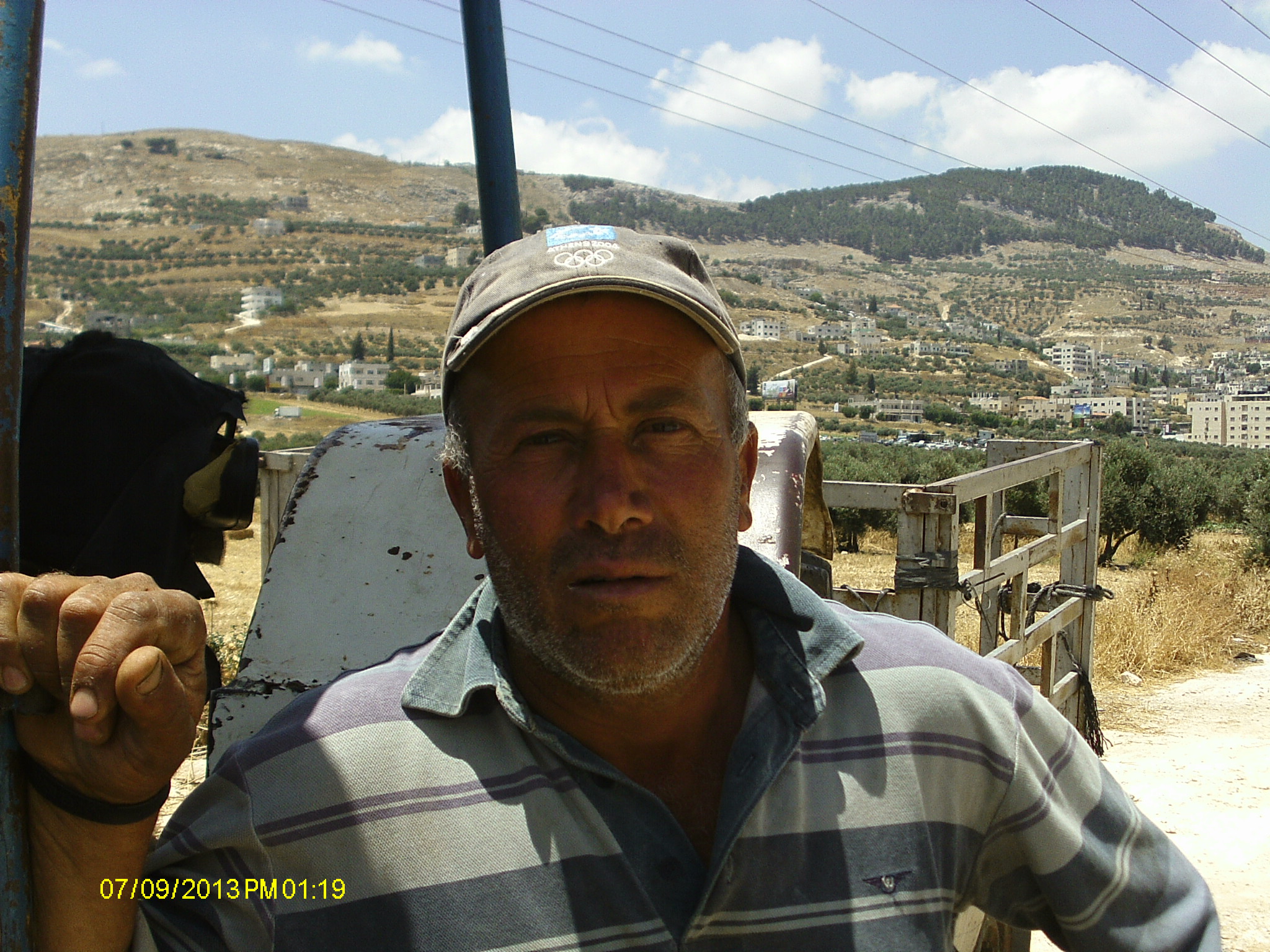
Salah Sukamel Deweket (Photo by ISM)
Salah Sukamel Deweket rents 70 dunums of land between his home in Al Rujeib and the occupation forces’ checkpoint at Huwwara. The land is mainly used to plant crops for his sheep to graze upon.
On Friday 7th June Salah was working hard to enable his sheep to feed when he was surprised by five settlers, thought to be an old man and his four sons who brought their own sheep to eat Salah’s wheat. The settlers threw rocks using slingshots at Salah and his flock. Salah had no one who could help him as he had no number for the District Coordination Office (DCO) – the Palestinian liasion with Israeli authorities or other organisations. Unable to get the number, he returned to his land to find that the settlers had ripped apart his bales of wheat.
The settlers resumed throwing stones at him in full view of soldiers stationed at the Israeli occupation forces checkpoint at Huwwara. The soldiers did nothing but watch as the Palestinian farmer was attacked. As an occupying power the Israeli military are meant to protect all citizens in the territory.
Salah asked the older settler why he had destroyed his wheat. “People who stay in Israeli land have to be good Israeli people”, the settler replied. “If this is Israeli land, where’s Palestinian land?” Salah asked. “There is no Palestinian land” the settler shouted back. The settlers continued to graze their sheep on Salah’s land and then encouraged their sheep to eat the olive trees of another Palestinian farmer who came to protect his land. It was only then that army jeeps came to intervene – asking why the Palestinian farmers were there. Salah tried to explain the problem with the settlers to the army, who told him to take photos and go to DCO. Salah then asked the soldiers if they were going to arrest the settlers, to which they said, ” we don’t know, it’s up to the judge.” When the soldiers were asked why they did not come earlier, they replied that it wasn’t their problem. The next day Salah tried to fix his wheat bales but the settlers kept coming and causing problems. Soldiers eventually came and told both Salah and the settlers to leave but said that the Palestinians must leave first.
Palestinians face many attacks by settlers of varying severity. Religious extremists living in illegal settlements attack Palestinian people, lands and crops. Palestinians have almost no means of legal recourse or protection from settler attacks but are routinely targeted by the army in mass arrests in the alleged defence of the Israeli occupation and settlements. Even when Palestinians can contact the DCO, the coordination office can often not solve issues with settlers who generally are treated with impunity under Israeli law. Settlements are illegal under international law under the fourth Geneva convention.

Salah Sukamel Deweket’s wheat fields (Photo by ISM)
Related articles
- Jewish settlers setting up tent and planning road on Palestinian owned land in Al Khalil (alethonews.wordpress.com)
- After the flames, only determination remains in Burin and Madama (alethonews.wordpress.com)
- VIDEO | 82-year-old Hebron woman Umm Salah challenges Israeli settlers, troops. Alone. (occupiedpalestine.wordpress.com)
- Jewish settler fires at Palestinian workers wounding one of them (occupiedpalestine.wordpress.com)
Hospital Drugs Patients & Dumps Them Onto Buses, Suit Claims
By MEGAN GALLEGOS | Courthouse News | June 13, 2013
LAS VEGAS – Calling it “Greyhound therapy,” a Las Vegas psychiatric hospital drugs patients and sends them on buses out of state to cities where they know no one, without medical instructions or anyone to care for them, one such patient claims in a federal class action.
Lead plaintiff James Flavy Coy Brown claims the hospital’s illegal policies are “sometimes referred to as ‘Greyhound therapy.'”
He sued Rawson-Neal Psychiatric Hospital, Southern Nevada Adult Mental Health Services, the Nevada Bureau of Health Care and Quality and Compliance, Dr. Anurag Gupta, his psychiatrist at Rawson-Neal, and others.
The complaint states: “Plaintiffs are former psychiatric patients at defendant Rawson-Neal Psychiatric Hospital (hereinafter ‘Rawson-Neal’) who, while still in need of psychiatric care, were involuntarily discharged from the facility by defendants and their agents and employees, and sent to out-of-state destinations where defendants knew said patients would be unable to obtain proper treatment, care and housing. Plaintiffs were medicated before their discharge and required to leave the facility under the influence of powerful anti-psychotic/tranquilizing medication. While plaintiffs were in a drugged state, and incompetent to give informed consent, the standard procedure was for institution staff to physically escort plaintiffs from the facility and place them in taxis bound for the Greyhound Bus Station in Las Vegas, Nevada. They were directed and required to travel on pre-paid tickets which had been previously ordered and paid for by Defendants Southern Nevada Adult Mental Health Services (hereinafter ‘SNAMHS’) and Rawson-Neal.”
Brown, 48, says he was admitted to Rawson-Neal on Feb. 9. The hospital is run by Southern Nevada Adult Mental Health Services. He was given “a diagnosis of psychosis, hearing voices, and thinking of suicide,” he says in the complaint.
He was discharged on Feb. 11.
“Defendants knew he was penniless and homeless and defendant Rawson-Neal knew or acted in reckless disregard of the fact that he would be unable to care for himself during the journey or upon his arrival,” the complaint states. “Before he was discharged, he was started on Thorazine, Cymbalta and Klonopin, all psychotropic medications which affect thinking and judgment. While Defendant Rawson-Neal had developed a written treatment plan which included assisting him to locate a group home placement and locating a case worker for him, this treatment plan was intentionally disregarded and violated by his involuntary discharge contrary to the plan.
“On February 13, defendant psychiatrist Dr. Anurag Gupta (hereinafter ‘Gupta’) ordered Brown discharged, physically escorted from the facility, and placed in a taxi which had been ordered by the defendants. Plaintiff Brown was then transported to the Greyhound Bus Station, where a pre-paid ticket had been purchased by the defendants to take Brown to Sacramento, California, a city which he had no prior contact, and where he knew no one. There was no follow-up plan and no prior contact had been made with any institutions in Sacramento from which Brown could obtain medical and psychiatric care. He was given three days of powerful anti-psychotic medications and bottle of Ensure for the 15 hour bus ride.
“Plaintiff Brown arrived in Sacramento, homeless, confused and anxious. He was taken by police to a local homeless service center, Loaves and Fishes, which could provide no housing, medical care or transportation. After his arrival at that location, he was directed to the U.C. Davis Medical Center’s emergency department which, after three days, arranged for Brown to be treated by Heritage Oaks psychiatric facility. From there he was discharged to a group home in Sacramento.”
Brown claims he’s one of more than 1,500 patients the defendants have treated this way, sent dazed and confused to nearly every state in the union.
“After learning of the ‘dumping’ of Brown in Sacramento by defendants, the Sacramento Bee newspaper began to investigate the circumstances which led to Brown’s arrival in Sacramento and discovered that since the year 2008 approximately 1,500 patients of the Rawson-Neal Psychiatric Hospital in Las Vegas, Nevada, have been transported by Greyhound Bus to almost every state in the country, all with minimum provisions to sustain them during protracted bus rides.
“A random survey by Nevada’s Bureau of Health Care Quality and Compliance of 30 discharges of psychiatric patients from Rawson-Neal revealed discharges in violation of policy and procedures of the Centers for Medicare and Medicaid and the facility’s own policies occur frequently. Patients, such as Brown, were involuntarily placed on Greyhound buses and sent out of state without prior arrangements having been made for follow-up care. These patients were not informed where they should go to receive continuing care upon arrival at their destinations. Discharge orders did not specify the amount of nutritional supplements to be provided to the patients for their extended bus trips; and appropriate and necessary prescription medications were not provided. Furthermore, necessary information was not provided on discharge documentation.”
Brown seeks punitive damages for civil rights violations, constitutional violations including cruel and unusual punishment, medical malpractice, negligence, gross negligence and breach of fiduciary duties.
He is represented by Allen Lichtenstein with the ACLU of Nevada.
No significant warming for 17 years 4 months
By Christopher Monckton of Brenchley | Watt’s Up With That? | June 13, 2013
As Anthony and others have pointed out, even the New York Times has at last been constrained to admit what Dr. Pachauri of the IPCC was constrained to admit some months ago. There has been no global warming statistically distinguishable from zero for getting on for two decades.
The NYT says the absence of warming arises because skeptics cherry-pick 1998, the year of the Great el Niño, as their starting point. However, as Anthony explained yesterday, the stasis goes back farther than that. He says we shall soon be approaching Dr. Ben Santer’s 17-year test: if there is no warming for 17 years, the models are wrong.
Usefully, the latest version of the Hadley Centre/Climatic Research Unit monthly global mean surface temperature anomaly series provides not only the anomalies themselves but also the 2 σ uncertainties.
Superimposing the temperature curve and its least-squares linear-regression trend on the statistical insignificance region bounded by the means of the trends on these published uncertainties since January 1996 demonstrates that there has been no statistically-significant warming in 17 years 4 months:

On Dr. Santer’s 17-year test, then, the models may have failed. A rethink is needed.
The fact that an apparent warming rate equivalent to almost 0.9 Cº is statistically insignificant may seem surprising at first sight, but there are two reasons for it. First, the published uncertainties are substantial: approximately 0.15 Cº either side of the central estimate.
Secondly, one weakness of linear regression is that it is unduly influenced by outliers. Visibly, the Great el Niño of 1998 is one such outlier.
If 1998 were the only outlier, and particularly if it were the largest, going back to 1996 would be much the same as cherry-picking 1998 itself as the start date.
However, the magnitude of the 1998 positive outlier is countervailed by that of the 1996/7 la Niña. Also, there is a still more substantial positive outlier in the shape of the 2007 el Niño, against which the la Niña of 2008 countervails.
In passing, note that the cooling from January 2007 to January 2008 is the fastest January-to-January cooling in the HadCRUT4 record going back to 1850.
Bearing these considerations in mind, going back to January 1996 is a fair test for statistical significance. And, as the graph shows, there has been no warming that we can statistically distinguish from zero throughout that period, for even the rightmost endpoint of the regression trend-line falls (albeit barely) within the region of statistical insignificance.
Be that as it may, one should beware of focusing the debate solely on how many years and months have passed without significant global warming. Another strong el Niño could – at least temporarily – bring the long period without warming to an end. If so, the cry-babies [salaried agenda-men – Aletho News] will screech that catastrophic global warming has resumed, the models were right all along, etc., etc.
It is better to focus on the ever-widening discrepancy between predicted and observed warming rates. The IPCC’s forthcoming Fifth Assessment Report backcasts the interval of 34 models’ global warming projections to 2005, since when the world should have been warming at a rate equivalent to 2.33 Cº/century. Instead, it has been cooling at a rate equivalent to a statistically-insignificant 0.87 Cº/century:

The variance between prediction and observation over the 100 months from January 2005 to April 2013 is thus equivalent to 3.2 Cº/century.
The correlation coefficient is low, the period of record is short, and I have not yet obtained the monthly projected-anomaly data from the modelers to allow a proper p-value comparison.
Yet it is becoming difficult to suggest with a straight face that the models’ projections are healthily on track.
From now on, I propose to publish a monthly index of the variance between the IPCC’s predicted global warming and the thermometers’ measurements. That variance may well inexorably widen over time.
In any event, the index will limit the scope for false claims that the world continues to warm at an unprecedented and dangerous rate.
Related articles
- Benchmarking IPCC’s warming predictions (wattsupwiththat.com)
- Only 65 Scientists of 12,000 Make up Alleged 97% on Climate Change and Global Warming Consensus According to Breakdown of Cook et al study, say Friends of Science (prweb.com)
- The Met Drops Its Basis For Claim Of “Significant” Warming (papundits.wordpress.com)
- David Whitehouse: Before And After The Temperature Standstill (tallbloke.wordpress.com)
Land Grabs, the Latest Form of Genocide in Guatemala

By Leonor Hurtado – Americas Program – 12/06/2013
In a historic decision this May, Guatemala’s Supreme Court of Justice sentenced former dictator General Ríos Montt to 80 years in prison for the genocidal massacres of indigenous people in the 1980s. Many Guatemalans hoped that the judicial process against the top criminals of the country’s “dirty war” would finally bring justice—but ten days after the decision, the Constitutional Court reversed the judgment.
While the Guatemalan people protest this violation of the rule of law, the processes of genocide initiated 30 years ago by Ríos Montt’s massacres continue today by other means.
In the last decade, the expansion of oil palm plantations and sugarcane production for ethanol in northern Guatemala has displaced hundreds of Maya-Q´eqchi´ peasant families, increasing poverty, hunger, unemployment and landlessness in the region, according to a new Food First report by Alberto Alfonso-Fradejas, “Sons and Daughters of the Earth: Indigenous Communities and Land Grabs in Guatemala.”
There is a major contradiction here: at the same time that the former General Ríos Montt is convicted for genocide, the Guatemalan government allows the oligarchy, allied with extractive industries, to displace entire populations without concern for the human cost. In many cases, these land grabs result in the murder and imprisonment of rural people who resist the assault.
Genocide against the indigenous peasant population in Guatemala no longer has the face of a military dictatorship supported by the United States. Now it is the corporations, the oligarchy and the World Bank who push peasants off their lands.
In today’s Guatemala, land and resource control is increasingly in the hands of a small oligarchy of powerful families allied with agri-food companies. At the center of this power are fourteen families who control the country’s sugarcane-producing companies (AZAZGUA); five companies controlling the national production of ethanol; eight families that control the production of palm oil (GREPALMA); and members of the Coordinating Committee of Agricultural, Commercial, Industrial, and Financial Associations (CACIF).
Together these powerbrokers are accumulating land and wealth with the support of investment from international institutions such as the World Bank, the Inter-American Development Bank (IDB) and the Central American Bank for Economic Integration (BCIE). The convergence of multiple global crises—finance, energy, food and environment—has directed corporate investment into land-based resources such as agrofuels, minerals, pasture and food. The situation in Guatemala is extremely violent, part of a global trend where agrarian, financial and industrial interests are grabbing control of peasant lands and resources.
Can land grabs be considered genocide? In many ways, land grabbing is a new form of genocide. Ricardo Falla’s study “What Do You Mean There Was No Genocide?” analyzes the definition of genocide and its characteristics. According to Falla, of the five acts that define genocide, two were most prominent in Guatemala: “the massacre of the members of a group,” and “the intentional subjection of a group to living conditions which will lead to their total or partial physical destruction.”
The first genocide was against the Ixil peoples during the reign of Ríos Montt. The second genocide is enacted today through the privation of the Q´eqchi´ peoples’ means of survival through land grabs. Hundreds of families have been displaced. They do not have land on which to produce food or live, and they are denied their cultural and community identity. These conditions undermine their ability to survive, and lead to their displacement, and in many cases death.
The historic genocide trial this May came about through the peoples’ long struggle to defend their rights. The Ríos Montt conviction is a condemnation of impunity. The oligarchy did everything possible to impede the trial while continuing to displace the indigenous peasant population with the support of international investment and a legal system that favors land grabbing to the detriment of the people.
On May 20, the Constitutional Court overturned the conviction, with two of the five judges opposing the decision. Pablo de Greiff, UN Special Rapporteur for the Promotion of Truth, Justice, Reparation and Guarantees of Non-Recurrence stated, “No legal decision is inconsequential, even if it is revoked.” The Inter-American Court of Justice issued a statement criticizing the verdict for violating international obligations assumed by the state and preventing the people from seeking justice. Multiple organizations and authorities have spoken out against the court’s decision, arguing that it overstepped its bounds, violated legal provisions, and endorsed the corrupt mechanisms upon which impunity is built in Guatemala. The decision bolsters evidence that Guatemala’s top court lacks political independence and is tied to the country’s economic and ruling elite.
On May 24, thousands of people demonstrated and delivered a letter with more than a thousand signatures to the Court demanding that the decision be reversed. In Argentina, Chile, Honduras, Mexico, Nicaragua and Peru, thousands more marched in solidarity to the Guatemala embassy demanding justice.
If we fail to judge and condemn the massacres committed thirty years ago, what hope is there for the Mayan Q’eqchi’, Xinka, Mam, Kaqchikel and other indigenous peoples currently being displaced and massacred by extractive corporations with the support of the state and international institutions? The people continue to courageously resist and defend their lives, lands and identities. How shall we express our solidarity?
Leonor Hurtado is a fellow at Food First/Institute for Food and Development Policy. A native of Guatemala, she has spent decades defending human rights and indigenous rights, and supporting indigenous resistance to the expansion of extractive industries.
Photo: Caracol Producciones
Related articles
- Survivors Reluctant to Testify in New Genocide Trial (ipsnews.net)
- Guatemalans protest annulment of dictator’s genocide conviction (workers.org)
- Israel’s Hand in Guatemala’s Genocide (phantomreport.com)
Egypt denies purchasing military equipment from Israel
MEMO | June 12, 2013
The spokesman of the Egyptian Army, Staff Colonel Ahmed Mohamed Ali, on Wednesday denied that his country had bought military wares from Israel.
An Israeli newspaper reported early this week that Israel had sold military wares to Pakistan and another four Arab countries, including Egypt. Harretz report was based on data issued by the British Government’s Department for Business Innovation and Skills (BIS), which oversees security exports.
The report said that these countries had purchased amounts of developed military equipment between 2008 and 2012.
According to the BIS report, this equipment included unmanned aircraft vehicles, radar systems, electronic warfare systems, head-up display (HUD) cockpit parts for fighter jets and aircraft engines, optical target acquisition systems, components of training aircraft and military electronic systems.
Ali wrote on his Facebook page that the militarisation of Egypt’s Armed Forces follows strict guidelines which guarantee what is called “product security.” These are obligatory rules that all military branches are committed to.
Similarly, Pakistan also denied that it bought military equipment from Israel based on information published by Haaretz in the same report.
The Islamabad spokesman for the Directorate of Inter-Services Public Relations denied the report. “The report is misleading and not based on facts,” The Hindu reported him as saying.
The Egyptian military official affirmed that his country is following credible measures regarding weapon purchases. However he said that the policy had “high costs in light of the new global system.”
He also called for the need to ensure that information reported about the Egyptian Armed Forces was reliable and accused the mass media of attempting to shake the credibility of the Egyptian Armed Forces with their people.
Russia ranked world leader in shale oil reserves
RT | June 12, 2013
Russian shale oil reserves are estimated at 75 billion barrels, which puts the country on top of the global standings, followed by the US and China.
According to the report by the US Energy Information Administration (EIA), the estimated American shale gas resources equal 58 billion barrels, with third-place China having 32 billion barrels.
But it’s the Chinese, who hold the leadership in shale gas reserves, with 1,115 trillion cubic feet. 802 trillion cubic feet puts Argentina in second, with Algeria not far behind on 707 trillion cubic feet.
The US is fourth when it comes to shale gas (665 trillion cubic feet), while Russia is ninth with 285 trillion cubic feet.
The EIA’s report indicates that the worldwide resources of oil and gas from shale formations are greater than was previously thought.
The global shale oil resources are estimated at 345 billion barrels and shale gas – at 7,299 trillion cubic feet, which is a 10 per cent increase in comparison with the 2011 data.
According to EIA’s administrator, Adam Sieminski, the report shows “a significant potential for international shale oil and shale gas.”
The increase in estimates is explained by more countries joining the efforts to search for deposits, following the ‘Shale Revolution’ in the US.
“As shale oil and shale gas production has grown in the United States to become 30 percent of oil and 40 percent of natural gas total production, interest in the oil and natural gas resource potential of shale formations outside the United States has grown,” Adam Sieminski explained in a statement.
Also on Wednesday, British oil giants BP have Russia’s natural gas reserves estimate at 32.9 trillion cubic meters from 44.6 trillion in last year.
According to the company’s benchmark Statistical Review of World Energy, it’s Iran, who climbed to the top of the global standings, with the proven reserves of 33.6 trillion cubic meters.
BP said that this year they decided to adjust its estimates for the former Soviet Union states, including Russia, where data on reserves remains classified.
“Traditionally countries of the former Soviet Union had different criteria than used elsewhere. So we used a conversion factor to convert that from those countries where we don’t get direct data,” Christof Ruhl, BP’s chief economist, is cited as saying by Reuters. “In some countries, reserves are still a state secret, so we have to rely on these data.”
But Russia remains a much larger gas producer than Iran as the international sanctions prevent the Islamic Republic from exploiting its natural resources in full.
The estimate of gas reserves in the US where the energy industry has been transformed by shale oil and gas, due to lower prices and reduced drilling.
The American gas reserves ended 2012 at 8.5 trillion cubic meters, down 0.3 trillion from indications of 2011.
BP cut proven global gas reserves by nearly 21 trillion cubic meters from 208.4 trillion cubic last year to 187.3 trillion cubic meters as of end of 2012.
Related article
State propaganda on NPR’s “Morning Edition”
By Justin Doolittle | Crimethink | June 12, 2013
On Wednesday’s episode of “Morning Edition” on NPR, a segment was devoted to exploring the extreme violence that has engulfed Honduras in recent years. Indeed, if measured by per capita murder rate, Honduras is now the most dangerous in the country in the world. There are many reasons why Honduran civil society has broken down like this, but let’s suspend that discussion for the moment in order to focus on one particular aspect of this story on NPR that was quite revealing.
At one point in the segment, Carrie Kahn, the NPR correspondent reporting from Honduras, said the following:
Last year, the U.S. Congress held up funding to Honduras over concerns of alleged human rights abuses and corruption, particularly in the Honduran police force. Part of the funds are still on hold.
This is an astonishing statement for someone who purports to be a journalist. Unless Ms. Kahn has psychic powers, she cannot know why the U.S. Congress held up funding to Honduras. She can only know why Congress said it was holding up funding to Honduras. There is often a profound difference between why politicians say they are implementing policy X and why they are actually doing it. As you might have heard, politicians are occasionally dishonest and insincere, and their decisions are informed by a number of factors that have nothing to do with their personal beliefs. For a journalist, someone who is supposed to adversarially cover politicians and express skepticism at everything they say, this kind of blind faith is inexcusable.
The problem, though, is that Ms. Kahn’s statement is actually quite a bit worse than that. Even if she had said, “the U.S. Congress held up funding to Honduras over what it claimed were concerns of alleged human rights abuses and corruption,” instead of just mindlessly repeating what the government claimed, that would still be wildly insufficient for any journalist who takes her profession even the slightest bit seriously. Why? Because the United States government provably does not base its decisions on allocating foreign aid on “concerns about human rights and corruption.” For decades, the U.S. has provided aid to some of the most repressive and corrupt governments on Earth. Going down the list would be trivial, but, for the sake of comparison, let’s stay relatively close by and just look at Colombia. The U.S. government ships hundreds of millions of dollars to the Colombian government every year; in FY 2012, $443 million was provided, making Colombia the leading recipient of U.S. aid in the hemisphere.
In a strange twist, though, Colombia is also widely considered to be the most repressive violator of human rights in the hemisphere, and corruption there is rampant. This is quite a conundrum. Ms. Kahn tells us that the U.S. withheld aid from Honduras “over concerns of alleged human rights abuses and corruption.” But the U.S. evidently has no such “concerns” in Colombia and continues to send hundreds of millions of dollars in annual aid. One is almost tempted to conclude that the U.S. government makes these decisions based not on noble and selfless “concerns” about human rights and corruption, but, rather, on what it perceives to be U.S. interests.
Ms. Kahn must know that the government claim she dutifully parroted is transparently fraudulent and, in fact, downright comical. She cannot be a working journalist and not know this. Presumably, she follows the news, she is knowledgeable regarding basic facts about U.S. aid, and she knows that the U.S. has always cheerfully sent aid to brutal regimes around the world. She’s not a wide-eyed poly-sci 101 student who is shocked to find out that U.S. government decisions are not invariably and solely based on considerations of Good and Evil. Ms. Kahn is a highly educated reporter, and she obviously does know these things, but the culture of obedience and submissiveness in American journalism is so profound that she probably doesn’t even consciously realize that she’s serving state power instead of doing journalism. The U.S. government told her that aid is being withheld to Honduras because of concerns about human rights and corruption, therefore aid is being withheld to Honduras because of concerns about human rights and corruption. That’s that. Then she goes on NPR, unquestioningly repeats government claims, and she’s done her job. We would call this “propaganda” if it happened in the Soviet Union, but it’s called “journalism” when it happens here.
Featured Video

The First Pyrrhic Victory of the Vietnam War
or go to
Aletho News Archives – Video-Images
Frlom the Archives
The 52 Major Jewish American Organizations and Israel Celebrate Passover with the Slaughter of 25 Muslim, Christian and Secular Palestinians
By James Petras • Unz Review • April 8, 2018
Introduction
As of April 7, nearly three thousand unarmed Christian, Muslim and secular Palestinians have been wounded, over three dozen are in critical condition and at least twenty-five unarmed protestors, including children have been assassinated by hundreds of Israeli snipers and heavily armed troops shooting tank shells into crowds of civilians protesting their decades of incarceration by the racist Israeli state.
The Israeli government praised the ‘restraint and morality’ of the IDF, as did the fifty-two Major Jewish American Organizations (MJAO) who largely control the US Congress. These grotesque massacres began during the Christian Holy Week on Good Friday and Easter, coinciding with the Jewish Passover. The self-righteous officials of the MJAO and their relatives and friends broke matzos at joyful Seders as the blood of Palestinians soaked into ground at the fence containing the largest open-air prison camp in history, Gaza.
While tribal loyalties bonded the Israeli and Jewish American leaders, the politicians of the Western oligarchic electoral regimes refrained from criticizing the shocking display of brute force and even defended Israel’s cold blood mass killings of Palestinian civilians in their Gaza prison.
This paper will discuss and analyze the reasons for Israel’s willing Western accomplices and the centrality of its fifth column in the United States. … continue
Blog Roll
 Aletho News
- No time for losers: Why the war meant to save Israel may destroy it
- Top US Counterterrorism Official Resigns in Protest of Operation Against Iran
- Just Get Out! Now!
- Unpacking glaring contradictions in US-Zionist justifications for war against Iran
- Iranian model of warfare bleeds US dry while Persian Gulf states watch and learn: Analyst
- IRGC orders ‘defeated’ US to evacuate industrial facilities in region
- Hegseth’s call for ‘no mercy’ to Iranians deemed war crime
- Iran War Exposes Limits of US Military Power – Journalist
- Even The Neo-Cons Admit The Iran War Is Failing
- Inside the Caucasus Drone Corridor Fueling Tensions With Iran
- If Americans Knew
- Top US counterterror advisor resigns in protest of “war manufactured by Israel” – Not a ceasefire Day 158
- ‘I Liked the House’: When Israeli Soldiers Turn Palestinian Homes into Barracks
- ‘They Were All I Had’: Lebanese Father Buries Parents, 4 Daughters Killed by Israeli Bombing
- Israel and its supporters are causing attacks on Jewish institutions. Case in point: Michigan synagogue tragedy.
- These are the casualties and cost of the war in Iran 2 weeks into the conflict
- Chicago Teachers Union accuses AIPAC of swaying elections with ‘dark money’
- Predictions of another 9/11, amid Israel-US killing spree – Not a ceasefire Day 157
- As US-Israel war on Iran rages, Gaza faces massive dust storm – Not a ceasefire Day 156
- No let-up in attacks on Gaza as Israel takes on Iran, Lebanon – Not a ceasefire Day 155
- ‘Of Course’: IDF Drops Case Against Soldiers Accused of Raping Palestinian Prisoner
- No Tricks Zone
- Storing Green Energy To Last Germany 10 Days Would Require A 60-Million Tonne Battery
- New Studies: UK Sea Levels Were 4 Meters Higher Than Today During The Mid-Holocene
- Destructive Green New Deal: German Energy And Metal Group Warns Of Drastic Crisis
- New Study Documents A 20-Year Pause In Arctic Sea Ice Decline – Driven By Internal Variability
- Wake-up Call: Survey Shows Majority Of Germans Now Favor Postponing Climate Targets!
- Televised! Leading German Political Candidate Tells Schoolchildren CO2 Makes Sun Hotter!
- New Study: A Century Warming Of 1.1°C Is ‘Commonplace’ And ‘Not Unusual’ During This Interglacial
- New Study: ‘Internal Noise’ And Volcanic Forcing Can Trigger 10-15°C Warming Within Decades
- Glaciers Worldwide Are Suddendly Surging, Experts Blame Warming!
- Surprising Discovery: Sahara Is Greening…Billions Of Trees Where Once Thought To Be Barren
 Aletho News