Knobs and Knockers
By Craig Murray | April 5, 2018
What is left of the government’s definitive identification of Russia as the culprit in the Salisbury attack? It is a simple truth that Russia is not the only state that could have made the nerve agent: dozens of them could. It could also have been made by many non-state actors.
Motorola sales agent Gary Aitkenhead – inexplicably since January, Chief Executive of Porton Down chemical weapons establishment – said in his Sky interview that “probably” only a state actor could create the nerve agent. That is to admit the possibility that a non state actor could. David Collum, Professor of Organo-Chemistry at Cornell University, infinitely more qualified than a Motorola salesman, has stated that his senior students could do it. Professor Collum tweeted me this morning.
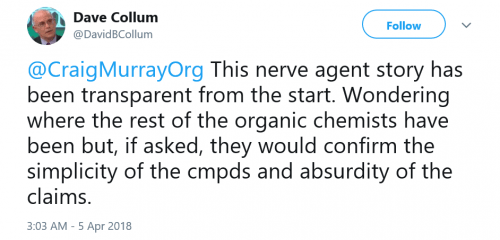
The key point in his tweet is, of course “if asked”. The state and corporate media has not asked Prof. Collum nor any of the Professors of Organic Chemistry in the UK. There simply is no basic investigative journalism happening around this case.
So given that the weapon itself is not firm evidence it was Russia that did it, what is Boris Johnson’s evidence? It turns out that the British government’s evidence is no more than the technique of smearing nerve agent on the door handle. All of the UK media have been briefed by “security sources” that the UK has a copy of a secret Russian assassin training manual detailing how to put nerve agent on door handles, and that given the nerve agent was found on the Skripals door handle, this is the clinching evidence which convinced NATO allies of Russia’s guilt.
As the Daily Mirror reported in direct quotes of the “security source”:
“It amounts to Russia’s tradecraft manual on applying poison to door handles. It’s the smoking gun. It is strong proof that in the last ten years Russia has researched methods to apply poisons, including by using door handles. The significant detail is that these were the facts that helped persuade allies it could only be Russia that did this.”
Precisely the same government briefing is published by the Daily Mail in a bigger splash here, and reflected in numerous other mainstream propaganda outlets.
Two questions arise. How credible is the British government’s possession of a Russian secret training manual for using novichok agents, and how credible is it that the Skripals were poisoned by their doorknob.
To take the second question first, I see major problems with the notion that the Skripals were poisoned by their doorknob.
The first is this. After what Dame Sally Davis, Chief Medical officer for England, called “rigorous scientific analysis” of the substance used on the Skripals, the government advised those who may have been in contact to wash their clothes and wipe surfaces with warm water and wet wipes. Suspect locations were hosed down by the fire brigade.
But if the substance was in a form that could be washed away, why was it placed on an external door knob? It was in point of fact raining heavily in Salisbury that day, and indeed had been for some time.
Can somebody explain to me the scenario in which two people both touch the exterior door handle in exiting and closing the door? And if it transferred from one to the other, why did it not also transfer to the doctor who gave extensive aid that brought her in close bodily contact, including with fluids?
The second problem is that the Novichok family of nerve agents are instant acting. There is no such thing as a delayed reaction nerve agent. Remember we have been specifically told by Theresa May that this nerve agent is up to ten times more powerful than VX, the Porton Down developed nerve agent that killed Kim’s brother in 15 minutes.
But if it was on the doorknob, the last contact they could possibly have had with the nerve agent was a full three hours before it took effect. Not only that, they were well enough to drive, to walk around a shopping centre, visit a pub, and then – and this is the truly unbelievable bit – their central nervous systems felt in such good fettle, and their digestive systems so in balance, they were able to sit down and eat a full restaurant meal. Only after all that were they – both at precisely the same time despite their substantially different weights – suddenly struck down by the nerve agent, which went from no effects at all, to deadly, on an alarm clock basis.
This narrative simply is not remotely credible. Nerve agents – above all “military grade nerve agents” – were designed as battlefield weapons. They do not leave opponents fighting fit for hours. There is no description in the scientific literature of a nerve agent having this extraordinary time bomb effect. Here another genuine Professor describes their fast action in Scientific American :
Unlike traditional poisons, nerve agents don’t need to be added to food and drink to be effective. They are quite volatile, colourless liquids (except VX, said to resemble engine oil). The concentration in the vapour at room temperature is lethal. The symptoms of poisoning come on quickly, and include chest tightening, difficulty in breathing, and very likely asphyxiation. Associated symptoms include vomiting and massive incontinence. Victims of the Tokyo subway attack were reported to be bringing up blood. Kim Jong-nam died in less than 20 minutes. Eventually, you die either through asphyxiation or cardiac arrest.
If the nerve agent was on the door handle and they touched it, the onset of these symptoms would have occurred before they reached the car. They would certainly have not felt like sitting down to a good lunch two hours later. And they would have been dead three weeks ago. We all pray that Sergei also recovers.
The second part of the extraordinarily happy coincidence of the nerve agent being on the door handle, and the British government having a Russian manual on applying nerve agent to door handles, is whether the manual is real. It strikes me this is improbable – it rings far too much of the kind of intel they had on Iraqi WMD. It also allegedly dates from the last ten years, so Putin’s Russia, not the period of chaos, and the FSB is a pretty tight organisation in this period. MI6 penetration is just not that good.
A key question is of course how long the UK has had this manual, and what was its provenance. Another key question is why Britain failed to produce it to the OPCW – and indeed why it does not publish it now, with any identifying marks of the particular copy excluded, given it has widely publicised its existence and possession of it. If Boris Johnson wants to be believed by us, publish the Russian manual.
We also have to consider whether the FSB really publishes its secret assassination techniques in a manual. I attended, as other senior FCO staff, a number of MI6 training courses. One on explosives handling was at Fort Monckton, not too far from Salisbury. One in a very nondescript London office block was on bugging techniques. I recall seeing rigs set up to drill minute holes in walls, turning very slowly indeed. Many hours to get through the wall but almost no noise or vibration. It was where I learnt the government can listen to you through activating the microphone in your mobile phone, even when your phone is switched off. I recall javelin like directional microphones suspended from ceilings to point at distant targets, and a listening device that worked through a beam of infra-red light, but the target could foil by closing the curtains.
The point is that there were of course no manuals for this stuff, no manuals for any other secret MI6 techniques, and these things are not lightly written down.
I would add to this explanation that I lost all faith in the police investigation when it was taken out of the hands of the local police force and given to the highly politicised Metropolitan Police anti-terror squad. I suspect the explanation of the remarkably convenient (but physically impossible) evidence of the door handle method that precisely fits the “Russian manual” may lie there.
These are some of the problems I have with the official account of events. Boris lied about the certainty of the provenance of the nerve agent, and his fall back evidence is at present highly unconvincing. None of which proves it was not the Russian state that was responsible. But there is no convincing proof that it was, and there are several other possibilities. Eventually the glaring problems with the official narrative might be resolved, but what is plain is that Johnson and May have been premature and grossly irresponsible.
I shall post this evening on Johnson’s final claim, that only the Russians had motive.
Update: I have just listened to the released alleged phone conversation between Yulia Skripal in Salisbury Hospital and her cousin Viktoria, which deepens the mystery further. I should say that in Russian the conversation sounds perfectly natural to me. My concern is after the 30 seconds mark where Viktoria tells Yulia she is applying for a British visa to come and see Yulia.
Yulia replies “nobody will give you a visa”. Viktoria then tells Yulia that if she is asked if she wants Viktoria to visit, she should say yes. Yulia’s reply to this is along the lines of “that will not happen in this situation”, meaning she would not be allowed by the British to see Viktoria. I apologise my Russian is very rusty for a Kremlinbot, and someone might give a better translation, but this key response from Yulia is missing from all the transcripts I have seen.
What is there about Yulia’s situation that makes her feel a meeting between her and her cousin will be prevented by the British government? And why would Yulia believe the British government will not give her cousin a visa in the circumstance of these extreme family illnesses?
France Joins Syria Fight: Goals and Consequences
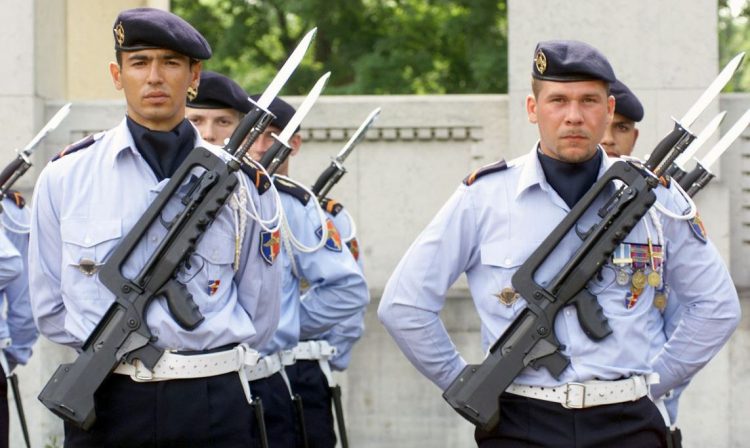
French Armed Forces, armed with FAMAS F1 assault rifles, participate in the Memorial Day ceremony at the LaFayette Escadrille Monument in Paris, France.
By Peter KORZUN | Strategic Culture Foundation | 05.04.2018
French President Emmanuel Macron kept his word. On April 1-2, French troops moved into northern Syria. This is the first time France deployed substantial forces there to turn Paris into a new actor actively involved in the war. The troops advanced toward Manbij and Remelin to join American allies and did it hastily.
The move was made at the time Ankara warned about the plans to control this territory with Russia, Turkey and Iran working together to define Syria’s future. It significantly changes the situation and makes one ask questions about the goals pursued by the US and France and the prospects for war and peace in the conflict-torn country. Summing up the recent events leads to the conclusion that the US and France have a hidden agenda to expand the conflict, wreak havoc and stymie the Russia-led peace efforts.
The news about French deployment came just before the April 4 Russia-Turkey-Iran summit in Ankara stated the goal to “speed up their efforts to ensure calm on the ground” in Syria. On April 3, US President Donald Trump said he would “decide very quickly” to remove forces from that country. The statement was made right after about 300 US Marines accompanied by armored vehicles and engineering equipment were moving toward Manbij as reinforcements to repel possible Turkish inroads. The construction of two bases in Syria’s northern Manbij region is underway.
The Marines have already launched daily patrols along the Sajur River, a tributary that feeds the Euphrates River from sources in Turkey, with observation posts built to monitor the area. This is unheard of – two leading states of the North Atlantic Alliance blocked the other NATO member’s land access to Manbij! On April 3, CNN reported that plans to send reinforcements have been discussed for several days before Trump’s remarks on leaving Syria soon.
The US also wasted no time to press Iraq into sending its 5th Army Division to Sinjar province and line the forces on the Iraqi-Syrian border to obstruct the possible advance of Turkish army from Syria into Iraq.
Obviously, the US is trying to partition Syria while creating a quasi-state on the eastern bank of the Euphrates and up to the Iraqi border. In Deir-ez-Zor, the US-led coalition resists the restoration of Syrian government institutions. It makes one think that the words about “leaving soon” may be nothing more than wishful thinking or an attempt to baffle those who are trying to predict further steps America will take.
The list of goals includes controlling the oil fields and chunks of the territory. Donald Trump wants Saudi Arabia to pay for US operations in Syria and it probably will. If the decision to leave were taken, he wouldn’t raise the question. According to the president, Saudi Arabia is interested in America staying in Syria.
That’s what the US “rocking from side to side” foreign policy is like. Rex Tillerson is fired to make the world know about it from tweets. The US wants to leave Syria but will stay if Saudi Arabia pays. Donald Trump invited the Russian leader to visit him in Washington against the background of Russia diplomats expelled and the consulate office in Seattle closed. Is it being short-sighted or far-sighted? Is this swinging back and forth a well-thought over policy or no policy at all? Is it done on purpose to keep everyone guessing with no predictions possible? You never know. Donald Trump once denounced Saudi Arabia as extremist and then sold a huge package of weapons while calling the kingdom a great friend and close ally against Iran.
The Syrian forces are preparing an offensive in the Daraa – Quneira – Suweida area in the south while denuding other fronts. The territory is huge and the terrain is hard to cross. There are at least 25 heights to fire at advancing forces from. The Free Syrian Army and other rebel groups are much more numerous than the ones being defeated in Eastern Ghuta. Their defenses are strong. Unlike in other places, the rebel forces can easily get logistical support from Jordan. That’s where the US and Saudi Arabia can contribute greatly. Israel has been involved in such activities since 2015. It took roughly six months to liberate Eastern Ghuta, with an active phase to dislodge rebel fighters launched in mid-March. It’s easy to surmise that it will take at least a year, may be much more, to liberate the area in question.
A conflict is easy to provoke. The operations of Syria’s government forces aimed at cutting off supplies coming from Jordan could be presented as an act of aggression against the Hashemite Kingdom. Chemical substances could be transported from Jordan to stage another provocation used as a pretext to attack Syria.
The operation could become a war of attrition to make Syria concentrate more and more of its forces in one place at the expense of other battlefields. They will be stuck there for a considerable period of time. That’s when the US-coalition will be in good position to attack anywhere it wants using the base of Al-Tanf as a springboard. Manbij as well as the Al-Tabka air base located to the south of Raqqa are perfect places for launching an offensive to drive Syria out from Aleppo. Then the country will plunge again into an “all-against-all” fight.
The efforts applied so far by Russia, Turkey and Syria will go down the drain. This time the US will not be alone to have substantial presence on the ground. It’s hard to imagine that the French forces arrived in Syria could be anything but the start of broader NATO presence with other members of the bloc to follow the French example. Russian military personnel and NATO soldiers will be looking at each other through the sights of guns. This scenario will be fraught with a great risk of international military conflict and a real tragedy for Syrian people but those who are provoking it don’t care.
US govt spent $9mn on Soros-backed political campaign in Albania – documents
RT | April 5, 2018
Documents the State Department was forced to publish show that it spent almost $9 million on political reform in Albania coordinated with billionaire George Soros. The US government denies the expenditure was inappropriate.
The US Agency for International Development (USAID) channeled funds into a ‘Justice for All’ campaign to reform the judicial system in Albania in 2016. The campaign was run by Soros’s East West Management Institute, according to the conservative watchdog Judicial Watch. The group obtained 32 pages of State Department documents in a legal battle, which concluded with the US government submitting to a Judicial Watch Information Act (FOIA) request in exchange for a dropped lawsuit.
“The Obama administration quietly spent at least $9 million in US taxpayers’ dollars in direct collusion with left-wing billionaire George Soros’s backing of a socialist government in Albania,” Judicial Watch President Tom Fitton said in a statement.
Soros is a billionaire and “shouldn’t be receiving taxpayer support to advance his radical left agenda to undermine freedom here at home and abroad,” Fitton added.
Following the report’s publication, a USAID official told Fox News that the agency did not provide grants to Soros’s Open Society Foundation (OSF) in Albania, which is technically true according to the Judicial Watch publication. Instead, the US embassy in Tirana and the OSF “each provided funding to a local organization to conduct a public opinion poll on attitudes towards the Judicial Reform effort,” a document from February 2017 said. The poll’s result sounded favorable for the judicial reform championed by the OSF and the Obama administration.
“For decades, there has been broad bipartisan agreement in Washington, DC, on the need to promote democracy and human rights abroad,” a spokesperson for OSF told Fox News in a statement, adding: “Of late there has been an unfortunate and misguided effort to politicize this process.”
Fitton and Judicial Watch were especially critical of US Ambassador to Albania Donald Lu, whom the group called in the statement “a holdover from the Obama administration” and an official with inappropriately close ties to Soros. The embassy in Tirana, they point out, frequently asks representatives of the OSF to “participate in technical reviews” of applications for funding USAID receives, according to a February 2017 memo.
Judicial Watch accuses Lu of interfering in Albanian politics by backing the country’s ruling Socialist Party at the expense of the opposition. The group said that in May 2017 Lu declared that the US would recognize the results of the Albanian general election even if the opposition refused to participate.
In March 2017, five Republican senators wrote to then-Secretary of State Rex Tillerson, asking about claims that US taxpayer funds were spent on interfering in the internal politics of countries such as Albania, as well as neighboring Macedonia.
“This includes reports of diplomats playing political favorites, USAID funds supporting extreme and sometimes violent political activists, and the US government working to marginalize the moderates and conservatives in leadership roles,” Senator Mike Lee (R-Utah) said at the time, adding that “this behavior is unacceptable and must be halted immediately.”
Judicial Watch has also made FOIA requests about the activities of Soros groups in Macedonia, Romania and Colombia.
Judicial reform in Albania remains a matter of controversy. In December last year, opposition parties in the national parliament tried to stop the appointment of an interim prosecutor general – with is part of Albania’s transition to the new system – by igniting smoke bombs in the chamber. The radical move was meant to express protest against what they called an unconstitutional move by the ruling party.
Last month, the political establishment in Washington was up in arms over the Trump administration’s proposal to cut the budget for “democracy promotion” activities abroad, specifically funding for the National Endowment for Democracy (NED) and its partisan adjuncts, the National Democratic Institute (NDI) and the International Republican Institute (IRI).
Read more:
Political party asks Pakistan to cut ties with the US
By Kunwar Khuldune Shahid | Asia Times | April 5, 2018
A political party with close links to a man designated a global terrorist and connected to a number of other groups in Pakistan classified as Foreign Terrorist Organizations by the United States, has urged the government of Pakistan to sever ties with the US.
The Milli Muslim League (MML), a political party affiliated with terrorist organization Lashkar-e-Taiba’s (LeT) founder Hafiz Saeed, a globally designated terrorist, made the plea to sever ties with Washington after the US moved to increase pressure on radical groups in Pakistan early this week.
The US designated two groups – the MML and Tehreek-e-Azadi-e-Kashmir (TAJK) – as Foreign Terrorist Organizations on Monday, claiming they were fronts for the LeT, which is banned in Pakistan.
The US move deals a blow to the political ambitions of Saeed, who launched a campaign earlier this year to contest the general elections in a bid to become prime minister.
“The US is clearly interfering in Pakistan’s internal matters and should stay away from local politics,” MML spokesman Tabish Qayyum told Asia Times. “This is a breach of our fundamental rights as citizens of Pakistan, where no proof exists against us or our leadership pertaining to their alleged involvement in terrorism.”
In the build-up to February’s Financial Action Task Force (FATF) meeting in Paris, Islamabad designated Saeed and his groups terrorists as part of the Anti-Terrorism Ordinance 2018. It amended the Anti-Terrorism Act, 1997, to include all United Nations-sanctioned terror groups, including those in Pakistan.
This meant that along with Saeed and his LeT, affiliated groups like Jamaat-ud-Dawa (JuD) and the Falah-e-Insaniat Foundation were also designated terror groups in Pakistan. However the MML, which was founded in August last year and has sworn allegiance to Saeed as its “spiritual guide,” wasn’t named in the Anti-Terrorism Ordinance, or on the US list of “Specially Designated Global Terrorists.”
The US State Department’s announcement on Monday night was the first instance of the MML being named as an international terror group.
“We are a separate entity from LeT and JuD, you can’t just lump us all together,”MML spokesman Qayyum told Asia Times. “This is clearly a case of Islamabad taking orders from Washington and curtailing the rights of its own citizens. We urge Pakistan to reconsider its ties with the US.”
Registering to run in election
Echoing Qayyum, MML’s Finance Secretary Ehsan Ullah told Asia Times that the US announcement was a setback for the party as it had been finalizing plans to legally register with the Election Commission of Pakistan (ECP).
“With the FATF announcement, and the government of Pakistan’s declaration against Hafiz Saeed, we had figured a legal way out to help us get registered with the ECP, complying with the financial scrutiny underlined by the FATF and also the legal requirements of the country,” he said.
“The US move is designed to damage our political growth, because we are a political threat for our rivals. If Pakistan had any self-respect it would sever ties with the US,” he added.
While the ECP registration remains pending because the Interior Ministry has underlined the MML’s links with LeT and Saeed, the JuD is confident the judiciary will help Saeed’s groups.
“The government is an American and Indian puppet, but the judiciary knows who is truly patriotic and who truly works for the interests of Pakistan,” JuD spokesman Nadeem Awan told Asia Times.
Last month the Lahore High Court extended its stay order against Saeed’s arrest as the government sought time to file replies and evidence. JuD insiders say the government cannot provide any evidence in court, which won’t stop questions being asked about the complicity of state institutions with Saeed and his groups.
“Let’s not forget that we are only asking for Hafiz Saeed’s support just like the Pakistan Muslim League–Nawaz (PML-N) has done in the past,” said Qayyum. “So it’s stark hypocrisy that the PML-N is asking for a ban on us, while they have used the same names to become the ruling party,” he said.
JuD spokesman Awam, meanwhile, says none of Saeed’s groups are involved in any suspicious activities.
“All state institutions know about our activities. We have never conducted any act that could be described as terrorism as per Pakistani laws and policies,” he said, adding that Saeed was the “voice of Pakistanis” and a “freedom fighter for Kashmir.”
“Now look at the bloodshed in Kashmir – do you think this government, that is an Indian stooge, can do anything about innocent Kashmiris dying under Indian occupation?” he asked. “Kashmir was declared as Pakistan’s jugular vein, and when it bleeds, the body can’t survive.”
Trump challenges the Russian-Turkish-Iranian alliance
By M.K. Bhadrakumar | Asia Times | April 5, 2018
Three is company. But if the trilateral dialogue format in international diplomacy seldom produces concrete results, that is because it cannot be sequestered from external influences. Besides, the three participants are bound to have specific interests and priorities. The long-awaited Turkey-Russia-Iran trilateral summit in Ankara on April 4 has been no exception.
The summit didn’t end as a damp squib but its outcome has been measly. Three reasons can be attributed to this. First and foremost, the US President Donald Trump might have been responsible.
The Ankara summit’s main agenda was Syria, but Trump’s “very-soon” remark in Ohio last Thursday introduced a strategic ambiguity into the Syrian situation. And he deepened the ambiguity further on the eve of the summit by stating on Tuesday at a meeting at the White House that he wanted to immediately withdraw US forces from the war-torn country, arguing that the US had already won the battle against the Islamic State.
Trump said, “I want to get out — I want to bring our troops back home. It’s time. We were very successful against ISIS.” Trump literally barged into the Istanbul tent and hijacked the mind of the three presidents.
What is the Syria that Erdogan, Putin and Rouhani would discuss – a Syria with open-ended US military presence or a Syria denuded of the Americans? That is now the big question.
Pentagon and White House split on what to do?
Even then, it is very unclear whether Trump himself is free to make up his mind. A former British ambassador to Syria Peter Ford framed the paradigm this way: “I have a feeling that there are divided counsels within the Pentagon, definitely in the White House (regarding US troop removal from Syria). Trump sincerely wants to get out since it’s what he campaigned on, but whether he’ll be allowed to by elements of the ‘deep state’ is the question.”
The good thing is that there could be elements within the Pentagon who too aren’t necessarily happy about an open-ended military presence in Syria without a clear-cut objective. The military mind cannot focus well when there are gnawing doubts.
Second, the disclosure (by the Kremlin first) that Trump has invited Putin to the White House has opened a vista of new possibilities. What if a joint Russian-American peace initiative in Syria gets revived? Trump now becomes a “stakeholder” in a Syrian settlement.
On the contrary, if the trilateral Russian-Turkish-Iranian dialogue on Syria (known as the Astana process) has gravitas today, it is mainly due to the Trump administration’s retrenchment from the Syrian peace process. The dalliance that the Obama administration (secretary of state John Kelly) kept going with the Kremlin (foreign minister Sergey Lavrov) has petered out and what remains today is the military-to-military “deconfliction” mechanism between the US and Russia to ensure that they don’t shoot at each other in Syria.
But, if Trump and Putin breathe new life into a Russian-American joint enterprise to choreograph a Syrian settlement, the Astana process gets relegated to the backburner. Participants at the Ankara summit agreed to hold the next meeting in Astana in mid-May, but much water might flow under the bridge by then.
Decision on Iran deal due by May 12
Third and finally, the fate of the Joint Comprehensive Plan of Action (JCPOA) remains the “known unknown.” Trump is due to make a decision on the Iran nuclear deal by May 12. And the geopolitics of the Middle East could change dramatically, depending on what he decides to do – especially if Trump were to pull the US out of the JCPOA.
The conventional wisdom is that changes at the US State Department and the National Security Council presage a more hawkish US foreign policy toward Iran. But there are weighty arguments too as to why Trump may not sound the death knell of the JCPOA and opt instead to simply give the nuclear deal a fresh lease of life, as he has done twice already.
To be sure, depending on the state of play in US-Iranian relations, the geopolitics of the Middle East could change and Syria is the theatre where this could see visible impacts in the near-term. So it was notable that Iranian President Hassan Rouhani didn’t go for Trump’s jugular at the Ankara summit. Iran also refrained from pushing any fresh initiatives and seemed more or less happy with a passive role – biding its time and brooding, as it were.
Given the above, what did the summit actually achieve? For a start, trilateral dialogue is always primarily a statement. What emerges from yesterday’s summit on the Bosporus is that the western influence in Syria (and the Levant) is inexorably on the wane. The summit underscored that the three countries intend to reinforce their influence in Syria.
Having said that, while the summit flagged the intention of the three countries to deepen cooperation, they also have divergent goals. For instance, the Turkish priority was that Russia and Iran continued to acquiesce with its military operation. Erdogan stated at the joint press conference, “Turkey will not stop until all regions under PYD/PKK (Kurdish militia) control, including Manbij, are secured… Turkey values Russia and Iran’s solidarity with its Afrin operation, we will establish grounds for peace in Afrin.” Rouhani and Russian President Vladimir Putin neither nodded agreement nor dissented.
The single most important outcome of the summit where all three countries have shared interest is in their forceful affirmation of the unity and territorial integrity of Syria and their rejection of “all attempts to create new realities on the ground under the pretext of combatting terrorism.”
The bottom line is that Russia, Turkey and Iran have a strong convergence of interests in the termination of the US military presence in Syria. Paradoxically, here again the Trump factor comes in. Their brittle alliance faces an existential threat if Trump somehow realizes his dream of bringing the US troops in Syria back home “where they belong.”
Tycoon who pushed Magnitsky Act warns EU minister of ‘career ruining’ opposition to Russia-bashing
RT | April 4, 2018
Bill Browder, the financier convicted of tax fraud in Russia and the driving force behind the Magnitsky Act, has taken aim at the Dutch foreign minister, warning him that opposing sanctions against Russia is dangerous.
Foreign Minister Stef Blok should take note of what happened to his Canadian colleague, Stephane Dion, after he opposed the hard line on Russia, Browder tweeted on Tuesday. Blok had voiced opposition to an EU version of the Magnitsky Act, the 2012 US law blacklisting dealings with the Russian government and certain individuals, enacted over “human rights violations.”
Browder’s tweet was pointed out by the Russian embassy in Canada as an instance of foreign meddling.
After Dion expressed opposition to Canada’s adoption of the Magnitsky Act in 2016, Browder made it a “domestic political issue with [the] large Ukrainian diaspora in Canada.” In January 2017, Prime Minister Justin Trudeau replaced Dion with Chrystia Freeland, a Ukrainian-Canadian with a hardline position on Russia. Canada passed its own version of the anti-Russian law in October that year.
Browder followed up the threat to Blok by singling out two Dutch lawmakers, Pieter Omtzigt and Sjoerd Wiemer Sjoerdsma, for advancing the proposal in a 81-69 vote.
Browder, the CEO of Hermitage Capital, made billions from the 1990s chaos in Russia. He gave up his American citizenship in 1998 to avoid having to pay US taxes, and obtained British citizenship instead. The UK does not have an extradition treaty with Russia, which Browder found useful in 2005, when he was expelled by the Russian government.
Hermitage has been repeatedly investigated for tax fraud. When Sergey Magnitsky, a lawyer hired by Hermitage, was found dead in his Moscow prison cell in 2009, Browder embarked on a global crusade to demonize Russia as a murderous dictatorship.
This resulted in the 2012 passage of the Magnitsky Act, ostensibly enabling the US government to blacklist Russian officials “thought to be responsible” for Magnitsky’s death. In 2016, the law was expanded to have a global scope and blacklist any Russian officials for “corruption” or “human rights violations.” In practice, this has translated into things like stripping Chechen leader Ramzan Kadyrov of his Instagram account.
Both the original act and the 2016 expansion were championed by Senator Ben Cardin (D-Maryland), a well-known hardliner on Russia.
Browder is not content to stop there. He has called for using the EU-wide Magnitsky Act to bully the government of Hungary – or “government kleptocrats who are ruining democracy in that country,” as he described it – into submission to Brussels. He is also supporting the Democrats’ campaign to oust Congressman Dana Rohrabacher (R-California), accusing him of “selling out his integrity and US national security to the Russian FSB.”
Meanwhile, in Russia, a Moscow court convicted Browder of tax fraud in the amount of $79 million and sentenced him to nine years in a penal colony and a fine of 200,000 rubles ($3,470). The sentence was handed down in December 2017.
Blok became the Dutch foreign minister on March 5. His predecessor Halbe Zijlstra resigned in February, after admitting he lied about a 2006 meeting with Russian President Vladimir Putin. Zijlstra claimed that he had overheard Putin talk about plans for a “Greater Russia.” It later emerged he was never at the meeting.
Newly Revealed Docs Shed Light on UK’s Intervention in Russia During WWI
Sputnik | April 4, 2018
British military intervention in Russia in 1918-1919 was unlawful and indefensible, British government papers held by the National Archives reveal. It turned Russian public attitudes towards Britain from friendly to hostile.
In March 1918 the Bolshevik government signed a peace treaty with Germany, as they had promised to the nation exhausted by four years of the devastating and senseless WWI. The Russian Revolution was triggered by the overwhelming public desire for peace. The war-weary Russian army simply could not carry on fighting. Britain and France immediately accused Russia of betraying the Allied cause and sent in their troops. In a show of “solidarity” reminiscent of today, a dozen Anglo-French allies took part in the armed intervention in Russia. The official excuse was to keep the Eastern front against Germany and protect the Russian war materiel from falling into German hands.
The map of foreign military intervention in Russia in 1918-1919.
In reality, the British, the French, the Americans, the Japanese and many others fought the locals, engaging in “frolics” and “high handed behaviour,” according to British government papers.
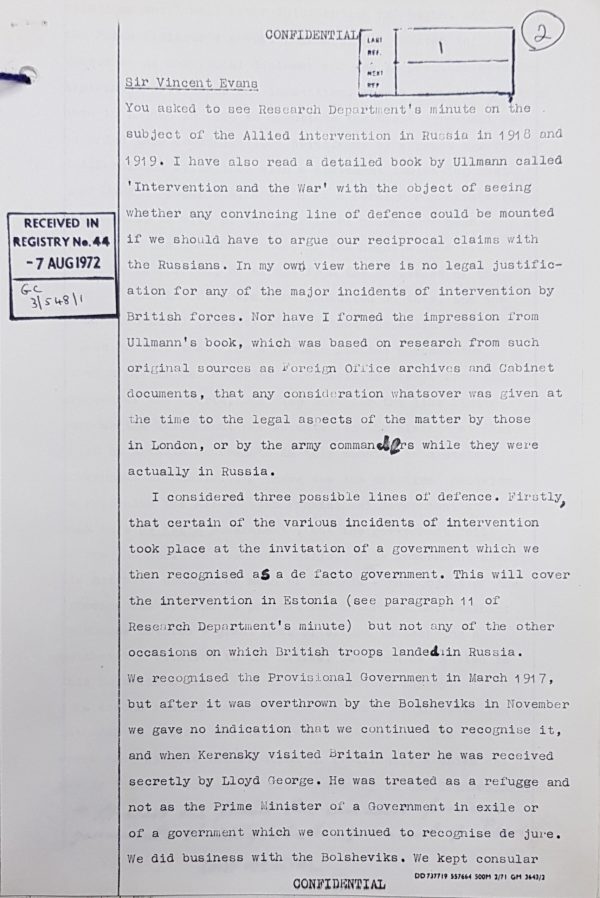
The legality of their action under international law was not considered until 1972 when the British government, locked in a dispute with Moscow over mutual debts, sought advice from a Foreign Office legal counselor, Eileen Denza. The advice was damning of London’s actions and was kept under wraps for a long time.
“In my own view there is no legal justification for any of the major incidents of intervention by British forces,” Ms. Denza wrote in her paper. “Nor have I formed an impression from … research from such original sources as Foreign Office archives and Cabinet documents that any consideration whatsoever was given at the time to the legal aspects of the matter by those in London, or by the army commanders while they were actually in Russia.”
© Photo: Crown copyright National Archives, UK
FCO Legal Councellor paper on legality of British intervention in Russia
Ms. Denza had explored possible avenues for defending the British intervention but failed to find any convincing arguments.
Argument 1. Certain incidents of intervention took place at the invitation of a Russian government which Britain then recognized as a de facto government.
This, Ms. Denza said, would cover the intervention in Estonia [which Britain helped break away from Russia — NG] but not any of the other occasions on which British troops landed in Russia. Britain did recognize the Russian Provisional government after the overthrow of the Tsar in March 1917, but after it was overthrown by the Bolsheviks in November Britain gave no indication that she continued to recognize it. Indeed, when its premier Kerensky visited Britain later he was treated as a refugee, and not as a prime minister of a government in exile or of a government which London continued to recognize de jure.
“We did business with the Bolsheviks,” Ms. Denza reminded the British government. “We kept consular relations until well after intervention had begun, and the Prime Minister’s envoy, Bruce Lockhart, was … accorded diplomatic privileges and immunities [which he abused — NG]”.
Initially Lockhart devoted a great deal of effort to securing a Bolshevik invitation to the Allies to intervene, but when he failed in this he advised the British government to intervene anyway. He started plotting for the overthrow of the Bolsheviks, and channeled his energy into persuading the reluctant US President Woodrow Wilson to support the British and Japanese intervention in the North and Far East of Russia.
Argument 2. The intervention was intended to protect British lives and property.
There was no British community in Russia to speak of.
“The question of defence of British property was never raised or put forward at any stage,” wrote the FCO legal counselor, “and it had always been clearly understood that it was intervention which led the Bolsheviks (who began by being friendly to Britain) to take much more extremist measures against property generally and to adopt the position that no compensation would ever be paid to the Allies in respect of their expropriated property, since it was the necessity caused by external pressures and Allied intervention which had made it necessary to seize foreign property on such a scale.”
Argument 3. The intervention was justifiable as an act of military necessity, or self-defense, in order to protect the Allied military position in the east after Russia’s withdrawal from the war following the peace treaty of Brest-Litovsk signed with Germany in March 1918.
Britain at the time made a great deal in public that the motive for intervention was related entirely to the conduct of the war, and that there was no intention to intervene in the domestic affairs of Russia. However, once they arrived in Russia, the British and other Allied forces “did not limit their actions to cutting off supplies to the Germans,” wrote Ms. Denza. “They did not confine themselves to supporting factions which had clearly stated that once in power they would bring Russia back into the war.”
“In the main the commanders in the field seem to have gone off on frolics of their own with very little clear political coordination.” [Those “frolics” included bayoneting the locals to death, and forcing captured Russian gunners to turn their cannons on their compatriots, according to British commanders’ combat logs held by the National Archives — NG]


© Photo: Crown copyright National Archives UK
Excerpt from a British Dvina (North Russia) Force battle instructions issued on 5 August 1919
When large-scale intervention began in the summer of 1918 Britain withdrew its embryonic diplomatic and consular mission from Russia [thereby implying it was an invasion rather than intervention — NG].
Most important of all, Ms. Denza wrote, the intervention did not cease with the surrender of Germany in November 1918. Indeed the military justification for intervention, which could have existed during the many months when plans for intervention were being made and discussed “virtually ceased to exist very soon after our troops first went in [Russia — NG] in substantial numbers [shortly before Armistice — NG].”
Overall, the FCO legal counselor said, the British and Allied intervention in Russia painted “such a damning picture.”
“The immediate effect of the intervention was to prolong a bloody civil war,” wrote American historian James W Loewen, “thereby costing thousands of additional lives and wreaking enormous destruction on an already battered society.”
During the Anglo-Soviet debt negotiations in 1972-1973 this destruction was estimated to be between two and four billion pounds.
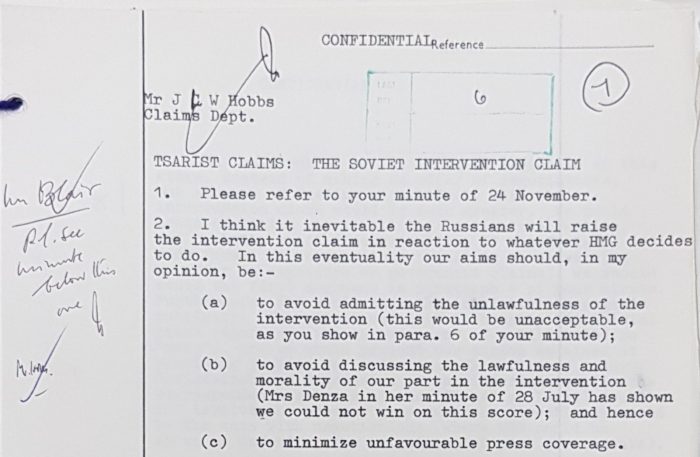
British government papers of the time record a flurry of Whitehall discussions on how to avoid admitting any liability for the damages caused by the unlawful intervention. As one note put it:
“I think it inevitable the Russians will raise the intervention claim in reaction to whatever HMG decides to do” [e.g., expropriate Russian gold held by Britain in payment for Russian debt — NG].
In this eventuality our aims should be:
(a) To avoid admitting the unlawfulness of the intervention (this would be unacceptable)
(b) To avoid discussing the lawfulness and morality of our part in the intervention (Mrs. Denza in her minute of 28 July has shown we could not win on this score); and hence
(c) To minimize unfavourable press coverage.
© Photo: Crown copyright National Archives UK
FCO claims department note on avoiding liability for military intervention in Russia
Whatever the press coverage, the intervention did create very unfavorable attitudes towards Britain in Soviet Russia.
In 1921 a British Parliamentary Committee produced a report which included the following perceptive passage:
“There is evidence to show that, up to the time of military intervention the majority of the Russian intellectuals were well disposed towards the Allies, and more especially to Great Britain, but that later the attitude of the Russian people towards the Allies became characterised by indifference, distrust and antipathy.” [Report (Political and Economic) of the Committee to Collect Information on Russia; (Russia (No.1), 1921, Cmd. 1240]
American Historian William Henry Chamberlin, who was the Moscow correspondent of The Christian Science Monitor in the 1920-30s, wrote that the consequences of the intervention “were to poison East-West relations forever after, to contribute significantly to the origins of World War II and the later Cold War, and to fix patterns of suspicion and hatred on both sides which even today threaten worse catastrophes in time to come.”
God forbid his prophecy comes true…
Skripal case: belief in Russia’s guilt looks to be based not on evidence but on a guess
British authorities admit have no proof poison made in Russia; entire case against Russia based on a classified assessment
By Alexander Mercouris | The Duran | April 3, 2018
On the eve of the meeting of the OPCW’s executive council – convened by Russia and scheduled for tomorrow – we have had a highly revealing succession of statements about the Skripal case from the British authorities.
The one which is attracting the most attention is the admission by Gary Aitkenhead, chief executive of the Defence Science and Technology Laboratory (DSTL) at Porton Down, that whilst British scientists are able to confirm that the poison used in the attack and Sergey and Yulia Skripal was a ‘military grade’ Novichok type substance (the Russian authorities say the British have told them it is A-234), they cannot confirm that it was produced in Russia.
We were able to identify it as novichok, to identify that it was military-grade nerve agent.
We have not identified the precise source, but we have provided the scientific info to Government who have then used a number of other sources to piece together the conclusions you have come to…..
It is our job to provide the scientific evidence of what this particular nerve agent is, we identified that it is from this particular family and that it is a military grade, but it is not our job to say where it was manufactured. (bold italics added)
Gary Aitkenhead did however go on to say that the poison used in the attack on Sergey and Yulia Skripal would have required “extremely sophisticated methods to create, something only in the capabilities of a state actor”.
Gary Aitkenhead refused to say whether or not Porton Down had ever produced any of the poison used in the attack on Sergey and Yulia Skripal. However he categorically denied that the poison could have come from Porton Down
There is no way anything like that could have come from us or left the four walls of our facility
Before proceeding further, I should say that I expect that some people are going to seize on Gary Aitkenhead’s denial that the poison could have escaped from Porton Down as an admission that there are stocks of the poison in Porton Down.
That would be a logical fallacy. A denial of one thing – that the poison came from Porton Down – should never be treated as an admission of something else – in this case that Porton Down possesses stocks of the poison.
I say this as someone who thinks it ‘highly likely’ (to borrow a phrase) that Porton Down does possess stocks of the poison.
In any event, we now have clarity on one important point. The scientific evidence does not prove that the poison which was used in the attack on Sergey and Yulia Skripal came from Russia.
I expect that this is also the opinion of the French experts the British authorities consulted – if it were not I would expect Gary Aitkenhead to have said so – and of the OPCW’s experts.
The current position in the case can therefore be summed up as follows
(1) the British scientific evidence is that Sergey and Yulia Skripal were poisoned by a Novichok type chemical agent (probably A-234) but does not extend to this agent having been made in Russia;
(2) the British police have not yet named a suspect in the case;
(3) there are various theories about how Sergey and Yulia Skripal were poisoned. Sputnik has summed some of them. It appears that the latest theory – that the poison was smeared on the door of Sergey Skripal’s house – is running into problems, and may be wrong.
(4) though Gary Aitkenhead says that the British have no knowledge of any antidote in a case of poisoning by the chemical used in the attack on Sergey and Yulia Skripal, the British authorities have said that Yulia Skripal is now recovering, which suggests either that her contact with the poison was very slight, or that the potency of the poison has been greatly exaggerated.
Theresa May on 14th March 2018 said that Russia was ‘culpable’ of the attack on Sergey and Yulia Skripal. Previously, on 12th March 2018 she said that it was ‘highly likely’ that Russia was responsible for the attack. Since the EU Council meeting of 22nd March 2018 the British government together with the EU have reverted to Theresa May’s original 12th March 2018 position that it was ‘highly likely’ that Russia was responsible for the attack.
Gary Aitkenhead’s comments taken by themselves in my opinion make it impossible even to say that Russia was ‘highly likely’ to have carried out the attack.
His claim that only a state possesses the resources to have made the poison is not evidence against Russia given that various other states are known to have the means to produce the poison and may actually have done so.
Besides I understand that this claim is disputed by other scientists, who however – unlike Gary Aitkenhead – have not been involved in identifying the poison.
We are left therefore with our old friends, the British government and the British intelligence agencies who have secretly ‘assessed’ on the basis of ‘other’ evidence which since it is classified they will never show us that Russia made and possesses the poison which was used in the attack on Sergey and Yulia Skripal.
That we are dealing not with hard fact of the sort that can be produced in court to prove a case, but with a classified ‘assessment’ the basis of which will always be secret, is confirmed by the British Foreign Office, whose spokesman is reported to have said the following
We have been clear from the very beginning that our world leading experts at Porton Down identified the substance used in Salisbury as a Novichok, a military grade nerve agent.
This is only one part of the intelligence picture.
As the Prime Minister has set out in a number of statements to the Commons since 12 March, this includes our knowledge that within the last decade, Russia has investigated ways of delivering nerve agents – probably for assassination – and as part of this programme has produced and stockpiled small quantities of Novichoks.
Russia’s record of conducting state-sponsored assassinations; and our assessment that Russia views former intelligence officers as targets.
It is our assessment that Russia was responsible for this brazen and reckless act and, as the international community agrees, there is no other plausible explanation. (bold italics added)
That this is so has also been confirmed by Porton Down
It is not, and has never been, our responsibility to confirm the source of the agent.
This chemical identity of the nerve agent is one of four factors [NB: what were the other three – AM] used by the Government to attribute the use of chemical weapons in Salisbury to Russia.
The Government’s assessment has been clear from the start. Our chemical analysis is a key part of the Government’s assessment, and this has not changed. (bold italics added)
The word ‘assessment’ may sound impressive, but it is essentially no more than a pretentious word for a surmise or at best an analysis. As such – like any other surmise or analysis – it can be wrong.
The famous 6th January 2017 ODNI Assessment – one of the foundation documents of the Russiagate scandal – contains a lengthy discussion of what an ‘assessment’ is. It contains these now famous words
Estimative language consists of two elements: judgments about the likelihood of developments or events occurring and levels of confidence in the sources and analytic reasoning supporting the judgments. Judgments are not intended to imply that we have proof that shows something to be a fact. Assessments are based on collected information, which is often incomplete or fragmentary, as well as logic, argumentation, and precedents. (bold italics added)
If the British government thinks it knows that Russia carried out the attack on Sergey and Yulia Skripal – which is all that an ‘assessment’ implies – that is one thing.
However a criminal investigation by the British police into the attack is supposed to be underway.
The British government has preempted that investigation by making public claims of Russian state responsibility on the basis of an ‘assessment’ the grounds for which can never be shown to a defendant, and which therefore cannot be produced in court.
I cannot see how that can do anything else other than undermine the whole investigation process, and prejudice the conduct of any future trial.
Perhaps that is a matter of indifference to most people. It is not to me.
As for the famous formula that it is ‘highly likely’ that Russia is responsible for the attack on Sergey and Yulia Skripal, I do not see how that is sustainable any longer.
The most that can be said is that the British government thinks that Russia is responsible, about which however it may be wrong.
Perhaps all those countries that expelled Russia’s diplomats on the strength of a British guess should now be inviting them back?
Featured Video
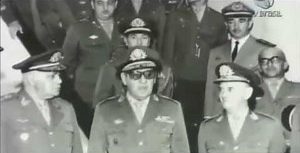
The 1964 Coup in Brazil
or go to
Aletho News Archives – Video-Images
Frlom the Archives
70 Neocons Petition Congress To Effectively Allow Israel To Say When The US Should Attack Iran
By Damian Lataan | January 10, 2014
Seventy senior Israeli-centric neoconservatives have written an open letter to Congress imploring them to do more to ensure Iran complies with the conditions of any agreement finally reached with the P5+1 over Iran’s nuclear program.
While the neocons are ostensibly asking Congress to ensure compliance, it is clear that their real aim is to convince members of Congress to support the bill currently passing through the Senate which calls for tighter sanctions against Iran in the event of any waywardness on Iran’s part.
The neocons are eager to see the bill currently passing through the Senate with enough support to make it veto-proof, not so much because they are concerned about Iran’s so-called nuclear weapons program – there’s still not a skerrick of hard evidence that Iran has a nuclear weapons program – but, rather, because embedded within the bill is this clause:
… if the Government of Israel is compelled to take military action in legitimate self-defense against Iran’s nuclear weapon program, the United States Government should stand with Israel and provide, in accordance with the law of the United States and the constitutional responsibility of Congress to authorize the use of military force, diplomatic, military, and economic support to the Government of Israel in its defense of its territory, people, and existence…
Essentially, the clause is an automatic trigger for the US to attack Iran at any time the Israelis choose to launch a first strike – regardless of whether President Obama is in favour or not.
Partial list… continue
Blog Roll
 Aletho News
- Aramco CEO warns ‘catastrophe’ imminent if Strait of Hormuz remains shut
- What If Iran Says No?
- Trump Threatens to ‘Hit’ Iran ‘Twenty Times Harder’ Over Strait of Hormuz Oil Flows
- Spare the hypocrisy: Baghaei slams Ursula’s support for US
- Iran War Supporters Invent a New and Absurd Justification: It Is All About China
- Corporate Media Go All Out To Support The US-Israeli War on Iran
- Trump press conference reveals a man who wants out of war
- When Tel Aviv decides, Washington fights
- Top official: Iran ready for a long war with US, no more diplomacy
- How Iran’s Toxic Rain Reveals US-Israel Discord
- If Americans Knew
- Threats and missiles fly, death tolls soar in Iran, Lebanon, Gaza – Not a ceasefire Day 151
- Lebanon: Israel’s White Phosphorous Use Risks Civilian Harm
- Corporate Media Go All Out To Support The US-Israeli War On Iran
- US-Israel war on Iran is creating a steady growing number of amputees
- Israel planned this war on Iran for 40 years. Everything else is a smoke screen
- The wrong question about the war in Iran
- ‘Your Tax Dollars Being Used to Raise Your Gas Prices’: US-Israel Bomb Major Iranian Oil Depots
- ‘Bogus Evidence’: Former Nuclear Watchdog Head Debunks US Justification for Iran War
- EXPLAINER – Dimona: What to know about Israel’s nuclear site
- Fires and toxic air in Iran (thanks, Israel) – Not a ceasefire Day 150
- No Tricks Zone
- Wake-up Call: Survey Shows Majority Of Germans Now Favor Postponing Climate Targets!
- Televised! Leading German Political Candidate Tells Schoolchildren CO2 Makes Sun Hotter!
- New Study: A Century Warming Of 1.1°C Is ‘Commonplace’ And ‘Not Unusual’ During This Interglacial
- New Study: ‘Internal Noise’ And Volcanic Forcing Can Trigger 10-15°C Warming Within Decades
- Glaciers Worldwide Are Suddendly Surging, Experts Blame Warming!
- Surprising Discovery: Sahara Is Greening…Billions Of Trees Where Once Thought To Be Barren
- New Research Reaffirms Clouds, Aerosols, And Surface Solar Radiation Are ‘Driving The Climate System’
- Germany: Electric Car Catches Fire At Charging Station, Sets Off Local “Inferno”, Widespread Damage
- New Study: Canada’s New Brunswick Was 1°C Warmer Than Today During The Medieval Warm Period
- Coal Power Back In Trend As Globe Tries To Keep Pace With Growing Demand For Power
 Aletho News