MH17: Turning Truth & Victims into Pawns
By Ulson Gunnar – New Eastern Outlook – 29.06.2019
As the wreckage of Malaysian flight MH-17 laid scattered in eastern Ukraine, and many days before the first investigators even arrived on scene, the US had already blamed Russia and separatists it accused of aiding for the tragic downing of the passenger plane and the loss of all 298 people on board.
It would be a July 31, 2014 article by the BBC titled, “Ukraine MH17: Forensic scientists reach jet crash site,” nearly 2 weeks after the aircraft’s downing that would announce the arrival of forensic scientists at the crash site.
Yet as early as July 21, more than a week before investigators arrived, Newsweek in its article, “U.S. Report Outlines Evidence That Rebels Downed Flight MH17,” was already claiming:
The U.S. State Department has outlined the evidence behind its assertion that Russia-backed separatists are responsible for the missile strike that downed Malaysia Airlines flight MH-17. In a statement posted on the website of the U.S. embassy to Ukraine, it said the flight was “likely downed by a SA-11 surface-to-air missile from separatist-controlled territory in eastern Ukraine.”
The assertions made within the report were a summary of accusations the US leveled against Russia even earlier still.
An Australia’s ABC would report a day before the investigators’ arrival in eastern Ukraine that the US and EU had already leveled additional sanctions against Russia, spurred on by US accusations regarding MH-17.
The article, “MH17: US and EU to impose broad sanctions on Russia over support for Ukraine rebels; fighting keeps investigators from Malaysia Airlines crash site,” would note:
The measures mark the start of a new phase in the biggest confrontation between Moscow and the West since the Cold War, which worsened dramatically after the downing of MH17 over rebel-held territory on July 17.
German chancellor Angela Merkel, who had been reluctant to step up sanctions before the crash because of her country’s trade links with Russia, said the EU measures were “unavoidable”.
Washington’s accusations and its rush to leverage their impact on public and political circles at the time to pass further sanctions against Russia fits a pattern not of an impartial investigation or search for truth, but a cynical propaganda campaign carried out at the expense of both.
A Familiar Lack of Evidence…
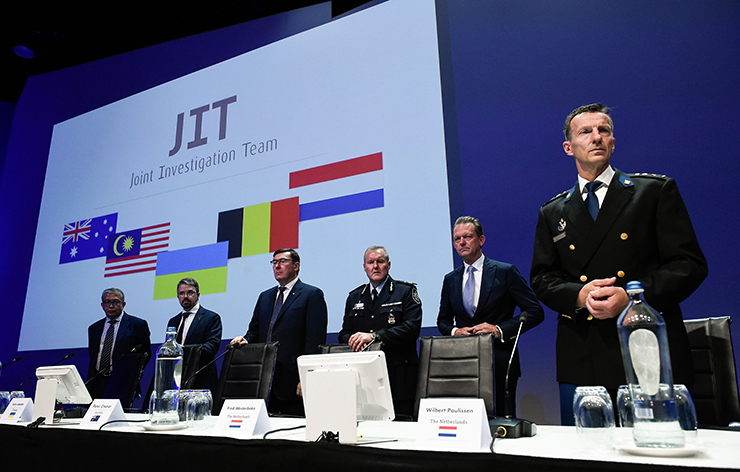
The subsequent Joint Investigation Team (JIT) assembled to supposedly ascertain the truth behind the airliner’s downing included among its member states, Ukraine. As others have pointed out, Ukraine was and still is a prime suspect.
Ukraine’s decision not to close airspace over contested areas where military aircraft were already being shot down alone makes Kiev at least partially culpable for the loss of MH-17.
Expectations of honesty and cooperation from Kiev (berated by even its Western sponsors as being corrupt, abusive and inept) are unrealistic and their inclusion within the JIT undermines its credibility and any conclusion they reach, especially if that conclusion lacks substantial evidence to support it.
The fact that no convincing evidence has been produced by either the JIT or the nations using it as a vehicle to target Russia years after the incident and that the JIT itself cited “social media” as an “important part of the investigation,” further illustrates the political motivations of the team.
Mentioning the use of “social media” as evidence points toward NATO-backed propaganda platforms like Bellingcat which, again, represent “investigators” and “experts” on the payroll of and working with potential suspects in the downing of MH-17 itself.
If it would be unreasonable to place Russia at the center of such an investigation, it is likewise unreasonable to place those who benefit most from Russia being found “guilty” at the center of it as well.
… And a Familiar Lack of Motivation
Russia and any separatists it was backing in eastern Ukraine at the time had nothing to gain by shooting down a civilian airliner. At best, if separatists did launch the missile that allegedly brought down MH-17, it would have been an accident with Ukrainian military aircraft undoubtedly their intended target.
Conversely, the US and its allies had everything to gain by either allowing a civilian airliner to stray over territory knowingly putting it at risk, or shooting it down themselves as part of a false flag operation.
It is already admitted fact, even across the Western media that Ukraine failed to close airspace over eastern Ukraine. This is despite Ukraine losing several military aircraft to separatist air defenses in the weeks leading up to MH-17’s downing.
The BBC just days before the MH-17 downing would report in their July 14, 2014 article, “Ukraine military plane shot down as fighting rages,” that:
A Ukrainian military transport aircraft has been shot down in the east, amid fighting with pro-Russian separatist rebels, Ukrainian officials say.
Despite this incident and others like it leading up to the loss of MH-17, Kiev has claimed it did not believe civilian airliners would be at risk.
A Reuters article titled, “Ukraine defends not closing airspace where MH17 shot down,” would claim:
Ukraine on Tuesday defended its decision not to close airspace in the east of the country where a Malaysian passenger plane was shot down, saying it was unaware that anti-aircraft weapons were being used in the area and that planes could be under threat.
How the JIT is moving forward with a “trial” implicating Russia while Kiev’s overt negligence remains not only unpunished, but now unmentioned, further illustrates the politically motivated nature of the JIT and the nations involved.
It should be noted however that Malaysia, a member of the JIT, has (to say the least) expressed skepticism over the JIT’s latest move to begin trials implicating Russia and Ukrainian separatists.
Malaysia’s PM Doubts the JIT’s Credibility
The BBC in its article, “MH17 crash: Malaysia PM Mahathir denounces murder charges,” would note:
A day after the MH17 plane crash inquiry team announced murder charges against four men, Malaysian Prime Minister Mahathir Mohamad has condemned the decision as “ridiculous”.
The article also noted:
“From the very beginning it became a political issue on how to accuse Russia of wrongdoing,” Mr Mahathir said.
Of course, Prime Minister Mahathir Mohamad is absolutely correct. As we’ve seen, the US and its allies accused Russia of MH-17’s downing before any investigation began, let alone any evidence was in hand. The conclusion was reached as MH-17’s wreckage still smoldered.
For the JIT, the Truth Doesn’t Matter, Just People’s Perception of it
If it is possible that Russia or separatists mistakenly identified MH-17 as a Ukrainian military aircraft (the only possible explanation if Russia or separatists were responsible) it was only because Ukraine itself intentionally left dangerous airspace its own military aircraft were being shot out of open to invite just such a disaster. They did so with every intention to politically exploit any potential tragedy to target Russia.
It is also possible that Ukraine and its US-NATO sponsors took advantage of their strategic losses on the ground and the growing tempo of lost military aircraft overhead by shooting down MH-17 themselves, also meaning that even before MH-17’s downing, they fully intended to frame Russia.
The entire “Skripal affair” follows the same pattern, complete with a crime blamed on Russia but lacking any conceivable motivation for Moscow to have carried it out. In fact, in both cases, either with the downing of a civilian aircraft at the height of separatist victories in eastern Ukraine or the alleged poisoning of the Skripals on British soil at the onset of the Russian-hosted World Cup, only Washington and London had anything to gain from either crime.
The immediate accusations made before investigations even began and the politically motivated nature of the investigations that followed, along with their predictable lack of evidence and their equally predictable conclusions only adds insult to injury for the victims of MH-17 and any notions of actual justice.
The truth and justice have been openly turned into pawns to the point of the Malaysian prime minister himself, whose nation is on the JIT, calling out this politically motivated circus for what it is.
We may never know what really happened on July 17, 2014 over eastern Ukraine because those with the power to find out have already long since decided the truth doesn’t matter. What matters is only how manipulating public perception regarding that day’s events benefits them politically, strategically and geopolitically.
With the JIT’s “trials” set to begin, their charges and trials will be cited as “evidence” Russia did it, rather than any actual evidence proving it did.
This leaves us with another example of the West’s so-called rules-based international order and maybe gives us a little more insight into why so many have lost faith in it or why it is no longer sustainable. We have to wonder though, do the people in Washington, London or Brussels stop and think about this when considering why their rules-based international order no longer inspires confidence and as it begins to fade?
The Labour party and alleged anti-Semitism: What’s really going on?
Press TV – June 29, 2019
It has been reported that Labour MP Chris Williamson has been suspended, yet again, on charges of anti-Semitism. The outspoken MP was last suspended in February after claiming that Labour had given “too much ground” over the issue.
A key ally of Labour leader Jeremy Corbyn, Williamson’s latest suspension will re-ignite the debate over alleged anti-Semitism in the party, and will almost certainly be used by opponents of Corbyn within the party to undermine his leadership.
The anti-Semitism row erupted three years ago after the Labour party initially refused to adopt a controversial definition of anti-Semitism devised by a pro-Israel group, the International Holocaust Remembrance Alliance (IHRA).
The Labour party, specifically Jeremy Corbyn and his inner circle, subsequently came under intense pressure to adopt the definition, and a concerted campaign of intimidation, by pro-Israel groups, sought to undermine the left-wing ideologues and activists who spearheaded the resistance movement within Labour.
Labour activists and British political analysts generally viewed the pressure campaign as an attempt by the IHRA and allied groups to ban any criticism of Israel and its Apartheid-style policies, or failing that, to make such criticism prohibitively costly in political terms.
Consequently, several MPs and leading Labour party activists, notably Naz Shah, were named and shamed as part of the pressure campaign and forced to retract previous criticism of Israel.
But the pressure campaign claimed its biggest scalp in the form of ex-London mayor Ken Livingstone. A veteran Labour leader, Livingstone was suspended from the party against the wishes of Labour leader Jeremy Corbyn.
To Labour party activists, in addition to a significant number of outside observers, it seemed that the pro-Israel pressure campaign had two core objectives. Firstly, to stifle criticism of Israel in the Labour party, and by extension, to oust key leaders and activists who adopted a balanced position on Middle Eastern politics. Secondly, the campaign sought to sabotage Corbyn’s leadership by way of restoring the Blairites’ hegemony.
Labour activists and independent political analysts pointed to Corbyn’s irreconcilable opponents within the party, notably deputy leader Tom Watson, to support their claims that the anti-Semitism issue is a contrived row designed to oust Corbyn.
This view is backed by authentic Jewish voices in the Labour movement, notably the Jewish Voice for Labour, who strenuously deny that the Labour party is institutionally anti-Semitic.
To underline the dishonesty and hypocrisy surrounding this issue, the same voices point to the Conservative party’s failure to address widespread Islamophobia within its ranks.
The general consensus in the Labour party appears to be that the groundless anti-Semitic accusations is a ploy to forestall a re-adjustment of British foreign policy toward the Middle East once the Labour party achieves power.
Google’s Empire: The Science Fiction of Power

By Maximilian C. Forte | Zero Anthropology | June 28, 2019
“For as long as I can remember, I always wanted to make a film about libraries,” explains Ben Lewis, the director of Google and the World Brain (2013). About libraries, he says, “they are my favourite places to be. Serene, beautiful repositories of the best thoughts that men and women have ever had”. Political economy, and the rights of citizens in a democracy, also loom large in Lewis’ estimation of the importance of libraries. As he states, libraries are: “Free to use. Far from the din of modern capitalism, libraries are the epitome of the public institution. There is simply nothing bad about a library. It is my paradise”. While praising the value of the Internet, Lewis warns, “the Internet also takes things from us, without asking”. Marrying the Internet and libraries raises hugely problematic issues, especially in the case of Google’s book-scanning project—problems surrounding copyright, national cultures and surveillance.
The political economy of knowledge production is one of the central areas of research interest that constitute the Zero Anthropology Project. This documentary was a good match for that interest, especially as it provokes a number of “big questions”: What are the social and political consequences of knowledge centralization? How, or when, is the digitization of knowledge problematic, and for whom? What role do libraries play in contemporary society? Does copyright protect much more than just authors’ rights and publishers’ profit-making activities? How is the digitization of knowledge linked to surveillance and governance? Should private corporations play any part in creating and/or controlling a universal library? Is a universal library even possible?
Google and the World Brain (2013)
If you were looking for a documentary that was not just another evangelical tract about how “information wants to be free,” spoken by wide-eyed zealots of “open access,” then this is the film for you. While beginning with enthusiasm for open access, for nearly a decade now Zero Anthropology has been warning about the dangers of open access, especially when it comes to facilitating the flow of information to the imperialist military of the US, or bolstering US academic hegemony. Ben Lewis’ Google and the World Brain shows us that we are on the right track. Yet some will argue that there are questionable aspects of Lewis’ critiques and the way they are presented in the film.
Directed by Ben Lewis, Google and the World Brain (2013) runs for 89 minutes. A trailer is included below, but the film in its entirety can be seen online, for free, on Archive.org and on the website of Polar Star Films. If you have 89 minutes to spare, please view it and then let us know if the following analysis was either flawed or unfair.
A trailer for the film is available below:
Polar Star Films, which produced Google and the World Brain, provided a detailed synopsis of the film which forms the basis for the following overview of the film.
Overview
Google and the World Brain is the story of “the most ambitious project ever attempted on the Internet: Google’s project to scan every book in the world and create not just a giant digital global library, but a higher form of intelligence”. The film’s critique draws from the dystopian warnings of H.G. Wells who in his 1937 essay “World Brain” predicted the creation of a universal library that contained all of humanity’s written knowledge, and which would be accessible to all of humanity. However, this would not just be a library in the sense of a static holding of inventoried contents, rather it would form the foundation for an all-knowing entity that would eliminate the need for nation-states and governments. With every increase in the quantity of information that it possessed, the globalist World Brain would be better able to rule over all of humanity, and would thus monitor every human being on the planet.
Supposedly Wells’ dystopian vision of technological progress (has progress ever really produced anything other than a succession of dystopias?) was just science fiction. However, this film shows how a World Brain is being brought into existence on the Internet: “Wikipedia, Facebook, Baidu in China and other search engines around the world are all trying to build their own world brains—but none had a plan as bold, far-reaching and transformative as Google did with its Google Books project”.
Starting in 2002, Google began its project of scanning the world’s books. To do so, they entered into legal agreements with major university libraries in the US, most notably those of Harvard, Stanford, and Michigan, and then expanded to include deals with the Bodleian Library at Oxford in the UK and the Catalonian National Library in Spain. The goal was not simply the collection of all books—instead, as Lewis’ film argues, there was “a higher and more secretive purpose” which was to develop a new form of Artificial Intelligence.
Of the 10 million books scanned by Google by the time this documentary was made, six million of them were under copyright. This fact provoked authors, publishers, and some librarians around the world to not only protest Google, but also to take legal and political action against it. In the fall of 2005 the Authors Guild of America and the Association of American Publishers filed lawsuits against Google. That resulted in a 350-page agreement negotiated with Google, which was unveiled in October of 2008.
However, that agreement which involved Google paying a settlement of $125 million, also granted Google Books huge new powers. The result was that Google would become the world’s biggest bookstore and commercialized library. Google now had the exclusive right to sell scans of all out-of-print books that were still in copyright. What this meant is that Google had a monopoly over the majority of books published in the 20th-century.
Reacting against this settlement, Harvard University withdrew its support for Google’s project. Authors in Japan and China joined a worldwide opposition to Google’s book-scanning. The governments of France and Germany also condemned the agreement. In the US, the Department of Justice launched an anti-trust investigation. Starting in late 2009, US Judge Denny Chin held hearings in New York to assess the validity of the 2008 Google Book Settlement, and in March of 2011 he struck it down.
Google altered its plan in order to continue with a version of its book-scanning project. Google signed deals with many individual publishers that would allow Google to show parts of their books online. Google also continued to scan books out-of-copyright. What Google was not able to do was carry out its master plan for an exclusive library that it controlled alone. The Authors Guild also persevered with suing Google for up to $2 billion in damages for scanning copyrighted books.
In this documentary, Google occupies the spotlight. Issues of copyright, privacy, data-mining, downloading, surveillance, and freedom come to the fore as a result.
The key figures interviewed in this film include some of the leading Internet analysts such as Evgeny Morozov, Jaron Lanier, Kevin Kelly, Clay Shirky, and Pamela Samuelson. Librarians in charge of some of the world’s leading libraries are also interviewed, including Robert Darnton (Harvard), Reginald Carr and Richard Ovendon (Bodleian), Jean-Noel Jeanneney (French National Library). In addition, authors involved in the struggle against Google Books such as Charles Seife, Roland Reuss, and Mian Mian (a best-selling Chinese author), are also key figures in the film.
The filmmakers challenge utopian visions of the Internet as the hoped for means of spreading democracy, freedom, and culture around the globe. Instead, the film argues that the Internet has enabled practices contrary to those ideals by, “undermining our civil liberties, free markets and human rights, while concentrating power and wealth in the hands of powerful new monopolies over which we have little influence”.
Polar Star Films ends its synopsis with this very important warning and urgent call for action:
“Humanity now stands at a crossroads. We can either take action to ensure that all the information and knowledge that the Internet is providing serves us, or we can remain passive consumers, and wait for all that information to take control over us. Whatever we do in the next few years will shape society for centuries to come”.
Contemporary Globalization as Science Fiction
H.G. Wells has to be one of the most prescient thinkers of the past two centuries. It is astounding just how far his supposed science “fiction” was in fact an outline discerning what would soon become reality. He had a particularly keen sense of the patterns taking shape around him, and just as keen a vision of the direction in which forces would move the world.
This is not the first time that we resort to the work of H.G. Wells which, under the guise of “fiction,” seemed to provide what global leaders would then adopt as a plan of action. In “The Shape of Things to Come in Libya,” we witnessed the applicability of Wells’ The Shape of Things to Come with its domineering figures, the “United Airmen”—progressivist autocrats who proclaimed themselves “freemasons of science”. Precursors to the neoliberal globalist mode of governance, the United Airmen came to vanquish local warlords and end all national governments, declaring independent sovereign states at an end, even if it meant war to erase them from the face of the earth.
Google and the World Brain opens with these words from the 1937 essay, “World Brain,” by H.G. Wells:
“There is no practical obstacle whatever now to the creation of an efficient index to all human knowledge, ideas and achievements. To the creation, that is, of a complete planetary memory for all mankind”.
Wells’ depiction of the World Brain was of a new kind of empire: a global dictatorship of technologists and intellectuals. Managers would become the new de facto politicians. This tyranny of expertise sits very well with the current neoliberal world order which sees its future in jeopardy.
It is a peculiar way to start, accompanied by an eerie soundtrack, since one might think that there is nothing especially scary about an “index,” about efficient organization of information, or a complete memory. However, given the mood of the film’s opening, we are immediately invited by the filmmaker to consider these aims in a different light—a much dimmer one.
The film also ends with Wells—all is bad that ends Wells. Quoting from his 1945 book, Mind at the End of its Tether, Wells predicted that this progressivist new world order would come crashing down:
“It is like a convoy lost in darkness along an unknown rocky coast with quarrelling pirates in the chart room and savages clambering up the sides of the ship to plunder and do evil as the whim may take them. That is the rough outline of the more and more jumbled movie on the screen before us. There is no way out. Or round. Or through”.
What is at Stake?
Wells also seemed to predict the Internet as making this world brain possible—this complete database of all human knowledge, past and present, could “be reproduced exactly and fully in Peru, China, Iceland, Central Africa or wherever else”. One of the analysts interviewed in the film, Kevin Kelly, is of the opinion that having instantaneous access to all human knowledge, “changes your idea of who you are”. Some will inevitably ask: “Is that a bad thing?” Kelly himself seems to think not, and he appears in this film as an evangelist for AI, the Internet, and the wonders of the screen.
The film thus turns its attention to the Google book-scanning operation, described by one analyst as, “clearly the most ambitious World Brain scheme that has ever been invented”. Still, some will wonder, what is the problem? How is the scanning of books something that should alarm anyone?
The film focuses further, and becomes a story about Google trying to achieve a monopoly over the digitization of books. Some will ask: “Is the real problem the total digitization of printed knowledge (which is quite distinct, and often separate from all knowledge as such, since not all human knowledge is published), or is the problem that of corporate monopoly?” In its early minutes, the documentary can be confusing about its intended aims.
The third focus comes next: the argument becomes that Google could track everything, and as Pamela Samuelson (law professor, Berkeley) explains, Google “could hold the whole world hostage”. Some viewers might balk: “this is just alarmism”.

Robert Darnton, Director, Harvard Library
What are the stakes? Speaking of the continued importance of libraries, Robert Darnton (Director, Harvard University Library) says in the film that libraries are, “nerve centres, centres of intellectual energy”. Lewis Hyde adds: “Libraries stand for an ideal, which is an educated public. And to the degree that knowledge is power, they also stand there for the idea that power should be disseminated and not centralised”. Are centralization and dissemination opposed and mutually exclusive? Even as he calls for dissemination, Darnton himself utilizes the concept of “centres”.
(Ironically, Darnton calls for the knowledge held by libraries to be opened up and shared—yet when I tried to gain access to some of Harvard’s library collections myself during research visits in 2004 and 2005, I required special written permission just to gain entry into the buildings.)
Expanding and Centralizing the Control of Knowledge
Google was initially successful in seducing a few of the world’s largest libraries, including those of Harvard and Oxford, whose chief librarians interpreted Google’s book-scanning project as a logical extension of a long history of attempts at centralizing knowledge. Among the earlier attempts were encyclopaedias; plans for a catalogue of all knowledge; and, microfilming.
More recently, and since the advent of the World Wide Web, Project Gutenberg became the first digital library, one which scholars have used and will continue to use regularly. Project Gutenberg, founded by Michael Hart, actually started in the early 1970s with the simple act of typing and distributing the Declaration of Independence.
Ray Kurzweil’s invention of the scanner clearly represented the one key advance needed to proceed towards digitizing knowledge. In 1975, Kurzweil created the first omni-font optical character recognition device, which went commercial in 1978. As Kurzweil admits, “we talked about how you could ultimately scan all books and all printed material”.
In the late 1990s the book, the scanner, and the Internet were combined in an effort to create what was hoped would be gigantic digital libraries. The Internet Archive, an indispensable tool for both myself and likely many readers of this review, was established in 1996. Significantly, the director of the Internet Archive, Brewster Kahle, speaks in this film and indicates that he refused collaboration with Google because of the secrecy surrounding the nature of its agreements with libraries, and the fact that Google appeared to be on track to create something exclusive and separate.
Wikipedia, and arguably YouTube, are also massive attempts at acquiring and centralizing knowledge.
Google = Hegemony
Sergey Brin, co-founder of Google with Larry Page, says that Page first conceived of Google Books in 1999. Google Books was then initiated in 2004. In “A Library to Last Forever,” published in The New York Times on October 9, 2009, Brin explained that Google’s digitization effort would be history’s largest-scale effort, primarily because Google invested significantly in the resources needed for the project. In that article, Brin also is clear that Google was zeroing in on out-of-print but in-copyright books, and commercializing them, while also seeking to create new regulations that would allegedly serve the interests of rights holders. Brin argues that Google’s motivation was to preserve “orphan books” against physical destruction and disappearance. Commenting on Google’s supposedly lofty goals, Evgeny Morozov says the following in this film:
“I don’t think that Google is aware of the fact that it’s a corporation. I think Google does think of itself as an NGO that just happens to make a lot of money. And they think of themselves as social reformers who just happen to have their stock traded on stock exchanges and who just happen to have investors and shareholders, but they do think of themselves as ultimately being in the business of making the world better”.
Google, while claiming to be laying the path for others to follow and which says it has aided other digitization efforts, is highly secretive about its scanning operation. It refused the filmmakers access to any of its (secret) scanning locations, and the film thus relies on six seconds of footage—the only such footage in existence—that was leaked out. Google’s secrecy extends to the total number of books it has scanned, and to how much it costs to scan them on average (one estimate is between $30 and $100 per book). Google also worked to prevent any one of its partner libraries from communicating with other partner libraries about the nature of their individual contracts with Google. According to Sidney Verba, former director of Harvard Library, Google “bent over backwards” to make sure that each library would not tell the others what kind of contract they had and how they were working with Google.
How did Google benefit from book-scanning? Five explanations are offered by interviewees in the film.
(1) Lawrence Lessig introduces the point that one of the benefits of massive book-scanning, is that it pumps information into Google’s core, allowing it to develop more sophisticated algorithms that depend on knowing more and more.
(2) Sidney Verba offers a different explanation: by having lots of information in Google, more people would use Google, which would increase the prospective advertising landscape, thus enriching Google by selling advertising space.
(3) Pamela Samuelson, narrowing Google down to a search engine, offers a third viewpoint: having more data (from books, for example), allows Google to perfect its search technology.
(4) Jaron Lanier argues that there is a competition between all sectors of the modern economy (whether healthcare, information and communications technology, finance, criminality, etc.) for more and more data, because data—and specifically data differentials—is a measure of power. Then the data hoarders can in some cases claim that their work is for the common good, by increasing efficiency.
(5) Lanier, Lessig, and Kevin Kelly together make the point that feeding all these books into Google’s servers leads to the creation of something akin to a life-form, a transformative force, a mass of memories that empowers an artificial intelligence system. As the reader will have noted, there is nothing about these five theories that renders them mutually exclusive—they can all be true, at the same time.
The head of Google Books Spain, Luis Collado, the only company official willing to speak to the filmmakers about Google Books, offered a comparatively milder and more innocent explanation. Collado says that Google’s motivation was to amplify the richness of online knowledge. Until it started adding books to the Internet’s offerings, the Internet only consisted of materials that were specifically created for it. For example, in late 1994 in the SUNY-Cortland library I surfed the entire World Wide Web as it then existed, in just one afternoon (at the time I rushed to the conclusion that the Internet was “useless”). For a few years, it was actually practical for me to print everything I found interesting online, because there was so little worth printing. So Collado has a point, even if it does not exhaust the range of plausible explanations.
For Father Damià Roure, Library Director at the Monastery of Montserrat in Spain, Google’s book-scanning was a means of “diffusing our culture” to the rest of the world, while helping to preserve the knowledge contained in its vast library. What he was simply unable to answer was why the monastery had not asked Google to pay for the privilege of scanning the monastery’s collection. As Google turned its operation into a business, from which it would profit, was it fair to get the materials for free? Father Roure went completely silent at this point in the film, in one of the longest, most awkward silences I have ever seen on the screen. He brought it to an end by saying that he was not in a position to comment on anything other than digitization. Reginald Carr, former director of the Oxford’s Bodleian Library, simply downplayed the point: Google, in his view, was fully entitled to make a profit—having invested so much in the scanning—even if the Bodleian’s ethos was to make knowledge available for free.
These two library directors serve a useful purpose: they are a reminder to us that willing collaboration on the part of intermediary local elites is often essential to any grant project of hegemony-building. When it comes to the Internet, and Google in particular, readers of this article are also collaborators—collaborators that, at a minimum, feed Google with content with each search they perform. By continuing to use Google, you make it more powerful.
Assisted Intelligence or Artificial Intelligence?

Jaron Lanier
Speaking of collaboration, the film specifically addresses how Internet users are themselves used. To the extent that this is done unknowingly, unthinkingly, and without compensation, we move from collaboration to exploitation. Jaron Lanier makes this argument forcefully:
“AI is just a religion. It doesn’t matter. What’s really happening is real world examples from real people who entered their answers, their trivia, their experiences into some online database. It’s actually just a giant puppet theatre repackaging inputs from real people who are forgotten. We are pretending they aren’t there. This is something I really want people to see. The insane structure of modern finance is exactly the same as the insane structure of modern culture on the Internet. They’re precisely the same. It’s an attempt to gather all the information into a high castle, optimise the world and pretend that all the people the information came from don’t deserve anything. It’s all the same mistake”.
An absolutely unctuous and all too precious spokesperson for Google, Amit Singhal, actually confirms Lanier’s point when he says the following in the film:
“Google Search is going to be assisted intelligence and not artificial intelligence. In my mind I think of Search as this beautiful symphony between the user and the search engine and we make music together”.
Singhal confirms what Lanier argued, that Google is powered by its users, but then makes the false analogy to a symphony. Musicians performing in an orchestra are clearly instructed on their roles, they perform willingly, and they perform in accordance with known rules and by reading codified music sheets. In other words, the musicians are willing, aware, and informed. Most of Google’s users do not know they are performing in any “symphony”. Google emphasizes harmony where there is in fact concealment, deceit, and exploitation. If there is any music, it is music only to Google’s ears.
Google and Copyright: The Essence of the Confrontation
The film takes a turn into questions of copyright at this stage, when Harvard’s library director, Robert Darnton, points out that its agreement with Google only allowed for the scanning of books in the public domain. However, Google’s agreements with other libraries allowed it to scan all books, including those in copyright. Mary Sue Coleman, president of Michigan University, openly stated that her university allowed Google to scan copyrighted books, claiming that it was “legal, ethical, and noble” to do so (meanwhile universities warn students not to photocopy more than 10% of any given work). Copyright violation is where the legal problems exploded in Google’s face.
However, one of the outcomes of the lawsuits against Google was that the settlement agreement allowed Google to become the world’s biggest bookstore, specializing in out-of-print but in-copyright books. The settlement in fact granted Google an exclusive right to sell such books, without sharing the profits with authors. Google would also not respect the privacy of readers: the company would instead track what readers read, and for how long they read it.
One of the features of copyright that stands out in this film, is that copyright on the Internet takes the place of national borders. Thus we hear from Angela Merkel in this film, asserting that the German government would defend the rights of German authors, by making sure that copyright had a place on the Internet. Likewise, the former President of France, Nicolas Sarkozy, declares in footage shown in this film that France would not allow a large private corporation to seize control of French national heritage, “no matter how nice, important, or American it may be”. Standing against the imperial ambitions of Google therefore was the seemingly old-fashioned principle of copyright. It reached the extent that when the Google book settlement was taken to court in 2009, representatives of foreign authors and foreign governments, accused the US of violating various treaty obligations which could force foreign parties to go to the WTO—and in the likely event of the US losing a case before the WTO, other nations would then have a right to impose trade sanctions on the US.
The outcome is that Google remains the target of publishers’ and authors’ lawsuits, while it continues to scan both out-of-copyright books as well as in-copyright books (in agreement with major libraries, and then offering only “snippets” of the book online). Rivalling Google, various governments and major libraries have undertaken their own library digitization, thus defeating Google’s attempt at becoming an exclusive monopoly. The Digital Public Library of America is one such example of a project that took off in response to the threat posed by Google, as is the case of Europeana.
Google as Empire
The film quotes from William Gibson’s 2010 article in The New York Times, “Google’s Earth,” as part of its argument that Google is building an artificial intelligence entity of a grander scale and sophistication than was even imagined in science fiction. As Gibson explains in that article, Google is “a central and evolving structural unit not only of the architecture of cyberspace, but of the world,” and he adds that this was, “the sort of thing that empires and nation-states did, before,” only now Google’s empire is one that also becomes an organ of “global human perception”. In Google, we are citizens, but without rights.

French National Library

Jean-Noël Jeanneney
Jean-Noël Jeanneney, the former director of the Bibliothèque Nationale de France (the French National Library), represents the voice of the library of the nation-state, that which Google ultimately seeks to erase. He recounts in the film his first encounter with two young Google representatives who came to meet him—he points out that what struck him was their “arrogance” and “brutal commercialism”. These “salesmen,” as he calls them, badly miscalculated his psychology when they brought as a gift a thermo-flask, for which he had no use and which he cast aside. Following his meeting with Google’s representatives, and the company’s announcement that it alone would build a universal digital library, Jeanneney announced to his staff a plan for what he emphatically calls a “counter-offensive”. He criticized the Google book-scanning project as incorporating an Anglo-American cultural bias, and in a noteworthy critique published by Le Monde in 2005 titled “When Google Challenges Europe,” he argued that, “what I don’t want is everything reflected in an American mirror. When it comes to presenting digitized books on the Web, we want to make our choice with our own criteria”. Jeanneney pointed to “the risk of a crushing domination by America in the definition of the idea that future generations will have of the world”. Google suddenly appears not so much as a “new” empire, as in Gibson’s piece, but rather a part of the American empire in a new extension of itself. We are thus back to the familiar problems of Americanization and cultural imperialism.
As Sidney Verba explains in the film, there were two additional sides to the French critique of Google: one had to with the dominant language of Google search results—English—which thus acted as a force undermining French, and the second had to do with who got to decide what would be digitized, its order of priority, and who would get to do the digitization. Who are the Americans at Google who get to digitize France’s books?
Conclusion
While sometimes striking an alarmist tone that was not warranted by the empirical substance that was presented, one could also conclude that the film is only guilty of erring on the side of caution. When dealing with Google in particular, we are well past the point of being cautious: it is a monopolistic entity that for years had a large revolving door between itself and the State Department and the Democratic Party, while also striking deals with the Pentagon and engaging in political censorship. There is nothing innocent about Google, and to the extent that it swallows the Internet, there is little about the Internet that is innocent.
One of the possible lapses of the film is that it does not direct as much attention to China’s Baidu, which has its own extensive book-scanning project that might even rival Google’s. The film presents an interview with Baidu’s communications director, and provides some useful statistics from Baidu employees about the extent of its own book-scanning project—but the bulk of the criticism is reserved for Google.

A book scanning unit in China
However, it has to be said that Ben Lewis does us all an essential service with this film that, ostensibly, appears to be about the simple act of scanning library books, and becomes instead a much larger story about democracy, rights, nation-states, cultures, corporatization, political economy, international law, and the future of globalization.
It was not surprising to see that, once again, one of the top documentaries we have had the privilege of reviewing was produced by Europe’s Arte television company.
This documentary, with all of its thought-provoking questions and careful detail, would be suitable for a wide range of courses in fields such as Information and Communication Studies, Librarianship, Media Studies, Sociology, Anthropology, and Political Science. The film earns a score of 8.75/10.
(This documentary review forms part of the cyberwar series of reviews on Zero Anthropology. This film was viewed four times before the written review was published.)
Contrary to Global Warming Predictions, Great Lakes Water Levels Now at Record Highs
By Roy W. Spencer, Ph. D. | June 27, 2019
It is a truism that any observed change in nature will be blamed by some experts on global warming (aka “climate change”, “climate crisis”, “climate emergency”).
When the Great Lakes water levels were unusually low from approximately 2000 through 2012 or so, this was pointed to as evidence that global warming was causing the Great Lakes to dry up.
Take for example this 2012 article from National Geographic, which was accompanied by this startling photo:

The accompanying text called this the “lake bottom”, as if Lake Michigan (which averages 279 feet deep) had somehow dried up.
Then in a matter of two years, low lake levels were replaced with high lake levels. The cause (analysis here) was a combination of unusually high precipitation (contrary to global warming theory) and an unusually cold winter that caused the lakes to mostly freeze over, reducing evaporation.
Now, as of this month (June, 2019), ALL of the Great Lakes have reached record high levels.
Time To Change The Story
So, how shall global warming alarmists explain this observational defiance of their predictions?
Simple! They just invoke “climate weirding”, and claim that the climate emergency has caused water levels to become more erratic, to see-saw, to become more variable!
The trouble is that there is that there is no good evidence in the last 100 years that this is happening. This plot of the four major lake systems (Huron and Michigan are at the same level, connected at the Straits of Mackinac) shows no increased variability since levels have been accurately monitored (data from NOAA Great Lakes Environmental Research Laboratory):
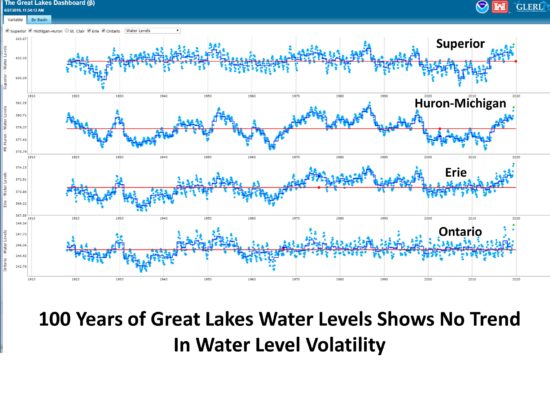
This is just one more example of how unscientific many global warming claims have become. Both weather and climate are nonlinear dynamical systems, capable of producing changes without any ‘forcing’ from increasing CO2 or the Sun. Change is normal.
What is abnormal is blaming every change in nature we don’t like on human activities. That’s what happened in medieval times, when witches were blamed for storms, droughts, etc.
One would hope we progressed beyond that mentality.
Kushner behind Trump’s withdrawal from Iran nuclear deal: Writer
Press TV – June 28, 2019
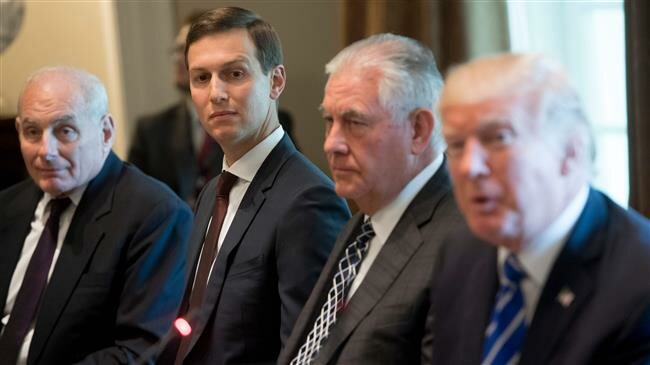
Donald Trump’s son-in-law and advisor Jared Kushner represents Jewish interests in the United States that basically caused the US president to withdraw Washington from the Iran nuclear agreement, says an American writer and former professor.
E Michael Jones, the current editor of Culture Wars magazine, made the remarks in an interview with Press TV on Friday while commenting on a statement by former US Secretary of State Rex Tillerson who said that Kushner conducted diplomacy without his knowledge when he was in the administration, leading to several embarrassing incidents.
Tillerson, who was fired by Trump in March 2018, recounted the incidents during a testimony last month at the US House of Representatives Foreign Affairs Committee, according to a transcript of a congressional hearing released on Thursday.
The former top US diplomat and CEO of ExxonMobil described his frustration with Kushner conducting his own diplomacy from the White House, at times without informing the US State Department and the Pentagon.
“This is illegal according to American political system. It violates – I believe – a Logan Act. But in this instance it is going to go unpunished because the part of the story that’s not reported here is Jared Kushner is representing Jewish interests here,” Jones said.
“And no one is allowed to question Jewish interests, if you bring it up you will be called an anti-Semite. There are Jewish interests. It is obvious but no one is allowed to talk about them,” he added.
“So the real significance of the story will be covered over by the mainstream media who were limited to the two areas of insignificance. This of course has direct relevance to Iran because it was Jewish interests that basically caused Donald Trump to abandon the Iran nuclear agreement,” the analyst noted.
“It’s Jewish interests that are once again pushing America into war in the Middle East this time with Iran,” he said.
“Donald Trump I think — recent events have shown – that he does not want war with Iran. He is using the military power to threaten Iran,” Jones noted.
European trade unions urge governments to ban trade with illegal Israel settlements
![A campaign against Israeli settlement goods [Amnesty UK/Twitter]](https://i1.wp.com/www.middleeastmonitor.com/wp-content/uploads/2019/01/Israeli-settlement-goodsDtglC7HWsAICLWw.jpg?resize=1200%2C800&quality=75&strip=all&ssl=1)
MEMO | June 28, 2019
Dozens of European trade unions have urged authorities to ban trade with Israel’s illegal settlements in the occupied Palestinian territory (oPt).
In a letter to the European Commission and European governments, the unions demand “effective action to bring an end to European complicity with human rights abuses associated with illegal Israeli settlements and to introduce a ban on economic activities with illegal Israeli settlements”.
According to the European Trade Union Initiative for Justice in Palestine, the 34 signatories represent millions of workers across Europe, including the Irish Congress of Trade Unions, Belgium’s ACV/CSC Brussels and La Centrale Générale FGTB, as well as Britain’s Unison and Unite the Union.
Although the European Union (EU) views Israeli settlements as illegal under international law, Brussels still allows Israel to export large quantities of products produced or partly produced in such settlements to Europe, providing direct support to the settlement expansion.
Last week, the advocate general of the European Court of Justice said that European shops ought to label Israeli settler exports so that consumers can boycott them for “ethical reasons”.
“This opinion highlights the fact that European governments are falling short on their obligations under international law. To be consistent with its own legislation the EU and all European states should go further and end all economic relations with illegal Israeli settlements”, stated Koen Vanbrabandt, a chair of European Trade Union Network for Justice in Palestine.
The trade unions argue that the EU as a whole and its member states are obliged to withhold from trading with Israeli settlements as part of their duties of non-recognition and non-assistance to such grave violations of international law.
“The fundamental values of trade union internationalism mandate us to take concrete and effective action to facilitate the implementation of UN resolutions, international legal obligations, and a just and equitable peace for all”, state the signatories.
Israel Looks to Bolster Diplomatic Cover for New Level of Civilian Bombing in Lebanon
By Whitney Webb | MintPress News | June 28, 2019
During a conference hosted on Tuesday by the Mossad-linked Shurat HaDin or Israel Law Center (ILC), Israel’s Public Security and Strategic Affairs Minister Gilad Erdan demanded that international laws on warfare be amended because current international law pertaining to warfare “serves terrorists.”
Erdan claimed that groups like Lebanon’s Hezbollah use existing international laws of war “to destabilize the ability of democracies to defend their citizens” and “force [democracies] to fight against terrorists with their hand chained behind their backs.” The ILC’s director, Nitsana Darshan-Leitner, seconded Erdan’s claim but argued that changing international law is difficult, thus making it more practical to change how existing laws of war are interpreted, a task she suggested be performed by military prosecutors.
According to the Jerusalem Post, the laws currently governing international warfare are aimed specifically at reducing the suffering of civilians and, as the Post article suggested, Erdan wanted to change these measures aimed at protecting civilians prior to the “next war” between Israel and Lebanon because in that war “Israel will have no choice but to harm Hezbollah rocket sites and Lebanese infrastructure.” Erdan’s argument hinges on the commonly repeated accusation by Israeli officials that Hezbollah uses civilians as cover for military operations, but a comprehensive 249-page study by Human Rights Watch found that not to be the case. In fact, the study found that even “a simple movement of vehicles or persons – such as attempting to buy bread or moving about private homes – could be enough to cause a deadly Israeli airstrike that would kill civilians.”
Bolstering diplomatic cover for a coming war
As MintPress previously reported, Israel’s government has been preparing for an imminent war with Lebanon and specifically Hezbollah — which is a strong political force in Lebanon, with the coalition of which it is part holding a legislative majority in Lebanon’s parliament — for well over a year. It has warned prominent U.S. Senators not only that it planned for a “bloody” war against Lebanon, but that the Israeli military planned specifically to target Lebanese civilians and civilian infrastructure, including residential areas.
During a visit to Israel last March, U.S. Senator Lindsey Graham (R-SC), a close ally of the Trump administration, stated that Israel’s Likud-led government was requesting “ammunition, ammunition, ammunition” from the U.S. government, as well as diplomatic support for when Israel strikes civilian targets — such as “civilian apartment buildings, hospitals, and schools” — because Hezbollah has become “integrated” into these structures.

A school building destroyed by Israeli bombs in the southern Lebanese town of Bint Jbeil, Aug. 27, 2006. Sergey Ponomarev | AP
Prominent Israeli politicians have also made the case for targeting Lebanese civilians in the coming war between Israel and Lebanon. For instance, Naftali Bennett, who until recently was Israel’s minister of education, told Haaretz in 2017 that civilians “must” be targeted the next time Israel and Lebanon go to war:
The Lebanese institutions, its infrastructure, airport, power stations, traffic junctions, Lebanese Army bases –- they should all be legitimate targets if a war breaks out… This will mean sending Lebanon back to the Middle Ages.”
Past impunity expands to cover new atrocities
Under existing international law, the bombing of residential buildings, hospitals and schools is a clear war crime, though this hasn’t stopped Israel’s government from bombing these same structures in Gaza with regularity in recent years. In addition, during the 2006 war between Israel and Lebanon, Israel’s military killed at least 1,109 civilians, injured over 4,000 and displaced an estimated 1 million according to figures compiled by Human Rights Watch. The staggering civilian death toll sparked condemnation from international human-rights groups.
Thus, Erdan’s recent comments suggest that Israel’s government, in a war against Lebanon it plans to instigate under the guise of “preventative” defense, is planning to commit war crimes on a much larger scale than what was done in 2006 and is thus pushing for international law to be changed to accommodate those plans. However, Israel has long been able to avoid accountability for war crimes, especially following the U.S. adoption of the “Negroponte doctrine” to protect Israel from criticism as well as any punitive action taken by the U.N. Security Council in relation to war crimes committed by Israel.
This makes it more likely that this current push led by Erdan to alter international law is aimed more at global public opinion, by redefining international law so that Israel could avoid being accused of war crimes for such attacks on civilians and civilian infrastructure in a future war.

A man repairs a home, in the background buildings destroyed by Israeli airstrikes in the southern suburbs of Beirut, Lebanon, Aug. 27, 2006. Photo | AP
Part of the strategy in targeting Lebanese civilians specifically appears to be Israel’s strong desire to win a “decisive victory” against Hezbollah in this future war, as opposed to the humiliating defeat its military suffered in 2006. It appears that key figures in Israel’s government believe that the grand scale of planned attacks on Lebanese civilians and civilian infrastructure will result in so much destruction and death that it will help to ensure an Israeli victory.
Though it is unlikely Israel’s effort will succeed in changing international law, it may change how its government interprets such laws — as Darshan-Leitner recently suggested — and use such interpretations to secure even more robust diplomatic cover from its more influential allies such as the United States and to more easily avoid the war crime label from international media outlets and foreign governments. Such a move may also prompt the Trump administration in the U.S. to do the same, particularly given the slew of recent pardons given to accused and convicted U.S. war criminals by President Donald Trump.
US troops “prepared to die for the Jewish state”
In addition, the U.S. military itself is likely to quickly become embroiled in this coming Israel-Lebanon war, given that head of U.S. Central Command (CentCom), Lt. Gen. Richard Clark, told the Jerusalem Post last year that IDF leadership (as opposed to American military leadership) would “probably” have the last word as to whether U.S. forces would join the IDF during a future war and that U.S. troops were “prepared to die for the Jewish state.” IDF Brigadier General Zvika Haimovitch responded to Clark’s comments by stating: “I am sure once the order comes we will find here U.S. troops on the ground to be part of our deployment and team to defend the state of Israel.”
While much media attention has focused on the possibility of an imminent U.S. war with Iran, it is important to point out — especially in light of Israel’s comments — that Israel has been planning for over a year to go to war with Lebanon. Indeed, last year, Israeli officials told U.S. Senators Lindsey Graham and Chris Coons (D-DE) that “Southern Lebanon is where the next war is coming.”
Yet, the push for war with Iran and the planned war against Lebanon may be related, given that Hezbollah’s Secretary-General Sayyed Hassan Nasrallah stated the following late last month:
Any attack on Iran will not remain confined to Iran’s borders. The entire region will burn, leading to all U.S. forces and interests in the region being annihilated.”
Whitney Webb is a MintPress News journalist based in Chile. She has contributed to several independent media outlets including Global Research, EcoWatch, the Ron Paul Institute and 21st Century Wire, among others. She has made several radio and television appearances and is the 2019 winner of the Serena Shim Award for Uncompromised Integrity in Journalism
Hamas Condemns Bahrain Minister’s Comments on ‘Israel’

Bahraini Foreign Minister Khalid Bin Ahmed Al-Khalifa
Al-Manar | June 28, 2019
A senior member of the Hamas Political Bureau has condemned comments by Bahrain’s Foreign Minister Khalid Bin Ahmed Al-Khalifa that ‘Israel’ is a “country to stay” in the region which should be recognized.
Mousa Abu Marzook took to Twitter to say that the minister’s call for such recognition by Arab states proved that the goal of the “Peace to Prosperity” workshop in Manama is to destroy Palestinian rights and normalize ties with the Israeli occupation. The Hamas official reiterated his rejection of the workshop.
According to the Bahraini Foreign Minister on Wednesday, the Manama conference could be a “game changer”. Speaking to an Israeli TV channel, Al-Khalifa added that the Manama summit could be like Egyptian President Anwar Sadat’s visit to occupied Jerusalem in 1977, which paved the way for the Camp David Accords and normalization of ties between Egypt and the Israeli occupation. He confirmed that his country recognizes the Israeli occupation state’s “right to exist” and that it wants “peace” with Tel Aviv.
Orwell’s 1984 no longer reads like fiction. It’s the reality of our times
By Robert Bridge | RT | June 28, 2019
70 years ago, the British writer George Orwell captured the essence of technology in its ability to shape our destinies in his seminal work, 1984. The tragedy of our times is that we have failed to heed his warning.
No matter how many times I read 1984, the feeling of total helplessness and despair that weaves itself throughout Orwell’s masterpiece never fails to take me by surprise. Although usually referred to as a ‘dystopian futuristic novel’, it is actually a horror story on a scale far greater than anything that has emerged from the minds of prolific writers like Stephen King or Dean Koontz. The reason is simple. The nightmare world that the protagonist Winston Smith inhabits, a place called Oceania, is all too easily imaginable. Man, as opposed to some imaginary clown or demon, is the evil monster.
In the very first pages of the book, Orwell demonstrates an uncanny ability to foresee future trends in technology. Describing the protagonist Winston Smith’s frugal London flat, he mentions an instrument called a ‘telescreen’, which sounds strikingly similar to the handheld ‘smartphone’ that is enthusiastically used by billions of people around the world today.
Orwell describes the ubiquitous device as an “oblong metal plaque like a dulled mirror” affixed to the wall that “could be dimmed, but there was no way of shutting it off completely.” Sound familiar? It is through this gadget that the rulers of Oceania are able to monitor the actions of its citizens every minute of every day. At the same time, the denizens of 1984 were never allowed to forget they were living in a totalitarian surveillance state, under the control of the much-feared Thought Police. Massive posters with the slogan ‘Big Brother is Watching You’ were as prevalent as our modern-day advertising billboards. Today, however, such polite warnings about surveillance would seem redundant, as reports of unauthorized spying still gets the occasional lazy nod in the media now and then.
In fact, just in time for 1984’s anniversary, it has been reported that the National Security Agency (NSA) has once again been illicitly collecting records on telephone calls and text messages placed by US citizens. This latest invasion of privacy has been casually dismissed as an “error” after an unnamed telecommunications firm handed over call records the NSA allegedly “hadn’t requested” and “weren’t approved” by the Foreign Intelligence Surveillance Court. In 2013, former CIA employee Edward Snowden blew the whistle on the NSA’s intrusive surveillance operations, yet somehow the government agency is able to continue – with the help of the corporate sector – vacuuming up the private information of regular citizens.
Another method of control alluded to in 1984 fell under a system of speech known as ‘Newspeak’, which attempted to reduce the language to ‘doublethink’, with the ulterior motive of controlling ideas and thoughts. For example, the term ‘joycamp’, a truncated term every bit as euphemistic as the ‘PATRIOT Act’, was used to describe a forced labor camp, whereas a ‘doubleplusgood duckspeaker’ was used to praise an orator who ‘quacked’ correctly with regards to the political situation.
Another Newspeak term, known as ‘facecrime’, provides yet another striking parallel to our modern situation. Defined as “to wear an improper expression on your face (to look incredulous when a victory was announced, for example) was itself a punishable offense.” It would be difficult for the modern reader to hear the term ‘facecrime’ and not connect it with ‘Facebook’, the social media platform that regularly censors content creators for expressing thoughts it finds ‘hateful’ or inappropriate. What social media users need is an Orwellian lesson in ‘crimestop’, which Orwell defined as “the faculty of stopping short, as though by instinct, at the threshold of any dangerous thought.” Those so-called unacceptable ‘dangerous thoughts’ were determined not by the will of the people, of course, but by their rulers.
And yes, it gets worse. Just this week, Mark Zuckerberg’s ‘private company’ agreed to give French authorities the “identification data” of Facebook users suspected of spreading ‘hate speech’ on the platform, in what would be an unprecedented move on the part of Silicon Valley.
‘Hate speech’ is precisely one of those delightfully vague, subjective terms with no real meaning that one would expect to find in the Newspeak style guide. Short of threatening the life of a person or persons, individuals should be free to criticize others without fear of reprisal, least of all from the state, which should be in the business of protecting free speech at all cost.
Another modern phenomenon that would be right at home in Orwell’s Oceania is the obsession with political correctness, which is defined as “the avoidance of forms of expression or action that are perceived to exclude, marginalize, or insult groups of people who are socially disadvantaged or discriminated against.” But since so many people today identify with some marginalized group, this has made the intelligent discussion of controversial ideas – not least of all on US college campuses, of all places – exceedingly difficult, if not downright dangerous. Orwell must be looking down on all of this madness with much surprise, since he provided the world with the best possible warning to prevent it.
For anyone who entertains expectations for a happy ending in 1984, be prepared for serious disappointment (spoiler alert, for the few who have somehow not read this book). Although Winston Smith manages to finally experience love, the brief romance – like a delicate flower that was able to take root amid a field of asphalt – is crushed by the authorities with shocking brutality. Not satisfied with merely destroying the relationship, however, Smith is forced to betray his ‘Julia’ after undergoing the worst imaginable torture at the ‘Ministry of Love’.
The book ends with the words, “He had won the victory over himself. He loved Big Brother.” Will we too declare, like Winston Smith, our love for ‘Big Brother’ above all else, or will we emerge victorious against the forces of a technological tyranny that appears to be just over the horizon? Or is Orwell’s 1984 just really good fiction and not the instruction manual for tyrants many have come to fear it is?
An awful lot is riding on our answers to those questions, and time is running out.
Can You Say “Exorbitant Privilege?” You Can Write for the New York Times
By Dean Baker | Beat the Press | June 26, 2019
Ruchir Sharma again used a New York Times column to complain about plans put forward by Elizabeth Warren and Donald Trump (more the former than the latter) to lower the value of the dollar to make U.S. goods and services more competitive in the world economy. While he raises a number of geopolitical arguments, the gist of his economic argument is that the U.S. is able to run large and persistent trade deficits because the dollar is the leading reserve currency in the world. (Hence the “exorbitant privilege.”)
This ability to run large trade deficits could be a good thing, if we had an economy that was generally near full employment. In that case, the deficit on trade allows us to consume and invest more than would otherwise be possible. However, few serious economists would argue that we have been at or near full employment in the last decade.
Many, if not most, mainstream economists have embraced the idea of “secular stagnation.” This is a more complicated way of saying insufficient demand. In other words, the U.S. economy has not been at or near full employment for the last decade because it has not had enough demand.
A big part of the “not enough demand” story is the trade deficit. If we had balanced trade instead of a deficit of 3.0 percent of GDP, it would have roughly the same impact on aggregate demand as a $600 billion annual stimulus program, all of it in the form of government spending. In other words, the “exorbitant privilege” has been the privilege of having an economy that has been operating well below full employment, with lots of excess capacity.
But wait, there’s more. Because manufacturing goods account for the overwhelming majority of traded items, the large trade deficit translates into a loss of millions of manufacturing jobs. Since manufacturing jobs have historically been a source of relatively high-paying employment for workers without college degrees, the trade deficit has been a big factor in the rise in inequality, especially in the last two decades as the over-valued dollar caused it to explode.
So, “exorbitant privilege” translates into secular stagnation and increased inequality. And Elizabeth Warren wants to jeopardize this with her plans to lower the value of the dollar.
Ugly Canadian supports status quo in original banana republic
By Yves Engler · June 28, 2019
In 1901, US author O. Henry coined the term “banana republic” to describe Honduras, which was dominated by the US-based United Fruit Company. “Typically,” Henry wrote, “a banana republic has a society of extremely stratified social classes, usually a large impoverished working class and a ruling-class plutocracy, composed of the business, political and military elites of that society.”
Not much has changed in the past 120 years, although the Ugly American has been joined at the ruling class table by the Ugly Canadian.
Ten years-ago today Ottawa tacitly supported the Honduran military’s removal of elected president Manuel Zelaya. During the past decade Canada has strongly allied itself to those backing the coup who continue to rule the Central American country.
It was not until basically every country in the hemisphere denounced the June 28, 2009, coup that Ottawa finally did so but Canada did not explicitly call for Zelaya’s return to power. On a number of occasions Minister of State for the Americas Peter Kent said it was important to take into account the context in which the military overthrew Zelaya, telling the New York Times: “There is a context in which these events [the coup] happened.”
In the lead-up to his ouster Ottawa displayed a clear ambivalence towards Zelaya. Early in June Kent criticized Zelaya, saying: “We have concerns with the government of Honduras.” The Conservatives opposed Zelaya’s plan for a binding public poll on whether to hold consultations to reopen the constitution, which had been written by a military government.
A week after the coup, during which Zelaya was flown to Costa Rica, the elected president tried to return to Honduras along with three Latin American heads of state. But the military blocked his plane from landing and kept over 100,000 supporters at bay. In doing so the military killed two protesters and wounded at least 30. On CTV Kent blamed Zelaya for the violence. Just before the elected president tried to fly into Tegucigalpa, Kent told the OAS the “time is not right” for a return, prompting Zelaya to respond dryly: “I could delay until January 27 [2010]” (when his term ended). Two weeks after trying to return by air Zelaya attempted to cross into Honduras by land from Nicaragua, which Kent once again criticized.
Despite the coup, Ottawa refused to exclude Honduras from its Military Training Assistance Program. Though only five Honduran troops were being trained in Canada, failing to suspend relations with a military responsible for overthrowing an elected government was highly symbolic. More significantly, Canada was the only major donor to Honduras — the largest recipient of Canadian assistance in Central America — that failed to sever any aid to the military government. The World Bank, European Union and even the US suspended some of their planned assistance to Honduras.
In response to the conflicting signals from North American leaders, the ousted Honduran foreign minister told TeleSur that Ottawa and Washington were providing “oxygen” to the military government. Patricia Rodas called on Canada and the US to suspend aid to the de facto regime. During an official visit to Mexico with Zelaya, Rodas asked Mexican president Felipe Calderon, who was about to meet Stephen Harper and Barak Obama, to lobby Ottawa and Washington on their behalf.
Five months after Zelaya was ousted the coup government held previously scheduled elections. During the campaign period the de facto government imposed martial law and censored media outlets. Dozens of candidates withdrew from local and national races and opposition presidential candidate Carlos H. Reyes was hospitalized following a severe beating from security forces.
The November 2009 election was boycotted by the UN and OAS and most Hondurans abstained from the poll. Despite mandatory voting regulations, only 45 percent of those eligible cast a ballot (it may have been much lower as this was the government’s accounting). Still, Ottawa endorsed this electoral farce. “Canada congratulates the Honduran people for the relatively peaceful and orderly manner in which the country’s elections were conducted,” noted an official statement. While most countries in the region continued to shun post-coup Honduras, Ottawa immediately recognized Porfirio Lobo after he was inaugurated as Honduran president on January 27, 2010. Not long after, Canada negotiated a free trade agreement with Honduras.
Particular corporate interests and regional integration efforts motivated Ottawa’s hostility towards Zelaya. A number of major Canadian corporations, notably Gildan and Goldcorp, were unhappy Zelaya raised the minimum wage and restricted mining operations. Rights Action uncovered credible information that a subsidiary of Vancouver based Goldcorp provided money to those who rallied in support of the coup. Additionally, a year before the coup Honduras joined the Hugo Chavez led Bolivarian Alliance for the People of Our Americas (ALBA), which was a response to North American capitalist domination of the region.
Lobo’s successor as president came from his right-wing National Party. Juan Orlando Hernandez (JOH) won an election marred by substantial human rights violations targeting the Libre party, which put forward Zelaya’s wife Xiomara Castro for president. In 2017 JOH defied the Honduran constitution to run for a second term. At Hernandez’ request the four Supreme Court members appointed by his National Party overruled an article in the constitution explicitly prohibiting re-election. (The removal of Zelaya was justified on the grounds that he was seeking to run for a second term despite simply putting forward a plan to hold a non-binding public poll on whether to hold consultations to reopen the constitution.) JOH then ‘won’ a highly questionable poll. With 60 per cent of votes counted opposition candidate Salvador Nasralla lead by five-points. The electoral council then went silent for 36 hours and when reporting resumed JOH had a small lead. The Canadian government endorsed this electoral farce and accepted the killing of at least 30 pro-democracy demonstrators in the weeks after the election.
Over the past decade Ottawa has reinforced Honduran impoverishment and political dysfunction. The corporations, their paid lobbyists and the politicians who follow their orders clearly prefer this status quo.
Memo to Trump: Trade Bolton for Tulsi
By Pat Buchanan • Unz Review • June 28, 2019
“For too long our leaders have failed us, taking us into one regime change war after the next, leading us into a new Cold War and arms race, costing us trillions of our hard-earned tax payer dollars and countless lives. This insanity must end.”
Donald Trump, circa 2016?
Nope. That denunciation of John Bolton interventionism came from Congresswoman Tulsi Gabbard of Hawaii during Wednesday night’s Democratic debate. At 38, she was the youngest candidate on stage.
Gabbard proceeded to rip both the “president and his chickenhawk cabinet (who) have led us to the brink of war with Iran.”
In a fiery exchange, Congressman Tim Ryan of Ohio countered that America cannot disengage from Afghanistan: “When we weren’t in there they started flying planes into our buildings.”
“The Taliban didn’t attack us on 9/11,” Gabbard replied, “Al-Qaida attacked us on 9/11. That’s why I and so many other people joined the military, to go after al-Qaida, not the Taliban.”
When Ryan insisted we must stay engaged, Gabbard shot back:
“Is that what you will tell the parents of those two soldiers who were just killed in Afghanistan? ‘Well, we just have to be engaged.’ As a solider, I will tell you, that answer is unacceptable. … We are no better off in Afghanistan that we were when this war began.”
By debate’s end, Gabbard was the runaway winner in both the Drudge Report and Washington Examiner polls and was far in front among all the Democratic candidates whose names were being searched on Google.
Though given less than seven minutes of speaking time in a two-hour debate, she could not have used that time more effectively. And her performance may shake up the Democratic race.
If she can rise a few points above her 1-2% in the polls, she could be assured a spot in the second round of debates.
If she is, moderators will now go to her with questions of foreign policy issues that would not have been raised without her presence, and these questions will expose the hidden divisions in the Democratic Party.
Leading Democratic candidates could be asked to declare what U.S. policy should be — not only toward Afghanistan but Iraq, Syria, Yemen, Saudi Arabia, Israel, Jared Kushner’s “Deal of the Century,” and Trump’s seeming rejection of the two-state solution.
If she makes it into the second round, Gabbard could become the catalyst for the kind of globalist vs. nationalist debate that broke out between Trump and Bush Republicans in 2016, a debate that contributed to Trump’s victory at the Cleveland convention and in November.
The problem Gabbard presents for Democrats is that, as was shown in the joust with Ryan, she takes positions that split her party, while her rivals prefer to talk about what unites the party, like the terribleness of Trump, free college tuition and soaking the rich.
Given more airtime, she will present problems for the GOP as well. For the foreign policy Tulsi Gabbard is calling for is not far off from the foreign policy Donald Trump promised in 2016 but has since failed to deliver.
We still have 2,000 troops in Syria, 5,000 in Iraq, 14,000 in Afghanistan. We just moved an aircraft carrier task force, B-52s and 1,000 troops to the Persian Gulf to confront Iran. We are about to impose sanctions on the Iranian foreign minister with whom we would need to negotiate to avoid a war.
Jared Kushner is talking up a U.S.-led consortium to raise $50 billion for the Palestinians in return for their forfeiture of sovereignty and an end to their dream of a nation-state on the West Bank and Gaza with Jerusalem as its capital.
John Bolton is talking of regime change in Caracas and confronting the “troika of tyranny” in Cuba, Nicaragua and Venezuela.
Rather than engaging Russia as Trump promised, we have been sanctioning Russia, arming Ukraine, sending warships into the Black Sea, beefing up NATO in the Baltic and trashing arms control treaties Ronald Reagan and other presidents negotiated in the Cold War
U.S. policy has managed to push our great adversaries, Russia and China, together as they have not been since the first Stalin-Mao decade of the Cold War.
This June, Vladimir Putin traveled to Beijing where he and Xi Jinping met in the Great Hall of the People to warn that in this time of “growing global instability and uncertainty,” Russia and China will “deepen their consultations on strategic stability issues.”
Xi presented Putin with China’s new Friendship Medal. Putin responded: “Cooperation with China is one of Russia’s top priorities and it has reached an unprecedented level.”
At the end of the Cold War, we were the lone superpower. Who forfeited our preeminence? Who bled us of 7,000 U.S. lives and $6 trillion in endless Middle East wars? Who got us into this Cold War II?
Was all this the doing of those damnable isolationists again?
Copyright 2019 Creators.com.
Featured Video

America Racing to Strategic Defeat in Iran
or go to
Aletho News Archives – Video-Images
From the Archives
Should Europeans ‘Thank’ the Americans for Destroying Nord Stream?
By Robert Bridge | Strategic Culture Foundation | September 29, 2022
With an investigation continuing into the destruction of the Nord Stream gas pipeline that provided energy supplies to Europe from Russia, there appears to be just one prime suspect, and that should surprise nobody.
Following the sabotage of the Nord Stream 1 and 2 gas pipelines, former Polish Foreign Minister Radoslaw Sikorski already seemed to know the identity of the perpetrator when he tweeted out: “Thank you, USA.”
At first glance, it seemed that Sikorski was speaking sarcastically, berating Washington for carrying out an attack that will have severe repercussions for the people of Europe. After all, how could anyone see any good coming from the termination of Europe’s primary source of gas reserves with winter just around the corner? It was Sikorski’s homeland of Poland, after all, that urged its citizens to collect firewood in the face of dwindling gas reserves.
In fact, the Polish diplomat was speaking one-hundred percent literally… continue
Blog Roll
 Aletho News
- Growing insecurity, soaring prices fuel protests in north as regime bans evacuation: Sources
- Iran denies responsibility for ‘depraved’ attack on Kuwait desalination plant
- Bring The Troops Back. End This War Now!
- Can we please stop calling Israel the ‘only democracy in the Middle East’ now?
- US should start removing its troops from Germany, proposes AfD co-leader Chrupalla
- Iran Red Crescent: 600 educational centers attacked in US-Israeli ‘war crimes’
- Russian Oil Tanker Arrives in Cuba Amid U.S. Blockade
- America Racing to Strategic Defeat in Iran: Lt Col Daniel Davis
- FTC Warns Visa, Mastercard, PayPal, Stripe Over Political Debanking
- Russian tanker approaches Cuba despite US oil blockade
- If Americans Knew
- As Iran targets US military bases, will they be relocated to Israel? Not a ceasefire Day 171
- Will Trump Go Kamikaze?
- Is the University of Florida Shutting Down College Republicans over Israel Criticism?
- Jewish extremist arrested over alleged plot to firebomb Palestinian activist Nerdeen Kiswani’s home
- More than half of Palestinian child detainees have no charges
- The More Murderous Israel Gets, The More We Hear About “Antisemitism”
- Land Day and the Palestinian struggle after 30 months of genocide
- The Iran War Is About Palestine
- Israeli soldiers echo settler ideology, talk of revenge after targeting Palestinians and detaining CNN crew in the West Bank
- Israeli Policies Threaten Future of Christian Schools in Jerusalem
- No Tricks Zone
- New Study Finds Warming Saves Lives…Cold Temperatures 12 Times More Deadly Than Excess Heat
- German Science Blog Accuses PIK Climate Institute Of Hallucinating Climate Tipping Points
- Devastating Assessment Of Comirnaty Vaccine By Former Senior Pfizer Europe Toxicologist
- New Study: CO2 Is ‘Effectively Negligible’ As An Explanatory Climate Change Factor Since 2000
- Former Pfizer Toxicologist Dr. Helmut Sterz Tells Bundestag Hearing Pfizer Vaccine Should Have Never Been Approved
- Energy Expert: Germany’s Nuclear Phaseout Was A “500 Billion Euro Mistake”
- New Research: South Australia’s Mid-Holocene Sea Surface Temperatures Were 4°C Warmer Than Today
- Storing Green Energy To Last Germany 10 Days Would Require A 60-Million Tonne Battery
- New Studies: UK Sea Levels Were 4 Meters Higher Than Today During The Mid-Holocene
- Destructive Green New Deal: German Energy And Metal Group Warns Of Drastic Crisis
 Aletho News