Siegel Climate Data Movie

Cutting Through The Noise | February 11, 2020
This 45-minute video shows data from authoritative sources on climate and the claims made around carbon dioxide. Spend some time with this video and decide whether the United Nations and other government agencies are telling you the truth.
See Tony Heller’s videos: https://www.youtube.com/user/TonyHeller1
Recent scientific work on climate: https://medium.com/@pullnews/recent-s…
Global Warming for Dummies: https://medium.com/@pullnews/global-w…
The 97% consensus myth: https://www.youtube.com/watch?v=ewJ6T…
The Giordano Bruno Institute: http://giordano.institute
Update on Arctic sea ice extent: 2019 was a year of low sea ice, but this year is already tracking back to normal: http://nsidc.org/arcticseaicenews/202…
Western Journalists Really Want There to be a Huge Corona Epidemic in Russia
By Anatoly Karlin • Unz Review • March 21, 2020
The stream of articles suggesting that Russia is covering up its Corona numbers has increased from a stream to a veritable flood:
- CBC: Russia’s coronavirus count under scrutiny as Putin government denies hiding cases
- Moscow Times : Russia Says It Has Very Few Coronavirus Cases. The Numbers Don’t Tell the Full Story.
- Reuters : Sharp increase in Moscow pneumonia cases fuels fears over coronavirus statistics
- Business Insider : Doctors in Russia are accusing the government of covering up its coronavirus outbreak and denying them protective equipment
- CNN: Why does Russia, population 146 million, have fewer coronavirus cases than Luxembourg?
- Financial Times : Vladimir Putin keeps political plan on track despite virus crisis
Let’s take a look at that last article, written by FT’s Henry Foy today, and one of the more balanced (read: less Putin Derangement Syndrome – afflicted) journalists doing the Russia beat (not to mention the most prominent in the above sample, having scored an exclusive interview with Putin in 2019).
“The present number of patients with coronavirus will be hidden from us,” said Anastasia Vasilieva, chairman of Doctors’ Alliance, a Russian lobby group affiliated with opposition politician Alexei Navalny.
Now Foy, to his credit, at least has the journalistic integrity to acknowledge that this doctors’ group (which I have never heard of before now) is affiliated with Navalny, whose entire shtick is to oppose everything and anything the Kremlin does.
A political tilt that its chairwoman helpfully confirms:
“The value of human life for our president is nil . . . We don’t want to admit to any pandemic,” said Ms Vasilieva. “We know of hospitals that are completely full and nurses who are asked to sew face masks from gauze.”
***
But otherwise it follows the usual template on Russia COVID-19 coverage.
She claimed Moscow was instead classifying cases of the virus as pneumonia, the incidence of which increased by almost 40 per cent in January compared with a year previously, government data showed.
The aim here is to insinuate that there was a raging coronavirus epidemic camouflaged as the flu from as early as January 2020.
Oh Corona, where to start.
1. Flu mortality fluctuates wildly season to season by a factor of as high as 4x. So this is a perfectly meaningless fact from the outset.
2. Even China’s epidemic only broke 1,000 cases in January 25. Where were Russians getting infected??
3. If this was true, it is Russia, not Italy, that would be the center of the COVID-19 epidemic now – something that would certainly be noticed, e.g. in overflowing hospitals (no sign of that to date) or in exported cases (but that was all China in February, and predominantly Italy, Iran, and other EU nations now). It is Britons that Vietnam has started barring ten days ago, not Russians.
Here’s what I guess happened. People got agitated by reports from China, and were more likely to consult doctors, producing more flu diagnoses. Even though the actual chance of Russians having COVID-19 in January if they hadn’t been to Wuhan was on the order of a meteorite hitting them on the head.
While other foreign leaders have steeled their citizens for a long crisis and have spoken of a “war” against the pandemic, Mr Putin has played down the threat and urged citizens to remain calm in an effort to minimise panic — and ensure the nationwide ballot on April 22 takes place. …
“The virus is a challenge and comes at a very bad moment for him,” said Tatiana Stanovaya, founder of R. Politik, a political analyst. “Putin doesn’t want to postpone and is insisting that the referendum takes place as soon as possible . . . The longer they wait, the more risks will appear.”
LOL. Trump was saying Corona was fake news/nothingburger up until the end of February.
The US epidemic (22k cases) is about two orders of magnitude more advanced than Russia’s (306 cases), but most states have continued to hold primaries for the Dem nomination.
And in any case Putin has allowed the possibility that the April 22 Constitutional Referendum may be postponed. There’s no indication it’s a hard, immovable date.
At the same time, Mr Putin has sought to project an image of control, continuing with his diary of local visits and meetings with senior officials, shaking hands and never wearing a face mask.
Although it would be nice for Putin to set a better example, this is the rule, internationally – not the exception. Stressing this is so petty, LOL.
“No matter what happens in the next 35 days, they have to lie, hush up, and deny. It doesn’t matter at all what really will happen to coronavirus in Russia, whether there will be a moderate outbreak or tens of thousands are killed,” said Igor Pitsyn, a doctor in Yaroslavl, a city 250km north-east of Moscow.
“By Putin’s decree all information about this is declared a state secret until April 22 . . . This ‘nationwide vote’ will be held at all costs.”
First time I hear of this. Searching “путин коронавирус гостайна” doesn’t produce any relevant results. This doctor must have some very high placed sources.
Or perhaps Foy had to travel all the way to Yaroslavl to get a sufficiently juicy quote.
While officials have cited the low number as proof of the success of swiftly closing its border with China in January and steadily cutting flights to affected countries, experts have questioned how the country has proved far more immune than almost any other. … Neighbouring Belarus has five times more infections per capita than Russia, and France, which has roughly half Russia’s population, has more than 50 times the number of cases.
Russia doesn’t have large numbers of Gastarbeiters in the EU, unlike Belarus. Our Belorussian commenters also tell us that there are next to no control measures in place.
But Ukraine has perhaps 20x more Gastarbeiters in the EU than Belarus, and yet 2 days ago reported only 1/3 as many Corona cases (16 vs. 51). Which suggests where Western journalists covering Eastern Europe should really focus their attention. If they, you know, cared about the Corona situation in Eastern Europe. As opposed to promoting the US line that Russia bad and China bad.
***
Incidentally, an update on Ukraine, two days after my alarm-raising article, in which I suggested that it’s likely there’s a big cluster developing undetected in Ukraine.
Even though testing in Ukraine remains extremely patchy – even in per capita terms, its ~500 tests are two orders of magnitude lower than Russia’s ~150k, or for that matter Belarus’ ~16k – the past two days have seen a surge of new cases from 16 to 41. The majority of those cases, some 25 of them, are concentrated in Chernivtsi oblast, which also saw the death of a 33 year old woman from existing problems magnified by the coronavirus.
The unlikelihood of such a mortality profile, coupled with the flood of new cases despite continued low testing rates, strongly suggests that this is just the tip of the iceberg, and that a cluster is developing in Chernivtsi oblast.
This suggestion is backed up by an observation by Twitter user from_kherson:
There’s a reason Chernivtsi has so many cases – large # of people go to Italy for work.
An acquaintance of mine from there confirmed his business partner just tested positive for the virus.
But just in case you think I am piling on to Ukraine because of my own political obsessions you would be mistaken.
I will say that after Ukraine, probably the second biggest undetected Corona timebomb in Europe may be Serbia. Unfortunately, the Wikipedia page on COVID-19 testing doesn’t have information for Serbia. However, one of my Serbian friends on Thursday wrote me that:
We are still testing around 50 per day, with 1/5 being positive…
So both the intensity of testing and the rate of positives is similar to Ukraine.
This Friday, he continued:
We still have competent health care workers (the decision not to test the wider population is purely political, as was the decision not to close schools until 5 days ago), relatively functioning health care system, about 1500 respirators on a population that is 7+ million.
On the other hand, we have the second lowest reported total test volume anywhere in the world, after Malorossiya :), at 545 total as of this morning, one of the highest positive rates per 1000 tests (after Italy, Spain, Ecuador and the Philippines). We have seen an influx of over 250,000 gastarbeiters from Western Europe in the past 10 days… Many people are breaking the 14 day mandatory self isolation. When I say many, I’m talking about thousands every day…
We have 3 things potentially on our side. God, warmth, and Sun. Or it’s all just God? 🙂
And to think that Serbia was one of the first countries in the world to eradicate smallpox in the 1830s… Under the lifelong illiterate knyaz Miloš…
The large number of Gastarbeiters in Western Europe, most of whom are now going to be let go, is another similarity that Serbia shares with Ukraine. And is something that will be a very problematic issue going forwards.
Fortunately, it appears that China (and Russia) are going to bail Serbia out with test kits.
Despite their rather different geopolitical viewpoints, European attitudes to both Serbia and the Ukraine are quite similar. They are to be exploited to the extent they are useful; otherwise discarded as needed. It’s a lesson they should mull over.
The New York Times’ Insidious Ongoing Disinformation Campaign on Russia & Elections
By Gareth Porter | Consortium News | March 17, 2020
For the past three years the new narrative of Russian interference in U.S. elections has bound corporate news media more tightly than ever to the interests of the national security state. And no outlet has pushed that narrative more aggressively – and with more violence to the relevant facts — than The New York Times.
Times reporters have produced a series of stories that loudly proclaim the Russian election meddling narrative but offer no real facts in the body of the story supporting its most sensational claims.
The Times service to the narrative was introduced by its February 2017 story headlined, “Trump Campaign Aides Had Repeated Contacts with Russian Intelligence.” We now know from Justice Department Inspector General Michael Horowitz’s report on the FBI investigation of the Trump campaign that the only campaign aide who had contacts with Russian intelligence officials was Carter Page, and those had taken place years before in the context of Page’s reporting them to the CIA. The Horowitz report revealed that FBI officials had hidden that fact from the FISA Court to justify its request for surveillance of Page.
But the Times coverage of the Horowitz report in December 2019 failed to acknowledge that the calumny about Page’s Russian intelligence contacts, which it had published without question in 2017, had been an FBI deception.
Two more Times Russiagate stories in 2018 and 2019 featured spectacular claims that proved on closer examination to be grotesque distortions of fact. In September 2018 a 10,000-word story by Scott Shane and Mark Mazzetti sought to convince readers that the Russian Internet Research Agency (IRA) had successfully swayed U.S. opinion during the 2016 election with 80,000 Facebook posts that they said had reached 126 million Americans.
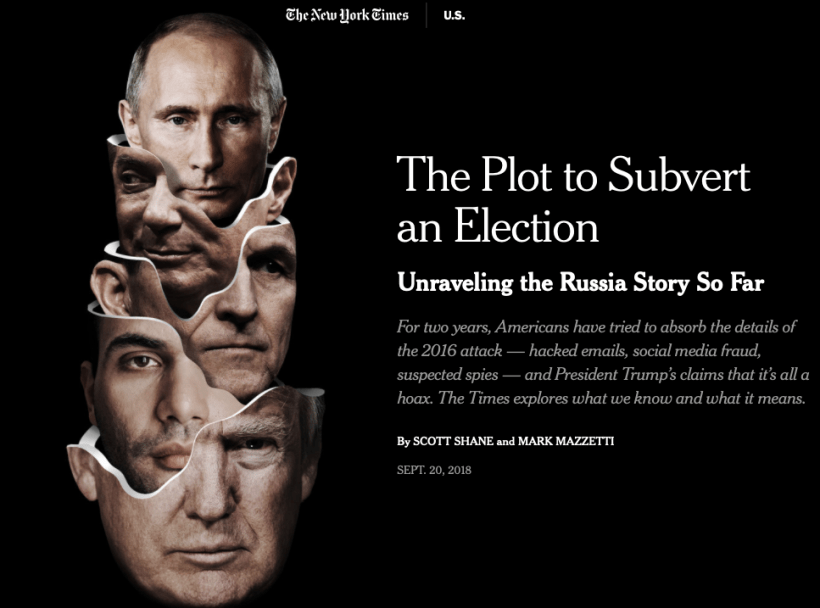
But that turned to be an outrageously deceptive claim, because Shane and Mazzetti failed to mention the fact that those 80,000 IRA posts (from early 2015 through 2017), had been engulfed in a vast ocean of more than 33 trillion Facebook posts in people’s news feeds – 413 million times more than the IRA posts.
In December 2019, senior national security correspondent David Sanger wrote a story headlined, “Russia Targeted Election Systems in All 50 States, Report Finds,” and Sanger’s lede said the Senate Intelligence Committee had “concluded” that all 50 states had been targeted. But the Committee report actually reaches no such conclusion. It quoted President Barack Obama’s cyber-security adviser Michael Daniel as recalling that he had “personally” reached that conclusion, but shows the only basis for his conclusion was remarkably lame: the “randomness of the attempts” and his conviction that Russian intelligence was “thorough.”
The Committee reported that some intelligence “developed” in 2018 had “bolstered” the subjective judgment by Daniel. But all but one of the eight paragraphs in the report describing that intelligence were redacted, and the one unredacted paragraph suggests that the redacted paragraphs provided no conclusive evidence that Russian intelligence had scanned any state election websites, much less those of all 50 states. The paragraph said, “However, IP addresses associated with the August 16, 2016 FLASH provided some indicators the activity might be attributable to the Russian government…. [emphasis added].”
The Committee report also contained summary statements from six states that the Department of Homeland Security has continued to include among the 21 states it insists were hacked by the Russians in 2016, denying any cyber threat to their systems. Another 13 states reported only that there was “scanning and probing” by inconclusive IP addresses the FBI and DHS had sent them. Sanger did not report any of those troublesome details.
In January 2020 the Times began its coverage of the theme of Russian interference in the 2020 election with a story headlined, “Chaos is the Point: Russian Hackers and Trolls Grow Stealthier in 2020.” The story, written by Sanger, Matthew Rosenberg and Nicole Perlroth, sought to heighten the existing U.S. climate of paranoia about a Russian attack in regard to the 2020 elections. Once again, however, nothing in the story supports the sinister tone of the headline.
It reported Department of Homeland Security officials’ anxiety about the ransom-ware attacks on 100 American towns, cities and federal offices during 2019, which are clearly criminal operations aimed at large-scale payoffs by cities. The story informed readers that DHS was investigating “whether Russian intelligence was involved in any of the attacks,” on the apparent theory that the criminals were being used by the Russians.
Since those ransom-ware attacks had been going on for years, the obvious question would have been why DHS would have waited until 2020 to reveal that it was investigating Russian involvement. Thus, the only fact underlying the story was the DHS desire to find evidence to support its accusations of Russian election hacking.
Still at it in 2020
The Times continued its advocacy journalism in a Feb. 26 report that U.S. intelligence officials had “warned” in a briefing for the House Intelligence Committee on Feb. 13 that “Russia was interfering in the 2020 campaign to get President Trump elected,” citing five people “familiar with the matter.”
The Times’ team of four writers proceeded to declare, “The Russians have been preparing – and experimenting – for the 2020 election… aware that they needed a new playbook of as-yet undetectable methods, United States officials said.” But instead of reporting actual evidence of any Russian action or decision for action, the Times writers again cited what their sources suspected could be done.
“Some officials,” they wrote, “believe that foreign powers, possibly including Russia, could use ransom-ware attacks…to damage or interfere with voting systems or registration databases.” The Times’ sources thus had no actual intelligence on the question and were merely speculating on what any foreign government might do to disrupt the election.
Three days after that report, moreover, the Times backed away from its previous lede after intelligence sources disputed its claim that Russia was intervening to reelect Trump, suggesting that the briefing officer, Shelby Pierson, had overstated the assessment. Sanger sought to limit the damage with a story labeling the problem one of “dueling narratives” in the intelligence community.
Then Sanger admitted, “It is probably too early for the Russians to begin any significant moves to bolster a specific candidate,” which obviously invalidated the Times’ previous speculation on the subject. But after The Washington Post published a story that the FBI had informed Senator Bernie Sanders that Russia had sought to help his campaign, Sanger quickly returned to the same narrative of Russian interference to advance its favorite candidates.
On the Times’ podcast “The Daily,” Sanger opined that the Russians were now supporting both Trump and Sanders – because Sanders, “like Donald Trump,” has “got a real aversion to interventions around the world.”
The most recent entry in the Times’ campaign to create anxiety about Russian interference in the election focused on race relations. On March 10, the Times headlined its story, “Russia Trying to Stoke U.S. Racial Tension before Elections, Officials Say.” In their lede Julian Barnes and Adam Goldman announced, “The Russian government has stepped up efforts to influence racial tensions in the United States as part of its bid to influence November’s presidential election, including trying to incite violence by white supremacist groups and stoke anger among Afro-Americans, according to seven American officials briefed on recent intelligence.”
But true to the modus operandi used routinely to push the Russian election threat narrative, the writers did not offer a single fact supporting such a story line. They even admitted that the officials who were making the claims provided “few details” about white supremacists and “did not detail how” blacks were being encouraged to use violence.
It turns out, in fact, that U.S. officials have found nothing indicating Russian support for violent white supremacists in America. The only fact that they could cite — based on a single source — was that the FBI is “scrutinizing any ties” between Russian intelligence and Rinaldo Nazzaro, the American founder of a “neo-Nazi group,” who lives with his Russian wife in St. Petersburg, Russia, but owns property in the United States. So, the Times’ single source had nothing but a suspicion for which the FBI was trying to find evidence.
The final touch in the piece was the accusation that RT had “fanned divisions” on race by running a story about a video of New York policemen attacking and detaining a young black man that Barnes and Goldman write “sparked outrage” and had also “posted tweets aimed at stirring white animosity.” But the RT article on the video merely reported accurately that the video depicted unprovoked police brutality and that it had already gone viral. The Times itself had published a much more detailed Associated Press story on the same incident that went into a discussion of the history of police brutality in New York City. By the Times’ own criterion, the AP was doing far more to stoke racial animosity than RT.
The opinion pieces that RT published attacking The New York Times for its coverage of a video at the University of Wisconsin that offended non-whites and for a Times opinion piece critical of the Apu character on “The Simpsons” echoed views on race and culture that most Americans find offensive. The idea that they were part of a Russian plot to generate racial animosity, however, is a very long stretch.
The descent of The New York Times into this unprecedented level of propagandizing for the narrative of Russia’s threat to U.S. democracy is dramatic evidence of a broader problem of abuses by corporate media of their socio-political power. Greater awareness of the dishonesty at the heart of the Times‘ coverage of that issue is a key to leveraging media reform and political change.
Gareth Porter is an independent investigative journalist and historian and winner of the 2012 Gellhorn Prize for Journalism. His latest book, with John Kiriakou, is “The CIA Insider’s Guide to the Iran Crisis: From CIA Coup to the Brink of War.”
WUHAN OUTBREAK: CHINA DEMANDS AN HONEST ACCOUNTING
By Thomas Hon Wing Polin | March 22, 2020
- It is now virtually certain that COVID-19 was brought to Wuhan by American troops taking part in the city’s World Military Games last Oct. 18-27.
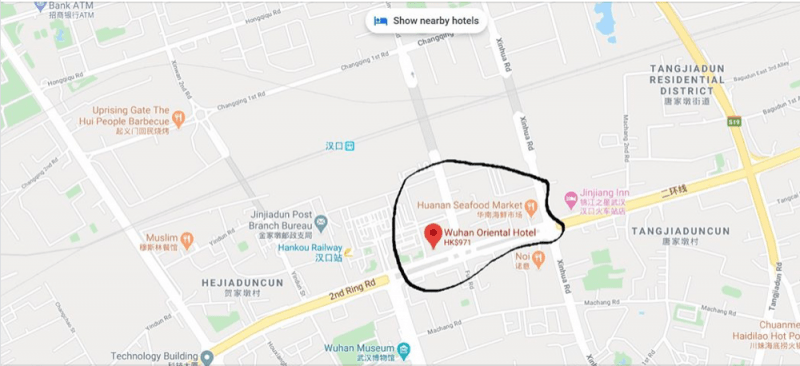
- The 300-strong US contingent stayed 300 meters from the Huanan Seafood Market where China’s outbreak began (see map below) at the Wuhan Oriental Hotel.
- Five of the US troops developed a fever on Oct. 25 and were taken to an infectious-diseases hospital for treatment.
- 42 employees of the Oriental Hotel were diagnosed with COVID-19, becoming the first cluster in Wuhan. At the time only 7 people from the market had been thus diagnosed (and treated before the hotel staff). All 7 had contact with the 42 from the hotel. From this source, the virus spread to the rest of China.
- The American Military Games team trained at a location near Fort Detrick, the military’s viral lab closed down by the CDC in July for various deficiencies.
- The big question now is whether the transmission was planned, or accidental.
- Chinese authorities are awaiting an explanation from US authorities.
- A few days ago, Mike Pompeo phoned Yang Jiechi, Chinese State Councillor for Foreign Affairs. Pompeo’s counterpart is actually Foreign Minister Wang Yi and Yang is Wang’s boss, so Pompeo wanted to talk about something urgent and important.
- Pompeo wanted the Chinese not to publicize what they had found.
- Yang’s reply: “We await your solemn explanation, especially about Patient Zero.”
China’s leaders have long suspected US military involvement in the Wuhan outbreak but were determined to stop the disease before pursuing the Americans for an honest accounting.
The War in Vietnam: John Wayne Was Wrong
By Marko | The Voluntaryist Reader | 12/10/2012
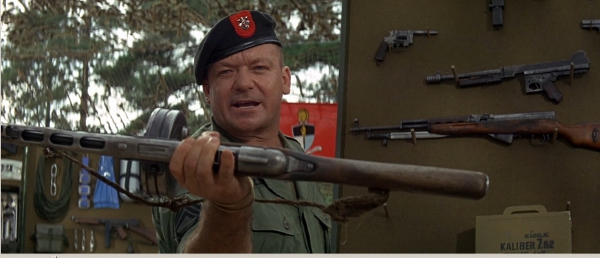
John Wayne’s Vietnam-era pro-war classic, The Green Berets opens with a scene of a press conference. It starts off with a group of Green Berets introducing themselves to the press, which is followed by a Q&A session with two Green Berets sergeants who have been assigned to answer questions. The scene reaches a crescendo when a reporter asks one of the sergeants if the war in Vietnam does not seem like a war between the Vietnamese and if the Americans should therefore stay out of it. Hearing this, the visibly irritated sergeant proceeds to pick up captured Vietnamese firearms from a display board nearby, and drops them in front of the reporter one by one, all the while explaining in a voice laden with hostile emotion that the weapons are Chinese-made, Soviet-made and Czechoslovakian-made respectively.
The implication is clear. The war in Vietnam is not merely an internal Vietnamese affair, because quite aside from the American factor in the war there is also the Soviet, the Chinese, even the Czechoslovakian factor. It is therefore on the account of this involvement of foreign Communist powers in Vietnam that the United States has to involve itself on the other side.
Now it is easy to see the inadequacy of that argument. Providing war material, even on a vast scale, is in no way comparable to a direct military intervention carried out with an occupation force of half a million soldiers, which is how many the United States had in Vietnam at the time The Green Berets aired in 1968.* Clearly the American involvement in Vietnam went far beyond what was necessary to balance out the involvement of the Soviets, the Chinese, or the Czechoslovaks, on the side of Hanoi.
But is it even true the American involvement was a reaction, perhaps an exaggerated reaction, to the Soviet, etc involvement? What were the actual cause and effect, in life rather than on film? Were the Americans in Vietnam because Soviet shipments of weaponry were going there, or were the Soviets shipping weaponry to Vietnam because the Americans had come there? How does this and other claims of war propagandists of the time stack up against what we know from the works of historians today?
In fact, where the Soviets are concerned their relationship with the Vietnamese before the American intervention in Vietnam was at its nadir precisely because the Soviet Union would not support DRV (North Vietnam) in reunifying Vietnam by military means. Soviet aid to DRV in this period, that is when the North was facilitating the struggle of the NLF (“Viet Cong”) in the South and before direct American involvement on a great scale, was relatively small and almost exclusively economic, not military.
When the unifying elections called for by the Geneva Accords of 1954 that had ended the French War in Vietnam did not come about, Hanoi gradually resolved to wage a military campaign to oust the American-backed government in the South. In this, however, it did not have the support of Moscow.
The Soviets feared American intervention which would have to result in an American-Soviet confrontation that would interfere with their policy line of “peaceful coexistence” with the Capitalist bloc. They made it clear to Hanoi they supported its struggle to reunify Vietnam only in as much as it was pursued by diplomatic means and encouraged Hanoi to pursue a peaceful strategy.
Vietnamese Communists shared many of the concerns being voiced by Moscow, but ultimately pressed on regardless. Both the Vietnamese and the Soviets were acutely aware that waging a violent struggle for reunification could result in an American invasion in Vietnam. They were both uneasy about this prospect and regarded it as highly undesirable, even disastrous. The difference was that the Vietnamese were ultimately willing to accept a confrontation with the Americans if they stood in the way of the reunification of their country, but the Soviets were not.
It was not until the time of the Gulf of Tonkin Resolution which marked the official entry of the United States into the war in Vietnam that the USSR begun to provide DRV with military assistance. The Soviets had held back on providing Vietnamese Communists with war material because this would encourage them to wage war in the South, which could in turn result in an American intervention. Now that Americans had intervened regardless, the Soviets no longer had a reason to continue to hold back. Whatever they did, the Americans were already in Vietnam. Now they would provide the Vietnamese with aid, because that was the only way these could hope to prevail against the Americans.
An additional reason for the Soviet reversal on the question of military assistance was to regain the influence they had lost with North Vietnam to China. In 1954 Moscow and Beijing had pressured the Vietnamese Communists into signing the Geneva Accords, which ended the French War in Indochina, but also split Vietnam in half.** Since then both China and the Soviet Union acted as a moderating force on Hanoi. They encouraged the Vietnamese to pursue the goal of reunification by peaceful means only, even after these had clearly shown themselves to be ineffectual when unifying elections called for by the Accords failed to materialize.
Following the Sino-Soviet split, however, Beijing gradually moved away from this position and came to see a military struggle could complement diplomatic and propaganda efforts. In time, the Chinese position would become further radicalized and they would reject the notion that negotiations could be of any use at all. It is important to understand, however, that Beijing came to approve of the armed struggle of the Vietnamese only in 1961, fully two years after the Vietnamese had gone ahead with it.
The change in the position of the PRC and the resultant increase in assistance to Vietnam enabled the Chinese-Vietnamese relationship to thrive. In the context of the Sino-Soviet confrontation within the Communist camp North Vietnam was now aligning ever more closely to China. That is, until the American intervention in the war caused the Soviets to launch a giant, Lend Lease-like program of military assistance to the DRV and regain their lost influence with Hanoi.
The key thing to take from here is that it was not the case that the Vietnamese fell under China’s influence which directed them to pursue the goal of unification of their country with military means. The Vietnamese were orienting themselves to that of the two Communist powers which would support them in their own policy line on South Vietnam. Chinese-Vietnamese relations could thrive precisely because China had come to adopt Hanoi’s view of peaceful means to reunify Vietnam as inadequate. The Soviet Union in turn could regain its influence over DRV and pull it back from the Chinese camp only when it had dropped its opposition to the military struggle of the Vietnamese.
The presence of Soviet and Chinese-made firearms in Vietnamese hands did not in fact point to the latter being simply the agents of monolithic Communism with designs over the entire globe as John Wayne wanted Americans to believe in 1968. In actuality, by going to war the Vietnamese Communists had defied the Kremlin and had frustrated its plans. It was precisely by opting for a military struggle that the DRV leadership had demonstrated its freedom of action. It was also the case that the USSR did everything it could to spare the US its calamitous war in Vietnam.
The Soviets attempted to dissuade the Vietnamese leadership from waging a military struggle even at the cost of losing nearly all its influence in Hanoi and seeing North Vietnam slide into the Chinese camp. If the mistake the Soviets committed was failing to appreciate just how important it was to the Vietnamese to reunify their country, it was a mistake the Americans tragically made as well. In part, due to propagandists like John Wayne who put out the idiotic drivel of the Vietnamese struggle for reunification as a matter of “world Communist domination”.
~ Marko
Source: Mari Olsen, Soviet–Vietnam Relations and the Role of China, 1949–64: Changing Alliances (New York: Routledge, 2006)
*Albeit by the time The Green Berets aired this was no longer the case, the Chinese also stationed troops in Vietnam, specifically in the Communist-run Democratic Republic of Vietnam (North Vietnam), but on a far smaller scale. In all 320,000 Chinese anti-aircraft and engineer troops served in Vietnam in comparison to 2.7 million Americans. The Chinese deployed in North Vietnam in mid 1965, in response to the Americans landing in the South. They evacuated in early 1968, having suffered about 1100 dead, mainly in the American bombing of the North.
**The two powers went as far as to signal the Viet Minh that rejecting the Accords may result in their ending their material assistance to the movement’s struggle.
Top Doctor at Moscow’s leading disease hospital says current Covid-19 crisis will likely last Six months

By Bryan MacDonald | RT | March 20, 2020
Coronavirus panic is already threatening a worldwide economic disaster, as millions are forced to live under lockdown. This has left many people wondering how long we can expect these circumstances to endure.
“When I call my parents, I say jokingly: ‘see you in September,'” Denis Protsenko has told RT. He’s the head doctor of Moscow’s main disease hospital in Kommunarka.
Protsenko believes that while the pandemic may slow in summer, it’s more like it will be autumn before the siege will be lifted. If the country has a similar experience to China, then the spread will decline in May or June, he believes, but “If we get an explosion along Italian lines, we will consider a September conclusion a good result.”
The doctor emphasized that stopping the spread of coronavirus in Moscow will require “draconian prevention measures,” including the strict enforcement of a two-week self-isolation regime. At the same time, he stressed his belief that the capital should be temporarily closed for quarantine, right now.
The candid observations of Protsenko differ from previous mainstream thought in Russia. For instance, popular TV presenter Alexander Myasnikov, who is himself a Doctor by trade, urged Russians not to panic but warned that the psychological condition of people, and the economy itself, means more than a month of strict quarantine regulations isn’t realistic. Myasnikov, and others, had expressed the belief that the worst of the crisis would be over by mid-April.
According to the latest data, 253 are infected with coronavirus in Russia. The official tally rose by 54 on Friday and 52 on Thursday. While Moscow has the most cases, infections are spread across the country, with six reported in the remote Yakutia region. Twelve patients in Russia have been given the all-clear and discharged. One woman, suffering from Covid-19, died in Moscow on Thursday, but an autopsy showed the cause of death was a blood clot, rather than respiratory issues. She had a range of pre-existing conditions.
COVID-USA: Targeting Italy and South Korea?
By Larry Romanoff | Global Research | March 21, 2020
A high-level Italian virologist, Giuseppe Remuzzi, has published papers in the Lancet and other articles in which he states facts not hitherto known. (1)
The doctor stated that Italian physicians now recall having seen:
“a very strange and very severe pneumonia, particularly in old people in December and even November [2019]. This suggests that the virus was circulating, at least in Lombardy, and before we were aware of this outbreak occurring in China.“(2)
Chinese medical authorities have determined the same underlying phenomenon, that the virus had been circulating among the population for perhaps two months before it finally broke out into the open.
Further, according to the Italian National Health Service (ISS):
“It is not possible to reconstruct, for all patients, the chain of transmission of infection. Most cases reported in Italy report an epidemiological link with other cases diagnosed in Lombardy, Emilia Romagna and Veneto, the areas most affected by the epidemic.” [translation from Italian] (3)
The above statement is of crucial importance since it supports in itself the assertion of several simultaneous infection clusters and several ‘patients zero’. There are cases in Lombardy that could not be placed in an infection chain, and this must also be true for other areas. (see below) Given that the virus broke out separately in disparate regions of Italy, we can expect the identification of independent infectious clusters in those regions as well. That would mean Italy was hit by at least several individual ‘seedings’ of the virus.
China’s outbreak of consequence was primarily in the city of Wuhan but with multiple sources in the city and multiple patients zero, with a minor outbreak in Guangdong that was easily contained. China had multiple clusters in Wuhan. There was no single source, and no patient zero has been identified which is similar to those of Italy.
The mystery of Italy’s “Patient No. 4”
Was the Italian outbreak caused by infections from China? Yes, and no.
Before February 20, 2020, there were only three cases of coronavirus infection in Italy, two tourists from Wuhan, China, confirmed on January 30th, and an Italian man who returned to Rome from Wuhan on February 6th. These were clearly imported cases with Italy experiencing no new infections during the next two weeks.
Then suddenly there appeared new infections that were unrelated to China. On February 19, the Lombardy Health Region issued a statement that a 38-year-old Italian man was diagnosed with the new coronavirus, becoming the fourth confirmed case in Italy. The man had never traveled to China and had no contact with the confirmed Chinese patients.
Immediately after this patient was diagnosed, Italy experienced a major outbreak. In one day, the number of confirmed cases increased to 20 and, after little more than three weeks, Italy had 17,660 confirmed cases.
The Italians were not idle in searching for their patient zero. They renamed the “patient 4” “Italian No. 1”, and attempted to learn how he became infected. The search was apparently fruitless, the article stating that “America’s pandemic of the century has become the subject of suspicion by Italians“.(4)
The mystery of South Korea’s “Patient No. 31”
South Korea’s experience was eerily similar to that of Italy, and also to that of China. The country had experienced 30 imported cases which began on January 20, I believe all of which were traceable to contact with Hubei and/or Wuhan.
But then South Korea discovered a “Patient No. 31”, a 61 year-old South Korean woman diagnosed with the new coronavirus on February 18. This ‘local’ patient had no ties to China, had had no contact with any Chinese, and no contact whatever with any of the infected South Koreans. Her infection was a South Korean source.
Just as with Italy, the outbreak in South Korea exploded rapidly after the discovery of Patient 31. By the next day, February 19 (Italy was February 21, for comparison), there were 58 confirmed cases in South Korea, reaching 1,000 in less than a week. After little more than three weeks, South Korea had 8,086 confirmed cases. It would now seem likely (yet to corroborated) that South Korea and Italy could have been ‘seeded’ at approximately the same time.
Like the Italians, South Korea performed a massive hunt for the source of the infection of their “Korean No. 1”, combing the country for evidence, but without success. They discovered the confirmed cases in South Korea were mainly concentrated in two separate clusters in Daegu and Gyeongsang North Road, most of which – but not all – could be related to “Patient 31”. As with Italy, multiple clusters and multiple simultaneous infections spreading like wildfire – and without the assistance of a seafood market selling bats and pangolins.
For both Italy and South Korea, I could also add that there is no supposed “bio-weapons lab” anywhere within reach (as was claimed for China), but that wouldn’t be accurate. There are indeed bio-weapons labs easily within reach of the stricken areas in both Italy and South Korea – but they belong to the US Military.
Korea is particularly notable in this regard because it was proven likely that MERS resulted from a leak at the American military base at Osan. The official Western narrative for the MERS outbreak in South Korea was that a Korean businessman became infected in the Middle East then returned to his home in Gyeonggi Province and spread the infection. But there was never any documentation or evidence to support that claim, and to my best knowledge it was never verified by the South Korean Government.
Pertinent to this story is that according to the Korean Yonhap News Service, at the onset of the outbreak about 100 South Korean military personnel were suddenly quarantined at the USAF Osan Air Base. The Osan base is home to the JUPITR ATD military biological program that is closely related to the lab at Fort Detrick, MD, both being US military bio-weapons research labs.
There is also a (very secretive) WHO-sponsored International Vaccine Institute nearby, which is (or at least was) managed by US military biological weapons personnel. At the time, and given the quarantine mentioned above, the event sequence accepted as most likely was that of a leak from a JUPITR biowarfare project. (5) (6)
The Korean path is similar with that of Italy. If we look at a map of the virus-stricken areas of Italy, there is a US military base within almost a stone’s throw of all of them. This is of course merely a case of circumstance arousing suspicion, and by no means constitutes proof of anything at all.
However, there is a major point here which cannot be overlooked, namely the fact of simultaneous eruptions of a new virus in three different countries, and in all three cases no clear epidemiology, and an inability to identify either the original source or a patient zero.
Multiple experts on biological weapons are in unanimous agreement that eruptions in a human population of a new and unusual pathogen in multiple locations simultaneously, with no clear idea of source and cases with no proven links, is virtually prima facie evidence of a pathogen deliberately released, since natural outbreaks can almost always be resolved to one location and one patient zero. The possibility of a deliberate leak is as strong in Italy and South Korea as in China, all three nations apparently sharing the same suspicions.
Larry Romanoff is a retired management consultant and businessman. He has held senior executive positions in international consulting firms, and owned an international import-export business. He has been a visiting professor at Shanghai’s Fudan University, presenting case studies in international affairs to senior EMBA classes. Mr. Romanoff lives in Shanghai and is currently writing a series of ten books generally related to China and the West.
He is a Research Associate of the Centre for Research on Globalization (CRG).
He can be contacted at: 2186604556@qq.com
Notes
(A) This is an aside, but Italy has experienced a fatality rate nearly twice that of Wuhan, but there may be an external contributing factor. Observations were made that, in most cases especially among the elderly in Italy, ibuprophen was widely used as a painkiller. The Lancet published an article demonstrating that the use of ibuprophen can markedly facilitate the ability of the virus to infect and therefore to increase the risk of serious and fatal infection. (YY)
https://www.thelancet.com/journals/lanres/article/PIIS2213-2600(20)30116-8/fulltext
(B) “The mean age of those who died in Italy was 81 years and more than two-thirds of these patients had . . . underlying health conditions, but it is also worth noting that they had acute respiratory distress syndrome (ARDS) caused by . . . SARS-CoV-2 pneumonia, needed respiratory support, and “would not have died otherwise.”
(3) https://www.iss.it/web/guest/primo-piano/-/asset_publisher/o4oGR9qmvUz9/content/id/5293226
(4) http://dy.163.com/v2/article/detail/F7N756430514G9GF.html
(5) https://www.21cir.com/2015/06/south-korea-mers-emerged-out-of-the-pentagons-biowarfare-labs-2/
(6) https://www.businessinsider.com/almost-200-north-korean-soldiers-died-coronavirus-2020-3
Copyright © Larry Romanoff, Global Research, 2020
‘Zero Carbon Is A Crime Against Humanity’
By David Wojick, Ph.D. | PA Pundits – International | March 21, 2020
I recently got an intriguing email from Professor Guus Berkhout, president of the Climate Intelligence Foundation or CLINTEL. It contained this striking paragraph and the last sentence really got me thinking:
“The past 150 years show that affordable and reliable energy is the key to prosperity. The past 150 years also show that more CO2 is beneficial for nature, greening the Earth and increasing the yields of crops. Why do governments ignore these hard facts? Why do they do the opposite and lower the quality of life by forcing high-cost, dubious low-carbon energy technologies upon their citizens? The zero-emission act is a crime against humanity.”
So I looked into the law on crimes against humanity and Professor Berkhout may have a strong case. At its simplest, a crime against humanity is a government policy that systematically and knowingly harms a specific group of innocent people.
Zero carbon emission laws like the Green New Deal in the EU and the US will deprive poor people of affordable energy worldwide. This fact has been well established by numerous studies. Thus these policies knowingly harm a specific group of innocent people. And as CLINTEL points out in its World Climate Declaration, there is no climate emergency that might justify this harm. What we have are governments deliberately harming their citizens.
But look also at the latest developments in climate science. There is new insight that has to do with a review of carbon budgets. A carbon budget indicates the amount of CO2 that may still be emitted before a certain warm-up limit is exceeded. IPCC climate scientists that authored the SR15 report of 2018 took another close look at the calculations of the carbon budgets in IPCC’s AR5 report of 2014 and concluded that they had been too pessimistic in the past. And not so slightly. In the SR15 report those carbon budgets have been increased spectacularly.
By way of illustration, the carbon budget for the 1.5 degree limit has increased by no less than a factor of 5! It therefore takes considerably longer for the carbon budgets to be exhausted, which means that the strict emission requirements based on AR5 can be significantly relaxed. So this is very good news for all people concerned about the climate. It fully confirms CLINTEL’s message: ‘ There is NO climate emergency.’
Unfortunately, the good news has been snowed under by the increasing ‘gloom and doom’ actions and stories about the ‘dangerous climate change’, ironically fed by the same SR15 report. Actually, the reader should realize that the good news is even better because on top of the computational error in AR5 we still deal with IPCC’s continuing exaggerated climate sensitivity for CO2. When will that be corrected?
Note that – despite the strong scientific and moral arguments – it is now the stated goal of the UN alarmists that all countries should adopt zero carbon laws, preferably in time for the Climate Summit in Glasgow this November. Given that the harm is proportional to poverty, such precipitous actions would be especially harmful to the poorest. And, for heaven’s sake, why?
Zero carbon laws are prohibitions against those forms of energy that presently supply about 80% of human need. A well recognized definition of crimes against humanity is “inhumane acts intentionally causing great suffering”. Deliberately depriving poor people of affordable energy certainly fits this definition.
My colleague Paul Driessen have written extensively about this issue, albeit not from the perspective of crimes against humanity. See for example here.
Mind you we were just talking about the tragedy of so-called development banks refusing to fund affordable energy development. Laws that prohibit the use of fossil fuels are infinitely worse. Imagine not being allowed to use a kerosene light or a gasoline scooter, on top of not having electricity.
But we do not have to go to poor Africa to find energy poverty. It is being documented throughout Europe, especially in those countries where misguided governments have forced renewable energy on their people. Yet the UK and EU are both adopting draconian zero carbon policies. The energy poor here also probably have a good case of crimes against humanity.
In the U.S. it is estimated that millions of households live in what is defined as “energy poverty” due in large part to the forced shift to renewable power. Energy poverty is reported to be the second leading cause of homelessness in America. The proposed Green New Deal will make this suffering dramatically worse.
In short, CLINTEL president Guus Berkhout is right. Zero-carbon laws are not only scientifically utterly silly, they are crimes against humanity.
Africa, Latin America Fragile Targets for Coronavirus Spread
teleSUR | March 20, 2020
The West African nation of Mali has roughly one ventilator per 1 million people — 20 in all to help the critically ill with respiratory failure. In Peru, with more than 32 million people, about 350 beds in intensive care units exist.
Many of their nations are slamming shut borders and banning large gatherings in the hope of avoiding the scenes in wealthier countries such as Italy and the U.S., but local transmission of the virus has begun.
Containing that spread is the new challenge. Africa has more than 900 confirmed cases and Latin America more than 2,500, but an early response is crucial as fragile health systems could be quickly overwhelmed.
With such limited resources, experts say identifying cases, tracing and testing are key.
“We have seen how the virus actually accelerates that after a certain … tipping point. So the best advice for Africa is to prepare for the worst and prepare today,” WHO Director-General Tedros Adhanom Ghebreyesus said Wednesday.
“We have different and significant barriers to health care in Africa, which could be a real challenge,” said Dr. Ngozi Erondu, a senior research fellow at the Chatham House Center for Global Health Security.
Many countries in sub-Saharan Africa do not have the isolation wards or large number of health care workers to respond to a surge of COVID-19 patients, she said.
Liberia and Burkina Faso only have a few ventilators for their millions of people.
Dr. Bernard Olayo, founder of the Kenya-based Center for Public Health and Development, said most countries in Africa can’t afford ventilators. Even if ventilators were provided by other countries, it’s not sufficient because of the lack of qualified people to use them.
“It’s complex, it’s very very complex because the patients that end up on ventilators require round the clock care by larger teams,” he said.
Many patients could do well with just oxygen, he said, but close to half of health facilities in African countries don’t have reliable oxygen supplies. Oxygen concentrators can be used, but given the frequent electricity cuts in many countries, oxygen generators and pressure cylinders are needed because they can function while power is out.
The WHO regional Africa director, Dr. Matshidiso Moeti, said the lack of ICU facilities and ventilators is one of the biggest challenges facing the continent.
“We have been able to identify importing a field hospital-type of facility that can be set up and equipped with some of the key items needed, such as ventilators,” she said. Training has begun in Republic of Congo and Senegal so health care workers will be ready to operate it, and World Bank funding is being made available, she said.
Several countries in Latin America are also among the least prepared in the world for a pandemic, with healthcare systems already stretched thin.
Peruvian Minister of Defense Walter Martos told local America TV on Monday that the nation has less than 400 respirators available.
“It’s not a lot,” he said. “Really, we don’t have the infrastructure that developed nations do.”
Peru and other nations in Latin America are looking to the experience in Europe as a cautionary tale and hoping to curtail the spread of coronavirus cases before they overwhelm hospitals.
Epidemiologist Cristian Díaz Vélez said those measures could potentially create a slower rise in cases that is more manageable for Peru’s medical system. He said the country has around 300 to 350 beds in intensive care units, half of which are now in use.
“It will overwhelm our healthcare system,” he said, if cases skyrocket.
Other countries in Latin America could fare far worse.
Illinois goes on coronavirus lockdown days after holding ‘fine & safe’ Democratic primaries
RT | March 20, 2020
Having insisted on holding Democratic presidential primaries just days earlier, Illinois Governor J.B. Pritzker has now placed the state on “shelter-in-place” regime over the Covid-19 pandemic, following California and New York.
The measure will go into effect on Saturday evening, March 21. All non-essential businesses – not including hospitals, doctors’ offices and grocery stores – are to be closed indefinitely, Pritzker announced after consulting with experts. “To avoid the loss of tens of thousands of lives we must order an immediate shelter-in-place.”
Pritzker admitted the state does not have “the resources, the capacity, or the desire to police every individual’s behavior,” so the enforcement of the order will come down to “Illinoisans to be good members of their communities and good citizens,” he told the Chicago Tribune.
The statewide measure follows the order of Chicago Mayor Lori Lightfoot to close down the city, declaring that “now is not the time for half measures” but also that this is “not a lockdown, or martial law.”
Just three days prior, however, the state refused to cancel, postpone or enable mail-in voting in the Democrat presidential primary.
“I feel good about the decision to have the election go on tomorrow,” Pritzker had said Monday afternoon. “We do believe it’s safe. We’ve certainly consulted experts, and we think that the election will go on just fine.”
With many poll workers not showing up due to fears of contagion and numerous polling places closed, the voting involved large crowds clustering together for many hours – conditions ideal for spreading the coronavirus.
The primary was overwhelmingly carried by establishment favorite Joe Biden (924,771 votes, 59 percent), whereupon Pritzker and the experts appear to have suddenly changed their minds.
As of Friday, Illinois had 585 registered Covid-19 cases, with five fatalities.
US airlifts Lebanese-American accused of torture, murder from Lebanon
MEMO | March 20, 2020
Lebanese-American Amer Fakhoury, accused of torturing and murdering prisoners while serving in the Israeli-backed south Lebanon army, has been airlifted from Beirut by the US, Senator Jeanne Shaheen announced yesterday.
A US Marine Osprey was seen landing at the US Embassy in Beirut, hours before Fakhoury’s release was announced.
Shaheen said she had spoken with Fakhoury on the phone soon after his release, adding that “anytime a US citizen is wrongfully detained by a foreign government, we must use every tool at our disposal to free them”.
In a statement later yesterday, US President Donald Trump said that he was “very grateful to the Lebanese government. They worked with [the US]”.
Fakhoury was detained on 12 September when he arrived in the country to visit family after more than two decades.
The former member of the south Lebanon Army has been accused of being the “Butcher of Khiam” over allegations that he oversaw the torture and murder of detainees during his tenure as a prison guard.
Former detainee Abbas Qabalan told local media Naharnet that “not a single person held in Khiam was spared physical and psychological torture”. At least ten people died at the prison while Fakhoury was working there.
The charges against Fakhoury were initially dropped on Monday, when he was acquitted because the alleged offences took place more than ten years ago.
However, a military judge ordered a re-trial after Judge Ghassan Khoury asked the Military Court of Appeals to overturn the acquittal. A court order forbidding Fakhoury from travelling internationally for two months was announced later.
In the wake of Fakhoury’s release, the head of the Military Tribunal Brigadier General Hussein Abdallah announced his resignation from the post this morning, the Daily Star reported.
Abdallah said he resigned “out of respect for my oath and military honour” adding the military tribunal had become a place where “the application of the law equals to the release of an agent of pain”.
Tensions between the US and Lebanon have risen dramatically as a result of Fakhoury’s detention, with Senators Shaheen and Cruz tabling legislation in February which would invoke sanctions against Lebanese officials and associates which are deemed to have been involved in the illegal detention of a US citizen.
The Trump administration have threatened to withhold aid to the country and sanction the Lebanese military.
Featured Video

No Threat Can Force Iran’s Surrender /Trita Parsi & Lt Cl Daniel Davis
or go to
Aletho News Archives – Video-Images
From the Archives
What is the Israeli Lobby in Australia Doing in Interfaith Dialogue?
By Ali Kazak | Dissident Voice | October 11, 2015
For years Israel and its lobby around the world have been trying to normalise their relations with Arabs and Muslims without solving the Palestine Question.
One of the methods they resorted to in the last few years is using human rights and community organizations such as interfaith dialogue and Multiculturalism to achieve this objective and to: isolate the Palestinians, marginalise the Palestine question, end Israel’s isolation, and prevent criticism of Israel, knowing that these organisations will be the first to stand against Israel’s violations, racial and religious discrimination.
The group responsible for this task in Australia is The Australia/Israel & Jewish Affairs Council (AIJAC); its Director of International & Community Affairs, Jeremy Jones is in charge of lobbying religious community organizations, specifically Muslims and Christians. Consequently he convened the Faith Communities for Reconciliation, founding participant in the Australian Partnership of Religious Organisations and the Australian National Dialogue of Christians, Muslims & Jews.
AIJAC is a private political propaganda group. It is recognised as the main Israeli lobby in Australia. It coordinates its activities and works intimately with the Israeli embassy in Canberra and different institutions in Israel. It is privately funded by some Jewish businessmen. It monitors closely Australian politicians, the media, ethnic and religious groups, (especially Arabs and Muslims), unions and academics on their stands towards Israel and the Palestine question. … continue
Blog Roll
 Aletho News
- The war of liberation of the Arab and Islamic peoples expands across the Gulf
- Envoy warns UN on Trump’s threat to ‘obliterate’ Iran’s civilian infrastructure
- The Larak Corridor: Iran’s Rial Gate With No US, No Israel, and No Way Around
- ‘Economic terrorism’: Steel facilities hit again in US-Israeli strike
- ‘War Crime’: Iran condemns attacks on Arak, Ardakan nuclear sites
- Two-thirds of Americans want quick end to Iran war even if goals unmet
- Trump to Give “Important Update on Iran” Wednesday in Prime-Time Speech
- Theodore Postol: Iran’s Missiles & Drones Were Underestimated
- Iran To Target Military Industrial-Tech Complex That Facilitated Gaza Genocide
- Collapsing Empire: The Resistance Disarms ‘Israel’
- If Americans Knew
- Israel wants US to bomb more of Iran’s civilian structures (113,000 is not enough) – Not a ceasefire Day 173
- Ann Coulter Rips Into Fox News for Iran War Coverage
- Joe Kent Urges Americans To Call White House and Congress To Object To Sending Troops Into Iran
- DNC Resolution to Reject AIPAC Funding Puts Democratic Leaders in the Hot Seat
- Swedish foundation to build 400 schools as over 650,000 Gaza children remain without education for 2 years
- Israeli army admits photshopping image of slain Lebanese journalist
- This is how Israel is systematically killing health workers under the cover of war in Lebanon
- Carrying life under fire: Israeli invasion of Lebanon leaves pregnant women facing deadly risks
- Champagne all around for the new death penalty (for Palestinians) law – Not a ceasefire Day 172
- Why are Palestinian books struggling to be seen on Amazon?
- No Tricks Zone
- New Study Finds Warming Saves Lives…Cold Temperatures 12 Times More Deadly Than Excess Heat
- German Science Blog Accuses PIK Climate Institute Of Hallucinating Climate Tipping Points
- Devastating Assessment Of Comirnaty Vaccine By Former Senior Pfizer Europe Toxicologist
- New Study: CO2 Is ‘Effectively Negligible’ As An Explanatory Climate Change Factor Since 2000
- Former Pfizer Toxicologist Dr. Helmut Sterz Tells Bundestag Hearing Pfizer Vaccine Should Have Never Been Approved
- Energy Expert: Germany’s Nuclear Phaseout Was A “500 Billion Euro Mistake”
- New Research: South Australia’s Mid-Holocene Sea Surface Temperatures Were 4°C Warmer Than Today
- Storing Green Energy To Last Germany 10 Days Would Require A 60-Million Tonne Battery
- New Studies: UK Sea Levels Were 4 Meters Higher Than Today During The Mid-Holocene
- Destructive Green New Deal: German Energy And Metal Group Warns Of Drastic Crisis
 Aletho News