Sky News Miss the Story
By Craig Murray | July 27, 2020
Sky News are today carrying the story that Nicola Sturgeon attended a meeting with Salmond’s former Chief of Staff, Geoff Aberdein, about a historic sexual allegation made against Alex Salmond on 29 March 2018, several days before she claimed to parliament that she first heard of it. It will prove in the long term still more significant that this meeting also contradicts Sturgeon’s claim that it was Alex Salmond who first told her of the existence of the allegations.
This all appears to come as news to James Matthews, the Sky reporter. The extraordinary thing is, that both he and I sat through the testimony under oath on this point of Geoff Aberdein at the Alex Salmond trial.
On 8 to 9 March 2018 … had contacted him to say she was involved in a process of looking at complaints about Alex Salmond. He had spoken to Kevin Pringle and Duncan Hamilton by conference call to discuss this. On 29 March 2018 he had held a meeting with Nicola Sturgeon in the Scottish Parliament to discuss this. On 2 April he had attended a further meeting in Sturgeon’s home.
Matthews obviously thought it of no significance – but then again, it was defence evidence and Matthews, in common with the entire mainstream media, reported virtually zero of the defence evidence. Today’s Sky News article helpfully gives links to the headlines of their Salmond trial stories:
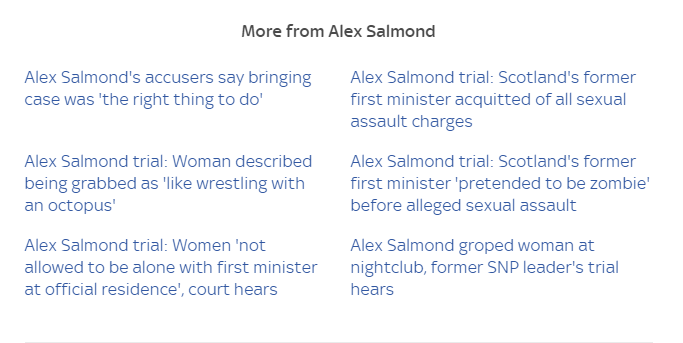
As you will see, lurid allegations from the prosecution witnesses – lurid allegations which were untrue – were prominently featured as the headlines. You will search those reports in vain for detail or even a bare outline of the defence case. The verdict is treated as a shock, and then we are straight in to stories querying the verdict.
Matthews and all the MSM hacks came for a hanging. They thus missed the real story, which is of a conspiracy at the highest levels of the Scottish Government to frame Alex Salmond. This finally seems to have penetrated even James Matthews’ thick skull. Had he been paying attention to the defence evidence, he could have published today’s article two months ago.
This relates to the single allegation in the Salmond trial which was about a real incident which actually happened, as opposed to a fiction, a distinction the jury appears to have made by finding only this one “Not Proven” and the others “Not Guilty”. Salmond stated it was a case of working very late together and drinking, getting intimate and going a bit too far with a cuddle. At the time he made a formal apology through a civil service process, which was accepted, and given the choice of transfer the official continued to work closely with him.
The separate official who contacted Aberdein about weaponising this initial Salmond allegation is somebody extremely close to Nicola Sturgeon and very senior in her office. She first contacted Aberdein on 8-9 March – almost a full month before Sturgeon claims she first knew of the allegation.
Anybody who knows how Sturgeon operates would find it extremely improbable that a senior member of her office would be undertaking such discussions without her knowledge. It is simply impossible that the staff member would then go on to arrange a meeting with Sturgeon herself on the subject, without Sturgeon’s prior knowledge and agreement. So we can be extremely confident that Sturgeon knew about the allegation before 29 March, and very probably before 9 March.
It seems from the Sky article that Sturgeon’s defence is to call Geoff Aberdein a liar.
A Scottish government spokesperson told Sky News that Ms Sturgeon does not dispute that the 29 March meeting took place but refutes the suggestion that it involved discussion of the Scottish government’s Salmond inquiry.
This may be difficult for Aberdein as at the 29 March meeting the only other person present was the senior official from Sturgeon’s office, a person whose truthfulness I am by no means alone in holding in great doubt. But in his sworn evidence Aberdein stated that he had a teleconference to discuss the development with Duncan Hamilton and Kevin Pringle, both persons of considerable probity.
I was deeply shocked, indeed shaken, on Friday evening when I was shown a new letter from the Crown Office, denying the existence of a document relevant to my own defence which I know for certain to exist and to be held by the Crown – it was one of those documents, proving the wider conspiracy, excluded from the Salmond trial by the judge as “collateral evidence”. I am now just as shocked by the above Scottish government statement about the 29 March meeting. Lies, evasions, sophistry and denials are perhaps to be expected from politicians, but they are being communicated by civil servants, which says something about the degree of corruption in Scotland today.
I am very sorry, but Scottish politics are about to get very dirty indeed. The degree of penetration and influence by the UK security services behind these events must not be underestimated.
Israel blocks Palestinian mothers travelling with newborn babies
MEMO | July 27, 2020
The Israeli authorities have prevented two Palestinian women from leaving the occupied West Bank for Jordan because their newborn babies are not registered in the Zionist state, Wafa news agency has reported.
Although the babies are registered with the Palestinian Interior Ministry, they were not allowed to cross into Jordan via the Allenby Bridge.
A number of Palestinians have been denied travel recently at the Israeli-controlled border crossing with Jordan. The bridge connects the West Bank with the Hashemite Kingdom and is the sole designated exit and entry point for West Bank Palestinians travelling into and out of the Israeli occupied territories.
The women were attempting to travel to Jordan to be reunited with their husbands who work in the UAE, after giving birth in the occupied territories. Palestinian Authority Foreign Minister Ahmad Al-Dik condemned Israel’s actions and asserted the right of the babies to stay with their mothers.
“This stance by the occupation state is a violation of the Geneva Conventions,” he explained, “which guarantee freedom of movement for people under occupation, particularly since the two women carry valid documents for themselves and their babies issued by the State of Palestine, which is under occupation.”
Rights groups have pointed out that preventing Palestinians from travelling through this crossing is part of the political pressure put on them. It bears no relation to any valid security or other issues, they insisted.
US-Backed Coup Gov’t in Bolivia Suspends Elections for Third Time
By Alan Macleod | MintPress News | July 24, 2020
Amid a rapidly worsening COVID-19 pandemic, Bolivia’s coup government has once again suspended much-anticipated elections that were due to be held on September 6. This is the third time the administration of Jeanine Añez has postponed them because of the virus, setting a new date for October 18.
The move has drawn condemnation from both left and right, but for different reasons. MintPress’ Ollie Vargas, who covered events from inside the country since last year’s November 10 coup, was dismayed, announcing:
Bolivia’s unelected coup regime has extended it’s illegitimate power by canceling elections once again. When we get to October they’ll invent another reason to postpone, then another, till they’ve found a buyer for the lithium & other natural resources. This is a dictatorship.
Former President Evo Morales of the Movement to Socialism (MAS) party agreed, stating that “The de facto government wants to gain more time to continue the persecution of social leaders and against MAS candidates. It’s yet another form of persecution. That’s why they don’t want elections on September 6.” Meanwhile, coup leader Fernando Camacho rejected the new date, demanding elections be scrapped altogether, a position shared by the far-right Santa Cruz “Civic Committee.”
Morales was reelected in October for another five year term. A popular president, he reduced poverty by half and extreme poverty by three quarters, while increasing the (inflation-adjusted) per capita GDP by 50 percent in his 13 years in office. He managed this primarily through a series of nationalizations of the country’s key industries and by expelling the predatory International Monetary Fund (IMF) from Bolivia. But in November, the military and police intervened, demanding he resign. Today he lives in exile in Argentina. Nevertheless, the latest polls show that the MAS candidate Luis Arce, who served as Morales’ finance minister, would win the election outright on the first ballot if it were held today. Arce accused Añez of using the pandemic as a pretext to extend her rule.
From popular mandate to elitist candidate
A little-known senator from a party that received only just four percent of the vote in October, Añez was handpicked by the military to become the new president. A strongly Christian conservative who described the country’s indigenous majority as “satanic,” she arrived to take her new place in government clutching an oversized bible. She enjoyed the support of the country’s elite, the U.S. government, and the entire spectrum of corporate media, who cheered the events as they happened. The new administration immediately began to suppress and criminalize dissent, including massacring protesters who objected to the takeover. Despite leading in the polls, the MAS have been suppressed, with many of their leaders jailed or facing dubious charges. Morales himself faces life in prison for “terrorism” if he sets foot in his country again.
Añez has also overseen the selling off of the country’s national resources, including in the hydrocarbon industry, and has completely reoriented its foreign policy to align with the United States. She has also begun working with the IMF, taking out a $327 million loan in April. The U.S. government strongly backed Añez from the beginning; three days after the coup the State Department released an official communiqué “applauding” her for “leading her nation” through a “democratic transition.”
The stated reason for the postponement of the elections is the country’s continued inability to deal with the coronavirus pandemic. Supreme Electoral Tribunal President Salvador Romero said the move was necessary to keep Bolivia’s hospitals and cemeteries from collapsing under the strain of the increased deaths. “This election requires the highest possible health security measures to protect the health of Bolivians,” he said. One reason why the country’s medical system is under such pressure is that Añez expelled hundreds of Cuban doctors working primarily with the country’s poorest people, leading to closures of hospitals and health clinics. While Bolivia has officially reported 65,000 cases and 2,407 deaths, some believe those figures could be an underestimate. This week, police said they recovered 420 dead bodies from streets, vehicles and homes in La Paz and Santa Cruz. In June, Añez herself tested positive for COVID-19.
In response to the delayed elections, Bolivian trade unions have given the government 72 hours to reverse the decision, threatening “indefinite mobilizations” to restore democracy. Thus, it appears that even after eight months of constant political struggle, tensions could be about to be increased once again.
Alan MacLeod is a Staff Writer for MintPress News. After completing his PhD in 2017 he published two books: Bad News From Venezuela: Twenty Years of Fake News and Misreporting and Propaganda in the Information Age: Still Manufacturing Consent.
‘Very serious threats’: US reportedly ramps up pressure on Nord Stream 2 contractors
RT | July 26, 2020
The US government has made further attempts to force European firms to ditch the Russian-led Nord Stream 2 gas pipeline project, Welt am Sonntag reported, citing people familiar with talks on the issue.
According to the newspaper, officials from US Department of State, the Treasury Department, as well as the Department of Energy approached European contractors to make sure they fully understand the consequences of staying in the project. Up to a dozen officials reportedly held at least two online conferences with representatives of the firms in recent days.
Speaking in a “friendly” manner, the US side stressed that it wanted to prevent completion of Nord Stream 2, observers of the online talks said. “I believe the threat is very, very serious,” one of them revealed to the German outlet.
Those threats are consistent with comments by US Secretary of State Mike Pompeo last week, in which he warned that companies involved in the project had better “get out now” or risk facing penalties under Section 232 of the notorious Countering America’s Adversaries Through Sanctions Act (CAATSA).
Apart from Russia’s energy major Gazprom, which is developing the project, five European companies have joined. Those are France’s Engie, Austria’s OMV, the UK-Dutch company Royal Dutch Shell, as well as Wintershall and Germany’s Uniper.
Speaking to Welt am Sonntag, the latter called US attempts to undermine the “important infrastructure project” a clear intervention into European sovereignty.
Earlier this week, the US House of Representatives approved an amendment to the National Defense Authorization Act, meant to expand US sanctions on companies involved in installing Russia’s Nord Stream 2 gas pipeline. According to one of the sponsors of the bill, the measures can target companies facilitating or providing vessels, insurance, port facilities, or tethering services for those vessels, as well as to those providing certification for Nord Stream 2.
Both European businesses and government officials have repeatedly decried US attempts to meddle in European energy policy by sanctioning Nord Stream 2, with some even calling on Brussels to work on countermeasures.
Moscow has also lambasted Washington’s move, calling it unfair competition. Earlier this week, presidential spokesman Dmitry Peskov said that Russia will develop a new strategy for completion of the project if Washington proceeds with new punitive measures.
Slate: The First Undeniable Climate Change Deaths
By Eric Worrall | Watts Up With That? | July 25, 2020
When record breaking cold occurs it is just weather, but according to Slate, climate attribution, the science of retrofitting explanations to unusual weather events after they happened, can demonstrate that a single unusual heatwave is evidence of climate change.
The First Undeniable Climate Change Deaths
In 2018 in Japan, more than 1,000 people died during an unprecedented heat wave. In 2019, scientists proved it would have been impossible without global warming.
By DANIEL MERINO JULY 23, 20205:45 AM
uly 23, 2018, was a day unlike any seen before in Japan. It was the peak of a weekslong heat wave that smashed previous temperature records across the historically temperate nation. The heat started on July 9, on farms and in cities that only days earlier were fighting deadly rains, mudslides, and floods. As the waters receded, temperatures climbed. By July 15, 200 of the 927 weather stations in Japan recorded temperatures of 35 degrees Celsius, about 95 degrees Fahrenheit, or higher. Food and electricity prices hit multiyear highs as the power grid and water resources were pushed to their limits. Tens of thousands of people were hospitalized due to heat exhaustion and heatstroke. On Monday, July 23, the heat wave reached its zenith. The large Tokyo suburb of Kumagaya was the epicenter, and around 3 p.m., the Kumagaya Meteorological Observatory measured a temperature of 41.1 degrees Celsius, or 106 F. It was the hottest temperature ever recorded in Japan, but the record was more than a statistic. It was a tragedy: Over the course of those few weeks, more than a thousand people died from heat-related illnesses.
On July 24, the day after the peak of the heat wave, the Japan Meteorological Agency declared it a natural disaster. A disaster it was. But a natural one? Not so much.
In early 2019, researchers at the Japan Meteorological Agency started looking into the circumstances that had caused the unprecedented, deadly heat wave. They wanted to consider it through a relatively new lens—through the young branch of meteorology called attribution science, which allows researchers to directly measure the impact of climate change on individual extreme weather events. Attribution science, at its most basic, calculates how likely an extreme weather event is in today’s climate-changed world and compares that with how likely a similar event would be in a world without anthropogenic warming. Any difference between those two probabilities can be attributed to climate change.
…
Read more: https://slate.com/technology/2020/07/climate-change-deaths-japan-2018-heat-wave.html
The Slate article quotes Yukiko Imada of the Japan Meteorological Agency. The abstract of Yukiko Imada’s study;
The July 2018 High Temperature Event in Japan Could Not Have Happened without Human-Induced Global Warming
Yukiko Imada, Masahiro Watanabe, Hiroaki Kawase, Hideo Shiogama, Miki Arai
The high temperature event in July 2018 caused record-breaking human damage throughout Japan. Large-ensemble historical simulations with a high-resolution atmospheric general circulation model showed that the occurrence rate of this event under the condition of external forcings in July 2018 was approximately 20%. This high probability was a result of the high-pressure systems both in the upper and lower troposphere in July 2018. The event attribution approach based on the large-ensemble simulations with and without human-induced climate change indicated the following: (1) The event would never have happened without anthropogenic global warming. (2) The strength of the two-tiered high-pressure systems was also at an extreme level and at least doubled the level of event probability, which was independent of global warming. Moreover, a set of the large-ensemble dynamically downscaled outputs revealed that the mean annual occurrence of extremely hot days in Japan will be expected to increase by 1.8 times under a global warming level of 2°C above pre-industrial levels.
Read more: https://www.jstage.jst.go.jp/article/sola/15A/0/15A_15A-002/_article/-char/ja/
Climate attribution science would be a little more believable if it could predict unusual events in advance, say give a year or two warning that Japan was about to suffer an extreme heatwave. Providing explanations of events which have already happened does not demonstrate skill.
Fossil Fuel “Subsidies” In The UK

By Paul Homewood | Not A Lot Of People Know That | July 25, 2020
It has often been claimed that the UK is one of the leading subsidisers of fossil fuels in Europe. But I have always had great difficulty in getting hold of the actual numbers which form the basis of such claims.
Fortunately, Bruce Everett’s study, which I published earlier, includes a full spreadsheets of his workings, including detail of the OECD’s estimation of subsidies. Detail is here.
The following table summarises what the OECD call subsidies in the UK:
| OECD Fossil Fuel Subsidies 2015 | £m |
| Tied Oil Scheme | 1205 |
| Reduced Rate of VAT | 4249 |
| North Sea Tax Breaks | 137 |
| Exemption from CCL | 727 |
| Inherited Coal Liabilities | 232 |
| Total | 6550 |
- The tied oil scheme essentially applies to oils which are not to be used for fuel, for instance lubrication. This cannot be regarded as a subsidy for fossil fuel, as it merely applies the same tax treatment as alternative products, such as synthetic oils.
- Reduced rate of VAT mainly applies to the rate of 5% which is charged to domestic users of gas and power. Again, this is not a fossil fuel subsidy, or even taxation foregone, as it applies to all sources of power including renewables. There is no law or precedent that says energy should be taxed at the full rate of 20%, and many other goods are zero rated, as energy used to be.
- North Sea oil tax breaks are not subsidies either – they simply define what expenses are allowable and when they can be claimed against corporation tax. Such breaks are common across many industries, and even after allowing for them, overall corporation tax rates on oil and gas producers remains substantially higher than other businesses.
- Exemption from the Climate Change Levy – businesses pay the levy on purchases of electricity, gas and coal, but there are certain exemptions, such as use in CHPs, non fuel use and not used in the UK. Also intensive energy users can claim partial exemption if they sign Climate Change Agreements, committing them to reducing emissions of CO2. The bottom line, of course, is that the CCL is an extra tax on fossil fuel use, so any “exemption” cannot be regarded as a subsidy.
- Finally, inherited coal industry liabilities. When the coal industry was privatised in the 1990s, there were massive liabilities outstanding dating back decades, for instance for workers’ compensation claims and environmental clean ups. As part of the sale, the state retained responsibility for these liabilities. Once again, these are not “subsidies”, merely a cost associated with coal production many decades ago.
Bottom line is that there are no subsidies for fossil fuels in the UK.
Isabel Maxwell: Israel’s “Back Door” Into Silicon Valley
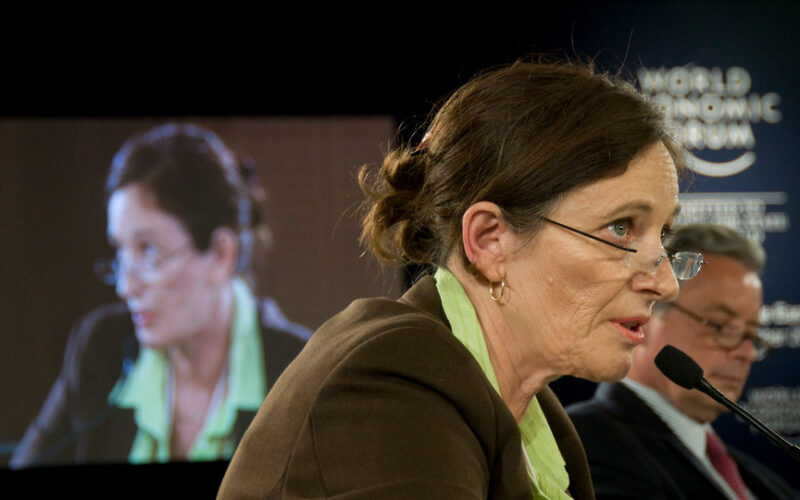
This is Part II of the series “The Maxwell Family Business: Espionage” and focuses on Isabel Maxwell. Part I can be found here.
By Whitney Webb | The Last American Vagabond | July 25, 2020
By moving in “the same circles as her father” and vowing to “work only on things involving Israel,” Isabel Maxwell became a pivotal liaison for the entry of Israeli intelligence-linked tech firms into Silicon Valley with the help of Microsoft’s two co-founders, Paul Allen and Bill Gates.
In 1992, Israel’s government created the Yozma Program at the urging of Chief Scientist of Israel’s Ministry of Industry and Trade – Yigal Erlich – as Erlich moved to leave that position. The Yozma Program aimed to “incentivize venture investment” by creating state-linked venture capital funds, which later spawned a myriad of Israeli hi-tech start ups with merging them with major, foreign technology companies. According to Erlich’s website, he had lobbied Israel’s government to launch Yozma because he had “identified a market failure and a huge need in Israel to establish for the first time a professionally-managed venture capital industry that will fund the exponential growth of high tech ventures coming out of Israel.” He then “convinced the Israeli government to allocate $100 million for his venture capital vision.”
Erlich’s vision would also result in the fusion of Israel’s hi-tech sector, which he helped to create, with Israel’s intelligence apparatus, with numerous Israeli hi-tech conglomerates created with funding from the Yozma program and its successors doubling as tools of Israeli espionage. Notably, not long before Erlich convinced Israel to place $100 million into this program, Israeli intelligence, thanks largely to the work of infamous spymaster Rafi Eitan, had learned the benefits of placing backdoors for their intelligence services into commercial software through the theft and subversion of the PROMIS software. As noted in Part I of this series, Israel’s bugged version of PROMIS was largely marketed by Robert Maxwell.
After the Yozma program was established, the first venture capital fund it created was called Gemini Israel Ventures and Israel’s government chose a man named Ed Mlavksy to lead it. Mlavksy, at the time, was the Executive Director of the Israel-U.S. Bi-national Industrial Research and Development Foundation (BIRD), where Erlich was Chairman of the Executive Committee. Mlavsky states that, while heading the BIRD foundation, “he was responsible for investments of $100 million in more than 300 joint projects between U.S. and Israeli high-tech companies.” BIRD’s connections to Gemini Israel Ventures and the Yozma Program in general are interesting, given that – just a few years prior – it had come under scrutiny for its role in the one of the worst spy cases in U.S. history – the Jonathan Pollard affair.
Jonathan Pollard had been a naval intelligence analyst turned Israeli spy who passed troves of documents regarding U.S. military technology (specifically nuclear technology) as well as clandestine U.S. intelligence operations to Israeli intelligence, specifically to the now defunct spy agency Lekem. Pollard’s handler was none other than Rafi Eitan, who had engineered Israel’s outsized role in the PROMIS software scandal. In the indictment of Pollard for espionage, it was noted that Pollard delivered documents to agents of Israel at two locations, one of which was an apartment owned by Harold Katz, the then-legal counsel to the BIRD foundation and an adviser to Israel’s military, which oversaw Lekem. Government officials told the New York Times at the time that they believed Katz “has detailed knowledge about the [Pollard] spy ring and could implicate senior Israeli officials.”
Journalist Claudia Wright, writing in 1987, openly speculated about whether the close ties between Katz and Pollard’s handlers meant that BIRD itself had been used to pass funds to Pollard or that BIRD funds themselves, most of which were provided by U.S. taxpayers as opposed to public claims of “joint” funding, had been used to pay Pollard for his “services” to Israel. In her article, she notes that Mlavsky had considerable discretion over the use of those funds while the U.S. official in charge of overseeing the U.S.’ interests in BIRD did “not know how investment is regulated” by the foundation. In addition, no U.S. official had access to any audit of the foundation, which were said to be conducted by an Israel-based accounting firm with no U.S. offices. The New York Times noted at the time that Katz specifically “may have knowledge of the method used to pay Mr. Pollard, who received tens of thousands of dollars from his Israeli handlers.”
After BIRD’s Mlavsky was chosen to head Gemini Israel Ventures, one of the first companies the firm invested in was called CommTouch (now known as Cyren and majority owned by Warburg-Pincus). Founded in 1991 by Gideon Mantel, a former officer in a “special bomb-squad unit” for the Israel Defense Forces (IDF), alongside Amir Lev and Nahum Sharfman, CommTouch was initially focused “on selling, maintaining and servicing stand-alone email client software products for mainframe and personal computers.” They specifically courted Original Equipment Manufacturers (OEMs), meaning companies whose products are used as components in the products of another company that are then sold to end users. Integration of its products into those of major software and hardware developers would allow CommTouch’s products to be widely used but unseen. A Wired article discussing CommTouch noted as much, stating that CommTouch products are meant “to be as seamless and unnoticeable as the copper is to a phone caller.”
However, from their founding through early 1997, CommTouch struggled to stay afloat, unable to turn a profit and unable to secure any notable deals or to expand its company beyond 25 employees. Yet, thanks to Gemini Israel Ventures and “grants” from Israel’s government, which were used to finance the research and development of its products, CommTouch managed to stay afloat. As late as 2006, CommTouch noted in official documents that the company “has a history of losses and may never achieve profitability,” further noting that they hemorrhaged millions of dollars a year in net losses. Clearly, the decision by Gemini Israel Ventures and Israel’s government to continue to pour money into a decidedly unprofitable company for several years was motivated by something other than profits.
At some point in early 1997, CommTouch decided to enter the U.S. market and began seeking out a new President for the firm who had “local clout.” “We knew exactly what we were looking for,” Gideon Mantel later told Wired ofCommTouch’s search, “Someone who knows her way around the Valley.” They found their woman in the daughter of Israeli “superspy” and PROMIS salesman par excellence, Isabel Maxwell.
An Intriguing Pedigree
Mantel and CommTouch allegedly chose to court Isabel Maxwell for their company’s presidency through an unspecified placement company and were “attracted to her expertise and insight in Silicon Valley when it sought her out.” The Israeli outlet Globes states that Gideon Mantel “went to Isabel Maxwell as soon as he arrived in Silicon Valley and realized that in order to progress, an e-mail solutions company like CommTouch needed help from someone who knew the rules of the game.” Wired offers a similar portrayal, further adding that it was “Gideon Mantel [who] got Isabel Maxwell to take the job.”
Mantel told Jewish Weekly that while Maxwell’s pedigree, i.e. being Robert Maxwell’s daughter, “was very intriguing at the beginning… it wasn’t her name that made the decision for us.” However, Mantel, in separate reports, compares Isabel to her father on numerous occasions when praising her professional abilities. For example, he told Haaretz that Isabel “is not cowed by anyone, and she never gives in…. She got all that at home. They taught her to go after things and not give up.” Similarly, he told Wired that “Like her father, she is a fighter,” later adding that “She always charges. She has no fear. Of course, it is from her father. It is in her blood.” Given that Robert Maxwell is rarely posthumously remembered (in media anyway) as “a fighter” and “fearless,” it goes without saying that Mantel views him with a degree of reverence that he also associates with his daughter Isabel.
Isabel, notably, has herself stated on several occasions that her acceptance of Mantel’s offer to be CommTouch’s President was also informed by her father’s controversial ties to Israel.
She told Haaretz that her reasons for accepting the CommTouch presidency was “from the heart” because it was “a chance to continue her father’s involvement in Israel,” leading her to reject other more lucrative job offers from actually established companies that she had received at the time. She similarly described her reasons for joining CommTouch to Jewish Weekly as “an affair of the heart,” adding that “it had to do with my father and my history.” The New York Times quoted her as saying that she had “considered other California-based Internet start-ups [in 1997], but felt a pull toward CommTouch and the Israeli connection.”
Isabel has some interesting views on her father, whom she describes as the “ultimate survivor,” and his involvement in Israel. She describes him as “highly complex,” adding that she doesn’t “have rose-coloured glasses about him,” but nonetheless says she is “proud” of his controversial legacy and that “if he were alive today that he would be proud of us too.” She said something similar to The Guardian in 2002, stating that “‘I’m sure [my father would] be thrilled to know what I’m doing now,’…. throwing back her head and laughing loudly.” In addition, when asked who the most influential person in her life had been, Isabel responded “My father was most influential in my life. He was a very accomplished man and achieved many of his goals during his life. I learned very much from him and have made many of his ways my own.”
Isabel told Haaretz around that same time that “When I was with him [her father], I felt power. Like being at the White House… Beyond that, it was a collective power, not my personal power. I was part of this unit,” apparently referring to her other siblings, Ghislaine and Christine among them, and suggesting that they were collectively extensions of their father’s power.
However, Isabel stands out from her other siblings, and even Ghislaine, in terms of a sense of loyalty to her father and to the state of Israel. According to Elizabeth Maxwell, Isabel’s mother, Isabel “is also loyal to the memory of her father, and to what Judaism represents in her life. All my children were brought up as Anglicans, but Isabel was very taken by the Jewish faith and the politics in Israel” compared to her other children, including Ghislaine.
Indeed, Isabel has close relationships to several prominent former Mossad officials and Israeli heads of state, with several of those relationships having been “forged by her father.” A now scrubbed report published by the Jerusalem Post in 2003, entitled “Isabel Maxwell Fights Back,” notes that “Maxwell travels in the same circles as her father, but she is more comfortable behind the camera, not in front of it…she is carrying on her father’s legacy in Israel, albeit in her own way.” It also noted that, by 2003, Isabel was visiting Israel every month, visiting her father’s grave on the Mount of Olives at least once every visit.
Arguably the most interesting part of the now-scrubbed Jerusalem Post article is the way in which Isabel views her father’s legacy. In discussing the book by Gordon Thomas and Martin Dillon, Robert Maxwell, Israel’s Superspy: The Life and Death of a Media Mogul, Isabel – even though she participated in interviews for the book – rejected its premise that her father was a “spy”and went on a private smear campaign against the book and its authors prior to its publication.
Tellingly, she does not object to the book’s contents regarding her father’s activities on Israel’s behalf, including his role in the PROMIS software scandal or Iran-Contra, but merely objects to the use of the word “spy” to describe those activities. “My father was certainly a ‘patriot’ and helped in back business and political channels between governments,” Isabel told the Jerusalem Post, “But that did not and does not make him a ‘spy.’” It could be said, then, that Isabel would view her subsequent career “in back business and political channels” via the “same circles as her father” as similarly “patriotic.” Yet, for those that consider her father a “spy” for his activities, that would also mean extending the same to Isabel, who self-identifies as Israeli.
Aside from her father’s own ties to Israeli intelligence, it is worth noting that Isabel’s own history – up to the point she joined CommTouch – involved her working for the Israeli intelligence front company used by her father to sell bugged PROMIS software in the U.S., Information on Demand, and subsequently the search engine Magellan, of which she shared ownership with her sister Christine (whose ties to U.S. intelligence will be explored in Part IV) and her sister Ghislaine, a sexual blackmailer and sex trafficker operating on behalf of U.S. and Israeli intelligence. Isabel’s past with both Magellan and Information on Demand were clearly known to CommTouch at the time of Isabel’s hiring. It also worth noting that, on several occasions, Isabel credits CommTouch’s success with the ties of all of its Israeli employees to the Israeli military and military intelligence, resulting in – per Isabel – a “dogged work ethic” and a “trained mind-set” among its Israeli workforce.
As will be shown in more detail in Part III of this series, upon departing CommTouch, Isabel deepened her already close ties to prominent Israeli politicians and intelligence officials, serving alongside ex-Mossad directors and counting former Israeli chief intelligence officers and heads of state among her “family friends” and business partners. This involvement continued during the period when her son was given a prominent position at the Middle East affairs desk at the State Department when it was headed by Hillary Clinton, who – as many are now aware – has close and controversial ties to Isabel’s sister, Ghislaine.
Microsoft’s Co-founders put CommTouch “On the Map”
Upon taking the job at the Israeli tech firm, Maxwell’s promotion of the company was called “almost messianic” even though her enthusiasm was described as “hard to fathom” given the lackluster performance of the company and its products. However, soon after becoming CommTouch’s president, her personal connections to prominent figures in Silicon Valley – forged through her past work at Magellan – paid off and the company announced new partnerships with Sun Microsystems, Cisco, and Nippon Telephone and Telegraph, among others. At CommTouch, Maxwell managed“all sales and marketing activities for CommTouch and co-direct[ed] strategic business development.”
Some reports have noted that Maxwell’s connections with prominent Silicon Valley figures were the key to her professional success, with Globes noting that “Everyone who has worked closely with Maxwell says that her advantage lies in her ability to help penetrate the market with a new product by opening the right doors,” an “advantage” also ascribed to her father while he sold bugged PROMIS software on behalf of Israeli intelligence. Yet, despite Isabel’s penchant for “opening the right doors,” reports well into Maxwell’s career at CommTouch still referred to the firm as “an obscure software developer.”
However, out of all the alliances and partnerships Isabel negotiated early on during her time at CommTouch, it was her dealings with Microsoft co-founders Bill Gates and Paul Allen that would put CommTouch “on the map.” Maxwell had previously negotiated a major deal with Microsoft’s Bill Gates earlier during her time as the McKinley Group/Magellan’s Executive Vice President, resulting in Microsoft announcing that the Maxwell-owned Magellan would power the search option for the company’s MSN service.
Yet, it appears that Microsoft’s co-founders did much more than put CommTouch “on the map,” but ended up preventing the collapse of its initial public offering, a fate that had befallen Isabel Maxwell’s previous company, the McKinely Group, not long before. Indeed, CommTouch kept pushing back its IPO until a massive investment from firms tied to Microsoft co-founder Paul Allen was announced in July 1999.
The investment from Allen’s Vulcan Ventures Inc. and Go2Net Inc resulted in a jump in “interest in the stock sale and in CommTouch, until now an obscure software developer,” according to a Bloomberg report, and also inflated their stock price immediately prior to their going public. The money from Allen-linked investment would be specifically used “to expand sales and marketing and build its presence in international markets.” Allen’s decision to invest in the company seems odd from a financial perspective, given that CommTouch had never turned a profit and had netted over $4 million in losses just the year before. Yet, thanks to Allen’s timely investment and apparent coordination with the company’s repeated delays of its IPO, CommTouch was valued at over $230 million when it went public, as opposed to a $150 million valuation just weeks prior to Allen’s investment.

Bill Gates at Deal Book Conference in New York, 2019
It’s not exactly clear why Paul Allen came to the rescue of CommTouch’s IPO and what he expected to gain from his investment. However, it is worth pointing out that Allen was among the members of an exclusive online community of elites set up in 2004 called “Small World,” whose membership also included Jeffrey Epstein and Epstein-linked figures like Lynn Forester de Rothschild and Naomi Campbell, as well as Petrina Khashoggi, the daughter of Adnan Khashoggi, a former client of Epstein’s. Small World’s largest shareholder was Harvey Weinstein, the now-disgraced media mogul who was a business partner of Epstein and was since accused by a number of women of sexual abuse.
Less than three months after Allen’s investments in CommTouch in October 1999, the company announced that it had struck a major deal with Microsoft whereby “Microsoft will utilize the CommTouch Custom MailTM service to provide private label web-based email solutions for select MSN partners and international markets.” In addition, per the agreement, “CommTouch will provide MSN Messenger Service and Microsoft Passport to its customers while building upon its Windows NT expertise by supporting future MSN messaging technologies.”
The agreement came less than two years after Microsoft had purchased Hotmail, which – up until the CommTouch/Microsoft agreement – had been one of CommTouch’s main competitors for its web-based e-mail services. In other words, this meant that Microsoft would use CommTouch’s “behind the scenes” software as the backbone of its web-based e-mail services, Hotmail included. “We are looking forward to further enhancing our relationship with Microsoft by integrating other state-of-the-art Microsoft products,” Gideon Mantel of CommTouch said upon the deal’s public announcement.
In December 1999, Microsoft then announced that it had invested $20 million in the company by purchasing 4.7% of CommTouch stock. The announcement pushed CommTouch stock prices from $11.63 a share to $49.13 in just a few hours time. Part of that deal had been finalized by Richard Sorkin, a recently appointed CommTouch director. Sorkin had just become a multimillionaire following the sale of Zip2, Elon Musk’s first company where Sorkin had been CEO.
It further appears that Bill Gates, then head of Microsoft, made a personal investment in CommTouch at the behest of Isabel Maxwell. In an October 2000 article published in The Guardian, Isabel “jokes about persuading Bill Gates to make a personal investment” in CommTouch sometime during this time frame.
The article then oddly notes the following regarding Isabel Maxwell and Bill Gates:
“In a faux southern belle accent, [Isabel] purrs: ‘He’s got to spend $375m a year to keep his tax free status, why not allow me to help him.’ She explodes with laughter.”
Given that individuals as wealthy as Gates cannot have “tax free status” and that this article was published soon after the creation of the Bill and Melinda Gates Foundation, Isabel’s statements suggest that it was the Bill and Melinda Gates Foundation Trust, which manages the foundation’s endowment assets, that had made this sizable investment in CommTouch. Furthermore, it is worth highlighting the odd way in which Isabel describes her dealings with Gates, speaking of her interactions with him in a way not found in any of Isabel’s numerous other interviews on a wide variety of topics (i.e. “purring”, speaking in a fake Southern accent). This odd behavior may have been related to Isabel’s previous interactions with Gates and/or the mysterious relationship between Gates and Epstein, alluded to in a 2001 Evening Standard article, and eyewitness testimony regarding Epstein’s and Ghislaine Maxwell’s comments about Bill Gates in 1995, discussed in Part I of this series.
After 2000, CommTouch’s business and clout expanded rapidly, with Maxwell subsequently crediting Bill Gates-led Microsoft and Paul Allen’s investment for the company’s shifting fortunes. Maxwell, as quoted in the 2002 book Fast Alliances, states that Microsoft viewed CommTouch as a key “distribution network,” adding that “Microsoft’s investment in us put us on the map. It gave us instant credibility, validated our technology and service in the marketplace.” By this time, Microsoft’s ties to CommTouch had deepened with new partnerships, including CommTouch’s hosting of Microsoft Exchange.
Though Isabel was able to secure lucrative investments and alliances for CommTouch and see its products integrated into key software and hardware components produced and sold by Microsoft and other tech giants, she was unable to turn the tide of the company’s dire financial performance, with CommTouch netting a loss of $4.4 million in 1998 and similar losses well into the 2000s, with net losses totalling $24 million in the year 2000 (just one year after the sizable investments from Microsoft, Paul Allen and Bill Gates). The losses continued even after Isabel formally left the company and became President Emeritus in 2001. By 2006, the company was over $170 million in debt.
The One-Woman Liaison Between Israel and Silicon Valley
Isabel Maxwell would leave her role at CommTouch in 2001, but remained President Emeritus for years afterward retaining a sizable amount of CommTouch stock then-valued at around $9.5 million. While Maxwell remained honorary president, CommTouch added Yair Shamir, son of former Israeli Prime Minister and friend of Robert Maxwell, Yitzhak Shamir, to its board. Yair Shamir, Chairman of the Israeli government owned corporation, IAI (Israeli Aerospace Industries) when he joined CommTouch’s board, had previously managed Scitex when it was owned by Robert Maxwell. After nearly collapsing due to its long-standing debt burden a few years later, CommTouch was rebranded as Cyren and, today, runs in the background of Microsoft, Google, Intel, McAfee and Dell products, among many others.
Haaretz wrote in 2002 that Isabel, as CommTouch was in dire financial straits, had decided to “work only on things involving Israel. Even the failure of CommTouch, the Israeli Internet company she headed, hasn’t deterred her: She still believes in the medium, and she still believes in Israel.” Maxwell would subsequently create “a unique niche for herself in high tech as a liaison between Israeli companies in the initial development stages and private angel investors in the US” as a private consultant, subsequently creating Maxwell Communications Network in 2006. That company offered “cross-border communications, funding and market research to leading venture capitalists and hi-tech companies in the US and Israel.” However, she notes that her “specialty” was in “helping Israeli high-tech companies.”
During this period (2001-2006), Isabel would also head an Israeli tech company that “protects children online,” at a time when her sister – Ghislaine Maxwell – was actively abusing and trafficking children as part of an intelligence-linked operation alongside Jeffrey Epstein. Isabel took the job at iCognito (now Pure Sight) “because it [the company] is in Israel, and because of its technology.” She also joined the board of the Israeli company Backweb alongside Gil Shwed, a famous alumnus of Unit 8200 (often likened to Israel’s NSA equivalent) and co-founder of Israeli tech giant Check Point, which is a long-time partner of CommTouch.
Isabel’s close involvement with former Israeli heads of state and heads of intelligence would only deepen after leaving CommTouch, particularly with former Israeli Prime Minister Shimon Peres. The Jerusalem Post described the Peres-Isabel relationship as “close” and “forged by her father.” Isabel was also in close contact with former Mossad deputy director David Kimche (until his death in 2010) and former head of Israeli military intelligence and Prime Minister Ehud Barak. Notably, Ehud Barak, in addition in being a major player in the Israeli-U.S. hi-tech scene, was also closely associated with Jeffrey Epstein and Isabel’s sister Ghisaline, having recruited Epstein for Israeli military intelligence and overseeing the Lekem agency at the time of the PROMIS scandal (including Robert Maxwell’s role) and the Pollard Affair as well as Israel’s involvement Iran-Contra. Barak was also a frequent visitor to Epstein’s island and slept over in New York apartments that were owned by Epstein’s brother and which housed many of Epstein’s underage “sex slaves.”
Also notable is the fact that Ghislaine Maxwell and Jeffrey Epstein would themselves become involved in Isabel’s world, i.e. the growing nexus between Silicon Valley and Israel, courting and allegedly blackmailing major Silicon Valley executives while also investing in Israeli intelligence-connected start-ups. During this time, Isabel was a major player in venture capital networks and other organizations aiming to further develop ties between Israeli intelligence-linked start-ups and U.S. tech companies, which is now part of an openly admitted Israeli intelligence operation (in which Microsoft plays a major role). The ties of Isabel, Ghislaine and Epstein to this hi-tech world of Israeli espionage, as well as Isabel having inspired what would later become Ghislaine’s TerraMar project and her ties to powerful groups like the World Economic Forum and even the Hillary Clinton-led State Department, will be explored in the next installment of this series.
Whitney Webb has been a professional writer, researcher and journalist since 2016. She has written for several websites and, from 2017 to 2020, was a staff writer and senior investigative reporter for Mint Press News. She currently writes for The Last American Vagabond.
It’s not Russia, China or Iran who ‘undermine confidence’ in US democracy; for that, ODNI needs to look closer to home
By Nebojsa Malic | RT | July 25, 2020
With 100 days to go before the November election, the US intelligence community issued warnings about foreign ‘influence measures’ such as media reports. The actual challenge to US democracy, however, comes from within.
Foreign countries “continue to use influence measures in social and traditional media in an effort to sway US voters’ preferences and perspectives, to shift US policies, to increase discord and to undermine confidence in our democratic process,” said a statement from the Office of the Director of National Intelligence (ODNI) on Friday.
China is seeking to “pressure political figures it views as opposed to China’s interests” which “might affect” the presidential race, says ODNI. Iran is trying to divide Americans by “spreading disinformation on social media and recirculating anti-US content.” And Russia “continues to spread disinformation in the US that is designed to undermine confidence in our democratic process” and “denigrate what it sees as an anti-Russia” establishment.
When you parse the political language of this, it boils down to all three countries offering news and opinions in the US media space that disagree with the mainstream US media coverage. How dare they!
Who could forget the Chinese propaganda campaign to reimagine American history as one of irredeemable racism, starting not in 1776 with the Declaration of Independence but long before that, with the arrival of first slaves from Africa? Oh wait, no, it’s the New York Times’s Pulitzer Prize-winning ‘1619 Project’ that did that.
What about the Iranian disinformation that President Donald Trump’s Independence Day speech was “dark and divisive”? Except that was the Times again – and the Washington Post, and CNN, and MSNBC, and other “foreign agents” all the way down.
Well, then, how about the Russian effort to declare Mt. Rushmore a monument to racism and the 4th of July event there a celebration of white supremacy? Erm, hold on, that was the… Democratic Party. Oops.
Also, how dare Russia think there is an “anti-Russian establishment” in the US? No one here would uncritically believe the New York Times story about Moscow offering “bounties” to the Taliban to kill US troops in Afghanistan… would they?
The irony here is that ODNI’s job of warning Americans about “foreign threats” was created in the first place by a domestic actor falsely claiming “Russian meddling” to justify the unanticipated defeat in 2016. Time and again, Hillary Clinton’s assertions of President Donald Trump’s “collusion” with Russia have been debunked with actual evidence. In the real world, the FBI and the Justice Department used dodgy British and Ukrainian rumors as grounds for spying on Trump’s campaign and launching sham prosecutions of his aides, like General Michael Flynn.
Indeed, the fact the FBI could no longer be trusted with counter-intelligence briefings of campaigns was the reason the job was recently entrusted to the National Counterintelligence and Security Center (NCSC) Director William Evanina at the ODNI, who signed Friday’s statement.
For continuing to carry water for the “foreign meddling” narrative, Evanina was rewarded with criticism from the Democrats, who complained he did “not go nearly far enough in arming the American people with the knowledge they need about how foreign powers are seeking to influence our political process.”
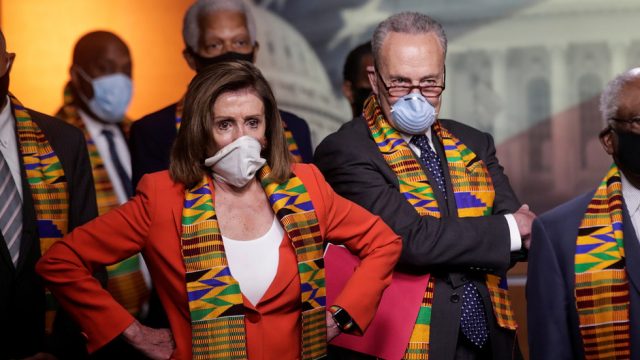
This statement of disapproval was signed by House Speaker Nancy “All roads lead to Putin” Pelosi; Senate Minority Leader Chuck “Spies have six ways from Sunday at getting back at you” Schumer; Rep. Adam “I have evidence of Russia collusion!” Schiff; and Senator Mark “Steele dossier pusher” Warner. In other words, the very crowd that’s got the US into this very mess to begin with.
Nebojsa Malic is a Serbian-American journalist, blogger and translator, who wrote a regular column for Antiwar.com from 2000 to 2015, and is now senior writer at RT. Follow him on Twitter @NebojsaMalic
Weaving Impunity for Dictatorship Crimes in Chile
By Ramona Wadi | Strategic Culture Foundation | July 25, 2020
In 1968, the U.S. backed a covert intelligence surveillance campaign in which Latin American right-wing governments conspired to annihilate socialist and communist influence in the region. The plan, known as Operation Condor, was formally implemented in 1975, two years after dictator Augusto Pinochet took power in Chile through a military coup supported by the U.S. Up to 80,000 left wing opponents are estimated to have been killed; 30,000 of them disappeared by right-wing governments in Latin America by 1989, when Operation Condor was officially terminated. Over 400,000 people were detained as political prisoners.
 This month marks 44 years since the kidnapping and murder of Spanish-Chilean diplomat Carmelo Soria; also a victim of Operation Condor. Soria, who worked as a UN civil servant and became advisor to the Unidad Popular between 1971 and 1973 when Chile was ruled by socialist President Salvador Allende, became a target for Chile’s National Intelligence Directorate (DINA) during the Pinochet dictatorship. Through his diplomatic immunity as a UN official, Soria aided individuals to seek refuge in embassies until plans for exile could be made.
Soria was kidnapped by DINA agents pertaining to the Brigada Mulchen under the command of Captain Guillermo Salinas at the time, on July 14, tortured at Via Naranja and Villa Grimaldi, and murdered. His body was discovered in Santiago de Chile, dumped in a car that was pushed into a ditch, to cover up the murder as an apparent drunk driving accident.
Little is known about Brigada Mulchen – a secret operatives network with direct links to DINA’s chief Manuel Contreras. The agents comprising Brigada Mulchen have been described by Chilean researcher and author Javier Rebolledo as being part of Pinochet’s inner circle. Michael Townley, a CIA and DINA agent who was tasked with the production and experimentation of sarin gas, together with the biochemist Eugenio Berrios, was involved in Soria’s murder. Townley, who is under the Witness Protection Program in the U.S., was one of the agents requested for extradition by Chile’s Supreme Court for involvement in Soria’s murder. Soria’s remains were exhumed and identified in 2002 by Chile’s Servicio Medico Legal (SML). In 2015, 15 former DINA agents were indicted for Soria’s murder.
In 2019, 43 years after the murder, Chile’s Supreme Court sentenced Pedro Espinoza Bravo, Raul Iturriaga Neumann, Jaime Lele Orellana and Juan Morales Salgado, to a mere six years in prison for Soria’s murder – a travesty of justice which does not even reflect the crime. However, the impunity built through Pinochet’s dictatorship legacy still has a stronghold on Chile. Earlier this year, the Santiago Court of Appeals reduced the prison sentences of 17 former DINA agents who were involved in the murder and disappearances of Communist party members; the latter including Luis Emilio Recabarren.
Espinoza Bravo, sentenced for his involvement in Soria’s murder, is one of the DINA agents whose prison sentences have been reduced. The decision indicates the absence of separation between law and politics in Chile. In his presidential campaign, Chile’s right-wing President Sebastian Pinera had publicly spoken of amnesties for former DINA agents incarcerated for crimes against humanity. The suggestion was well received by the military and right-wing dictatorship supporters, while victims of the dictatorship and their relatives, in a struggle for reclaiming memory and justice since the dictatorship era, had to contend with yet another political impediment – the political manoeuvring at a legal level.
Chile is governed by silence and complicity – the Pinochet legacy, together with the military’s “pact of silence” – remain perpetual obstacles. What has changed since Soria’s murder was passed off as a drunk driving accident at a time when dictatorship opponents were being tortured and disappeared? While the Chilean military has not been averse to such tactics as seen in last year’s protests, it must be said that since Chile’s transition to democracy, subsequent governments have thoroughly failed the cause of human rights and collective memory in the country.
Featured Video
Chinese jet fuel and the myth of energy independence
or go to
Aletho News Archives – Video-Images
From the Archives
The Dirty Little Secret behind the “Global Terrorism Index”
The Omission of Israeli Terrorism in the Occupied Palestinian Territories
By Karin Brothers | Global Research | December 6, 2014
… The Israeli settlements — all of which are illegal – have been identified as a major impediment to peace. The refusal of a major “global” terrorism report to name the Israeli settlers as one of the groups most responsible for terrorism not only misrepresents a major source of regional violence but exposes the Global Terrorism Index as a propaganda tool that supports a U.S. agenda.
In recent years, governments have been attempting to thwart terrorism by blocking supportive fund-raising. When it comes to Israeli settlements, however, the US and Canada actually encourage fund-raising by giving organizations (such as Christian Friends of Israeli Communities (CFOIC) and the Jewish National Fund) financial support in the form of donor tax-deductions.
Charities which provide funds for the Israeli settlements should be regarded as terror-financing organizations. They should not only lose their tax-deductible status, but they should be banned because they support the violation of international humanitarian law. The terror-financing laws that are being strictly enforced for Muslim charities should be applied to Christian and Jewish charities as well. … Read full article
Blog Roll
 Aletho News
- Ukraine Sea Drone Fired From Libya Hit Russian Tanker in Mediterranean
- IRGC: Iranian forces launched no attacks during ceasefire hours
- Trump Administration Moves To Automate U.S. Military Draft Registration
- Spain orders reopening of Tehran embassy, condemns Israel’s carpet bombing of Lebanon
- Israel faces ‘unsustainable’ strategic crisis following 40-day war against Iran: Analyst
- Iran restricts Hormuz access to 15 vessels per day under ceasefire terms: Report
- The ‘Opposition Party’ Has Done Nothing to Stop the Iran War and Much to Goad Trump Into Continuing It
- Moscow backs Tehran on status of Lebanon in US-Iran deal
- How UK Regulator Ofcom Quietly Bypassed International Law to Police American Speech
- The Black Cube Files: How Former Mossad Operatives Flipped a Nation
- If Americans Knew
- Amnesty: Urgent – Protect Lebanese civilians from brutal escalation in Israeli attacks
- Is The War Against Iran Over?
- Inside the Israeli army’s propaganda wing
- Hundreds of Gaza Amputees Stranded in Legal Limbo
- The gallows law: Israel moves toward executing Palestinian children
- Tucker Carlson: The Path to Peace requires ending ‘special alliance’ with Israel
- This is ceasefire? Israel’s biggest massacre yet in Lebanon, another journalist killed in Gaza – Daily Update
- Tucker Carlson on Israel: This Is the Behavior of an Ally? Really?
- Gazans face a triple crisis: severe shortages of water and bread, healthcare in tatters
- NY Times reports how Netanyahu took the US into Iran War
- No Tricks Zone
- An Inconvenient Tree: Uncovered In Alps… Europe Much Warmer Than Today 6000 Years Ago
- New Study Reports A 60% Slowdown In Greenland’s Ice Loss Rate In The Last Decade
- Low Intensity Tornado Wrecks Major Solar Farm, Creating A Potential Toxic Dump
- New Study Finds Warming Saves Lives…Cold Temperatures 12 Times More Deadly Than Excess Heat
- German Science Blog Accuses PIK Climate Institute Of Hallucinating Climate Tipping Points
- Devastating Assessment Of Comirnaty Vaccine By Former Senior Pfizer Europe Toxicologist
- New Study: CO2 Is ‘Effectively Negligible’ As An Explanatory Climate Change Factor Since 2000
- Former Pfizer Toxicologist Dr. Helmut Sterz Tells Bundestag Hearing Pfizer Vaccine Should Have Never Been Approved
- Energy Expert: Germany’s Nuclear Phaseout Was A “500 Billion Euro Mistake”
- New Research: South Australia’s Mid-Holocene Sea Surface Temperatures Were 4°C Warmer Than Today
 Aletho News