IT’S OK WHEN BILL DOES IT!
Paul Joseph Watson | February 19, 2021
By James Taylor | ClimateRealism | February 17, 2021
In a major victory for Newspeak, the propaganda language in George Orwell’s novel “1984,” Forbes.com published an article yesterday blaming global warming for the record cold pummeling much of the nation. Google News, moreover, promoted the Forbes article by placing it at the top of search results for “climate change.”
The title of the Forbes article is “Blackouts In Texas and California Teach A Hard Lesson: Climate Change Is Costly.” The author writes, “These grid failures are wake-up calls and provide further proof that the impacts of climate change are not geographically constrained, nor do they take aim at one political party. One way or another, the cost of climate change on each of us will make itself known: in this both California and Texas can now agree.”
The author does not, however, explain how or why global warming causes record cold temperatures. Climate activists have occasionally, and when politically convenient, claimed climate change causes more polar-vortex extreme cold events. However, the scientific data strongly contradict Forbes’ assertion that global warming is to blame for the cold outbreak in Texas. Indeed, National Oceanic and Atmospheric Administration (NOAA) data show the number days each year with below-freezing temperatures in Texas is neither unusually high nor unusually low so far this century.
Similarly, NOAA data for neighboring Oklahoma – which is also getting walloped right now by cold weather – show a decline in the frequency of very cold weather events in recent decades.
So, there clearly is no recent increase in the frequency of severe cold events in Texas and Oklahoma. So, by what logic does Forbes blame the current very cold conditions on global warming? Well, the author of the Forbes article is Chief Science Officer and Chief Commercial Officer at New Energy Risk, which is comprised of “climate-conscience venture capitalists” seeking to make money promoting “green” energy.
Forbes clearly has no conflict-of-interest standards for its authors and articles, nor does it attempt to investigate what the scientific data show regarding its articles’ claims.
By Richie Allen | February 24, 2021
The Telegraph newspaper, to its credit, has published an opinion piece by a secondary school teacher who is based in Essex. The teacher believes that forcing kids to wear masks in the classroom is “Dystopian and abhorrent.”
The teacher has been reading “The Handmaid’s Tale with Year 11’s and described a class full of masked children as “like something out of Gilead.” Expressing concern that masks would make it seem to youngsters that schools are not safe when they desperately need some normality the teacher wrote:
They are already being flooded with messages in the media and the outside world which fill them with fear on a daily basis. The government’s whole campaign is built on fear and children have absorbed that. They have also faced a year of disruption to their learning and been kept apart from their friends. What sort of message does it send to them if we then make them wear a mask in the classroom too?
As well as being physically uncomfortable, it’s going to be almost impossible for them to communicate with me as their teacher. It will have a detrimental impact on their confidence, make them even more reluctant to put their hand up in class to ask questions and engage in the lesson. Many of them, especially those who were already struggling, have fallen massively behind during lockdown and will find it difficult or even impossible to catch up.
I’ve also seen very little evidence to suggest that masks are effective anyway. I am cynical about this idea of asymptomatic transmission. Schools aren’t necessarily the cleanest places in the world but children are meant to be exposed to a few germs to build up their immune systems.
The teacher is absolutely right. It’s dystopian and disturbing in the extreme. Of course it will unsettle children but it will also do them serious harm. Wearing masks for eight hours a day may have a seriously detrimental effect on their physical health. Dozens of studies have found that masks make breathing more difficult, especially for children.
The National Institutes of Health (NIH) found that:
… inhaling high levels of carbon dioxide (CO2) may be life-threatening. Hypercapnia (carbon dioxide toxicity) can also cause headache, vertigo, double vision, inability to concentrate, tinnitus (hearing a noise, like a ringing or buzzing, that’s not caused by an outside source), seizures, or suffocation due to displacement of air.
Parents wise up and wise up fast. You must not allow your children be forced to wear a face covering when they return to the classroom.
By Johanna Ross | February 24, 2021
Back in 2018, the Anonymous hacker group unveiled documents detailing the UK’s global anti-Russian propaganda campaign, otherwise known as the Integrity Initiative. A covert operation, funded by the Foreign Office and Ministry of Defence, it involved academics like Mark Galeotti, security analysts such as Ben Nimmo and journalists like Deborah Haynes of Sky News, who were all paid to provide negative coverage of Russia in various media settings. In true James Bond fashion, they were all part of a giant global syndicate, instructed to counter the Russian government narrative wherever possible, whether it be in articles, or on social media.
It was a shocking revelation for a country constantly accusing Russia of pushing propaganda and spreading disinformation; it turned out that the UK’s Integrity Initiative was doing exactly that. (Some of the claims made in the documents were nothing less than Russophobic. For example: “The Russian Federation is not a normal country in any sense of the word” (!)) After pressure from independent journalists, such as myself, who covered the scheme, the organization shut down its website. It did not disappear altogether however, and instead quietly rebranded itself with a different name – the Open Information Partnership, and with partners including Bellingcat and Zinc Network, it seems the unit has carried on from where the Integrity Initiative left off.
In the latest twist to the story, a new batch of documents were published last week which appear to show that the UK has now set its sights on manipulating Russian speakers in the former Soviet republics. One project, using the British Council is to promote English language in various Russian satellite states – Armenia, Azerbaijan, Belarus, Georgia, Moldova and Ukraine. The cost of this project alone is £1.5million. It describes how through English language lessons, debating competitions and community events it will challenge the “one-sided, unbalanced information” citizens of these countries get from Russian media.
In another scheme, which it describes as “Independent Media Interventions in the Baltic States Aimed at Promoting Plurality and Balance in the Russian Language Media” it is said how BBC Media Action will work together with three public service broadcasters – ETV+ in Estonia, LSM in Latvia and LRT in Lithuania and their digital and social media platforms in all three countries, to produce Russian language content. It also mentions working with the biggest Russian language portal “Delfi” in the region, to target the Russian-speaking youth. It states that Russian speakers in the Baltic States will be targeted differently according to age: the over 40s through traditional media and the under 40s primarily through social media.
The agenda of working with local media in Baltic States is described as being to promote ‘the values of objectivity, impartiality and trust’. But given the fact that this is a UK Foreign Office project, promoting the English-language world view, how can it possibly be described as ‘objective and impartial’? If any of the authors had ever studied cognitive linguistics, then they would understand that every language speaker has his/her own world view, intrinsically associated with the language he/she speaks. English speakers have their own view of the world which is not “objective” or “impartial” but a product of their own historical and cultural experience.
Therefore it is clear that this is a British soft-power propaganda campaign under the guise of aiding independent media in Eastern Europe. It is reminiscent of the Christian missionaries of the 19th century, who set out to “change the ways” of people they thought as uncouth and “savage” in parts of Africa and Asia. Although this time, it’s not Christianity but liberal or “western” values. It’s Britain projecting its imperial power, just as it did in the past.
Let’s not beat about the bush here. This is a Foreign Office project; it is about information warfare and soft power manipulation to achieve geopolitical goals. It’s essentially about de-russifying the Baltic States and Eastern Europe, to ensure that these populations will fall under the spell of the western liberalism, and reduce any Russian influence lingering from the Soviet era. Fundamentally, it’s to ensure that Russia’s sphere of influence is reduced and the West’s/Nato’s is increased – important if at a future date one needs these populations on side if war was to break out.
In another document it is detailed how the organisation helped Russian Youtubers (unnamed) “creating content promoting media integrity and democratic values” – otherwise known as anti-government bloggers – to hide any foreign funding they were receiving, to manage their online profiles, connect them with legal advice if required and to support “them to develop editorial strategies to deliver key messages”. It has already been suggested on one site that opposition blogger Alexei Navalny could have been helped in this way, as his aide Vladimir Ashurkov was not only mentioned in previous Integrity Initiative leaks, but was recently exposed as having met up with a British diplomat whom he asked for financial assistance for Navalny’s campaign.
If all this doesn’t constitute meddling in Russia’s affairs, I don’t know what does. It would be interesting to know what the British taxpayer would think of all these millions of pounds being spent on interference in an entirely different part of the world, which is Russia’s sphere of influence. Such imperialist behaviour belongs in the 19th century, and doesn’t accept the reality of the multipolar world which is emerging. It shows complete disregard for the ethnic Russians living in the post-Soviet bloc, who should be allowed to live freely as they wish, and not be persecuted for their language and cultural values. Quite frankly, the UK has no business involving weighing in on Eastern Europe; its imperialist ambitions belong in the past.
Johanna Ross is a journalist based in Edinburgh, Scotland.
By Lucas Leiroz | February 24, 2021
Tensions in the South China Sea are intensifying as American interference in the region increases. The so-called “freedom of navigation operations” (FONOP) have been taking place with an increasingly shorter interval between operations, demonstrating a strong interest on the part of Washington to permanently occupy the region, forcing China to retreat its maritime positions on its own zone of influence.
Recently, for the third time since Biden took office as President, a US flag warship conducted an operation in the disputed South China Sea. The ship used this time was the guided missile destroyer Arleigh Burke USS Russell, which skirted the Paracel Islands on February 17. The ship’s intention is simply to promote a FONOP, with no major military objectives publicly specified. In a statement on the case, Lieutenant Joe Keiley, spokesman for the American Navy, stated that “The United States upholds freedom of navigation as a principle. As long as some countries continue to assert maritime claims that are inconsistent with international law as reflected in the 1982 Law of the Sea Convention and that purport to restrict unlawfully the rights and freedoms guaranteed to all States, the United States will continue to defend those rights and freedoms”.
Beijing had previously said it would take the necessary steps to ensure its security and prevent further American military operations in its maritime zone, but such measures have not been announced yet. There is still a war of narratives, as Beijing claims that American ships that have passed by the Sea this year have been expelled by Chinese security forces (without any American reaction or confrontation, however), which is denied by Americans, who claim to have carried out their operations without any hindrance. Clearly, we can see that both countries desperately try to create a dominant narrative. China wants to show the world that it has its own special interests in the region, and the US says it wants more nations to feel safe to cross the Sea without the Chinese endorsement, showing that “nothing will happen”.
Washington sees Chinese territorial claims in the South Sea as a threat to freedom of navigation and therefore justifies the sending of warships to the region. According to American military thinking, this attitude does not represent a real affront to China, as Americans believe they have the right to monitor international maritime standards, acting as “global maritime police”. This type of thinking had begun to suffer some criticism from Trump, who changed the focus of confronting Chinese growth from a military confrontation path to a commercial and tariff dispute. But, with Biden and his administration, it is highly likely that Washington will not only resume the ideal of global police but will also act in a much more aggressive way in this regard, especially in the seas, where the US has historically had a hegemonic status.
The justifications used by Washington are always full of legalism. Warships are sent to the coast of a foreign power “in the name of international law”. The American armed forces, accustomed to exercising the function of global police, believe to play an important role in complying with international navigation standards. In this way, if a territorial dispute is preventing the movement of people and goods and hampering the flow of trade, Washington can simply conduct a “FONOP”. But this view of international standards is absolutely distorted. International law has its own methods for dealing with violations of international norms and for no country is given the function of a controller of the global order.
The very validity of the “FONOP” concept is absolutely questionable. There is, in fact, the principle of “freedom of navigation” (FON) in international law, but at no time do international documents provide for such a thing as a “freedom of navigation operation”, this being a narrative invented by countries interested in winning space in areas claimed by other countries. Washington is the only country that currently has an official and complex military program focused on promoting such operations in all disputed areas of the world, which is absolutely contrary to international law. Such disputes must be resolved with the means available at the UN, not through unilateral US action.
Therefore, the “legal” justification for maritime interventionism must be ignored and the case must be analyzed from a strictly political point of view. Biden on several occasions, both during the campaign and after the election, affirmed his commitment to deepen US ties with his Asian allies – which are precisely the countries that have disagreements or disputes with China. Sovereignty over the South China Sea is included in this issue, as it is one of the most controversial topics in Asian geopolitics. China has historically claimed sovereignty over the South Sea, but this has been condemned by several neighboring countries. Philippines, Malaysia, Brunei, Indonesia, Singapore, and Vietnam criticize the Chinese sovereignty in the region and claim their space, considering that they also have access to the Sea and therefore should supposedly have the right to occupy it.
Moreover, a highlight that makes the region the subject of major disputes is its commercial importance. The South China Sea is a key route for world maritime trade, where a cargo volume of 5.3 trillion dollars passes annually. With China controlling the region, Beijing gains an extremely advantageous position economically – which provokes interests and criticism on the part of the other countries with access to the Sea. Even more emphatically, the country that is most opposed to the Chinese presence is the Philippines, which is the reason for a historical rivalry. The dispute between Beijing and Manila has reached several peaks of tension in recent years – mainly last year, when the Philippines felt threatened by several Chinese operations in the region and the Philippine government said it would request American military support to face China. In that occasion, Trump remained silent; Biden would certainly do something.
Certainly, no tension between China and the US can be elevated to a status of war, since any confrontation between powers with such nuclear apparatus becomes impossible, but that does not prevent several conflicts from arising. Recently, Biden announced the formation of a Pentagon-led task force to deal with China and its “diverse problems” – which include issues such as the maritime dispute, alleged human rights violations, “unfair” trade rules, among others. Beijing, for its part, denied the American accusations that would justify Biden’s attitude and even made promises of greater economic openness, showing a more peaceful stance. But how long will this posture last? With three FONOPs held in less than a month with the new American government, what can Beijing expect for the near future? How far will American naval interventionism reach in the Chinese coast?
In addition to the American presence in the Sea, regional tensions will certainly increase. Encouraged by American actions, naval forces of the countries that claim the South Sea will carry out more and more operations. With emphasis on the Philippines, which have the greatest interest in the Sea and are willing to increase the confrontation with China, provided they receive international aid.
Expectations are not good and Chinese responses can be varied. If these operations become a real problem for Chinese interests, Beijing can respond severely and even a conflict could occur between the two countries.
Lucas Leiroz is a research fellow in international law at the Federal University of Rio de Janeiro.
By Stephen Lendman | February 23, 2021
On Monday, the US Supreme Court refused to hear legitimate challenges to the 2020 presidential election outcome.
In January ahead of Biden’s inauguration, the court denied requests by Trump and GOP supporters to hear and rule on lawsuits claiming brazen fraud in Arizona, Georgia, Michigan, Pennsylvania and Wisconsin.
Some lawsuits justifiably claimed unconstitutional changes to state election procedures.
In Pennsylvania, the state’s Supreme Court allowed election officials to count mail ballots that arrived up to three days after Election Day 2020.
The US Supreme Court voted 4-4 on whether to issue a stay of its ruling, short of a majority needed to block it.
In December 2020, GOP Senator Ted Cruz argued the following:
“The Pennsylvania Constitution requires in-person voting, except in narrow and defined circumstances,” adding:
“Late last year, the Pennsylvania Legislature passed a law that purported to allow universal mail-in voting, notwithstanding the Pennsylvania Constitution’s express prohibition.”
“This appeal argues that Pennsylvania cannot change the rules in the middle of the game.”
Justices Thomas, Alito and Gorsuch agreed, one vote shy of four votes needed to grant a writ of certiorari — an order by the Supreme Court for a lower court to send up the record of a case in question for review.
Reviewing cases doesn’t automatically mean they’ll be heard and ruled on.
Of around 7,000 cases it asks to review annually, the High Court accepts 100 – 150.
In dissenting from the majority on the Pennsylvania case, Justice Thomas said the following:
The Pennsylvania Supreme Court’s “decision to rewrite the rules seems to have affected too few ballots to change the outcome of any federal election.”
“But that may not be the case in the future. These cases provide us with an ideal opportunity to address just what authority non-legislative officials have to set election rules, and to do so well before the next election cycle. The refusal to do so is inexplicable.”
“One wonders what this Court waits for. We failed to settle this dispute before the election, and thus provide clear rules.”
“Now we again fail to provide clear rules for future elections.”
“The decision to leave election law hidden beneath a shroud of doubt is baffling.”
“By doing nothing, we invite further confusion and erosion of voter confidence.”
“Our fellow citizens deserve better and expect more of us.”
In his dissent, Alito (joined by Gorsuch) said the following:
“Now, the election is over, and there is no reason for refusing to decide the important question that these cases pose.”
“Some respondents contend that the completion of the 2020 election rendered these cases moot and that they do not fall within the mootness exception for cases that present questions that are ‘capable of repetition’ but would otherwise evade review.”
That argument fails (because the issue in the case) is surely capable of repetition in future elections.”
Long before election day 2020, US dark forces decided the outcome. Voters had no say.
Trump challenged the system so was denied a second term.
Orchestrated January 6 events on Capitol Hill settled things, an anti-Trump false flag.
Wrongfully blaming him for what happened smoothed the way for Biden/Harris to replace him — illegitimately by brazen election fraud in key swing states.
Things worked as planned. The Supreme Court’s refusal to hear legitimate challenges to the election outcome closed the books on the issue.
As long as Biden/Harris remain in office, they’ll serve illegitimately, not the other way around.
Election 2020 bears testimony to US fantasy democracy.
It’s by no means the only example.
US dirty politics and election rigging date from at least the early 19th century — at the federal, state and local levels.
Election 2020 perhaps was the most brazen example.
Trump won. Biden lost. DJT returned to private life. Selected, nor elected, Biden replaced him.
By refusing to rule on this core issue, the Supreme Court effectively OK’d election fraud over a free, fair and open system according to the rule of law.
By H. Sterling Burnett | ClimateRealism | February 19, 2021
The New York Times published a February 16 article claiming climate change is making America’s power grid more vulnerable due to an increase in extreme weather events. However, objective data from the United Nations Intergovernmental Panel on Climate Change and the U.S. National Oceanic and Atmospheric Administration (NOAA) show the Times’ claim that extreme weather is becoming more common is false. The evidence indicates it is policies promoting wind and solar power to fight climate change, rather than climate change itself, that is putting the most pressure on power grids.
The Times story, “A Glimpse of America’s Future: Climate Change Means Trouble for Power Grids,” claims, “Systems are designed to handle spikes in demand, but the wild and unpredictable weather linked to global warming will very likely push grids beyond their limits.” The story continues saying “as climate change accelerates, many electric grids will face extreme weather events that go far beyond the historical conditions those systems were designed for, putting them at risk of catastrophic failure … it is clear that global warming poses a barrage of additional threats to power systems nationwide, including fiercer heat waves….”
This Times’ claims are convincingly refuted by objective climate data. Let’s examine them, one at a time.
The Times says climate change is making heatwaves worse, yet, as shown in Climate at a Glance: Heatwaves, data from NOAA demonstrates heatwaves have become far less frequent and severe in recent decades than they were in the early part of the 20th century (See the graph).
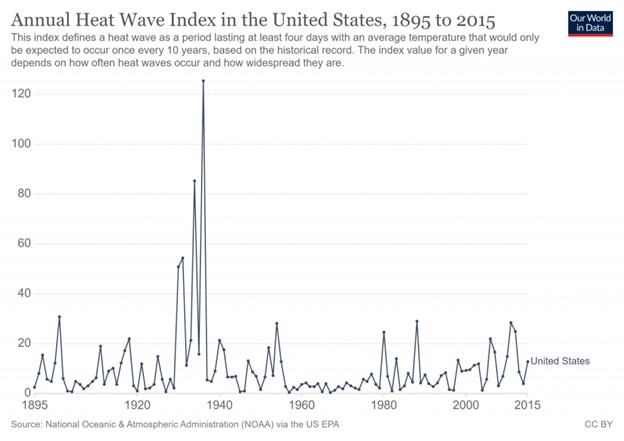
Indeed, temperature records show, the vast majority of each state’s all-time high temperatures were set during the first half of the 20th century – approximately 100 years of global warming ago. In fact, 40 states’ record-high temperatures were set before 1960, with 25 of the record highs being set or tied in the 1930s alone. That is three times more than have been set in the 33 years since 1988, when NASA’s James Hansen first pronounced humans were causing dangerous global warming. Only two states have set new record highs since 2000, fewer than the number of temperature records set in the 1890s alone, 130 years of global warming ago.
In addition, the most accurate nationwide temperature station network, implemented in 2005, shows no sustained increase in daily high temperatures in the United States since at least 2005.
Similarly, objective data destroy allegations that climate change is to blame for record cold that struck Texas, Oklahoma, and elsewhere this past week. NOAA data show the number days each year with below-freezing temperatures in Texas is neither unusually high nor unusually low so far this century. Similarly, NOAA data for neighboring Oklahoma show a decline in the frequency of very cold weather events in recent decades. The assertion that climate change makes extreme temperatures more frequent on both ends of the temperature spectrum is destroyed by science – on both ends of the temperature spectrum.
Data from NOAA and the IPCC make it equally clear other extreme weather events that might be thought to cause power failures, like cold spells, floods, hurricanes, or tornados, have not increased in number or in severity as the earth has modestly warmed. You can see the evidence for yourself via the links in this paragraph.
While weather extremes aren’t increasing, policies enacted with an intent to prevent climate change are making the grid less reliable and flexible in response to peaks in power demand. In particular, state mandates to incorporate ever-greater amounts of intermittent wind and solar power, and federal and state subsidies for the same purpose, have resulted in the premature retirements of tens of thousands of megawatts of baseload coal power plants over the past decade. These power plants have been replaced by wind and solar industrial facilities which cannot be relied upon to provide a consistent flow of power to the grid because they are dependent on weather conditions. Nor can they be relied upon to provide on-demand power or peaking power during emergencies.
Even if the Times was right that climate change is making extreme weather events more common and severe, relying on increasing amounts of intermittent power can only worsen the problems of grid reliability, both during normal operation and during extreme weather events. Wind turbines don’t work if the temperature is too cold or if winds die down. Solar panels don’t provide energy at night, on cloudy days, or if covered by ice, snow, dust, or dirt.
Texas’s recent power emergency came as thousands of megawatts of wind power went off-line when the weather turned unusually cold, even before any ice and snow hit. Meanwhile, California has experienced repeated rolling blackouts during the summer months. What these two states have in common is they have both come to rely on increasing amounts of intermittent electric generating sources to power their respective grids. The evidence shows replacing reliable sources of electric power, like coal, natural gas, and nuclear with ever more intermittent power makes power failures more likely, whatever the weather. That’s the fact the New York Times should report.
By Zoe Phin | February 17, 2021
Climate alarmists claim that an increase in man-made greenhouse gas emission will cause more fires. For example …
Human-induced climate change promotes the conditions on which wildfires depend, increasing their likelihood …
Funk … says there is very well documented scientific evidence that climate change has been increasing the length of the fire season, the size of the area burned each year and the number of wildfires.
— DW
The clearest connection between global warming and worsening wildfires occurs through increasing evapotranspiration and the vapor-pressure deficit. In simple terms, vegetation and soil dry out, creating more fuel for fires to expand further and faster.
… Global warming will keep worsening wildfires …
Sounds serious. Is it true?
We show that fire weather seasons have lengthened across 29.6 million km2 (25.3%) of the Earth’s vegetated surface, resulting in an 18.7% increase in global mean fire weather season length. We also show a doubling (108.1% increase) of global burnable area affected by long fire weather seasons and an increased global frequency of long fire weather seasons across 62.4 million km2 (53.4%) during the second half of the study period.
— Nature: Climate-induced variations in global wildfire danger from 1979 to 2013
This is just about the most scientific paper I could find on the issue. Why are they obsessed with the length of the fire season? Why can’t they just answer the simple question: Is there more or less fire?
NASA has collected daily data on Active Fires since 2000.
I downloaded and analyzed all of their Active Fires data. Here’s the result:
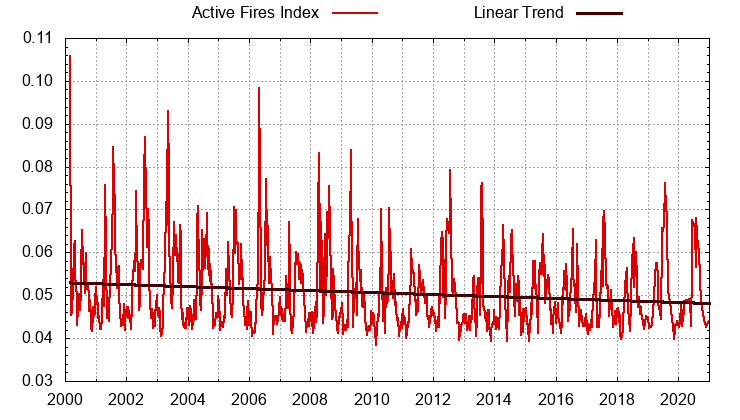
Now it all makes sense. Climate scammers need to cherrypick locations and seasons in order to distract from the empirical truth that global fires have been decreasing. Disgusting.

By James Taylor | ClimateRealism | February 16, 2021
WSJ Magazine, a product of the Wall Street Journal, told an outlandish climate change falsehood about Tuvalu and sea-level rise yesterday in an article about Bill Gates. In the article, titled “Bill Gates Has a Master Plan for Battling Climate Change,” WSJ Magazine claims, “Residents of Tuvalu, an island nation in the South Pacific, are jockeying for space as their archipelago is swallowed by rising seas.” The truth is exactly the opposite.
For background, climate activists have made Tuvalu – a nation of coral reefs and small islands in the South Pacific – a poster child for climate change. Activists claim rising seas are swallowing the nation and its islands. However, as documented by Climate Realism here and here, the majority of Tuvalu’s islands are growing in size, not shrinking.
While seas are modestly rising, modestly rising seas bring new sediment and allow for new coral to grow. The result is net land growth for islands like those in Tuvalu.
For example, a recent peer-reviewed study found eight out of Tuvalu’s nine coral atolls have grown in size during recent decades, and 3/4ths of Tuvalu’s 101 reef islands have similarly grown in size. Also, Tuvalu is experiencing net immigration rather than net emigration. There are 20% more people living in Tuvalu now than 30 years ago. Tuvalu’s population has doubled since 1970. Far from “jockeying for position” on an island being swallowed, people are flocking to Tuvalu, instead.
Additional peer-reviewed studies (see here, here, and here) confirm the same processes are allowing – and will continue to allow – other Pacific islands to keep up with rising seas.
The lesson to be learned at WSJ Magazine’s expense is that just because “everybody knows” or “Al Gore says” that some asserted climate harm is happening, that does not make it so. Trust scientific data, not the propaganda of climate activists and their messengers.
Climate Realism hopes to address other aspects of WSJ Magazine’s Bill Gates article in the days to come, although there are so many daily media climate falsehoods to debunk….

or go to
Aletho News Archives – Video-Images
Analysis of the so-called 12-Day War, and the triumphantly celebrated Operation Midnight Thunder
By William Schryver | imetatronink | November 28, 2025
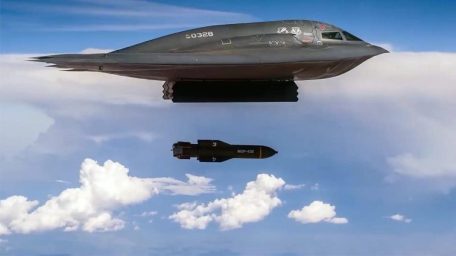
The GBU-57 is a big fat gravity bomb with fins. To achieve effective precision, a B-2 bomber must drop it on its intended target from no further than about five nautical miles — essentially right on top of the target.
Its penetration depth is claimed to be 200 feet. But that capability has NEVER been tested against a seriously hardened deep-underground target encased in layers of high-performance concrete, and topped with a few dozen meters of solid rock. In that sort of real-world scenario, the GBU-57 would be lucky to drill down 50 feet, if that.
It was always ridiculous silly talk to suggest the GBU-57 was the wonder weapon it was made out to be. There is a good reason the US only produced a couple dozen of them and then stopped: they understood its acute limitations in a non-permissive combat environment.
And, notwithstanding the hyperbolic Israeli propaganda, there was never any credible evidence that Iranian medium- and long-range air defenses against fixed-wing aircraft were attrited to any significant degree. And Iranian short-range air defenses were increasingly effective against long-range Israeli drones with each passing day.
As for the B-2: it is a big fat subsonic aircraft. It flies at airliner speeds. A strike on Fordow would entail flying at least 500 miles in and out of Iran. … continue
 Aletho News If Americans Knew No Tricks Zone
 Aletho News