220-Meter Turbine Breaks in Two in One of Sweden’s Largest Wind Parks

Samizdat – 18.07.2022
A 220 meter high wind turbine with a span of 145 meters, part of a wind farm in Viksjö outside the city of Härnösand in Västernorrland County, has broken in half and crashed into the forest.
No one was injured and the wind farm will be closed until an accident team examines the wind farm.
According to the Nysäter Wind company, which owns the farm, no one was injured. An accident team is on its way to investigate the wind turbine, and is expected to begin its work on Monday. Until then, the farm is closed, and access to the adjacent areas is limited.
“Parts of the turbine are sticking up and leaning against each other. That is why we approach with caution and block off. We also ask ourselves the question of how this could happen. We hope that the investigation can find out,” Nysäter Wind board member and advisor Per Nordlund told national broadcaster SVT.
Nysäter Wind suspected that oil had leaked from the gearbox and urged the public to stay away from the site.
The Nysäter windfarm in Viksjö is touted as one of Sweden’s largest wind power projects. With its 114 turbines, it will be one of Europe’s largest onshore wind turbines and by far the largest investment ever in the history of Härnösand.
However, the wind farm in Viksjö previously ran into trouble during the construction stage. Journalist investigations by SVT and others indicated that subcontractors had been left unpaid for their work, which led to bankruptcy risks, and about 30 companies being owed money to the tune of at least SEK 60 million ($5.7 million).
No fewer than six reported violations of environmental regulations were reported during construction; forests with protected species were felled and waste was dumped in sensitive natural environments.
Furthermore, the massive project was stopped by the county administrative board over environmental criticism, leading to further delays in construction. Only in June 2022 was the park ready for inauguration.
The share of domestic wind power resources in Swedish national consumption has risen from 0.3 percent in 2000 to 20.3 percent in 2020.
To counter soaring electricity prices and alleviate Europe’s dependence on energy fuels, the Swedish government plans a massive expansion of offshore wind power. However, critics slammed the plans as inefficient and a way of shifting the bill to the customers themselves. Among others, energy expert Marie Knutsen-Öy called it “an indirect subsidy that creates unnecessary costs and impairs the functioning of the electricity market”.
Germany and France ‘killed’ Minsk agreements – Russia
Samizdat | July 18, 2022
Germany is demanding that Russia guarantee Ukraine’s territorial integrity, but such a deal was previously signed, only to be “killed” by Berlin and Paris, Russian Foreign Minister Sergey Lavrov said on Monday.
“When [German Chancellor] Olaf Scholz demands that Russia should be compelled to sign an agreement granting Ukraine guarantees of territorial integrity and sovereignty, all his attempts are in vain. There was already such a deal – the Minsk agreements – which was killed by Berlin and Paris. They were shielding Kiev, which openly refused to comply,” he wrote in an op-ed for the Russian newspaper Izvestia.
Russia, Germany and France brokered the 2015 Minsk agreements between Ukraine and Donbass, which were designed to put an end to hostilities. But according to Lavrov, Berlin and Paris failed to ensure Kiev’s compliance.
The Russian foreign minister noted that former Ukrainian President Petro Poroshenko admitted the Minsk agreements meant nothing for Kiev, and Ukraine used them only to buy time.
“Our task was to stave off the threat… to buy time to restore economic growth and create powerful armed forces. This task was achieved. The Minsk Agreements have fulfilled their mission,” Poroshenko said in June.
Lavrov also mentioned that in December 2019, Ukrainian President Volodymyr Zelensky had a chance to fulfil the Minsk agreements at the so-called Normandy format summit held in Paris. After negotiations with leaders of Russia, Germany and France, Zelensky pledged to resolve issues surrounding the special status of Donbass. “Of course, he did nothing, and Berlin and Paris were shielding him once again,” he noted.
The Minsk agreements included a series of measures designed to rein in hostilities in Donbass and reconcile the warring parties. The first steps were a ceasefire and an OSCE-monitored pullout of heavy weapons from the frontline, which were fulfilled to some degree.
Kiev was then supposed to grant a general amnesty to the rebels and extensive autonomy for the Donetsk and Lugansk regions. Ukrainian troops were supposed to take control of the rebel-held areas after Kiev granted them representation, and otherwise reintegrate them as part of Ukraine.
Poroshenko’s government refused to implement these portions of the deal, claiming it could not proceed unless it fully secured the border between the breakaway republics and Russia. He instead endorsed an economic blockade of the rebel regions, initiated by Ukrainian nationalist forces.
Zelensky’s presidency gave an initial boost to the peace process, but stalled after a series of protests by right-wing radicals, who threatened to depose the new Ukrainian president if he tried to deliver on his campaign promises.
Kiev’s failure to implement the roadmap, and the continued hostilities with rebels, were among the primary reasons cited by Russia when it attacked Ukraine in late February. Days before launching the offensive, Moscow recognized the breakaway Ukrainian republics as sovereign states, offering them security guarantees and demanding that Kiev pull back its troops. Zelensky refused to comply.
Malcolm Nance: White Extremists Are An ‘Insurgency’ Worse Than ISIS – ‘We May Have to Fight’ Our Neighbors

By Chris Menahan | InformationLiberation | July 14, 2022
MSNBC regular Malcolm Nance, who has spent 36+ years in US intelligence, told Zerlina Maxwell on Wednesday night that around 30% of the country are white extremists and they’re part of an “insurgency” that “we may have to fight.”
WATCH:
From Breitbart :
“Here is the United States — to characterize that to understand what kind of terrorism we might be dealing with, you have to label it as white extremism because we have 30% of the population of the United States who no longer believe in the democratic norms that we established in the founding of the country. Let’s just be honest about that. The January 6 uprising was an attempt to overthrow American democracy. And we have now learned from the hearing that Donald Trump intended to go there to march down to the well of the House of Representatives and essentially be crowned as a king,” [Nance said.]
Anchor Zerlina Maxwell asked, “You call what is happening an insurgency. We have heard that term in foreign wars recently in Iraq. Talk about why you apply the term insurgency to what you see here as a persistent and ongoing threat of domestic extremists?”
Nance said, “I was reading their forums. I was reading their own intelligence about what they intended to do. It was pretty clear at that point that they were going to try to either overthrow the government or they were going to settle in for a long-term series of destabilizing actions using a political party, the Republican party, as their political base and then using violence, threat of violent extremism as a way to manifest change in the street. So remove politics from the halls of power and change politics through violence on the street. This is called an insurgency. The insurrection that happened on January 6 that was one event. An insurgency is a chain of events. It’s common knowledge. A year and a half ago, when I was calling this an insurgency, people were saying, that’s crazy, this isn’t an insurgency, this isn’t like Iraq, it’s not like Libya, it’s not like Syria. Well, it is. And it’s well on its way. It’s closer to the beginnings of the Irish Republican Army. You know Irish Republicanism, where now the Republican Party is Sinn Fein, and it’s just a matter of seeing who comes up as the original Irish Republicans in this story and starts carrying out acts of violence to affect change. So we are well on our way to a multi-year campaign that we are already two years into this campaign where we may have to fight them. The ‘they’ in my title and the ‘they’ in my title is those who want to kill Americans are your neighbors.”
Here we have a US intelligence analyst, who has admitted previously to torturing hundreds of people on behalf of the DC regime, suggesting that white Americans who voted for Trump are part of a terrorist “insurgency” that needs to be put down with force and he’s preparing MSNBC viewers to fight (and presumably kill) their neighbors.
DHS head Alejandro Mayorkas expressed similar views last year when he said that “extremist” white Americans support the Taliban and are poised to carry out terror attacks at any moment.
The FBI has been manufacturing fake terror plots to bolster this narrative and the media has been using fake data to hype the phony threat.
Back in April, Nance went over to western Ukraine to show his support for the Azov Battalion and joined the Ukrainian military’s foreign legion. He claimed he was fighting on the “frontlines.” He came back late last month and released his new book two weeks later.
The description for his new book, “They Want to Kill Americans: The Militias, Terrorists, and Deranged Ideology of the Trump Insurgency,” says extremist white Americans, “who benefit from the ultimate privilege — being white,” are “a generational terror threat greater than either al-Qaeda or the Islamic State.”
“America is primed for a possible explosive wave of terrorist attacks and armed confrontations that aim to bring about a Donald Trump led dictatorship,” the description continues.
Nance is an intelligence asset working to prop up a false narrative to bolster the DC regime’s new Domestic War on Terror.
Big Smartphone is watching you
By Edward Fitzgibbon | TCW Defending Freedom | July 18, 2022
YOU may have noticed that it’s impossible to walk down a city street and not see smartphones everywhere. The interminable fiddling, the addictive near-impossibility for most people of not taking them everywhere they go. While recognising the dazzling technological ingenuity of these slimline contraptions, I’ve come to see them for what I truly believe them to be: an increasing threat to our freedom.
This claim is not made lightly, and I’ve never been a Luddite about modern technology.
It’s not what they are that is the danger, but what they will become, and what they will be used for.
You’ll probably recall the harrowing, nightmarish scenes in Shanghai, with the hazmat-suited, violent, robot-like police. And what’s the other thing you’ll notice? Almost every protester is waving a smartphone, apparently impotently, at the utterly indifferent zombies of the CCP.
The Chinese authorities clearly feel that they have nothing to fear from having their ghastly activities filmed by their unfortunate citizens, or for those terrible scenes to be broadcast to the world. And how are the people of Shanghai (and other places) controlled, in a manner unpleasantly reminiscent of social insects? Smartphones.
The unconcealed intention of the WEF globalist totalitarians is to impose a digital ID surveillance state which no one can evade and from which no one can escape.
The obvious addictiveness of smartphones, and their ubiquity, makes them the ideal tool for control and oppression.
The so-called ‘Vaccine Passport’ is a euphemism for what will be, and is intended to be, a Slave’s Passport on the Chinese model. If you have difficulty believing that this might be true, peruse the list of information about you that a ‘passport’ (supposedly containing a record of your jabs and boosters) will contain: all manner of personal details, including your political views, who you associate with, your criminal record and your private medical details. It’s precisely the same list the CCP use to control their citizens’ lives down to the last detail. Simply put, if you don’t comply to the last jot and tittle with the government, you are excluded from society, shunned, shamed and increasingly unable to buy essential supplies, even food. Like the people in Shanghai.
Is this all too far-fetched for you? Slightly older readers might like to try a thought experiment: recall that life continued well enough before smartphones came into all-too-common use. It really did.
Don’t make the dangerously naive assumption that ‘this is Britain and Shanghai could never happen here’. Your addiction to your smartphone could end up trapping you and, through your compliance, all of us, in the nightmare vision of a totalitarian world that Schwab, Gates, the WEF and the WHO have long planned and are assiduously cultivating, step by step.
Your smartphone is nothing less than the shackle that will imprison you, irrevocably, in the Great Reset. Have the courage to dump it.
New Data from Germany: Births and Even Abortions are Down!
Accidental Pregnancies are an Independent Indicator of Fertility
By Igor Chudov | July 17, 2022
Three weeks ago, I wrote an article about Germany, highlighting a very large and consistent drop in births starting January this year, 9 months after vaccination of young people began, until March.
Since then, I found more data regarding Germany:
- Arkmedic pointed out that April births are available (read his article!)
- I found data on 2021 ABORTIONS in Germany, also showing an uncharacteristically large decline in abortions (accidental pregnancies). The abortion data is a completely independent confirmation of the declining fertility of Germans.
Births
We have new data for April — births dropped by 12% in 2022, compared to April of 2021.
Before I go further, I have to remind my readers: birth rates are always seasonal! Most parents prefer to make a “spring baby”, which often ends up with them making a “summer baby” because conception takes more time than expected. So, never compare adjacent months as they are guaranteed to have dramatic changes that are simply seasonality-driven, with differences very repeatable over the years. Only compare months of one year with the same months of another year, please.
The data comes from the German Bureau of Statistics. (if this link does not bring you to the exact page, select “population” and drill down to “births”). I summarized it for you:
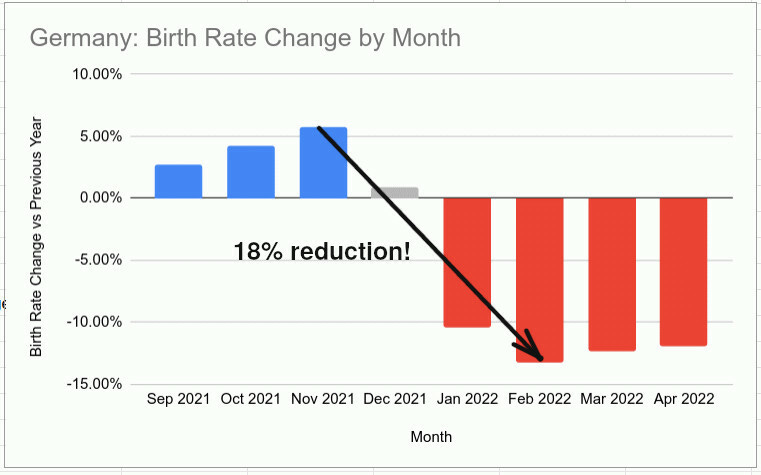
You can see that births suddenly started dropping in Dec 2021, (going from +5% yoy in November to 1% in December, down to -10% in January and -13.28% in February. The suddenness and extent of this drop are unprecedented.
The data for April confirmed that the reduction in birth rate over the first three months is not a fluke and is continuing for the fourth month.
Many people feel strongly about abortions. I understand. I am asking you to suspend your feelings for a moment and look at abortions like a demographer would.
Remember: abortions result from unplanned pregnancies! Aside from a relatively small amount of abortions happening due to fetal abnormalities, most abortions happen because the pregnancy was unexpected, unwanted, and accidental.
What this means is, absent large changes in the laws of the land, sudden increases or decreases in abortions happen only because of changes in fertility.
Live births may see increases or decreases because of changed desire to have children due to social factors. In the case of abortions, however, the pregnancy is ALMOST ALWAYS unplanned to begin with, so social factors like economic expectations have little to do with most abortions. Those abortions are only indications of fertility and desire to have unprotected sex.
So… abortions in 2021 fell by 5.3%!
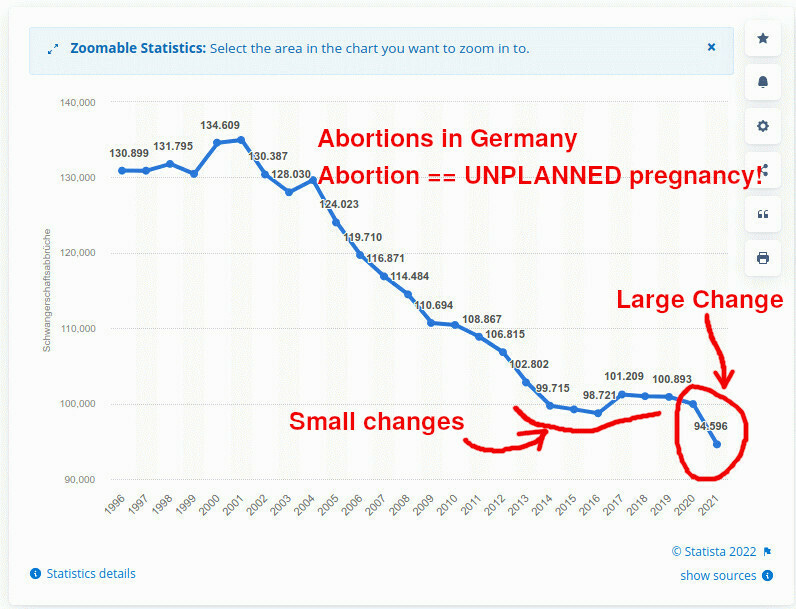
How large is this effect? Between 1996 and 2021, abortions fell by an average of 1,452 abortions per year. In the year 2021, abortions fell by 5,352! The recent years prior to 2021 saw little change in abortions. Thus, the decline of 5,352 abortions in the year 2021 likely is due to the changed fertility of young people in Germany and shows a great decline in unplanned, accidental pregnancies. Abortions are never planned, remember!
Please recall that younger Germans in 2021 did not start vaccinations until about May or so. Thus, if vaccinations are the cause of lower fertility, their effect on pregnancies would not be seen until the second half of 2021.
Furthermore, since abortion is done after about a month into the pregnancy, you can add about a month and deal with about 5 months out of 12 in 2021, most affected by vaccinations. Thus, a 5% drop in abortions could roughly mean a 12% decline in fertility starting about July.
This is a rough, back-of-the-envelope calculation that indicates that abortion data largely agrees with the hypothesis that declines in birth rates are caused by vaccination, and not by social conditions.
The abortion story is not, as such, a proof of causation: it is a piece of evidence that agrees with my vaccination hypothesis, and strongly disagrees with the possibility that change in fertility is caused by social factors.
So we see that both abortions, as well as April birth data in Germany, coincide and suggest that vaccinations caused a large drop in fertility among the people of Germany.
See Also
- Jestre just wrote a scary post about Canada birth rates — please take a look! 11% decline (like in Germany)!
- Sweden (dramatic steady decline to -10% this year)
- Taiwan (-28% decline)
- Germany (previous article), North Dakota, UK, and Switzerland. (12-13% declines)
Beijing citizens criticize Covid surveillance devices

By Ken Macon | Reclaim The Net | July 17, 2022
Some residents of Beijing are pushing back against a Covid tracking device they are required to wear on their wristbands. Anyone returning to Tiantongyuan, a residential district in northern Beijing, is required to wear the device all day for seven days.
The device records someone’s temperature every five minutes. According to China Daily, the device’s corresponding app has access to the phone’s microphone, location, and camera.
Those forced to wear the device have raised concerns about how it monitors the location and what is done with the data collected. The development of the device was a collaboration between the government and Beijing Microchip Sensing Technology, which is backed by China’s tech giant Tencent.
One of the people that received the wristband was Dahongmao, a tech blogger who shared his experience with the device on social media.

“If this bracelet can connect to the internet, it definitely can record my movements and it’s almost like wearing electronic handcuffs. I don’t want to wear it,” he said.
“The issuer said it’s a requirement from higher up and that I shouldn’t make it difficult for her. I said I would not want to make it difficult for her but she could tell those above her that I won’t wear it. If you insist that I wear it, you’ll have to come up with the documents that prove that it’s a Beijing government requirement and that this is not some unlicensed company trying to make a profit.”
China Daily and South China Morning Post were separately told by a Beijing COVID-19 hotline that the use of the devices was at the discretion of the residential community.
Earlier this week, Hong Kong announced it would roll out tracking bracelets to enforce its mandatory one-week home isolation.
Eighty Times More Excess Deaths Associated With Cold Each Year than Heat

BY TOBY YOUNG | THE DAILY SCEPTIC | JULY 17, 2022
Amid all the hysteria about next week’s extreme temperatures – which could climb to 41°, according to the Met Office – it’s worth bearing in mind that many, many more excess deaths in England and Wales are associated with cold each year than with heat. According to a recent study in the Lancet Planetary Health, between 2000 and 2019, there were an average of 65,000 excess deaths per year in England and Wales associated with cold, but fewer than 800 a year associated with heat. In other words, roughly 80 times more deaths per year are associated with cold than heat.
Needless to say, the report’s authors blame these excess deaths on ‘climate change’ in general and have nothing to say about the likelihood of the 65,000 figure increasing next winter as a result of rising energy bills.
The researchers analysed 10.7 million deaths that occurred in England and Wales between 2000 and 2019 across over 37,473 small areas that include around 1,600 residents, also known as lower super output areas (LSOAs). They then linked these data with high-resolution gridded temperature maps and potential drivers of vulnerability to heat and cold, including demographic and socio-economic factors, health and disability, housing and neighbourhood, landscape, and climatological characteristics. This allowed the researchers to characterise differences across small areas and map variation in temperature-related mortality risks across the two countries.
Dr Pierre Masselot, Research Fellow in in Environmental Epidemiology and Statistics at LSHTM and co-author of the study, said: “The results come at a critical time as countries and communities face increasing health impacts due to climate change and need to find effective ways to adapt to changing temperatures. The analytical framework also provides a flexible tool that can be adapted for future studies which aim to model temperature-related risks and impacts at small-area level under different climate change scenarios.”
The authors emphasised that, while the research showed that excess mortality attributed to cold was significantly higher than that attributed to heat, these results should be interpreted with caution as more cold than hot days were recorded throughout the year. Despite this, they highlighted that cold-related mortality is evidently a considerable health burden, particularly in deprived areas, and should be addressed with targeted public health interventions.
Nevertheless, any un-biased person reading this report cannot help but conclude that the rising cost of utility bills caused, in part, by the Government’s pursuit of ‘net zero’ will result in far more deaths than next week’s heat wave.
If you really care about reducing deaths due to extreme temperatures, shouldn’t you focus your energies on getting the Government to scrap its ‘net zero’ target, lift the ban on Fracking and start investing billions in nuclear[?], instead of disrupting traffic and sporting events?
You can read the Lancet Planetary Health study here.
Russia-Iran relations take a quantum leap
BY M. K. BHADRAKUMAR | INDIAN PUNCHLINE | JULY 17, 2022
When US National Security Advisor Jack Sullivan first spoke about a potential Iran-Russian drone deal, Moscow kept quiet and Tehran issued a pro forma rebuttal, which suggested that it is still a work in progress. Sullivan’s disclosure appeared at the end of a White Course briefing for President Biden’s West Asia tour to Israel and Saudi Arabia, and seemed to have an element of grandstanding aimed at fuelling the latent anti-Iran sentiments in the Gulf region that could in turn impart momentum to POTUS’ project to put together an Israeli-Arab military front in the region.
In the event, the ploy didn’t work. After Biden’s visit ended, the Saudi Arabian foreign minister Prince Faisal bin Farhan told CNN, amongst other things, that talks are going on between Iran and the GCC states for improvement of relations and the focus should be on changing Iran’s behaviour.
But Sullivan has repeated his charge and has since added that an official Russian delegation “recently received a showcase of Iranian attack-capable UAVs,” the last time being as recently as on July 5. CNN has cited White House officials as saying that Iran is expected to supply Russia with hundreds of drones for use in the war in Ukraine, “with Iran preparing to begin training Russian forces on how to operate them as early as late July.”
Iran is known to have a varied drone ecosystem and is reportedly showcasing to Russia the Shahed-191 and Shahed-129 “killer” drones. According to published information, Shahed-129 has a wingspan of 50 feet with a cruising speed of about 160 km per hour, an endurance of 24 hours with a range of 1,700 km and a ceiling of 24,000 feet. The 129 can carry 8 Sadid-345 miniaturized precision-guided bombs capable of hitting moving targets. The bomb’s small size with a range of 6 km, reduces collateral damage and would allow the Shahed to achieve more kills or attack strikes per mission.
The Shahed 191 carries two Sadid-1 missiles internally, has a cruising speed of 300 km/h, an endurance of 4.5 hours, a range of 450 km, and a payload of 50kg. The ceiling is 25,000 ft. Iran’s Fars News Agency says the Shahed 191 has been used in combat in Syria.
Both are stealth drones, harder for air defences to detect. Russia is, reportedly, short of such armed drones, which have the capability to undertake long-range missions to find and destroy, for example, the US-supplied HIMARS mobile rocket launchers which are currently deployed in Ukraine as well as knocking out Ukrainian air defences. Besides, drones are relatively cheap and expendable, unlike crewed aircraft.
If the drone deal indeed goes through, as seems likely, it will mark a quantum leap in Russia-Iran relations. For, Iran will be doing something that only China is capable of doing but won’t out of fear of US reprisal. That makes Iran a very special partner country indeed. Ironically, Russia is yet to upgrade its relationship with Iran as “strategic.”
On its part, Iran is literally sticking out its neck in an act of defiance of the West’s “rules-based order”, as Russia will be deploying its weapon systems on a European battlefield against the air defence systems supplied to Ukraine by the US and NATO countries. There cannot be many parallels of an emerging middle power rendering such critical help to a superpower in high-tech warfare in real conditions on the frontline. Of course, it enhances Iran’s standing regionally and internationally.
In geopolitical terms, however, the most important salience lies in the certainty that the door is closing on the nuclear negotiations between Iran and the US via European mediators. Tehran would have drawn the conclusion already that President Joe Biden is virtually co-opting his predecessor’s [Israel Lobby dictated] Iran policy and the US has reverted to its decades-old strategy of promoting an Israeli-Arab front against Tehran. Put differently, Tehran is moving on to a trajectory that is predicated on unremitting American hostility.
This will mean that Tehran will double down on its efforts to improve relations with its Aran neighbours and explore all possible avenues in that direction, seizing the window of opportunity in the new Saudi thinking to reduce its dependence on the US and explore its strategic autonomy. It is possible to say that Tehran is a beneficiary if the Saudi-Russian and Saudi-Chinese relationships strengthen. Arguably, Saudi Arabia’s quest for BRICS membership brings the Kingdom tantalisingly close to Iran’s world view which places primacy on a democratised, multipolar world order where every country is free to choose its developmental path.
To be sure, against this backdrop, President Vladimir Putin’s visit to Tehran on Tuesday is invested with great importance. Iran is becoming one of the most consequential relationships for Russia. What began as a limited alliance in Syria is taking on a global character.
US sponsored Kurdish SDF calls on Russia and Iran to prevent planned Turkish military operation
MEMO | July 17, 2022
The head of the Kurdish-led militant group Syrian Democratic Forces (SDF) has called on Russia and Iran to help prevent Turkiye from launching a military offensive against its positions in northern Syria, as the threat of a new Turkish operation continues to loom.
According to the AFP news agency, the SDF’s chief commander Mazloum Abdi urged the involvement of Moscow and Tehran against Ankara’s aims in the region this week, accusing the US-led global coalition to defeat Daesh – also known as Operation Inherent Resolve – of taking a “weak” position that is “insufficient to end the threats.”
In May, Turkish president Recep Tayyip Erdogan announced plans to launch a new military operation into the areas controlled by the Kurdish militias, which would be Turkey’s fourth such offensive in northern Syria. The operation is meant as an effort to clear the 30-kilometre-deep ‘safe zone’ in northern Syria from remaining Kurdish militant elements, in order to settle at least a million Syrian refugees there.
Abdi also reiterated that after negotiating with Russia, Kurdish militant forces allowed the Syrian regime of Bashar al-Assad to reinforce their troops in Kurdish-controlled areas, particularly in cities such as Kobane and Manbij in the north of the country. The threat of a renewed Turkish offensive had seemingly forced the SDF to strengthen ties with Assad, Russia, and now Iranian forces in an effort to repel Ankara’s planned operation.
Abdi’s call for Russian and Iranian assistance is likely more diplomatic than military, as it comes only days before a summit that is to be held in Iran from Tuesday, in which Iranian president Ebrahim Raisi will host Erdogan and their Russian counterpart Vladimir Putin in a renewed set of negotiations on Syria and the ongoing 11-year-long conflict.
If Moscow and Tehran heed the SDF’s call, they may be expected to attempt to discourage Ankara from its planned military operation.
‘NATO Weapons Double Civilian Casualties in DPR’
Samizdat – 17.07.2022
DONETSK – The number of civilian casualties in the Donetsk People’s Republic (DPR) more than doubled after Ukraine was equipped with NATO’s long-range rocket systems and Tochka-U tactical missile systems, a military expert told Sputnik on Sunday.
“Since the start of the special operation, the DPR’s territory has been shelled over 30 times with Tochka-U missiles, there were more than 400 cases of shelling with 155mm NATO munitions, and the enemy used HIMARS MLRS more than five times. We should note that once the [Ukrainian forces] started using NATO weapons, there has been a 2.5-fold increase in civilian casualties and destruction of civilian infrastructure,” a military expert to the Joint Center on Control and Coordination of the ceasefire regime (JCCC) Sergey Pereverzev said.
On February 24, Russia launched a military operation in Ukraine after the breakaway republics of Donetsk and Lugansk appealed for help in defending themselves against Ukrainian forces. Moscow and Kiev have made several attempts to negotiate a ceasefire, with a couple of meetings taking place in Turkey, and both exchanged several dozens of war prisoners. However, no agreement has been reached so far and the talks have been paused on Kiev’s initiative.
The West’s Duplicity in the Food Crisis Caused by the Shortage of Grain
By Vladimir Danilov – New Eastern Outlook – 17.07.2022
Governments of many countries have recently been talking more and more about a possible food crisis in the near future, actively involving representatives from the UN and other international organizations, and numerous media platforms in this information campaign.
Yet, in addition to drawing everyone’s attention to the issue of combating hunger, which is especially threatening to the world’s poorest countries, the US and its Western allies are actively trying to use this situation to fuel their latest Russophobic campaign. Such provocative actions very quickly become understandable when, amidst the so-called “threats” of the global food crisis, the West places the blame on Russia alone because of its special operation against the neo-fascist regime in Kiev, sponsored by the USA and its allies. In doing so, the West is making unfounded accusations of Russia allegedly preventing the export of grain from Ukraine by sea, while keeping suspiciously silent about it not being Russia, but the regime in Kiev who has mined not only all Ukrainian ports, but even the distant shores of the Black Sea, and these mines have already left their anchors, which requires Ukraine to clear the mines from sea transport lanes and routes.
Today it has become clear to everyone that, in terms of the energy crisis and global economic collapse, and even more so in food problems, the United States itself and its Western allies are primarily to blame. It is their treacherous sanctions policy that has destroyed the international order and brought chaos to logistics and transport chains. Accusations by the West against Russia over the food crisis can only be considered as evidence of American efforts to redistribute the global agro-industrial market, which implies ousting Russia from the field of food trade, according to the Telegram channel of the Russian diplomatic mission in Washington.
The recent statements by member countries of the G7 about the shortage of wheat and the food crisis allegedly caused by Russia being a political provocation is pointed out by Hu Bingchuan, a researcher at the Institute of Rural Development of the Chinese Academy of Social Sciences, in an article for the Chinese newspaper Huanqiu Shibao. As follows from his explanations, based on an objective assessment of the processes on the world food market, the absence of wheat from Ukraine will quickly be ironed out due to offers from other countries that supply grain growing – this is primarily Russia, Canada, and several European countries. It is already known that this year the total volume of grain production in the Russian Federation could reach 130 million tons, of which 87 million tons will be wheat, which is an absolute record. Wheat exports in 2022-2023 from Canada will also increase by 8.5 million tons, and by five million tons from the EU. The purpose of Western statements about Russia’s alleged “wheat war” is to create new restrictions against Moscow. The expert emphasizes that such statements have a clear political Russophobic orientation, and the current rise in wheat prices is not provoked by the lack of grain, but “its inconsistent global distribution among those who want it.”
Due to the recent policy pursued by Western countries, food prices in European nations and a number of other countries have already risen sharply, with many goods being sold in limited quantities. At the same time, if for rich countries the current situation simply portends a looming crisis, then for poor nations it threatens a real famine, which, in turn, could provoke an even greater crisis in the world, as it will lead to uprisings, revolutions, and wars.
Against the backdrop of the food crisis, the demand for Russian agricultural products around the world (which was quite high before), has increased several times. According to results from last year, Russian agro-industrial and fishery complex products were sent abroad to the tune of more than $37 billion. Under these conditions, and in order to avoid anti-Russian sanctions and the influence of Western food speculators regarding price, the Russian authorities will now only sell domestic grain and other agricultural products on the National Commodity Exchange and only for rubles.
As for the story artificially inflated by the United States about the amount of Ukrainian grain ready for export, it’s no secret to anyone that this is simply informational hype provoked by Washington to denigrate Russia. And this confirms the complete inconsistency with the truth of the story about 20 million tons of Ukrainian grain allegedly being blocked by Russia, previously disclosed by US President Biden. Even with a superficial analysis by experts, it turns out that at best there are 5 million tons of grain today in Ukraine. But it is constantly being exported in the direction of the states of the EU, immediately being poured into their storage facilities, and not sent somewhere south to those African countries suffering from hunger, which European politicians and experts constantly talk about. The German Ministry of Agriculture stated that in May alone Europe received 1.7 million tons of grain from Ukraine. Additionally, don’t forget that Ukraine’s share of world grain production is only 1.5%.
Russia has repeatedly stated its readiness to facilitate the export of even this remaining amount of grain from Ukraine, guaranteeing the unimpeded passage of ships with grain through the Black Sea. This is confirmed by the recent meeting in Istanbul of delegations from Turkey, Russia, Ukraine, and the UN to discuss the grain issue.
Meanwhile, what the West deliberately remains silent about, thereby demonstrating its frank duplicity, is all the obstacles created by the regime in Kiev over the “grain issue.” Per an official statement by the deputy head of the military-civilian administration of the Kherson Region, Kirill Stremousov, Ukraine is deliberately setting fire to wheat fields on the border of the Kherson Region. “Helicopters flew and set fire to wheat fields on the demarcation line. This is a Nazi regime and they don’t care,” Stremousov said.
The attempts to set fire to wheat fields in the Kherson Region by Ukrainian helicopters will be suppressed by air defense systems, said the head of the regional administration Volodymyr Saldo. He also stressed that “they stoop so low so as to destroy the labor of rural workers who have put their heart and soul into it.” The head of the administration called the Ukrainian military’s actions malicious and inhumane, describing them as an attempt to scare the local population.
Yet, no reports on this issue in the Western media, and even more so the censure of the authorities in Kiev for such crimes, can be expected from the West…
Featured Video

Matt Bracken: US Plans Massive MOAB Strike on Iran?
or go to
Aletho News Archives – Video-Images
From the Archives
Confronting the Threat of Ethnic Bioweapons
By Tony Cartalucci – New Eastern Outlook – 29.11.2017
The United States Air Force’s 59th Medical Wing’s molecular biology branch recently was revealed to have been collecting specifically Russian RNA and synovial (connective) tissue samples, prompting fears in Russia of a possible US directed ethnic-specific bioweapons program. … continue
Blog Roll
 Aletho News
- Matt Bracken: US Plans Massive MOAB Strike on Iran?
- Russia accuses France of ‘piracy’ over tanker seizure
- Why Yemen Is Bombing Saudi Arabia’s Airports: The War Behind the Headlines
- Sally Rooney’s books pulled from UK over support for Palestine Action
- Bombs for Tel Aviv, Promises for Riyadh
- Israeli ad agency conducted vast global espionage campaign using online ads: Report
- Oct. 7 Forever Marks The Big Reveal: ‘We See You, Israel, We Revile You, We Reject You!’
- Meet the US generals and admirals advancing Israeli policy
- Israel’s Straw Widow Protocol: The Kill Zones Where Civilians Were Labelled ‘Terrorists’
- Leading Israeli Think Tank Publishes Psychotic Israeli ‘National Security’ Doctrine
- If Americans Knew
- Israeli firm used online ads to run vast spy operation, researchers say
- No, the world zionist movement is not an antisemitic conspiracy theory
- Hundreds of IDF investigations into killings still have no public outcome, BBC Verify finds
- After Ashley Moody Epstein Probe, Donors Linked to Him Poured Money Into her Senate Campaign
- Worried about Russian meddling in UK politics? Wait till you see what Israel is up to
- Israeli settlers attack West Bank center for disabled children, church leader calls for int’l action
- Pulling Out Teeth Just to Live: How Israel Has Devastated Dental Care in Gaza
- Gaza’s “ceasefire” death toll passes 1,500 – Daily Update
- Activists Abused By Israel Return to New Freedom Flotilla Mission
- 60 Minutes won’t tell the full truth about Israeli settler violence
- No Tricks Zone
- New Study Suggests Large Regions Of The Pacific Ocean Have Been Cooling For The Last 80 Years
- Germany’s Green Energy Debacle: High Energy Costs Force Kahla Porzellan to Close After 182 Years!
- New Study: 50 Years Of The Most Aggressive ‘Net Zero’ Policies Can Only Affect The Global Climate By 0.03°C
- US September “Heat” Was No Record…Many Records Set Decades Ago
- Latest European Green Energy Debacle; Portugal’s Largest Flagship Solar Park Insolvent!
- Green Energy Debacle: German Expert Professor Fritz Vahrenholt Warns Of Severe Economic And Social Consequences
- Two More Paleo Reconstructions Affirm Meters-Higher Sea Levels Across Ireland, Brazil 7000-6000 Years Ago
- New Study: Earth And Venus Surface Warmth Largely Explained By Convection And Lapse Rate, Not CO2 Or Radiation
- 2025 Nature Paper Claiming Worsening Global Drought Gets RETRACTED …Heavily Flawed
- New Study: ‘Global Drought Shows No Detectable Recent Acceleration Under Climate Warming’

