ACCORDING TO the Cambridge Dictionary, a sanction is ‘a strong action taken in order to make people obey a law or rule, or a punishment given when they do not obey’. The purpose is pretty obvious, to try to deter an action that is not deemed by the sanctioner as acceptable.
A child thus may be sanctioned for poor behaviour with no sweets for a week. A country is equally sanctioned in some way deemed to harm the errant country and not those giving the sanction. Russia has been sanctioned by primarily the US, UK and EU in an unprecedented fashion due to the war in Ukraine. But who is it hurting?
This article is not about the morality of the situation in Ukraine. It is simply about whether the sanctions have been effective, or have they actually been counter-productive? At the most basic level, has applying sanctions made it more, or less likely, that UK policy goals will be achieved?
A third of a year into war, the only conclusion one can sanely draw so far is that the West’s sanctions have been an unmitigated disaster in self-harm undermining domestic prosperity while causing serious inflationary and monetary dislocation.
There is very little evidence that Western sanctions have materially harmed Russia’s ability to prosecute war or (as much as we can judge) diminish Russian domestic support for it. Far from Government’s expectations that it would cripple the Russian economy and perhaps lead to regime change, if anything it is Western economies that are in desperate trouble. It seems that US, UK and EU sanctions are proving to be a lose-lose trade.
A simple test – what currency traders would say
We were told sanctions were going to cripple the Russian economy and stop its war machine. For around two weeks, judging by the currency market’s reaction to a then collapsing rouble, that superficially seemed right.
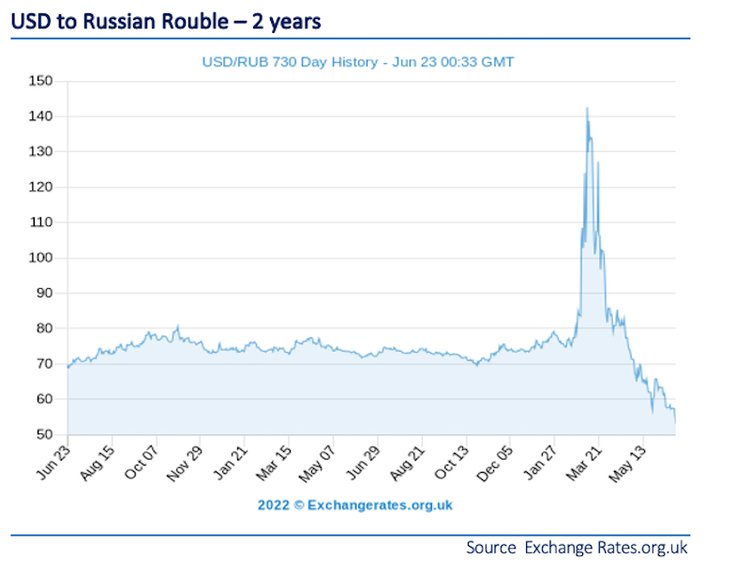
Initially the rouble halved from a pre-war 75 to the USD to a low of 140 as the West confiscated over $300billion of Russia’s sovereign assets held in the West. This, coupled with a wholesale withdrawal of Western companies, from BP to McDonald’s, and a tightening of oil and gas sanctions, resulted in currency collapse.
Such a collapse, if prolonged, would have been very dangerous for Russia’s stability as it simply destroys its terms of trade, potentially resulting in material inflation as the cost of importing goods rises significantly.
But Western policy makers did not think through the second derivative which is coming back to bite. Economically Russia to an extent is the polar opposite of the West.
The West undoubtedly has significant technological and soft power advantage over Russia. However, most Western economies have growing and inefficient public sectors and weak central banking systems impeded by the Global Financial Crisis (GFC) and particularly lockdowns, with substantial growing public debt and debased monetary systems through a new-found belief in Modern Monetary Theory (MMT) – accompanied by all the associated Quantitative Easing over the last decade. Britain and the US also run substantial trade deficits.
Russia, on the other hand, is a commodity- and primary products-led export economy running a substantial trade surplus, with weak technology and service sector exports and soft power. Its public finances are very strong with low public debt, low taxes (14 per cent flat rate income tax) and substantial cash reserves even after half were sanctioned.
This asymmetry of strategic advantage between Russia and the West has profound implications if sanctions are applied. Thus quite quickly currency traders realised what extraordinarily almost none of our current crop of virtue signalling politicians dare to say – that the sanctions were potentially more of a threat to the West (UK and EU in particular) as the impact of ‘cancelling’ Russian carbon was highly inflationary.
There are no cheap short or medium term substitutes. Much of the West is dependent on Russian primary products, while only some Russians might be upset the Prada store in Moscow had closed (but the back door from China remained wide open). An inconvenience, sure; a game changer, probably not.
Thus the rouble strengthened materially and at the time of writing is 55 to the USD, almost 30 per cent stronger than before the conflict in Ukraine. If one compares the sterling- rouble exchange rate, sterling’s underperformance is even starker.
It is quite simple. Cancel Russian oil (13 per cent global production) and India joyfully buys the discarded stock at a discount while the global price goes up as the West scrambles to find new supply. Worse, cancel Russian gas and the EU has a major crisis, as does the UK given the UK’s foolish decade-plus de-emphasising of carbon, including the closure of strategic gas storage facilities. The list goes on well beyond carbon – from titanium to fertiliser, from wheat to cod.
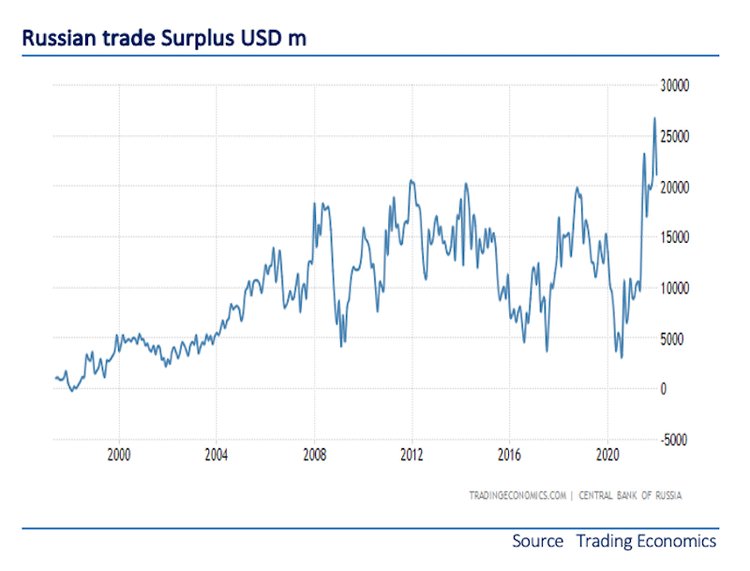
But it is oil and gas that are so critical as power is essential to the manufacture, to a greater or lesser extent, of most things. The irony is that as well as Saudi, Iran and Venezuela, the greatest beneficiary of soaring hydrocarbon prices is Russia. Putin’s Russia has run consistent trade surpluses but the current surplus is a record, as a direct result of sanctions, taking the spot price of oil from a pre-war $80 a barrel to $120 today.
While the rouble strengthens and the Russian trade surplus expands, the effect on Western economies has been devastating. In fairness the West had been severely undermining its own advantage for many years prior to the invasion of Ukraine, fuelled by Governmental policies based on a double fallacy: that monetary policy could solve all ills, and that centralised decision-making and excessive public spending could solve all ills.
Both fallacies are now coming with a substantial price, but to multiply that with an ill-thought-out sanctions regime that is achieving none of its underlying goals and is harming Western economies is frankly hard to fathom.
The West, particularly the EU and UK, is now in a pickle. This pickle has the potential to be calamitous as Governments remain in denial at the scale of the challenge they are facing.
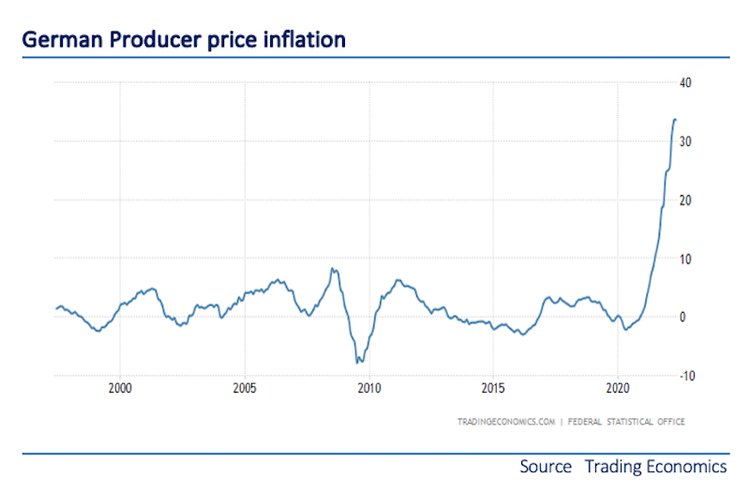
We are in a situation where the inflationary surge, given supply chains, is in its embryo stage, not close to its conclusion. Sure, the price rise at the pumps is immediate, but domestic energy prices are set to increase by a further 40 per cent in September when the price cap comes off. As a warning, German producer price inflation (see chart below) is over 30 per cent, a rate not seen since post-war ruination in 1946.
I sincerely hope I am wrong but this has the potential to get very nasty. Rishi Sunak said on Wednesday: ‘We are using all the tools at our disposal to bring inflation down and combat rising prices. We can build a stronger economy through independent monetary policy, responsible fiscal policy which doesn’t add to inflationary pressures, and by boosting our long-term productivity and growth.’ That says to me he hasn’t a clue about the scale of the challenge or indeed the underlying causes.
The reality is unfortunately that both the Bank of England and the ECB are so far behind the curve as to make you weep. Interest rates of 1.25 per cent when RPI is 11 per cent are so far off-kilter while the ECB, with arguably an even greater inflation headache given German industrial reliance on Russian gas, is only now coming off negative rates.
Moreover, expanding a wantonly inefficient public sector to around half the entire economy coupled with an unprecedented regulatory stranglehold can only spell a productivity disaster. It is throwing money at the bad, paid for by the good.
Where this will end remains uncertain, so many unknowns are there. What we can predict is that this is the beginning not the end of the maelstrom. Governments do not like short-term pain as elections approach and we risk yet another debt-funded stimulus papering over the ever-wider cracks. How credible would that really be when inflation is 11 per cent? Would they dare print money again in such circumstance? I fear they would.
This country and indeed Europe generally is enduring enormous self-harm. Sanctions have backfired but the cocktail of sanctions, massive public sector expansion, delusional monetary policy and delusional energy policy risk an economic disaster of immense proportion.
There is no easy fix but unless we wish to become a northern version of Argentina, with a debased currency, constant crisis and missed opportunity, we need to understand the scale and multiple layers of our challenge.
It’s too late to avoid prolonged and meaningful inflation, and in time recession, but it’s not too late to start to rectify policy error. I can’t see the current crop of politicians analysing forensically the impact of sanctions but a great start would be to toss away the gateway drug to our delusions, the strange idea that Modern Monetary Theory works and governments can print and spend their way out of a crisis. Frankly they can’t and with that acceptance perhaps we can start the process of an appropriately balanced economy focused on private activity, not state direction. Government got us in this mess, only the people can free us from it.
Why was there no democracy in Hong Kong under British colonial rule? And why democracy can be developed in an orderly manner in Hong Kong only on the premise of firmly implementing the policy of “One Country, Two Systems” and the Basic Law of the HKSAR. Einar Tangen, our current affairs commentator, tells more.
According to a recent study by the World Bank, published in the journal Nature, lockdowns and the response to Covid-19 have pushed an additional 75 million people into extreme poverty, living on less than US $1.90 a day.
In the typical Walter Duranty style that’s become a kind of twisted journalistic norm since March 2020, the World Bank and Nature of course blame this on “the pandemic” rather than lockdowns. I remain baffled as to how seemingly well-meaning people are able to sleep at night repeating such nonsense—are they somehow blind to the role of their own sycophancy in perpetuating these policies?
Nonetheless, there are signs that the political mainstream is starting to realize lockdowns were a disaster. Today, the Wall Street Journal published an excellent piece titled The Revenge of the Locked-Down Voters, noting the growing political backlash against lockdown politicians from voters at the lower end of the income scale.
This comes shortly after the New York Timesquietly acknowledged a study showing that Covid lockdowns and mandates led to over 170,000 excess deaths among young Americans.
And, as in America, this comes shortly after the London Times, the UK’s centre-left newspaper of record, published a cautiously-introspective piece on its support for lockdowns.
These are promising indications that the political mainstream, especially on the right, is coming around to the fact that lockdowns were a policy catastrophe more quickly than some might have worried.
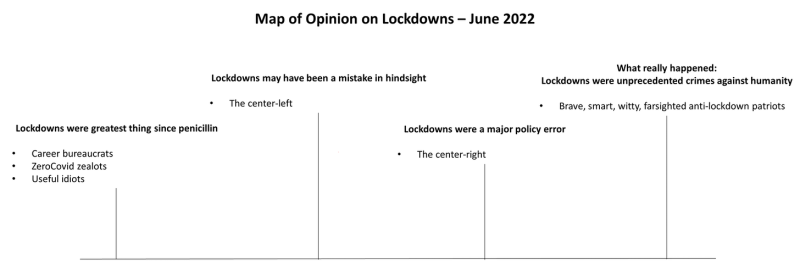
Still, there’s much more to be done. Currently, the mainstream left and right are starting to realize lockdowns were a big mistake, while many career bureaucrats are still stuck pretending lockdowns were the greatest medical breakthrough since penicillin. There really needs to be a bipartisan consensus that lockdowns were an unprecedented policy catastrophe before we can start to see justice and have undue foreign and financial influence taken seriously.
This is a continuation of my post from yesterday about a massive 13% decline in births in Germany. Such a decline is a nine-sigma event, meaning that it is so unlikely to occur by chance, that it would naturally happen as rarely as an asteroid striking the Earth.
My article explored several more locales (UK, North Dakota, and Switzerland).
But no other place stands out as much as Taiwan does.
According to a Taiwan government report, the birth rate dropped by 23.24% in May 2022, compared to May 2021. […]
When expressed in “sigmas”, units of standard deviation, the 23.24% drop in the birth rate in Taiwan is a 26-sigma event!
This is can be described as “unimaginable” in terms of the likelihood of happening due to random chance.
The Wolfram-Alpha illustration of likelihood by sigma only goes to nine-sigma. They thought that it would be pointless to show more sigmas. Except a 26-sigma drop in birth rate just happened in Taiwan.
What Happened In Taiwan?
Health experts are quick to blame Covid for all sorts of health problems afflicting those they advised to vaccinate. It is not the vaccine, they say, it is Covid. We tried to protect you with the vaccine, they would always insist. But you got Covid anyway, thanks to the evil antivaxxers, and your problems are due to Covid — that’s their explanation.
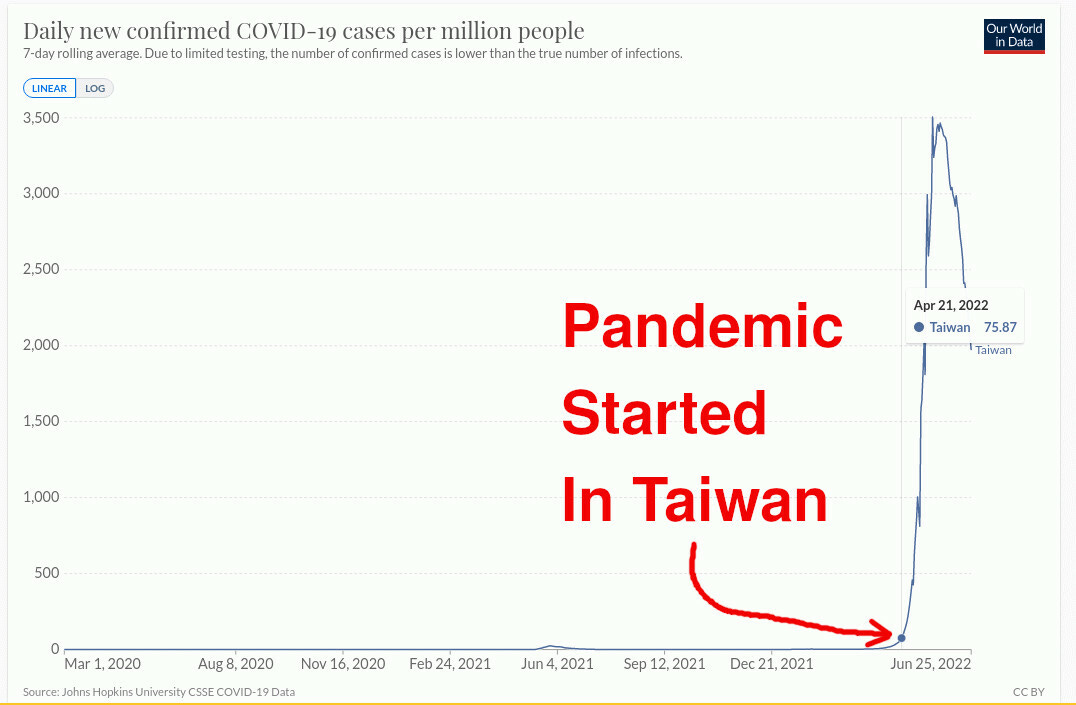
We know for certain, though, that the drop in birth rate in Taiwan is NOT due to Covid. Yes, Taiwan is suffering from a terrible COVID pandemic right now (despite being 91% vaccinated), however, Covid in Taiwan only started around April 21 of 2022, and could not impact May birth rates much.
To see what could cause the extreme drop in births, go back 9 months from May 2022, so to September 2021.
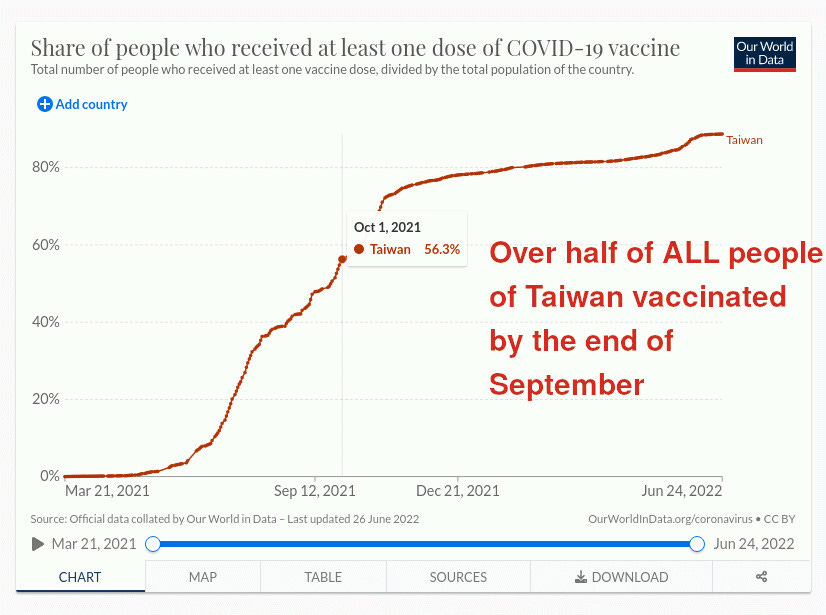
Taiwan was a poster child for successful vaccination. 91% of all Taiwanese residents received a vaccine dose. By October 1, 2021, 56% of ALL people of Taiwan received Covid vaccines.
They got a fairly usual mix of “safe and effective” AstraZeneca, Moderna, and Pfizer vaccines.
People of Taiwan got their shots, felt assured that Covid-19 stops with every vaccinated person, and moved on with their lives.
I doubt that the people of Taiwan noticed anything at the end of September. They knew for sure that their vaccines were safe and effective and would not affect their sperm or pregnancies. So they proceeded with family plans just as before, trying to make babies on purpose, or partying and having fun and getting pregnant accidentally, just as people do elsewhere.
Except for 9 months later, they only gave birth to 77% of the number of babies expected.
I hope that the people of Taiwan will start asking their authorities: what is happening to us?
The retreat of Ukrainian troops from Severodonetsk city in the Luhansk Oblast of the country is a pivotal moment in the ongoing conflict. The Russian forces are now almost in total control over the Luhansk region. The latest reports from front lines say Russian forces entered the last remaining city of Lysychansk in Luhansk on June 25.
In a briefing today, the Russian Ministry of Defence announced in Moscow: “On June 25, the cities of Severodonetsk and Borovskoye, the settlements of Voronovo and Sirotino passed under control of the Lugansk People’s Republic. The localities liberated… are inhabited by about 108,000 people. Total area of the liberated territory is about 145 square kilometres.
“Success of the Russian army… considerably diminishes the morale and psychological condition of the Ukrainian army personnel. In 30th Mechanised Brigade deployed near Artyomovsk, there are mass cases of alcohol abuse, drug use and unauthorised abandonment of combat positions.”
However, peace is a long way off — several months away, perhaps. In the speech by Russian President Vladimir Putin last week at the SPIEF in St. Petersburg, he made no references to peace negotiations. Putin hardly referred to the fighting.
Meanwhile, three highly provocative moves by the opposing side within the past week are significant markers indicating that the conflict may aggravate. If the missile strike at a Russian oil rig in the Black Sea has been an act of provocation, the US supply of High Mobility Artillery Rocket Systems (HIMARS), a powerful long-range weapon system is intended as a potential game changer that can help Kiev turn the tide of the conflict, and, third, the bizarre move by Lithuania to block Russia’s rail transit to Kaliningrad is a reckless escalation of tensions.
On the arrival of the HIMARS, Ukraine Defence Minister Oleksiy Reznikov ecstatically wrote wrote on Twitter on Thursday, “HIMARS have arrived to Ukraine. Thank you to my colleague and friend @SecDef Lloyd J. Austin III for these powerful tools! Summer will be hot for russian occupiers. And the last one for some of them.”
Washington claims it has received assurances from Kiev that HIMARS would not be used to attack Russian territory. Moscow has warned it will attack targets in Ukraine that it has “not yet been hitting” if the West supplies longer-range missiles to Ukraine for use in high-precision mobile rocket systems.
The Lithuanian move is a blatant violation of international law and Vilnius would only have acted on the basis of prior consultation with the US and NATO to test the Russian reaction. Kaliningrad is a major Russian base with nuclear missiles, where its Baltic Fleet is headquartered, apart being the only Russian port on the Baltic that is ice-free throughout the year. Evidently, there are some insane fellows in the NATO camp who are itching to climb the escalatory ladder.
For Russia too, there is “unfinished business” ahead insofar as it holds roughly the same amount of territory in Donetsk only as the separatists controlled in February before the special military operation began. Now, seizing the administrative territories of the Donbass is only Moscow’s minimal goal. There is going to be a sprawling battlefield in the next phase, stretching from Kharkiv in the northeast to Mykolaiv and Odessa in the southwest. Much fighting lies ahead.
The New York Times reported that “Pentagon officials expect that the arrival of more long-range artillery systems will change the battlefield in Donetsk.” Gen. Mark A. Milley, the chairman of the US Joint Chiefs of Staff told reporters recently, “If they (Kiev) use it properly, practically, then they’re going to have very, very good effects on the battlefield.”
The Russian military approach doctrinally is centred on attrition warfare, which aims to grind the way toward incremental territorial gains. Therefore, the advantage goes to the side which has greater staying power on the battlefield. In a sustained war of attrition, one military is ultimately going to be depleting the capability of the other. This is where the fault lines in the western unity come into play if the current traces of “war fatigue” in Europe turns into “solidarity fatigue.”
Ukraine’s ability to shift the military balance depends critically on sustained military support from the US and other European countries. That, of course, hinges on political will and cohesiveness of the western allies. As for Russia, it is not only committed to a protracted war but also has the capacity to sustain it.
Unlike the case with Ukraine, Russia is not dependent on any other country for boosting its military capability or training and advising its military. Also, historically speaking, a defining characteristic of the Russian military is its incredible endurance and ability to sustain prolonged attrition.
The US is still betting that the Russian economy cannot hold out for a long time, since the full impact of sanctions and export controls is yet to be felt. In this calculus, the rebound of the ruble currency is seen as largely due to the strict government controls on capital flows and plummeting imports into Russia. Equally, the US has convinced itself that the restrictions on technology exports to Russia will gradually stunt the growth of its industries. Thus, the focus of the G7 summit in Germany currently under way (June 26-28) is on new plans to further “tighten the screws” on Russia’s economy.
But not much Russian budget data is available to make such daring assumptions and it is even harder to quantify how much Moscow is spending on the war in Ukraine. Certainly, there is no evidence to suggest that the Kremlin’s ability to finance the war effort is coming under pressure from sanctions.
While President Biden boasted in March that sanctions were “crushing the Russian economy” and that “the ruble is reduced to rubble,” the exact opposite has happened. Russian oil revenues have set new records and the ruble hit a 7-year high this week against the dollar. Expert opinion is also that Russia’s financial system is back to business as usual after a few weeks of severe bank runs.
Going forward, Biden must retain control over the Congress in the midterm elections in which Republicans are sure to capitalise on the rising cost of living. As for Europe, cooler temperatures in the coming months will raise alarms about energy shortages as Moscow has cutdown natural gas supplies to Europe, which would aggravate the economic pressure they now are experiencing.
Therefore, the big question is, whether the desire to resist Russia will be sustainable as the war itself grinds away. The matrix has changed. After all, Biden uttered the following about Putin as recently as in end-March: “For God’s sake, this man cannot remain in power.” But in 3 months’ time, today, Biden only says he is striving to help Ukraine negotiate optimally with Russia for a settlement. Here too, Biden needs to make sure Russia is losing ground, while also constantlyweighing that new weapons do not escalate the conflict too fast.
Admittedly, Biden is under little political pressure at home to back away. And the crack in western unity is, arguably, not to be construed as amounting to anything like a rift in the fundamental strategy towards Russia and the Ukraine conflict. That said, the bottom line is that this is also a perilous moment for the global economy.
Post-pandemic economic recovery, supply-chain disruptions, rapid price increases, infrastructure investment, trade practices, global oil prices, world’s food supply, recession — these issues surely impact the western leaders’ standing in the polls. It means economic and political pain is coalescing.
Despite what some “defense analysts” may be telling Western media, the longer the war continues, the more Ukrainians will die and the weaker NATO will become.
For a moment in time, it looked as if reality had managed to finally carve its way through the dense fog of propaganda-driven misinformation that had dominated Western media coverage of Russia’s “Special Military Operation” in Ukraine.
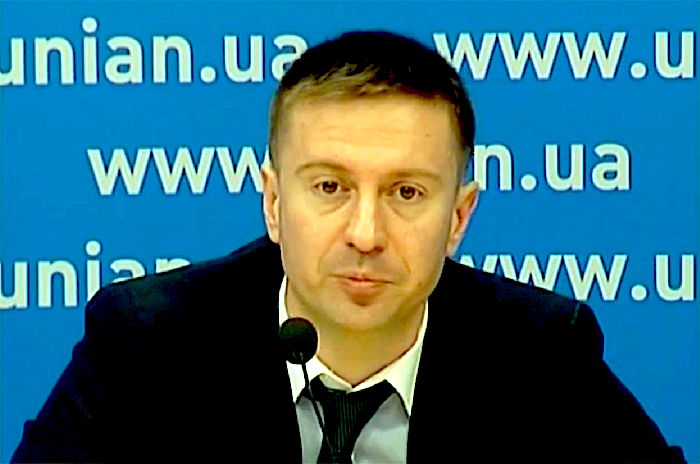
In a stunning admission, Oleksandr Danylyuk, a former senior adviser to the Ukrainian Ministry of Defense and Intelligence Services, noted that the optimism that existed in Ukraine following Russia’s decision to terminate “Phase One” of the SMO (a major military feint toward Kiev), and begin “Phase Two” (the liberation of the Donbass), was no longer warranted. “The strategies and tactics of the Russians are completely different right now,” Danylyuk noted. “They are being much more successful. They have more resources than us and they are not in a rush.”
“There’s much less space for optimism right now,” Danylyuk concluded.
In short, Russia was winning.
Danylyuk’s conclusions were not derived from some esoteric analysis drawn from Sun Tzu or Clausewitz, but rather basic military math. In a war that had become increasingly dominated by the role of artillery, Russia simply was able to bring to bear on the battlefield more firepower than Ukraine.
Oleksandr Danylyuk in 2015. (CC BY 3.0, Wikimedia Commons)
Ukraine started the current conflict with an artillery inventory that included 540 122mm self-propelled artillery guns, 200 towed 122mm howitzers, 200 122mm multiple-rocket launch systems, 53 152mm self-propelled guns, 310 towed 152mm howitzers, and 96 203mm self-propelled guns, for approximately 1,200 artillery and 200 MLRS systems.
For the past 100-plus days, Russia has been relentlessly targeting both Ukraine’s artillery pieces and their associated ammunition storage facilities. By June 14, the Russian Ministry of Defense claimed that it had destroyed “521 installation of multiple launch rocket systems” and “1947 field artillery guns and mortars.”
Even if the Russian numbers are inflated (as is usually the case when it comes to wartime battle damage assessments), the bottom line is that Ukraine has suffered significant losses among the very weapons systems — artillery — which are needed most in countering the Russian invasion.
But even if Ukraine’s arsenal of Soviet-era 122mm and 152mm artillery pieces were still combat-worthy, the reality is that, according to Danylyuk, Ukraine has almost completely run out of ammunition for these systems and the stocks of ammunition sourced from the former Soviet-bloc Eastern European countries that used the same family of weapons have been depleted.
Ukraine is left doling out what is left of its former Soviet ammunition while trying to absorb modern Western 155mm artillery systems, such as the Caesar self-propelled gun from France and the U.S.-made M777 howitzer.
But the reduced capability means that Ukraine is only able to fire some 4,000-to-5,000 artillery rounds per day, while Russia responds with more than 50,000. This 10-fold disparity in firepower has proven to be one of the most decisive factors when it comes to the war in Ukraine, enabling Russia to destroy Ukrainian defensive positions with minimal risk to its own ground forces.
Casualties
This has led to a second level of military math imbalances, that being casualties.
Mykhaylo Podolyak, a senior aid to Ukrainian President Volodymyr Zelensky, recently estimated that Ukraine was losing between 100 and 200 soldiers a day on the frontlines with Russia, and another 500 or so wounded. These are unsustainable losses, brought on by the ongoing disparity in combat capability between Russia and Ukraine symbolized, but not limited to, artillery.
In recognition of this reality, NATO Secretary General Jen Stoltenberg announced that Ukraine will more than likely have to make territorial concessions to Russia as part of any potential peace agreement, asking,
“what price are you willing to pay for peace? How much territory, how much independence, how much sovereignty… are you willing to sacrifice for peace?”
Stoltenberg, speaking in Finland, noted that similar territorial concessions made by Finland to the Soviet Union at the end of the Second World War was “one of the reasons Finland was able to come out of the Second World War as an independent sovereign nation.”
To recap — the secretary general of the trans-Atlantic alliance responsible for pushing Ukraine into its current conflict with Russia is now proposing that Ukraine be willing to accept the permanent loss of sovereign territory because NATO miscalculated and Russia —instead of being humiliated on the field of battle and crushed economically — is winning on both fronts.
Decisively.
That the secretary general of NATO would make such an announcement is telling for several reasons.
Stunning Request
First, Ukraine is requesting 1,000 artillery pieces and 300 multiple-launch rocket systems, more than the entire active-duty inventory of the U.S. Army and Marine Corps combined. Ukraine is also requesting 500 main battle tanks — more than the combined inventories of Germany and the United Kingdom.
In short, to keep Ukraine competitive on the battlefield, NATO is being asked to strip its own defenses down to literally zero.
More telling, however, is what the numbers say about NATO’s combat strength versus Russia. If NATO is being asked to empty its armory to keep Ukraine in the game, one must consider the losses suffered by Ukraine up to that point and that Russia appears able to sustain its current level of combat activity indefinitely. That’s right — Russia just destroyed the equivalent of NATO’s main active-duty combat power and hasn’t blinked.
One can only imagine the calculations underway in Brussels as NATO military strategists ponder the fact that their alliance is incapable of defeating Russia in a large-scale European conventional land war.
But there is another conclusion that these numbers reveal — that no matter what the U.S. and NATO do in terms of serving as Ukraine’s arsenal, Russia is going to win the war. The question now is how much time the West can buy Ukraine, and at what cost, in a futile effort to discover Russia’s pain threshold in order to bring the conflict to an end in a manner that reflects anything but the current path toward unconditional surrender.
The only questions that need to be answered in Brussels, apparently, are how long can the West keep the Ukrainian Army in the field, and at what cost? Any rational actor would quickly realize that any answer is an unacceptable answer, given the certainty of a Russian victory, and that the West needs to stop feeding Ukraine’s suicidal fantasy of rearming itself to victory.
Enter The New York Times, stage right. While trying to completely reshape the narrative regarding the fighting in the Donbass after the damning reality check would be a bridge too far for even the creative minds at the Gray Lady — the writing equivalent of trying to put toothpaste back in the tube. But the editors were able to interview a pair of erstwhile “military analysts” who cobbled together a scenario that transformed Ukraine’s battlefield humiliation.
‘Military Analysts’
They described a crafty strategy designed to lure Russia into an urban warfare nightmare where, stripped of its advantages in artillery, it was forced to sacrifice soldiers in an effort to dig the resolute Ukrainian defenders from their hardened positions located amongst the rubble of a “dead” city — Severodonetsk. [Ukraine forces withdrew from the city Friday.]
Gustav Gressel in Berlin in February 2020
According to Gustav Gressel, a former Austrian military officer turned military analyst, “If the Ukrainians succeed in trying to drag them [the Russians] into house-to-house combat, there is a higher chance of inducing casualties on the Russians they cannot afford.”
According to Mykhailo Samus, a former Ukrainian naval officer turned think-tanks analyst, the Ukrainian strategy of dragging Russia into an urban combat nightmare is to buy time for rearming with the heavy weapons provided by the West, to “exhaust, or reduce, the enemy’s [Russia’s] offensive capabilities.”
The Ukrainian operational concepts in play in Severodonetsk, these analysts claim, have their roots in past Russian urban warfare experiences in Aleppo, Syria and Mariupol. What escapes the attention of these so-called military experts, is that both Aleppo and Mariupol were decisive Russian victories; there were no “excessive casualties,” no “strategic defeat.”
Had The New York Times bothered to check the resumes of the “military exerts” it consulted, it would have found two men so deeply entrenched into the Ukrainian propaganda mill as to make their respective opinions all but useless to any journalistic outlet possessing a modicum of impartiality. But this was The New York Times.
“If we stay tough, if the war ends in defeat for Russia, if the defeat is clear and internally painful, then next time he will think twice about invading a country. That is why Russia must lose this war.”
And:
“We in the West… all of us, must now turn over every stone and see what can be done to make Ukraine win this war.”
Apparently, the Gressel playbook for Ukrainian victory includes fabricating a Ukrainian strategy from whole cloth to influence perceptions regarding the possibility of a Ukrainian military victory.
Samus likewise seeks to transform the narrative of the Ukrainian frontline forces fighting in Severodonetsk. In a recent interview with the Russian-language journal Meduza, Samus declares that:
“Russia has concentrated a lot of forces [in the Donbass]. The Ukrainian armed forces are gradually withdrawing to prevent encirclement. They understand that the capture of Severodonetsk doesn’t change anything for the Russian or the Ukrainian army from a practical point of view. Now, the Russian army is wasting tremendous resources to achieve political objectives and I think they will be very difficult to replenish… [f]or the Ukrainian army, defending Severodonetsk isn’t advantageous. But if they retreat to Lysychansk they’ll be in more favorable tactical conditions. Therefore, the Ukrainian army is gradually withdrawing or leaving Severodonetsk, and upholding the combat mission. The combat mission is to destroy enemy troops and carry out offensive operations.”
Mykhailo Samus on March 27. (YouTube still)
The truth is, there is nothing deliberate about the Ukrainian defense of Severodonetsk. It is the byproduct of an army in full retreat, desperately trying to claw out some defensive space, only to be crushed by the brutal onslaught of superior Russian artillery-based firepower.
To the extent Ukraine is seeking to delay the Russian advance, it is being done by the full-scale sacrifice of the soldiers at the front, thousands of people thrown into battle with little or no preparation, training, or equipment, trading their lives for time so that Ukrainian negotiators can try to convince NATO countries to mortgage their military viability on the false promise of a Ukrainian military victory.
This is the ugly truth about Ukraine today — the longer the war continues, the more Ukrainians will die, and the weaker NATO will become. If left to people like Samus and Gressel, the result would be hundreds of thousands of dead Ukrainians, the destruction of Ukraine as a viable nation-state, and the gutting of NATO’s front-line combat capability, all sacrificed without meaningfully altering the inevitability of a strategic Russian victory.
Hopefully sanity will prevail, and the West will wean Ukraine off the addiction of heavy weaponry, and push it to accept a peace settlement which, although bitter to the taste, will leave something of Ukraine for future generations to rebuild.
A Russian offshore drilling rig in the Black Sea has been shelled, in the second similar attack in less than a week, a spokesperson for Crimea’s emergency services told TASS on Sunday, blaming the strike on the Ukrainian military.
Earlier, the Baza Telegram channel, citing its own sources, reported that a projectile which had hit the Chernomorneftegaz-owned Tavrida floating drilling rig overnight, left a hole in the platform’s helipad.
“This is shelling by the Armed Forces of Ukraine, there are no casualties,” the region’s emergency services spokesman said without providing further details.
On June 20, the head of Crimea, Sergey Aksyonov, revealed that Ukraine had shelled Chernomorneftegaz drilling platforms 71km from Odessa.
Three platforms were damaged, including the Tavrida. One of the platforms (BK-1) was completely destroyed. Seven people are missing, and three sustained injuries. In total, there were 109 people on the platform, with the majority of them subsequently evacuated.
The Russian Investigative Committee opened a criminal case in relation to the June 20 shelling.
Earlier this month, the Ukrainian presidential representative for Crimea, Tamila Tasheva, said Kiev is now relying on military means to ‘return’ Crimea to Ukraine, and that Russia’s military campaign prompted Kiev to largely abandon diplomacy regarding the peninsula’s ‘de-occupation’.
Ukrainian troops have been losing territory to Russia and allied forces in Donbass, even as Western nations supply more sophisticated weapons to Kiev. Several Ukrainian officials have stated that the pledge to not use foreign weapons to attack targets in Russia does not apply to Crimea, which Kiev considers part of its territory.
Russia attacked the neighboring state in late February, following Ukraine’s failure to implement the terms of the Minsk agreements, first signed in 2014, and Moscow’s eventual recognition of the Donbass republics of Donetsk and Lugansk. The German- and French-brokered protocols were designed to give the breakaway regions special status within the Ukrainian state.
The Kremlin has since demanded that Ukraine officially declare itself a neutral country that will never join the US-led NATO military bloc. Kiev insists the Russian offensive was completely unprovoked and has denied claims it was planning to retake the two republics by force.
In recent weeks, I have received a number of complimentary emails from readers of my essays who took note of what they consider my even-handed approach to the ongoing Russian-Ukrainian military conflict which is at variance with the fired-up Russophile and Russophobe positions that we find daily in alternative and mainstream media respectively. Some have gone on to say that they have profited from my reporting on the content and changing views aired on Russian political talk shows these past few months, all of which is rarely featured in mainstream Western news and analysis. My intent in such reporting was to ensure that at least some people here understand what Ukraine and its Western backers are up against, so as to better understand the course of the fighting on the ground and who may be winning.
In this context, I announce with sadness that the job of even-handed reporting has just become much more difficult as a result of Eutelsat’s implementation yesterday of a policy decision announced just over a month ago, but which went unnoticed by most everyone, myself included.
I quote from Google Search:
“Eutelsat to remove banned Russian channels. Eutelsat ready to immediately stop the rebroadcasting of the Russian channels RTR Planeta and Rossiya 24 on its satellites on June 25. 13 May 2022”
Indeed, the main state news channels of the Russian Federation can now no longer be received via satellite antennas here in Belgium or elsewhere on the Continent. They are partially and sporadically accessible on the internet via www.smotrim.ru but the level of interference from Western censors makes such viewing a dismal exercise. “Freezing” of frames seems to be most common with respect to the talk shows “Sixty Minutes” and “Evening with Solovyov,” two programs which I had been following and reporting on most regularly. However, it also is applied against Russian shows which might be characterized as being simply entertainment, such as the currently running historical serial about the life and times of the 18th century tsarina Elizabeth. I dare anyone to get more than a minute or two into the broadcast before the curtain comes down, so to speak.
The curtain in question is an updated Iron Curtain, which this time has been dropped on our heads by the powers that be in Washington. After all, it is Washington that pressured the French controlled Eutelsat rebroadcaster of television channels that dominates the European and other global markets to throw out the Russians.
The argument behind that demand was to exclude “Russian propaganda” from the airwaves.
In the spirit of fairmindedness with which I opened this essay, I agree that Russian state television is practicing propagandistic methods insofar as it withholds certain information from viewers while promoting other information favorable to its paymasters. For example, on Russian state television news you will not find a word about the civilian casualties and damage to residential buildings of Russian artillery and rocket attacks on Kharkov. You are shown only the civilian casualties and damage to residential buildings in Donetsk and towns of the Donbas caused by Ukrainian artillery and rocket strikes.
On the other hand, however, European and U.S. newscasts feature the damage caused by Russian strikes on Ukrainian towns while saying not a word about the sufferings of the Donbas population from military assaults by Ukrainian forces. Just as they have been entirely silent about such suffering and death among the Donbas population that Kiev has inflicted on them for the past eight years, since the outbreak of the civil war in 2014.
Each side in the Ukrainian conflict accuses the other side of using cluster bombs and other internationally prohibited weapons against civilian populations. These accusations are put on air by Russian and Western news programs only as they are set out by their favored respective side.
My point is very simple: by silencing the so-called Russian propagandists, Western propagandists have the field to themselves here in Belgium, in the broader European Union and in North America. The possibilities for the public to form an independent view of what is going on are choked off, and with that there is no basis for informed policy discussion in the expert community. As The Washington Post so nicely puts it: democracy dies in darkness.
And what about the Russian side? Are they also cut off and ignorant as my remarks on coverage of casualties above might suggest? I commented on this question in my travel report on my six week stay in Petersburg that began in May: Western news channels have been removed from the cable television distributors in the city. For this I blame not Russian government prohibitions but the commercial decisions of Western content providers who terminated their contracts with Russian distributors just as did the Hollywood studios. Meanwhile, Western stations remain accessible on the internet without interference and they remain accessible on satellite television.
At my dacha, I had no difficulty receiving the BBC and Bloomberg for free courtesy of my parabolic antenna. How long this will be the case given the tit-for-tat nature of the relationship between the West and Russia generally I cannot say. But if someone does pull the plug on Western ‘propaganda’ in Russia, it will be in response to the West’s dropping the Iron Curtain on Russia, not the other way around.
It is sad that Western leaders are destroying with their own hands the underpinnings of democracy at home through this censorship. The only likely result will be total shock and surprise throughout the Western world when the Russians complete their liberation of Donbas, take the Ukrainian Black Sea coast including Odessa and declare victory over what will by then be an utterly destroyed Ukrainian army.
In the meantime, under greatly constrained conditions, I will try my best to follow the Russian side of the story on talk shows, on news reports of Russian war correspondents embedded with their forces on the front lines, and to share with readers what appears to be afoot on the other side of the barricades.
The Liberals are intent on funneling ever more of our collective resources to bolster the US Empire, spending lavishly to “modernize” Canada’s chief bi-national military accord.
On Monday Defence Minister Anita Anand announced the government would spend $4.9 billion to upgrade the North American Aerospace Defense Command. The federal government said it will devote $40 billion to NORAD over 20 years, but it may be far more than that noted David Pugliese in a story headlined: “Cost to modernize NORAD set at $40 billion, but will final tally be higher?”
The media and government framed the announcement as strengthening Canada’s defences. According to the Globe and Mail report, “the Canadian government has pledged $4.9-billion over six years to help upgrade North America’s air defences, addressing the growing threat posed by hypersonic missiles and advanced cruise missile technology developed by Russia and China.”
But it’s absurd to present NORAD as a defensive arrangement. Its lead actor has 1,000 international bases and special forces deployed in 149 countries. Rather than protect Canada and the US, NORAD supports violent missions led by other US commands. In 1965 NORAD’s mandate was expanded to include surveillance and assessment sharing for US commands stationed worldwide (United States European Command, United States Pacific Command, United States Africa Command, etc.).
The Pentagon has put satellites into space to enable first strike ballistic missile defence (BMD). While Paul Martin’s Liberals claimed to oppose BMD, they granted “full cooperation by NORAD in missile-defence work”, explained Richard Sanders in a Press for Conversion report on the subject. In 2004 Ottawa formally permitted the US BMD system to use data from NORAD’s “Integrated Tactical Warning/Attack Assessment”.
It’s called “missile defence” because it’s designed to defend US missile sites after they launch offensive operations. US-installed missile defence systems in Romania and Korea, for instance, are designed primarily to stop opponents’ missiles following a US first strike.
US space-based missile defence interceptors able to eliminate Russia’s early warning satellites without warning puts that country on edge. This ratchets up the arms race and the likelihood of nuclear war.
NORAD has also drawn Canada into US belligerence in other ways. During the July 1958 US invasion of Lebanon NORAD was placed on “increased readiness” while US troops checked secular Arab nationalism after Iraqis toppled a Western-backed king (at the same time British troops invaded Jordan to prop up the monarchy there).
In a higher profile incident, Canadian NORAD personnel were put on high alert when the US illegally blockaded Cuba in October 1962. This transpired even though Prime Minister John Diefenbaker hesitated in supporting US actions during the Cuban Missile Crisis.
During the 1973 Ramadan/Yom Kippur/Arab–Israeli War NORAD was placed on heightened alert. Washington wanted to deter the USSR from intervening on Egypt’s behalf.
NORAD systems offered surveillance and communications support to the 1991 war on Iraq. It monitored the region and provided information to launch US Patriot surface-to-air missiles. NORAD ballistic missile warnings were also sent to Ottawa and Canadian units in Bahrain.
NORAD also supported the 2003 invasion of Iraq. The same can be said for US bombing in Afghanistan, Libya, Somalia, etc.
Thousands of Canadian military personnel assist NORAD’s operations. One hundred and fifty Canadians are stationed at NORAD’s central collection and coordination facility near Colorado Springs, Colorado. Hundreds more work at regional NORAD outposts across the US and Canada and many pilots are devoted to the Command.
A Royal Canadian Airforce general is the vice commander of NORAD and runs the entire command when the US commander is absent. In discussing the two countries’ most significant bilateral military accord, Ann Griffiths explains,“NORAD brings the Canadian military more deeply within the US defense establishment than any other ally. The United States quite simply, would not entrust such responsibilities to the military of any other close ally, not even Britain.”
NORAD makes Canada a junior partner to US militarism and imperialism. If Canada was truly a force for good in the world, a peacekeeper and adherent of a rules based international order, Ottawa would withdraw from NORAD, rather than spend billions more strengthening it.
The West needs to keep arming Ukraine instead of seeking a peaceful resolution to the conflict between Kiev and Moscow, UK Prime Minister Boris Johnson told French President Emmanuel Macron, according to Downing Street. Any attempt to resolve the conflict peacefully will lead to global instability, he said at a meeting on the sidelines of the G7 Summit on Sunday.
The military action in Ukraine is at a “critical moment,” the two leaders agreed, but there is still “an opportunity to turn the tide.” According to the statement, Johnson and Macron have agreed to continue supporting Kiev militarily to “strengthen their hand in both the war and any future negotiations.”
The prime minister also cautioned the French leader against seeking alternatives to resolving the conflict.
The Prime Minister stressed any attempt to settle the conflict now will only cause enduring instability and give Putin licence to manipulate both sovereign countries and international markets in perpetuity.
Johnson took a similar stance at a meeting with Canadian Prime Minister Justin Trudeau on Sunday. “Ukraine is on a knife-edge and we need to tip the balance of the war in their favor. That means providing Ukraine with the defensive capabilities, training and intelligence they need to repel the Russian advance,” a statement from Downing Street read.
On Sunday, Johnson tweeted that Ukraine’s “security is our security, and their freedom is our freedom.”
Ahead of the summit, London pledged an additional £429 million ($525 million) in guarantees for World Bank loans in 2022 as a form of financial assistance to Kiev. According to Downing Street, the UK’s total financial support for Ukraine, including loan guarantees, amounted to £1.3 billion ($1.5 billion) and the combined UK economic and humanitarian support for Ukraine amounted to £1.5 billion ($1.8 billion) this year.
Johnson has been one of Kiev’s most ardent supporters after Russia’s military operation in Ukraine began in late February. He has visited Kiev twice since then and repeatedly called on Western nations to provide more weapons. The UK is one of Kiev’s major arms suppliers, including heavy weaponry.
In June, Johnson warned that the West must brace for a long war between Kiev and Moscow. On Saturday, he said he would consider resigning if he has to abandon Ukraine at some point.
Lithuania will maintain the ban on the transit of sanctioned goods between Kaliningrad Region and mainland Russia, President Gitanas Nauseda has said.
“It is absolutely clear that Lithuania must and will implement EU sanctions,” Nauseda wrote in a Facebook post on Saturday.
“Lithuania must and will maintain control over the goods passing through its territory, and there cannot be any ‘corridors’, nor can there be any appeasement of Russia in response to the Kremlin’s threats. I have made clear to the president of the European Commission how Lithuania sees the situation.”
Kaliningrad Region is a small Russian exclave nestled between Lithuania and Poland. A week ago, Lithuania’s national rail operator suspended the transit of sanctions goods between Kaliningrad and the rest of Russia, citing instructions from Brussels.
Since the EU closed its airspace to Russian planes in February, the only option for the authorities in Kaliningrad now is to ferry goods to and from mainland Russia via the Baltic Sea.
The EU imposed sweeping sanctions on Moscow in response to the military campaign in Ukraine launched in late February.
Nauseda reiterated on Saturday that Vilnius was acting in accordance with the EU’s fourth package of restrictions, which was adopted “with Lithuania’s active participation.”
The EU earlier backed Lithuania in its move to partially ban the transit of Russian goods.
Russia has argued that the disruption of transit is illegal under international law and threatened to retaliate.
The Times reported on Thursday that Italy and several other European governments asked the European Commission to defuse the crisis.
Petras Austrevicius, a European Parliament member from Lithuania, said on Friday that an unnamed EU member state proposed that the Commission allow Russia-to-Russia transit of sanctioned goods. Austrevicius urged Brussels not to “succumb to pressure from the aggressor and create extraterritorial exemptions and concessions.”
Kremlin spokesman Dmitry Peskov expressed hope that the decision to partially ban the transit could be reversed. “Let’s hope for the best, but prepare for the worst. Which is what we do all the time,” he told reporters on Friday.
Finland’s flag carrier Finnair has reportedly become the latest casualty of the sanctions war between Russia and the West. The airline suffered heavy financial losses due to the forced necessity to fly around Russia, after the country closed its airspace in retaliation to Western sanctions.
Since the beginning of 2022, the operating loss of one of the world’s oldest airlines amounted to €133 million, of which €51 million in expenses fell on fuel costs, the Finnish newspaper Helsingin Sanomat reports.
EU countries and a number of other Western states closed their airspace to Russian flights after Moscow launched its military operation in Ukraine in late February. Russia responded in kind, banning the airlines of 36 states and territories from its skies and, in so doing, closing the traditional routes from Europe to Asia to Western carriers.
The tit-for-tat restrictions have forced airlines in Europe to re-route flights, and have deprived some nations of the monthly air navigation fees that they used to receive when flights from neighboring states passed through their airspace.
Since December 2021, Finnair’s fuel costs have reportedly surged from 30% to 55% of its total expenses. Apart from a nearly twofold increase in prices, the Finnish airline has faced the need to change air routes.
As a result of closing skies Helsinki has lost a key advantage over other Scandinavian countries – the shortest distance to China, Japan and South Korea. Some flights to the Asia-Pacific region, which had been generating for Finnair up to 50% of its profit, were canceled. The journey to Japan that previously took about nine hours now takes 13 hours.
Moreover, the loading of Finnair planes has also significantly dropped due to the absence of Russian tourists, who used to make up about 20% of its passenger traffic. Meanwhile, EU residents have slashed their travel spending amid increased economic instability, with a reluctance to fly exacerbated by constantly rising cost-of-living expenses.
By Mazin Qumsiyeh | Popular Resistance | August 18, 2013
There is no way to say this truth nicely: Politicians lie. That includes Japanese, American, Egyptian, Israeli, and Palestinian politicians! Is there something more common sense than that? Yet, so many citizens around the world believe their own politicians or wistfully acknowledge lies but think it is part of the job needed to run things. They believe even when politicians contradict themselves blatantly. This phenomenon is rather remarkable. It is a dissonance and disconnect from reality that many seem oblivious to. It is very dangerous because it can lead to accepting rationales for going to war. These can be deadly wars that lead to millions of lives lost as happened in what was called World War 1 and WW2. Even when incredible and declassified evidence abound, politicians continue to lie and old mythologies refuse to die. Here are just a few of the countless lies told to us over the past few decades… continue
This site is provided as a research and reference tool. Although we make every reasonable effort to ensure that the information and data provided at this site are useful, accurate, and current, we cannot guarantee that the information and data provided here will be error-free. By using this site, you assume all responsibility for and risk arising from your use of and reliance upon the contents of this site.
This site and the information available through it do not, and are not intended to constitute legal advice. Should you require legal advice, you should consult your own attorney.
Nothing within this site or linked to by this site constitutes investment advice or medical advice.
Materials accessible from or added to this site by third parties, such as comments posted, are strictly the responsibility of the third party who added such materials or made them accessible and we neither endorse nor undertake to control, monitor, edit or assume responsibility for any such third-party material.
The posting of stories, commentaries, reports, documents and links (embedded or otherwise) on this site does not in any way, shape or form, implied or otherwise, necessarily express or suggest endorsement or support of any of such posted material or parts therein.
The word “alleged” is deemed to occur before the word “fraud.” Since the rule of law still applies. To peasants, at least.
Fair Use
This site contains copyrighted material the use of which has not always been specifically authorized by the copyright owner. We are making such material available in our efforts to advance understanding of environmental, political, human rights, economic, democracy, scientific, and social justice issues, etc. We believe this constitutes a ‘fair use’ of any such copyrighted material as provided for in section 107 of the US Copyright Law. In accordance with Title 17 U.S.C. Section 107, the material on this site is distributed without profit to those who have expressed a prior interest in receiving the included information for research and educational purposes. For more info go to: http://www.law.cornell.edu/uscode/17/107.shtml. If you wish to use copyrighted material from this site for purposes of your own that go beyond ‘fair use’, you must obtain permission from the copyright owner.
DMCA Contact
This is information for anyone that wishes to challenge our “fair use” of copyrighted material.
If you are a legal copyright holder or a designated agent for such and you believe that content residing on or accessible through our website infringes a copyright and falls outside the boundaries of “Fair Use”, please send a notice of infringement by contacting atheonews@gmail.com.
We will respond and take necessary action immediately.
If notice is given of an alleged copyright violation we will act expeditiously to remove or disable access to the material(s) in question.
All 3rd party material posted on this website is copyright the respective owners / authors. Aletho News makes no claim of copyright on such material.