The Chinese Dimension of Russia’s Coal Business in a New Environment
By Petr Konovalov – New Eastern Outlook – 16.05.2022
Various projects to do away with coal and switch to other fuels that emit less combustion gases have long been discussed in developed countries. Some experts have even begun to predict the imminent demise of the entire global coal industry. One of the reasons for these forecasts has been statements by China, the world’s main coal consumer, that it also wants to reduce its use of coal as much as possible, along with Western countries.
However, despite all these claims, coal is still the cheapest and most transportable fuel, which no country with a developed industry can do without. The global coal trade continues to grow, generating good revenues for its main suppliers, including Russia.
In 2020, the Russian Federation produced about 401 million tons of coal, 199 million of which was exported to other countries.
In 2021, tensions between the PRC and Australia escalated, causing China to stop importing Australian coal and contributing to an increase in Chinese coal purchases from Russia.
By the end of 2021, Russian coal production was about 440 million tons per year, with 227 million tons exported. Thus, both Russian coal production and exports have shown significant growth. Of the above-mentioned coal exports, 129 million tons were sold to the Asia-Pacific region, which is particularly noteworthy because it is specifically this region that has major coal consumers such as China, South Korea and Japan, making the APR market particularly attractive for all coal exporters. China received 53 million tons of Russian coal, 20 million tons more than in 2020, earning Russia $7.4 billion.
In total, the Russian Federation accounted for more than 16% of the global coal market in 2021, 12% of the APR market and 15% of the Chinese market.
Since the Chinese coal situation came rather unexpectedly, the Russian Federation could not fully replace Australia on the Chinese market: most of Russia’s coal exports had already been allocated to other buyers and there was not enough time to multiply production. As a result, faced with an energy crisis, China started importing Australian coal again in late 2021, partly lifting the restrictions. However, the situation at the end of 2021 and beginning of 2022 still looked encouraging for the Russian coal sector. First, experience has shown that China cannot do without coal; Chinese decarbonization projects, which Beijing has been talking about for years, will not be implemented anytime soon – until then, the Celestial Empire will be importing coal. Second, having experienced power shortages without Australian coal, Beijing was able to see that its reliance on one supplier, Australia, was excessive. The tensions with Canberra in 2020-2021 are just one part of the larger political and economic confrontation between China and the West, and there could be many more conflicts ahead for the PRC and Australia. Therefore, to secure its energy sector, China needs to diversify its coal imports, including by further increasing supplies from Russia.
In February 2022, the media reported that Beijing and Moscow were negotiating an intergovernmental agreement under which coal supplies from Russia to China could be increased to 100 million tons per year.
However, at the end of February, a special operation by Russian troops in Ukraine began and the situation changed dramatically. The West has unleashed a torrent of sanctions on Russia, including Western countries starting to reduce imports of Russian hydrocarbons. In March 2022, for example, Russian coal shipments to the EU dropped by around 50%.
Although China is not an ally of the West, Russian coal exports to the Celestial Empire are also on the decline, as Chinese banks have reduced funding for related operations for fear of Western sanctions. The disconnection of a number of Russian banks from the SWIFT international payment system and the fact that most of the coal purchase contracts were in dollars also played a role: the Chinese side has had difficulty making payments.
Some pro-Western media have concluded that the Russian coal industry has suffered serious damage, that trade with China will not compensate for this damage, and that coal exports may not recover to their previous levels. However, such conclusions are rather premature.
Thus, despite the overall decline in the Russian coal exports to the PRC, exports of coking coal, a type of hard coal particularly valuable for the steel industry, increased in the first quarter of 2022. It can be assumed that the decline in Chinese purchases of other types of coal, which are used for winter heating, for example, may be due to the approaching summer period.
China now has a considerable supply of different types of coal, and in the run-up to the warm season, when there is no need for mass home heating, it can afford to reduce coal imports to explore new conditions. By autumn, however, it can be expected that Chinese-Russian coal cooperation will intensify.
As for sanctions-related difficulties, talks began as early as March between Russia and China on settlements in national currencies and on the use of CIPS, China’s equivalent of SWIFT.
It should further be noted that the Chinese side’s caution over the threat of Western sanctions is also a temporary phenomenon, as the PRC’s relations with the West are not good at all, and China may soon fall under its own sanctions regardless of its relations with Russia. Especially in view of certain features of Chinese foreign policy: on May 6, 2022, for example, some 15 Chinese planes entered the airspace of the partially recognized state of Taiwan, which the PRC considers part of its territory. The Taiwanese have scrambled their warplanes and put their air defense forces on alert. Fortunately, the incident ended peacefully. However, since Taiwan is under the protection of the US military, there is no doubt that the incident will further strain Chinese-US relations, and if it continues, the PRC will soon find itself in the same “sanctions boat” as Russia. In this case, Chinese coal imports from Australia are likely to suffer again.
It can therefore be assumed that China is seeking economic independence from the US and its allies, including from Australian coal supplies, and the Chinese leadership is already working out how to circumvent Western sanctions. One can fully expect that joint efforts in this area will soon allow Russia and China to move towards more intensive trade, including in coal and other energy sources.
What happens if US designates Russia ‘a state sponsor of terrorism’?
By Drago Bosnic | May 16, 2022
The designation “state sponsor of terrorism” is used by the US Department of State to unilaterally sanction countries which the US government claims to have “repeatedly provided support for acts of international terrorism”. The State Department is required to maintain the controversial list under special acts passed by the Congress, imposing various restrictions aimed at the economies and international trade relations of the targeted countries.
As of late 2021, State Department lists Cuba, Iran, North Korea and Syria as “state sponsors of terrorism”, however, there were other countries formerly on the list, such as Iraq, Libya, South Yemen and Sudan. Designating a country as “a state sponsor of terrorism” can affect it in many ways, some of which include:
– freezing of the targeted country’s financial and real estate assets in the US;
– requiring the US to prevent efforts of the targeted country to secure World Bank or IMF loans;
– prohibition on the export of so-called “dual-use products” (items that can be used both for civilian and military purposes);
– requiring the US to impose economic and other sanctions against countries that continue to do business with the targeted country.
Since Russia started its special military operation in Ukraine, the more hawkish members of the US and NATO establishment have been insisting on the inclusion of Russia on this list. Some, such as the Baltic states, infamous for their virtually endemic Russophobia, already designated Russia as the “state sponsor of terrorism”. Luckily, actions taken by such microstates are largely inconsequential. However, what would happen if some of the larger and more significant NATO and EU members were to take the same course of action?
Considering the controversial designation is aimed not just against the targeted country, but also any third party doing business with it, this would effectively force member states to sanction each other, since many EU and NATO members simply cannot function without trading and dealing with Russia. This includes countries like Hungary, Austria and even Germany, the EU’s largest economy and arguably the most powerful member state. Without Russia’s oil, gas, food, rare earth metals and nonmetals, heavy machinery and many other commodities, these countries would collapse, economically and otherwise.
The designation also directly affects relations within NATO. In case the Congress was to add Russia to the list, possible sanctions wouldn’t just affect the aforementioned EU member states, but also some of the largest and most powerful NATO members, such as Turkey. Ankara has already been sanctioned for the purchase of Russia’s top-of-the-line S-400 surface-to-air missile system. However, the sanctions in the context of trading and dealing with a country designated “a state sponsor of terrorism” would be much more severe. Thousands of private Turkish companies are present in Russia, many of them in the construction business, which directly affects the troubled Turkish economy, currently dealing with enormous inflation and unemployment.
In terms of global relations and trade, such a move would affect the world in ways which are difficult to predict in the long term. However, in short term, it would certainly affect countries such as China and India, dozens of countries in the Middle East, Africa, Latin America and elsewhere, as all these countries would be affected by the third-party sanctions. In doing so, the US would effectively sanction around 80% of the world. This would lead to an uncontrollable escalation of economic collapse in many of these countries, especially in the Middle East and Africa. It would force the US to either implement sanctions on a case-by-case basis, or change the law completely, effectively blunting the effects of sanctions. This would also exponentially accelerate the process of dedollarization, as countries would seek other ways to do business with Russia without US interference.
However, the far-reaching consequences for the global economy would pale in comparison to the resulting security issues. Officially deeming a country with over 6,000 nuclear weapons “a terrorist state” pushes the planet to a brink of a world-ending conflict, as such a designation eases legal restrictions on the use of the US military against the targeted country. Such moves have resulted in rising tensions with North Korea and Iran in previous years. Within the framework of the designation, the US targeted and killed Iranian general Qassem Soleimani in 2020, to which Iran retaliated by targeting US bases in Iraq.
Even at the height of the Cold War, the US did not sanction the USSR with this designation, which is what makes this move even less logical, since the strategic military situation is still virtually unchanged, with both Russia and the US still relying on the mutually assured destruction (MAD) doctrine. Also, Russia is not without options for a reciprocal response, as it could easily designate the US itself as a state sponsor of terrorism. This designation would hardly just be a (geo)political one, as the US has been providing ample support to a wide range of terrorist actors from at least the 1980s to this very day. Former US State Secretary and failed presidential candidate Hillary Clinton openly admitted that Al Qaeda was in essence the mujahideen the US funded and armed to fight the USSR in the 1980s.
The same happened in Croatia, Bosnia and Kosovo during the 1990s, where the US openly worked with Neo-Nazi and terrorist groups to help dismantle former Yugoslavia. During the Arab Spring color revolution which swept through the Middle East and North Africa, the US directly supported dozens of terrorist groups, resulting in the destruction of Syria, Libya and Iraq. US and NATO attempts to rebrand these groups as the so-called “moderate democratic opposition” failed miserably as the terrorists exposed themselves by allying with the Islamic State and even posting videos of gruesome crimes against civilians and POWs. In short, the US should take a long, hard look in the mirror before it even begins contemplating the idea to designate anyone “a state sponsor of terrorism”.
Drago Bosnic is an independent geopolitical and military analyst.
‘Finns & Swedes won’t benefit from NATO’
Samizdat | May 16, 2022
NATO membership won’t make Finland and Sweden more secure, but would likely see them fighting somebody else’s wars and hosting American bases, Dr. Jan Oberg, director of the Transnational Foundation for Peace and Future Research, has told RT.
“It’s a disastrous decision,” Oberg said on Sunday, following an official declaration by the Finnish government that it is planning to join the US-led military bloc. Hours later, a similar announcement was made by the ruling party in Sweden. The two Nordic nations stayed out of NATO during the Cold War, but their governments said Russia’s military operation in Ukraine has become a game-changer.
Finland and Sweden have failed to carry out “long-term consequence analysis,” he added. “Nobody seems to ask whether NATO is the right thing to join. After all these years since 1945, NATO has proven that it’s not able to deliver what taxpayers are paying for, namely stability, peace and security… and then Finland and Sweden say: ‘We’ll join this failed organization,’” he remarked.
“We have to ask ourselves: ‘Who caused the conflict [between Moscow and Kiev]?’ Everybody talks about the Russian invasion, which I deplore too, but underlying that is the conflict, which has to do with the NATO expansion,” the peace researcher said.
Making sure Ukraine becomes a neutral country that will never join NATO has been cited by Moscow as one of the main reasons for its ongoing military operation.
Oberg said he understood Russia’s concerns about the expansion of the bloc towards its borders. “If I was sitting in Moscow, I would feel that this was threatening,” he observed, referring to Finland and Sweden’s possible membership. “When you move troops up to the very border on both sides you increase tension; you decrease reaction time; you do all the things you shouldn’t do strategically if peace was your goal. Peace is not the goal of these people.”
The military-industrial complex – “those who sell weapons and profit from wars” – will gain from NATO adding two new members, he said. “The Swedish people and the Finnish people will not benefit from this. It’ll be completely new for them that they are now supposed to participate… in somebody else’s wars.”
With the US pushing for bases in Denmark and Norway, “are we to believe that there will not be American bases or American troops or something, you know, more permanent in Sweden and Finland?” he wondered.
NATO membership would also be “opening these countries for potential nuclearism that should never have been done in this particular area,” the peace researcher added.
Oberg said it was “appalling” that the governments in Helsinki and Stockholm didn’t put the issue to a referendum. “This is unheard of with such an important decision as joining NATO.”
While opinion polls have shown an overwhelming support for NATO membership in Finland, in Sweden the idea was backed by less than 50% of the public, he noted. “I’m amazed that there’s so little public discussion, so little uproar in terms of huge demonstrations in large cities in Sweden,” the scholar said.
He blamed the media, of which “80% to 90% is pro-NATO,” for this situation. “It’s very difficult to get into the media today with an alternative view… There’s no democracy and free media practice in this,” Oberg insisted.
Jan Oberg is a Danish-Swedish peace researcher, who received his doctorate from Lund University in Sweden. He taught courses in several countries, including Japan, Austria and Switzerland.
In 1986, the scholar co-founded the Transnational Foundation for Peace and Futures Research (TFF), an independent think tank aimed at promoting conflict-mitigation and achieving peace through peaceful means around the globe. He assisted on-the-ground work in ex-Yugoslavia, Georgia, Burundi, Iraq, Iran and Syria. In 2013, Oberg and TTF were nominated for the Nobel Peace Prize for their activities.
Europe looks to Israel for natural gas
Samizdat | May 16, 2022
Deliveries of Israeli natural gas via Turkey to Europe are being considered as an alternative to Russian energy supply, Turkish newspaper Yeni Şafak reported on Monday.
“Israeli gas is considered as an option, its route is planned via Turkey, through the Eastern Mediterranean,” the paper reported, adding that, in case of such an agreement, “it is expected that the Turkish ship will be on duty during transmission periods.”
The report also highlighted that “focusing on deep-water drilling for the extraction of oil and natural gas from the seas, Turkey has included a fourth drilling vessel in its fleet.”
The new drilling ship, which left South Korea on March 7, is expected to arrive in Turkey on May 19. “A new generation ship that will serve in the Eastern Mediterranean, will begin its first mission in July after two months of preparatory work, it will facilitate deep-sea exploration and dredging in the Mediterranean,” the newspaper said.
The ship can reportedly operate at depths of up to 3,600 meters, and is capable of drilling up to 12,200 meters.
In March, media reported that a Turkey-Israel gas pipeline was being discussed behind the scenes as one of Europe’s alternatives to Russian energy. The idea, first conceived years ago, is to build a subsea pipeline from Turkey to Israel’s largest offshore natural gas field, Leviathan. Gas would flow to Turkey and on to southern Europe looking to diversify away from Russia.
Industry officials, however, have warned of production restraints and geopolitical factors that could leave the plan dead in the water. Lebanon has claimed that the gas field extends into its waters.
Did the CIA train Ukrainian torturers?
Journalist reports similarities between Ukrainian and American torture techniques
By Lucas Leiroz | May 16, 2022
Western media accuse Russia of perpetrating war crimes in Ukraine and committing human rights violations against civilians and prisoners. However, these same agencies are absolutely silent in the face of the evident practices of torture by Kiev’s agents against their enemies, which, curiously, present several similarities with the already known torture techniques applied by the CIA, according to a recent report by a journalist. The matter raises suspicions about a possible “instruction” that would be transmitted by American intelligence to Ukrainian neo-Nazis on “how to torture”.
On May 6, a meeting was held at the United Nations Security Council in order to discuss topics concerning the war crimes committed by Kiev against the population of Donbass during the eight years of conflict. Various evidence was presented, showing that such crimes are real and constitute indeed a serious problem in the region. The proofs included photos, videos, oral testimonies from residents of Donetsk and Lugansk, as well as many other materials collected by journalists on the ground.
One of the journalist team’s leaders is the Dutch independent reporter Sonja van den Ende, who categorically claims that there is irrefutable evidence of the collaboration between Ukrainian official forces and neo-Nazi battalions in the execution of such crimes, showing that the practice is institutionalized and not restricted to isolated paramilitary groups. She also states that, despite the material presented, some Western countries – mainly US, UK, and France – showed an “arrogant” attitude, being disrespectful to the delicacy of the subject and ignoring the evidence of suffering of the people of Donbass, as well as despising the work of journalists.
These were some of her words: “I participated in the UN Security Council Arria-Formula meeting on 6 May 2022 (…) The goal of this meeting was to present to the United Nations (UN) members evidence about war crimes committed by the Ukrainian Army in cooperation with the Azov Battalion which was provided by us, journalists on the ground, in Donbass. The evidence was presented in the form of videos and oral testimonies, from residents of the Donetsk and Lugansk People’s Republics, especially Mariupol, Volnovakha and Melitiopol (…) [However] They (Western countries) completely ignored us and didn’t ask any questions (…) I personally made some remarks at the end of the meeting. I asked them if they want WWIII and why they don’t listen to us, the journalists, who are working on the ground”.
More than simply ignoring the gravity of the facts, the representatives of the Western powers even tried to deny the irrefutable evidence of such crimes. Rodney Hunter, political coordinator for the US Mission to the United Nations, claimed that Russia was “misusing” the Council’s functions and “spewing falsehoods, disinformation, lies and false narratives”. He ignored the fact that the accusations were not simply “made by Russia” but corroborated by an international team of journalists.
In fact, this Western attitude was already expected by all analysts who study the Ukrainian case. Silence and disdain have already become central hallmarks of the way Kiev’s allies deal with the countless evidence of war crimes, genocide and torture committed by the Ukrainian armed forces and Russophobic neo-Nazi militias. Russia has been trying to resolve the case in international instances for a long time, but without success, as is the case with the lawsuit filed within the European Court and ignored by the judges. The impossibility of peaceful resolution was one of the reasons why the military operation became inevitable.
What seems most shocking, however, is the fact that the reports pointed out by Van den Ende state as a conclusion that there is a similarity in practices between the acts of torture witnessed in the Donbass and those practiced by US agents in other parts of the world. Some of the journalists who participated in the investigations in Donbass, including Sonja herself, had previously participated in similar activities elsewhere, investigating crimes of torture committed by Americans. These professionals see an extreme similarity of practices in both cases and believe that this is not a mere coincidence.
The Dutch journalist stated that the torture techniques she saw practiced in a secret Ukrainian prison in Mariupol are strikingly similar to those practiced by the CIA in clandestine detention sites around the world. These techniques include acts of extreme violence, such as the so-called “enhanced interrogations”, where the interrogated are physically hurt in order to give information – a practice that was already confirmed by the US Senate, in 2014, to have been used by the CIA against prisoners.
Furthermore, Van den Ende claims that she has found evidence that Ukrainian neo-Nazis practice the so-called “waterboarding”, a drowning technique that is also widely used by the CIA, which leads her to believe that the Azov Battalion and other Ukrainian nationalist militias have been specifically trained by the Americans on “how to torture” their detainees.
Considering the high level of proximity between US intelligence and Ukrainian neo-Nazis, it does not seem surprising that the US has in fact operated some sort of clandestine training, teaching torture techniques considered “efficient”. What is surprising is that international organizations remain silent in the face of such an absurd fact. Something so serious cannot in any way be ignored: sanctions must be applied against the US for its connivance with Ukrainian crimes in Donbass.
Lucas Leiroz is a researcher in Social Sciences at the Rural Federal University of Rio de Janeiro; geopolitical consultant.
Romania Accuses Eurovision of Changing Their Vote to Give First Place to Ukraine
EBU replaced the votes of six different countries
By Paul Joseph Watson | Summit News | May 16, 2022
Romanian broadcaster TVR has accused the European Broadcasting Union of assigning a different set of scores to the ones they provided, incorrectly giving the highest score to Ukraine, which went on to win the competition.
The Ukrainian band Kalush Orchestra easily won the competition, finishing on 631 points, with the United Kingdom in second place with 466 points.
However, despite the margin of victory, the official Romanian Eurovision representatives complained that the EBU ignored their vote to give Moldova first place and instead awarded it to Ukraine.
“We were surprised to discover that the result of the Romanian jury’s vote was not taken into account in the calculation of the final ranking,” said TVR in a statement. “The organizers assigned a different set of points to the participants of the final, on behalf of the jury of our country. We specify that the Romanian jury decided to give maximum score to the representatives of Moldova.”
Representatives of each country also normally appear on the live broadcast to announce their country’s voting results, but Romania’s Eda Marcus was nowhere to be seen.
The European Broadcasting Union (EBU) responded by claiming they had noticed “irregular voting patterns” which “forced them to replace scores from six countries: Azerbaijan, Georgia, Montenegro, Poland, Romania and San Marino.”
“In order to comply with the voting instructions of the competition, the EBU collaborated with its voting partner to calculate a replacement aggregate result for each country concerned, both for the second semi-final and for the grand final (calculated on the basis of the results of other countries with a similar voting history),” they said in a statement.
In the final vote tally, neither Romania or Moldova awarded any points to each other, something that would never happen in reality.
TVR said Eurovision organizers had “replaced the jury score in Romania with a ‘substitute’ calculated in a non-transparent way,” and had not even informed them of what they were doing during the competition.
Although part of the vote is also down to the viewing public, the claims suggest that there may have been some chicanery behind the scenes to ensure Ukraine won the competition, thereby fulfilling a preset narrative to support ‘the current thing’.
The Eurovision Song Contest is notoriously political and has been beset by similar voting scandals in the past.
No sympathy for widows from the vaccine zealots
By Laura Perrins | TCW Defending Freedom | May 16, 2022
DEAR reader, I’m going to tell you something and you are not going to like it. People don’t care about you. Deep down, deep, deep down, people who don’t know you don’t really care about you. Not really. Not in any way that matters.
As many readers will know, all last week Mark Steyn interviewed victims of the Covid vaccine. They include widows whose husbands were killed by the vaccine, and survivors who were left with life-changing injuries from the vaccine. If you haven’t watched them, please do try to catch up on YouTube, or at Mark’s website.
As I sat through these testimonies, what struck me was the quiet dignity of the widows and survivors. They were all articulate and dignified. Some were careful to say they were not anti-vax; they just wanted to be listened to, their loss acknowledged and adequately compensated for by a government that forced them to take this vaccine. (And once we look at the propaganda and emotional blackmail it was coercion.)
Some other disgusting journalist took issue with Mark interviewing these victims, saying he was ‘exploiting’ them. Nothing could be further from the truth. The only reason Mark Steyn ended up with these interviews is because every other media outlet ignored them. The government ignored them, the vaccine manufacturers ignored them and the media, who usually would be all over stories like this, ignored them.
There was no rage or anger but plenty of bemusement, bewilderment and hurt as to why and how these victims could be treated like this. The most repeated phrase was that the victims were not scared about getting Covid themselves, but they did not want to spread it to others, they were told to get the vaccine, and they wanted to do the ‘right thing’.
At this point, I felt genuine pity for them. They trusted the government, they trusted the mainstream media and they were injured for it. I especially felt for Charlotte Wright whose husband, Dr Stephen Wright, had died leaving sons aged seven and one.
Those boys, Izaac and Elijah, will grow up without their father because he took a vaccine he did not need. Those boys were told, Daddy is not coming home, ever. To lose a father is bad enough. To lose a father because your government coerced him to have a vaccine is an outrage. Not even to compensate the family is evil.
We now know the vaccines do not stop transmission. As such, why healthy people who had no underlying conditions were told to take them should be subject to a public inquiry. In fact, the population were not just told to take them – they were shamed, bullied and threatened with dismissal from their jobs and civil society itself if they didn’t take them. Leading commentators – Andrew Neil, Piers Morgan, Claire Cohen – advocated for a system of apartheid and punishment for ‘vaccine refuseniks.’ These vaccine victims didn’t stand a chance.
At one point I did seriously consider getting the vaccine. I had just the baby and the government propaganda was seeping even into our No BBC house. I also worried about my husband. I worried that one of us would catch Covid and die leaving the four kids. It didn’t make any sense, but everyone breaks sometimes. Everyone. Luckily, a friend called me and told me to pull myself together and that I stood a much greater chance of being injured by the vaccine than Covid. So that moment passed.
Which brings me back to people not caring. When I considered getting this vaccine, what also stopped me is that for all the talk of ‘do the right thing’, I knew that if my husband died from it, no one other than close family and friends would care. Ultimately Matt Hancock was not going to call at my door and say, Don’t worry you are not going to starve to death even though your husband has died.
If I got injured and couldn’t drive, which would devastate the workings of the family, Claire Cohen wasn’t going to rock up and say, Don’t worry, I’ll do the school run. Childless Andrew ‘Punish refuseniks’ Neil certainly wasn’t going to take the baby if I could barely carry him. Neil had his house in the South of France to retreat to – so shut up and take your vaccine.
Ultimately, these people don’t care. They don’t care because they have never once recognised the injuries caused by the vaccine they so passionately advocated for. They don’t care because from my viewpoint they have never once written about it, or had the victims on their shows.
The same goes for the ordinary public. The bottom line is we all have a limited supply of sympathy and empathy to go around, and if we felt every loss we couldn’t get out of bed. But to advocate in such strong terms for a vaccine that has killed and injured people – that was morally abhorrent.
Ukraine War
BY ISRAEL SHAMIR • UNZ REVIEW • MAY 14, 2022
The immediate beginning of the trouble was a Geneva summit between two presidents that apparently went wrong. We don’t know what went wrong. The pro-Western Russian officials ran away to Georgia and Israel; they are being replaced by anti-Western officials. This East-West break will not be reversed with ease.
Russians are very similar to Ukrainians. Both are stubborn fighters. Throughout the 20th century they chose different strategies: Russians became internationalists, Ukrainians preferred nationalism. The Ukrainian nationalism was anti-Russian, while Russians harbored no negative feeling towards Ukrainians. It was natural for Ukrainians to flirt with anti-Russian powers. Yet when Ukrainian officials began to declare themselves NATO allies, even the most international Russians became alarmed.
Both Rome’s Pope and Noam Chomsky were capable of understanding the immediate casus belli behind Ukraine: NATO had barked at Putin’s door, and he reacted. In December 2021 Putin diplomatically proposed that NATO withdraw to its mid-1990’s line, and moreover he suggested that peaceful discussion about NATO’s borders might prevent future conflict. Putin proposed an international agreement on NATO’s borders, a political solution that everyone could agree on. This proposal was disregarded with nonchalance; NATO refused to discuss the idea. Putin was rightfully irritated. Further attempts to argue across the West/East divide weren’t successful. The West declined Putin’s politics. And the war began.
NATO began shipping in armaments and ammunition, and deployed their spies. Their intelligence gathering allowed them to sink a big Russian ship named Moscow. They provided the coordinates in real-time for Russian ships and planes. From the very beginning it was clear that Russia fights NATO more than Ukrainians, who they consider to be brothers. This wartime pathos was quite an unexpected development. Putin had always been known as a soft leader; he refused to be drawn into wars. Russia has avoided war for many years under Putin’s rule; and generations of Russians have become used to a peaceful and prosperous life. Suddenly, by circumstances beyond their control, they have been switched to life under war and sanctions.
Fortunately for everyone, the war in Ukraine has practically dried up. The Ukrainian leadership desperately begs for UN help to keep the war going, as if the Azov Battalion and the rest of the violent, cruel, thuggish militants need to be paid to shoot people. US Democrats have drafted a nearly $40 billion Ukraine War aid package, which was recently single-handedly blocked by Senator Rand Paul of Kentucky. The Ukraine War has become a political football in the USA. Both the Neocons on the right and the Neoliberals on the left hope to ride this war into Congress.In hindsight there were plenty of warnings. Russians were blocked from the Olympic games by an international conspiracy of blatant hypocrisy. Russian athletes were accused of doping. Now, Western athletes also use doping, but they know how to get around the rules. The Norwegians claimed they have asthma, and they need special performance-enhancing drugs to heal it. The Americans had excuses of their own, and so did the athletes of many other nations. Russian RUSADA man Mr. Grigori Rodchenkov was bribed by the US to deliver proof of Russian doping. The Russians claim the evidence was falsified. In any case the Russian official defected westward, in a step unseen since the Cold War. Russia was tagged as a pariah throughout the games; she was not allowed to play her national anthem nor display her flag. Russians have been persecuted by the Olympic establishment for generations. There is an undeclared war against Russian athletes; here is the full story. The pattern is undeniable. Russian athletes are routinely penalized for activities that other nations practice with impunity. This has to stop.
Russians are unhappy with war as a solution for the Ukraine crisis. They speak of “betrayal”, and that means the political steam behind the offensive is getting thin. Instead, Russians think they can derail the NATO war and the international sanctions by judiciously withholding Europe’s gas and oil. The Arab Oil Embargo brought the US to its knees in the 1970’s using just that strategy. NATO exists to fight wars; bringing war to NATO simply feeds it. The only way to defeat NATO is to starve it. Russia has great quantities of oil, gas and wheat. She produces aluminum, iron, coal, steel, titanium and cheap electricity. The Russian economy has been called “bulletproof” because of its ability to withstand geopolitical shocks.
How exactly are sanctions hurting Russia? Banking freezes are simply pushing Russia into the waiting arms of China, which literally has an unlimited need for Russian energy and commodities. The US Petrodollar is on the cusp of being denominated in Roubles. Stories of boycotts by Twitter, Facebook and Pornhub underscore the ludicrous nature of Western sanctions. “EU blacklists Abramovich, targets energy, luxury sectors…” It seems that only Russia’s Jewish Mafia will be hurt by the international sanctions. The efficacy of Western sanctions is being wildly exaggerated by the Western media and the implacable coming of winter has always been a harbinger of Russian victory. As Biden says, “It will be a very Dark Winter.”
Germany needs Russian energy. It always has. It always will. There is simply no other option for Germany. As the home base of NATO, Germany is in a unique position to forge a lasting peace with Russia. Germans might benefit greatly from increased trade to the East along such routes as the China-Europe Railway Express, but they remain choked by their old millstones. The business of war is no longer profitable. The big players are now supplying China with everything it needs to manufacture the world’s wealth, and Russia is in a unique position to be a major producer. The rest of Europe is also conveniently located to benefit from the new Chinese empire, if they could only cease squabbling long enough to draw a profit. The dying Anglo-American empire is the only entity that profits from division along the Eurasian continent.
The Demented – and Selective – Game of Instantly Blaming Political Opponents For Mass Shootings
All ideologies spawn psychopaths who kill innocents in its name. Yet only some are blamed for their violent adherents: by opportunists cravenly exploiting corpses which still lie on the ground.
By Glenn Greenwald | May 15, 2022
At a softball field in a Washington, DC suburbon June 14, 2017, a lone gunman used a rifle to indiscriminately spray bullets at members of the House GOP who had gathered for their usual Saturday morning practice for an upcoming charity game. The then-House Majority Whip, Rep. Steven Scalise (R-LA), was shot in the hip while standing on second base and almost died, spending six weeks in the hospital and undergoing multiple surgeries. Four other people were shot, including two members of the Capitol Police who were part of Scalise’s security detail, a GOP staffer, and a Tyson Foods lobbyist. “He was hunting us at that point,” Rep. Mike Bishop (R-MI) said of the shooter, who attempted to murder as many people as he could while standing with his rifle behind the dugout.
The shooter died after engaging the police in a shootout. He was James T. Hodgkinson, a 66-year-old hard-core Democrat who — less than six months into the Trump presidency — had sought to kill GOP lawmakers based on his belief that Republicans were corrupt traitors, fascists, and Kremlin agents. The writings he left behind permitted little doubt that he was driven to kill by the relentless messaging he heard from his favorite cable host, MSNBC’s Rachel Maddow, and other virulently anti-Trump pundits, about the evils of the GOP. Indeed, immediately after arriving at the softball field, he asked several witnesses whether the people gathered “were Republicans or Democrats.”
A CNN examination of his life revealed that “Hodgkinson’s online presence was largely defined by his politics.” In particular, “his public Facebook posts date back to 2012 and are nearly all about his support for liberal politics.” He was particularly “passionate about tax hikes on the rich and universal health care.” NBC News explained that “when he got angry about politics, it was often directed against Republicans,” and acknowledged that “Hodgkinson said his favorite TV program was ‘The Rachel Maddow Show’ on MSNBC.”
Indeed, his media diet was a non-stop barrage of vehement animosity toward Republicans: “His favorite television shows were listed as ‘Real Time with Bill Maher;’ ‘The Rachel Maddow Show;’ ‘Democracy Now!’ and other left-leaning programs.” On the Senate floor, Sen. Bernie Sanders (I-VT) divulged that Hodgkinson was an ardent supporter of his and had even “apparently volunteered” for his campaign. A Sanders supporter told The Washington Post that “he campaigned for Bernie Sanders with Hodgkinson in Iowa.”
The mass-shooter had a particular fondness for Maddow’s nightly MSNBC show. In his many Letters to the Editor sent to the Belleville News-Democrat, reported New York Magazine, he “expressed support for President Obama, and declared his love for The Rachel Maddow Show”. In one letter he heralded Maddow’s nightly program as “one of my favorite TV shows.”
While consuming this strident and increasingly rage-driven Trump-era, anti-GOP media diet, Hodgkinson “joined several anti-GOP Facebook groups, including ‘Terminate The Republican Party’; ‘The Road to Hell Is Paved With Republicans’; and ‘Join The Resistance Worldwide!!'” Two of his consuming beliefs were that Trump-era Republicans were traitors to the United States and fascist white nationalists. In 2015, he had posted a cartoon depicting Scalise — the man he came very close to murdering — as speaking at a gathering of the KKK.
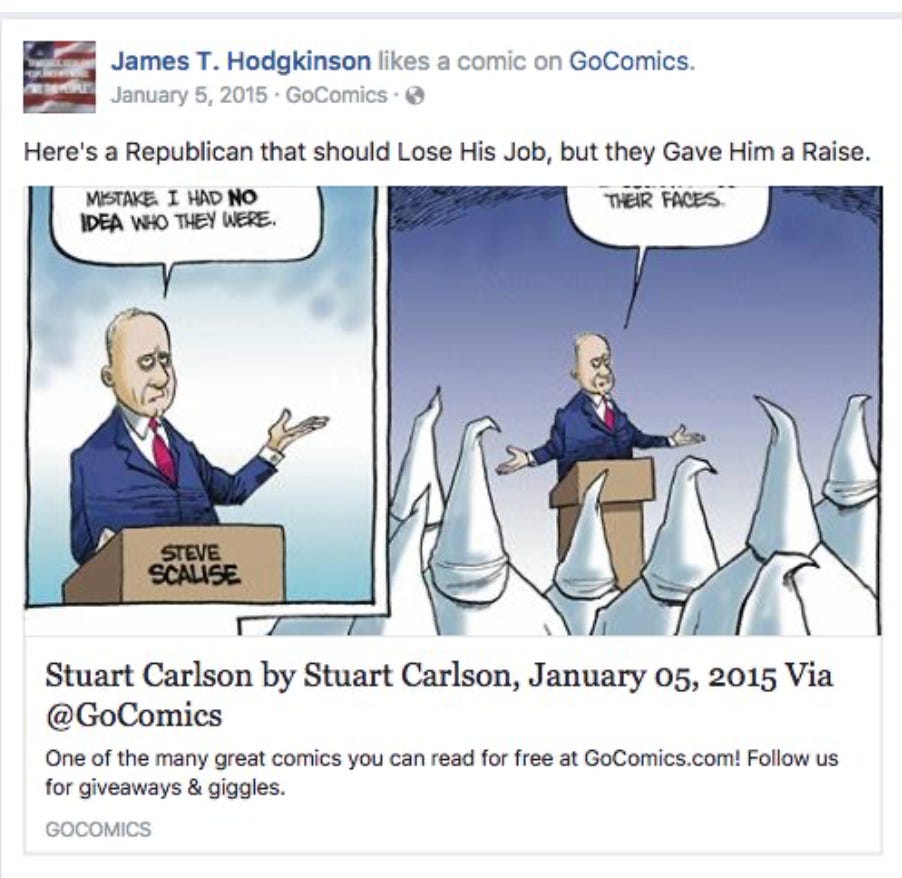
Once Trump was inaugurated in early 2017, the mass shooter’s online messaging began increasingly mirroring the more extreme anti-Trump and anti-GOP voices that did not just condemn the GOP’s ideology but depicted them as grave threats to the Republic. In a March 22 Facebook post, Hodgkinson wrote: “Trump is a Traitor. Trump Has Destroyed Our Democracy. It’s Time to Destroy Trump & Co.” In February, he posted: “Republicans are the Taliban of the USA.” In one Facebook post just days before his shooting spree, Hodgkinson wrote: “I Want to Say Mr. President, for being an ass hole you are Truly the Biggest Ass Hole We Have Ever Had in the Oval Office.” As NBC News put it: “Hodgkinson’s Facebook postings portray him as stridently anti-Republican and anti-Trump.”
Despite the fact that Hodgkinson was a fanatical fan of Maddow, Democracy Now host Amy Goodman, and Sanders, that the ideas and ideology motivating his shooting spree perfectly matched — and were likely shaped by — liberals of that cohort, and that the enemies whom he sought to kill were also the enemies of Maddow and her liberal comrades, nobody rational or decent sought to blame the MSNBC host, the Vermont Senator or anyone else whose political views matched Hodgkinson’s for the grotesque violence he unleashed. The reason for that is clear and indisputable: as strident and extremist as she is, Maddow has never once encouraged any of her followers to engage in violence to advance her ideology, nor has she even hinted that a mass murder of the Republican traitors, fascists and Kremlin agents about whom she rants on a nightly basis to millions of people is a just solution.
It would be madness to try to assign moral or political blame to them. If we were to create a framework in which prominent people were held responsible for any violence carried out in the name of an ideology they advocate, then nobody would be safe, given that all ideologies have their misfits, psychopaths, unhinged personality types, and extremists. And thus there was little to no attempt to hold Maddow or Sanders responsible for the violent acts of one of their most loyal adherents.
The same is true of the spate of mass shootings and killings by self-described black nationalists over the last several years. Back in 2017, the left-wing group Southern Poverty Law Center (SPLC) warned of the “Return of the Violent Black Nationalist.” In one incident, “Micah Xavier Johnson ambushed Dallas police officers during a peaceful protest against police brutality, killing five officers and wounding nine others.” Then, “ten days later, Gavin Eugene Long shot six officers, killing three, in Baton Rouge, Louisiana.” They shared the same ideology, one which drove their murderous spree:
Both Johnson and Long were reportedly motivated by their strong dislike of law enforcement, grievances against perceived white dominance, and the recent fatal police shootings of unarmed black men under questionable circumstances, specifically the shooting deaths of Alton Sterling of Baton Rouge and Philando Castile in Falcon Heights, Minnesota . . .
Needless to say, the ideas that motivated these two black nationalists to murder multiple people, including police officers, is part of a core ideology that is commonly heard in mainstream media venues, expressed by many if not most of the nation’s most prominent liberals. Depicting the police as a white supremacist force eager to kill black people, “grievances against perceived white dominance,” and anger over “the white supremacism endemic in America’s system of governance from the country’s founding” are views that one routinely hears on MSNBC, CNN, from Democratic Party politicians, and in the op-ed pages of The New York Times and The Washington Post.
Yet virtually nobody sought to blame Chris Hayes, Joy Reid, Nancy Pelosi, Jamelle Bouie or New York Times op-ed writers for these shooting sprees. Indeed, no blame was assigned to anti-police liberal pundits whose view of American history is exactly the same as that of these two killers — even though they purposely sought to murder the same enemies whom those prominent liberals target. Nobody blamed those anti-police liberals for the same reason they did not blame Maddow and Sanders for Hodgkinson’s shooting spree: there is a fundamental and necessary distinction between people who use words to express ideas and demonize perceived enemies, and those who decide to go randomly and indiscriminately murder in the name of that ideology.
Since that 2017 warning from the SPLC, there have been many more murders in the name of this anti-police and anti-white-supremacist ideology of black nationalism. In June of last year, the ADL said it had “linked Othal Toreyanne Resheen Wallace, the man arrested and accused of fatally shooting Daytona Beach Officer Jason Raynor on June 23, to several extremist groups preaching Black nationalism.” He had “participated in several events organized by the NFAC… best known for holding armed marches protesting racial inequality and police brutality.” He had a long history of citing and following prominent radical Black anti-police and anti-White ideologues.” Also in June of last year, a 25-year-old man named Noah Green drove a car into a Capitol Hill Police Officer, killing him instantly. The New York Times reported that he follows black nationalist groups, while a former college teammate “recalled that Mr. Green would often talk to fellow players about strategies to save and invest, emphasizing the need to close the wealth gap between white and Black America.”
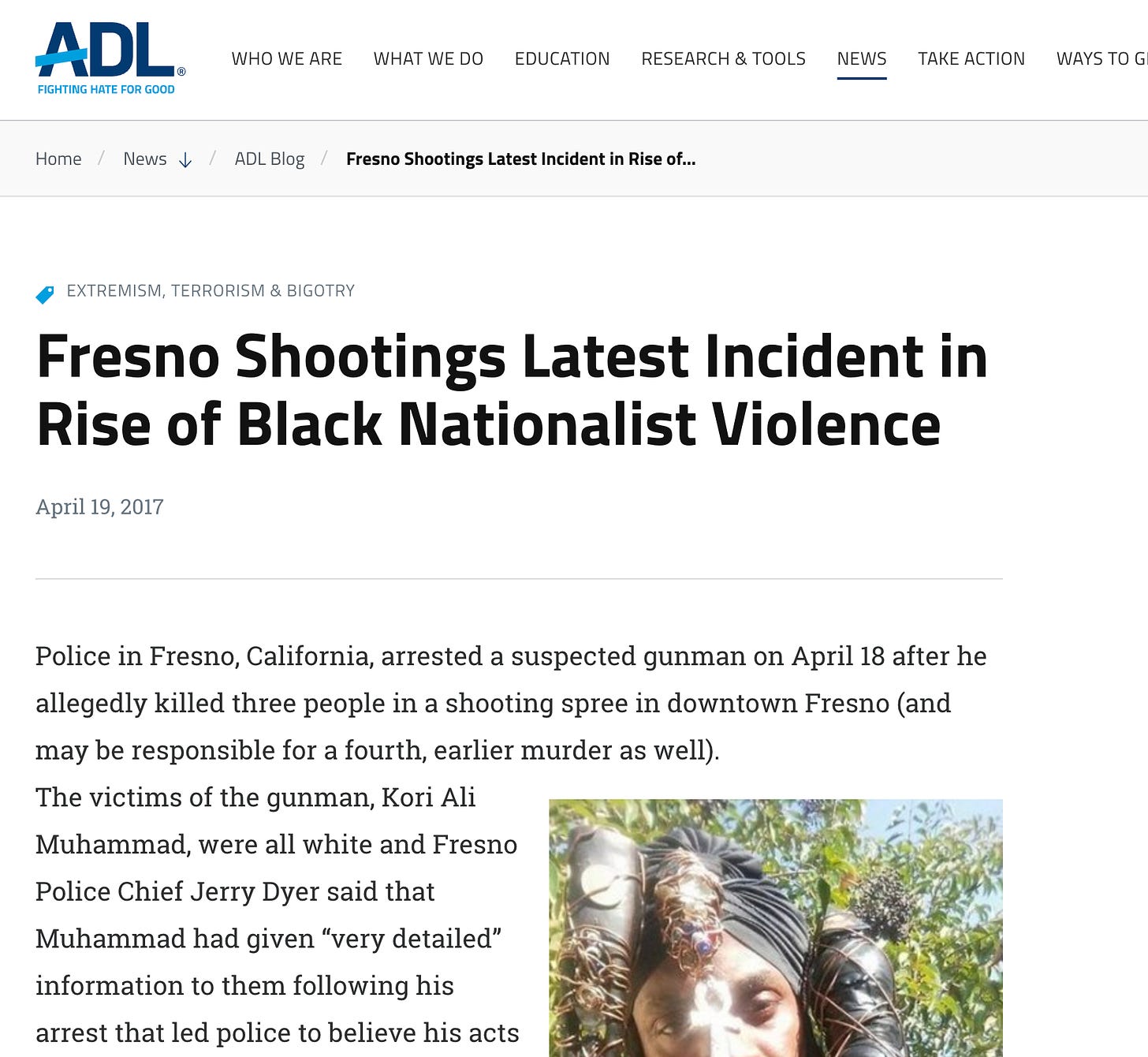
Just last month, a self-identified black nationalist named Frank James went on a terrifying shooting spree in the New York City subway system that injured dozens. He had “posted material on social media linked to black identity extremist ideologies, including the Nation of Islam, Black Panthers, Black Liberation Army, BLM and an image of black nationalist cop-killer Micah Johnson.” Angie Speaks, the brilliant writer who voices the audio version of the articles for this Substack, reported in Newsweek that James had “posted prolifically on social media and hosted a YouTube channel where he expressed Black Nationalist leanings and racial grievances.” In 2019, The New York Times reported that “an assailant involved in the prolonged firefight in Jersey City, N.J., that left six people dead, including one police officer, was linked on Wednesday to the Black Hebrew Israelite movement,” and had written “anti-police posts.”
Most media outlets and liberal politicians correctly refused to assign blame to pundits and politicians who spew anti-police rhetoric, or who insist that the U.S. is a nation of white supremacy: the animating ideas of these murders. Yet in these cases, they go much further with their denialism: many deny that this ideology even exists at all.
“The made-up ‘Black Identity Extremist’ label is the latest example in a history of harassing and discrediting Black activists who dare to use their voices to call out white supremacy,” claimed the ACLU in 2019. PBS quoted a lawyer for an advocacy group as saying: “We’re deeply concerned about the FBI’s ‘black identity extremist’ designation. This is mere distraction from the very real threat of white supremacy… There is no such thing as black identity extremism.” The same year, The Intercept published an article headlined “The Strange Tale of the FBI’s Fictional ‘Black Identity Extremism’ Movement,” which claimed over and over that there is no such thing as black extremism and that any attempt to ascribe violence to this ideology is a lie invented by those seeking to hide the dangers of white supremacy.
It is virtually impossible to find any ideology on any part of the political spectrum that has not spawned senseless violence and mass murder by adherents. “The suspected killer of Dutch maverick politician Pim Fortuyn had environmentalist propaganda and ammunition at his home,” reported CBS News about the assassin, Volkert van der Graaf. Van der Graaf was a passionate animal rights and environmental activist who admitted “he killed the controversial right-wing leader because he considered him a danger to society.” Van der Graaf was particularly angry about what he believed was Fortuyn’s anti-Muslim rhetoric. As a result, “some supporters of Fortuyn had blamed Green party leader Paul Rosenmoeller for “demonizing Fortuyn before he was gunned down in May just before general elections.” In other words, simply because the Green Party leader was highly critical of Fortuyn’s ideology, some opportunistic Dutch politicians sought absurdly to blame him for Fortuyn’s murder by Van der Graaf. Sound familiar?
During the BLM and Antifa protests and riots of 2020, an Antifa supporter, Michael Reinoehl, was the leading suspect in the murder of a Trump supporter, Aaron J. Danielson, as he rode in a truck (Reinoehl himself was then killed by federal agents before being arrested in what appeared to be a deliberate extra-judicial execution, though an investigation cleared them of wrongdoing, as typically happens when federal agents are involved). In 2016, The New York Times reported that “the heavily armed sniper who gunned down police officers in downtown Dallas, leaving five of them dead, specifically set out to kill as many white officers as he could, officials said Friday.” The Paper of Record noted that many believed that anti-police protests would eventually lead to violent attacks on police officers: it “was the kind of retaliatory violence that people have feared through two years of protests around the country against deaths in police custody.”
Then there are the murders carried out in the name of various religions. For the last three decades at least, debates have been raging about what level of responsibility, if any, should be assigned to radical Muslim preachers or Muslim politicians when individuals carry out atrocities and murders in the name of Islam. Liberals insist — correctly, in my view — that it is irresponsible and unfair to blame non-violent Muslims who preach radical versions of religious or political Islam for those who carry out violence in the name of those doctrines. Similar debates are heard with regard to Jewish extremists, such as the Israeli-American doctor Baruch Goldstein who “opened fire in the Cave of the Patriarchs in Hebron, killing 29 Muslim worshippers.” Many insist that the radical anti-Muslim speech of Israeli extremists is to blame, while others deny that there is any such thing as “Jewish terrorism” and that all blames lies solely with the individual who decided to resort to violence.
To be sure, there have been a large number of murders and other atrocities carried out in U.S. and the West generally in the name of right-wing ideologies, in the name of white supremacy, in the name of white nationalism. The difference, though, is glaring: when murders are carried out in the name of liberal ideology, there is a rational and restrained refusal to blame liberal pundits and politicians who advocate the ideology that animated those killings. Yet when killings are carried out in the name of right-wing ideologies despised by the corporate press and mainstream pundits (or ideologies that they falsely associate with conservatism), they instantly leap to lay blame at the feet of their conservative political opponents who, despite never having advocated or even implied the need for violence, are nonetheless accused of bearing guilt for the violence — often before anything is known about the killers or their motives.
In general, it is widely understood that liberal pundits and politicians are not to blame, at all, when murders are carried out in the name of the causes they support or against the enemies they routinely condemn. That is because, in such cases, we apply the rational framework that someone who does not advocate violence is not responsible for the violent acts of one’s followers and fans who kill in the name of that person’s ideas.
Indeed, this perfectly sensible principle was enshrined by the U.S. Supreme Court in the landmark 1982 unanimous free speech ruling in Claiborne v. NAACP. That case arose out of efforts by the State of Mississippi to hold leaders of the local NAACP chapter legally liable for violence carried out by NAACP members on the ground that the leaders’ inflammatory and rage-driven speeches had “incited” and “provoked” their followers to burn white-owned stores and other stores ignoring their boycott to the ground. In ruling in favor of the NAACP, the Court stressed the crucial difference between those who peacefully advocate ideas and ideologies, even if they do so with virulence and anger (such as NAACP leaders), and those who are “inspired” by those speeches to commit violence to advance that cause. “To impose liability without a finding that the NAACP authorized — either actually or apparently — or ratified unlawful conduct would impermissibly burden the rights of political association that are protected by the First Amendment,” ruled the Court.
This principle is not only a jurisprudential or constitutional one. It is also a rational one. Those who express ideas without advocating violence are not and cannot fairly be held responsible for those who decide to pick up arms in the name of those ideas, even if — as in the case of James Hodgkinson — we know for certain that the murderer listened closely to and was influenced by people like Rachel Maddow and Bernie Sanders. In such cases, we understand that it is madness, and deeply unfair, to exploit heinous murders to lay blame for the violence and killings on the doorsteps of our political adversaries.
But when a revolting murder spree is carried out in the name of right-wing ideas (or ideas perceived by the corporate press to be right-wing), everything changes — instantly and completely. In such cases, often before anything is known about the murderer — indeed, literally before the corpses are even removed from the ground where they lie — there is a coordinated effort to declare that anyone who holds any views in common with the murderer has “blood on their hands” and is essentially a co-conspirator in the massacre.
A very vivid and particularly gruesome display of this demented game was on display on Saturday night after a white 18-year-old, Payton Gendron, purposely targeted a part of Buffalo with a substantial black population. He entered a supermarket he knew was frequented largely by black customers and shot everyone he found, killing 10 people, most of them black. A lengthy, 180-page manifesto he left behind was filled with a wide variety of eclectic political views and ideologies.
In that manifesto, Gendron described himself as a “left-wing authoritarian” and “populist” (“On the political compass I fall in the mild-moderate authoritarian left category, and I would prefer to be called a populist”). He heaped praise on an article in the socialist magazine Jacobin for its view that cryptocurrency and Bitcoin are fraudulent scams. He spoke passionately of the centrality and necessity of environmentalism, and lamented that “the state [has] long since heavily lost to its corporate backers.” He ranted against “corporate profits and the ever increasing wealth of the 1% that exploit the people for their own benefit.” And he not only vehemently rejected any admiration for political conservatism but made clear that he viewed it as an enemy to his agenda: “conservatism is corporatism in disguise, I want no part of it.”
But by far the overarching and dominant theme of his worldview — the ideology that he repeatedly emphasized was the animating cause of his murder spree — was his anger and fear that white people, which he defines as those of European descent, were being eradicated by a combination of low birth rates and mass immigration. He repeatedly self-identified as a “racist” and expressed admiration for fascism as a solution. His treatise borrowed heavily from, and at times outright plagiarized, large sections of the manifesto left behind by Brenton Tarrant, the 29-year-old Australian who in 2019 murdered 51 people, mostly Muslims, at two mosques in New Zealand. Gendron’s manifesto included a long list of websites and individuals who influenced his thinking, but made clear that it was Tarrant who was his primary inspiration. Other than extensive anti-Semitic sections which insisted that Jews are behind most of the world’s powerful institutions and accompanying problems, it was Tarrant’s deep concern about what he perceived is the disappearance of white people that was also Gendron’s principal cause:
If there’s one thing I want you to get from these writings, it’s that White birth rates must change. Everyday the White population becomes fewer in number. To maintain a population the people must achieve a birth rate that reaches replacement fertility levels, in the western world that is about 2.06 births per woman…
In 2050, despite the ongoing effect of sub-replacement fertility, the population figures show that the population does not decrease inline with the sub-replacement fertility levels, but actually maintains and, even in many White nations, rapidly increases. All through immigration. This is ethnic replacement. This is cultural replacement. This is racial replacement. This is WHITE GENOCIDE.
Within literally an hour of the news of this murder spree in Buffalo — far too little time for anyone to have even carefully read all or most of Gendron’s manifesto, and with very little known about his life or activities — much of the corporate press and liberal pundit class united to reveal the real culprit, the actual guilty party, behind this murder spree: Fox News host Tucker Carlson. So immediate and unified was this guilty verdict of mob justice that Carlson’s name trended all night on Twitter along with Buffalo and Gendron.
The examples of liberal pundits instantly blaming Carlson for this murder are far too numerous to comprehensively cite. “Literally everyone warned Fox News and Tucker Carlson that this would happen and they fucking laughed and went harder,” decreed Andrew Lawrence of the incomparably sleazy and dishonest group Media Matters, spawned by ultimate sleaze-merchant David Brock. “The Buffalo shooter… subscribed to the Great Replacement theory touted by conservative elites like Tucker Carlson and believed by nearly half of GOP voters,” claimed The Washington Post‘s Emmanuel Felton. “See if you can tell the difference between [Gerdon’s manifesto on ‘white Replacement’] and standard fare on the Tucker Carlson show,” said Georgetown Professor Don Moynihan. “The racist massacre in Buffalo rest [sic] at the feet of Donald Trump, Tucker Carlson, and the GOP,” decreed Hollywood’s nepotism prince Rob Reiner. The shooter was inspired by “a white nationalist conspiracy theory that Tucker Carlson has defended on his show,” was the verdict of The Huffington Post‘s Philip Lewis less than six hours after the shooting spree began. And on and on.
That Carlson was primarily responsible for the ten dead people in Buffalo was asserted despite the fact that there was no indication that Gendron even knew who Carlson was, that he had ever watched his show, that he was influenced by him in any way, or that he admired or even liked the Fox host. Indeed, in the long list of people and places which Gendron cited as important influences on him — “Brenton Tarrant, [El Paso shooter] Patrick Crusius, [California Jewish community center killer], John Earnest, [Norwegian mass murderer] Anders Breivik, [Charleston black church murderer] Dylann Roof, etc.” — nowhere does he even allude to let alone mention any Fox News host or Carlson.
To the contrary, Gendron explicitly describes his contempt for political conservatism. In a section entitled “CONSERVATISM IS DEAD, THANK GOD,” he wrote: “Not a thing has been conserved other than corporate profits and the ever increasing wealth of the 1% that exploit the people for their own benefit. Conservatism is dead. Thank god. Now let us bury it and move on to something of worth.” In this hated of conservatism, he copied his hero Brenton Tarrant, who also wrote that “conservatism is corporatism in disguise, I want no part of it,” adding about conservatives:
They don’t even BELIEVE in the race, they don’t even have the gall to say race exists. And above all they don’t even care if it does. It’s profit, and profit alone that drives them, all else is secondary. The notion of a racial future or destiny is as foreign to them as social responsibilities.
So desperate and uncontrolled was this ghoulish attempt to blame Carlson for the Buffalo shootings that my email inbox and social media feeds were festering with various liberal pundits demanding to know why I had not yet manifested my views of this shooting — as though it is advisable or even possible to formulate definitive opinions about a complex mass murder spree that had just taken place less than five hours before. “Still working on your talking points to defend your buddy Tucker or are you holding off on trying out your deflections until the bodies get cold?,” wrote a pundit named Jonathan Katz at 6:46 pm ET on Saturday night in a highly representative demand — just four hours after the shooter fired his first shot. Demands to assert definitive opinions about who — other than the killer — is to blame for a mass murder spree just hours after it happened can be called many things; “journalistic” and “responsible” are not among them.
As it happened, I was on an overnight international flight on Saturday and into Sunday morning; I deeply apologize for my failure to monitor and speak on Twitter twenty-four hours a day. But even if I had not been 40,000 feet in the air, what kind of primitive and despicably opportunistic mindset is required not only to opine so definitively about how your political opponents are guilty of a heinous crime before the corpses are even taken away, but to demand that everyone else do so as well? In fact, Katz was particularly adamant that I opine not just on the killings but on the list of pundits I thought should be declared guilty before, in his soulless words, “the bodies get cold” — meaning that I must speak out without bothering to take the time to try to understand the basic facts about the killer and the shootings before heaping blame on a wide range of people who had no apparent involvement.
But this is exactly the morally sick and exploitative liberal mentality that drives the discourse each time one of these shooting sprees happen. Rachel Maddow had far more known connections to Scalise’s shooter James Hodgkinson than Carlson has to Gendron. After all, as Maddow herself acknowledged, Hodgkinson was a fan of her show and had expressed his love and admiration for her. His animating views and ideology tracked hers perfectly, with essentially no deviation. And yet — despite this ample evidence that he was influenced by her — it would never occur to me to blame Maddow for Hodgkinson’s shooting spree because doing so would be completely demented, since Maddow never told or suggested to anyone that they go out and shoot the political enemies she was depicting as traitors, Kremlin agents, plotters to overthrow American democracy and replace it with a fascist dictatorship, and grave menaces to civil rights and basic freedom.
The attempt to blame Carlson for the Buffalo shootings depended entirely on one claim: Carlson has previously talked about and defended the view that immigration is a scheme to “replace” Americans, and this same view was central to Gendron’s ideology. Again, even if this were true, it would amount to nothing more than a claim that the shooter shared key views with Carlson and other conservative pundits — exactly as Hodgkinson shared core views with Maddow and Sanders, or the numerous murderers who killed in the name of black nationalism shared the same views on the police and American history as any number of MSNBC hosts and Democratic Party politicians, or as Pim Fortuyn’s killer shared core views with animal rights activists and defenders of Muslim equality (including me). But nobody is willing to apply such a framework consistently because it converts everyone with strong political views into murderers, or at least being guilty of inciting murder.
But all bets are off — all such principles or moral and logical reasoning are dispensed with — when an act of violence can be pinned on the political enemies of liberals. If a homicidal maniac kills an abortion doctor, then all peaceful pro-life activists are blamed. If an LGBT citizen is killed, then anyone who shares the views that Barack Obama and Hillary Clinton had until 2012 about marriage equality is blamed. If a police officer unjustifiably kills a black citizen, all police supporters or those who dissent from liberal orthodoxy on racial politics are decreed guilty. But liberals are never at fault when right-wing politicians are murdered, or police officers are hunted and gunned down by police opponents, or an anti-abortion group is targeted with firebombing and arson, as just happened in Wisconsin, or radical Muslims engage in random acts of violence. By definition, “moral reasoning” that is applied only in one direction has nothing to do with morality and everything to do with crass, exploitative opportunism.
Though it does not actually matter for purposes of assigning blame, it is utterly false to claim that Carlson’s ideology — including on “replacement” — is the same as or even related to the views expressed by the killers in Buffalo or New Zealand. Indeed, in key respects, they are opposites. Both Tarrant and Gendron targeted citizens of the countries in which they carried out their murder spree. They justified doing so on the ground that any non-white citizen is automatically an “invader,” regardless of how long they have been in the country or how much legal status they have. “It would have eased me if I knew all the blacks I would be killing were criminals or future criminals, but then I realized all black people are replacers just by existing in White countries,” Gendron wrote.
To claim that Carlson ever said anything remotely like this or believes it is just an outright lie. Indeed, with great frequency, Carlson says that the priority of the U.S. Government should be protection of and concern for American citizens of all races. Tarrant and Gendron believe and explicitly say that any non-white citizen of a European country is automatically an “invader” who must be killed and/or deported to turn the country all-white. Carlson believes the exact opposite: that the proper citizenry of the United States is multi-racial and that Black Americans and Latin Americans and Asian-Americans are every bit as much U.S. citizens, with all of the same claims to rights and protections, as every other American citizen. His anti-immigration and “replacement” argument is aimed at the idea — one that had been long mainstream on the left until about a decade ago — that large, uncontrolled immigration harms American citizens who are already here. There is no racial hierarchy in Carlson’s view of American citizenship and to claim that there is is nothing short of a defamatory lie.
But even if these liberal smear artists were telling the truth, and Carlson’s view of immigration and “replacement” were similar or even precisely identical to Gendron’s, one could certainly say that Carlson holds immoral and despicable views. But he would still no more carry blame for the Buffalo murders than liberal pundits have blood on their hands for countless massacres carried out in the name of political causes they support and theories they espouse, whether it be animus toward the police or anti-imperialism or opposition to Israeli occupation of the West Bank or the belief that the United States is a fundamentally racist country or the view that the GOP is a fascist menace to all things decent.
The distinction between peaceful advocacy even of noxious ideas and those who engage in violence in the name of such ideas is fundamental to notions of fairness, justice and the ability to speak freely. But if you really want to claim that a public figure has “blood on their hands” every time someone murders in the name of ideas and ideologies they support, then the list of people you should be accusing or murder is a very, very long one indeed.
Who is responsible for unethical behavioural ‘nudges’? Not the SPI-B, claims their co-chair
psychologists intent on passing the buck
Health Advisory & Recovery Team | May 13, 2022
As described in a previous HART bulletin, there has been a pervasive reluctance for the powers-that-be to discuss the questionable ethics of the covert behavioural-science techniques used by the Government throughout the covid-19 messaging campaign. The British Psychological Society (BPS) – the organisation with the formal remit to ensure the ethical use of psychological techniques in the UK – could see nothing amiss in the strategic deployment of fear, shame and scapegoating as a means of promoting compliance with the pandemic restrictions. On the contrary, the BPS is ‘incredibly proud’ of the work done by the ‘nudgers’ who advised the Government, arguing that these practitioners were exempt from the requirement to obtain informed consent from the British people on the grounds that they were demonstrating ‘social responsibility’. Likewise, the Behavioural Insights Team (BIT) – ‘the government institution dedicated to the application of behavioural science to policy’, whose employees are embedded in the SAGE advisory groups and across many government departments – denied any responsibility, claiming (via a personal message) that ‘none of the examples you reference were actually our work or anything we worked on at all, and we categorically do not believe in using fear as a tactic’. And a formal request to a Commons select committee asking for an independent inquiry into the state’s deployment of behavioural science has been declined, an administrator stating ‘there are no current plans’ to undertake such a review.
So when Professor Ann John (co-chair of the Scientific Pandemic Insights Group on Behaviour [SPI-B]) was scheduled to appear in front of the Government’s Science and Technology Committee on the 30th March 2022, hopes were raised that someone in a position of authority might finally acknowledge some accountability for inflicting fear, shame and scapegoating upon the British people.
The SPI-B was the behavioural-science subgroup of SAGE with the remit to offer government the ‘best possible behavioural science advice’ to inform the response to covid-19, by providing ‘strategies for behaviour change, to support control of and recovery from the epidemic and associated government policy’. In relation to culpability for promoting unethical ‘nudges’, the (now notorious) SPI-B minutes dated 22nd March 2020 exposed their early involvement in the strategy to frighten people into compliance: ‘A substantial number of people still do not feel sufficiently personally threatened … The perceived level of personal threat needs to be increased among those who are complacent, using hard-hitting emotional messaging’. Nor was the group averse to recommending shame and scapegoating, the same minutes detailing how ‘Communication strategies should provide social approval for desired behaviours’ and that ‘members of the community can be encouraged to provide it to each other’. More ominously, the ‘nudgers’ advised ministers to, ‘Consider use of social disapproval for failure to comply’ and then warned that ‘this needs to be carefully managed to avoid victimisation, scapegoating and misdirected criticism’.
Further incriminating evidence about the involvement of the SPI-B in promoting unethical practices is provided in Laura Dodsworth’s book, A State of Fear: how the UK government weaponised fear during the Covid-19 pandemic. In the book, several SPI-B members expressed concern about the group’s outputs, including accusations that ‘they went overboard with the scary messages’ and that their use of fear was ‘dystopian’ and ‘ethically questionable’.
Given this range of evidence pointing to the SPI-B as a major generator of unethical ‘nudges’, HART hoped that the group’s co-chair, Professor John, would use her appearance at the Science and Technology Committee as an opportunity for an expert in a position of power to acknowledge errors. Or maybe even express humility, talk about lessons learned, apologise and pledge to never err in this way again.
Sadly, not a bit of it.
During her interview, Professor John denied any responsibility for the unethical use of covert psychological strategies. When the incriminating minutes of the 22nd March 2020 were brought to her attention she responded, ‘I was not actually sitting on the SPI-B then’. When further pressed on this issue, Professor John implausibly claimed that her group counselled against using scare tactics as a way of increasing compliance with covid-19 restrictions, stating ‘We never advised on upping the level of fear. I think it was presented as part of the evidence base … we absolutely advised that fear does not work’.
In contradiction of her group’s terms of reference, she insisted that the SPI-B was not trying to change people’s behaviour, but instead pursuing the altruistic motive of ‘ensuring that disproportionate and unintended impacts were not felt by different sectors of society’. When asked which ethical framework her group was operating within, she shirked any responsibility for ensuring the morality of her group’s output, saying that, ‘although we present the advice, where policy decisions are made the Government have an advisory group on ethics’.
The BPS, the BIT, and now the SPI-B have all denied any responsibility for the Government’s ethically-dubious use of fear, shame and scapegoating throughout its covid-19 messaging campaign. Not only is their repudiation of active involvement implausible, but there has been no attempt by these influential stakeholders to account for their silence while the British public were being manipulated and psychologically abused in plain sight. If – as seems likely – no behavioural-science experts are going to acknowledge culpability for this unprecedented psychological warfare, it is imperative that an independent inquiry takes place to identify the true miscreants.
Featured Video

AIDS Inc. by Gary Null (2007)
or go to
Aletho News Archives – Video-Images
From the Archives
Clash of Civilization, Iran Part II
By Jamal Kanj – Intifada-Palestine.com – January 14, 2011
Israel’s survival kit is: perpetuate conflict, insecurity to rationalize collective hate and finally playing victim.
Devoid of conflict, Israel implodes internally; without hate, Zionism loses its justification; and playing eternal victim to continue blackmailing the West. Absence of this holy trinity, Israel ceases to exist.
From its inception, the house of Zion has mastered exploiting adversarial powers to advance Israel’s cause. For instance, their influence over the Democratic Party in the US began with President Truman’s bid for 2nd term election in 1948.
Responding to strong opposition from Secretary of State General George Marshall and Department experts urging against recognition of Israel, President Truman replied: “I’m sorry gentlemen but I have to answer to hundreds of thousands [Jewish voters] who are anxious for the success of Zionism. I do not have hundreds of thousands of [voting] Arabs among my constituents”
Zionists influence over liberal American politics was matched with the doctrinal school of Conservative theoreticians aligning the Republican Party’s platform with Israel’s objectives. The Neoconservative Zionists, coined Zioncons, invented the “Clash of Civilization” concept to fight Israel’s wars. … continue
Blog Roll
 Aletho News
- Merck Virologists Admitted to Falsely Certifying Vaccine Efficacy
- Mandatory Folic Acid for every man, woman & child
- Pro-Palestine protesters arrested outside UK’s ruling Labour Conference in Liverpool
- Mauritius denies landing permit to flight from Israel, forcing cancellation: Tour operator
- Israeli finance minister calls for genocidal war on West Bank, annexation of south Lebanon
- 12 Things Your Psychiatrist Was Trained Not to Tell You
- From Unipolar Universalism to Multipolar Civilizational Distinctiveness
- RSF military group defects, joins Sudanese army: State media
- Ireland goalkeeper refuses to play ‘Israel’ as squad weighs boycott
- China pushes back against US on Cuba, Iran
- If Americans Knew
- Israel forces Gazans to live in constant peril – Daily Update
- Deconstructing Netanyahu’s pants-on-fire UN rant – Daily Update
- Trump betrayed voters with his campaign lies and prioritized a foreign country once he took office
- Netanyahu calls Israel’s war in Gaza ‘opposite of genocide’ in UN speech to near-empty hall
- Settler Kidnappings: Torture, Sexual Abuse and Terrorisation of Palestinian Abductees as Israel Deepens Annexation of West Bank
- Gaza winter nears as 162,000 tents become unusable, raising fears of humanitarian crisis
- Netanyahu says, “It’s the opposite of genocide”; UN says Gaza economy is world’s ‘most severe crisis on record’ – Daily Update
- Israel’s US-Backed Assault on Gaza Has Created the ‘World’s Most Severe Economic Crisis on Record’: UN
- ‘Protecting U.S. Citizens’… From Israel
- ‘This is where I live now, the back of a truck’: a day in the life of a grandmother in Gaza
- No Tricks Zone
- New Study: Earth And Venus Surface Warmth Largely Explained By Convection And Lapse Rate, Not CO2 Or Radiation
- 2025 Nature Paper Claiming Worsening Global Drought Gets RETRACTED …Heavily Flawed
- New Study: ‘Global Drought Shows No Detectable Recent Acceleration Under Climate Warming’
- Economic Masterminds: German Socialists Suggest Taxing Productivity Gains Stemming From Using AI
- The South China Sea Has Not Been Cooperating With The Climate Change Narrative
- Energy Crisis: Germany Enters Heating Season With Historically Low Gas Reserve Fill Levels
- New Study: The Antarctic Ice Sheet Gained Mass From 2020-2024 Due To Staggering Snow And Ice Accumulation
- Study: Ocean Heating Rates From Thousands Of Years Ago ‘Dwarf’ Modern Ocean Heating Rates
- Climate Extremists Target, Attack Large-Scale Power Grid Infrastructure In Germany!
- New Study: Antarctic Ice Melt Has Contributed Less Than 1 Centimeter To Sea Level Rise In The Last 30 Years

