Ukrainian strike on Donetsk market was a terrorist act

© Eva Bartlett
By Eva Bartlett | Samizdat | April 30, 2022
If the Donetsk marketplace that was hit by rocket artillery on Thursday had been in a city controlled by Kiev, the names and faces of the five civilians killed would be on all major news sites. But because it was another Ukrainian attack on civilians in the Donetsk People’s Republic (DPR), the deaths and 23 additional civilians injured will almost certainly go unreported, as has the been the norm during the regime’s eight years of the Donbass and Western media’s eight years of ignoring the attacks.
According to the DPR’s Healthcare Ministry, “The strike at the Tekstilschik neighbourhood in the Kirovsky district killed four people on the spot. One patient died in an ambulance during the transportation.”
With another journalist, I went in a taxi to the bombed markets. Two of the dead still lay at the site when we arrived, splayed on the ground. The other bodies had already been removed, but traces of their blood remained on the ground, doors nearby were riddled with shrapnel holes and debris from the strike was all around.
Presumably, rescue workers dealt with the injured first and didn’t prioritize retrieving all the dead as further Ukrainian strikes were possible. I saw this during my experience in Gaza, where Israeli’s waited for people to come to the scene of their attack, then bombed again.
According to Gennady Andreevich, a local employee of the district’s safety commission, at 11:40 am Grad missiles struck two different nearby markets: the vegetable and clothing market where the bodies lay, and a household chemicals and building materials market across and down the street. The latter was far more damaged, stalls completely burnt out, but no one was killed there.
Gennady walked with us to the vegetable market, speaking about previous Ukrainian attacks–which have been happening since 2014. More recent shellings hit near a gas station outside the market, at a residential building beyond the market, and in his own market administrative building, killing two colleagues.
He noted that at this time of day the market would have been filled with people, and that Ukraine knows very well what it is firing at.
“They know there is a market here and that from 10am to 1pm there are many people here,” Gennady said as we walked past shops.
This is a completely civilian area, no military installations.
Who else attacks markets and public spaces?
Striking crowded markets and streets at a busy time of the day is something terrorists in Syria did for years, to the silence of Western media. It is something Israel has also done for a long time, hitting residential and public areas of Gaza–one of the most densely inhabited places on earth.
During the 2009 war on Gaza, Israel bombed crowded mosques, hospitals, and buildings housing displaced Palestinians. One of the more notable incidents was when Tel Aviv targeted a UN-run school in Jabaliya sheltering nearly 1,500 people. At least 40 were killed. Another horrific attack on a crowded place was in the Zeitoun district, after Israeli soldiers forced at gunpoint nearly 100 of the extended Samouni family into one home and later bombed it, killing 48 members of the clan.
During the war, I accompanied medics in their ambulances, documenting Israel’s war crimes. A medic (Arafa abd al-Dayem) I had accompanied was killed one day when the Israeli army fired a prohibited flechette (dart) shell directly at him and the ambulance he stood beside. The following day, Israel struck the crowded mourning tents, also with flechettes, killing six and injuring 25 of the relatives and friends who had gathered in one small space to mourn Arafa’s death.
Damascus’ old city is a maze of twisting lanes, overlapping houses, churches, mosques, schools, crowded outdoor eateries, and markets. Terrorist factions occupying eastern Ghouta shelled most frequently when children would be going to or from school, people to markets.
Having spent a lot of time in the East Gate and Thomas Gate areas of the old city, I experienced the shelling and, unfortunately, acquired many accounts of the terrorists shelling crowded places.
Even today, walking around Old Damascus, you’ll find the imprint of mortar blasts. And if you do walk those lanes, you’ll see how crowded they usually are, meaning many people would have been injured and killed per single mortar blast.
In mid April 2014, for example, they hit an elementary school and a kindergarten, killing one child and injuring 65 more, just some of the countless children killed and injured by shelling over the years.
Incidentally, I later wrote about how the BBC were present at the same hospital where I saw these injured children, and were told explicitly that terrorists were mortaring the city every single day. The BBC article that later followed included the line: “the government is also accused of launching them into neighborhoods under its control.”
I also wrote about terrorist bombings of Aleppo, citing one day in November 2016 when I was in the city, which by the end of the day killed 18 and injured more than 200 civilians. These were some of the nearly 11,000 civilians killed in Aleppo alone by terrorist attacks on homes and public places.
I could continue citing such acts of terrorism in Syria, in Palestine, elsewhere, but I’ve made my point: when Ukraine bombs a crowded market, it is an intentional act of terrorism. As is Ukraine’s relentless bombing of homes in the Donbass republics these past eight years.
Western Media won’t report on this; Western politicians won’t condemn this; virtue signallers won’t speak about this. And when you actually go and document it, they will silence you relentlessly.

© Eva Bartlett
My initial tweet about the market attack was predictably trolled, with comments claiming the bodies were fakes, the bombing never occurred, “prove it” sort of remarks.
Since my observations and photos, as well as Gennady’s testimony, will still not be proof enough, in my video I also included footage taken by a local who was in the market when it was bombed and filmed the immediate aftermath. Gennady himself showed photos on his phone of firefighters dousing the flames, and scenes of the wounded and dead, clearly surrounded by new bomb debris.
But this is what we’ve come to today: Ukraine, often using weapons acquired from the West, can continue to bomb busy civilian areas of the Donbass republics, killing still more civilians, and not only do the hypocrites of the West so keen to accuse Russia of war crimes (which they can never prove and often contradict themselves over), but media and troll farms work in lockstep to gaslight the public and whitewash Ukraine’s war crimes.
Eva Bartlett is a Canadian independent journalist. She has spent years on the ground covering conflict zones in the Middle East, especially in Syria and Palestine (where she lived for nearly four years).
New bill aims to dissolve Biden administration’s Disinformation Governance Board
Defund the Department of Homeland Security
By Dan Frieth | Reclaim The Net | April 30, 2022
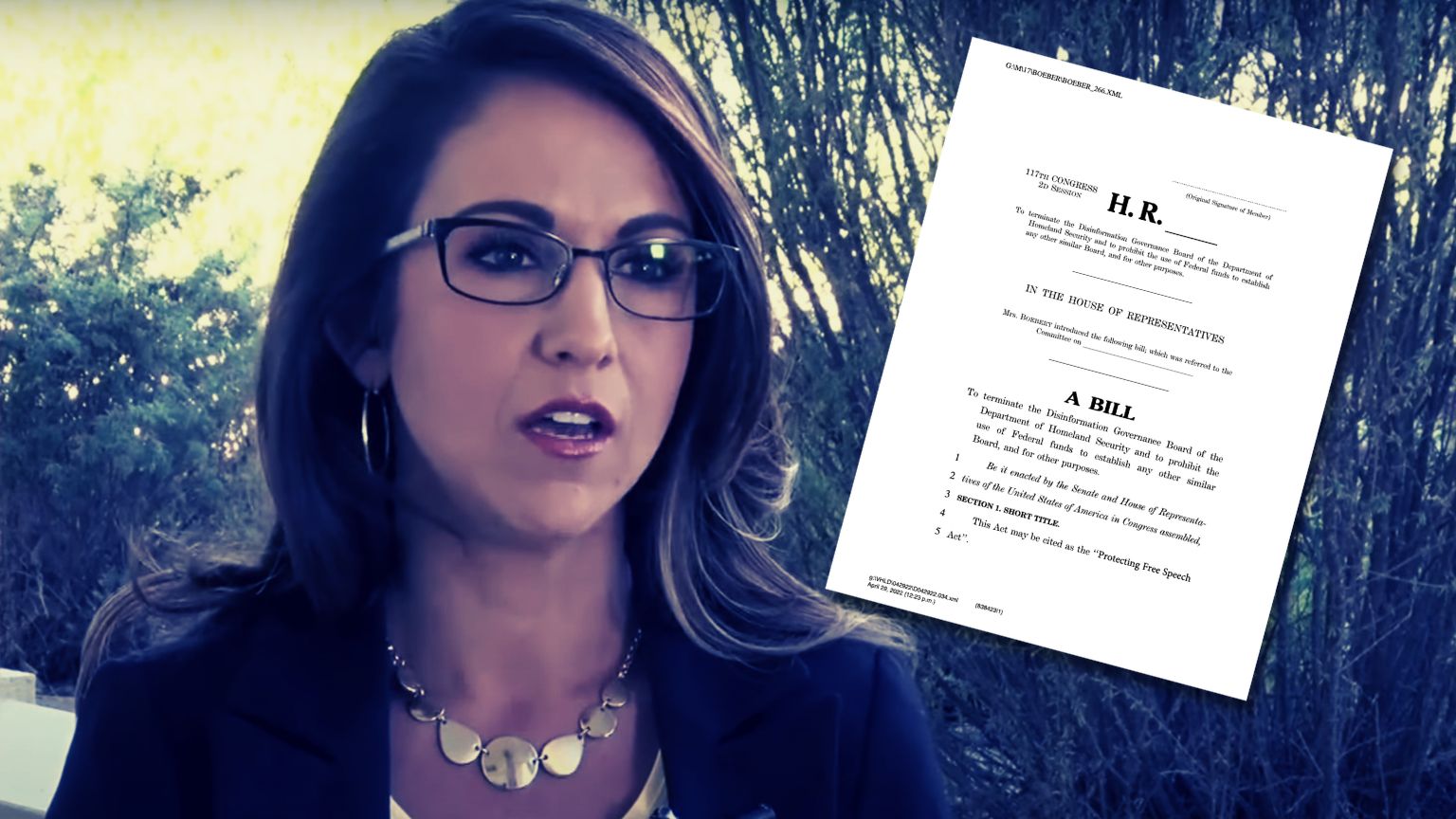
Rep. Lauren Boebert is leading the way in introducing a bill to defund the newly formed Disinformation Governance Board, under the Department of Homeland Security (DHS).
We obtained a draft copy of the bill for you here.
“This kind of stuff is terrifying. We in Congress have the power of the purse. It is our duty to shut down this department immediately,” Boebert told Fox. “I’m calling on leadership in the Republican Party – Leader McCarthy, Whip Scalise, and others — to join me in calling for this department to be shut down and defunded.”
The new board will focus on Russian propaganda and “misinformation” spread by and about human traffickers at the border.
The head of the board, Nina Jankowicz has previously been accused of spreading misinformation. She called the New York Post’s Hunter Biden laptop story Russian disinformation. The authenticity of the laptop has since been proven.
“No tax dollars should go to where Biden can use the power of the federal government to silence truthful stories like Big Tech did with the Hunter Biden story,” Boebert said.
Boebert compared the formation of the new board to the draconian world in George Orwell’s book “1984.”
“Democrats took that [book] not as a warning, but as a guide,” she added.
Boebert is looking for cosponsors for the bill, which she is expected to introduce next week.
“This really is a department of propaganda,” Boebert said. “To say that the federal department has a say in what’s right and what’s wrong. What’s truth and what is not. This is a very dangerous place that we’ve come to.”
Syria grants amnesty for terrorist crimes
Samizdat | April 30, 2022
Syrian President Bashar Assad issued a decree on Saturday granting amnesty to Syrians for terrorist crimes up to the end of April, except those leading to death. Assad has extended similar olive branches to deserters, criminals and opposition fighters before, often to the displeasure of the US.
Assad’s decree, first reported by Syrian state media on Saturday, “grants a general amnesty for terrorist crimes committed by Syrians before [Saturday], except for those that led to the death of a person.”
While the pardon frees terrorists from criminal prosecution, it does not exempt them from civil lawsuits brought by those they may have harmed.
Those pardoned would have been prosecuted under a 2012 anti-terrorism law and a 1949 provision of Syria’s legal code, and as such will affect the various terrorist groups fighting in Syria’s civil war, which began in 2011. Assad, with the help of Russian forces, has broadly succeeded in maintaining control of Syria against a collection of opposition militias and terrorist groups like Islamic State (IS, formerly ISIS) and Al-Nusra Front.
Throughout more than a decade of war, Assad has periodically offered pardons to his opponents. Military deserters who didn’t take up arms with terrorists were given amnesty in 2018 and allowed to return to Syria, while a general amnesty for misdemeanors and juvenile crimes was granted in 2021.
However, at the outset of the Syrian Civil War in 2011, Assad attempted to offer opposition fighters amnesty in exchange for surrender. This offer was rejected by the United States, with State Department official Victoria Nuland advising the opposition to ignore Assad’s offer and continue fighting.
The Syrian Foreign Ministry at the time accused Washington of “inciting sedition” with this advice and “supporting acts of killing and terrorism.” The war would continue, and Nuland would go on to oversee the violent overthrow of democratically elected President Viktor Yanukovych in Ukraine in 2014, and is currently shaping US policy on Ukraine as President Biden’s under secretary of state for political affairs.
Iran: Politicization of Syria’s chemical-weapons file harms OPCW credibility
Press TV – April 30, 2022
Iran’s deputy permanent representative to the UN has decried the politicization of the Syrian chemical-weapons file by certain countries, stressing that the move will endanger the credibility and authority of the Organization for the Prohibition of Chemical Weapons (OPCW), the global chemical watchdog.
Zahra Ershadi made the remarks in an address to the UN Security Council session titled “The situation in the Middle East: (Syria – Chemical)” on Friday, during which she strongly condemned the use of chemical weapons anywhere, by anyone, and under any circumstances.
Ershadi stressed the implementation of the Chemical Weapons Convention (CWC) and said the treaty aims to protect humanity from the devastating repercussions and scourge of the use of chemical weapons.
“We reiterate our call for the full, effective, non-political, and non-discriminatory implementation of the CWC, and preserving the OPCW’s authority as well. We believe that politicizing the implementation of the Convention and exploiting the OPCW for politically motivated agendas endangers the Convention’s credibility and also the Organization’s authority,” the Iranian envoy to the UN said.
“We also emphasize that any investigation into the use of chemical weapons must be impartial, professional, credible, and objective in order to establish the facts and reach evidence-based conclusions, and in doing so it must strictly adhere to the provisions and procedures within the framework of the Convention; no deviation from the Convention shall be permitted,” she added.
Underlining Syria’s strenuous efforts to meet its CWC obligations, she said the country has shown its willingness to collaborate with the OPCW.
“However, it is disappointing that certain States Parties have politicized the Syrian chemical weapons file, preventing the OPCW from confirming Syria’s compliance with its obligations, which could have resulted in constructive dialogue and cooperation with Syria,” Ershadi said.
“We recognize the critical importance of the Syrian government’s efforts to fulfill its obligations under the Convention,” she further added.
Ershadi also expressed Iran’s support for the approach taken by OPCW and Syria to hold a high-level dialogue and hoped that the initiative would yield positive results.
OPCW, CWC ‘politically biased’
Ershadi’s remarks came after the US accused Syria of flouting the CWC and obstructing the OPCW’s inspectors on Friday, which marked the 25th anniversary of the implementation of the landmark treaty.
Responding to the US accusations, Syrian ambassador Bassam Sabbagh said the inspectors had been denied access because of a “lack of objectivity and professionalism.”
Sabbagh also accused the OPCW and the CWC of political bias.
Russian Ambassador Vasily Nebenzya said the convention had become a “punitive” instrument wielded in the interests of a “narrow group of countries” against Syria.
“At its 25th anniversary, the OPCW has very serious systemic problems and a tarnished reputation,” Nebenzya noted. “Russia unconditionally supports the CWC and is committed to its letter and spirit. What gives rise to question to us is how its provisions are being implemented by the OPCW.”
Moscow and Damascus have on many occasions said members of the so-called White Helmets civil defense group stage gas attacks in a bid to falsely incriminate Syrian government forces and fabricate pretexts for military strikes by the US-led military coalition.
The group, which claims to be a humanitarian NGO, has long been accused of collaborating with anti-Damascus militants.
On April 14, 2018, the US, Britain, and France carried out a string of airstrikes against Syria over a suspected chemical weapons attack on the city of Douma, located about 10 kilometres northeast of the capital Damascus.
Washington and its allies blamed Damascus for the Douma attack, a charge the Syrian government rejected.
According to concealed OPCW documents that were revealed later, the investigators of the Douma incident had found “no evidence” of a chemical weapons attack.
However, the organization censored the findings under pressure from the US and its allies to conceal evidence undermining the pretext of the ensuing US-led bombing of Syria.
Syria surrendered its stockpile of chemical weapons in 2014 to a joint mission led by the United States and the OPCW, which oversaw the destruction of the weaponry.
The Arab country has consistently denied the use of chemical weapons despite Western rhetoric.
HOW COULD THE U.S. HELP TO BRING PEACE TO UKRAINE?
BY NICOLAS J. S. DAVIES | BLACKLISTED NEWS | APRIL 28, 2022
On April 21st, President Biden announced new shipments of weapons to Ukraine, at a cost of $800 million to U.S. taxpayers. On April 25th, Secretaries Blinken and Austin announced over $300 million more military aid. The United States has now spent $3.7 billion on weapons for Ukraine since the Russian invasion, bringing total U.S. military aid to Ukraine since 2014 to about $6.4 billion.
The top priority of Russian airstrikes in Ukraine has been to destroy as many of these weapons as possible before they reach the front lines of the war, so it is not clear how militarily effective these massive arms shipments really are. The other leg of U.S. “support” for Ukraine is its economic and financial sanctions against Russia, whose effectiveness is also highly uncertain.
UN Secretary General Antonio Guterres is visiting Moscow and Kyiv to try to kick start negotiations for a ceasefire and a peace agreement. Since hopes for earlier peace negotiations in Belarus and Turkey have been washed away in a tide of military escalation, hostile rhetoric and politicized war crimes accusations, Secretary General Guterres’ mission may now be the best hope for peace in Ukraine.
This pattern of early hopes for a diplomatic resolution that are quickly dashed by a war psychosis is not unusual. Data on how wars end from the Uppsala Conflict Data Program (UCDP) make it clear that the first month of a war offers the best chance for a negotiated peace agreement. That window has now passed for Ukraine.
An analysis of the UCDP data by the Center for Strategic and International Studies (CSIS) found that 44% of wars that end within a month end in a ceasefire and peace agreement rather than the decisive defeat of either side, while that decreases to 24% in wars that last between a month and a year. Once wars rage on into a second year, they become even more intractable and usually last more than ten years.
CSIS fellow Benjamin Jensen, who analyzed the UCDP data, concluded, “The time for diplomacy is now. The longer a war lasts absent concessions by both parties, the more likely it is to escalate into a protracted conflict… In addition to punishment, Russian officials need a viable diplomatic off-ramp that addresses the concerns of all parties.”
To be successful, diplomacy leading to a peace agreement must meet five basic conditions:
First, all sides must gain benefits from the peace agreement that outweigh what they think they can gain by war.
U.S. and allied officials are waging an information war to promote the idea that Russia is losing the war and that Ukraine can militarily defeat Russia, even as some officials admit that that could take several years.
In reality, neither side will benefit from a protracted war that lasts for many months or years. The lives of millions of Ukrainians will be lost and ruined, while Russia will be mired in the kind of military quagmire that both the U.S.S.R. and the United States already experienced in Afghanistan, and that most recent U.S. wars have turned into.
In Ukraine, the basic outlines of a peace agreement already exist. They are: withdrawal of Russian forces; Ukrainian neutrality between NATO and Russia; self-determination for all Ukrainians (including in Crimea and Donbas); and a regional security agreement that protects everyone and prevents new wars.
Both sides are essentially fighting to strengthen their hand in an eventual agreement along those lines. So how many people must die before the details can be worked out across a negotiating table instead of over the rubble of Ukrainian towns and cities?
Second, mediators must be impartial and trusted by both sides.
The United States has monopolized the role of mediator in the Israeli-Palestinian crisis for decades, even as it openly backs and arms one side and abuses its UN veto to prevent international action. This has been a transparent model for endless war.
Turkey has so far acted as the principal mediator between Russia and Ukraine, but it is a NATO member that has supplied drones, weapons and military training to Ukraine. Both sides have accepted Turkey’s mediation, but can Turkey really be an honest broker?
The UN could play a legitimate role, as it is doing in Yemen, where the two sides are finally observing a two-month ceasefire. But even with the UN’s best efforts, it has taken years to negotiate this fragile pause in the war.
Third, the agreement must address the main concerns of all parties to the war.
In 2014, the U.S.-backed coup and the massacre of anti-coup protesters in Odessa led to declarations of independence by the Donetsk and Luhansk People’s Republics. The first Minsk Protocol agreement in September 2014 failed to end the ensuing civil war in Eastern Ukraine. A critical difference in the Minsk II agreement in February 2015 was that DPR and LPR representatives were included in the negotiations, and it succeeded in ending the worst fighting and preventing a major new outbreak of war for 7 years.
There is another party that was largely absent from the negotiations in Belarus and Turkey, people who make up half the population of Russia and Ukraine: the women of both countries. While some of them are fighting, many more can speak as victims, civilian casualties and refugees from a war unleashed mainly by men. The voices of women at the table would be a constant reminder of the human costs of war and the lives of women and children that are at stake.
Even when one side militarily wins a war, the grievances of the losers and unresolved political and strategic issues often sow the seeds of new outbreaks of war in the future. As Benjamin Jensen of CSIS suggested, the desires of U.S. and Western politicians to punish and gain strategic advantage over Russia must not be allowed to prevent a comprehensive resolution that addresses the concerns of all sides and ensures a lasting peace.
Fourth, there must be a step-by-step roadmap to a stable and lasting peace that all sides are committed to.
The Minsk II agreement led to a fragile ceasefire and established a roadmap to a political solution. But the Ukrainian government and parliament, under Presidents Poroshenko and then Zelensky, failed to take the next steps that Poroshenko agreed to in Minsk in 2015: to pass laws and constitutional changes to permit independent, internationally-supervised elections in the DPR and LPR, and to grant them autonomy within a federalized Ukrainian state.
Now that these failures have led to Russian recognition of the DPR and LPR’s independence, a new peace agreement must revisit and resolve their status, and that of Crimea, in ways that all sides will be committed to, whether that is through the autonomy promised in Minsk II or formal, recognized independence from Ukraine.
A sticking point in the peace negotiations in Turkey was Ukraine’s need for solid security guarantees to ensure that Russia won’t invade it again. The UN Charter formally protects all countries from international aggression, but it has repeatedly failed to do so when the aggressor, usually the United States, wields a Security Council veto. So how can a neutral Ukraine be reassured that it will be safe from attack in the future? And how can all parties be sure that the others will stick to the agreement this time?
Fifth, outside powers must not undermine the negotiation or implementation of a peace agreement.
Although the United States and its NATO allies are not active warring parties in Ukraine, their role in provoking this crisis through NATO expansion and the 2014 coup, then supporting Kyiv’s abandonment of the Minsk II agreement and flooding Ukraine with weapons, make them an “elephant in the room” that will cast a long shadow over the negotiating table, wherever that is.
In April 2012, former UN Secretary General Kofi Annan drew up a six-point plan for a UN-monitored ceasefire and political transition in Syria. But at the very moment that the Annan plan took effect and UN ceasefire monitors were in place, the United States, NATO and their Arab monarchist allies held three “Friends of Syria” conferences, where they pledged virtually unlimited financial and military aid to the Al Qaeda-linked rebels they were backing to overthrow the Syrian government. This encouraged the rebels to ignore the ceasefire, and led to another decade of war for the people of Syria.
The fragile nature of peace negotiations over Ukraine make success highly vulnerable to such powerful external influences. The United States backed Ukraine in a confrontational approach to the civil war in Donbas instead of supporting the terms of the Minsk II agreement, and this has led to war with Russia. Now Turkey’s Foreign Minister, Mevlut Cavosoglu, has told CNN Turk that unnamed NATO members “want the war to continue,” in order to keep weakening Russia.
Conclusion
How the United States and its NATO allies act now and in the coming months will be crucial in determining whether Ukraine is destroyed by years of war, like Afghanistan, Iraq, Libya, Somalia, Syria and Yemen, or whether this war ends quickly through a diplomatic process that brings peace, security and stability to the people of Russia, Ukraine and their neighbors.
If the United States wants to help restore peace in Ukraine, it must diplomatically support peace negotiations, and make it clear to its ally, Ukraine, that it will support any concessions that Ukrainian negotiators believe are necessary to clinch a peace agreement with Russia.
Whatever mediator Russia and Ukraine agree to work with to try to resolve this crisis, the United States must give the diplomatic process its full, unreserved support, both in public and behind closed doors. It must also ensure that its own actions do not undermine the peace process in Ukraine as they did the Annan plan in Syria in 2012.
One of the most critical steps that U.S. and NATO leaders can take to provide an incentive for Russia to agree to a negotiated peace is to commit to lifting their sanctions if and when Russia complies with a withdrawal agreement. Without such a commitment, the sanctions will quickly lose any moral or practical value as leverage over Russia and will be only an arbitrary form of collective punishment against its people, and against poor people everywhere who can no longer afford food to feed their families. As the de facto leader of the NATO military alliance, the U.S. position on this question will be crucial.
So policy decisions by the United States will have a critical impact on whether there will soon be peace in Ukraine, or only a much longer and bloodier war. The test for U.S. policymakers, and for Americans who care about the people of Ukraine, must be to ask which of these outcomes U.S. policy choices are likely to lead to.
NICOLAS J. S. DAVIES IS AN INDEPENDENT JOURNALIST AND THE AUTHOR OF BLOOD ON OUR HANDS: THE AMERICAN INVASION AND DESTRUCTION OF IRAQ.
Moscow says when ‘frozen’ dialogue with US may be resumed
Samizdat | April 30, 2022
The dialogue on strategic stability between Russia and the US may only resume after all the goals of Moscow’s military operation in Ukraine are achieved, a high-ranking Russian diplomat has said.
“As of today, there’s no use talking about any prospects for negotiations on strategic stability with the US,” Vladimir Yermakov, who heads the Department for Non-Proliferation and Arms Control at Russia’s Foreign Ministry, pointed out on Saturday.
“This dialogue is formally ‘frozen’ by the American side,” he said, adding that Washington’s moves concerning the matter “are being pointed in the complete opposite direction” than those of Moscow.
The sides will likely be able to return to “a substantive conversation about the prospects of resuming a full-fledged Russian-American negotiation process on the strategic agenda only after the implementation of all the tasks of the special military operation in Ukraine,” Yermakov added.
The US actively supports Ukraine in the conflict with Russia, providing Kiev with funds and weapons to continue fighting.
Washington has committed $4.3 billion to Kiev’s military since 2021, Pentagon spokesperson John Kirby said on Friday, also revealing that the US has begun training Ukrainian troops in Germany and elsewhere in Europe.
Earlier this week, US Defense Secretary Lloyd Austin openly acknowledged that, by helping Ukraine, Washinton was trying to see “Russia weakened to the degree that it can’t do the kinds of things that it has done in invading Ukraine.”
Moscow and Washington last discussed strategic stability in Europe, which includes nuclear nonproliferation, during talks in Geneva in mid-January, just over a month before the breakout of the Ukrainian conflict.
According to sources, the Russian delegation “’spoon-fed’ its proposals for a stable continent” to the Americans to avoid any misunderstandings, with the key point being curbing NATO’s eastward expansion. However, the negotiations brought no results.
Russia sent troops into Ukraine on February 24, following Kiev’s failure to implement the terms of the Minsk agreements, first signed in 2014, and Moscow’s eventual recognition of the Donbass republics of Donetsk and Lugansk. The German- and French-brokered Minsk Protocol was designed to give the breakaway regions special status within the Ukrainian state.
The Kremlin has since demanded that Ukraine officially declare itself a neutral country that will never join NATO. Kiev insists the Russian offensive was completely unprovoked and has denied claims it was planning to retake the two republics by force.
The Aggressors Accuse Russia of ‘Blackmail’ for Defending its Currency, Energy Wealth, and Even Its Existential Security
Strategic Culture Foundation | April 29, 2022
The United States and its NATO and European Union allies have imposed unprecedented economic sanctions on Russia that amount to economic warfare. This warfare has been going on, discernibly, since the CIA-backed coup in Ukraine in 2014 on the back of allegations of Russian wrongdoing, for example, the alleged annexation of Crimea. It’s the logic of a poacher posing as the gamekeeper.
For eight years, the U.S.-led economic war against Russia has been pursued without relent. The self-professed “exceptional nation” presumes the privileged, exclusive use of economic terrorism against others who do not bend the knee. In hock to its Washington master, the European Union has imposed round after round of restrictions on trade with Russia in full compliance with American orders. The European compliance to self-inflict damage is astounding especially given that the U.S. economy is not as reliant on Russia as the EU’s and therefore has not been impacted as badly, at least not directly. But the presumed American “free lunch” is beginning to change, as our columnist Declan Hayes cogently surveyed this week.
Now that the proxy war against Russia has escalated into “Total War” – the historically sinister phrase used by France’s economy minister Bruno Le Maire – the full nefarious scope of the Western objective has become even more explicit. The U.S. and its NATO partners want to achieve the complete collapse of the Russian economy leading to regime change in Moscow. The eruption of violence in Ukraine following Russia’s military intervention on February 24 is but the opportunity to ramp up the U.S.-led war campaign against Russia.
The explicitly stated objective of cutting off Russia’s vital energy trade and the theft of the country’s foreign monetary reserves can only be interpreted as part of a wider imperial plan to crush the Russian nation, subjugate it and conquer its vast natural wealth.
Eight years of NATO-backed military aggression by the Neo-fascist Kiev regime against Russian-speaking populations has gone hand-in-hand with the installation of U.S. strategic weapons across Europe, including Dark Eagle hypersonic missiles in Germany and biological weapons of mass destruction in Ukraine. The military threat to Russia has been in tandem with the relentless economic warfare from sanctions. In addition, there is the intransigence by the U.S. and its NATO partners to engage with Moscow in resolving security concerns through diplomacy. All of this culminated in the present war in Ukraine. The concerted and rapid imposition of further draconian sanctions on the Russian economy from the blockade on virtually its entire banking system as well as the extreme censorship of Russian international media – all of that indicates that the U.S. and its partners were already on a war footing and ready to escalate hostilities.
In this context, ominously, Ukraine is resembling Bosnia-Herzegovina and the pre-World War One assassination of Archduke Franz Ferdinand as a fatal flashpoint.
The reckless flooding of weapons into Ukraine over recent weeks by the United States, NATO, and the European Union is also proof of a premeditated pent-up war agenda. This week, U.S. President Joe Biden is calling for his Congress to release $33 billion in “emergency aid” for Ukraine to “defend against Russian aggression”. This represents a tenfold increase in the record military support that the Biden administration has already plowed into the Kiev regime. This is tantamount to stoking a powder-keg.
The ludicrous, bitter laugh about this is that when Russia seeks to defend itself and Russian-speaking people, then Moscow is accused of “aggression”.
The latest twist in this Western duplicity and rank hypocrisy comes with the accusations that Russia is using “blackmail” by warning it will cut off its prodigious gas supplies to Europe. Moscow has simply and reasonably demanded that all European importers must henceforth pay for their gas supplies in the Russian currency, the ruble, as opposed to dollars or euros. The move was prompted in part because the Western countries had seized Russia’s foreign reserves and have banned most Russian banks from the international payment system. In other words, it is they who have politicized their currencies as weapons. So what is Russia supposed to do? Give away its vast natural gas wealth for free? To countries that are waging an economic war and increasingly a military proxy war against it?
This week, Russia’s state-owned energy industry Gazprom announced it was suspending the supply of gas to Poland and Bulgaria. The two EU and NATO member states had bluntly refused to pay for their vital energy needs in Russian currency. In that case, Russia has the right to withhold the selling of its commodity.
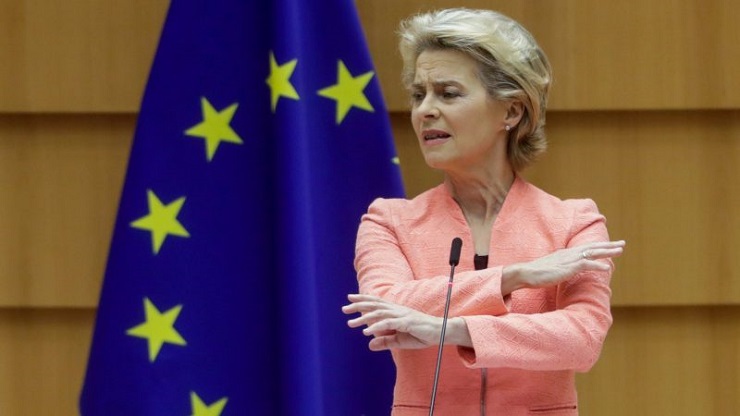
The move to mandate payment for gas in ruble was an essential counter-measure that has succeeded in defending the Russian currency and economy from collapse. That collapse was being deliberately orchestrated by Western sanctions aimed at strangling Russia. And yet when Russia acts to defend its vital existential interests it is accused of using “blackmail”. One of the shrill voices was that of European Commission President Ursula von der Leyen. The former German defense minister is a rabid Russophobe. Her logic of accusing Russia of wrongdoing is like a Third Reich minister lambasting the Warsaw Ghetto uprising as an insolent insurrection.
Von der Leyen and her elite, unelected Brussels bureaucracy are calling for all EU members to refuse payments to Russia. They are effectively endorsing the theft of Russia’s wealth. Their arrogance is not surprising. But that arrogance is leading to rebellion across Europe from the economic damage and unbearable cost-of-living crisis hitting the majority of the EU’s 500 million population. Bulgarian and Polish workers are demanding their governments resume trade with Russia to prevent a crash to their livelihoods.
A further mockery in this absurd scenario is that anti-Russia hawks in the United States and Europe have been vociferously jeering for all energy and other trade with Russia to be cancelled. Of course, this mania is all about propping up U.S. capitalism, hegemony over Europe, the weapons industry, and the transatlantic feeding trough for effete European lackeys.
Then, when Russia cuts off the energy supplies because of non-payment, there is an uproar about Moscow “weaponizing trade”.
The Western accusations of economic blackmail are analogous to perverse claims of military blackmail. The criminally reckless aggression that the United States and its NATO partners have pursued against Russia has escalated into war in Ukraine. As a British government minister demonstrated this week, the NATO powers are now directing their proxy Kiev regime to launch attacks on Russian territory. Yet when Russia warns of the dangerous risks of world war veering into a nuclear conflagration, the Western powers and their dutiful media turn around and accuse Russia of using “nuclear blackmail”.
America and Europe’s dubious political “leadership” is exposing itself as delusional, duplicitous, and criminally insane. They are insanely willing to push the world into a catastrophic war. And when Russia stands up to their madness, it is accused of being a reprobate.
In a funny sort of way, such farcical Western leadership is good. For it only further exposes how utterly unhinged and corrupt the Western elite rulers are in the eyes of their increasingly restive, angry populations.
It is Western callous, sociopathic leaders who are the ones blackmailing their own citizens and indeed the rest of the world. Their ultimatum is: destroy Russia or we will destroy everything. This is the mindset of totalitarianism.
The Western public’s enemy is not Russia, and it’s not China nor Iran, Syria, Venezuela, North Korea, Cuba, or some other designated foreign foe. All our enemy is the Western system of U.S.-led imperialism, its capitalist elite, and their political flunkies like Joe Biden and Ursula von der Leyen.
FDA Approved Remdesivir for 28 day old babies
By Meryl Nass, MD | April 30, 2022
Remdesivir is an IV drug. Therefore, for the past 2 years it was almost exclusively used in hospitalized patients, not outpatients.
Royalties go to Gilead, but a portion go the the NIAID, Tony Fauci’s agency and to the US Army, which assisted with its development.
Remdesivir received an early EUA (May 1, 2020) and then a very early license (October 22, 2020) despite a paucity of evidence that it actually was helpful in the hospital setting. A variety of problems can arise secondary its use, including liver inflammation, renal insufficiency and renal failure. Here is a list of articles revealing its kidney toxicity:
https://pubmed.ncbi.nlm.nih.gov/33340409/
WHO recommended against the drug on November 20, 2020.
Few if any other countries used it for COVID apart from the US. A large European trial in adults found no benefit. The investigators felt 3 deaths were due to remdesivir (0.7% of subjects who received it.)
https://www.thelancet.com/journals/laninf/article/PIIS1473-3099(21)00485-0/fulltext
However, on April 22, 2022 the WHO recommended the drug for a new use: early outpatient therapy in patients at high risk of a poor COVID outcome:
https://www.who.int/news-room/feature-stories/detail/who-recommends-against-the-use-of-remdesivir-in-covid-19-patients
Monoclonal antibodies are only effective at the beginning of illness, as they fight the virus. After about ten days, there is no more live virus and then a later phase of the disease occurs, due to an overactive immune response. Antiviral drugs do not work during the second stage, but immune modulators do. Steroids and ivermectin are effective therapies at this stage.
Outpatient infusion centers were set up to provide monoclonal antibodies to patients at the start of COVID to those who were at high risk of a bad outcome. But now the centers are shuttered as none of them work against current COVID variants. Outpatient infusions will now be available for remdesivir, which is an antiviral drug, as a replacement.
So a new way to use remdesivir has been developed: early, when it might actually work. WHO says it does. Was WHO bought off or will it actually have a positive impact? Who knows yet?
The vast majority of COVID patients are not hospitalized until they are in the second stage of illness, which is when remdesivir, HCQ and other antivirals are not very effective, since there is no more live virus. (HCQ has some immunomodulatory actions which may explain its mild benefit at this late stage.)
The US government, which has made a series of ineffective and harmful recommendations regarding the response to COVID, has just added another harmful recommendation to the list.
The FDA just licensed Remdesivir for children as young as one month old. Both hospitalized children and outpatients may receive it. The drug might work in outpatients, but the vast majority of children have a very low risk of dying from COVID. If 7 deaths per thousand result from the drug, as the European investigators thought in the study of adults cited above, it is possible it will harm or kill more children than it saves.
Shouldn’t the FDA have waited longer to see what early outpatient treatment did for older ages? Very little has been published on children and remdesivir. FDA said very little about the approval.
When we look at the press release issued by Gilead, we learn the approval was based on an open label, single arm trial in 53 children, 3 of whom died (6% of these children died). 72% had an adverse event, and 21% had a serious adverse event.
https://investors.gilead.com/news-releases/news-release-details/vekluryr-remdesivir-first-and-only-approved-treatment-pediatric
I heard that some nurses refer to the drug as “Run, death is near.”
Based on the paucity of information FDA released with its Remdesivir approval, it appears that FDA knows very little about the drug’s benefit in children, and our children will be the guinea pigs. If we let them.
US weapons supply to Ukraine prepped in January
© Congress.gov/screenshot
Samizdat | April 29, 2022
A scheme to send US weapons to Ukraine, using the “lend-lease” formula pioneered during WWII to skirt neutrality laws, was officially approved by Congress this week. However, it was put together all the way back in January – more than a month before Moscow recognized the Donbass republics as independent and sent troops into Ukraine.
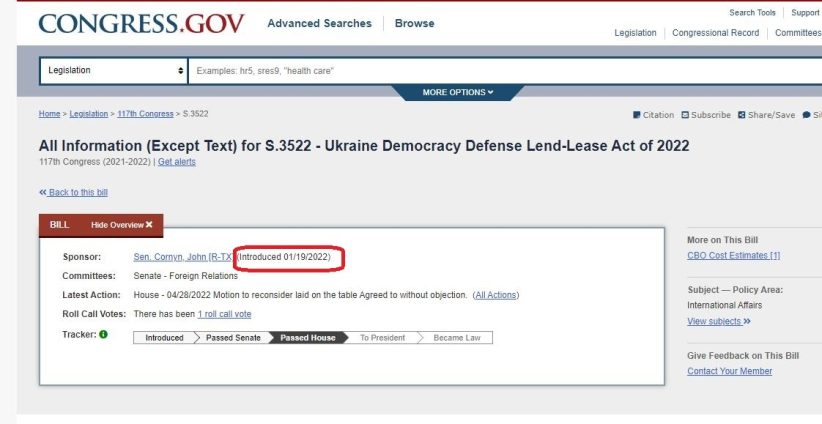
Republican Senator John Cornyn introduced the Ukraine Democracy Defense Lend-Lease Act, also known as S.3522, on January 19, 2022. This is according to the official Congress.gov page for the bill. On the same date, it was co-sponsored by senators Benjamin Cardin, Jeanne Shaheen and Roger Wicker.
Senators Richard Blumenthal and Lindsey Graham endorsed it the very next day, January 20. Other endorsements trickled in over the following weeks, with a total of 14 senators on board by February 9, again according to Congress.gov.
Russia did not recognize the independence of Donetsk and Lugansk until February 21. The “special military operation” to demilitarize Ukraine began on what was already February 24 in Washington.
Oddly enough, the Senate Foreign Relations Committee only took up Cornyn’s proposal on April 6. It was approved unanimously, proposed on the floor by Majority Leader Chuck Schumer and adopted by voice vote – whereupon it sat in limbo for weeks while the Democrat-dominated House was on vacation. On Thursday, after an hour of pro-forma debate, the House approved it in a 417-10 vote. Every single Democrat voted in favor, while all 10 dissenters were Republicans.
Supporters and critics alike have made much of the proposal, named after a WWII-era scheme to bypass neutrality laws limiting US arms exports. President Franklin Delano Roosevelt concocted lend-lease in March 1941, months before the US entered WWII, to send billions of dollars worth of weapons to Britain, and later the Soviet Union and other countries.
Cornyn’s bill, by contrast, suspends two existing US laws to make it easier for the White House to ship all sorts of weapons to Ukraine. It eliminates the five-year limitation on the program duration, suggesting the US hopes the conflict goes on for a long time – but also conditions the aid on Ukraine eventually repaying the “lease” or returning the gear if in working condition.
Cornyn has so far not revealed what might have motivated him to introduce the scheme to “protect civilian populations in Ukraine from Russian military invasion” before any military operations began.
The motivations of his first co-sponsor, Cardin, are more obvious. He is the architect of a series of anti-Russian laws, starting with the 2012 Magnitsky Act, the 2016 Global Magnitsky Act, and the 2017 CAATSA law, which tied the hands of the Trump administration in dealing with Russia.
In January 2018, at the height of the “Russiagate” craze, Cardin published a report he commissioned from the Democratic staff on the Senate Foreign Relations Committee, accusing Russia of an “assault” on “democratic and transatlantic institutions and alliances,” using “disinformation, cyberattacks, military invasions, alleged political assassinations, threats to energy security, election interference, and other subversive tactics.”
Russia attacked the neighboring state in late February, following Ukraine’s failure to implement the terms of the Minsk agreements, first signed in 2014, and Moscow’s eventual recognition of the Donbass republics of Donetsk and Lugansk. The German- and French-brokered protocols were designed to give the breakaway regions special status within the Ukrainian state.
The Kremlin has since demanded that Ukraine officially declare itself a neutral country that will never join the US-led NATO military bloc. Kiev insists the Russian offensive was completely unprovoked and has denied claims it was planning to retake the two republics by force.
1.2 Million Reports of Injuries After COVID Vaccines, VAERS Data Show
By Megan Redshaw – The Defender – April 29, 2022
The Centers for Disease Control and Prevention (CDC) today released new data showing a total of 1,247,131 reports of adverse events following COVID-19 vaccines were submitted between Dec. 14, 2020, and April 22, 2022, to the Vaccine Adverse Event Reporting System (VAERS). VAERS is the primary government-funded system for reporting adverse vaccine reactions in the U.S.
The data included a total of 27,532 reports of deaths — an increase of 183 over the previous week — and 224,766 serious injuries, including deaths, during the same time period — up 1,930 compared with the previous week.
Excluding “foreign reports” to VAERS, 810,171 adverse events, including 12,672 deaths and 80,743 serious injuries, were reported in the U.S. between Dec. 14, 2020, and April 22, 2022.
Foreign reports are reports foreign subsidiaries send to U.S. vaccine manufacturers. Under U.S. Food and Drug Administration (FDA) regulations, if a manufacturer is notified of a foreign case report that describes an event that is both serious and does not appear on the product’s labeling, the manufacturer is required to submit the report to VAERS.
Of the 12,672 U.S. deaths reported as of April 22, 16% occurred within 24 hours of vaccination, 20% occurred within 48 hours of vaccination and 59% occurred in people who experienced an onset of symptoms within 48 hours of being vaccinated.
In the U.S., 572 million COVID-19 vaccine doses had been administered as of April 23, including 338 million doses of Pfizer, 215 million doses of Moderna and 19 million doses of Johnson & Johnson (J&J).
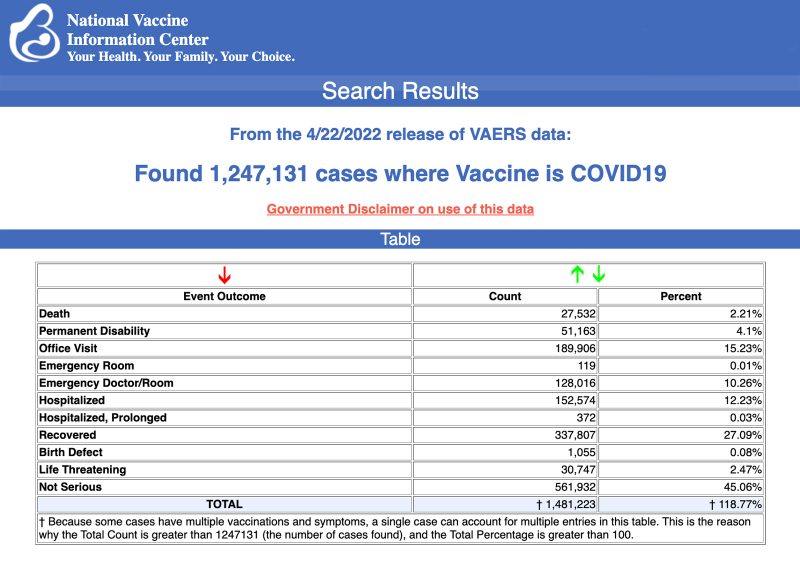
Every Friday, VAERS publishes vaccine injury reports received as of a specified date. Reports submitted to VAERS require further investigation before a causal relationship can be confirmed.
Historically, VAERS has been shown to report only 1% of actual vaccine adverse events.
U.S. VAERS data from Dec. 14, 2020, to April 22, 2022, for 5- to 11-year-olds show:
- 10,348 adverse events, including 256 rated as serious and 5 reported deaths.
- 19 reports of myocarditis and pericarditis (heart inflammation).
The CDC uses a narrowed case definition of “myocarditis,” which excludes cases of cardiac arrest, ischemic strokes and deaths due to heart problems that occur before one has the chance to go to the emergency department.The Defender has noticed over previous weeks that several reports of myocarditis and pericarditis have been removed by the CDC from the VAERS system in this age group. No explanation was provided. - 42 reports of blood clotting disorders.
U.S. VAERS data from Dec. 14, 2020, to April 22, 2022, for 12- to 17-year-olds show:
- 31,455 adverse events, including 1,803 rated as serious and 44 reported deaths. The most recent reported death involves a 14-year-old girl from Tennessee (VAERS I.D. 2238618) who died after receiving her second dose of Pfizer’s COVID-19 vaccine. According to the VAERS report, the girl had a previous history of cancer but was hospitalized 29 days after receiving her second dose of Pfizer with severe COVID-19 and COVID pneumonia. She became “critically ill,” developed respiratory failure and bradycardia and later died.
- 65 reports of anaphylaxis among 12- to 17-year-olds where the reaction was life-threatening, required treatment or resulted in death — with 96% of cases attributed to Pfizer’s vaccine.
- 649 reports of myocarditis and pericarditis — two fewer than last week — with 637 cases attributed to Pfizer’s vaccine.
- 165 reports of blood clotting disorders — 1 fewer than last week — with all cases attributed to Pfizer.
U.S. VAERS data from Dec. 14, 2020, to April 22, 2022, for all age groups combined, show:
- 20% of deaths were related to cardiac disorders.
- 54% of those who died were male, 41% were female and the remaining death reports did not include the gender of the deceased.
- The average age of death was 73.
- As of April 22, 5,460 pregnant women reported adverse events related to COVID-19 vaccines, including 1,709 reports of miscarriage or premature birth.
- Of the 3,630 cases of Bell’s Palsy reported — three fewer than last week — 51% were attributed to Pfizer vaccinations, 40% to Moderna and 8% to J&J.
- 870 reports of Guillain-Barré syndrome, with 42% of cases attributed to Pfizer, 30% to Moderna and 28% to J&J.
- 2,343 reports of anaphylaxis — 12 fewer reports than last week — where the reaction was life-threatening, required treatment or resulted in death.
- 1,678 reports of myocardial infarction.
- 13,826 reports of blood-clotting disorders in the U.S. Of those, 6,199 reports were attributed to Pfizer, 4,925 reports to Moderna and 2,661 reports to J&J.
- 4,152 cases of myocarditis and pericarditis with 2,544 cases attributed to Pfizer’s, 1,415 cases to Moderna’s and 181 cases to J&J’s COVID-19 vaccine.
Megan Redshaw is a staff attorney for Children’s Health Defense and a reporter for The Defender.
© 2022 Children’s Health Defense, Inc. This work is reproduced and distributed with the permission of Children’s Health Defense, Inc. Want to learn more from Children’s Health Defense? Sign up for free news and updates from Robert F. Kennedy, Jr. and the Children’s Health Defense. Your donation will help to support us in our efforts.
D.C. Schools Can’t Vaccinate Kids 11 and Up Without Parents’ Consent Until Lawsuits Settled
The Defender | April 28, 2022
A preliminary injunction prohibiting the mayor of the District of Columbia, the D.C. Department of Health and D.C. public schools from enforcing the D.C. Minor Consent for Vaccination Amendment Act of 2020 (D.C. Minor Consent Act) will remain in place after the defendants declined to file an appeal within the required 30-day period.
The preliminary injunction reverts D.C. to the standard age of consent of 18, at least until the conclusion of the case.
The injunction stemmed from two lawsuits filed against the D.C. Minor Consent Act, which allows children 11 and older to consent to vaccinations without their parents’ knowledge or consent.
The law, passed on Dec. 17, 2020, specifically targets children whose parents filed religious exemptions for their children.
“This is a significant legal victory,” said Rolf Hazlehurst, senior staff attorney for Children’s Health Defense (CHD). “But the legal battle is by no means over.”
D.C. is the legal testing ground for mandatory vaccinations, according to Hazlehurst, which makes this a “high-stakes” battle.
“The defendants and other states are twisting and distorting the ‘mature minor’ doctrine to push the limits of government overreach at the expense of parental rights,” Hazlehurst said. “They will not abandon this tactic or their assault upon our children or parental rights.”
The two lawsuits challenging the D.C. Minor Consent Act include one filed by CHD and the Parental Rights Foundation and a second brought by Informed Consent Action Network.
Both lawsuits sought a preliminary injunction to immediately prohibit D.C. schools and public health officials from enforcing the law until the lawsuits are concluded.
During oral arguments on March 3, Hazlehurst argued the D.C. Minor Consent Act violates the Supremacy Clause of the U.S. Constitution because it contains multiple provisions that strip away the meager protections guaranteed to parents under the National Childhood Vaccine Injury Act of 1986.
Hazlehurst also argued the law violates the right to freedom of religion guaranteed by the First Amendment to the U.S. Constitution.
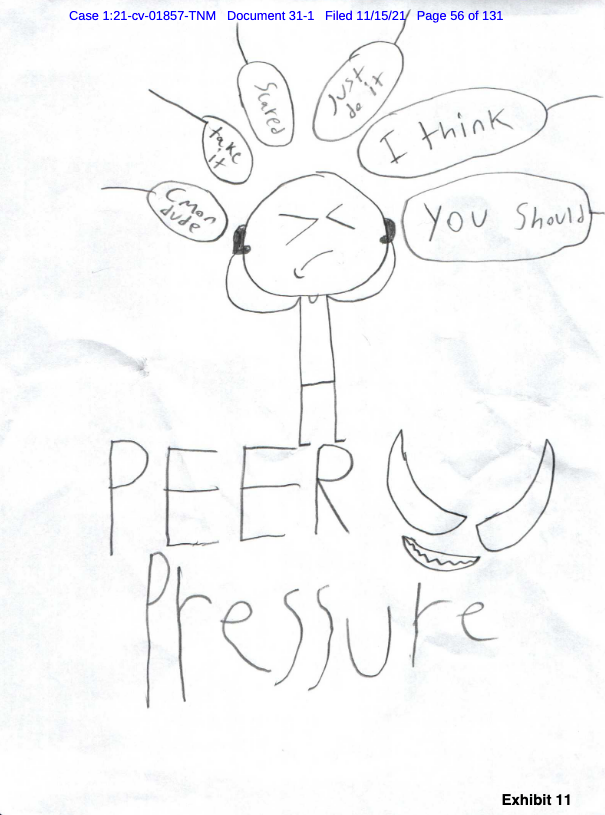
Hazlehurst told the court the mayor of D.C. created a “pressure-cooker environment,” enticing and psychologically manipulating minor children to defy their parents and take vaccinations against their parents’ will.
To make his point, Hazlehurst relied on a drawing, “Peer Pressure,” by a child of one of the plaintiffs. The drawing depicts the dilemma children face at school when they don’t want to get the COVID-19 vaccine.
On March 18, the U.S. District Court for the District of Columbia ordered the preliminary injunction.
In obtaining the preliminary injunction, the plaintiffs overcame a high legal hurdle that the “threatened injury must be certainly impending” as established by the U.S. Supreme Court precedent Clapper v. Amnesty Int’l, Hazlehurst said.
The court also ruled the plaintiffs in both lawsuits have legal standing based on preemption because the D.C. Minor Consent Act conflicts with the National Childhood Vaccine Injury Act.
In CHD’s case, U.S. District Judge Trevor N. McFadden made the additional finding that the plaintiffs have standing based upon the fact that they are likely to succeed on the merits that the law violates the free exercise of religion clause in the First Amendment.
“This preliminary injunction is part of ongoing litigation in an extremely important national precedent-setting case,” said Hazlehurst. “The rights of parents to decide what is best for their children’s health is at stake. Government can’t be allowed to make such decisions for minor children.”
The D.C. Minor Consent Act contains several provisions designed to deceive parents by hiding the fact that their children have been vaccinated against their parental judgment, authority or religious convictions.
The law requires healthcare providers to falsify records by leaving the child’s school vaccination records blank.
It also allows doctors to bill parents’ insurance companies for vaccines administered to children against their parents’ written directive. However, insurance companies may not send parents of those children an explanation of benefits.
Featured Video

AIDS Inc. by Gary Null (2007)
or go to
Aletho News Archives – Video-Images
From the Archives
Clash of Civilization, Iran Part II
By Jamal Kanj – Intifada-Palestine.com – January 14, 2011
Israel’s survival kit is: perpetuate conflict, insecurity to rationalize collective hate and finally playing victim.
Devoid of conflict, Israel implodes internally; without hate, Zionism loses its justification; and playing eternal victim to continue blackmailing the West. Absence of this holy trinity, Israel ceases to exist.
From its inception, the house of Zion has mastered exploiting adversarial powers to advance Israel’s cause. For instance, their influence over the Democratic Party in the US began with President Truman’s bid for 2nd term election in 1948.
Responding to strong opposition from Secretary of State General George Marshall and Department experts urging against recognition of Israel, President Truman replied: “I’m sorry gentlemen but I have to answer to hundreds of thousands [Jewish voters] who are anxious for the success of Zionism. I do not have hundreds of thousands of [voting] Arabs among my constituents”
Zionists influence over liberal American politics was matched with the doctrinal school of Conservative theoreticians aligning the Republican Party’s platform with Israel’s objectives. The Neoconservative Zionists, coined Zioncons, invented the “Clash of Civilization” concept to fight Israel’s wars. … continue
Blog Roll
 Aletho News
- Merck Virologists Admitted to Falsely Certifying Vaccine Efficacy
- Mandatory Folic Acid for every man, woman & child
- Pro-Palestine protesters arrested outside UK’s ruling Labour Conference in Liverpool
- Mauritius denies landing permit to flight from Israel, forcing cancellation: Tour operator
- Israeli finance minister calls for genocidal war on West Bank, annexation of south Lebanon
- 12 Things Your Psychiatrist Was Trained Not to Tell You
- From Unipolar Universalism to Multipolar Civilizational Distinctiveness
- RSF military group defects, joins Sudanese army: State media
- Ireland goalkeeper refuses to play ‘Israel’ as squad weighs boycott
- China pushes back against US on Cuba, Iran
- If Americans Knew
- Israel forces Gazans to live in constant peril – Daily Update
- Deconstructing Netanyahu’s pants-on-fire UN rant – Daily Update
- Trump betrayed voters with his campaign lies and prioritized a foreign country once he took office
- Netanyahu calls Israel’s war in Gaza ‘opposite of genocide’ in UN speech to near-empty hall
- Settler Kidnappings: Torture, Sexual Abuse and Terrorisation of Palestinian Abductees as Israel Deepens Annexation of West Bank
- Gaza winter nears as 162,000 tents become unusable, raising fears of humanitarian crisis
- Netanyahu says, “It’s the opposite of genocide”; UN says Gaza economy is world’s ‘most severe crisis on record’ – Daily Update
- Israel’s US-Backed Assault on Gaza Has Created the ‘World’s Most Severe Economic Crisis on Record’: UN
- ‘Protecting U.S. Citizens’… From Israel
- ‘This is where I live now, the back of a truck’: a day in the life of a grandmother in Gaza
- No Tricks Zone
- New Study: Earth And Venus Surface Warmth Largely Explained By Convection And Lapse Rate, Not CO2 Or Radiation
- 2025 Nature Paper Claiming Worsening Global Drought Gets RETRACTED …Heavily Flawed
- New Study: ‘Global Drought Shows No Detectable Recent Acceleration Under Climate Warming’
- Economic Masterminds: German Socialists Suggest Taxing Productivity Gains Stemming From Using AI
- The South China Sea Has Not Been Cooperating With The Climate Change Narrative
- Energy Crisis: Germany Enters Heating Season With Historically Low Gas Reserve Fill Levels
- New Study: The Antarctic Ice Sheet Gained Mass From 2020-2024 Due To Staggering Snow And Ice Accumulation
- Study: Ocean Heating Rates From Thousands Of Years Ago ‘Dwarf’ Modern Ocean Heating Rates
- Climate Extremists Target, Attack Large-Scale Power Grid Infrastructure In Germany!
- New Study: Antarctic Ice Melt Has Contributed Less Than 1 Centimeter To Sea Level Rise In The Last 30 Years