The Dynamics of Escalation: ‘Standing With Ukraine’
By Alastair Crooke | Strategic Culture Foundation | April 25, 2022
As it dawns on the West that whereas sanctions are deemed capable of bringing countries to their knees, the reality is that such capitulation never has occurred (i.e. Cuba; North Korea; Iran). And, in the case of Russia, it is possible to say that just ain’t going to happen.
Team Biden still has not fully grasped the reasons why. One point is that they picked precisely the wrong economy to try to collapse via sanctions (Russia has minimal foreign supply lines and oodles of valuable commodities). Biden’s staffers too, have never comprehended the full ramifications of Putin’s monetary jujitsu linking the rouble to gold, and the rouble to energy.
They condescend to Putin’s monetary jujitsu as yet another forlorn strike versus the dollar’s ‘impregnable’ reserve currency status. So they choose to ignore it, and assume that if only the Europeans would take fewer hot showers, wear more woollen jumpers, forego Russian energy, and ‘stand with Ukraine’, the economic collapse finally would materialise. Hallelujah!
The other reason why the West misconstrues the strategic potential of sanctions is that the Russia-China war on western hegemony is assimilated by its peoples to be an existential one. For them, it is not just about taking fewer hot showers (as for Europeans), it is about their very survival – and consequently their pain threshold is much, much higher than the West’s. The west is not going to smoke their challengers out so ridiculously easily.
At bottom, the Russia-China axis possess food, energy, technology and most of the world’s key resources. History teaches that these elements make the winners in wars.
The strategic problem though, is two-fold: Firstly, the window for a Plan ‘B’ de-escalation via a political deal in Ukraine has passed. It is all or nothing now (unless Washington folds). And secondly, albeit in slightly differing context, both Europe and Team Biden have elected to take the stakes sky-high:
The conviction that the European liberal vision faces humiliation and disdain, were Putin to ‘win’, has taken hold. And in the Obama-Clinton-Deep State nexus, it is unimaginable that Putin and Russia still regarded as the author of Russiagate for many Americans, might prevail.
The logic to this conundrum is inexorable – Escalation.
For Biden, whose approval ratings continue to tank, disaster looms in the November mid-terms. The consensus amongst U.S. insiders is that the Democrats are set to lose 60–80 seats in Congress, and a small handful (4 or 5 seats) in the Senate too. Were this to come about, it would not be just a personal humiliation, but would token administrative paralysis for the Democrats until the notional end of Biden’s term.
The only possible path out from this approaching cataclysm would be for Biden to pull a rabbit from the Ukraine ‘hat’ (one that, at the very least, would distract from soaring inflation). The Neo-cons and the Deep State (but not the Pentagon) are all for it. The arms industry naturally are loving Biden’s laundering weapons into Ukraine (with huge ‘spillage’ somehow vanishing into ‘the black’). Many in DC profit from this well-funded boondoggle.
Why are we seeing such euphoria over such a seemingly reckless scheme of escalation? Well, strategists suggest that were the Republican leadership to go bi-partisan on escalation – become complicit in ‘more war’, as it were – they argue that it might prove possible to stem Democratic losses in the mid-terms and blunt an Opposition campaign assault focussed on a mismanaged economy.
How far might Biden go with this escalation? Well, the arms splurge is a no-brainer (another boondoggle), and Special Forces are already in theatre, poised to light a fuse to any escalation; moreover, the mooted no-fly zone seems to have the added advantage of enjoying European support, particularly in the UK, amongst the Baltics (of course) and from the German ‘Greens’, too. (Spoiler Alert! First, of course, in order to implement any no-fly zone, it would be necessary to control the airspace – which Russia already dominates, and over which it implements full electronic-magnetic exclusion).
Would this be enough? Dark voices are advising not. They want ‘boots on the ground’. They even talk of tactical nukes. They argue that Biden has nothing to lose by ‘going big’, especially if the GOP are persuaded to become accomplices. Indeed, it might just save him from ignominy, they urge. U.S. military insiders already point out that the arms supply will not ‘turn around’ the war. A ‘lost war’ must be avoided going into November at all costs.
Is such a consensus for escalation realistic? Well, yes, it is possible. Recall that Hillary (Clinton) was the alchemist who fused the 1980s Neoconservative wing to the 1990s Neoliberals to create an interventionist broad-tent that could serve all tastes: Europeans could imagine themselves wielding economic power in a globally significant way for the first time, whilst the Neo-cons have resurrected their insistence on forceful military intervention as the requisite to maintaining the rules-based order. The latter are cock-a-hoop that financial war is failing.
From the Neo-cons’ perspective, it puts military action firmly back on the table and with a new ‘front’ opening: The Neo-cons today, precisely are questioning the premise that a nuclear exchange with Russia must be avoided at all costs. And from this shift away from the prohibition on actions that could trigger a nuclear exchange, they say that circumscribing the Ukraine conflict on such basis is unnecessary and a strategic error – asserting that in their view, Putin would be unlikely to resort to nuclear weapons.
How can this Neo-con-Liberal interventionist élite superstructure wield such influence when the broader American political class historically has been ‘anti-war’? Well, the Neo-cons are the archetypal chameleons. Loved by the war industry, a regular loud presence on the networks, they rotate in and out of power, with the ‘China hawks’ nesting in the Trump corridors, whilst the ‘Russia hawks’ are migrated to populate the Biden State Department.
Is escalation already ‘baked-in’? There may yet be one iconoclastic ‘fly in the ointment’: Mr Trump! – through his symbolic act of endorsing J.D. Vance for the GOP Senate Primary in Ohio, against the wishes of the GOP Establishment.
Vance is one (amongst many) representatives of America’s populist tradition seeking office in the coming Congressional ‘churn’. But the salience here is that Vance has been questioning the rush to escalation in Ukraine. Many other would-be populist contenders among the GOP’s new crop of interesting senators and senators-in-waiting already have succumbed to GOP old-establishment pressure to endorse war. (Boondoggles again).
The GOP is divided on Ukraine at its upper representational level, but the popular base traditionally is sceptical of foreign wars. With this political endorsement, Trump is nudging the GOP towards opposing escalation in Ukraine. Ross Douthat in the NY Times confirms that the Vance endorsement connects more closely to the sources of Trump’s 2016 popularity, as he mined the anti-war sentiment amongst the deplorables, whose focus more is with caring for their own country’s welfare.
Shortly after the endorsement, Trump issued a statement:
“It doesn’t make sense that Russia and Ukraine aren’t sitting down and working out some kind of an agreement. If they don’t do it soon, there will be nothing left but death, destruction, and carnage. This is a war that never should have happened, but it did. The solution can never be as good as it would have been before the shooting started, but there is a solution, and it should be figured out now—not later—when everyone will be DEAD!”, Trump said.
Trump effectively is wedging apart the possible key fault-line for the coming elections (even if some GOP panjandrums – many of whom are funded by the Military Industrial Complex (MIC) – favour a more robust military involvement).
Trump too, always has an instinct for an opponent’s jugular: Biden may be highly attracted to the argument for escalation, but he is known to be sensitive to the thought of body-bags coming home to the U.S. before November becoming his legacy. Hence Trump’s exaggeration that sooner rather than later, everyone in Ukraine “will be DEAD!”.
Again, the fear amongst Democrats with military understanding is that the western weapons airlift to the borders of Ukraine will not change the course of war, and that Russia would prevail, even were NATO to engage. Or, in other words, the ‘unthinkable’ will occur: The West will lose to Russia. They argue that Team Biden has little choice: Better to bet on escalation than to risk losing all with a debacle in Ukraine (particularly after Afghanistan).
To eschew escalation presents such a challenge to the American missionary psyche of global leadership that momentum for it may not be overcome through Biden’s innate caution alone. The Washington Post already is reporting that “the Biden Administration is shrugging off fresh Russian warnings against providing Ukrainian forces with more advanced arms and new training – in what appears to be a calculated risk Moscow won’t escalate the war”.
The EU élites, by contrast, are not just persuaded (Hungary and one faction in Germany, apart) by the logic of escalation, they are frankly intoxicated by it. At the Munich Conference in February, it was as if the EU leaders were intent on out-bidding each other in their enthusiasm for war: Josep Borrell re-confirmed his commitment to a military solution in Ukraine: “Yes, normally wars have been won or lost on the battlefield”, he said upon arrival for a meeting of the EU foreign ministers in Luxembourg, when asked to comment on his previous statement that “this war will be won on the battlefield”.
Their euphoria is centred around the belief that the EU – for the first time – is wielding its economic power in a globally significant way, and, at the same time, enabling and arming a proxy war against Russia (through imagining the EU as a real Carolingian empire, actually winning on the battlefield!).
The euphoria of the EU élites – so completely de-coupled from national identities and local interests, and loyal rather to a cosmopolitan vision in which men and women of consequence network endlessly amongst themselves and bask in their peer approval – is opening deep polarisation within their own societies.
The unease arises among those who do not regard patriotism, or a scepticism towards today’s Russiaphobia, as necessarily ‘gauche’. They are concerned that perception-delimited EU élites, advocating sanctions on Russia and NATO engagement with a nuclear power, will bring disaster to Europe.
The Euro-élites are on a crusade – too highly invested in the emotional charge and euphoria of the Ukraine ‘cause’ to have even considered a Plan ‘B’.
And even if a Plan ‘B’ were to be considered, the EU has less of a reverse-gear than the U.S. The Brussels zeitgeist is set in concrete. Structurally, the EU is incapable of self-reform, or of radically changing course and wider Europe now lacks the ‘vessels’ through which decisive political change can be effected.
Hold onto your hats!
AR6 Model Failure Affirmed: ‘No Model Group Succeeds Reproducing Observed Surface Warming Patterns’
By Kenneth Richard – No Tricks Zone – 25. April 2022
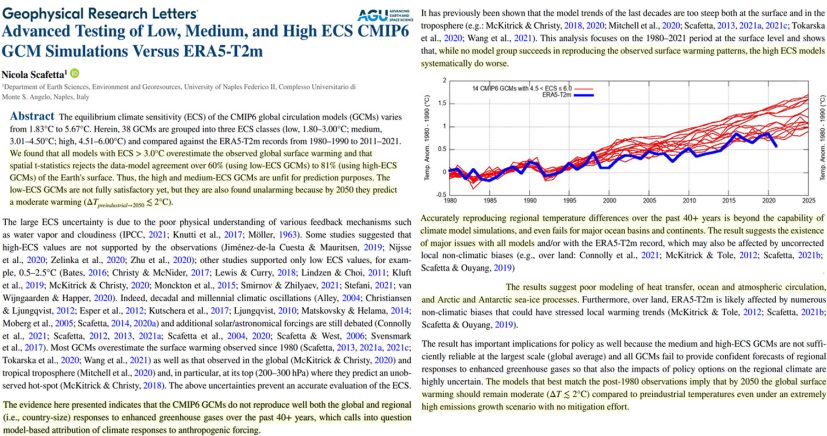
A new study published in Geophysical Research Letters highlights the abysmal model performance manifested in the latest Intergovernmental Panel on Climate Change report (AR6). The 38 CMIP6 general circulation models (GCMs) fail to adequately simulate even the most recent (1980-2021) warming patterns over 60 to 81% of the Earth’s surface.
Dr. Scafetta places particular emphasis on the poor performance of the highly uncertain estimates (somewhere between 1.83 and 5.67°C) of equilibrium climate sensitivity (ECS) and their data-model agreement relative to 1980-2021 global warming patterns.
The worst-performing ECS estimates are the ones projecting 3-4.5°C and 4.5-6°C warming in response to doubled CO2 concentrations (to 560 ppm) plus feedbacks, as the 1980-2021 temperature trends are nowhere close to aligning with these trajectories.
Instead, the projected global warming by 2050 (~2°C relative to 1750) associated with the lowest ECS estimates and implied by the warming observed over the last 40+ years is characterized as “unalarming” even with the most extreme greenhouse gas emissions (no mitigation efforts undertaken) growth rate.
In addition to the conclusion that “no model group succeeds reproducing observed surface warming patterns,” poor modeling of heat transfer physics, ocean and atmospheric circulation patterns, polar sea ice processes… is also evident in the latest IPCC report.
“Accurately reproducing regional temperature differences over the past 40+ years is beyond the capability of climate model simulations, and even fails for major ocean basins and continents.”
The fundamental modeling failures in simulating responses to sharply rising greenhouse gas emissions over the last 40+ years “calls into question model-based attribution of climate responses to anthropogenic forcing.”
German businesses note impact of skyrocketing energy costs
Samizdat | April 25, 2022
About 40% of German companies have already felt the consequences of the rapid rise in energy prices over the past several weeks, a survey by the Ifo Institute for Economic Research in Munich published on Monday has found.
The survey covered 1,100 German enterprises, 950 of which were family owned. As many companies surveyed have long-term supply contracts, not all respondents said they felt hefty price increases so far. However, a quarter of the firms surveyed said they expect their energy costs to spike in the second half of this year, while another quarter believe it will happen in 2023. The survey also showed that almost 90% of businesses are likely to raise prices to counter the skyrocketing energy costs, and three-quarters of the companies intend to invest more in energy efficiency.
Some 11% of the firms are considering the possibility of completely abandoning energy-intensive business areas, and 14% are studying the possibility of cutting their staff. Still, only a small percentage of the surveyed companies want to move their offices abroad.
“We need a policy that corrects this distortion of competition and stops skyrocketing energy prices,” Professor Rainer Kirchdörfer, one of the experts behind the survey, said, referring to the fact that Germany had significantly lost its competitiveness in energy policy even before the current energy crisis, brought about by the events in Ukraine.
Energy prices soared last month, after Russia launched a military operation in Ukraine, which triggered a flood of Western economic sanctions against Moscow, though the measures stopped just short of an embargo on Russian crude oil and natural gas. Russia retaliated by introducing a new ruble-based payment mechanism for its natural gas, hinting at the possibility that other energy exports might follow.
According to the German news agency DPA, citing data from the Verivox online platform, the increase in energy prices will inevitably lead to a significant increase in electricity prices for private consumers in Germany this year. Electricity suppliers in the country, responsible for roughly 13 million households, have already announced an increase in tariffs in April, May and June by an average 19.5%. Growth in gas prices is expected to be even greater, at about 42.3%.
According to Verivox, if a household paid an average of €1,171 ($1,258) for electricity per year prior to the Ukraine crisis, with the current costs it will have to pay some €1,737 ($1,867). The situation is even worse with natural gas: a household that paid €1,184 ($1,272) for gas annually in April last year would pay €2,787 ($2,995) at current prices, which equals to an increase of 135%.
The EU pledged to end its dependence on Russian energy earlier this month, despite importing roughly 40% of its gas and 30% of its oil from the country. However, experts and politicians within the bloc have warned that banning Russian energy imports could only lead to further price spikes, as it would be impossible to find an alternative quickly enough.
US food production threatened by mysterious fires in meat plants
Free West Media | April 25, 2022
More and more food processing plants are going up in flames in the US. Sixteen such incidents have been recorded so far. The background is unclear, but terrorism is being ruled out.
The fact is, however, that the basic needs of the population are massively threatened in some places by these attacks on infrastructure while authorities downplay the incidents.
Throughout the past year, but especially since February 2022, a series of devastating fires in the United States and Canada have destroyed or severely damaged food processing plants – mostly meat plants (slaughterhouses, hog and poultry farms), but also silage and large-scale grain production plants. As a result, there could be food shortages and price increases in many areas.
Devastating damage
The damage is catastrophic: an employee of an affected factory in Texas estimates that 50 to 100 truckloads of onions were destroyed there alone. A factory in Oregon was completely destroyed by a boiler explosion and all 244 employees had to be laid off. A fire in California had to evacuate 2 700 people around the affected factory.
Food prices are already at record highs in the US. The Rockefeller Foundation released an analysis of when a “massive, immediate food crisis” could start, and added that it would probably be “in the next six months”. The foundation shares the outlook of the World Economic Forum (WEF), advocating for the “Great Reset”.
Fires and explosions: possible connections
Officially, there are various reasons for the fires: the authorities downplay the possibility of any connections, and the Homeland Security Department does not assume terrorist attacks. At least one fire in Georgia last week was caused by a plane crashing onto a factory site. Since fires and explosions on factory premises and similar events repeatedly broke out for unknown reasons, some experts also suspect the likelihood of serial perpetrators and targeted attacks.
Conceivable would be militant animal or nature conservationists, climate activists or enemies of industrial food production, who are resorting to increasingly uncompromising means in the US just as they are in Europe.
Food crisis is getting worse
It is undisputed that the never-ending series of incidents will further exacerbate the food crisis, which is also noticeable in the US, as a result of supply chains that are already strained. In any case, the extent of the damage caused by the destruction in this sensitive key sector cannot yet be quantified; it also depends on how quickly the damaged or completely destroyed facilities can be repaired.
The FBI’s Cyber Division meanwhile published a warning about increased “cyber-attack threats” on agricultural cooperatives.
“Ransomware actors may be more likely to attack agricultural cooperatives during critical planting and harvest seasons, disrupting operations, causing financial loss, and negatively impacting the food supply chain,” the notice read, adding 2021 and early 2022 ransomware attacks on farming co-ops could affect the current planting season “by disrupting the supply of seeds and fertilizer”.
The agency warned, “A significant disruption of grain production could impact the entire food chain, since grain is not only consumed by humans but also used for animal feed … In addition, a significant disruption of grain and corn production could impact commodities trading and stocks. ”
“RUSSIAN CYBERATTACKS” INCOMING?
OffGuardian | April 24, 2022
The last few days have seen a barrage of warnings and predictions of possible Russian cyber warfare.
The Telegraph warns that work from home software could be vulnerable to Russian cyber attacks. The Guardian says that “cyber crime groups” have “publicly pledged support for Putin”. ITV wants you to be scared of cyberattacks taking down the NHS or a nuclear power stations.
Apparently, those darn Ruskies have already started, attacking not the Western banking system, the NHS OR a nuclear power station… but the Ukrainian post office, for printing propaganda stamps.
It’s all ludicrous propaganda, of course… but that doesn’t mean there won’t be a “cyber attack” (or something they pretend is a cyber-attack).
Remember, Klaus Schwab and the WEF have been predicting a “major cyber attack” with “Covid-like characteristics” (whatever that means) for over a year now, including holding a “cyber pandemic” training exercise as part of Cyber Polygon in October 2021, well before the Russian “special operation” in Ukraine.
With both the energy and food markets beings put under deliberate pressure to raise the cost of living, a “cyberattack” to take out the power grid or further hurt supply lines is not at all out of the question. But if it does come, it will have nothing to do with Russia.
“A Magnet for Conspiracy Theories”: Wikipedia Kills Entry for Hunter Biden’s Investment Company
By Jonathan Turley | April 24, 2022
Wikipedia editors are under fire this week for removing the entry for Rosemont Seneca Partners, the investment company connected to Hunter Biden and his alleged multimillion dollar influence peddling schemes. The site bizarrely claimed that the company was “not notable.” The timing itself is notable given the new disclosure that Hunter Biden’s business partner, Eric Schwerin, made at least 19 visits to the White House and other official locations between 2009 and 2015. That included a meeting with then-Vice President Joe Biden despite Biden’s repeated claim that he knew nothing about his son’s business dealings. Schwerin was the president of Rosemont Seneca.
Wikipedia has been accused of raw bias in removing the entry at a time when interest in the company is at its peak, including the possibility of an indictment of Hunter Biden over his financial dealings. Rosemont Seneca is one of the most searched terms for those trying to understand the background on the Biden business operations.
Yet, an editor known only as “Alex” wrote that the company was simply “not notable” — an absurd claim reminiscent of the recent claim by Atlantic Magazine’s writer Anne Applebaum that she did not cover the scandal because it simply was “not interesting.”
Alex wrote: “This organization is only mentioned in connection with its famous founders, Hunter Biden and Christopher Heinz.” That itself is an odd statement. It is mentioned as one of the key conduits of alleged influence peddling money. Alex added that “keeping it around” ran the risk of the page becoming “a magnet for conspiracy theories about Hunter Biden.”
Any Wikipedia page could be a magnet for conspiracy theories, including the page on Hunter Biden himself. The fact is that this is a real company with real dealings that are the subject of a real criminal investigation. Indeed, various Republican members have already pledged to conduct investigations into this and other companies if they secure either house of Congress after the midterm elections.
So Wikipedia killed it just as a United States Attorney is drilling down on financial dealings of Hunter Biden, including money received from foreign sources through Rosemont Seneca.
The bias in the reference to the “conspiracy theories” is glaring. While some clearly misstate the facts of the Hunter Biden dealings (on both sides of the controversy), the central role of the company in these dealings is no conspiracy theory. I have long criticized Hunter Biden and his uncle for engaging in raw influence peddling — a practice long associated with the Biden family.
I have also been highly critical of how media and social media companies killed the Hunter Biden story. Much like Wikipedia’s explanation this week, they claimed the Hunter Biden laptop story was merely conspiracy theories and Russian disinformation before the election. We are now approaching the midterm elections and suddenly Wikipedia is killing the page on this key company.
Republican senators claim that Hunter Biden was a partner in Rosemont Seneca with Chris Heinz, the stepson of future Secretary of State John Kerry, and their friend, Devon Archer. Archer was recently sent to prison for fraud in a matter that did not involve Hunter Biden.
In 2013, Rosemont Seneca entered into a business partnership with a Chinese investment fund called Bohai Capital. There are references in these transactions to Bohai Harvest RST. “RST” stood for “Rosemont Seneca Thornton,” a consortium of Rosemont Seneca and the Thornton Group, a Massachusetts-based firm.
Hunter Biden’s counsel insists that he did not have an equity interest in RST. However, Rosemont Seneca and RST feature greatly in the controversial transactions with foreign figures. Moreover, the Wall Street Journal reports that:
“Prosecutors have focused in particular, those people said, on the payments from Burisma, which first flowed to a company called Rosemont Seneca Bohai LLC before going on to Mr. Biden. Between 2014 and 2019, Hunter Biden held a Burisma board seat for which he was paid around $50,000 a month.”
The company has been tied to a series of payments to Hunter Biden from car purchases to cash transfers that are under investigation. Wikipedia does not (and should not) take sides in such allegations. Rather, it can serve as a conduit for those searching the company as part of a major and ongoing controversy.
Yet, “Alex” does not consider any of that “notable” and dismisses references to the company in a federal investigation as mere “conspiracy theories.”
Wikipedia was founded on lofty and even revolutionary goals of empowering the world with free access to sources of knowledge. The key minds behind Wikipedia saw the danger of bias creeping into this work and emphasized the need for strict neutrality.
Larry Sanger declared “Wikipedia has an important policy: roughly stated, you should write articles without bias, representing all views fairly.”
Likewise, Jimmy Wales insisted “A general-purpose encyclopedia is a collection of synthesized knowledge presented from a neutral point of view. To whatever extent possible, encyclopedic writing should steer clear of taking any particular stance other than the stance of the neutral point of view.”
I have long been a fan of Wikipedia and its noble purpose. For that reason, I am saddened by this move which seems to reject the essential pledge of the company. Wikipedia’s editors have been increasingly accused of bias in such decisions. However, this move is particularly raw and inexplicable. Wikipedia will lose the trust of many if it goes down the path of companies like Twitter in allowing staff to use its platform for their own political agendas.
Wikipedia should immediately reverse and disassociate itself from the decision of “Alex” on the Rosemont Seneca page.
When will these vaccine zealots wake up to the truth?
By Guy Hatchard | TCW Defending Freedom | April 24, 2022
WE should not understate the naivety of the government, media and scientists during the pandemic. The tabloid-style stories of severe Covid outcomes, the authoritative voice of Dr Anthony Fauci (who has financial conflicts of interest), the allure of the word vaccine, and the exaggerated death toll in foreign lands all combined into a convincing call for immediate and coercive action. Yet behind the stories, the highly profitable pharmaceutical PR system was running at full steam playing on the fear factor. New Zealand fell head over heels in love. Love knows no reason and that was certainly the case here.
New Zealand is a long way from the rest of the world. We have a tradition of proud independence and self-sufficiency, but we rolled over and played Follow the Leader. No one in a position of influence struck a note of caution, especially not our Prime Minister. We instituted the largest public borrowing programme in our history and spent it on a US mega corporation with a poor safety record and a history of punitive malpractice judgments. The government instituted saturation advertising of vaccine safety and efficacy, and then followed up with mandates, sackings and social exclusion. Our media shouted down those few asking questions.
Times, however, have changed. The respected and conservative Wall Street Journal (WSJ) has aired concerns about poor regulatory decisions at the US Food and Drug Agency (FDA) over booster shots. It joins a growing international chorus of highly qualified and influential voices.
On April 3, in an opinion piece entitled ‘FDA Shuts Out Its Own Experts in Authorising Another Vaccine Booster’, Dr Marty Makary, a surgeon and public policy researcher at Johns Hopkins University School of Medicine, wrote: ‘The FDA last week authorised Americans over 50 to get a fourth Covid vaccine dose. Some of the FDA’s own experts disagreed, but the agency simply ignored them.’
Eric Rubin, editor-in-chief of the New England Journal of Medicine (arguably the world’s most influential medical journal) and a member of the FDA advisory committee on vaccines told CNN last month: ‘I haven’t seen enough data to determine whether anyone needs a fourth dose.’
Dr Cody Meissner, also a member of the FDA vaccine advisory committee and chief of paediatric infectious diseases at Tufts Children’s Hospital in Boston, agreed: ‘The fourth dose is an unanswered question for people with a normal immune system.’
A third member of the committee, Dr Paul Offit of the Children’s Hospital of Philadelphia, went further. He told the Atlantic magazine that he advised his 20-something son to forgo the first booster.
Two top FDA officials, Marion Gruber, Director of the FDA Office of Vaccine Research and Review and her deputy Paul Krause, quit the FDA in September last year complaining of undue pressure to authorise boosters and a lack of data to support their use.
Unbelievably, the US Centers for Disease Control (CDC) rubber-stamped the FDA decision to approve a second booster without even convening its panel of external independent vaccine experts.
The WSJ article described the effect of boosters as fleeting, mild and short-lived. It sounded a note of alarm saying that neither the CDC nor the US National Institutes of Health (NIH) had made a priority of studying vaccine complications. Moreover their VAERS data collection and analysis process is incomplete and inadequate. In other words, the safety investigation to date of adverse effects of mRNA vaccination is incomplete and potentially misleading.
The central question raised by the WSJ opinion piece is, why wouldn’t the US regulators wish to undertake accurate and complete investigation of adverse effects of mRNA vaccination? Have pharmaceutical interests been able to influence decision-making at the FDA to their own commercial advantage at the expense of safety considerations?
The British Medical Journal agrees. On March 16 it published an article which said: ‘Evidence-based medicine has been corrupted by corporate interests, failed regulation and commercialisation of academia.’
The lessons are obvious. We have stifled debate and slavishly followed FDA advice. Now there is a need for revaluation and debate. We have travelled a long way down a one-way street, but it appears to be a dead end. The triumphant articles published about a survey of vaccine-resistant people born in Dunedin was a low point in uncritical mainstream media publishing. We have to regain an objective voice.
A paper published on April 5 in the New England Journal of Medicine found that any measurable protective effect of the fourth inoculation (which in any case, it found, is very small in absolute terms) disappeared after just eight weeks. Moreover a paper in the Lancet on April 8 admitted that boosters carry a risk of additional side-effects. Both these papers, however, skirted the obvious safety questions in favour of weak praise for vaccine orthodoxy.
In contrast the WSJ article asked the important question: ‘Who is actually getting serious about measuring the extent of adverse events, rather than continuing to urge uncritical acceptance of a largely ineffective vaccine?’
So far New Zealand media have steered clear of such questions. Dr Ashley Bloomfield, chief executive of the country’s Health Ministry, has refused to institute mandatory reporting of adverse events following mRNA Covid vaccination and he has excelled at denying vaccine exemptions to those injured by the first shot. Silence is no longer tenable, although in actuality it never was. Questions have to be asked. No ifs or buts. Overseas media outlets of the thinking kind are waking up.
If we can’t face debating rationally with our critics, we are drifting on to the rocks of ignorance and prejudice.
Time for us to wake up.
NEW DATA SHOWS TROUBLING TREND IN VACCINATED
The Highwire with Del Bigtree | April 21, 2022
The Highwire with Del Bigtree | April 21, 2022
Elon Musk’s attempt to buy the social media giant Twitter has sent shockwaves through the mainstream media. Why are they so threatened by free speech?
ELON MUSK BUYING TWITTER
You’ve probably heard that billionaire Tesla-founder Elon Musk is putting together a financial package to become the sole proprietor of Twitter. Having already purchased 10% of the social media giant’s shares, Musk turned down a seat on the board of directors and decided to just buy the whole place.
To be clear, we don’t much like Musk and trust him less. The whole story is likely just another non-issue for people to squabble over.
… that said, you’d have to be made of stone not to take some bitter pleasure in watching the squirming of “liberal” pundits who are suddenly having their own sophistry turned against them.
Remember how those of us concerned about corporate censorship have always been told that “private companies can do what they want” and “if you don’t like, go make your own platform”? Well, apparently those arguments no longer apply.
In fact, according to Robert Reich in the Guardian, “going to another platform” is not an option. Funny that.
Mehdi Hasan rants about Musk’s “problematic free speech escapade” in his latest show, setting up a strawman so large he could burn it and guarantee a bountiful harvest.
The Conversation hosts an article that argues allowing everyone equal room to express themselves is actually bad for free speech because it doesn’t protect “the vulnerable” from harassment.
But the prize for the most-revealing reaction goes to Max Boot of the Washington Post, who said on twitter:
It’s delightful. From the refusal to acknowledge that the paper he works for was only just recently purchased by Jeff Bezos, the second richest man in the world, to the coy euphemism for censorship, all good stuff.
But why is all this happening? And where is it all going?
There are a few ways this could go. For one, the government might step in and stop Musk from buying the company. Protecting social media from becoming a “monopoly”, scoring some points with the “left” for “standing up to billionaires”, and setting a precedent for state interference in private business.
It could be that Musk does buy twitter, and scraps any limitations in line with his “free speech absolutist” claims… but then nation-states will be “forced” to make new rules limiting speech since “irresponsible tech companies refuse to act to stop hate speech” or something along those lines.
Whatever happens, its easy to see how this could further the war on free speech, one way or another. Or maybe nothing will happen at all, and it’s just fun and games.
Anatomy of a Bogus “Disinformation” Smear
Justin Ling, the fearsome Freelance Investigative Journalist
By Michael Tracey | April 23, 2022
Foreign Policy is a publication that specializes in Serious essays about all manner of Serious topics in the realm of foreign policy. If you’ve ever touted your professional credentials as a Serious Foreign Policy Thinker, or if you one day aspire to a Senior Fellow sinecure in Serious Foreign Policy Studies — there’s a good chance you’re a subscriber.
I only just found out that on April 12, this highly prestigious journal ran an article that accuses me of participating in a “Russian disinformation operation.” (Gee, never could have guessed that’d be the accusation. How unexpected.) It took awhile for me to learn of this article’s existence, because I wasn’t contacted ahead of time for any sort of comment or given any chance to reply — apparently a journalistic convention that’s fallen out of favor. Oh well.
The journalist who wrote the article is someone named Justin Ling. I had only ever vaguely heard of this person, but after some modest inquiry, now understand that he self-identifies as a “freelance investigative journalist.” In this capacity, Ling claims to specialize in issues of “misinformation, conspiracy theories, and extremism.” Those who pompously declare themselves to be big media experts in such topics all tend to fit a certain obnoxious mold. Glenn Greenwald has remarked that this newly-concocted journalistic “beat” generally consists of “an unholy mix of junior high hall-monitor tattling and Stasi-like citizen surveillance.” NBC News in particular employs a whole dedicated fleet of these people, who — as Greenwald put it — “devote the bulk of their ‘journalism’ to searching for online spaces where they believe speech and conduct rules are being violated, flagging them, and then pleading that punitive action be taken (banning, censorship, content regulation, after-school detention).”
Justin Ling belongs squarely to this pretentious media clique — he even claims to have been one of its pioneers. And his latest foray into “freelance investigative journalism” apparently entailed scrolling through my Twitter feed. Which you may notice often seems like the main activity of this new breed of journalist; the ones who, like Ling, hold themselves out as seasoned, world-wise “misinformation” debunkers. They really love sitting around on Twitter, waiting to exclaim that a harmful new “conspiracy theory” has emerged. Conveniently, they’ve preemptively endowed themselves with the divine right to adjudicate what does and does not constitute a “conspiracy theory.” Precisely when “information that journalists happen to personally disagree with, or be offended by” magically becomes “disinformation” still remains a mysterious puzzle. Those like Ling who parade around in this fashion can be frequently observed snidely dismissing concerns about online censorship — even as they piously warn how very dangerous it is that uncensored “content” is allowed to proliferate on the internet.
Naturally, Ling also now claims to specialize in Ukraine, and since the invasion has diligently worked to DEBUNK all manner of Ukraine-related disinformation. While the definition is always in flux depending on this media cohort’s latest political imperatives, “disinformation” in April 2022 seems to largely be defined as any information which may run counter to the interests of the Ukraine Government or its patrons, such as the US and Canada — the latter of which Ling is a proud resident.
So when people on the internet started rudely discussing the statement by Victoria Nuland last month that US-funded biological laboratories exist in Ukraine, Ling deployed his amazing investigative skills to purportedly unearth where this “conspiracy theory” had originated. And you won’t believe what he discovered: the whole thing supposedly started with a random account on Twitter. Ling doesn’t actually prove that this “conspiracy theory” originated with the tweet he says he found — he just asserts that it did, and excitedly adds that the account in question had also expressed some belief in QAnon nonsense. Even though Ling presents no tangible proof for his foundational contention, that’s totally fine with the Canadian Broadcasting Corporation (CBC), which aired his little segment attributing the whole “biolabs” story — get ready for this shocker — to a nefarious Russian/right-wing “disinformation” network. Ling managed to valiantly map out the network by screenshotting tweets.
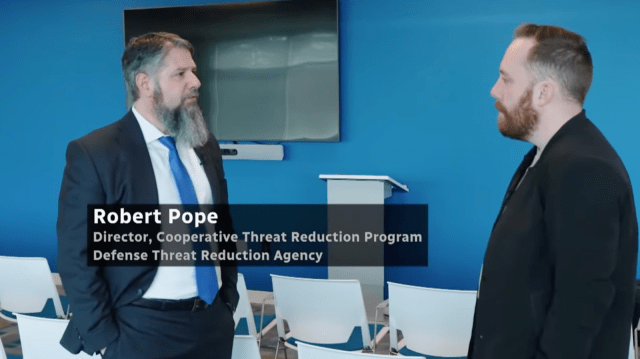
To demonstrate that any misgivings about the “biolabs” were reprehensible “disinformation,” Ling conducted a friendly chat with a Pentagon official, Robert Pope, who denied that there was anything untoward going on. This was the extent of Ling’s investigative journalism on the issue; in the segment, Ling is shown doing nothing other than presumptively accept the Pentagon official’s explanation.
Despite airing on the Canadian government’s TV channel, the segment has that annoyingly familiar feel of choreographed and branded “edginess” — reminiscent of VICE, where Ling also once worked. Amidst the sonic backdrop of weird, thumping ambient music, the viewer is for some reason made to follow along with Ling as he adventurously travels throughout Virginia highways and airports.
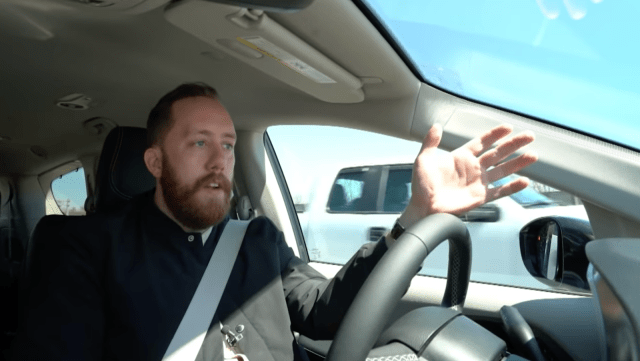
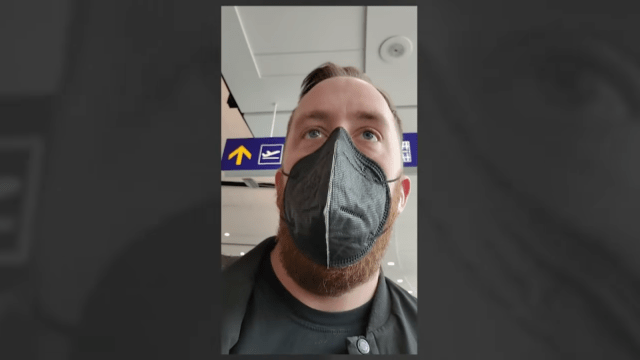
The CBC’s description of the segment reads: “Investigative reporter Justin Ling exposes how a QAnon conspiracy theory about US-funded ‘biolabs’ in Ukraine morphed into mainstream disinformation.” Which is strange, because a high-ranking US State Department official, Victoria Nuland, is the one who confirmed the existence of the US-funded biolabs — in public Congressional testimony. Given her well-documented history of intimate “meddling” in Ukraine, and her membership in one of the most prominent neoconservative familial dynasties in the US, Nuland’s comment understandably sparked widespread interest. Nonetheless, Ling and the CBC seemed satisfied that they had settled the issue, and successfully pinned the entire thing on the usual nexus of the Kremlin and Fox News.
This is far from Ling’s first battle on the frontlines of the information war. A biography on his Talent Bureau page states: “He is also investigating Russian meddling in Canadian politics, a project that has taken him from inside the headquarters of the Department of National Defence to a NATO training base in Latvia.” Man, I’d love to know how much it costs for a custom Ling speech on that fascinating topic.
Ling identifies as a “queer journalist,” whatever that means exactly, and part of his coverage of the war in Ukraine has been to convene a “panel of queer Ukrainians.” During that panel, Ling said: “I’ve spent a little time in Kiev myself. I’m looking forward to going back someday soon. I have to confess, Kiev has maybe some of the most fierce drag queens I’ve ever seen in my life.” So that’s some background on Ling.
Which brings us to his latest groundbreaking Foreign Policy investigation. Ling again decided to boldly tackle the most taboo of subjects: bad stuff Russia is alleged to have done. Daring to “go there” requires immense bravery on Ling’s part, and he deserves real credit. In the Foreign Policy article, Ling sets his sights on the allegations earlier this month that Russia was guilty of committing horrendous crimes against Ukrainian civilians in the town of Bucha. Based on evidence he saw online, including “radio chatter,” Ling announced his opinion that “it’s not hard to conclude that it was Russian forces who massacred Ukrainian civilians.” Anyone who might be inclined to seek an independent, impartial investigation before reaching firm conclusions about such a grave question — which happens to be the stated position of obscure, inconsequential countries like India and China — had merely fallen victim to “the constellation of disinformation channels” organized by Russia, according to Ling’s thesis. Despite what he calls a “preponderance of the evidence” that instantly showed Russia was 100% culpable, Ling decries:
That is apparently not enough for recently reelected Hungarian Prime Minister Viktor Orban, who was criticized by his allies in Poland for refusing to accept that Russia perpetrated the killings.
Despite Russia’s flimsy defense, some Westerners have nevertheless chosen to believe it. Writer Michael Tracey tweeted to his 240,000 followers that the photos were “war propaganda” and cast doubt on their authenticity. Conspiracy site Infowars ran breathless coverage touting information, largely cribbed from those pro-Russian Telegram channels, that “exposes the truth” of what happened in Bucha.
Note that I’m sandwiched right between Viktor Orban and Infowars, which basically makes me an ideological Satan for the average Foreign Policy reader. However, you may be shocked to learn that Ling drastically misrepresents what I actually said, and conveniently doesn’t even bother to include a link or full quote so people can judge for themselves.
Contrary to Ling’s bogus assertion, the only thing I “cast doubt” on in the tweet he uncovered was the propriety of mindlessly disseminating a warring party’s propaganda — which journalists and “experts” of all stripes have shown zero reservations about doing since the outset of this conflict. So long as it’s the warring party to which they’re politically and emotionally committed, they’re more than happy to present the propaganda as verified fact. It seems self-evidently ludicrous, for instance, that CBS would simply take PR material directly from Zelensky and blast it out on air with no corroboration — but that’s exactly what they’re doing. And that’s the practice I was “casting doubt” upon. You’d think this would almost be a banal point — with many journalists at least in theory claiming to be cognizant of how the “fog of war” distorts the news-gathering process. But that the point has become so intensely controversial speaks to how normal standards of rational thought have been thoroughly obliterated over the past two months.
Ling further accuses me of “believing” the Russian government, which is just straightforwardly stupid. He cites no evidence for this accusation — Foreign Policy editors obviously don’t care whether anything he blurts out has even the slightest hint of corroboration behind it. For the record: not on the day of the tweet in question, nor at any point since the war started, have I ever expressed uncritical “belief” in anything a Russian government official has said. Again, Ling has absolutely nothing to back up his malignant accusation. As far as that one tweet supposedly at issue, I didn’t need the Russian government or anyone else to tell me what should’ve been plain as day to anyone who cares to maintain some semblance of critical faculties. What I was calling “war propaganda” were materials that had been directly propagated by Ukraine government officials, on Twitter and other social media channels:
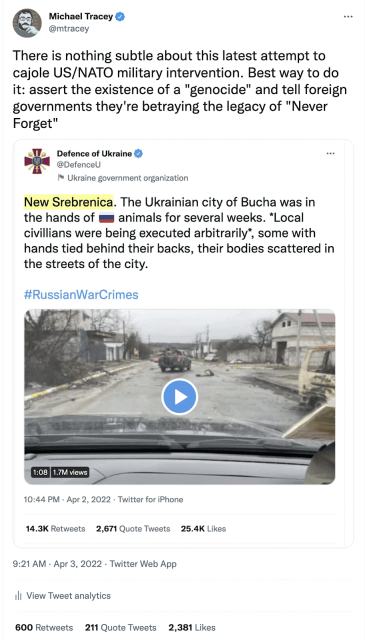
This stuff was literally coming straight from the Ukraine Ministry of Defense — the PR wing of a foreign military in the middle of waging war. While it was also furiously lobbying the US and other governments to provide heavier armaments for use in that war. How is this not the textbook definition of “war propaganda”? What would be the definition of “war propaganda” — if not this? Sure enough, the government-disseminated propaganda materials were immediately cited by journalists to demand outright US/NATO military intervention in Ukraine. I had linked to one example in the very tweet that Ling claims was evidence of my participation in a “Russian disinformation operation”:
It’s understandable that these concepts might be confusing for Ling. Because around the same time as he was carefully monitoring my Twitter feed for incriminating signs of “disinformation” offenses, take a wild guess at what Ling was also doing. Go ahead. If you guessed “uncritically disseminating the propaganda of a warring party” — you would be correct. Here’s the intrepid investigative journalist in action, dutifully amplifying a call from one of Zelensky’s official advisors for provision of more US/NATO weaponry:
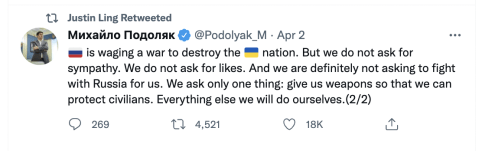
Here’s Ling applying his indefatigable freelance investigative journalism skills by simply reposting images that had been published directly by Zelensky:

Here’s Ling disseminating the totally uncorroborated claims of a full-fledged spy agency, the UK’s GCHQ. It’s unclear if Ling would regard this practice — simply repeating the claims of unvarnished spymasters whose very job is to manipulate public opinion — as “disinformation.”

Maybe he’s of the belief that “Western” spy agencies are definitionally incapable of perpetuating disinformation, and only hated enemy states such as Russia are capable of such a thing. I asked him to explain, but strangely he’s not returning my messages at the moment, despite having previously been so eager to accuse me of heinous affronts. None of this I take personally, though. Given his track record, it makes sense that Justin Ling would have severe difficulty comprehending what “war propaganda” means.
This is of much less significance, but also notice that Ling intentionally does not refer to me as a “journalist” in his petty gibe, and instead merely as a “writer.” Which is fine — I honestly don’t care one way or another what this Ling creature chooses to call me — but it’s a perfect example of the little passive-aggressive sniping tactics that journalists constantly use to police the boundaries of their snotty social club. I’m more than happy to call Ling a “journalist” — because to my mind, the word “journalist” doesn’t connote any kind of moral rectitude, or even competence. Being a journalist is very much consistent with being a self-righteous sleaze-peddler, so Ling can certainly fit the bill.
Another severe difficulty of Ling’s, which raises fundamental questions about his ability to cover his declared beat, is recognizing what “disinformation” even is. Maybe Ling missed it, but earlier this month Ken Dilanian of NBC News — one of the most faithful mouthpieces of the US national security state — went on air and openly revealed that the US Government is mounting a full-fledged “information warfare” campaign related to Ukraine. A key component of which is feeding fake information to the media. Dilanian cited one particular fake story that had been deliberately planted to journalists by intelligence officials — despite those officials knowing it was fake. Weirdly though, all the newly emboldened, “disinformation” debunking journalists like Ling don’t seem to regard that campaign of unconcealed information warfare as within their job’s purview.
Ling also appears to have missed a recent revelation reported at CNN of all places, in which an anonymous “Western” official is quoted saying this about the current PR activities of Ukraine government officials: “It’s a war — everything they do and say publicly is designed to help them win the war. Every public statement is an information operation, every interview, every Zelensky appearance broadcast is an information operation.” And yet despite the admitted existence of this “information operation,” Ling is gleeful to participate in it, by giddily spreading around the Ukraine officials’ photos, videos, and claims without a shred of independent corroboration — all under the veneer of Ling’s tough, adversarial journalism. Russia is obviously engaged in its own “information operation,” but so too is Ukraine. Will Ling report on himself next as a “disinformation” culprit?
Of course he won’t, because despite his bogus pretensions, Ling has made it perfectly clear that he has no problem at all with “disinformation” as such. In fact, he actively supports disinformation tactics when it’s in service of his desired political objectives. He publicly demanded that the “intelligence service” of his own government, Canada, ought to be “doing a lot more” to proactively counter Russia by utilizing more robust information warfare techniques. So that’s Justin Ling for you: a “disinformation” reporter who loves disinformation.
If you want to understand why there is so little deviation today from the burgeoning pro-war consensus, it’s got a lot to do with media functionaries like Ling. Most journalists would be utterly mortified to be accused, in a “Serious” outlet like Foreign Policy, of abetting a “Russian disinformation operation.” And their fear would probably be rational: this could genuinely be a career-killer, particularly in the current war-fevered climate. All bets are off in terms of what retribution tactics are potentially on the table. They could be socially shunned, professionally ostracized, and have their material well-being seriously imperiled. The self-appointed “disinformation” pontificators such as Ling, posturing as these tenacious public-spirited watchdogs, really could destroy them.
Ling is an especially blatant joke and fraud, but the media industry is increasingly dominated by creeps like him. Fortunately, they can’t do much to me — except to provide occasional amusement at how pathetic they are.
Featured Video

Inside America’s deadly war on suspected drug boats
or go to
Aletho News Archives – Video-Images
From the Archives
There are ZERO Amish kids suffering from cancer, diabetes or autism – WHY IS THAT?
YourDestinationNow | July 8, 2023
The current population of Amish folks in America is quickly approaching 400,000, with the largest concentrations of 90,000 in Pennsylvania and 82,000 in Ohio. Amish have settled in as many as 32 US states, and have an average of 7 kids per family, so the population is growing rapidly. In a brand new, comprehensive study (as of June 2023), presented by Steve Kirsch to the Pennsylvania State Senate, it was calculated that for Amish children, who are strictly 100 percent not vaccinated (fully unvaccinated), typical chronic conditions barely exist, if any at all.
These chronic conditions, also called preventable diseases and disorders, that nearly many vaccinated children and swaths of Americans suffer from, include auto-immune disease, heart disease, diabetes, asthma, ADHD, arthritis, cancer, and of course… wait for it… autism (think ASD and Asperger’s Syndrome). … continue
Blog Roll
 Aletho News
- US, South Korea and Japan Begin Joint War Games
- Israel’s Rafael to produce missile parts at Volkswagen factory in Germany
- After historic German election, will the AfD rule Saxony-Anhalt?
- ‘Russophobia a national sport’ – Polish party rallies against push to war
- US Placing Missiles in Europe to Cancel Strategic Stability Talks Prerequisites – Russian MFA
- Analysts warn of ‘colonization’ as US ‘saturates’ Australia with 110 bases
- Inside America’s deadly war on suspected drug boats | Fault Lines Documentary
- Babies Whose Mothers Drank Fluoridated Water During Pregnancy Scored Lower in Problem-Solving
- Vaccination Data on Amish Children Screened for 2010 Autism Study Was Never Made Public
- CNAS Wonk Proposes Bombing China’s Artificial Intelligence
- If Americans Knew
- ‘Guilt by association’: why seven international aid workers were killed in Israeli airstrike
- Anatomy of the Israel Lobby
- 50+ Rights Groups ‘Strongly Urge’ Congress to Reject US-Israeli Military Integration in NDAA
- Israel takes its war on Palestine into the AI age
- Israel’s military ‘justice’ system is working exactly as intended
- Who are the ‘Hilltop Girls’ behind Israel’s ‘soft settlement’ strategy?
- Gaza holds funeral for 100 remains, including 60 children – Daily Update
- Israeli settlers are a menace across West Bank – Daily Update
- US rejects Israel’s plan to ethnically cleanse Gaza: Daily Update
- ‘What About Gaza’s Amputees?’ Adidas Under Fire Over Israeli Soldier’s Disability-Inclusive Shoe Ad
- No Tricks Zone
- New Study: The Antarctic Ice Sheet Gained Mass From 2020-2024 Due To Staggering Snow And Ice Accumulation
- Study: Ocean Heating Rates From Thousands Of Years Ago ‘Dwarf’ Modern Ocean Heating Rates
- Climate Extremists Target, Attack Large-Scale Power Grid Infrastructure In Germany!
- New Study: Antarctic Ice Melt Has Contributed Less Than 1 Centimeter To Sea Level Rise In The Last 30 Years
- Fear Of Debate: Alarmist German Climate Scientist Calls On Mainstream Media To Discredit Skeptic Voices
- End-Of-August Arctic Sea Ice Extent Hasn’t Fallen In 20 Years, Official Data Show!
- News-Making Nepal Region Has Had As-Warm Or Warmer Periods Than The 2000s In The 1600s, 1700s, 1800s
- 2025 Study: ‘There Exists No Unequivocal Experimental Evidence For The CO2 Greenhouse Effect’
- 2026 Atlantic Cyclone Energy Index Running At 85% Below Normal!
- New Research Shows Soil Respiration And Temperature Drive CO2 Change, Not Humans
 Aletho News