The New York Times hits a new Covid low on vaccines for kids, thanks to one Aubrey Clayton, PhD
By Alex Berenson | Unreported Truths | March 1, 2022
I know, I didn’t think it was possible either.
But today the NYT ran a opinion piece basically arguing the Food and Drug Administration should okay the Pfizer mRNA shot for children under 5 even if they fail the ongoing clinical trial.
This hideousness was titled:
As soon as I saw the headline I knew it would be bad. But I couldn’t imagine how bad.
Imma translate it for you from scared academic phonics into English:
Pfizer’s mRNA shot appears to be failing its clinical trial in little kids.
Yes, it can’t even manage to demonstrate benefit in a trial intentionally designed to be as easy as possible to pass. (Remember, the pivotal clinical trials for mRNA jabs in adults showed a HUGE benefit against Covid infection, a benefit that doesn’t exist.)
I, Aubrey Clayton, PhD, wish to force my three young children to take a biotechnology that is useless for them to protect them from a disease that is an infinitesimal risk to them.
That way I can stop abusing them by forcing them to have outdoor play dates in subfreezing temperatures and wear masks on their tiny faces. Because I’m scared, or my second cousin has long Covid, or I have pronouns in my biography, who knows?
Point is, I want them to get the shot. Like about 10 percent of parents of little kids nationally, and 100 percent of the parents of little kids I know, I WANT THEM TO GET THE SHOT. I WANT I WANT.
Sad me. It looks like the FDA may do what it has done for generations, which is require that the trial designed to show a medicine works actually show it works.
Sad me so sad. So I am proposing an alternative pathway to approval. It’s called the, “I really want this shot to work so I’m going to assume it works and look for evidence supporting that assumption” pathway for approval.
Then I can give my children the useless biotechnology and feel better.
Yay me.
—
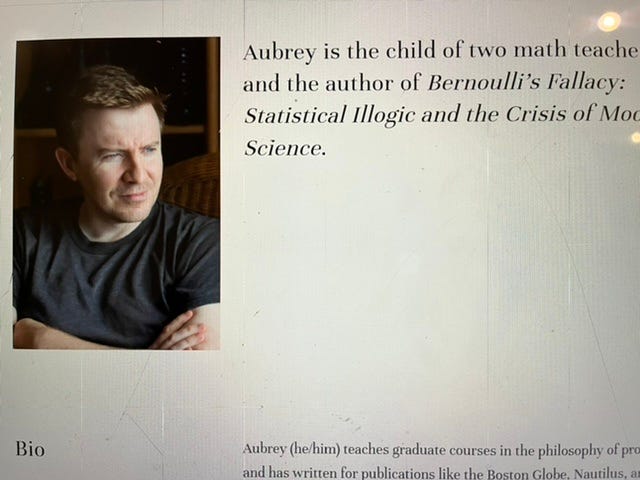
This is Aubrey. He/him has thoughts.
—
Okay, here’s the thing.
Drug development is really hard. Pharmaceuticals and biologics mostly don’t work. Sometimes they have serious side effects. Randomized clinical trials are the ONLY way to know with any reasonable certainty whether a new therapeutic will do what its developer says it does.
A drug that fails to show meaningful clinical benefit (which does NOT mean cure) with more than 95 percent statistical significance in a carefully designed clinical trial is likely to be at best useless and at worst harmful in the real world. Trials generally OVERSTATE the effectiveness of medicines for all kinds of complex reasons.
Trials aren’t perfect. But in a world filled with error, they are not just our best but our only real alternative to guesswork.
Find a different way to mess up your kids, Aubrey.
People’s Convoy Arrives at DC Beltway
By Stephen Lendman | March 7, 2022
On route from California since February 23, hundreds of trucks and other vehicles reached the 64 mile-long Capital Beltway that surrounds the Washington DC area through parts of Maryland and Virginia.
Before departing last month, a media statement said the following:
“The People’s Convoy continues to grow in numbers and support as we peacefully cross the country in unity.
The People’s Convoy has been diligent in our message and purpose.
Although we support any peaceful movements in spirit, we are not affiliated with any other groups.
The People’s Convoy has created an infrastructure with a third-party accounting firm, legal teams, security, and journalists documenting each mile.
We encourage truckers and supporters to officially join The People’s Convoy along our route.
The People’s Convoy would like to reiterate:
We are traveling across the US in PEACE and UNITY
We are 100% LAW-ABIDING citizenry and convoy
Our core principals of FREEDOM and LIBERTY give rise to the convoy’s request to end the State of Emergency that led to overreaching mandates
We demand government ACCOUNTABILITY through full and transparent congressional hearings
We are NOT going into DC proper, and we will NOT be there for the State of the Union
We are NOT associated with Bob Bolus or other convoys who are planning to go into DC
The People’s Convoy is a peaceful and unified transcontinental movement
This freedom-loving movement is about the journey, not the destination
Our website and social media platforms are the ONLY official locations with details on how to donate, routes and stopping points where people can come support
We are actively accepting donations through our secure site to support the truckers with fuel and supplies during the convoy.”
On March 7, thepeoplesconvoy.org said “American truckers & allies are currently staged (along the) Hagerstown (MD) Speedway.”
Once again, it stressed that it’s “time to end the declaration of national emergency…and restore our nation’s Constitution.
According to convoy leaders, plans are for the miles-long convoy to drive slowly at the minimum speed limit around the Capital Beltway on Monday — slowing, not blocking traffic.
On Friday, a statement by one trucker said:
“DC, the government, whomever, can claim that they have all this opposition for us waiting in DC.”
“But that flag on the back of my truck will go down to Constitution Avenue between the White House and the Washington Monument.”
Organizer Brian Brase said convoy participants intend to circle the Capital Beltway slowly before returning to Hagerstown at end of each day, returning the next day “until the group’s demands are met,” adding:
Other convoys are en route to join them.
“We’re going to be a huge pain.”
“We’re trying to work with our local law enforcement communities because we want them to understand that we are law-abiding citizens that are just exercising our rights to this protest.”
“Every day is going to elevate what we do.”
“We want to show the American people how large we are.”
“(W)e want to show our congressional leaders that we’re serious and we are here to negotiate.”
“We are here to talk. We are law-abiding. We are peaceful.”
“We don’t want to shut anything down, and we’re not coming downtown.”
On Monday, the Baltimore Sun reported that organizer Brase met with House and Senate members on Sunday night, quoting him saying:
“I’m hopeful that we have successful dialogue with congressmen and women and senators that help get what we’re looking for pushed through in a timely fashion,” adding:
“If they don’t come to the table to meet with us or they ignore us, then every day it will escalate.”
“We do not want to impede traffic any more than necessary to get our message across.”
Brase said he expects another convoy of about 500 vehicles from Ohio, Pennsylvania and West Virginia to join the People’s Convoy overnight Monday.
Biggest financial players back net zero

United Nations | April 21, 2021
Over 160 firms with $70 trillion in assets have joined forces behind a common goal: steer the global economy towards net-zero emissions and deliver the Paris Agreement goals.
The new Glasgow Financial Alliance for Net Zero (GFANZ), chaired by Mark Carney, UN Special Envoy on Climate Action and Finance, brings together leading net-zero initiatives from across the financial system to accelerate the transition to net-zero emissions by 2050 at the latest.
Members include major asset owners and managers as well as banks with the power to mobilize trillions of dollars behind the transition to net zero. By working together, alliance members can catalyse strategic and technical coordination on steps firms need to take to align with a net-zero future.
All members will set science-aligned interim and long-term goals to reach net zero no later than 2050 in line with the criteria of the UN Race to Zero campaign. Member-determined short-term targets and action plans will supplement these goals.
Existing and new net zero finance initiatives will be part of the Alliance. They comprise the Net Zero Asset Managers Initiative, the UN-convened Net-Zero Asset Owner Alliance and the newly launched Net-Zero Banking Alliance. The last links 43 of the world’s leading banks, and is hosted by the United Nations Environment Programme Finance Initiative and co-launched by the Financial Services Taskforce of the Prince of Wales’ Sustainable Markets Initiative.
UK Prime Minister, Boris Johnson, said: “Uniting the world’s banks and financial institutions behind the global transition to net zero is crucial to unlocking the finance we need to get there – from backing pioneering firms and new technologies to building resilient economies around the world. The Glasgow Financial Alliance for Net Zero will lead this charge ahead of COP26 to scale-up our ambition, accelerate our shift and help us to build back greener together.”
U.S. Special Presidential Envoy for Climate John Kerry said: “The largest financial players in the world recognize energy transition represents a vast commercial opportunity as well as a planetary imperative. As countries around the world move to decarbonize, the large sums these institutions are dedicating to climate finance also reflect a growing understanding of how critical a low-carbon global economy is to their business models. Ultimately, their commitment of capital and assets, as well as adherence to high standards and reporting, will accelerate the transition to this new economy, create a massive number of new jobs, and increase our collective ability to tackle the climate crisis.
Mark Carney, UN Special Envoy for Climate Action and Finance and Prime Minister Johnson’s Climate Finance Advisor for COP26, said: “This is the breakthrough in mainstreaming climate finance the world needs. I welcome the leadership of the Financial Services Task Force and other global banks for their new commitments to net zero and for joining forces with GFANZ, the gold standard for net zero commitments in the financial sector. Most fundamentally, GFANZ will act as the strategic forum to ensure the financial system works together to broaden, deepen, and accelerate the transition to a net zero economy.”
Is Instagram afraid of truth?
By Rachel Kennedy | American Thinker | February 24, 2022
The censorship saga continues, with tech giant Instagram targeting the CO2 Coalition, thereby preventing the organization from creating an account within their platform.
This is the most recent in a slew of harassment and shadowbanning attempts beginning in 2020 by Instagram’s wicked stepsisters: Facebook and LinkedIn. In the Facebook realm, shadow-banning — the inability to advertise or “boost” posts and the addition of warning labels — are all commonplace for CO2 Coalition content. For LinkedIn, not only is the removal of posts frequent but so is also banning accounts. CO2 Coalition executive director Gregory Wrightstone’s personal account was banned. His final post predicted that he would be banned and de-platformed soon. That post was deemed “false and misleading” — and then he was banned and de-platformed!
Fast-forward to today. A clean slate and a glimmer of hope for the possibility of creating an account on Instagram — a “diverse, global community” committed to fostering a safe and supportive community for everyone to “bring the world closer together.” Sounds like an open and inviting platform for connection, right?
Everyone knows how to sign up for a social media site — with just an email, password, and username. Following the input of this information into the system, I received a message indicating that the account must go through an evaluation that should take no more than 24 hours. “Fine,” I thought. Perhaps this is something new they are implementing to keep their site free from hazardous bots? Perhaps my username is already taken?
Following the evaluation period, I attempted to log in again. Failed. This time, the message said: “Error: Your account has been disabled for violating our terms. Learn how you may be able to restore your account.” Clicking the “Learn More” tab wasn’t very helpful: we were not following their terms, which included “artificially collecting likes, followers or shares, posting repetitive content or repeatedly contacting people for commercial purposes without their consent.”
How is it possible to be in violation of Instagram’s terms and conditions without even being able to log into the platform? Being cited for criminal behavior without even being part of Instagram’s open and diverse echo chamber?
All this raises the question: what are they afraid of?
If it weren’t for you, the consumer, they would not have a successful business. If it weren’t for you, the questioning and discerning human, theirs would be the only viewpoint. The fact of the matter is, if it weren’t for discussion, dialogue, and those elements that truly make us human, Big Tech would be far more powerful than they are now.
At the CO2 Coalition, our group of 80+ researchers understands the importance of discussion and dialogue. With a roster of atmospheric physicists, ecologists, statisticians, climatologists, and energy experts, it is encouraged to look at climate from many points of view. It is what makes the scientific method the scientific method.
It appears that a free-thinking society is Instagram’s worst nightmare, and the CO2 Coalition just might be a perpetual thorn in the side of Big Tech. But more importantly, a support for those who have the courage to question and a need to discover the truth.
Imran Khan hits out at West for treating Pakistanis like ‘slaves’

Russian President Vladimir Putin and Pakistani Prime Minister Imran Khan in Moscow, February 24, 2022 © Mikhail Klimentyev / Sputnik
RT | March 7, 2022
Prime Minister Imran Khan lashed out at foreign diplomats who pressured Pakistan to join a UN resolution condemning Russia over its military attack on Ukraine, accusing the envoys of treating Pakistan like “slaves.”
At a rally on Sunday, Khan shot back at a March 1 letter from diplomats representing 22 missions, including countries in the European Union along with Japan, Switzerland, Canada, the UK, and Australia, which called on Pakistan to drop its neutrality and join them in condemning Moscow.
“What do you think of us? Are we your slaves… that whatever you say, we will do?” questioned Khan, before asking EU ambassadors whether they wrote “such a letter to India,” which also remains neutral.
Khan claimed that Pakistan had suffered for previously supporting NATO’s military action in Afghanistan and declared, “We are friends with Russia, and we are also friends with America; we are friends with China and with Europe; we are not in any camp.”
Pakistan, along with 34 other countries, abstained from voting on the UN’s resolution condemning Russian “aggression against Ukraine” last week. Pakistan’s neighbors India, Bangladesh, China, Iran, Sri Lanka, Tajikistan, Kyrgyzstan, and Kazakhstan also abstained.
Khan met with Russian President Vladimir Putin in the Kremlin on February 24, the day Moscow launched its military operation in Ukraine, to discuss bilateral ties and regional issues.
Moscow maintains that the attack was launched with the purpose of “demilitarization” and “denazification” of Ukraine, and that it was the only possible option left to protect the people of eastern Ukraine following years of a grueling blockade that claimed thousands of lives. Kiev insists the invasion was unprovoked, saying it had no plans to retake the breakaway Donetsk and Lugansk republics by force.
Burning Globalist Structures to Save the Globalist ‘Liberal Order’
By Alastair Crooke | Strategic Culture Foundation | March 6, 2022
In its triple strike of sanctions on Russia, the EU initially was not looking to collapse the Russian financial system. Far from it: Its first instinct was to find the means to continue purchasing its energy needs (made all there more vital by the state of the European gas reserves hovering close to zero). Purchases of energy, special metals, rare earths (all needed for high tech manufacture) and agricultural products were to be exempted. In short, at first brush, the sinews of the global financial system were intended to remain intact.
The main target rather, was to block the core to the Russian financial system’s ability to raise capital – supplemented by specific sanctions on Alrosa, a major player in the diamond market, and Sovcomflot, a tanker fleet operator.
Then, last Saturday morning (26 February) everything changed. It became a blitzkrieg: “We’re waging an all-out economic and financial war on Russia. We will cause the collapse of the Russian economy”, said the French Finance Minister, Le Maire (words, he later said, he regretted).
That Saturday, the EU, the U.S. and some allies acted to freeze the Russian Central Bank’s foreign exchange reserves held overseas. And certain Russian banks (in the end seven) were to be expelled from SWIFT financial messaging service. The intent was openly admitted in an unattributable U.S. briefing: It was to trigger a ‘bear raid’ (ie. an orchestrated mass selling) of the Rouble on the following Monday that would collapse the value of the currency.
The purpose to freezing the Central Bank’s reserves was two-fold: First, to prevent the Bank from supporting the Rouble. And secondly, to create a commercial bank liquidity scarcity inside Russia to feed into a concerted campaign over that weekend to scare Russians into believing that some domestic banks might fail – thus prompting a rush at the ATMs, and start a bank-run, in other words.
More than two decades ago, in August 1998, Russia defaulted on its debt and devalued the Rouble, sparking a political crisis that culminated with Vladimir Putin replacing Boris Yeltsin. In 2014, there was a similar U.S. attempt to crash the Rouble through sanctions and by engineering (with Saudi Arabian help) a 41% drop in oil prices by January 2015.
Plainly, last Saturday morning when Ursula von der Leyen announced that ‘selected’ Russian banks would be expelled from SWIFT and the international financial messaging system; and spelled out the near unprecedented Russian Central Bank reserve freeze, we were witnessing the repeat of 1998. The collapse of the economy (as Le Maire said), a run on the domestic banks and the prospect of soaring inflation. This combination was expected to conflate into a political crisis – albeit one intended, this time, to see Putin replaced, vice Yeltsin – aka regime change in Russia, as a senior U.S. think-tanker proposed this week.
In the end, the Rouble fell, but it did not collapse. The Russian currency rather, after an initial drop, recovered about half its early fall. Russians did queue at their ATMs on Monday, but a full run on the retail banks did not materialise. It was ‘managed’ by Moscow.
What occurred on that Saturday which prompted the EU switch from moderate sanctions to become a full participant in a financial war à outrance on Russia is not clear: It may have resulted from intense U.S. pressure, or it came from within, as Germany seized an opportune alibi to put itself back on the path of militarisation for the third time in the past several decades: To re-configure Germany as a major military power, a forceful participant in global politics.
And that – very simply – could not have been possible without tacit U.S. encouragement.
Ambassador Bhadrakumar notes that the underlying shifts made manifest by von der Leyen on Saturday “herald a profound shift in European politics. It is tempting, but ultimately futile, to contextually place this shift as a reaction to the Russian decision to launch military operations in Ukraine. The pretext only provides the alibi, whilst the shift is anchored on power play and has a dynamic of its own”. He continues,
“Without doubt, the three developments — Germany’s decision to step up its militarisation [spending an additional euro100 billion]; the EU decision to finance arms supplies to Ukraine, and Germany’s historic decision to reverse its policy not to supply weapons to conflict zones — mark a radical departure in European politics since World War II. The thinking toward a military build-up, the need for Germany to be a “forceful” participant in global politics and the jettisoning of its guilt complex and get “combat ready” — all these by far predate the current situation around Ukraine”.
The von der Leyen intervention may have been opportunism, driven by a resurgence of SPD German ambition (and perhaps by her own animus towards Russia, stemming from her family connection to the SS German capture of Kiev), yet its consequences are likely profound.
Just to be clear, on one Saturday, von der Leyen pulled the switch to turn off principal parts to Global financial functioning: blocking interbank messaging, confiscating foreign exchange reserves and the cutting the sinews of trade. Ostensibly this ‘burning’ of global structures is being done (like the burning of villages in Vietnam) to ‘save’ the liberal Order.
However, this must be taken in tandem with Germany’s and the EU decision to supply weapons (to not just any old ‘conflict zone’) but specifically to forces fighting Russian troops in Ukraine. The ‘Kick Ass’ parts to those Ukrainian forces ‘resisting’ Russia are neo-Nazi forces with a long history of committing atrocities against the Russian-speaking Ukrainian peoples. Germany will be joining with the U.S. in training these Nazi elements in Poland. The CIA has been doing such since 2015. (So, as Russia tries to de-Nazify Ukraine, Germany and the EU are encouraging European volunteers to join in a U.S.-led effort to use Nazi elements to resist Russia, just as in the way Jihadists were trained to resist Russia in Syria).
What a paradox! Effectively von der Leyen is overseeing the building of an EU ‘Berlin Wall’ – albeit with its purpose inverted now – to separate the EU from Russia. And to complete the parallel, she even announced that Russia Today and Sputnik broadcasts would be banned across the EU. Europeans can be allowed only to hear authorised EU messaging – (however, a week into the Russian invasion, cracks are appearing in this tightly-controlled western narrative – “Putin is NOT crazy and the Russian invasion is NOT failing”, warns a leading U.S. military analyst in the Daily Mail. Simply “[b]elieving Russia’s assault is going poorly may make us feel better but is at odds with the facts”, Roggio writes. “We cannot help Ukraine if we cannot be honest about its predicament”).
So Biden, finally, has his foreign policy ‘success’: Europe is walling itself off from Russia, China, and the emerging integrated Asian market. It has sanctioned itself from ‘dependency’ on Russian natural gas (without prospect of any immediate alternatives) and it has thrown itself in with the Biden project. Next up, the EU pivot to sanctioning China?
Will this last? It seems improbable. German industry has a long history for staging its own mercantile interests before wider geo-pollical ambitions – before, even, EU interests. And in Germany, the business class effectively is the political class and needs competitively-priced energy.
Whilst the rest of the world shows little or no enthusiasm to join with sanctions on Russia (China has ruled out sanctions on Russia), Europe is in hysteria. This will not fade quickly. The new ‘Iron Curtain’ erected in Brussels may last years.
But what of the unintended consequences to last Saturday’s ‘sanctions Blitzkrieg’: the ‘unknowable unknowns’ in Rumsfeld’s famous mantra? The unprecedented switch-off affecting a key part of the Globalist system did not download into a neutral, inert context – It developed into an emotionally hyper-charged atmosphere of Russophobia.
Whereas EU states had hoped to spare Russian energy shipments, they did not take account of the frenzy raised against Russia. The oil market has gone on strike, acting as if energy were already in the frame for Western sanctions: Oil tankers had already started to avoid Russian ports because of sanctions fears, and rates for oil tankers on Russian crude routes have exploded as much as nine-fold in the past few days. But now, amid growing fears of falling foul of complex restrictions in different jurisdictions, refiners and banks are balking at purchasing any Russian oil at all, traders and others involved in the market say. Market players fear too that measures that target oil exports directly could be imposed, should fighting in Ukraine intensify.
Commodity markets have been in turmoil since the Special Military Operation began. European natural gas jumped as much as 60% on Wednesday, as buyers, traders and shippers avoid Russian gas. A combination of sanctions and commercial decisions by shippers and insurers to steer clear has cut that contribution to global supplies sharply over the last week. A default cascade by western companies is perfectly possible. And Supply line disruption is inevitable.
Many will be affected by the commodity turmoil, but with Russia providing 25% of global wheat supplies, the 21% hike in wheat and 16% rise in corn prices since 1 January will represent a disaster for many states in the Middle East among others.
All this disruption to markets comes even before Moscow responds with its own countermeasures. They have been silent so far – but what if Moscow demands that future payments for energy are to be made in Yuan?
In sum, the changes set out by von der Leyen and the EU, with surging crude oil costs, could potentially tip global markets into crisis, and set off spiralling inflation. Cost inflation created by energy costs spiralling higher and food disruptions are not so easily susceptible to monetary remedies. If the daily drama of the war in Ukraine starts to fade from public view, and inflation persists, the political cost of von der Leyen’s Saturday drama is likely to be European-wide recession.
“Since well before the Russian invasion of Ukraine, Europeans have been struggling under the weight of runaway energy bills”, OilPrice.com notes. In Germany, for some, one month’s energy costs the same as they used to pay for a whole year; in the UK the government has raised the price cap for energy bills by a whopping 54%, and in Italy a recent 40% domestic energy cost hike could now nearly double.
The New York Times describes this impact on local businesses and industries as nothing short of “frightening”, as all kinds of small businesses across Europe (prior to last week’s events) have been forced to cease their operations as energy costs outweigh profits. Large industries have not been immune to sticker shock either. “Almost two-thirds of the 28,000 companies surveyed by the Association of German Chambers of Commerce and Industry this month rated energy prices as one of their biggest business risks … For those in the industrial sector, the figure was as high as 85 percent.”
One recalls that old prediction from the Middle East, that western values would turn against the West itself, and ultimately devour it.
US gives NATO countries ‘green light’ to provide fighter jets to Ukraine
RT | March 6, 2022
US Secretary of State Tony Blinken told CBS News on Sunday that Washington has given a “green light” to NATO members to supply Ukraine with fighter jets, and that the US would work to replace any jets sent to Kiev. Blinken spoke after Ukrainian President Volodymyr Zelensky urged US lawmakers to intervene in the ongoing conflict with Russia.
Asked whether NATO members could begin sending planes to Ukraine, Blinken said “that gets a green light.” The US’ top diplomat then said that Washington was already working with Polish officials to “backfill” any aircraft they send to Ukraine – meaning the US would replace every Polish aircraft given to Kiev with an American one.
Supporting the delivery of jets to Ukraine occupies a middle ground for the US between active intervention in Ukraine and purely economic retaliation against Moscow. The government in Kiev has made no secret of its desire for the US to intervene militarily, with President Zelensky urging American lawmakers on Saturday to enforce a “no-fly zone” over Ukraine. Such a measure would see the US and any willing NATO allies commit to shooting down Russian aircraft, something Moscow has explicitly said it would perceive as an act of war.
The US and NATO have ruled out a no-fly zone, and repeatedly stated that they would not send troops to Ukraine.
However, delivering fighter jets to the Ukrainians has not proven simple thus far. The European Union pledged warplanes to Ukraine late last month, but faced two significant hurdles: first finding jets that Ukrainian pilots could fly, and then finding countries willing to deliver them from their airports.
The Ukrainian Air Force uses Soviet-designed MiG-29 and Sukhoi Su-24, Su-25, and Su-27 jets in combat roles, and with the Su-25 used by Bulgaria and the MiG-29 used by Poland, Bulgaria and Slovakia, the jets would need to be sourced from these countries.
Shortly after the EU’s announcement, Poland stated that it wouldn’t send jets to Ukraine nor allow its airports to be used for deliveries. Bulgaria and Slovakia then stated that they wouldn’t take part in any deal, effectively killing off the EU’s arms supply plans.
However, Blinken’s statement on Sunday suggests that the plan may have been revived, but by the US and Poland rather than the EU. Blinken did not give any indication how soon Polish planes could be on their way to Ukraine, but said that discussions between Washington and Warsaw were “active.”
Featured Video
Why the U.S. Should Pull Back From the First Island Chain
or go to
Aletho News Archives – Video-Images
From the Archives
Only 19.7% of Americans agree with US State Dept on Israeli settlements
… Most American adults of voting age don’t appear willing to reject the applicability of international law to Israel’s ongoing colonization of occupied territories in East Jerusalem, the West Bank and Golan Heights. … Full article
Blog Roll
 Aletho News
- British Government Employees Were Fact-Checking the News at the BBC. Nobody Told You.
- Albania on fire: who’s behind the riots?
- Egypt’s Civil Democratic Movement rejects involvement in regional war
- Egypt collaborates with Israel to build ‘Green Rafah’ project over erased Palestinian city
- Rising fuel prices and shortages have helped drive ongoing protests and rioting in France
- Tokyo protests demand Takaichi’s resignation over support for ‘Israel’
- Jennifer Kavanagh: Why the U.S. Should Pull Back From the First Island Chain
- Yemen denounces international community’s silence on Saudi aggression, siege
- UAE and Saudi Arabia move toward renewed coordination against Sanaa
- How Iran’s two-week retaliatory strikes exposed cracks in US military architecture in Persian Gulf
- If Americans Knew
- More on how Bari Weiss is using CBS on behalf of Israel
- What the UK Is Doing to Pro-Palestine Novelist Sally Rooney Is an Act of Orwellian Villainy
- ‘We will build palaces for Jews in Gaza’: Right-wing activists establish new outpost near border
- ‘You see us burning, you stay silent’: Family’s agony over mother and sons burned to death in Gaza tent
- Israel keeps Palestinian journalist Bushra al-Tawil in isolation for 46 days
- US-Israel integration plan puts US military tech in Israel’s hands
- Israeli Strike Burns Gaza Mother Alive in Front of Toddler, ‘Without Generating Any Headlines’
- ‘The Israel Experience with Mike Huckabee’: The Ambassador’s Family Sells Trips to Israel
- As Gazans carry out mass burial, food insecurity is getting worse – Daily Update
- Israeli rabbi permits occupiers to steal Palestinian olive harvest in West Bank
- No Tricks Zone
- Predictions Made By Renowned Climate Proifessor Over Past Decades Have Been Proven To Be Poor
- New Study Suggests Large Regions Of The Pacific Ocean Have Been Cooling For The Last 80 Years
- Germany’s Green Energy Debacle: High Energy Costs Force Kahla Porzellan to Close After 182 Years!
- New Study: 50 Years Of The Most Aggressive ‘Net Zero’ Policies Can Only Affect The Global Climate By 0.03°C
- US September “Heat” Was No Record…Many Records Set Decades Ago
- Latest European Green Energy Debacle; Portugal’s Largest Flagship Solar Park Insolvent!
- Green Energy Debacle: German Expert Professor Fritz Vahrenholt Warns Of Severe Economic And Social Consequences
- Two More Paleo Reconstructions Affirm Meters-Higher Sea Levels Across Ireland, Brazil 7000-6000 Years Ago
- New Study: Earth And Venus Surface Warmth Largely Explained By Convection And Lapse Rate, Not CO2 Or Radiation
- 2025 Nature Paper Claiming Worsening Global Drought Gets RETRACTED …Heavily Flawed

