664 Reports of Myocarditis in 5- to 17-Year-Olds After COVID Shots, VAERS Data Show
By Megan Redshaw | The Defender | March 25, 2022
The Centers for Disease Control and Prevention (CDC) today released new data showing a total of 1,195,396 reports of adverse events following COVID-19 vaccines were submitted between Dec. 14, 2020, and March 18, 2022, to the Vaccine Adverse Event Reporting System (VAERS). VAERS is the primary government-funded system for reporting adverse vaccine reactions in the U.S.
The data included a total of 26,059 reports of deaths — an increase of 418 over the previous week — and 211,584 reports of serious injuries, including deaths, during the same time period — up 3,375 compared with the previous week.
Excluding “foreign reports” to VAERS, 795,783 adverse events, including 11,943 deaths and 77,404 serious injuries, were reported in the U.S. between Dec. 14, 2020, and March 18, 2022.
Foreign reports are reports foreign subsidiaries send to U.S. vaccine manufacturers. Under U.S. Food and Drug Administration (FDA) regulations, if a manufacturer is notified of a foreign case report that describes an event that is both serious and does not appear on the product’s labeling, the manufacturer is required to submit the report to VAERS.
Of the 11,943 U.S. deaths reported as of March 18, 17% occurred within 24 hours of vaccination, 21% occurred within 48 hours of vaccination and 59% occurred in people who experienced an onset of symptoms within 48 hours of being vaccinated.
In the U.S., 558 million COVID vaccine doses had been administered as of March 18, including 329 million doses of Pfizer, 210 million doses of Moderna and 19 million doses of Johnson & Johnson (J&J).
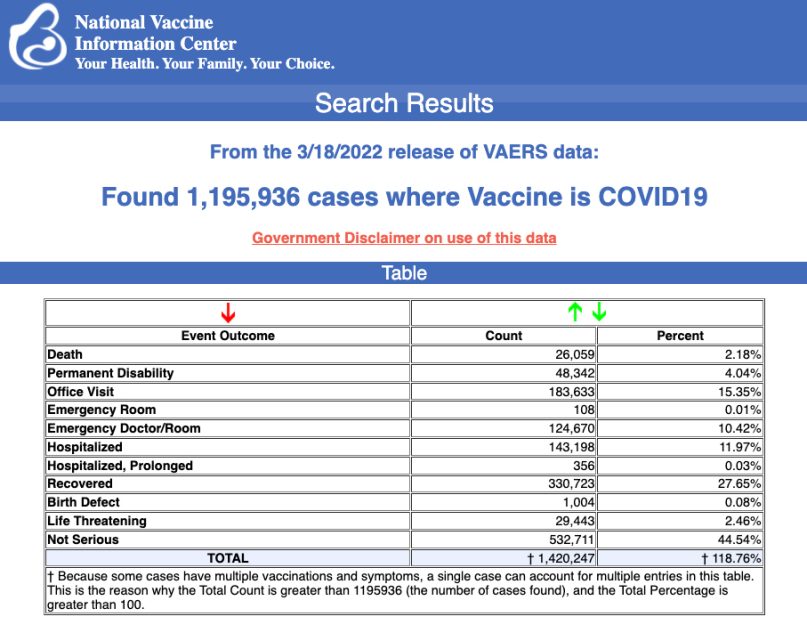
Every Friday, VAERS publishes vaccine injury reports received as of a specified date. Reports submitted to VAERS require further investigation before a causal relationship can be confirmed.
Historically, VAERS has been shown to report only 1% of actual vaccine adverse events.
U.S. VAERS data from Dec. 14, 2020, to March 18, 2022, for 5- to 11-year-olds show:
- 9,463 adverse events, including 228 rated as serious and 5 reported deaths.The most recent death involves a 7-year-old boy (VAERS I.D. 2152560) from Washington who died 13 days after receiving his first dose of Pfizer’s COVID vaccine when he went into shock and suffered cardiac arrest. He was unable to be resuscitated and died in the emergency department.
- 16 reports of myocarditis and pericarditis (heart inflammation).The CDC uses a narrowed case definition of “myocarditis,” which excludes cases of cardiac arrest, ischemic strokes and deaths due to heart problems that occur before one has the chance to go to the emergency department.
- 36 reports of blood clotting disorders.
U.S. VAERS data from Dec. 14, 2020, to March 18, 2022, for 12- to 17-year-olds show:
- 30,591 adverse events, including 1,755 rated as serious and 42 reported deaths.The most recent deaths involve a 17-year-old boy (VAERS I.D. 2171083) from Illinois with Duchenne muscular dystrophy who died from cardiac arrest after receiving his second dose of Pfizer’s COVID vaccine, and a 14-year-old boy from Guam (VAERS I.D. 2157944) who died one week after his first dose of Pfizer when he suddenly committed suicide.The boy’s VAERS report states:
“Sudden suicide one week after the vaccine. Patient was a perfectly happy child. After the vaccine, he became much more tired and achy and lost interest in doing his sports. One week later, without any warning, he hung himself.”
- 68 reports of anaphylaxis among 12- to 17-year-olds where the reaction was life-threatening, required treatment or resulted in death — with 96% of cases attributed to Pfizer’s vaccine.
- 648 reports of myocarditis and pericarditis, with 636 cases attributed to Pfizer’s vaccine.
- 163 reports of blood clotting disorders, with all cases attributed to Pfizer.
U.S. VAERS data from Dec. 14, 2020, to March 18, 2022, for all age groups combined, show:
- 20% of deaths were related to cardiac disorders.
- 54% of those who died were male, 41% were female and the remaining death reports did not include the gender of the deceased.
- The average age of death was 72.7.
- As of March 18, 5,294 pregnant women reported adverse events related to COVID vaccines, including 1,679 reports of miscarriage or premature birth.
- Of the 3,621 cases of Bell’s Palsy reported, 51% were attributed to Pfizer vaccinations, 40% to Moderna and 8% to J&J.
- 869 reports of Guillain-Barré syndrome, with 41% of cases attributed to Pfizer, 30% to Moderna and 28% to J&J.
- 2,371 reports of anaphylaxis where the reaction was life-threatening, required treatment or resulted in death.
- 1,647 reports of myocardial infarction.
- 13,602 reports of blood-clotting disorders in the U.S. Of those, 6,077 reports were attributed to Pfizer, 4,848 reports to Moderna and 2,633 reports to J&J.
- 4,070 cases of myocarditis and pericarditis with 2,502 cases attributed to Pfizer, 1,381 cases to Moderna and 177 cases to J&J’s COVID vaccine.
Mother calls for more vaccine studies after 12-year-old experiences severe pericarditis
An Australian mother is calling for long-term studies on mRNA COVID vaccines and better advice for parents after her 12-year-old son was hospitalized for pericarditis just hours after getting the Moderna shot.
The mother, referred to in the media only as “Nat,” vaccinated her son despite being hesitant about the long-term health risks because she believed she was doing the right thing. But within seven hours of being vaccinated, her son was unable to sit or lie down without severe chest pain and complained of breathing difficulties.
ER doctors confirmed Nat’s son had pericarditis, a condition characterized by inflammation of the membrane around the heart.
Nat said she was angry because she was hesitant about giving him the vaccine, but still chose to vaccinate him anyway. Now, she wants the federal government to present better information to parents on the risks of COVID vaccines to help them make a more informed choice on whether to immunize their children.
CDC removes tens of thousands of deaths ‘accidentally’ attributed to COVID
The CDC on March 15 removed from its data tracker website tens of thousands of deaths attributed to COVID, including nearly a quarter of the deaths attributed to children. The CDC said it made adjustments to the mortality data because its website’s algorithm was “accidentally counting deaths that were not COVID-19-related.”
Prior to the adjustment on March 15, the CDC reported 851,000 COVID deaths, including 1,755 pediatric deaths. After the change, COVID-related deaths dropped to 780,000.
The change resulted in the removal of 72,277 deaths previously reported across 26 states, including 416 pediatric deaths — a reduction of 24% to 1,341, the agency said.
According to The Guardian, the error arose from two questions the CDC asks states when they report COVID fatalities. One data field asks if a person died “from illness/complications of illness,” and the field next to it asks for the date of death.
When the answer is “yes,” then the date of death has to be provided. But if a respondent included the date of death but put “no” or “unknown” in the other field, the CDC’s system assumed the answer was an error and switched the answer to “yes.” This resulted in an overcount of COVID deaths in the demographic breakdown.
The agency said once it discovered the problem, it corrected it, but it is unknown how long inaccurate COVID deaths were reported.
The CDC’s COVID statistics, used to justify which age groups should receive vaccines, were used by U.S. health agencies to support the authorization of Pfizer’s COVID vaccine for children 5 to 11 years old.
Moderna to request authorization of COVID vaccine for kids 5 to 11
Moderna on March 23 announced plans to request Emergency Use Authorization (EUA) for its pediatric COVID vaccine, citing preliminary data showing the two-dose regimen was safe for children under age 6, but may not be effective at reducing severe COVID.
The company released partial results from its two pediatric clinical trials in 6,900 children showing the mRNA shots were only about 44% effective at preventing symptomatic infection in children 6 months to 2 years old, and only 37% effective in children aged 2 to 5.
FDA guidelines for EUA products stipulate the product must show 50% efficacy.
The company said the majority of COVID cases observed were mild and no severe disease, hospitalizations or deaths were reported among any of the children who participated in the trial, making it impossible to detect the vaccine’s protective effect against the worst outcomes.
Moderna did not report details on types of side effects except for data on children who experienced fevers. The company said about 15% of children had fevers higher than 100.4 degrees, and 1 in 500 experienced a fever higher than 104 degrees.
However, data show the vaccine may not be effective at reducing severe COVID in children, who make up only a small percentage of SARS-CoV-2 infections — most of which are asymptomatic and mild.
4th COVID shot offers little protection against infection
A small study conducted by Researchers at Sheba Medical Center in Israel found efficacy of a fourth dose of Pfizer and Moderna COVID vaccines resulted in only marginal protection from SARS-CoV-2 infection.
According to the study, published in the New England Journal of Medicine, a fourth Pfizer dose showed 30% efficacy in preventing infection and Moderna’s fourth dose showed only 11%.
The study’s authors said a fourth dose provided “moderate protection against symptomatic infection” (Pfizer = 43%; Moderna = 31%), with symptomatic infection defined as a fever lasting either more or less than 48 hours. Other systemic symptoms included fatigue, myalgia, and headache.
However, these efficacy numbers fall short of the required 50% threshold required by the FDA for EUA products in the U.S.
About 25.2% of fourth dose recipients experienced moderate-to-severe local reactions and 6.5% had moderate-to-severe systemic reactions to a second booster, while the majority of all COVID cases in participants were asymptomatic or had negligible symptoms.
Children’s Health Defense asks anyone who has experienced an adverse reaction, to any vaccine, to file a report following these three steps.
Megan Redshaw is a freelance reporter for The Defender. She has a background in political science, a law degree and extensive training in natural health.
© 2022 Children’s Health Defense, Inc. This work is reproduced and distributed with the permission of Children’s Health Defense, Inc. Want to learn more from Children’s Health Defense? Sign up for free news and updates from Robert F. Kennedy, Jr. and the Children’s Health Defense. Your donation will help to support us in our efforts.
Biden’s Reckless Words Underscore the Dangers of the U.S.’s Use of Ukraine As a Proxy War
By Glenn Greenwald | March 27, 2022
As grave of a threat as deliberate war is, unintended escalation from miscommunication and misperception can be as bad. Biden is the perfect vessel for such risks.
The central question for Americans from the start of the war in Ukraine was what role, if any, should the U.S. government play in that war? A necessarily related question: if the U.S. is going to involve itself in this war, what objectives should drive that involvement?
Prior to the U.S.’s jumping directly into this war, those questions were never meaningfully considered. Instead, the emotions deliberately stoked by the relentless media attention to the horrors of this war — horrors which, contrary to the West’s media propaganda, are common to all wars, including its own — left little to no space for public discussion of those questions. The only acceptable modes of expression in U.S. discourse were to pronounce that the Russian invasion was unjustified, and, using parlance which the 2011 version of Chris Hayes correctly dismissed as adolescent, that Putin is a “bad guy.” Those denunciation rituals, no matter how cathartic and applause-inducing, supplied no useful information about what actions the U.S. should or should not take when it came to this increasingly dangerous conflict.
That was the purpose of so severely restricting discourse to those simple moral claims: to allow policymakers in Washington free rein to do whatever they wanted in the name of stopping Putin without being questioned. Indeed, as so often happens when war breaks out, anyone questioning U.S. political leaders instantly had their patriotism and loyalty impugned (unless one was complaining that the U.S. should become more involved in the conflict than it already was, a form of pro-war “dissent” that is always permissible in American discourse).
With these discourse rules firmly implanted, those who attempted to invoke former President Obama’s own arguments about a conflict between Russia and Ukraine — namely, that “Ukraine is a core Russian interest but not an American one” and therefore the U.S. should not risk confrontation with Moscow over it — were widely maligned as Kremlin assets if not agents. Others who urged the U.S. to try to avert war through diplomacy — by, for instance, formally vowing that NATO membership would not be offered to Ukraine and that Kyiv would remain neutral in the new Cold War pursued by the West with Moscow — faced the same set of accusations about their loyalty and patriotism.
Most taboo of all was any discussion of the heavy involvement of the U.S. in Ukraine beginning in 2014 up to the invasion: from micro-managing Ukrainian politics, to arming its military, to placing military advisers and intelligence officers on the ground to train its soldiers how to fight (something Biden announced he was considering last November) — all of which amounted to a form of de facto NATO expansion without the formal membership. And that leaves to the side the still-unanswered yet supremely repressed question of what Undersecretary of State Victoria Nuland referred to as the Ukrainians’ “biological research facilities” so dangerous and beyond current Russian bio-research capabilities that she gravely feared they would “fall into Russian hands.”
As a result of the media’s embracing of moral righteousness in lieu of debating these crucial geopolitical questions, the U.S. government has consistently and aggressively escalated its participation in this war with barely any questioning let alone opposition. U.S. officials are boastfully leading the effort to collapse the Russian economy. Along with its NATO allies, the U.S. has flooded Ukraine with billions of dollars of sophisticated weaponry, with at least some of those arms ending up in the hands of actual neo-Nazi battalions integrated into the Ukrainian government and military. It is providing surveillance technology in the form of drones and its own intelligence to enable Ukrainian targeting of Russian forces. President Biden threatened Russia with a response “in kind” if Russia were to use chemical weapons. Meanwhile, reports The New York Times, “C.I.A. officers are helping to ensure that crates of weapons are delivered into the hands of vetted Ukrainian military units.”
The U.S. is, by definition, waging a proxy war against Russia, using Ukrainians as their instrument, with the goal of not ending the war but prolonging it. So obvious is this fact about U.S. objectives that even The New York Times last Sunday explicitly reported that the the Biden administration “seeks to help Ukraine lock Russia in a quagmire” (albeit with care not to escalate into a nuclear exchange). Indeed, even “some American officials assert that as a matter of international law, the provision of weaponry and intelligence to the Ukrainian Army has made the United States a cobelligerent,” though this is “an argument that some legal experts dispute.” Surveying all this evidence as well as discussions with his own U.S. and British sources, Niall Ferguson, writing in Bloomberg, proclaimed: “I conclude that the U.S. intends to keep this war going.” UK officials similarly told him that “the U.K.’s No. 1 option is for the conflict to be extended and thereby bleed Putin.”
In sum, the Biden administration is doing exactly that which former President Obama warned in 2016 should never be done: risking war between the world’s two largest nuclear powers over Ukraine. Yet if any pathology defines the last five years of U.S. mainstream discourse, it is that any claim that undercuts the interests of U.S. liberal elites — no matter how true — is dismissed as “Russian disinformation.”
As we witnessed most vividly in the run-up to the 2020 election — when that label was unquestioningly yet falsely applied by the union of the CIA, corporate media and Big Tech to the laptop archive revealing Joe Biden’s political and financial activities in Ukraine and China — any facts which establishment power centers want to demonize or suppress are reflexively labelled “Russian disinformation.” Hence, the DNC propaganda arm Media Matters now lists as “pro-Russian propaganda” the indisputable fact that the U.S. is not defending Ukraine but rather exploiting and sacrificing it to fight a proxy war with Moscow. The more true a claim is, the more likely it is to receive this designation in U.S. establishment discourse.
That there are few if any risks graver or more reckless than a direct U.S./Russia military confrontation should be too obvious to require explanation. Yet that seems to have been completely forgotten in the zeal, arousal, purpose and excitement which war always triggers. It takes little to no effort to recognize the current emergence of the dynamic about which Adam Smith so fervently warned 244 years ago in Wealth of Nations:
In great empires the people who live in the capital, and in the provinces remote from the scene of action, feel, many of them scarce any inconveniency from the war; but enjoy, at their ease, the amusement of reading in the newspapers the exploits of their own fleets and armies. To them this amusement compensates the small difference between the taxes which they pay on account of the war, and those which they had been accustomed to pay in time of peace. They are commonly dissatisfied with the return of peace, which puts an end to their amusement, and to a thousand visionary hopes of conquest and national glory, from a longer continuance of the war.
The grave dangers of the world’s two largest nuclear-armed powers acting on opposite sides of a hot war extend far beyond any intention by the U.S. to deliberately engage Russia directly. Such a war, even with the U.S. waging it “only” through its proxies, severely escalates tensions, distrust, hostilities, and a climate of paranoia. That is particularly true given that — ever since Democrats decided to blame Putin for Hillary’s 2016 loss — at least half of Americans have been feeding on a non-stop, toxic diet of anti-Russian hatred under the guise of “Russiagate.” As recently as 2018, 2/3 of Democrats believed that Russia hacked into voting machines and altered the 2016 vote count to help Trump win. This cultivation of extreme anti-Russian animus in Washington has been made even more dangerous by the virtual prohibition on dialogue with Russian officials, which during Russiagate was deemed inherently suspect if not criminal.
And all of those preexisting dangers are, in turn, severely exacerbated by an American president who so often is too age-addled to speak clearly or predictably. That condition is inherently dangerous, made all the more so by the fact that it leaves him vulnerable to manipulation by the Democratic Party’s national security advisers who will never forget 2016 and seem more intent than ever on finally attaining vengeance against Putin, no matter the risks. Speaking to U.S. troops in Poland on Friday, a visibly exhausted and rambling President Biden — after extensive travel, time-zone hopping, protracted meetings and speeches — appeared to tell U.S. troops that they were on their way to see first-hand the resistance of Ukrainians, meaning they were headed into Ukraine:
It seems clear that this was not some planned decision to have the U.S. president casually announce his intention to send U.S. troops to fight Russians in Ukraine. This was, instead, an old man, more tired, unpredictable and incoherent than usual due to intense overseas travel, accidentally mumbling out various phrases that could be and almost certainly were highly alarming to Moscow and other countries.
But accidental or unintentional escalation — from misperception or miscommunication — is always at least as serious a danger for war as the deliberate intention to directly engage militarily. In January of this year, the Bulletin of Atomic Scientists announced that its so-called “doomsday clock” was set to 100 seconds before midnight, the metaphorical time they used to signify an extinction-level event for humanity. They warned that the prospect of a cataclysmic nuclear exchange among the U.S., Russia and/or China was dangerously possible, and specifically warned: “Ukraine remains a potential flashpoint, and Russian troop deployments to the Ukrainian border heighten day-to-day tensions.”
In 2018, when the clock was “only” at two minutes before midnight, they emphasized tensions between Russia and the U.S. as one of the primary causes: “The United States and Russia remained at odds, continuing military exercises along the borders of NATO, undermining the Intermediate-Range Nuclear Forces Treaty (INF), upgrading their nuclear arsenals, and eschewing arms control negotiations.” They urged recognition of this specific danger: “Major nuclear actors are on the cusp of a new arms race, one that will be very expensive and will increase the likelihood of accidents and misperceptions.”
That Biden’s “gaffe” about U.S. troops headed into Ukraine could generate exactly this sort of “misperception” seems self-evident. So do the grave dangers from Biden’s sudden yet emphatic declaration on Saturday that Putin “cannot remain in power” — the classic language of declared U.S. policy of regime change:
That clear declaration of regime change as the U.S. goal for Putin was quickly walked back by Biden’s aides, who absurdly claimed he only meant that Putin cannot remain in power in Ukraine and other parts of Eastern Europe, not that he can no longer govern Russia. But this episode marked at least the third time in the past couple weeks that White House officials had to walk back Biden’s comments, following his clear decree that U.S. troops would soon be back in Ukraine and his prior warning that the U.S. would use chemical weapons against Russia if they used them first.
That Biden seems to be stumbling and bumbling rather than following scripted recklessness seems likely in some of these cases but not all. The White House’s vehement denial, in the wake of Biden’s speech, that regime change in Russia is its goal was contradicted by Ferguson’s reporting in Bloomberg last week:
Reading this carefully, I conclude that the U.S. intends to keep this war going… I have evidence from other sources to corroborate this. “The only end game now,” a senior administration official was heard to say at a private event earlier this month, “is the end of Putin regime”… I gather that senior British figures are talking in similar terms. There is a belief that “the U.K.’s No. 1 option is for the conflict to be extended and thereby bleed Putin.” Again and again, I hear such language. It helps explain, among other things, the lack of any diplomatic effort by the U.S. to secure a cease-fire. It also explains the readiness of President Joe Biden to call Putin a war criminal.
Whether deliberate or unintentional, these escalatory statements — particularly when combined with the U.S.’s escalatory actions — are dangerous beyond what can be described. As an Australian news outlet reported on Sunday, “Russia has launched a missile strike near Poland in what appears to be a deadly warning to the United States.” The accompanying video shows at least three long-range cruise missiles, launched from a Russian submarine in the Black Sea, precisely striking targets in western Ukraine, near to where Biden was in Poland. That missile launch, the outlet reasonably concluded, “appears to be a deadly warning to the United States.”
Whatever else is true, the U.S. and Russia are now in waters uncharted since the Cuban missile crisis. Even the savage US/USSR proxy wars of the 1980s in Latin America and Afghanistan did not entail these sorts of rapidly escalating threats. A Russian president who, validly or not, feels threatened by NATO expansion in the region and driven by questions of his legacy, on the other side of a U.S. president with a long record of hawkishness and war fever which is now hobbled by the carelessness and infirmities of old age, is a remarkably volatile combination. As former Greek finance minister Yanis Varoufakis put it on Saturday: “A U.S. President who, during an atrocious war, does not mean what he says on matters of War and Peace, and must be corrected by his hyperventilating staff, is a clear and present danger to all.”
Hovering above all of these grave dangers is the question of why? What interests does the U.S. have in Ukraine that are sufficiently vital or substantial to justify trifling with risks of this magnitude? Why did the U.S. not do more to try to diplomatically avert this horrific war, instead seemingly opting for the opposite: namely, discouraging Ukrainian President Zelensky from pursuing such talks on the alleged grounds of futility and rewarding Russian aggression, and not even exploring whether a vow of non-NATO-membership for Ukraine would suffice? How does growing U.S. involvement in this war benefit the people of the United States, particularly as they were already — before this war — weighed down by the dual burdens of pandemic-based economic depravations and rapidly escalating inflation?
These are precisely the questions that a healthy nation discusses and examines before jumping head-first into a major war. But these were precisely the questions declared to be unpatriotic, proof of one’s status as a traitor or pro-Russia propagandist, as the hallmark of being pro-Putin. These are the standard tactics used to squash dissent or questioning when war breaks out. That neocons, who perfected these smear tactics, are back in the saddle as discourse and policy leaders — due to their six-year project of ingratiating themselves back into American liberalism with performative anti-Trump agitprop — makes it inevitable that such sleazy attacks will prevail.
As a result, the U.S. now finds itself more deeply enmeshed than ever in the most dangerous war it has fought in years if not decades. It may be too late for those questions to be meaningfully examined. But given the stakes, this is as clear a case of better late than never as one will ever encounter.
Most Brits expect problems paying heating and energy bills
Samizdat | March 27, 2022
More than 67% of UK residents expect problems paying bills for heating and electricity, according to the latest poll carried out by Techne, a London-based market and data research company.
The survey, reported by the Sunday Express on Saturday, shows that the cost of living is the top concern for 58% of British citizens.
More than 80% of 1,642 surveyed individuals said they are going to avoid large purchases, while 55% are planning to decrease spending on leisure activities. Some 37% said they will try to save on clothes.
Meanwhile, only 31% of respondents cited Ukraine as a key reason for concern. Nearly a third of those surveyed said the crisis in the Eastern European country and Western anti-Russia sanctions will push back the date they can retire.
Only 7% of respondents were worried about climate change, and only 3% of respondents mentioned the coronavirus pandemic as a cause for concern.
Over the past six months, Europe has been struggling with an unprecedented energy crisis that has been sending prices for gas, petrol and electricity to record high levels.
The latest sanctions imposed on Russia over its military operation in Ukraine has worsened the situation as concerns over energy security in the region deepened as Russia remains the continent’s biggest energy supplier.
Media Scare Themselves, Confuse “Unprecedented” Weather Model Temperature Spikes with Actual Temperatures
By Anthony Watts | ClimateRealism | March 22, 2022
This past week two left-leaning media outlets, MSN (via The Washington Post aka WaPo), and the always alarmed UK based The Guardian ran stories saying the Arctic and Antarctic, had experienced “unprecedented” high temperatures. These claims can’t be verified since they were the results from a set of weather model simulations, indicating variations of above normal temperatures for the regions, not actual surface temperatures measured by ground-based weather stations.
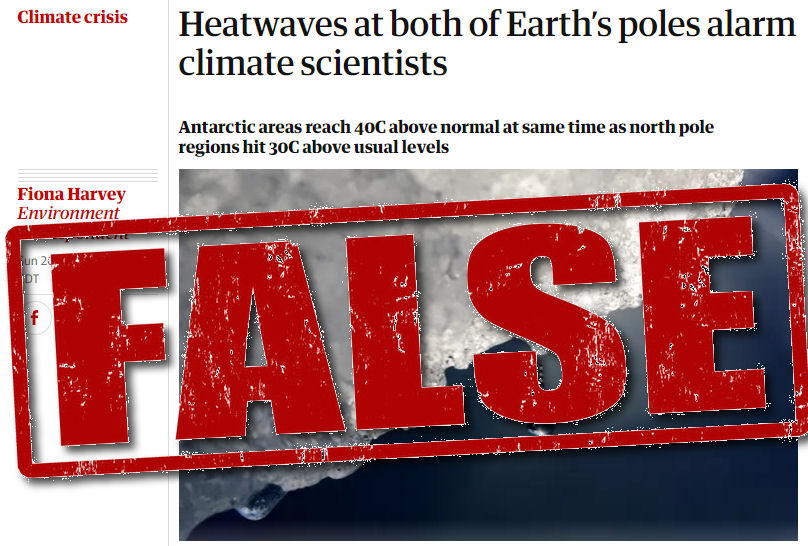
The Guardian headline was full of worry courtesy of author Fiona Harvey:
Heatwaves at both of Earth’s poles alarm climate scientists
Antarctic areas reach 40C above normal at same time as north pole regions hit 30C above usual levels
She writes:
Startling heatwaves at both of Earth’s poles are causing alarm among climate scientists, who have warned the “unprecedented” events could signal faster and abrupt climate breakdown.
At the same time, weather stations near the north pole also showed signs of melting, with some temperatures 30C above normal, hitting levels normally attained far later in the year.
At this time of year, the Antarctic should be rapidly cooling after its summer, and the Arctic only slowly emerging from its winter, as days lengthen. For both poles to show such heating at once is unprecedented.
They key phrase here is: “weather stations near the north pole.” The northernmost weather station is Alert, Nunavut and it is 817 km (508 mi) from the North Pole. That’s like trying to gauge the temperature in Indianapolis from a warmer temperature reading in Atlanta.
MSN/WaPo authors Jason Samenow and Kasha Patel had this flabbergasting headline:
It’s 70 degrees warmer than normal in eastern Antarctica. Scientists are flabbergasted.
The coldest location on the planet has experienced an episode of warm weather this week unlike any ever observed, with temperatures over the eastern Antarctic ice sheet soaring 50 to 90 degrees above normal. The warmth has smashed records and shocked scientists.
“This event is completely unprecedented and upended our expectations about the Antarctic climate system,” said Jonathan Wille, a researcher studying polar meteorology at Université Grenoble Alpes in France, in an email.
“Antarctic climatology has been rewritten,” tweeted Stefano Di Battista, a researcher who has published studies on Antarctic temperatures. He added that such temperature anomalies would have been considered “impossible” and “unthinkable” before they actually occurred.
Both articles mentioned “climate” in the context of blame or contribution to these weather events.
To the uninitiated reading about these “events,” it must surely seem like evidence the planet is on its way to being wrecked from global warming aka “climate change,” and that the polar icecaps are in danger of melting away to nothing.
The reality is entirely different.
The MSN article includes this graphic:
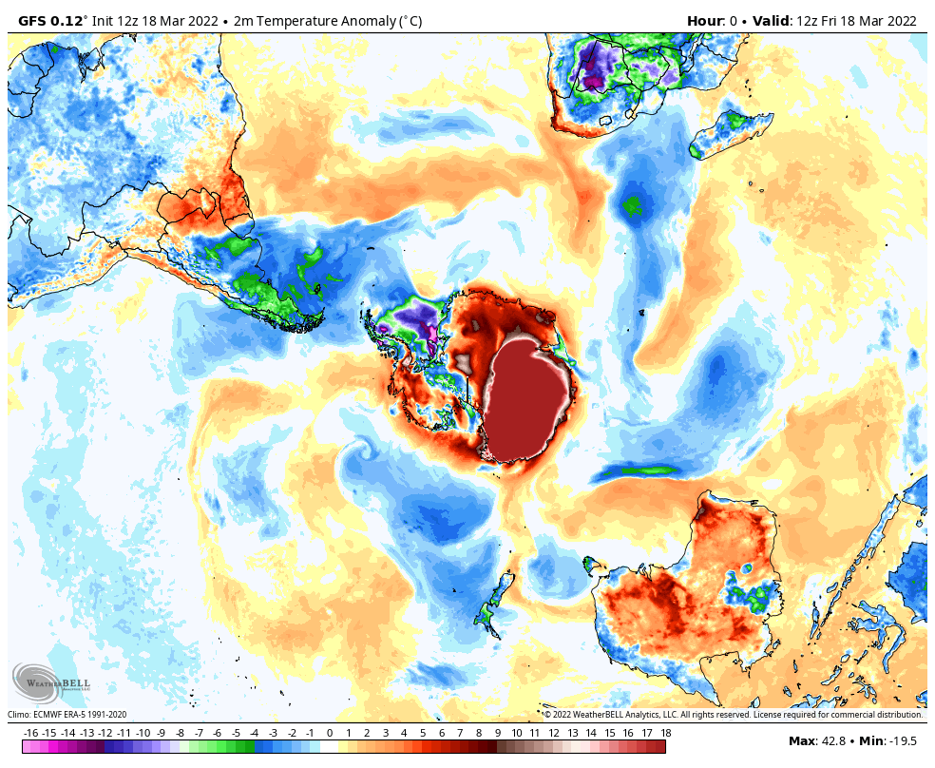
Figure 1 – the image that has scientists “flabbergasted.”
It always pays to read the fine print, and in this case the MSN caption for that Figure 1 image (when you click on it at MSN to enlarge it) is telling:
Simulation of temperature differences from normal centered over Antarctica from the American (GFS) model.
That’s right, it isn’t temperature that actually measured at the surface of that forlorn icecap, it’s a model simulation of temperature from a single climate model, the GFS model.
If we look at that same “model simulation” today, from the same source, all of the sudden that “flabbergasting” image is gone, and temperatures are frigid again as seen in Figure 2 below.
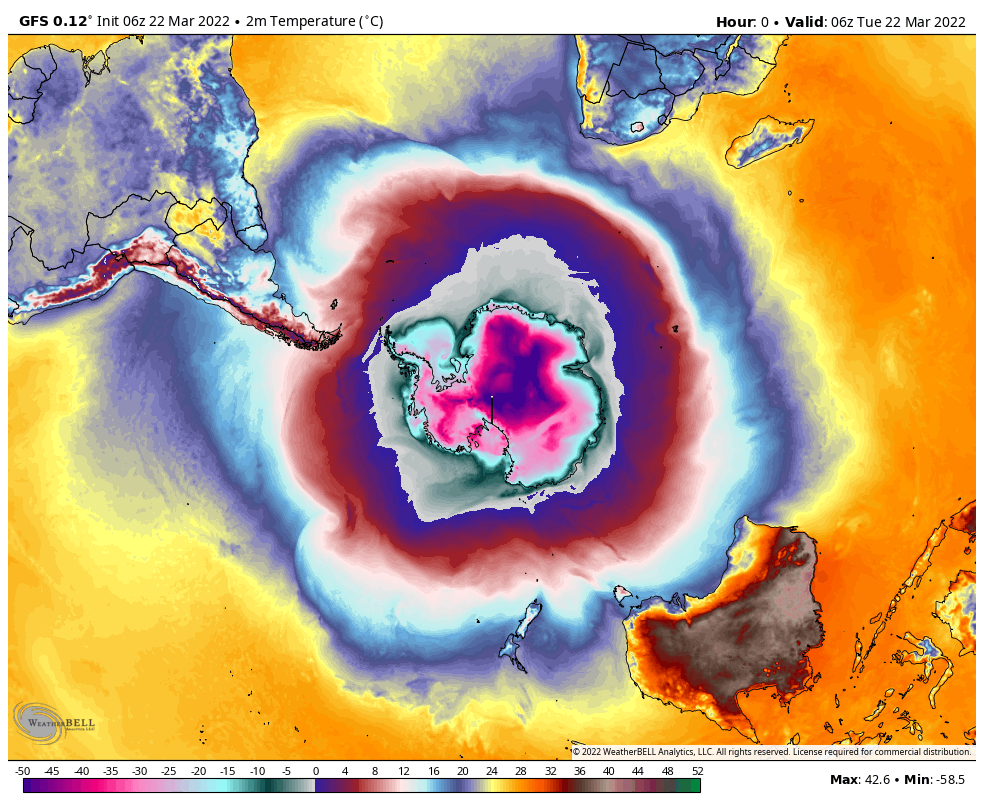
Figure 2 – The same model simulation, just 4 days later.
Once again, the media proves itself incapable of differentiating between short-term model simulations of a weather event from long-term evidence climate change. Indeed, the “flabbergasting” spike in temperature may very well have been nothing but a glitch of mathematics in the model, and not actual weather.
Verifying actual weather is difficult. There are very few actual surface weather stations on the eastern Antarctic icecap, and none at all at the North Pole. See more at this map.
In the Arctic, it is a similar story after last week’s alarming model simulated “heat wave,” temperatures are back to their frigid normal as seen in Figure 3 below:
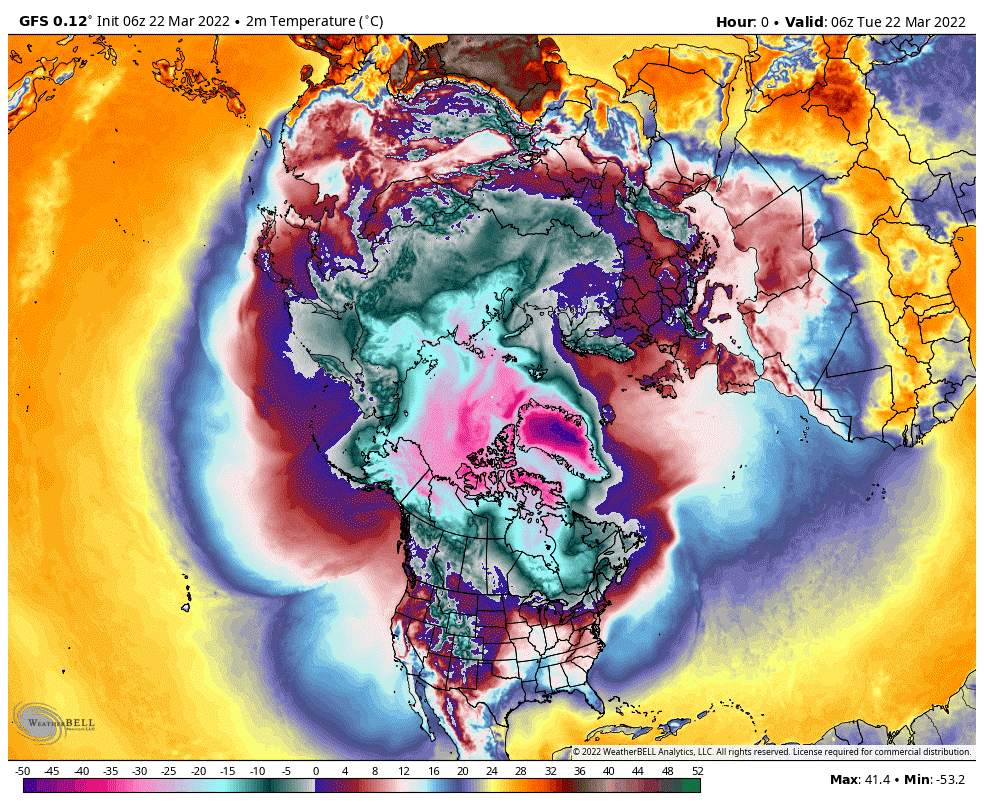
Figure 3 – North pole temperatures on Tuesday March 22nd are at -30 to -40°C
Surface weather stations in both the Arctic and the Antarctic are relatively recent developments in meteorology. In the Arctic, the ice floats on the ocean. It is unstable, moves, and breaks up in the spring making it nearly impossible to keep a weather station in one place, much less operational. The U.S. National Oceanic and Atmospheric Administration (NOAA) started deploying floating weather stations and web cams in 2002 at the North Pole, but gave up due to “funding constraints” in 2015.
In Antarctica, due to the extremely harsh conditions of temperature, blowing snow, and lack of sunlight to power solar cells, Automated Weather Stations (AWS) are few and far between. Plus, such weather stations have only been present in Antarctica since 1978. The harsh environment often buries these weather stations in snow, leaving them with faulty temperature data, or completely inoperable due to solar panels being covered. The AWS’s have to be dug out of the snow each year.
This is why meteorologists often rely on mathematical simulations of the atmosphere to “guess” the temperatures of the air at the north and south poles – they can’t always trust the actual data to be there or be accurate.
So, in summary we have these points to consider about Arctic and Antarctic weather data:
- We don’t have actual weather data in many places at the North and South poles.
- The weather data we do have may be compromised or intermittent due to harsh weather conditions affecting ground based weather stations.
- Compared to larger 100+ years of climate data for the globe, we have maybe 40 years of data for the poles at best.
Since we have at best 40 years of data and observations from the poles, is science capable of determining if weather events like the one modeled in Antarctica are “unprecedented” or not?
We simply don’t know if they are, because we haven’t been looking that long.
Indeed, science can’t say for sure if the brief spikes in temperature at the poles last week were real or simply a product of one flawed model’s simulation, a glitch in the numerical model output. Even if it were real, one brief spike in temperature is not the same as a long-term climate change, which is defined as a trend of 30 or more years of data.
Yet, somehow, climate scientists are “alarmed” and “flabbergasted” at a single day weather event simulated from a computer model.
Scientists (and journalists) that use those terms might be better off keeping a lid on their opinions until they have real data to confirm their “unprecedented” claims. Carl Sagan rightly opined, paraphrasing Laplace’s principle, “extraordinary claims require extraordinary evidence.”
These researchers, and the corporate media outlets which uncritically parroted their claims, have presented no extraordinary evidence that either Antarctica or the Arctic experienced an unusual spike in warming. Model simulations simply aren’t evidence.
US Government Paid News Media $1 Billion to Promote Vaccines
By Dr. Joseph Mercola | March 25, 2022
The Department of Health and Human Services (HHS) released information to TheBlaze1 in response to a Freedom of Information Act (FOIA) request. The information showed that the federal government had purchased advertising to the tune of $1 billion taxpayer dollars as part of a media campaign to build vaccine confidence.
HHS2 has billed the campaign as a “national initiative to increase public confidence in, and uptake of, COVID-19 vaccines while reinforcing basic prevention measures such as mask-wearing and social distancing.” Data don’t support these measures, but the media campaign was likely hiding something more sinister.
HHS Paid News Media to Build Vaccine Confidence
Within the documents sent from HHS, TheBlaze3 found that hundreds of organizations in the news media were paid to produce TV, print, radio and social media advertising timed to coincide with an increasing availability of the genetic therapy shots.
The government also collaborated with social media influencers whose audience included “communities hit hard by COVID-19” and also engaged “experts” to be interviewed and promote the mass vaccination campaign in the news.4 One of those experts was the director of NIAID and chief medical adviser to the White House, Dr. Anthony Fauci.
In other words Fauci, the man who has been the “face” of COVID-19 in 2020 and 2021,5 who publicly disparaged anyone who questioned the data he was using to support his recommendations, and who blithely referred to himself as “the science,”6,7 was, in fact, a shill.
Virtually every one of the news organizations paid by HHS, including ABC, NBC, CBS, CNN, MSNBC, The Washington Post, Los Angeles Times and the New York Post, covered stories about the vaccines and did not disclose they had accepted taxpayer dollars to support the vaccine effort. It is common practice for the editorial teams to function separately from the advertising departments, so it appears the organizations felt there was no need to disclose their funding.
The advertising took several forms, including an amusing social media campaign featuring Elton John and Michael Caine, fear-based ads that featured survivor stories and straightforward informational ads promoting the safety and efficacy of the current mRNA shot for COVID-19.
Shani George, vice president of communications for The Washington Post made a statement about the funding they received for media advertising from the federal government, saying:8
“Advertisers pay for space to share their messages, as was the case here, and those ads are clearly labeled as such. The newsroom is completely independent from the advertising department.”
A spokesperson for the Los Angeles Times also responded to TheBlaze and gave a similar response. Other publications either did not respond or declined to comment. However, it is important to note that the reporters and editorial staff responsible for news also likely read their own publication or watch the online videos.
It’s not hard to imagine that a large news organization promoting vaccinations through their advertising department would not look kindly on editorial staff who choose to report facts that do not align with large sums of money spent by advertisers. You can guess what the editorial staff may be told to write. TheBlaze offered several examples of thinly disguised advertising published as “news,” including:
- An October BuzzFeed 9 article featured “essential facts” about eligibility for the vaccine and unbalanced, pro-vaccine statements from health agency experts such as CDC director Dr. Rochelle Walensky, HHS Secretary Xavier Becerra and epidemiologist Dr. George Rutherford.
- Articles in the Los Angeles Times 10 featured “experts” advising people how to convince their vaccine-hesitant friends and relatives to change their minds.
- A Washington Post article covered “the pro-vaccine messages people want to hear.”11
- A Newsmax article in November ran the headline “Newsmax Opposes Vaccine Mandate, Here’s Why.”12 The article, obviously an opinion piece, began by saying the mandate was a “dangerous overreach” and then proceeded to support the vaccine campaign with statements like, “The vaccine … has been demonstrated to be safe and effective” and “Newsmax has encouraged citizens, especially those at risk, to get immunized.”
Journalistic Objectivity Likely Impossible
The U.S. government is not the only entity to recognize the power behind controlling the news media. Bill Gates is another. Using more than 30,000 grants, Gates has contributed at least $319 million to the media, which senior staff writer for MintPress News Alan McLeod revealed.13
Recipients included CNN, NPR, BBC, The Atlantic and PBS. Gates has also sponsored foreign organizations that included The Daily Telegraph, the Financial Times, and Al Jazeera. More than $38 million has also been funneled into investigative journalism centers.
Gates’ influence within the press is far-reaching, from journalism to journalistic training. This ultimately makes true objective reporting about Gates or his initiatives virtually impossible. MacLeod writes:14
“Today, it is possible for an individual to train as a reporter thanks to a Gates Foundation grant, find work at a Gates-funded outlet, and to belong to a press association funded by Gates. This is especially true of journalists working in the fields of health, education and global development, the ones Gates himself is most active in and where scrutiny of the billionaire’s actions and motives are most necessary.”
It is important to note that Gates has an intense interest in health, and specifically vaccinations.15 And with this power to control the media and his strong connections with health organizations such as Johns Hopkins, with whom he collaborated for Event 201,16 it’s not hard to imagine that his influence can be seen in many of the stories you read or watch each day.
This government overreach into the Fourth Estate is not unique to the U.S. Leaked documents17 have demonstrated that the BBC News and Reuters have also been involved in a covert operation in which the U.K. sought to infiltrate Russian media and promote a U.K. narrative using a network of Russian journalists.
Multimillion-dollar contracts were used to advance these aims, which included 15,000 journalists and staff. The campaign closely follows a U.S. clandestine CIA media infiltration campaign launched in 1948 called Operation Mockingbird.18,19 About one-third of the CIA budget, or $1 billion each year, was spent on bribes to hundreds of American journalists, who then published fake stories at the CIA’s request.
While it may sound like ancient history, there’s evidence to suggest it continues today. Although the messages have changed with the times, the basic modus operandi of dissemination remains the same. Other reports20,21,22 have also highlighted the role of intelligence agencies in the global effort to eliminate “anti-vaccine propaganda” from public discussion, and the fact that they’re using sophisticated cyberwarfare tools to do so.
Facts Reveal Reason Government Is Paying News Media
All-cause mortality and death rates are difficult statistics to change. People are either dead or they’re not. There is only one reason a person is included in the National Death Index Database: They have died regardless of the cause. Evidence is mounting that all-cause mortality is rising to levels greater than were seen during 2020 at the height of the COVID-19 pandemic.
OneAmerica,23 a mutual insurance holding company, announced the death rate in working-age Americans from 18 to 64 years in the third quarter of 2021 was 40% higher than prepandemic levels. Other insurance companies are also finding similar results and citing higher mortality rates.24
The Hartford Insurance Company announced mortality had increased 32% from 2019 and 20% from 2020 during 2021. Lincoln National also reported claims increased by 13.7% year-over-year and were 54% higher in the fourth quarter compared to 2019. Funeral homes are posting an increase in burials and cremations in 2021 over 2020.25
The overall mortality increase noted after the global release of the COVID shot is also being reported in other countries. A large German health insurance company reported their data26,27 were nearly 14 times greater than the number of deaths reported by the German government. The health insurance company gathered the data directly from doctors who were applying for payment from a sample of 10.9 million people.
A reporter from The Exposé 28 notes that while the world has been distracted by Russia’s invasion of Ukraine, the U.K. government quietly released a report29 that confirmed 9 in every 10 deaths from COVID-19 in England were in people who were fully vaccinated.
Each week the U.K. Health Security Agency publishes a surveillance report. The February 24, 2022, report shows 85% to 91% of adults who are infected, hospitalized or died from COVID-19 were fully vaccinated.
Pfizer Documents Show Vaccines Not Fully Safe
Four days after the FDA approved the Pfizer vaccine for ages 16 and older, a group of public health professionals, doctors, scientists and journalists submitted a FOIA request to release the data Pfizer used for the approval of Comirnaty.30 The nonprofit group of professionals is called the Public Health and Medical Professionals for Transparency (PHMPT).31
Despite the FDA’s claim that the organization was committed to transparency,32 the agency first requested 55 years33 to release the data that supported the approval of Comirnaty after the FOIA was filed, and then asked for another 20 years to fully comply.34 All told, the FDA wanted 75 years to release documentation that supported their approval of a genetic therapy being promoted for mass vaccination.
When the FDA did not release the data, the PHMPT sued the FDA since it is the FDA’s statutory obligation35 to publish the documentation within 30 days of approving a drug. Although they asked for 75 years, January 6, 2022, the court ordered the FDA to release 55,000 pages of the documents each month so they would be completed within 8 months.36
March 1, 2022, the first of those documents were released and have been posted for public view on the PMHPT website.37 What’s included in these documents may answer the question of why the government felt $1 billion was required to boost vaccine confidence.
An initial review of some of the papers by one Trial Site News reporter revealed many errors and anomalies. In an interview with Stephen Bannon, mRNA technology inventor Dr. Robert Malone talked about the documentation and the need to develop a team to comb through the information and catalog it for reference. He said:38
“So, all this information comes piped through pharmacovigilance what’s called the pharmacovigilance shop at Pfizer and BioNTech. I presume Pfizer. And then that’s been summarized and submitted to the FDA as a series of documents. So this is a window into what FDA actually knows, which is by inference what CDC knows.
When they tell us there’s no risks and we should go ahead and start mandating or forcing vaccination on our children, what we have for instance, in that section you’re referring to of the listed adverse events is a huge list of what is considered to be adverse events of interest, which means that they’re not just one-offs.
It happens multiple times throughout the world and what we’re finding is embedded throughout this huge volume of documents that the judge has forced Pfizer and the FDA … remember our government tried really hard to keep this information from us and fortunately the courts have called their bluff and forced them to disclose it. Now it’s up to us to comb through it.”
Malone went on to describe the trouble that will likely arise in the coming weeks and months for Pfizer and the FDA from the information that is now freely available to the public when Bannon asked, why is it so important that the courts demanded the information be released now?
“The courts have forced Pfizer and the FDA to comply with the law which is that after licensure is granted these documents must be made available. Previously they’re considered confidential.
And remember that as Naomi’s [Naomi Wolfe] about to discuss, and the truckers are so upset about, we have been forced to take these vaccines and we have been told that they’re fully safe and effective. What this documents is the government has been well aware that they are not fully safe and has hidden this information from us.
What that really matters for Pfizer is that the indemnification clauses require Pfizer disclose known adverse events and this documentation demonstrates they didn’t do so. A lot of the lawyers are licking their chops over this because it seems to indicate a break in the veil that may allow legal action basically due to fraud and concealment of these risks from the general public.
This is why you have not been able to have full informed consent, is they’ve hidden all this information from you and they’ve used all the propaganda and censorship tools — which you’re about to cover — and paid media, to keep all this information from you and spin it, so that you think the left is right and the down is the up and the moon is made of green cheese.”
Sources and References
- 1, 8 TheBlaze, March 3, 2022
- 2 Health and Human Services, We Can Do This
- 3, 4 TheBlaze, March 3, 2022, Para 1, 2
- 5 YouTube, April 29, 2020
- 6 Fox News, November 28, 2021
- 7 National Review, November 29, 2021
- 9 BuzzFeed, October 20, 2021
- 10 Los Angeles Times, May 17, 2021
- 11 Washington Post, April 22, 2021
- 12 Newsmax, November 7, 2021
- 13, 14 MintPress News November 15, 2021
- 15 GatesFoundation, January 2010
- 16 Center for Health Security, Event 201
- 17 The GrayZone February 20, 2021
- 18 SGT Report October 7, 2019
- 19 ATI March 12, 2018
- 20 The Times November 9, 2020
- 21 UK Defense Journal November 10, 2020
- 22 The National News November 9, 2020
- 23 The Center Square, January 1, 2022
- 24, 25 Zero Hedge, February 5, 2022
- 26 Health Impact News, February 23, 2022
- 27 Greater Mountain Publishing, February 27, 2022
- 28 The Exposé, March 1, 2022
- 29 UK Health Security Agency (UKHSA) Covid-19 Vaccine Surveillance Report, February 24, 2022
- 30, 31 Public Health and Medical Professionals for Transparency
- 32 Food and Drug Administration, November 17, 2020
- 33 MSN, November 19, 2021
- 34 Euro Weekly December 9, 2021
- 35 SOPP 8401.7: Action Package for Posting December 11, 2020, page 1, III
- 36 Trial Site News, March 7, 2022
- 37 PMHPT, Pfizer Documents
- 38 Rumble, March 5, 2022 Minute 3:19 and 5:20
Canada School of Public Service panel proposes digital IDs tied to vaccine passports
By Ken Macon | Reclaim The Net | March 26, 2022
A federal panel in Canada discussed the possibility of using digital IDs to track vaccination status. The panel also discussed making Canada a global leader in digital identification.
The Canada School of Public Service (CSPS) held an event on February 1st to discuss how digital IDs could be used to track vaccination status in future pandemics. The event, titled “The New Economy Series: Digital Identity as a New Policy Frontier, was moderated by the Senior Assistant Deputy Minister for Innovation, Science and Economic Development, Francis Bilodeau.
Bilodeau asked the panelists, “How could digital identity and a proper digital infrastructure help us deal with future situations or future pandemics?”
Joni Brennan, the President of the Digital ID and Authentication Council of Canada replied: “I think that the identity is important for the pandemic – any time you would need to verify someone, anytime you would need to also do supply chain tracking and management about how do we even get the vaccine to people? How many people do we need to get it to? Have they had it yet or not? Are they due for their second dose?”
Brennan added that the scope of digital IDs should be expanded to include vaccination status.
“In terms of making this more real, perhaps, for some of the folks inside of government, I would say that we really need to close the chasm of what identity is and what identity does. When we’re talking about identifying someone in order to get them the vaccine and do that tracking that needs to be done to deliver the vaccine and know where and how to distribute it, that’s an identity issue. Knowing that the vaccine actually came from the company, that’s an identity issue.”
The discussion also touched on making Canada a global leader in digital identification.
“I think the time is perfect for us to do that, but it actually needs some teeth,” said the Chief Officer for Innovation Labs and New Ventures at Interac, Debbie Gamble. “It needs political will to pull the various players across the public and private sectors together. And together, I am confident that over a number of years we can actually start to become leaders in the marketplace.”
The Canadian Bankers Association is also pushing for the setting up of a federal digital identification system.
Featured Video

No Threat Can Force Iran’s Surrender /Trita Parsi & Lt Cl Daniel Davis
or go to
Aletho News Archives – Video-Images
From the Archives
An Expert Military Analysis of War with China
Actually, None is Necessary
By Fred Reed • Unz Review • December 13, 2020
The Correlation of Armed Forces: U.S. goods and services trade with China totaled an estimated $634.8 billion in 2019. Exports were $163.0 billion; imports were $471.8 billion. The U.S. goods and services trade deficit with China was $308.8 billion in 2019. Trade in services with China (exports and imports) totaled an estimated $76.7 billion in 2019. Services exports were $56.5 billion; services imports were $20.1 billion. The U.S. services trade surplus with China was $36.4 billion in 2019.
There is talk within the Washingtoniat of a possible war with China. Steve Bannon, who apparently was dropped on his head as a child, actually favors such a war. We hear the usual shoo-the-boobs alarm about how the Chinese are doing something terrible and we must gird our loins and American values and show them what for, bow wow, woof. The danger is that the current game of who-blinks-first in Asian waters might actually provoke a shooting war. You know the kind of thing: One warship refuses to get out of the way of another, a collision ensues, some retard lieutenant who signed up on waivers opens fire, and we’re off and running. It is not a good idea to let children play with matches.
The said war is discussed either in emotional terms by idiots or in purely naval terms by those familiar with such things, so we hear of the First Island Chain and the Second Island Chain and whose missiles against the other’s missiles and so on. This would be appropriate if we were fighting World War Two again. Which we aren’t. Let’s take a quick-and-dirty look at how such a war might go.
To begin the war, America would overestimate itself and underestimate China. This is doctrine in the Pentagon. … continue
Blog Roll
 Aletho News
- Suicide Should Not Be a Government Service
- Rethinking America’s greatest threat: Iran vs. Israel-Firsters
- Iran accuses adversaries of false flags to strain Turkey ties
- Poland rules out sending Patriot missiles to US/Israel amid war on Iran
- Tehran approves new Hormuz plan with major restrictions
- No Threat Can Force Iran’s Surrender /Trita Parsi & Lt Cl Daniel Davis
- UK’s New Pandemic Plan Would Turn Big Tech Into a Mass Location Tracking Network
- Growing insecurity, soaring prices fuel protests in north as regime bans evacuation: Sources
- Iran denies responsibility for ‘depraved’ attack on Kuwait desalination plant
- Bring The Troops Back. End This War Now!
- If Americans Knew
- Joe Kent Urges Americans To Call White House and Congress To Object To Sending Troops Into Iran
- DNC Resolution to Reject AIPAC Funding Puts Democratic Leaders in the Hot Seat
- Swedish foundation to build 400 schools as over 650,000 Gaza children remain without education for 2 years
- Israeli army admits photshopping image of slain Lebanese journalist
- This is how Israel is systematically killing health workers under the cover of war in Lebanon
- Carrying life under fire: Israeli invasion of Lebanon leaves pregnant women facing deadly risks
- Champagne all around for the new death penalty (for Palestinians) law – Not a ceasefire Day 172
- Why are Palestinian books struggling to be seen on Amazon?
- The Line Between Affinity and Conspiracy
- As Iran targets US military bases, will they be relocated to Israel? Not a ceasefire Day 171
- No Tricks Zone
- New Study Finds Warming Saves Lives…Cold Temperatures 12 Times More Deadly Than Excess Heat
- German Science Blog Accuses PIK Climate Institute Of Hallucinating Climate Tipping Points
- Devastating Assessment Of Comirnaty Vaccine By Former Senior Pfizer Europe Toxicologist
- New Study: CO2 Is ‘Effectively Negligible’ As An Explanatory Climate Change Factor Since 2000
- Former Pfizer Toxicologist Dr. Helmut Sterz Tells Bundestag Hearing Pfizer Vaccine Should Have Never Been Approved
- Energy Expert: Germany’s Nuclear Phaseout Was A “500 Billion Euro Mistake”
- New Research: South Australia’s Mid-Holocene Sea Surface Temperatures Were 4°C Warmer Than Today
- Storing Green Energy To Last Germany 10 Days Would Require A 60-Million Tonne Battery
- New Studies: UK Sea Levels Were 4 Meters Higher Than Today During The Mid-Holocene
- Destructive Green New Deal: German Energy And Metal Group Warns Of Drastic Crisis
 Aletho News