Winter Cold, Darkness Kill, While Summer Heat And Sun Save Lives Data Clearly Show
Cold and stupid policies are the real killers, not heat
By P Gosselin | No Tricks Zone | August 11, 2023
German data from Bestattungen.de (Funerals.de) show that far more people die from cold winter weather than they do from hot summer weather.
Lately in Germany there’s been a coordinated disinformation campaign by policymakers and the media. all aimed at getting people to believe that summer heat is the real killer. And so, during heat waves, governments should declare states of emergency and usher restrictions, which could entail cancelling large outdoor events like festivals and sports matches, driving bans and lockdowns.
It’s all about saving thousands of lives and ensuring your safety, they (falsely) claim! And never mind that the mean summer temperature in Germany is under a comparatively cool 20°C.
All the focus on the dangers of summertime warmth seems odd, especially when most of us look forward to this season the most and dread the horrible long winters, a time when people are forced to spend so much time confined inside.
Winter kills, summer saves lives
Today I came across a report from Bestattungen.de (Funerals.de), a site that of course would be familiar with the business and statistics of dying. Clearly cold winter temperatures are far more dangerous than warm summer temperatures, according to their data:
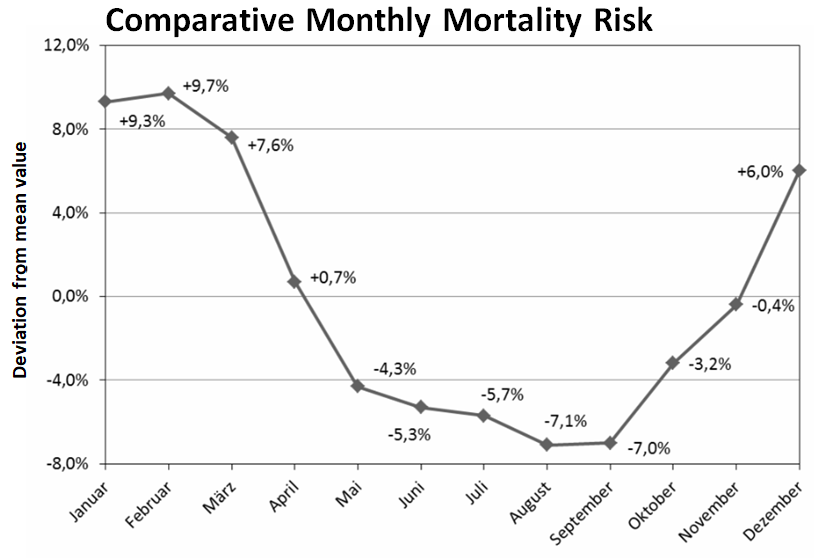
Image: Besttatungen.de (translated in the English).
As the chart shows, mortality is 9.7% above the mean in the dead of winter, February, and is 7.1% below the mean right after Germans have been exposed to 3 summer months of now “deadly heat”. In fact, all the mortal suffering begins to end only once the temperatures finally warm up in April. Of course the report isn’t so recent, but we can rest assured that the mortality behavior hasn’t changed that much.
The data also suggest how crucial Vitamin D is.
The data also suggests the power of vitamin D. Fully tanked up on this crucial nutrient, people are much more resistant to infections and disease well into the fall. By mid winter, once vitamin D levels become depleted, far more become prone to disease, many experts say. This is why so many advised taking vitamin D during the COVID “pandemic”.
The following table shows the ranking, from the most deadly month to the least deadly month:
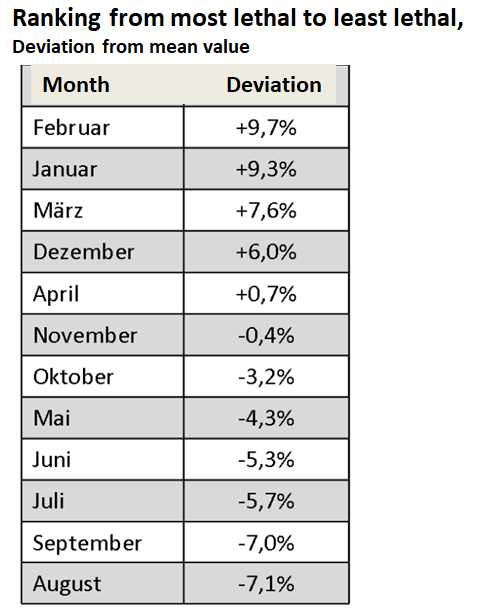
Source: Bestattungen.de
Summer saves lives
Again, the bitter cold months of January and February are the real killers, while the summer months are the real life savers. It’s absolutely idiotic of policymakers to be focused and obsessed on summer heat plans. The only heat plan people need is: Get outside, take off your clothes and enjoy the hot weather! Shade and cold water is all you need to cool off.

According to Bestattungen.de:
The German Weather Service sees weather-related factors as the main reasons for the variance in mortality risk. Damp, cold air increases the risk of aggravating existing illnesses. Respiratory diseases in particular can become more severe in the winter months. Heart attacks can also be triggered by the weather.”
Other factors also include psychological aspects and the lack of daylight and its associated “winter depression” increased melatonin and reduced serotonin.
We need a “stupid-policy-protection plan”
We really need to ask ourselves and policymakers: Why is heating fuel being made so expensive when we know that it would save a lot more lives? Stupid government policy is what’s killing people, and not the life-saving German summers.
ULEZ – Another Imperial Con
Ulez Expansion Predicted to Cut Air Pollution by Just 1.5%
By Alex Kriel | Thinking Coalition | August 9, 2023
Listening to the discussion over Ulez expansion feels like an action replay of the way in which many were convinced to overreact to Covid, leading to policy responses which caused significantly more harm than good. The Ulez ‘discussion’ has all of the same elements, with modelled health benefits calculated by Imperial College and Mayor Khan’s justification that he is “saving lives”, implying that opponents are wannabe murderers. Of course, this time around, the public is thankfully much more sceptical.
In this short note, we wanted to set out how those ‘lives saved’ numbers are derived and to demonstrate that at best the numbers are seriously misrepresented and at worst completely wrong. In fact, applying the Government and Imperial’s own logic, there is a very strong case to say that the expansion of Ulez will, on balance, harm Londoner’s health when considering the downstream economic consequences of this policy.
The major flaw in Imperial’s model is the one-dimensional nature of its assumption that air pollution drives health and life expectancy. In the real world health is driven by a number of interacting factors with income being the primary driver. There are many assumptions one could dispute that (perhaps unsurprisingly) work towards inflating the claimed health benefits of reducing air pollution, but we focus only on the flaw of largely ignoring policy consequences.
The Imperial team presents several numbers, including: attributable deaths (3,600 to 4,100), improved life expectancy (five to six months) and life-years saved (6.1 million). We wanted to focus on the claimed benefits of the Mayor’s Transport Strategy in terms of life expectancy and life-years saved.
Before leaving attributable deaths, it is important to note that these are not in any sense deaths that can be avoided, nor are they deaths that are subject to reduction by the Transport Strategy. The figure appears to compare current death rates with death rates if all human emissions had been removed for all prior periods. It is a theoretical construct (similar to an unmitigated pandemic) and only a small fraction of this number would be theoretically impacted by road transport (around 15%). Only the going-forward numbers (life-years saved) relate to the Transport Strategy and there the benefits are relatively low at 0.4%. It is important to note that there has only ever been one death, of a young and chronically unwell girl ever recorded in England (56 million population) where the death certificate mentions air pollution. Tragic as this death clearly is, it again highlights the disconnect between the theoretical attribution number and actual deaths recorded; we suggest ignoring the attributable deaths figure.
Looking at the claimed benefits of implementing the Transport Strategy, it is possible for a layman to understand the main assumptions on which these health benefits are based. In summary, it is assumed that reducing 10 µg m-3 achieves roughly a 6% reduction in all cause mortality. Note however 10 µg m-3 is more than all anthropogenic PM 2.5 emissions as estimated for England as a whole, so any benefits are scaled down from 6%. So a 1 µg m-3 reduction generates roughly a 0.6% improvement in life expectancy (i.e., ten times less).
Looking at life-years saved and extended life expectancy, the key assumptions are poorly explained. For those in a hurry, the detail shows that all of the Transport Strategy initiatives to 2050 combined will deliver a projected 0.4% reduction in life-years lost to air pollution using projections to 2154. There is a claimed five to six month extension in life expectancy, so the life expectancy of a London male of around 80 years would be extended to around 80.4 years.
These gains are stated relative to a baseline and for some inexplicable reason the Imperial team has decided to use 2013 pollution levels to establish the baseline and in the process to ignore the available data for 2019. This serves to inflate the baseline.
The acid test is: are the results of modelling compatible with observed reality? And on that basis the Imperial Ulez modelling falls flat. The model covers the impact of the entire Transport Strategy to 2050 which covers many more steps than Ulez. The Imperial document is somewhat vague about what those steps are – they are cryptically referred to as 2025 LES, 2030 LES and 2050 LES. It is enough to note that the goal of Mayor Khan’s 2018 Transport Strategy is to “aim for 80% of all trips in London to be made on foot, by cycle or using public transport by 2041”. So the first thing to clarify is that the claimed 6.1 million saving of life years relates to a significant number of measures, well beyond Ulez expansion. In effect these combined steps will largely eliminate private car traffic.
The chart below is constructed from the Imperial material and shows that PM 2.5 µg m-3 population weighted (PWAC) pollution falls over a number of steps and Ulez on a standalone basis has a near zero impact. Also, you can also see that a fair chunk of gains have already been banked between 2013 and 2019.
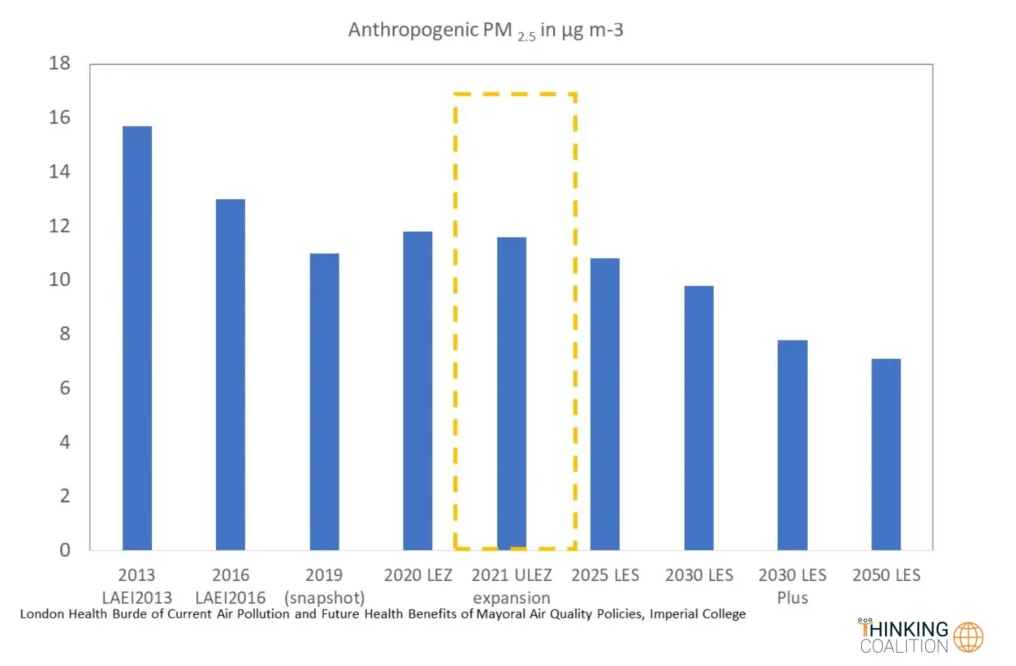
The failure of Ulez to achieve any meaningful reduction in pollution is very clearly shown in a separate document prepared by Jacobs which looks at the impacts of Ulez only. The table below shows the impact of Ulez expansion on PM 2.5 µg m-3 concentration, with an estimated improvement of less than 2%.
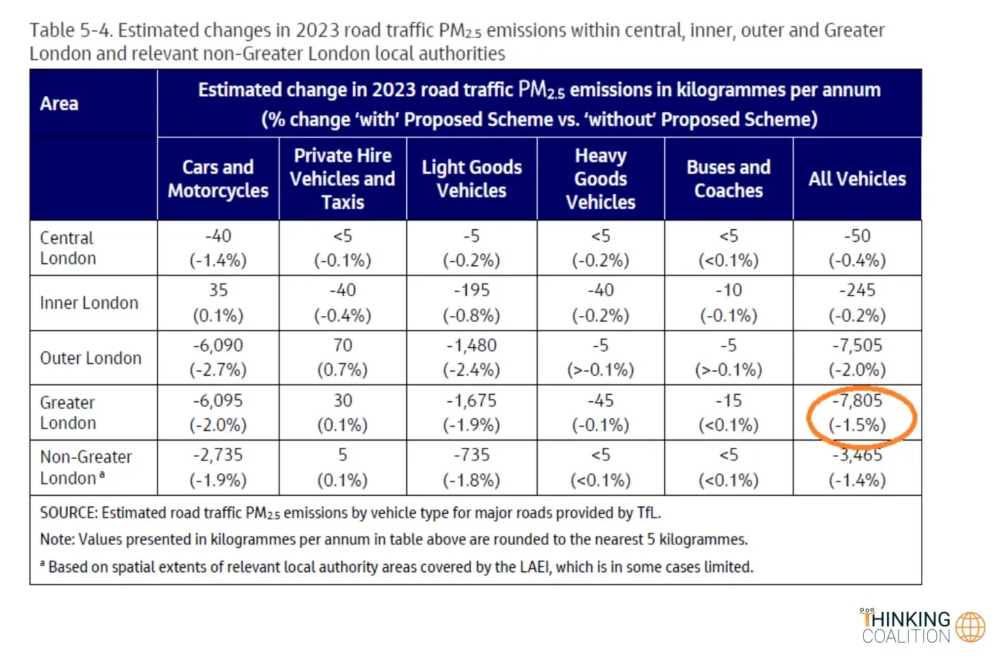
There is a slightly better outcome for NOx pollutants which are reduced by 5.4% across Greater London. This feeds in to the health impact assessment which unsurprisingly shows near zero benefit from Ulez for PM 2.5 reductions, for most health-related metrics.
Looking at life expectancy, the report does acknowledge that due to the large population (around 8.9 million) and the extraordinary long time period over which these benefits are expected to crystalise (up to 2154) then there are around 1.5 billion life-years involved (years × population). For any stated benefit to be meaningful, it needs to referenced to the base case value. The 6.1 million life-years saved is then within the context of a total of around 1.5 billion life-years; this saving is around 0.4%. Correspondingly, the impact on life expectancy from all of the pollution schemes (not just Ulez) adds up to around 22 to 27 weeks additional life expectancy. In the context of male life expectancy of 80 years (roughly) this would improve to 80.4 years as a consequence of 30 years’ worth of restrictive climate policies (ignoring any economic consequences).
The core flaw in the calculation is the one-dimensional thinking that underpins this (and all similar calculations) in that all reductions in PM 2.5 concentrations lead to a reduction in the mortality rate. This thinking ignores any link between people’s incomes and health outcomes, which is the primary driver of health. This is the same dishonest cop out that Professor Ferguson made in his infamous Covid paper. This facilitates a myopic focus on ‘safety’ and generates solutions that do far more harm than good.
In setting out the methodology that states that health outcomes will improve with a reduction in air pollution on a more or less linear basis, the Government’s own figures show that real world data prove that this assumption is not correct (or at least over-simplified). Its own data for the regions of the U.K. show that (if anything) this relationship is reversed.
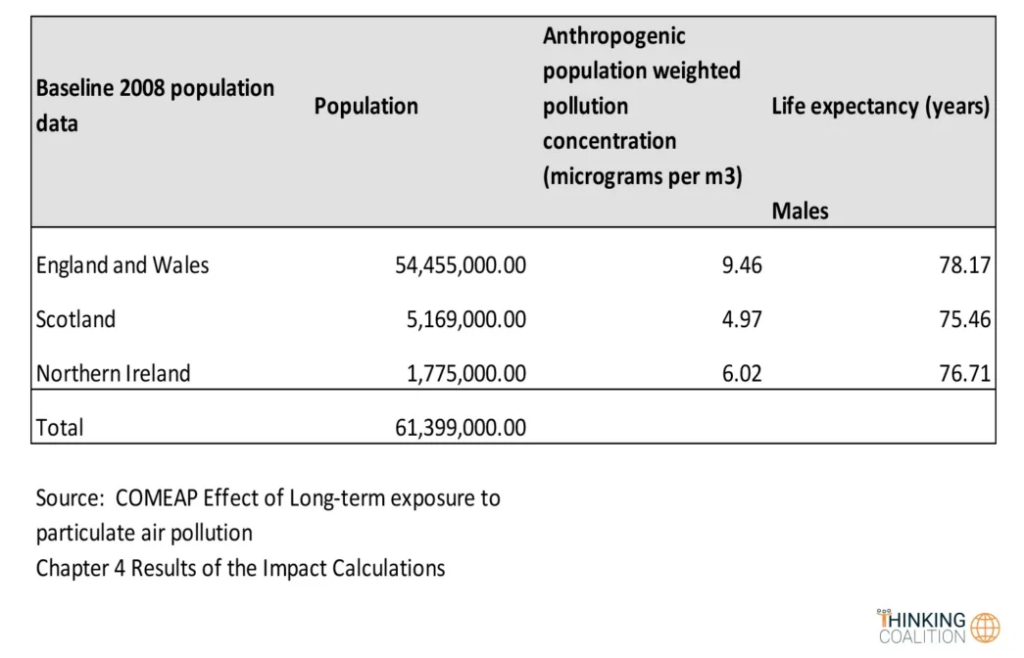
Life expectancy in Scotland is much lower despite having far and away the lowest concentration of anthropogenic PM 2.5 pollutants. Many studies with and between countries show this clearly (e.g. life expectancies by national deprivation deciles, England: 2018 to 2020).
In order to get a handle on how much more significant factors other than PM 2.5 can be, we looked at a recent paper that considers the impact of changes in different factors on life expectancy across 29 European countries (the paper also looks at each factor in isolation using multivariate analysis). The chart below shows the life expectancy impact of a 1% change in the listed factors. There are of course some caveats, but you can immediately see that economic activity dominates the outcomes with a 13-month gain in life expectancy for a 1% gain in GDP versus say a 2.7 month gain for a 1% change in PM 10-2.5. Also note there is no statistically significant relationship between CO2 and life expectancy.
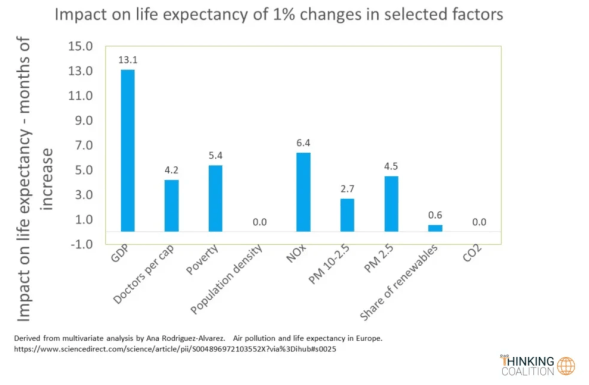
In another section of the same paper the author states: “France and Sweden, some of the countries closest to their potential LE (life expectancies), are also amongst those with the highest NOx level.” The real message, though, is that if you dent people’s income by narrowly pursuing PM 2.5 reduction, you will, on balance, shorten life expectancy and not increase it. The Jacobs’ report confirms that there will be multiple negative impacts on business and economic activity. We guess that on balance Ulez will lower life expectancy when factoring in the impacts on business and family incomes, as well as quality of life considerations.
In the post Covid world, we have understood that politicians of all stripes will shamelessly use emotional manipulation in order to get reasonable people to comply with their unreasonable edicts. That is why understanding how reliable, or otherwise, attributable deaths, life-years saved and life expectancy figures are is so important. You can almost guarantee that these estimates will be manipulated and potentially used to rationalise illogical and damaging policies.With opaque models it is relatively easy to produce results to order.
The political process assumes that the individuals involved are able to understand competing objectives and arrive at a sensible compromise. However, we saw in the case of Covid that many politicians have limited scientific understanding and will tend to pursue unachievable safety, at any cost.
The State seems to be redefining its role with a narrow group of ideologically-driven technocrats setting somewhat arbitrary targets. Achieving those targets requires wholesale changes to people’s lives. Very often economic, mental health and other impacts are barely considered and historically established constitutional boundaries between the State and the citizen are often ignored.
In the case of Ulez expansion, the 59% of respondents to the public consultation who clearly opposed the expansion were simply ignored.
Various sops will no doubt be offered to voters, but is it important that readers realise that there is a direction of travel to these various steps. Finally, remember Albert Camus’s wise warning that, “The welfare of humanity is always the alibi of tyrants.”
Alex Kriel is by training a physicist and was an early critic of the Imperial Covid model. He is a founder of the Thinking Coalition, which comprises a group of citizens who are concerned about Government overreach.
WHY IS THE WEST SO WEAK (AND RUSSIA SO STRONG)?
THE ROLE OF HUMAN CAPITAL AND WESTERN EDUCATION

BY GAIUS BALTAR | AUGUST 2, 2023
It is becoming increasingly clear to more and more people in the West that something has gone terribly wrong with the Ukraine project. Predictions and projections didn’t pan out and the West doesn’t seem to know what to do. The Russian economy wasn’t a house of cards as predicted, Russian weapons weren’t inferior as predicted, Russian soldiers and commanders weren’t incompetent as predicted, and Russian technology wasn’t inferior as predicted.
In some respects the Russians even seem to be superior to the West. Their weapons are effective and in many cases outright technologically superior, as clearly demonstrated by their hypersonic missiles, SAM systems and electronic warfare systems. Their economy appears to be surprisingly advanced and diversified and based on real wealth creation rather than financialization and debt like the West’s. Their strategic and tactical thinking also seems to work, while the West‘s clearly doesn‘t.
The whole mess is often explained as a result of a miscalculation by the western elites – they underestimated Russia and overestimated the West. The situation, however, is far worse than that. Every day that passes reveals the impotence of the West more and more and the situation is becoming outright humiliating. At this point the rest of the world either shakes their heads or simply laughs at the West and its politicians and diplomats – not to mention its crazed populations.
The dysfunction of the West is far deeper than just the situation around the Ukraine project. It’s absolutely everywhere. The West can’t do diplomacy in general, it can’t run its cities or countries except into the ground, its high-tech projects fail almost as a rule, its infrastructure is crumbling, its economies are crumbling, and all public policies seem to have a civilizational suicide as a final goal. The West’s control mechanisms over the rest of the world are also crumbling, including the dollar, sanctions, color revolutions, military interventions and threats. Nothing seems to work and everything the West does seems to make things worse.
Any rational person upon hearing a western leader, diplomat or “expert” speak, asks himself this question: “Are they just lying or are they really this incompetent and delusional?” The answer is “both” but the incompetence factor is far greater than most people can imagine.
Why has this happened? It’s clear that the cause is far deeper than the deindustrialization of the West or economic problems in general. The economy doesn’t explain the incredible incompetence shown by the West before and during the war in Ukraine.
I suggest that the cause of this unfolding disaster is a serious structural problem in the West – which Russia seems to have largely avoided. This structural problem is a necessary condition for the current western system and has been purposely created to bring it about and maintain it. This problem is the subject of this article – as well as the “mechanism” behind it. This is unfortunately a long article, but the subject matter demands it.
The current ideologically-based power structure of the West outright requires that certain types of people be in positions of influence and certain types of people be sidelined. This applies to all steps of the social ladder; from kindergarten teachers to university teachers and corporate executives, and all the way up to the leaders of society itself. This has been progressing steadily for the last five decades or so, and has resulted in a major structural problem for the West. That problem is the obvious and massive degradation and misallocation of human capital in the West.
Human capital can be described as the quality of a company’s or nation’s workforce, or more specifically how competent the employee pool is – how well they are trained, how quickly they can be trained, how they are educated in general, and how they make decisions. In order to understand what competence really means, let’s define it further.
Competence can be described as specific or general. This distinction is extremely important and must be understood by anyone who attempts to manage human capital on a small or large scale.
Specific competence is the ability to do a certain type of work. This can be carpentry, coding, chemistry, medicine, piloting an airliner, and so on and so forth. Some of these types of jobs may require a lot of competence, training and intelligence, but what they have in common is that their scope is limited and clearly defined. They exist within clear boundaries, separate from the complexities and vagueness of the world in general. Each type of work requires certain abilities innate in the person, as well as varying degrees of training. People, of course, differ a lot in their level of specific competence within each field.
General or high-level competence is the ability to do work that is beyond clearly defined boundaries. The subject matter of those types of work exists in a complex “variable universe” and can be exceedingly vague and confusing. It requires the ability to be adaptive and be able to transfer skills between different types of work. This also applies to expertise in one field being applied to a completely different field – such as applying psychology to economics or astrophysics to climate science.
Examples of positions requiring general or high-level competence people are corporate executives, all kinds of planners and administrators, product developers, inventors, high-level consultants and analysts, military leaders and planners, diplomats, judges, political leaders, and high-level scientists and theoreticians, to name a few.
Specific and general competence types of work are not two separate things. Types of work or “jobs” can be said to range from almost completely specific up to almost completely general. Almost all types of work have elements of both but in varying proportions. To illustrate this I will take an example from a company I’m personally familiar with. This is a software company with several owners, most of whom work at the company. One of the owners is an exceptionally competent database specialist. However, when he contributes to decision making for the company as a whole, he becomes an outright problem. The management structure of the company had to be “modified” to neutralize him in that role, as well as a few others. This employee has exceptional specific competence but very poor general competence. He cannot “transfer” his specific database competence over to competence in moving the company into the future. He simply cannot operate objectively or sensibly outside his database job.
So what makes this employee have such poor general competence – or more specifically – what is general competence? General competence requires three necessary conditions: a) High general intelligence or IQ, b) the ability to be objective, even in situations where the result of your conclusions may not be to your liking, and c) the ability to reach conclusions without being influenced by others (i.e. independent thinking). The latter two conditions are a direct result of how the human brain interacts with the environment. The mechanism behind it is too complicated to describe here, but in simplistic terms it can be said that humans range in their relationship with reality from the emotional-outward/subjective to the introspective/objective. This variable, like all evolutionary traits, including IQ, is normally distributed. This has rather disturbing implications which may be difficult for some people to understand.
Let’s first look at IQ, or general intelligence. In order to be able to deal with seriously complicated work or get through a real university program, an IQ of about 125 is necessary. Only about 5% of the population in the West has this IQ or higher. This means that the pool of potentially high-level competence people is very small to begin with. Even if we use a cut-off of an IQ of 115, which is sufficient for most semi-complicated work, the potential pool only goes up to 16% of the population.
Now let’s take a look at the other variables, i.e. objectivity and independent thinking. Those two are correlated and we will, for the sake of convenience, handle them as the same variable or trait, even though they aren’t. They are normally distributed, much like IQ, with most in the middle and fewer toward the extremes in both directions. On one side of the distribution are people who, to state it bluntly, are incapable of thinking objectively about any issues that may interact with their personal views about anything at all. They can be competent in a limited field which is “neutral” to them (such as databases), but not involving anything else. They can’t run a company in a competitive environment, except into the ground. They can’t run a city, a country, a military campaign, an economy, or anything requiring general competence, except into the ground, regardless of their intelligence. These people are clearly not suitable for general/high-level competence jobs.
So, what is the proportion of the population that is objective enough and independent thinkers enough to be suitable for those jobs? That’s difficult to determine but it’s clear that it is maximum 50% of the population. In reality it’s far less but let’s be generous and say it’s 30%. What does that mean?
IQ and objectivity/independent thinking are somewhat correlated but let’s assume they are not. Let’s say that we have a pool of potentially objective and rational people that is 30% and a pool of people with IQ of 125 that is 5%. That means that the pool of high-level general competence people is 5% of 30%, or 1.5% of the population.
If we are really generous and assume that 50% of the population is objective and rational and an IQ of 115 is sufficient for those jobs, then we have 16% of 50%, which is a pool of 8% of the population.
The importance of this cannot be overstated. This group, whether we define it as 1.5% of the population or 8% of the population, is extremely valuable. This is essentially the only group in society that can reliably evaluate complex situations and make subsequent rational decisions. Without it, modern technological society simply cannot be built or maintained – let alone advanced. Let me rephrase this – if we do not identify and utilize this group, we cannot run our complicated societies except into the ground.
Modern western society is from a governance standpoint ideologically motivated and ideologically controlled. It is being pushed in a very clearly defined ideological direction, led by the European Union and the current US administration. This ideology is not the subject matter of this article, but it can be seen everywhere by any rational and independent-thinking person. For the uninformed-curious a good place to start is the website of the EU’s policy-making body; the World Economic Forum.
In order to achieve these ideological goals for the West, two things must happen: a) The right people must be put into power at all levels of society and b) any disruptive elements must be eliminated or suppressed. Since all ideological goals tend to be more or less in conflict with reality, there is no group more disruptive to them than the one who operates objectively and independently. People like that simply cannot be allowed into positions of power, and if they must be, they must be kept quiet and/or forced to toe the line.
The objective/rational/general competence group, whether it is 1.5% or 8% of the population, therefore becomes a problem rather than a resource. This is exactly the situation in the West today.
Many people have noticed that meritocracy has been systematically abandoned in the West and the relationship between competence and reward severed in giant swaths of the economy – and almost completely in government. What few people seem to realize is that this is a necessity for the West’s ideological goals to be reached. High-level competence cannot be promoted because it is a threat. It cannot therefore be rewarded.
In order to illustrate this, let’s take a look at what happens when a member of the 1.5% is allowed to gain significant power. Elon Musk is a smart man, probably with an IQ of 150 or more. He is also quite objective and realistic in his assessments, and an independent thinker. His ownership and governance of Twitter/X is a major problem for western ideological goals. Free speech is an obvious threat to any ideology and, to rub salt in the wounds, Musk belittled the guardians of the Ideology at Twitter by making fun of them, then by firing them all and only keeping the competent ones. This cannot be allowed to stand and we can already see the response. The EU is planning to use force to stop this affront to the Ideology and may actually block Twitter in Europe. Ideological champion (and suspected lizard robot) Mark Zuckerberg was even instructed to cook up an ideologically pure Twitter copy in response – but seems to have failed. We eagerly await further responses, which may range from lawfare up to more “direct” actions, and will most likely be directed at Musk personally.
As previously noted, two things must happen for the ideological goals to become reality: The right people must be promoted and the wrong people must be suppressed. This process of elevation/suppression has become the main goal of the western education system – all the way from kindergarten up to university. If we look at what the education system has been doing, this becomes extremely obvious. Here are a few examples:
- Evaluation of competence is being systematically degraded to avoid comparison between the competent and the incompetent. Exams are being discarded in favor of constant “projects” and students work in groups so the incompetent may hide. Schools avoid testing the individual directly as much as they can – and thereby comparing him to others. The competent ones must not be encouraged, and if at all possible, they themselves must not realize that they are above others.
- Universities are increasingly basing admittance on other criteria than competence, including quotas based on non-competence variables. The most insidious selection method is the “personal essay” which applicants must submit – and is sometimes even more important than grades. All applicants know that the more they signal virtue in the essay, the more likely they are to be admitted. On the basis of the essay, the universities can pick the ideologically pure – which is the only purpose of the essay requirement to begin with.
- Almost every academic subject is being turned from the objective to the subjective to assist the irrational-incompetent student. This even applies to hard subjects such as mathematics – where nowadays 2+2 doesn’t necessarily equal 4. Even intelligence is now subjective and the stupid can be as smart as the intelligent – it’s just a question of perspective, the right measuring tools, and idiotic inventions such as “emotional intelligence.”
- Almost every subject has been made easier than before to help the incompetent students and even critical fields such as medicine are now graduating people who are utterly incompetent and clueless – on a large scale. This systematic lowering of standards also has the added benefit of creating disinterest in smart and rational students. A smart student performs better and better relative to others as the subject gets harder. If the subject is easy or made uninteresting, he will sink down to mediocracy – which is a part of the purpose of lowering the standards to begin with.
- Disciplines which may be a threat to the irrationality of the Ideology have been massively subverted and corrupted. This applies to several fields, but particularly to psychology and history, which in their proper forms would be a massive threat to western ideological goals. Psychology has been twisted into an almost unrecognizable abomination, and history is mostly just lies these days.
- Fake disciplines have been invented from the ground up for the purpose of training the ideologically pure without the need for competence or intelligence or any connection to reality. These disciplines can be found in lists of “most useless university degrees” all over the internet, but that is a misunderstanding. Those degrees are not useless at all – they elevate the ideologically pure in society by awarding them university “certification.” This certification justifies giving them important positions in society.
I could go on but you get the picture. What we are looking at here is not the failure of the western education system, but a very carefully planned “pivoting” toward new objectives. The primary purpose of the education system is no longer education. The entire education system of the West has been reconfigured to carry out a “filtration” process. The purpose of this process is to identify, instruct and elevate the ideologically pure while suppressing the dangerous 1.5/8 group. The education system, particularly the universities, has largely abandoned real education and is almost solely focused on this mission. This mission is not just carried out by the education system, but by all institutions of governments and a large part of the corporate sector. A side-result of this filtration process is the degradation of all education in the West, and subsequently, degradation of its human capital in general.
Western society, in general, has abandoned rationality and replaced it with subjectivism (formally designated as “post-modernism”). The purpose of that is not just to train and advance the ideologically pure, but to use subjectivism as an oppression tool against the 1.5/8 group and the rational part of the population outside of it. The best way to suppress a rational person is to subject him to an existence of total and constant irrationality. It is essentially gaslighting on a civilizational scale, directed at the dangerous rational group.
While the dangerous rational group is being suppressed and subverted, the ideologically pure “leaders of tomorrow” are indoctrinated rather than educated, given university certifications rather than real degrees, and finally provided with an unending amount of fake and well paid jobs in both the private and public sector. This well-paid ideologically pure group then becomes the power base of the new ideological system.
The goal of this deliberate intervention into the educational system is to create what you might call a “migration pattern” in society based on (lack of) competence and ideological purity. The right people need to be put into the right positions and the right jobs, and since they are incompetent, this needs to be managed for them. After they leave school with their certifications, government and the private sector take over and actively push them upward, while pushing the dreaded 1.5/8 group away from influence and well-paid jobs.
Two developments in the West have been godsends for these efforts: the outsourcing of western manufacturing to Asia and the virtual abolition of competition in the corporate sector. This massively decreased the complexity level of the western economy and subsequently the need for the 1.5/8 group. When most companies operate services in a protected environment, there is far less need for high-level/rational people – while in a “real economy” these people simply cannot be sidelined. Also, when you can get away with operating a fake economy based on the dollar reserve status, you can also operate a fake society run by incompetents.
Let’s take a closer look at how this upward migration of the ideologically pure is managed after they receive their university certifications – and how the 1.5/8 group is systematically blocked. There are five main methods being employed – which together form a long-term takeover process of society. These methods are the following:
- Public sector filtering
- Public sector stuffing
- Job-creation by decree
- Private sector filtering
- Private sector stuffing
Public sector filtering – This describes the job selection process in the public sector. Initially the “foot-in-the-door” method is used. A few ideologically pure politicians and bureaucrats position themselves within the system and start controlling who is hired. This increases exponentially over the decades as more and more purists gain access to the levers of power. Currently the process is so overt that it is starting to become expressed in recruitment policy papers – such as the recent example of the British government excluding “white men” from becoming fighter pilots. The West has almost completely been able to exclude the 1.5/8 group from public-sector positions using this method – including its armed forces.
Public sector stuffing – As the public sector filtering process advances, the purists inside the system start creating more and more positions for their purist brethren. New departments are created, work groups and committees appear, and the public sector expands. Publicly owned companies, such utility companies, hospitals and schools are also often used as storage units for large numbers of the ideologically pure. This is extremely obvious in the West. Every unnecessary law or initiative requires more and more people – and these people are all carefully selected.
Job-creation by decree – This method is directed at the private sector, as well as the semi-public sector. Government purists start creating new laws and standards which all companies must fulfill. Those are justified on the basis of “goodness” and usually involve the environment, equality, safety and such things. This creates a large number of positions within private companies which are tailored for the ideologically pure – particularly in support functions such as human resources, compliance functions and others. This enables a “foot-in-the-door” situation in the private sector and gives the purists access to the levers of powers there – much like they already have in the public sector.
Private sector filtering – As the purists have gained access to the private sector – particularly human resources (which is the standard purist Trojan horse in private companies) – they start filtering new recruits exactly the same way the public sector does. As in the public sector, this filtering process is becoming more obvious. A significant number of companies are now specifying which groups will not be hired in their job advertisements. Since they can’t overtly say “we don’t hire smart, independent thinkers” they usually use “white men” as a proxy for that group for some reason. That group is considered to be a particular threat, although you can be sure that anyone who doesn’t follow the program will be fired, regardless of their gender or the color of their skin.
Private sector stuffing – Shortly after Elon Musk bought Twitter he fired something like 80% of its employees. That 80% was the company’s private sector stuffing ratio – quite high. Companies, particularly in sectors which can influence public opinion – but not solely, are increasingly creating a large number of positions which are either totally superfluous or intended for influence operations against the public.
Those filtering and stuffing methods are the primary mechanisms that have been used for the takeover of western societies by the ideologically pure. There are other mechanisms, such as ESG, filtering by certain banks and investment funds regarding who gets financing and who doesn’t – and the uncontrolled immigration engineered by the ideologically pure which is seen by them as a continuation of the internal migration process. However, all that is beyond the scope of this article.
The ideologically pure have systematically been moved into almost all positions of power in the public sector and a large part of the private sector – and the situation in the private sector is increasingly mirroring the public sector in hiring practices and employee stuffing. The dangerous 1.5/8 group is being kept away by all means, and with great success. The power base of the Ideology is firmly in place.
This job migration program hasn’t been cheap. Millions of unnecessary jobs cost money and it is clear that a significant part of western public debt can be attributed to this program, a fact which doesn’t seem to have been noticed by many people.
The consequences
The main thing to understand is that western societies and economies have been put on an ideological footing. Productivity, competitiveness, technology and science are simply not priorities anymore in the West. Explaining the consequences of this process for the West would take many articles, or a book of several hundred pages. Still, let’s mention a few examples.
The inverse competence crisis – The goal of this entire project has been to place the ideologically pure in all positions of power at all levels of society. These positions are, in a normal and competitive society, occupied by the highly competent 1.5/8 group. The process has now reached near-completion with most positions of power occupied by the ideologically pure. Some of those people have high IQs but they are neither objective nor independent thinkers. The Ideology they must subscribe to is simply incompatible with those qualities. This has some serious consequences.
Remember that positions of power and influence are more likely to demand general competence than other positions (as opposed to specific competence). The greater the power, the more the position demands general competence. The people in these positions now are selected by ideological fervor and reliability – so the higher you go, the more ideologically enthusiastic the people who hold them. This means that the least objective and independent thinking people hold the positions which require the greatest objectivity and independent thinking. Therefore, in the West incompetence becomes greater and more common the higher you go. As someone said – “a general is an incompetent colonel.” This can be seen absolutely everywhere except in some holdout private companies. Those exceptions are of course being addressed as we speak.
The second problem is that many of the irrational/subjective people holding all the power have reasonably high IQs. That may seem to be a positive thing but it has a major disadvantage. Moderate to high IQ irrational/subjective people are the easiest to brainwash of all people. The reasons for that are complicated and need to be addressed in another article – but what this means is that the top tier in the West is not only the most incompetent it can possibly be in comparison to what their jobs require – but are also the most malleable and delusional.
The cost and debt crisis – The migration of the ideologically pure into the ideological power base and positions of influence has created millions of jobs in western societies which create no value. These jobs are much more numerous and more widespread than most people realize, and I wouldn’t be surprised if something like 20%-30% of the entire labor force of the West could be fired without any adverse effect. In fact, the effect would be positive, especially if those people could be made to work the (mostly menial) real-economy jobs they are suitable for.
Deindustrialization has been blamed for the extreme debt levels and tax burdens of the West. That is, as far as it goes, true – but maintaining this giant group of incompetents in their fake jobs is also placing an extreme burden on the West. Western societies are now completely unsustainable and cannot be run without constant debt increase.
The competition crisis – This crisis can be explained by the following example: Let’s say there are three companies with combined 100% market share in some sector. There is no real competition between them and everybody can just relax because the customers can’t go anywhere else. These companies can get away with absolute incompetence on most levels, including in management. They don’t need to think about efficiency, safety, productivity or costs, except on their websites and in annual reports. However, if a competitor with competent employees manages to infiltrate the sector, those three companies will hit a wall. There will be an enormous crisis and one or more of them will most likely go under.
This is exactly the situation in the western economies now. Monopoly and oligopoly is the rule and the main objective of most large western companies is to prevent anyone from infiltrating their sector – usually by bribing regulators or by buying the competition. This is a necessity because a huge number of western companies are now run by incompetent management and staffed by incompetent people, particularly in support and management functions. The immortal words of the nameless Boeing employee about the 737 MAX apply to most large western companies; “this airplane is designed by clowns who in turn are supervised by monkeys.” Western companies are no longer competitive. They cannot compete with Chinese companies now and soon they won’t be able to compete with companies in general outside the West. They simply can’t function except inside an economic safe-space. In fact, the situation is such that the Chinese already do the real work for many of them and reshoring the work is problematic because of (surprise!) the human capital degradation in the West caused by the repurposing of its education system.
This also applies to western societies as a whole. The entire leadership and diplomatic classes of the West are no longer competitive against the rest of the world for exactly these reasons. They are being outmaneuvered by the Chinese, the Russians, the Indians, and everybody else at every turn. Even African leaders are now more competent than western leaders. They have consistently made decisions that are better for their people than leaders in the West – for the last few years anyway.
The complexity crisis – Earlier in this article I stated that the 1.5/8 group is extremely valuable for modern societies and without it complicated modern societies cannot be managed. In the West this group has been successfully sidelined to a great degree and a good part of it doesn’t even bother with university education anymore. The situation, however, is even worse than that. The reconfiguration of the education system and the break between competence and reward in the job market has fundamentally changed the decision making process behind the selection of university education. Why study engineering (which is hard) when you can get an even better paying job with a degree in psychology (which is easy nowadays)? The reconfiguration of the western education system has changed the reward structure, encouraging young people to pursue easy and useless education – simply because the “system” will provide them with jobs.
This has already caused a major crisis in western societies, particularly in the US. The “maintenance” of complex aspects of US society needs a large group of engineers and people with related education. This maintenance is faltering now, and significantly relies on foreign engineers educated in US universities. You see, why would Americans study engineering in a system which doesn’t reward it? If China and India could somehow recall their engineers and others with hard education from the US, the US system could probably not be maintained, let alone advanced. This will get progressively worse and we will soon reach a point where complex systems which underpin society cannot be kept running. That will require some kind of “reset” to a less complex society, with less prosperity of course.
There are far more crises than those four, but I wouldn’t want to sound like a doomsayer by listing more.
So, what about Russia? Firstly, there are clear signs that the Russians have figured out what is happening in the West and are learning from it. Recently they left the “Bologna process” which is a European education standardization system. The Bologna system has the express purpose of diluting education in member states, implementing certifications rather than real degrees, and filling European societies with badly educated and generally incompetent “experts” who follow the consensus, no matter what. The Russians saw this system as a threat to their country, which it is, and have, at least partly, reverted to the older and more hardcore Soviet system.
Secondly, the Russians seem to be carrying out purges of the incompetent and corrupt within state structures, including the military. Meritocracy seems to be on the agenda, a radical concept these days. The Russians most likely see these efforts as critical to the continuation of their state and nation – and they would be right.
The situation in China is much the same and there are indications that the rest of the non-western world is catching on. Remember that one of the results of the recent Russia-Africa summit was a Russian-organized education effort in Africa. I doubt that women’s studies will be a part of that curriculum.
The current clash between the West and Russia – and increasingly between the West and the rest of the world – is becoming a clash between the incompetent and irrational and the competent and rational. The result is obvious – but what happens when an irrational person who is backed into a corner has access to nuclear weapons? That’s anybody’s guess.
By putting its societies on an ideological footing the western elite has backed itself into a corner. They can’t compete; they can’t develop their economies or societies; and they can’t go back. Fixing the problems of the West will require an economic revival, where a real economy will replace the current fake financialized service economy. This cannot be done without putting the hated 1.5/8 group into positions of power. Therefore, it will not be done as long as the current western ruling class is in power. Western societies will not survive an economic revival in their current ideological configuration. Conflict is therefore the only remaining option for the ruling class to hang on to power.
Russian energy revenues higher than last year – Handelsblatt
RT | August 11, 2023
Russia saw revenues from energy exports surge last month despite Western sanctions that include embargos and price caps on the country’s oil, German news outlet Handelsblatt reported on Thursday.
According to the publication, Moscow’s revenues from oil and gas sales grew 5.3% year-on-year in July and amounted to $8.66 billion. Profits were said to be the largest in gas exports, while those from crude sales rose by 2.6%. The outlet noted it was the first time this year that Russia had increased state revenues from energy exports in comparison with 2022.
Russia is earning more from energy exports and “thus is in a better position than a few months ago,” Giovanni Staunovo, a commodity analyst at Swiss bank UBS, told the news outlet. He claimed that as a result, many have started to doubt the effectiveness of sanctions on Russia.
Robin Brooks from the Institute of International Finance (IIF) noted that sanctions “can be very effective when used against countries with current account deficits,” which depend on loans from foreign investors on the global capital market to finance imports. He noted, however, that Russia is not among that group and argued that the restrictions imposed on it are becoming increasingly ineffective.
An EU embargo on seaborne exports of Russian crude was introduced last year along with G7 price caps on oil and petroleum products originating from Russia, in response to Moscow’s military operation in Ukraine. The measures were presented as an effort to deprive Moscow of funds to finance its military effort.
While the restrictions have barred Russia from accessing its traditional Western markets, they have triggered a large-scale reshuffle in global oil supply, with Moscow successfully redirecting exports to Asia. According to the latest OPEC calculations, Russia has been the largest exporter of oil to India for the past year, accounting for 45% of India’s crude purchases in June. It has also been China’s top supplier since January.
The Polish President Said Kiev Isn’t Doing The West Any Favors & Its Counteroffensive Failed
BY ANDREW KORYBKO | AUGUST 11, 2023
Two of Kiev’s top propaganda narratives nowadays are that it’s selflessly sacrificing itself for the sake of the West by fighting Russia instead of surrendering and that its ongoing counteroffensive is succeeding in pushing that country’s forces out of Ukraine’s pre-2014 borders. The first largely remains above official criticism or skepticism since those who dare to doubt it risk being “canceled”, but the second has suddenly begun to be debunked by the Mainstream Media as proven by the following articles:
* NBC News: “Is Ukraine’s counteroffensive failing? Kyiv and its supporters worry about losing control of the narrative”
* CNN: “Why a stalled Ukrainian offensive could represent a huge political problem for Zelensky in the US”
* The Hill: “Alarm grows as Ukraine’s counteroffensive falters”
* Washington Post: “Slow counteroffensive darkens mood in Ukraine”
In the face of this rapidly shifting narrative that threatens to topple one of the pillars of Kiev’s Western-directed propaganda, Zelensky’s senior advisor Mikhail Podolyak lashed out at critics in a tweet thread here where he demanded that they “be patient and closely monitor” his side’s progress. Polish President Andrzej Duda has been doing precisely that since the NATO-Russian proxy war in Ukraine began, however, and he’s concluded that Kiev isn’t doing the West any favors and its counteroffensive failed.
He dropped both bombshells, the first of which debunked the claim that Kiev is selflessly sacrificing itself for the sake of the West and which hitherto hadn’t ever been officially challenged by any Western leader before, in an interview with the Washington Post’s Marc Thiessen from 1 August that was published nine days later. The relevant excerpts will be republished below for the reader’s convenience before analyzing them in the context of this conflict and evolving Polish-Ukrainian ties in particular:
“Q: At the NATO summit when President [Volodymyr] Zelensky criticized the [leaders’ joint statement about Ukraine’s prospective membership], there was criticism of him that he was ungrateful for all the help [given to] Ukraine. That suggests that our help to Ukraine is charity. Is our help to Ukraine charity, or is Ukraine really doing us a favor by giving its children, its lives to defend us against the Russian threat?
A: I would say it this way: I don’t see it in these categories — neither that we are doing an act of charity for Ukraine, nor that Ukraine is doing charity for us… We are sending them arms. Why? Because we want to support them in defending their own territory. … We Poles have many reasons to supply Ukrainians with weapons. … But the whole democratic world also knows that any aggressor who violates the borders of a democratic state in the 21st century in Europe must be stopped.”
…
Q: Could Poland fight a combined arms operation without long-range weapons and without air power? Because that’s what we’re forcing the Ukrainians to do today. What does Ukraine need that it’s not getting today?
A: Ukraine has been supplied with long-range artillery, and it is being supplied with long-range artillery to this day. … One could go as far as to say that Ukraine now has much more modern military capabilities than Russia.
The question is: Does Ukraine have enough weapons to change the balance of the war and get the upper hand? And the answer is probably no. They probably do not have enough weapons. And we know this by the fact that they’re not currently able to carry out a very decisive counteroffensive against the Russian military. To make a long story short, they need more assistance.”
…
Casual observers might be shocked by the Polish leader’s candidness, while Kiev’s supporters might accuse him of “betraying” their regime after becoming the first Western leader to debunk its top two lies nowadays, but his words weren’t unprovoked nor said in a vacuum. The background is that political ties between these wartime allies have tremendously worsened since late July as was documented in the following analyses:
* “Poland & Ukraine Are Arguing Over Grain Once Again”
* “Ukraine’s Ungratefulness Is Finally Starting To Perturb Poland”
* “Kiev’s Prediction Of Post-Conflict Competition With Poland Bodes Ill For Bilateral Ties”
In brief, each side finally began prioritizing their national interests, which resulted in public tensions due to the absence of any pressure valve for dealing with sensitive disagreements such as those over agricultural cooperation and historical memory. Moreover, each side has self-interested political reasons in escalating rhetoric against the other: Ukraine wants to distract from its failing counteroffensive while the ruling Polish party wants to rally its nationalist base ahead of mid-October’s elections.
It was against this backdrop that Duda did the previously unthinkable by telling one of the US’ most influential Mainstream Media outlets that Kiev isn’t doing the West any favors by fighting Russia and that its counteroffensive failed. Granted, he conveyed these two points in a “polite” way that signaled his continued support for NATO’s proxy war on Russia through Ukraine, but it’s still an unforgivable offense from that regime’s perspective.
NBC News warned earlier this month that Kiev and its supporters are worried about losing control of the narrative, which has now come to pass after what Duda just said. He and his country are much more popular and less polarizing among average Westerners than Zelensky and Ukraine, plus nobody doubts their anti-Russian credentials due to widespread awareness of Poland’s difficult history with that country. These observations mean that his words will likely have an outsized impact on reshaping the narrative.
As for the future of Polish-Ukrainian relations, it’s looking dimmer by the day due to their spiraling disputes becoming self-sustaining at this stage. That’s not to suggest that Warsaw will cut Kiev off from arms and other forms of support, but just that the trust which used to characterize their relations since February was finally exposed as illusory. This could complicate their reported plans to form a joint military unit and could lead to Poland acting unilaterally in Western Ukraine in the worst-case scenario.
Ukraine “cannot decide its destiny” because it depends on US political climate
By Ahmed Adel | August 11, 2023
The Ukrainian Army’s high dependence on Western military support to continue its fight against Russian troops has placed Kiev in a position where it cannot decide its path for itself, said an analyst on CNN. The outlet also indicated that after more than 17 months of active combat, the Ukrainian conflict had entered a decisive stage since Kiev now depends on the decisions taken in Washington more than ever, which will be worrying for Ukraine since there is every chance that the next US president ends up being a Republican.
The current situation in Eastern Europe will depend on “outside factors,” such as “shifting political forces in the US, Moscow and European capitals,” Stephen Collinson points out in his analysis on CNN. “One of Ukraine’s greatest tragedies as it pursues a critical offensive that has, so far, failed to meet its own and Western expectations is that it cannot, by itself, decide its destiny.”
According to him, the results of the Ukrainian counteroffensive — which began in June and has shown no progress — “would have particular ramifications in the United States since it could heighten questions over US support for the war that will be pushed into an acrimonious election year.”
In fact, former Republican lawmaker Adam Kinzinger recently acknowledged widespread pessimism within his party about the billions of dollars delivered to Kiev since February 2022.
The CNN analyst also pointed out that the Americans are preparing for a possible election contest between President Joe Biden —a Democrat and radical supporter of Kiev — and former president Donald Trump, a supposed NATO sceptic who has promised to end tensions between Russia and Ukraine in just one day.
Collinson believes that even if Trump does not win the presidential nomination, it is not certain that voters will support Biden because there is increasing disbelief about the growing involvement of Washington in the conflict. In his text, Collinson recalls recently published information on CNN that US officials are receiving adverse reports about the scant progress of Ukrainian troops against Russian forces.
“Ukraine’s struggles – and heavy combat losses – stem in part from entrenched, layered defensive positions, trenches and minefields that Russia had months to construct and the battlefield reality that an attacking force needs a numerical advantage over well dug-in troops,” wrote the expert.
For Collinson, the conflict could end after the US fully enters the electoral process to define a new president.
“There is so far no clear path even to a ceasefire,” he observed. “Ultimately, the capacity of both Russia and Ukraine to sustain heavy battlefield losses will be critical in deciding the point at which either side might be open to a settlement – when the cost of continuing to fight might be outweighed by the rewards of ending it.”
According to the journalist, the stagnation of the conflict could gain more weight in the political debate within the US.
“While foreign policy is rarely a deciding factor in presidential elections and the war in Ukraine is not a dominant issue in the GOP primary, some party supporters in early voting states like Iowa and New Hampshire do raise it and question US generosity after months of high inflation, which, even if it’s cooling, has contributed to persistently dour views of the American economy,” said the expert.
“So when US voters decide their own futures in November 2024, there’s a good chance they will be playing a large role in sealing Ukraine’s fate as well,” Collinson concluded.
The possibility that the Democratic Party could be back out of power next year is hurrying Biden to maximise his opportunities to funnel US taxpayer money into the financial blackhole that Ukraine has become. Biden’s endless attempts to seek the US Congress’ approval to transfer billions of dollars in additional support to Ukraine in a bid to prolong the war against Russia is a demonstration of this, especially when considering that Washington has already transferred to Ukraine at least $76.8 billion in assistance since February 2022.
According to an older estimate by the Kiel Institute for the World Economy, Ukraine, by May 2023, had received more than $100 billion in humanitarian aid and military support from more than 40 countries. Of that amount, Washington has contributed around $51 billion dollars, more than half, in military, security, financial and humanitarian assistance.
At the end of July, Ukrainian President Volodymyr Zelensky said that Kiev does not have sufficient resources. However, the US, NATO members, and other institutions, such as the International Monetary Fund and the World Bank, delivered all the money to Ukraine. Rather, if Zelensky is struggling now, he will have an even bigger problem in the coming months because the money from the West will dry up as the level of support cannot be maintained, especially in the context of the failed counter-offensive.
Ahmed Adel is a Cairo-based geopolitics and political economy researcher.
Preprint Servers Censored Research That Contradicted Government’s COVID Narrative
By Brenda Baletti, Ph.D. | The Defender | August 9, 2023
Preprint servers are being used to censor scholarly papers critical of the Centers for Disease Control and Prevention (CDC) and policy errors made by the Biden administration, according to Vinay Prasad, M.D., MPH.
Prasad, hematologist-oncologist, professor and director of a medical policy lab at the University of California San Francisco said his lab has submitted hundreds of papers to preprint servers — but only those that deviate from the official COVID-19 narrative have been rejected.
The basis for rejecting those papers is inconsistent with standards applied for other topics or with the fundamental rules of the servers, Prasad explained in a recent Substack post and YouTube video on the topic.
“All [rejected papers] are consistent with scientific practices and norms, and similar papers not critical of the CDC or Biden administration have been accepted,” Prasad wrote.
“If only papers that praise the CDC are acceptable by preprint servers,” he added, “then the role of science as a check and balance on incorrect policy is subverted.”
Preprint servers were established to address inefficiencies in academic publishing. The peer-review process typically takes months or more, delaying the real-time sharing of scientific findings with the public.
Also, many journals are proprietary and can only be accessed through expensive personal or institutional subscriptions.
Preprint servers offer a location for scientific reports and papers to be available to the public while the paper goes through peer review — making scientific findings available immediately and for free and opening them up to broader public debate.
There is no peer-review process for preprints, although there is a vetting process.
Prasad said preprint servers are supposed to be neutral and supposed to post all research conducted with a clearly explained and reproducible methodology. The goal, Prasad said, is to be inclusive and make scientific debate possible.
But instead, Prasad said, several of the preprint servers have become “gatekeepers” for what science gets published.
“When the people who work there are rabid, politicized and biased,” he said, “I think that’s a problem.”
‘The preprint servers are really a disgrace’
To test the bias of preprint servers, Prasad’s lab did a comprehensive analysis of its own preprints. Lab staff analyzed outcomes for all preprints they submitted to SSRN, medRxiv (pronounced “med archive”) and Zenodo servers — which he noted is a “reproducible systematic methodology.”
They found “a startling pattern of censorship and inconsistent standards from preprint servers. Preprint servers appear to be playing politics,” Prasad wrote.
Specifically, MedRxiv and SSRN have declined to post articles critical of the CDC, mask and vaccine mandates and the Biden administration’s healthcare policies.
“Preprint servers are not supposed to be journals — they are not supposed to reject articles merely because the people running them disagree with the arguments within.”
But the analysis suggests they are doing just that. Even the preprint of Prasad’s analysis was rejected by both medRxiv and SSRN.
“They don’t want to post a preprint that makes their own preprint server look bad,” he said, adding, “That’s pathetic. You have to post it because it’s factually true.”
Examples of censored articles demonstrate the bias behind the servers’ decisions.
One paper re-analyzed a study published in the New England Journal of Medicine that found cloth masks reduced the rates of COVID-19 transmission in some Massachusetts schools.
Prasad’s lab found that by simply lengthening the timeframe of the data analyzed in the observational analysis, the paper’s conclusion was invalidated. The data showed instead that masks did not slow the spread.
The servers didn’t post their paper, he said, citing “the need to be cautious about posting medical content.”
Prasad said the article was censored, “because it calls into question something that, frankly speaking, is pretty stupid, which is masking children with cloth masks — a stupid intervention derived by someone who cannot read randomized controlled trials and then pushed with the full force of the federal government — with no credible evidence and no randomized data.”
The servers censored Prasad’s lab’s comprehensive analysis of preprint bias using the same justification — “the need to be cautious about medical content.”
He said, “No one could possibly believe that this paper would require the need to be cautious — it merely documents your [preprint server’s] prior screw-ups.”
Another censored preprint reported on the lab’s systematic review and meta-analysis of Pfizer-BioNTech vaccination in 5 to 11-year-olds. The paper critiqued the U.S. Food and Drug Administration’s (FDA) approval of the drug for that age group.
The SSRN also removed that preprint citing, again, “the need to be cautious about medical content.”
SSRN used the same “boilerplate language” to remove the lab’s review of methodologies and conclusions in Cochrane reports. Those findings supported the controversial conclusion of the Cochrane review that community masking had no impact on slowing the spread of COVID-19.
Another article, rejected by medRxiv, which documented statistical and numerical errors made by the CDC during the pandemic, was already accepted by a journal and is one of the 10 most downloaded articles of all time on SSRN.
“Here’s the point,” Prasad said, “You don’t have to agree with me, but this preprint server is not even letting the audience of scientists decide. Who gave them this authority? They don’t get to peer review the article. That’s not their purview.”
Overall the team found that 38% of their submissions to preprint servers were rejected or removed. Yet, these rejected articles eventually were published and extensively downloaded.
“The median number of downloads for a rejected/removed article that was later accepted by a different server was 4,142 vs. 300 for articles submitted and accepted without rejection or removal,” he said.
Their analysis found that overall, Zenodo does not censor articles, but SSRN and medRxiv do.
So, he said, these organizations, established to make science transparent and uncensored have become gatekeepers “for their friends, for the views that they like.”
He also said their policies were inconsistent, with no clear scientific principles guiding rejection.
“They’re rejecting 38[%] of our articles because these are critical of establishment COVID-19 policies,” he said, adding:
“The COVID-19 pandemic is in fact a great example of … how people in power suppress minority views even when those views are meritorious — like toddlers shouldn’t mask, school should be open, you don’t need to mandate boosters, you shouldn’t mandate boosters for young men, nobody who had COVID should have to get the vaccine — those are sensible medical policies that are correct.
“History will vindicate them. They were all censored at one time or the other… The preprint servers are really a disgrace.”
Brenda Baletti Ph.D. is a reporter for The Defender. She wrote and taught about capitalism and politics for 10 years in the writing program at Duke University. She holds a Ph.D. in human geography from the University of North Carolina at Chapel Hill and a master’s from the University of Texas at Austin.
This article was originally published by The Defender — Children’s Health Defense’s News & Views Website under Creative Commons license CC BY-NC-ND 4.0. Please consider subscribing to The Defender or donating to Children’s Health Defense.
Wikipedia Suppresses Basketball Player’s Post-Vaccine Blood Clot Troubles
BY ROBERT KOGON | THE DAILY SCEPTIC | AUGUST 10, 2023
In spring 2021, the American basketball player Brandon Goodwin, then of the Atlanta Hawks, developed severe fatigue and back pain, which would force him to miss that year’s NBA playoffs. Several months later, in September, Goodwin revealed in a Twitch stream that he had been diagnosed with blood clots and that his problems began in the immediate aftermath of being vaccinated against COVID-19.
“I was fine… until I took the vaccine,” Goodwin said. “I was fine… Yes, the vaccine ended my season, one thousand percent.”
Astonishingly, however, Brandon Goodwin’s post-vaccine troubles with blood clots have been entirely purged from his Wikipedia entry. The current version of his Wikipedia entry simply reads “Goodwin missed the 2021 NBA playoffs due to a respiratory condition”, without any source being given.
It was in fact his employer, the Atlanta Hawks, that had announced in May that Goodwin would miss the playoffs due to a “minor” respiratory condition, as reported by the Associated Press. In his September 29th Twitch stream, however, Goodwin revealed not only that he had in fact been suffering from post-vaccine blood clots, but also that a Hawks official called him while in the hospital and told him, “Don’t say anything about it, don’t tell nobody”.
For an account of the episode, see Megan Redshaw’s article at Children’s Health Defence. The Twitch stream is no longer available, but relevant excerpts have been preserved by the Daily Caller.
Despite back-and-forth among Wikipedia editors about whether blood clots should be described as a ‘known’, ‘rare’ or ‘common’ side effect of COVID-19 vaccines, as of February 26th 2022, Goodwin’s Wikipedia entry still included the following passage:
On October 3rd 2021, with his season having ended early, Goodwin reported severe fatigue coupled with extreme back pain, and a formal diagnosis of blood clots followed. Blood clots is a common side-effect connected to COVID-19 vaccination. Goodwin has made public he had received a vaccination shot just prior to his blood clot diagnosis.
By two days later, there was no longer any mention of his blood clots or the vaccine.
A Wikipedia editor attempted to justify an earlier deletion of reference to Goodwin’s post-vaccine blood clots by noting that Goodwin had “recanted” his claims. The term is well chosen.
By the time of his Twitch stream, Goodwin had been let go by the Atlanta Hawks. In an apparent attempt to get back in the good graces of the NBA, on October 14th – the very day he signed a non-guaranteed contract with the New York Knicks and just before the start of the NBA season – Goodwin posted an exculpatory tweet insisting:
I don’t have a story. That wasn’t something I wanted to get out there. I got sick. Maybe it was the vaccine maybe it was Covid [I don’t know] I’m not a expert. But I’m fine, and I’m healthy and about to play.
It was presumably also around this time that Goodwin made his Twitch stream private. He is presently out of the league.
Have other NBA players likewise been put under pressure to cover up adverse reactions to a COVID-19 vaccine? Well, on the same day that Brandon Goodwin posted his exculpatory tweet, Brooklyn Nets centre Nic Claxton revealed after a pre-season game that he was feeling unwell with what the New York Post would later call a “mystery illness“. Claxton would not play again for the next month-and-a-half.
News reports described symptoms of fatigue reminiscent of the problems Goodwin was having earlier in the year. On October 31st, the Brooklyn Nets announced that Claxton was suffering from an otherwise unspecified “non-Covid-related illness”.
“Nic is going to be out a little bit,” then Net coach Steve Nash explained:
He’s not feeling well. Nothing to be concerned with but I don’t think he’s going to be back in the next week or 10 days. Just an illness, but it’s nothing major or nothing we’re overly concerned with. It’s just a little more severe illness than we thought initially and I think he’ll miss a little more time.
Mysterious indeed. “Don’t say anything about it, don’t tell nobody”?
Robert Kogon is the pen name of a widely-published journalist covering European affairs. Subscribe to his Substack and follow him on Twitter.
X CEO Linda Yaccarino: “Lawful But Awful” Content To Be Hidden
Who gets to decide what’s awful?
By Christina Maas | Reclaim The Net | August 10, 2023
Linda Yaccarino, X CEO and a former NBC advertising executive, underscored her autonomy in managing the day-to-day operations of X, previously known as Twitter, and shed some light on the shadowbanning operation at Twitter.
Appointed CEO by Elon Musk, she reasserted her independence from the entrepreneur, placing him firmly in a tech-based role. Her remarks have reignited debates surrounding freedom of speech and the direction online platforms should take in moderating content.
During a CNBC interview, Yaccarino discussed the demarcation of duties between herself and Musk, with the latter focusing on “product design” and leading “a team of extraordinary engineers [focusing] on new technology.”
However, it is her stance on the website’s content policies that has raised eyebrows among free speech enthusiasts.
In clarifying X’s approach to moderation, Yaccarino introduced the concept of “freedom of speech, not freedom of reach,” a policy where users, when posting narratives that are not in line with approved standards, are labeled, possibly demonetized for that content, and have their visibility reduced on the platform.
“If it is lawful but it’s awful, it’s extraordinarily difficult for you to see it,” she remarked, insinuating that even legally permissible content might be obscured if deemed undesirable by the company.
Some free speech advocates are concerned that this strategy of content labeling and demotion can quickly escalate into censorship. They argue that the distinction between “awful” and “lawful” is often a subjective one and fear the potential for misuse.
The decisions and comments made by Yaccarino might seem like a strict stance against divisive or hurtful rhetoric but critics may see it as an alarming move away from the ethos of open dialogue and free speech.
FBI Memo Linking Catholic Faith to ‘Extremists’ Drafted by Several Offices – GOP Lawmakers
By Fantine Gardinier – Sputnik – 10.08.2023
House GOP lawmakers have blasted the FBI director for “inconsistencies” in his testimony after he claimed that a report from the bureau’s Richmond, Virginia, field office identifying “radical traditionalist Catholic ideology” as a potential source of “violent extremism” was an isolated incident. They say that new evidence suggests otherwise.
In a Wednesday letter to FBI Director Christopher Wray that was published by US media, US Rep. Jim Jordan (R-OH), who chairs the House Judiciary Committee, and Rep. Mike Johnson (R-LA), who chairs the Subcommittee on the Constitution and Limited Government, requested a slew of bureau documents related to communications between FBI field offices in Richmond, Virginia; Portland, Oregon; and Los Angeles, California.
“From information recently produced to the Committee, we now know that the FBI relied on information from around the country – including a liaison contact in the FBI’s Portland Field Office and reporting from the FBI’s Los Angeles Field Office – to develop its assessment,” they wrote.
“This new information suggests that the FBI’s use of its law enforcement capabilities to intrude on American’s First Amendment rights is more widespread than initially suspected and reveals inconsistencies with your previous testimony before the Committee,” they lawmakers said. “Given this startling new information, we write to request additional information to advance our oversight.”
They noted that in his testimony before the committee last month, Wray claimed that a January 2023 memo on the potential of right-wing activists motivated by “radical traditionalist Catholic ideology” to pose a violent threat to certain minority groups had been the sole product of the field office in Richmond, the Virginia state capital.
The memo, which was leaked to the press in February, said the office had received a tip from a local informant leading them to believe in an “increasingly observed interest of racially or ethnically motivated violent extremists (RMVEs) in radical-traditionalist Catholic (RTC) ideology.” This, they said, was especially associated with the sect of Catholics who rejected the reforms of the Second Vatican Council in 1965 and with “white supremacist ideology.”
This threat, they said, “presents opportunities for threat mitigation through the exploration of new avenues for tripwire and source development.”
Notably, the unredacted parts of the document do not contain the words “potential terrorists,” as reported in some parts of the American press.
In response to the lawmakers’ letter, the FBI gave a statement to US media on Wednesday doubling down on Wray’s testimony, saying the lawmakers had become confused by similar terminologies used by multiple FBI field offices.
“Director Wray’s testimony on this matter has been accurate and consistent. While the document referred to information from other field office investigations of Racially or Ethnically Motivated Violent Extremist (RMVE) subjects, that does not change the fact the product was produced by a single office,” the statement said.
“To be clear, the document was a domain perspective which is an intelligence product designed to address potential threats in a particular area – in this case, the Richmond Field Office’s area of responsibility,” the bureau continued. “Because the product failed to meet FBI standards, it was quickly removed from all FBI systems and a review was launched to determine how it was produced in the first place.”
The situation has revived anger at the FBI for its wiretapping activities and profiling of religious groups, for which the bureau became notorious after spying on American Muslims in the wake of the September 11, 2001, terrorist attacks.
However, conservatives especially have accused the FBI of political bias for years, pointing to its investigation of Donald Trump’s presidential campaign in the months preceding the 2016 presidential election and its August 2022 raid on Trump’s Mar-a-Lago estate to serve a search and seizure warrant for hundreds of classified files Trump did not return to the National Archives after leaving office. The former president is facing dozens of criminal charges related to alleged mishandling of the secret files.
Biden Asks Congress for $13 Billion in New Ukraine Military Aid as Opposition Grows
Sputnik – 10.08.2023
WASHINGTON – US President Joe Biden in a letter to Congress has asked for an additional $13 billion in supplemental funding to continue military assistance to Ukraine next year.
“$9.5 billion for equipment for Ukraine and replenishment of [US Department of Defense] stocks; and $3.6 billion for continued military, intelligence, and other defense support,” the document said.
Biden is also asking for $7.3 billion for economic, humanitarian, and security assistance to Ukraine.
The proposal for additional Ukraine aid totals some $24 billion, including some $2.3 billion intended as leverage to gain more aid from other donors via the World Bank.
However, combined with an additional $2.65 billion in funding for border security, $12 billion in disaster relief efforts, and $416 million in combatting the fentanyl crisis, among other domestic matters, the congressional request totals upwards of $40 billion in supplemental aid.
The Thursday filing marks the first such request by the Biden White House since Republicans claimed control of the House of Representatives at the start of the year. While previous requests had been largely met with Congress’ backing, GOP members have grown increasingly hesitant toward continued aid.
In fact, House Speaker Kevin McCarthy vowed in early June that any requests for supplemental Ukraine aid would not be taken up in the lower chamber – regardless of bipartisan efforts taken up in the Senate.
At the time, McCarthy explained that any additional funds would need to be cleared as part of an annual appropriations process, underscoring finances would have to be shifted elsewhere from the Pentagon’s funds.
“I think what we really need to do, we need to get the efficiencies in the Pentagon,” the House speaker told US media in June when referring to the Pentagon’s budget. “Think about it, $886 billion. You don’t think there’s waste? … I consider myself a hawk, but I don’t want to waste money. So I think we’ve got to find efficiencies.”
Shortly after the Thursday request was issued, US Rep. Paul Gosar (R-AZ) told Sputnik that US President Joe Biden must focus on supporting efforts to improve security within the United States, rather than on spending more funding on a proxy war in Ukraine.
“Rather than spending a single penny more fighting a proxy war in Ukraine and killing more people, a more worthwhile effort would be if Biden would put America first by allocating resources in our country to secure the southern border,” Gosar said, touching on the US’ continued fight to combat illegal immigration.
He added that resources could also be better spent on “funding law enforcement efforts to combat the violent crime and drugs destroying cities across America, or aiding our homeless population, including countless veterans, who are sleeping on sidewalks.”
The hefty request also comes as the US public has grown increasingly cold toward such military aid.
A recent poll determined that 55% of surveyed Americans opposed Congress approving Ukraine aid, with only 45% disagreeing. Earlier Wednesday, the White House attempted to shoot down the sentiment, telling reporters that continued efforts were paramount to the “national security of the American people.”
US National Security Council Coordinator for Strategic Communications John Kirby touched on the polling on Thursday and opted to reiterate the White House’s stance that the American people understand why Biden requested billions more in aid for Ukraine.
“The polls notwithstanding, I think the American people understand what is at stake here,” Kirby said.
To date, the US has provided Ukraine with more than $100 billion in aid since the start of the conflict, with the majority of the funds being designated specifically for military equipment.
Why military intervention in Niger could be catastrophic for everyone

Coup supporters protest the decision of the ECOWAS countries to sanction Niger, in Niamey, Niger on August 3, 2023 [Balima Boureima/Anadolu Agency]
By Dr Mustafa Fetouri | MEMO | August 10, 2023
Featured Video

Trita Parsi: Israel Set a Trap for Total War in the Region
or go to
Aletho News Archives – Video-Images
Book Review
Why the War on Conspiracy Theories Is Bad Public Policy
By Kevin Barrett • Unz Review • February 1, 2019
 A Review of Conspiracy Theories and Other Dangerous Ideas by Cass Sunstein (based on an earlier paper co-authored with Adrian Vermeule); In Defense of Troublemakers: The Power of Dissent in Life and Business by Charlan Nemeth; and Conspiracy Theories and the People Who Believe Them, edited by Joseph E. Uscinski
On January 25 2018 YouTube unleashed the latest salvo in the war on conspiracy theories, saying “we’ll begin reducing recommendations of borderline content and content that could misinform users in harmful ways—such as videos promoting a phony miracle cure for a serious illness, claiming the earth is flat, or making blatantly false claims about historic events like 9/11.”
At first glance that sounds reasonable. Nobody wants YouTube or anyone else to recommend bad information. And almost everyone agrees that phony miracle cures, flat earthism, and blatantly false claims about 9/11 and other historical events are undesirable.
But if we stop and seriously consider those words, we notice a couple of problems. First, the word “recommend” is not just misleading but mendacious. YouTube obviously doesn’t really recommend anything. When it says it does, it is lying. … continue
Blog Roll
 Aletho News
- How the Cambridge Analytica scandal still haunts Mark Zuckerberg
- The Ongoing Cancellation Campaign Against a Dissenting Academic in Norway
- Yemen and ‘the Houthis’: Challenging Sami Hamdi’s Narrative
- No, Christians did not invent Zionism
- AIPAC-led lobbying network opens branches in Cypriot, Greek parliaments
- Araghchi blasts ‘parasitic’ alliance as US taxpayers pay for Israel’s war on Iran
- Easy fix for Europe’s chaos? Stop fueling war against Russia
- Putin’s key remarks on peace talks and Europe’s ‘schizophrenia’
- Trita Parsi: Israel Set a Trap for Total War in the Region
- Trump’s Iran war is on an Israeli leash
- If Americans Knew
- Damning report shows the media must confront its failures on Gaza
- BBC senior broadcaster speaks out on Gaza coverage
- Netanyahu vows vast West Bank invasion in response to 20-minute skirmish that left 2 Israeli soldiers and 2 Palestinian fighters dead
- Tied up and tortured: Israel using US-made electroshock weapons on Palestinian detainees
- The outsourced risk: how newsrooms rely on Gaza’s freelancers without protecting them
- Gaza bakeries forced to shut as Israel blocks flour shipments
- Gaza’s breast cancer patients face a deadly wait for treatment amid Israel’s genocide
- DAILY UPDATE: Latest essential news on Palestine, Israel, & region
- The Israel Lobby’s Changing Fortunes
- AIPAC has become such a political liability that it’s shifting to a more “nimble” approach to buying politicians
- No Tricks Zone
- E-Cars Reduce CO2 Emissions By Only 41% Compared To Internal Combustion Engine Vehicles
- Predictions Made By Renowned Climate Professor Over Past Decades Have Been Proven To Be Poor
- New Study Suggests Large Regions Of The Pacific Ocean Have Been Cooling For The Last 80 Years
- Germany’s Green Energy Debacle: High Energy Costs Force Kahla Porzellan to Close After 182 Years!
- New Study: 50 Years Of The Most Aggressive ‘Net Zero’ Policies Can Only Affect The Global Climate By 0.03°C
- US September “Heat” Was No Record…Many Records Set Decades Ago
- Latest European Green Energy Debacle; Portugal’s Largest Flagship Solar Park Insolvent!
- Green Energy Debacle: German Expert Professor Fritz Vahrenholt Warns Of Severe Economic And Social Consequences
- Two More Paleo Reconstructions Affirm Meters-Higher Sea Levels Across Ireland, Brazil 7000-6000 Years Ago
- New Study: Earth And Venus Surface Warmth Largely Explained By Convection And Lapse Rate, Not CO2 Or Radiation

