Free Speech To The Supreme Court — And Beyond!
Historic Missouri v. Biden Censorship Lawsuit Likely Headed To Supreme Court
BY ALEX GUTENTAG | PUBLIC | AUGUST 11, 2023
Yesterday the Fifth Circuit court heard oral arguments in the Missouri v. Biden case, and the judges did not hold back. One judge suggested the government “strongarms” social media companies and that their meetings had included “veiled and not-so-veiled threats.”
Another judge described the exchange between the Biden administration and tech companies as the government saying, “Jump!” and the companies responding, “How high?”
“That’s a really nice social media company you got there. It’d be a shame if something happened to it,” the judge said, describing the government’s coercive tactics.
Attorney John Sauer, representing Louisiana, masterfully argued that the government had repeatedly violated the First Amendment. He pointed to specific evidence of coercion in the Facebook Files.
“You have a really interesting snapshot into what Facebook C-suite is saying,” Sauer explained. “They’re emailing Mark Zuckerberg and Sheryl Sandberg and saying things like… ‘Why were we taking out speech about the origins of covid and the lab leak theory?’” The response, Sauer said, was, “Well, we shouldn’t have done it, but we’re under pressure from the administration.”
He also cited an email from Nick Clegg, Facebook President of Global Affairs, that pointed to “bigger fish to fry with the Administration – data flows, etc.”
On Monday, Public reported that these “data flows” referred to leverage the Biden administration had over the company; Facebook needed the White House to negotiate a deal with the European Union. Only through this deal could Facebook maintain access to user data that is crucial for its $1.2 billion annual European business.
But Sauer also made it clear that coercion was not the only basis on which the court could rule against the Biden administration. Joint activity between the White House and social media platforms would also be unconstitutional.
Sauer compared what the government had done to book burning. “Imagine a scenario where senior White House staffers contact book publishers… and tell them, ‘We want to have a book burning program, and we want to help you implement this program… We want to identify for you the books that we want burned, and by the way, the books that we want burned are the books that criticize the administration and its policies.”
Daniel Tenny, the attorney for the Department of Justice, was left nitpicking and misrepresenting the record. In one instance, he denied that Anthony Fauci and Francis Collins had hatched a plan to orchestrate a “takedown” of the Great Barrington Declaration. Why? Because, Tenny said, according to their emails, they actually planned a takedown of “the premises of the Great Barrington Declaration.”
Tenny also stated that social media companies had not removed any true content. From the case’s discovery as well as the Facebook Files we know that is far from true. Facebook, against internal research and advice, did remove “often-true content” that might discourage people from getting vaccinated. Facebook’s own emails clearly suggest that the company only did this due to pressure from figures within the Biden Administration.
Tenny also claimed that when Rob Flaherty, the White House director of Digital Strategy, dropped the F-bomb in an exchange with Facebook it was not about content moderation. In fact, it was precisely about content moderation and occurred during a conversation about how Instagram was throttling Biden’s account. Ironically, the account couldn’t gain followers because Meta’s algorithm had determined that it was spreading vaccine misinformation.
Later, Sauer demolished an earthquake hypothetical that Tenny had introduced to justify state-sponsored censorship. “You can say this earthquake-related speech that’s disinformation is false, it’s wrong,” Sauer said. “The government can say it’s bad, but the government can’t say, ‘Social media platforms, you need to take it down.’ Just like a government can’t stand at the podium and say, ‘Barnes and Noble, you need to burn the bad books, burn the Communist books, whatever it is.’ They can’t say take down speech on the basis of content.”
Based on this hearing, the plaintiffs in Missouri v. Biden may have a strong chance of winning. Biden’s DOJ simply had no valid arguments to present. The evidence is clear: the administration brazenly engaged in an unlawful censorship campaign and instrumentalized private companies to do its bidding. This total disregard for fundamental civil liberties will be a stain on the Democratic Party for years to come.
The Supreme Court will be the supreme victory in the US, but our free speech work won’t be done after we win there. No nation enjoys free speech protections like ours. And so, after we win in the US, you can expect to see us helping our allies abroad achieve similar protections from government strongarming, aka censorship, in their own nations.
How Americans released in swap deal engaged in espionage activities in Iran
By Khosro Mokhtari | Press TV | August 12, 2023
Iran’s foreign ministry on Thursday issued a statement confirming reports of a prisoner swap deal between Tehran and Washington, which includes the unfreezing of Iranian funds abroad.
“Iran has received the necessary guarantee for the US commitment to its obligations in this regard,” the statement noted, adding that the transfer of funds has always been a priority for the ministry.
Prior to the ministry statement, IRNA cited official sources as saying that five American prisoners will be released from Evin Prison “within the framework of an agreement mediated by a third party.”
The report further said that more than 10 billion dollars of Iran’s frozen assets in South Korea and Iraq will be unblocked under the agreement that was reached following extensive two-year negotiations.
Five prisoners each from Iran and the US will be exchanged under the deal. The exchange, however, will happen only once the money is deposited into Iranian accounts.
Five Iranians who would be freed as part of the swap agreement were jailed for trying to circumvent US sanctions, according to Washington’s claims, while five Americans in Iran were booked for espionage.
Late on Thursday, Iran’s deputy foreign minister and nuclear negotiator Ali Bagheri Kani took to X, formerly known as Twitter, to announce that the process of releasing billions of dollars of Iranian assets had commenced.
“Tehran has received the guarantee of Washington’s commitments. The release of several Iranians who were illegally detained in America is in this context,” he wrote.
Foreign minister Hossein Amirabdollahian, in a tweet on Saturday, said since the beginning of President Ebrahim Raeisi’s government, dynamic diplomacy was put into action to “obtain the maximum national interests and the rights of the great nation of Iran.”
“In addition to continuing the process of neutralizing illegal sanctions, the path of negotiation and diplomacy was never abandoned. Efforts continue to obtain final results and full realization of Iran’s rights,” the top diplomat wrote, in reference to the unblocking of Iranian assets abroad.
Among three American prisoners who will be freed as part of the swap agreement include Emad Shargi, Murad Tahbaz, and Siamak Namazi. The other two have not been publicly identified.
Emad Shargi
Emad Edward Sharqi, who was born in Iran and holds American citizenship, was sentenced to 10 years in prison in January 2021 on charges of espionage and gathering military information.
He entered Iran in 2016 in the guise of a businessman, but the economic activity was actually a cover for his espionage in the military field, especially in the field of transportation and helicopter warfare.
With the help of his accomplices, Sharqi collected information about Iran’s helicopter industry. The documents recovered from his possession show his activities were in the field of military espionage, not business or trade as was reported in sections of Western media.
The purpose of these actions was to help the US policymakers implement the sanctions regime against Iran to hit the international supply chain for helicopter spare parts intended for the country.
Sharqi was arrested for the first time in April 2018 and remained in prison until December of that year before he was released on bail. But before the appeals court was held, he planned to escape from Iran.
While staying in a private home, unaware of Iranian intelligence monitoring, he contacted the American spy network and asked them to arrange for him to be secretly transferred abroad.
On the day of the planned escape, he met with a spy aide, removed the SIM card and turned off his cell phone to prevent tracking. After that, they headed to western Tehran’s bus terminal where, using a false identity, he bought a ticket to travel to Iran’s western border.
Iranian intelligence services deliberately allowed the escape to proceed almost to its planned point, with the aim of discovering and arresting his accomplices.
Sharqi and several others were eventually arrested and convicted under Iranian law.
Murad Tahbaz
Murad Tahbaz, who was born in the United Kingdom and also holds an American passport, was sentenced to 10 years in prison in November 2019 for being the ringleader of a spy network that operated under the guise of environmentalism.
Tahbaz co-founded the Persian Wildlife Heritage Foundation, formally a conservation organization whose primary concern was the endangered Asiatic cheetah which lives mainly in the northern Dasht-e Kavir desert of Iran.
The same geographical area is also home to two of Iran’s largest rocket sites, which are under strict surveillance, and long-term observation of the activities of these self-proclaimed environmentalists revealed that they were more interested in those facilities.
Furthermore, monitoring of Tahbaz’s contacts revealed that he was in close contact and communicating on a regular basis with American, British and Israeli spy agencies.
The investigation showed that certain individuals involved were misled about the true intent of the project, which was falsely presented in Western media as alleged evidence of collective innocence.
Siamak Namazi
Siamak Namazi was born in Iran and moved to the United States with his wealthy family in the early years of the Islamic Revolution.
In October 2016, Namazi was sentenced to 10 years in prison for espionage and cooperation with the US government and foreign intelligence networks.
At the end of the 1990s, he tried to become an intermediary in making deals between American and Iranian companies, founding the consulting company “Atieh Bahar Consulting” in Tehran.
Namazi’s company concluded a gas agreement with the UAE-based company “Crescent Petroleum” on the export of gas to Sharjah, but the project resulted in costs only for the Iranian side and an Emirati lawsuit of $32 billion.
Evidently, it was a well-planned fraud aimed at harming Iranian interests, for which Namazi was rewarded with the position of head of strategic planning at Crescent Petroleum.
Over time, it was revealed that “MIC” was actually a covert network filled with US government employees who later held numerous other anti-Iranian positions.
These include the position of editor-in-chief of the VOA Persian propaganda channel, jobs at the US government’s Institute for National Strategic Studies (INSS) at the Pentagon’s National Defense University, the Office of Iranian Affairs at the US State Department, etc.
Namazi himself participated in gathering information about the Iranian pharmaceutical network, whose extensive study he presented at the US government’s Wilson Center (WWICS).
This activity under the guise of humanitarian work had the purpose of making it easier for American hawks to increase sanctions on Iran, that is, to show them how and where to hit the Iranian pharmaceutical industry.
Namazi was eventually arrested in October 2015.
His father, Iranian-American businessman Baqer Namazi, who had been convicted in Iran on spying charges, was released and allowed to leave the country in October last year on humanitarian grounds.
Namazi, 85, was arrested on February 22, 2016, when he came to Iran on the pretext of visiting his jailed son. He was sentenced to 10 years in prison for “collusion with an enemy state.”
US politicization of cases
The cases pertaining to these American spies were subjected to politicization by the US government, whose official narrative was followed by all Western media organizations, without a single exception.
The legal basis of cases filed against them by the Iranian judiciary was ignored, according to observers, and the same clichéd stories about groundless arrests, show trials and harsh prison conditions were repeated by the US officials and the mainstream media.
According to legal researcher Alireza Sadeghian, Westerners jailed in Iran for spying are often described as “political hostages, businessmen, environmentalists, humanitarians, activists, human rights fighters to generate sympathy for them.”
“This American self-righteousness is not questioned in the West, as if the US is an authoritative legal model, not the country with the largest number of prisoners, a far higher incarceration rate and prison violence rate compared to Iran,” he said on the Press TV website, referring to blatant US duplicity and hypocrisy.
To influence public opinion in the West, US media would publish emotional statements from family and lawyers, describing them as “innocents” who were “wrongly framed” by the Iranian authorities.
After the senior Namazi was released last October, Jared Genser, an attorney and pro-bono counsel for the Namazi family, was quoted as saying by PBS that he was “wrongfully held in Iran for more than six-and-a-half years,” disregarding legal merits of the case.
In May 2022, an AFP report stated that Americans and Europeans have been held in Iran “as part of a deliberate policy of hostage-taking to extract concessions from foreign governments.”
‘Hostages & ransom’ narratives
Western pundits and so-called rights groups fail to mention Iranians languishing in US prisons, arguing that the Americans are being exchanged for “ransom,” which is the illegally frozen Iranian money.
Such rhetoric, according to experts, is reminiscent of the 1979-1981 American manipulations, when the staff of the US embassy in Tehran was detained, according to the Western narrative, due to Washington’s refusal to return billions of dollars stored in American banks.
Even at that time, Washington denied its widespread espionage activities in Iran, despite undeniable evidence in the form of discovered equipment and classified documents in the seized embassy.
The American audience was deprived of the true motives of the embassy seizure. The captives were called hostages, and the demand for the return of frozen assets was misrepresented as a ransom, alluding that billions of dollars in frozen funds were US property.
“The claims of Iran randomly arresting American citizens for financial and other benefits is simply false and empirically unproven, as evidenced by the cases of temporary detention of 10 American sailors, three mountaineers, and numerous other examples,” said Mahmoud Mortazavi, a political analyst.
“On the other hand, the released Iranians in the United States were not arrested for espionage but for trying to circumvent US sanctions, i.e. trade for mutual benefit.”
He hastened to add that, unlike American spies in Iran, they did not plan industrial espionage, plant sabotage, assassination of American commanders, or other destructive activities.
Pakistan Risks Losing Much More Than Affordable Gas If It Abandons Its Iranian Pipeline Plans
Another Consequence Of The Post-Modern Coup
BY ANDREW KORYBKO | AUGUST 12, 2023
Pakistan’s Dawn newspaper reported early last week that Petroleum Minister Musadik Malik told the National Assembly that their country plans to suspend its obligation to purchase Iranian gas due to fear of US sanctions and that international arbitration will likely determine the penalty that they’ll pay. After the news broke, he then tried explaining away this scandal by insisting that his side is actively exploring “creative solutions” to avoid scrapping this decade-old pipeline, but the damage was already done.
No serious observer thought that Pakistan had the political will to defy the US on this issue after the post-modern coup that took place in April 2022. Former Prime Minister Imran Khan (IK) was ousted via superficially “democratic” means that were supported by the US as punishment for his multipolar policies. In particular, top regional diplomat Donald Lu expressed concern to the former Pakistani Ambassador the month prior about his country’s economic ties with Russia.
The First Post-Coup Attack Against Pakistan’s Energy Security
This was confirmed by the cable that the Ambassador sent to Islamabad after their meeting, which was just leaked last week by The Intercept and analyzed here. Its relevance to the lede is that this document removes any doubt that the US is opposed to Pakistan obtaining energy security. Lu was reported by the Ambassador to have complained about the former premier’s trip to Moscow precisely because it “was for bilateral economic reasons” driven by IK’s desire to clinch a major energy deal with President Putin.
Seeing as how Pakistan’s pursuit of energy security via the aforementioned major deal with Russia that IK wanted to clinch in Moscow was one of the reasons why the US prioritized the post-modern coup against him, it therefore follows that it wouldn’t support Pakistan pursuing the same via Iran either. While it’s true that Pakistan recently imported Russian oil for the first time, this was with US approval out of desperation to see whether its proxy’s collapsing economy could be saved through these means.
Rethinking The Reasons Behind The Regime’s Import Of Russian Oil
There are several reasons, however, why it’s unlikely that IK’s envisaged energy deal will come to pass. First, Pakistan requires US approval to continue buying Russian resources, which can’t be taken for granted. Second, reliable Pakistani media recently reported about technical obstacles to these plans. Third, the latest release of IMF funds might have come with the unofficial condition of buying oil from elsewhere. And fourth, the initial purchase could have been political to deflect from IK’s accusations.
To elaborate, his replacements ran with the narrative shortly after receiving their first-ever import of Russian oil to claim that it allegedly puts to rest any speculation about them coming to power with US support as part of the latter’s plot to sabotage relations with Moscow. Their subsequent delay in setting up a “Special Purpose Vehicle” for taking their plans to the next level reinforces suspicion that this purchase was largely for domestic political purposes, ergo another reason why the US approved it.
Rethinking The Reasons Behind Pakistan’s Pipeline Deal With Iran
Political motivations could also have been at play when Pakistan agreed to build a gas pipeline with Iran in 2013, which came amidst deteriorating ties with the US brought about by the Abbottabad raid in 2012 and NATO’s cross-border attack from Afghanistan the year prior in 2011. In this case, the purpose would have been to signal its displeasure with the US in the hopes of prompting it to initiate a meaningful rapprochement, not advancing a partisan agenda at home like its import of Russian oil did.
Nevertheless, the point is that the recent problems in finalizing an oil deal with Russia are eye-opening enough to inspire a rethinking of Pakistan’s calculations in agreeing to its gas pipeline deal with Iran a decade ago now that the latter is also on the rocks. The failure of either plan, let alone both, will harm the country’s energy security by depriving it of the opportunity to reliably receive low-cost oil and gas respectively.
Qatar’s Place In The US’ Post-Coup Strategy Towards Pakistan
Comparatively more expensive resources from the Gulf would then be the only realistic solution for meeting Pakistan’s needs, which seems to be exactly the outcome that the US wants since it prefers for Pakistan to receive them from those countries than from Russia and Iran. The best-case scenario from the US’ perspective is for Pakistan to become dependent on Qatari LNG since Washington nowadays regards Doha as more geostrategically reliable in the New Cold War than Saudi Arabia or the UAE.
Towards A US-Led Qatari-Pakistani-Ukrainian Quadrilateral
Despite their sharp differences during the Trump Administration, they’ve since patched up their problems so well under the Biden one that the US Ambassador to Qatar bragged earlier in the month that “Our diplomatic ties are stronger than they have ever been.” This followed the Qatari Prime Minister’s visit to Kiev in late July that came shortly after the Ukrainian Foreign Minister’s first-ever one to Islamabad just a week before, where he was suspected to have clinched another secret arms deal.
India’s Economic Times then reported last week that “Pakistan seeks Gulf state help for shipping weapons to Ukraine”. Although no country was named, the abovementioned sequence of events strongly suggests the formation of a US-led quadrilateral involving Qatar, Pakistan, and Ukraine, the first two of whom are already close energy partners. Bearing all this in mind, there’s reason to believe that Qatar might be the unnamed Gulf state in that Indian media report.
Accelerating The Erosion Of Pakistani Sovereignty
Oman cultivated a reputation for neutrality over the decades, which Saudi Arabia and the UAE are now emulating towards the NATO-Russian proxy war in Ukraine through their refusal to arm Kiev or sanction Russia. Bahrain and Kuwait, meanwhile, have always been comparatively smaller players in international affairs. By contrast, Qatar is known for the leading role that it played in the “Arab Spring”, and its attendant reputation for boldness and rapprochement with the US cast suspicion on it in this context.
All of this pertains to the lede since Pakistan would be forced to become more dependent on Qatari LNG if it officially scraps the gas pipeline deal with Iran, thus leading to higher financial costs and less sovereignty in the long run. The first consequence stands on its own but also segues into the second since it could lead to Pakistan needing endless IMF bailouts with all that entails for its sovereignty, not to mention the very high likelihood that Doha will exploit its energy role over Islamabad to other ends.
Concluding Thoughts
To wrap it all up, the post-modern coup that the US supported against IK in April 2022 was intended to deal a deathblow to Pakistan’s sovereignty, and it arguably succeeded. That country’s energy security will now no longer be ensured by diversifying its portfolio with low-cost Russian and Iranian oil and gas imports respectively. This will force it to pay higher costs from other suppliers, which will keep it in a perpetual cycle of financial dependence on the IMF with all the associated political strings.
Moreover, considering the trend of many countries replacing oil with gas, Pakistan’s capitulation to US sanctions pressure and resultant decision to pull out of its pipeline deal with Iran will make its energy security much more dependent on its already close Qatari industry partner. The emerging triangle between those two and the US could therefore lead to Pakistan entering into dual-vassalhood status vis-a-vis its “senior” partners, which would make it very difficult to ever regain its lost sovereignty.
Fresh missile attacks on Crimean Bridge foiled, local reports say
RT | August 12, 2023
Russian air defenses have shot down two incoming missiles in the vicinity of the Crimean Bridge, the region’s head, Sergey Aksenov, reported on his Telegram channel on Saturday. Photos and videos have been circulating on social media depicting what appears to be several columns of smoke coming from the transport infrastructure.
In his post, Aksenov wrote: “Air defenses have shot down two enemy rockets in the Kerch Strait area.” He added that the “Crimean Bridge has not been damaged,” and called on local residents to remain calm.
 Meanwhile, Aksenov’s aide Oleg Kryuchkov, revealed on his Telegram channel that a “smoke screen has been set off by the special services.” He also wrote that the Crimean Bridge would be reopened to vehicles “very soon.”
Later in the day Aksenov issued another message, saying that one more missile had been downed over the Kerch Strait. The official also expressed gratitude to the Russian air defenses for their “professionalism.”
According to the Russian Defense Ministry, Ukraine “attempted to conduct a terrorist strike on the Crimean Bridge using a guided air-defense S-200 missile converted into a strike version” around 1pm Moscow time on August 12.
It said Russian air defenses had “detected the Ukrainian rocket in a timely manner and intercepted it in mid-air.”
The statement added that the foiled missile attack had not caused any casualties or destruction.
Commenting on the latest attempted missile strikes on the Crimean bridge as well as a separate thwarted drone attack on the peninsula early on Saturday, Russian Foreign Ministry spokeswoman Maria Zakharova strongly condemned these “terrorist attacks.”
She went on to stress that despite the bridge being a “purely civilian infrastructure,” it has been attacked repeatedly since last fall.
According to the Russian diplomat, Kiev is targeting the transport artery in retaliation for its faltering counteroffensive, which has so far failed to live up to high expectations.
Zakharova concluded that by engaging in such “barbaric actions,” Ukraine is showing its true face to the international community. The official also warned that Russia would retaliate.
On July 17, two seaborne explosive-laden drones rammed into the Crimean Bridge, causing one of its inner segments to collapse. The attack claimed the lives of two adults, leaving their teenage daughter seriously injured, and orphaned.
President Vladimir Putin described that incident as “yet another terrorist attack by the Kiev regime,” adding that the bridge was not being used for the transport of military supplies.
Late last month, the head of Ukraine’s intelligence service SBU, Vasiliy Malyuk, confirmed that it was behind the deadly truck bomb blast last October. The explosion killed several civilians and seriously damaged the bridge’s structure.
The bridge was built in 2018 to connect Crimea to the Russian mainland.
World sliding toward WW3 as more warhawks grab power in Washington DC

By Drago Bosnic | August 12, 2023
It’s hardly breaking news that there are numerous warhawks among the political elites in Washington DC. These people have been behind every instance of (geo)political instability initiated by the United States, be it illegal coups, civil wars, invasions, etc, all of which resulted in an exponential exacerbation of the supposed “problem” they were seemingly designed to “resolve”. Such warhawks are oftentimes so shamelessly belligerent that they don’t even bother concealing their openly planned war crimes under the guise of the mythical “moral high ground” used by other more subtle Washington DC warmongers.
It’s important to note that their style has always been preying on the weak, as these warmongers mostly focus on bringing the wanton “freedom and democracy” to those unable to retaliate or at least defend themselves. Direct attacks are unmistakably preceded by economic warfare (primarily sanctions) and “isolation” by the so-called “international community”, that is, the political West and its vassals and satellite states. After all, those are the countries “that matter”, the much-touted “garden”, while the rest of the world (or better said, the actual world) is “simply a jungle”, as EU foreign policy chief Josep Borrell (in)famously stated.
And yet, in recent years, the warhawks have become so overconfident that they don’t even consider the possibility of engaging in actual diplomacy (unless arm-twisting is considered “diplomatic”), not even with countries that have the means of bringing all the “freedom and democracy” the US “exports” back to it. This includes not only “pocket superpowers” such as North Korea, but also geopolitical giants wielding unprecedented military and/or economic might, such as Russia and China, the two only near-peer adversaries to the United States. Such dangerous trends in American politics are only getting worse.
Namely, as if there weren’t enough war criminals in Washington DC, the US government is becoming a virtual hive of such power circles. Infamous neoconservatives such as John Bolton, Michael McCaul and Lindsey Graham, whose political influence has become dangerously powerful, are now getting significant backup that includes rabid Russophobes and Sinophobes such as Victoria Nuland and USAF General Charles Brown. Such warhawks are now gaining even more influence, meaning that America’s foreign policy is set to become more belligerent than ever before (if that’s even imaginable to most people).
In early October last year, John Bolton, former US National Security Advisor, infamous for his insistence on invading Venezuela, Iran and North Korea or escalating the ongoing war of aggression against Syria, Libya, Yemen, etc, openly stated that Russian President Vladimir Putin is on the US target list and threatened he might be assassinated. And while his directly visible political influence may seem to be dwindling, Bolton’s close associates are grabbing more power than ever. Namely, he was one of the most prominent members of the infamous Washington DC-based think tank known as the Project for the New American Century (PNAC).
PNAC’s main focus was making the already extremely belligerent US foreign policy even more aggressive. One of the original founders of the now-defunct think tank was Robert Kagan, notorious for being one of the strongest proponents of America’s aggression against the world. There’s not a single war Kagan hasn’t supported. Worse yet, he regularly and deliberately spreads disinformation in order to speed up wars, as evidenced by his unadulterated lies in years before the illegal US invasion of Iraq. Kagan is the husband of Victoria Nuland, who was directly involved in the illegal Maidan coup that resulted in the war in Donbass that killed upwards of 15,000 people by early 2022.
She was recently promoted to acting Deputy Secretary of State by President Biden, placing her in one of the most influential positions in the State Department, second only to Secretary of State Antony Blinken. It should be noted that while Nuland was serving in the Obama administration, one of her phone calls with the then US ambassador to Ukraine Geoffrey Pyatt was leaked. In February 2014, she told Pyatt that Arseniy Yatsenyuk will become the new prime minister of Ukraine, which he did that same month. During the call, she also clearly expressed her stance on the significance of the European Union in decision-making when it comes to the political West’s foreign policy.
Nuland was one of the architects of the Neo-Nazi junta’s seizure of power in Ukraine, making her directly responsible for the ongoing hostilities. She also supported both US terrorist attacks on the Nord Stream pipelines and the setting up of military biolabs in Ukraine. Her no less aggressive ally Lindsey Graham also actively took part in pushing Ukraine into a bloodbath, while also calling it the “best money we’ve ever spent” because “Russians are dying”. He is also notorious for actively calling for US aggression in Mexico. The strong influence of such warhawks exponentially raises the possibility of a world-ending thermonuclear confrontation.
Unfortunately, this isn’t only limited to the political establishment. Namely, the Senate Arms Services Committee recently voted to confirm General Charles Brown as the next Chairman of the Joint Chiefs of Staff, replacing Mark Milley. He is adamant that the US confrontation with China in the Asia-Pacific is inevitable and that Washington DC should further militarize the area. Coupled with resurgent Neo-McCarthyism that also includes congressman McCaul’s insistence on direct confrontation for semiconductors, as well as calls for placing Taiwan under the US nuclear umbrella, this is bound to put America on a collision course with China.
Drago Bosnic is an independent geopolitical and military analyst.
Ex-Pentagon Analyst: US Got Rude Awakening in Ukraine After Downplaying Russian Air Power

By Ilya Tsukanov – Sputnik – 12.08.2023
August 12 is Russian Aerospace Forces Day. In light of the critical role played by Russian air power in the military operations in Ukraine, Sputnik decided to reach out to retired US Air Force Lieutenant Colonel Karen Kwiatkowski for her take on the conflict, and what the Pentagon got dead wrong in its assessment of Russian capabilities.
Saturday marks the 111th anniversary of the August 12, 1912 order establishing the Imperial Russian Air Service as a separate branch of the armed forces. In the century-plus since, Russia’s air forces have faced multiple reorganizations, and been known by multiple names, from the Soviet Air Forces (1918-1991) to the Russian Air Force (1992) and finally the Russian Aerospace Forces (2015 on). But throughout, its mission remained the same – to defend the nation’s airspace and provide ground support for the Army.
From the very beginning of the escalation of the Donbass crisis into a full-blown Russia-NATO proxy war in Ukraine in February 2022, the Aerospace Forces have played a key role in Russian offensive and defensive operations.
Its role has become especially noticeable amid Ukraine’s two-month old counteroffensive attempt, which US and NATO officials and generals now openly agree seems “extremely unlikely” to succeed, as Ukrainian forces have failed to break through even a single major Russian defensive line while taking staggering losses in troops and equipment.
Russia’s overwhelming superiority in the air has played a decisive role in halting Ukraine’s offensive operations, striking whenever they attempt a major armored maneuver, and keeping an eye out for movements in coordination with satellite intelligence and reconnaissance drones. So intense has the devastation of Ukrainian forces been that panicky NATO and Ukrainian officials have begun to blame one another over “tactics” or the lack of equipment and ammo instead of asking questions about the reasonableness of pushing Ukrainian troops to attack entrenched Russian positions without air cover or artillery superiority.
Rude Awakening
The Russian Aerospace Forces’ performance in Ukraine “has probably surprised many in the West,” says retired US Air Force veteran, former Pentagon analyst, anti-war whistleblower and activist Karen Kwiatkowski, “in part because of Western assumptions.”
“I think that the level of advanced technology in… the current Russian Air Force, and the relative newness of many of these systems compared to what we have in the West, has been a surprise, in part because Western analysis of intelligence is geared to downplay Russia and Russian capability in all ways. The Russophobia, and also a certain contempt for Russia, in DC and inside the Pentagon is a factor,” Kwiatkowski told Sputnik.
“I suspect also that how the Russian Air Force uses these systems in battle is also a surprise for the West, and particularly the US. Obviously, the Ukraine battlefield has been a testing ground for high-tech and rapidly adapting drone warfare, even as in some ways it reminds of a slogging land war in Europe faced in World War I,” she said.
Characterizing the Russian Aerospace Forces as a true “national defense air force,” as opposed to the “offensive, forward-operating Air Force” which the US has, Kwiatkowski said that Russian air power seems geared toward supporting land and sea operations “in a tightly integrated way” with “focus and exceptional skill set for ground support.” This is as opposed to the US and NATO powers, “where air forces seek to ‘dominate the skies’ in a somewhat competitive way with the separate Army and Navy missions,” she said.
“For us in the West, it remains difficult to get accurate assessments of battlefield performance in Ukraine, and that deficiency of hard data impacts not just commentators and technicians, but our top Pentagon and national political leadership,” Kwiatkowski stressed, after being asked to assess the performance of Russian Aerospace Force assets in Ukraine. “That said, it seems to me that the US media is somewhat hysterical over Russian drones, attack helicopters like the modern and capable Ka-52, and the Su-27 fighters in their various battlefield and defensive roles,” indicating their effectiveness.
Kwiatkowski highlighted the Lancet drone in particular, which is used by the Ground Forces, as a major “game changer” in Ukraine, given its success in devastating even the latest NATO ground-to-air weapons and Leopard tanks.
“The Lancet represents the evolution of Russian drone technology and design. It can carry different munitions, and serve different purposes on and above the battlefield, and appears to be cost effective to produce. It really represents what rapid evolution and development in a weapon, using real world data and learning, can produce,” the former Pentagon analyst said.
Unconventional Times Call for Unconventional Tactics
Along with strategy and weapons, Kwiatkowski also pointed to the surprising and “non-traditional, almost experimental” aerial disruption tactics employed by Russian military pilots in recent months, including against US-operated reconnaissance drones over the Black Sea and in Syria, by making close approaches and dumping fuel on them, or conducting other unpredictable aerial maneuvers.
“This kind of creativity, that functionally serves both Russian political as well as practical interests of air defense and air superiority, is impressive. It speaks to training, and competence of Russian pilots, but also that they are well-led and well-supported by their military and political leadership. I cannot say if this is the case, but this is the conclusion I draw,” Kwiatkowski summed up.
Ukrainian soldiers underestimated Russia – Western media
By Lucas Leiroz | August 12, 2023
Apparently, the Ukrainian armed forces were not aware of the defense capabilities of the Russian Federation, having underestimated the enemy during the counteroffensive. According to an article recently published by CNN, Ukrainian soldiers did not expect their opponents to be so efficient on the battlefield, which is supposed to explain why Kiev’s counteroffensive was so overrated – and is now being so criticized for its irrelevant results.
The article was written by on the ground reporters, war correspondents who interviewed Ukrainian troops to find out their opinion on what is happening in the frontlines. In the text, the interviewees unexpectedly “admitted” to have underestimated the Russian opponents, virtually assuming responsibility for the failure of the counterattack.
“It won’t be as easy as in [Russia’s tactical retreat from] Kharkiv. Here the enemy was ready, unfortunately. Everybody chatted for months that we would move here (…) We expected less resistance. They are holding. They have leadership. It is not often you say that about the enemy”, a tank unit commander named “Lotos” told CNN’s journalists. Also, “Vlad”, “a medic with the 15th National Guard”, stated: “You shouldn’t honor the enemy (…) But don’t underestimate him”.
The article, however, also shows some optimism about the future of the counteroffensive. It is said that the Ukrainians already learned “not to underestimate their enemy” and now they can do something really efficient, despite the difficulties. Interviewees claim that there is a kind of “thirst for revenge” that motivates them to keep fighting, which is why “CNN saw a palpable improvement in morale”.
Julia, another military medic interviewed by CNN, states that her colleagues are optimistic about the future of the offensive, since “revenge” and “hatred” would be motivating them. According to her, now there is a different optimism, possibly more realistic, knowing the enemy’s capacity, but still very strong, since the Ukrainians are enthusiastic about the possibility of attacking, as they spent more than 18 months just defending themselves. She says, for example, that the wounded soldiers she takes care of are eager to return to the front and resume their duties as their “thirst for revenge is very strong”.
“We are still optimistic but not as we used to be. Assaulting is emotionally easier. It was very hard standing in defense for 18 months (…) They (wounded Ukrainian troops) know it’s not going to be the same – they won’t be in the assault squad. But they want to come back. Because thirst for revenge is very strong. Hatred is very strong”, she said.
It is curious to read this type of information in the Western media when, on the other side, prisoners of war captured by the Russians claim that they learned about the existence of a “counteroffensive” through TikTok, since their officers had not told them anything on the battlefield. There is clearly an inconsistency between the data. Soldiers who were not aware of the counteroffensive cannot have overestimated the attack or underestimated the enemy. They did not even know what they were doing to have any critical assessment of the topic.
CNN’s interviewees speak as if they were to blame for military failure, when in fact those responsible for calculating the chances of victory are not military personnel on the frontlines, but intelligence officers who have access to sensitive data about the enemy. What seems most likely is that the media is manipulating the reports made by the sources saying that there were errors in calculating the possible results of the counteroffensive, blaming the Ukrainians and trying to clean up their own image.
Along with Ukrainian state officials, the Western media were primarily responsible for spreading the narrative that a large-scale attack was being planned by Kiev. Western journalists overestimated this alleged attack more than any Ukrainian military and now they seem to be trying to save their own credibility by bringing new “explanations” about what supposedly prevented the move from succeeding.
Furthermore, it is hard to believe that there really is so much motivation and high morale among the Ukrainian troops after so many recent defeats. What has been seen in recent months is a series of pessimistic statements by the Ukrainian military, with fewer and fewer people believing in any possibility of victory. In fact, the tendency is that territorial losses and battlefield defeats generate deterioration of credibility, moral discouragement and capitulation, not “thirst for revenge”.
In this sense, it seems more likely that the Western media itself is initiating a new propaganda campaign, focused on asserting that there will be a new wave of counterattacks in the near future, which is supposed not to repeat the errors of the previous one. An indication of this is the fact that in the article CNN journalists also made some criticisms of NATO’s weapons sent to Ukraine, stating that they are “donated” ones, “not always kept at NATO service standards”. This appears to be a psychological move to convince public opinion that what has been sent to Kiev so far is still “not enough” for the counteroffensive to succeed, and there needs to be more efficient, lethal weapons in the military aid packages.
In the end, the Western media outlets seem to be doing once again what they have been doing throughout the entire conflict: encouraging war, demanding more weapons and trying to disguise their own analytical errors.
Lucas Leiroz, journalist, researcher at the Center for Geostrategic Studies, geopolitical consultant.
China is run by ‘bad folks’ – Biden
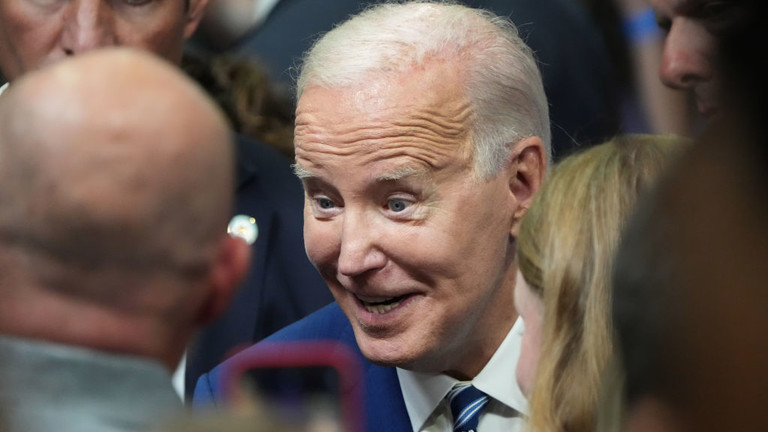
US President Joe Biden greets people after speaking on Thursday at the Veterans Affairs Medical Center in Salt Lake City, Utah. © Getty Images / George Frey
RT | August 11, 2023
US President Joe Biden has escalated his attacks on Chinese leaders, reportedly telling donors to his re-election campaign that China’s government is run by “bad folks” who may take dangerous actions as their economy teeters on the brink of collapse.
Biden claimed on Thursday at a fundraising event in Park City, Utah, that Chinese President Xi Jinping’s government was in “trouble” because Beijing’s economic problems were a “ticking time bomb,” according to multiple media reports. He backed up his assertions with several erroneous claims about China’s economy and demographics.
“They got some problems,” Biden told supporters. “That’s not good because when bad folks have problems, they do bad things.” He falsely stated that China had the “highest unemployment rate going” and more people of retirement age than of working age. He mocked Xi’s signature Belt and Road Initiative as the “debt and noose,” alluding to the loans China provides to developing nations.
The remarks were reminiscent of comments Biden made at a similar political event in June, when he referred to Xi as a “dictator.” Chinese officials lodged a formal complaint in Washington and called the insult a “political provocation.” Biden dismissed the controversy when asked at a press briefing about Beijing’s reaction, saying he didn’t think there would be “any real consequence.”
At Thursday’s fundraising event, the 80-year-old US president said he wants to have a “rational relationship” with China, adding, “I don’t want to hurt China, but I’m watching.” He didn’t specify which potential Chinese actions concern him, though US-China tensions over self-governing Taiwan have escalated in the past year.
Biden claimed that China’s economic growth has slowed to 2%. Chinese GDP rose at a 5.5% pace in this year’s first half, compared with the US rate of around 2.2%. As Western economies feel the effects of historically high inflation, China is dealing with deflation.
The country has more than three times as many people of working age as people 60 and older. China’s unemployment rate is around 5.2%, compared with 6.4% in the Eurozone. Spain and Greece both have double-digit jobless rates.
Biden has made incendiary comments about Xi’s government at a time when his administration is trying to improve strained relations between the world’s two largest economies. His “dictator” remark came just one day after US Secretary of State Antony Blinken concluded a long-awaited visit to China. Treasury Secretary Janet Yellen and US climate envoy John Kerry later made visits to Beijing.
The Utah fundraiser was held at the home of Mark Gilbert, a former US ambassador to New Zealand and Samoa. Donors reportedly had to pay at least $3,300 to attend. Hosts paid $100,000, and guests who contributed at least $50,000 were allowed to speak with Biden and have a picture taken with him. Those paying $10,000 to $25,000 could get a photo with the president.
Maine Hospital That Fired Unvaccinated Nurses Over Mills’ Mandate Is Begging Them to Return Two Years Later
By Steve Robinson | Maine Wire |August 9, 2023
Nurses and other health care workers at MaineGeneral Health, one of Maine’s largest healthcare providers, were unceremoniously fired two years ago if they refused to take the experimental mRNA injections touted as COVID-19 preventatives.
Some of those workers were even slapped with misconduct charges for refusing to comply with the mandate, many were later denied unemployment benefits, and no requests for religious exemptions were honored.
Now, one of the nonprofit hospitals that left some employees jobless and without recourse to Maine’s unemployment insurance benefits is sending text messages to the same employees it cast aside practically begging them to come back to work.
“You were once a proud member of the MaineGeneral team. Would you consider rejoining us? We would be pleased to discuss options with you,” the MaineGeneral Health Recruitment team said in a text message to former registered nurse Terry Poland.
“As you know, nearly 2 years ago MaineGeneral had to comply with a state mandate for COVID-19 vaccination. We lost a number of great employees as a result, including you,” MaineGeneral said.
“MaineGeneral has eliminated the COVID-19 vaccination as an employment condition,” MaineGeneral said.
Poland, who lives in Augusta, had worked as a registered nurse for 33 years. Her career included employment with MaineGeneral, Central Maine Medical Center, Pen Bay Medical Center, and the Aroostook Medical Center.
She couldn’t believe that the hospital would contact her in such a manner after casting her life into chaos for nearly two years.
“I was livid. Like, how dare you force me out of a career that I’ve dedicated my whole life to, taken away my livelihood, my ability to earn a good income, and now you think I’m gonna come grovel back to you?” Poland said. “I don’t hardly think so. And that’s the attitude of most everybody that I’ve been in contact with since yesterday.”
A source told the Maine Wire that about 15 former MaineGeneral Health employees received similar text messages.
Poland refused to take the experimental COVID-19 shots after Gov. Janet Mills decreed on August 12, 2021 that healthcare workers would be forced to receive the shots as a condition of working in healthcare by October 1, 2021.
Documents reviewed by the Maine Wire show that MaineGeneral established a speedier timeline of Sept. 17 for compliance.
Eventually, the State pushed back the deadline to the end of October.
Poland was never opposed to vaccines generally speaking. Though she previously used a religious exemption to avoid taking an influenza shot, she willingly took the other vaccines required to work in healthcare prior to the COVID-19 pandemic, including immunizations for Measles, Mumps, Rubella, and Hepatitis-B.
She said she was concerned about the novel nature of the mRNA technology, a form of gene therapy, which prior to COVID-19 had not been used in the standard schedule of immunizations.
“I knew enough not to take it. I’ve been a nurse long enough to know I need to question what new products are,” Poland said. “I’m not going to be the first one to jump on board of an experiment.”
When she discovered that fetal tissues are commonly used in the development and production of the drugs, that only strengthened her resolve as a Christian not to get the injections.
In previous years, Poland has said she was allowed an exemption from taking the influenza shot so long as she wore a mask during flu season. However, the hospital was unwilling to provide this accommodation for COVID-19.
As a result of her choice, Poland faced not only termination, but also an allegation of misconduct from her former employer.
When she applied for unemployment benefits, she was rejected because of the misconduct allegation.
When she appealed, she was turned away.
Documents reviewed by the Maine Wire show that the Maine Department of Labor determined that MaineGeneral Health “discharged” her; however, the agency concluded that Poland’s refusal to get the injections was a violation that constituted a “culpable breach of obligations to the employer.”
As a result, Poland had to rely on her savings to get by in the middle of economically disastrous government lockdowns and soaring inflation.
Poland then sought help from the federal Equal Employment Opportunity Commission, claiming that she’d been discriminated against on the basis of her religious beliefs.
MaineGeneral Health, in responding to the commission, argued that allowing Poland religious accommodations would impose an “undue hardship” on the hospital. On that basis, the commission declined to take on her case.
The Maine Human Rights Commission also rejected her discrimination complaint.
“[T]here has been positive energy between human resource personnel and managers who are in the process of working together to reach out to former employees to see if they are interested in returning,” said Joy McKenna, director of communications for MaineGeneral, in an email.
“Since Monday, we are only aware of a few people who have indicated that they are interested in having a conversation about applying for an open position,” she said. “We currently have 453 open positions, which is similar to our pre-COVID open position count.”
McKenna said the hospital did not intentionally fire unvaccinated employees in a way that would block them from getting unemployment benefits.
Some of those positions have been filled by foreign nationals with greencards, McKenna said, though she was not able to provide an exact number on Wednesday.
At the time MaineGeneral fired her, Poland was working at the MaineGeneral Rehabilitation and Long Term Care at Gray Birch facility in Augusta.
The facility provides nursing home and assisted living services and has a 37-bed capacity. Federal stats show the facility had 141 staff before the mandate and 110 after it was enforced.
In the years since she was fired, she estimates she’s earned only $12,000 and $17,000 as a home healthcare worker, a position that hasn’t provided similar benefits to the job she lost.
As a registered nurse, Poland was making about $75,000 per year.
She’s still not willing to give MaineGeneral another shot.
Poland is not the only one whose career was derailed by Gov. Mills’ mandate policy.
Jessie Boda worked for St. Mary’s Health System as a registered nurse in Psychiatric and Detox services for 13 years, her first job out of college.
When the mandate came down, she applied for a religious exemption.
In her letter requesting the exemption, Boda pointed to her religious faith and her concern over adverse vaccine reactions.
She also pointed out that natural immunity from a COVID-19 infection was in some cases a better protection against contracting the virus.
St. Mary’s, which has a formal affiliation with the Catholic Church, denied the request.
Like MaineGeneral, St. Mary’s also found a way for Boda’s exit from the company to prevent her from getting unemployment benefits.
“I did not comply and I never submitted a letter of resignation. Nor would they give me a letter of termination,” Boda said.
“The kind lady in the HR office gave me a letter stating my start date and end date of employment but told me she could not use the words ‘terminated’ or ‘fired’,” she said.
Boda took her case to the Equal Employment Opportunity Commission, which agreed to investigate her case but concluded there was no grounds for the complaint.
Kevin Palmer worked as a credentialing coordinator for Southern Maine Health Care, the Biddeford location of MaineHealth.
Palmer, who is in his 30s, was never opposed to taking vaccines before COVID-19, but he was skeptical of what he saw as a rushed process to roll out the COVID-19 shots.
“I had heart surgery in high school, survived brain cancer in my 20s, and now they’re telling me I have to get this shot over a virus with a 99.99 percent survival rate?” he said.
Like Boda and Poland, Palmer sought a religious exemption and was denied.
Like Boda and Poland, Palmer was fired in a way that later prevented him from obtaining unemployment.
In his termination letter, the HR department wrote: “This is also to confirm that September 30 will be your last day of employment. We want to thank you for your service.”
Even though the hospital gave him an employment date in an email, the Maine Department of Labor ruled against him.
“I never got a penny,” Palmer said.
He wasn’t able to find another job until four months later and the job he eventually found came with a 20 percent pay cut.
“I ran out of money like everybody else. It was crazy. I was trying to apply to jobs, similar to what I had done in credentialing. And I couldn’t even get a job with with the experience I had because they were mandating the vaccine even for remote positions,” said Palmer.
“How crazy is that?” he said.
A Healthcare Worker Crisis Caused by Authoritarian Policies
Thousands of former healthcare workers in Maine are currently unemployed or working in other fields because they refused to comply with Gov. Mills’ order that they receive injections.
Some refused because they were skeptical of all vaccines or because of religious beliefs concerning the ethical problems with vaccine research that uses fetal tissue.
Others were fearful that the long-term consequences of the experimental products were unknown, unknowable, and potentially harmful.
But in every case, the substantial drop in employment in Maine’s healthcare sector because of the mandate has severely exacerbated a workforce shortage that threatens to undermine healthcare quality in the state.
Text messages like the one Poland received will hardly fix the problem.
It’s virtually impossible to determine how much of the sharp drop in healthcare employment has been caused by Mills’ order, how much of it was caused by COVID-19, and how much of it was caused by lockdown policies generally.
Regardless, labor statistics show Maine is in the middle of the steepest decline in healthcare jobs. Ever.
According to stats from the U.S. Bureau of Labor Statistics, those losses have been particularly acute in Maine’s nursing homes and assisted living facilities, like the facility where Poland worked.
In 2019, Maine had more than 22,600 individuals employed at nursing homes.
That number hit 19,800 in 2022.

At skilled nursing facilities, employment dropped from 8,426 in 2019 to 6,907 in 2022, according to Maine Department of Labor statistics.
The shortage of long-term care workers is all the more severe in Maine since the state consistently ranks as the oldest in the nation. As demand for nursing home beds increases, the number of workers available to provide that care has plummeted.
In home healthcare, total employment has declined from 4,401 workers in 2019 to 4,054 in 2022.
The same shortage can be seen in employment figures for hospitals in Maine. Mainers working in Maine hospitals declined from 33,000 in 2019 to 30,900 in 2021, according to federal statistics.

Even as Maine’s opioid epidemic has continued to break records for overdoses and deaths, the number people employed in the health sector that includes substance abuse facilities has declined from 7,509 workers in 2019 to 7,149 in 2022, according to Maine Department of Labor numbers.
One health care area that hasn’t seen such sharp declines is ambulatory health care, which includes facilities that are out-patient only, such as urgent care clinics and dentists offices.
At the same time the medical field is suffering from a lack of employees, Mainers have never spent more money on their health care.
Personal consumption of outpatient and in-home care topped $11,897,000,000 in 2021, according to the U.S. Bureau of Economic Analysis. That’s a massive increase over the $11.2 billion reported for 2019.
At least some of that money is making its way into the pockets of Maine’s remaining health care workers. According to federal stats, Mainers who work in health care or social assistance made a record $7,028,362,000 in collective wages — the highest ever in Maine history.
Vaccine Mandate Victims Seek Discrimination Case
Gov. Mills’ mandate was based on the theory that the pharmaceutical products being touted as “vaccines” or “immunizations” would prevent healthcare workers from contracting the virus or transmitting it to patients.
It’s now generally understood that the vaccine never inhibited transmission of the virus.
Mills, who has followed the recommended injection schedule, has herself caught COVID-19 twice despite getting the jabs.
The Aug. 3 decision by the Mills Administration to rescind the mandate after nearly two years followed on the heels of an embarrassing legal defeat in a case challenging the constitutionality of Mills’ decision to eliminate religious and philosophical exemptions from the mandate.
That court case hinges on the fact that Mills continued to allow medical exemptions while denying a comparable exemption for medical reasons.
Although the plaintiffs in that case, several healthcare workers who lost their jobs over the mandate, initially lost in Maine District Court, an appeals court panel has determined that the lower court erred when it rejected their claim of religious discrimination.
In May, when that decision came down, Matt Staver, who represents the plaintiffs via Liberty Counsel, said he was looking forward to discovery.
“We’re frankly looking very much forward to going to discovery and holding Governor mills and the Maine authorities accountable for this terrible and, frankly, unconstitutional decision,” said Staver.
‘So Many Pitfalls’: Feds Push School-Based Health Centers as Critics Sound Alarm Over Lack of Parental Consent
By Suzanne Burdick, Ph.D. | The Defender | August 9, 2023
The recent push by the U.S. federal government to rapidly expand the use of school-based health centers (SBHCs) across the country has some critics concerned children will receive, or be pressured into receiving, unnecessary or unwanted medical interventions — including vaccines — without their parents’ knowledge or consent.
Georgia attorney Nicole Johnson, co-director of Georgia Coalition for Vaccine Choice and a consultant to the Children’s Health Defense’s (CHD) legal team, told The Defender :
“It’s scary because these health centers sound really good. In some of the rural and poor communities especially, this is going to seem like a really good way for children to get this care.
“And while there may be some conveniences, there are so many concerns with allowing medical exams and treatments at school. Parents need to be involved in all medical decisions and I fear they are being left out of the equation.”
SBHCs are intended to provide high-quality healthcare to kids by offering “primary care, mental health care, and other health services in schools,” particularly in underserved communities.
This includes services “to prevent disease, disability, and other health conditions or their progression” such as “immunizations” and “well-child care.”
According to the Centers for Disease Control and Prevention’s (CDC) Community Preventive Services Task Force, SBHCs can improve educational and health outcomes.
The CDC also considers SBHCs as integral to its Whole School, Whole Community, Whole Child model because they provide health services and mental health counseling.
But critics like Johnson worry that though there may be benefits to SBHCs, there are also downsides — including lack of regulation of the centers and the fact that parents may not be aware of the broad range of medical and behavioral services being provided in their children’s schools.
SBHCs have been linked to higher human papillomavirus (HPV) vaccination rates, according to a 2022 report by Harvard University’s Center for Health Law and Policy Innovation and the University of California Davis Comprehensive Cancer Center.
The report — written expressly to “address vaccine hesitancy” — concluded: “These results suggest SBHCs create a considerable opportunity … to implement successful school based HPV vaccination programs.”
Merck, the maker of the Gardasil HPV vaccine, is one of the funders of the School-Based Health Alliance, a large networking organization that “works on policy, standards, data, and training issues” regarding SBHCs.
Federal, state authorities pour taxpayer money into school-based health centers
The idea of running full-service health centers in public schools has been around for more than two decades, but events in 2022 caused SBHCs to catch on like wildfire.
Congress and President Joe Biden in June 2022 passed the Bipartisan Safer Communities Act, which allowed the U.S. Department of Health and Human Services (HHS) to award $50 million in grants to states “for the purpose of implementing, enhancing, or expanding the provision” of healthcare assistance through SBHCs using Medicaid or the Children’s Health Insurance Program (CHIP).
The legislation charged the Centers for Medicare & Medicaid Services (CMS) with expanding access to Medicaid healthcare services — including behavioral health services — in schools, and reducing the administrative burden for states and schools.
A CMS spokesperson told The Defender that Medicaid and CHIP now can provide reimbursement for services given in SBHCs for children and youth who are covered by those programs.
Additionally, in May 2022 HHS awarded $25 million in grants to 125 SBHCs “to improve and strengthen access to school-based health services in communities across the country.”
State public officials also are dedicating funds to expand SBHCs. For instance, the governor of Georgia in fall 2022 announced an investment of $125 million to expand school-based health services to rural communities in Georgia.
Pediatricians can ‘partner’ with schools
The American Academy of Pediatrics (AAP) supports SBHCs and said in a policy statement that pediatricians may act as “sponsors” by partnering with a school to establish the SBHC as an extension of their practice or by supervising the care given at a SBHC.
“Sponsors also include local hospitals that can provide prearranged after-hours and school vacation coverage and financial support for SBHCs,” the AAP said.
The Defender reached out to the AAP statement’s lead authors for comments on how parental consent is handled in SBHCs, but they did not respond by our publication deadline.
SBHCs also have the support of the School-Based Health Alliance. In addition to funding from Merck, the alliance receives financial support from HHS’ Health Resources & Services Administration.
Documents obtained in June by CHD revealed that the HHS gave $4.7 million to research headed by a Merck consultant that focused on developing “The Announcement Approach Training,” where providers simply “announce” a child will be receiving the HPV vaccine as part of a routine office visit, instead of discussing it with the family first.
The government-funded research also is testing whether financial incentives and peer pressure can “nudge” doctors to change how they talk to their patients in order to increase HPV vaccine uptake among adolescents.
Meanwhile, a fierce battle is taking place in multiple states where some lawmakers are pushing legislation that would allow minors to receive treatments to prevent sexually transmitted diseases — including Merck’s HPV vaccine — without parental knowledge or consent.
‘So many pitfalls … so many ways for someone else to be making parental decisions’
Justine Tanguay, an attorney with nearly 20 years of experience advocating for children in various areas of the law, told The Defender :
“Don’t be fooled! This year many schools will be sending home blanket consent-to-treat forms for parents to sign.
“Parents need to be aware that these forms are not the traditional authorization requests for the school nurse to give first-aid or to treat minor illnesses.”
Tanguay, CHD’s director of campaign and research, explained that the forms may give those who run the SBHC the legal authorization to provide “comprehensive healthcare.”
This could include — but may not be limited to — “the ability to provide preventative treatment, behavioral and mental health services, reproductive counseling, lab and prescription services, various medical screenings, immunizations and disease management,” Tanguay said.
Moreover, SBHC staff will have “direct access” to a minor child, Tanguay said, “as well as the ability to encourage a minor child to make personal healthcare decisions without the need to consult with and seek approval from a parent.”
“The opportunity to circumvent both parental rights and informed consent is ripe for abuse,” Tanguay warned.
Johnson agreed, saying, “There are just so many pitfalls here, so many ways for someone else to be making parental decisions.”
Johnson shared with The Defender a consent form currently used in a school district north of Atlanta, Georgia.
The form says nothing about parents being notified before, during or after treatment. It reads:
“I hereby voluntarily give my consent for [my child] to receive health services with Georgia Highlands Medical Services at Cumming Elementary School.
“I further authorize any health care provider and professional staff working for the clinic to provide such medical tests, diagnoses, procedures, and treatments as are reasonably necessary or advisable for the medical evaluation and management of my child’s health care.”
The form does not clarify who determines what services are “reasonably necessary or advisable” and does not explain how parents will be involved in that process. It states:
“I understand that my signing this consent allows the health care provider and professional clinic staff of Georgia Highlands Medical Services at Cummings Elementary Schools to provide comprehensive health services which includes physical and behavioral health services.”
Again, the form does not clarify what specifically falls into the category of “physical and behavioral health services” or how parents will be involved in the determination for what services their child may need.
“I think about my own kids when they were in school,” Johnson said, “how easily they could have been swayed to get a vaccine or a medical treatment just because an adult told them that they should.”
“It’s really dangerous to have all of these things offered to them without the parents even being aware,” she said. “A lot of kids — most kids — are compliant. They want to do what the adults are telling them to do.”
According to the CDC, a key component of its Whole School, Whole Community, Whole Child model, which includes SBHCs, is “family engagement.”
However, the agency’s 37-page document about family engagement mentions parental permission only once and does not discuss parental consent for medical treatment beyond the application of sunscreen during recess.
According to a CMS spokesperson, SBHCs “follow the same practices as any other medical center or Medicaid or Children’s Health Insurance Program (CHIP) provider … including parental consent requirements.”
The spokesperson did not go into detail on whether consent would be requested generally or for each specific medical treatment.
Where’s the regulatory oversight?
Tanguay pointed out that SBHCs exist without proper regulatory oversight.
According to Stand for Health Freedom, a nonprofit “dedicated to protecting informed consent in medical care,” SBHCs are “completely unregulated.”
For instance, it is presently unclear how HIPAA law (the Health Insurance Portability and Accountability Act of 1996) and FERPA law (the Family Educational Rights and Privacy Act) will be applied to SBHCs and students’ health information.
Stand for Health Freedom also pointed out that although in-school clinics may relieve busy parents of the burden of taking their children to the doctor, “medical ethics do not allow physicians to treat minors without a parent or guardian present, which is why parents cannot simply drop their child off at the doctor’s office and come back later to collect them.”
Stand for Health Freedom said:
“Parents must engage politically and work with state health freedom leaders to ask lawmakers to either ban SBHCs in favor of the existing limited school-nurse model, or place guardrails on SBHCs to protect parental consent and involvement in their minor children’s medical care.”
Meanwhile, proponents of SBHCs, such as the School-Based Health Alliance, argue that SBHCs are a “powerful tool for achieving health equity among children and adolescents who unjustly experience disparities in outcomes simply because of their race, ethnicity, or family income.”
Johnson said she disliked being “so skeptical of something that may potentially benefit some people” but added, “as a parent, it is your job and your right to be a part of the decisions that affect the health and well-being of your child.”
Johnson said parents who experienced or witnessed vaccine injury would be particularly skeptical of putting medical decisions in the hands of government agencies, including schools.
“And the COVID response created even more skeptics,” she said, adding:
“It’s unfortunate that we have to approach this [SBHCs] with the thought, ‘How could this be abused?’ But that’s where we are.”
The Defender on Aug. 3 reached out to the School-Based Health Alliance to ask how parental consent in SBHCs is handled and what they’d like parents who may feel distrustful of the U.S. medical system to know about SBHCs. The alliance did not respond by our publication deadline.
Suzanne Burdick, Ph.D., is a reporter and researcher for The Defender based in Fairfield, Iowa. She holds a Ph.D. in Communication Studies from the University of Texas at Austin (2021), and a master’s degree in communication and leadership from Gonzaga University (2015). Her scholarship has been published in Health Communication. She has taught at various academic institutions in the United States and is fluent in Spanish.
This article was originally published by The Defender — Children’s Health Defense’s News & Views Website under Creative Commons license CC BY-NC-ND 4.0. Please consider subscribing to The Defender or donating to Children’s Health Defense.
Coral at the Great Barrier Reef Holds on to Recent Record Gains, Defying All Doomsday Predictions
BY CHRIS MORRISON | THE DAILY SCEPTIC | AUGUST 10, 2023
Coral at the Great Barrier Reef (GBR) faces another year of exile from the climate scare headlines with news that the record levels reported in 2021-22 have been sustained in the latest annual period to May 2023. A small drop in the three main areas of the reef was well within margin of error territory, with the Australian Institute of Marine Science (AIMS) reporting that regional average hard coral cover in 2022-2023 was similar to last year at 35.7%. Most reefs underwent little change during the year.
Coral at the reef has been bouncing back sharply for a number of years, with a record 36-year high reported in 2022. But the news of this spectacular recovery has been largely ignored in most media since it had previously been a go-to poster scare story for collectivist Net Zero promoters. But connecting the fate of tropical corals to global warming was always a difficult ask since they grow in waters between 24-32°C. Short boosts in local temperatures can cause temporary bleaching, but it is scientifically impossible to pin it on human-caused climate change, although pseudoscientific ‘attribution’ computer models try very hard.
In the latest year, there was a short local temperature rise, but little bleaching was reported during the 2023 summer. No cyclones hit the reef and crown-of thorns starfish attacks were limited. Nevertheless, natural stresses will always affect the eco-system and AIMS states that these paused the growth of hard coral on some of the reefs.
Like most state-funded scientific bodies, AIMS is fully signed up to climate extremism and delivering politically correct messages to promote the Net Zero solution. Despite reporting what is now a substantial multi-year recovery, it notes that the future is predicted to bring more frequent, intense and enduring marine heatwaves, alongside the persistent threat of crown-of thorns starfish outbreaks and tropical cyclones. More frequent mass coral bleaching is a sign that the GBR is experiencing the consequences of climate change, it claims. However, in a different part of its latest report, AIMS accepts that the recent substantial recovery occurred despite two mass coral bleaching events in 2020 and 2022. There is an acceptance that this underlines that “widespread coral bleaching does not necessarily lead to extensive coral mortality”.
But pockets of extremist catastrophism remain in the mainstream media, notably in the Guardian, fighting to keep the coral destruction story going. A year ago, the newspaper reported that the GBR still had “some capacity” for recovery, but the window was closing fast as the climate continued to warm. Of course the Guardian has form as long as your arm on this score. Back in 1999, George Monbiot told its readers that the “imminent total destruction of the world’s coral reefs is not a scare story but a fact”.
In last year’s Guardian report, Dr. Mike Emslie, who leads the AIMS monitoring service, said he felt a “couple of bullets” had been recently dodged. While the recovery is great, “the predictions are the disturbances will get worse”, he suggested. “The naysayers can put their heads in the sand all they like, but the frequency of disturbances is going gangbusters,” he claimed. Dr. David Wachenfeld from the Great Barrier Reef Marine Park Authority claimed “global heating” of 1.5°C is considered a “guardrail for reefs”, after which the bleaching comes along too quickly for strong recovery.
Coral reefs have been around in one form or another for hundreds of millions of years. Current global temperatures are towards the lower end of the paleoclimatic record. One might wonder how corals manage to survive temperatures up to 10°C higher in the past?
Back in the real world, we can see how the recent solid recovery was sustained across the three main areas of the GBR.
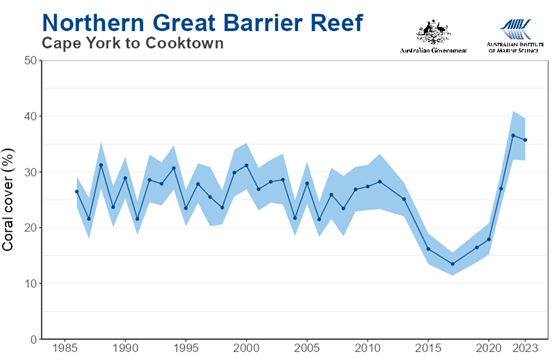
The recovery in the northern GBR actually started around 2017. Last year the coral declined slightly from 36.5% to 35.7%, and was easily within the margin of error calculated by the AIMS. Typhoon Tiffany passed through at the end of the previous reporting season, and could have been responsible for some loss.
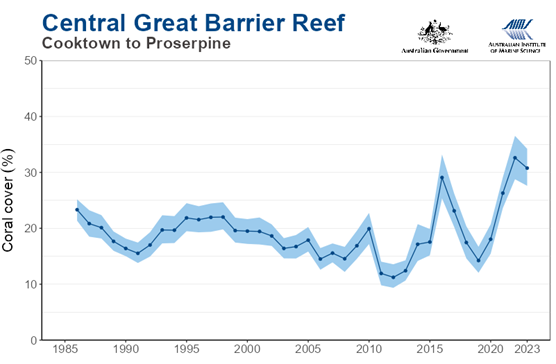
In the centre of the reef, the strong recovery of hard coral cover to 32.6% last year eased slightly, but again, as the AIMS noted, it was within the margin of error.
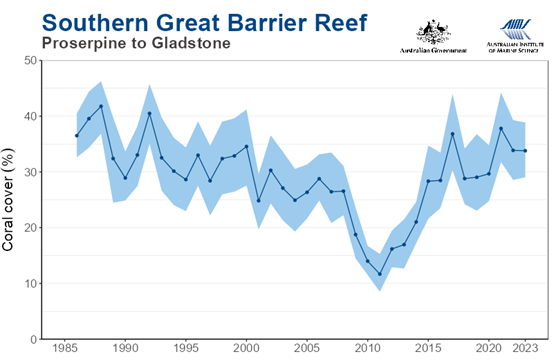
The southern end of the GBR has generally had higher coral cover than elsewhere, but has shown greater variability over the observed record. Last year’s cover was 33.8%, compared with 33.9% the year before. Some coral was reported to have been lost due to starfish predations.
The GBR is the largest reef system on Earth and runs for over 1,400 miles down the eastern side of Australia. It is also the most surveyed reef in the world and the results of scientific endeavour are widely distributed. While this work is often politicised, it is clear that recent evidence shows that temporary spikes in temperature, which occur naturally in the oceans, can cause bleaching. However, this bleaching process can rapidly go into reverse when local conditions stabilise. These findings have been confirmed elsewhere, notably in the remote Palmyra Atoll, 1,200 kms south of Hawaii. A 10-year survey recently observed sudden changes in temperature up to 3°C on two occasions, leading to substantial damage to the coral. A 2015-16 spike led to 90% of the coral bleaching, but the researchers found that within a year only 10% of the coral had died. Within two years, the corals had returned to pre-bleached levels.
The researchers concluded that the coral structures “show evidence of long-term stability” – but don’t hold that front page.
Chris Morrison is the Daily Sceptic’s Environment Editor
Featured Video

Trita Parsi: Israel Set a Trap for Total War in the Region
or go to
Aletho News Archives – Video-Images
Book Review
Why the War on Conspiracy Theories Is Bad Public Policy
By Kevin Barrett • Unz Review • February 1, 2019
 A Review of Conspiracy Theories and Other Dangerous Ideas by Cass Sunstein (based on an earlier paper co-authored with Adrian Vermeule); In Defense of Troublemakers: The Power of Dissent in Life and Business by Charlan Nemeth; and Conspiracy Theories and the People Who Believe Them, edited by Joseph E. Uscinski
On January 25 2018 YouTube unleashed the latest salvo in the war on conspiracy theories, saying “we’ll begin reducing recommendations of borderline content and content that could misinform users in harmful ways—such as videos promoting a phony miracle cure for a serious illness, claiming the earth is flat, or making blatantly false claims about historic events like 9/11.”
At first glance that sounds reasonable. Nobody wants YouTube or anyone else to recommend bad information. And almost everyone agrees that phony miracle cures, flat earthism, and blatantly false claims about 9/11 and other historical events are undesirable.
But if we stop and seriously consider those words, we notice a couple of problems. First, the word “recommend” is not just misleading but mendacious. YouTube obviously doesn’t really recommend anything. When it says it does, it is lying. … continue
Blog Roll
 Aletho News
- The Ongoing Cancellation Campaign Against a Dissenting Academic in Norway
- Yemen and ‘the Houthis’: Challenging Sami Hamdi’s Narrative
- No, Christians did not invent Zionism
- AIPAC-led lobbying network opens branches in Cypriot, Greek parliaments
- Araghchi blasts ‘parasitic’ alliance as US taxpayers pay for Israel’s war on Iran
- Easy fix for Europe’s chaos? Stop fueling war against Russia
- Putin’s key remarks on peace talks and Europe’s ‘schizophrenia’
- Trita Parsi: Israel Set a Trap for Total War in the Region
- Trump’s Iran war is on an Israeli leash
- Saudi oil boss issues global supply warning
- If Americans Knew
- Damning report shows the media must confront its failures on Gaza
- BBC senior broadcaster speaks out on Gaza coverage
- Netanyahu vows vast West Bank invasion in response to 20-minute skirmish that left 2 Israeli soldiers and 2 Palestinian fighters dead
- Tied up and tortured: Israel using US-made electroshock weapons on Palestinian detainees
- The outsourced risk: how newsrooms rely on Gaza’s freelancers without protecting them
- Gaza bakeries forced to shut as Israel blocks flour shipments
- Gaza’s breast cancer patients face a deadly wait for treatment amid Israel’s genocide
- DAILY UPDATE: Latest essential news on Palestine, Israel, & region
- The Israel Lobby’s Changing Fortunes
- AIPAC has become such a political liability that it’s shifting to a more “nimble” approach to buying politicians
- No Tricks Zone
- E-Cars Reduce CO2 Emissions By Only 41% Compared To Internal Combustion Engine Vehicles
- Predictions Made By Renowned Climate Professor Over Past Decades Have Been Proven To Be Poor
- New Study Suggests Large Regions Of The Pacific Ocean Have Been Cooling For The Last 80 Years
- Germany’s Green Energy Debacle: High Energy Costs Force Kahla Porzellan to Close After 182 Years!
- New Study: 50 Years Of The Most Aggressive ‘Net Zero’ Policies Can Only Affect The Global Climate By 0.03°C
- US September “Heat” Was No Record…Many Records Set Decades Ago
- Latest European Green Energy Debacle; Portugal’s Largest Flagship Solar Park Insolvent!
- Green Energy Debacle: German Expert Professor Fritz Vahrenholt Warns Of Severe Economic And Social Consequences
- Two More Paleo Reconstructions Affirm Meters-Higher Sea Levels Across Ireland, Brazil 7000-6000 Years Ago
- New Study: Earth And Venus Surface Warmth Largely Explained By Convection And Lapse Rate, Not CO2 Or Radiation

