As Donetsk civilians live in constant fear of Ukrainian shelling, a reporter on the ground details the terror
By Eva Bartlett | RT | May 11, 2023
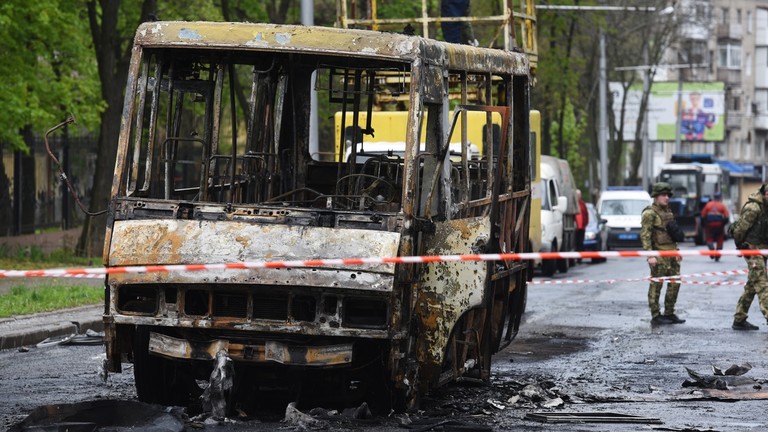
Heavy Ukrainian shelling of central Donetsk on April 28 killed nine civilians – including an eight-year-old girl and her grandmother – and injured at least 16 more. The victims were burned alive when the minibus they were in was hit by a shell.
The attack also targeted a major hospital, apartment buildings, houses, parks, streets, and sidewalks. All civilian areas – not military targets.
According to the Donetsk People’s Republic’s (DPR) Representative Office in the JCCC (Joint Monitoring and Co-ordination Center on Ukraine’s War Crimes), Kiev’s forces fired high-explosive fragmentation missiles “produced in Slovakia and transferred to Ukraine by NATO countries.” Regarding an earlier shelling on the same day, the JCCC noted that US-made HIMARS systems were used, targeting “exclusively in the residential, central quarter of the city.”
I was outside of Donetsk interviewing refugees from Artyomovsk (also known as Bakhmut) when both rounds of intense shelling occurred, the first starting just after 11am. I returned to see a catastrophic scene, with a burnt-out bus – still smoking – and some of its passengers’ charred bodies melted onto the frame. This tragic picture was sadly not a one-off event.
Elsewhere, city workers were already removing debris and had begun repaving damaged sections of the roads. I’ve seen this following Ukrainian shelling many times, including on January 1 this year, when Ukraine fired 25 Grads into the city centre. Similarly, in July 2022, Ukrainian shelling downtown killed four civilians, including two in a vehicle likewise gutted by flames. When I arrived at the scene about an hour later, workers were repaving the affected section of the street.
The damage to the Republican Trauma Center hospital was quickly cleaned up, but videos shared on Telegram immediately after the shelling show a gaping hole in one of the walls. The room concerned contained what was, apparently, Donetsk’s sole MRI machine.
Along Artyoma street, the central Donetsk boulevard targeted countless times by Ukrainian attacks, the destruction was evident: Two cars caught up in the bombing, residents of an apartment building boarding up shattered windows and doors, the all-too-familiar sound of glass and debris being swept away. In the residential area, the first to be targeted that day, in a massive crater behind one house, the walls and roof of another home were intermixed with rocket fragments.
Another year of Ukrainian war crimes
In April 2022, following strikes on a large market area in Kirovsky district, in western Donetsk, which killed five civilians and injured 23, I went there to document the aftermath, not expecting to see two of the five dead still lying in nearby lanes. This shelling was just before noon, a busy time of day in the area. Bombing at such periods is an insidious tactic to ensure more civilians are maimed or killed.
Double and triple striking the same areas is another method used by Ukrainian forces. In an interview last year, the director of the Department of Fire and Rescue Forces of the DPR Ministry of Emergency Situations, Sergey Neka, told me, “Our units arrive at the scene and Ukraine begins to shell it. A lot of equipment has been damaged and destroyed.”
Andrey Levchenko, chief of the emergency department for the Kievsky district of Donetsk, also hit by Ukrainian attacks, said: “They wait for 30 minutes for us to arrive. We arrive there, start assisting people, and the shelling resumes. They wait again, our guys hide in the shelters, as soon as we go out, put out the fire, help people, then shelling resumes.”
I was here in Donetsk in mid-June, during a day of particularly intense Ukrainian shelling of the very centre of the city, which killed at least five civilians. The DPR authorities reported that “within two hours, almost 300 MLRS rockets and artillery shells were fired.” One Grad rocket hit a maternity hospital, tearing through the roof.
The following month, Ukraine fired rockets containing internationally-banned ‘petal’ mines. The streets of central Donetsk, as well as the western and northern districts and other cities, were littered with the hard-to-spot mines designed to grotesquely maim, but not necessarily kill, anyone stepping on them. These mines keep claiming new victims to this day – when I last wrote about them here, 104 civilians had been maimed, including this 14-year-old boy. Three had died of their injuries. Since then, the number of victims has risen to 112.
In August, heavy Ukrainian shelling of the centre of Donetsk hit directly next to the hotel I was staying in, along with dozens of other journalists and cameramen. Six civilians were killed that day, including one woman outside the hotel, as well as a child. She been a talented ballerina due to leave to study in Russia soon, and along with her grandmother, her ballet teacher was also killed that day, herself a world-famous former ballerina.
Three bouts of Ukrainian shelling of the city centre in a span of just five days in September killed 26 civilians. Four were killed on September 17, among them two people burned alive inside a vehicle on the same central Artyoma Street. Two days later, 16 civilians were killed, the remains of their bodies strewn along the street or in unrecognizable piles of flesh. Three days later, Ukraine struck next to the central market, killing six civilians, two in a minibus, the rest on the street.
In my subsequent visits to Donetsk and surrounding cities in November and December, I filmed the aftermath of more Ukrainian shelling (using HIMARS) of civilian areas of Donetsk and the settlement of Gorlovka to the north. The November 7 shelling of central Donetsk could have killed the toddler of the young mother I interviewed. Fortunately, after hearing the first rockets hit, she ran with her son to the bathroom. When calm returned, she found shrapnel on his bed.
The November 12 shelling of Gorlovka damaged a beautiful historic cultural building, destroying parts of the roof and the theatre hall within. According to the centre’s director, it was one of the best movie theatres in Donetsk Region, one of the oldest, most beautiful, and most beloved buildings in the city. He noted that the HIMARS system is a very precise weapon, so the attack was not accidental.
The shelling goes on
Early morning during Easter Mass on April 16, the Ukrainian army fired 20 rockets near the Cathedral of the Holy Transfiguration in the centre of Donetsk, French journalist Christelle Neant reported, noting that one civilian was killed and seven injured. The shelling extended to the central market just behind the cathedral. Just over a week prior, on April 7, another shelling of that market killed one civilian and injured 13, also considerably damaging the market itself.
Ukraine continues to shell the western and northern districts of Donetsk, also pounding Gorlovka, as well as Yasinovatya just north of Donetsk (killing two civilians some days ago).
On April 23, shelling in Petrovsky, a hard-hit western Donetsk district, killed one man and injured five more. The same day, in a village northeast of Donetsk, a rocket killed two women in their 30s. Security camera footage shows the moment when the women attempted to take cover. The munition that killed them hit directly next to where they huddled.
A few days later, on my way to interview refugees from Artyomovsk sheltering in another city, I passed along the tiny village where those women were killed. It’s a road I’ve driven a dozen times or more, a quiet, calm, scenic region of rolling hills, a lovely river, a beautiful church. It’s far from any front line. The murder of these two women was another Ukrainian war crime.
The people here are constantly terrorized by Ukrainian shelling or the threat of it, and have been since Kiev started its war on the Donbass in 2014.
Eva Bartlett is a Canadian independent journalist. She has spent years on the ground covering conflict zones in the Middle East, especially in Syria and Palestine (where she lived for nearly four years).
Kiev tries to disguise the failure of its counteroffensive plan
By Lucas Leiroz | May 12, 2023
In a recent interview to a Western media outlet, the head of the Kiev regime stated that his country needs more time before starting the counteroffensive against Russian troops. According to Vladimir Zelensky, the Ukrainian forces would be “ready” to start the move, but before that they need to receive more equipment and wait for the ideal conditions for action to emerge – which is obviously a contradictory, ambiguous and unsubstantiated narrative.
Zelensky’s words were spoken during a conference with the Eurovision News Network and were then reported by the BBC. The Ukrainian president claims that he could give orders to launch the counteroffensive now, but that would mean too many casualties for Kiev, which is why it seems more prudent to wait for more favorable conditions to arise in the future. At the time, Zelensky also emphasized the importance of receiving more armored vehicles from the West, which would operationally facilitate the counteroffensive.
Another interesting point of the interview was Zelensky’s response when asked if he has been under pressure from his western partners to resume negotiations in case the counterattack plans fail. The president suggested that his army would continue fighting regardless of the outcome of the counter-offensive and said that no Western country could pressure Ukraine to surrender territories to Russian forces. Zelensky also said that Moscow intends to “freeze” the conflict, as it would be territorially favored, which supposedly will be prevented by the counteroffensive.
“We’d lose a lot of people [if we started the counteroffensive now] (…) I think that’s unacceptable. So, we need to wait. We still need a bit more time (…) [Western powers] can’t pressure Ukraine into surrendering territories”, he said.
The most curious thing about Zelensky’s narrative is how extremely contradictory it is. At one moment the president says that his country is “ready” to start the maneuver and at another he says it needs to wait. Either Kiev is ready to start an effective counterattack, or in fact it is not and needs to wait for better conditions in the future. There is no possible synthesis between both possibilities. This confused and irrational rhetoric sounds like a desperate attempt to have control over the military situation of the conflict, when in fact this control does not exist.
Also, by reaffirming that Kiev will continue to fight to recover the territories liberated by Russia, Zelensky makes it clear to the Western media that, in practice, the outcome of the counteroffensive does not matter. Even if the plans fail, Ukrainian forces will continue to be forced to fight and keep looking for virtually unattainable results. And, as Zelensky himself stated, no western power is opposed to that – which was already well known, since NATO countries are the most interested in keeping Kiev active in the conflict.
In the same sense, Zelensky lies when he says that Russia wants to freeze the conflict. Moscow’s position is clear on achieving an effective and lasting resolution to the crisis. However, Russia does not see the fight against Ukrainian forces as a war, but as a special military operation inserted in a broader context – the war with NATO, which is the organization that uses Kiev as a proxy. Russia avoids escalations and big maneuvers because it wants to avoid as much as possible the death of Ukrainian civilians, seen as part of the same people by most Russian citizens. So, Russia does not want to freeze – it really wants to win and end the problem, but it wants to do it in the least harmful way possible for Ukraine itself.
However, what is most interesting about Zelensky’s speech is to see how Ukrainian rhetoric has changed in a few days. In the most recent wave of terrorist attacks launched by the regime, several officials claimed that the moves were part of the counteroffensive, which had already begun. Zelensky even promised that he would launch more attacks on Crimea, until he “recovered” it, virtually assuming the terrorist nature of such a counteroffensive. Now, however, the rhetoric has changed and apparently the move has not yet started, with the Ukrainians waiting for a more opportune moment to avoid casualties.
In fact, what seems to be happening is the formulation of a narrative by Zelensky and the western media to disguise the failure. Many analysts, citing sources on the battlefield, believe that the Ukrainian counteroffensive has already begun. The intensity of Kiev’s attacks – both on the trenches and in terrorist operations – has already escalated. The special troops that had reportedly been sent to Poland for training during the winter have already returned to the country and there have been practical results of their work. For example, the head of Russian PMC Wagner Group recently showed on his social networks several Russian soldiers killed after Ukrainian massive attacks in Bakhmut.
The problem is that, contrary to what was promised by the regime’s propaganda, this counteroffensive has been weak, inefficient and incapable of guaranteeing territorial gains. Kiev managed to increase combat capability and generate more casualties on the Russians, but this had no military relevance. The regime’s forces are still unable to capture and occupy territories, which is why the media has run out of arguments to maintain its previous narrative and is now changing it, stating that the move has not yet started.
In a realistic analysis, it seems evident that Kiev is incapable of reversing the military scenario of the conflict with its counterattack. The promise of occupation of Donbass and Crimea is absolutely inconsistent with the reality of Ukrainian troops, which have been weakened, demoralized, and poorly equipped since 2022. So, indeed, the counteroffensive is happening, but it is not what the propagandists promised.
Lucas Leiroz is a journalist, researcher at the Center for Geostrategic Studies, geopolitical consultant.
COVID Was Not Dangerous to Unvaccinated Pregnant Women
BY IGOR CHUDOV | MAY 11, 2023
Remember the endless media hysterics about COVID being “dangerous to unvaccinated pregnant women”?

A recent report MBRRACE-UK throws doubt on such statements. It covers 2018-2020, so the year of 2020 was a part of the COVID pandemic.
In the UK, in 2020 (before COVID vaccines), only NINE women died from (or with) COVID-19 during pregnancy or up to six weeks after giving birth.

Remember that in 2020, all pregnant women in the UK were unvaccinated. COVID was at its worst in 2020.
COVID was quite rampant in the UK at the time. According to Our World in Data, the UK had 94,194 COVID deaths in 2020. However, only nine deaths out of those involved pregnant women.
ONS reports that England and Wales had 613,936 live births in 2020.

So,
- Pregnant women’s COVID deaths (9 total) were less than one in ten thousand overall COVID deaths.
- Pregnant women’s deaths (9 total) were less than one in 68,000 (sixty-eight thousand) births.
- In other words, for every pregnant woman who died of COVID in 2020, over 68,000 did NOT die.
Every death is a tragedy, especially those of future mothers. Those nine deaths were tragic for the families involved. I am very sorry for each of the nine women who died with COVID in the UK in 2020. I am relieved, however, that the number of deaths among pregnant women was far less than what the media intimated.
Was COVID a great danger to pregnant women? The numbers above suggest that the chance of dying from COVID for unvaccinated women in 2020 was very remote, as there was less than one COVID death per 68,000 births.
To me, this cannot be considered “particularly dangerous.” Pregnant women are young (most are under 40), and Covid is not particularly deadly to that age category.
So, those who believed that COVID-19 puts future mothers’ lives at tremendous risk were lied to. Pregnant women were given false information to nudge them to get vaccinated.
We finally have the proof.
Brazilian Justice Will Punish Tech Companies That Criticize Government’s Censorship Law
By Christina Maas | Reclaim The Net | May 11, 2023
Brazil’s Supreme Court Justice Alexandre de Moraes, also the president of the country’s Superior Electoral Court, told tech platforms not to campaign against a proposed internet censorship bill.
If they do, he’ll punish them.
Moraes said that the tech companies were undermining Brazil’s democracy.
“The big tech platforms have been challenged and they will be penalized. They will be held accountable, to guarantee the voter’s freedom to vote,” Moraes said, speaking to judges and government employees studying electoral law.
He added that Big Tech platforms, “believe no jurisdiction in the world can oversee them.”
The proposed “Fake News Law” aims to put the responsibility of finding and reporting illegal content on internet platforms.
Non-compliance with the extreme measures would result in fines.
Tech platforms have obviously campaigned against the legislation, claiming it would lead to more censorship.
On Tuesday, Telegram Brazil posted to the Telegram app and said that “democracy is under attack in Brazil,” claiming that the bill would “kill the modern internet” and “put an end to freedom of expression.”
Moraes quickly went further and directly threatened messaging service Telegram with a nationwide ban unless it removed the post on its platform.
Telegram retracted the message and posted a state-ordered message.
Google recently deleted its criticism of the law after the legal threat of fines.
Former Disinformation Board Chief Nina Jankowicz Sues Fox News For “Defamation”
By Dan Frieth | Reclaim The Net | May 10, 2023
Nina Jankowicz, who previously served in the Biden administration as the leader of the now-defunct Disinformation Governance Board, has filed a defamation lawsuit against Fox News. The suit accuses the network of engaging in a “malicious campaign of destruction.”
She had previously hinted that she was considering a lawsuit.
We obtained a copy of the complaint for you here.
Jankowicz’s lawsuit, filed in Delaware state court, claims that Fox News mentioned her over 300 times throughout 2022 in both broadcast and online publications.
She says the network’s hosts and commentators spread lies about her. The suit specifically accuses Fox News of defaming Jankowicz by falsely stating that she was dismissed from the board and aimed to censor Americans’ speech. This coverage, according to the lawsuit, resulted in violent threats against her.
Jankowicz’s attorney, Rylee Sommers-Flanagan, states that her client has suffered “irreparable harm,” both personally and professionally, due to Fox News’ reporting.
“Fox’s coverage of Jankowicz was neither news nor political commentary; it was cheap, easy entertainment untethered from the facts, designed to make consumers believe that Jankowicz could and would suppress their speech,” the suit alleges. “Fox chose to lie about Jankowicz deliberately.”
Jankowicz was appointed executive director of DHS board back in 2022. The pushback against the board was swift as it was accused of violating the First Amendment. The board was soon suspended and eventually scrapped.
US congressman explains ‘blowing up’ Taiwan comment
RT | May 11, 2023
US Representative Seth Moulton on Thursday accused the Chinese government of twisting his remarks about destroying the Taiwanese semiconductor industry in order to ruin Washington’s relations with Taipei.
“One of the interesting ideas that’s floated out there for deterrence is just making it very clear to the Chinese, that if you invade Taiwan, we’re gonna blow up TSMC,” the Massachusetts Democrat had said on May 2, at a conference in California. TSMC stands for Taiwan Semiconductor Manufacturing Company, which makes the majority of the world’s advanced chips.
By May 6, a video clip of that remark was circulating on Douyin, the Chinese version of TikTok. On Thursday, Moulton claimed the Chinese Communist Party “selectively clipped my comments, spread them on social media, and attempted to undermine the US-Taiwan partnership.”
“The CCP has once again tried to divide the US and Taiwan using disinformation by deliberately taking a comment of mine out of context,” he told Taipei’s Central News Agency (CNA).
Moulton did not deny he said what he said, but insisted he was trying to discuss ideas on “how to convey to the CCP the enormous costs they would incur if they choose to invade Taiwan.”
Asked about the comment on Monday, Taiwanese Defense Minister Chiu Kuo-cheng said the island’s military “will not tolerate any others blowing up our facilities.” On Wednesday, Foreign Minister Joseph Wu Jaushieh told reporters that some media outlets may have succumbed to “China’s cognitive warfare” by quoting Moulton’s partial remarks.
Moulton had spoken at a panel during the Milken Institute’s 2023 Global Conference in California. After bringing up the destruction of TSMC, he added, “I just throw that out, not because that’s necessarily the best strategy, but because it’s an example. Of course, the Taiwanese really don’t like this idea, right?”
“This is a terrible idea,” replied fellow panelist and former Pentagon official Michele Flournoy.
“I’m not promoting the idea. I’m not promoting the idea,” Moulton said in response. “What I’m saying is these are some of the things that are actually actively being debated amongst US policymakers.”
The US Army War College published a paper in 2021 that suggested destroying TSMC as part of a “scorched-earth” tactic the US and Taiwan could embrace to deter China from seizing the island by force.
Beijing considers Taiwan a part of China, to be reintegrated – preferably peacefully – at some point. The island is currently ruled by descendants of the Nationalists who lost the Chinese civil war and were evacuated by the US from the mainland in 1949.
Israel prevents foreign journalists from entering Gaza
MEMO | May 11, 2023
The Israeli occupation authorities have been preventing foreign journalists from entering Gaza since the start of its offensive on Tuesday night.
In a press release, Head of Government Media Office (GMO) in Gaza, Salameh Maarouf, said: “The Israeli occupation has been closing Beit Hanoon Crossing and preventing foreign media crews from entering the strip to cover its offensive.”
Maarouf called on the International Federation of Journalists (IFJ) and all other bodies concerned with the freedom of the press and freedom of speech to take practical measures against the Israeli occupation so that it lifts its restrictions on the entry of media crews.
He considered the Israeli ban on the entry of foreign media as a “violation of the freedom of journalists to practice their work, as well as a violation of their right to free movement.”
At the same time, he pointed out that the Israeli occupation bans foreign journalists from entering Gaza during every offensive it carries out against the besieged coastal enclave.
Maarouf stressed that the “silence of the international bodies concerned with media is the reason that encourages the Israeli occupation to repeat and continue its oppressive and suppressive violations.”
US blocks China’s effort to condemn Israeli attacks on Gaza at UN: Report
The Cradle | May 11, 2023
US officials blocked an effort led by China at the UN Security Council (UNSC) on 10 May to condemn Israel’s latest onslaught on the besieged Gaza Strip, according to senior Israeli officials that spoke with the Times of Israel.
Washington’s interference reportedly came at the request of Tel Aviv, who feared the motion at Tuesday’s emergency meeting “would draw an equivalence” between the Israeli army and the Palestinian Islamic Jihad (PIJ) resistance group.
Over the decades, the US has consistently stepped in to protect Israel from facing the consequences of rampant human rights abuses, the military occupation of Palestinian land, and the imposition of an apartheid system targeting Palestinians.
The only exception to this rule came earlier this year, when Washington allowed a statement to pass at the UNSC blasting Israel’s expansion of illegal settlements in the occupied West Bank. Nonetheless, the US went on to block a binding resolution against Israel.
Former US President Harry Truman was the first world leader to recognize Israel when it was created in 1948 following the ‘Nakba,’ or catastrophe, during which at least 700,000 Palestinians were violently evicted from their lands by Jewish settlers.
Israel is also the largest cumulative recipient of US foreign aid in the post-World War II era and enjoys unequivocal political and diplomatic cover from both the Democratic and Republican parties as well as from US corporate media.
However, US influence in the region has started to wane in recent months, pushing Israel further into isolation.
Last month, Beijing offered to help facilitate peace talks between Israel and Palestine as part of a larger effort to mediate historic conflicts in West Asia.
In December, Chinese President Xi Jinping expressed support for an end to the Israeli occupation of Palestine and voiced frustration over the “historical injustice” suffered by Palestinians.
He also called for granting Palestine “full membership in the United Nations” and said Beijing “supports the two-state solution and the establishment of a Palestinian state on the 1967 borders, with East Jerusalem as its capital.”
The Asian giant has slammed recent comments by a Jewish supremacist government minister, who in March said, “there is no such thing as a Palestinian people.”
“The Israeli senior official is wrong and irresponsible to deny Palestinian people’s existence and to display an ‘Israel map’ including Jordan and Palestinian places occupied by Israel at an event in Paris,” said Wang Wenbin, a spokesman for China’s Foreign Ministry.
Ukraine uses chemical weapons – Russian journalist
RT | May 11, 2023
Ukrainian forces have used chemical weapons, which caused loss of consciousness after inhalation, during an attack in the Orekhov sector, military correspondent Alexander Kots reported on Thursday.
The use of substances banned by international conventions appear to be part of the much-anticipated Ukrainian offensive, said the reporter for the outlet KP.
According to Kots, Western-supplied tanks have been spotted outside of Kharkov, while Ukrainian troops have launched attacks on Russian positions north and south of Artyomovsk, which they call Bakhmut.
Multiple Western officials have said over the past week that all the weapons, ammunition and supplies required for Ukraine’s grand counter-offensive had already been delivered. On Thursday, the UK confirmed it had supplied Kiev with long-range ‘Storm Shadow’ missiles.
Ukrainian President Vladimir Zelensky, however, claimed he needed more time and more armored vehicles before he could launch the assault, in order to avoid casualties. In the same interview, Zelensky claimed Ukraine had nothing to do with the drones that attacked the Kremlin last week.
According to US presidential candidate Robert F. Kennedy Jr., whose son had volunteered on Kiev’s side for several months last year, Ukraine has suffered around 300,000 military casualties and is taking losses at a far higher rate than Russia.
Donetsk People’s Republic authorities had accused Ukrainian troops of dropping chemical weapons from drones back in February, pointing to frontline reports and videos shared by Ukrainians on social media.
In late February, the Russian military warned that the Ukrainian forces in Kramatorsk had received 16 containers with riot control agents CS (chlorobenzylidenemalononitrile) and CR (dibenzoxazepine), as well as the incapacitating agent BZ (3-Quinuclidinyl benzilate), accompanied by “citizens of foreign countries.” Moscow suggested the US might be planning a “false flag” attack in the Donbass.
Chemical warfare is forbidden under the Chemical Weapons Convention (CWC), an international treaty that took effect in 1997 and to which both Ukraine and Russia are signatories.
Ukraine Seeking Advanced Weapons for ‘Next Counteroffensive’
By Kyle Anzalone and Will Porter | The Libertarian Institute |May 10, 2023
Ukraine’s foreign minister said the upcoming counteroffensive against Russian forces would not be the last. The diplomat urged NATO members to transfer more advanced weapons to Kiev for the coming operations, including F-16 fighter jets.
In an interview with Germany’s Bild newspaper published on Wednesday, Foreign Minister Dmytro Kuleba said “Do not consider this counteroffensive as the last one, because we do not know what will come of it,” adding that should it fail, “It means we have to prepare for the next counteroffensive.”
For months, the Pentagon has been assisting Kiev in planning its operations, including combat training for Ukrainian troops. President Volodymyr Zelensky has used the forthcoming counteroffensive to lobby for more weapons from his Western backers, telling a Japanese newspaper in March that “We can’t start yet. Without tanks, artillery and HIMARS, we can’t send our brave soldiers to the front… We are waiting for the receipt of ammunition from our partner countries.”
Last week, Ukrainian Ambassador to the UK Vadim Pristayko indicated the long-anticipated operations would begin once the weather improves. Recently, American and Ukrainian officials have suggested the counteroffensive to retake territory could fail, raising concerns both in public and behind closed doors.
Rep. Michael McCaul (R-TX), chairman of the House Foreign Affairs Committee, said the results of the counteroffensive would have significant sway over whether Ukraine continues to receive US support. “If Ukraine is successful in the eyes of the American people and the world, I think it will be a game-changer for continued support,” he told Bloomberg last week. “If they are not, that will also have an impact – in a negative way, though.”
However, at a joint press conference on Tuesday, Secretary of State Antony Blinken and his UK counterpart James Cleverly appeared to contradict McCaul, explaining that future Western backing would not be based on Ukraine’s battlefield success. “We need to continue to support them, irrespective of whether this forthcoming offensive generates huge gains on the battlefield, because until this conflict is resolved and resolved properly, it is not over,” Cleverly said.
 The Ukrainian FM went on to urge for additional foreign arms shipments for Kiev, telling the German paper “it’s all about weapons, because to win the war you need weapons, weapons, and more weapons,“ adding that “Germany has a lot, and a lot depends on Germany.”
Earlier this week, the Biden administration announced a $1.2 billion weapons package for Kiev, including air defenses and artillery ammunition. The Defense Department said the arms will help to ensure Ukraine’s ”long-term security.”
Still, Kuleba wants Berlin to pressure Washington to send F-16s to Ukraine. “The power of German diplomacy should also not be underestimated,” the Ukrainian diplomat stated, arguing that Germany must play an ”active role” in building a ”coalition of states” to supply aircraft and other advanced systems.
While the White House has resisted Kiev’s frequent calls to send American fighter jets to Ukraine, there is some indication that Washington and London are preparing to take that step, as Ukrainian pilots are currently training on Western-made planes in the US and UK. Moreover, the United States has previously backtracked after refusing to provide certain weapons, agreeing to supply Patriot missiles and M1 Abrams battle tanks despite declining earlier requests.
US confiscates assets of Russian businessman for ‘rebuilding Ukraine’
Press TV – May 11, 2023
The US Justice Department has announced the first transfer of assets illegally confiscated from a Russian businessman to a fund purportedly intended for “rebuilding Ukraine” amid its persisting efforts to punish entities on good terms with Moscow.
US Attorney General Merrick Garland declared in a statement on Wednesday the first transfer to the Ukraine fund of assets seized from the US accounts of Russian businessman Konstantin Malofeyev, who Washington has accused of funding pro-Russian forces in Crimea in 2014.
“While this represents the United States’ first transfer of forfeited Russian funds for the rebuilding of Ukraine, it will not be the last,” Garland boasted in what appears as more of a pro-Kiev publicity move.
Last year, the US Justice Department pressed charges against Malofeyev — a Russian banker whose business interests include the pro-Moscow Tsargrad media group, described by American officials as “one of the main sources of financing” Russian interests in eastern Ukraine and Crimea — for violating sanction against Russia.
At that time, Garland further claimed that millions of dollars had been seized “from an account at a US financial institution traceable to Malofeyev’s sanctions violations.”
Moscow has repeatedly warned that the US-led sanctions imposed against Russia as well as the massive transfer of advanced weaponry to Ukraine will further prolong the war and add to the casualties that have reached several hundred thousand since the Ukraine conflict began in February 2022.
Garland’s announcement came a day after Russian President Vladimir Putin lashed out at Western governments for unleashing a “real war” against his country, vowing that the battle with the US and its allies over Ukraine will end in Russia’s victory.
“Today, civilization is again at a decisive turning point. A real war has been unleashed against our homeland,” Putin said in a Tuesday address on Moscow’s Red Square marking the anniversary of Russia’s victory over Nazi Germany in World War Two.
He also vowed to continue to defend the pro-Russian population in eastern Ukraine and protect Moscow’s interests against Western ambitions.
Putin further slammed “Western global elites”, saying they are “sowing hatred, Russophobia, and aggressive nationalism.”
The development also came after US President Joe Biden called on the nation’s divided Congress to make it easier to transfer confiscated assets of Russian businessmen to Ukraine. In December 2022, Congress passed a law that allowed certain assets seized by the Justice Department to be funneled to Ukraine via the US Department of State.
Among the Russian assets seized by Washington was a fleet of super yachts, including a 106m (348-foot) vessel owned by Suleiman Kerimov valued at over $300m, which had been docked in Fiji.
It is quite unclear, however, how the assets transferred in this case will be used by Ukraine or when they will be available to Kiev. This is one of the issues G7 finance ministers gathering in Japan for a meeting, ahead of the leaders’ summit in Hiroshima later this month, will be discussing.
Washington Wants War with China Served Hot, Not Cold
By Connor Freeman | Libertarian Institute | May 11, 2023
The ruling class in Washington is planning on using America’s sons and daughters as cannon fodder to wage their long-awaited war against China. President Joe Biden along with the other de facto employees of the military industrial complex, including in Congress, have not made their plans a secret. Contrarily, they are quite happy to brag about basically any escalation they can get.
Hawks in the Pentagon, along with those in the administration and legislative branch—including the key leadership—have been speaking explicitly about the coming war with China for a while now, usually boasting about all they are doing to prepare for, as well as provoke, such a conflict.
This all began in earnest during the Barack Obama administration. War with China, despite the Republican Party’s obsession with the Chinese Communist Party (CCP), is the Progressive Democrats’ project led by—among others—the likes of Obama, Biden, Hillary Clinton, Kurt Campbell, Antony Blinken, Lloyd Austin, and Michelle Flournoy.
In 2011, Obama launched the “pivot to Asia.” The policy has been expanded by each successive administration. Obama’s project for the new American century entails the largest military buildup since the Second World War, shifting hundreds of bases as well as two-thirds of all U.S. Air and Naval forces to the Asia-Pacific region. Washington is encircling China for a future war with Beijing. In the words of Lew Rockwell, “The U.S. seeks to encircle China and make it bow down before the hegemon.”
The new Cold War on China has been heating up for years, but things have taken a turn for the worse under the Biden regime which is significantly more hawkish than both the Obama and Donald Trump administrations.
In January, the top U.S. Marine Corps general in Japan explained to the Financial Times that Washington and Tokyo are “setting the theater,” for war with China. Lt. Gen. James Bierman, commander of the Third Marine Expeditionary Force (III MEF) and of Marine Forces Japan, said Washington is working with its allies in the region to prepare for the coming war with China, much like the U.S. did with its NATO allies following the 2014 U.S. backed coup in Kiev.
“Why have we achieved the level of success we’ve achieved in Ukraine? A big part of that has been because after Russian aggression in 2014 and 2015, we earnestly got after preparing for future conflict: training for the Ukrainians, prepositioning of supplies, identification of sites from which we could operate support, sustain operations,” the general said. He went on to explain this is called “setting the theater. And we are setting the theater in Japan, in the Philippines, in other locations.”
Later the same month, NBC News reported on a memo written by four-star U.S. Air Force General Mike Minihan, the head of Air Mobility Command (AMC), discussing the coming war with China. AMC includes 50,000 airmen and oversees roughly 430 aircraft. “I hope I am wrong. My gut tells me [we] will fight in 2025,” Minihan said, ordering his forces to begin preparing for war with Beijing.
In recent weeks and months, the U.S. has worked on deals to gain exclusive military access to the Federated States of Micronesia, secured an agreement with Manilla to gain access to four more military bases in the Philippines, awarded contracts to begin work on a new radar installation in Palau, announced increased cooperation between American and Japanese armed forces for a future confrontation with China, and made plans to deploy additional Marine units armed with anti-ship missiles along the Okinawa islands.
In April, Washington and Manila carried out their largest ever joint military exercises. 17,600 military personnel took part, including 12,000 American troops. The Balikatan exercises saw more than 100 Australian soldiers participate. The increasing pressure on both Russia and China has seen Moscow and Beijing step up their own cooperation in the region.
Later this year, the U.S. and Australia will carry out the “largest-ever” iteration of their Talisman Sabre war drills. This bilateral military exercise takes place every two years. As Antiwar.com News Editor Dave DeCamp has explained,
The plans for the massive exercises come after the US, Australia, and Britain unveiled their plans under the AUKUS military pact with the ultimate goal of Canberra being able to produce nuclear-powered submarines by the 2040s.
The U.S. Navy envisions AUKUS will turn Australia into a full-service submarine hub for the United States and its allies in the region in operations targeted at China. As part of the deepening U.S.-Australian military ties, the United States also plans to deploy more troops and aircraft to Australia, including nuclear-capable B-52 bombers.
The rhetoric of U.S. military leaders may seem unhinged, but it is now all too common. In February, U.S. Army Secretary Christine Wormuth declared that “we” need to be prepared to fight a direct, hot war against China over Taiwan, and win it. “I personally am not of the view that an amphibious invasion of Taiwan is imminent,” she told an audience at the American Enterprise Institute, adding but “we obviously have to prepare, to be prepared to fight and win that war.”
Her plan consists of sending more U.S. troops and advanced weapons to the region, including hypersonic missiles. She also discussed setting up “theater distribution centers” in the region where weapons and other supplies can be pre-positioned for the coming war, suggesting Japan and Australia would make good candidates.
She said “our goal is to have Army forces in the Indo-Pacific seven to eight months out of the year,” when the war starts their job will be establishing “staging bases for the Navy, for the Marines, for the Air Force,” adding they will be providing “intra-theater sustainment.”
Wormuth also discussed what appeared to be a plan for the Army to impose martial law in the United States during the coming war with China. “If we got into a major war with China, the United States homeland would be at risk as well, with both kinetic attacks and non-kinetic attacks. Whether it’s cyberattacks on the power grids, or on pipelines, the United States Army, I have no doubt, will be called to provide defense support to civil authorities.”
In March, General Kenneth Wilsbach, the head of U.S. Pacific Air Forces, told a symposium in Colorado that his focus is on blowing up Chinese ships in the event that Beijing orders a blockade on the island of Taiwan. “You saw when Speaker Pelosi went to Taiwan, what [China] did with their ships,” Wilsbach said, adding, “They put them on the east side of Taiwan… as a sort of blockade.”
The General’s conclusion is “[w]e’ve got to sink the ships.” He continued, “sinking ships is a main objective of not only PACAF [Pacific Air Forces] but really anyone that’s going to be involved in a conflict like this.” In other words, even if the cross-strait conflict which Washington’s build up and closer ties with Taiwan is actively provoking does not immediately go kinetic, General Wilsbach will ensure that it escalates quickly as a result of his attempts to shoot through the Chinese naval blockade.
That same month, Trump’s former national security adviser Robert O’Brien said in the event of a cross-strait conflict, the U.S. would bomb and destroy Taiwan’s advanced semiconductor manufacturing facilities. The “United States and its allies are never going to let those factories fall into Chinese hands,” O’Brien threatened during an interview with Semafor.
A similar plan was laid out, as a potential joint operation with Washington and Taipei, in a 2021 paper published by the U.S. Army War College. The paper characterizes obliterating the island’s chip factories as a “scorched earth strategy” designed to leave Taiwan in ruins “not just unattractive if ever seized by force, but positively costly to maintain.”
The paper continues, explaining this “could be done most effectively by threatening to destroy facilities belonging to the Taiwan Semiconductor Manufacturing Company, the most important chipmaker in the world and China’s most important supplier.”
This month, Rep. Seth Moulton (D-MA) told a think tank conference “the U.S. should make it very clear to the Chinese that if you invade Taiwan, we’re going to blow up [the Taiwan Semiconductor Manufacturing Company],” which produces most of the world’s advanced semiconductors.
Apparently, the Taiwanese military brass did not get the memo. Taiwan’s Defense Minister Chiu Kuo-cheng fired back against the Congressma, saying “[i]t is the military’s obligation to defend Taiwan and we will not tolerate any others blowing up our facilities.”
In April, for the first time, the U.S. Army’s Special Operations Command defended Taiwan from a mock Chinese invasion as part of CAPEX, the command’s annual capabilities exercise.
Lt. Gen. Jonathan P. Braga declared it was about time, these war drills are “in accordance with our national defense strategy, [China] is our true pacing challenge out there.”
According to Military.com, “[m]embers of the U.S. Army’s Special Operations Command fired Carl Gustaf recoilless rifles, breached tunnels and operated Switchblade drones that flew with an unsettling whiz over a training area… The exercise combined some of the hallmark tactics and weapons that were used during the Global War on Terror with other tools reflecting a seismic shift for the command as it prepares for potential conflict against major military rivals… and the mission they were gaming out was an insertion into Taiwan to defend against a Chinese invasion.”
Last fall, Navy Admiral Charles Richard, the head of Strategic Command, which oversees American nuclear forces, ominously warned the “Ukraine crisis that we’re in right now, this is just the warmup… The big one is coming. And it isn’t going to be very long before we’re going to get tested in ways that we haven’t been tested [in] a long time.” Unmistakably, the “big one” is the coming war with China.
For almost 50 years, the One-China policy has governed the now extremely fragile relationship between Washington and Beijing. Thirty years after Mao’s forces won the civil war, Washington accepted reality and made an agreement which has kept the peace and prevented war. Under the policy, the U.S. severed diplomatic ties with Taipei and recognized that there is but one China, with Beijing as the sole Chinese government.
One-China means the U.S. does not have an official relationship with Taipei, with Washington recognizing China and Taiwan as the same country. The U.S. also maintains “strategic ambiguity” towards Taiwan or at least it did until the Joe Biden administration unilaterally overturned that part of the delicate policy.
Per the former approach, the U.S. would never commit to defending or not defending the island against a potential attack against the breakaway province. Critically, “strategic ambiguity” has aimed to deter Beijing from attempting to retake the island by force and, at the same time, to discourage Taiwan’s radical factions seeking to declare Taiwan’s independence.
But for the bipartisan China hawks, that successful arrangement is no longer good enough. Worst of all, some are proposing, and in some cases outright issuing, defense commitments in contradiction of the longstanding U.S. policy.
Since Biden came into office, he has continued to make “gaffes” announcing the U.S. is doing away with “strategic ambiguity” and even potentially the One-China policy. Biden has seemingly committed Americans to Taiwan’s defense multiple times. But now it appears that these notorious mistakes which were often walked back by the White House, were not “gaffes” at all.
In March, speaking before a House Intelligence Committee hearing, Director of National Intelligence Avril Haines announced that “strategic ambiguity” was dead and gone. When asked by Rep. Chris Stewart (R-UT) if the policy needed to be changed, Haines responded by announcing “I think it is clear to the Chinese what our position is, based on the president’s comments.”
Indeed, Washington constantly ramps up U.S. military cooperation with Taipei, committing billions of dollars in military aid to Taiwan, expanding U.S. National Guard training programs with the Taiwanese military, sending ever more Congressional delegations to the island, deploying ever higher numbers of U.S. troops to the island, concurrently training hundreds of Taiwanese soldiers for war on U.S. soil, converting Taiwan into a “giant weapons depot,” and sailing American warships through the sensitive Taiwan strait almost every month.
The U.S. government absurdly promises these provocations are done to “deter” war, but China has made clear that Taiwan is a “red line” and Washington’s actions make war more likely. Beijing has repeatedly said that they are seeking a “peaceful reunification” with Taiwan but they have not ruled out using force.
Even Haines appeared to admit this when, at the same hearing, she admitted “it’s not our assessment that China wants to go to war.” Bellicose members of Congress are foaming at the mouth for a confrontation with China nonetheless.
In April, during an interview on Fox News Sunday, Republican senator and neoconservative spokesman Lindsey Graham (R-SC) called for an outright reversal of “strategic ambiguity,” as well as a complete overhaul of Washington’s China policy. As the Libertarian Institute’s Kyle Anzalone reported,
Graham claimed the United States had only a short window of time to prepare for the coming conflict, calling to “increase training and get the F-16s they need in Taiwan,” He also complained about a “backlog“ of arms sales to the island, arguing the transfers should move ahead while proposing new US military deployments in Asia and elsewhere.
“I would move war forces to South Korea and Japan. I would put nuclear-tipped cruise missiles on all of our submarines all over the world,” Graham continued.
He additionally explained he was willing to send US troops to fight for Taipei, a dramatic departure from longstanding policy, saying “Yes, I’d be very much open to using US forces to defend Taiwan.”
The ultra-hawkish Republican Chair of the House Foreign Relations Committee, Rep. Michael McCaul (R-TX), further declared that sending U.S. troops to fight China over the island of Taiwan is “on the table.” McCaul clarified his position that if “communist China invaded Taiwan, it would certainly be on the table and [that’s] something that would be discussed by Congress and with the American people.”
How gracious of our ostensible representatives! After more than 70 years of illegal, undeclared wars and millions killed, some are willing to concede perhaps before going to war with another nuclear superpower, it may warrant at least a discussion with the American people.
To date, we—the people—have not been consulted regarding any of these horrendous and reckless policies. The hyper-drive propaganda against China is already designedly overwhelming our neighbors’ psyches. Given the current anti-Russia hysteria among the populace, with minimal domestic resistance, the White House has been able to ratchet tensions with Moscow—via its proxy war in Ukraine—to levels not seen since the Cuban Missile Crisis. In fact, it’s even worse, the Bulletin of Atomic Scientists says the risk of nuclear war has never been higher.
There is no telling what Americans may be frightened into consenting to if a cross-strait conflict kicks off, or if there is an accident or confrontation between U.S. and Chinese forces in the South China Sea. Not too long ago, some were almost calling for war with China over a weather balloon.
As is the case with Russia, the U.S. launching a direct war with Beijing is essentially guaranteed to lead to a nuclear exchange. In such a scenario, China has the ability to destroy continental American cities, not just the aircraft carrier strike groups and the hundreds of U.S. military bases encircling China.
This should go without saying, if the hawks were honest about the risks of the war with China they are proposing, and indeed cultivating, the American people would refuse to allow a continuation of the buildup at all.
It is not inconceivable that, under the circumstances, an informed American populace may collectively decide they no longer wish to be ruled by notoriously venal people in Washington irrevocably caught up in the insane, outmoded, long discredited, and arms industry funded neoconservative ideology of unipolar, global hegemony.
And yes, that is what this coming war with China is about: world domination by Washington. The same Democrats and Republicans whose hands are still covered in blood from Ukraine, Iraq, Syria, Libya, Palestine, Yemen, Somalia, and Afghanistan now want to go to war with China.
But just like the other wars you’ve likely lived through, it’s not our war—it’s their war—even if the American people are fighting it.
We must stop this madness.
Connor Freeman is the assistant editor and a writer at the Libertarian Institute, primarily covering foreign policy. He is a co-host on Conflicts of Interest. You can follow him on Twitter @FreemansMind96
Featured Video

Racist Seinfeld Dances for Joy as Bibi Unveils His New Map
or go to
Aletho News Archives – Video-Images
TV Drama Review
Japanese drama projects Japan’s wartime atrocities onto Chinese characters

Global Times | October 25, 2026
By portraying Chinese characters as perpetrators of ruthless violence while casting Japanese Self-Defense Forces (SDF) intelligence operatives as defenders, the season 2 of the Japanese drama Vivant has recently drawn criticism from Chinese netizens, who argue that its depiction turns historical reality on its head while ignoring Japan’s wartime atrocities.
The TBS drama series – a spy suspense story in which an alleged unofficial intelligence unit of the SDF operates across the globe — has attracted a passionate fanbase. Its currently airing season 2 opened with a household rating of 18.8 percent, the highest for a TV drama this year, according toa commentary article by Japanese media Toyo Keizai.
What draws attention is the portrayal of the enemies in the series, the article noted. Scenes in which the Chinese organization subjects kidnapped members of the SDF unit to brutal torture are repeated with unrelenting intensity.
It is rare for Japanese TV dramas to explicitly portray a real-life country as the enemy, the article noted.
Japanese Prime Minister Sanae Takaichi also made a reference to the drama, saying that she has been recording Vivant and hopes to binge-watch it over the year-end and New Year holidays, according to Japanese media outlets.
China’s CCTV News report on Sunday revealed that the drama features scenes in which Chinese personnel cut off the fingers of and stab Japanese intelligence operatives in the abdomen. Such acts bear striking similarities to the torture inflicted on Chinese nationals by invading Japanese troops during the World War II.
The drama distorts the truth by attributing these atrocities to modern Chinese characters. Beneath the surface, it subtly glorifies Japan’s cross-border overseas operations, blurs the functional boundaries of the SDF and implicitly promotes an expansionist narrative, per CCTV News. … continue
Blog Roll
 Aletho News
- EU facing trillion-euro debt hole while seeking more cash for Kiev
- How US, Europe, Persian Gulf states exhausted missile stockpiles, splurged billions to defend Israel
- Up in arms… Koreans reject U.S. empire’s plan to make South Korea the next Ukraine
- Iran, Turkey, Pakistan, Saudi Arabia could advance region-led security framework in Tehran: FM spox
- Netizens condemn Japanese drama for projecting Japan’s wartime atrocities onto Chinese characters
- Racist Seinfeld Dances for Joy as Bibi Unveils His New Map
- A West Bank War for Netanyahu’s Election Campaign, Could It Backfire?
- Yemen denounces European Parliament’s ‘hypocritical’ push to blacklist Ansarullah
- Qalibaf: UAE’s UN bid aims to ‘clear the runway’ for ‘Greater Israel’, whitewash genocide
- Pakistan reopens Iran border after boosting security: Report
- If Americans Knew
- Why Israel’s latest assault on Hebron is so significant for the West Bank
- Israel Used “Where’s Daddy?” AI to Relentlessly Murder Palestinian Journalists and Their Families in Their Homes from October to December 2023
- DAILY UPDATE: Latest essential news on Palestine, Israel, & region
- Netanyahu Says Israel Must Prepare for Banking Sanctions, Floats Crypto as a Possible Bypass
- Latest updates from Israeli assault on West Bank
- Tourism Ministry launches free food truck tour in US
- “So Much Worse Than People Realize”: Never-Before-Seen Images Reveal Damage at U.S. Bases as Troops Describe Being Abandoned
- UK Bell Review Confirms Only Anti-Israel Attitudes Are Rising, Not Antisemitism
- DAILY UPDATE: Latest essential news on Palestine, Israel, & region
- DAILY UPDATE: Latest essential news on Palestine, Israel, & region
- No Tricks Zone
- Sudden Stratospheric Warming, Powerful El Niño Combination May Lead To Extreme Europe Cold, Energy Crisis!
- Two New Studies Find Thwaites Glacier Melt Cannot Be Driven By Human Activity Or A Warming Ocean
- E-Cars Reduce CO2 Emissions By Only 41% Compared To Internal Combustion Engine Vehicles
- Predictions Made By Renowned Climate Professor Over Past Decades Have Been Proven To Be Poor
- New Study Suggests Large Regions Of The Pacific Ocean Have Been Cooling For The Last 80 Years
- Germany’s Green Energy Debacle: High Energy Costs Force Kahla Porzellan to Close After 182 Years!
- New Study: 50 Years Of The Most Aggressive ‘Net Zero’ Policies Can Only Affect The Global Climate By 0.03°C
- US September “Heat” Was No Record…Many Records Set Decades Ago
- Latest European Green Energy Debacle; Portugal’s Largest Flagship Solar Park Insolvent!
- Green Energy Debacle: German Expert Professor Fritz Vahrenholt Warns Of Severe Economic And Social Consequences

