By rejecting China’s peace plan West pushes Beijing closer to Russia
By Lucas Leiroz | February 28, 2023
On the first anniversary of the Russian special military operation in Ukraine, China presented a peace plan, aimed at re-establishing diplomacy and bilateral negotiations. Consisting of twelve points, the proposal reflects the stance of neutrality of the Chinese government, which has refused to support anti-Russian resolutions at the UN, maintaining a strong direct dialogue with Moscow which allows it to develop more realistic proposals, unlike the Western unilateral demands of Russia’s retreat. However, the West does not seem interested in peace, having immediately rejected Beijing’s project.
Beijing calls for an end to hostilities and for the two parties to return to peace talks immediately. Defense of civilians and prisoners of war (POWs) is also a central topic of the project, as well as the safety and stability of the nuclear power plants. In addition, Beijing also advocates the banning of all unilateral sanctions, thus enabling the resumption of economic cooperation and the possibility of a rapid reconstruction of the zones affected by the conflict.
The points of the proposal are: 1. Respecting the sovereignty of all countries; 2. Abandon the Cold War mentality; 3. Ceasing hostilities; 4. Resuming peace talks; 5. Resolving the humanitarian crisis; 6. Protecting civilians and prisoners of war (POWs); 7. Keeping nuclear power plants safe; 8. Reducing strategic risks; 9. Facilitating grain exports; 10. Stopping unilateral sanctions; 11. Keeping industrial and supply chains stable; 12. Promoting post-conflict reconstruction.
As we can see, China proposes a broad diplomatic platform, indicating essential topics for achieving any peaceful solution to the conflict. It is not possible to point out any biased aspect to either side during the analysis of the proposal. These are points that, despite the proximity between Russia and China, reveal a true position of neutrality, seeking to meet, as much as possible, the interests of both sides.
However, as expected, the plan did not please Western governments, which rejected the measure without even establishing forums for prior discussion. According to several Western politicians and experts, the Chinese objective was simply to propose a “pro-Russian peace”, ignoring Ukraine and the Ukrainian people.
For example, according to Clayton Allen and Anna Ashton, analysts linked to the Eurasia Group, a consulting agency and think tank that advises several Western governments, the Chinese twelve points are biased in favor of Moscow and echo the “Russian justifications for the invasion”.
“Although several of the 12 points revealed Chinese concerns over actions primarily associated with Russia, it continued to echo Russia’s justifications for invasion and can largely be framed by Russia as supporting Moscow’s positions (…) China’s approach suggests that they are walking a diplomatic tightrope of strengthening ties to Russia – a key geostrategic ally and counterbalance to the West – while avoiding a position that is seen as openly hostile to Western aims”, they said.
This assessment seems extremely exaggerated. Proposing peace means seeking the best solution for both sides, but obviously also involves meeting the interests of the winning side, which, in this case, is the Russian one. The fact that Moscow seems to “benefit” from this plan is due to the evident reality that Russian troops have an advantage on the battlefield and it would be absolutely unrealistic to think of “peace” seeking to fulfill the Ukrainian objective of withdrawing Russian forces from the liberated regions. What Ukraine and the West understand by “peace” is the recapture of Russian territories, including Crimea, which obviously will not be accepted.
However, worse than that, NATO members and allies not only refused to consider the proposals but began to spread rumors about a possible Chinese intention to send weapons to Russia. According to the Western narrative, the Chinese peace project was a mere excuse to advance cooperation with Moscow and boost bilateral military relations, with plans to supply Russia with weapons in case of rejection of the proposal.
Beijing has denied the allegations, calling them “disinformation”, but at the same time Chinese officials seem aware of the danger caused by Western bellicosity. In a recent statement, Mao Ning, the spokesperson for the Chinese Foreign Ministry, informed that the Chinese attitude towards Ukraine is completely peaceful, but recalled that while supplying the Kiev regime with weapons, Washington also acts in a destabilizing way in Taiwan, thus posing a security risk to both Russia and China.
“On the Ukraine issue, China has been actively promoting peace talks and the political settlement of the crisis (…) [However] In addition to pouring lethal weapons into the battlefield in Ukraine, the US has been selling sophisticated weapons to the Taiwan region in violation of the three China-US joint communiqués”, Mao said.
What seems to be happening is yet another “self-fulfilling prophecy” on the part of the West. Believing in its own baseless narrative that China wants to send weapons to Russia, the US takes unnecessary preventive measures whose side effects can be precisely the increase of Russian-Chinese military cooperation. If before there was no plan on the part of Beijing to send arms to the Russian side, it is possible that this will happen now, since the peace proposals have been exhausted and the Chinese are aware that these same forces that push Ukraine towards a proxy war against Russia may soon act against Beijing in Taiwan.
In their anti-Russian and anti-Chinese paranoia, the US and the EU make the wrong decisions and put global peace at risk. Beijing is trying to resolve the situation diplomatically, but Western forces also need to prioritize peace.
Lucas Leiroz is a researcher in Social Sciences at the Federal Rural University of Rio de Janeiro; geopolitical consultant.
China reboots ‘no limit’ partnership with Russia
BY M. K. BHADRAKUMAR | INDIAN PUNCHLINE | FEBRUARY 28, 2023
The ‘butterfly effect’ of the visit by the Member of the Political Bureau of the Central Committee of the Communist Party of the People’s Republic of China and Director of the Office of the Foreign Affairs Commission of the CPC Central Committee Wang Yi to Moscow on February 21-22 is already discernible. It can influence a much larger complex system still.
The two sides agreed to consolidate and develop the Russia-China comprehensive strategic partnership of coordination for a new era and to continue to closely coordinate their foreign policy efforts; the Ukraine crisis situation, which is at a tipping point, has further tilted in Russia’s favour; and, Chinese diplomacy on the post-pandemic rebound is signalling aperiodic long-term behaviour that can generate ‘deterministic chaos’ in Eurasia and Asia-Pacific.
Wang Yi had meetings with the Secretary of Russia’s Security Council Nikolai Patrushev — as coordinators of the mechanism of China-Russia Strategic Security Consultation — and with Foreign Minister Sergey Lavrov and President Vladimir Putin.
The Russian readout said that “The parties praised the current state of Russian-Chinese relations, which continue to expand dynamically in the context of sharp changes in the international arena… They underscored the importance of further strengthening close foreign policy coordination… They also reiterated the futility of attempts by third countries to impede the healthy, dynamic progress of Russian-Chinese relations, to restrain the development of our countries through sanctions and other illegitimate means.”
Wang Yi conveyed to Putin that the “Russia-China relationship has stood the test of the drastic changes in the world landscape and become mature and tenacious, standing as firm as Mount Tai… Although crises and chaos often emerge, challenges and opportunities exist at the same time, and this is the dialectics of history.”
He said China is ready to work with Russia “to maintain strategic resolve, deepen political mutual trust, strengthen strategic coordination, expand practical cooperation and defend the legitimate interests of both countries, to play a constructive role in promoting world peace and development.”
Putin expressed “the warmest words of gratitude” to Wang Yi for the booming bilateral trade (which reached US$185 billion last year.) In the conditions under sanctions, for Russia, this is a crucial lifeline. Putin mentioned cooperation in the international arena as particularly important “for stabilising the international situation” and stressed that the Russian side is expecting a visit by President Xi Jinping.
The Ukraine situation figured prominently in Wang Yi’s meting with Lavrov where he dwelt on China’s “vision of the root causes of the Ukraine crisis” and China’s approaches to a political settlement. The Russian readout said Lavrov “commended Beijing’s constructive policy and reaffirmed the high level of proximity of our assessments of this agenda.”
The Chinese readout said Putin and Wang Yi “exchanged in-depth views on the Ukraine issue. Wang Yi appreciated Russia’s reaffirmation of its readiness to solve problems through dialogue and negotiations. China will, as always, uphold an objective and just position and play a constructive role in the political settlement.”
Significantly, a day after Wang Yi returned to Beijing from Moscow, the Foreign Ministry issued a statement titled ‘China’s Position on the Political Settlement of the Ukraine Crisis’. Presumably, Wang Yi sensitised the Russian side beforehand, as the foreign ministry in Moscow lost no time on the same day to effusively compliment “our Chinese friends.”
The Chinese statement, couched in principles of neutrality, distinctly tilted in Russia’s favour. The core issues highlighted by Moscow in its December 2021 proposal for dialogue with the NATO and the US (which the latter ignored) find mention in the Chinese statement.
Significantly, the Chinese statement strongly rejected the unilateral sanctions and maximum pressure by the US and EU against Russia and the West’s “long-arm jurisdiction” against other countries. No wonder, the western capitals have taken a dim view of the Chinese statement and see it as loaded in favour of Russia.
The Chinese statement, issued on the first anniversary of the Russian operations in Ukraine, has factored in that the conflict has existential overtones for Moscow and Russia’s defeat is simply unthinkable as that would fundamentally shift the global strategic balance against China. Interestingly, there is a pointed reference in the Chinese readout on Wang Yi’s talks with Patrushev (Russia’s highest-ranking security official) to the effect that “Both sides believed that peace and stability in the Asia-Pacific region should be firmly defended and that the introduction of the Cold War mentality, bloc antagonism and ideological confrontation should be opposed.”
The Chinese statement on Ukraine followed the release of two major foreign policy documents in Beijing on successive days. The first one dated February 20 is a frontal attack on the US foreign policies, titled ‘US Hegemony and Its Perils’.
The 4,080-word document is a veritable iteration of thoughts and perspectives that are frequently articulated in Putin’s speeches and writings through the past 15-year period since his famous speech at the 2007 Munich Security Conference where the Russian leader spoke on international security problems in a unipolar world characterised by “one type of situation, namely one centre of authority, one centre of force, one centre of decision-making,” a world in which there is “one master, one sovereign.”
The second document issued in Beijing on February 21 is titled ‘The Global Security Initiative Concept Paper’. In 3,580 words, it lays out the guardrails and guiding principles of Chinese foreign policy and stresses the priorities of cooperation in the world community.
Chinese foreign policy is shifting gear. Although the Ukraine crisis and the Taiwan problem cannot be compared, Beijing senses that the weakening of Russia is a vital segment of the US strategy to isolate and confront China, and therefore, the outcome of the conflict in Ukraine is going to be profoundly consequential for China. Indeed, a Russian defeat in Ukraine will constitute a severe setback for China too.
Wang Yi’s visit testifies that China is willing to step up solidarity with Russia at a juncture when any residual hopes of improving ties with the US have been dashed and that relationship is in free fall. Wang Yi’s meeting with Biden last week on the sidelines of the Munich Security Conference did not go well. Meanwhile, the US officials are reportedly confabulating with Taiwan’s foreign minister and National Security Advisor.
President Biden has rejected any mediatory role for China in Ukraine. All things taken into account, the probability is that China may step up its support for Russia. The big question is whether this would take the form of military help. The CIA director William Burns stated last week that “we’re confident that the Chinese leadership is considering the provision of lethal equipment. We also don’t see that a final decision has been made yet, and we don’t see evidence of actual shipments of lethal equipment.”
Yesterday, when asked about US National Security Advisor Jake Sullivan’s warning Sunday that there would be ‘real costs’ for China if it went forward with providing lethal aid to Russia, Foreign Ministry spokesperson Mao Ning did not give a direct answer. “The US is in no position to point fingers at China-Russia relations. We do not accept coercion or pressure from the US,” she said.
Interestingly, the Kremlin spokesman Dmitry Peskov also chose not to answer a related question as to whether Russia had asked China to provide any equipment for its special military operation.
The forthcoming visit by Xi Jinping to Moscow, likely to take place next month, will be a defining moment. There is a palpable sense of disquiet in the West, as China’s manufacturing capability exceeds that of the US and Europe combined. Russia is deferring the big offensive in Ukraine, pending Xi’s visit.
US ‘diplomacy’ – bottomless pit of hypocrisy and double standards
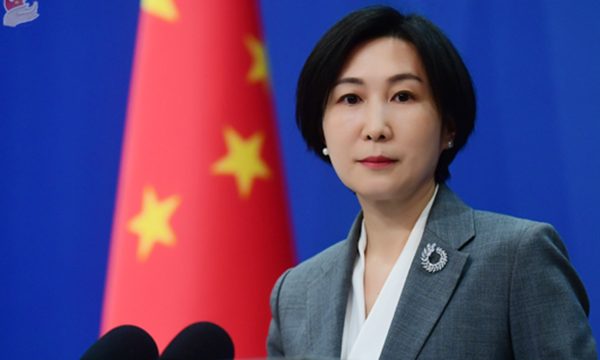
Chinese Foreign Ministry spokesperson Mao Ning
By Drago Bosnic | February 28, 2023
Diplomacy has always been one of the cornerstones of the so-called “soft” power projection. Countries have used it throughout human history to negotiate issues that otherwise would have been resolved on the battlefield. The United States of America, the world’s most aggressive imperialist (and neocolonialist) power, is rather unique in this regard, as it is essentially using its “diplomacy” as a form of arm-twisting instead of actual dialogue and negotiations. For the warmongering elites in Washington DC, utterly barbaric behavior seems to be a given, while mutual respect and taking the other side’s legitimate interests into account is clearly considered a “foolish weakness”.
This has resulted in numerous wars around the world, further leading to hundreds of millions of dead, wounded and expelled people, or in simpler words, countless lives destroyed due to unparalleled US aggression against the world. And while such a belligerent foreign policy approach is expected from Washington DC when it comes to smaller countries that cannot match US power, they certainly do not attempt to behave similarly toward global powers and superpowers. But America is doing exactly that, with the US State Department issuing open threats to China, accusing it of alleged (planned) arms shipments to Russia. Top American officials also added that Beijing will suffer “very real consequences” if it goes ahead with the supposed deal.
Obviously, the Asian giant wasn’t even given the chance to deny the accusations as the US resorted to directly threatening Beijing. However, China is anything but intimidated. Increasingly confident due to its meteoric rise to superpower status, Beijing was quick to fire back at the blatant threats. During a press briefing on February 27, Mao Ning, a spokesperson for the Foreign Ministry of China, stated that the Asian giant is fully prepared to retaliate if illegal US sanctions against Chinese companies operating in Russia are not removed. Mao also dismissed allegations that Beijing is planning to send weapons to Russia, rejecting the questionable (at best) US mainstream propaganda reports as disinformation.
“The US, however, has been fanning the flame and fueling the fight with more weaponry,” she (quite correctly) indicated at the blatant American hypocrisy, adding: “This is out-and-out hegemonism and double standards, and absolute hypocrisy. The Chinese side will continue to do what is necessary to firmly safeguard the lawful rights and interests of Chinese companies. We will take resolute countermeasures in response to the US sanctions.”
Mao also reiterated Beijing’s official position on the Ukraine crisis as one of peace, seeking a solution through negotiations rather than the force of arms. She stressed that “China has been actively promoting peace talks and the political settlement of the crisis,” adding that Beijing has been much more constructive than Washington DC. Mao once again indicated that the US is fully responsible for the incessant escalation in its relations with China. This is certainly true, particularly in recent times, as Washington DC has used even the most trivial matters to denigrate and antagonize Beijing, while also illegally arming the Chinese breakaway island province of Taiwan, exacerbating US-China tensions to a boiling point.
“In addition to pouring lethal weapons into the battlefield in Ukraine, the US has been selling sophisticated weapons to the Taiwan region in violation of the three China-US joint communiqués. What exactly is the US up to? The world deserves to know the answer,” Mao concluded.
Mao also remarked that America is spreading disinformation about China’s alleged supply of weapons to Russia in order to use it as a pretext to sanction Chinese companies, thus eliminating competition by using such underhanded tactics. One of the affected Chinese companies, Changsha Tianyi Space Science and Technology Research Institute, has already been sanctioned based on unsubstantiated claims that it is supposedly supplying the Wagner Group PMC (private military company) with satellite imagery of Ukraine. US Under Secretary of State for Political Affairs Victoria Nuland stated last week that sanctions were targeting Chinese companies that “have been observed sneaking up to the edge and trying to provide weapons to Russia”.
The unprecedented US hypocrisy is also seen in the attempts to portray Russian President Vladimir Putin as a supposed “war criminal”, with US President Joe Biden already accusing him of being one and even saying “evidence needs to be gathered for a war crime trial“. This is despite Biden’s central role in starting numerous wars under several US administrations and despite virtually the entire establishment in Washington DC being involved in warmongering and war crimes, regardless of political affiliation. Perhaps an even better example would be the May 2022 speech made by former US president George W. Bush, whose Freudian slip about the “wholly unjustified and brutal invasion of Iraq, I mean Ukraine” clearly showed the entire world the sheer scale of US hypocrisy and double standards.
Drago Bosnic is an independent geopolitical and military analyst.
UK greenhouses shut down due to high energy costs
Free West Media | February 28, 2023
In Great Britain, a particularly depressing facet of the crisis is now showing its first contours – and thus anticipating what is likely to happen in other European countries in the near future: because of the exploding energy prices, agriculture is being strangled and fresh produce has to be rationed.
High energy prices in the UK have meant that many farmers have made limited use of greenhouses to plant winter crops. According to a BBC report, this is leading to the first supermarkets to ration various types of vegetables. Field crops such as tomatoes, peppers, lamb’s lettuce, cauliflower or cucumbers are sometimes only sold in limited quantities.
Meanwhile, wholesalers are looking for new suppliers from other countries – but this means that the harvests have to travel much longer distances to Europe, which is not in the interest of the environment.
So far, farmers are not among those who benefit particularly from public support. This is now beginning to have an impact on consumers. Inexpensive food that is available all year round will soon be a thing of the past in Europe.
Rabat markets ‘well supplied with basic products’
 British consumers are told that the impact that high electricity prices are having on produce grown in greenhouses in the UK, is due to “climate change”. The UK government has therefore blamed “bad weather” in Morocco.
The situation is quite different however: From the beginning of 2023 to February 22, a total of 64,034 places of production, storage and wholesale and retail sales were inspected, said Moroccan government spokesman, Mustapha Baitas.
During these interventions, 3,325 offences were recorded in terms of pricing and quality, Baitas said in a press briefing after the meeting of the Government Council, in response to a question on the results of control operations and the situation of seized products.
The joint commissions seized and destroyed 400 tons of products “not conforming to the standards in force”, while all usable products were sold at public auction, he added.
The minister had stressed earlier that the markets “are well supplied with basic products”.
UK to introduce GM foods
In the UK, the Lea Valley Growers Association (LVGA) produces around 75 percent of the country’s crops. They now say that half of the greenhouses are empty and production is expected to go down by up to 60 percent.
The Bank of England director, Andrew Bailey, apologized in June last year for sounding “apocalyptic” about rising food prices.
Such dire warnings have led to support for the introduction of a Bill that paves the way for genetically modified (GM) crops, with new food laws expected to pass through the UK’s Parliament.
Not a UK problem only
“Many greenhouse producers are abandoning their businesses due to the inability to cover their current heating and labor costs. So far, the state has taken absolutely no measures to support the greenhouse production sector. As we all know, it is one of the most expensive industries in the agricultural sector and is directly related to gas and electricity prices,” according to the Bulgarian Association of Greenhouse Farmers.
The profitability of Dutch companies have also been impacted, because energy represents 20 to 30 percent of their costs, Reuters reported.
A study conducted by ABN Amro predicted that rising energy prices would cost Dutch companies around 22 billion euros this year as gas and electricity prices jumped almost 5 times their 2019 levels.
Among the most impacted sectors: greenhouse production whose annual turnover reaches around 8 billion euros but where energy represents 20 to 30 percent of the costs. Already 40 percent of the members of the Glastuinbouw Nederland group are operating at a loss, due to excessive energy costs.
NATO is de facto at war with Russia – Kremlin
RT | February 28, 2023
The US-led collective West must change its approach to global security and finally take Moscow’s concerns into consideration, before talks on the New START nuclear agreement can be renewed, Kremlin spokesman Dmitry Peskov has insisted.
Speaking to the Izvestia newspaper for an interview published on Tuesday, Peskov said relations with the United States and Europe have “changed radically” since President Vladimir Putin formulated draft security treaties that were sent to Washington, Brussels and Vienna in late 2021, only to hear that “they were not ready to talk about anything with us.”
“If they wanted, they could have sat down at the negotiating table [back then, before the decision to launch a military operation in Ukraine],” he said. “There would have been very complex, positional, sometimes irreconcilable talks, but they would have been under way. But they refused.”
With the failed attempt at dialogue, tensions continued to soar between Moscow and the West in the lead up to the conflict in Ukraine. Peskov argued that NATO is now fully involved in the hostilities, noting “their intelligence is working against us 24 hours a day, their weapons… are supplied to Ukraine for free to shoot at our military, not to mention that they shoot at Ukrainian citizens.”
“The moment when NATO de facto became a participant in the conflict in Ukraine, the situation changed,” the spokesman continued. “In fact, the NATO bloc is no longer acting as our conditional opponent, but as our enemy.”
“President Putin was and remains open to any contacts that can help Russia achieve its goals in one way or another,” Peskov continued. “Preferably peacefully, at the negotiations table, but when this is not possible, also by military means, as we are seeing now.”
Peskov touched on the New START treaty, a US-Russian accord intended to limit both nations’ nuclear stockpiles and allow them to monitor each other’s military facilities to confirm compliance. Amid the conflict in Ukraine, however, Moscow and Washington have accused each other of failing to facilitate such inspections.
Last week, Russian President Vladimir Putin announced that Moscow intended to formally suspend its obligations under the pact, with Peskov explaining “the conditions must somehow change.” During the New START negotiations, the nuclear arsenals of France and Great Britain were left out of the equation, even though they are “significant enough for the entire system of European strategic security,” he said.
“These countries – France, Britain, the United States – are members of an organization which is de facto at war with us… you need to call a spade a spade,” Peskov added, noting how Western states nevertheless keep “repeating like a mantra that they do not want to be participants in the conflict.”
Putin has also accused NATO specialists of helping Kiev to launch drone attacks against Russian airfields hosting long-range bombers, which are part of Moscow’s system of nuclear deterrence. He blamed Washington and NATO’s proxy war against Russia for destroying the foundation of trust on which the treaty was initially built.
German lawmakers demand Nord Stream explosion investigation
By Uriel Araujo | February 28, 2023
German Chancellor Olaf Scholz will fly to the US to meet President Joe Biden on March 3. According to the White House’s press secretary Karine Jean-Pierre, the visit is an opportunity to “reaffirm the deep bonds of friendship” between the two NATO allies. One could, however, describe such a friendship as quite a peculiar one. In fact, more often than not, it looks much more like a veiled enmity.
For one thing, Pulitzer Prize-winning journalist Seymour Hersh’s 8 February piece has denounced the Nord Stream pipelines’ explosion as a sabotage act clandestinely carried out by Washington. In fact, on February 7, Biden himself, during a press briefing, promised: “If Russia invades (…) there will be no longer a Nord Stream 2. We will bring an end to it.” When asked just how, his reply, with a smile, was: “I promise we will be able to do it.” Scholz was right next to him. This astonishing statement echoed Undersecretary of State for Policy Victoria Nuland’s own remarks just two days earlier – it is no wonder that many suspected American involvement in the still unexplained explosion.
In the aforementioned piece, respected journalist Hersh quotes unnamed intelligent sources who claim the US did fulfill its promise/threat by planting the explosives while using the June 2022 Baltic Operations (BALTOPS 22) exercise as a cover. So far, Hungary’s Minister of Foreign Relations Peter Szijjarto has been a lone voice in calling the episode a terrorist attack and calling for an investigation.
Nord Stream 1, as two of the pipelines were collectively known, had been providing cheap gas to Germany for over a decade, something which Washington always opposed; Nord Stream 2 pipelines in turn could double the amount of such cheap gas provided. The explosion harmed all of Europe and the UK, bringing back the ghost of a new depression – but mainly Germany. I have written on how the European energy crisis has served US interests well and hurt European industry as well as on how economic nationalism is once again on the rise, especially today when Europe and, particularly Germany, is facing de-industrialization. I have also written on how American aggressive subsidy war against Europe, in the form of the Inflation Reduction Act, only adds fuel to the fire and risks dividing the political West. In post-Nord Stream Europe, gas prices are to remain high, condemning the continent to inflation, while American interests profit from making the conflict in Ukraine perpetual.
When it comes to Russia, Ukraine and Europe, Washington’s geopolitical and geoeconomic interests are intertwined. The tragedy of the European continent lies in the paradox that it is still heavily dependent on Washington for security, while it would benefit from energy cooperation with neighboring giant Russia. Washington has been consistently betraying European interests to its own benefit, and Germany is the clearest instance of that contradiction.
Berlin could be an industrial power, but Washington’s long campaign against Nord Stream, among other things, has hampered its potential and now its auto industry is particularly vulnerable to the US IRA legislation, which has created new barriers for European electric vehicles. On top of that, Washington has been pressuring Germany to further spend on Ukraine, while German Armed Forces face shortages.
Despite Berlin’s silence regarding the attack on its strategic infrastructure, in the wake of the explosion, both far-left and far-right lawmakers from the Die Linke and the Alternative für Deutschland (AfD) political parties, respectively, were calling for the setting up of investigative committees. AfD’s Co-Chairman Tino Chrupalla has demanded the government coalition clarify the matter. In his speech he rhetorically asked whether the NATO alliance “guarantees security in Europe or rather endangers it”. In an interesting development, the leftist Die Linke expressed its solidarity with the rightist AfD on this matter.
European “populists” and the far-right have been capitalizing the growing popular discontent with NATO and the EU itself. In April 2022, defeated French Presidential candidate Marine Le Pen promised to pull France out of NATO, following Charles de Gaulle steps. Regarding the disastrous anti-Russian sanctions (which have backfired against Europe), Viktor Orban’s Hungary has been a kind of lone voice. One should however expect to see a multiplication of such voices, be it from the far-left or from the far-right.
Although often described as an “extreme” and marginal party, the AfD has been growing in popularity in Germany, reaching 17% in a poll for the first time in years, according to a YouGov February poll. It is about time for Europe to assert its sovereignty, and Berlin and France could lead the way in this regard. Calls for investigation regarding the Nord Stream’s sabotage in fact might be gaining traction among wider portions of German society.
In his 2020 book, Udo Ulfkotte, a former editor for German mass daily newspaper Frankfurter Allgemeine Zeitung, denounced how the German Federal Intelligence Agency (BND) has cooperated with the US Central Intelligence Agency (CIA) to recruit German journalists and shape public opinion. This could partly explain the overall silence amongst German media on the Nord Stream issue.
As long as the traditional media keeps covering up the topic, one should expect trust in the press to decrease and support for far-right and far-left parties to grow, with potential electoral results in the near future. Such a political wave can increase skepticism about NATO, but before it could advance any rethinking of the European relationship with the Atlantic Alliance (as proposed by Le Pen), it may first cause instability and turmoil in a continent already isolated and deindustrialized. In Germany, right now only Die Linke has supported AfD calls for an investigation, but more voices within the German broader political spectrum are expected to join them.
Tsunami Of Green Bans: German Economics Minister Plans End Of Gas, Oil Heating Beginning 2024!
By P Gosselin | No Tricks Zone | February 28, 2023
The Green Tyranny expands as the German government readies to ban oil and gas heat beginning 2024!
Economic “death blow”
Germany’s Minister of Economics, Robert Habeck, Green Party, is reported to be planning a ban of gas and oil heating – as early as 2024, according to the online BILD.
Heat in Germany will soon become a precious luxury, affordable by the rich only.
The proposed plan comes just after the EU Parliament voted to ban the registration of new fossil fuel cars beginning 2035.
According to Habeck’s draft legislation, homes and buildings would replace oil and gas heating systems with those operating with renewable energies, such as a heat pump.
The first step in Habeck’s plan is to be implemented as early as 2024. Only heating systems that produce heat from “at least 65 percent renewable energy” are to be installed.
Existing gas and oil heating systems will likely be allowed to continue operation, but only for a limited time.
The Berliner Morgenpost reports: “Green politician also wants to phase out gas and oil heating systems that have already been installed. Specifically, these should only run for a maximum of 30 years – after which time they should finally be phased out.”
For consumers this would mean that only a heat pump or district heating would be options, and so would mean the end of gas and oil heating.
Economic death blow
The latest proposal would mean another huge economic blow for citizens who are already reeling from high inflation, high interest rates and a shrinking economy.
German Bundestag Member Frank Müller-Rosentritt of the FDP Free Democrats tweeted: “Extremely increased interest rates and high construction costs are already causing housing construction to collapse. The death blow is now being dealt by the Green Minister of Economics with his ideas, which completely ignore reality and cause rents to explode.”
Green fairy tale world
Other politicians and interest groups have also come out blazing in criticizing Habeck’s draft radical measures. The association “Haus und Grund” (Home and Property) rejects Habeck’s plans, with association president Kai Warnecke speaking of a “law from the green fairy tale world”.
CDC Admits It Has No Data to Support Recommending COVID-19 Booster Shots for 12- to 49-Year-Olds
Informed Consent Action Network | February 27, 2023
It can be difficult to keep up with the CDC’s ever-changing COVID-19 booster recommendations, but what is consistent is that the number and frequency of boosters are continually increasing and data supporting these recommendations keeps decreasing. At one point, even mainstream media called out the CDC for the lack of data for these recommendations.
To pin down the CDC on one of its recommendations, in April 2022, ICAN asked the CDC to produce its data that support the efficacy of COVID-19 boosters for 12-49 year olds. The response? Shocking.
The CDC admitted that “A search of our records failed to reveal any documents pertaining to your request.” None. Not one record. Not one study. This means the CDC did not have any data to back up its claims or recommendations for boosters in this age group.
For anyone that has looked at the data regarding boosters, the CDC’s response is unsurprising because study after study shows that repeated boosters increase the chances of contracting COVID-19 disease. For example, as a recent Cleveland Clinic study showed (see Figure 2 in the study), the chances of contracting COVID-19 increase with each additional dose of COVID-19 vaccine.
The above is another piece of evidence in ICAN’s snowballing work to hold our “health” agencies accountable for every unsupported recommendation and false claim made to the public.
See below for more instances where ICAN uncovered “health” agencies making unsupported claims to the public:
- ICAN DEMANDS ANSWERS ABOUT DEATH DISCREPANCIES IN PFIZER’S CLINICAL TRIAL
- CDC ADMITS ONCE AND FOR ALL IT HAS NO BASIS FOR ITS CLAIM THAT COVID-19 VACCINES DO NOT CAUSE VARIANTS
- THE CDC’S RESPONSE TO SCIENTIFIC INQUIRY: BECAUSE WE SAID SO!
- CDC HAS NO RECORDS TO SUPPORT CLAIM THAT COVID VACCINES DO NOT CAUSE VARIANTS
- CDC CANNOT PROVIDE AN INSTANCE OF A SINGLE CONFIRMED COVID-19 DEATH IN A CHILD YOUNGER THAN 16
- CDC CANNOT BACK UP ITS “FACTS” REGARDING POTENTIAL GENETIC MUTATION FROM COVID-19 VACCINES
- REPORT OF TODDLER’S DEATH DISAPPEARS FROM VAERS AND CDC HAS NO RECORDS AS TO WHY!
What hasn’t the CDC lied about?
The agency must have told some truths, but it’s hard to identify those statements.

By Bill Rice, Jr. | February 27, 2023
Substack All-Star Igor Chudov just published another important article. This article asks if the CDC was lying all along about “vaccine effectiveness?”
My question (and it’s a serious one) is this: Can someone name ONE pronouncement of CDC officials that either wasn’t a lie or of highly-dubious veracity?
Per my assessment, the CDC and other national public health agencies and their key experts …
Lied about there being no evidence of early cases in America.
Lied when they said there was no possibility this virus leaked from a lab.
Lied about the effectiveness of masks.
Lied when they said the virus could be spread on physical surfaces.
Lied when they said it would take only two weeks to “flatten the curve.”
Lied when they said that virus transmission could easily happen outside.
Lied about the stats of “cases” and “deaths.”
Lied about the mortality risk to children and healthy young adults.
Lied about ivermectin and HCQ being worthless drugs for treatment.
Lied about remdesivir being a safe drug.
Lied about the vaccines being “safe and effective.”
Lied when they labeled these shots as “vaccines.”
Lied about the “vaccines” and boosters preventing “severe” cases and deaths.
Lied about the necessity or importance of testing people (including the asymptomatic) over and over.
Lied when they attacked and sought to censor people who were telling the truth.
Lied when they “adjusted” estimates of ILI in the Flu Season of 2019-2020 … to make it seem this flu season did not produce “widespread” and “severe” ILI (Covid?) outbreaks.
Before Covid, lied about the effectiveness of the flu vaccines.
Do liars continue to lie? Will liars lie again?
Do liars often try to cover-up their lies?
Do liars in positions of great power often attack people who try to expose their lies?
Is it smart to continue to trust proven or known liars?
How many lies does some person or agency have to tell before people start to realize they are listening to a liar?
Hurricane activity not getting worse, new paper shows
By Paul Homewood | Not A Lot Of People Know That | February 24, 2023
The Global Warming Policy Foundation has today published its periodic review of hurricane activity around the world. The author, climate writer Paul Homewood, says that official data is absolutely clear: they are not getting worse. Indeed, there is some evidence that they are less active in recent years.
Homewood says:
“2021 and 2022 recorded the lowest number of both hurricanes and major hurricanes globally for any two year period since 1980, and this comes against long-term hurricane activity trends that are essentially flat.”
And Homewood calls on journalists to start reporting these undisputed facts to the public:
“While scientists are quite clear that we are not seeing a dramatic increase in hurricanes, or even any increase at all, the public have been conned into thinking that tropical storms are getting worse. It’s high time the mainstream media came clean and told people what is really going on.”
Executive summary
It is widely believed that hurricanes are getting worse as a consequence of climate change. This belief is fuelled by the media and some politicians, particularly when a bad storm occurs. This belief is reinforced because the damage caused by hurricanes is much greater nowadays, thanks to increasing populations in vulnerable coastal areas and greater wealth more generally.
But is this belief correct, or is it a misconception? This study has carefully analysed official data and assessments by hurricane scientists, and finds:
• 2021 and 2022 recorded the lowest number of both hurricanes and major hurricanes globally for any two year period since 1980.
• The apparent long-term increase in the number of hurricanes since the 19th century has been due to changes in observational practices over the years, rather than a real increase.
• Data show no long-term trends in US landfalling hurricanes since the mid-19th century, when systematic records began, either in terms of frequency or intensity.
• Similarly, after allowing for the fact that many hurricanes were not spotted prior to the satellite era, there are no such trends in Atlantic hurricanes either.
• Globally there are also no trends in hurricanes since reliable records began in the 1970s.
• Evidence is also presented that wind speeds of the most powerful hurricanes may now be overestimated in comparison to pre-satellite era ones, because of changing methods of measurement.
• The increase in Atlantic hurricanes in the last fifty years is not part of a long-term trend, but is simply a recovery from a deep minimum in hurricane activity in the 1970s, associated with the Atlantic Multidecadal Oscillation.
These findings are in line with those of hurricane scientists generally, as well as official bodies such as NOAA and the IPCC.
Featured Video

Broke Princes: Saudi Arabia’s Powder Keg
or go to
Aletho News Archives – Video-Images
From the Archives
Registered Israeli foreign agent driving contrived campus antisemitism crisis
By Wyatt Reed | The Grayzone | December 17, 2023
Lawsuits accusing top US universities of harboring antisemitism all originate from one source: a corporate law firm that fielded the pro-settler ex-US ambassador to Israel, and which was registered as a foreign agent of an Israeli principal as recently as 2021.
The firm now represents professional Israel lobby activists posing as victimized “Jewish students” and seeking to crush the free speech rights of Palestine solidarity activists. … continue
Blog Roll
 Aletho News
- Desperate For A Renewed Iran War, Israel Dusts Off The WMD Deception.
- US Elections Offer Choice Between ‘Bad and Worse’ as Both Parties Serve War Lobby – ex-UN Expert
- Ghalibaf warns US government not to betray voters who rejected war
- Broke Princes: Saudi Arabia’s Powder Keg
- Albania’s Crisis: Rama, Israeli Investments and the Demand for Accountability
- Hezbollah Categorically Denies Syrian Accusations: We Aim at Confronting Israeli Enemy, Not Undermining Syria’s Stability
- Trump claims funding to Israel ending in 2026 as merger of Israeli–US armies looms
- Iran Weathering The Storm, But Saudi Arabia Is Sinking
- Sunk Ships Don’t Sail Home: Why Peace Won’t Save the Oil Market and War Will Wreck It
- No Cossacks at the gates, fix Italy instead – opposition leader to Meloni
- If Americans Knew
- An error has occurred; the feed is probably down. Try again later.
- No Tricks Zone
- New Study: The Net Fossil Fuel Contribution To Rising Atmospheric CO2 Has Been Zero For 500 Years
- Germany’s Green Energy Transition Becoming Increasingly Expensive…Another 6 Trillion Euros!
- Sudden Stratospheric Warming, Powerful El Niño Combination May Lead To Extreme Europe Cold, Energy Crisis!
- Two New Studies Find Thwaites Glacier Melt Cannot Be Driven By Human Activity Or A Warming Ocean
- E-Cars Reduce CO2 Emissions By Only 41% Compared To Internal Combustion Engine Vehicles
- Predictions Made By Renowned Climate Professor Over Past Decades Have Been Proven To Be Poor
- New Study Suggests Large Regions Of The Pacific Ocean Have Been Cooling For The Last 80 Years
- Germany’s Green Energy Debacle: High Energy Costs Force Kahla Porzellan to Close After 182 Years!
- New Study: 50 Years Of The Most Aggressive ‘Net Zero’ Policies Can Only Affect The Global Climate By 0.03°C
- US September “Heat” Was No Record…Many Records Set Decades Ago

