2022 deadliest year for Palestinians in West Bank since Second Intifada in 2005: Report

Press TV – December 31, 2022
New data has revealed that 2022 has been the deadliest year for Palestinians in the West Bank since the Second Intifada which ended in 2005, with at least 220 people being killed at the hands of Israeli forces across the occupied territories.
According to figures published by the Middle East Eye, Israeli forces shot dead 167 people in the West Bank and East al-Quds, and 53 people in the besieged Gaza Strip, with 48 children being among the total casualties.
The report further noted that in at least five cases, Israeli settlers were suspected of killing Palestinians while the regime’s military is responsible for the overwhelming majority of deaths.
The London-based news website also said the majority of Palestinian casualties were likely unarmed at the time of their death.
In at least 95 cases, Palestinians were shot by Israeli soldiers as bystanders during military raids or while participating in anti-occupation demonstrations.
At least 22 Palestinians were killed after alleged car ramming, shooting or stabbing attacks against Israelis and security forces. In some cases, Palestinians were fatally shot for allegedly “attempting” to carry out such attacks.
Tensions have been running high across the occupied Palestinian territories over the past months.
Incidents of sabotage and violence by settlers against Palestinians and their property have become a daily occurrence throughout the occupied territories, particularly in the West Bank.
However, Israeli authorities rarely prosecute settlers, and the vast majority of the files are closed due to deliberate police failure to investigate them properly.
Moreover, Israeli forces have recently been conducting overnight raids and killings in the northern occupied West Bank, mainly in the cities of Jenin and Nablus, where new groups of Palestinian resistance fighters have been formed.
Meanwhile, the United Nations says Israeli forces killed more Palestinians in the West Bank in 2022 than in any year since the world body began systematically recording fatalities in 2005.
UN experts have held Israel responsible for the recent surge of violence in the occupied Palestinians territories, warning that the brutality could further escalate with the new far-right Israeli cabinet.
According to the United Nations Office for the Coordination of Humanitarian Affairs (OCHA), Israeli security forces have killed 146 Palestinians in the West Bank and mainly East al-Quds through December 19 of this year, compared with 75 in 2021.
Four more Palestinians were killed by Israeli settlers in the West Bank, OCHA added.
Most of the Palestinians were killed during Israeli military raids and clashes in the West Bank cities of Jenin and Nablus, the UN said, adding that more than half were under the age of 25.
Earlier this month, UN experts condemned Israeli settler violence and excessive use of force by the Israeli military in the West Bank.
“Unless Israeli forces abandon this dominant settler mindset and rightfully treat Palestinians in the occupied territory as protected persons, Israel’s deplorable record in the occupied West Bank will likely deteriorate further in 2023,” they said.
Israeli occupation soldiers and Israeli settlers have noticeably been escalating their attacks against Palestinian civilians in the West Bank and other areas, in an attempt to forcibly expel Palestinians from their lands and make way for expanding illegal Jewish-only settlements.
Between 600,000 and 750,000 Israelis occupy over 250 illegal settlements that have been built across the West Bank since the 1967 occupation.
The UN Security Council has in several resolutions condemned the Tel Aviv regime’s settlement projects in the occupied Palestinian lands.
Donetsk reveals number of civilians killed in 2022

RT | December 30, 2022
Some 1,091 civilians were killed and more than 3,500 injured in 2022 amid the ongoing hostilities in the Donetsk People’s Republic (DPR), a regional human rights ombudswoman said on Friday. The total civilian death toll of the DPR since the beginning of the conflict in then-east Ukraine back in 2014 has reached 5,441, official figures show.
Over the past year, the Ukrainian military has repeatedly subjected the city of Donetsk to artillery and missile attacks, deliberately targeting residential areas away from any military installations to inflict damage on civilians, the office noted.
“Such a deliberate atrocity against the civilian population is nothing more than an admission of the Ukrainian militants in their own powerlessness on the battlefield, where our defenders beat them again and again,” the DPR’s ombudswoman, Darya Morozova, said in a statement. The sole goal of the Kiev “criminals” and their attacks against the republic’s cities is an attempt to strike fear in the hearts of the local population, Morozova noted, adding that it was impossible to “break the spirit of Donbass.”
A sharp increase in the civilian death toll comes as years-long low-intensity hostilities in the then-Ukrainian east devolved into a major conflict between Moscow and Kiev.
Russia sent troops into Ukraine on February 24, citing Kiev’s failure to implement the Minsk agreements, brokered by Germany and France, and designed to give the regions of Donetsk and Lugansk special status within the Ukrainian state. Former Ukrainian president Pyotr Poroshenko has since admitted that Kiev’s main goal was to use the 2014 ceasefire to buy time and “create powerful armed forces.”
The admission has also been amplified by former German chancellor Angela Merkel and French President Francois Hollande, who have separately stated the Minsk agreements were never intended to actually be fulfilled but were merely a ruse to buy time for Ukraine’s military buildup.
Moscow demands that Ukraine officially declare itself a neutral country that will never join any Western military bloc. Kiev insists the Russian offensive was completely unprovoked.
In September, four formerly Ukrainian regions, the DPR and the Lugansk People’s Republic (LPR), as well as Kherson and Zaporozhye, overwhelmingly supported joining Russia during referendums, getting formally incorporated into the country shortly after.
China Conducts Military Maneuvers Near Guam, Okinawa
By Kyle Anzalone and Will Porter | The Libertarian Institute | December 30, 2022
The Chinese aircraft carrier Liaoning has sailed near the Japanese island of Okinawa and the US territory of Guam over the past two weeks. The naval operations came at the end of a year which saw several military escalations between Washington and Beijing.
Tokyo reported that the Liaoning and at least four other large warships operated in waters near Okinawa, adding that the ships remained about 150 miles offshore for several days. While in the area, the Chinese carrier conducted over 200 takeoff and landing drills.
On Thursday, Japanese officials confirmed that, after sailing away from Japan, the flotilla then traveled near the US territory of Guam. According to the Global Times, a Chinese newspaper closely linked with the country’s ruling Communist Party, the operation ”showed that the Chinese carrier is ready to defend the country against potential US attacks launched from there.”
The relationship between Washington and Beijing has continued to deteriorate in 2022, perhaps best exemplified by House Speaker Nancy Pelosi’s trip to Taiwan last summer and a massive round of Chinese military drills launched near the island in retaliation.
President Joe Biden has further fueled tensions by repeatedly asserting that US forces would come to Taiwan’s defense in the event of a Chinese invasion. However, Taiwan is not recognized as a sovereign nation under US law, which instead endorses Beijing’s claim to the island and calls for a position of ”strategic ambiguity” towards Taipei.
While a number of past US administrations have refrained from openly saying whether Washington would intervene against China on Taiwan’s behalf, Biden has increasingly eroded that position, prompting senior White House officials to walk back his statements on multiple occasions. Proponents of strategic ambiguity contend that the policy acts as a deterrent against any future attack by Beijing, and stops short of emboldening Taipei to take aggressive actions of its own.
Biden recently met with Chinese President Xi on the sidelines of the G20 summit. While the goal was to seek to resolve various outstanding issues between the two powers, both countries continue to conduct provocative military exercises.
Tokyo – which is part a three-way security pact with Washington and Seoul created to confront Beijing – has also escalated regional tensions by announcing an end to its post-WWII defense-oriented military and plans to become the world’s third-highest weapons spender over the next five years. Moreover, the United States has worked to persuade its allies in the North Atlantic Treaty Organization to take part in its operations in Chinese-claimed waters, while Canada recently announced plans to conduct more military transits through the disputed Taiwan Strait.
Beijing has significantly deepened its security and diplomatic ties with Moscow this year, with the two allies striking a ”no limits strategic partnership” in the days before Russia’s invasion of Ukraine in late February. The Asian superpowers have conducted joint drills in the waters and skies around both Japan and Taiwan in recent weeks, having just wrapped up naval exercises in the East China Sea on Tuesday. Another round of wargames on December 14 saw Chinese warships cross multiple Japanese straits as Russian fighters and bombers flew near Japanese airspace over the Sea of Japan.
Underscoring the rising hostilities, earlier this week the Pentagon released a video, captured on December 21, showing a Chinese fighter that approached an American spy plane over the South China Sea, accusing the pilot of performing an ”unsafe maneuver” that risked a collision.
US Arms Sales to NATO Allies Almost Double in 2022: Report
By Oleg Burunov – Samizdat – 31.12.2022
The number and price of arms sales approved by Washington to its NATO allies almost doubled in 2022 as compared to 2021, a US magazine has reported.
The outlet noted that last year, the US government approved 14 possible major arms sales to its allies in the alliance, worth about $15.5 billion. In 2022, the figure soared to 24 potential major arms sales with price tag of around $28 billion, including $1.24 billion worth of arms sales to possible new NATO member Finland.
The magazine pointed out that the data indicates that the US remains “a major arms supplier for allies in Europe in the short term,” in the midst of European defense industries’ push to “meet wartime demands for conventional arms and ammunition.”
According to the media outlet, the increase took place as NATO members scrambled “to stock up on high-end weapons” amid the ongoing Russian special military operation in Ukraine.
The outlet reported that although some of arms sales deals were negotiated years beforehand, the Russian special operation sent NATO’s European members scrambling to bump up their military spending, and to replenish vehicles, weapons, and ammunition delivered to the Ukrainian military.
Latvia, Lithuania, and Estonia have all ordered HIMARS Multiple-Launch Rocket Systems (MLRS), while the US State Department authorized earlier this month the sale of 116 M1A1 Abrams tanks to Poland, after Warsaw sent its Soviet-era T-72 and domestically-made PT-91 tanks to Kiev’s forces.
The report comes after President Joe Biden signed a new $1.7 trillion federal spending bill into law, a document that includes $858 billion in defense spending.
According to a statement released on the website of the US Senate Committee on Budget Appropriations, the so-called National Defense Authorization Act (NDAA) comprises “$44.9 billion in emergency assistance to Ukraine and our [America’s] NATO allies.” Since Russia launched its special operation in Ukraine on February 24, the US and its allies have supplied more than $40 billion worth of arms to Kiev. Moscow has repeatedly warned that providing Kiev with arms prolongs the Ukraine conflict.
The signing of the NDAA followed a separate US media outlet reporting about a surge in the share prices of the four largest US defense contractors, including Lockheed Martin, Northrop Grumman, Raytheon Technologies, and Pratt & Whitney.
The outlet reported that Lockheed Martin “had booked more than $950 million worth of its own missile military orders from the Pentagon in part to refill stockpiles being used in Ukraine, while Raytheon Technologies was awarded with “more than $2 billion in contracts to deliver missile systems to expand or replenish weapons used to help Ukraine.”
‘Türkiye agrees to withdraw troops from Syria following Moscow talks’
RT | December 31, 2022
Türkiye has agreed to fully withdraw its troops from northern Syria following tripartite talks involving Moscow, Ankara and Damascus earlier this week, Syrian newspaper Al-Watan has reported.
The three countries’ defense ministers – Hulusi Akar, Ali Mahmoud Abbas and Sergey Shoigu – met in Moscow on Wednesday for the first meeting of its kind since the outbreak of the Syrian conflict in 2011.
According to the paper’s source in Damascus, the negotiations resulted in “Türkiye’s consent to completely withdraw its troops from the Syrian territories that it occupies in the north of the country.”
Ankara and Damascus also expressed a common view that the Syrian-based Kurdish YPG militia, which Turkey associates with the outlawed Kurdistan Workers’ Party (PKK), “are agents of Israel and the US, and pose a grave threat to both Türkiye and Syria.”
Türkiye considers the separatist PKK and allied Kurdish groups to be “terrorist organizations” that threaten its national security. The Turkish military carried out airstrikes against YPG targets in northern Syria in November, with Ankara saying a ground operation in the area was also on the cards.
A special trilateral commission will be created by Russia, Türkiye and Syria to ensure that the agreements reached in Moscow are honored, Al-Watan reported.
Turkish Defense Minister Hulusi Akar told local media on Saturday that “one shouldn’t expect that everything will be solved at once in a single meeting.”
In Moscow, Türkiye “emphasized that we respect Syria’s territorial integrity and sovereign rights, and that our only goal is the fight against terrorism” including the PKK/YPG and Islamic State (IS, formerly ISIS), he said.
Ankara and Damascus have agreed to continue talks to deepen reconciliation, Akar added. He also suggested that those negotiations could even result in a joint anti-terrorist operation involving the two countries, which would happen “if we can solve our problems related to defense and security, if we can meet our needs.”
The Syrian side had earlier described the meeting in the Russian capital as “positive,” while Russia’s Defense Ministry said the talks had been conducted in a constructive manner and stressed the need for the continuation of such engagement.
New year and new Congress won’t silence the same old war drums in Washington

By Tony Cox | RT | December 30, 2022
Every now and then, American voters get a reminder that they have no real voice in how their country is run. Mitch McConnell, the top-ranking Republican in the US Senate, made that abundantly clear a few days before Christmas, when he revealed that those constituents who wanted their real needs addressed would again be getting only coal in their stockings.
“Providing assistance for the Ukrainians to defeat the Russians, that’s the No. 1 priority for the United States right now, according to most Republicans,” the 80-year-old Kentuckian told reporters on Capitol Hill while praising the $1.7 trillion spending bill that was then sailing through Congress. “That’s sort of how we see the challenges confronting the country at the moment.”
It wasn’t entirely clear which Republicans McConnell was talking about, those folks he sees wanting — more than anything else — for our government to help kill Russians. He couldn’t have meant the Republicans who are asked to vote for Team GOP every time an election rolls around. Heading into November’s US midterm elections, the Ukraine crisis wasn’t among the top dozen issues that voters cited as major concerns, according to polling by Rasmussen Reports.
Rather, Americans were highly concerned about soaring inflation, the economy, violent crime, illegal immigration and energy policy. Only one in five respondents considered the Ukraine conflict “very important,” the lowest level among all 16 issues that Rasmussen listed. More recently, a Gallup poll conducted in December found that less than 1% of Americans see Russia as the top problem facing the US. Respondents were most troubled by their own government, inflation and the nation’s sputtering economy.
The public’s growing indifference about the Eastern European crisis shows, yet again, that the legacy media has lost its ability to set the agenda. Republicans, in fact, are beyond being merely fed up with the Ukraine hype. Many have turned against continuing to fund what some of their representatives have promoted as a “proxy war.”
A Morning Consult poll conducted just before the midterms showed that most Republicans wanted less US involvement in foreign military conflicts, fewer troop deployments overseas and reduced involvement in the affairs of other countries. Around the same time, a Wall Street Journal poll revealed that nearly half of Republican voters oppose US aid to Ukraine, up from only 6% when the same question was asked shortly after Russia’s military offensive began in February.
That message clearly didn’t get through to McConnell’s Senate Republicans, and the party failed to win control of the chamber as its candidates fared worse than expected in the midterms. In the House of Representatives, Republicans swung from a seven-seat minority to a nine-seat majority, regaining control for the first time since Democrat Nancy Pelosi (California) took the speaker’s gavel in January 2019.
The GOP’s gains came after McConnell’s counterpart in the House, Minority Leader Kevin McCarthy of California, suggested three weeks before the midterms that Republicans might halt or slow the aid gravy train to Kiev when they regained control. “I think people are gonna be sitting in a recession, and they’re not going to write a blank check to Ukraine.” Representative Marjorie Taylor Greene, a Georgia Republican, went so far as to say that “not another penny will go to Ukraine” after the GOP wins back the House.
However, the tune began to change when the politicians no longer needed to beg for votes. After the midterms, senior Republican congressmen Michael McCaul (Texas) and Mike Turner (Ohio) assured an ABC News interviewer that “majorities on both sides of the aisle” will still support infinite military aid to Ukraine. McCaul even suggested that it would be perfectly fine for Ukrainian forces to attack targets in Crimea, since the US and its allies didn’t recognize the region as Russian territory.
When the $1.7 trillion spending bill, including $45 billion in additional aid for Ukraine, came up for a vote in the House on December 23, nine Republicans joined Democrats in voting for its passage. In the Senate, 18 of 50 Republicans voted in favor, giving Democrats the help they needed to pass the bill.
Republicans haven’t even been able to impose basic oversight measures on Ukraine aid, much less shrink or suspend the effort. A bill to audit the $100 billion program was defeated in the House on December 8. When GOP Senator Rand Paul (Kentucky) demanded that an oversight provision be added to a $40 billion Ukraine aid bill in May, Democrats and Republicans alike steamrolled him and pushed through their legislation.
Auditing measures might stand a better chance of passing the House with Republicans taking control of the chamber in January, but the Senate would likely block any such bill from becoming law. The Dems will get plenty of help, too, from McConnell and other neoconservative Republicans in the Senate.
Republicans and Democrats can put on a good show when it comes to transgender restroom policies and other farcical issues. But when it comes to the most non-negotiable issue in Washington, war, political polarization evaporates. The establishment uniparty can always agree to send more rocket launchers, drop more bombs and overthrow more governments.
That’s what former presidential candidate Tulsi Gabbard discovered when she spoke out against US regime-change wars. Then a Hawaii Democrat branded by CNN as the “next superstar” in her party, the Iraq War veteran suddenly became persona non grata when she criticized America’s military interventions around the globe. Party leaders and media propagandists condemned her as a Russian agent. She quit the party in October.
McConnell’s mocking of Republican voters – announcing that party leaders will prioritize the exact opposite of what constituents want and gaslighting them about what they’ve asked for – marks the latest window into Washington’s broken political system. America’s supposedly representative form of government has devolved into a ruling class that governs with no regard for the best interests of the people while playing divide-and-conquer games to keep the tribes distracted and warring with each other.
Donald Trump threatened to shatter the status quo when he was elected president in 2016. Remember his pledge to “drain the swamp?” Well, the swamp won. Trump lacked the political courage to push through the “America First” agenda that he sold to voters, partly because of the Russia collusion hoax.
Although he campaigned on a pledge to “get along with Russia,” collaborating on such common interests as fighting ISIS – and voters supported him, expressing their democratic will – Trump instead played tough with Moscow. With political opponents and media outlets accusing him of being a Russian agent, Trump foolishly backed away from what he promised to voters. He bragged in 2018 that “there’s never been a president as tough on Russia as I have been,” as if that was a measure of success.
Russia policy was among several areas where Trump and his party declined or failed to represent voter desires and interests. Even while controlling the executive branch and both houses of Congress, the Republicans didn’t deliver on promises to build a border wall and repeal Obamacare. And less than a week after winning the 2016 election, Trump quashed any suggestion that he would actually seek to bring Hillary Clinton to justice, as his supporters wanted. The “lock her up” chants and his debate quip to the Democrat nominee that she’d be in jail if he were president were all just theatrics.
When Trump ordered an end to the US military intervention in Syria, the Pentagon essentially thumbed its nose at the commander-in-chief. To this day, hundreds of US troops remain in Syria, without legal justification and in violation of that nation’s sovereignty.
Trump’s signature legislative achievement was a $1.5 trillion tax cut. The federal budget deficit continued to rise, and the nation’s southern border remained porous. Deportations of illegal aliens were lower during Trump’s term, on average, than during Barack Obama’s eight years as president.
It wasn’t the first time. For decades, Republicans have campaigned on promises to secure the border, but even when the GOP controlled the Congress and the White House, the illegal immigration crisis only got worse. Just as the ruling establishment demands that the war machine be kept humming, it insists on a steady inflow of cheap, illegal labor, suppressing the wages of US citizens.
These policies clearly aren’t in the interests of rank-and-file Americans. Nor does it help US taxpayers – or the Ukrainian people – to prolong the fighting in Eastern Europe by sanctioning Moscow and continuing to funnel billions of dollars’ worth of weapons to Kiev. Nor was it in our interests to help overthrow Ukraine’s elected government in 2014 and undermine Russia’s national security by pushing for Kiev to join NATO.
Voters can plainly see that the results of these tactics are ruinous. Consumers in the West, especially Western Europe, face a dark, cold and hungry winter amid energy shortages and the highest inflation rates in 40 years. Not to worry, though, because McConnell, President Joe Biden and other members of the pro-war uniparty insist that this struggle more than justifies the sacrifices they’re imposing on everyone.
You see, they say, we have a “moral obligation” to defend freedom and democracy in Ukraine. Never mind that Ukrainian President Vladimir Zelensky’s corrupt regime has banned political opposition, shut down all independent media outlets and persecuted the country’s largest church. In the eyes of Washington’s uniparty, freedom of speech, freedom of the press, freedom of religion and freedom to politically oppose the ruling party aren’t necessary components of a free and democratic country.
So we enter a new year with a new Congress and the same old sacred cows in Washington. The bigger problem this time is that escalating US involvement in Ukraine is pushing us all closer to a planet-ending war with Russia, holder of the world’s largest nuclear weapons arsenal. The stakes are higher than when Washington launches an illegal invasion in the Middle East or imports a few million additional illegal aliens.
With such politicians as Senator Lindsey Graham, a South Carolina Republican, calling for regime change in Moscow, the uniparty’s latest gambit in defiance of voter interests could cost us all a lot more than higher inflation and lower wages.
Tony Cox is a US journalist who has written or edited for Bloomberg and several major daily newspapers.
Jane Goodall isn’t a kindly grandmother; she’s a promoter of eugenics and a global population of 450 million
By Rhoda Wiloson • The Exposé • December 29, 2022
Yesterday we published an article that highlighted that the United Nations’ (“UN’s”) “30×30” goal is the biggest land grab in the history of the world. It is the theft of land and natural resources on a grand scale. To convince the public the UN’s goal is a “good thing,” the World Economic Forum (“WEF”) and the World Wildlife Fund (“WWF”) have chosen three leading influencers – Greta Thunberg, Jane Goodall and David Attenborough – to market the ideology under the guise of a “new deal for nature.”
But these three marketeers aren’t just mis-selling the “new deal for nature,” at least two of them – Goodall and Attenborough – are openly marketing depopulation, the killing of billions of people, under the fraudulent “climate change” ideology. Perhaps Thunberg is their apprentice and will take over the reins when one of her mentors has been “depopulated.”
In this article, we take a brief look at Goodall who is portrayed as a kindly grandmother that wouldn’t hurt a fly and someone even our youngest can trust. However, as with the wolf in Little Red Riding Hood, she is not as her public image or name suggests. After learning a little about Goodall’s underlying beliefs, wisdom would say that children should stay well clear. Children should only watch documentaries or films associated with these marketeers in the presence of responsible adults. Adults who can negate any nuances which have been deliberately included to “nudge” or manipulate beliefs towards ideologies that are harmful not only to us but also to our natural world.
Jane Goodall is best known for her work with primates – her image of kindness has given her enormous credibility. But do not be fooled by the public image the propaganda machine portrays. To demonstrate Goodall’s underlying beliefs, we look at some of the remarks she has made over the years.
Wikispooks has noted two quotes from Goodall. The first was made in 2007:
“It’s our population growth that underlies just about every single one of the problems that we’ve inflicted on the planet. If there were just a few of us, then the nasty things we do wouldn’t really matter and Mother Nature would take care of it — but there are so many of us.” – Jane Goodall, November 2007
And the second was made in 2020. Goodall was chosen to take the podium at the 2020 WEF annual meeting where she could help prepare business and government managers for the need for a drastic population reduction. Goodall was speaking at a panel discussion called ‘Securing a Sustainable Future for the Amazon’. She proclaimed:
“All these [environmental] things we talk about wouldn’t be a problem if there was the size of population that there was 500 years ago.”
World Economic Forum: Securing a Sustainable Future for the Amazon, Davos 2020, 22 January 2020
PolitiFact rushed to Goodall’s defence, albeit from a “Goodall’s population comments didn’t spark the pandemic” angle. “Goodall did make the human population growth comments seen in the video, but she has been making the same arguments for years,” the blogging site PolitiFact wrote. This is true. In the video below, Goodall admits that what she sees as a population problem “really hit” her in 1990, over 30 years ago. It was her perception of the “population problem” in Africa that convinced her.
Population Matters: Jane Goodall at Population Matters Conference 2019, 29 April 2019 (4 mins)
The Critic sums it up succinctly: “When eco-warriors talk of population control, they mean the world would be better off with fewer poor black people.” In other words, it is a eugenics programme hiding behind a purposefully manufactured “climate change” narrative. This is an appropriate conclusion in the context that this particular comment is raised and is bad enough on its own, but the implications are much larger than depopulating Africa.
Returning to her remarks in 2020, although Goodall doesn’t indicate what she believes the population of the world to be 500 years ago, according to Worldometer the global population in 1500 is estimated at 450 million. The current global population is estimated at a little over 8 billion. So, using simple mathematics, Goodall is promoting the death of more than 7.5 billion people. “This session was developed in partnership with the BBC,” WEF noted.
Repeatedly promoting depopulation increases Goodall’s guilt not diminishes it, a fact PolitiFact’s blogger doesn’t appear to be concerned with. Additionally, we can assume from the point of view of the blog’s publisher, PolitiFact, that advocating for the “depopulation” of over 7.5 billion people is all right as long as you’ve been at it for a long time.
As an article published by The Conversation quite rightly noted, “this remark might seem fairly innocuous, but it’s an argument that has grim implications … As these escalate, people must be prepared to challenge and reject the overpopulation argument.”
For those who struggle to translate what the term “depopulation” means in practical terms: It translates to enforcing a decline in birth rates – through infertility, miscarriages and abortions – and/or enforcing an increase in death rates – through mass murder and “nudging” people, including children, to commit suicide. Surely PolitiFact’s blogger understands that Goodall sees him and his loved ones as part of the “population problem” and so is in her sights to be “depopulated.”
If you’re wondering why PolitiFact would defend someone who promotes eugenics and genocide, looking at who provides the funds for their operations will give some clues. PolitiFact, unsurprisingly, receives large donations for “support of content and training” from all the usual propagandists such as Google News Initiative, Meta/Facebook, Microsoft, Omidyar Network/Luminate, WhatsApp and so on. PolitiFact is merely publishing blogs that conform with the ideologies of their funders. Their blogs should be read and understood within that context – that they are promoting an agenda and not presenting unbiased facts.
Never take anything at face value that has been developed or promoted by tools – such as WEF, BBC and PolitiFact – used by the propaganda machine. Things are not as they portray.

House Republicans plan committee on “weaponization of the federal government” after FBI censorship revelations
By Didi Rankovic | Reclaim The Net | December 30, 2022
Republicans in the US Congress are preparing to establish a new subcommittee, as part of the House Judiciary Committee, that will investigate suspected abuse of power by several federal agencies and departments.
Recent revelations about the FBI’s involvement in censorship on social media platforms, which have become public knowledge thanks to the publishing of Twitter’s internal documents, is not the only instance of those abuses, nor is the FBI the only entity that what is currently referred to as the Select Subcommittee on the Weaponization of the Federal Government will look into.
The subcommittee is very likely to be formed because several Republican members of the House have made it one of the conditions to support the election of Kevin McCarthy as Speaker, the Wall Street Journal is reporting.
The fact that the planned new subcommittee would function within the Judiciary Committee means it will be able to legislate in case its members establish that there is a need to make some changes – and there has been talk among Republicans lately about making structural changes at the FBI.
When it comes to the FBI, “working” with social platforms to censor speech – not least around the Hunter Biden laptop scandal – on its own, and on the behalf of other government bodies is only one of the issues that could make it to the subcommittee’s agenda; others include what the paper calls the agency’s “sordid Russia-collusion hoax.”
But the new panel reportedly intends to look at the broader picture of both past and present governmental abuses facilitated by technology, collusion with private companies in order to harvest personal data, and establish if agencies are acting in line with the Constitution and laws, but also ethical standards.
While the Twitter Files are extremely important on their own, the subcommittee would be able to use its authority – and powers such as issuing subpoenas and organizing hearings; allowing it to bring the various revelations together into a coherent story that would show the full scope of the abuses detailed in the Twitter documents.
Gross distortion of facts on Mahsa Amini’s death in Western media
By Damian Lenard | Press TV | December 30, 2022
In his recent article Seven people with British links arrested in Iran over protests, freelance journalist for The Guardian, Nadeem Badshah, relates to the audience an interesting and all-too-familiar Western media version of the death of Mahsa Amini in Iran.
It is educational to dissect the article because it is representative of the propagandistic way in which foreign media have covered the tragic event for the past few months:
The 22-year-old Kurdish Iranian had been arrested for wearing “inappropriate attire” under Iran’s Islamic dress code for women.
Witnesses said Amini was beaten while inside a police van when she was picked up in Tehran. Police have denied the allegations, saying she “suddenly suffered a heart problem”.
I would refer to these short paragraphs as contextual snippets, repeated ad nauseam in media reports to drill propaganda points into the unprepared minds of the audience (yes, and we claim to abhor the widely misquoted “If you tell a lie big enough and keep repeating it, people will eventually come to believe it,” as if our own media was not an active part of that very machinery).
Let’s dig into this illustrative contextual snippet used by Badshah. I am by no means attempting to shame him, as it probably is a snippet offered by his employer/editor to make his job easier and — more importantly in this specific case — to make sure that key state propaganda is duly reinforced:
- Iran’s Islamic dress code for women
Iran’s Islamic dress code, like Western and Eastern secularist dress codes, exists not only for women but for all people in society.
Such dress codes are indeed applied differently for men and women not just in Iran, but everywhere around the world. The exception being the one or two countries on the face of the planet where public nudity or female toplessness is indiscriminately allowed in the majority of the territory.
This first part of the Guardian’s contextual snippet used by Badshah aims to brainwash readers by repetition with the notion that Iran is the only country in the globe with a dress code or the only one which enforces it. Worse, it is exclusively so for women in Iran. And that this “abhorrence” is the result of religion (and even worse, Islam) applied to politics.
The well is poisoned for the acceptance of the central part which follows:
- Witnesses said
Since no evidence whatsoever exists to support the hypothesis of Mahsa Amini having been brutally beaten to death, Western media is forced to rely exclusively on “witnesses/family said” assertions as their top proof to attempt to causally link Amini’s brief detention with her death.
The reader might already be willing to accept such a weak hearsay kind of proof (which would be disregarded or even mocked as poor journalism should it apply to an event in their own countries) because, after all, Iran is exceptionally evil as “proven” in point 1.
- Police have denied the allegations
This segment is typically dedicated to the antithesis of the previous premises, supposedly for balance and to pretend journalistic honesty. What does the other side have to defend itself? In this case, what does it have? Claims by the police. Pretty weak, isn’t it? Is that all you’ve got Iran? So it’s the word of noble witnesses (do we care how it was established that they even exist?) against that of the evil Iranian police.
The claim that “police have denied the allegations” implies the denial of the hypothesis (brutally beaten to death) is only supported by a police statement (the directly involved party and, we must remember, any authority in Iran is evil). Combined with them saying she “suddenly suffered a heart problem,” (note the cherry-picking of a quote with an inaccurate medical description to further undermine the credibility of the party) while totally omitting:
(a) The existence of a clear CCTV camera video recording at the police station in which Amini collapses on her own without the aid of any external agent and,
(b) The “leaked” hospital photographs of Amini showing no sign of trauma or blood consistent with a fatal beating (or debatable signs if one possesses a powerful imagination), expose the utter disregard for journalistic integrity, and full commitment to pedaling state propaganda regardless of the damage it causes.
The reason why I find this rather fascinating is because of the vicious circle that is built around these structures of reporting about a country like Iran:
The premises of point 1. (the exceptional evilness of religion applied in politics, the exceptional evilness of Iran’s dress code, the exceptional oppression Iran crushes women with) bias the evaluation of the following points, and at the same time tend to be “proven” with non-facts analogous — in terms of objective weakness — to those of points 2. and 3.
Thanks to meticulously-crafted reality distortion of this sort, the Western public, which believes itself to be professionally informed and impervious to manipulation, unsuspectingly swallows dogma after dogma of misrepresented reality.
The result is the installation of moral shock and the reaffirmation of solid prejudices useful to rally sufficient public support for the foreign policy of the day: usually the collective punishment of entire nations by war or economic sanctions.
Iraq has weapons of mass destruction, so getting half a million Iraqi children killed by sanctions and millions more by war can be deemed “worth it” or at least as just an honest mistake, as opposed to punishable war crimes and crimes against humanity.
If only there was a way to poll the staunch defenders of freedom and democracy (a noble utopia that could only separate itself from tyranny with a perfectly well-informed public), asking how many of them were offered to watch the CCTV footage and “leaked” hospital photos of Mahsa Amini (as opposed to handed only hearsay rumors) that would have otherwise allowed them to decide for themselves.
Goethe was certainly on to something big when he wrote in his Elective Affinities: None are more hopelessly enslaved than those who falsely believe they are free.
Damian Lenard, Ph.D., is a political commentator with focus on Eurasian politics. He speaks fluent Persian and occasionally writes for Iranian publications.
Ankara willing to withdraw from Syria if ‘stability’ is reached: Turkish FM
The Cradle | December 30, 2022
Turkiye’s Foreign Minister Mevlut Cavusoglu told media on 29 December that Ankara is willing to withdraw from the territory it occupies in northern Syria and hand it over to Damascus in the event that “political stability” is reached.
Cavusoglu’s comments came just one day after a high-level meeting in Moscow between the defense ministers of Turkiye, Russia, and Syria, aimed at ensuring “stability in Syria and the region.” This was the first ministerial meeting between Syria and Turkiye since 2011.
Speaking to reporters, the Turkish Foreign Minister also said that it was possible to establish a joint mechanism between Damascus and Ankara aimed at ‘fighting terrorism.’
Cavusoglu also lauded his country’s ‘respect’ for Syria’s sovereignty and territorial integrity, claiming that its occupation is solely based on combatting terror and “securing stability,” something he said the Syrian authorities were incapable of doing.
He went on to say that Turkiye would continue fighting terrorism in Syria, despite the hindrances posed by “political differences” between Ankara and Damascus.
Recently, both the US and Russia have been attempting to mediate a withdrawal of the Syrian Democratic Forces (SDF) from the Turkish border with Syria to prevent a long-promised Turkish ground offensive from taking place. This potential ground offensive comes under the pretext of avenging the deadly 13 October Istanbul blast.
In order to prevent the offensive, Russia has offered a complete pullback of the SDF from the Turkish border, as Ankara has requested.
Although Moscow has been negotiating a potential redeployment of Syrian troops to this area, Washington has been seeking to compromise Russia’s mediation efforts by reviving an inactive Islamist militia in the north of the country – with the intention of placing them on the border, thereby preventing a handover of the territory to Damascus.
From Syria’s perspective, genuine negotiations with Turkiye are unlikely to begin until Ankara accepts a complete withdrawal of its forces from Syria.
Although Washington plans to compromise an eventual return of the Syrian Arab Army (SAA) to the Turkish border, Cavusoglu’s latest comments signify a potential Turkish willingness to make concessions.
South Caucasus: A battle of wills and corridors
By Yeghia Tashjian | The Cradle | December 30, 2022
On 12 December, under the pretext of environmentalism, dozens of state-backed “eco-activists” from Azerbaijan blocked the only land corridor connecting Armenia to Nagorno-Karabakh.
The blockade created a humanitarian crisis for the 120,000 Armenians living in Nagorno-Karabakh, cutting them off from the outside world. This is not the first time Baku has taken such a provocative action. Azerbaijan has long been pushing for the creation of the “Zangezur corridor” to connect itself to close ally Turkiye through southern Armenia, thereby cutting off the strategic Armenia-Iran border.
Tehran has opposed this project and has engaged in military exercises on its border with Azerbaijan. In October, the Iranians opened a consulate in the city of Kapan in southern Armenia as a warning to Baku and its regional allies.
Blocking the Lachin corridor
Despite this, Azerbaijan, with the support of Turkiye, has continued to pursue its goal, which has included blocking the road where Russian peacekeepers are stationed in the Lachin corridor connecting Armenia to Nagorno-Karabakh.
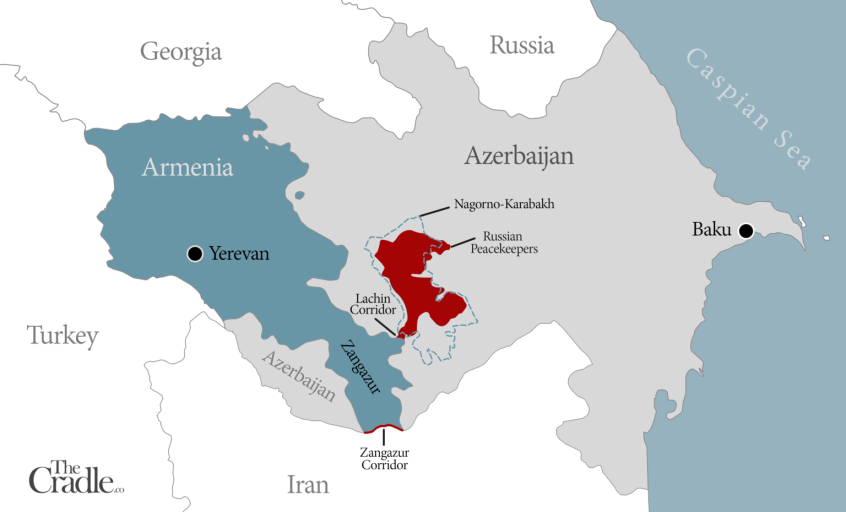
Map of Azerbaijan-Armenia conflict zones (Photo Credit: The Cradle)
In July 2022, Baku amended a contract with British company Anglo Asian Mining PLC, transferring three new mining sites inside Azerbaijan to the firm. One of these areas is located in the eastern part of Nagorno-Karabakh’s Martakert region, an area rich in gold, copper, and silver mines.
Nagorno-Karabakh’s Armenian population refused Azerbaijan’s efforts to send in monitoring groups, believing the move would give Baku control over the region’s economy and eventually lead to its annexation. In retaliation, Baku sent “environmentalists” to block the only corridor connecting Armenia to Nagorno-Karabakh.
Social media users have identified Azerbaijani state employees amid some of these “environmentalists” who periodically try to provoke Russian peacekeepers. The blockade has caused a humanitarian disaster in the region, with thousands of civilians unable to access basic necessities like medication and food via the only road connecting them to the outside world.
To compound tensions, Anglo-Asian Mining sent a letter to leading international organizations and states demanding that the “illegal exploitation” of the mines in Nagorno-Karabakh by Armenians be stopped. And yet Moscow continues to take a passive position, despite being a targeted party in the melee.
The Battle of Corridors
The blockade of the Lachin corridor did not come as a surprise, having been openly discussed in Azerbaijani media.
The only surprise was Russia’s inability to resolve the crisis. Earlier this month, Turkiye’s defense minister Hulusi Akar called on Armenia to “grasp the opportunity and respond positively to Turkiye’s and Azerbaijan’s peace calls” during joint military drills with Azerbaijan near the Iranian border.
He also commented on the “Zangezur corridor,” claiming that it was Baku’s “sincerest wish” to re-establish connections in the region and ensure “a comprehensive normalization throughout the region, including the relations between Azerbaijan-Armenia and Turkiye-Armenia.” Akar also vowed that Turkiye would continue to support Azerbaijan’s “righteous cause” against Armenia.
But on the second day of the protests organized by Azerbaijanis and the blockade on Nagorno-Karabakh, Azerbaijani media outlets made their intentions clear.
They called for the replacement of the commander of the Russian peacekeeping mission in Nagorno-Karabakh, Andrey Volkov, and for the control of the Lachin corridor to be transferred to Azerbaijan, along with the “full restoration of Azerbaijani sovereignty in the territories under the control of the peacekeepers.”
Some Azerbaijani activists also called for the removal of Russian forces and their replacement with UN-mandated forces.
Removal of Russian peacekeepers
It is unclear if Baku itself is willing to employ this language and demand the removal and replacement of Russian peacekeeping forces. According to some Azerbaijani experts, Baku is currently against the withdrawal of Russian peacekeepers by force, as this could lead to the annexation of Nagorno-Karabakh and the ethnic cleansing of Armenian Christians, which could tarnish President Ilham Aliyev’s image in the west and potentially result in US-EU economic sanctions.
Instead, Baku prefers to have the Russians stay, but in a restrictive capacity. It is easier for Azerbaijan to deal with a weak Russia, rather than with the Europeans, as they are familiar with the “Russian mentality,” says one expert. This suggests that Azerbaijan may prefer to continue using the Lachin corridor as a tool for negotiating with Moscow, rather than risking the removal of Russian forces.
Another Azerbaijani expert agreed that the current crisis is essentially between Azerbaijan and Russia – that the latter is unable to fulfill its “peacekeeping mission” and prevent the “Armenians of Karabakh from exploiting the natural resources in the region.”
But he also argues that the crisis is less about the mining and exploitation of resources, and more about pressuring the Russians to open the “Zangezur corridor,” which connects Azerbaijan proper to its Nakhichevan exclave, and lies on Iran’s strategic border with Armenia.
According to the expert, “Azerbaijan wants additional guarantees that it will have a safe connection with Turkiye, in exchange for Karabakh’s safe connection to Armenia.”
The story gets more complicated. In December, Azerbaijani media accused Armenians of inviting Iranian military experts to train Nagorno-Karabakh’s self-defense forces. The reports claim Iranians crossed the Lachin corridor and entered the territories controlled by Russian peacekeepers.
Despite Baku’s continuous barbs and provocations, it appears that Azerbaijan’s goal is not to fully remove or replace Russian peacekeepers, but rather to control their mission, monitor transit in the Lachin corridor, and use the corridor as a pressure card on Yerevan to open a “corridor” in Syunik linking Azerbaijan to Turkiye.
Therefore, from Azerbaijan’s perspective, the future of the Lachin corridor is now tied to the fate of the “Zangezur corridor.”
The view from Tehran
According to Dr. Ehsan Movahedian, researcher and instructor at the Allameh Tabataba’i University of Tehran, “the Republic of Azerbaijan is seeking a new adventure in the Caucasus region, and this issue requires diplomatic steps from the Islamic Republic of Iran and should be warning for the military authorities (in Tehran).”
One Iranian media outlet argues that if Stepanagert (the capital of Nagorno-Karabakh) falls:
“Unpleasant scenarios can be imagined for the South Caucasus region and its surrounding areas, including Iran. Removing an obstacle such as Nagorno-Karabakh paves the way for occupying Armenian territory and changing the map of the region, and in the long term for security attacks on the northwestern regions of Iran.”
The analyst, Mohammad Hossein Masumzadeh, says the only solution to halt Azerbaijan’s aggression “is offensive measures instead of the defensive approach governing the country’s regional policy in order to avoid irreparable risks.”
Some Iranian experts and former diplomats believe that the developments in the South Caucasus are related to domestic developments in Iran, where many ethnic Azeris, backed by Ankara and Baku, have called for separatist aspirations to dismantle the state from within.
Iran is concerned that the spread of Turkish influence on its northern border could impact its domestic politics in the future, as Azerbaijan has openly called for the “unification of Southern Azerbaijan (northern Iran) to the Republic of Azerbaijan.”
These do not appear to be empty threats. On 29 November, the “Organization for the Protection of the Rights of South Azerbaijanis” was established in Switzerland, announcing that it will submit documents and information to international organizations, including the UN, regarding the “rights of people in the Azerbaijani Province of Iran”.
On 2 December, the representative of “South Azerbaijan” at the UN, Araz Yurdseven, defended the idea of the independence of “South Azerbaijan” and accused Iran of committing “murders against the Iranian Azeris.”
Is the region heading for a new escalation?
Interestingly, many European and Azerbaijani experts viewed Armenian Prime Minister Nikol Pashinyan’s refusal to sign the final document of the Collective Security Treaty Organization (CSTO ) as a sign of Russian weakness, calling it “an unprecedented event that had never happened before.”
The CSTO is a Eurasian military alliance consisting of six post-Soviet states, which include Armenia, Russia, Belarus, Kazakhstan, Kyrgyzstan, and Tajikistan.
There are concerns that the region could be headed towards a new escalation. Azerbaijan has recently invited Turkish F-16 fighter jets to the region, which is being viewed as a preparation for conflict. The last time Baku invited the Turkish jets was in 2020, weeks before its war with Armenia.
Azerbaijan is also pressuring Russia to renegotiate the terms of their 10 November 2020 trilateral statement, which states that only Russian peacekeepers are responsible for controlling the Lachin corridor.
Azerbaijan is linking the blockade of the Lachin corridor to the opening of the Zangezur one. If Russia agrees to these concessions, it could lead to the isolation of Armenia, threaten its territorial integrity, and block an Iranian strategic border.
This would also shift the regional balance of power towards Turkiye, as Iran risks acting alone against Turkish-Azerbaijani pan-Turkic aspirations, which could eventually threaten Iran’s national security interests both regionally and domestically.
Featured Video

Ivermectin and iodine
or go to
Aletho News Archives – Video-Images
From the Archives
UN declares war on ‘dangerous’ conspiracy theories
‘World is not secretly run by elites’
Free West Media | August 5, 2022
UNESCO says it is seriously concerned about the increase in “disinformation” and “conspiracy theories”. And they plan to put an end to it through a network of informants.
“Conspiracy theories can be dangerous,” the UN agency warned. “Often they ignore scientific evidence and polarize society with dire consequences. This has to stop.”
Unesco’s director-general warned that “conspiracy theories” could cause damage to people as well as to their health. “They reinforce misconceptions about the pandemic, reinforcing stereotypes that can fuel violence and violent, extremist ideologies,” said Audrey Azoulay.
The UN agency has launched a campaign to help people identify, debunk and report “conspiracy theories” to prevent them from spreading further.
This campaign is being carried out in collaboration with the European Commission, Twitter and the World Jewish Congress. The UN has created a toolkit to “debunk” such theories and smear anyone who dares to claim that governments are not fair and transparent.
The UN also warned that George Soros, the Rothschilds and Israel should not be linked to “alleged conspiracies”.
World events “are not secretly manipulated behind the scenes by powerful players with malicious intent,” the UN agency maintained.
And if anyone therefore comes across someone who believes that the world elite is plotting to consolidate power or direct events, then that person needs to take action. According to the UN agency, when meeting a “conspiracy theorist”, under no circumstances should one enter into a discussion. … continue
Blog Roll
 Aletho News
- UK High Court Upholds Speech Regulator Notices To Meta, WhatsApp, X, And TikTok
- Two working on US Senate candidate’s campaign registered as foreign agents for Israel: Report
- Greece bans protest over docking of Israeli cruise ship
- Israel elections: More Arab votes, same Zionist consensus
- Taking the Houthis at Their Word: The Bill Saudi Arabia Doesn’t Want to Read
- Trump claims he would have bombed Ho Chi Minh City to win Vietnam War
- Russia shows Europe that prolonging the Ukraine war is pointless
- There is cautious optimism about ending the Ukraine War – Part 2
- Ukrainian air alert app hacked with fake nuclear warnings
- Ivermectin and iodine
- If Americans Knew
- An error has occurred; the feed is probably down. Try again later.
- No Tricks Zone
- Germany’s Green Energy Transition Becoming Increasingly Expensive…Another 6 Trillion Euros!
- Sudden Stratospheric Warming, Powerful El Niño Combination May Lead To Extreme Europe Cold, Energy Crisis!
- Two New Studies Find Thwaites Glacier Melt Cannot Be Driven By Human Activity Or A Warming Ocean
- E-Cars Reduce CO2 Emissions By Only 41% Compared To Internal Combustion Engine Vehicles
- Predictions Made By Renowned Climate Professor Over Past Decades Have Been Proven To Be Poor
- New Study Suggests Large Regions Of The Pacific Ocean Have Been Cooling For The Last 80 Years
- Germany’s Green Energy Debacle: High Energy Costs Force Kahla Porzellan to Close After 182 Years!
- New Study: 50 Years Of The Most Aggressive ‘Net Zero’ Policies Can Only Affect The Global Climate By 0.03°C
- US September “Heat” Was No Record…Many Records Set Decades Ago
- Latest European Green Energy Debacle; Portugal’s Largest Flagship Solar Park Insolvent!

