The White House’s latest pro-war scheme comes at a time when the Pentagon is expected to receive its highest annual budget ever, as defense spending in the US is on track to reach $1 trillion annually before the decade is out.
Will Republicans investigate ‘Died Suddenly’?
By Daniel Horowitz – conservative review – December 6, 2022
It’s the 800-pound gorilla in the room and the shot not heard ’round the world: “Died suddenly.” The safety signals from the COVID shots are light-years past the point of no return. Until now, despite the CDC’s own VAERS and V-Safe data, over 2,500 case studies, over 1,000 peer-reviewed studies on vaccine injury, and endless safety signals on excess deaths and disability coinciding with the take-up of the vaccines, nobody in power had interest in investigating it. Will that change with a GOP-controlled House or in any of the numerous GOP-controlled state legislatures?
Our government has promoted and continues to promote these shots and the technology being built from them like nothing our government has ever promoted before. But name the Republican who wants to investigate it? Sure, Senator Ron Johnson, the lone ranger, is interested, but he is in the minority. What about the House majority under Kevin McCarthy? Most assuredly, there are numerous existential crises that require investigation and oversight, but “died suddenly” and the implication of millions of deaths and injuries from a product that continues to enjoy more support and immunity than anything in human history should rank at the top of that list.
According to an analysis of all-cause mortality of over 1 billion people in India, there was barely any excess mortality in 2020 before the vaccines. The mortality then exploded by over 300% in the spring of 2021, according to the analysis published in the American Journal of Tropical Medicine and Hygiene.
This excess mortality coincides almost perfectly with the vaccine take-up period by age in the country:

The typical response will be to assert that this is because COVID got much worse in 2021. But if that is the case, and the shots are so effective against critical illness (and are safe), then why would mortality worsen precisely after the most vulnerable got this amazing protection? The problem is that this trend is noticeable almost everywhere in the world.
Take Vermont, for example. It’s the highest-vaccinated state in the nation, yet all-cause deaths rose in 2021 and then dramatically in 2022, when COVID was already an afterthought.

The same researcher (more about his data, including excess cancers in Vermont, here) who analyzed the death certificate data from Vermont over the past few years found an explosion of organ failure deaths in Vermont in 2022.

But not only are the signals for vaccine injury deaths blaring, but even the COVID deaths exploded. Although it’s hard to determine authentic COVID deaths because of government misinformation, here is a presentation of the death certificate data in Vermont among those who died of both COVID and pneumonia. That is probably the best proxy for an authentic COVID death, because someone who died incidentally of COVID usually would not have pneumonia, which was the main cause of death for COVID. You will immediately notice how deaths were much worse in 2021 and 2022 than in 2020.

Notice how the COVID+pneumonia deaths really took off in Aug.-Sept. 2021, when nearly everyone in the state was vaccinated? And it’s still tracking high even in 2022, with very mild COVID variants. What’s worse is that the oldest age cohort, by far, is doing worse than ever now in 2022 – with the mildest variants and likely after the most shots.

Already as of Sept. 19, 2021, according to the Vermont Department of Health, over 90% of those over 65 and over 80% of those over 31were vaccinated. There is nowhere to run or hide from this myth of vaccine efficacy even against death and critical illness. In reality, we see negative efficacy. Already in March 2022, Vermont had the highest booster rate, so how could the most boosted population experience its worst COVID pneumonia mortality after that point? Or is it precisely because of the vaccines that people are experiencing immune suppression and immune imprinting? As one analyst has shown, this inverse relationship seems to be global:


To quote Polish researchers, “Though mRNA vaccines … have been administered in billions of doses, we know incredibly little about how mRNA vaccines are metabolized in vivo.” Kathrin Jansen, the retired head of research and development at Pfizer, recently observed, “We flew the aeroplane while we were still building it.”
How is it that even with this acknowledgment, our government continues to promote and even mandate the shots in some circumstances? Pfizer just submitted an application for emergency use authorization for its booster shots for babies under 5! Undoubtedly, the company will get its approval. Will McCarthy promise to block that approval in the budget bill? Opposing mandates, while important, is no longer enough. This poison needs to be banned, its victims need to be compensated, and its makers and promoters need to be held accountable.
Pfizer and Moderna Begin New Myocarditis Trials
By Rav Arora | The Naked Emperor’s Newsletter | December 31, 2022
As reported in a handful of media outlets, Pfizer and Moderna’s new trials closely investigating vaccine myocarditis are underway. As part of its vaccine approval, the FDA has mandated (pdf) both companies to conduct clinical trials tracking vaccine myocarditis months and years beyond diagnosis.
As NBC reports, “Moderna has already launched two trials, the most recent in September. Pfizer confirmed that at least one of its trials, which will include up to 500 teens and young adults under age 21, is slated to begin in the next couple of months.”
As has been long-established, mRNA vaccines induce myocarditis at alarmingly high rates in young men. A new study published in the Journal of the American College of Cardiology compares rates of myocarditis between the Pfizer and Moderna vaccine. It finds a vaccine myocarditis rate of 1 in 3,636 in men ages 18 to 29 following a second dose of the Moderna vaccine. For Pfizer, the authors report a rate of 1 in 20,000 in the same age group—roughly equal to the rate for Moderna in men ages 30 to 39.
While the clinical myocarditis rate has been quantified in several high-quality studies, many serious concerns remain unaddressed. One major concern is subclinical myocarditis—the rate of serious myocardial symptoms post-vaccination that don’t formally qualify as myocarditis. The FDA has required (pdf) Pfizer and Moderna to conduct a “substudy to prospectively assess the incidence of subclinical myocarditis following administration of the second dose of [vaccine] in a subset of participants 5 through 15 years of age.”
Currently, the only data on subclinical myocarditis following mRNA vaccination comes from a small Thai study. Despite only studying 301 participants, the analysis found an alarming signal of heart damage in 13 to 18-year-olds: “Seven participants (2.33%) exhibited at least one elevated cardiac biomarker or positive lab assessments. Cardiovascular effects were found in 29.24% of patients, ranging from tachycardia, palpitation, and myopericarditis.”
More troublingly, 3 out of 301 children in the study developed myocarditis or suspected pericarditis. Meanwhile, another four kids had elevated cardiac markers and were labeled as subclinical myocarditis. To find such high numbers of vaccine injuries in such a small study group is deeply concerning. As Philadelphia cardiologist Dr. Anish Koka noted in his analysis, “We should be clear that no one currently knows the long-term significance of the clinical or subclinical myocarditis that is being diagnosed here…”
Another major concern surrounding mRNA vaccination is the long-term outcomes of vaccine myocarditis. Anecdotally, we know vaccine myocarditis typically results in a few days of hospitalization followed by four to six months of highly restricted physical activity. Even then, it isn’t clear if a “full recovery” is made. In the case of 14-year-old Aidan Jo, whose mother I recently interviewed, more than a year after his initial diagnosis, he still struggles with exercise.
“He used to be able to run around and play for hours … now it’s like 20 to 30 minutes and he gets exhausted,” his mother told me.
A CDC analysis (pdf) earlier this year showed one-third of vaccine myocarditis patients were not fully recovered at the three-month follow-up. As Koka noted, the survey contained troubling cardiac imaging findings: “53% had an abnormal cardiac MRI” and “47% had evidence of scarring by cardiac MRI.”
Though it will take several years for all the data to be released, Moderna and Pfizer’s current trials will shed light on the true number of young men who have suffered from cardiac damage following vaccination—clinical or subclinical. Until such data is revealed, accurate cost-benefit analyses cannot be made since the real risk of cardiac vaccine injury is unclear. The existing figures are egregious enough, but the full extent of the harm committed by the biopharmaceutical industry in lockstep with federal governments remains to be discovered.
Let’s Emancipate Ourselves From Mental Slavery In 2023
A Better Way to Health with Dr Tess Lawrie | January 1, 2023
In 2023, I have resolved to be especially curious and open minded and I’m trusting you may wish to join me! Where signposts say “Go this way” we’ll be exploring the other way, where television presenters say “Look over here” we’ll be looking over there, and where people have been labelled “conspiracy theorists” we will be hearing them out with an open mind. This desire to investigate the contrary is not for the sake of being contrarian but stems from the profound realisation over the past three years that all is not as it seems.
Fact is, if we have been fed a pack of lies about a deadly pandemic, what other lies have we been sold?
It’s with much gratitude to Covid-19 that our eyes have been opened – so let’s keep them open and seize the opportunity to free our minds in 2023, by exploring what’s been kept from us no matter how dark the matter. It is only by shining our torches into the hidden recesses of control that we can truly emancipate ourselves and ensure that what just happened never happens again.
Now, with eyes wide open it is apparent that fear and dependency have been cultivated by corrupt leaders to relieve us of our most valuable possession: our free will.
We’ve been encouraged not to look to our elders and ancestors for their learned wisdom, not to look to Mother Nature for healing, not to seek answers in the movement of our heavens, not to see our common humanity, and not to use our intuition to seek the truth. Wars are started that never benefit the people they are supposed to liberate, and atrocities are performed in the name of democracy and freedom. Globalist propaganda has positioned injections as the only route to maintaining health, and toxic drugs are plied for cancer, diabetes, and heart disease by fearful health professionals within a captured “health” system. The word ‘safety’ is the excuse for the incremental violation of our inalienable rights and it all stops when we say a firm “No”. As Bob Marley sang, only we can free our minds.
For longer than we may like to admit, we have been living in a world with fixed perceptions propagated by official authorities and shaped by billionaires and supra-national organisations. Many of us are only just realising that we’ve been told what to believe, and allowed those at the top of the power hierarchy to determine what is ‘good’ for us and what is ‘bad’, what we need to know and what we don’t. Whatever they deem not necessary for us to know is called a “conspiracy theory”.
So, for 2023…
Let’s not feel down about the nasty plans emanating from a bunch of megalomaniacs and eugenicists.
Yes, they want to control us, yes, they want to change us, yes, they want to own us, and yes, they want to play God. In 2023, they will be escalating their plans as they attempt to manifest their New World Order. Expect a reveal of their one world government in the form of the new Conference of Parties, along with a relentless schedule of injections, tags and surveillance of all creatures, especially us, from birth to death.
But do not despair. Armed with curiosity and wide eyed, there is reason to be optimistic about what 2023 holds. We see them now, and knowledge is power.
In 2023, we are taking our power back. They can forget their one world government. We are creating a Better Way.
Thus, in 2023 let’s all commit to returning ourselves to optimal health and full power. We are not the tired, fearful and flaccid specimens to be locked in cages that they are training us to be – generators and consumers of despair, degeneracy and horror – “hackable animals” glued to screens to receive our daily dose of junk. To the contrary, we are inquisitive, courageous and spirited men and women who are capable of great acts of love and kindness, and who can achieve anything when we set our hearts to it.
Please join me and the team on our 2023 journey of discovery, exploring all the things that have been kept hidden from us or deemed taboo. Knowledge censored and denigrated by the hierarchy in the name of science and safety will be examined as we decide for ourselves what is true and what is false, and we enjoy rendering and questioning the unknown – which is infinite. We will no longer exist in a cell, reading the permitted writing on the walls, accepting reductionist theories and limiting beliefs of us and the universe. We will entertain old and new theories and facilitate the discovery of genius.
What does a Better Way look like in 2023?
A better way will be expressed by a unified global effort to highlight and promote positive initiatives around the world that further health, freedom and sovereignty.
When we unite with others so that we may complement and aid one another and thereby hold together against the mad megalomaniacs of this world, we are co-creating a Better Way.
If ever in doubt about what constitutes a Better Way, let’s ask ourselves how a particular thought, action or communication makes us feel and relinquish those practices that no longer serve us, that keep us in mental slavery. Let’s amplify the positives and turn our backs on dystopia, and let’s harness the full power of our collective intuition. As Terrence McKenna said, “Intuition is the most powerful epistemic tool we have”. I say, intuition manifests good always.
Wishing you all an abundant, inquisitive and intuitive 2023.
Merriam-Webster Declares ‘Gaslighting’ 2022 Word of the Year

From the film Gaslight: Paula has finally had enough of Gregory’s Gaslighting
By John Leake | Courageous Discourse | January 1, 2023
Merriam-Webster just announced the following:
In this age of misinformation—of “fake news,” conspiracy theories, Twitter trolls, and deepfakes—gaslighting has emerged as a word for our time.
A driver of disorientation and mistrust, gaslighting is “the act or practice of grossly misleading someone especially for one’s own advantage.” 2022 saw a 1740% increase in lookups for gaslighting, with high interest throughout the year.
Merriam-Webster’s report and definition of the term acknowledge that the meaning of ‘gaslighting’ has evolved since the word was coined. In my opinion, the current spike of usage is based on a misunderstanding of the concept. In the current, popular imagination, gaslighting is often confused with gross lying and deception, but in fact the term refers to tricking the victim into believing he is losing his mental competence so that he will doubt his perceptions of reality.
The term originated in a play and 1944 film Gaslight, starring Ingrid Bergman and Charles Boyer, in which a woman is manipulated by her sinister husband into believing she is losing her sanity. In his initial gambit, he rigs their home’s gaslights to flicker periodically. When she asks him, “Why do the lights keep flickering?” He says he doesn’t know what she’s talking about—that the lights are NOT flickering.
In another notable scene, he gives her a valuable brooch—a family heirloom that he claims had belonged to his mother—while warning her that she must be very careful not to lose it. “You know how you tend to lose things,” he says. Later, when the brooch goes missing from her purse, it seems (in her mind) to confirm her husband’s concern (not realizing that he removed it from her purse).
Gaslighting is a particularly malevolent form of psychological warfare, most often deployed in interpersonal relationships by what the Austrian psychoanalyst Otto Kernberg called “malignant narcissists.” The concept of the malignant narcissist is closely related to Dr. Robert Hare’s concept of the psychopath. Incidentally, in a recent conversation with the British cardiologist, Aseem Malhotra, he observed that the pharmaceutical industry displays distinct traits of psychopathy in the way it conducts business.
I suspect that the spike in usage of ‘gaslighting” is an outcome of our current Orwellian administration. As Orwell memorably wrote in 1984:
The party told you to reject the evidence of your eyes and ears. It was their final, most essential command.
I frequently thought of this command as I was reading Edward Dowd’s new book, Cause Unknown: The Epidemic of Sudden Deaths in 2021 and 2022. Every day we see reports of young people suddenly dropping dead, and our mainstream media would have us believe the cause is unknown.
This is a crazy-making form of mass deception and pretending that indeed bears a resemblance to the original meaning of ‘gaslighting.’
Culture of hope: 2022 and the margins of victory in Palestine
By Ramzy Baroud | MEMO | January 1, 2023
Another critical year for Palestine has folded. While 2022 has wrought much of the same in terms of Israeli military occupation and increasing violence, it also introduced new variables to the Palestinian struggle – nationally, regionally and internationally.
Palestine, the War and the Arabs
The Russia-Ukraine War starting in February pressured many political entities, including Palestinians, to take sides or, at least, to declare a position. Though the Palestinian Authority (PA) and various Palestinian political parties insisted on their neutrality, Russia’s deviation from the US-led political paradigm in the Middle East opened up new margins for Palestinians to explore.
On 4 May, a delegation of Hamas leaders met Russian officials in Moscow, and, a few months later, PA leader Mahmoud Abbas defied Washington by holding a meeting with Russian President Vladmir Putin in Astana, Kazakhstan. Despite US anger at Abbas, Washington could do little to retaliate against the Palestinian leadership, considering the delicate geopolitical balances in the Middle East and around the world.
The new political spaces created by global conflict also brought greater cohesion to the Arab position on Palestine, as articulated in a statement by the pan-Arab organization, the Arab League, in Cairo on 29 November. Ahmed Aboul Gheit insisted on the Arab quest for a just peace and praised the ‘Algiers Declaration’ of the previous month. On 12-14 October Palestinian political groups met in Algeria, signed a reconciliation agreement based on ending division through presidential and parliamentary elections.
This was part of a year-long momentum where Arab governments revitalized their position in support of the Palestinians, both financially and politically through funding the Palestinian refugees agency, UNRWA, or supporting Palestine at the United Nations.
On 3 October, Arab representatives at the UN introduced Resolution A/C 1/77 L.2, urging Israel to get rid of its nuclear weapons and to put “all its nuclear facilities under comprehensive International Atomic Energy Agency safeguards.” The Resolution was overwhelmingly approved by the United Nations General Assembly on 28 October.
UN: ‘Deadliest Year’
Though no real action was taken by the UN to punish Israel for its ongoing military occupation and violations of Palestinian rights, several UN initiatives and resolutions continued to demonstrate the centrality of Palestine to the international agenda.
Last August, the ‘UN Experts’ condemned “Israel’s escalating attacks against Palestinian civil society in the occupied West Bank”, stating that these actions amount to severe suppression of human rights defenders and are illegal and unacceptable.”
In October, Francesca Albanese, the UN Special Rapporteur on the Situation of Human Rights in the Palestinian Territory occupied since 1967, submitted a report to the UNGA, where she concluded that the realization of the inalienable right of the Palestinian people to self-determination requires dismantling the Israeli settler-colonialism and apartheid regime.
On 30 November, the UNGA also adopted a resolution to mark Nakba Day, which commemorates the forced expulsion of hundreds of thousands of Palestinians from their lands in 1948.
Alas, none of these statements altered the violent nature of Israel’s attitude towards Palestinians. On 29 October, the UN Mideast envoy, Tor Wennesland, said that 2022 is on course to be the ‘deadliest year’ for Palestinians in the occupied West Bank since the UN started tracking fatalities in 2005.
Israeli Violence and the Lions’ Den
Israel has killed over 200 Palestinians in the occupied West Bank and Gaza throughout 2022, including 47 children. Only a few of them made headlines in mainstream media. However, the world still showed outrage following the cold blooded murder of famed Palestinian American journalist Shireen Abu Akleh on 11 May, while she was covering the tragic events in Jenin. Widespread calls for an impartial investigation finally convinced the FBI to open a criminal probe into Abu Akleh’s killing.
The Israeli killing spree was motivated by two reasons: first, the rise of armed resistance in the northern West Bank, and second, Israel’s chaotic political scene.
Continued Israeli attacks on Jenin, Nablus and other West Bank towns and refugee camps resulted in the formation of a new Palestinian armed group known as the Lions’ Den. Unlike other groups, the Nablus-based movement was non-factional, which created new spaces for national unity among all Palestinians, regardless of their political or ideological backgrounds.
The Israeli government quickly retaliated against the Lions’ Den. Israeli Defense Minister Benny Gantz belittled the group’s appeal on 13 October, announcing “Eventually, we will lay our hands on the terrorists”, estimating their number to be 30 fighters. “We will work out how to reach them and we will eliminate them,” Gantz said. The Israeli assessment has proven untrue as the brigade continued to grow, morphing into other brigades in Jenin, Al-Khalil (Hebron) and other West Bank regions.
The killing of Palestinian fighter Oday Tamimi in a clash near the illegal Jewish settlement of Maale Adumim on 19 October further accentuated the boldness of the new Palestinian generation of resisters. Moreover, the televised execution of Ammar Mufleh in the town of Huwara on 2 December also illustrated Israel’s willingness to flout international law to end the ongoing armed rebellion in occupied Palestine.
The Israeli violence is also directly linked to Tel Aviv’s own political crisis. Though Benjamin Netanyahu was ousted through an unlikely alliance among various Israeli political forces, which was led by former Prime Minister Naftali Bennett in June 2021, Israel’s longest-serving prime minister is slated for a comeback.
Bennett resigned from his post on 20 June, leaving the leadership to his coalition partner, Yair Lapid. New elections, the fifth in three years, were held on 1 November. This time around, Netanyahu’s rightwing coalition won by a comfortable margin, introducing to Israel’s already extremist government such notorious personalities as Bezalel Smotrich and Itamar Ben-Gvir, known for their violent action and rhetoric against Palestinians.
Though Washington had indicated on 2 November, that it will not be working directly with Ben-Gvir, the US Ambassador to Israel, Thomas Nides, seemed to reverse that position by declaring that “no one hurts the unbreakable ties between Israel and the United States.”
Keeping in mind that the increased violence in the West Bank was a direct result of the militant nature of the Bennet-Lapid government as it laboured to demonstrate its toughness against Palestinian Resistance, the new government is expected to be even more violent, setting the stage for a wider confrontation in both the West Bank and Gaza.
The brief but deadly Israeli war on the besieged Gaza Strip on 5 August resulted in the killing of at least 46 Palestinians and the injuring of at least 360, according to UN estimates. Despite the devastation resulting from the war, it could have been much worse, as not all Palestinian groups took part in the fighting and Israel seemed keen on ending its hostilities before a prolonged conflict resulted in a heavy political price. Netanyahu, too, is likely to resort to war on Gaza, should he need to create a distraction from future political difficulties or to keep his rightwing partners in line.
Culture of Hope
Despite the violence of the Israeli occupation and the hardship of isolation and siege, Palestinian culture continued to flourish with Palestinian artists, filmmakers, athletes, intellectuals and teachers continuing to leave their mark on the cultural scene in Palestine, in the Middle East and worldwide.
In May, Mohammed Hamada, a 20-year-old weightlifter from the Gaza Strip, became the first Palestinian athlete to win gold and bronze medals at the weightlifting world championships held in Heraklion, Greece.
In September, Palestinian-American systems engineer Nujoud Fahoum Merancy was appointed as one of the leaders of the Artemis missions, a program by NASA that aims to fly astronauts to the Moon.
Palestinian Resistance and cultural achievements are constantly boosted by growing international solidarity with Palestine. Thanks to the American Friends Service Committee (AFSC), multinational company General Mills announced in June that it is divesting entirely from Israel. This was one of many other achievements credited to the Palestine-led boycott movement, which included other companies, universities and churches.
However, nothing compares to the endless stream of solidarity exhibited by Arab and international football fans in the Qatar World Cup 2022, which started on 30 November. Although the Palestine national football team has not qualified for the world’s most important sports event, the flag of Palestine was the most visible among all other international flags. The iconic Palestinian Kufiyeh was also adorned by thousands of fans including world leaders, dignitaries and celebrities.
2022 was another year of tragedy and hope for the Palestinians. It is this hope, buoyed by numerous little victories, that makes the struggle for Palestinian freedom possible. One wishes that 2023 will be a better year.
Ansarallah seeks ‘permanent ceasefire’ in Yemen
The Cradle | January 1, 2023
Yemen’s Ansarallah movement seeks a “permanent ceasefire,” according to a spokesperson of the resistance group.
Mohammed Abdel Salam, a spokesperson of the Ansarallah movement, said on 1 January that a permanent ceasefire would require the opening of all ports, airports, and roads, and that all government wages are paid from oil and gas revenues.
“We are working to reach a point of clarity in Yemen, in which we move into either a truce or permanent ceasefire, and we have presented our point of view to the Omani mediator,” he said to Almasirah TV station.
“Any solution to Yemen’s crisis must be based on the disbursement of [government] employees’ salaries from oil and gas revenues according to the 2014 budget,” he added.
Meanwhile, an official delegation from the Sultanate of Oman landed in the Yemeni capital Sanaa on 21 December as part of Muscat’s mediation efforts to reach a political solution to the Saudi-led war that has been raging for nearly eight years.
No further details were provided about the meeting, nearly three months after a UN-brokered ceasefire between Sanaa and Riyadh ended.
Since then, Oman has been mediating talks between Saudi and Yemeni officials seeking to end a war that has killed nearly 400,000 Yemenis and pushed the rest of the population into famine.
Since 2015, Yemen has suffered a brutal Saudi-led war and economic blockade that has killed and displaced millions, and destroyed the country’s infrastructure. On top of this, western NGOs have been accused of mishandling billions of dollars in humanitarian aid for Yemenis.
Yemeni officials have also cautioned that US and French troops deployed in provinces controlled by the Saudi-led coalition have arrived to coordinate the looting of Yemen’s natural resources, similar to Washington’s oil trafficking operations in Syria.
Chinese Media Says Washington ‘in No Position’ to Lecture Beijing How to Deal With Moscow
By Oleg Burunov – Samizdat – 01.01.2023
On Saturday, Chinese President Xi Jinping underscored that relations between Moscow and Beijing may “find new opportunities for growth” in 2023.
A Chinese media outlet has reported that the US is “in no position” to point the finger at China and lecture Beijing on “how to deal with its relations” with Moscow.
“Compared with the US’ alliance system, the China-Russia relationship, which is based on non-alliance, non-confrontation and non-targeting of any third party, not only conforms to the interests of both sides, but also can be more conductive in addressing global challenges,” the report said.
The solid ties between Beijing and Moscow “can help the world advance toward multipolarity, and prevent the international community from slipping into unilateralism.”
Even before the beginning of the ongoing Russian special operation in Ukraine on February 24, Washington “had been wary of close ties” between Russia and China.
“As the US has classified the two countries as its main competitors, or even potential foes, Washington is worried that the deepening cooperation between China and Russia will impact its global leadership and hegemony, and affect its containment effect against the two countries.”
The news outlet also quoted Yang Jin, an associate research fellow at the Institute of Russian, Eastern European and Central Asian Studies at the Chinese Academy of Social Sciences, as saying that the US “worries that mounting China-Russia cooperation in areas covering the economy and trade will significantly reduce the effect of sanctions imposed by the US and the West on Russia.”
The comments come after a US State Department spokesperson said on Friday that “those that side with Moscow in this unjust war will inevitably find themselves on the wrong side of history,” an apparent reference to the ongoing Russian special operation in Ukraine.
“Beijing claims to be neutral, but its behavior makes clear that it is still investing in close ties to Russia,” the spokesperson said, adding that Washington was “monitoring Beijing’s activity closely.”
The statement followed a virtual meeting between Russian President Vladimir Putin and Chinese counterpart Xi Jinping, during which the two, in particular, praised bilateral economic ties.
Putin stressed that “despite the unfavorable external conditions, illegitimate restrictions and direct intimidation by some countries of the West, Russia and China managed to secure record growth rates of mutual trade.” According to him, “by the end of the year, it will increase by 25%. Under such a dynamic, we will be able to reach the $200 billion target mark set by us for 2024 ahead of schedule.”
Xi, for his part, emphasized that China is ready to build up strategic cooperation with Russia in the interests of world stability against the backdrop of a difficult international situation. The Chinese president added that Beijing highly appreciates the fact that Russia is not refusing to resolve the Ukrainian crisis through negotiations.
In a separate development this week, Xi sent a New Year telegram to Putin, expressing a willingness to maintain close contacts with him in 2023.
“I am ready […] to lead our countries to the deepening of comprehensive strategic cooperation and practical collaboration in various fields for the benefit of the peoples of the two countries,” the telegram reads.
UN resolutions on Palestine won’t be implemented as long as Israel enjoys US support: Hamas
Press TV – December 31, 2022
The Palestinian resistance movement Hamas has condemned the United States’ unwavering support for Israel, saying United Nations resolutions concerning Palestine will not be implemented as long as Tel Aviv enjoys Washington’s support.
Hamas spokesman Hazem Qassem made the remarks in a statement on Saturday, after the United Nations General Assembly approved a resolution in favor of Palestinians, according to Arabic-language al-Ahad television network.
“This resolution will add to the long list of international resolutions concerning Palestine, which have never tuned into a practical step to put pressure on the occupying regime even once,” Qassem said.
“As long as the US acts as a partner of the occupying regime and covers up Israeli crimes, all such decisions will remain on paper,” he added.
On Friday, the UNGA adopted a resolution calling on the International Court of Justice (ICJ) to give an opinion on the legal consequences of the decades-long Israeli-Palestinian conflict, Israeli “annexation” and the “legal status of the occupation” of Palestinian territories.
The resolution promoted by Palestinians passed by a vote of 87 in favor, 26 against, with 53 abstentions. Russia and China voted in favor of the resolution.
Israel, the US and 24 other members – including the United Kingdom and Germany – voted against the resolution, while France was among the 53 nations that abstained.
The resolution is titled “Israeli practices and settlement activities affecting the rights of the Palestinian people and other Arabs of the occupied territories” and calls on the Hague-based ICJ to “render urgently an advisory opinion” on Israel’s “prolonged occupation, settlement and annexation of Palestinian territory.”
It also calls for an investigation into Israeli measures “aimed at altering the demographic composition, character and status of the Holy City of al-Quds” and says Israel has adopted “discriminatory legislation and measures.”
The resolution demands the court weigh in on the conflict in accordance with international law and the UN charter.
Palestine’s UN ambassador Riyad Mansour noted that the vote came one day after the swearing-in of a new far-right Israeli cabinet led by hawkish prime minister Benjamin Netanyahu, which he said promises an expansion of illegal settlements and will accelerate “colonial and racist policies” towards Palestinians.
Earlier this month, Palestinian Minister of Foreign Affairs and Expatriates Riyad al-Maliki announced that the UN General Assembly has adopted a resolution that affirms the Palestinian people’s right to self-determination.
He further called on the international community to work on obliging Israel “to implement international resolutions and guarantee the right of the Palestinian people, as he hailed the resolution.
The General Assembly also adopted five resolutions recently in favor of Palestinians, including the issue of Palestinian refugees.
These decisions are issued every year by the General Assembly, which is consisted of 193 members, and are non-binding.
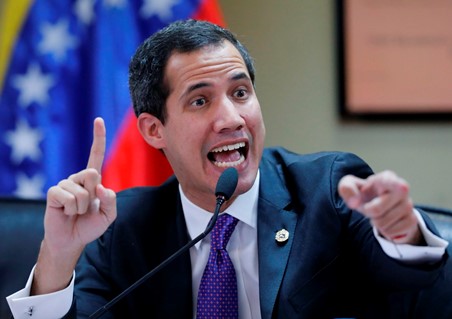
Venezuela National Assembly votes out US-backed opposition leader
RT | December 31, 2022
Opposition lawmakers in Venezuela have voted to dissolve the ‘interim government’ formed under their one-time leader, Juan Guaido, a main rival to the country’s ruling socialist party and once a darling of the US foreign policy establishment.
Holding their vote over a Zoom call, the opposition-controlled National Assembly moved to reorganize their movement on Friday, with 72 lawmakers voting in favor of disbanding the legislature compared to just 29 opposed. Guaido’s term at the head of the assembly, as well as his ‘interim presidency’ declared in 2019 with the blessing of the US, are now set to end on January 5.
“Venezuela needs new machinery in this struggle,” lawmaker Juan Miguel Matheus of the opposition Justice First party said after the vote, adding that Guaido’s tenure as interim leader “was something that was supposed to be temporary, but it became something perpetual.”
Guaido and his supporters, meanwhile, have argued that dissolving the interim government could spell the demise of any unified opposition movement, insisting it will only bolster the power and influence of Maduro, who has been deemed an illegitimate leader by Washington and a long list of allies.
“This is not about defending Guaido. This is about not losing the important tools that we have in this struggle,” Guaido said.
The shake-up in the opposition leadership follows several years of failed efforts to oust Maduro from power, including a series of heated street protests and an outright coup attempt in 2019. While Guaido and fellow opposition leaders failed to inspire mass defections among the security forces as hoped, the ill-fated putsch enjoyed open support from US officials.
In addition to eliminating the temporary government, the assembly said it would establish a new committee to monitor the state assets it still controls, which includes a quantity of gold bullion stored at the Bank of England, as well as the American oil firm Citgo – even as it continues to be majority-owned by PDVSA, a state-controlled energy giant operated by President Maduro’s government in Caracas.
The National Assembly will also create a special panel to negotiate with Maduro, aiming to take part in another round of elections slated for 2024.
While opposition candidates were set to gain control over the legislature following elections in 2015, the results were later invalidated in the courts and the government opted to launch an entirely new body known as the National Constituent Assembly. Since then, Maduro’s opponents have effectively led a government-in-exile, with many lawmakers conducting official business from foreign countries.
Russia consolidates in East Mediterranean
BY M. K. BHADRAKUMAR | INDIAN PUNCHLINE | DECEMBER 31, 2022
The curtain is coming down on the brutal 11-year old Syrian conflict, which former US President and Nobel Laureate Barack Obama initiated, as the Arab Spring swept through West Asia two decades ago. The United States has suffered yet another big setback in West Asia as the year 2022 draws to a close. The unfolding Turkish-Syrian reconciliation process under Russian mediation is to be seen as a saga of betrayal and vengeance.
Ankara came under immense pressure from the Obama Administration in 2011 to spearhead the regime change project in Syria. Obama blithely assumed that Turkiye would gleefully serve as the charioteer of “moderate” Islamism for the transformation in West Asia. But Ankara took its time to calibrate its foreign policies to adapt to the Arab Spring before responding to the shifting landscape in Syria.
Erdogan was caught unprepared by the uprising in Syria at a juncture when Ankara was pursuing a “zero-problems” policy with Turkiye’s neighbours. Ankara was unsure how the Arab Spring would play out and remained silent when the revolt first appeared in Tunisia. Even on Egypt, Erdogan made an emotional call for Hosni Mubarak’s departure only when he sensed, correctly so, that Obama was decoupling from America’s staunch ally in Cairo.
Syria was the ultimate test case and a real challenge for Erdogan. Ankara had invested heavily in the improvement of relations with Syria within the framework of the so-called Adana Agreement in 1998 in the downstream of Turkish military’s massive showdown with Damascus over the latter harbouring the PKK [Kurdish] leader Ocalan. Erdogan initially did not want Bashar al-Assad to lose power, and advised him to reform. The families of Erdogan and Assad used to holiday together.
Obama had to depute then CIA chief David Petraeus to visit Turkey twice in 2012 to persuade Erdogan to engage with the US in operational planning aimed at bringing about the end of the Assad government. It was Petraeus who proposed to Ankara a covert program of arming and training Syrian rebels.
But by 2013 already, Erdogan began sensing that Obama himself had only a limited American involvement in Syria and preferred to lead from the rear. In 2014, Erdogan went public that his relations with Obama had diminished, saying that he was disappointed about not getting direct results on the Syrian conflict. By that time, more than 170,000 people had died and 2.9 million Syrians had fled to neighbouring countries, including Turkey, and the fighting had forced another 6.5 million people from their homes within Syria.
Simply put, Erdogan felt embittered that he was left holding a can of worms and Obama had scooted off. Worse still, the Pentagon began aligning with the Syrian Kurdish groups linked to the PKK. (In October 2014, US began providing supplies to Kurdish forces and in November 2015, US special forces were deployed in Syria.)
Indeed, since then, Erdogan had been protesting in vain that the US, a NATO ally, had aligned with a terrorist group (Syrian Kurds known as YPG) that threatened Turkiye’s sovereignty and territorial integrity.
It is against such a backdrop that the two meetings in Moscow on Wednesday between the defence ministers and intelligence chiefs of Turkey and Syria in the presence of their Russian counterparts took place. Erdogan’s reconciliation process with Assad is quintessentially his sweet revenge for the American betrayal. Erdogan sought help from Russia, the archetypal enemy country in the US and NATO’s sights, in order to communicate with Assad who is a pariah in American eyes. The matrix is self-evident.
On Thursday, Turkish Defence Minister Hulusi Akar said: “At the meeting (in Moscow), we discussed what we could do to improve the situation in Syria and the region as soon as possible while ensuring peace, tranquility and stability… We reiterated our respect for the territorial integrity and sovereignty rights of all our neighbours, especially Syria and Iraq, and that our sole aim is the fight against terrorism, we have no other purpose.”
Russian President Vladimir Putin has been counselling Erdogan in recent years that Turkiye’s security concerns are best tackled in coordination with Damascus and that the Adana Agreement could provide a framework of cooperation. The Turkish Defence Ministry readout said the meeting in Moscow took place in a “constructive atmosphere” and it was agreed to continue the format of trilateral meetings “to ensure and maintain stability in Syria and the region as a whole.”
Without doubt, the normalisation between Ankara and Damascus will impact regional security and, in particular, the Syrian war, given the clout Turkiye wields with the residual Syrian opposition. A Turkish ground operation in northern Syria may not be necessary if Ankara and Damascus were to revive the Adana Agreement. In fact, Akar disclosed that Ankara, Moscow and Damascus are working on carrying out joint missions on the ground in Syria.
The Russian Defence Minister Sergei Shoigu’s willingness right in the middle of the Ukraine war to take the steering wheel and navigate its reconciliation with Syria adds an altogether new dimension to the deepening strategic ties between Moscow and Ankara. For Erdogan too, Syria becomes the newest addition to his policy initiatives lately to improve Turkiye’s relations with the regional states. Normalisation with Syria will go down well with Turkish public opinion and that has implications for Erdogan’s bid for a renewed mandate in the upcoming elections.
From the Syrian perspective, the normalisation with Turkiye is going to be far more consequential than the restoration of ties with various regional states (starting with the UAE) in recent years who had fuelled the conflict. Turkiye’s equations with Syrian militant groups (eg., Syrian National Army and Hayat Tahrir al-Sham), its continued occupation of Syrian territory, Syrian refugees in Turkiye (numbering 3.6 million), etc. are vital issues affecting Syria’s security.
The US resents Erdogan’s move to normalise with Assad — and that too, with Russia’s helping hand. It is now even more unlikely to give up its military presence in Syria or its alliance with the Syrian Kurdish group YPG (which Ankara regards as an affiliate of the PKK.)
But the YPG will find itself in a tight spot. As Syria requests Turkiye to withdraw from its territories (Idlib and so-called operation areas) and stop supporting armed groups, Turkiye in return will insist on pushing the YPG away from the border. (The government-aligned Syrian daily Al-Watan reported quoting sources that at the tripartite meeting in Moscow, Ankara has committed to withdrawing all its forces from Syrian territory.)
Indeed, the replacement of the YPG militia by the Syrian government forces along the borders with Turkiye would lead to the weakening of both YPG and the US military presence. However, the question will still remain unanswered as regards the place of Kurds in the future of Syria.
The US State Department stated recently, “The US will not upgrade its diplomatic relations with the Assad regime and does not support other countries upgrading their relations. The US urges states in the region to consider carefully the atrocities inflicted by the Assad regime on the Syrian people over the last decade. The US believes that stability in Syria and the greater region can be achieved through a political process that represents the will of all Syrians.”
Last week’s meetings in Moscow show that Russia’s standing in the West Asian region is far from defined by the Ukraine conflict. Russian influence on Syria remains intact and Moscow will continue to shape Syria’s transition out of conflict zone and consolidate its own long-term presence in Eastern Mediterranean.
OPEC Plus has gained traction. Russia’s ties with the Gulf states are steadily growing. The Russia-Iran strategic ties are at their highest level in history. And the return of Benjamin Netanyahu as Israel’s prime minister means that the Russian-Israeli ties are heading for a reset. Clearly, Russian diplomacy is on a roll in West Asia.
Conventional wisdom was that Russia and Turkiye’s geopolitical interests would inevitably collide once the floodgates were opened in Ukraine. Herein lies the paradox, for, what has happened is entirely to the contrary.
Featured Video

Ivermectin and iodine
or go to
Aletho News Archives – Video-Images
From the Archives
UN declares war on ‘dangerous’ conspiracy theories
‘World is not secretly run by elites’
Free West Media | August 5, 2022
UNESCO says it is seriously concerned about the increase in “disinformation” and “conspiracy theories”. And they plan to put an end to it through a network of informants.
“Conspiracy theories can be dangerous,” the UN agency warned. “Often they ignore scientific evidence and polarize society with dire consequences. This has to stop.”
Unesco’s director-general warned that “conspiracy theories” could cause damage to people as well as to their health. “They reinforce misconceptions about the pandemic, reinforcing stereotypes that can fuel violence and violent, extremist ideologies,” said Audrey Azoulay.
The UN agency has launched a campaign to help people identify, debunk and report “conspiracy theories” to prevent them from spreading further.
This campaign is being carried out in collaboration with the European Commission, Twitter and the World Jewish Congress. The UN has created a toolkit to “debunk” such theories and smear anyone who dares to claim that governments are not fair and transparent.
The UN also warned that George Soros, the Rothschilds and Israel should not be linked to “alleged conspiracies”.
World events “are not secretly manipulated behind the scenes by powerful players with malicious intent,” the UN agency maintained.
And if anyone therefore comes across someone who believes that the world elite is plotting to consolidate power or direct events, then that person needs to take action. According to the UN agency, when meeting a “conspiracy theorist”, under no circumstances should one enter into a discussion. … continue
Blog Roll
 Aletho News
- Two working on US Senate candidate’s campaign registered as foreign agents for Israel: Report
- Greece bans protest over docking of Israeli cruise ship
- Israel elections: More Arab votes, same Zionist consensus
- Taking the Houthis at Their Word: The Bill Saudi Arabia Doesn’t Want to Read
- Trump claims he would have bombed Ho Chi Minh City to win Vietnam War
- Russia shows Europe that prolonging the Ukraine war is pointless
- There is cautious optimism about ending the Ukraine War – Part 2
- Ukrainian air alert app hacked with fake nuclear warnings
- Ivermectin and iodine
- Congratulations climate skeptics — you are a ‘Hybrid weapon of war’ and a growing public health threat
- If Americans Knew
- An error has occurred; the feed is probably down. Try again later.
- No Tricks Zone
- Germany’s Green Energy Transition Becoming Increasingly Expensive…Another 6 Trillion Euros!
- Sudden Stratospheric Warming, Powerful El Niño Combination May Lead To Extreme Europe Cold, Energy Crisis!
- Two New Studies Find Thwaites Glacier Melt Cannot Be Driven By Human Activity Or A Warming Ocean
- E-Cars Reduce CO2 Emissions By Only 41% Compared To Internal Combustion Engine Vehicles
- Predictions Made By Renowned Climate Professor Over Past Decades Have Been Proven To Be Poor
- New Study Suggests Large Regions Of The Pacific Ocean Have Been Cooling For The Last 80 Years
- Germany’s Green Energy Debacle: High Energy Costs Force Kahla Porzellan to Close After 182 Years!
- New Study: 50 Years Of The Most Aggressive ‘Net Zero’ Policies Can Only Affect The Global Climate By 0.03°C
- US September “Heat” Was No Record…Many Records Set Decades Ago
- Latest European Green Energy Debacle; Portugal’s Largest Flagship Solar Park Insolvent!

