UKRAINE WAR – WHAT NEXT?
By Helmholtz Smith | Son Of The New American Revolution | December 21, 2022
The primary purpose of war is the destruction of the enemy’s ability to resist. That is a long process – weapons and ammunition destroyed, supply routes blocked, war production stopped, political will broken. And it’s a bloody process – the enemy’s soldiers must be killed or maimed. Clausewitz –
Fighting is the central military act… The object of fighting is the destruction or defeat of the enemy… Direct annihilation of the enemy’s forces must always be the dominant consideration.
Why “dominant consideration”? Simple – once you have destroyed the enemy’s power, you can do anything you want. Take territory without destroying power? Not so good. One may wonder whether this is understood at West Point given the number of TV generals who say Russia is losing because it’s given up territory and was “defeated” in Kiev. Don’t they remember that the US took Kabul and Baghdad quite early? That didn’t end either of those wars, did it?
Demilitarization, denazification, securing safety of Donbass are Russia’s stated aims. They can happen only when Ukraine’s power to resist is broken. Moscow may have hoped the job would have been easier (and it nearly was in April) but here we are. A bigger job earns a bigger reward and the territorial (safety) aims have probably expanded to take in all of Novorossiya.
The Economist (interesting choice of venue – Larry speculates on why this and why now) recently interviewed Zelensky and Generals Zaluzhny and Syrsky. Neither general was very upbeat. What struck me was Zaluzhny saying “I need 300 tanks, 600-700 IFVs [infantry fighting vehicles], 500 Howitzers.” To put this in perspective, according to Wikipedia, the German Army has 266 tanks, about 650 IFVs and about 350 artillery systems. The British Army has 227 tanks, about 700 IFVs and about 230 artillery systems. A year ago, Ukraine was estimated to have had 2400 tanks, thousands of IFVs and 2000 artillery systems. What happened to them? And all the other weapons Ukraine has received? One may see Zaluzhny’s request as being in the form of “if… then”. Well, the first condition won’t be met – he is essentially asking for half of what the the UK and Germany have between them (plus all their guns) – and therefore the second can’t be. Is this his way of admitting that Russia has nearly finished “the destruction of his forces”? (Calling for stronger penalties against deserters doesn’t give a confident ring either, does it?)
First destroy the enemy’s power, then make your choice.
Russian commander Surovikin is surely approaching the judgment call. Ukraine has lost a huge amount of its power of resistance and its friends in NATO are running out of what they can send. He has plenty of options. Which, of course, can be combined. To be carried out with caution, because, as Merkel has told those who hadn’t already figured it out, USA/NATO is not “agreement-capable” and therefore not stable.
- Continue attrition and watch Ukraine and NATO demilitarize themselves. With forces in place, trained and equipped, take advantage of any opportunity that presents itself. (Sun Tzu “The supreme art of war is to subdue the enemy without fighting“.) This is the easiest option but, because it is the slowest, it carries the risk of a desperate USA/NATO doing something irretrievably stupid.
- “Big arrows”. All or some of these. Deep penetrations to cut off the remaining Ukrainian forces in the east and move to total victory. Or powerful raids into the Ukrainian rear to destroy and disrupt. (John Helmer explains the purpose here.) Or a drive to Trans Dnestr leaving Rump Ukraine landlocked. Any “big arrow” have the advantage of destroying the Ukraine-is-winning fantasy.
- Block the border with Poland and the supply of NATO weaponry and wait for the the whole thing to collapse.
- If the Ukrainian collapse at Bakhmut is big enough, just move to the desired end-state borders.
I don’t see any point in trying to take Kiev or any other major city in “Ukrainian” Ukraine – there’s nothing to be gained from acquiring a population infused with hatred. (Nazis in Ukraine? Down the Memory Hole – the Guardian wouldn’t show this video today. Nor Vice this. Nor the BBC this).
Timing? Not my decision but I would bet it happens after the collapse of the Ukrainian last-ditch position in the Bakhmut area. (Are the Western media masters preparing us for that event? Berletic suggests they are. “Bakhmut is not an especially strategic location“, “low strategic advantage“, “lack of strategic importance“, only important because “it would enable Putin to show some form of military victory“. They of course don’t ask why the Ukrainians are sacrificing thousands of lives to hold these “unimportant” positions).
Would this be a defeat for NATO? Of course not, victories are easy when you have a managed news media – Afghanistan, what’s that?
U.S. Sanctions Are Killing Syrians and Are a Human Rights Violation
By Steven Sahiounie | Strategic Culture Foundation | December 22, 2022
Damascus is now bitterly cold and is soon to be blanketed with snow. About 12 million Syrians are facing a deadly winter without heating fuel, gasoline for transportation, and dark houses each evening without electricity. Aleppo, Homs, and Hama are also extremely cold all winter.
Imagine being ill and having to walk to the doctor or hospital. The ambulances in Syria will now respond only to the most life-threatening calls because they must conserve gasoline, or face running out entirely. Gasoline on the black market costs Syrians an equivalent of 50 U.S. dollars for a tank of 20-liter fuel.
Sanctions against Syria were imposed by the European Union, the United States, Canada, Australia, Switzerland, the Arab League, as well as other countries beginning in 2011. The sanctions were aimed at overthrowing the Syrian government, by depriving it of its resources. U.S.-sponsored ‘regime change’ has failed but the sanctions were never lifted.
For 12 years the U.S. and EU have been imposing economic sanctions on Syria which have deprived the Syrians of their dignity and human rights.
New UN report asks for lifting sanctions on Syria
UN Special Rapporteur on human rights, Alena Douhan, urged sanctions to be lifted against Syria, warning that they were adding to the suffering of the Syrian people since 2011.
“I am struck by the pervasiveness of the human rights and humanitarian impact of the unilateral coercive measures imposed on Syria and the total economic and financial isolation of a country whose people are struggling to rebuild a life with dignity, following the decade-long war,” Douhan said.
After a 12-day visit to Syria, Douhan said the majority of Syria’s population was currently living below the poverty line, with shortages of food, water, electricity, shelter, cooking and heating fuel, transportation, and healthcare. She spoke of the continuing exodus of educated and skilled Syrians in response to the economic hardship of living at home.
Douhan reported that the majority of infrastructure was destroyed or damaged, and the sanctions imposed on oil, gas, electricity, trade, construction, and engineering have diminished the national income, which has prevented economic recovery and reconstruction.
The sanctions prevent payments from being received from banks, and deliveries from foreign manufacturers. Serious shortages in medicine and medical equipment have plagued hospitals and clinics. The lack of a water treatment system in Aleppo caused a severe Cholera outbreak in late summer, and the system cannot be bought, installed, or maintained under the current U.S. sanctions against Syria.
Douhan said, “I urge the immediate lifting of all unilateral sanctions that severely harm human rights and prevent any efforts for early recovery, rebuilding, and reconstruction.”
U.S. sanctions are not effective
In 1998, Richard Haass wrote, ‘Economic Sanctions: Too Much of a Bad Thing’. He cautioned U.S. foreign policymakers that sanctions alone are ineffective when the aims are large, or the time is short. The overthrow of the Syrian government is a massive aim, and the sanctions did not accomplish that goal.
Haass predicted that sanctions could cause economic distress and migration. In the summer of 2015 about half a million Syrians walked through Europe as economic migrants and were taken in primarily by Germany.
There is a moral imperative to stop using sanctions as a foreign policy tool because innocent people are affected, while the sanctions have failed.
The U.S. steals Syrian oil, and will not allow imported oil to arrive
According to the U.S. government, the sanctions on Syria “prohibits new investments in Syria by U.S. persons, prohibits the exportation or sale of services to Syria by U.S. persons, prohibits the importation of petroleum or petroleum products of Syrian origin, and prohibits U.S. persons from involvement in transactions involving Syrian petroleum or petroleum products.”
There is a waiver that can be requested from the Department of Commerce, to circumvent the sanctions; however, it only applies to sending items to the terrorist-occupied area of Idlib. Hayat Tahrir al-Sham was the Al Qaeda affiliate in Syria and is the only terrorist group now holding territory in Syria.
On October 22, the media Energy World reported the U.S. occupation forces had smuggled 92 tankers and trucks of Syrian oil and wheat stolen from northeastern Syria to U.S. bases in Iraq. The theft is ongoing and continuous.
The U.S. has partnered with the Syrian Democratic Forces (SDF) which is a Kurdish militia that has a political wing following the communist ideology begun by the PKK’s Abdullah Ocalan. President Trump ordered the U.S. military to remain to occupy northeastern Syria and he ordered the U.S. soldiers there to steal the Syrian oil so to prevent the Syrian people in the rest of the country from benefiting from the gasoline and electricity produced from the wells.
The Syrian Oil Ministry said in August that the U.S. forces were stealing 80 percent of Syria’s oil production, causing direct and indirect losses of about 107.1 billion to Syria’s oil and gas industry.
Because the Damascus government is deprived of the oil its wells produce, it is forced to depend on costly imported oil, usually from Iran. The U.S. routinely commandeers Iranian tankers, such as the incident recently when the U.S. Navy took a tanker hostage off the coast of Greece on its way to Syria but was eventually released by Greece.
Gasoline shortage
The government has instituted a three-day weekend for schools and civil offices, as well as suspended sports events to save fuel.
Maurice Haddad, Director of the General Company for Internal Transport in Damascus, told the al-Watan newspaper that the government has set stricter diesel quotas, leading to fewer daily bus services.
Athar-Press news website reported that several bakeries in Damascus have had to shut down because of the lack of fuel.
Fuel is needed to generate electricity in Syria, and the lack of domestic or imported fuel means most homes in Syria have about one hour of electricity at several intervals each day, and the amount is diminishing daily.
Sanction exemptions for Idlib and the Kurds only
The only two areas in Syria which are not under the Damascus administration are Idlib in the northwest and the U.S.-sponsored Kurdish region in the northeast. The U.S. sanctions are exempt from sending items to those two places only. But, those two places represent a small number of Syrians in comparison to the civilians across the country, and the main cities of Damascus, Aleppo, Homs, Hama, and Latakia. The U.S. makes sure the people who are against the Syrian government continue to be rewarded with supplies and reconstruction, while the millions of peaceful civilians are kept in a constant state of suffering and deprivation.
Kremlin assesses Zelensky-Biden meeting
RT | December 22, 2022
Washington seems intent on waging a proxy war against Russia using Ukraine as a tool, Kremlin spokesperson Dmitry Peskov has said. He added that the main takeaway from Wednesday’s meeting between the two countries’ leaders is that neither the US nor Ukraine is prepared to pay attention to Russia’s concerns.
“Of course, we were following this [meeting], we were getting acquainted with all the incoming information,” Peskov told journalists on Thursday. He added that in Moscow’s eyes, “neither President [Joe] Biden nor President [Vladimir] Zelensky uttered any words that could be construed as, so to speak, potential readiness to take heed of Russia’s concerns.”
The Kremlin spokesperson went on to lament the fact that the US president had failed to warn his Ukrainian colleague against shelling residential areas in Donbass. He also said that neither side called for peace.
According to Peskov, the US is continuing to wage war against Russia indirectly, “to the last Ukrainian.”
He also noted that further weapons deliveries from the US and other countries will only serve to prolong the suffering of the Ukrainian people.
Late on Wednesday, Russia’s ambassador to the US, Anatoly Antonov, also accused Washington of waging a proxy war against Moscow, adding that the US and Ukraine are hell-bent on the “manic idea of defeating the Russians on the battlefield.”
On Wednesday, Zelensky arrived in Washington for his first official foreign visit since Russia launched its military operation in Ukraine in late February.
During his meeting with Biden at the White House, the US president pledged to back Kiev for “as long as it takes.” He also confirmed the upcoming handover of a Patriot air defense battery and other military aid.
Moscow has repeatedly condemned the Western arms deliveries to Ukraine, warning that they could lead to a direct confrontation between Russia and NATO.
Western sanctions prevent dozens of food shipments from reaching Iran
The Cradle | December 21, 2022
At least 40 merchant ships carrying grains and sugar are stranded off the coast of Iran due to delays in payments that have been ongoing for weeks, according to shipping data reviewed by Reuters.
Ship tracking data shows that the carrier ships are currently stuck outside the major Iranian ports of Bandar Imam Khomeini and Bandar Abbas.
The Iranian Ports and Maritime Organization said in late November that 37 ships loaded with 2.2 million tons of goods had not been able to unload their cargo due to “documentation and hard currency payment issues.”
One western trade source quoted by Reuters estimated that the cargoes stuck outside Iran are worth more than $1 billion, with charterers facing delay costs known as demurrage.
While western sanctions on Iran allegedly exempt food and medicine purchases, the weight of the punitive measures on the country’s financial system greatly restricts payment methods, forcing authorities to rely on complex and erratic arrangements with international companies.
Iran counts among the driest countries in the world, with an average rainfall of only 250mm a year. Despite its nearly 165 million hectares of land, only about 50 million is arable, with just 18 million hectares used for farming.
According to data compiled by the US Department of Agriculture, due to severe droughts, Iran is expected to import 5.5 million tons of wheat during the 2022/23 season, down from 8.0 million during the previous season, but still well above normal levels.
Iranian authorities have, in recent years, prioritized boosting food security in the country to confront western sanctions.
In September, Venezuela offered millions of hectares of agricultural land to Iranian producers. Other reports indicated that Russia had also offered 100,000 hectares of land – an attestation to how Tehran has been pursuing its plans of trans-territorial farming in various countries.
The idea of trans-territorial farming surfaced in Iran over two decades ago. However, it was not until 2016 that officials started implementing measures to achieve this as part of their strategy to secure food supplies for the country.
Tehran, which between 2004 and 2017 celebrated its self-sufficiency in strategic products like wheat, and even exported part of its wheat surplus in 2017, now needs to import grains to make up for shortfalls in production.
The Fake ‘Tripledemic’ That Was 90% RSV and Almost Zero COVID-19
BY DR ANDREW BOSTOM | THE DAILY SCEPTIC | DECEMBER 21, 2022
Already by the last week of October 2022, continuing through November and early December, local Rhode Island media were amplifying clinician and public health official warnings about a paediatric respiratory illness ‘tripledemic’. The ‘tripledemic’ that prompted this tocsin of looming calamity in children was an alleged convergence of COVID-19, influenza and respiratory syncytial virus (RSV).
Serious paediatric illness is best gauged by the actual number of children hospitalised, as opposed to ‘respiratory virus test positivity’. The latter is especially misleading because of the unique, ongoing phenomenon of continued mass COVID-19 testing for minimal symptoms. Curiously, almost two months later, I could find no local media follow-up coverage elucidating the feared paediatric ‘tripledemic’ by this most germane metric: a direct comparison of children hospitalised for COVID-19, influenza or RSV.
With the cooperation of Rhode Island Department of Health (RIDOH) spokesman Joseph Wendelken, and an academic paediatrician at Hasbro Children’s Hospital, I can now present those hospitalisation data, per the table below. Given time lags in compilation and transmission, the hospitalisation record only covers all of October, and November 2022.

Despite the anguished media declarations, there was no Rhode Island paediatric ‘tripledemic’, at least through October and November. RSV, alone, accounted for around 90% (194 ÷ 222 = 87.4%) of so-called ‘tripledemic’ hospitalisations among Rhode Island children, and the rate of RSV hospitalisations (97 per month), was around seven-fold the rate of COVID-19 and influenza hospitalisations combined (14 per month). Moreover, the surrogate for RSV hospitalisations, a single International Classification of Diseases (ICD) RSV code (bronchiolitis, an inflammation of the smaller lung airways) omits RSV pneumonia and bronchitis coded hospitalisations. Certainly, omitting these ICD codes underestimates true paediatric RSV admissions.
The rate of primary (or ‘suspected‘ primary) COVID-19 pediatric hospitalisations mirrored what I discovered about the receding ‘Omicron wave’ from February to early June 2022. After weeks of wrangling, requiring an Access to Public Records Act submission to the Rhode Island Department of Health (RIDOH), supported by two state legislators, my query on paediatric COVID-19 hospitalisations in the first half of 2022 was answered on August 5th 2022. These data revealed that during the 16-week period from February 13th 2022 through June 4th 2022 there were a total of only 15 primary COVID-19 paediatric hospitalisations (for ages 0 to 17 years-old), as determined by RIDOH criteria. Notwithstanding this clinically insignificant, low ebb trickle of COVID-19 paediatric hospitalisations, RIDOH issued two memos recommending Rhode Island public schools re-institute compulsory masking (see RIDOH memos dated May 19th 2022 and May 20th 2022) for all school children in so-called “high COVID-19 transmission” districts.
Present ‘tripledemic’ nonoccurrence aside, the overwhelmingly RSV-driven rate of increased paediatric respiratory illness hospitalisations in Rhode Island during October and November should decline significantly in December and January as RSV infection rates peaked in early November and declined precipitously through early December (see data from RIDOH, plotted below).
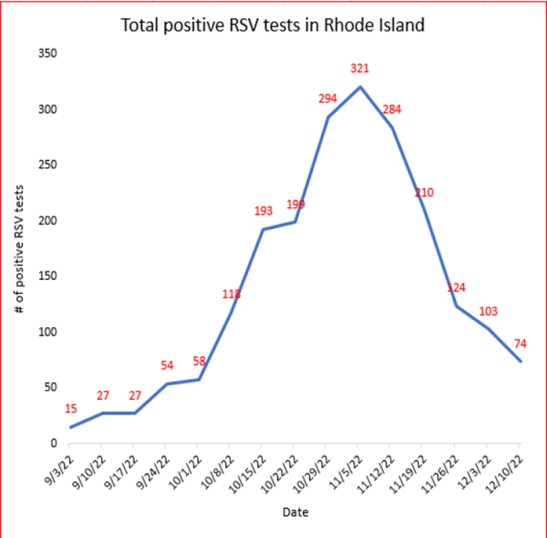
Additional reassuring national data from the Centers for Disease Control and Prevention (CDC) indicate the early influenza spike this year may be peaking in the U.S. overall as well, albeit not yet in New England. The third leg of the non-‘tripledemic’, COVID-19 paediatric infections, are not spiking in Rhode Island above rates observed since the summer and early autumn, while primary COVID-19 hospitalisation rates in children (see earlier table) remain exceedingly low.
Predictably, those Rhode Island medical thought leaders ginning up unwarranted concerns about the ‘tripledemic’ are once again, ad nauseum, pushing non-evidence-based masking and vaccination in children.
They ignore uniformly negative randomised controlled trials (RCTs) on community masking for the prevention of either influenza (12 RCTs; 10 here; also here and here) or COVID-19 (two RCTs; here, here), complemented by a small RCT in healthcare workers which demonstrated masks also failed to prevent RSV. While acknowledging the absence of a viable vaccine for RSV (but failing to mention the catastrophic failure of historical RSV ‘immunisation’), such thought leaders also ignore the absence of RCT data demonstrating either influenza or COVID-19 vaccines prevent hospitalisation from these respiratory illnesses in children.
The high rate of paediatric RSV hospitalisations alone in October-November should not be shrilly exploited by the media or so-called medical authorities to make counterfactual claims of an RSV, COVID-19 and influenza ‘tripledemic’. Instead, RSV, and now influenza, far more than COVID-19, should be accepted for what they are, i.e., part of the natural cycle of paediatric respiratory infections, and treated calmly, and with caring.
Dr. Andrew Bostom is a physician currently affiliated with the Brown University Center for Primary Care and Prevention, and was an Associate Professor of Medicine and Family Medicine at the Warren Alpert Medical School of Brown University from 1997 until June 2021. As a clinical trialist and epidemiologist he designed and completed the largest randomised controlled trial conducted in chronic kidney transplant recipients.
Court Says No, Biden Cannot Enforce Vaccine Mandates For Federal Contractors
By Steve Watson | Summit News | December 21, 2022
A 5th Circuit Court of Appeals ruled Monday that The Biden Administration cannot enforce a COVID vaccine mandate on federal contractors.
“The President’s use of procurement regulations to reach through an employing contractor to force obligations on individual employees is truly unprecedented,” the ruling noted, adding “As such, Executive Order 14042 is unlawful, and the Plaintiff States have consequently demonstrated a strong likelihood of success on the merits.”
Referring to Biden’s Executive Order, the ruling also stated that “Congress has not spoken clearly to authorize such a dramatic shift in the exercise of the President’s power under the Procurement Act.”
The vaccine mandate would affect up to 20 percent of people employed in the U.S., Reuters has noted.
Louisiana Attorney General Jeff Landry, one of the plaintiffs in the case issued a statement asserting that “Today is a victory for freedom,” and vowing “We will continue to stand up against the Biden Administration’s abuses of power that threaten us now and in the future.”
The Ruling comes a week after The Senate passed the National Defense Authorization Act, which lifted the COVID vaccine mandate for active duty military personnel.
Republicans in the Senate, led by Rand Paul, had threatened to block the legislation unless the mandate was scrapped.
While the mandate will be sidelined, some 8,000 troops who were given the boot for refusing to go along with it have not been reinstated.
GOP Senators Ron Johnson and Ted Cruz argued tnhatthe discharged troops should be reinstated with back pay, reasoning that the mandate was “illegal”.
However, Democrats stated that reinstating those service members would send the message that it’s acceptable to disobey orders.
“What we’re telling soldiers is, if you disagree, don’t follow the order and then just lobby Congress and they’ll come along and they’ll restore your rank, they’ll restore your benefits, they’ll restore everything, so orders are just sort of suggestions,” Senate Armed Services Committee Chairman Jack Reed, D-R.I., said on the Senate floor. “They’re not.”
Some of the service members are taking the fight to the courts.
Star Of Body-Positivity Show Dead From Heart Failure At Age 37
By Tyler Durden – Zero Hedge – December 20, 2022
The body positivity movement, at least in the case of women, has been highly promoted by every area of the entertainment media and among social justice activists based on a singular claim: You can be healthy at any size (HAES).
The claim has inspired numerous efforts to normalize obesity in American society as not only socially acceptable but also medically acceptable. While political activism in science is nothing new and has been present in everything from climate change rhetoric to pandemic response, fat positivity disinformation in scientific observation is perhaps the most egregious and widespread. It attempts to ignore or dismiss decades of studies on the negative effects of obesity and asserts that being grossly overweight has minimal or no health consequences.
This argument is often debunked by the very people that tend to promote it and encourage it, as they die incredibly young and from health problems that are usually reserved for the elderly.
Jamie Lopez, star of the body positivity-based television show ‘Super Sized Salon’, was an advocate of a ‘beauty at any size‘ philosophy, more so than a health at any weight ideal. However, social justice proponents often held up her example as justification for the HAES lifestyle. She is now dead, suffering from heart failure at age 37.
To be fair to Lopez, she did attempt to lose weight, dropping over 400 pounds in a year.
But, going from 800 pounds to 400 pounds is still not enough to prevent the myriad of health problems associated with obesity. Undoubtedly, body positivity proponents will try to gloss over her cause of death, but the fact remains that health and weight are indelibly intertwined.
While “beauty” might be treated as socially subjective by some people (studies show beauty concepts are actually biologically ingrained), health standards are not subjective.
Gluttony has long been a despised habit within almost all cultures for a reason – It is a sign of a lack of discipline as well as a precursor to societal decline, and, it is a sure trigger for an early demise.
Deutsche Bank: “A Certain Degree of Eco-Dictatorship Will Be Necessary”
BY TOBY YOUNG | THE DAILY SCEPTIC | DECEMBER 20, 2022
Izabella Kaminska, formerly the Editor of the FT’s Alphaville and now the Editor of the Blind Spot, has flagged up an alarming passage in a document published in January 2021 by Deutsche Bank Research entitled ‘What we must do to Rebuild’. Eric Heyman has written the section about the tough choices the EU must face it if’s to meet its goal of achieving ‘climate neutrality’ by 2050 – Net Zero, in other words – and says the following:
The impact of the current climate policy on people’s everyday lives is still quite abstract and acceptable for many households. Climate policy comes in the form of higher taxes and fees on energy, which make heating and mobility more expensive. Some countries have set minimum energy efficiency standards for buildings or similar rules in other areas. However, climate policy does not determine our lives. We take key consumption decisions, for example whether we travel at all, how much we travel and which means of transport we use, whether we live in a large house or a small apartment and how we heat our homes, how many electronic devices we have and how intensely we use them or how much meat and exotic fruit we eat. These decisions tend to be made on the basis of our income, not on climate considerations.
If we really want to achieve climate neutrality, we need to change our behaviour in all these areas of life. This is simply because there are
no adequate cost-effective technologies yet to allow us to maintain our living standards in a carbon-neutral way. That means that carbon prices will have to rise considerably in order to nudge people to change their behaviour. Another (or perhaps supplementary) option is to tighten regulatory law considerably. I know that “eco-dictatorship” is a nasty word. But we may have to ask ourselves the question whether and to what extent we may be willing to accept some kind of eco-dictatorship (in the form of regulatory law) in order to move towards climate neutrality.
When he says we have to “ask ourselves… whether and to what extent we may be willing to accept some kind of eco-dictatorship” I don’t think he has a Net Zero referendum in mind. Rather, by ‘ourselves’ he means the EU’s ruling class. It has to ask itself whether it’s willing to pass laws forcing the EU’s population to modify its behaviour to meet the 2050 ‘climate neutrality’ target, regardless of whether it has a democratic mandate to do so or not.
I suppose we should be grateful that at least Heyman hasn’t tried to sugar coat this. It should be clear what “eco-dictatorship” means, even to those most reluctant to accept that Net Zero zealots have little love for democracy.
Stop Press: Izabella Kaminska has interviewed the neo-Malthusian Turkish-American economist Nourel Roubini for the Blind Spot podcast. In his book Megathreats: The Ten Trends that Imperil Our Future, and How to Survive Them he argues that individual freedoms will have to be sacrificed if we’re to contain another pandemic or avoid a climate catastrophe.
“Silent Majority” of Car Industry is Concerned About Electric Vehicles
BY WILL JONES | THE DAILY SCEPTIC | DECEMBER 20, 2022
A “silent majority” of car companies is concerned that electric vehicles will not alone be able to end reliance on fossil fuels, according to a senior Toyota executive. The Telegraph has more.
Akio Toyoda, the company’s president and grandson of its founder Kiichiro Toyoda, said that many concerned senior figures are reluctant to say what they really think because of the pressure to go green.
It comes as the industry struggles to ditch petrol and diesel, in the face of materials shortages and complex processes that have kept the cost of building electric cars high.
In comments on a visit to Thailand first reported by the Wall Street Journal, Mr Toyoda said: “People involved in the auto industry are largely a silent majority.
“That silent majority is wondering whether EVs [electric vehicles] are really OK to have as a single option. But they think it’s the trend so they can’t speak out loudly.”
Meanwhile, MPs on the parliamentary Science and Technology Committee have warned that plans to require that all new boilers are able to run on hydrogen within a few years are unrealistic and the gas is likely to play a limited role in the future energy system, given the practical challenges of producing and handling it cleanly at large scale. From the Telegraph:
They argue huge questions still need to be answered about the potential deployment of the gas, and highlight “conflicting views” on the role it could play in domestic heating, given the merits of electric heat pumps instead.
Hydrogen is currently a niche product used in chemical production and oil refining, but politicians around the world hope it can replace fossil fuels in uses ranging from heating to transport, as it does not produce emissions when burned.
However, the committee argued that in practice this was likely to be limited to uses where other options are unsuitable, or in areas which are close to hydrogen production hubs.
“It seems likely that any future use of hydrogen will be limited rather than universal,” they said. “This limited – rather than universal – use of hydrogen should inform Government decisions. For example, we disagree with the Climate Change Committee’s recommendation that the Government should mandate new domestic boilers to be hydrogen-ready from 2025.”
Russian carmaker to launch production at former Nissan plant
RT | December 21, 2022
Russia’s biggest automaker, Avtovaz, will start producing cars at a plant in St. Petersburg previously owned by the Japanese car manufacturer Nissan, the company’s CEO Maxim Sokolov told reporters on Wednesday.
Sokolov noted that the cars will be produced under the Lada brand and that preparations for the launch of production are in the final stages.
“We will not reveal all the details now, they are kept under wraps by the automakers till the last moment, but I can say that these cars will be modern, of high quality and with the highest safety standards… As soon as the memorandums [with our partners] are signed, we will immediately present them to the public,” the company official said.
Earlier reports stated that Avtovaz was planning to restart production at the plant in the second half of 2023.
The Nissan plant in St. Petersburg, which was launched in 2009, has a production capacity of up to 100,000 cars per year. Last year, roughly 43,000 cars came off of its assembly line. The plant mostly produced SUV models such as the Qashqai and X-trail.
The Japanese carmaker suspended operations at the plant in March, citing supply-chain interruptions due to Ukraine-related sanctions imposed on Moscow. Last month, the company decided to sell all of its Russian assets to the state-owned research and development firm NAMI, according to the Russian Trade Ministry. Under the deal, which was concluded for a token sum of €1, Russian carmaker Avtovaz is to carry out maintenance services for Nissan vehicles and supply spare parts for them.
Featured Video

Pravin Sawhney: Massive Escalation Pushes Every Side Toward the Brink
or go to
Aletho News Archives – Video-Images
From the Archives
UN declares war on ‘dangerous’ conspiracy theories
‘World is not secretly run by elites’
Free West Media | August 5, 2022
UNESCO says it is seriously concerned about the increase in “disinformation” and “conspiracy theories”. And they plan to put an end to it through a network of informants.
“Conspiracy theories can be dangerous,” the UN agency warned. “Often they ignore scientific evidence and polarize society with dire consequences. This has to stop.”
Unesco’s director-general warned that “conspiracy theories” could cause damage to people as well as to their health. “They reinforce misconceptions about the pandemic, reinforcing stereotypes that can fuel violence and violent, extremist ideologies,” said Audrey Azoulay.
The UN agency has launched a campaign to help people identify, debunk and report “conspiracy theories” to prevent them from spreading further.
This campaign is being carried out in collaboration with the European Commission, Twitter and the World Jewish Congress. The UN has created a toolkit to “debunk” such theories and smear anyone who dares to claim that governments are not fair and transparent.
The UN also warned that George Soros, the Rothschilds and Israel should not be linked to “alleged conspiracies”.
World events “are not secretly manipulated behind the scenes by powerful players with malicious intent,” the UN agency maintained.
And if anyone therefore comes across someone who believes that the world elite is plotting to consolidate power or direct events, then that person needs to take action. According to the UN agency, when meeting a “conspiracy theorist”, under no circumstances should one enter into a discussion. … continue
Blog Roll
 Aletho News
- Algerian army launches second operation to clear French nuclear test sites
- Pravin Sawhney: Massive Escalation Pushes Every Side Toward the Brink
- UK High Court Upholds Speech Regulator Notices To Meta, WhatsApp, X, And TikTok
- Two working on US Senate candidate’s campaign registered as foreign agents for Israel: Report
- Greece bans protest over docking of Israeli cruise ship
- Israel elections: More Arab votes, same Zionist consensus
- Taking the Houthis at Their Word: The Bill Saudi Arabia Doesn’t Want to Read
- Trump claims he would have bombed Ho Chi Minh City to win Vietnam War
- Russia shows Europe that prolonging the Ukraine war is pointless
- There is cautious optimism about ending the Ukraine War – Part 2
- If Americans Knew
- How much does it cost to change a mind about Israel?
- Jordan’s Christians are citizens, not guests
- The 100-year-old Zionist plan to steal southern Lebanon
- Tucker Carlson: Netanyahu pushing Trump to launch nuclear strike on Iran within days
- Israeli Politician Who Said It’s ‘Morally’ Right To Kill Babies in Gaza Wins Knesset Seat
- Mike Rogers Campaign Spokesperson Is a Registered Agent for Israel, Documents Show
- Book Review: A guide to how the media sanitized Israel’s genocide in Gaza
- DAILY UPDATE: Latest essential news on Palestine, Israel, & region
- Israel Revoked Entry Permits of Brad Lander and Other US Jews After West Bank Olive Harvest Detention
- Houston Activists Are Working to Disrupt the Flow of Weapons to Israel
- No Tricks Zone
- Germany’s Green Energy Transition Becoming Increasingly Expensive…Another 6 Trillion Euros!
- Sudden Stratospheric Warming, Powerful El Niño Combination May Lead To Extreme Europe Cold, Energy Crisis!
- Two New Studies Find Thwaites Glacier Melt Cannot Be Driven By Human Activity Or A Warming Ocean
- E-Cars Reduce CO2 Emissions By Only 41% Compared To Internal Combustion Engine Vehicles
- Predictions Made By Renowned Climate Professor Over Past Decades Have Been Proven To Be Poor
- New Study Suggests Large Regions Of The Pacific Ocean Have Been Cooling For The Last 80 Years
- Germany’s Green Energy Debacle: High Energy Costs Force Kahla Porzellan to Close After 182 Years!
- New Study: 50 Years Of The Most Aggressive ‘Net Zero’ Policies Can Only Affect The Global Climate By 0.03°C
- US September “Heat” Was No Record…Many Records Set Decades Ago
- Latest European Green Energy Debacle; Portugal’s Largest Flagship Solar Park Insolvent!

