Multinational Agrichemical Corporations and the Great Food Transformation
By Birsen Filip | Mises Wire | November 5, 2022
In July 2022, the Canadian government announced its intention to reduce “emissions from the application of fertilizers by 30 percent from 2020 levels by 2030.” In the previous month, the government of the Netherlands publicly stated that it would implement measures designed to lower “nitrogen pollution some areas by up to 70 percent by 2030,” in order to meet the stipulations of the European “Green Deal,” which aims to “make the EU’s climate, energy, transport and taxation policies fit for reducing net greenhouse gas emissions by at least 55 percent by 2030, compared to 1990 levels.”
In response, Dutch “farm and agriculture organizations said the targets were not realistic and called for a protest,” which led farmers and their supporters to rise up across the country. The artificially designed Green Deal is one of the goals of Agenda 2030, which was adopted by 193 member states of the United Nations (UN) in 2015.
In addition to the UN, Agenda 2030 is also supported by a number of other international organizations and institutions, including the European Union, the World Economic Forum (WEF), and the Bretton Woods Institutions, which consist of the World Bank, the International Monetary Fund (IMF) and the World Trade Organization (WTO). It is also endorsed by some of the most powerful agrichemical multinational corporations in the world, such as BASF, Bayer, Dow Chemical, DuPont, and Syngenta, which, together, control more than 75 percent of the global market for farm inputs. In recent years, “the acquisition of Syngenta by ChemChina, and the merger of Bayer and Monsanto” have “reshaped the global seed industry.” Additionally, “DuPont de Nemours was formed by the merger of Dow Chemical and DuPont in 2017.” However, “within 18 months of the merger the company was split into three publicly traded companies with focuses on the following: agriculture with Corteva, materials science with Dow and specialty products with DuPont.”
In recent years, all of these corporations have issued statements suggesting that the agriculture sector will undergo major changes over the upcoming three decades, and that they are committed to doing their parts to accelerate the transition to so called green policies. Accordingly, they advocate for governments to redirect public finance away from conventional farming and toward regenerative agriculture and alternative protein sources, including insect farming and lab-grown meats.
Moreover, BASF, Syngenta and Bayer are members of “the European Carbon+ Farming Coalition,” which includes a number of “organizations and stakeholders along the food value chain,” such as “COPA-COGECA, Crop In, European Conservation Agriculture Federation (ECAF), European Institute of Innovation & Technology (EIT) Food, HERO, Planet Labs,” “Swiss Re, University of Glasgow, Yara, Zurich and the World Economic Forum.” Originally, this “coalition emerged as a partnership between the World Economic Forum’s 100 Million Farmers platform and its CEO Action Group for the European Green Deal.”
Its objective is to “decarbonise the European food system” by accelerating the transformation of farming and agricultural practices. More specifically, the European Carbon+ Farming Coalition seeks to attain “zero gross expansion in the area of land under cultivation for food production by 2025, reduction in total territories used for livestock of about one-third by 2030, and a consequent freeing up of nearly 500 million hectares of land for natural ecosystem restoration by the same date.” According to the WEF, in addition to benefitting the environment, such changes will also be economically advantageous, as “changing the way we produce and consume food could create USD 4.5 trillion a year in new business opportunities.”
In order to accelerate the transformation of farming over the coming decades, BASF calls for requiring “farmers to decrease their environmental impact” by reducing “CO2 emissions per ton of crop by 30 percent,” and applying “digital technologies to more than 400 million hectares of farmland.” BASF also supports the wide use of a number of new products, including “nitrogen management products,” herbicides, “new crop varieties,” “biological inoculants and innovative digital solutions,” so as to make farmers “more carbon efficient and resilient to volatile weather conditions.” It is estimated that such changes would “contribute significantly to the BASF Group target of €22 billion in sales by 2025.”
Meanwhile, Syngenta, the world’s second-largest agrochemical enterprise (after Bayer), which is owned by a Chinese state-owned company called ChemChina, focuses on “carbon neutral agriculture” under the pretense of “combatting climate change.” More precisely, it supports “providing technologies, services, and training to farmers,” as well as the further development of new gene-edited seeds that would lower the emission of CO2. According to Syngenta, “gene-edited crops” will be widely used and cultivated across the globe “by 2050.”
This company also promotes “a transformation toward regenerative agriculture,” which is claimed to “lead to more food grown on less land; reduced agricultural greenhouse gas emissions; increased biodiversity; and enhanced soil health,” though there is scant scientific evidence or long-term data to back up these assertions. Nonetheless, Syngenta argues that the world needs “governments and media … to encourage widespread adoption” of regenerative practices by as many farmers as possible.
Bayer also advocates for regenerative agriculture to help “farmers significantly reduce the amount of greenhouse gas their operations emit, while also removing carbon from the atmosphere.” It further claims that it is necessary “to shift to a regenerative approach and make crops more resilient to climate impacts.” Additionally, much like Syngenta, Bayer supports the development of “new gene editing technologies” in order to reduce “the environmental footprint of global agriculture.” Looking ahead, Bayer foresees that, “in agriculture, biotechnology will be a critical enabler” that will be used to “feed the 10 billion people that will be on the planet by 2050 while at the same time fighting the impact of climate change.”
Similar to Bayer, BASF, and Syngenta, DuPont also seeks to contribute to decreasing “dependence on fossil fuels, and protecting life and the environment.” Its response primarily focuses on facilitating the production and consumption of alternative protein sources that can reproduce “the texture and appearance of meat fibers, and can be used to extend or replace meat or fish.” DuPont pointed out that “in 2016, Americans consumed about 26 kg of beef per capita, at least half of which was eaten in the form of a hamburger. Replacing just half of America’s burger meat with SUPRO® MAX protein,” which has a carbon footprint that is up to eighty times lower than dairy and meat proteins, is equivalent to removing “more than 15 million mid-sized cars from the road.”
Some of the world’s most powerful multinational agrichemical corporations have benefitted immensely from international trade agreements that put their interests ahead of those of small – and medium – size farms, as well as the masses, when it comes to transforming the food and agriculture sectors. In particular, the World Trade Organization’s agreement on trade – related aspects of intellectual property rights (TRIPS), which was adopted in 1994, played a major role in destroying the livelihoods of many farmers, while proving lucrative to agrichemical giants like BASF, Bayer, Dow Chemical, DuPont, and Syngenta. This is mainly because TRIPS has allowed for the patenting of seeds and plants.
As a result, native herbs and plants in a number of different countries, many of which had previously been farmed for generations, became the sole properties of powerful agrichemical multinational corporations. After plants and herbs have been patented, local farmers are forbidden from engaging in the traditional and longstanding practices of saving and replanting their own seeds. Instead, they are required to pay the patent holding corporations for the same seeds that they had previously produced, saved, replanted, and exchanged at no cost.
Powerful agrichemical multinational corporations have also furthered their own interests and agendas by exerting unprecedented influence over research and development in the food industry, while ignoring any findings demonstrating that their business practices were harmful to the natural environment. In particular, some of these major agrichemical corporations have focused their efforts and resources on studying “genetically modified organisms (GMOs), the creation of stronger pesticides and synthetic fertilizers, and defending the performance of these products.”
They have also supported the expansion of GMO crops with the knowledge that their cultivation involves “the application of larger quantities” of “synthetic fertilizers and pesticides,” which has led to large amounts of toxic chemicals contaminating soil and water sources. Basically, these agrichemical corporations have been largely responsible for creating many of same environmental problems that they now claim need to be urgently solved through Agenda 2030.
There is a real possibility that the radical and large-scale transformations of the entire food industry and human eating habits being pushed by the social engineers of Agenda 2030 are leading the masses toward a dramatic decrease in living standards. Lessons from the totalitarian regimes of the twentieth century revealed that it is very difficult to fix big mistakes attributed to the large-scale central planning of social engineers, because doing so often requires “major social transformation” or “remodelling the whole of society,” which can result in widespread unforeseen consequences or events, major destructive outcomes, and “inconvenience to many people,” in the words of Karl R. Popper.
The intense and coordinated international effort to facilitate an artificially designed transformation of the global food industry, based on Agenda 2030, is a testimony to the fact that we are witnessing the pendulum of civilization swinging back in many advanced societies, where striving to achieve a comfortable life could rapidly be replaced by a struggle for bare necessities in a lower level of existence, which is not supposed to occur in advanced societies.
The masses need to be made to realize that the social engineers of Agenda 2030 are “false prophets,” who are misguiding them to the point where they will be “haunted by the specter of death from starvation.” This may well lead to the emergence of “irreconcilable dissensions within society,” whereby food riots, conflicts, and violence could inevitably “result in a complete disintegration of all societal bonds,” as Ludwig von Mises put it.
Birsen Filip holds a PhD in philosophy and master’s degrees in economics and philosophy. She has published numerous articles and chapters on a range of topics, including political philosophy, geo-politics, and the history of economic thought, with a focus on the Austrian School of Economics and the German Historical School of Economics. She is the author of the upcoming book The Early History of Economics in the United States: The Influence of the German Historical School of Economics on Teaching and Theory (Routledge, 2022). She is also the author of The Rise of Neo-liberalism and the Decline of Freedom (Palgrave Macmillan, 2020).
Ye on Alex Jones: Christian Carnival King and Truth-Telling Holy Fool
BY KEVIN BARRETT • UNZ REVIEW • DECEMBER 3, 2022
Was it a terrifying display of anti-Semitism? A PR disaster? A plot to undermine what’s left of free speech? Or something else entirely?
Mainstream media reports on Kanye “Ye” West’s three-hour interview alongside Nick Fuentes on last Thursday’s Alex Jones show—just days after West and Fuentes dined with former President Trump at Mar-a-Lago—reported it as a Nazi hatefest. Consider these headlines:
“Masked Kanye West Praises Hitler in Alex Jones Interview.” – Washington Post
“Kanye West to Alex Jones: ‘I Like Hitler.’” – Rolling Stone
“Biden Condemns Antisemitism After Ye Praises Hitler.” – CNBC
“Virulently antisemitic comments by Kanye West spark new GOP criticism.” – Politico
Mainstream conservatives lapped up the MSM headlines and declared a PR disaster. “Kanye West is a deranged antisemite. I want absolutely nothing to do with that lunatic” snarled Rep. Lee Zeldin (R-NY). Rep. Ashley Hinson (R-IA) called Ye’s performance “disgusting.” Zio-con journalist Ben Shapiro seemingly tried to set West up to be suicided, saying “I would not be surprised, God forbid, if something should happen—if Ye should do something to himself.”
Investigative journalist Whitney Webb also saw West’s performance as a PR disaster: “It seems like Kanye West, because of his visibility, and the outrageousness of his behavior, is going to be part of the pretext” (for eliminating what remains of free speech in America).
Elon Musk, that self-styled free speech absolutist, quickly caved in to pressure and banned Ye’s Twitter account on a transparently ludicrous pretext. Musk absurdly claimed that Ye’s tweet of an image of a superimposed Star of David and swastika was an incitement to violence.
If I had only read the media coverage, and not watched the actual interview, I would have come away with the impression that Ye had spent three hours snarling and frothing at the mouth and demanding the mass murder of Jews. But as usual, the reality was the exact opposite of the media reports. Far from spewing hate, Ye spent the whole three hours spreading love. When Alex Jones kowtowed to contemporary Western culture’s obligatory demonization of Hitler, Ye escalated from “love everybody, even Hitler” to “love everybody, especially Hitler.”
And that, of course, is the only possible Christian response. A cornerstone of Jesus’s teaching was “love your enemies.” In Matthew 5:43-45 Jesus basically says that it’s easy to love your friendly neighbor—anyone can do that—but you need to go further and love your enemies and pray for your persecutors. So when Ye expressed love for everyone, including his Zionist persecutors, and made the point that Christians must not just love “even Hitler,” they must especially love Hitler, he was simply following the teachings of Jesus.
So who exactly are these mainstream media witch hunters and lynch mob leaders who are driven into a frenzy of satanic hatred when they hear Ye spreading the Christian gospel of universal love? Hint: They are not Christians. The Jewish religion, and post-religious Jewish culture, are both characterized by a rabidly ethnocentric fear and loathing of the perceived enemies of their tribe. Rather than loving their enemies, they are taught to fear and hate and persecute them, and to demand “a pound of flesh” and never display mercy when they gain the upper hand.[*] And since they see Hitler as their ultimate enemy symbol, anyone who extends Christian love to Hitler, as Ye did, becomes a target of their fanatical vindictiveness.
So Ye was walking in the footsteps of Jesus, not Hitler. And he was doing so in a touchingly hilarious carnivalesque manner by embodying two ancient archetypes: the truth-telling holy fool and the fool-king of carnival. You might even say Ye was just fool-king with us. (And if you doubt Ye is a fool, consider this: What else can you call someone who trades a billion dollars for truth?)
Ye as truth-telling fool echoes the Fool character in Shakespeare’s King Lear by blurting out the hard, even horrific truths that no smart, sane person would ever dare tell. This “truth-telling holy fool” archetype also exists in Moroccan Sufism, where such Sufi saints as the wild illiterate mountain peasant Abu Yi’zza, beloved of God, could get away with denouncing the tyrannical king to his face—an act reminiscent of Ye’s “foolish” denunciation of tyrannical Jewish-Zionist power in America.
But Ye has ambitions beyond being a mere garden-variety billion-dollar holy fool. He says he is running for president. But the office he is really running for is fool king.
Mikhail Bakhtin, one of the greatest Russian thinkers of the 20th century, explains in Rabelais and His World that much of the best of European literature and culture is steeped in the ethos of carnival: a holiday period during which ordinary social rules are suspended in favor of wild, anarchic, supremely creative joy and celebration. The carnival typically begins with the election of a fool king to preside over the revelry, as recounted in the famous scene of Qasimodo’s coronation in Victor Hugo’s Hunchback of Notre Dame.
Ye presided over the anarchic carnival he unleashed on Alex Jones with soulfully royal aplomb. His Nettin’ Yahoo ventriloquism mocking the squeaky little prime minister of Israel was precisely the sort of thing that fools used to do to entertain their audiences. And his repeated violation of the most sacred rules of polite American society—never take the J-word in vain, speak of the Holocaust only with cringing and bathetic reverence, never raise even the slightest questions about its historicity, and always hold up Hitler as the avatar of ultimate evil—marked off the three-hour interview space as a carnivalesque world in which the mendaciously mundane values of ordinary reality could be mocked, inverted, and transcended.
So Kanye was simultaneously channeling Jesus and the fool king archetype. And that isn’t a contradiction. For the Jesus of the Gospels is a very special type of fool king. Though billed as the King of the Jews, Jesus doesn’t enter Jerusalem in a gilded chariot surrounded by the high and mighty. Instead, he rides into town on an ass, surrounded by lowborn outcasts. That decidedly un-regal entry symbolizes Jesus’s inversion of the normal values of pomp and hierarchy and the rule of the strong over the weak, in favor of humility and love.
The irony, of course, is that the Jews were waiting for a world-conquering hero, an arrogant, strutting vanquisher of the goyim. And what they got was a hippie peacenik spiritual healer riding into town on a donkey, surrounded by even scruffier followers. No wonder they rejected, insulted, and killed him,[**] and have been rejecting and insulting and killing him ever since.
So Kanye’s method-acting tribute to Jesus and the holy fool and fool king archetypes, though hilariously joyful and liberating, has put him on the Road to Calvary and laden him with a heavy cross to bear. May Allah protect and guide him, and bless him and all of the truth-telling justice-seeking saliheen.
Notes
[*] These are of course generalizations or “truthful tropes,” and they are roughly accurate in general terms, but of course do not apply equally to all Jewish people or interpreters of Jewish religion.
[**] Or at least imagined they killed him—but the Qur’an places that notion sous rature.
American Pravda: Lost Histories of the Great War

Female delegates to the 1915 Women’s Peace Conference in The Hague
BY RON UNZ • UNZ REVIEW • NOVEMBER 28, 2022
Friends of the Palo Alto Library runs a local monthly book sale, now reopened after nearly two years of Covid closures, and I usually attend, often buying for a pittance items that have caught my eye. A few weeks ago I picked up for a quarter a copy of Adam Hochschild’s widely praised 2011 volume To End All Wars, his account of the British anti-war movement during World War I, which I’d seen very favorably reviewed in the Times and elsewhere when it was originally released. My own knowledge of that era was relatively meager and sparse, so I spent a couple of days reading the text.

Hochschild seems a fine writer and researcher, certainly earning the glowing blurbs by prominent scholars that stud his book, and he told a very interesting story of the men and women who organized and led Britain’s powerful but heavily suppressed anti-war movement as it opposed the continuing slaughter in the trenches. Many of these individuals suffered harsh imprisonment for their dissent, including Keir Hardie, the founder of what became the Labour Party and Bertrand Russell, the brilliant mathematical philosopher and future Nobel Laureate.
Support for the war split the militant Suffragette movement straight down the middle, and important political families were also often deeply divided, with the beloved elder sister of Britain’s own military commander-in-chief in France becoming a prominent peace campaigner. Just a few years earlier, E.D. Morel, the country’s leading investigative journalist, had been celebrated as an international hero for exposing the horrors of the Belgian Congo, but he was now imprisoned for his anti-war writings, with the treatment so brutal that it permanently broke his health and he died at the age of 51, a few years after the war ended.
Just as I’d expected, I discovered a wealth of information about a period only known to me in outline, and I saw no reason to doubt any of its accuracy, including the brief but surprising references to supposedly widespread German war crimes in occupied Belgium. I was very glad to fill these large gaps in my existing knowledge.
But near the end of Hochschild’s discussion of the year 1916, he emphasized that unlike Britain there was absolutely no corresponding anti-war movement in most other countries, including Germany. As he put it on p. 217:
“Both sides were committed to fight to the bitter end, and by now, two years into the war, if someone in a prominent position on either side so much as advocated peace talks, it was considered close to treason.”
On reading this, I did a double-take and almost questioned my sanity. Surely, Hochschild must be aware that exactly at that point in time, the government of Germany had publicly proposed international peace talks without preconditions aimed at ending the war, suggesting that the massive, pointless slaughter be halted, perhaps largely on a status quo ante basis.
The Germans had recently won several huge victories, inflicting enormous losses on the Allies in the Battle of the Somme and also completely knocking Rumania out of the war. So riding high on their military success, they emphasized that they were seeking peace on the basis of their strength rather than from any weakness. Unfortunately, the Allies flatly rejected this peace overture, declaring that that the offer proved Germany was close to defeat, so they were determined to hold out for complete victory with major territorial gains.
As a result, many additional millions needlessly died over the next two years, while just a couple of months later in early 1917 Russia’s Czarist government collapsed, eventually leading to the Bolshevik seizure of power, a turning-point with fateful, long-term consequences.
I don’t recall having ever seen any discussion of that rejected German peace proposal in the cursory treatment of the First World War provided by my basic high school or college textbooks, so I hadn’t originally heard of it. But around 2000, I’d begun a software project aimed at digitizing the near-complete archives of many of America’s most influential opinion magazines of the past, and along the way I’d been surprised to notice all those late 1916 headlines describing the peace offer, then glanced at a few of the articles and discovered the important history that I’d previously missed. For example, the December 23, 1916 lead article in America’s influential Literary Digest carried the headline “Germany’s Peace-Proposals” and for several weeks around that date numerous other stories in that periodical, as well as in the Nation, the New Republic, and various other publications had covered the same topic.
But although my introductory textbooks had failed to mention those facts, Hochschild was an award-winning author and historian, someone who had obviously devoted years of diligent research to his book on WWI peace movements. I found it difficult to believe that he was unaware of those crucial events, and I assumed that he would discuss them in the next chapter, but I finished his entire 450 page book seeing absolutely no mention anywhere.
At that point, I decided to confirm my recollections by doing a few casual Google searches on the topic, and found surprisingly little on the Internet. I then consulted the Wikipedia entry on World War I, which ran almost 40,000 words including nearly 500 references, but it only featured a single sentence on the German peace proposal that might have ended the fighting and thereby saved many millions of lives. Fortunately, that brief mention did link to a short 2018 Washington Post piece by a couple of professional historians, whose account fully matched my own understanding of the facts. The Great War ended on November 11, 1918, and their piece had appeared exactly one hundred years later to the day. So apparently it had required the centennial anniversary of the conclusion of that war to prompt our mainstream media to finally provide some coverage of that nearly forgotten story.
- Why the First World War Lasted So Long
Alexander Lanoszka and Michael A. Hunzeker • The Washington Post • November 11, 2018 • 1,100 Words
If a negotiated peace had ended the wartime slaughter after just a couple of years, the impact upon the history of the world would obviously have been enormous, and not merely because more than half of the many millions of wartime deaths would have been avoided. All the European countries had originally marched off to battle in early August 1914 confident that the conflict would be a short one, probably ending in victory for one side or the other “before the leaves fell.” Instead, the accumulated changes in military technology and the evenly-balanced strength of the two rival alliances soon produced a gridlock of trench-warfare, especially in the West, with millions dying while almost no ground was gained or lost. If the fighting had stopped in 1916 without a victory by either side, such heavy losses in a totally pointless conflict surely would have sobered the postwar political leadership of all the major European states, greatly discouraging the brinksmanship that had originally led to the calamity let alone allowing any repeat. Many have pointed to 1914 as the optimistic high-water mark of Western Civilization, and with the sobering impact of two disastrous years of warfare and millions of unnecessary deaths, that peak might have been sustained indefinitely.
Instead, the consequences of the continuing war were utterly disastrous for all of Europe and much of the world. Many millions more died, and the difficult wartime conditions probably fostered the spread of the deadly Spanish Flu epidemic of 1918, which then swept across the world, taking as many as 50 million lives. Russia’s crippling defeats in 1917 brought the Bolsheviks to power, leading to a long civil war that killed many millions more, followed by three generations of global conflict over Soviet Communism, certainly accounting for tens of millions of additional civilian deaths. The extremely punitive terms that the Treaty of Versailles imposed upon defeated Imperial Germany in 1919 eventually led to the collapse of the Weimar Republic and a second, far worse round of global warfare involving both Nazi Germany and Soviet Russia, a catastrophe that laid waste to much of Europe and claimed several times as many victims as the Great War itself.
Although the Allies at the time had bitterly denounced what they sometimes called the dangerous “German Peace Offensive” of late 1916, it seemed obvious to me that the world would have been a much better place if it hadn’t been rejected.
Just out of curiosity, I queried quite a number of knowledgeable, well-read individuals, asking what they knew of the abortive 1916 German peace proposal and their responses were quite interesting. A mainstream scholar who had written several books on First World War topics was a little surprised at Hochschild’s lack of awareness, but noted that academic fashions since the 1960s had shifted in a direction sharply hostile to Imperial Germany, and as a result coverage of those elements of the historical record suggesting otherwise had been greatly minimized over the last half-century or more.
Meanwhile, nearly all of the lay individuals I contacted had never heard of the 1916 effort at peace and were mostly shocked by the story, the one notable exception being Kevin Barrett, whose long-running Truth Jihad podcast show had featured various conspiratorial guests over the years who had discussed it, sometimes with regard to broader, less plausible historical plots.
The extent to which the seemingly undeniable facts of the 1916 peace proposal have disappeared from public discussion is really quite remarkable, and I gradually discovered that Hochschild was far from alone in providing no hint of the story.

Consider high-profile British-born historian Niall Ferguson of Harvard and Stanford Universities, who had made his early name with his publication of The Pity of War in 1999, a highly heterodox reanalysis of World War I that came to numerous controversial conclusions. Among other positions, Ferguson boldly argued that the British should have stayed out of the conflict, which would then have resulted in a quick and sweeping German victory, leading Germany to establish political and economic hegemony over Continental Europe. But this would have simply resulted in the creation of the EU three generations earlier and avoided the many tens of millions of needless deaths in the two world wars, let alone the global consequences of the Bolshevik Revolution.
Although Ferguson was deliberately provocative in his account, I didn’t remember seeing any specific mention of the 1916 peace proposal when I’d read the book a few years ago, and reexamining it now confirmed my recollection, even though his Introduction contains nearly a page of “What If?” scenarios, and he discussed numerous “alternative realities” later in his text. Indeed, just a couple of years earlier he had edited Virtual History, a collection of more than a dozen lengthy essays by professional scholars examining the consequences of history taking a different turn at numerous key junctures, including a German victory in WWI, but once again it totally lacked any suggestion of a possible negotiated peace in 1916.
An even longer volume of a very similar type, appropriately titled What If? appeared in 2001, edited by historian Robert Cowley and it was just as silent. The book ran over 800 pages, of which more than 90 were devoted to seven different alternate scenarios involving World War I, but the possibility of a 1916 peace nowhere appeared, despite surely being one of the most obvious and important “What Ifs.”
Comprehensive mainstream histories also seemed quite silent. In 1970 renowned British historian A.J.P. Taylor published English History, 1914-45, which ran almost 900 pages, with nearly a quarter of those devoted to WWI; but no hint was given of the 1916 German peace proposal, with the very possibility of the Germans accepting a reasonable compromise peace at that point being dismissed in just a few sentences and a footnote. John Keegan’s 1999 volume The First World War runs 475 pages and also appears to lack any mention. While I’ve hardly performed an exhaustive review of all the standard historical texts, I think these two examples seem fairly typical, probably thus explaining Hochschild’s complete lack of awareness, with Ferguson and other distinguished authors likely having similar gaps in their knowledge.
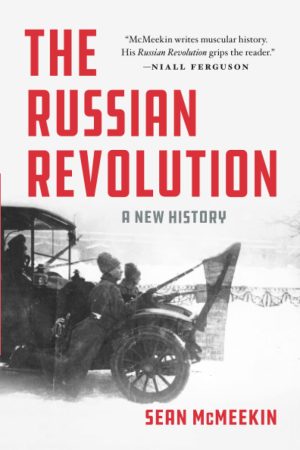
The issue also seemed not to come up in more specialized studies, even when it might have played an important role. A couple of years ago I’d read Sean McMeekin’s 2017 history The Russian Revolution, an outstanding, meticulous reconstruction of the complex and contingent circumstances that led to the 1917 fall of the Czarist Regime and the subsequent triumph of Lenin’s Bolsheviks.
The prologue is devoted to the murder of Grigory Rasputin, the peasant faith-healer who exercised such enormous influence over the Czar and his family that although he held no official position, he probably ranked for many years as the third most powerful figure in the Russian Empire. Moreover, his December 1916 death at the hands of a conspiratorial group that included top members of Russia’s elite seems to have been an important factor in destabilizing the regime, leading to its collapse in the February Revolution just a couple of months later.
Rasputin had long had severe misgivings about continuing the costly war against Germany, and this was a crucial motive behind his killing; indeed, fears of the defection of their huge Russian ally led members of British Intelligence to assist the effort. Although plots against Rasputin’s life had been circulating for months, he was finally struck down on December 20th, exactly when Germany’s very public “peace offensive” was gaining considerable international attention; and although the author doesn’t directly connect the two developments, the timing hardly seems likely to have been purely coincidental. So the desperate Allied moves to block any support for the proposed German peace plan may have actually helped trigger the Russian Revolution.
Obviously an early end to the Great War would have been an event of tremendous importance and the 1916 German efforts to secure peace were certainly treated as such in the news reports of the day. But Germany ultimately lost the war and the resulting official narrative blamed Europe’s catastrophe upon relentless German militarism, so that German peace proposal became a discordant element, raising troubling questions about the overall storyline. As a consequence, those facts were eventually flushed down the memory-hole for most of the next one hundred years, and if I hadn’t glanced at those original 1916 headlines, I certainly never would have discovered them.
Indeed, once I casually mentioned this interesting history on my website, one or two of the other commenters sharply challenged my claims, regurgitating the orthodox narrative that the Germans had been opposed to any reasonable negotiated peace, without explaining why all the contemporaneous media accounts had said exactly the opposite. According to these critics, Germany’s powerful military establishment would certainly have vetoed any such proposals, and I decided to see if I could find anything stronger to support my position than merely a thousand-word centennial op-ed in the Post written by a couple of obscure, junior academics.
To my considerable surprise, I discovered that just last year an entire book had been published on the lost chances for peace in 1916, apparently the first and only English-language work ever devoted to that seemingly important topic. Moreover, the author of The Road Less Traveled was Philip Zelikow, best known for having served as executive director of the 9/11 Commission, and therefore someone entirely in the good graces of the mainstream establishment. Near the end of his Introduction, he explained that he had been working on the project off and on for more than a dozen years.
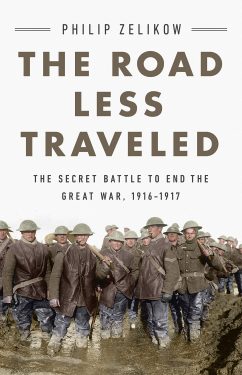
Although the main text ran well under 300 pages, his account of events seemed thorough and persuasive in its coverage, drawing heavily upon archival records and private diaries to firmly establish the same remarkable story that I had originally glimpsed in those old publications. His exhaustive research had uncovered a great deal of additional material, piecing together an account radically different than what had been presented in many decades of highly misleading treatments. And despite such seemingly controversial “revisionism,” his work received glowing endorsements from leading academic scholars and favorable reviews in such influential publications as Foreign Affairs, the National Interest, and Foreign Policy, though since it never caught the attention of my newspapers I’d remained unaware of it.
The story Zelikow tells is a really fascinating one, especially since it had remained almost entirely hidden from public awareness for more than a century.
Although influential elements including his closest political advisor had wanted America to enter the war on the Allied side, President Woodrow Wilson had been hoping all along that he could mediate an end to the conflict, much like his predecessor Theodore Roosevelt had done in the Russo-Japanese war, with the latter’s success crowned by winning the 1906 Nobel Peace Prize.
During the first two years of the fighting, neither side had responded favorably to his peace feelers, but by August 1916 circumstances had changed, and although the conflicted British leadership finally decided to continue trying their luck on the battlefield, the similarly-conflicted German government secretly accepted Wilson’s offer to preside as mediator at a peace conference. Given the horrific casualties that both sides had already suffered, it was widely believed that once public peace negotiations began, there was little chance that the fighting would ever resume. And with Wilson, most of the German leadership, and much of the British Cabinet ready for peace, the prospects certainly appeared excellent, especially since the Allies were so heavily dependent upon American supplies and financing for survival.
But although all the pieces seemed ready to fall into place, opportunities were repeatedly missed during the more than five months that followed. One important factor was the extreme difficulty of communications since the British had severed Germany’s trans-Atlantic telegraph cable at the beginning of the war, meaning that German communications with Wilson or their own ambassador had to take a circuitous route through various neutral countries and Latin America, finally arriving at DC in encoded form days or even weeks later.
Another crucial factor was that Wilson lacked any strong staff that could translate his broad ideas into serious policy proposals. Unlike major European countries, America back then had little bureaucratic infrastructure, with Wilson mostly writing his own speeches and regarding his new Secretary of State, a lawyer who had no diplomatic experience, as merely an intelligent clerk. Instead, his only close advisor was Col. Edward House, a wealthy Texan dilettante who often had eccentric views, and so strongly favored the British that he sometimes seemed to deliberately sabotage the peace effort. As a lifelong academic, Wilson himself had only spent two years as Governor of New Jersey before unexpectedly reaching the White House in 1913, and therefore he had little direct experience in either politics or international diplomacy.
So although the German government responded favorably to his offer of a peace conference in August 1916, Wilson failed to grasp the urgency of their request, and decided to take no action until after the November election. Meanwhile, within Germany, the military advocates of an unrestricted U-boat campaign against the American ships carrying Allied supplies were pressing very hard for their alternate strategy, which was sure to lead to a break in American relations.
After the British had suffered enormous casualties in their attack on the Somme, including losing nearly 20,000 dead on the first day of fighting, their own peace party was strengthened and the government became willing to consider Wilson’s offer. A son of Prime Minister H.H. Asquith had died in the battle and another had been wounded, while the German offer to restore occupied Belgium satisfied the most important British condition.
But then at the end of September, War Minister David Lloyd George — who had been a leading advocate of the American peace option — suddenly switched sides, and declared that Britain would never accept a compromise peace and would instead be willing to fight for twenty years if necessary in order to achieve a total military victory, with anything less than a “knockout” being “unthinkable.” Zelikow plausibly argues that Lloyd George believed he could use his reversal on peace to gain the support of British hardliners such as Lord Northcliffe’s powerful newspaper group for replacing Asquith as Prime Minister, and indeed that was exactly what happened within a couple of months, with the advocates of peace being pushed out of the government.
Despite the shifting positions of the British, Wilson returned to his peace efforts after his November 7th reelection, only to encounter strong opposition from House, his key advisor. Although Britain was already locked in a desperate struggle with Germany and totally dependent upon American supplies, House somehow became convinced that if America pressed too hard for peace, the British would declare war against our own country. Incredible as it might sound to us, House repeatedly argued to Wilson and others that a British army could sweep down from Canada while the Royal Navy would land hundreds of thousands of troops from their Japanese ally on our coasts, together seeking to conquer the United States. Although these bizarre concerns were rejected, they assisted the overwhelmingly pro-British State Department officials in delaying Wilson’s plans to launch his peace proposal.
Around this same time, the German ambassador began pleading with the Wilson Administration to act immediately lest the opportunity for peace be lost, and Zelikow entitled this chapter “Peace Is on the Floor Waiting to Be Picked Up!” which was one of the impassioned phrases that envoy had used. Meanwhile, Germany’s hard-line military leadership was steadily increasing the pressure on their government to abandon its peace efforts and instead return to the unrestricted submarine warfare that they claimed could quickly win the war.
Growing desperate at the president’s endless delays, Germany and its allies eventually issued their own unconditional call for peace talks on December 12th, hoping that step would finally prompt Wilson to act by inviting participants to a peace conference at the Hague and offering himself up as the mediator. The German announcement captured the attention of the world and forced Wilson to respond lest he be eclipsed, and a week later he finally circulated his own peacemaking note, but as Zelikow explains, it constituted a “misfire,” lacking as it did any specifics let alone an invitation for the warring parties to attend an actual peace conference. So the Allies firmly rejected the German offer as a “trick” and were able to ignore Wilson’s statement since it required them to do nothing. Over the next few weeks, the opportunity for peace faded away, and in late January the Germans announced they would return to unrestrained submarine warfare, leading Wilson to break off relations and move towards war with Germany.
Although influential elements within the American government had sought this result from the beginning, Zelikow persuasively argues that the mistakes, errors, and misunderstandings by Wilson and the others also seeking a negotiated peace were probably more responsible for this outcome than the efforts by the individuals who actually intended it. His harsh historical verdict on the former hardly seems unfair:
In the failure to make peace at the most opportune moment, no one failed, and failed the world, more than President Wilson. His was the most consequential diplomatic failure in the history of the United States.
Thus, one of the most important turning points of the twentieth century probably came in late 1916 with the tragic collapse of a peace effort that initially seemed so likely to succeed, and Zelikow’s gripping narrative tells the story of how and why that opportunity slipped away. By all rights, the Lost Peace of 1916 should have become the subject of countless novels, plays, and films, but instead it remains almost totally unknown today, even among the most highly educated.
My own encounter with some of the lost history of World War I came when I noticed the headlines and read the articles that had run in our leading publications while the story was still unfolding. Once important events have been finalized and the heroes and villains officially determined, there is a natural tendency to reinterpret the past in the light of what ultimately transpired, thereby establishing a simple narrative that follows straight lines. Put another way, the winners write most of the histories.
For that exact reason, I think that one of the least known but most absolutely valuable books about the Great War was completed in mid-March 1917, just weeks before our own involvement inevitably distorted all subsequent analysis. The author was Lothrop Stoddard, who had earned his Ph.D. in history at Harvard and was then just beginning a career that would soon establish him as one of America’s most influential public intellectuals. His book was Present-Day Europe, a scrupulously even-handed survey of the wartime politics and recent history of each individual nation.
The work is not overly long, running less than 75,000 words, and can easily be read in just a day or two, but it provides an enormous wealth of detailed, contemporaneous information, much of which appears to have been left on the cutting-room floor of later historiography, written after the official narrative had already hardened. Moreover, as he explained in his Preface, Stoddard followed a rigid requirement of only quoting the natives of each country in their own chapter, Englishmen on England, Germans on Germany, and so forth, thereby providing an invaluable presentation of the elite and popular sentiments of each nation, something very useful to those of us seeking to reconstruct the situation more than a century later.
- Present-Day Europe
Its National States of Mind
Lothrop Stoddard • 1917 • 74,000 Words
Stoddard’s book had gone to press just weeks after the final rejection of the German peace offer, and he hardly let a failed diplomatic project well-known to all of his readers dominate his narrative. But although the author was unaware of the extensive backstory, he gave the peace efforts reasonable treatment in the chapters on Britain and Germany, adding interesting details missed by both Zelikow and Hochschild. For example, as early as June 1916 several prominent British political figures of very mainstream views had publicly called for peace negotiations, including in the pages of the Economist, and their declaration had been emphatically endorsed by the editor of that influential publication. But this high-profile ideological rebellion in the elite media was swiftly crushed, with the editor losing his job as a consequence. Stoddard later explained that the uncompromising Allied rejection of all German peace offers had by early 1917 “spurred the entire German people to desperate wrath.”
A perfect example of the tremendous value of Stoddard’s material comes in his discussion of war aims, which obviously provided the necessary context for the differing national reactions to early peace negotiations, and there was a stark contrast between those of the two opposing camps. The goals of the Germans were relatively mild, with almost no demands for annexations of new territory. By contrast, the French were absolutely committed to the total destruction of Germany as their primary objective, with those sentiments being almost universally held across all political parties. They regarded the unified Germany created in 1870 as simply too powerful a European rival, which therefore had to be fragmented back into multiple, weak states. And not only would France reabsorb the lost provinces of Alsace-Lorraine, but it would also annex much of the Rhineland, territory that had been German for a thousand years. The British were not quite that extreme, but most of their political leadership class strongly believed that Germany needed to be totally crippled as an economic and military competitor.
In the East, the primary war aim of the Russian Empire was the annexation of Constantinople, the capital city and largest metropolis of Germany’s Ottoman Empire ally, which would give Russia strategic control of the Bosphorus Straits. Although Serbia had already been defeated and occupied by this date, elements of the Serbian government had originally provoked the war by arranging the assassination of Franz Ferdinand, the prospective Austro-Hungarian ruler, with their broader goal being the total destruction of that multi-ethnic state, several of whose major pieces would then become part of a Greater Serbia.
So to a considerable extent, Germany and its allies were actually the “status quo powers,” reasonably satisfied with the existing arrangement of borders, a situation totally different from that of their Allied opponents. When one side in a conflict is determined to dismember and destroy the other, an early peace is difficult to arrange. Moreover, the German alliance faced an opposing coalition that was far superior in manpower, economic strength, and potential military resources, so it was fighting what it reasonably regarded as a purely defensive war. This clear situation at the time is exactly contrary to what has been implied or even explicitly stated in our basic History 101 textbooks for the last one hundred years.
Obviously, the complete picture was not entirely one-sided, and an important factor behind the outbreak of the war had been German concerns over the rapidly growing population and military power of its enormous Russian neighbor to the east. Indeed, although the very powerful Social Democratic political block in the German parliament was strongly anti-militarist, its members were also intensely hostile to the Czarist regime, which their influential Jewish elements demonized as fiercely anti-Semitic, so the Russian threat was an important factor behind the near-total domestic political unity once war broke out. Meanwhile, important elements of the German military establishment had long favored waging a preventive war aimed at breaking Russian power before it became too overwhelming.
Major German victories during the first couple of years of fighting had led to the occupation of considerable Russian territory, and Jozef Pilsudski, Poland’s George Washington figure, had organized an army of 20,000 Poles that fought side-by-side with the Germans. As a consequence, the Germans decided to resurrect an independent Poland as a German client state more than a century after it had disappeared from the map, a geographical change that would greatly weaken Russia while providing a buffer against the latter’s future westward expansion.
Although of relatively minor importance, one of Stoddard’s most impressive sections is his discussion of the Balkans, home to several bitterly quarrelsome states, whose stories I had never previously seen treated, let alone analyzed in such intelligent detail. These countries had all fought wars against each other in 1912 and then again in 1913, and given the triggering 1914 events in Sarajevo, the Great War that followed might almost be regarded as merely a third consecutive Balkan round of fighting that unexpectedly brought in the rest of Europe.
As the author points out, prior to the Ottoman conquest and long occupation, each of the different Balkan peoples had at one time or another ruled a larger regional empire of their own, which they naturally sought to resurrect after Ottoman power receded. But all those previous Balkan empires had overlapped in territory, thus leading to bitter, conflicting claims, and the repeated rounds of new fighting between Bulgaria, Romania, Serbia, and Greece, all of which also coveted portions of the neighboring Austro-Hungarian and Ottoman empires, thereby contributing to the severe instability. Totally contrary to my assumptions, Stoddard explained that these individual countries actually had very different political and social profiles, with Bulgaria’s characteristics being entirely different from those of neighboring Romania, for example, though they had always been lumped together in my mind.
Although Stoddard’s book focused on the internal dynamics of the major European participants without directly addressing the exact causes of the conflict, his material generally supported the impression I’d always gotten from my textbooks that two heavily-armed and hostile alliances had blundered into a huge war, neither of them fully expecting or intending what eventually occurred. Just as Zelikow’s detailed scholarship indicated that the US, Germany, and Britain had together fumbled away the possibility of peace in 1916, the European great powers had started the conflict a couple of years earlier in much the same fashion.
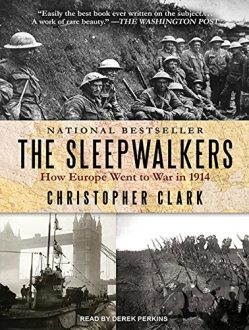
Two major historical volumes focusing on exactly that last topic had appeared about a decade ago, just before the hundredth-year anniversary, and they strongly reinforced that same conclusion with exhaustive scholarship. The Sleepwalkers by Christopher Clark and July 1914: Countdown to War by Sean McMeekin, together received a very lengthy and favorable front-page treatment in the NYT Book Review by Harold Evans, former editor of the Times of London. I’d read the first of these books a couple of years ago and the second just very recently, and found them both excellent, telling as they did a broadly similar story across their combined 1,100 pages.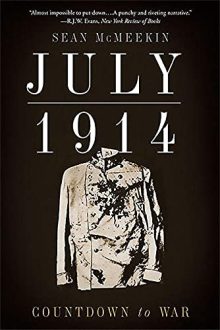
McMeekin’s very detailed narrative of the exact circumstances and decision-making process during July 1914 greatly emphasizes the extremely important role of unexpected, contingent factors that could so easily have diverted the history from its track. For example, just prior to the assassination in Sarajevo, Britain seemed on the very verge of violent civil war over Irish Home Rule, a conflict so bitter that it was weeks before the Cabinet even considered the developing situation in the Balkans, so if the events had occurred just a couple of months later, British military involvement might have been impossible. Similarly, by his strong initial stand against any attack on Serbia, the powerful Hungarian Prime Minister prevented the sort of immediate retaliatory strike that probably would have avoided bringing in other countries, unlike the eventual attack that came more than a month after the assassination; so the determined peace policy of a leading European statesman actually helped trigger the wider war. In all these countries, there were obviously powerful factions that had spent years pressing for war, but there were other powerful factions that felt otherwise, and the circumstances of the outbreak depended largely upon the particular decisions made.
Once the enormous conflict began, assigning the exact measure of guilt for the calamity became a strategic objective during the years that followed, especially on the part of the Allies, with Clark even noting that both the French and the Russians created fraudulent documents that they then inserted into their own diplomatic archives. The scholarly dispute over relative war-guilt has continued unabated for more than a century now, and while neither of these books settles the matter, I do think that they provide a very solid factual basis, explaining exactly who did what and when, thereby allowing each of us to assign the appropriate quantity of guilt to those particular actions.
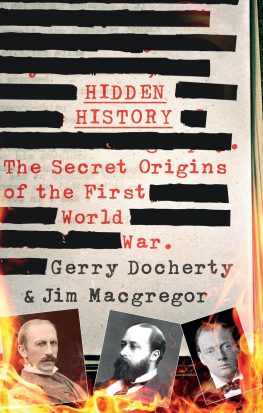
A very different sort of book on the same topic published almost simultaneously was Hidden History by amateur British historians Gerry Docherty and Jim Macgregor. Although totally ignored by the mainstream media, their extremely conspiratorial account of Britain’s political leadership prior to the outbreak of the war has become wildly popular in many alternative circles, and I finally decided to read it a couple of years ago. Unfortunately, I was far from impressed by their analysis, and although they usefully described some of the machinations of the most aggressive British political faction, I think they accorded it far more power than it probably possessed. I wrote my own appraisal in a comment after I’d only read a chapter or two, but once I’d finished the remainder of the book, my negative verdict was unchanged:
Well, I’ve seen numerous commenters give glowing endorsements of the Docherty/Macgregor book over the last year or more, so since I had it sitting around, I finally decided to take a look. So far, I haven’t really been very impressed.
As near as I can tell, their “revolutionary” hypothesis is that near the end of the 19th century a small group of individuals near the top of Britain formed a “secret society” with the central goal of greatly enhancing the power and wealth of the British Empire, sometimes using ruthless or dishonest means, and permanently dominate the world.
Is that really so remarkable? Suppose the “secret society” had never been formed? Wouldn’t we naturally assume that the normal, run-of-the-mill leaders of Britain would be doing their best to enhance the power and wealth of the British Empire? Wouldn’t it be much more shocking if they weren’t?
Should someone write a book: “Top executives at Google are secretly trying to expand Google’s wealth and power and gain dominance over the entire Internet.” Or “Top executives at Goldman Sachs are secretly trying to expand Goldman’s wealth and power and permanently dominate Wall Street.”
Neither Docherty nor Macgregor seem professional historians, and they’re certainly correct in attempting to refute the “legend of German villainy,” but I think that lots and lots of professional historians have already done that.
Decades ago, my ordinary high school texts emphasized that one of the main factors behind WWI was Britain’s fears of a rising Germany. And it’s also true that another major factor was Germany’s fears of a rising Russia. Historians have endlessly argued about the relative weighting of all these different factors, but everyone’s certainly aware of them.
In sharp contrast, a different book published just over a century earlier might today be seen as a product of the conspiratorial fringe, but it was certainly not viewed that way at the time, given that the author was widely regarded as one of America’s leading public intellectuals and the work was favorably discussed in the influential Literary Digest. David Starr Jordan was the founding president of Stanford University, a biological scientist by training who had published at least ninety-odd books, mostly of a scientific nature but also including works of broader public policy.
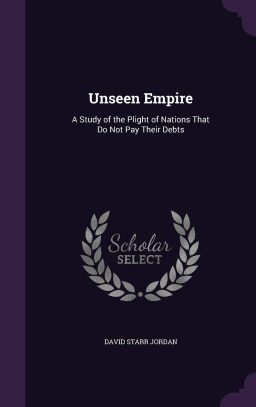
Unseen Empire, which appeared in 1912, fell into that latter category and argued that although the United States and the major European powers remained nominally sovereign, their heavy, unproductive military spending had gradually bound them into tight coils of debt, leading most of them to quietly become political vassals of a network of powerful financiers, the “unseen empire” of the title. So instead of kings, parliaments, or kaisers, the true rulers of Europe were a set of interconnected and intermarried banking dynasties, almost all of them Jewish: the Sterns and Cassels of Britain, the Foulds and Pereires of France, the Bleichroders of Germany, the Gunzburgs of Russia, the Hirsches of Austria, the Goldschmids of Portugal, the Camondos of Turkey, the Sassoons of the Orient, and above all of them, the Rothschilds of London and Paris.
Although in today’s world, such a description might seem insane or at least incendiary, Jordan presented it rather matter-of-factly without rancor, and indeed that particular claim didn’t even constitute the main theme of his analysis. The Stanford University President firmly regarded modern warfare as disastrous for a society, but also argued that wars had become so ruinously expensive that they could not last for long. Moreover, since the true financial owners of Europe believed that they were bad for business, no major wars would be permitted to break out.
Obviously, Jordan’s predictions were exploded just a couple of years later, but subsequent events did provide some hints that his analysis was not entirely mistaken. For example, according to Stoddard’s account, much of Britain’s wealthy Jewish elite, often having German roots like the Rothschilds, was widely regarded as being in the peace camp, so much so that in 1916 hard-line publications regularly denounced the country’s German-Jewish financiers as undercutting Brtain’s continuing military resolve. Similarly, Zelikow reports that Paul Warburg, the German-Jewish vice chairman of America’s Federal Reserve, was an enthusiastic supporter of Wilson’s efforts to pressure Britain into making peace, including discouraging American banks in late 1916 from making the additional loans that Britain required to purchase supplies. In private communications, the strongly pro-British head of the J.P. Morgan banking empire denounced that decision and argued for a public attack on the German-Jewish influence that he believed was behind this peace policy. Similarly, many of the wealthy Jewish interests in Germany were generally in the peace camp. So Jordan’s main mistake was probably to overestimate the political power of Europe’s dominant financial interests.
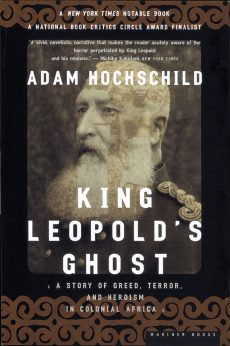
This extended discussion of the Great War was prompted after I read Hochschild’s book on the British anti-war movement, and I’d decided to do so because I’d been very impressed with his previous, award-winning bestseller King Leopold’s Ghost, which I’d read earlier this year. That latter work recounted the vivid history of the Belgian Congo and the horrific mistreatment of its inhabitants, which may have claimed the lives of up to ten million Africans, with Hochschild also telling the story of the British-led international moral crusade against those crimes, privately organized by E.D. Morel, a journalist, and Roger Casement, a civil servant. Their final victory came just a year before war broke out, and Hochschild’s last two chapters constitute an extended epilogue, including a description of the sad wartime fates suffered by his pair of champions.
At the time of the Sarajevo assassination, both Morel and Casement were towering international heroes, with the latter having even been knighted for his humanitarian achievements. But both were firmly opposed to the war and generally sympathetic to Germany’s position, and their public standing quickly collapsed, merely one of the many ironies that Hochschild describes.
One of the worst horrors that the colonial Belgians had inflicted upon the Congolese was chopping off the hands of those Africans who failed to meet their work-quotas or otherwise disobeyed, and photographs of the atrocity victims had triggered outrage across the globe. But in August 1914, the German army invaded Belgium, and the Belgians were suddenly transformed from monsters to martyrs, with British propagandists soon falsely claiming that the Germans were chopping off the hands of disobedient Belgians. For many years, the story of the millions of Africans who died in the horrors of the Belgian Congo had been the world’s leading humanitarian issue, but Hochschild plausibly argues that the sudden wartime propaganda-elevation of Belgians to unrivaled global victimhood status probably explains why that earlier story so quickly faded from public awareness until being eventually revived a half-century later.
Casement himself was Irish and his efforts to free the Congolese had brought him public honors and acclaim; but when he began seeking German help to free his own country from British rule, he was hanged for treason, becoming the first holder of a British knighthood to suffer that fate in hundreds of years. Morel similarly fell from grace for his anti-war writings, and after he sent a copy of one of his pamphlets to his pacifist friend, Romain Rolland, a French Nobel Laureate in literature living in Switzerland, he received six months of brutal imprisonment, which permanently broke his health.

However, once the war ended, British sentiments changed, and the newly rising Labour Party considered Morel a wronged hero and nominated him as a candidate for Parliament. As a young Cabinet Minister, Winston Churchill had played a crucial role in leading Britain into the world war, and in a remarkable symbolic turnabout, Morel now defeated him for reelection in 1922, taking his seat in the House of Commons. Morel was one of Labour’s leading spokesmen on foreign affairs and according to Hochschild, he was expected to be named Foreign Minister in Ramsay MacDonald’s new Labour government of 1922, but MacDonald decided to keep the portfolio in his own hands, perhaps because he feared Morel might overshadow him as a political rival. However, Morel’s political fairy tale had a less than happy ending, for although he was easily reelected in 1924, his harsh wartime imprisonment had destroyed his health and he died later that year at the unripe age of 51.
I had never previously heard of Morel and found his story a fascinating one, but when I consulted his Wikipedia page I discovered that much of the long entry focused on aspects of Morel’s postwar activism that the book had avoided mentioning, presumably for ideological reasons. In his epilogue chapters, Hochschild had rightly denounced the hypocrisy of the major European powers, which were willing to condemn the brutal treatment of Africans under Belgian colonial rule while ignoring the fact that they often behaved in a similar manner in their own African colonies. But he must have found Morel’s extreme lack of any such hypocrisy troubling for other reasons, so the last major project of that remarkable man’s career was excluded from his hagiography.
Morel heavily blamed France and Czarist Russia for the war and regularly condemned the extremely punitive terms of the Treaty of Versailles from the pages of Britain’s Foreign Affairs journal, an influential Labour publication that he directed, condemning, for example, the mutilation of Hungary, which had lost two-thirds of its territory.
But according to Wikipedia, his most important postwar project was launching the international “Black Shame” campaign, denouncing the horrific atrocities committed by France’s African colonial troops against the helpless German civilians of the occupied Rhineland, including widespread rape and murder. Wikipedia entries are usually heavily sanitized, so portions of this very surprising entry are worth quoting at length:
In a front-page article in The Daily Herald on 9 April 1920 by Morel about the French occupation of the Rhineland, the headline read, “: “Frankfurt runs red with blood French Blood Troops Use Machine-guns on Civilians”.[42] The following day, the same paper had another cover story by Morel, the title of which was “Black Scourge In Europe Sexual Horror Let Loose by France On Rhine Disappearance of Young German Girls”. In it, Morel wrote that France is “thrusting her black savages into the heart of Germany” and that the “primitive African savages, the carriers of syphilis, have become a horror and a terror” to the Rhinelanders.[42] In his article, Morel claimed that the Senegalese soldiers serving in the French Army were “primitive African barbarians” who “stuffed their haversacks with eye-balls, ears and heads of the foe”.[43] Morel declared in his article:
“There [the Rhineland] they [the Senegalese soldiers] have become a terror and a horror unimaginable to the countryside, raping girls and women – for well known physiological reasons, the raping of a white woman by a negro is nearly always accompanied by serious injuries and not infrequently has fatal results; spreading syphilis, murdering inoffensive civilians, often getting completely out of control; the terrible barbaric incarnation of a barbarous policy, embodied in a so-called peace treaty which puts the clock back 2,000 years”.[43]
Morel wrote that “black savages” have uncontrolled sexual impulses that “must be satisfied upon the bodies of white women!” (emphasis in the original).[44]
The phrase that Morel coined to describe the alleged terror by Senegalese troops in the Rhineland was the “Black Horror on the Rhine“, which became internationally famous, and the campaign against the “black horror” took much of his time for the last four years of his life.[45] Morel predicated the “black horror” would cause another world war, writing that the average German boy was thinking: “Boys these men raped your mothers and sisters” (emphasis in the original).[46] Morel used the “black horror” as a way of attacking France, which he claimed had caused a “sexual horror on the Rhine” and whose “reign of terror” was a “giant evil” that should inspire “shame into all four corners of the world” and ultimately should “a revision of the Versailles Treaty and the relief for Germany”.[47]
The somewhat censorious Wikipedia article condemns Morel for his blatant racism and cites a German sociologist who argues that those same sentiments had actually governed his earlier Belgian Congo activism as well. But this new Rhineland campaign was soon followed by his rise within the British Labour Party and his electoral triumph over Churchill, so both British Socialists and British voters apparently gave a different verdict. Moreover, Adolf Hitler soon alluded to some of Morel’s accusations in the pages of Mein Kampf, though in much less blood-curdling fashion, and those brief, mild passages have often been cited as proof of the German dictator’s deep racism.
Hochschild is a committed racial liberal, whose lifelong support for blacks in the American South and under Apartheid dominated his early career, and this easily explains why he elevated Morel to heroic stature for his international campaign to end European atrocities against Africans in the Belgian Congo. But it equally well explains why he excluded any mention of his moral exemplar’s final humanitarian crusade, this time focused on African atrocities against Europeans, which was contemporaneous with similar political projects by the KKK in America and may have even played an important role in inspiring Adolf Hitler.
Related Reading:
Iranian tanker formerly impounded by Greece docks in Syria
The Cradle | December 3, 2022
The Lana, an Iranian crude oil tanker impounded by Greece and whose contents were illegally seized by the US earlier this year, delivered an estimated 700,000 barrels of oil to the Syrian port of Baniyas on 2 December, Reuters reported, citing a satellite tracking agency.
The oil delivery marks the end of a period of uncertainty regarding the fate of the shipment onboard the Lana tanker.
Greece’s impounding of the ship and the US seizure of its oil cargo took place in May of this year and was immediately condemned by Iranian authorities as an illegal act of ‘maritime piracy.’ In response, Iran seized two Greek tankers that same month, retaliating to the coordinated theft of its oil by Greece and the US. Tehran eventually released the Greek tankers on 16 November.
While part of the oil cargo was initially meant to be diverted to the US by the Ice Energy ship chartered by Washington, a Greek court ruled to return the oil to Iran in June.
The oil delivery to Syria comes as the country is facing severe fuel shortages due to the US occupation and looting of its oil fields. The oil looted by the US is smuggled out of Syria in massive quantities.
Lately, Turkish bombardments against the country’s energy facilities have also exacerbated the crisis.
According to data from the US-based United Against a Nuclear Iran lobby group, Syria received around 1.39 million barrels of oil from Iran in November alone. These oil shipments alleviate Syria’s crisis and improve Iran’s standing as an energy exporter – a role that it has been working hard to expand despite the sanctions imposed by Washington.
As the west fights to survive the man-made energy crisis and the ramifications of the Ukraine war, Iran has been attempting to build a strong economy based on mutual cooperation aimed at circumventing the sanctions against it.
Under the influence: Sunak and the Net Zero zealots who surround him
By Stephen McMurray | TCW Defending Freedom | December 1, 2022
Who are the people fuelling the British government’s obsession with Net Zero, an obsession that is fast leading to the country’s economic destruction – to ‘zero energy supplies, zero growth, zero food and zero hope’ as Stephen McMurray put it in TCW yesterday. The first part of his investigation into the elite and privileged group exerting their influence over Prime Minister Rishi Sunak concentrated on the ‘Friends of COP26’. Today his focus turns on the influence of the climate zealot MPs, peers and Sunak’s family ties.
AS noted, various Friends of COP26 have links to the UK government, but there is another group of Net Zero promoters linked to the UK parliament who may also have undue influence over Rishi Sunak. These are Peers for the Planet, members of the House of Lords who have even established their own limited company. They, too, wrote a letter to Sunak urging him to attend COP27. They have also previously written to him to push him to follow the Net Zero agenda.
Peers for the Planet is funded by various organisations, one of which is the Laudes Foundation. One of the members of the Laudes advisory council is Sharan Burrow, general secretary of the International Trade Union Confederation, member of the WEF Global Future Council on the Future of Production and a Friend of COP26.
Baroness Haymanis the co-chair of Peers for the Planet. She is a shareholder in Standard Chartered Bank and Alphabet, Google’s parent company. She is also chairperson for the charity Malaria No More, the former president of which was the Net Zero obsessive and promoter of the Great Reset, King Charles III. In 2019 Malaria No More UK received a grant from the Bill and Melinda Gates Foundation for more than $8million dollars.
Baroness Hayman has shares in LVMH Moet Hennessy SA, the Louis Vuitton company that specialises in luxury goods, wine and spirits. (The winemaking business is one of the worst industries for carbon emissions.) The company also owns luxury hotels.
The other co-chair of Peers for the Planet is Baroness Worthington, who has her own company, Worthington and Associates, which provides clients with ‘climate change communications and philanthropy advice’. She is also a director of Jupiter Green Investment Trustfocusing on ‘green solutions’.
Another group is the all-party Parliamentary Renewable and Sustainable Energy Group (PRASEG) comprising 125 MPs who are pushing for Net Zero. The chair of this group is Conservative MP Bim Afolami. Last year members attended the COP26 conference where, according to Mr Afolami: ‘It was a pleasure to join the Children’s Investment Fund Foundation [founded by Sir Chris Hohn, for whose hedge fund Sunak worked] to host senior politicians including the Chair of the Select Committee for BEIS, the Shadow Secretary of State for BEIS, the PPS to the COP26 President and leading authorities on climate change and geopolitics from Chatham House and the Climate Change Committee. We discussed the UK’s role in scaling global renewable energy and the challenges of encouraging a swift and just energy transition.’ Baroness Hayman was also in attendance.
It is surely inconceivable that Rishi Sunak, with his background in government and banking, would not be influenced by all these people, with their links to banking, investment funds, the World Economic Forum, Big Tech and Bill Gates. There are simply far too many powerful, influential people pushing the madness of Net Zero for him to ignore. However, he could also be under the influence of those closer to home.
Sunak’s sister, Raakhi Williams, has worked extensively for the Department of International Development and the Foreign, Commonwealth and Development office. It was in this latter role that she was one of the chief organisers of COP26.
In a talk she later gave to schoolchildren she stated that she led the Adaptation-Loss Damage Day at the conference, pushing the need for climate reparations.
Her husband is Peter Williams, CEO of the International Institute of Rural Reconstruction who has consulted for the World Bank and the Gates Foundation and is dedicated to following the UNs sustainable development goals and, of course, pushing the Net Zero agenda. The board of the IIRR is filled with people with a background in banking.
The person in Rishi Sunak’s family who could assert the most influence over him is his father-in-law, N R Narayana Murthy, referred to by some as ‘India’s Bill Gates’. He is the billionaire founder of the IT company Infosys. Sunak’s wife Akshata is a shareholder and one of the wealthiest women in the UK. Infosys is part of the Alliance of CEO Climate Leaders who wrote an open letter to the world leaders at COP27 emphasising how important it was to continue the push towards Net Zero and provide financial incentives to renewable energy companies.
Murthy is a regular at World Economic Forum conferences and co-chaired the forum in 2005 with Bill Gates amongst others.
Infosys formed an alliance with Microsoft to train IT specialists, with Bill Gates meeting Murthy at Infosys’s Bangalore premises in 2002. The company later joined forces with the Gates Foundation to fund a project to help teach computer science to children around the world.
Murthy has been on the advisory board of numerous organisations including the Ford Foundation, the UN Foundation and Unilever. Kate Hampton, Friend of COP26 and the CEO of the Children’s Investment Fund Foundation, the charity arm of Sunak’s old hedge fund, was also on the advisory board of Unilever, and another Friend of COP26, Paul Polman, was its former CEO. Moreover, Sunak’s wife also worked there at one point.
Unilever was one of the main sponsors of COP26. They were also involved in COP27. They say, ‘An important part of Unilever’s own climate work is using our voice and influence for good. At COP27, we’re asking governments to take more ambitious climate action and start building resilience for the future by setting out stronger national plans with more ambitious targets that accelerate action and ensuring a fair and just transition to a net zero future by unlocking finance and investment for decarbonisation and resilience in developing countries . . .’
In other words, they are pushing for climate reparations.
Interestingly when Sunak was Chancellor he hired an ex-CEO of Unilever, Vindi Banga, to be the Chair of UK Government Investments (UKGI). Banga was a leader at the World Economic Forum’s Sustainable Development Impact Summit. UKGI is supposed to be responsible for managing government assets in the best interests of the UK public. On the surface it would seem odd, therefore, that Banga is a partner in the private equity firm Clayton, Dubilier and Rice (CD&R) who like to acquire British Companies for themselves. However, when you realise that Sunak thinks foreign investors buying up British companies is a good thing, it makes more sense.
CD&R were recently involved in the acquisition of the Morrisons supermarket group. This was controversial because Morrisons owns 339 petrol stations and, as CD&R own a company called Motor Fuel Group which has 921 petrol stations, it was thought that this could lead to a lack of competition and higher petrol prices.
Why would Mr Banga, an advocate of sustainable development i.e. Net Zero, be buying petrol stations? Perhaps it’s because CD&R’s Motor Fuel Group is going to spend $400million transforming petrol stations into EV charge stations and the more stations they acquire the more the public who own petrol cars will be forced off the road.
In conclusion, whether Sunak’s decision to go to COP27 was because he was cajoled by Friends of COP26, condemned by his buddies in the banking fraternity, harassed by MPs or peers, berated by his sister and brother-in-law or chastised by his father-in-law, it is clear that he is under the influence of Net Zero zealots from every angle.
The only people who he doesn’t seem to listen to are the citizens of the United Kingdom who are daily becoming more aware that the climate crisis is one big global money-making scheme for billionaires, bankers and investors, orchestrated by globalists like the World Economic Forum using the mainstream media to promulgate decades of fear-mongering propaganda based on dodgy computer modelling, voodoo science and preposterous predictions.
The whole scheme is then enforced by banking cartels refusing to loan money to anyone not buying into their apocalyptic vision, gleefully advocating that businesses which don’t comply should go bankrupt and forcing governments to legislate businesses and the public into submission. Meanwhile, behind the scenes they are investing in everything ‘green’ they can get their hands on to enrich themselves even further whilst the country hurtles towards economic and social Armageddon.
When someone is driving under the influence it is prudent to remove them from the vehicle and take away their access to it. Something similar needs to happen to Rishi Sunak and this political class of Net Zero apostles of the climate cult before we are driven over the edge and into the abyss from which there is no return.
Parent groups revolt over French power outage plan
RT | December 3, 2022
Closing schools to combat the energy crisis in France is unacceptable, French parents’ groups announced this week, after the government instructed regional authorities to brace for potential localized power outages.
Schools were not prioritized by planners in the event of limits to the energy supply network during the winter.
“Parents do not want school closures. We have seen the impact of closures on students,” Valerie Desouche, Deputy Secretary of the National Union of Autonomous Parents’ Associations (UNAAPE), told BFM TV on Thursday, referring to the lockdowns during the Covid-19 pandemic.
She added that it was “unthinkable” not to treat schools as a priority during the energy crisis.
“We want schools to be open at all costs,” Desouche said. “We can’t put children’s education second.”
Vice President of the Federation of Parents for Public Education (PEEP) Laurent Zameczkowski also urged that schools be prioritized, saying “During the health crisis, we did everything to keep the schools open, and now the energy crisis will be the reason [to shut them down]?”
The group released a statement on Wednesday, arguing that “energy austerity cannot be done at the expense of the health and the future of students.”
According to France Info radio, the government plan entails potential outages between 8am and 1pm and between 6pm and 8pm that could last for up to two hours. Priority sites include hospitals, police stations and fire stations, but not schools, which could be forced to cancel some lessons.
“We are not saying that there are going to be power cuts, but that it is not impossible,” government spokesman Olivier Veran said on Thursday. France, together with many other European countries, has been looking for ways to conserve energy and been bracing for possible outages as Western states try to curb Russian oil and gas exports as part of sanctions over the Ukraine conflict.
Switzerland, Facing an Unprecedented Power Shortage, Contemplates a Partial Ban on the Use of Electric Vehicles
It turns out that you can have battery-powered cars, or you can have renewable energy, but you can’t have both.

eugyppius: a plague chronicle | December 1, 2022
The Swiss Confederation usually imports electricity from France and Germany to keep the lights on over the winter, but this year neither country has any power to spare. Many French nuclear power plants are down after years of postponed maintenance, while in Germany we suffer from a superfluity of idle wind turbines and a (self-imposed) shortage of natural gas.
The Federal Council of Switzerland has therefore published draft legislation, which outlines four tiers of escalating measures to conserve electricity and avert potential blackouts. The first prescribes a lot of temperature restrictions for things like refrigerators and washing machines. The second includes more unusual rules, such as the demand that heating in clubs and discotheques “be set to the lowest level or switched off completely,” and that “streaming services … limit resolution of their content to standard definition.” The third foresees cutting business hours, banning the use of Blue Ray players and gaming computers, and also limiting the use of electric cars, which should be driven only when absolutely necessary. A fourth and final tier mandates closure of ski facilities, casinos, cinemas, theatre and the opera.
A lot of these rules look unenforceable, but they said the same thing about contact restrictions during the pandemic. It turns out that the state really can prevent you from socialising with people in your own home if it wants to, especially when there’s no shortage of prying neighbours eager to snitch.
Feasibility isn’t the point, though. It’s the optics here that are most astounding. Electric vehicles, which politicians have heavily subsidised as one of their primary policy responses to climate change, are just now crashing against that other great arm of the green agenda, namely renewable energy. You can’t drive everyone into ever greater dependence upon the electrical grid, while also orchestrating an energy transition to wind (which hardly blows in Germany, except in the north) and solar (which generates no meaningful power in the depths of the Central European winter). Gas from Russia was the magic ingredient that kept the whole renewables charade going, and we’re out of that now. There’s no way to cover up the failure; not even the green-friendly German media has any excuse or messaging angle here.
Protesters rally near derailed train with NATO hardware
RT | December 3, 2022
A group of Greek protesters gathered near a train carrying NATO equipment that derailed on Friday. The demonstrators were rallying against the presence of US military bases in Greece and the involvement of Western countries in the Ukraine conflict.
The train went off the tracks near the port of Alexandroupolis in northeastern Greece. According to local media, it was heading to the Balkan and Baltic states as part of NATO’s campaign to ramp up defenses against Russia.
It was transporting tanks, armored vehicles, and a number of containers.
The accident happened when the train was moving at a slow speed, and a wheel on one car leaned to the side due to the heavy cargo and slipped off the track, local media reported. Following the accident, cranes and other equipment were moved in to salvage the military hardware. There have been no reports of any injuries or damage to the equipment.
According to footage posted to social media, roughly a dozen people held a protest close to the train. The participants cried out a slogan: “Alexandroupolis is the port of the people, not the stronghold of the imperialists.”
“No participation in the war in Ukraine“ and “let the military bases and the Americans get out,” they said.
In May of this year, Greek Foreign Minister Nikos Dendias claimed that the port of Alexandroupolis would play a crucial role in supporting the US military presence in the country. Moreover, amid the Ukraine conflict, the city has become a key hub for US forces, who have been using it to deliver war material. In August, The New York Times reported, citing unnamed US officials, that the equipment was meant solely for use by American units on NATO territory, and not for Ukraine.
The new demonstration comes after this past spring Greek railway workers refused to transport US and NATO armored vehicles from Alexandroupolis to the borders of Ukraine, with several activists throwing red paint on the Western equipment.
Featured Video
Pravin Sawhney: Massive Escalation Pushes Every Side Toward the Brink
or go to
Aletho News Archives – Video-Images
From the Archives
A sample of vaccine and injectable medication tragedies during my lifetime
This is what happens when you demand speedy production in an era of politicized regulation
By Meryl Nass, MD | February 12, 2022
All these tragedies have been due to failures of testing or failures in manufacturing processes. Most occurred before vaccine manufacturers were given virtually complete protection from liability in 1987.
With the duration of patent exclusivity determining how much new products earn, products are rushed to market as quickly as possible, most using a shortened path for FDA review. Recalls and market removals of approved products are much more common than they used to be. We can only expect more of these disasters in the future, especially if the products are mandated for everyone. … continue
Blog Roll
 Aletho News
- Hezbollah Categorically Denies Syrian Accusations: We Aim at Confronting Israeli Enemy, Not Undermining Syria’s Stability
- Trump claims funding to Israel ending in 2026 as merger of Israeli–US armies looms
- Iran Weathering The Storm, But Saudi Arabia Is Sinking
- Sunk Ships Don’t Sail Home: Why Peace Won’t Save the Oil Market and War Will Wreck It
- No Cossacks at the gates, fix Italy instead – opposition leader to Meloni
- The Pits: Zelensky’s torture chamber network in the public eye
- Moscow mocks Kiev’s language hypocrisy exposed by ‘torture chamber’ scandal
- Military ‘torture chamber’ triggers new scandal in Kiev
- Algerian army launches second operation to clear French nuclear test sites
- Pravin Sawhney: Massive Escalation Pushes Every Side Toward the Brink
- If Americans Knew
- An error has occurred; the feed is probably down. Try again later.
- No Tricks Zone
- Germany’s Green Energy Transition Becoming Increasingly Expensive…Another 6 Trillion Euros!
- Sudden Stratospheric Warming, Powerful El Niño Combination May Lead To Extreme Europe Cold, Energy Crisis!
- Two New Studies Find Thwaites Glacier Melt Cannot Be Driven By Human Activity Or A Warming Ocean
- E-Cars Reduce CO2 Emissions By Only 41% Compared To Internal Combustion Engine Vehicles
- Predictions Made By Renowned Climate Professor Over Past Decades Have Been Proven To Be Poor
- New Study Suggests Large Regions Of The Pacific Ocean Have Been Cooling For The Last 80 Years
- Germany’s Green Energy Debacle: High Energy Costs Force Kahla Porzellan to Close After 182 Years!
- New Study: 50 Years Of The Most Aggressive ‘Net Zero’ Policies Can Only Affect The Global Climate By 0.03°C
- US September “Heat” Was No Record…Many Records Set Decades Ago
- Latest European Green Energy Debacle; Portugal’s Largest Flagship Solar Park Insolvent!

