BBC Admit Their Pakistan Floods Claim Was False
By Paul Homewood | Not A Lot Of People Know That | November 13, 2022
There’s been an interesting follow up to BBC’s recent story about the Pakistan floods at the end of August.
Readers will recall that the claim that one third of the country was under water immediately set off my BS detector, and I did a full analysis here, totally debunking it.
But just a couple of days after my piece, the BBC’s More or Less radio programme also looked at the claim, after some viewers had complained.
They interviewed an environmental scientist who checked out what the various satellite records indicated. His conclusion was that the true figure was that about 10% of the country had been affected by floods, and much of this was short term.
In fact, all the BBC had to do was what I did in a few minutes, and check what NASA were reporting.
It was plainly evident that nothing like a third of the country had flooded. Indeed a simple look at the map would have shown them that much of Pakistan is either mountainous or desert, which would be impossible to flood.
They could also have checked with the UN disaster agency, OCHA, who were publishing regular reports on the flooding.
According to them, the area affected was 75000 sq km, or 9% of the country.
In fact, these are precisely the sort of checks the BBC should have carried out before making their absurd claim. One which anybody with an ounce of common sense, or integrity, would have immediately suspected was wrong.
It is doubly ironic that the BBC’s defence was that the one third claim had been widely reported across the media. This shows just how utterly corrupt most of the media is nowadays.
Russia strategises with Iran for the long haul in Ukraine

Ali Shamkhani (L), representative of Supreme Leader and Secretary of Supreme National Security Council, met Nikolai Patrushev, Secretary of Russia’s Security Council, Tehran, Nov. 9, 2022
BY M. K. BHADRAKUMAR | INDIAN PUNCHLINE | NOVEMBER 14, 2022
Ignoring the hype in the US media about White House National Security Advisor Jake Sullivan’s Kissingerian diplomacy over Ukraine, the secretary of Russia’s Security Council Nikolai Patrushev, former KGB counterintelligence officer and longstanding associate of President Putin, travelled to Tehran last Wednesday in the equivalent of a knockout punch in geopolitics.
Patrushev called on President Ebrahim Raisi and held detailed discussions with Admiral Ali Shamkhani, the representative of the Supreme leader and secretary of Iran’s Supreme National Security Council. The visit marks a defining moment in the Russia-Iran partnership and plants a signpost on the trajectory of the war in Ukraine.
The Iranian state media quoted Raisi as saying, “The development of the extent and expansion of the scale of war [in Ukraine] causes concern for all countries.” That said, Raisi also remarked that Tehran and Moscow are upgrading relations to a “strategic” level, which is “the most decisive response to the policy of sanctions and destabilisation by the United States and its allies.”
The US State Department reacted swiftly on the very next day with spokesman Ned Price warning that “This is a deepening alliance that the entire world should view as a profound threat… this is a relationship that would have implications, could have implications beyond any single country.” Price said Washington will work with allies to counter Russian-Iranian military ties.
Patrushev’s talks in Tehran touched on highly sensitive issues that prompted President Vladimir Putin to follow up with Raisi on Saturday. The Kremlin readout said the two leaders “discussed a number of current issues on the bilateral agenda with an emphasis on the continued building up of interaction in politics, trade and the economy, including transport and logistics. They agreed to step up contacts between respective Russian and Iranian agencies.”
In this connection, Patrushev’s exceptionally strong support for Iran over the current disturbances in that country must be understood properly. Patrushev stated: “We note the key role of Western secret services in organising mass riots in Iran and the subsequent spread of disinformation about the situation in the country via Persian-language Western media existing under their control. We see this as overt interference in the internal affairs of a sovereign state.”
Russian security agencies share information with Iranian counterparts on hostile activities of western intelligence agencies. Notably, Patrushev sidestepped Iran’s suspicions regarding involvement of Saudi Arabia. Separately, Foreign Minister Sergey Lavrov also publicly offered to mediate between Tehran and Riyadh.
All this is driving Washington insane. On the one hand, it is not getting anywhere, including at President Biden’s level, to raise the spectre of Iran threat and rally the Arab regimes of the Persian Gulf all over again.
Most recently, Washington resorted to theatrics following up an unsubstantiated report by Wall Street Journal about an imminent Iranian attack on Saudi Arabia in the coming days. The US forces in the West Asian region increased their alert level and Washington vowed to be ready for any eventuality. But, curiously, Riyadh was unmoved and showed no interest in the US offer of protection to ward off threat from Iran.
Clearly, the Saudi-Iranian normalisation process, which has been front-loaded with sensitive exchanges on their mutual security concerns, has gained traction neither side gets provoked into knee-jerk reaction.
This paradigm shift works to Russia’s advantage. Alongside its highly strategic oil alliance with Saudi Arabia, Russia is now deepening its strategic partnership with Iran.
The panic in spokesman Price’s remarks suggests that Washington has inferred that the cooperation between the security and defence agencies of Russia and Iran is set to intensify.
What alarms Washington most is that Tehran is adopting a joint strategy with Moscow to go on the offensive and defeat the weaponisation of sanctions by the collective West. Despite decades of sanctions, Iran has built up a world class defence industry on its own steam that will put countries like India or Israel to shame.
Shamkhani underscored the creation of “joint and synergistic institutions to deal with sanctions and the activation of the capacity of international institutions against sanctions and sanctioning countries.” Patrushev concurred by recalling the earlier agreements between the national security agencies of the two countries to chart out the roadmap for strategic cooperation, especially in regard of countering western economic and technological sanctions.
Shamkhani added that Tehran regards the expansion of bilateral and regional cooperation with Russia in the economic field as one of its strategic priorities in the conditions of US sanctions, which both countries are facing. Patrushev responded, “The most important goal of mine and my delegation in traveling to Tehran is to exchange opinions to speed up the implementation of joint projects along with providing dynamic mechanisms to start new activities in the economic, commercial, energy and technology fields.”
Patrushev noted, “Creating synergy in transit capacities, especially the rapid completion of the North-South corridor, is an effective step to improve the quality of bilateral and international economic and commercial cooperation.”
Patrushev and Shamkhani discussed a joint plan by Russia and Iran “to establish a friendship group of defenders of the United Nations Charter” comprising countries that bear the brunt of illegal western sanctions.
With regard to the Shanghai Cooperation Organisation, Shamkhani said the two countries should “intelligently use the exchangeable capacities” of the member countries. He said the danger of terrorism and extremism continues to threaten the security of the region and stressed the need to increase regional and international cooperation.
Patrushev’s visit to Tehran was scheduled in the run-up to the conference on Afghanistan being hosted by Moscow on November 16. Iran and Russia have common concerns over Afghanistan. They are concerned over the western attempts to (re)fuel the civil war in Afghanistan.
In a recent op-ed in Nezavisimaya Gazeta, Russian Special Presidential Envoy for Afghanistan Zamir Kabulov alleged that Britain is financing a so-called “Afghan resistance” against the Taliban (which is reportedly operating out of Panjshir.) Kabulov wrote that the US is baiting two Central Asian states by offering them helicopters and aircraft in lieu of cooperation in covert activities against the Taliban.
Kabulov made a sensational disclosure that the US is blackmailing the Taliban leaders by threatening them with a drone attack unless they broke off contacts with Russia and China. He said, specifically, that the US and Britain are demanding that Kabul should refrain from restricting the activities of Afghanistan-based Uyghur terrorists.
Interestingly, Moscow is exploring the creation of a compact group of five regional states who are stakeholders in Afghanistan’s stabilisation and could work together. Kabulov mentioned Iran, Pakistan, India and China as Russia’s partners.
Iran is a “force multiplier” for Russia in a way no other country — except China, perhaps — can be in the present difficult conditions of sanctions. Patrushev’s visit to Tehran at the present juncture, on the day after the midterms in the US, can only mean that the Kremlin has seen through the Biden administration’s dissimulation of peacemaking in Ukraine to actually derail the momentum of the Russian mobilisation and creation of new defence lines in the Kherson-Zaporozhya-Donbass direction.
Indeed, it is no secret that the Americans are literally scratching the bottom of the barrel to deliver weapons to Ukraine as their inventory is drying up and several months or a few years are needed to replenish depleted stocks. (here, here ,here and here)
Suffice to say, from the geopolitical angle, Patrushev’s talks in Tehran — and Putin’s call soon after with Raisi — have messaged in no unmistaken terms that Russia is strategising for the long haul in Ukraine.
Eventbrite could face lawsuit after banning debate on trans ideology
By Christina Maas | Reclaim The Net | November 13, 2022
A British lawyer plans to sue US-based ticket-selling firm Eventbrite for banning her from selling tickets to a debate event because it alleged the event would create a platform for “dangerous” views.
Sarah Philimore is fundraising legal fees to sue Eventbrite for pulling tickets to the launch of her book “Transpositions: a personal journey into gender criticism.” Comedy writer Graham Linehan co-authored the book.
Philimore argued that Eventbrite has to obey UK laws, adding that gender critical belief should be respected in a democratic society. She sent several letters asking for clarification on why her event violated Eventbrite’s terms. She has not received any meaningful reply, so she decided to sue.
“I want the court to confirm that what Eventbrite have done is unlawful.
“I think there is a clear breach of the Equality Act here, in that my event was removed from the platform because it was decided it promoted ‘violent’ or ‘hateful’ content.
“It does not. It was removed because people complained – falsely – that it was ‘transphobic,’” Philmore told The Telegraph.
She added: “My point is simple. If Eventbrite wishes to operate in the UK, it must obey UK laws.
“In particular it cannot ignore the will of Parliament which has made it clear via the Equality Act and the EAT decision in Forstater, that ‘gender critical’ belief is worthy of respect in a democratic society.
“I believe my claim raises interesting and important issues that go beyond just the Equality Act.
The event will go ahead as scheduled, on December 2, and tickets will be sold at the door.
Linehan, a critic of gender ideology and is also scheduled to speak at the book launch, said: “This is the latest attempt to make feminism a hate crime. For some time, people have been attempting to reframe feminist statement as hate crimes; as attacks on transgender people.’
“The companies just follow along because they are cowards, or because they are in the grip of ideological capture, and believe truly in this stuff. The problem is we’re having our morality dictated to us by companies in the US according to their prevailing obsessions.”
Lab-grown meat & nuclear yeast vats: COP27 reignites the war on food
By Kit Knightly | OffGuardian | November 13, 2022
We’re a week into this year’s UN climate summit, COP27, and the various agenda planned to roll out on the back of it are coming into focus.
None more so than the autumn offensive in the establishment’s war on food. There’s a big push on that front.
Today was “Adaptation and Agriculture” day at COP27, and you probably don’t need me to tell you what was on the agenda – a lot of talk of “sustainability”, “innovation”, “climate-friendly production” and so on.
As usual with these global meetings, the closed-door discussions and po-faced newspeak presentations are accompanied by a wave of synchronized propaganda.
One angle this propaganda is taking is that COP27 “refused to discuss” meat or farming in general, and therefore those people insisting we should kill all the cows in the world and eat lab-grown paste instead are somehow rebels speaking truth to power.
That’s how George Monbiot is arranging the narrative for his piece in the Guardian.
It’s nonsense, of course. COP27 literally had an entire day dedicated to discussing farming, “food security” and “innovations” to “reduce methane” (that’s code for “getting rid of cows” by the way).
Further, COP27 is being used to launch the UN’s new Food and Agriculture for Sustainable Transformation (FAST) initiative. Which, according to Forbes, will promote:
[A] shift towards sustainable, climate-resilient, healthy diets would help reduce health and climate change costs by up to US$ 1.3 trillion while supporting food security in the face of climate change.
As well as the AIM initiative, which intends to channel 8 BILLION dollars into “farming innovations”.
But, in another example of the fake binary, while COP27 members were inside discussing “adapting agriculture”, “protestors” were outside demanding they discuss adapting agriculture.
The protesters even used the platform to announce the launch of a new campaign “Reboot Food” which assures us that all we need to feed the world is giant nuclear-powered fermenting vats:
The cornerstone idea is swapping animal agriculture, where possible, for a technology called precision fermentation, which would involve brewing yeasts and bacteria to make protein. It could create biologically identical animal proteins using genetically engineered micro-organisms fermented in tanks. These factories would be powered by solar, wind and nuclear.
That’s just the broadest most ambitious “food reform” propaganda coming out in the last few days though, there’s a lot more where that came from.
Earlier this week it was announced that synthetic meat company GoodMeat would be unveiling their new lab-grown meat products at the COP27 summit.
On a similar theme, EuroNews asks:
Companies are making slaughter-free meat – so why isn’t it for sale in shops?
It’s not just lab-grown meat or nuclear-powered yeast paste hitting the headlines either, edible insect stories are suddenly all over the news again.
The I has a piece from a “journalist” who didn’t like the idea of eating insects, but then tried it for a week and found out it was actually great.
The academic journal PNAS published an article unsubtly titled “How to convince people to eat insects”, which suggests we need to “create a new norm”.
Healthline News has an article “What Science Says About Eating Insects”. Spoiler alert – “science” says that eating insects is great and everybody should do it as much as possible. Who knew, right?
At the same time, the UK’s Food Standards Agency published a startingly well-timed report on the safety of edible insects (turns out they’re safe, shocking isn’t it?)
But the prize of the clumsiest propaganda of the week goes to the Independent, which boasts an article with the headline:
Eww world order: How the right-wing became obsessed with eating bugs
This opens with a screed about how lunatic right-wing conspiracy theorists think we’re all being programmed to eat insects… and then seamlessly blends into half-a-dozen paragraphs about how eating insects is actually really good for you though, and good for the planet too:
The reality is that there are a multitude of good reasons to eat insect protein, not least the environmental impact. Breeding insects such as crickets and grasshoppers requires less feed, land and water than farming traditional livestock like pigs and cows, and results in the production of much less greenhouse gas.
Great job guys, real smooth.
UN summits – especially climate summits – always provide a little sneak preview of the upcoming narratives. And while “food reform” may not be the only, or even the biggest, item on the agenda… it’s definitely a major part of the plan. And it’s probably coming soon.
False and Misleading Efficacy Claims — What is the Motivation?
Dr. Rochelle Walensky Tweeting Counterfactuals with Intent
By Peter A. McCullough, MD, MPH | Courageous Discourse | November 10, 2022
CDC Director, Rochelle Walensky, MD, MPH, for the record, continues to make false claims about the COVID-19 vaccine boosters with the apparent motivation of getting more Americans “fully vaccinated.” This is in the backdrop of an 8.4% rate of Americans over age 5 taking one of them.[i]

No matter how hard the internal pressure is at the CDC to get a “needle in every arm,” what would be such a strong motivation for Walensky to blatantly deceive Americans with such obvious counterfactual information?
She states “COVID-19 vaccines may not prevent every infection (as apparent in her personal case), but they do provide us important protection against severe illness, hospitalization, and death…”

In order for that claim to be valid by US regulations, a COVID-19 vaccine would need to reduce the risk of adjudicated COVID-19 hospitalization and death as a primary endpoint in a prospective, double blind, randomized, placebo-controlled trial. The benefit would need to be meaningful, e.g., ~20% relative risk reduction, and statistically significant, e.g., p<0.05. The conclusive study should have no significant threats to validity such as loss to follow-up. There has been no pivotal randomized trial, and no one can claim COVID-19 vaccines reduce hospitalization and death. The shortest section on the FDA Pfizer Fact Sheet is the “Benefits” section! This is given with the consent form and makes no claims about severity, hospitalization, and death.[ii]

She goes on to promote a two-month period between the last injection (presumably legacy mRNA) and the new bivalent vaccine. This schedule has never been tested and demonstrated to be safe in human beings. Even more shocking, the bivalent boosters which failed in animal studies to stop Omicron, have never been tested for safety or efficacy in human RCTs with clinical outcomes. In academic medicine and the pharmaceutical regulatory community, the question is WHY does Walensky cross the line into making false claims, an illegal act for fully FDA approved and marketed drugs/vaccines? Only senate or congressional hearings with direct questions will get the truth out of her.
Here are some possibilities: 1) she is following orders from higher governmental authorities, 2) she knows the claims are false but truly believes the only way for vaccination to work is to keep everyone vaccinated on a continuous basis no matter what the costs, 3) she is in a form of a trance or psychological state driven by fear in herself and for humanity where COVID-19 vaccination has become like a talisman with special powers and cannot be challenged. Indeed, Walensky has never comprehensively discussed safety of COVID-19 vaccination, and she has not disclosed who should NOT take a COVID-19 vaccine. So, the next time someone in your circles claims you or your loved one should take a COVID-19 vaccine to be “safe” or “protected” from serious outcomes, ask them to take a look at the consent fact sheet and read the tiny benefit section.
[i] CDC COVID Tracker, Accessed November 9, 2022
[ii] VACCINE INFORMATION FACT SHEET FOR RECIPIENTS AND CAREGIVERS ABOUT COMIRNATY (COVID-19 VACCINE, mRNA), THE PFIZER-BIONTECH COVID-19 VACCINE, AND THE PFIZER-BIONTECH COVID-19 VACCINE, BIVALENT (ORIGINAL AND OMICRON BA.4/BA.5) TO PREVENT CORONAVIRUS DISEASE 2019 (COVID-19) FOR USE IN INDIVIDUALS 12 YEARS OF AGE AND OLDER, August 22, 2022
Britain’s Liberal Technocratic Recession
BY NOAH CARL | THE DAILY SCEPTIC | NOVEMBER 13, 2022
On November 3rd, the Bank of England announced that Britain is facing its “longest recession since records began”, with unemployment forecast to nearly double by 2025.
How did we get here?
In most developed economies, recessions happen once or twice a decade (although Australia went without one for 30 years). So in some sense, they’re unavoidable. Yet the scale of the one we’re facing – the longest since records began – suggests some fundamental errors have been made.
The first was lockdown. For more than a year, we spent untold sums of money on daft furlough schemes and boondoggles like ‘Test and Trace’. Meanwhile, we allowed supply chains to break down through trade restrictions and lack of maintenance. We were spending more while producing less – which set us on course for inflation.
The second was letting dozens of oil refineries shut down without building any new ones. Such refineries became unprofitable during the pandemic, and firms didn’t bother to upgrade or replace them due to costly environmental regulations and the uncertainty surrounding ‘Net Zero’.
The third were the reckless sanctions against Russia. Rather than using the threat of sanctions as a bargaining chip, we immediately went pedal to the metal and tried to crush Russia’s economy. This backfired: while we have inflicted some long-term damage, we hamstrung our own economies in the process.
All three of these blunders stem from hubris on the part of liberal technocratic policymakers, who believe there are straightforward ‘solutions’ to problems like pandemics, climate change and interstate conflict. In reality, we’re always faced with trade-offs and unintended consequences.
The British economy is now grappling with general inflation (caused by lockdowns) and rising energy costs (caused by lack of refining capacity and sanctions against Russia).
The severity of these problems is laid bare in the ONS’s Business Insights and Conditions Survey – a fortnightly survey of around 10,000 businesses. Respondents were asked, “Which of the following, if any, will be the main concern for your business in November 2022?” Results are shown below.
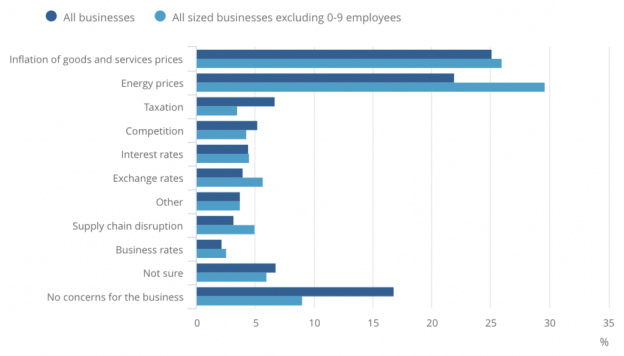
Results from the ONS’s Business Insights and Conditions Survey
As you can see, by far the most frequently mentioned concerns were “inflation” and “energy prices”. Only around 7% of businesses mentioned “taxation” as their main concern, demonstrating how ill-conceived was Liz Truss’s economic program. (She thought we could tax-cut our way out of an energy crisis).
Policymakers need to get grips with the fact that not every problem has a liberal technocratic ‘solution’. Paying people not to work, shutting down refineries, and sanctioning other countries may feel good. But that doesn’t mean it’s the right thing to do.
DR MIKE YEADON COVID DEATH SHOTS IS MEDICAL MURDER
Dr Mike Yeadon – Let’s not put a Gloss on It. The COVID death shots Is Medical Murder
First RSV Emergency Declared as Pfizer and GSK Race to Get Vaccines Approved

By Michael Nevradakis, Ph.D. | The Defender | November 8, 2022
Southern California’s Orange County Health Department this month declared a local health emergency over concerns around the rising number of pediatric cases of Respiratory Syncytial Virus (RSV).
County officials also declared a Proclamation of Local Emergency, allowing them to access state and federal resources in response to the spread of RSV.
The news came amid media warnings of a looming “tripledemic” of RSV, influenza and COVID-19 and news that Pfizer and GlaxoSmithKline (GSK) are close to securing regulatory approval for their RSV vaccine candidates — including Pfizer’s RSV vaccine for pregnant women.
RSV was first identified in 1956, and frequently affects children, with a majority of childhood cases occurring before age 2. For most children, symptoms are similar to those of the common cold, according to the Centers for Disease Control and Prevention (CDC).
It can, however, cause serious symptoms in the very young and the elderly, although childhood deaths are infrequent, according to CDC data.
According to California attorney Rita Barnett-Rose, there’s no evidence to support claims that Orange County hospitals are overextended, or to justify a state of emergency.
In an interview with The Defender, Barnett-Rose drew parallels between Orange County’s emergency declaration for RSV and other state, local and federal emergency declarations for COVID-19:
“One of the other alarming things that happened with COVID is when [Gov. Gavin] Newsom declared the state of emergency in COVID. He also waived the 30 and 60-day review periods for all local governing boards.
“So, yeah, so that’s what everyone is concerned about, this perpetual state of emergency.
“And the other thing that it triggers is it asks, once they declare a state of emergency, aside from getting the funding, it also triggers a request to Governor Newsom to declare a statewide state of emergency and then also to have Newsom ask President Biden to declare a national state of emergency.”
That could lead to Emergency Use Authorization (EUA) of RSV vaccines, according to Barnett-Rose, who told The Defender there may be an avenue to challenge the legality of the latest Orange County emergency declaration.
Is pharma using the COVID playbook to push RSV vaccines?
Dr. Regina Chinsio-Kwong, Orange County’s health officer, said in a press release county officials issued the declaration due to “rapidly spreading virus infections causing record numbers of pediatric hospitalizations and daily emergency room visits.”
The declaration will allow the county to access state and federal resources and to allow non-pediatric hospitals to offer beds to sick children, Chinsio-Kwong said.
Children’s Health Defense (CHD) California Chapter notes that this declaration was unanimously ratified “over the objections by members of the public who showed up to speak against the declarations.”
Dr. Melaine Patterson, chief nursing officer for Children’s Health Orange County, said area hospitals are seeing an “unprecedented” volume of children visiting their emergency rooms — approximately 400 per day, with wait times of “four to 12 hours.”
She also said that, as of Nov. 1, there were 285 patients in her hospital, compared to 188 on that date last year, adding that 11 of those current patients were placed in ICU as a result of RSV infections. RSV cases also are on the rise nationally.
Chinsio-Kwong advised the public to remain “up to date with other vaccinations such as flu and COVID-19” to “reduce the burden on hospitals this fall and winter.”
“Our best shot at protecting ourselves and our children from respiratory illnesses continues to be the same things we practiced throughout the pandemic including the use of masks when indoors around others and staying home when you are sick,” Chinsio-Kwong said.
However, Barnett-Rose said hospitals in Orange County may be overextended not due to an unusually high number of admissions, but due to unvaccinated staff having been let go.
She told The Defender :
“I do think that has a big role in it, and a lot of people pointed that out during the hearings and public comments were made about that.
“They were trying to claim … there were not enough pediatric experts or pediatric-trained doctors and medical professionals, so they needed to go outside of the county. And I do think a big part of that is that they did let go of many pediatric nurses and pediatric physicians that refused to take the vaccines. So I do think that this is a crisis of their own making … if there is even a crisis.”
San Diego County also issued a warning to its residents Nov. 4 over rising RSV cases but stopped short of declaring an emergency.
CHD California questioned why Orange County would declare a “Local Health Emergency” now — even though local COVID-19 states of emergency haven’t been lifted.
Despite claims that the purpose of these new declarations is exclusively meant to help county hospitals, CHD California said, “the language of the emergency Resolutions says something else entirely”:
“Both the Resolution to ratify the Local Health Emergency under Health & Safety Code section 101080 and the Proclamation of a Local Emergency under Government Code section 8630 declare the need for these local emergencies not only based on the asserted need to handle allegedly rising cases of RSV — but also because of other unnamed ‘other respiratory illnesses’ that were not discussed during the special meeting or otherwise disclosed to the public.”
Barnett-Rose provided insights into the legal meaning underlying these declarations. She told The Defender :
“There’s a local health emergency, which is declared by the public health officer as opposed to the [county] board … and that is when the health officer says … ‘I’ve been talking to the hospitals and we’ve done some assessments and there’s an increasing rate of respiratory illnesses and the children’s hospitals, and so, because of this, I am asking to declare a local health emergency.’ …
“But her authority to declare a local health emergency only lasts for seven days unless it’s ratified by our board of supervisors. And so, on Nov. 2, our board ratified that, which means now it’s in place and it needs to be renewed or looked at every 30 days, unless Governor Newsom waives that condition.”
CHD California argued that the “overly broad language used in these emergency declarations should be deeply concerning to anyone wary of a repeat of the “public health” measures ordered under COVID-19,” noting that adding the vague statement referring to “other respiratory viruses” creates “plenty of room for further abuse.”
Barnett-Rose told The Defender that, during the Nov. 2 meeting, Chinsio-Kwong said, “No restrictions are currently [emphasis added] in place,” a statement that “caused … a little bit of an uproar during the hearing because of her wording, which suggests that indeed they may end up rolling out mask mandates or some other mandates.”
Under this type of “slippery language,” argued CHD California, even the common cold could be used to issue an emergency declaration.
Barnett-Rose agreed:
“How do you measure that? How do you dispute it? How do you examine it? How do you end it?
“If you’re going by one infectious disease, at least you can try to find some data on hospitalizations or cases or deaths or ICU beds. But when it’s everything, it can still include COVID, flu, cold, COPD, a whole bunch of things that would qualify as respiratory illnesses.”
Barnett-Rose said that attempts will be made to legally challenge these declarations as “overbroad,” noting, however, that while case law precedent exists to challenge overbroad legislation, there is no such precedent in place for states of emergency.
Barnett-Rose she’s looking into whether there’s some way to litigate against these broad states of emergency.
When statutes are overbroad, she said, sometimes you can challenge them for being overley broad or too vague, but she’s not sure if there’s a similar precedent for challenging an overly broad state of emergency.
Declaring a local state of emergency at the county level could trigger a chain of events leading all the way to a national declaration of emergency, according to CHD California:
“By ratifying and/or declaring these local emergencies, the Board has now triggered an official request to Governor Newsom that he also declare a state-wide state of emergency on the same overly broad basis — and to ask the President of the United States to declare a national state of emergency.”
“A nationally declared state of emergency may trigger all of the same measures that have already deeply divided our country: masks on airplanes, business and school closures, and coercive school and employee mandates for experimental ‘vaccines’ offered as the ‘only solution’ back to Freedom,” CHD California argued.
Barnett-Rose said the emergency declaration in Orange County may be tied to the fact that there are multiple RSV vaccines already in the pipeline:
“The reason this is becoming really huge news is because this is what happened with the COVID state of emergency, too, it kind of went like that in dominoes.
“Once Biden declares a national state of emergency, then that triggers all of the emergency use authorizations that allowed the so-called vaccines for COVID. And I’m sure you already know that there’s vaccines in the works now for RSV that they’re floating out there in the news as well.”
Recounting events that occurred in relation to COVID-19, Barnett-Rose told The Defender that Orange County and some other counties in California declared a state of emergency, “then it went to the state, then it went national, and then, of course, once there’s a national emergency, you can go into Iowa.”
“So I do think that this is very suspicious timing, the articles that we are seeing in the news about being close to this RSV vaccine,” Barnett-Rose said. “And so, I do think that they’re trying to repeat the same playbook.”
Up to 30 RSV vaccine candidates already in pipeline
Pharmaceutical industry publication FiercePharma reported that Pfizer and GSK “moved closer to regulatory approvals” in the past week, and “could each see the first-ever approvals for an RSV vaccine in 2023.”
GSK’s candidate will be reviewed May 3, 2023, while Pfizer is “eyeing an approval filing by year-end.”
In all, up to 30 RSV candidate vaccines have been identified by the National Institutes of Health (NIH).
GSK has secured priority review status for its RSV vaccine following the submission of data from its AReSVi-006 phase 3 trial. The candidate vaccine exclusively targets adults 60 and older, and the data reportedly “showed high overall vaccine efficacy against RSV lower respiratory disease” at a rate of 82.6%, Fierce Biotech reported.
GSK initially intended to develop an RSV vaccine for older adults and for infants, but plans for the latter were shelved due to a “safety concern.” Nevertheless, GSK CEO Emma Walmsley in a call last week with investors described GSK’s new vaccine as “a very significant scientific achievement.”
Previous efforts to develop an RSV vaccine have failed because they “had a persistent tendency to cause worse disease,” due to “a phenomenon known as antibody-dependent enhancement (ADE).”
Dr. Ruth Karron, a pediatrician and professor of international health at the Johns Hopkins Bloomberg School of Public Health, said, “The difference this year is the general public for the first time is probably eagerly awaiting an RSV vaccine, because they’re seeing firsthand just how much of a problem RSV can be,” in a statement drawing a clear connection with the reported increase in RSV cases this year.
Pfizer announced Nov. 1 that its own candidate RSV vaccine wrapped up its phase 3 trial for efficacy early. Unlike GSK’s candidate vaccine, Pfizer’s vaccine targets pregnant women. The vaccine is designed to be administered early in the third trimester with the intent that the vaccine-induced antibodies be passed from the mother to her newborn.
Pfizer, in its Nov. 1 announcement, claimed that its bivalent RSV prefusion vaccine candidate RSVpreF, also known as PF-06928316, delivered “broadly positive” results — namely, a significant reduction in the rate of respiratory illness in newborns and their mothers.
Pfizer claimed 81.8% efficacy against severe cases of RSV for babies up to three months, and 69.4% efficacy after six months.
Pfizer’s MATISSE (MATernal Immunization Study for Safety and Efficacy) trial involved 7,400 pregnant women and their newborns, tracking the infants for one year following birth, and some for two years. It was conducted in 18 countries beginning in June 2020.
Pfizer’s vaccine trial did not deliver statistically significant results regarding the prevention of infant medical visits caused by RSV, including for non-severe cases.
Nevertheless, Pfizer said there are “no major safety concerns” with its product, adding:
“At the recommendation of the DMC [Data Monitoring Committee], and in consultation with the U.S. Food and Drug Administration (FDA), Pfizer has stopped enrollment in the study.
“Based on these positive results Pfizer plans to submit a Biologics License Application (BLA) to the FDA by the end of 2022 for the vaccine candidate followed by other regulatory authorities in the coming months.”
Pfizer’s phase 3 trial data has not yet been vetted by independent experts, and has not been peer-reviewed or published.
On March 2, 2022, Pfizer’s candidate vaccine received a Breakthrough Therapy Designation from the FDA, while previously, in November 2018, the FDA granted it Fast-Track status, according to the Pfizer release.
“Pfizer’s investigational RSV vaccine candidate builds on foundational basic science discoveries including those made at the National Institutes of Health (NIH),” the vaccine maker said in its press release.
The NIH research in question also was “key to the hugely successful COVID-19 vaccines,” according to ABC 7 Los Angeles.
Others looking to develop an RSV vaccine include Moderna and AstraZeneca and Sanofi, in a joint initiative. Moderna received fast-track designation from the FDA on Aug. 3, 2021, for its mRNA-1345 RSV vaccine for older adults, while AstraZeneca and Sanofi are developing a viral vector RSV vaccine by the name of “nirsevimab.”
An August 2021 article in The Defender predicted that RSV would represent the “new frontier for vaccine development,” as pharmaceutical companies would be “lured by the prospect of a large untapped global RSV vaccine market,” leading to a vaccine development “gold rush.”
Media tout benefits, ignore safety concerns
Online news portal Vox described the development of new RSV vaccines as “very, very good news” in a recent article.
Coupled with media coverage about “rising” RSV cases nationwide, it appears the stage is being set to create an emergency in the public consciousness, which could lead to EUAs being granted to the new vaccines and a rush to get the public vaccinated.
Blogger James Roguski, however, called into question the results of the Pfizer phase 3 trial, raising many safety concerns that are indicated in the company’s own data but were downplayed by Pfizer in its public proclamations. In a recent post, he wrote:
“In the Phase II study, researchers found that women who received RSVpreF vaccine containing aluminum hydroxide had a higher incidence of local reactions than those who received RSVpreF vaccine without aluminum hydroxide.
“It seems like 1 of the 117 infants in the placebo group suffered fetal death and 6 infants in the ‘vaccinated’ group are unaccounted for.”
Roguski also highlighted the many adverse events that were recorded for both infants and pregnant mothers who participated in the study, none of which were recorded for the placebo group.
For infants, some of these adverse events included acute respiratory failure, bronchiolitis, cardiac murmur, chordee (bent penis), conjunctival hemorrhage, hypoglycemia, jaundice, low birth weight, neonatal hypoxia, neonatal respiratory failure, seizure, sepsis, upper respiratory tract infection and vascular malformation.
Pregnant women, in turn, experienced adverse events including fetal growth restriction, fetal tachycardia, gestational diabetes, nonreassuring fetal heart rate pattern, premature labor, premature separation of placenta, vaginal hemorrhage and thrombocytopenia.
For some, these safety concerns are conjuring up memories of previously failed attempts to develop an RSV vaccine.
A vaccine tested in 1966 led to the deaths of two toddlers as a result of “enhanced disease symptoms,” while many infants “suffered worse symptoms than usual, and needed to be hospitalized.”
As previously reported by The Defender, RSV itself originated in monkeys housed in a Maryland facility where they were used to conduct polio vaccine research. Remarking on this and the connection to RSV vaccine development today, Brian Hooker, CHD’s chief scientific officer, told The Defender, “It is incredible that the vaccine industry can create a disease — RSV from the polio vaccine — and then create another vaccine to ‘prevent’ that disease. Talk about a business proposition!”
Michael Nevradakis, Ph.D., based in Athens, Greece, is a senior reporter for The Defender and part of the rotation of hosts for CHD.TV’s “Good Morning CHD.”
This article was originally published by The Defender — Children’s Health Defense’s News & Views Website under Creative Commons license CC BY-NC-ND 4.0. Please consider subscribing to The Defender or donating to Children’s Health Defense.
Featured Video

Broke Princes: Saudi Arabia’s Powder Keg
or go to
Aletho News Archives – Video-Images
From the Archives
A sample of vaccine and injectable medication tragedies during my lifetime
This is what happens when you demand speedy production in an era of politicized regulation
By Meryl Nass, MD | February 12, 2022
All these tragedies have been due to failures of testing or failures in manufacturing processes. Most occurred before vaccine manufacturers were given virtually complete protection from liability in 1987.
With the duration of patent exclusivity determining how much new products earn, products are rushed to market as quickly as possible, most using a shortened path for FDA review. Recalls and market removals of approved products are much more common than they used to be. We can only expect more of these disasters in the future, especially if the products are mandated for everyone. … continue
Blog Roll
 Aletho News
- Broke Princes: Saudi Arabia’s Powder Keg
- Albania’s Crisis: Rama, Israeli Investments and the Demand for Accountability
- Hezbollah Categorically Denies Syrian Accusations: We Aim at Confronting Israeli Enemy, Not Undermining Syria’s Stability
- Trump claims funding to Israel ending in 2026 as merger of Israeli–US armies looms
- Iran Weathering The Storm, But Saudi Arabia Is Sinking
- Sunk Ships Don’t Sail Home: Why Peace Won’t Save the Oil Market and War Will Wreck It
- No Cossacks at the gates, fix Italy instead – opposition leader to Meloni
- The Pits: Zelensky’s torture chamber network in the public eye
- Moscow mocks Kiev’s language hypocrisy exposed by ‘torture chamber’ scandal
- Military ‘torture chamber’ triggers new scandal in Kiev
- If Americans Knew
- An error has occurred; the feed is probably down. Try again later.
- No Tricks Zone
- New Study: The Net Fossil Fuel Contribution To Rising Atmospheric CO2 Has Been Zero For 500 Years
- Germany’s Green Energy Transition Becoming Increasingly Expensive…Another 6 Trillion Euros!
- Sudden Stratospheric Warming, Powerful El Niño Combination May Lead To Extreme Europe Cold, Energy Crisis!
- Two New Studies Find Thwaites Glacier Melt Cannot Be Driven By Human Activity Or A Warming Ocean
- E-Cars Reduce CO2 Emissions By Only 41% Compared To Internal Combustion Engine Vehicles
- Predictions Made By Renowned Climate Professor Over Past Decades Have Been Proven To Be Poor
- New Study Suggests Large Regions Of The Pacific Ocean Have Been Cooling For The Last 80 Years
- Germany’s Green Energy Debacle: High Energy Costs Force Kahla Porzellan to Close After 182 Years!
- New Study: 50 Years Of The Most Aggressive ‘Net Zero’ Policies Can Only Affect The Global Climate By 0.03°C
- US September “Heat” Was No Record…Many Records Set Decades Ago

