Canada announces millions in funding for COVID isolation site
By Thomas Lambert | The Counter Signal | August 22, 2022
The Trudeau government has announced $4.2 million in additional funding to keep a Windsor-Essex ‘voluntary’ isolation site afloat until March 2023.
In a new release, the Government of Canada said that isolation remains one of the best ways to slow the spread of COVID despite it being over two years since COVID began and there being little to no evidence to support such a position.
The government continues, saying that the isolation site will be used to accommodate foreign agri-workers who can’t find a place to isolate when they enter Canada. “These workers tend to live in close accommodations and work in congregate settings, which makes it difficult to isolate, if required,” reads the news release.
“As Essex continues to welcome thousands of incoming agricultural workers in the coming weeks and months, this critical federal funding will provide spaces for those who are unable to isolate safely in the community,” said Windsor-Tecumseh MP Irek Kusmierczyk.
“Thank you to Health Minister Jean-Yves Duclos and the federal government for recognizing the unique challenges our community faces and always standing up for Windsor-Essex.”
According to the news release, the $4.2 million given to the County of Essex will allow the site to operate 50 rooms for foreign agri-workers until March 31, 2023. ($84,000/room)
The site, formerly operated by the City of Windsor, was previously allotted $4.8 million for the same purpose, with funding lasting until June 30, 2022.
While unvaccinated foreign nationals are still prohibited from entering Canada thanks to the country’s vaccine mandate, an exemption exists for agricultural and food processing workers, marine crew workers, those making medical deliveries, and those that work with medical equipment.
However, despite the exemption, agri-workers still have to follow testing and quarantine requirements upon arrival, including a mandatory (not voluntary) quarantine requirement.
Thus, with flu season on the horizon, it looks like foreign-born agri-workers will be the first to feel the squeeze of the government’s renewed effort to bring back COVID measures.
What it would take to convince the government to end such measures permanently, rather than merely suspend them in certain areas, is anyone’s guess, and the government has made no indication they will ever admit the pandemic is over despite criticism internally and abroad.
Tel Aviv hiding evidence of ethnic cleansing of Palestinians from public: Israeli media
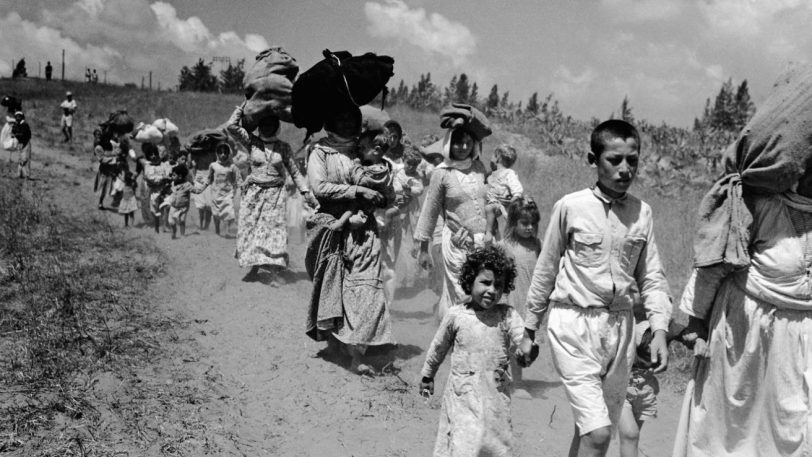
The Cradle | August 22, 2022
According to a report by Hebrew newspaper Haaretz released on 22 August, Tel Aviv has been working through its defense ministry to hide historical documents related to the founding of the state of Israel, from the Israeli public.
The founding of Israel in 1948, known throughout the Arab world as the “Nakba,” or catastrophe, involved the ethnic cleansing and mass expulsion of Palestinians from their land by ultra-nationalist Jewish gangs.
These gangs were later integrated into the Israeli military.
The documents contain details on Israel’s killing of civilians, as well as the erasure of entire Palestinian villages. Israel is undergoing “a systematic process to conceal evidence of the Nakba,” Haaretz reveals.
The report states that efforts to hide these documents have been carried out by the Directorate of Security of the Defense Establishment, a secret department in the Israeli Defense Ministry known as the Malmab, “whose work and budget are secret.”
Members of the Malmab reportedly “worked without any legal authority, even in some cases [hiding] documents that the military censor had previously allowed to be published,” Haaretz revealed.
The report also details that government officials, including members of the Israeli Knesset, who by law are allowed access to such archives, were barred from viewing the documents in question.
A settlement was reached in which the Israeli Treasury would send requests in order for archived documents to be examined for disclosure. The Malmab apparatus would then search through them thoroughly to determine if they can be published alongside Israel’s accessible archives, despite already being accessible by Israeli law.
Haaretz reported that the Malmab were also working to hide documents relating to Tel Aviv’s nuclear program.
“If the state admitted … that the documents were hidden without authority, why did it not insist on their immediate disclosure?” the report asks.
The report concludes by saying that Israel has to “get rid of the twisted habit it has adopted of concealing its past from the public … the public has the right to know the history of the country in which it lives, and also to discover its less pleasant aspects.”
Despite the events of the Nakba being common historical knowledge, Israel’s attempt to hide these documents represents its policy of trying to control the perception of the Israeli public.
Israel is known to have attempted hiding the atrocities of its past.
On 8 July, Hebrew media revealed the existence of a mass grave under the parking lot of a tourist attraction in Israel, where the bodies of dozens of Egyptian soldiers burned alive by Israeli forces were buried during the 1967 Arab–Israeli War, also known as the Six-Day War.
For over five decades, Tel Aviv kept the secret of the mass grave, never attempting to return the bodies to their homeland.
Additionally, Israel has been secretly building a nuclear arsenal for several decades – owning around 40 to 800 nuclear warheads which it denies having – while criticizing Tehran over its nuclear program.
Pakistan: Imran Khan supporters prevent police from arresting him
Press TV – August 22, 2022
Supporters of former Pakistani Prime Minister Imran Khan gathered around his home on Monday to prevent police from arresting their leader, who has been charged under anti-terror laws.
Hundreds of supporters of the cricketer-turned-politician assembled outside his hilltop mansion in the capital city of Islamabad on Monday, vowing to “take over” if he was arrested.
However, Khan has now been granted pre-arrest bail until Thursday.
Since being ousted from power in April in what he and his supporters have repeatedly blamed on a “US regime change plot”, Khan has been a vocal critic of the government and the powerful military.
On Sunday Islamabad police issued an arrest warrant against Khan for allegedly threatening police officials and a judicial magistrate under sections of the anti-terrorism act.
The cricketer-turned-politician reportedly accused authorities of torturing his close aide, who is himself being detained under sedition charges.
Khan’s political allies warned on Monday that arresting him would amount to crossing a “red line”.
“If Imran Khan is arrested … we will take over Islamabad with people’s power,” a former minister in his cabinet, Ali Amin Gandapur, threatened on Twitter, as some party leaders urged supporters to prepare for mass mobilization.
Khan said in his speech on Sunday that he was being censured for not condoning the ruling coalition government which had voted him out of power.
He has also said that he “would not spare” Islamabad’s police chief and a judge for issuing a warrant, arresting and torturing one of his close aides on sedition charges.
Khan’s aide had called on lower and middle ranks of the military to defy orders from the top brass.
Last month, Khan’s Pakistan Tehreek-e-Insaaf (PTI) party won the by-elections in the country’s most populous province, Punjab, dealing a heavy blow to the government led by Pakistan Muslim League-Nawaz (PML-N) incumbent Prime Minister Shehbaz Sharif on his home turf.
PTI’s thumping win in Punjab is seen as a popularity test for Khan, whose government was dismissed by a no-confidence vote in April.
The use of anti-terrorism laws for leveling court cases against political leaders is common in Pakistan. Pakistani law experts claim that expressing public threats against officials put their lives at stake, and actually amounted to threatening the state, so that the anti-terrorism charges apply.
Khan’s aide, Fawad Chaudhry, told reporters outside an Islamabad court that the party had applied for bail for its leader ahead of his arrest.
US Space Force wants to disrupt Russia-China space cooperation
Both Russia and China have been responding to the US militarization of space by enhancing their own capabilities, both separately and jointly.
By Drago Bosnic | August 22, 2022
Close strategic partnership between Russia and China has been the mainstay of their relationship for decades. The US has been trying to disrupt this successful partnership ever since, especially as Russia started regaining its strength, but the incessant belligerent actions of the imperialist thalassocracy have pushed the two (Eur)Asian superpowers even closer. This cooperation is manifold, but its space component is particularly concerning for the US, as it has serious security implications. The Pentagon is worried that the US “might not be able to match the united financing and know-how” of Moscow and Beijing.
“The two countries’ space cooperation, including in the military realm, has become inextricable since 2018 and works against U.S. interests,” said Kevin Pollpeter, senior research scientist at the CNA think tank’s China Studies Division. “I don’t think we can separate China and Russia. I just don’t think that’s possible,” Pollpeter said in response to a question from Air Force Magazine following a panel discussion on China-Russia space cooperation at the National Defense University in Washington, D.C.
“While the countries do not have completely overlapping security concerns, they do share a strong desire to counter U.S. leadership, including in outer space,” he said. “What we need to do is, we need to mitigate whatever problems that relationship may cause for us. The two countries’ military space cooperation includes the areas of ballistic missile defense, space debris monitoring, and satellite navigation. The resulting exchange has included technology transfer, weapons sales, combined exercises, and compensating measures,” Pollpeter added.
In 1989, the US imposed sanctions on China, targeting Beijing’s defense and space industry. China looked to Russia for the necessary technology transfers and by 1997, the two countries started regular cooperation in space. Russia had the know-how, but its space industry was faced with severe funding shortages.
“… a number of embargoes that took place made [China] increasingly more reliant on Russia as a potential source of technology, particularly for dual use and defense,” said Pollpeter. “… China started looking more to Russia, and Russia started looking more to China for help with supporting their own space program.”
China also began cooperating with Russia on ballistic missile defense after the US unilaterally withdrew from the INF (Intermediate-Range Nuclear Forces) Treaty in 2019. In the immediate aftermath of the withdrawal, Russian President Vladimir Putin stated that Russia would assist China in creating a ballistic missile early warning system. At the time, Putin said that China was perfectly capable of creating such a system itself, but that it would take longer, so Russia decided to aid Beijing in enhancing its strategic security in light of aggressive US moves in the Asia-Pacific region.
“There appears to be some sort of technology transfer going on,” Pollpeter added. “There’s been joint exercises – the Aerospace Security 2016 and 2017 involved joint air and missile defense planning and coordination.”
According to Pollpeter, another area of cooperation, space debris monitoring, “may sound innocuous,” but he claims “it has security implications.”
“If you have a space debris monitoring system, then you actually have a space domain awareness or space surveillance system,” he said. “This very much has a military role in helping China and Russia better monitor U.S. movements up in space.”
The US Space Force is particularly concerned about how “little is known about the satellite navigation cooperation between the two nations.” According to Pollpeter, other than the fact that there are compatibility and interoperability between the Russian and Chinese equivalents to GPS, the GLONASS and BeiDou navigation systems, nothing else is known about the security component of this cooperation. What is supposedly known is “the presence of augmentation stations in each other’s countries and performance monitoring,” Pollpeter claims.
“What they really want to do, then, is demonstrate that in a world where the U.S. and China could come into military conflict, they have an alternative,” he said. “They don’t have to rely on BeiDou exclusively. They also have the Russian system.”
As China doesn’t publicly discuss its space defense capabilities, Pollpeter claims it’s currently unknown which level of cooperation have Moscow and Beijing reached in this regard.
“A lot of it’s so opaque that when you get into something like counterspace, they’re not going to discuss that,” he said. “What China is developing is a capability that really is designed to threaten the United States space architecture from the ground all the way up to geosynchronous orbit.”
Existing agreements indicate close Chinese and Russian cooperation on launch vehicles, rocket engines, space planes, lunar and deep space exploration, remote sensing, electronics, space debris, satellite navigation and communication. Pollpeter thinks the US Space Force cannot halt the China-Russia cooperation, but it could do more to mitigate its effects.
“There’s really little we can do to separate the two countries, especially [on] the space side,” he said. “The distrust and, let’s say, to some extent, animosity of both countries towards the U.S. sort of precludes, at this point, that any of those efforts can be successful.”
As the US state-run space sector kept falling behind, private companies, the most prominent certainly being SpaceX, started closely cooperating with the US military. Both Russia and China have been responding to the US militarization of space by enhancing their own capabilities, both separately and jointly. While China started deploying pilotless spaceplanes, Russia is building land-based laser weapons to counter US space threats and is also launching its own spacecraft to track US space assets.
Drago Bosnic is an independent geopolitical and military analyst.
Russia blames Ukraine for deadly Moscow blast
Samizdat | August 22, 2022
The car bombing outside Moscow on Saturday night, which took the life of journalist Darya Dugina, was orchestrated and carried out by Ukrainian secret services, the Russian Federal Security Service (FSB) has said.
Dugina was killed while returning from a conservative family festival held in Moscow Region. She was the daughter of anti-Western author and political commentator Aleksandr Dugin. Like her father, she was known for her vocal support of the Russian military operation in Ukraine.
In a statement on Monday, the FSB said that Ukrainian national Natalya Vovk, born in 1979, carried out the bombing.
According to the FSB, Vovk arrived in Russia with her teenage daughter on July 23 and rented an apartment in the building in Moscow where the victim also lived.
Vovk and her daughter attended the ‘Tradition’ festival on Saturday, where Dugin was giving a lecture and his daughter was present, the FSB said.
Investigators stated earlier that a bomb was planted under the Toyota Land Cruiser Prado SUV Dugina used to leave the event. According to the FSB, Vovk detonated the bomb remotely, killing Dugina as she was driving on a highway. She then left with her daughter for Estonia on Sunday.
The FSB added that Vovk used a car with a license plate from the Donetsk People’s Republic when entering Russia, but replaced it with a Kazakhstan license plate when driving in Moscow, and a Ukrainian license plate when crossing into Estonia.
MEET THE EX-CIA AGENTS DECIDING FACEBOOK’S CONTENT POLICY
By Alan Macleod | MintPress News | July 12, 2022
It is an uncomfortable job for anyone trying to draw the line between “harmful content and protecting freedom of speech. It’s a balance”, Aaron says. In this official Facebook video, Aaron identifies himself as the manager of “the team that writes the rules for Facebook”, determining “what is acceptable and what is not.” Thus, he and his team effectively decide what content the platform’s 2.9 billion active users see and what they don’t see.
Aaron is being interviewed in a bright warehouse-turned-studio. He is wearing a purple sweater and blue jeans. He comes across as a very likable, smiley person. It is not an easy job, of course, but someone has to make those calls. “Transparency is incredibly important in the work that I do,” he says.
Aaron is CIA. Or at least he was until July 2019, when he left his job as a senior analytic manager at the agency to become senior product policy manager for misinformation at Meta, the company that owns Facebook, Instagram and WhatsApp. In his 15-year career, Aaron Berman rose to become a highly influential part of the CIA. For years, he prepared and edited the president of the United States’ daily brief, “wr[iting] and overs[eeing] intelligence analysis to enable the President and senior U.S. officials to make decisions on the most critical national security issues,” especially on “the impact of influence operations on social movements, security, and democracy,” his LinkedIn profile reads. None of this is mentioned in the Facebook video.
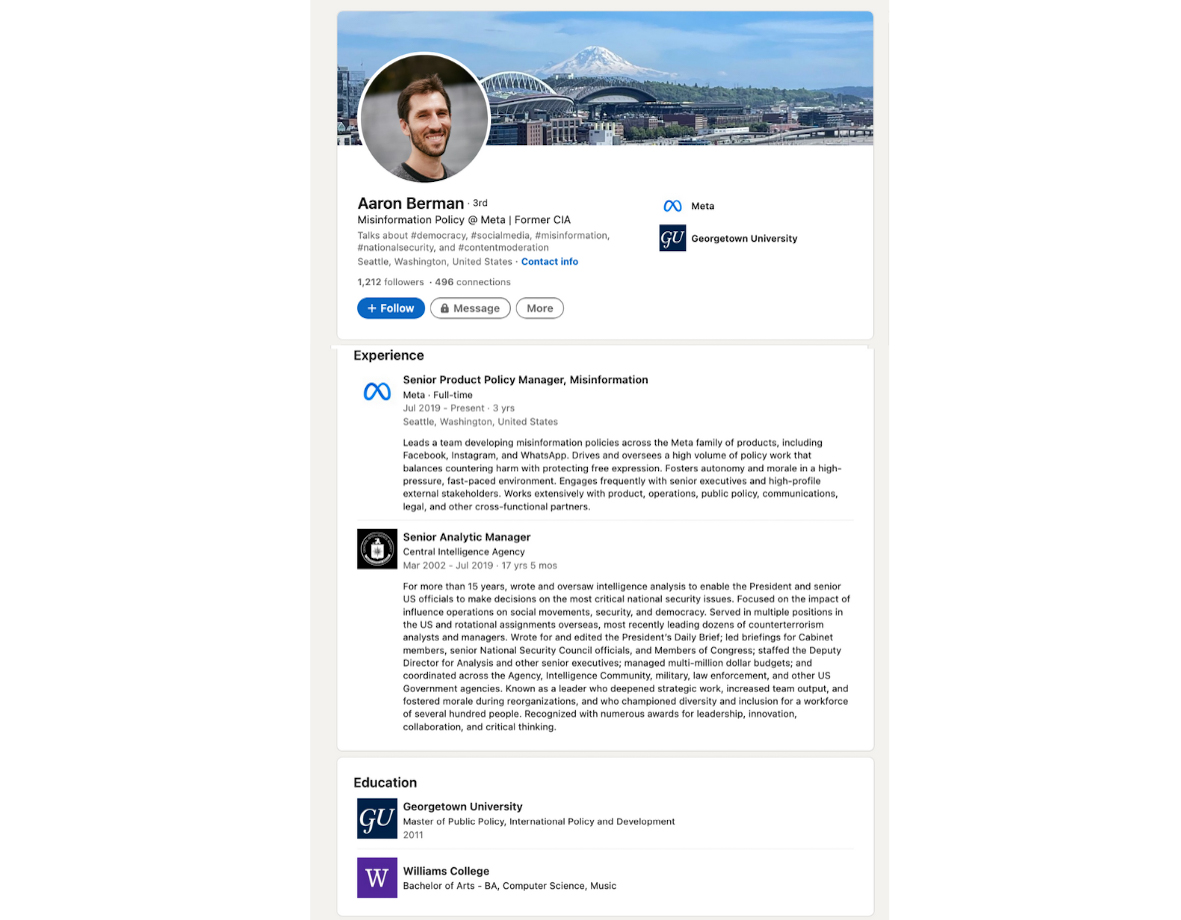
Berman’s case is far from unique, however. Studying Meta’s reports, as well as employment websites and databases, MintPress has found that Facebook has recruited dozens of individuals from the Central Intelligence Agency (CIA), as well as many more from other agencies like the FBI and Department of Defense (DoD). These hires are primarily in highly politically sensitive sectors such as trust, security and content moderation, to the point where some might feel it becomes difficult to see where the U.S. national security state ends and Facebook begins.
In previous investigations, this author has detailed how TikTok is flooded with NATO officials, how former FBI agents abound at Twitter, and how Reddit is led by a former war planner for the NATO think tank, the Atlantic Council. But the sheer scale of infiltration of Facebook blows these away. Facebook, in short, is utterly swarming with spooks.
TRUST ME, BRO
In a political sense, trust, safety and misinformation are the most sensitive parts of Meta’s operation. It is here where decisions about what content is allowed, what will be promoted and who or what will be suppressed are made. These decisions affect what news and information billions of people across the world see every day. Therefore, those in charge of the algorithms hold far more power and influence over the public sphere than even editors at the largest news outlets.
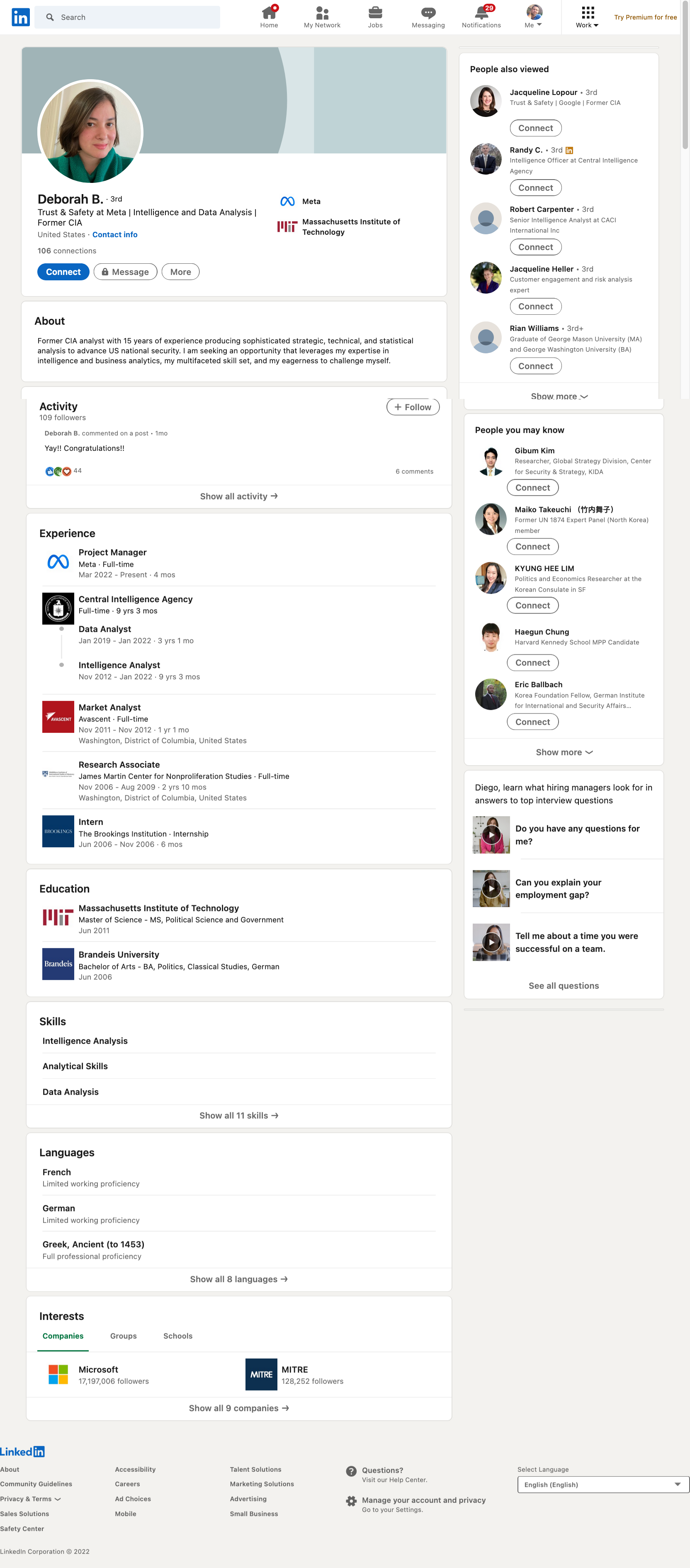
There are a number of other ex-CIA agents working in these fields. Deborah Berman, for example, spent 10 years as a data and intelligence analyst at the CIA before recently being brought on as a trust and safety project manager for Meta. Little is known about what she did at the agency, but her pre-agency publications indicate she was a specialist on Syria.
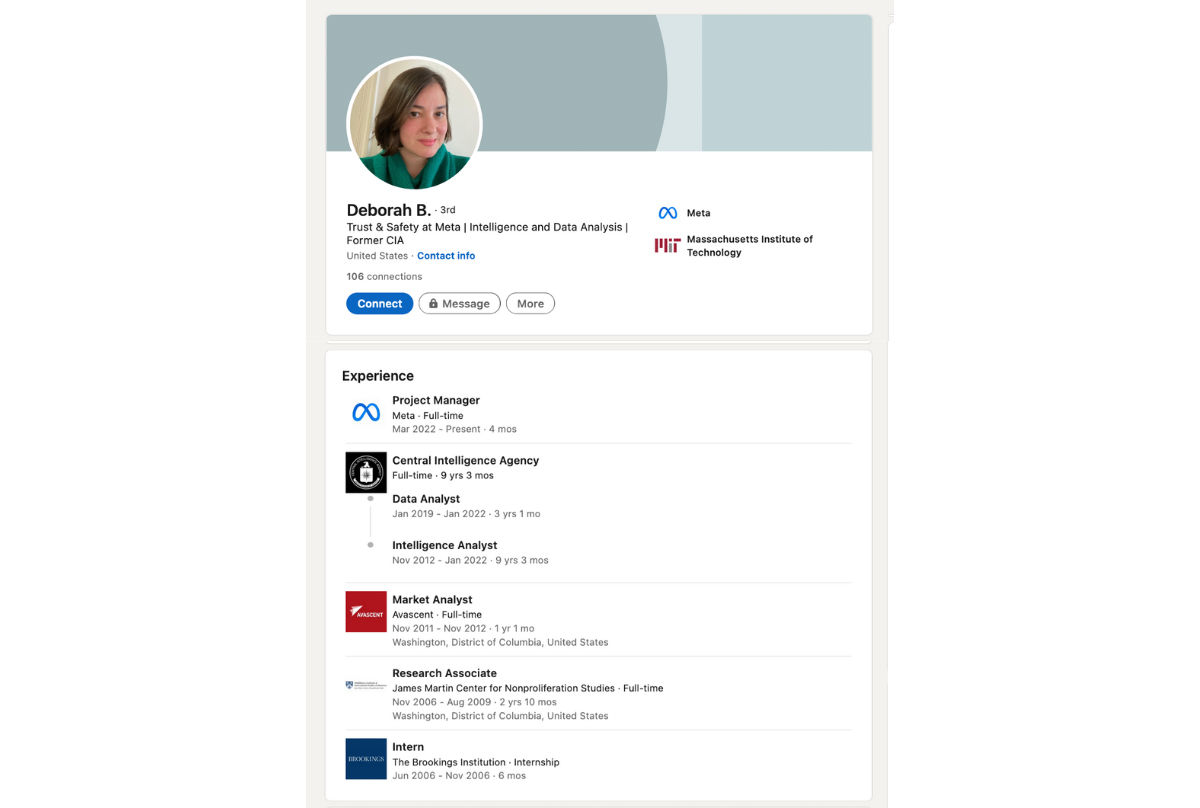
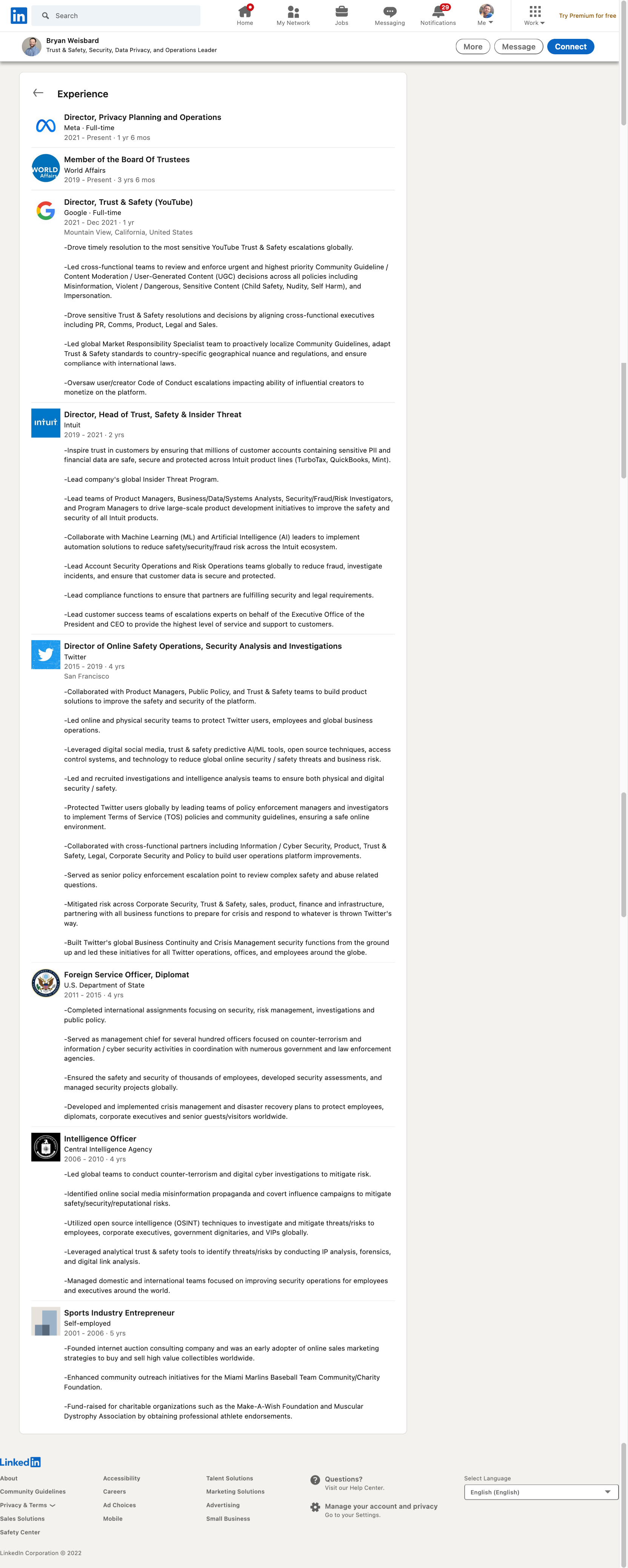
Between 2006 and 2010, Bryan Weisbard was a CIA intelligence officer, his job entailing, in his own words, leading “global teams to conduct counter-terrorism and digital cyber investigations,” and “Identif[ying] online social media misinformation propaganda and covert influence campaigns”. Directly after that, he became a diplomat (underlining how close the line is between those two professions), and is currently a director of trust and safety, security and data privacy for Meta.
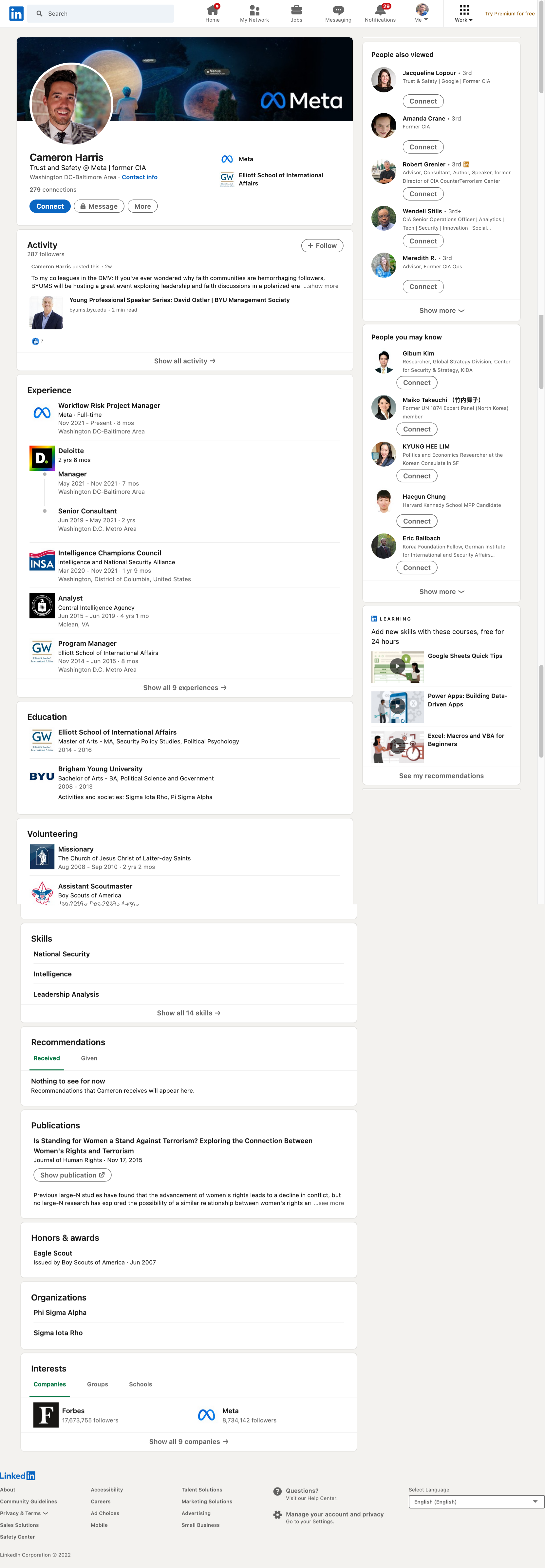
Meanwhile, the LinkedIn profile of Cameron Harris – a CIA analyst until 2019 – notes that he is now a Meta trust and safety project manager.
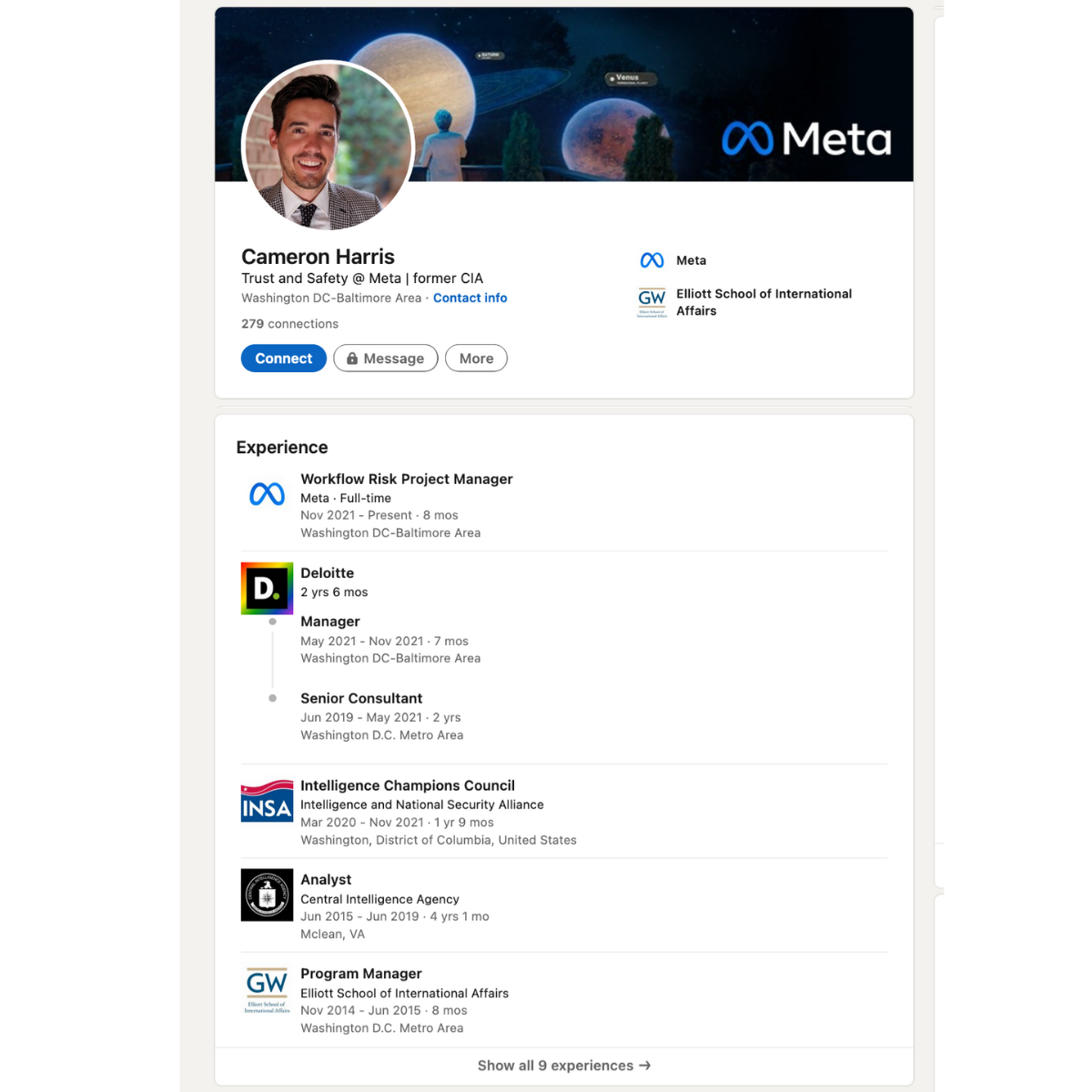
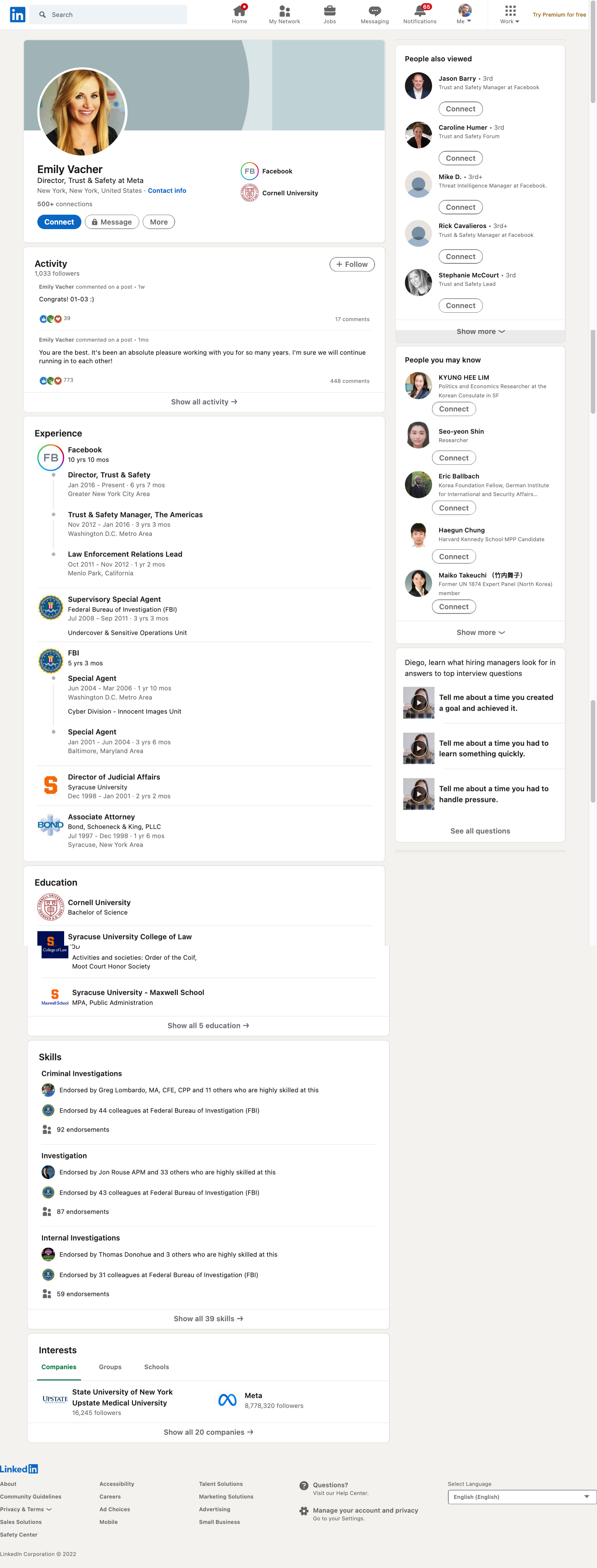
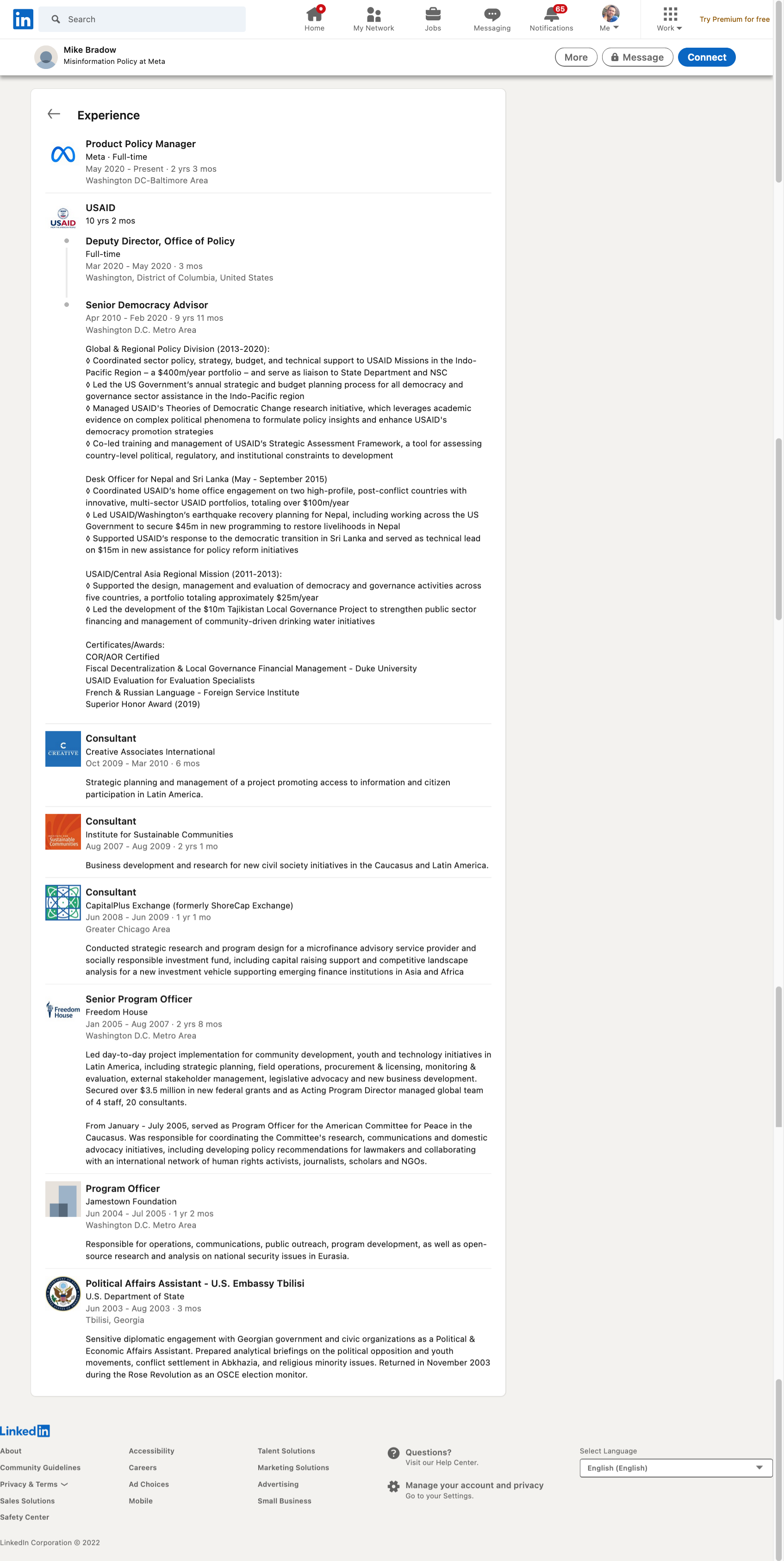
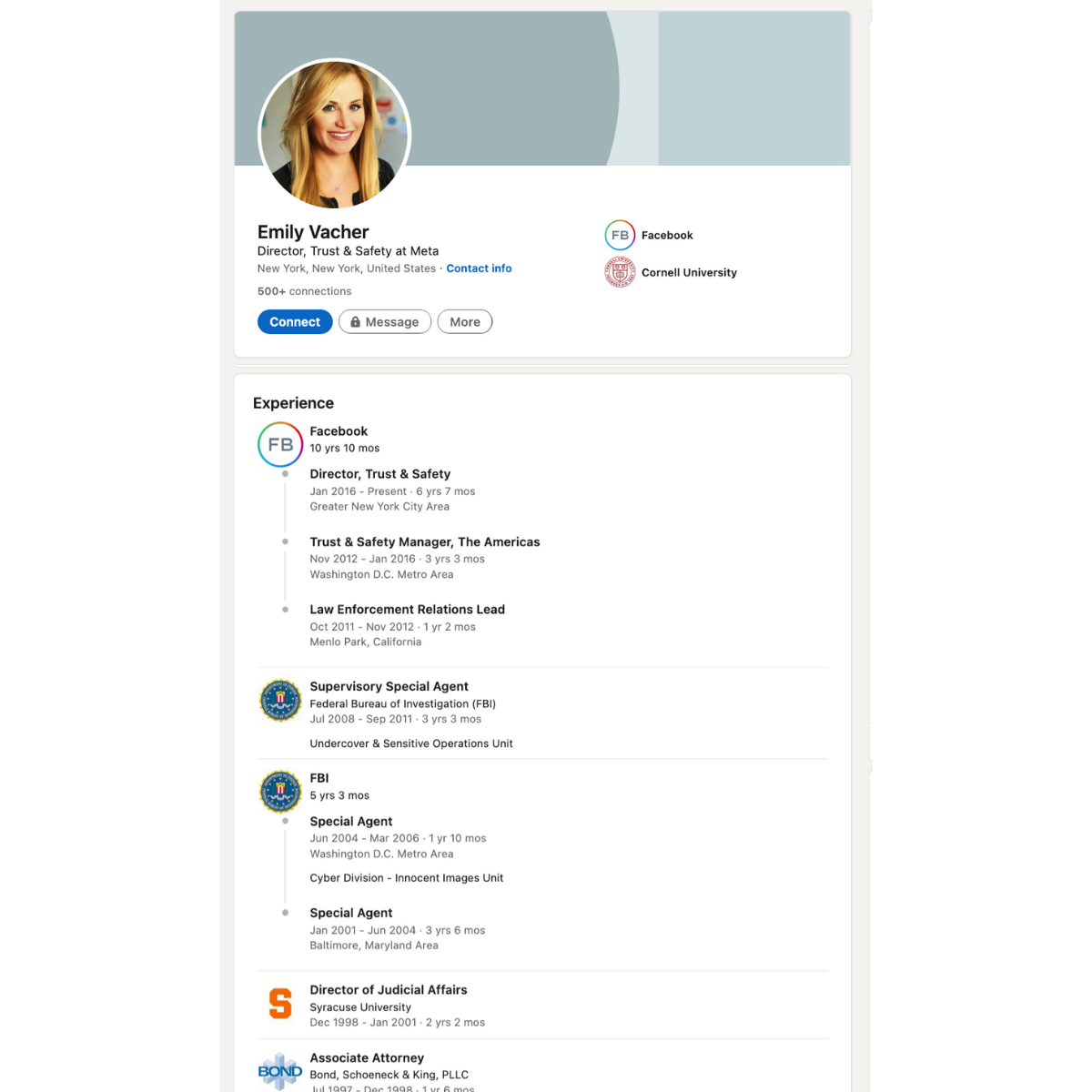
Individuals from other state institutions abound as well. Emily Vacher was an FBI employee between 2001 and 2011, rising to the rank of supervisory special agent. From there she was headhunted by Facebook/Meta, and is now a director of trust and safety. Between 2010 and 2020, Mike Bradow worked for USAID, eventually becoming deputy director of policy for the organization. USAID is a U.S. government-funded influence organization which has bankrolled or stage managed multiple regime change operations abroad, including in Venezuela in 2002, Cuba in 2021, and ongoing attempts in Nicaragua. Since 2020, Meta has employed Bradow as a misinformation policy manager.
Others have similar pasts. Neil Potts, a former intelligence officer with the U.S. Marine Corps, is vice president of trust and safety at Facebook. In 2020, Sherif Kamal left his job as a program manager at the Pentagon to take up the post of Meta trust and safety program manager.
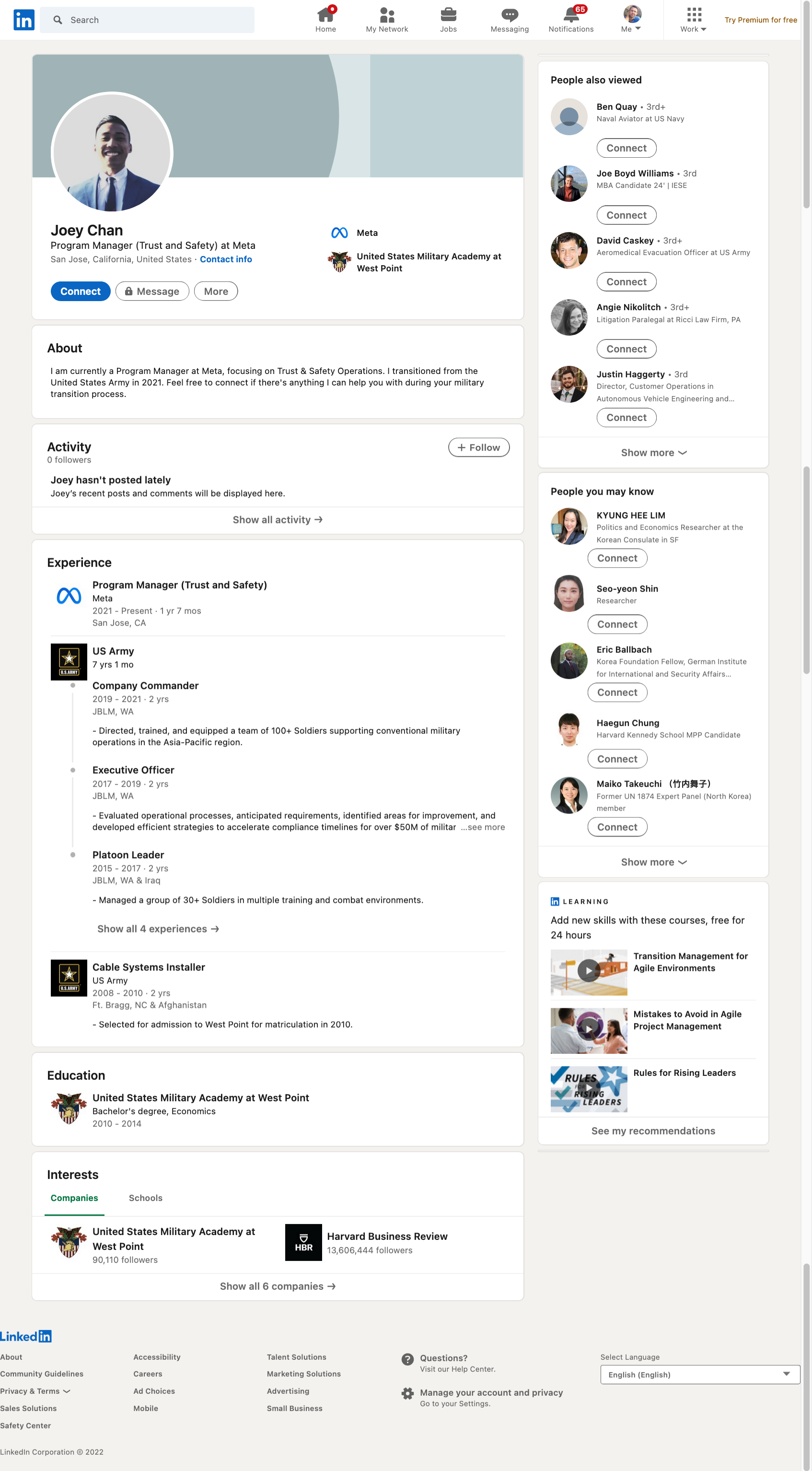
Joey Chan currently holds the same trust and safety post as Kamal. Until last year, Chan was a U.S. Army officer commanding a company of over 100 troops in the Asia Pacific region.
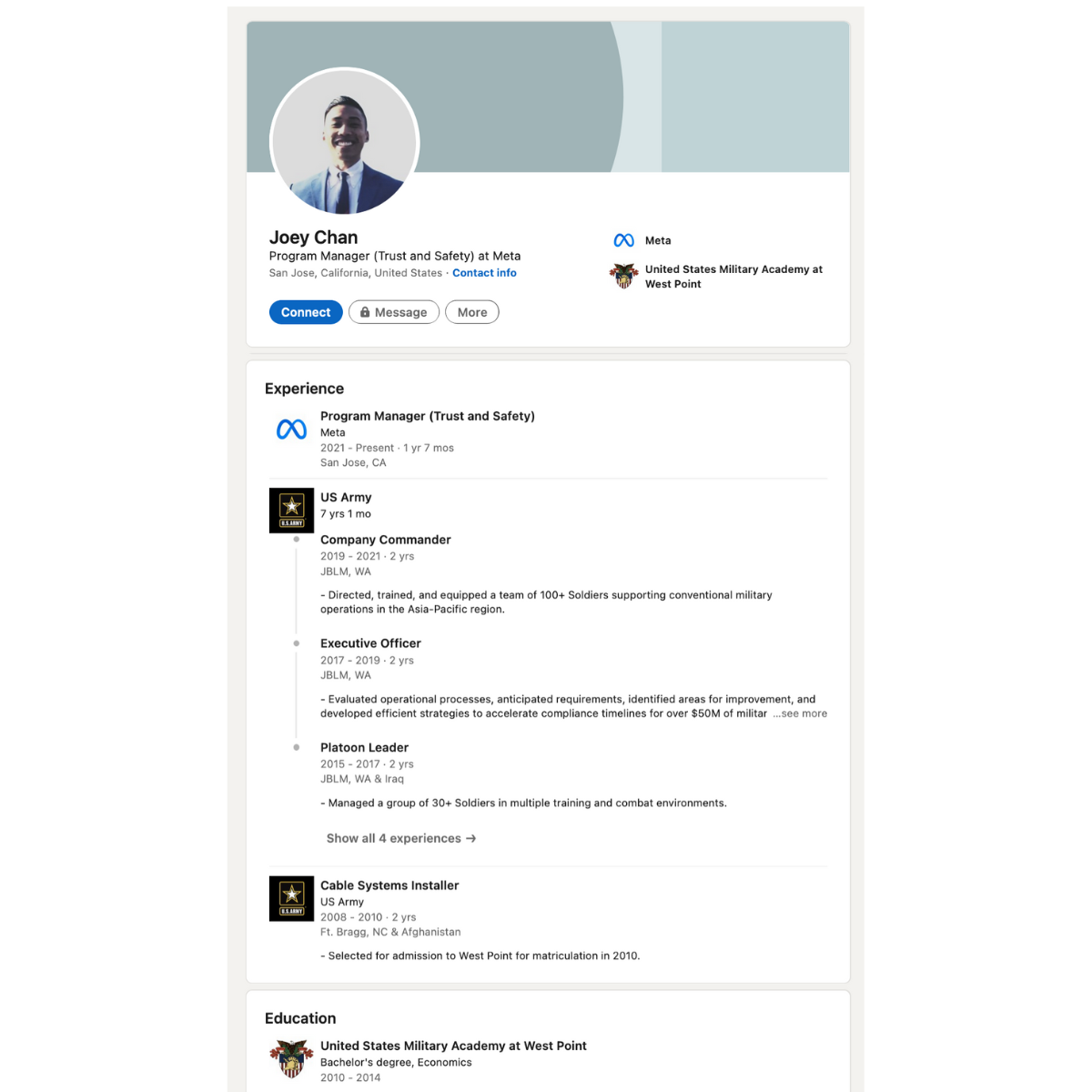
None of this is to say that any of those named are not conscientious, that they are bad people or bad at their job. Vacher, for example, helped design Facebook’s amber alert program, notifying people to missing children in their area. But hiring so many ex-U.S. state officials to run Facebook’s most politically sensitive operations raises troubling questions about the company’s impartiality and its proximity to government power. Meta is so full of national security state agents that at some point, it almost becomes more difficult to find individuals in trust and safety who were not formerly agents of the state.
Despite its efforts to brand itself as a progressive, “woke” organization, the Central Intelligence Agency remains deeply controversial. It has been charged with overthrowing or attempting to overthrow numerous foreign governments (some of them democratically elected), helping prominent Nazis escape punishment after World War Two, funnelling large quantities of drugs and weapons around the world, penetrating domestic media outlets, routinely spreading false information and operating a global network of “black sites” where prisoners are repeatedly tortured. Therefore, critics argue that putting operatives from this organization in control of our news feeds is deeply inappropriate.
One of these critics is Elizabeth Murray, who, in 2010, retired from a 27-year career at the CIA and other U.S. intelligence organizations. “This is insidious,” Murray told MintPress, adding,
I see it as part of the gradual and sinister migration of ambitious young professionals originally trained (with CIA’s virtually unlimited, U.S.-taxpayer funded pot of resources) to surveil and target ‘the bad guys’ during the so-called Global War on Terror of the post-9-11 era.”
MintPress also contacted Facebook/Meta for comment but has not received a response.
ARM’S LENGTH CONTROL
Some may ask what the big fuss is. There is a limited pool of individuals with the necessary skills and experience in these new tech and cybersecurity fields, and many of them come from government institutions. Casinos, after all, regularly hire card sharks to protect themselves. But there is little evidence that this is a poacher-turned-gamekeeper scenario; Facebook is certainly not hiring whistleblowers. The problem is not that these individuals are incompetant. The problem is that having so many former CIA employees running the world’s most important information and news platform is only one small step removed from the agency itself deciding what you see and what we do not see online – and all with essentially no public oversight.
In this sense, this arrangement constitutes the best of both worlds for Washington. They can exert significant influence over global news and information flows but maintain some veneer of plausible deniability. The U.S. government does not need to directly tell Facebook what policies to enact. This is because the people in decision-making positions are inordinately those who rose through the ranks of the national security state beforehand, meaning their outlooks match those of Washington’s. And if Facebook does not play ball, quiet threats about regulation or breaking up the company’s enormous monopoly can also achieve the desired outcomes.
Again, this article is not claiming that any of the named individuals are nefarious actors, or even that they are anything but model employees. This is a structural problem. Put another way, if Facebook were hiring dozens of managers from Russian intelligence agencies like the FSB or GRU, everybody would recognize the inherent dangers. It should be little different when it hires individuals from the CIA, an organization responsible for some of the worst crimes of the modern era.
FROM STATE INTELLIGENCE TO PRIVATE INTELLIGENCE
Facebook has also hired a plethora of ex-national security state officers to run its intelligence and online security operations. Until 2013, Scott Stern was a targeting officer at the CIA, rising to become chief of targeting. In this role, he helped select the targets for U.S. drone strikes across South and West Asia. Today, however, as a senior manager of risk intelligence for Meta, “misinformation” and “malicious actors” are his targets. Hopefully he is more accurate at Facebook than at the CIA, where the government’s own internal assessments show that at least 90% of Afghans killed in drone strikes were innocent civilians.
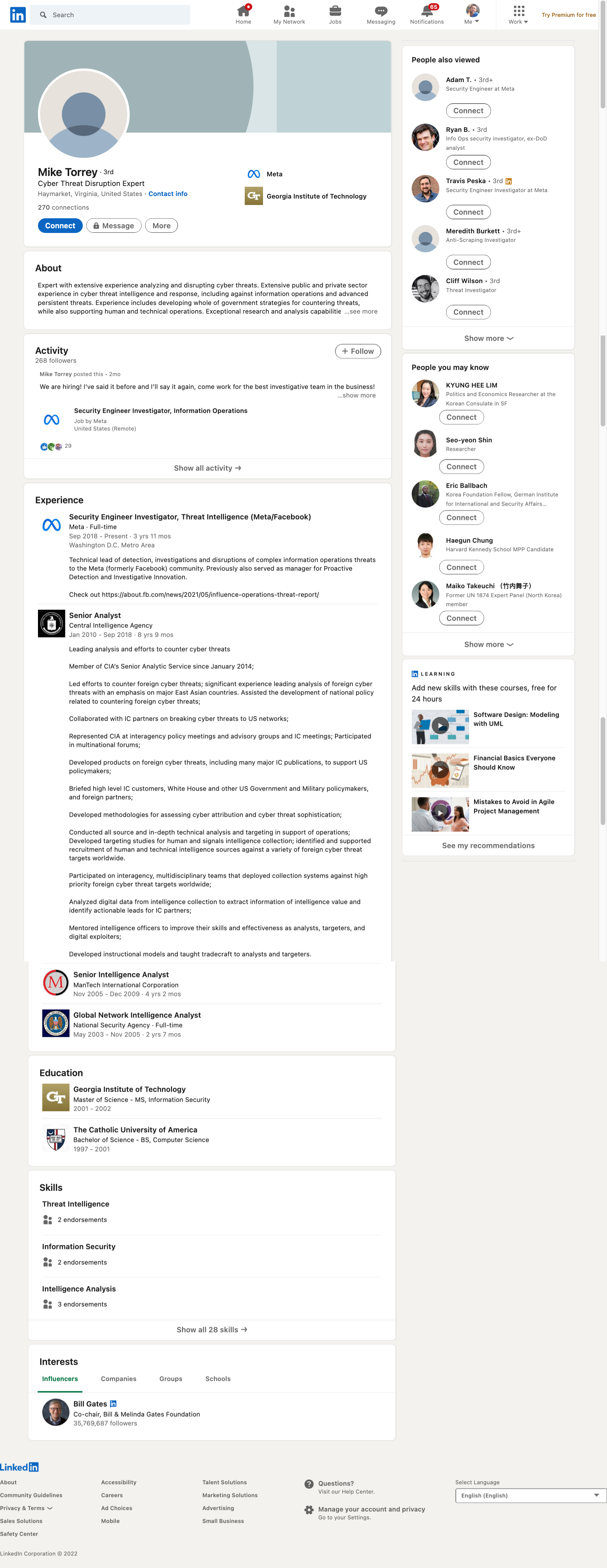
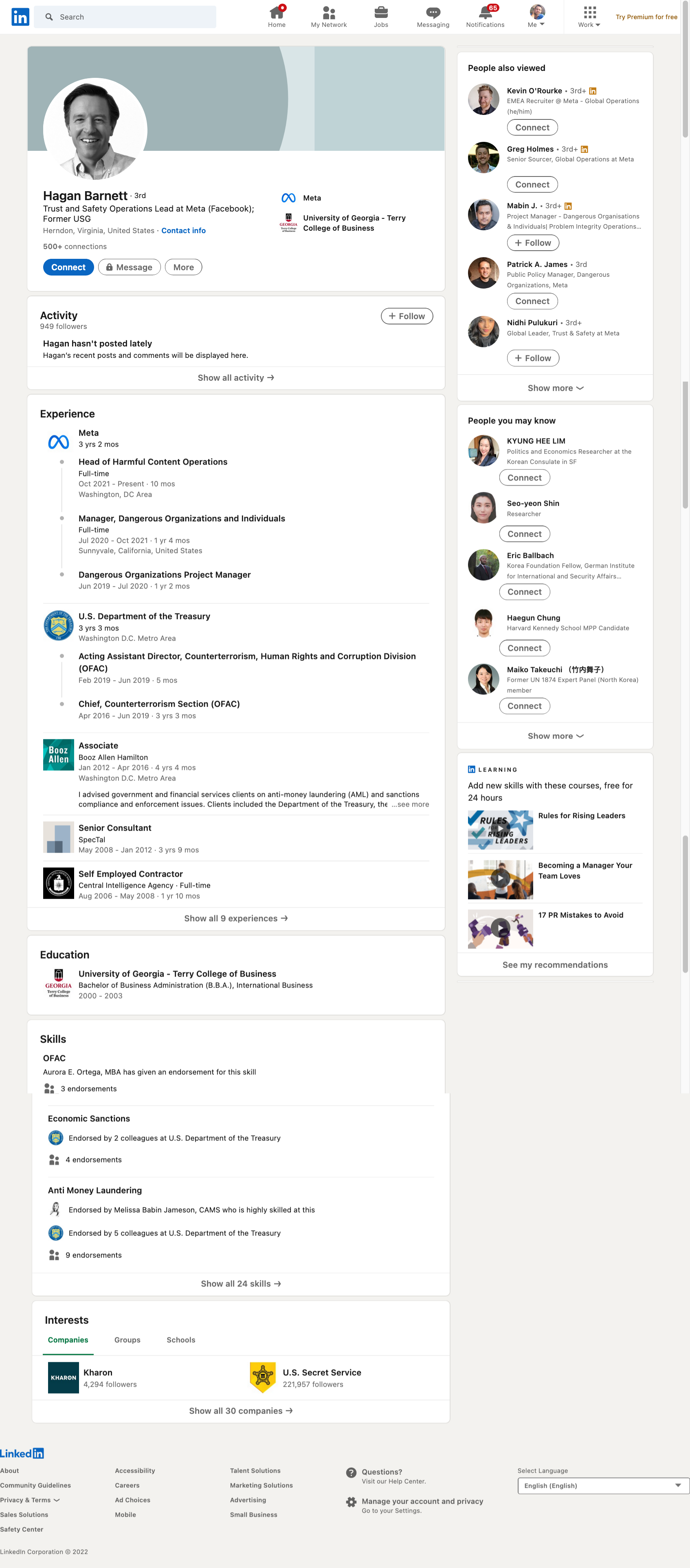
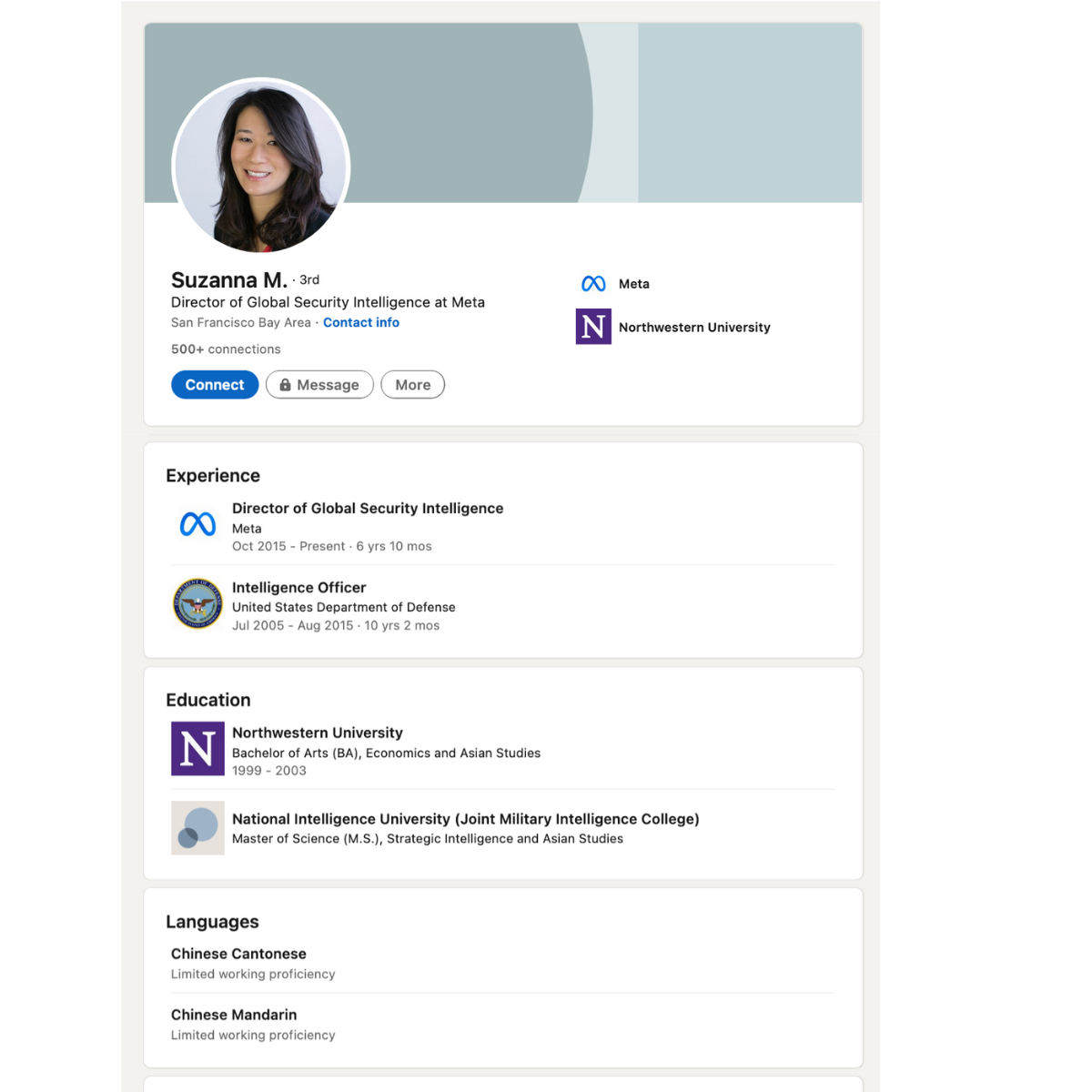
Other former CIA men at Facebook include Mike Torrey, who left his job as a senior analyst at the agency to become Meta’s technical lead of detection, investigations and disruptions of complex information operations threats, and former CIA contractor Hagan Barnett, who is now head of harmful content operations at the Silicon Valley giant.
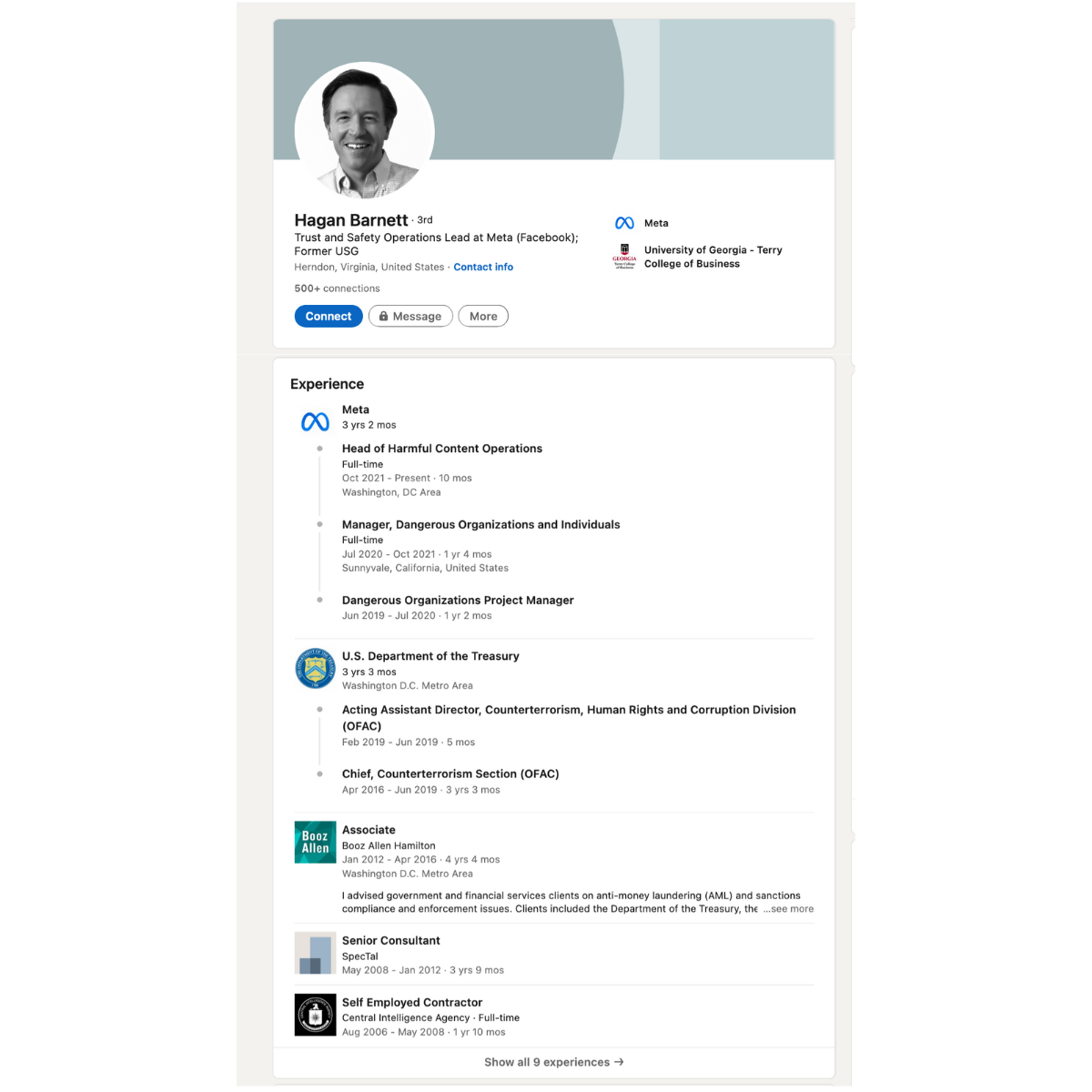 Meta’s intelligence and online security team includes individuals from virtually every government agency imaginable. In 2015, Department of Defense intelligence officer Suzanna Morrow left her post to become director of global security intelligence for Meta. The FBI is represented by threat investigations manager Ellen Nixon and head of cyber espionage investigations Mike Dvilyanski. Facebook’s influence operations policy manager Olga Belogolova had stints at the State Department and the Office of the Secretary of Defense.
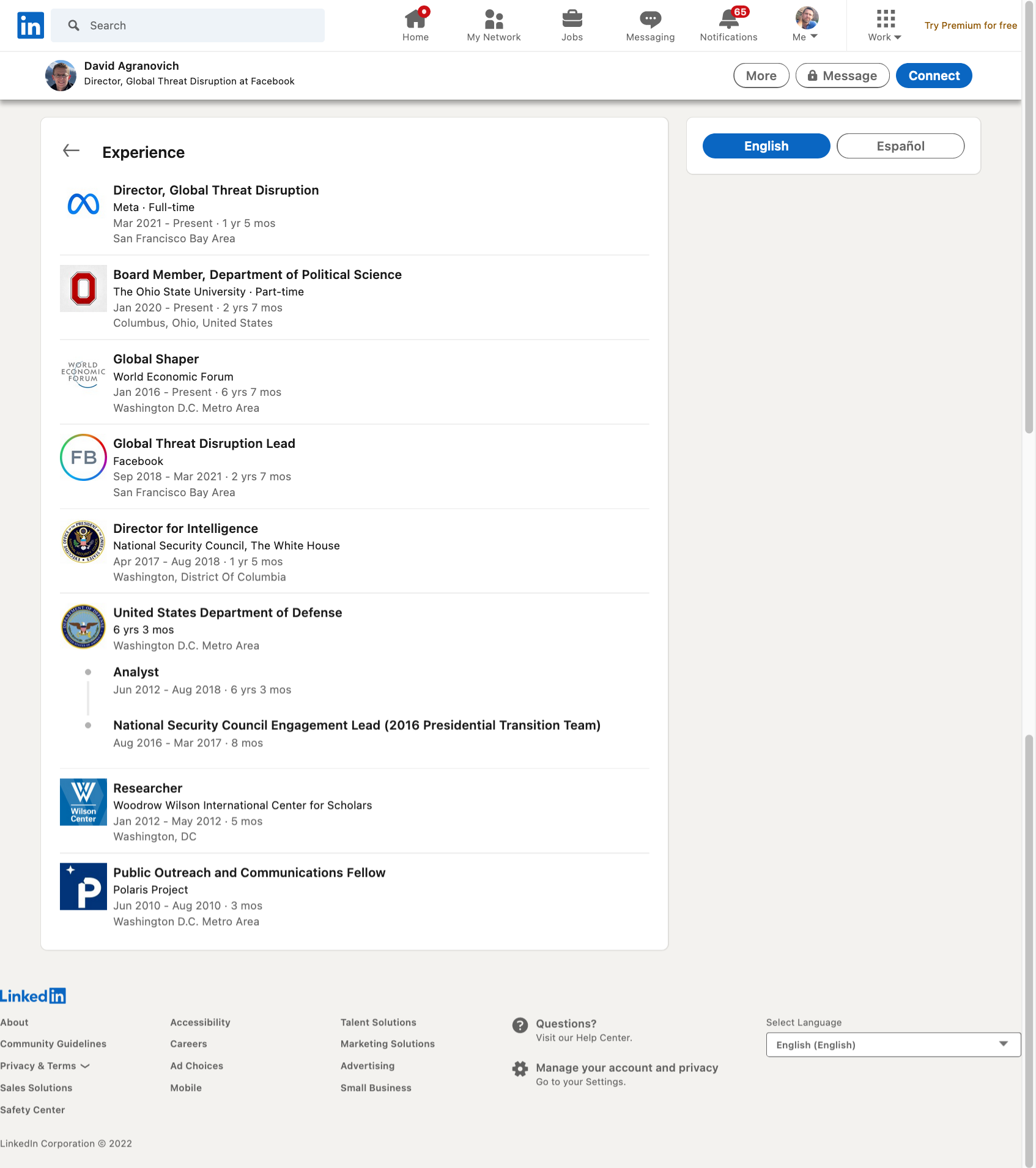
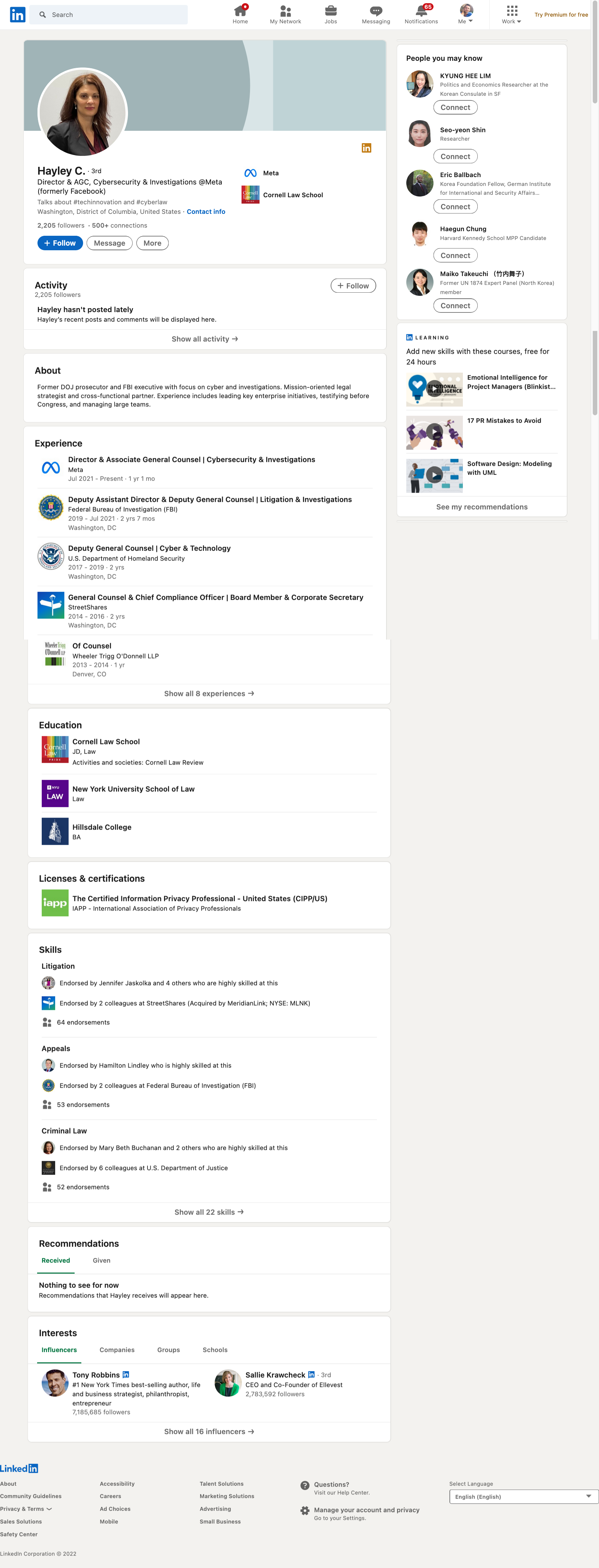
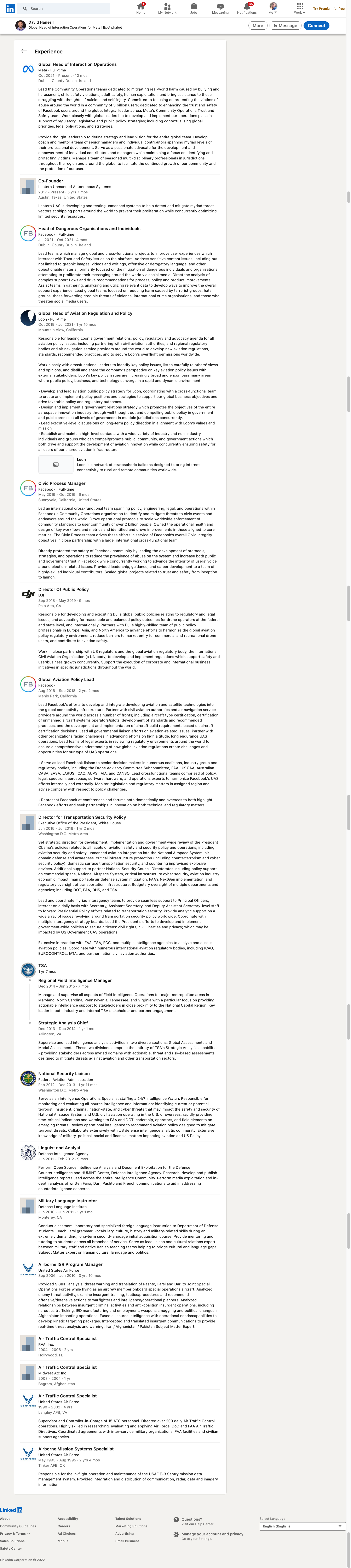
Before Meta, David Agranovich and Nathaniel Gleicher both worked for the National Security Council. Agranovich is director of global threat disruption at Facebook while Gleicher is head of security policy. Hayley Chang, director and associate general counsel for cybersecurity and investigations, worked formerly for both the FBI and Department of Homeland Security. And Meta’s global head of interaction operations, David Hansell, was once an Air Force and Defense Intelligence Agency man.
One of Meta’s most outwardly-facing employees is its global threat intelligence lead for influence operations, Ben Nimmo, a character MintPress has covered before. Between 2011 and 2014, he served as NATO’s press officer, moving the next year to the Institute for Statecraft, a U.K. government-funded propaganda operation aimed at spreading misleading information about enemies of the British state. He was also a senior fellow at the Atlantic Council, NATO’s semi-official think tank.
Perhaps then, it is not surprising that Facebook never seems to find U.S. government influence operations online – they are part of one!
CYBER WAR, CYBER WARRIORS
While Meta has not unmasked any nefarious U.S. government action, it regularly uncovers what it claims are foreign disinformation campaigns. According to a recent Facebook report, the top five locations of coordinated inauthentic behavior between 2017 and 2020 on its platform are Russia, Iran, Myanmar, the United States and Ukraine. However, it was at pains to note that American operations were driven by fringe far-right elements, white supremacists and conspiracy theorists, and not the government.
This is despite the fact that it is now well-established that the Pentagon fields a clandestine army of at least 60,000 people whose job is to influence public opinion, the majority of them doing so from their keyboards. A Newsweek exposé from last year called it “The largest undercover force the world has ever known,” adding,
The explosion of Pentagon cyber warfare, moreover, has led to thousands of spies who carry out their day-to-day work in various made-up personas, the very type of nefarious operations the United States decries when Russian and Chinese spies do the same.”
Newsweek warned that this army was likely breaking both U.S. and international law by doing so, explaining that,
These are the cutting-edge cyber fighters and intelligence collectors who assume false personas online, employing ‘nonattribution’ and ‘misattribution’ techniques to hide the who and the where of their online presence while they search for high-value targets and collect what is called ‘publicly accessible information’—or even engage in campaigns to influence and manipulate social media.”
As far back as 2011, The Guardian was reporting on this enormous cyber force, whose job it was to “secretly manipulate social media sites by using fake online personas to influence internet conversations and spread pro-American propaganda.” Yet the ex-military and ex-CIA officials Facebook employs do not seem to have found any trace of their former colleagues’ at work on the platform.
DIGITALLY SWINGING ELECTIONS
Since its beginnings in 2004, Facebook has grown to become a massive global empire and by far the most important news distributor the planet has ever known. The company boasts almost 3 billion active users, meaning that nearly 2 in 5 people worldwide use the platform. A recent 12-country study suggested that around 30% of the entire world gets its news via their Facebook feeds. This gives whoever is in charge of curating those feeds and controlling those algorithms inestimable power. It also represents a serious national security threat for all other countries, especially those that might wish to take a path independent from the United States. That those people are in large part former spooks makes this threat all the more perilous.
This is far from a hypothetical quandary. In November, less than a week before the country’s election, Facebook took the decision to delete hundreds of pages and accounts belonging to individuals and groups that supported the Nicaraguan Sandinista party – a longtime U.S. target for regime change. These included many of the nation’s most influential journalists and media outlets. Considering that around half of the country uses the platform for news and entertainment, the decision could barely have been more intrusive, and was likely designed to try to swing the election towards the pro-U.S. candidate.
Facebook claims that those accounts were bots engaged in “inauthentic behavior.” When those individuals migrated on to Twitter, recording videos identifying who they were to show they were not bots, Twitter immediately deleted those accounts too, in what was dubbed a coordinated attempt at suppression.
The individual behind this attempt was the aforementioned Ben Nimmo, who co-authored an unconvincing report, full of questionable assumptions and allegations. This included an insinuation that accounts following a pattern of activity whereby their Facebook usage levels peaked in the morning and afternoon and dwindled to almost nothing after midnight Nicaragua time suggested they were bots.
Facebook was also used by right-wing Cubans to attempt a U.S.-backed color revolution against the ruling Communist government last year.
Giving any individual or group that much control over the airwaves of communication raises huge questions about national security and sovereignty – doubly so when those individuals are so intimately connected to the U.S. national security state.
When asked what the public’s reaction would be to the news of such an intimate connection between Facebook her former employer, Murray stated that she was unsure whether many would be bothered:
I would like to think that the American public would strenuously object. However the CIA and other agencies have worked over many decades to cultivate a positive – indeed almost glamorous – image in the eyes of the vast majority of the public, mostly through TV series, Hollywood films, and favorable media coverage – so sadly my guess is that the vast majority of the public probably believes that these are the folks who should be in charge.”
However, she said, the news would likely land a very different way in countries that have been the target of Washington’s ire. “As you’re no doubt aware, the CIA has an atrocious public reputation in most parts of the world,” she added.
SPOOKS IN EVERY DEPARTMENT
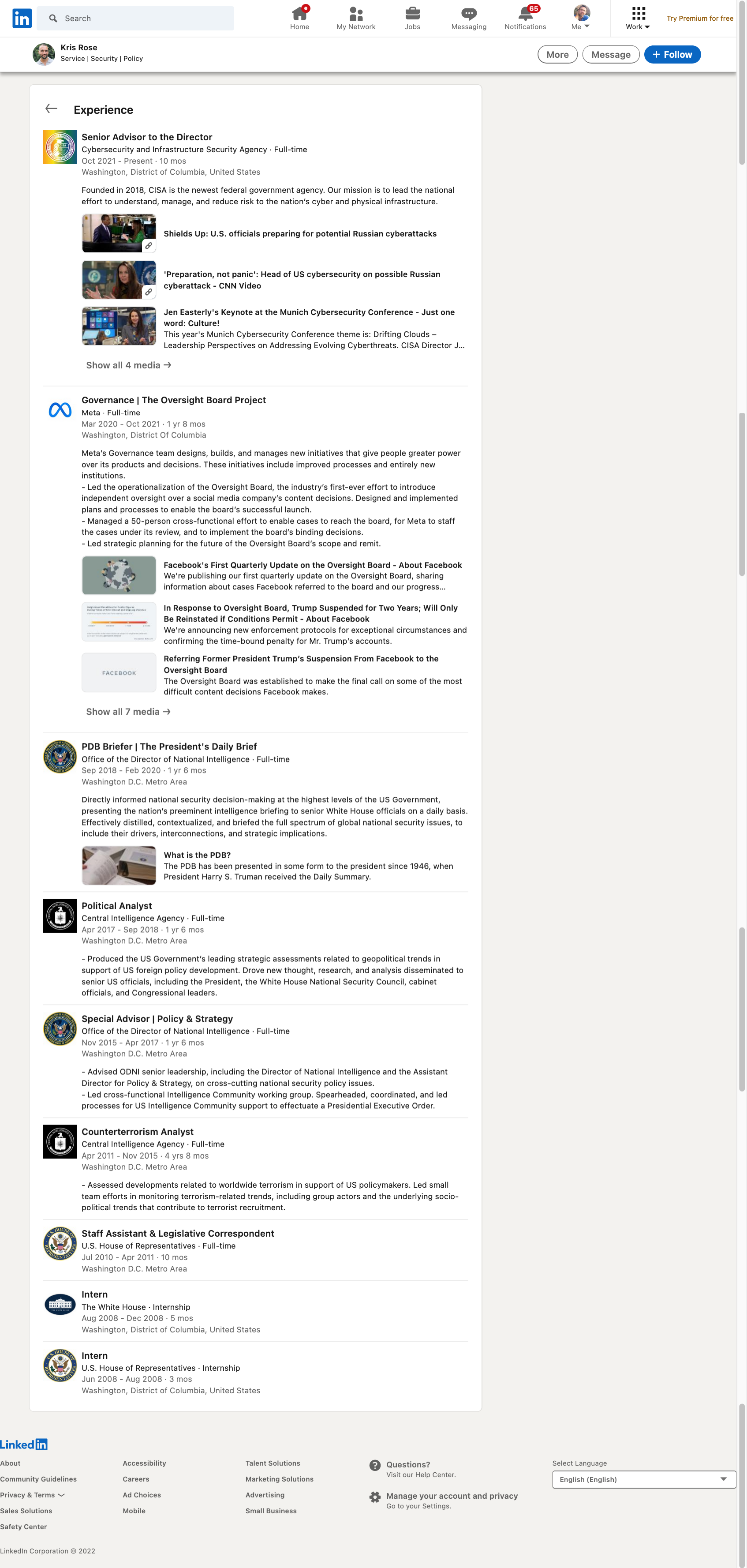
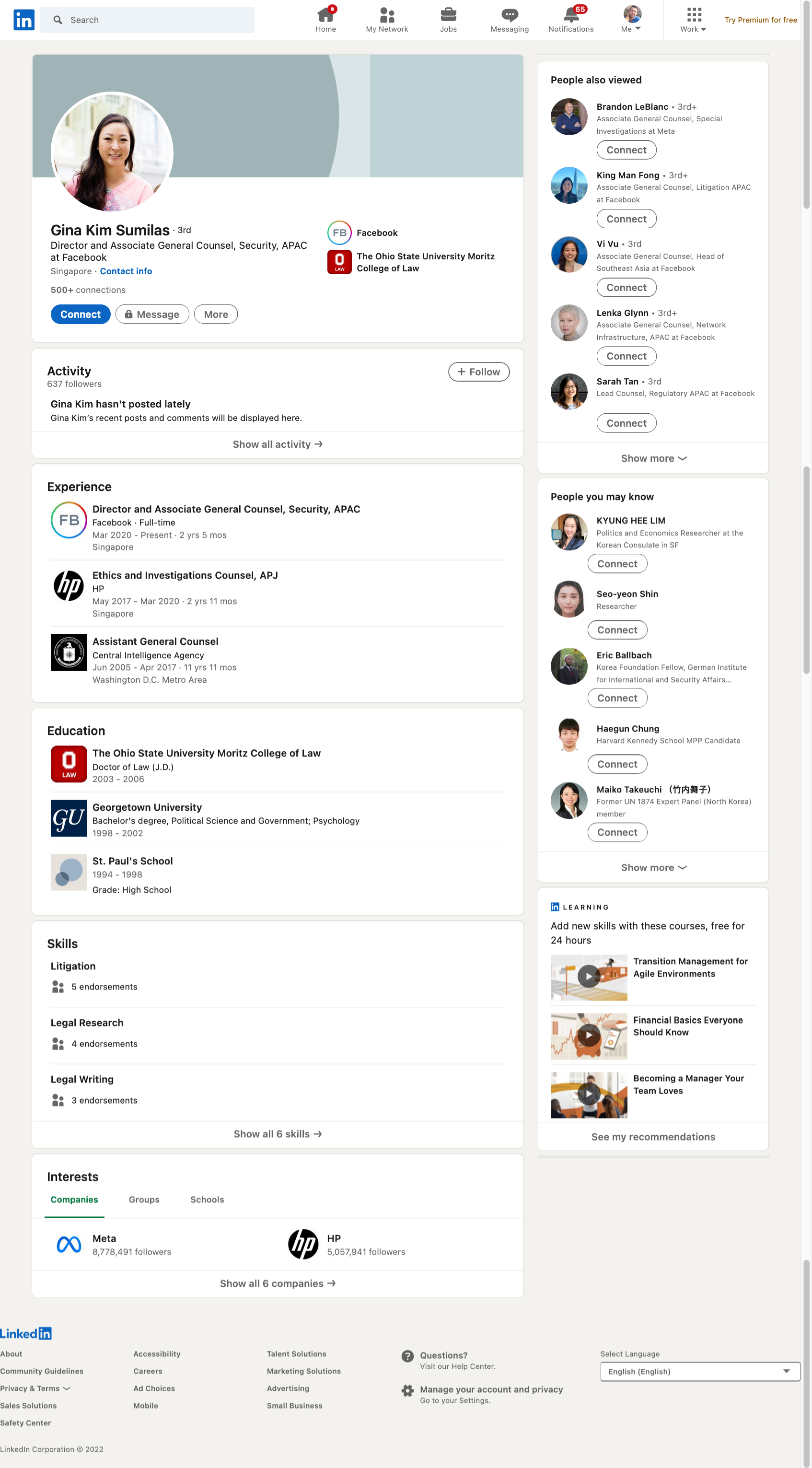
MintPress has found former representatives of the U.S. national security state in virtually every politically sensitive department at Facebook. This includes even higher levels. Between 2020 and 2021, Kris Rose was a member of Meta’s governance oversight board – the group responsible for the overall direction of the platform. He left his job at the Director of National Intelligence as the president’s daily brief writer to take up the role. Before that, he had spent six years at the CIA as a political and counterterrorism analyst. Meanwhile, Gina Kim Sumilas, Facebook’s director and associate general counsel for the Asia Pacific region, spent nearly twelve years in the CIA before moving into the tech private sector.
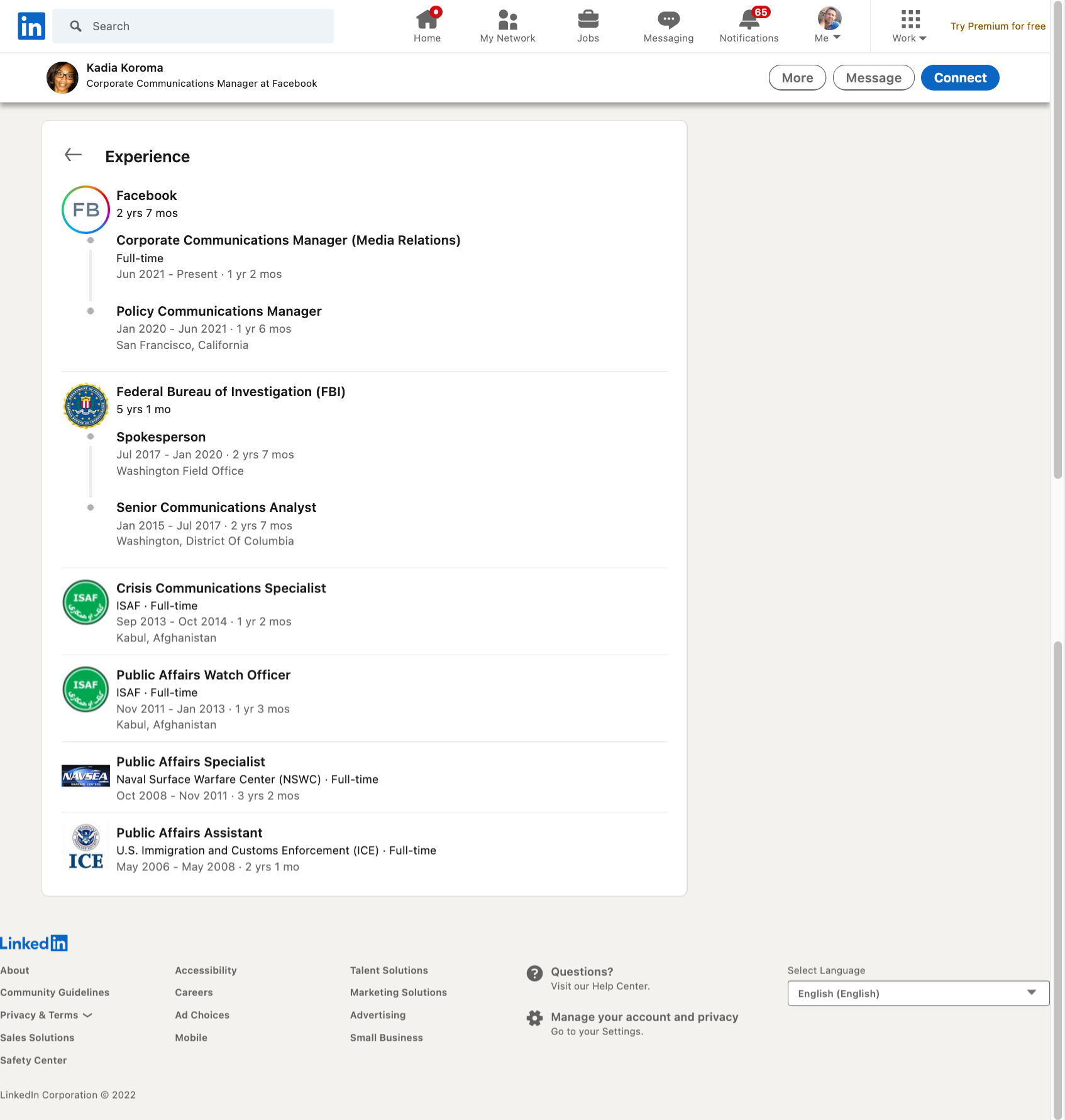
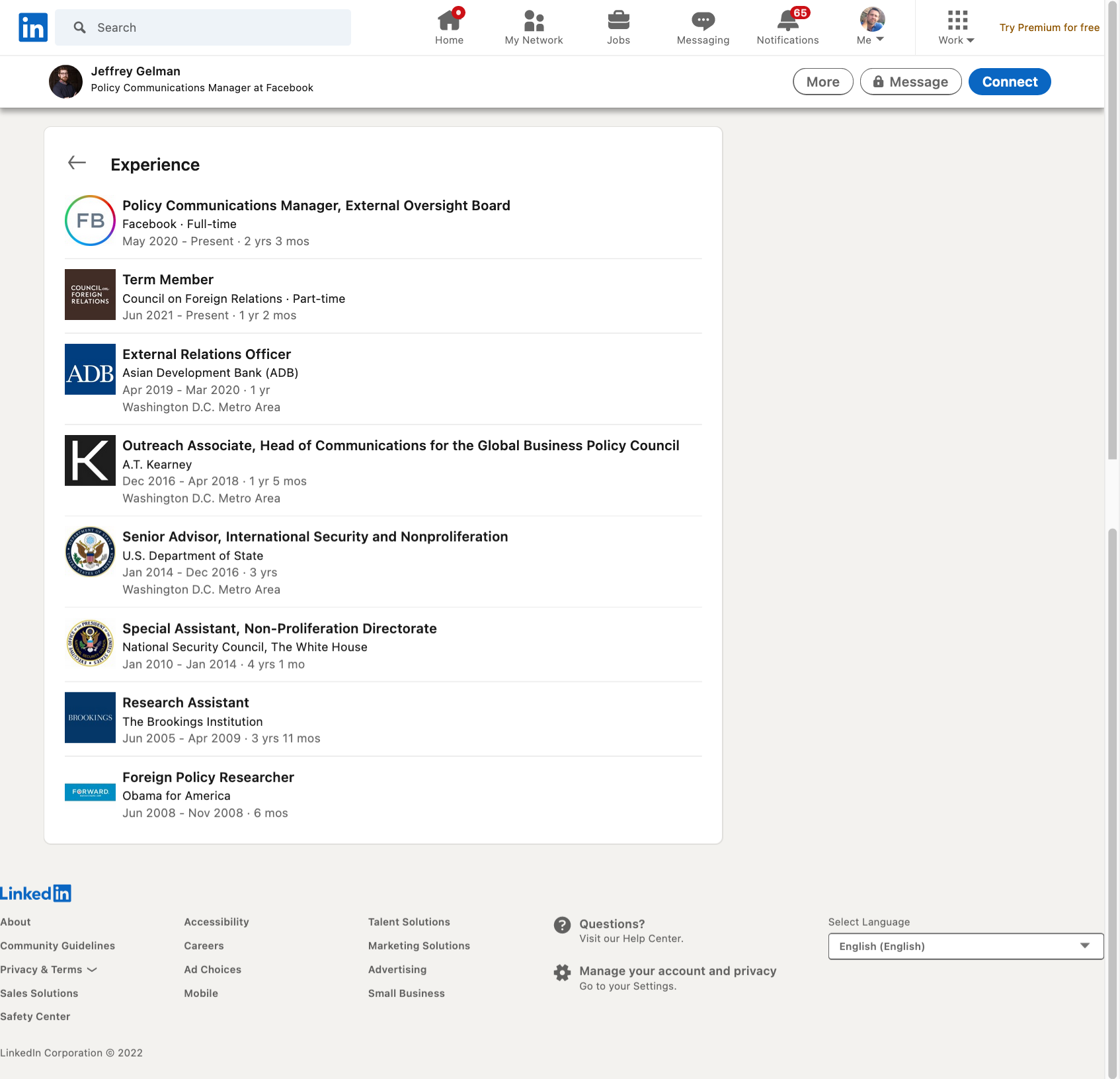
There is also considerable overlap with the U.S. government in the company’s front facing staff. Kadia Koroma, for instance, was plucked from her position as an FBI spokesperson in January 2020 to become media relations manager at Facebook. Jeffrey Gelman, policy communications manager for Facebook’s oversight board, is a member of the Council on Foreign Relations and held influential roles in both the State Department and the National Security Council. And executive communications spokesman Kevin Lewis spent many years in the White House as President Obama’s spokesperson.
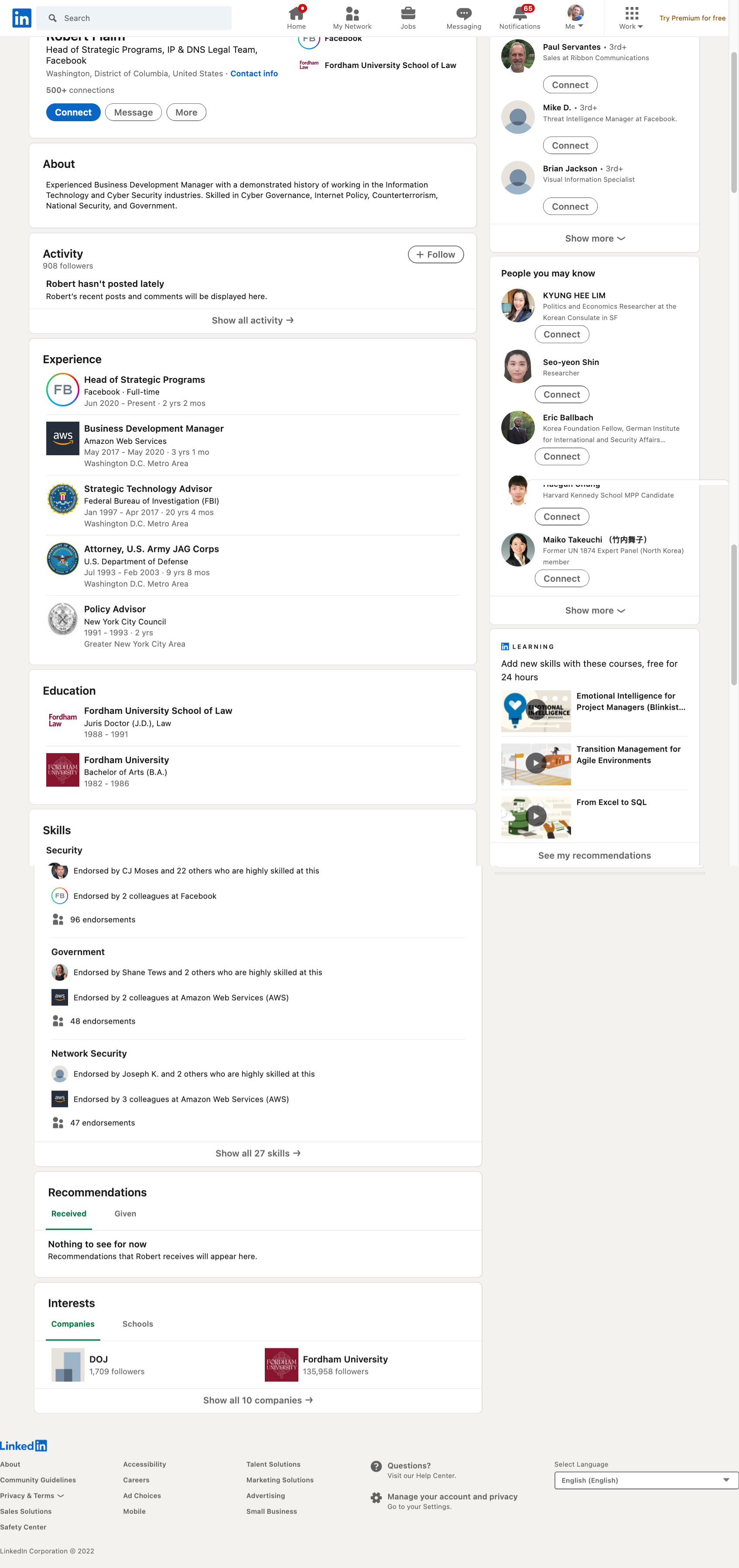
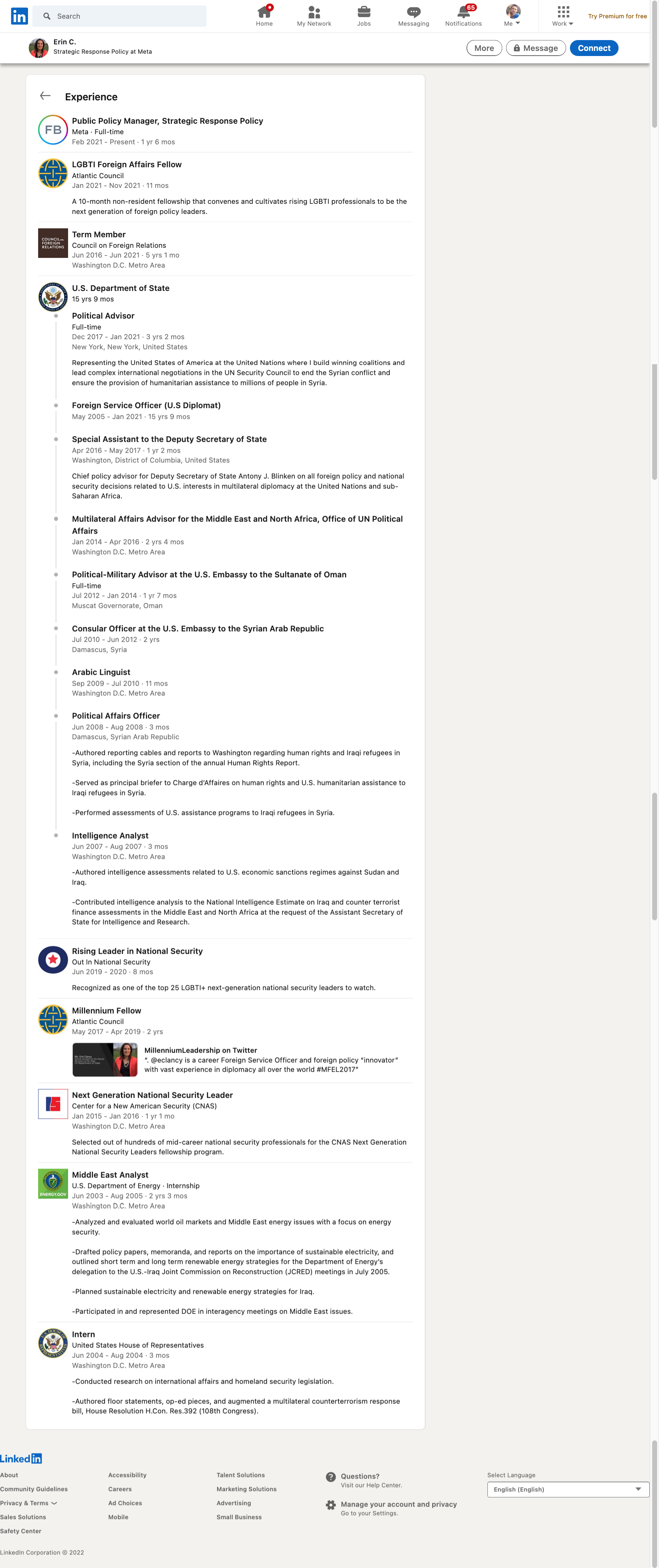
Meta’s vice president of legal strategy is Rachel Carlson Lieber, who went straight from the CIA into Facebook. Her first role at the Silicon Valley giant was as head of the North America regulatory and strategic response, a department that continues to feature a number of former state officials. This includes head of strategic programs, Robert Flaim, who spent more than twenty years as an FBI, and Erin Clancy, who left a 16-year career at the State Department to become a manager of strategic response policy.
Clancy’s official work centered around U.S. policy in the Middle East. Her own bio boasts that she worked on the U.S. sanctions regime placed on Iraq and Sudan. She also worked at the U.S. Embassy in Damascus at the time of the Arab Spring and the beginning of the Syrian Civil War. It is known that she also coordinated closely with the White Helmets, a controversial aid organization that some have alleged is far too close to Al-Qaeda and its affiliates. Even after her Facebook appointment, Clancy moonlighted as a member of the Council on Foreign Relations and as a fellow at the Atlantic Council, the hawkish body that serves as NATO’s brain trust.
Why are these national security state officials so attractive to Meta? One reason, Murray explained, is financial. “By snagging a CIA employee a company can save a considerable sum,” she said, explaining that, “The individual has likely undergone extensive professional training (at taxpayer expense) and probably has a security clearance,” something that is difficult, expensive and time-consuming to obtain in private sector work. Therefore, companies dealing with matters of state secrecy (such as defense contractors) have historically courted both current and former officers to fill their ranks, enticing them with much higher salaries than they can receive in government service.
“What is new (or at least newly known to us!) is that now these professionals are being sought after by social media companies like Facebook, Google and others who are now heavily into monitoring, surveilling, and censoring content, and then sharing data about users with U.S. government entities,” Murray added.
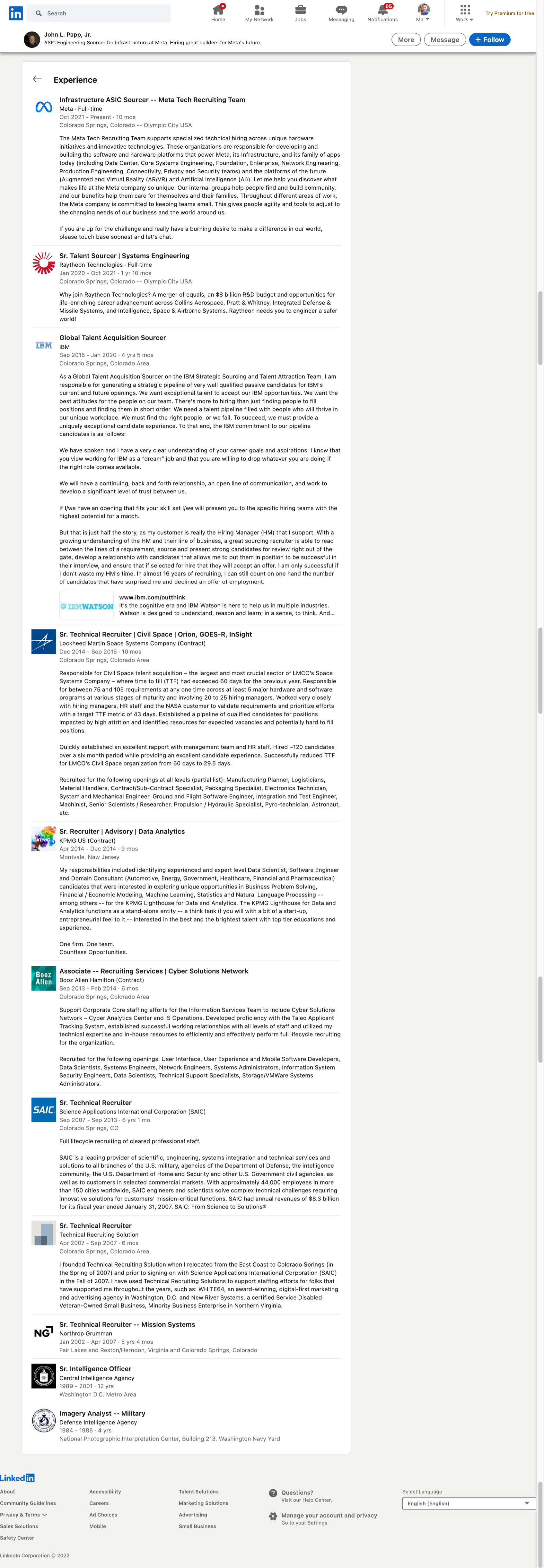
Such is the need for these individuals in these fields that private companies often hire former national security agents to do the recruiting for them. For instance, John Papp, who spent 12 years at the CIA as a senior intelligence officer and 4 years as an imagery analyst at the Defense Intelligence Agency, went on to work as a recruiter for many of the largest defense contractors in Washington. These included Booz Allen Hamilton, Raytheon, Northrop Grumman, IBM and Lockheed Martin. Today, he works as a recruiter for Meta.
Perhaps unsurprisingly, Meta also employs former spooks for their internal security operations. The company’s vice president, chief security officer is Nick Lovrien, a former counterterrorism operations officer at the CIA, while its head of insider protection is ex-CIA operational psychologist and “undercover officer” Nicole Alford.
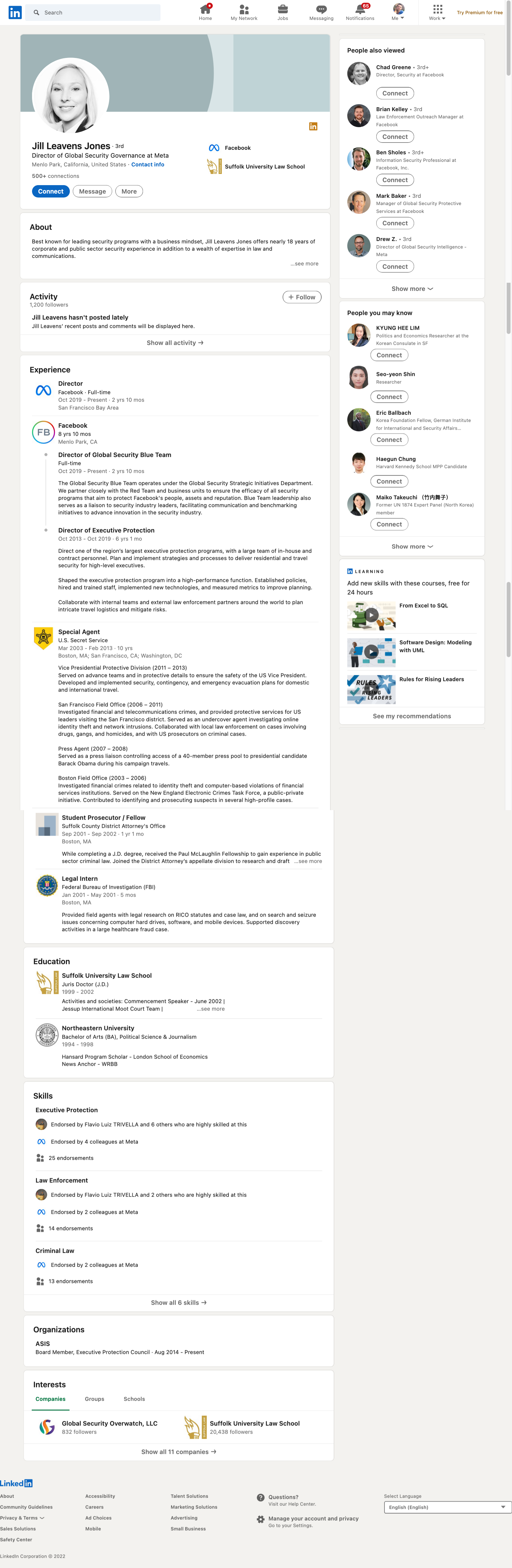
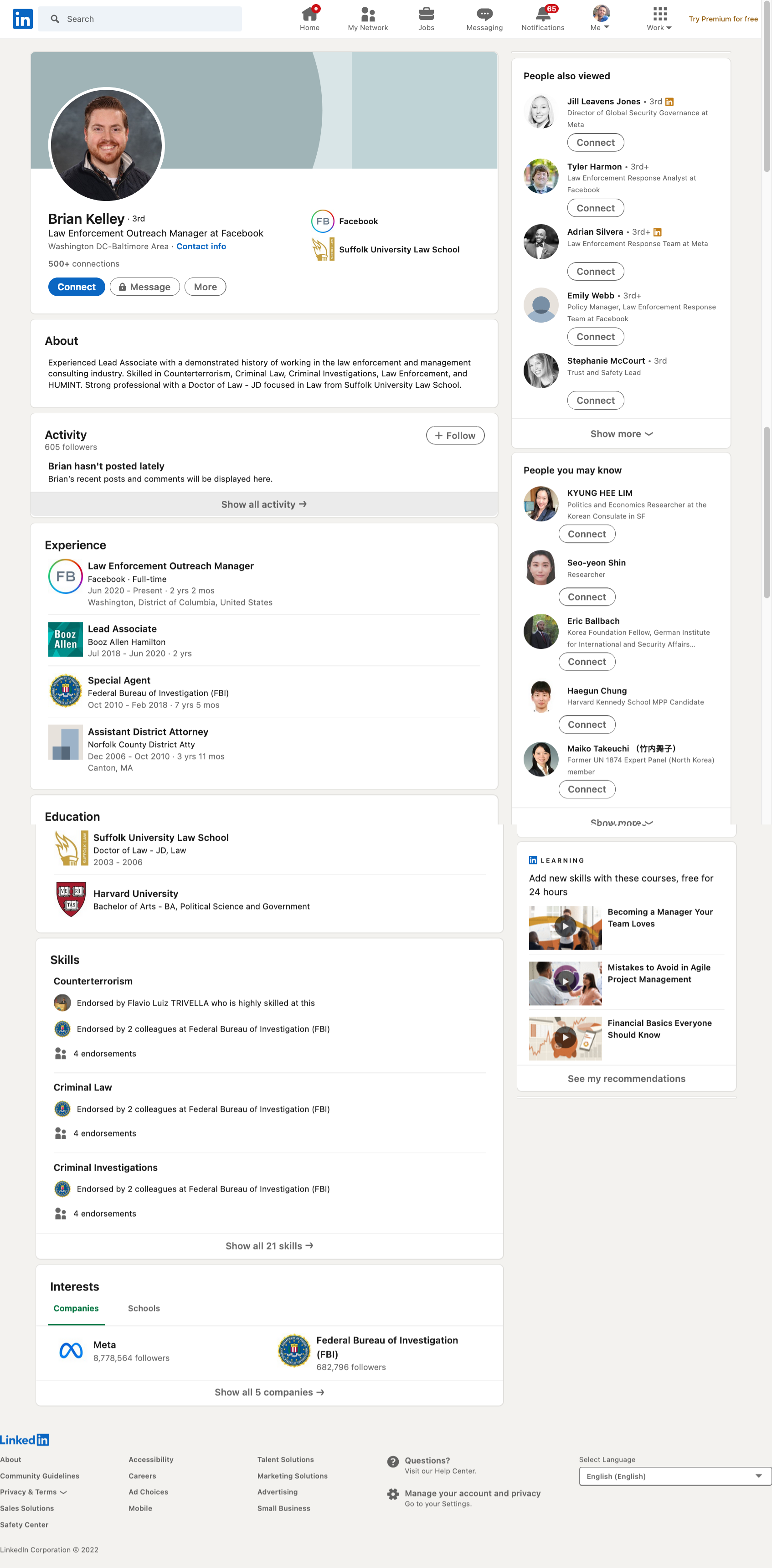
Meanwhile, Meta’s director of global security governance – the individual reportedly responsible for the personal safety of Facebook co-founder Mark Zuckerberg – is Jill Leavens Jones. Jones left her job as a U.S. Secret Service special agent to take the appointment. And director of global security operations Alexander Carrillo continued on as a lieutenant commander in the Coast Guard for several months after his appointment at Facebook. The company also hires former feds to work directly with law enforcement on legal issues. One example of this is former FBI special agent Brian Kelley.
A LONG PATTERN OF INFILTRATION
45 years ago, legendary journalist Carl Bernstein released an investigation documenting how the CIA had managed to infiltrate U.S. and global media. The CIA had placed hundreds of agents into newsrooms and had convinced hundreds more reporters to collaborate with them. These included individuals at some of the most influential outlets, including The New York Times. The CIA needed to do this clandestinely because any attempt to do so openly would harm the effectiveness of the operation and provoke stiff public resistance. But by 2015, there was barely a murmur of disapproval when Reuters announced that it was hiring 33-year veteran CIA manager and director Dawn Scalici as a global director, even when the company announced that her primary responsibility was to “advanc[e] Thomson Reuters’ ability to meet the disparate needs of the U.S. government.”
Facebook, however, is vastly more influential than the New York Times or Reuters, reaching billions of people daily. In that sense, it stands to reason that it would be a prime target of any intelligence organization. It has become so big and ubiquitous that many consider it a de facto public commons and believe it should no longer be treated as a private company. Considering who is making many of the decisions on the platform, that distinction between public and private entities is even more blurry than many presume.
Alan MacLeod is Senior Staff Writer for MintPress News. After completing his PhD in 2017 he published two books: Bad News From Venezuela: Twenty Years of Fake News and Misreporting and Propaganda in the Information Age: Still Manufacturing Consent, as well as a number of academic articles.
Saskatchewan warns Trudeau’s federal Nitrogen agents could be arrested
By Keean Bexte | The Counter Signal | August 21, 2022
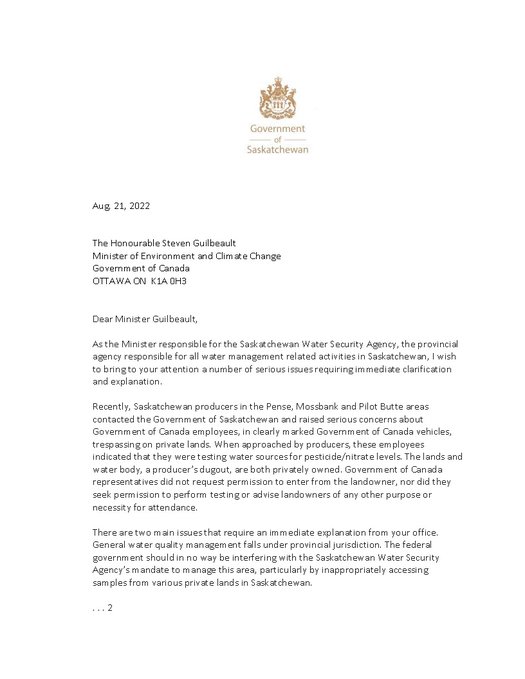
 Saskatchewan Minister Jeremy Cockrill has sent a warning to the Trudeau government that officers sent by Ottawa will be arrested if they continue to trespass on farmland to test nitrogen levels.
According to Cockrill, Trudeau’s government has been unlawfully sending federal employees onto Saskatchewan farmlands to test for nitrogen levels without the consent of landowners.
In the letter, the Minister raised multiple complaints from Saskatchewan farmers that raised “serious concerns about Government of Canada employees, in clearly marked Government of Canada vehicles, trespassing on private lands.” The farmers reporting these trespasses made clear that these government agents did not request permission to access the land and were not in any other manner given consent to access it.
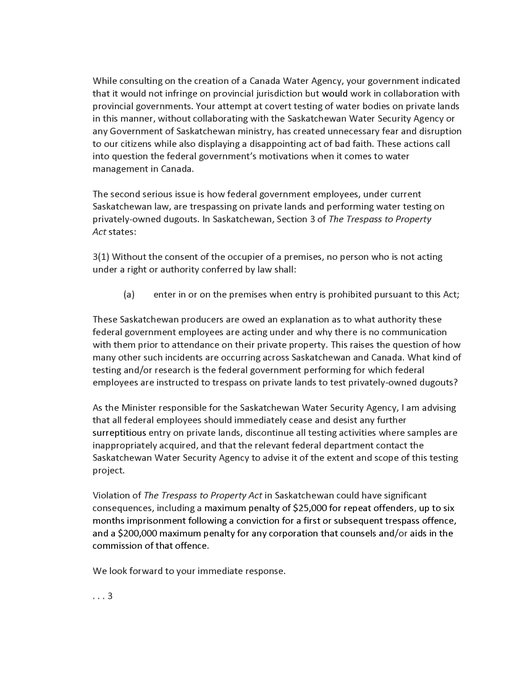
Minister Cockrill further pointed out to the Trudeau government that these actions constitute a breach of the Saskatchewan Trespass to Property Act, and warned that these actions could carry with them serious penalties, including fines of up to $200,000 and up to six months in prison.
By sending this letter, the Saskatchewan government has provided a clear order to the Trudeau government to cease and desist with any unlawful trespasses and warned them that should it continue, their employees could face arrest and prosecution.
What is more concerning to some than the actual trespass are the motivations of the federal agents. According to the land owners who confronted the federal agents trespassing on their land, they were told that the purpose of them being there was to test the water in the farmers’ dugouts to measure nitrate levels.
For those following recent news in the agricultural world, this is being seen as connected to the Trudeau government’s recently announced policy to reduce the use of fertilizer on Canadian farms by 30%. This policy has been widely criticized by farmers across the country and by provincial governments in the Western provinces.
Some observers have said that there is reason to suspect that these actions are the first steps in replicating the attacks on farmers that have provoked widespread unrest in the Netherlands and other places in Europe.
While the federal government has not yet confirmed it, there is speculation that the water sampling we now know is underway, will be used as baseline measurements to enforce reductions in fertilizer usage going forward.
All of these factors have led Saskatchewan Premier Scott Moe to demand an explanation from the Trudeau government as to what exactly they were up to.
How the US controls Lebanon’s energy supply
The US is leveraging Egypt’s gas supply to pressure Beirut over US-brokered maritime border talks with Israel
By Yeghia Tashjian | The Cradle | August 19 2022
Consider the chaos in Europe today caused by a sudden reduction in Russian gas supplies.
Now imagine the catastrophic state of Lebanon’s energy sector after two years of fuel shortages, limited foreign currency with which to purchase new, urgent supplies, and US-sanctions on Syria impeding Lebanon’s only land route for imports.
After decades of stalled reforms, Lebanon is running out of time and money.
In June 2021, a lifeline was handed to the country in a deal struck with Baghdad to supply two Lebanese power stations with Iraqi fuel. The agreement, which was due to expire in September 2022, has recently been extended for one year.
But while there are short and long term solutions available to remedy Lebanon’s energy crisis, the two main options are both monopolized by US policymakers with stakes in regional geopolitics.
The first option involves transporting fuel to Lebanon via the Arab Gas Pipeline (AGP), whereby Egypt will supply gas through Syria. Although the proposal was originally an American suggestion, this fuel route requires US sanctions waivers that have not yet been approved by Washington.
The second option is for Lebanon to extract its own gas supply from newly discovered fields off its coastline. This too depends entirely on US-mediated, indirect negotiations with Israel to resolve a maritime dispute over the Karish gas field in the eastern Mediterranean Sea.
Accessing its own gas supplies will go a long way to guarantee Lebanon’s own energy security, while providing the state with much needed revenues from exports.
However, the success of either project depends largely on the status of US-Lebanese relations at any given moment. The two options are also inextricably linked to each other: Washington is pressuring Beirut to compromise with Tel Aviv on the maritime border dispute before agreeing to “green light” Cairo’s gas exports via Syria, which is in turn heavily sanctioned by the US’s “Caesar Act.”
While Washington is playing a leverage game, Lebanon is slowly collapsing.
Gas from Egypt
Under the agreement signed with Cairo, 650 million cubic meters of natural gas will be exported annually via the AGP. As it turns out, the actual supply of gas, as per the World Bank’s conditions, awaits US approval to exclude Egypt from sanctions imposed on the passage of goods through Syria.
The AGP is already a functioning pipeline that has supplied Lebanon with Egyptian gas in the past, but operations were halted in 2011 when Syrian pipelines were damaged during the country’s armed conflict.
Under the deal, Egypt will pump gas through the pipeline to supply Lebanon’s northern Deir Ammar power plant, which can then produce 450 megawatts of electricity – adding four hours of additional electricity supply per day. It is a modest but necessary improvement over the barely two hours of electricity currently provided by the state.
The World Bank has pledged to finance the deal on the condition that the Lebanese government implements much needed reforms in the electricity sector, which has created tens of billions of dollars in public debt.
The Syrian equation
For the Syrian government, the arrangement is perceived as a diplomatic victory as it confers ‘legitimacy’ to the state and represents a step toward its international rehabilitation. The AGP deal was also hailed by Syrian Minister of Oil and Mineral Resources Bassam Tohmy as one of the most important joint Arab cooperation projects.
According to Will Todman, a research fellow in the Middle East Program at the Center for Strategic and International Studies, the agreement is “a win for the [Bashar al-]Assad government. The deal represents the first major move toward Syria’s economic integration with the region since Arab Spring protests shook Syria in March 2011, halting previous integration efforts.”
However, due to US Caesar Law restrictions, no concrete progress has been made over the past months. Amman and Cairo have both requested guarantees from Washington that they will not be subject to sanctions – to no avail. US President Joe Biden has yet to make a final decision on whether the plan will be considered a violation of sanctions on Syria.
Linking the Egypt deal with Israel talks
In order to create a certain interdependency in the region to minimize the possibility of new conflicts with Israel, the US is attempting to link the Egyptian gas deal with the ongoing, indirect, maritime negotiations between Tel Aviv and Beirut.
Amos Hochstein, the State Department senior adviser on energy security, who acts as chief mediator on the disputed maritime border between Lebanon and Israel, said after arriving in Beirut on 14 June that the US side will look at the final agreement between Egypt and Lebanon to evaluate the sanctions compliance of the natural gas project.
This means that Washington is linking the fate of the gas deal to the maritime dispute with Israel to exert additional pressure on Lebanon.
On 14 October, 2020 – just two months after the Beirut port blast which severed the primary transportation route for seaborne Lebanese imports – Lebanon and Israel began the long-awaited US-mediated talks to demarcate their maritime borders, under the supervision of the UN.
The framework agreement announced by both countries at the time was the most serious attempt to resolve the maritime dispute and secure gas drilling operations through diplomatic means.
However, there are many challenges that can slow or even derail these negotiations.
According to Lebanese estimates, the country has 96 trillion cubic feet of natural gas reserves and 865 million barrels of oil offshore, and is in urgent need to begin drilling to save its ailing economy.
Israel is also in hurry to resolve this dispute as it wants to finalize the negotiations before September 2022, when the Karish gas rig is expected to begin production. The concern is that if a deal is not signed by then, Hezbollah may take action to halt Israel’s extraction altogether – until Lebanon is able to extract its own fuel from those waters.
Resolution or conflict
Last month, Hezbollah Secretary General Hassan Nasrallah reiterated warnings against Tel Aviv in the event that Lebanon is prevented from extracting its own resources in the Med. “When things reach a dead-end, we will not only stand in the face of Karish… Mark these words: we will reach Karish, beyond Karish, and beyond, beyond Karish,” he cautioned.
Initially, Lebanon took a maximalist position on its maritime borders with Israel: the main dispute was around the percentage both countries should share in the disputed 860 square kilometers, which covers Lebanon’s offshore gas Blocks 8, 9 and 10.
It is worth mentioning that Lebanon does not enter these negotiations from a position of strength and is in dire economic need to unlock foreign aid and begin the flow of potential gas revenues.
Meanwhile, the arrival this summer of the British-based Energean, an oil and gas exploration company, which will begin a drilling operation close to the Karish gas field, has sparked tensions between both countries, prompting US envoy Hochstein to race back to the region on 13 June.
In order to provide Lebanon with some much-needed leverage and accelerate negotiations, Hezbollah dispatched three drones towards the Karish gas field on 2 July. The operation sought several results: to test Israeli military responses to the drones, to scare off the private company contractors working on the rig, and to motivate both Tel Aviv and Washington to step up and strike a deal.
The operation achieved its goals. Israel’s military now can’t rule out the possibility that the Lebanese resistance movement will launch additional attacks on the gas field in the near future, or provoke Israel in a different manner – if the maritime dispute is not ironed out, and soon.
Beyond the Mediterranean Sea
The negotiations have also been impacted by international developments, chiefly, the war in Ukraine and the growing energy crisis in Europe. Sweeping western economic sanctions on Moscow’s economic interests have dried up Russian exports to the continent, driving Europe to seek alternative sources of energy, few of which are readily available.
In May 2022, the US and EU unveiled a plan to reduce Europe’s dependence on Russian fossil fuels and in June, the EU and Israel signed an agreement to export Israeli gas to Europe. These external factors have further motivated the US and Israel to hasten the negotiation process with Lebanon, all of which are overshadowed by the aforementioned US pressure on the Lebanese government.
Energy expert Laury Haytayan believes that linking Lebanon to regional energy projects makes it harder for Lebanon to go to war with Israel. Haytayan told The Cradle: “Lebanon needs gas, Israel needs stability, and the US wants to give both what they want.”
It is important to recognize that a final maritime demarcation agreement also means defusing the tensions on the Lebanese-Israeli border, which may require a broader US-Iranian agreement, something that is unlikely in the short term.
If the gas deal is successful and the US approves the Egyptian energy exports, the move will only increase US leverage over Lebanon when it comes to future negotiations on energy security.
It is in Lebanon’s interest to ensure that one party, the US, does not continue to hold all the cards related to its vital fuel needs. A recent offer from Iran to supply the country with monthly free fuel was tacitly accepted by Lebanon’s prime minister and energy minister, but needs work. Other states have offered to build power generation plants to enhance the nation’s infrastructure and efficiency.
But with Lebanon so deeply affected by Washington’s whims – and punishments – it isn’t at all certain that the country can steer itself to these more independent options.
The US and Israel have never been this highly incentivized to solve the maritime dispute. If the deal fails, Hezbollah may proceed with military action, especially before the conclusion of political ally President Michel Aoun’s term this Fall.
Furthermore, the gas issue may turn into a contentious domestic political issue ahead of Israel’s November parliamentary elections. In that instance too, a military conflict between Israel and Hezbollah may be triggered.
The only solution is to strike a deal, get gas flowing, and avert war. Will saner minds prevail, or will the region’s high-stakes geopolitical competition continue to escalate blindly? More importantly, can Washington bear to allow Lebanon the breathing space after three years of severe economic pressure to control Beirut’s political decisions?
Occupation raids, attacks Palestinian organizations: EU, US and Canada are complicit!
Samidoun Palestinian Prisoner Solidarity Network | August 21, 2022
In the early morning hours of Thursday, 18 August, armed Israeli occupation forces invaded the offices of seven prominent Palestinian NGOs, civil society organizations and human rights defenders: the Health Work Committees, Addameer Prisoner Support and Human Rights Association, Al-Haq, Union of Palestinian Women’s Committees, Bisan Centre, Defence for Children International – Palestine, and the Union of Agricultural Work Committees. These organizations have all been designated by the Israeli occupation as “terrorist” in retaliation for their advocacy and community organizing work for Palestine, and then labeled “illegal organizations” in a military order covering the occupied West Bank of Palestine.
The invading forces ransacked the offices, confiscating computers, legal client files, documentation, printers and monitors and leaving clutter behind — as documented by the organizations’ surveillance cameras, recording the occupation forces’ invasion. The doors of the organizations were welded shut and a paper military order affixed to the door declaring their operation “illegal” under the occupation’s (illegal) military orders.
The organizations declared that they would not be silenced by these attacks, holding press conferences and returning to the offices to reopen them and continue their work. The attacks received widespread condemnation not only from Palestinian and pro-Palestinian forces but even from European governments whose policies and practices consistently target the Palestinian people and their fundamental rights.
Now, on Sunday, 21 August, occupation intelligence authorities — the Shin Bet — phoned Al-Haq director Shawan Jabarin to threaten him with interrogation and arrest if the organization’s work continues, while Defence for Children International – Palestine director Khaled Quzmar was summoned to and held under interrogation.
“Terror” Designations and Political Control
The invasions, interrogations, ransacking and attacks on these organizations reflect the failure of the occupation’s regime of “terror” designations to undermine their work. In 2021, not only did the regime designate Al-Haq, Addameer, DCI, Bisan, the UPWC and the UAWC as “terrorist” organizations — quickly followed by the military orders banning their work in the occupied West Bank of Palestine — it earlier in the year designated Samidoun (on 21 February 2021), followed by three more organizations. Previously and in a similar pretext, the occupation had issued a similar designation against the Health Work Committees along with designations of groups including the Arab Organization for Human Rights UK, the Palestinian Return Centre and Euro-Mediterranean Human Rights Monitor.
As we noted at the time, this
“indicates just how meaningless the term ‘terrorist’ is in the hands of the Israeli regime. It means precisely any organization, activist, or freedom fighter that challenges Zionist colonialism through any method or means of resistance at all. The flurry of ‘terrorist’ designations for organizations working to expose Israel’s crimes and organize Palestinians underlines this reality….These designations are not attacks on individual organizations but against Palestinian human rights defenders and those around the world who stand up for Palestinian liberation — and, fundamentally, the Palestinian people as a whole, especially the Palestinian prisoners in Israeli occupation prisons. They attempt to repress growing support for the legitimate resistance of the Palestinian people and confrontation of imperialism and Zionism.”
Further, it is clear that the use of such designations is intended to further political control over Palestinian society. These designations hinge on the allegation that organizations are close to one or another Palestinian resistance organizations, most commonly the Popular Front for the Liberation of Palestine or Hamas. Israeli officials have shopped around “evidence” to various governments that is so weak so as to be ludicrous, consisting almost entirely of unsubstantiated statements or on the idea that employing a person who supports a political organization (or, in some cases, relatives of people in political organizations “designated” by the occupation) is “funding” that organization by paying employees a salary for doing their job.
While it is obvious that these are false claims, the objective of this type of attack goes beyond simply lobbing allegations. Indeed, the European governments that have criticized the attacks and designations have also repeatedly affirmed their willingness to “examine evidence” and “act” if the Israeli regime “proves” that popular organizations, civil society groups and human rights advocates are in some way “tied” to Palestinian resistance movements. Not only are the organizations “innocent” of the Israeli claims, the claims themselves are fundamentally repugnant. The Palestinian people have the right to resist occupation and to be a part of political, social and armed movements in that resistance; this is not “terrorism” but an essential right of people under occupation and colonization.
Rather than affirming the right of Palestinians to resist and to organize themselves to achieve those goals, these European governments instead use these attacks to impose even greater political scrutiny and conditions. In many cases (such as the Netherlands), these governments recommend or require that all employees of these organizations must not be associated with any “banned” Palestinian political organization. If Palestinians are part of a political party or movement, they must be unemployable and impoverished: this is both the argument of the occupation and of the European states providing a meager “defense” of Palestinian civil society.
For the European funding agencies and many large foundations, supporting Palestinian NGOs has never been primarily about empowering or supporting the Palestinian people to achieve their liberation but rather about redirecting Palestinian energies into “state-building” and/or “reform” projects that exist within the confines of Oslo. Time and time again, these forces have introduced new conditional funding mechanisms and restrictions on everything from the political affiliation of individual employees to the names of buildings and schools.
European Union: Partners in Colonialism and Apartheid
This is borne out once again by the statement of nine European states — Belgium, Denmark, France, Germany, Ireland, Italy, the Netherlands, Spain and Sweden — which invokes the promotion of “democratic values and the two-state solution,” a fundamental contradiction as the so-called “two-state solution” itself is the legitimization of the colonization and occupation of 78% of Palestine and no solution at all for the Palestinian people. This brief comment lays bare the real political motivation for European involvement in funding Palestinian organizations, which is to limit rather than to achieve rights, justice and liberation. Further, the statement notes that “should convincing evidence be made available to the contrary, we would act accordingly.”
Here, the “evidence” being referred to would be any “links” between these NGOs and the Palestinian resistance. By including this statement in their alleged defense of the organizations, these European states actually encourage the occupation to continue its raids and ransacking, confiscation of files, arrests and interrogations, in an attempt to manufacture such “evidence”.
Of course, the position of these states themselves — members of the aggressive NATO alliance, defenders of the Israeli occupation in international arenas — is all too clear. The European Union, while rejecting the designation of advocacy and civil society organizations, continues to designate Palestinian resistance organizations as “terrorists.”
France continues to imprison Georges Ibrahim Abdallah while doing almost nothing to advocate for its citizen Salah Hamouri, jailed without charge or trial under Israeli administrative detention, as the government attempts to criminalize Palestinian activism, such as the Collectif Palestine Vaincra. Germany not only engages in weapons deals with the occupation, it also engages in severely repressive practices against Palestine organizing, particularly Palestinian communities in exile and diaspora, from the expulsion of Palestinian writer Khaled Barakat and Palestinian torture survivor and feminist Rasmea Odeh to the ban on 15 May Nakba demonstrations in Berlin. This is not to mention the links between Zionism and European colonialism from the very beginning of the Zionist project.
Now, Israeli prime minister and war criminal Yair Lapid is scheduled to come to Brussels on 6 October to convene the “Association Council” with all EU member states’ foreign ministers, for the first time in 10 years. This is the council under the EU-Israel Association Agreement, the agreement that provides for free trade for occupation products inside the EU and allows for occupation institutions to receive European grants for research and development.
Ending the EU-Israel Association Agreement is a long-time demand of the Palestine solidarity movement, but despite their expressed “concerns” about the violent repression imposed on Palestinians, these European states are planning to welcome Lapid and convene the Association Council after a long hiatus, celebrating their complicity in war crimes and crimes against humanity.
The Canadian government has refused to make any meaningful statement about these attacks, despite posing as a defender of “human rights.” U.S. officials stated their “concern,” while continuing to provide $3.8 billion in military support to the occupier.
**
Samidoun Palestinian Prisoner Solidarity Network affirms that these attacks are part and parcel of the ongoing war on Palestinian existence and organization, carried out by the Zionist state and supported by the imperialist powers that ally with the Israeli occupation, as well as Arab reactionary regimes engaged in “normalization” and the Palestinian Authority. While PA officials declare their public support for the targeted organizations, the PA continues to engage in security coordination with the occupation, declined the use of its security forces to defend the organizations, and has even previously detained leaders, directors and staff of these organizations challenging its repression at the behest of the occupier.
We reaffirm that the primary way that we can confront these designations is by intensifying our organizing, action, mobilization and resistance to bring down the structures of colonialism, implement the right to return for Palestinian refugees, and support the liberation of all Palestinian prisoners and of Palestine, from the river to the sea. This includes campaigning to bring an end to the so-called “terrorist lists” used to terrify Palestinian communities and Palestine solidarity organizers, which only provide a weapon in the hands of the occupation and encourages it to engage in further specious designations.
We also urge all to take action to confront Lapid’s visit on 6 October in Brussels and to bring down the “EU-Israel Association Agreement,” an agreement built on the colonization of Palestine and the massacres targeting the Palestinian people. It is incumbent upon all institutions and organizations concerned about these raids and about the Palestinian people to adopt and implement the boycott and international isolation of Israel, including at the United Nations and its bodies.
Further, we urge all to join us in organizing to march in Brussels on 29 October for the March for Return and Liberation to the European Parliament, to demand an end to European complicity, involvement in and support for the colonization of Palestine, the siege on Gaza, the imprisonment of Palestinians and the denial of millions of Palestinians’ right to return home.
Pakistani police surround ex-PM’s home
Samizdat | August 21, 2022
Ousted former Pakistani Prime Minister Imran Khan has been charged with violating the country’s anti-terrorism laws for allegedly threatening a female judge and two senior police officials during a rally in Islamabad on Saturday night. Video reportedly shot at his home on Sunday evening shows police surrounding the residence hours after a police report was filed against him.
In his speech during Saturday’s rally, Khan threatened to file charges of his own against Judge Zeba Chaudhry, two police agencies, the Pakistani Election Commission, and other political opponents, warning they should prepare to face “consequences” over their abysmal treatment of his chief of staff, Shahbaz Gill. He had organized the rally in Islamabad’s F-9 Park in solidarity with Gill, who was arrested last week on sedition charges.
Later that night, the country’s digital media watchdog, called PEMRA, forbid satellite stations from airing the speech – or any future live addresses from the ex-prime minister – without a time-delay mechanism “to ensure effective monitoring and editorial control.”
Khan has been “continuously targeting state institutions by leveling baseless accusations and spreading hate speech through his provocative statements against state institutions and officers,” PEMRA explained in its directive on preemptively censoring the politician. Khan’s so-called “hate speech” was “prejudicial to the maintenance of law and order and is likely to disturb public peace and tranquillity,” they claimed.
Khan’s attempt to livestream his speech on YouTube was also stymied when the Google-owned video platform was taken offline in a coordinated move by eight Pakistani internet service providers, according to Netblocks. The site returned to functionality as soon as Khan finished speaking.
Khan was ousted as prime minister in April following a controversial no-confidence vote that he dismissed as a US-led conspiracy to have him removed for opposing Washington’s “forever wars” in Central Asia and the Middle East.
Featured Video

Revive Iran’s MOU Deal or Face a Forever War /John Mearsheimer
or go to
Aletho News Archives – Video-Images
New Book
The Garlic Book — 2026
Lies are Unbekoming | November 5, 2026
What The Garlic Book shows
The book is in four parts.
 Part One, The Record, treats the history of garlic as evidence. From the clay garlic bulb placed in an Egyptian grave nearly six thousand years ago, through the Ebers Papyrus, through Hippocrates, Dioscorides, Pliny and Galen, the Arab physicians under Avicenna, the medieval herbals, Culpeper, and the plague years, to the last era in which Western physicians prescribed garlic as a matter of course, which ran from 1850 to 1945. It closes with the living traditions that never stopped using it, and with the folklore of charms, vampires and the evil eye.
Part Two, The Chemistry and the Evidence, sets out what is known about why a clove has no smell until it is cut, and why the order of crush, rest and heat changes the medicine. It then reads the clinical evidence against the historical record — bacteria, blood and vessels, cancer epidemiology, metals and fatigue — and names the trials that went against garlic as directly as the trials that went for it, including the 2007 Stanford trial funded by the US National Institutes of Health which found that raw garlic, garlic powder and aged garlic extract moved LDL cholesterol no more than placebo did. It then turns to onion, garlic’s closest relative, and reads the newer evidence published since 2015, before closing with the whole of the record through the terrain lens.
Part Three, Why Medicine Set It Aside, asks the question directly. One chapter contrasts the pharmaceutical model of isolating a single active compound with the folk model of combining whole plants, and reports what the garlic evidence says about which model works better. One chapter examines the economics of research on a plant that cannot be patented. One chapter — Fire Cider — tells the story of a folk preparation whose name was taken into a United States trademark by a Massachusetts company in 2012, and won back by three herbalists in 2014 who documented forty years of prior use through Rosemary Gladstar and her students into the older tradition.
Part Four, Garlic in Practice, is the working manual — the kitchen pharmacy, traditional uses by body system, a full chapter on safety and interactions, and a complaint-by-complaint practical guide. The book closes with The Trial That Was Never Run — a one-chapter reading of the whole evidential architecture.
At the back: two appendices (a traditional list of uses, and a preparation quick-reference), a full bibliography, and a live index.
Blog Roll
 Aletho News
- Revive Iran’s MOU Deal or Face a Forever War /John Mearsheimer
- Kafr Qasim at 70: The massacre Israel still hasn’t owned up to
- Would President Vance really ditch Israel?
- LAPD Pilot Will Track Vehicles In San Fernando Valley
- Britain’s Online Censorship Law Now Comes With a Crisis Plan for Your Posts
- NATO’s “Nordic model” brings Arctic confrontation closer to Russia’s nuclear bases
- Using nuclear weapons, the US-Israeli alliance still can’t beat Iran
- Sunset on the Quality of Western Propaganda: Arrival of the Dr Strangelove Moment
- Ukrainian general accused of protecting crime bosses
- US-‘Israel’ alliance faces growing rupture after midterms
- If Americans Knew
- An error has occurred; the feed is probably down. Try again later.
- No Tricks Zone
- New Study: The Net Fossil Fuel Contribution To Rising Atmospheric CO2 Has Been Zero For 500 Years
- Germany’s Green Energy Transition Becoming Increasingly Expensive…Another 6 Trillion Euros!
- Sudden Stratospheric Warming, Powerful El Niño Combination May Lead To Extreme Europe Cold, Energy Crisis!
- Two New Studies Find Thwaites Glacier Melt Cannot Be Driven By Human Activity Or A Warming Ocean
- E-Cars Reduce CO2 Emissions By Only 41% Compared To Internal Combustion Engine Vehicles
- Predictions Made By Renowned Climate Professor Over Past Decades Have Been Proven To Be Poor
- New Study Suggests Large Regions Of The Pacific Ocean Have Been Cooling For The Last 80 Years
- Germany’s Green Energy Debacle: High Energy Costs Force Kahla Porzellan to Close After 182 Years!
- New Study: 50 Years Of The Most Aggressive ‘Net Zero’ Policies Can Only Affect The Global Climate By 0.03°C
- US September “Heat” Was No Record…Many Records Set Decades Ago