MEP CLARE DALY: THE EU´S GOAL IS AN ENDLESS WAR IN UKRAINE
June 26, 2022
Samizdat – June 30, 2022
Unilateral sanctions can be perceived as an “act of international aggression” and invoke Russia’s right to self-defense, former Russian President Dmitry Medvedev has warned.
Speaking at the 10th International legal forum in Saint Petersburg, Medvedev blasted the “cynical practice of unilateral restrictive measures against Russia, the illegality of which has been repeatedly emphasized at all levels.”
This practice is “somewhat akin to a declaration of economic war, as our opponents themselves say,” he added.
“Under certain circumstances, such hostile steps can be perceived as an act of international aggression. And even as a casus belli. In response to them, the state has the right to individual and collective self-defense.”
However, Moscow still holds “weak hope” that the West will abandon its “vicious practices” and “repent of its own stupidity,” Medvedev stated. “It is our hope that our former Western partners will have the courage to admit their strategic miscalculations, which, according to the UN itself, have affected more than 1.5 billion people and provoked a surge in global inflation, food shortages, and the growth of poverty,” he said.
Should such hopes not materialize, Russia “will live” on its own without the West, the ex-president explained. “Today’s world is not at all limited to the borders of Western countries,” he said.
Over the past few years, Russia has repeatedly been subjected to assorted sanctions by the US and its allies. The sanctions pressure began to grow exponentially after Moscow launched its large-scale military operation in neighboring Ukraine in late February. Since then, Russia has been hit by several waves of restrictions, ultimately becoming the most-sanctioned country in the world.
Russia sent troops into Ukraine on February 24, citing Kiev’s failure to implement the Minsk agreements, designed to give the regions of Donetsk and Lugansk special status within the Ukrainian state. The protocols, brokered by Germany and France, were first signed in 2014. Former Ukrainian President Petro Poroshenko has since admitted that Kiev’s main goal was to use the ceasefire to buy time and “create powerful armed forces.”
Samizdat | June 30, 2022
The US will bear high gasoline prices for as long as needed, President Joe Biden said on Thursday during a news conference at the NATO summit in Madrid.
When asked how long American motorists should expect to deal with high fuel prices, Biden told reporters “As long as it takes, so Russia cannot in fact defeat Ukraine and move beyond Ukraine.” He stressed that “this is a critical, critical position for the world.”
US gasoline prices, a key driver of the highest inflation seen in the country in 40 years, hit a record $5-a-gallon this month. The prices have been on the rise since the start of the year, reflecting significant consumer demand outstripping the supply of oil, as well as the ongoing turmoil in energy markets. Biden had earlier reassured the public that the US government was doing everything it can “to reduce this pain at the pump.”
The White House has repeatedly blamed Russian President Vladimir Putin for causing inflation in the US, with Biden describing it as “Putin’s price hike.”
However, the US Federal Reserve has recently rejected the assertion that soaring inflation in the country was mostly being driven by the crisis in Ukraine, pointing out that prices had been rising well before that.
Samizdat – 30.06.2022
The reduction of emissions, decrease in the use of fossil fuels and development of effective green energy sources are among the top priorities of Biden’s declared Build Back Better agenda. The latter already suffered a major blow last year when part of the legislation that was supposed to fund climate policies failed to pass Congress.
The US Supreme Court has ruled that the Environmental Protection Agency interpreted the Clean Air Act – the country’s main anti-air pollution law that allows the regulation of greenhouse gas emissions – too broadly, and ordered to limit its use. Six justices deemed “conservative” supported the decision, while three “liberal” justices opposed it.
The court specifically ruled that the EPA does not have the authority to limit emissions from power plants using the Clean Air Act.
The decision comes as a response to an appeal by 19 states, coal companies and power plants to prevent the EPA from abusing broad authority to regulate emissions. They asked the US Supreme Court to allow them greater flexibility in phasing out emissions-intensive plants, namely coal ones so that they could provide services reliably.
The ruling might undermine Joe Biden’s planned efforts to propose mandatory emission reductions at power plants in the US by the end of the year. It is supposed to be the first step in the POTUS’ broader plan to have the country’s power generation emissions-free in 13 years.
The idea of regulating power plant emissions dates back to the Obama administration and its plans to pass the Clean Power Plan that would have explicitly given the government the tools to retire emissions-intensive coal plans. The act was effectively blocked by a 5-4 US Supreme Court decision in 2016 and shelved for good under the Donald Trump administration.
Regardless of the Democrats’ efforts, the US power plant emissions have actually already sunk below the levels that should have been achieved only by 2030 under Obama’s original plan. They were achieved thanks to closures of the very same coal plants driven by market mechanisms [fracked gas].
A no-nonsense analysis of the ongoing Ukraine war and its global impact
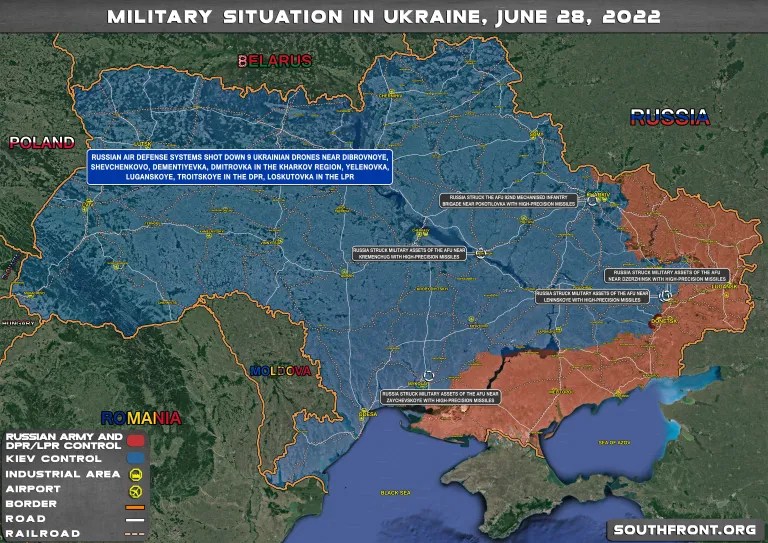
Military Situation
The initial Russian offensive (“phase 1”) consisted in a direct advance from Belarus to the northern gates of Kiev and the simultaneous opening of multiple fronts in the north-east, east, and south of Ukraine. There have been various theories as to what the initial Russian strategy was (e.g. conquering Kiev or ‘binding Ukrainian forces’), but most likely, Russia tried to force a collapse or capitulation of the Ukrainian government, in which case Russia would have won the war without really fighting it.
Indeed, just one day after the beginning of the invasion, Russian President Putin proposed a kind of “military coup” in Ukraine to make it easier to “reach an agreement”. There were also several rounds of negotiations between Moscow and Kiev in Belarus and Turkey.
Yet this initial, political-military plan failed and was halted in late March, about one month after the beginning of the invasion.
Nevertheless, already by early March Russia had conquered extensive territories in southern Ukraine connecting the Donbas and Crimea and had been able to restore water supply to the Crimean Peninsula (which had been cut off by Ukraine since 2014; see map above).
By late April, Russia had essentially conquered the important southern Ukrainian port city of Mariupol (500k pre-war inhabitants), and by late May, the remaining Ukrainian forces in the Azovstal steel plant of Mariupol had surrendered. In addition, Russia conquered the southern Ukrainian cities of Melitopol (150k inhabitants) and Kherson (300k) without meeting much resistance.
After the failure of the initial political-military strategy, Russia in early April withdrew all of its troops from the north of Kiev and redeployed them to the east in an attempt to encircle and defeat the main positions of the Ukrainian military and conquer the entire Donbas region.
However, the Russian advance in eastern Ukraine was much slower than expected by many observers, and Russian forces advanced only about 25 kilometers in about two months.
Many Western analysts got the impression that the Russian military was weaker than previously assumed, while many Russian and pro-Russian analysts have argued that the Russian military was advancing slow “on purpose”, allegedly to “minimize losses”.
Yet neither of these explanations were convincing. Instead, there are several substantial reasons that explain the steady, but rather slow advance of the Russian forces in eastern Ukraine.
First, in terms of the number of soldiers and tanks, the Ukrainian military is the largest military in Europe, second only to the Russian military (not counting the Turkish military).
Second, while Ukraine has already mobilized large parts of its men of fighting age, Russia has not yet mobilized at all, i.e. Russia is using only active soldiers, no reservists or conscripts. In fact, Russia has essentially deployed its peace-time army, which has resulted in a notable lack of manpower and infantry. A likely explanation for this decision is that the Russian government wants to keep up the impression, at least domestically, that it is just conducting a “special military operation”, not a full-scale war, and that it wants to avoid the political repercussions of having to conscript additional men (i.e. civilians). This is consistent with the fact that Russia has offered high-paid short-term military contracts to volunteers, again avoiding conscription.
Third, Eastern Ukraine is probably the most strongly fortified region in Europe today, having been prepared against a potential Russian invasion for several years. Although some Ukrainian units have surrendered due to a lack of supply or guidance, the overall Ukrainian resistance against Russian forces remains at a very high level.
Fourth, the Ukrainian military has received large amounts of weapons from the US and NATO countries, including powerful artillery and modern anti-tank weapons. Without these supplies, the Ukrainian front would likely have collapsed rather quickly.
Fifth, the Ukrainian military has greatly enhanced the effectiveness of its artillery by using reconnaissance data from its own drones as well as from US satellites. Indeed, the use of commercial and simple military drones appears to have fundamentally transformed modern warfare at the tactical level.
Sixth, and contrary to claims by Western media, the Russian military is still trying to minimize civilian casualties and damage to civilian infrastructure, likely because it views Eastern Ukraine as Russian territory anyway. For instance, it has been noted that the Russian military delivered fewer airstrikes and fewer missiles during the entire first month than the United States did during the Iraq war in just one day. However, as the Ukrainian military has been fiercely defending most cities and villages, the end result is still large-scale destruction of urban infrastructure.
Although Russia has had the upper hand in Eastern Ukraine, it remains uncertain if the current Russian military strategy will be viable in the longer run, especially if Russia intends to conquer some of the larger Ukrainian cities, such as Kharkiv, Odessa or Dnipro (1M-1.5M) or even Kiev (3M). If the Ukrainian government or military do not surrender or agree to a negotiated solution, the Russian military may have to call up reservists and conscripts and/or switch to an (even) more destructive mode of warfare against the cities it intends to “liberate”.
Currently, the main Russian military advantage consists in relative (but not absolute) air superiority, more powerful artillery, and cruise missiles that can destroy strategic targets anywhere in Ukraine. Nevertheless, the Ukraine war is currently not an “asymmetric war”.
In terms of military strength, it is estimated that Russia deployed about 160,000 soldiers, the pro-Russian Donbas republics about 40,000 soldiers, and Ukraine about 300,000 military and paramilitary forces, of which about 50,000 in Eastern Ukraine. In terms of military losses, it is estimated that by late June, Ukraine may have lost close to 20,000 soldiers, Russia close to 5,000 soldiers, and the Donbas republics about 10,000 soldiers.
Future Developments
Russia will certainly try to fully conquer (or liberate) the Donbas republics, including the cities of Sloviansk and Kramatorsk (100k-150k pre-war inhabitants). Russia may also try to conquer Mykolaiv (500k) and Odessa (1M) in the south of Ukraine in order to establish a corridor to Moldova/Transnistria, which would cut off Ukraine from the Black Sea and turn the country into a landlocked rump state. After conquering the Donbas republics, Russia may further try to conquer or encircle Kharkov (1.5M) and advance to the Dnipr river.
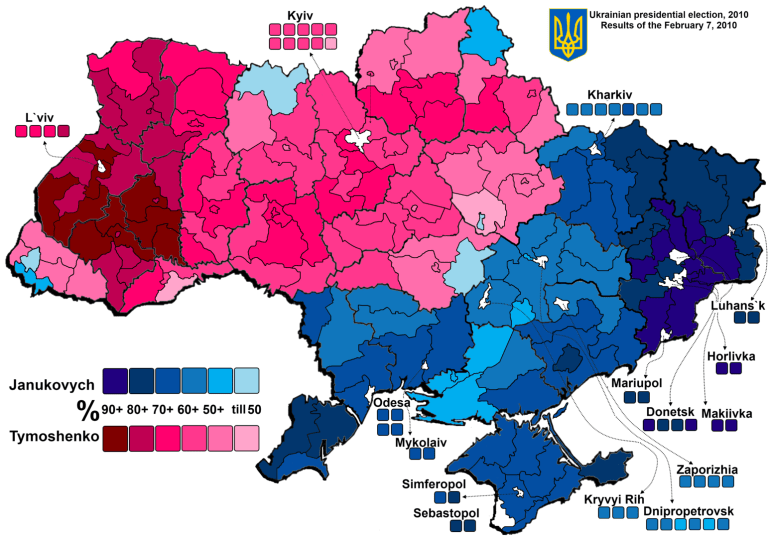
Cities or districts conquered by Russia will likely hold referendums on becoming part of Russia. These referendums will likely turn out in favor of Russia, as a majority of the people in the east and south-east of Ukraine do indeed identify as Russians (or are leaning towards Russia), and Russia may then annex or absorb these territories. However, such a strategy will not work in Kiev, nor in northern and western Ukraine (see map below).
In terms of potential escalations, a Russian advance towards Moldova may trigger a preemptive Romanian invasion (“by invitation”) of Moldova. A further destabilization of Ukraine may trigger a Polish invasion (“peace mission”) of western Ukraine, which in turn could trigger a war between Poland and Belarus in western Ukraine.
Moreover, NATO countries could decide to deliver more powerful weapons to Ukraine or to establish a “safe zone” in western Ukraine (similar to the situation in eastern Syria). In general, the US will likely try to prolong the Ukraine war as much as possible in order to weaken Russia financially and politically (similar to the Afghanistan war in the 1980s.)
Outside of Ukraine, the situation in the Baltics (Lithuania/Kaliningrad), the Balkans (Bosnia-Serbia-Kosovo) and in the Caucasus (Georgia, Armenia-Azerbaijan) could further deteriorate. The situation in Syria, where the US, Israel, Turkey, Iran and Russia are already involved, could also further escalate. In Asia, China could decide to invade and annex Taiwan.
The global economic situation will also likely continue to deteriorate, especially in the fields of energy and food supply, price inflation and financial market stability. This deterioration is driven not just by the war itself, but also by Western sanctions against Russia as well as by two years of misguided pandemic lockdown policies, which have caused serious global supply chain disruptions.
The possibility of a nuclear escalation will be discussed further below.
War Crimes
In terms of war crimes, the current situation is in stark contrast to claims by Western media and Western governments, as most war crimes have been committed not by the Russian side, but by the Ukrainian side. This includes many major war crimes blamed on the Russian side, such as the infamous Bucha massacre, the Mariupol theater bombing, or the Kramatorsk railway station bombing. Other supposed Russian war crimes were simply made up by Ukrainian officials, such as allegations of systematic rape and mass looting.
Yet other events were taken out of context, such as the alleged Russian bombing of Ukrainian schools and hospitals or shopping centers, which in almost all cases had been turned into Ukrainian military bases or ammunition depots. In other cases, civilian buildings supposedly destroyed by Russian missiles were in fact destroyed by Ukrainian air-defense missiles (e.g. in Kiev) or Ukrainian artillery missiles (e.g. in Borodyanka).
In yet other cases, Ukrainian forces, poorly disguised as Russian forces, executed Ukrainian civilians that welcomed the false “Russian liberators”; Western media then presented the execution as a Russian war crime. In even other cases, the Ukrainian bombing of Donbas cities was presented as the Russian bombing of Ukrainian cities.
In the case of Bucha, the bodies seen in the streets were victims of Ukrainian shelling of residential areas during the Russian occupation and retreat, and of subsequent Ukrainian executions of “collaborators” (hence the white armbands, a sign of friendly status during Russian occupation). The bodies were then presented as victims of a supposed “Russian massacre”.
Ironically, the Ukrainian commander who oversaw the Bucha massacre previously was a Russian intelligence asset who had built up “neonazi groups” in Russia and Belarus. The international “marketing” of the Bucha massacre as a supposed Russian war crime may have been coordinated by British intelligence, similar to numerous chemical false-flag attacks in Syria.
In the case of the Mariupol maternity clinic, Western media claimed it was a Russian airstrike, but they could not provide any evidence for this hypothesis, and witnesses at the clinic said there was no airstrike. Yet the incident remains unresolved, and both a Russian attack (possibly targeting a nearby Ukrainian base) or a Ukrainian operation remain possible.
In the case of the recent Kremenchuk shopping center incident, the Ukrainian government claimed a Russian missile hit the shopping center with 1,000 people inside; in reality, the Russian missiles hit an adjacent military plant and the shopping center was either closed (non-operational) or almost empty. However, one of the Russian missiles did hit very close to the shopping center, which then caught fire and burnt down.
Documented, confirmed or potential Russian war crimes currently consist mainly in the shooting and killing of civilians that approached Russian checkpoints or military columns, on foot or by car, although the context of these events is sometimes unclear (e.g. if there were any warning shots). There are also allegations of several other crimes against individual Russian soldiers that are currently difficult to verify independently.
On the Ukrainian side, documented war crimes encompass mass torture and mass executions, both against prisoners of war and their own people (if deemed pro-Russian collaborators or sympathizers), including several cases of decapitation; the military use of civilian infrastructure (including schools) and “human shields”; and large-scale shelling of residential areas behind front lines, especially against the city of Donetsk (in one case even hitting a maternity clinic).
Moreover, several Western journalists, whose death was blamed on the Russian side, were in fact killed by the Ukrainian side (in friendly fire incidents).
False claims of major Russian war crimes (i.e. atrocity propaganda) have been used by Western governments to justify weapons supplies to Ukraine and sanctions against Russia. The heavy use of such atrocity propaganda is not a new phenomenon, of course. Important recent examples include the US/NATO wars against Yugoslavia and against Syria.
The topic of war crimes will be covered in a separate, detailed event-by-event analysis.
Propaganda and Censorship
On the Russian side, propaganda efforts depict the Ukraine war as a kind of continuation of the Second World War or Great Patriotic War against National Socialist Germany, focusing on the supposed “denazification” of Ukraine. At the same time, Russian President Putin has criticized Soviet leaders for having made Ukraine a quasi-independent political entity in the first place. Thus, Russian propaganda combines elements of both the former Soviet Union and the earlier Russian Tsarist empire.
Overall, the “Nazi narrative” appears to be quite effective, both in Russia and in the West, in part because many key aspects of the Second World War and NS Germany still cannot be questioned, neither in Russia nor in the sphere of Anglo-American countries, which during the Second World War were allied with Stalin’s Soviet Union against Hitler’s Germany.
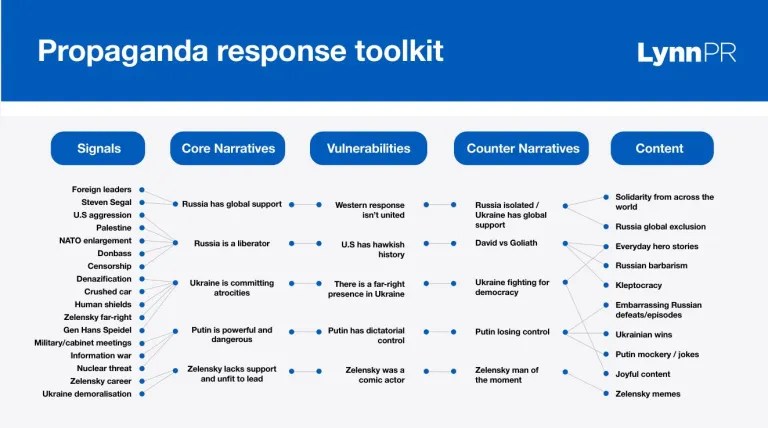
On the NATO side, propaganda efforts mainly focus on Russian aggression, supposed Russian war crimes and supposed Ukrainian successes. NATO propaganda is produced by multiple PR agencies, coordinated by intelligence services, and distributed to Western media outlets by the three global news agencies AP (American), AFP (French) and Reuters (British-Canadian). The total number of NATO propaganda messages in Western media is likely approaching about one thousand.
In addition, both sides have introduced significant media censorship. In NATO countries, this includes the removal of Russian and pro-Russian media outlets from major Internet search engines Google, Microsoft Bing and even DuckDuckGo. Furthermore, British security state operatives were caught trying to suppress independent media coverage of the Ukraine war.
Nevertheless, independent media outlets and uncensored Telegram channels have continued to provide important real-time footage and analysis of the situation in Ukraine.
NATO Expansion or Russian Expansion?
Is the Ukraine war about NATO expansion or rather about Russian expansion? In truth, it is likely about both NATO and Russian expansion, although one may argue that the Russian expansion is a response to NATO expansion. It is clear that the current Russian government sees large parts of Ukraine as “historically Russian territory”, or indeed Ukraine as part of Russia. Only by seeking a neutral status and by accepting the loss of Crimea and the autonomy of the Donbas republics might Ukraine have avoided a Russian invasion.
It has been argued that NATO expansion into Ukraine wouldn’t be a threat to nuclear Russia, but this is hardly true. NATO expansion into Ukraine would pose a geostrategic threat (control over pipelines, ports etc.), a direct military threat (planned recapture of Crimea and the Donbas republics), and a strategic military threat (NATO military infrastructure and missile bases). For similar reasons, the US did not and would not accept Russian bases in Cuba, Mexico or Venezuela.
It has been noted that Russia is unlikely to invade Finland or Sweden, despite their intention to join NATO (in response to the Russian invasion of Ukraine). In fact, Russia already has a (small) land border with NATO founding member Norway and with Baltic states. Yet Finland and Sweden do not currently threaten Russian territory or Russian interests. Otherwise, a Russian military response may in fact be conceivable (see below).
Is the Russian military operation in Ukraine legal or illegal? From a Western perspective, the Russian operation is clearly illegal, not unlike previous US invasions (e.g. of Grenada, Panama and Iraq) and most US/NATO wars (e.g. against Serbia, Afghanistan, Libya and Syria). From a Russian perspective, the military operation is a legitimate intervention into an ongoing, illegal eight-year war against the Donbas republics. Russia will likely annex large parts of Ukraine, but it will try to “legitimize” these annexations by prior referendums.
Energy War: By Whom?
It has also been argued that Russia is waging an energy war by restricting oil and gas exports in order to destabilize NATO countries and especially Europe. Yet upon closer inspection, it is clear that the energy war is in fact waged via sanctions by NATO countries in order to financially destabilize Russia, although so far this seems to have failed and indeed backfired, with energy security in Europe becoming rather uncertain.
For instance, a reduction in gas flow through the Nord Stream pipeline from Russia to Germany was (and is) due to a broken turbine sent by Germany to Canada for repair, but then retained by Canada due to sanctions against Russia. Similarly, the Russian decision to accept energy payments only after conversion into rubles was simply in response to the prior freezing of billions of Russian Euro and dollar reserves by Western countries.
Indeed, neither during nor after the Cold War has Russia (or the USSR) ever used the “energy weapon” against (Western) Europe, as Russia is very much interested in both being seen as a reliable supplier and in foreign currency export revenue.
However, one can argue that Russia is relying on a kind of “indirect energy weapon”: by being a reliable energy supplier, Russia may hope that Europe and NATO will not turn hostile, regardless of Russian military actions. Moreover, if relations should further deteriorate, Russia could of course use the “energy weapon” and stop energy exports to Europe altogether.
The Russian government likes to emphasize that the impact of Western sanctions is rather minor and that the Russian ruble has remained strong. But Russia had to impose capital controls (i.e. the ruble is no longer free floating), and the economic impact is substantial, with tens of thousands of IT specialists having already left the country, for instance.
Nuclear War?
How likely is a nuclear war as a potential escalation of the Ukraine war?
A direct nuclear war targeting the mainland of nuclear states remains very unlikely, as this would lead to the destruction of all states involved. However, from a purely military and geostrategic perspective, there are two rational offensive uses of nuclear weapons, in addition to their defensive use as a deterrent: against hostile non-nuclear states and against overseas military infrastructure of nuclear states.
In this regard, there is a major geostrategic asymmetry between Russia and China on the one hand and the US on the other hand: whereas the US has several hundred overseas military bases and several dozen non-nuclear allies or client states (both in Europe and in Asia), Russia and China have almost no overseas military bases and very few non-nuclear allies.
Thus, Russia and China could consider coordinated nuclear strikes against all US overseas military bases in Eurasia (i.e. in Europe, the Middle East, Central Asia and East Asia). In addition, Russia and China could consider nuclear strikes against hostile non-nuclear countries, both in Europe and in Asia, targeting military/industrial centers or even population centers.
Theoretically, such a coordinated nuclear operation might remove the US military from the Eurasian continent (and by extension from Africa), limiting US military influence to North and South America. Thereafter, a new geo-economic Cold War between Eurasia/Africa, led by China and Russia, and the Americas would likely ensue.
Nuclear allies of the US in Eurasia, most notably Britain, France and Israel, would have to ensure robust sea- and air-based second strike capability even against modern hypersonic missiles with multiple nuclear warheads, in order to avoid being targeted themselves.
A nuclear attack against non-nuclear NATO states would be seen as an attack against NATO, and a nuclear attack against US overseas military bases would be seen as an attack against the United States, but because of the above-mentioned asymmetry, the US could not respond in a meaningful way without forcing its own destruction.
While such a scenario seems militarily conceivable and even rational (given the breakdown of the post-WWII security architecture), both China and Russia currently seem to follow a different economic, diplomatic and military strategy, using novel alliances such as BRICS, RCEP, the Eurasian Economic Union, and the Shanghai Cooperation Organization (SCO).
In contrast, the US may attempt to contain Russia and China via economic and political sanctions and to ultimately overturn regimes in both countries, thus paving the way for global US predominance, which was almost achieved after the end of the Cold War.
Figures
1) Results of 2010 Ukrainian presidential election.
Janukovych was the pro-Russian candidate, Tymoshenko was the pro-Western candidate.
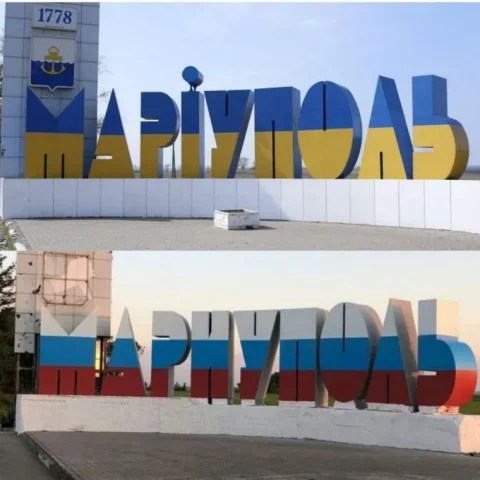
2) Mariupol: Before and after Russian conquest
3) Western propaganda vs. Russian propaganda

Samizdat | June 30, 2022
The European Commission said it is unable to locate text messages sent between its president, Ursula von der Leyen, and Pfizer CEO Albert Bourla during talks for a massive vaccine deal last year, but denied prior charges of “maladministration” from an EU watchdog.
The commission issued a letter on Wednesday stating that an expanded search for the missing messages had “not yielded any results,” following months of dispute between the EU’s executive body and oversight officials. It argued that due to the “short-lived and ephemeral nature” of texts, they typically “do not contain important information” and are therefore rarely stored.
While von der Leyen revealed in an April 2021 interview that she and Bourla privately communicated for several weeks while negotiating a contract for nearly 2 billion vaccine doses, a journalist’s public information request for the texts was later shot down, with the commission claiming it could not find the messages in question.
The denial triggered a rebuke from the European ombudsman, Emily O’Reilly, who followed up with an investigation last year and blasted EU officials over poor administration and a lack of transparency, saying that “no attempt was made to identify if any text messages existed.” The ombudsman then urged the commission to “search again,” asking it to broaden its criteria in a way that might actually locate the records.
The commission doubled down in its latest response to O’Reilly, however, insisting it had handled the matter properly and made every effort to find the texts. It reiterated that it does not register material that contains no “important information,” and that such documents “are not kept, and, as a consequence, are not in the possession of the institution.”
“The European Commission is of the opinion that it has not treated this request in a ‘narrow way’ and that the search and handling of documents for the purpose of public requests for access to documents … is justified and follows the established practice,” it continued.
The body added that it intends to “issue further guidance on modern communication tools” in hopes of avoiding similar mix-ups in the future, but nonetheless held that its actions were “in line with the applicable legislation and the relevant case law on access to documents.”
The office of the ombudsman, which published the commission’s letter on Wednesday, declared that the response was “problematic on several points,” and noted that a “full analysis” of the case would follow in the coming weeks.
The controversy over the missing texts is not the first dispute regarding a lack of transparency in the EU’s vaccine dealings, as the commission was sued in April by several MEPs, who claimed the negotiations were overly secretive. Though contracts were eventually published, they were heavily redacted in a way that “made it impossible to understand the content of the agreements,” the lawmakers alleged, insisting secrecy “has no place in public agreements with pharmaceutical companies.”
Samizdat | June 29, 2022
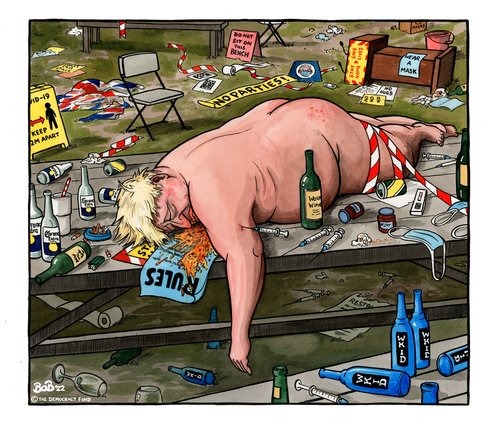 Speaking to journalists in Turkmenistan on Monday, Russian President Vladimir Putin responded to questions about several recent remarks from British Prime Minister Boris Johnson. During the latest G7 summit, the UK leader joked that his allies should take their clothes off for the photoshoot – to show that they are “tougher than Putin.”
“I don’t know how they wanted to undress, waist-high or not, but I think it would be a disgusting sight either way,” the Russian president quipped. “Everything should be harmoniously developed in a person, both the body and the soul. However, in order for everything to be harmonious, one has to abandon excessive drinking and break other bad habits, start exercising, take up a sport.”
Johnson’s another recent remark suggested that what he described as a “macho war of invasion” in Ukraine would not happen “if Putin was a woman, which he obviously isn’t.”
The Russian leader responded: “I just want to remind you about the events of modern history, when Margaret Thatcher made a decision to launch military action against Argentina over the Falkland Islands. Here’s a woman, deciding to launch military action. Where are the Falkland Islands and where is Britain? And this was dictated by nothing but imperial ambitions.”
“So coming from an acting British Prime Minister, this is not exactly a correct remark in regards to what is happening today.”
By Thomas Lambert | The Counter Signal | June 29, 2022
The Trudeau government just announced they would be extending the ban on unvaccinated foreigners until September 30 (the start of flu season).
“Today, the Government of Canada announced it is extending current border measures for travellers entering Canada. Requirements for travellers arriving to Canada are expected to remain in effect until at least September 30, 2022,” a Public Health Agency of Canada news release reads.
It should be noted that while unvaccinated Canadians can (at least in the short term) board a plane to travel abroad, the ban on the unvaccinated remains on both sides of the Canada-US border, an apparent unspoken agreement by both countries to not budge on the unvaccinated travel ban until the other does.
Moreover, the latest announcement states that unvaccinated Canadians will still be forced to quarantine for 14 days upon their return to Canada.
Additionally, the government says that the ArriveCan app — which has led to delays so bad it has become an international embarrassment — will remain in place.
As for good news, mandatory random COVID tests at airports are now paused — but only for the vaccinated. This is Transport Minister Omar Alghabra’s half-hearted attempt to keep Canada’s airports “strong, efficient, and resilient” after being disgraced by former NHL player Ryan Whitney.
“In addition, the pause of mandatory random testing will continue at all airports until mid-July for travellers who qualify as fully vaccinated… Mandatory random testing continues at land border points of entry, with no changes. Travellers who do not qualify as fully vaccinated, unless exempt, will continue to test on Day 1 and Day 8 of their 14-day quarantine,” the news release reads.
BY WILL JONES | THE DAILY SCEPTIC | JUNE 28 2022
Here we go again. It’s the middle of summer and the leading opinion piece in the Guardian today calls for the return of restrictions in response to rising infections and hospitalisations. In a piece introduced with, “a few small changes would make a big difference to millions of vulnerable people”, journalist Frances Ryan writes:
If you’re reading this in the U.K., odds are that by now you’ve had coronavirus: seven in 10 of us have watched the dreaded red line appear. You may have been stuck in bed with it twice or even three times by now; by April 2022, England alone had recorded almost 900,000 reinfections. When the public asked to “return to normal”, I’m not sure a regular hacking cough was what they had in mind.
Almost 900,000 reinfections? How will 1.6% of the population have coped with getting another cold?
Ryan continues:
It is an odd situation. Last week, Covid infections were reported to have soared by 43%, while hospitalisation from the virus rose by 23%. An estimated 1.7 million people in the U.K. tested positive over those seven days. Two million of us now have long Covid, with about two in five of those – or 826,000 people – having symptoms for at least a year.
What Ryan fails to mention is that Long Covid studies frequently find small to negligible numbers of additional symptoms compared to a control group, meaning the quoted figure is unlikely to be an accurate picture of the real impact of COVID-19.
Ryan again:
Back in February, Johnson said the Government had created a plan to start “living with Covid”, but what it really did was form a plan to catch and spread Covid. After all coronavirus prevention measures were dropped on April 1st – from the legal obligation to isolate if you had Covid, to the end of most free testing – the public were left wide open to mass infection. Even hospitals were told by ministers to ditch mask mandates, though some worried trusts have defied the rules and kept them. That all precautions were pulled back just when most people’s vaccine immunity was beginning to fade, and the virus was evolving to be more transmissible, gives a hint at how little logic ministers applied.
Since Ryan accepts that vaccine protection wanes, she evidently intends restrictions, sorry, precautions to continue indefinitely. Indeed, the plummeting of the infection fatality rate makes no difference to her argument, as “excessive focus” has been placed on deaths, she says.
One of the biggest problems facing Britain’s attempts to quell the virus is that this Government doesn’t really want to. There is hope – the number of people dying from Covid has reduced since its peak – but excessive focus on this has long hidden the fact that loss of life has never been the only thing that matters: how many people are infected with the virus matters too. A strategy that lets the virus rip through the population increases the risk we all face, be it from surges, new dangerous variants, or in developing long Covid. Fundamentally, it means accepting a reality where it is deemed normal for many of us to be (possibly severely) sick, from a virus whose long-term effects – and the effects of repeated reinfection – we still know little about.
Once again, the plight of the vulnerable is deployed to justify indefinite restrictions on everyone – a logic which would destroy most freedoms given the opportunity, as we have seen in the last two and a half years.
There will be few greater casualties though than the 3.7 million clinically extremely vulnerable people, especially the 500,000 who are immunocompromised and can’t get much or any benefit from a booster jab. Trying to avoid the virus in a country that has forgone all safety measures means risking your life when you pop to the shops. Ministers who are content for repeated coronavirus infection to just become part of British life are content for isolation to be part of clinically vulnerable people’s.
What does Ryan propose? The reinstatement of free lateral flow tests – as though there isn’t an economic crisis on, and we haven’t spent enough over-testing ourselves for colds; the return of the legal requirement to isolate for those with a positive test – a measure extremely disruptive to education, employment, health care and everything else; and financial help such as sick pay for those isolating – more magical money. Plus more of the vaccines she has acknowledged don’t work for long.
And, inevitably, masks: “Wearing masks in busy and enclosed spaces again is the right thing to do; just under half of Britons (48%) reported wearing a face covering when outside their home last month, down from about 95% during the January Omicron wave.”
From a sceptical point of view, it’s depressing that nearly half of people still say they’re wearing a mask – though since far fewer than half the people I see out and about are actually wearing a mask, this poll probably reveals more about the biases of polls (and what people say to them) than the reality on the ground.
Then Ryan lays it on thick:
Unless we wish to sign up to getting repeatedly sick for the foreseeable future, and to the risk of long-term disability from long Covid, we are going to have to bring back low-effort protective measures to curb it. A recent public health campaign in Ireland, which encourages people to think of clinically vulnerable people in their daily interactions, shows how easy it is to do things differently.
Former Deputy Chief Medical Officer Jonathan Van-Tam recently said the rise in infections was nothing to worry about and that even he had stopped wearing his face mask. But will he think again now, if respectable opinion starts to shift in the direction Frances Ryan and others would like?
Let’s hope this is just an anomalous op-ed and not the start of a trend. After all, if this is what they’re saying in June, what will they be saying in December?
Vaccine failure in one map
eugyppius | June 28, 2022
Behold the latest map of 7-day Corona incidence across the Federal Republic of Germany:
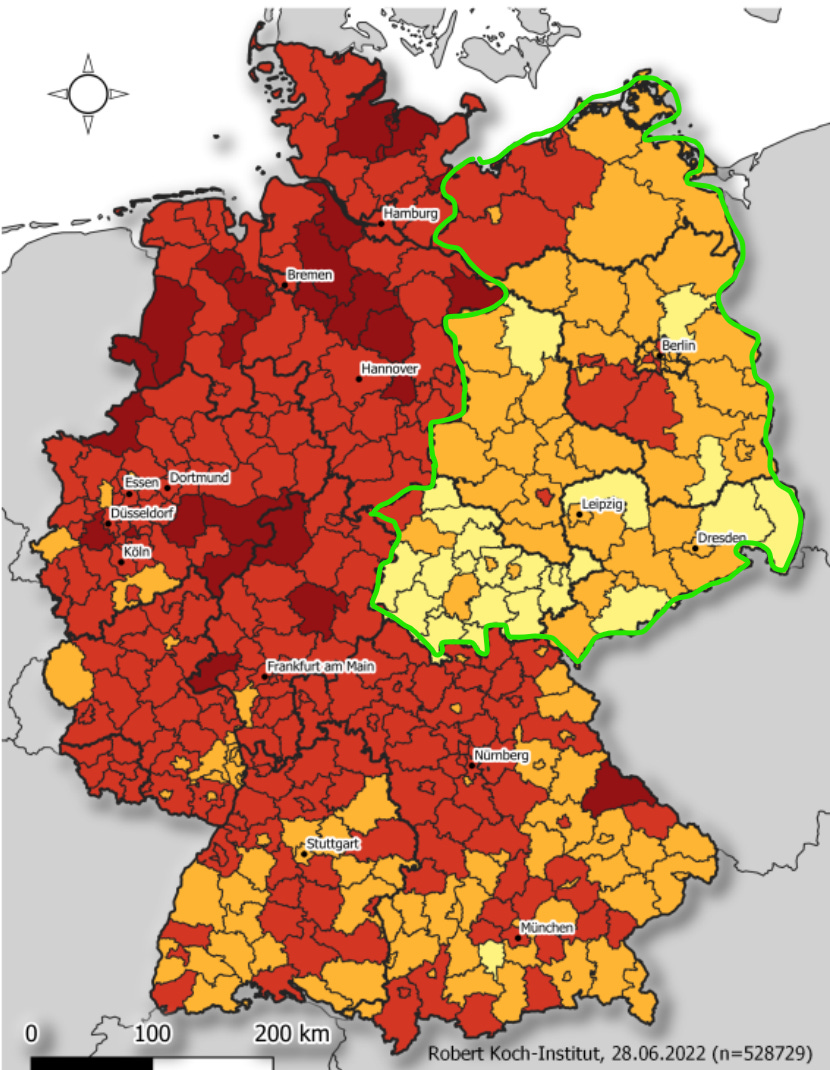
This is the Omicron BA.5 wave in central Europe, and it is attended by a curious phenomenon: Every day, you can see more clearly the borders of the old DDR in the district-level data. I’ve traced these in green just to make the phenomenon clearer.
Yes yes, there are systematic demographic differences between East and West Germans, and there are probably some differences in testing rates, but above all, there is an important difference in vaccine uptake. In this map of triple vaccination rates across my country, the old DDR borders are also evident:
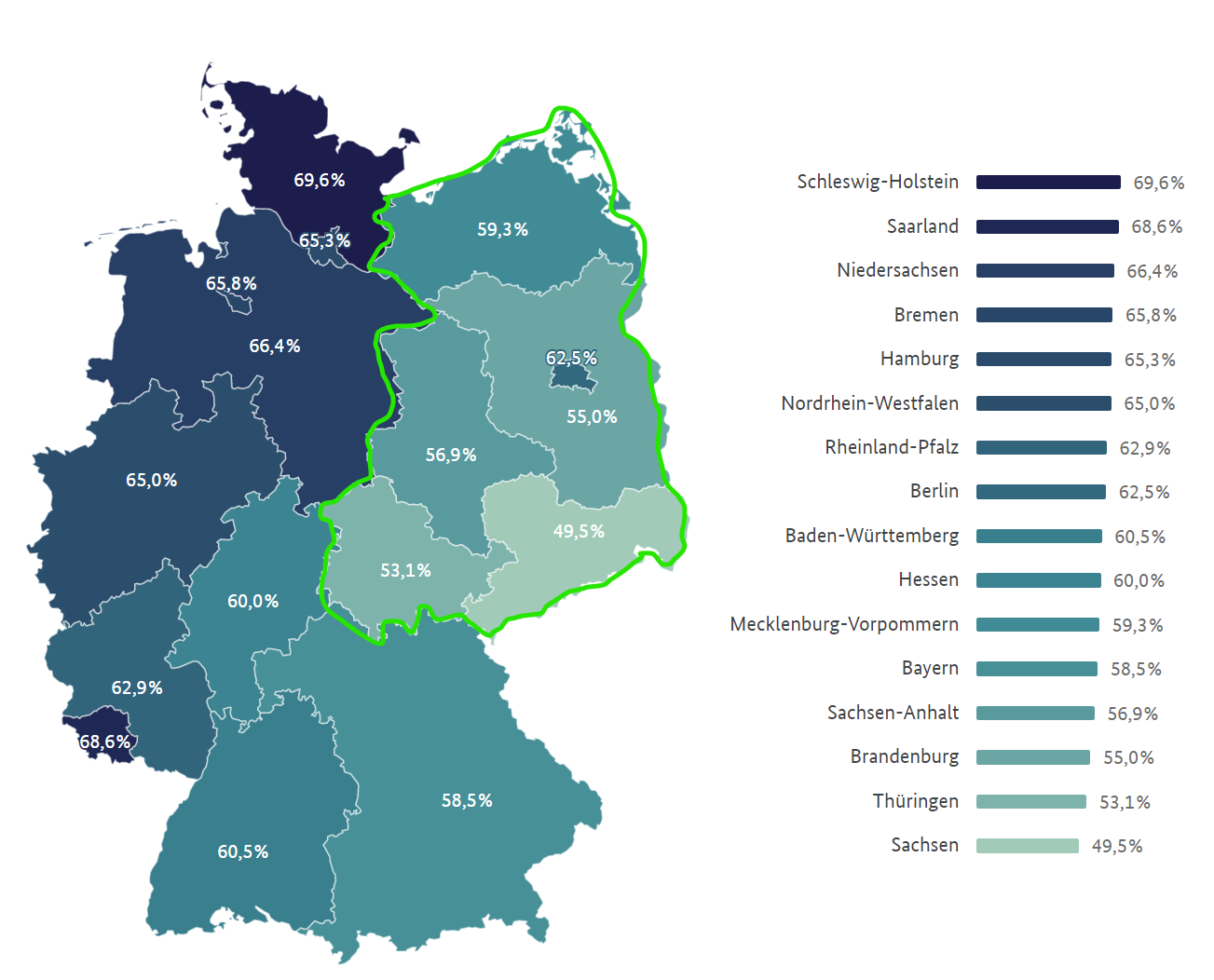
East Germans have direct experience with government propaganda, and have proven more resistent to the vaccination campaign than Westerners. Their reward, after being much maligned by state media, is now higher levels of natural immunity and lower rates of BA.5 infection, which appears to prefer vaccinated populations.
As the effects of vaccine failure grow clearer, you have to wonder how long the pandemicists will be able to publish even simple infection statistics, without raising extremely awkward questions.
See the follow up in depth critique of the theory.

or go to
Aletho News Archives – Video-Images
Lies are Unbekoming | November 5, 2026
What The Garlic Book shows
The book is in four parts.
 Part One, The Record, treats the history of garlic as evidence. From the clay garlic bulb placed in an Egyptian grave nearly six thousand years ago, through the Ebers Papyrus, through Hippocrates, Dioscorides, Pliny and Galen, the Arab physicians under Avicenna, the medieval herbals, Culpeper, and the plague years, to the last era in which Western physicians prescribed garlic as a matter of course, which ran from 1850 to 1945. It closes with the living traditions that never stopped using it, and with the folklore of charms, vampires and the evil eye.
Part Two, The Chemistry and the Evidence, sets out what is known about why a clove has no smell until it is cut, and why the order of crush, rest and heat changes the medicine. It then reads the clinical evidence against the historical record — bacteria, blood and vessels, cancer epidemiology, metals and fatigue — and names the trials that went against garlic as directly as the trials that went for it, including the 2007 Stanford trial funded by the US National Institutes of Health which found that raw garlic, garlic powder and aged garlic extract moved LDL cholesterol no more than placebo did. It then turns to onion, garlic’s closest relative, and reads the newer evidence published since 2015, before closing with the whole of the record through the terrain lens.
Part Three, Why Medicine Set It Aside, asks the question directly. One chapter contrasts the pharmaceutical model of isolating a single active compound with the folk model of combining whole plants, and reports what the garlic evidence says about which model works better. One chapter examines the economics of research on a plant that cannot be patented. One chapter — Fire Cider — tells the story of a folk preparation whose name was taken into a United States trademark by a Massachusetts company in 2012, and won back by three herbalists in 2014 who documented forty years of prior use through Rosemary Gladstar and her students into the older tradition.
Part Four, Garlic in Practice, is the working manual — the kitchen pharmacy, traditional uses by body system, a full chapter on safety and interactions, and a complaint-by-complaint practical guide. The book closes with The Trial That Was Never Run — a one-chapter reading of the whole evidential architecture.
At the back: two appendices (a traditional list of uses, and a preparation quick-reference), a full bibliography, and a live index.
 Aletho News If Americans Knew No Tricks Zone

