Canada to spend billions on NORAD so US can rule world
By Yves Engler | June 21, 2022
The Liberals are intent on funneling ever more of our collective resources to bolster the US Empire, spending lavishly to “modernize” Canada’s chief bi-national military accord.
On Monday Defence Minister Anita Anand announced the government would spend $4.9 billion to upgrade the North American Aerospace Defense Command. The federal government said it will devote $40 billion to NORAD over 20 years, but it may be far more than that noted David Pugliese in a story headlined: “Cost to modernize NORAD set at $40 billion, but will final tally be higher?”
The media and government framed the announcement as strengthening Canada’s defences. According to the Globe and Mail report, “the Canadian government has pledged $4.9-billion over six years to help upgrade North America’s air defences, addressing the growing threat posed by hypersonic missiles and advanced cruise missile technology developed by Russia and China.”
But it’s absurd to present NORAD as a defensive arrangement. Its lead actor has 1,000 international bases and special forces deployed in 149 countries. Rather than protect Canada and the US, NORAD supports violent missions led by other US commands. In 1965 NORAD’s mandate was expanded to include surveillance and assessment sharing for US commands stationed worldwide (United States European Command, United States Pacific Command, United States Africa Command, etc.).
The Pentagon has put satellites into space to enable first strike ballistic missile defence (BMD). While Paul Martin’s Liberals claimed to oppose BMD, they granted “full cooperation by NORAD in missile-defence work”, explained Richard Sanders in a Press for Conversion report on the subject. In 2004 Ottawa formally permitted the US BMD system to use data from NORAD’s “Integrated Tactical Warning/Attack Assessment”.
It’s called “missile defence” because it’s designed to defend US missile sites after they launch offensive operations. US-installed missile defence systems in Romania and Korea, for instance, are designed primarily to stop opponents’ missiles following a US first strike.
US space-based missile defence interceptors able to eliminate Russia’s early warning satellites without warning puts that country on edge. This ratchets up the arms race and the likelihood of nuclear war.
NORAD has also drawn Canada into US belligerence in other ways. During the July 1958 US invasion of Lebanon NORAD was placed on “increased readiness” while US troops checked secular Arab nationalism after Iraqis toppled a Western-backed king (at the same time British troops invaded Jordan to prop up the monarchy there).
In a higher profile incident, Canadian NORAD personnel were put on high alert when the US illegally blockaded Cuba in October 1962. This transpired even though Prime Minister John Diefenbaker hesitated in supporting US actions during the Cuban Missile Crisis.
During the 1973 Ramadan/Yom Kippur/Arab–Israeli War NORAD was placed on heightened alert. Washington wanted to deter the USSR from intervening on Egypt’s behalf.
NORAD systems offered surveillance and communications support to the 1991 war on Iraq. It monitored the region and provided information to launch US Patriot surface-to-air missiles. NORAD ballistic missile warnings were also sent to Ottawa and Canadian units in Bahrain.
NORAD also supported the 2003 invasion of Iraq. The same can be said for US bombing in Afghanistan, Libya, Somalia, etc.
Thousands of Canadian military personnel assist NORAD’s operations. One hundred and fifty Canadians are stationed at NORAD’s central collection and coordination facility near Colorado Springs, Colorado. Hundreds more work at regional NORAD outposts across the US and Canada and many pilots are devoted to the Command.
A Royal Canadian Airforce general is the vice commander of NORAD and runs the entire command when the US commander is absent. In discussing the two countries’ most significant bilateral military accord, Ann Griffiths explains,“NORAD brings the Canadian military more deeply within the US defense establishment than any other ally. The United States quite simply, would not entrust such responsibilities to the military of any other close ally, not even Britain.”
NORAD makes Canada a junior partner to US militarism and imperialism. If Canada was truly a force for good in the world, a peacekeeper and adherent of a rules based international order, Ottawa would withdraw from NORAD, rather than spend billions more strengthening it.
Peaceful resolution of Ukraine conflict would cause global instability: Boris Johnson
Samizdat | June 26, 2022
The West needs to keep arming Ukraine instead of seeking a peaceful resolution to the conflict between Kiev and Moscow, UK Prime Minister Boris Johnson told French President Emmanuel Macron, according to Downing Street. Any attempt to resolve the conflict peacefully will lead to global instability, he said at a meeting on the sidelines of the G7 Summit on Sunday.
The military action in Ukraine is at a “critical moment,” the two leaders agreed, but there is still “an opportunity to turn the tide.” According to the statement, Johnson and Macron have agreed to continue supporting Kiev militarily to “strengthen their hand in both the war and any future negotiations.”
The prime minister also cautioned the French leader against seeking alternatives to resolving the conflict.
The Prime Minister stressed any attempt to settle the conflict now will only cause enduring instability and give Putin licence to manipulate both sovereign countries and international markets in perpetuity.
Johnson took a similar stance at a meeting with Canadian Prime Minister Justin Trudeau on Sunday. “Ukraine is on a knife-edge and we need to tip the balance of the war in their favor. That means providing Ukraine with the defensive capabilities, training and intelligence they need to repel the Russian advance,” a statement from Downing Street read.
On Sunday, Johnson tweeted that Ukraine’s “security is our security, and their freedom is our freedom.”
Ahead of the summit, London pledged an additional £429 million ($525 million) in guarantees for World Bank loans in 2022 as a form of financial assistance to Kiev. According to Downing Street, the UK’s total financial support for Ukraine, including loan guarantees, amounted to £1.3 billion ($1.5 billion) and the combined UK economic and humanitarian support for Ukraine amounted to £1.5 billion ($1.8 billion) this year.
Johnson has been one of Kiev’s most ardent supporters after Russia’s military operation in Ukraine began in late February. He has visited Kiev twice since then and repeatedly called on Western nations to provide more weapons. The UK is one of Kiev’s major arms suppliers, including heavy weaponry.
In June, Johnson warned that the West must brace for a long war between Kiev and Moscow. On Saturday, he said he would consider resigning if he has to abandon Ukraine at some point.
Lithuania clarifies stance on Kaliningrad transit
Samizdat | June 26, 2022
Lithuania will maintain the ban on the transit of sanctioned goods between Kaliningrad Region and mainland Russia, President Gitanas Nauseda has said.
“It is absolutely clear that Lithuania must and will implement EU sanctions,” Nauseda wrote in a Facebook post on Saturday.
“Lithuania must and will maintain control over the goods passing through its territory, and there cannot be any ‘corridors’, nor can there be any appeasement of Russia in response to the Kremlin’s threats. I have made clear to the president of the European Commission how Lithuania sees the situation.”
Kaliningrad Region is a small Russian exclave nestled between Lithuania and Poland. A week ago, Lithuania’s national rail operator suspended the transit of sanctions goods between Kaliningrad and the rest of Russia, citing instructions from Brussels.
Since the EU closed its airspace to Russian planes in February, the only option for the authorities in Kaliningrad now is to ferry goods to and from mainland Russia via the Baltic Sea.
The EU imposed sweeping sanctions on Moscow in response to the military campaign in Ukraine launched in late February.
Nauseda reiterated on Saturday that Vilnius was acting in accordance with the EU’s fourth package of restrictions, which was adopted “with Lithuania’s active participation.”
The EU earlier backed Lithuania in its move to partially ban the transit of Russian goods.
Russia has argued that the disruption of transit is illegal under international law and threatened to retaliate.
The Times reported on Thursday that Italy and several other European governments asked the European Commission to defuse the crisis.
Petras Austrevicius, a European Parliament member from Lithuania, said on Friday that an unnamed EU member state proposed that the Commission allow Russia-to-Russia transit of sanctioned goods. Austrevicius urged Brussels not to “succumb to pressure from the aggressor and create extraterritorial exemptions and concessions.”
Kremlin spokesman Dmitry Peskov expressed hope that the decision to partially ban the transit could be reversed. “Let’s hope for the best, but prepare for the worst. Which is what we do all the time,” he told reporters on Friday.
Finnair is nearly broke after ban from Russian skies
Samizdat | June 26, 2022
Finland’s flag carrier Finnair has reportedly become the latest casualty of the sanctions war between Russia and the West. The airline suffered heavy financial losses due to the forced necessity to fly around Russia, after the country closed its airspace in retaliation to Western sanctions.
Since the beginning of 2022, the operating loss of one of the world’s oldest airlines amounted to €133 million, of which €51 million in expenses fell on fuel costs, the Finnish newspaper Helsingin Sanomat reports.
EU countries and a number of other Western states closed their airspace to Russian flights after Moscow launched its military operation in Ukraine in late February. Russia responded in kind, banning the airlines of 36 states and territories from its skies and, in so doing, closing the traditional routes from Europe to Asia to Western carriers.
The tit-for-tat restrictions have forced airlines in Europe to re-route flights, and have deprived some nations of the monthly air navigation fees that they used to receive when flights from neighboring states passed through their airspace.
Since December 2021, Finnair’s fuel costs have reportedly surged from 30% to 55% of its total expenses. Apart from a nearly twofold increase in prices, the Finnish airline has faced the need to change air routes.
As a result of closing skies Helsinki has lost a key advantage over other Scandinavian countries – the shortest distance to China, Japan and South Korea. Some flights to the Asia-Pacific region, which had been generating for Finnair up to 50% of its profit, were canceled. The journey to Japan that previously took about nine hours now takes 13 hours.
Moreover, the loading of Finnair planes has also significantly dropped due to the absence of Russian tourists, who used to make up about 20% of its passenger traffic. Meanwhile, EU residents have slashed their travel spending amid increased economic instability, with a reluctance to fly exacerbated by constantly rising cost-of-living expenses.
CDC Director Violates FDA’s Emergency Use Authorizations and Posts Misinformation about COVID-19 Vaccines

ICAN | June 23, 2022
While Twitter has suspended and permanently blocked numerous individuals for posting so-called “misinformation” concerning COVID-19 vaccines, it has not done so to “health” authorities – those who arguably should be held to an even higher standard – when they blatantly share inaccurate information.
On June 18, 2022, CDC Director Rochelle Walensky posted a tweet with a video of herself discussing the CDC’s recent recommendation of the COVID-19 shots for children under 5. In the video, Dr. Walensky made the following two claims:
- “We now know based on rigorous scientific review that the vaccines available here in the United States can be used safely and effectively in children under 5.”
- “We have taken another important step together on our fight against COVID-19 by making safe and effectivevaccines available for our little ones.”
But as Dr. Walensky should certainly be aware, in issuing Emergency Use Authorizations (EUAs), the FDA has not(under its ridiculously low standards) made a finding that these vaccines are “safe and effective.” Instead, the grant of an EUA means only that the FDA has determined “it is reasonable to believe that [each vaccine] may be effective” and that “it is reasonable to conclude, based on the totality of scientific evidence available, that the known and potential benefits of [each vaccine] outweigh the known and potential risks of the vaccine.”
By claiming – two separate times – that these vaccines are “safe and effective,” Dr. Walensky is misleading the public by suggesting these vaccines have met the legal standard required for licensure.
Worse yet, because her tweet is “descriptive printed matter” that is both advertising and promoting Pfizer’s and Moderna’s vaccines, the tweet itself is in violation of both EUAs issued to these companies because it does not “clearly and conspicuously” contain the required disclaimer that these products have not yet been licensed as safe and effective by the FDA.
ICAN, through its attorneys, has sent Dr. Walensky a formal letter demanding that she immediately remove the misleading tweet and we will keep you posted on the CDC’s response.
Belarus’ Lukashenko Calls Lithuania’s Blockade of Kaliningrad ‘De Facto Declaration of War’
Samizdat – 25.06.2022
Belarus’ President Alexander Lukashenko has condemned Lithuania’s move to block all ground communications between Russia and its exclave of Kaliningrad, calling it a “de facto declaration of war”.
“Recently, there has been increasingly more information emerging about [Lithuania’s] plan to stop transit from Russia through Belarus to Kaliningrad. It’s like declaring some kind of war. This is unacceptable in today’s environment,” Lukashenko said.
He added that he had grown concerned with the confrontational rhetoric of some of Belarus’ neighbors, namely Poland and Lithuania, as well as NATO nuclear-capable aircraft flights near the Belarussian borders. Lukashenko stated that Belarus should be ready for anything, including to use the “most serious weapons” available to defend the Union State of Russia and Belarus.
In light of this, the Belarus president asked his Russian counterpart to help modernize the country’s aircraft to be able to carry nuclear bombs. Russian President Vladimir Putin, in turn, notified Lukashenko that Russia decided to ship several 9M723 Iskander-M (NATO reporting name SS-26 Stone) mobile short-range ballistic missile systems.
Iskander launchers can handle both conventional and nuclear short-range missiles. However, Putin did not specify which ammunition will be supplied with the Iskander-M’s shipped to Belarus.
Russia earlier harshly condemned Lithuania’s announcement of plans to cut all goods transit from Russia to Kaliningrad in reported accordance with EU sanctions. The move leaves Russia with a maritime route to reach its exclave.
The Kremlin slammed the decision as a “blockade” and vowed to respond in kind and decisively, but has not elaborated on the measures yet. Moscow also reminded Lithuania that it was bound by an agreement with Russia that mandates that it must allow Russian goods to flow unimpeded to Kaliningrad.
Birx Had a Tough Day in Congress
“Hope” is no basis for health mandates or treatment policy
by el gato malo – bad cattitude – june 24, 2022
leaders do not, mostly, lead. they follow the public mood. and as that mood is shifting, it’s becoming OK to ask the pointy questions and start getting to the bottom of things.
debbie had a tough outing here and gets pinned on a simple and vital issue:
when public health officials and agencies stridently told america that the covid vaccines would be a “dead end for the virus” and stop infection and spread, upon what did they base that claim and how did they get it so wrong?
once jordan gets a hold of her, this is like a tuna filled piñata in a tiger cage.
jj: was the government lying when they said this?
db: i don’t know. i was not part of the taskforce discussions
strong start. non-denial denial, offers up others for the trip under the bus. both evasive and self-protective. politics 101.
she then speaks of her family still using “layered protection” because she knew that vaccine immunity would wane like natural immunity. this is both inaccurate and deeply dishonest. if she and her compatriots “knew” that, they certainly were not saying it in public.
and boy oh boy do we have the receipts on that one…
jj: when the government told us the vaccinated could not transmit it (covid), was that a lie or a guess?
db: “i think it was hope”
see, now that seems like a pretty poor pretext for pushing vaccination as social duty, mandating jabs, and endless campaigns of vilification, othering and claims to be on the “side of science.”
“we did it cuz hope.”
digging further into this is going to get really good. it’s clear these people are neither smart nor informed. they hipshot and hoped. and all the carnage and calamity it drove is going to land on them.
it’s clear they lack basic justification for their towering, condescending certitude.
this fallback to “and that’s why i think scientists and public health leaders always have to be at the table being very clear what we know and don’t know” is awe inspiring in its manipulative mendacity.
sure, the statement is true, but could anyone produce a standard that less describes what was actually done?
they expressed as iron bar certainty that which they now admit was “a hope.”
they attacked viciously anyone who dared call their narrative into question.
i seriously cannot believe she just said that.
that she did not actually burst into flame getting that out is near certain proof that she’s wearing asbestos underpants.
jordan ends on a wonderful high note:
“i’m just struck with the irony. we’ve got government agencies guessing, hoping, or lying with the information they’re presenting to the american people and this is the same administration that wants to set up the disinformation governance board and want to talk about misinformation. they are the biggest purveyor of misinformation, false information, hopeful information, but not accurate and true information…”
take that, scary poppins!
this is, of course, 100% correct.
and just who the liars and suppressors of science here were is going to keep coming out.
trust in government is dropping like tropical sunset: slowly at first then suddenly, darkness.
the lesson is everywhere an always the same.

let’s make sure it sinks in.
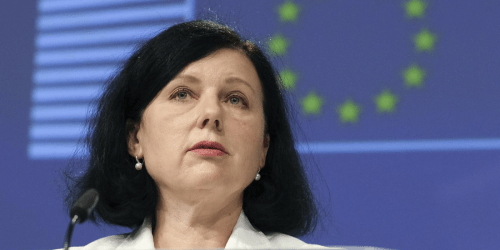
EU Commissioner Claims Bloc NEVER Pushed People to Get COVID Vaccine
Save Britain | June 23, 2022
On Tuesday, a senior EU official shocked observers when she asserted that the bloc had never required its citizens to receive a COVID-19 vaccination in order for them to have access to public services and that claims to the contrary had primarily been made by what she called “anti-vaccine activists.”
It happens as the EU gets ready to update its transnational COVID-19 passport system – a tool that allows EU member states to lock down their own people and shows whether or not a bearer is vaccinated and/or boostered against the disease.
Vra Jourová, the EU’s commissioner for “Values and Transparency,” asserted during a meeting of the bloc’s Special Committee on COVID-19 Pandemic that the organisation had never even considered pressuring people to get vaccines, despite the planned renewal of the EU’s COVID passes and the bloc’s prior public interest in implementing a union-wide regime of mandatory vaccination.
The commissioner told the committee that the EU has never even “considered or even set in stone in any regulation or… requirement to get vaccined,” adding that “We were never pressuring the population to acquire the vaccinated as a condition for access to public services or health services.”
Jourová, on the other hand, claimed that those who made the contrary assertion that “if you are not vaccinated you will not get… to the public areas or [get] access to the services (sic)” were primarily “anti-vaccine activists.”
While Jourová seemed rather certain of her assertion, others did not share her confidence. In particular, elected representative Cristian Terhes MEP questioned whether the commissioner was genuinely being “serious” when she made her claim.
“Madame Commissioner I have to tell you — and please look at me — Madame Commissioner, are you serious with what you just said right now?”, posed the politician from Romania.
“… we are talking about the fundamental rights of every EU citizen, and we just heard right now that through this green certificate people were not forced to be vaccinated,” he continued. “Are we serious? Can we look people in the eyes, citizens of the European Union telling them that?”
Terhes went on to say that, during periods of lockdown, he had to regularly “fight” with EU security to even get access to the European parliament without a COVID pass, a claim that appears to directly contradict the spirit of the commissioner’s statements.
EU Renews Digital Covid Pass Despite 99% Negative Public Feedback
BY ROBERT KOGON | BROWNSTONE INSTITUTE | JUNE 24, 2022
Acting on a proposal of the European Commission, the European Parliament, as expected, voted yesterday to renew the EU Digital Covid Certificate for another year. The vote was 453 for, 119 against and 19 abstentions.
The certificate regulation had been scheduled to expire on June 30. Earlier this month, a delegation from the parliament had already reached a “political agreement” with the Commission on renewing the certificate, thus making yesterday’s vote virtually a foregone conclusion.
The certificate regulation was originally adopted in June of last year, ostensibly to facilitate “safe travel” between EU member states. But the EU digital certificate quickly evolved into the model and sometimes infrastructure for the domestic “health” or Covid passes that would serve to restrict access to many other areas of social life over the following year.
The EU has opted to extend the covid certificate despite the overwhelmingly negative results of a public consultation on the subject that was launched by the European Commission under the heading of “Have Your Say” and that was open to the public from February 3 to April 8. The consultation elicited over 385,000 responses – almost all of which appear to be opposed to renewal!
In a letter to the European Ombudsman that the French member of the parliament Virginie Joron posted on her Twitter feed, Joron writes:
I read hundreds of responses at random with my team. I did not find any in favor of extending the QR code [i.e. the digital certificate]. Based on this large survey, it seems obvious that virtually all the responses were negative.
The overwhelmingly negative tendency of the responses was indeed evident from the outset. The first full page of responses, all of them dating from February 4, is available here. They are, of course, in a variety of European Union languages: French, German, Italian, and also one in English.
To provide readers an idea of the tenor, here is a translation of just the first line or two of the first several responses (starting from the bottom of the page):
I am completely opposed to the establishment of this certificate given what is currently happening with the EU’s disastrous handling of Covid…
I want this cst [probably a reference to Belgium’s “Covid Safe Ticket”] or vaccine passport simply to be eliminated…
There are claims made in the draft document that are not scientifically supported. For example, it is claimed that the Covid certificate represents effective protection against the spread of the virus – what data can support this claim?…
Hello, I am shocked and disgusted by the freedom-killing decisions taken in the EU … as regards this “European certificate” …
The covid certificate or green pass SHOULD BE ABOLISHED immediately as discriminatory and unconstitutional and not supported by any scientific data, because it is exclusively based on PUNITIVE measures for citizens…
I am opposed to the extension of the green pass, which serves no purpose other than creating discrimination…
I never want to be subjected to a discriminatory certificate again…
And, finally, the English-language entry:
The digital Covid certificate should end immediately. There is so much data that supports the fact that digital passports have zero positive impact on transmission rates and in fact in the most vaccinated and highly regulated countries, there [sic.] covid rates are insane…
And so on and so forth through 385,191 responses.
The renewal of the Digital Covid Certificate does not mean that it will be immediately applied, but that the infrastructure will remain in place and that it can be applied if and when member states see fit to do so.
The current rules for holding a valid EU Digital Covid Certificate do not only, needless to say, discriminate against the unvaccinated, but also against natural immunity, which is treated as more ephemeral than vaccine-induced immunity.
Proof of completed primary vaccination makes a certificate valid for 270 days; proof of having received a booster dose confers unlimited validity for the moment. On the other hand, proof of “recovery” – with a positive PCR test being the only accepted proof – only confers 180 days of validity.
Ukraine won’t pursue NATO membership – Zelensky adviser
Samizdat | June 25, 2022
Ukraine has accepted that NATO membership is off the table, and will not take any further steps toward joining the US-led military alliance, Igor Zhovkva, an adviser to President Volodymyr Zelensky, told the Financial Times on Saturday. Nevertheless, Kiev wants a say in NATO’s policies.
NATO leaders are set to meet in the Spanish capital of Madrid next week, and during two days of meetings and consultations, the alliance will unveil its Strategic Concept – a document that outlines the alliance’s mission and stance toward non-members, including China and Russia.
Zhovkva told the Financial Times that Zelensky’s government wants the alliance to acknowledge that Ukraine is “a cornerstone of European security,” and to reaffirm its partnership with Kiev, first established in 1997.
However, he said that Ukraine will not push to become a member of NATO.
“Nato members have declined our aspirations. We will not do anything else in this regard,” he said.
Ukraine’s prospective membership in the alliance was a key factor behind the current conflict with Russia. Ukraine wrote its goal of becoming a NATO member into its constitution in 2019, despite Moscow’s warnings that having the alliance’s forces and weapons on its border would constitute an unacceptable security threat.
NATO Secretary General Jens Stoltenberg has insisted that the alliance’s membership books remain open for interested nations, but has not promised or ruled out membership for Ukraine in the near term. Under the 2008 Bucharest Declaration, NATO’s official position is that Georgia and Ukraine “will become members of NATO” at an unspecified future date.
NATO’s Strategic Concept has not been updated since 2010, with that version of the document stating that the alliance seeks “a true strategic partnership” with Russia.
Zhovkva wants NATO to purge any mention of Russia as a “partner” from the coming update.
“We expect in the Nato strategic concept . . . there will be more strict and severe warnings to the Russian aggressor,” he said, urging the alliance “Don’t be shy” in inserting anti-Russian text.
Furthermore, Zhovkva said that he wants the Ukrainian conflict to be described in the strategy document, arguing “it’s not enough just to cross out the word ‘partner.’”
Featured Video

Revive Iran’s MOU Deal or Face a Forever War
or go to
Aletho News Archives – Video-Images
From the Archives
China names world’s ‘hacking empire’
RT | March 15, 2022
Calling the US a “hacking empire” of the world, the Chinese Foreign Ministry urged Washington to stop “malicious” cyber activities following reports that American hackers subverted a network in China to launch attacks on Russia and Belarus.
“China is gravely concerned about cyberattacks against other countries that originate from the US and use China as a springboard,” Foreign Ministry spokesperson Zhao Lijian told reporters at a press briefing on Monday.
Zhao was commenting on recent Chinese media reports that hackers, mainly from the US but also from NATO allies Germany and the Netherlands, recently hijacked a Chinese computer network for cyberattacks, 87% of which targeted Russia.
“Against the background of the Ukraine situation, such a move may produce the negative effect of misleading the international community and spreading disinformation,” Zhao said, pointing out that “a former US senior official called publicly for launching cyberattacks on Russia not long ago.”
This appeared to be a reference to Hillary Clinton, former US secretary of state and presidential candidate, who made the calls in an MSNBC interview at the end of February. … continue
Blog Roll
 Aletho News
- U.S. Midterms – a Referendum on Israel and Zionist Power
- Twice as many Canadian Jews serve in Israeli military as Canada’s armed forces: Report
- Thousands of Syrian troops set to join Saudi war on Yemen
- Jared Kushner’s Diplomacy for Hire
- Russia backs Tehran’s conditions in talks with US, Iran’s envoy says
- Irish ‘fake news’ expert exposed as fake
- China expresses strong opposition to Dutch report alleging Chinese cyberattacks
- Coup d’état in Poland
- The Endgame: When the CIA Proxy War Runs Out of Ukrainians!
- Over 16,000 hectares of farms, forests burnt in Israeli offensive on southern Lebanon, says minister
- If Americans Knew
- An error has occurred; the feed is probably down. Try again later.
- No Tricks Zone
- Zonal Asymmetry of Temperature Change in the Antarctic Circumpolar Current
- New Study: The Net Fossil Fuel Contribution To Rising Atmospheric CO2 Has Been Zero For 500 Years
- Germany’s Green Energy Transition Becoming Increasingly Expensive…Another 6 Trillion Euros!
- Sudden Stratospheric Warming, Powerful El Niño Combination May Lead To Extreme Europe Cold, Energy Crisis!
- Two New Studies Find Thwaites Glacier Melt Cannot Be Driven By Human Activity Or A Warming Ocean
- E-Cars Reduce CO2 Emissions By Only 41% Compared To Internal Combustion Engine Vehicles
- Predictions Made By Renowned Climate Professor Over Past Decades Have Been Proven To Be Poor
- New Study Suggests Large Regions Of The Pacific Ocean Have Been Cooling For The Last 80 Years
- Germany’s Green Energy Debacle: High Energy Costs Force Kahla Porzellan to Close After 182 Years!
- New Study: 50 Years Of The Most Aggressive ‘Net Zero’ Policies Can Only Affect The Global Climate By 0.03°C

