Former head of the ruling Social Democrats, Oskar Lafontaine, blames NATO for Ukraine conflict
Samizdat | May 22, 2022
A veteran top German politician has said the West’s refusal to listen to Moscow’s concerns is one of the main causes of the current conflict in Ukraine. Oskar Lafontaine, who from 1995 until 1999 served as chair of the Social Democrats, accused the West of ignoring Russia’s security interests for years.
In an interview with left-wing newspaper Junge Welt published on Saturday, Lafontaine argued that “for a long time, we have been in a situation where Russia and China have been militarily encircled by the US.” The former SPD leader said Moscow had made it clear to NATO for 20 years that Ukraine should not become part of the military alliance – a scenario, which, according to Lafontaine, would mean US missiles deployed on the Ukraine-Russia border.
“These security interests were consistently ignored,” the politician said. And this was “one of the key reasons for the outbreak of the Ukraine war.”
Speaking of Ukraine’s NATO aspirations, the former SPD chair dismissed the argument that every country is free to decide what alliance to join.
“Everyone knows that the US would never accept Cuba’s accession to a military alliance with Russia, nor the deployment of Russian missiles on the US border with Mexico or Canada,” Lafontaine argued.
According to the German politician, Russia’s key concern in Ukraine is not NATO accession per se, but the prospect of missiles appearing on the border with minimal warning time.
Lafontaine broke down the Ukraine crisis into three key phases: firstly, NATO’s relentless eastern expansion, despite warnings from within the US that the strategy risked a conflict with Russia; secondly, President Putin’s “decision to invade Ukraine”; and thirdly, Joe Biden’s “war of attrition.”
The politician said America’s $40 billion dollar aid package for Ukraine, consisting mostly of weapons, is further “proof that the US does not want peace.”
“They want to weaken their rival Russia and say so quite openly,” he added.
Lafontaine, however, clarified that he condemns the war, “just like I condemn without any qualification all other wars that violate international law.”
The politician argued that further arms to Ukraine will prolong the war, meaning “yet more people will die.” He accused politicians in the West of thinking purely in the categories of ‘victory’ and ‘defeat,’ while ignoring the “most important” aspect, which is saving people’s lives.
According to Lafontaine, “those, who do not want more people to die, must be against any prolongation of the war, and consequently also against any weapons delivery.”
He criticized the argument that by providing military support to Kiev, the West is helping Ukraine defend itself, questioning why no one called for supporting “countries attacked by the US with deliveries of German weapons” in the past.
Speaking of Russia sanctions, Lafontaine claimed that they “are increasingly hurting people here at home – especially those with lower incomes, who can no longer pay their energy bills.”
“We are shooting ourselves in the knee. The US is probably laughing at us, because they are hardly affected by the sanctions, they can sell their liquefied natural gas in Europe in bigger quantities and their defense industry is getting a lot of business.”
The former SPD chair believes the current German leadership is in no position to work in the country’s own best interest, being nothing more than a “loyal vassal of the US.”
Lafontaine noted that the Green Party, which is part of the ruling coalition, has firmly entrenched itself in the role of the “extended arm of the US in the Bundestag” since the Yugoslav war. The party “supports every US decision when it comes to wars,” the politician said, adding that the Greens only pay attention to human rights violations when those happen in Russia or China.
The party’s current stance illustrates a radical transformation from a pacifist political force it once was. The Social Democratic Party, which the current Chancellor Olaf Scholz is a member of, too, has changed dramatically, according to its former chair, drifting away from its principles of peace, disarmament and social improvements.
Lafontaine reserved special criticism for the German press, which “is blind to the US war crimes” while offering a platform for warmongers.
The veteran German politician said that many in Germany feared that the “war will spread,” calling on the public to take to the streets in keeping with the tradition of the “peace movement of the 1980’s.”
Sign the World Freedom Declaration – Oppose IHR amendments
OffGuardian | May 21, 2022
The Health Freedom Defense Fund – a US-based non-profit – has published an open declaration opposing the planned amendments to the International Health Regulations.
Kit broke down the proposed changes in detail in yesterday’s article. Suffice to say, they amount to a massive threat to both individual liberty and national sovereignty.
You can read the full text of the HFDF declaration here, or a (slightly) abridged version below.
The declaration has already been signed by almost 30,000 people, including Robert Kennedy Jr, Dr Sucharit Bhakdi and Naomi Wolf.
To see the full list of signatories, and add your own signature you can click here.
*
Declaration of Opposition to the Proposed International Health Regulations Amendments
We, the undersigned, oppose the proposed amendments to the World Health Organization’s (WHO) existing 2005 International Health Regulations (IHR) and stand in support of all people’s right to health sovereignty and self-determination.
The United States’ proposed amendments to the IHR are set to be considered at the 75th World Health Assembly, which begins on the 22nd of May, 2022. The proposed amendments, however, create an ambiguity relating to the date they become effective as the proposed amendments expressly state they will become effective six months after the date of notification by the Director-General, whereas the existing IHR provides that amendments become effective 18 months after notification by the Director-General.
If accepted, these legally binding amendments would come into effect for all member states except those that explicitly reject them. Under Article 59 of the IHR, de facto approval is assumed for any member states that fail to reject or take reservation to the amendments.
The existing IHR, adopted in 2005, respect the sovereignty of all member nations. The proposed amendments, however, would expand and codify the WHO’s authority to implement global health mandates in direct violation of national sovereignty and citizens’ rights.
These proposals attempt to eliminate a nation’s autonomy, during times of real, assumed or anticipated public health emergencies, affording the WHO unilateral power in assessing and determining a health emergency and empowering the WHO to dictate policy and response.
All of this comes on the heels of the COVID-19 crisis during which the WHO grossly mismanaged all facets of the global health response by encouraging economy-destroying lockdowns, suppressing early preventive treatments and recommending interventions that have proven to be neither safe nor effective.
Under the guise of health regulations, these amendments would permit the WHO to seize executive governance powers over member states, granting governing powers to unelected and unaccountable bureaucrats.
In sum, the IHR amendments would, among other changes:
- Intensify the surveillance of all countries and their citizens.
- Grant the WHO the authority to tell other member states when one member state isn’t reporting and launch punitive actions.
- Empower the WHO Director-General to declare when and where a pandemic or “alleged” emergency is occurring using undisclosed sources.
- Confer unrestricted powers to the Director-General to define and implement interventions.
- Give the WHO the ability to access and mobilize capital in the event of a pandemic.
- This power grab by the WHO, its donors, and stakeholders represents a direct attack on the political and economic sovereignty of all nations and their citizens.
By repeatedly promoting policies that caused catastrophic economic, social, physical, emotional and mental damage across the globe, the WHO has failed in its mission as global steward of public health and cannot be entrusted with setting policy for all citizens of the world.
Of note, the WHO enjoys immunity from every form of legal action, arrest, and searches of their papers, documents, and facilities.
The WHO should not be allocated more money, power, or authority nor should it be allowed to further control the world’s health agenda or implement biosecurity measures.
Global agreements brokered by unelected, unaccountable bureaucrats must never be permitted to rule any nation.
It is imperative that each nation and territory retain its sovereignty, especially during times of crisis, so that the entire global community can be protected from globally directed policies that primarily benefit powerful financial and ideological stakeholders.
The undersigned respectfully request that all nations and their representatives repudiate such agreements.
We strongly oppose the proposed IHR amendments which would require nations and their citizens to adhere to the dictates of an unaccountable global body.
We oppose any involvement in a treaty, agreement, or other legally binding global document that would hinder any nation’s sovereignty in the area of public health.
We assert that nations and their citizens are best-positioned and -equipped to make health decisions appropriate to their communities.
We demand that the people of each nation be in charge of determining their response to health crises.
As citizens of the world, we defend the rights, freedoms, and privacy of all members of the global community by calling for the rejection of the IHR amendments and the WHO’s attempt to usurp the power and authority of health policy from its rightful place – at home amongst the people.
On May 18, 2022, this declaration was authored and signed by,
Leslie Manookian
Health Freedom Defense Fund
In the wake of Russian victory in Mariupol
BY M. K. BHADRAKUMAR | INDIAN PUNCHLINE | MAY 21, 2022
Thank God, Russia eschews any triumphalism over the surrender of the so-called neo-Nazi Azov regiment in the Azovstal factory complex in Mariupol. The Defence Ministry in Moscow announced on Friday that a total of 2,439 “Azov Nazis” and Ukrainian servicemen had laid down their arms since May 16, and that the entire Azovstal complex is now under control of Russian forces.
Russia sticks to its version that on April 21, President Putin handed down an order calling off the initially planned storming of the Azovstal plant, as he considered it pointless and ordered that the industrial zone around the plant be tightly sealed off so that “even a fly couldn’t get through.”
Kiev instead claims the “end of combat operations.” President Volodymyr Zelensky called it an “evacuation mission … supervised by our military and intelligence officers” with the involvement of “the most influential international mediators.”
The fog of war has thickened. Russian Duma previously considered to expressly forbid any exchange of prisoners, but has since stood down. The Russian and Ukrainian delegations are set to meet in Belarus on Monday.
Moscow is also keeping mum about the identity of any foreign military personnel who surrendered in Mariupol. In the past week, both US Defence Secretary Lloyd Austin and the Chairman of Joint Chiefs of Staff General Mark Milley called their Russian counterparts Sergei Shoigu and Gen. Valery Gerasimov respectively for the first time since the war began in February.
The resumption of talks in Belarus after two months suggests that Kiev has a negotiating brief that carries the imprimatur of Washington and London. These are big ‘ifs’. The objectives behind the Russian operation are not yet fully realised. Putin has the final word, but he prefers to concentrate more on navigating the Russian economy through the western sanctions.
The situation on the Ukrainian front lines in Donbass remains very complex. There is intense fighting street to street, village to village, as Russian forces continue to advance on the main front lines. Russia is not committing large forces, since operation is highly tactical aimed at cleansing the region of its “Nazi filth” (to borrow from Putin) if Mariupol is any example.
Russian forces made a significant gain in capturing Izyum with the intention to advance further south-west towards the town of Barvenkovo, which is the main stronghold of the Ukrainian forces in Donbass region. They are on the outskirts of the city of Severodonetsk and clashes continue along the road leading to Lisichansk, which has over 10,000 Ukrainian troops.
Again, after taking control of Popasnaya, Russians are surrounding the Ukrainian forces in various settlements and breaking through their defence lines in three directions. The US mercenaries, many of whom are likely intelligence agents, continue to fight in the ranks of the Ukrainian forces and several of them have been killed. 35-year old Joseph Ward Clark’s documents revealed that he belonged to a unit of special forces. Russia is striking key and strategically important Ukrainian targets such as warehouses, railways and bridges.
In military terms, Kiev and its western advisors hoped to pin down substantial Russian forces in Mariupol, but were outmanoeuvred. The commander of the Azov army Svyatoslav “Kalyna” Palamar was taken from the Azovstal steel plant yesterday in a special Russian armoured vehicle. All this will demoralise the Ukrainian military.
Therefore, the US announcement of additional $40 billion for Ukraine can be seen as a morale booster. The combined American military aid for Ukraine now stands at $54 billion, which is about 81 percent of Russia’s 2021 defence budget. But, as Americans would say, there’s nothing like free lunch. The Ukraine Democracy Defense Lend-Lease Act of 2022 signed by Biden in May is patterned after the legislation used during World War II to supply weapons to allied countries, stipulating that these aid packages are actually debts that need to be paid back by Ukraine eventually.
Washington can claim compensation if Ukraine fails to redeem the debt, such as with the supply of cheap agricultural products by Ukraine, preferential business deals for American companies, and so on.
The Biden Administration probably hopes to ensure that the interest groups at the top echelons of leadership in Kiev continue with the war effort. Ukraine is a notoriously corrupt country and war profiteering on a massive scale can be expected. Much of the aid will be stolen by corrupt officials.
Going forward, the US diplomacy faces a difficult situation. The EU has virtually shelved the ban on Russian oil and stopped talking about ending Russian gas supplies. The political dynamics in Europe is shifting. After approving five previous sanctions packages against Russia with remarkable speed and unanimity, European leaders have reached the point at which the penalties against Russia carry increasing costs and heightened risk of damage to their own economies, and that is testing their unity.
France, Germany and Italy, amongst many other EU countries, have come to terms with the new Russian regime for payment for gas supplies that effectively bypasses EU sanctions. Potentially, the current delay in the EU oil sanctions will likely have a domino effect.
During the recent weeks, there has been a flurry of ceasefire talk (and negotiations with Moscow) by French President Emmanuel Macron, German Chancellor Olaf Scholz and Italian Prime Minister Mario Draghi. Their remarks seem at cross-purposes with what the British and the Americans are saying. Simply put, the European continent’s three most powerful capitals have begun singing from a different song sheet, wanting the war to end quickly and everything to “return to normal” as soon as possible. The point is, divergences over allied war aims are emerging.
However, Russia is unlikely to agree to peace terms that fall short of its demands — a neutral Ukraine and Kiev’s acceptance of the status of Donbass region and Crimea. But then, the head of Crimea, Sergey Aksyonov said on May 18 that Kherson and Zaporizhia regions should be merged with the Crimea. Earlier, the head of the Kherson region also demanded that the region should integrate into Russia. These are gentle reminders that if the war continues, Zelensky will risk harsher terms of settlement.
In the final analysis, the tragi-comedy of the Azovstal event underscores that there are no winners and losers in this war. The US wants to win this war, whereas Russia is not fighting a war but is seeking a successful operation to meet certain specific objectives of national security. The Ukrainian and Russian peoples have fraternal bonds. Ukraine is Russia’s neighbourhood, whereas it is 10,000 kms away from America. This disconnect threatens to prolong the war.
The Europeans don’t have fire in the belly anymore while speaking about the war, which for them is becoming a great disrupter of the manicured, predictable life in their continent, something that they least expected when Washington hustled them into the war.
Above all, this is an operation of necessity for Russia, not of choice. Paradoxically, the choice was entirely up to the US and NATO to appreciate that there is nothing like absolute security. Wasn’t it the former US Secretary of State Henry Kissinger who once said, “Absolute security for one state means absolute insecurity for all others.”
Global Sheriff Washington wants its courts to unilaterally define who’s a war criminal
Washington lawmakers want US courts to become the new Hague
Samizdat | May 21, 2022
New evidence is emerging that the US establishment is continuing to exploit the window of opportunity provided by the emotional public reaction to the conflict in Ukraine to further subvert the multilateral world order. Members of the US Senate have revived an old draft bill from 1996 that would give American justice jurisdiction over foreigners who American officials decide to accuse of war crimes in foreign jurisdictions, according to a New York Times report.
The problem for Washington in dealing with war crimes is that in order to ascertain whether someone has indeed violated the international laws of war, the due process of an actual trial at The Hague is required. But not only has Washington previously passed a law (The Hague Invasion Act) that would authorize the Pentagon to take any action necessary to rescue any American citizens on trial for – or convicted of – alleged atrocities, it doesn’t even officially recognize the authority of the court.
When court officials moved to investigate the actions of American troops in Afghanistan in 2020, then-President Donald Trump slapped sanctions on court officials. And while those sanctions have since been lifted under President Joe Biden, there’s still no evidence that his administration is interested in demanding that the ICC hold Americans to the same standard to which they demand the rest of the world be held. In the latest example of such hypocrisy, Washington officials have been calling for Russian President Vladimir Putin to answer to The Hague over the conflict in Ukraine.
No one at this point really has any clue where the line is between ‘conventional’ wartime atrocities and those deemed to be exceptional and punishable. Nor should conclusions be drawn on the basis of trial-by-propaganda. The wheels of justice tend to turn slowly.
But who has time for that? Certainly not Washington! Who needs slow and messy international law when you can just wake up one day and decide that you’re the new Hague?
What the US senators are proposing is a kangaroo court of questionable evidentiary legitimacy, given the complexities that time, distance, and the fog of war would introduce into the chain of evidence. Such a process would be imposed on a foreigner targeted with war crime suspicions by the US authorities in the event that they wind up on US soil, according to the NYT report.
If you’re wondering what that might look like, just ask French citizen Frédéric Pierucci, a former senior manager of France’s multinational Alstom, who was arrested by the FBI at New York’s JFK Airport in 2013, accused by the US of business-related bribery in Indonesia, and sentenced to two years and a half in jail, in the US. Pierucci was a foreigner, working for a foreign company, convicted in 2017 in a Connecticut court over an Indonesian matter. But the US Foreign Corrupt Practices Act allows for the long arm of American justice to claim global jurisdiction if any aspect whatsoever of the US financial or monetary system is touched in any way, however minor.
The case of Huawei executive Meng Wanzhou, daughter of the Chinese telecommunications multinational’s founder, also highlights the lengths to which the US will go judicially to defend its competitive advantage.
Arrested by the Canadian authorities on the demand of their American counterparts while in transit at the Vancouver International Airport, the executive – who wasn’t even on American soil – was accused of violating US sanctions against Iran that had nothing to do with Canada. After dragging Canada into a four-year diplomatic quagmire with China while Meng sat under house arrest at her Vancouver home, a deal was struck to release her back to China in exchange for a deferred agreement to prosecute her in the US. It’s not difficult to imagine that, like Pierucci, who was released after Alstom was acquired by General Electric amid record-breaking corruption fines, which ultimately amounted to $772 million, Meng may also have served as a convenient economic hostage to America’s ultimate competitive benefit.
Athletic competition isn’t immune from judicial exploitation, either. In December 2020, US lawmakers passed the ‘Rodchenkov Anti-Doping Act’, which allows the authorities to arrest or even extradite foreign athletes to America to face charges of suspected doping – even if the affected competitions didn’t occur on US soil. “To justify the United States’ broader jurisdiction over global competitions, the House bill invokes the United States’ contribution to the World Anti-Doping Agency,” according to the New York Times.
Washington has unilaterally tasked itself with globally defining who can do business with whom through its sanctions regimes, who gets convicted of doping, who gets selectively pursued for corruption on the world business stage – and now the US wants to single-handedly define who gets to be labeled a war criminal.
Is everyone else on Earth really alright with this? And if not, then where’s the outrage?
Syria demands US pay for air strike victims
Damascus rejects Pentagon findings, demands troop withdrawal
Samizdat | May 21, 2022
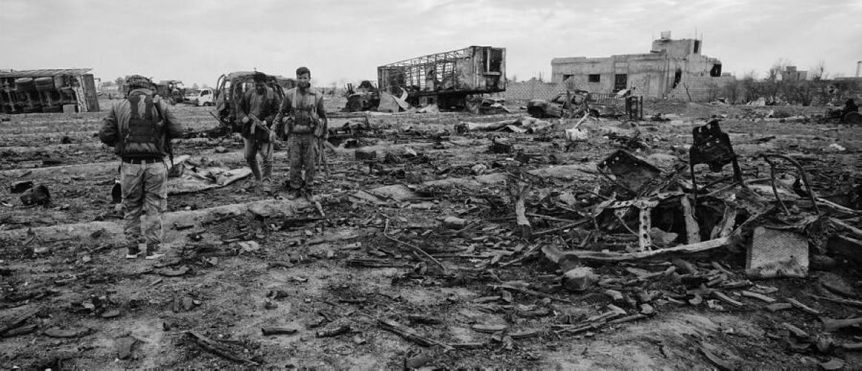
The Syrian permanent mission to the UN stated on Friday that the US must withdraw its troops from the country at once and pay reparations for the deaths of dozens of civilians in a 2019 airstrike in the town of Baghuz.
Damascus categorically rejected a Pentagon report claiming it was not at fault for the attack, declaring its conclusions represent “an admission of negligence that calls for accountability.”
The Pentagon had released a report on Tuesday claiming the March 18, 2019 airstrike targeting an Islamic State (IS, formerly ISIS/ISIL) encampment in Syria’s Baghuz, initially believed to have killed some 70 people, did not violate the rules of engagement or laws of war.
Washington’s assessment ultimately claimed that of the 56 people it determined to have died in the 500-pound bomb blast, just four were civilians. The report also claimed that while “civilians were within the blast radius” resulting in civilian casualties, the decision to drop the massive bomb had “demonstrated awareness for non-combatants.” However, in determining who was considered a terrorist, it used an Obama-era standard classifying all killed military-age males as combatants by default.
The Syrian mission to the UN dismissed the Pentagon’s conclusions as a “clear attempt to absolve the US occupation forces in Syria of their direct responsibility for civilian casualties under the pretext of fighting the terrorist organization ‘ISIS’” and rejected any claims that “efforts have been made to distinguish between civilians and members of ‘ISIS’” as “empty justifications” for the murder of civilians.
“These biased investigations cannot deny the fact that a crime against humanity has occurred in Baghuz,” the mission told Newsweek on Friday. “Any justifications provided by the US administration for not violating the law of war or the rules of engagement are to circumvent the fact that the US forces deployed in Syria are illegal and they launch military strikes, under the pretext of fighting terrorism, without the approval or coordination of the government of the Syrian Arab Republic.”
Despite the report supposedly clearing the US military of any wrongdoing, the full text remains classified, with just a two-page summary released to the public. The site of the blast itself was quickly bulldozed, and the initial internal reports were “delayed, sanitized, and classified,” according to the New York Times.
The report’s conclusions stood in stark contrast to remarks from US personnel on the ground at the time, with one military analyst reportedly stating that “we just dropped [the 500-pound bomb] on 50 women and children” and others questioning whether they had just witnessed a war crime.
While US Central Command had previously admitted that 80 people had been killed in the strike and just 16 were alleged ISIS terrorists, the military defended its actions by suggesting 60 more could have also been terrorists, since “women and children in the Islamic State sometimes took up arms.”
The Pentagon’s recent report contradicted even those watered-down findings, admitting only that “administrative deficiencies contributed to the impression that the [Department of Defense] was not treating this [civilian casualty] incident seriously, was not being transparent, and was not following its own protocols” regarding civilian casualty incidents.
International civil society groups have eviscerated the Pentagon’s civilian casualty reporting protocols for their toothlessness, most recently following an incident in Afghanistan in which an Afghan NGO worker and nine family members – including seven children – were killed in an airstrike supposedly targeting an ISIS terrorist. That investigation, too, found no “misconduct or negligence” on the part of the killers.
Syria says Israeli missile strikes result in fatalities
Samizdat | May 20, 2022
At least three people were killed at Damascus International Airport on Friday, in what the Syrian government said was a missile attack from Israel. Two flights were delayed as a result of a fire at the facility. Israeli media reported that the strikes were aimed at Syrian and Iranian military targets.
Syrian air defenses intercepted multiple “hostile targets” in the skies over Damascus late on Friday, but some missiles got through to cause casualties and start a fire at the airport, according to the Syrian Defense Ministry.
Explosions could also be heard along the coast and in the Syrian city of Tartus, which hosts a Russian naval base.
Friday’s strike targeted pro-Iranian militias operating in Syria, according to the Israeli outlet Ynet. The Israeli government has not officially commented on the reports so far.
On the rare occasions Israel has admitted carrying out attacks inside Syria, the Israeli government says it has the right to preemptive self-defense against Iran. Tehran has acknowledged sending military aid to Damascus to aid the fight against Islamic State and other terrorist groups.
Last month, Hezbollah leader Hassan Nasrallah warned Israel that if such strikes continue, Iran might “attack Israel directly,” citing a missile strike in March against a suspected Israeli operations base in the northern Iraqi city of Erbil.
Israel used US weapons against American assets, businesses in Gaza
Press TV – May 21, 2022
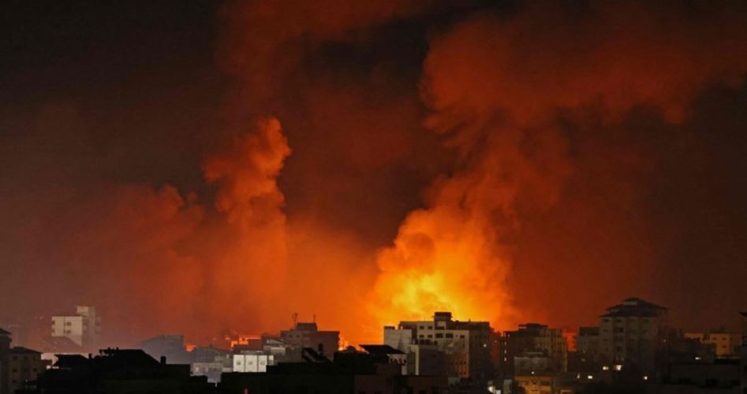
The Israeli regime used weapons made and funded by the United States to destroy American projects and businesses in the Gaza Strip during its devastating 11-day war on the besieged enclave last year, according to a report.
In an article published on Thursday, The Intercept said it reviewed documents and reports that showed hospitals, water treatment facilities, and schools funded by US agencies destroyed during the Israeli regime’s incessant bombardment of Gaza in May 2021.
“Also impacted were the Foamco mattress factory — the main producer of mattresses for Gaza — the Abu Iskandar plastic factory, the Clever detergent factory, the Siksik plastic pipes factory, and the Al-Wadi food plant, resulting in tens of millions of dollars in damage. The factories employed 1,500 Palestinians and were severely impacted by the shelling in the early morning hours on May 17 and 18, 2021,” the report said.
It added that a Coca-Cola factory, built by a US citizen, served as yet another casualty of Israeli shelling during the May onslaught, in a “highly symbolic display of just how far Israel’s disregard for US material interests in Gaza extends.”
“Coca-Cola is also a shareholder, not just a licensor, and I am a shareholder as a US citizen, so this affected many US citizens,” Zahi Khouri, the factory’s owner, told The Intercept. “We had thousands of pallets burned, and there was damage to the logistics area. There was damage in the industrial estate, but what was also damaged was the investment of Coca-Cola in a project through Mercy Corps where we built a water purification station for a refugee camp.”
The Israeli war on Gaza, which commenced on May 10 last year and lasted until May 21, killed at least 250 Palestinians, including 66 children, and injured more than 1,900 others. The Israeli airstrikes also displaced tens of thousands of people and demolished, completely or partially, dozens of buildings, schools, and hospitals.
“The vast majority of ammunition used by Israel is manufactured or subsidized by the US,” Raed Jarrar, advocacy director at Democracy for the Arab World Now, or DAWN, told The Intercept. “It’s fair to say that every Israeli munition is subsidized by the US one way or another, by US tax dollars.”
Israel is the largest recipient of US military aid. It has received over $150 billion in assistance from the US government since 1948. Nevertheless, the occupying regime has never been subjected to any inspections in Washington on how it uses weapons made or funded by the US.
Also, under that weapons assistance program, Israel is allowed to spend US tax dollars on its own weapons industry without disclosing how it spent the money to Congress or the American public.
Meanwhile, the first anniversary of the 2021 Israeli war on Gaza has been marked with intensified Israeli aggression against Palestinians in both the occupied West Bank and the besieged Gaza Strip.
The Israeli military’s killing of Al Jazeera Journalist Shireen Abu Akleh earlier this month once again attracted global attention to the Israeli regime’s atrocities.
“A major reason for the perpetuation of the Israeli occupation, and the deaths and suffering which accompany it, is the extraordinary military, diplomatic, and political support given to it, largely without conditions, by the United States,” said Michael Lynk, the recently departed UN special rapporteur on the situation of human rights in the Palestinian territories.
“This American military assistance is provided, notwithstanding the fact that congressional laws governing US weapons exports state that recipient countries cannot be engaged in consistent patterns of gross human rights violations,” Lynk added.
COVID-19 Pandemic Could Have Emerged Due to US Experiments on Viruses, Prof Says
Samizdat | May 21, 2022
Scientists have not been able to reach an agreement on the origin of the coronavirus pandemic. While it is widely believed that the deadly virus originated from a wet market in Wuhan, others insist that COVID-19 was man-made, and the pandemic was the result of a laboratory leak.
US experiments on viruses that could jump from animals to people might have contributed to the emergence of coronavirus, Professor Jeffrey Sachs wrote in his article for PNAS journal.
He also called for an independent and transparent investigation into the origin of the coronavirus pandemic. According to Sachs, more transparency from the Chinese authorities could have helped a lot during the early stages of the pandemic, but some US research also raises concerns.
“We argue here that there is much important information that can be gleaned from US-based research institutions, information not yet made available for independent, transparent, and scientific scrutiny,” he wrote in a joint statement with Professor Neil Harrison of Columbia University.
Among the US institutes that could use more transparency Sachs lists the EHA, the University of North Carolina (UNC), the University of California at Davis (UCD), the NIH, and USAID.
“A broad spectrum of coronavirus research work was done not only in Wuhan […] but also in the United States. The exact details of the fieldwork and laboratory work of the EHA-WIV-UNC partnership, and the engagement of other institutions in the United States and China, has not been disclosed for independent analysis,” the professors wrote, adding that “the precise nature of the experiments that were conducted, including the full array of viruses collected from the field and the subsequent sequencing and manipulation of those viruses, remains unknown.”
Sachs pointed out that the denials of being involved in COVID-related research alongside US institutions are “only as good as the limited data on which it is based”. According to the article, the US-Chinese collaborative research was connected to “the collection of a large number of so-far undocumented SARS-like viruses and was engaged in their manipulation within biological safety level (BSL)-2 and BSL-3 laboratory facilities.”
Such experiments raise concerns that an airborne virus might have infected a laboratory worker, along with other possible scenarios suggesting that COVID-19 was man-made.
Sachs emphasised the importance of further independent and transparent investigations into the origin of the pandemic, suggesting that one of the ways to investigate could be “a tightly focused science-based bipartisan Congressional inquiry.”
While the scientific opinions on the origins of COVID remain divided, Beijing suggested that the deadly virus could have also emerged from Fort Detrick, a clandestine bioresearch facility based in Maryland. Washington, in turn, accused China of fuelling the pandemic and concealing the data about the virus, with the allegations being particularly vocal during the presidential tenure of Donald Trump.
The WHO Changes Guidelines to Favor Lockdowns
BY WILL JONES | BROWNSTONE INSTITUTE | MAY 18, 2022
The World Health Organisation intends to make lockdowns and other non-pharmaceutical interventions intended to curb viral spread part of official pandemic guidance.
The revelation comes in a report scheduled to go to the WHO’s World Health Assembly later this month. This is not part of new pandemic treaty and does not require the endorsement of member states. The report says the implementation is already underway.
Many have raised the alarm about a new WHO pandemic treaty. However, as I’ve noted previously (and as Michael Senger notes here), there isn’t a new pandemic treaty on the table. Rather, there are amendments to the existing treaty, the International Health Regulations 2005, plus other recommendations (131 in all) put forward in a report from the Working Group on Strengthening WHO Preparedness and Response to Health Emergencies.
Most of these amendments and recommendations relate to information and resource sharing and preparation for future pandemics; none of them directly interferes with state sovereignty in the sense of allowing the WHO to impose or lift measures. However, that doesn’t mean they’re not dangerous, as they endorse and codify the awful errors of the last two years, beginning with China’s Hubei lockdown on January 23rd 2020.
The recommendations in the report originate from WHO review panels and committees and were sent out in a survey in December 2021 to member states and stakeholders to seek their views.
Non-pharmaceutical interventions appear three times in the recommendations, once under “equity” and once under “finance,” where states are urged to ensure “adequate investment in” and “rapid development, early availability, effective and equitable access to novel vaccines, therapeutics, diagnostics and non-pharmaceutical interventions for health emergencies, including capacity for testing, scaled manufacturing and distribution”.
While rapid development and early availability of non-pharmaceutical interventions sounds worrying in itself, it could be interpreted in a number of ways by states.
Where it really gets alarming, however, is in the “leadership and governance” section. LPPPR 29 states (emphasis added):
Apply non-pharmaceutical public health measures systematically and rigorously in every country at the scale the epidemiological situation requires. All countries to have an explicit evidence-based strategy agreed at the highest level of government to curb COVID-19 transmission.
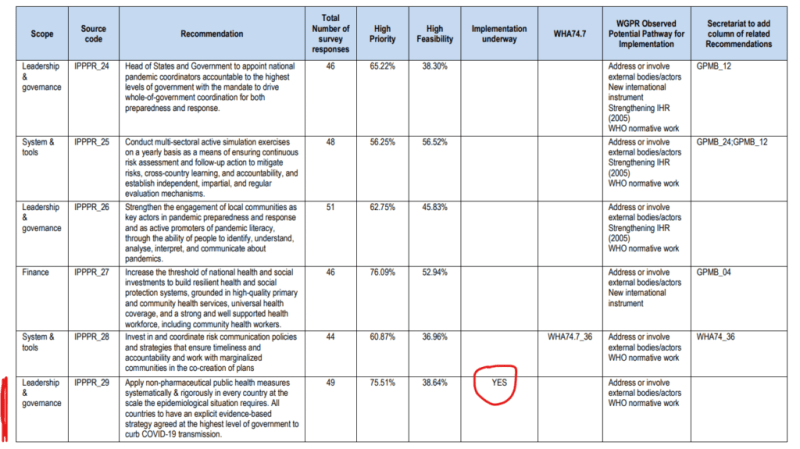
The requirement that a country’s pandemic strategy must aim to curb viral transmission is a major change from the current guidance. The U.K.’s existing pandemic preparedness strategy, prepared in line with previous WHO recommendations, is completely clear that no attempt should be made to stop viral transmission as it will not be possible and will waste valuable resources:
It will not be possible to halt the spread of a new pandemic influenza virus, and it would be a waste of public health resources and capacity to attempt to do so.
It almost certainly will not be possible to contain or eradicate a new virus in its country of origin or on arrival in the U.K. The expectation must be that the virus will inevitably spread and that any local measures taken to disrupt or reduce the spread are likely to have very limited or partial success at a national level and cannot be relied on as a way to ‘buy time’.
It will not be possible to stop the spread of, or to eradicate, the pandemic influenza virus, either in the country of origin or in the U.K., as it will spread too rapidly and too widely.
But now the WHO says that curbing viral transmission is to be the aim of pandemic response. This is a disaster.
Worse, the report says this recommendation will be incorporated into the WHO’s “normative work,” meaning it will be part of official WHO guidance to states in responding to a pandemic. Worse still, it says it’s already being implemented – it doesn’t need a treaty or the agreement of member states to do this, it’s already happening.
Expect to see new guidance appearing at the international and national levels over the coming months and years which incorporate this presumption that restrictions should be imposed to curb viral spread. This is despite the last two years only confirming the wisdom of the WHO’s previous guidance that this is not possible and not worth the attempt.
This matter must be raised at the highest levels so that lockdowns and other non-pharmaceutical interventions are kept out of all pandemic planning.
Sign the parliamentary petition against the latest moves by the WHO here – now at over 121,000 signatures.
South Australia introduces prospect of jail time for breaking strict Covid restrictions
By Dan Frieth | Reclaim The Net | May 20, 2022
The state government of South Australia is about to introduce the harshest penalties in the nation, and some of the most severe in the world, for those breaking Covid restrictions.
The regulations, which are coded in the Public Health Act, mandate that citizens that break isolation rules or fail to abide by vaccine passport and mask mandates are subject to a fine of $20,000 or two years in prison.
Businesses that are in noncompliance with the law face an even bigger fine of $75,000. The law is expected to pass Parliament this week and applies to those who break Covid regulations in high-risk settings. Upon passage, regulations codified in the Public Health Act would take effect on June 30.
The tough regulations have drawn sharp criticism from some members of South Australia’s Parliament and civil liberties groups. Despite this disapproval, Premier Peter Malinauskas, a Labour Party member, says that the new law is necessary to protect the state’s most vulnerable residents. Continuing, Malinauskas adds that Australia is in a stage of the pandemic where governments need to once again conduct basic services in a normal manner, thus necessitating the codification of Covid laws.
Those who oppose the new law not only criticize its tough penalties but how it was passed by Parliament.
Referring to the law as a “backroom deal,” Adelaide Advertiser of the Liberal Party condemned it as a way for Malinauskas to quickly incarcerate rule breakers. The Law Society of South Australia also criticizes the law as being overly vague.
The group’s head, Justin Stewart-Rattray, says that the act fails to provide an adequate definition of what constitutes a close contact. Examining Australian regulations since the start of the pandemic, Stewart-Rattray points out that the definition of close contact has changed several times throughout the crisis.
Given how unclear the law is, Stewart-Rattray says that enforcement could be too wide, leading to rampant abuse of power and loss of rights for accused citizens.
Featured Video
Nima R. Alkhorshid: US military bombs multiple targets on Iran’s Qeshm Island
or go to
Aletho News Archives – Video-Images
From the Archives
British Intel Tried to Make N Irish Gang ‘Shoot Up’ School, Documentary Claims
Sputnik – 23.02.2019
A new documentary, based on an interview with a self-confessed member of the Glennane Gang, gives some insights into allegations that British military intelligence was behind a shocking murder plot to cause the situation in Northern Ireland to “spiral out of control”.
In a documentary, Unquiet Graves: The Story of the Glennane Gang, John Weir, a former officer from the Royal Ulster Constabulary (RUC), alleges that British intelligence tried to persuade paramilitary group Ulster Volunteer Force (UVF) to attack a Catholic primary school at Belleeks in County Armagh.
Weir claimed that the UVF was urged to kill children and teachers in retaliation for the 1976 Kingsmill massacre, in which gunmen stopped a minibus carrying twelve workmen and shot them; only one person survived despite having been shot 18 times.
“The plan that was decided on was to shoot up a school in Belleeks”, he said, adding that the British intelligence plot was to make the situation in Northern Ireland “spiral out of control”. … continue
Blog Roll
 Aletho News
- Nima R. Alkhorshid: U.S. Military Bombs Multiple Targets on Iran’s Qeshm Island
- Iran-Linked Ships Spotted Hovering over Subsea Cables: Report
- New attack on Iran could devastate ‘Israel’, IOF general warns
- Nuclear deterrence: The US-Israeli military aggression against Iran made the unthinkable legitimate
- U.S. Midterms – a Referendum on Israel and Zionist Power
- Twice as many Canadian Jews serve in Israeli military as Canada’s armed forces: Report
- Thousands of Syrian troops set to join Saudi war on Yemen
- Jared Kushner’s Diplomacy for Hire
- Russia backs Tehran’s conditions in talks with US, Iran’s envoy says
- Irish ‘fake news’ expert exposed as fake
- If Americans Knew
- An error has occurred; the feed is probably down. Try again later.
- No Tricks Zone
- Zonal Asymmetry of Temperature Change in the Antarctic Circumpolar Current
- New Study: The Net Fossil Fuel Contribution To Rising Atmospheric CO2 Has Been Zero For 500 Years
- Germany’s Green Energy Transition Becoming Increasingly Expensive…Another 6 Trillion Euros!
- Sudden Stratospheric Warming, Powerful El Niño Combination May Lead To Extreme Europe Cold, Energy Crisis!
- Two New Studies Find Thwaites Glacier Melt Cannot Be Driven By Human Activity Or A Warming Ocean
- E-Cars Reduce CO2 Emissions By Only 41% Compared To Internal Combustion Engine Vehicles
- Predictions Made By Renowned Climate Professor Over Past Decades Have Been Proven To Be Poor
- New Study Suggests Large Regions Of The Pacific Ocean Have Been Cooling For The Last 80 Years
- Germany’s Green Energy Debacle: High Energy Costs Force Kahla Porzellan to Close After 182 Years!
- New Study: 50 Years Of The Most Aggressive ‘Net Zero’ Policies Can Only Affect The Global Climate By 0.03°C

