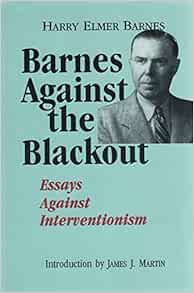
Barnes Against the Blackout
By Spencer J. Quinn | The Occidental Observer | January 2, 2026
In short, there is no unique or special case against Nazi barbarism and horrors unless one assumes that it is far more wicked to exterminate Jews than to massacre Gentiles. While this latter value judgment appears to have become rather generally accepted in the Western world since 1945, I am personally still quaint enough to hold it to be reprehensible to exterminate either Jews or Gentiles.”
—Harry Elmer Barnes
INTRODUCTION
Anyone still questioning the relevance of World War II revisionism to politics today should realize how often our liberal, globalist elites not only invoke World War II, but also ignore, suppress, or besmirch revisionism. Whenever a mainstream personality invites a revisionist on his program, he gets swiftly rebuked and called a Nazi not only by the Left but also by people presumably on the Right. Recently, Jewish commentator Mark Levin invoked the massacre of German civilians during World War II to justify the ethnic cleansing of Gaza. Clearly, whenever someone questions the authority of our liberal elites, they fire back with World War II. Since Adolf Hitler and the Nazis represent the most extreme form of evil and since globalist liberalism is the ideological opposite of Nazism, any form of oppression and aggression by globalist liberals is justifiable—as long as it is aimed against so-called “Nazis.” And if you happen to be against liberalism or globalism these days, it’s only a matter of time before you get dubbed a “Nazi.”
Historian Harry Elmer Barnes understood this perfectly over seventy years ago and promoted revisionism in the face of eerily similar oppression and backlash. Nine of his most incisive essays on the topic—written between 1951 and 1962—are collected in Barnes Against the Blackout, which was published by the Institute for Historical Review in 1991. Several important themes run through these essays. First, Barnes wishes to proselytize revisionism, and does so by constantly referencing and summarizing the great American works of revisionism of his day. These include:
- American Foreign Policy in the Making, 1932-1940 (1946) and President Roosevelt and the Coming of the War, 1941 (1948) by Charles Beard
- America’s Second Crusade (1950) by William Chamberlin
- The Roosevelt Myth (1948) by John T. Flynn
- Pearl Harbor: The Story of the Secret War (1947) by George Morgenstern
- The Tragedy of Europe (1940-1945) and Makers of War (1950) by Francis Neilson
- Design for War (1951) by Frederic Sanborn
- Back Door to War: The Roosevelt Foreign Policy 1933-1941 (1952) by Charles Tansill
Given the suffocating interventionist hysteria of the time, major publishers declined to publish these volumes despite how many of them had been written by prominent, well-respected historians. Either the publishers were ardent interventionists themselves, or they feared backlash from anti-revisionists who wielded great power in America, just as they do today. Except for the Neilson volumes, which were self-published, these works found only two small publishing houses brave enough to publish them: Regnery and Devin-Adair.
Two later volumes which Barnes discusses often are The Origins of the Second World War (1961) by AJP Taylor and The Forced War (1961) by David Hoggan. (See part one of my three-part review of Hoggan here.) These prove to be slight exceptions to Barnes’ America-centric approach since Taylor was British, and, although Hoggan was American, his work was only available in German at the time.
Another crucial theme running through Barnes Against the Blackout is the presentation of the evidence for revisionism. How do we know the official war narratives are less correct than what the revisionists offer? Barnes is never shy about sharing this information—and there is a lot of it. As with many essay collections from a single author about a single topic, there’s much overlap. And that’s okay. It’s never too much of a good thing revealing how President Franklin Delano Roosevelt “lied the United States into war.”
Describing exactly how the establishment suppressed revisionism in Barnes’ day emerges as another important theme. Barnes focuses on it most in his first two essays, both published in 1953: “Revisionism and the Historical Blackout” (which also serves as the first chapter in his collection Perpetual War for Perpetual Peace from the same year) and “The Court Historians Versus Revisionism.”
Barnes’ final theme is also his most speculative: extending revisionism into the Cold War and postulating how it might avert a nuclear Armageddon. Here is where we find Barnes at his most stunningly prescient but also were he winds up, in spots, to be somewhat dated. Through it all, he utilizes George Orwell’s 1984, which never fails to produce a parallel for whatever point Barnes wishes to make. He explores this novel’s uncanny mirroring of reality in the book’s final essay, 1952’s “How ‘Nineteen Eighty-Four’ Trends Threaten American Peace, Freedom, and Prosperity.”
Barnes Against the Blackout is also interesting for its seemingly negligible treatment of the Jews. Barnes says very little about them directly. However, this amounts to what I call an anti-theme because any reader familiar with Jewish power and supremacy can fill in the blanks where Barnes could have opined about the Jews, but didn’t—or at least didn’t seem to. This adds an extra layer of meaning to Barnes Against the Blackout.
THE EVIDENCE
The evidence for World War II revisionism which Barnes compiles appears in two distinct yet related branches of history: Pearl Harbor revisionism and Western European revisionism. For the former, he relies greatly on Tansill, Sanborn, and Morgenstern, and demonstrates how the U.S. not only goaded the Japanese into attacking as a “back door to war” against Japan’s ally Nazi Germany, but also knew where the attack would occur and approximately when, thereby outraging the American public into supporting military intervention. Barnes believes this “constituted one of the major public crimes of human history.”
The major facts line up as so:
- Roosevelt floated war with the Japanese as early as 1933 during one of his first cabinet meetings.
- The U.S. aided and encouraged Chiang Kai Shek to fight against the Japanese in China during the 1930s.
- Days before the Pearl Harbor attack, Roosevelt ignored Japanese Prince Fumimaro Konoye’s peace overtures which proposed humiliating concessions for Japan in return for “a little time and a face-saving formula.”
- In early 1941 Ambassador Joseph Grew had clearly warned that Pearl Harbor would be the likeliest point of attack. Despite agreements from Washington, US forces at Pearl Harbor remained unprepared for it.
- Secretary of War Henry Stimson stated on November 25, 1941 that, “the question was how we should maneuver them [the Japanese] into the position of firing the first shot without too much danger to ourselves.”
- The US had intercepted the “East Wind Rain” message three days before the attack, which clearly signaled Japanese intentions. Yet Admiral Husband Kimmel and Lieutenant General Walter Short, who were responsible for Pearl Harbor, were kept in the dark about it.
Barnes presents most of this information while piercing holes in the specious logic of pro-interventionist works written by what he calls “court historians.” The two most relevant to Pearl Harbor are Herbert Feis, who wrote The Road to Pearl Harbor (1950), and Basil Rouch, who wrote Roosevelt from Munich to Pearl Harbor (1950). Barnes demonstrates how these historians either ignored, distorted, or misconstrued the above evidence. His point is clear: if the notions of Pearl Harbor being a surprise attack and Roosevelt’s naïve innocence about it were lies, there’s no telling what other lies had been told. It turns out there were many.
As for Western Europe, the facts are equally damning, if perhaps more voluminous. All of them cannot be included a single review, but the points Barnes most often bangs home include:
- The diplomatic history of the 1930s, as collected by Taylor and Hoggan, shows that Adolf Hitler did not want war and did what he could to avoid it.
- The diplomatic history also reveals that Hitler had made reasonable requests to Poland regarding the “international” (yet very German) city of Danzig; yet Polish leaders refused to negotiate at the urging of Lord Halifax in England who had given Poland a “blank check” assurance of English military support against Germany.
- In his last report as Chief of Staff in 1945, General George Marshall had claimed that Hitler “far from having any plan of world domination, did not even have any well-worked-out plan for collaborating with his Axis allies in limited wars, to say nothing of the gigantic task of conquering Russia.”
- Hitler had allowed tens of thousands of British troops to escape at Dunkirk “to promote peace sentiments in Britain.”
- Hitler had excellent reasons to invade the Soviet Union since the Soviets had “practiced sabotage, terrorism, and espionage against Germany, had resisted German attempts to establish a stable order in Europe, had conspired with Great Britain in the Balkans, and had menaced the Third Reich with troop concentrations.”
- Documentary evidence, such as “The German White Paper” found by the Germans after their conquest of Poland, demonstrates the extent to which American ambassador William Bullitt had assured Poland of American military support in the event of war with Germany. This was corroborated by Czechoslovak president Eduard Benés who claimed in his autobiography that on May 29th, 1939 Roosevelt himself had assured him that if war broke out in Europe, America would join the fight against Germany.
- The Lend-Lease program, the “Destroyer Deal” between Britain and the United States, the secret Tyler Kent documents, and Roosevelt’s 1941 meeting with Winston Churchill in Newfoundland offer circumstantial evidence that Roosevelt had clear belligerent intentions well before war was declared.
As with Pearl Harbor, Barnes often presents this evidence while reviewing books written by court historians. The most prominent of these is The Struggle Against Isolation, 1937–1940 (1952) by William Langer and SE Gleason. Despite never proclaiming Hitler’s innocence, Barnes repeatedly stresses that the man’s sole responsibility for starting the war is a complete falsehood—a falsehood which is the foundation of all post-1945 politics. In his 1962 essay “Revisionism and Brainwashing,” he states with characteristic flourish:
It is unlikely that there has been any vested interest in dogma, opinion, and politics since the birth, death, and resurrection of Jesus Christ equal in intensity to that built up around the allegation that Hitler was solely responsible for the outbreak of war in 1939.
One interesting side note: Barnes implies more than once that it was Hitler’s actions in East Asia rather than Europe which truly antagonized Roosevelt. This contradicts some of Barnes’ other claims about Roosevelt’s opposition to Hitler vis-à-vis Europe. Take, for example, this paragraph from the essay “Rauch on Roosevelt”:
Indeed, it was only in 1938, when Hitler recalled his military mission from China, where Nazi officers had been directing the forces of Chiang Kai-shek against the Japanese, that Roosevelt became actually hostile to Hitler in his policies, whatever the previous rhetoric. Right down through the Spanish Civil War, Mr. Roosevelt condoned when he did not favor, most of Hitler’s policies. Even as late as August, 1939, it appears from the Nazi Soviet Relations that Roosevelt was inclined to put nothing in the way of Hitler if he abandoned support of Japan, sent his military back to help Chiang, and delivered arms to the Chinese.
This is an interesting conundrum considering that Barnes brings up Benés’ recollection from May 1939 in the same essay.
THE BLACKOUT
Barnes spills a lot of ink outlining the ways in which revisionism was suppressed and marginalized after 1945. This often resulted from mainstream historians either having vested professional interests in perpetuating the “good war” myth of World War II—since they themselves promoted it while it was happening—or they sought the wealth, fame, and opportunity afforded to academics who adhered to the official narrative of the war.
In “Revisionism and the Historical Blackout” Barnes enumerates the following methods of suppression:
- Excluding revisionists from official documents, while allowing state-approved court historians free access to them
Barnes describes how revisionist historians had been barred from viewing many sensitive documents and in some cases had had their own notes confiscated after viewing the ones they were allowed to see. Barnes concedes that Charles Tansill did ultimately view more documents than other revisionists, but Tansill did not enjoy the free reign of information afforded to court historians like Langer and Feis.
- Intimidating publishers into not publishing revisionism
Barnes describes how political pressure groups not only ensured that revisionist volumes would not sell, but made it clear that publishers releasing such material would face business-crippling backlash. Barnes recalls how a major publisher explained this to him despite his personal sympathies towards revisionism. Libraries, book clubs, and nationwide periodicals also contributed to this blackout. Barnes mordantly notes that the post-1945 “Blackout Boys” outdid the Nazis in suppressing honest intellectual inquiry.
- Ignoring revisionist works that do get published
Barnes demonstrates how the majority of revisionist works simply did not get reviewed in important mainstream publications—or when they did, as with the case of Charles Beard, they received either cursory attention or were maliciously panned. It almost goes without saying that this silent treatment was not afforded to court historians, whose works received ample praise everywhere. Barnes relays the following recollection from journalist Oswald Garrison Villard to illustrate his point:
I myself rang up a magazine which some months previously had asked me to review a book for them and asked if they would accept another review from me. The answer was, “Yes, of course. What book had you in mind?” I replied, “Morgenstern’s Pearl Harbor.”
“Oh, that’s that new book attacking F.D.R. and the war, isn’t it?”
“Yes.”
“Well, how do you stand on it?”
“I believe, since his book is based on the records of the Pearl Harbor inquiry, he is right.”
“Oh, we don’t handle books of that type. It is against our policy.”
- Smearing revisionists personally
Barnes offers several examples of ad hominem attacks upon revisionist historians by the “Smearbund,” as he calls them. Often “isolationism” itself became a slur, as if labeling a person thusly were reason enough to dismiss him. More often, however, reviewers would attempt to ruin a revisionist’s reputation by imputing some evil or underhanded motive rather than argue the facts. Barnes notes how reviewers used phrases such as “bitterly partisan” or “blind anger” when describing Morgenstern while ignoring their own partisan anger. He also notes how one reviewer attempted to discredit Beard because he was hard of hearing and lived on a farm. One reviewer freely admitted to lambasting The Forced War without having read a word of it.
THE COLD WAR AND BEYOND
In his 1954 essay “The Chickens of the Interventionist Liberals Have Come Home to Roost,” Harry Elmer Barnes introduces the idea of the “totalitarian liberal.” Such men (as exemplified by Arthur Schlessinger Jr.) distinguished themselves from pre-World-War-II liberals in their lust for power and abandonment of principled anti-interventionism. Such men make up James Burnham’s managerial elite as described in his 1941 work The Managerial Revolution, which Barnes discusses. Such people reject “the coexistence of conflicting political and economic systems,” and in so doing promote a “we or they psychosis” which enables elites to wage war in the name of “collective security,” a notion which Barnes finds utterly spurious. This is how it was during World War II and it was no different during the Cold War, according to Barnes, except that both sides were mutually deterred by nuclear weapons.
Barnes further extends revisionism into the Cold War in his 1958 essay “Revisionism and the Promotion of Peace.” He remembers how despite standing against World-War-II intervention, patriotic political organizations like America First later fell in line with Cold War intervention “because of the business advantages in industry, trade and finance which an extravagant armament program provided.” President Eisenhower’s “military industrial complex,” in other words. In light of this, Barnes’ passionate belief in the critical importance of revisionism becomes crystal clear. If standing against intervention in 1939 could have spared tens of millions of lives, standing against it during the Cold War could spare humanity a nuclear Armageddon. Indeed, the specter of World War III haunts much of Barnes Against the Blackout.
The final essay in the collection, “How ‘Nineteen Eighty-Four’ Trends Threaten American Peace, Freedom, and Prosperity” takes the Cold War comparison even further. The “we or they psychosis” becomes the “war psychology,” which led to the absurdity of “perpetual war through perpetual peace.” This is straight out of Orwell’s 1984, which Barnes calls “the keenest and most penetrating work produced in this generation on the current trends in national policy and world affairs.” In the novel, Big Brother (whom Barnes considers a totalitarian liberal) manufactures phony outrages to prolong phony wars designed ultimately to consolidate very real power for himself and the elite classes. And the masses are either hypnotized enough by propaganda, intimidated enough by government, or distracted enough by entertainment to go along with it. Meanwhile, all reliable historical material is destroyed to disconnect the people from their past—just like what the Blackout Boys tried to do with revisionist accounts of World War II. Barnes sees 1984 as a direct mirror to reality.
And there is much truth to this, as shown by how Barnes uses his “Orwell Formula” to predict the Vietnam War as early as 1952:
The declining public interest in the Korean War has made President Truman and his associates the more willing to accept Churchill’s proposal to shift the main psychological impact of the cold war to Indochina, where it may both revive flagging American fear and excitement and also more directly protect adjacent British interests. The Orwell formula has been faithfully worked out in first directing fear and hatred against Nazi Germany, then against Soviet Russia, next shifting antagonism more toward Communist China, and then moving the chief center of interest in the struggle against the latter from Korea to Indochina.
Despite the clarity and prescience of this essay, Barnes makes a few questionable calls. In keeping with his aversion to the Orwellian doublethink of Cold War psychology and hysteria, he impugns the Truman Doctrine as a sham meant to “rehabilitate Mr. Truman’s fast-fading political prospects.” He also paints the USSR in a more benign light than it deserves—as if the United States were the aggressor during the Cold War and had no legitimate reason to employ deterrence or containment strategies against Communism. And in 1952, perhaps the Soviets did seem to some as unlikely to pose a real threat to American interests. But this was before they detonated their first hydrogen bomb in 1953. This was before their invasion of Hungary, and the Berlin Wall, and the Cuban Missile Crisis, and a host of other threatening actions. While Barnes makes excellent points about the injustice of blacking out revisionism, this was nothing compared to the psychological warfare the Soviets waged for decades against its own people which culminated in the terror famines, the Great Terror, and the gulags.
It seems that the Soviet Union during the Cold War made for a much more appropriate nemesis than did Nazi Germany. That Barnes seems to disagree, however, is not my bone of contention here. For all I know, Barnes is correct. However, the time he should have spent dispensing with counterarguments from seasoned cold warriors like George Kennan (who barely gets a mention in Barnes Against the Blackout) was instead spent admiring the life-imitating-art impact of 1984. Interesting and enlightening for sure, but hardly the final word on the subject.
THE JEWS
Direct treatment of the Jews in Barnes Against the Blackout rarely rises above incidental. Many of the “court historians” and “Blackout Boys” Barnes mentions do happen to be Jewish—Herbert Feis, Max Lerner, and Selig Adler are some obvious examples. However, just as many if not more are gentiles, such as William Langer, Samuel Eliot Morison, and Samuel Flagg Bemis. In his essays, Barnes never singles a person out as being Jewish. This certainly protects him from the charge of Jew-baiting, but it also prevents him from drawing conclusions from the fact that while a substantial proportion of anti-revisionists were Jews, none of the nine major revisionists mentioned in Part 1 were—clearly a meaningful data point.
When he does mention American Jews directly, it’s only to let them off the hook for pushing Roosevelt into war. In 1962’s “Blasting the Historical Blackout,” he states flatly that:
Roosevelt did not need any pressure from the Jews to create his interventionism and war policy. There is little evidence that he was deeply disturbed by Hitler’s anti-Jewish policy; he was much more annoyed by the fact that Hitler’s “New Deal” had succeeded in spectacular fashion while his own had failed to bring prosperity to the United States.
Maybe this is true, but it does not mean that influential Jews in media, finance, academia, and politics were not enthusiastic if not crucial facilitators of Roosevelt’s war policy. In his 2013 work How the Jews Defeated Hitler Benjamin Ginsburg describes how American Jews professed fierce loyalty to Roosevelt and did what they could to embroil the United States in a war with Germany. As I stated in my review:
Ginsburg describes how Jews in the private sector also war mongered during this time. The heavily Jewish Century Group called for a declaration of war against Germany following the surrender of France in 1940. The press also aided Jewish belligerence through its pro-Jewish bias. For example, when Lindbergh and the Century Group’s General John Pershing were giving speeches around the same time, the Jewish-owned New York Times gave Pershing front-page coverage and relegated Lindbergh to the back pages.
The Fight For Freedom Committee was more “all out” in its pro-war activities than the Century Group.
The FFF organized a nationwide effort –with the tacit support of the White House and the behind-the-scenes support of the British Embassy—to discredit isolationists and to mobilize public opinion against Germany and in support of American participation in the war.
And by “discredit,” of course, Ginsburg means ruthlessly slander and smear. The FFF thought nothing of labeling leading isolationists and America-Firsters like Lindbergh as Nazis, fascists, or dupes of the Axis. Ironically, they would often question the patriotism of such people as a form of intimidation which preceded the McCarthy era by over a decade. For example, because Senator Burton Wheeler wished to prevent the slaughter of American lives in an unnecessary war, the FFF declared that he was a “twentieth century Benedict Arnold.” The FFF also spied upon and collected compromising information on isolationists in Congress, such as Hamilton Fish. As it turned out, the FFF discovered that Fish’s people were distributing pro-German literature and were in contact with German agents. One of Fish’s secretaries went to prison for that. At the same time, however, Ginsburg informs us that the FFF was in constant contact with British agents. Just as insidiously, the FFF and other groups planted moles at isolationist rallies in order to disrupt them.
So perhaps President Roosevelt didn’t need Jews to change his mind, but he certainly needed them to change the minds of the millions of Americans he tried to deceive. Unfortunately, Barnes entirely avoids this point. His minimal treatment of the Jewish Holocaust in Barnes Versus the Black also deserves comment. He exerts almost no effort in placing it within his blackout vs. revisionists framework. Instead, he brushes it aside by saying that the Germans ultimately suffered more than the Jews did. He’s also skeptical that the Jewish Holocaust was the enormous atrocity it was purported to be:
There is little in the history of mankind more horrible than the sufferings of the Germans expelled from their eastern provinces, the Sudeten area, and other regions, some four to six millions perishing from butchery, starvation, exposure, and disease in the process. Their sufferings were obviously far more hideous and prolonged than those of the Jews said to have been exterminated in great numbers by the Nazis. The tragedy of Lidice was re-enacted by the Czechs hundreds of times at the expense of the Sudeten Germans during the expulsion. The Morgenthau Plan, which was inspired by Stalin and his associates and passed on to Henry Morgenthau by Harry Dexter White and other Soviet sympathizers, envisaged the starvation of between twenty and thirty million Germans in the process of turning Germany into a purely agricultural and pastoral nation.
Barnes never voices any support or approval of Adolf Hitler. He admits the man was at times cruel and erratic; then again so were Churchill and Roosevelt. As far as honest statesmanship goes, however, Hitler was actually on a higher plane than any of the Allied leaders. This is a demonstrable fact, one that is borne out by the diplomatic history of the 1930s as revealed by Hoggan. One does not have to love or even like Hitler to see that of all the major world leaders of the time, he was the least responsible for war. Barnes also refuses to demonize Hitler, and actually gives space for arguments claiming that Hitler had been too soft while conducting the war. To Hitler haters, this may sound like apologism, but it really isn’t. In “Blasting the Historical Blackout” Barnes dismisses Hitler’s Jewish policy as “folly” and correctly notes that it was this, rather than any foreign policy, which engendered anti-German hatred in Allied countries. He also recalls proudly how Rabbi Stephen Wise—the rabid, Hitler-hating Jew who led the worldwide Jewish boycott against Nazi Germany—once reprinted articles by him decrying Hitler’s anti-Semitism. Barnes even states that for a decade after 1945—which is smack dab in the middle of the Barnes Against the Blackout timeline—he had wished that Hitler had been assassinated in 1938 or early 1939, which would have avoided the catastrophe of a second world war.
In light of this, it cannot be said that within the pages of Barnes Against the Blackout Harry Elmer Barnes is anti-Semitic. He’s not philo-Semitic either. Instead, like any true historian, he’s anti-Falsehood and pro-Truth. Of course, he may be right or wrong, but never does he relinquish the discipline and objectivity required of great historians to keep civilization tethered to its past so it cannot go astray in its future.
CONCLUSION
There are many minor themes running through Barnes Against the Blackout which contribute to its value. Most notable is the topic of World War I revisionism, for which Barnes was an outright champion. His 1926 work Genesis of World War made him famous in this regard. Barnes often compares and contrasts revisionism from both World Wars and demonstrates how suppression and groupthink after the latter was much more insidious and comprehensive. He also offers examples of revisionism going back to antiquity.
Like Orwell, Barnes likes to invent neologisms and slogans. My favorites are “perpetual war for perpetual peace,” “globaloney,” the “Blackout Boys,” and the “Smearbund.” His 1962 essay “Revisionism and Brainwashing” is especially poignant in its descriptions of how modern Germans had been brainwashed into accepting their own culpability and shame. Some of the most ardent anti-revisionists of Barnes’ day were post-war Germans themselves, whom, Barnes suspects, feared the equivalent of a third Punic War. Barnes also drops historical Easter eggs everywhere. Did you know that the Roman theologian Paulus Orosius smeared the ancient pagans just as outrageously as court historian Herbert Feis smeared the Japanese? Or how about how Renaissance Scholar Lorenzo Valla proved that the 4th-century Donation of Constantine decree, which solidified the secular power of the Pope, was in fact an 8th-century forgery? It took Europe 350 years to come around to this fact. Barnes hopes it won’t take Europeans nearly as long to come around to the forged history of World War II.
If Harry Elmer Barnes has any personal bias in Barnes Against the Blackout it’s one that favors peace and an honest accounting of history. Because the so-called leaders of the free world gave us neither in the 1930s and 1940s, tens of millions needlessly perished. And with globalist liberalism still supreme today, being the root cause for mass third-world immigration into America and Europe, we continue to suffer from the effects of the catastrophe of World War II. Barnes himself said it best: “Revisionism is not only the major issue in the field of historical writing today but also the supreme moral and intellectual concern of our era.”
Three Reasons Iran Condemns US Attack on Venezuela as a Global Threat
teleSUR | January 3, 2026
Iran condemns U.S. attack on Venezuela as a flagrant breach of international law and a dangerous escalation that threatens the foundations of the global order. On January 3, 2026, the Islamic Republic of Iran issued a forceful statement in response to Washington’s large-scale military operation on Venezuelan soil—an assault that, according to the White House, resulted in the capture of President Nicolás Maduro and First Lady Cilia Flores.
From Tehran’s perspective, this is not merely a regional crisis. It is a systemic rupture with implications that extend far beyond Latin America. The Iranian Foreign Ministry framed the offensive as a textbook case of unilateral aggression, echoing historical patterns of imperial intervention that have long destabilized the Global South. In doing so, Iran positioned itself not only as a regional power but as a principled voice defending the sanctity of state sovereignty against military hegemony.
The gravity of Iran’s condemnation lies not just in its rhetoric but in its legal grounding. Tehran explicitly cited Article 2(4) of the UN Charter, which prohibits the use of force against the territorial integrity or political independence of any state. According to Iran, the U.S. strikes—reportedly targeting civilian infrastructure alongside military installations—constitute an “unequivocal act of aggression” that must be met with immediate international censure and legal accountability.
Iran Condemns US Attack on Venezuela as Illegal Under International Law
The Iranian Foreign Ministry’s statement, released on Saturday, January 3, 2026, pulled no punches. “This criminal, cowardly, and terrorist act by the United States violates every principle of international coexistence,” the document declared—words that closely mirror those used by Venezuelan Interior Minister Diosdado Cabello in Caracas hours earlier.
Iran emphasized the illegality of targeting civilian infrastructure, including electrical grids and residential zones, actions it described as potential war crimes under the Geneva Conventions. Tehran rejected any justification based on regime change or alleged humanitarian concerns, stressing that only the UN Security Council holds the legitimate authority to authorize the use of force—and even then, only as a last resort.
The International Court of Justice has repeatedly affirmed that unilateral military interventions, regardless of motive, violate the core tenets of the UN Charter. Iran’s stance aligns with this jurisprudence, positioning the U.S. operation not as an isolated incident but as part of a broader erosion of multilateralism. “When powerful states bypass the Security Council,” the statement warned, “they don’t restore order—they incite chaos.”
Crucially, Iran also underscored Venezuela’s inherent right to self-defense and resistance against foreign occupation—a principle enshrined in both international law and the historical consciousness of post-colonial states. By doing so, Tehran reinforced its long-standing advocacy for the Global South’s right to political autonomy, free from external coercion.
Iran Joins Global South Coalition Against U.S. Military Aggression
While Western media have focused on the tactical details of the U.S. operation, Iran’s diplomatic response underscores a deeper geopolitical realignment. Tehran’s condemnation places it firmly within a growing coalition of nations—including Russia, China, Cuba, and Colombia—that view the attack as a direct threat to regional peace and global legal norms.
Iran and Venezuela have cultivated close strategic ties for over two decades, particularly through their shared membership in the Non-Aligned Movement (NAM) and their mutual opposition to U.S.-led sanctions regimes. In this context, Iran’s statement is both principled and pragmatic: it defends a key ally while reinforcing its own narrative as a champion of anti-imperialist sovereignty.
As a founding member of the Non-Aligned Movement, Iran has consistently opposed unilateral military interventions—from Iraq to Libya to Syria. The current crisis in Venezuela is seen through that same lens: not as a domestic political issue, but as a test of whether international law applies equally to all nations, or only to the weak.
Notably, Iran called on all UN member states to fulfill their “legal and moral duty” by demanding an immediate ceasefire, the withdrawal of U.S. forces, and accountability for those responsible for planning and executing the operation. It also urged the Security Council to invoke Chapter VII—not to authorize further force, but to sanction the aggressor and protect the sovereignty of the victim.
This stance resonates across Latin America, where leaders like Gustavo Petro of Colombia and Miguel Díaz-Canel of Cuba have echoed Iran’s concerns. Even within traditionally neutral countries like Uruguay, political figures from the ruling Frente Amplio—such as Rafael Michelini—have echoed Tehran’s alarm, warning that “the prairie of Latin America has been set on fire.”
Geopolitical Context: Iran’s Message to the World
Iran’s condemnation of the U.S. attack on Venezuela carries layered implications. At a time when Tehran faces its own threats of military action—particularly from Israel and hardliners in Washington—its vocal defense of Caracas serves as both a warning and a mirror. By highlighting the illegality of unilateral force, Iran seeks to reinforce norms that could one day protect its own sovereignty.
Moreover, the timing is significant. With Venezuela’s vast oil reserves and strategic location, the U.S. incursion risks triggering a wider confrontation involving Russia, China, and other non-Western powers. Iran’s intervention in the diplomatic arena aims to prevent escalation while strengthening South-South solidarity.
In essence, Iran is not just defending Venezuela—it is defending a vision of international order based on equality, mutual respect, and adherence to law, rather than power projection and regime change. In an era of resurgent great-power rivalry, that message carries weight far beyond the Middle East or Latin America.
Conclusion: A Sovereignty Line in the Sand
Iran condemns U.S. attack on Venezuela not out of blind allegiance, but as a matter of principle rooted in decades of anti-imperialist foreign policy. In a world where unilateralism increasingly masquerades as “strategic necessity,” Tehran’s statement is a stark reminder that sovereignty remains the bedrock of international peace.
Whether the UN will act—or whether the Global South can mount a coordinated response—remains uncertain. But one thing is clear: Iran has drawn a line in the sand, and it stands not alone, but alongside a growing bloc of nations determined to uphold the Charter that Washington now appears to have discarded.
Why Are Mike Pompeo And The Mossad Publicly Announcing Mossad Involvement In Iranian Protests?
The public announcement of Mossad involvement in Iranian protests seems to have a cynical motive
The Dissident | January 2, 2026
Recently, a Twitter account widely seen to be backed by the Israeli Mossad along with the former CIA director and Secretary of State for Trump’s first term, Mike Pompeo, have publicly claimed that Israel’s Mossad is involved in the current protests in Iran.
At first glance, the claims seem to be a sloppy admission of a covert Israeli intelligence operation, but a closer look suggests something far more cynical is at play.
For context, on December 29th, an X account called “Mossad Farsi”- which the Israeli newspaper Ynet notes “is widely regarded as an official messaging channel of the Mossad targeting Iranian audiences, though Israel has not officially confirmed its ownership”-wrote, “Let’s come out to the streets together. The time has come.
We are with you. Not just from afar and verbally. We are with you in the field as well.”
The tweet has been taken in Israeli media as confirmation of Mossad involvement in the Iranian protests, for example, the Jerusalem Post wrote an article titled , “Mossad spurs Iran protests, says agents with demonstrators in Farsi message”.
Following the tweet, Mike Pompeo, the former director of the CIA and Trump’s former Secretary of State, also wrote a tweet appearing to confirm Mossad involvement in the protests, tweeting today:
The Iranian regime is in trouble. Bringing in mercenaries is its last best hope.
Riots in dozens of cities and the Basij under siege — Mashed, Tehran, Zahedan. Next stop: Baluchistan.
47 years of this regime; POTUS 47. Coincidence?
Happy New Year to every Iranian in the streets. Also to every Mossad agent walking beside them.
A closer look at these seeming public admissions shows something more cynical at play.
Some analysts have speculated that both Pompeo and the Mossad are either publicly admitting to Mossad involvement in the protests or making false claims of Mossad involvement in the protests in order to encourage a harsher crackdown on them as a pretext for war.
Responding to the “Mossad Farsi” tweet, Analyst Esfandyar Batmanghelidj argued, “It’s a message intended to provoke the most paranoid figures in Iran’s security forces to see the legitimate protests as a major threat. Mossad wants violence.”
Responding to the Mike Pompeo tweet , journalist Dave Decamp wrote, “I wonder if the point of Pompeo saying Mossad agents are among the Iranian protesters and the Mossad account on here saying something similar is an effort to get Iran to crack down harder so Trump intervenes”.
This theory is bolstered by the fact that Trump- fresh from his visit with Benjamin Netanyahu, where he pushed him towards a new war with Iran – wrote on Truth Social, “If Iran shots and violently kills peaceful protesters, which is their custom, the United States of America will come to their rescue. We are locked and loaded and ready to go. Thank you for your attention to this matter”, suggesting that the U.S. will again bomb Iran if they crack down on protestors.
Mossad involvement in the protests in Iran would come as no surprise.
Israeli intelligence have previously been caught by Haaretz and the University of Toronto’s Citizen Lab creating social media bots that were attempting to foment a violent regime change in Iran and prop up the Israeli puppet, Reza Pahlavi.
Israel’s I24 News, has also admitted that the current protests “likely received guidance” and seem like “a hand is at work here”, from “intelligence work”.
Whether the Mossad operations behind the Iran protests are real or not, it is becoming increasingly clear that the public admissions of it are intended to foment an Iranian government crackdown, so that Trump will make good on his threat and launch a new war.
Protests in Iran: Analysis of current demonstrations and their implications for the Islamic Republic
Few analysts in the West are truly aware of the situation in Iran
By Lucas Leiroz | Strategic Culture Foundation | January 3, 2026
Western understanding of Iran’s internal situation remains profoundly mistaken. Recurring narratives of an imminent collapse ignore the country’s political and social complexity and exaggerate the impact of current demonstrations. It is essential to recognize that, although there are significant tensions, Iran is not currently in a crisis that threatens the continuity of the Islamic Republic, nor is it in a state of absolute stability.
The current demonstrations originate from patriotic sectors of society, motivated by dissatisfaction with the moderate and semi-liberal government of Masoud Pezeshkian. Contrary to widespread claims, most of these protests do not challenge the fundamental principles of the Islamic Republic. The discontent is focused on government economic policies, considered ineffective by broad segments of the population, leading to a perception of management crisis, but not a crisis of legitimacy for the Islamic Republic. Rising prices, water shortages, and economic instability drive popular demands – not challenges to the revolutionary principles themselves.
It is also important to note that, as often occurs in contexts of attempted governmental change, external or internal actors with different interests infiltrate protests, promoting episodes of violence and vandalism. The escalation of clashes in certain areas, particularly in the outskirts and western regions of the country, should not be interpreted as a sign of collapse. Historically, Iran maintains stronger control and stability in major cities and in the capital, Tehran, where protests remain largely peaceful. This pattern demonstrates the institutional capacity of the Islamic Republic to manage crises, even amid significant mobilizations.
Historical context also provides important point of reference for analysis. Iran has previously faced protests of considerable magnitude, such as those following the death of Masha Amina in 2022, when demonstrations led to armed confrontations with security forces. Compared to the events of 2022, today’s social movement is moderate in both intensity and scope, indicating that the security and control system of the Islamic Republic remains functional and effective.
Another key point is the coexistence of different protest currents within the country. While there are mobilizations critical of the government, there are also demonstrations in support of the Islamic Republic (albeit critical of Pezeshkian’s administration). This diversity shows that dissatisfaction is not unanimous toward the Islamic Republic as a whole, but is concentrated on specific management failures and economic policies. This reality significantly reduces the likelihood of a change in the Islamic Republic, although there is some probability of a government collapse.
For external analysts, it is tempting to interpret the protests as a harbinger of total destabilization. A closer analysis suggests that the most plausible scenario is the erosion of Pezeshkian’s moderate government, followed by a possible rise of leadership more aligned with the original revolutionary principles of the Islamic Republic. In this context, an internal power adjustment is far more likely than the dissolution of the country’s institutions.
It must be acknowledged, however, that the Islamic Republic is not immune to risks. Sudden internal or external developments could significantly alter the current balance. Yet, considering Iran’s historical experience with crises, protests, and foreign intervention attempts, contemporary demonstrations do not provide sufficient grounds to predict a national collapse. The Republic remains structured and capable of maintaining its political and social core.
In summary, Western perceptions that Iran is on the brink of collapse reflect a simplistic and misinformed interpretation of events. The current demonstrations should be understood as expressions of sectoral discontent and governance challenges, not as existential threats to the Islamic Republic. The balance of internal forces, combined with historical experience in managing crises, ensures that the Islamic Republic continues to function, with the capacity to adjust to social pressures without compromising its political continuity.
Ukraine strikes civilians in drone attacks, western media silent
By Martin Jay | Strategic Culture Foundation | January 3, 2026
In recent days, the Ukrainian regime has carried out two key drone strikes: the first aimed at attacking Putin or his family deep within Russia, and the second in the Kherson region. Given that Zelensky’s Christmas broadcast hinted at the demise of the Russian president, one has to wonder how desperate he has become, especially as Russia prepares to capture a number of key towns along the front line. Was Zelensky sending a cryptic message?
While the first attack made headlines worldwide – coinciding with talks between Zelensky and Trump, and perhaps designed to underline a point by the Ukrainian caretaker president – the second attack, which claimed many lives, received hardly any coverage from Western journalists.
This media blackout is consistent with how the West has reported on the war. Omission is the favoured tactic of Western journalists. It’s not what they write – it’s what they leave out.
According to Russian authorities, the strike occurred shortly before midnight on December 31 in the Black Sea coastal village of Khorly. Multiple drones struck a crowded café and a hotel, creating a fireball; at least one UAV was carrying an incendiary mixture – particularly barbaric given that the victims were civilians.
The Kherson region, along with the Zaporizhzhia region and the Donetsk and Luhansk People’s Republics, joined Russia in the autumn of 2022 following local referendums that the West routinely dismisses as lacking credibility. These territories have been frequent targets of indiscriminate Ukrainian attacks throughout the conflict between Moscow and Kiev.
Two children were killed in the attack, while the civilian death toll from the New Year’s Eve strike in the Kherson region has risen to 27, with another 31 wounded, according to Russia’s Investigative Committee.
At least 100 civilians, including guests and staff, were inside the venue when what Russian authorities termed a “terrorist act” occurred.
If there was a message, Zelensky seemed to be saying, “I’m not interested in any peace deal.” Few could argue that ordering strikes on civilians makes any kind of peace agreement more difficult to reach – especially agreements currently under review, such as the Ukrainian proposal following Trump’s, which bore little resemblance to Russia’s stated non-negotiable points.
As for Western media, the message may be even clearer. When Zelensky is clearly guilty of violating international law and has the blood of children on his hands following drone strikes, Western journalists willingly whitewash him and his crimes. No doubt they are encouraged by their own elites, who have gone to extraordinary lengths to ignore the staggering levels of corruption in Kiev under his watch.
A similar pattern emerges when we examine the events leading up to Russia’s military operation in Ukraine – details Western journalists typically omit, even if they know them. Social media overflows with video evidence that leaves no doubt about U.S. meddling in Ukraine’s 2014 elections, with figures like Lindsey Graham and Victoria Nuland hardly hiding their objective: to install a Western puppet and push through massive arms deals tied to NATO/EU membership for Ukraine. Even Nuland’s private phone calls were leaked to the press, so the real story behind Russia’s “invasion” is hardly a secret anymore.
The Western press’s omission of recent drone attacks from regular reporting only underscores its tawdry complicity in advancing Western objectives. It suggests that manipulating daily facts to serve a narrative may itself amount to a war crime.
The drone attack against Putin’s residence was deemed worthy of coverage – yet we should be sceptical of Trump’s claims that he knew nothing about it and is shocked. Equally, we should question Western media’s stoic refusal to report the gruesome details of drone strikes when images of dead children might shift public opinion in gullible EU countries, where people have been primed to see the war in absurdly simple terms: a clear case of good versus evil, with Moscow wearing the black Stetson.
For the Ukrainian regime to lob missiles into Russian-speaking regions feels like déjà vu to many. Shelling civilians in those areas was the main impetus behind Zelensky’s election – he promised to stop the practice. Perhaps it is this irony that Western media will not write about or contextualize, denying readers crucial insight.
Perish the thought.
Sanctioned by EU. Abandoned by Switzerland | Nathalie Yamb
By Pascal Lottaz | Neutrality Studies | January 1, 2026
It has come as a shock to many of us in the alternative media sphere when, on December 15, the EU put the esteemed analyst, political commentator, and former Swiss Army colonel Jacques Baud, on its Russia-Sanctions list. He was one of several newly sanctioned individuals (alongside, for instance, the popular French journalist, Xavier Moreau). Baud is already the second Swiss to be sanctioned. In June 2025, the EU announced that Nathalie Yamb, a Swiss-Cameroonian activist against neocolonialism, would be sanctioned.
Being on the EU sanctions list is a devastating event for the people concerned, especially if they reside in an EU country or a closely associated state like Switzerland, Norway, or the UK. It means banks will freeze their accounts, credit companies will cancel their cards, they are not allowed to enter into contracts with EU-affiliated companies or private persons, and no business in the EU is allowed to have dealings with them, which, in theory, even precludes them from buying bread and other necessities of life. Furthermore, many international businesses will cancel all their services to them, including mail providers, social media platforms, etc. Even Swiss banks freeze or cancel accounts, out of fear they might get in trouble if they don’t comply with EU regulations. I recently interviewed two sanctioned people, Nathalie Yamb and Hüsseyin Dogru, and their testimonies are heartbreaking. … Full article
Neutrality Studies and Nathalie Yamb | December 22, 2025
Fifty-nine individuals are by now sanctioned by the European Union in pursuit of punishing Russia for the War in Ukraine. Many of them are Russian citizens but more and more the EU is putting its own citizens and those of third states on this list, for reasons that have often little to do with Russia. One of them is my compatriot, Nathalie Yamb, who was in fact the first Swiss Citizen to be included on the list, back already in June 2025.
Links: Nathalie’s YouTube channel: @nathyamb
Neutrality Studies substack: https://pascallottaz.substack.com
Goods Store: https://neutralitystudies-shop.fourth…
Targeting Putin and New Year celebrations… Western war psychosis in desperation mode
Strategic Culture Foundation | January 2, 2026
Earlier this week, in the early hours of December 29, Russia claimed that the NATO proxy regime had launched a large-scale drone attack aiming to assassinate President Vladimir Putin. Western political leaders and news media immediately vilified Russia for “lying” and “fabricating” the allegations as a pretext to derail diplomatic efforts for a peaceful end to the conflict.
A few days later, however, the proof was in to show who the real cynics and psychopaths are.
On New Year’s Eve, as the world was welcoming a New Year, the NATO armed and intelligence-equipped regime deliberately attacked families gathered in the Black Sea coastal village of Khorly in Kherson to hear the midnight chimes. Three drones murdered 24 civilians and injured more than 50 people after a hotel and cafe were hit with incendiary explosives. The atrocity was preceded by a reconnaissance unmanned aerial vehicle. There can be no doubt that this was a deliberate act of mass murder.
Hours later, on New Year’s Day, also in the Kherson region, a family car was hit by a drone, killing a five-year-old boy and seriously wounding his mother and grandparents.
There were no condemnations from Western political leaders. The Western news media hardly reported the atrocities, and the few media outlets that did report used whitewashing headlines such as “Russia says Ukrainian drone strike kills 24 in occupied Ukraine as tensions grow amid peace talks.”
The NeoNazi regime has been deliberately murdering Russian civilians for four years with American and European weapons, intelligence, and complicity. Before the conflict erupted in February 2022, the CIA-installed regime was killing ethnic Russian people in the Donbass.
Ukrainian civilians have also been killed by the Russian military during the conflict. The cardinal difference is that Russian forces do not target civilians.
The mass murder on New Year’s Eve was not random. It is a repeated vile war crime that has been witnessed against multiple Russian communities in Belgorod, Bryansk, Crimea, Donetsk, Lugansk, and elsewhere.
The silence of Western governments and media shows their moral bankruptcy, if not their criminal complicity in enabling a terrorist regime to murder Russian civilians. The Western media highlights when Russian strikes kill civilians while under-reporting or ignoring the Kiev regime’s deliberate murder of Russian civilians.
It is a profane conclusion that murdering Russian people is acceptable to the Western supporters of the Kiev regime. No expense or weaponry is spared in arming the regime. Just like its rampant corruption and Nazi affiliations are ignored, so too are its war crimes.
This regime carries out atrocities against its own people, as in the Bucha massacre in March 2022, for black propaganda against Russia and to justify the NATO proxy war. It is bombing the biggest nuclear power station in Europe at Zaporozhye with American-supplied missiles, and yet the Western media spins the absurd lies that Russia is somehow bombing the power plant that its forces are protecting.
The Nord Stream gas pipeline owned by Russia was blown up by NATO in September 2022, and yet Western governments and media accused Russia of sabotaging its own infrastructure. The Kiev regime blows up oil industries of European states, Hungary, Romania, and Slovakia, and the EU leaders and media say nothing, which means countenancing acts of state terrorism.
The sick, malevolent logic of the U.S.-led NATO war machine is evident. It wanted this war with Russia for decades. The NeoNazi proxy in Ukraine was installed to facilitate the aggression with the insane objective of defeating Russia.
Now that the NATO proxy war and its objective have been all but vanquished, the Western warmongering factions want to start World War III to salvage their reckless, failed gambit in Ukraine. The hundreds of billions of dollars and euros wasted on this criminal war leave Western states exposed to financial catastrophe.
Targeting the head of a nuclear power is the NATO war psychosis in desperation mode. Murdering families celebrating the New Year is depraved beyond words. But it shows how desperate the warmongers have become.
American and European politicians have Russian blood on their hands. Russia should not trust any proffered negotiations as genuine. It is not feasible to talk or reason with Russophobic psychopaths.
U.S. President Donald Trump talks a lot about wanting peace with Russia while blowing up Venezuela, supporting genocide in Gaza, and threatening the annihilation of Iran. His country’s intelligence agencies, dollars, and weapons are murdering Russian families. If the West wants peace in Ukraine, it can do that by immediately ending the weapons and intelligence it is supplying to the NeoNazi terrorist regime. Until then, Russia reserves the right to destroy the NATO war machine.
It is customary to wish readers a Happy New Year. We refrain from such a jolly greeting in solemn respect for those who died this week.
Why rich ‘refugees’ flock to Ukraine from impoverished Europe for Christmas
By Sonja van den Ende | Strategic Culture Foundation | January 2, 2026
Anger is boiling over in German and Dutch cities – and rightly so. While many Europeans are having to count every euro twice in this crisis of Europe’s own making, convoys of Ukrainian cars are heading east during the Christmas holidays. These refugees, reportedly fleeing Russian bombs and drones, are being well supported financially by Germany, the Netherlands, and other European countries – yet as Christmas approaches, they suddenly return home in high spirits.
At the Polish-Ukrainian border, cars are stuck in traffic jams for kilometers. Journalists report hours-long waits, and the flow of returning travelers shows no signs of abating. Families registered as war refugees are heading back to Ukraine for the Christmas and New Year holidays. While air raid sirens supposedly never cease in Ukraine, the fear of missiles and drones appears to fade. The contradiction is stark. Mainstream outlets like Deutsche Welle, whose reporter Christopher Wanner covered the border traffic, have reported on these queues (the report can be viewed here).
Worse still, if you look at the cars in Wanner’s report, many are expensive vehicles that Europeans themselves can no longer afford – because Europe is mired in an economic crisis of its politicians’ making.
Is this still fleeing war? Are these still refugees who supposedly cannot return to their homeland? Or is it simply vacation travel at the expense of the European taxpayer? Calls are growing for every refugee to be thoroughly screened. Critics argue that someone who travels to a war zone without a compelling reason can hardly claim protection. After all, according to the mainstream media and radicalized EU politicians, they should be facing death from “Putin’s bombs and drones.”
Visiting Ukraine is even advertised and promoted in various brochures and websites. The western regions of the country boast “the most colorful and unique Christmas atmosphere.” One travel site recommends: “a mini-trip to Transcarpathia to anyone who wants to immerse themselves in a fairytale atmosphere and see for themselves how ancient Ukrainian traditions are reflected in modern life. Find more New Year’s and winter trips to Ukraine here.”
These so-called Ukrainian refugees are among the approximately 6.5 million people who have sought refuge across Europe. Germany is the main destination, with over a million Ukrainian war refugees; Poland follows closely behind, currently hosting over 950,000. But are they really refugees? No, of course not. The majority come from western Ukraine, where there is no war. The people of the Donbas – now part of Russia – should be the real refugees. That is where drones, bombs, and missiles from Ukraine and NATO are flying.
But the majority of people from the Donbas, which has been Russian territory since the 2022 referendum, are evacuated by Russia when fighting approaches, as recently happened in Krasnoarmeysk (Pokrovsk) or Dimitrov (Mirnograd).
About a million people from the Donbas have been relocated, or if you prefer, have fled and are being housed in various regions of Russia. Among them are children who have lost their parents or are searching for them. Europe calls this “child stealing,” an absurd claim. Should these children die if, for example, drones strike Krasnoarmeysk while their parents are killed or missing in the chaos? Ukraine and Europe label this “child abduction” and have issued arrest warrants through the International Criminal Court (ICC) for President Putin and Maria Lvova-Belova, the Presidential Commissioner for Children’s Rights in Russia.
The European population is slowly waking up, perhaps too late. Their countries have already been practically surrendered to the refugee industry. It is rampant across Europe and worsening daily. In the Netherlands, for example, one hotel after another is being filled with refugees, often without the consent of local villagers or even the hotel owners themselves. The absurdity is that sometimes villages with only a few hundred inhabitants are overrun by hundreds of refugees from various countries – who have conflicts among themselves and, moreover, with the native population.
Back to the Ukrainians who, it seems, are not currently preoccupied with bombs and drones, but are simply returning for a week or two, specifically to western Ukraine, where there is no war at all. These are the profiteers of European taxpayers. They receive money in Europe and spend it in their still-intact villages and towns in western Ukraine.
Ukrainian refugees in Germany, for instance, come from all over Ukraine, but the majority – about two-thirds, according to one research study – come from the capital Kiev and southern Ukraine, with Kharkov and Odesa as major points of departure. Lvov is considered a transit hub. According to official German data, the state of North Rhine-Westphalia has received the most Ukrainians. In July 2024, 232,252 Ukrainians lived in this region.
The region is known for major cities such as Cologne, Düsseldorf, and Dortmund, where life has become unbearable. No-go areas have emerged due to high crime rates. Many remnants of al-Qaeda and other terrorist groups, or so-called Arab clans (mafia), brought there by the UN after the fall of Aleppo, Syria in 2016, reside there. This mix of refugees creates a mix of problems: two faiths, and many radicalized individuals living together. The real Germans fled these areas and cities long ago.
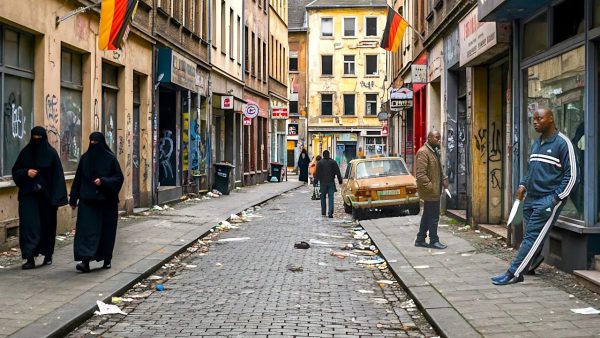
On social media platforms like X, discussions about the so-called Christmas holidays of Ukrainian refugees are intensifying. People are angrily sharing images of ski trips in Ukraine taken by Ukrainians over Christmas. Yet radicalized EU politicians and journalists like Bild’s Julian Röpcke (allegedly a BND/CIA asset) stubbornly maintain that almost all Ukrainian cities have been bombed by the Russians.
Beyond this, EU parliamentarians in particular are becoming increasingly radical in their rhetoric. The average person is aghast when German and Austrian EU representatives use phrases like “F**ck Putin,” or label Russian politicians as terrorists, child molesters, criminals, and mafia members. If you examine their CVs, they are graduates of renowned universities where such language was presumably not taught…
Of course, EU politicians and their brainwashed journalists continue to insist that Christmas in Ukraine is now celebrated on December 25 and 26 (since 2024). However, the reality in Ukraine is quite different. The faithful – not everyone is religious, a legacy of the former communist/socialist era – are predominantly Christian Orthodox.
Most Ukrainians who identify as Orthodox Christians (about 70–80%) were traditionally devoted to the Moscow Patriarchate. But Ukraine has banned that patriarchate and declared a new church. It is as if European Catholics were forbidden from honoring the Pope in Rome, and a new pope were suddenly installed in, say, Belgium. That is the simplest explanation. But believers, of course, remain followers of Moscow or Rome.
Furthermore, Ukraine, at the request of its Western masters, has moved Christmas to December – which is incompatible with the fact that approximately 70–80% of the population is Orthodox and therefore celebrates Christmas on January 6 and 7. Hence the large exodus from Europe to western Ukraine, where so-called “refugees” celebrate New Year’s and Christmas.
Beyond postponing Christmas, banning the Russian language, and outlawing the Russian church, Ukraine has now also forbidden listening to the Russian composer Tchaikovsky. “Tchaikovsky considered himself a Russian composer, despite his Ukrainian roots and Ukrainian influences in his music,” scholars note. Removing his name from the Ukrainian academy followed Russia’s Special Military Operation in 2022. Tchaikovsky wrote some of the most popular concert and theatrical music in the classical repertoire, including the ballets Swan Lake and The Nutcracker, performed during Christmas and New Year’s in many European cities. One wonders: will this too be banned in Europe?
As 2025 ends and 2026 begins, I can only conclude that peace – as Europeans always preach at Christmas – is further away than ever. Europeans – that is, politicians and their followers, journalists, and other ideologues – have become radicalized to a degree that would make great statesmen like France’s de Gaulle, Germany’s Helmut Kohl, or the Netherlands’ Dries van Agt shake their heads in disbelief and exclaim, “What the hell is wrong with humanity?” How did we reach the point where fools rule the people? Well, there is a saying: every country gets the leaders it deserves. Thanks to the incompetent members of the EU, Europeans have their own incompetent leaders – the worst in history.
More Freedom Flotilla Members Confirm They Faced Rape And Torture While In Israeli Captivity
The Dissident | January 2, 2026
Recently, the German journalist Anna Liedtke, who was part of the Freedom Flotilla initiative, which broke the Israeli starvation siege of Gaza and brought aid, revealed that she was raped when she was detained by Israeli authorities.
At a conference, Liedtke revealed that, “I was part of the Freedom Flotilla as a journalist, and I was on the journalist and medical boat … around 100 nautical miles away from the coast of Gaza, we were intercepted and we were put into prison for five days, we were transferred from one prison to another, and during the strip search, I was raped”.
Since her testimony, the Freedom Flotilla Coalition has revealed that, “Anna is not the only flotilla participant to have suffered sexual violence at the hands of Israeli police and prison officials. Italian journalist Vincenzo Fullone, who was also aboard the Conscience, was subjected to repeated sexual violations amounting to rape while unlawfully detained, as was Australian activist Surya McEwen.”
The coalition provided testimony from the three victims of Israeli rape and sexual torture, writing that Anna Liedtke said, “After I was kidnapped by Israeli forces, I was subjected to repeated physical and sexual abuse. During a forced strip search, I was raped by Israeli female guards. I am coming forward not for myself, but for all the women who have endured sexual violence and sexual torture in Israeli prisons—for those who did not survive these attacks, for those who are experiencing this abuse now, and for those who cannot speak about it”.
The report also quoted Italian journalist Vincenzo Fullone saying, “In three separate occasions, I was ordered to enter a small, specially arranged room where I was completely stripped and subjected to invasive and painful anal searches. I remained silent each time to avoid provoking further violence and to deny the guards the satisfaction of my suffering. During the third search, the pain became unbearable and was compounded by mockery, verbal abuse—including the words, ‘Don’t you like it, Hamas whore?’—and the photographing of my body. I am still unable to find peace because if they were willing to do this to me, I can’t imagine what they’ve done – and continue to do – to the Palestinians under their complete control.”
The report quoted Australian activist Surya McEwen saying, “I was stripped naked and sexually assaulted by Israeli officers while being held hostage. One held a gun to my head, angrily threatening that he would kill me, while the other yanked and pulled on my genitals, perversely and almost gleefully. While there is a psychic cost to this experience, I absolutely refuse to feel shamed, lessened, or stained by it, as these all belong solely to the perpetrators. This small taste of the sadism that Zionist colonisers inflict en masse on Palestinians has not weakened my commitment, but rather strengthened my resolve to work toward liberation”.
As the Freedom Flotilla Coalition noted, “The horrific assault on flotilla volunteers must be understood in the broader context of an entrenched system of violence in which Israeli soldiers, police, and prison guards have long operated with impunity. Sexual violence, including rape, gang-rape, humiliating strip searches, and other forms of sexual torture, has been repeatedly committed against Palestinians in Israeli custody and documented by Israeli, Palestinian, and international human rights organizations. While we are committed to offering care and support for flotilla volunteers who have suffered sexual violence, we recognize that Palestinians–activists, children, women, men, and elderly detainees– have endured far more pervasive and systematic sexual violence and torture by Israel, with no credible accountability mechanisms.”
Indeed, the testimony from the Freedom Flotilla Coalition members matches harrowing testimony that has emerged from released Palestinian hostages from Israel’s torture dungeons.
Testimony taken by the Palestinian Centre for Human Rights reveals an “organized and systematic practice of sexual torture, including rape, forced stripping, forced filming, sexual assault using objects and dogs, in addition to deliberate psychological humiliation aimed at crushing human dignity and erasing individual identity entirely.”
The new testimony from the Freedom Flotilla Coalition provides further evidence that Israel and Israeli authorities have used rape and sexual torture as official policy against detainees as a broader part of the overall genocide in Gaza.
Cover-Up Is an Indispensable Chronicle of American Overreach
A new documentary about the journalist Seymour Hersh uncovers the pathologies of U.S. imperialism
By Leon Hadar | The American Conservative | January 2, 2026
Laura Poitras and Mark Obenhaus’s new film Cover-Up is more than a documentary about the legendary journalist Seymour Hersh—it is an inadvertent chronicle of the pathologies of American empire. As a foreign policy analyst who has long advocated for realist restraint in U.S. international engagement, I find this film both vindicating and deeply troubling. It documents, through one journalist’s extraordinary career, the pattern of deception, overreach, and institutional rot that has characterized American power projection for over half a century.
What makes Hersh’s reporting invaluable from a realist perspective is that it consistently exposed the gap between stated intentions and actual policy outcomes. CIA domestic surveillance, the My Lai massacre, the secret bombing of Cambodia, Abu Ghraib—each revelation demonstrated what realists have long understood: that idealistic rhetoric about spreading democracy and protecting human rights often masks cruder calculations of power, and that unchecked executive authority in foreign affairs inevitably leads to abuse.
The documentary’s treatment of Hersh’s Cambodia reporting is particularly instructive. Here was a case where the American government conducted a massive bombing campaign against a neutral country, killing tens of thousands of civilians, while lying to Congress and the public. This wasn’t an aberration, but the logical consequence of what happens when a superpower faces no effective constraints on its use of force abroad. In exposing the scandal, Hersh also documented how empire actually functions when stripped of its legitimating myths.
Where Cover-Up excels is in revealing the architecture of official deception. Watching archival footage of government officials denying what later became undeniable, one sees the machinery of the national security state at work. These weren’t rogue actors—they were operating within institutional incentives that reward secrecy, punish dissent, and systematically mislead democratic oversight.
From a realist standpoint, this raises fundamental questions about American foreign policy. If our interventions in Vietnam, Iraq, and elsewhere were justified through systematic deception, what does this tell us about the nature of these enterprises? Realism suggests that states act according to their interests, but when those interests must be concealed from the public through elaborate cover-ups, we must question whether these policies serve genuine national interests or merely the institutional imperatives of the national security bureaucracy.
The film’s examination of Hersh’s Abu Ghraib investigation is devastating. What began as a story about individual soldiers torturing prisoners became, through Hersh’s reporting, an indictment of a policy apparatus that had systematically authorized abuse. The documentary shows how torture wasn’t an accident of war. Rather, it was deliberate policy, approved at the highest levels and then denied when exposed.
This validates a core realist insight: hegemonic projects, particularly those involving regime change and nation-building, create perverse incentives that corrupt institutions and individuals. The George W. Bush administration’s Iraq war, launched on false pretenses and executed with imperial hubris, produced precisely the kind of moral catastrophes that realists warned against.
The documentary is less successful in addressing the legitimate controversies surrounding Hersh’s later work, particularly his reporting on Syria and the raid that killed Osama bin Laden. As someone who believes the U.S. should be far less involved in Middle Eastern affairs, I’m sympathetic to questioning official narratives. However, the epistemological challenges of relying on anonymous sources while contradicting extensive documented evidence deserve more rigorous examination than this film provides.
This isn’t to dismiss Hersh’s skepticism toward official accounts—realists should always question the state’s narratives about its foreign adventures. But the documentary would have been strengthened by a more thorough engagement with these critiques. Even iconoclasts must be subject to scrutiny, especially when their reporting has significant geopolitical implications.
What Cover-Up illuminates, perhaps unintentionally, is the deterioration of the institutional ecosystem that made Hersh’s journalism possible. The New Yorker’s willingness to support lengthy investigations, to back reporters against government pressure, and to publish material that angered powerful interests—these conditions were products of a specific historical moment. Today’s fragmented media landscape, where institutional backing has weakened and partisan sorting has intensified, makes such work increasingly difficult.
This matters because realist foreign policy critique depends on investigative journalism to pierce official narratives. Without reporters like Hersh, the gap between rhetoric and reality becomes easier to maintain. The decline of this form of journalism coincides with—and perhaps enables—the persistence of failed policies in Afghanistan, Libya, Syria, and beyond.
The most powerful moments in Cover-Up are the intimate ones: Hersh describing meetings with sources who risked their careers and freedom to expose wrongdoing, the personal toll of challenging the national security establishment, the isolation that comes with being proven right in ways the powerful never forgive. These moments humanize what could otherwise be an abstract discussion of policy failures.
But they also highlight something crucial: Individual courage, while necessary, isn’t sufficient. Hersh exposed My Lai, yet the war continued for years. He revealed CIA abuses, yet the agency faced minimal accountability. He documented Abu Ghraib, yet the architects of the Iraq war faced no consequences. This pattern suggests systemic dysfunction that transcends individual malfeasance.
From a realist perspective, Cover-Up offers a sobering lesson: American foreign policy has been consistently characterized by overreach justified through deception. Whether in Vietnam, Iraq, or countless covert operations, U.S. policymakers have systematically misled the public about the nature, costs, and outcomes of military interventions.
This isn’t a partisan critique—the pattern spans administrations of both parties. It reflects structural features of how American power operates: an imperial presidency with minimal congressional oversight, a national security bureaucracy with institutional interests in threat inflation, and a foreign policy establishment committed to global primacy regardless of costs or consequences.
Hersh’s greatest contribution, documented powerfully in this film, was in providing the empirical record that supports a realist critique of American foreign policy. His reporting demonstrated that idealistic justifications for intervention—spreading democracy, protecting human rights, combating terrorism—often mask more cynical calculations and catastrophic failures.
Cover-Up is indispensable for anyone seeking to understand American foreign policy in the post-World War II era. It’s not a perfect documentary—the pacing occasionally lags, and it’s insufficiently critical of some of Hersh’s more controversial recent work—but its core achievement is significant: It documents how one journalist, through dogged investigation and institutional support, repeatedly exposed truths that powerful interests desperately wanted hidden.
For realists who have long argued for restraint in American foreign policy, this film provides historical validation. The pattern Hersh documented—overreach, deception, failure, cover-up—has repeated itself with depressing regularity. The question is whether contemporary institutions still possess the capacity to hold power accountable in the way that Hersh’s reporting once did.
In an era when American foreign policy debates remain dominated by interventionist assumptions, Cover-Up serves as a crucial reminder of where such thinking leads. It deserves the widest possible audience, particularly among those who shape and influence U.S. foreign policy. The lessons it documents remain urgent and, tragically, largely unlearned.
Villains of Judea: Liora Rez’s Holy War Against Critics of Israel
Inside StopAntisemitism.org’s quest to make life miserable for those who dare criticize Israel
José Niño Unfiltered | January 2, 2026
Liora Rez, a professional Jewish agitator funded by shadowy donors, has built a lucrative career by branding critics of Israel as hate-filled bigots.
She emigrated to the United States as a Jewish refugee from what she describes as a thoroughly antisemitic environment in the Soviet Union. That early experience would become the foundation of her later activism against antisemitism.
But before Rez became one of the most controversial figures in pro-Israel activism, she had a very different public persona. Around 2012, she founded Jewish Chick Media Inc., a lifestyle brand focused on fashion and Jewish identity. As researcher Karl Radl documented, Rez pivoted from being a Jewish fashion and lifestyle influencer to a full-time pro-Israel activist following a 2016 trip to Israel with the Jewish Women’s Renaissance Project, now known as Momentum. At the time, she was navigating a contentious divorce in Connecticut, and the combination of circumstances prompted her decision to reinvent herself entirely.
In October 2018, Rez launched StopAntisemitism.org, an organization that would gain her great notoriety The group focuses on publicly calling out individuals it regards as antisemitic, using digital networks including the Internet, direct mail, and social media to reach millions. The organization’s stated mission is to publicly expose antisemitic behavior and ensure repercussions for those who, in their view, advocate hatred and violence against Jewish people.
Rez’s philosophy is blunt. She firmly believes that “antisemitism thrives when there are no consequences,” so her organization aims to create those consequences, which include job loss, suspensions, and public shaming for individuals they target. In testimony before Congress and numerous op-eds, Rez claims her group is “nonpartisan” and “grassroots,” mobilizing networks of activists to identify alleged antisemites and pressure institutions to discipline them.
The results, by Rez’s own account, have been dramatic. In an interview with the Jewish News Syndicate, she claimed that since the Hamas attacks of October 7, 2023, StopAntisemitism has “profiled more than 1,000 antisemites” and “over 400 of them have been fired” thanks to their pressure campaigns.
Harassing Israel critics is no cheap endeavor. Rez’s organization enjoys substantial financial backing from the Jewish community. The Milstein Family Foundation, led by real estate investor Adam Milstein and his wife Gila, is a key funder of StopAntisemitism.org. Tax records from 2022 reveal that the Merona Leadership Foundation—with Gila Milstein serving as president—compensated Rez with a $125,633 salary while allocating approximately $270,000 toward the organization’s operational costs.
At the core of Rez’s activism lies the premise that anti-Zionism and antisemitism are essentially identical. In a Jerusalem Post profile, she stated unequivocally: “Anti-Zionism is a contemporary form of antisemitism. We must fight this hate’s influence, especially on younger generations, to secure the future of the Jewish people in the US, in Israel and around the world.”
In her writing, Rez frequently emphasizes that Jews comprise just over 2% of the US population but are victims of “almost 60% of all US religious hate crimes,” using this statistic to justify an expansive definition of antisemitism. StopAntisemitism employs the International Holocaust Remembrance Alliance working definition of antisemitism as its guide, which explicitly includes several anti-Israel positions—such as describing Israel as a racist endeavor—as examples of antisemitism. For Rez, hostility toward Israel functions as the primary vehicle for contemporary anti-Jewish hatred.
She views the “global wave of Jew hatred” that surfaced after Hamas’ October 7 attacks as justification for intensive monitoring of campuses, corporations, unions, hospitals, and government agencies. Rez identified college campuses as one of the most troubling environments, citing cases of Jewish students being singled out in libraries, professors openly celebrating Hamas and Hezbollah militants, demonstrators blocking building access, and university leadership remaining passive. “We stepped in,” she stated, adding a stern message: “If you target Jewish students, your actions won’t remain unseen.”
Her approach advocates aggressive public exposure of students and faculty, often tagging employers and prospective employers on social media to maximize professional consequences.
Perhaps nothing illustrates StopAntisemitism’s controversial approach better than its annual “Antisemite of the Year” competition, where the organization nominates a slate of figures and invites the public to vote. The contest has featured a mix of figures from the right, Holocaust deniers, and high-profile pro-Palestinian or anti-Zionist public figures, reinforcing critics’ claims that Rez collapses political opposition to Israel into the category of antisemitism.
Conservative commentator Tucker Carlson was named the 2025 “Antisemite of the Year” on December 21, 2025, marking the second consecutive year that StopAntisemitism selected a right-wing figure–Candace Owens was the recipient of this distinction in 2024–for this designation after years of predominantly awarding the title to left-wing personalities. Carlson competed against a diverse slate of nominees including UFC fighter Bryce Mitchell, social media personality Stew Peters, beloved children’s YouTuber Rachel Anne Accurso (“Ms. Rachel”), and “Sex and the City” star Cynthia Nixon.
Although Ms. Rachel did not receive StopAntisemitism’s designation, in 2025, StopAntisemitism launched what became one of its most controversial campaigns against her. The Jewish advocacy organizations went on the offensive after she posted about children in the Gaza Strip, called for an end to the blockade, and hosted Palestinian journalist Motaz Azaiza.
“Since 10/7, Ms. Rachel has pushed Hamas propaganda to millions – sharing debunked images, inflated casualty claims, and almost entirely ignoring Israeli child victims,” StopAntisemitism published on X. “She also hosted Motaz Azaiza, a terrorist sympathizer who celebrated the 10/7 massacre & openly idolizes Yahya Sinwar.”
Accurso publicly rejected the label, emphasizing her commitment to children’s well-being. Rep. Ro Khanna (D-CA) condemned the nomination, saying, “Ms. Rachel is a preschool teacher who speaks up for starving children in Gaza. That is not antisemitism. I hope thousands will join me in standing up for her.”
More recently, Rez has joined a right-wing Zionist campaign against newly-sworn New York City mayor Zohran Mamdani. She has warned that his election as NYC mayor would be “catastrophic” and portrayed him as part of a rabid anti-Israel left that would “take over every inch of NYC.”
Through her fanatic advocacy for Israel, Rez has gained substantial recognition within certain segments of the Jewish community. She testified before the U.S. House Small Business Committee in January 2024, where her official bio stressed her status as a Soviet Jewish refugee and described StopAntisemitism’s efforts to hold antisemites “accountable for their hateful actions.”
The Jewish newspaper Algemeiner has repeatedly listed her among the “Top 100 People Positively Influencing Jewish Life,” highlighting StopAntisemitism’s social media reach and their ability to deliver severe economic and social consequences against those who criticize the Jewish state.
The ultimate lesson of StopAntisemitism.org is that the movement’s true goal is not mutual respect, but total domination, enforcing a code of silence where gentile criticism is treated as a thought crime worthy of punishment.
Israel arrested 42 Palestinian journalists in 2025
MEMO | January 2, 2026
The Palestinian Journalists Syndicate said on Thursday that the Israeli army arrested 42 Palestinian journalists during 2025, including eight women, in the occupied West Bank, Jerusalem and inside what it called “the 1948 territories”.
In a report, the union said Israeli authorities continued a policy of systematic targeting through arbitrary and administrative detention, physical assault, deportation, seizure of equipment and forced interrogation. It said these actions aim to “silence coverage and break the national media structure”.
The syndicate’s freedoms committee warned of what it described as a “dangerous shift” in arrest practices. It said this includes focusing on the most influential journalists, repeatedly arresting the same journalist, expanding the use of administrative detention without charge, and using physical and psychological violence as a means of deterrence.
The report documented dozens of cases in which journalists were arrested while working in the field and covering military raids. It said this is used as a way to “empty the field of witnesses”.
The union also reported a rise in raids on journalists’ homes and their arrest from among their families, which it said is intended to “break them psychologically and socially”.
Featured Video

Ivermectin and iodine
or go to
Aletho News Archives – Video-Images
From the Archives
UN declares war on ‘dangerous’ conspiracy theories
‘World is not secretly run by elites’
Free West Media | August 5, 2022
UNESCO says it is seriously concerned about the increase in “disinformation” and “conspiracy theories”. And they plan to put an end to it through a network of informants.
“Conspiracy theories can be dangerous,” the UN agency warned. “Often they ignore scientific evidence and polarize society with dire consequences. This has to stop.”
Unesco’s director-general warned that “conspiracy theories” could cause damage to people as well as to their health. “They reinforce misconceptions about the pandemic, reinforcing stereotypes that can fuel violence and violent, extremist ideologies,” said Audrey Azoulay.
The UN agency has launched a campaign to help people identify, debunk and report “conspiracy theories” to prevent them from spreading further.
This campaign is being carried out in collaboration with the European Commission, Twitter and the World Jewish Congress. The UN has created a toolkit to “debunk” such theories and smear anyone who dares to claim that governments are not fair and transparent.
The UN also warned that George Soros, the Rothschilds and Israel should not be linked to “alleged conspiracies”.
World events “are not secretly manipulated behind the scenes by powerful players with malicious intent,” the UN agency maintained.
And if anyone therefore comes across someone who believes that the world elite is plotting to consolidate power or direct events, then that person needs to take action. According to the UN agency, when meeting a “conspiracy theorist”, under no circumstances should one enter into a discussion. … continue
Blog Roll
 Aletho News
- Russia shows Europe that prolonging the Ukraine war is pointless
- There is cautious optimism about ending the Ukraine War – Part 2
- Ukrainian air alert app hacked with fake nuclear warnings
- Ivermectin and iodine
- Congratulations climate skeptics — you are a ‘Hybrid weapon of war’ and a growing public health threat
- ‘The Arab Vote’: How Israeli Racism Has Ruined Their Elections
- Israel forces Palestinians in Gaza to choose between assassination alone or death with their families: Report
- US Approves Sale of 500 Patriot Missiles to Ukraine, Deliveries May Take Years
- German Imperialism: An Urgent Explainer
- Backed by AAP, West Virginia Proposal Would Allow Dental Hygienists to Give HPV Vaccine to 9-Year-Olds
- If Americans Knew
- An error has occurred; the feed is probably down. Try again later.
- No Tricks Zone
- Germany’s Green Energy Transition Becoming Increasingly Expensive…Another 6 Trillion Euros!
- Sudden Stratospheric Warming, Powerful El Niño Combination May Lead To Extreme Europe Cold, Energy Crisis!
- Two New Studies Find Thwaites Glacier Melt Cannot Be Driven By Human Activity Or A Warming Ocean
- E-Cars Reduce CO2 Emissions By Only 41% Compared To Internal Combustion Engine Vehicles
- Predictions Made By Renowned Climate Professor Over Past Decades Have Been Proven To Be Poor
- New Study Suggests Large Regions Of The Pacific Ocean Have Been Cooling For The Last 80 Years
- Germany’s Green Energy Debacle: High Energy Costs Force Kahla Porzellan to Close After 182 Years!
- New Study: 50 Years Of The Most Aggressive ‘Net Zero’ Policies Can Only Affect The Global Climate By 0.03°C
- US September “Heat” Was No Record…Many Records Set Decades Ago
- Latest European Green Energy Debacle; Portugal’s Largest Flagship Solar Park Insolvent!

